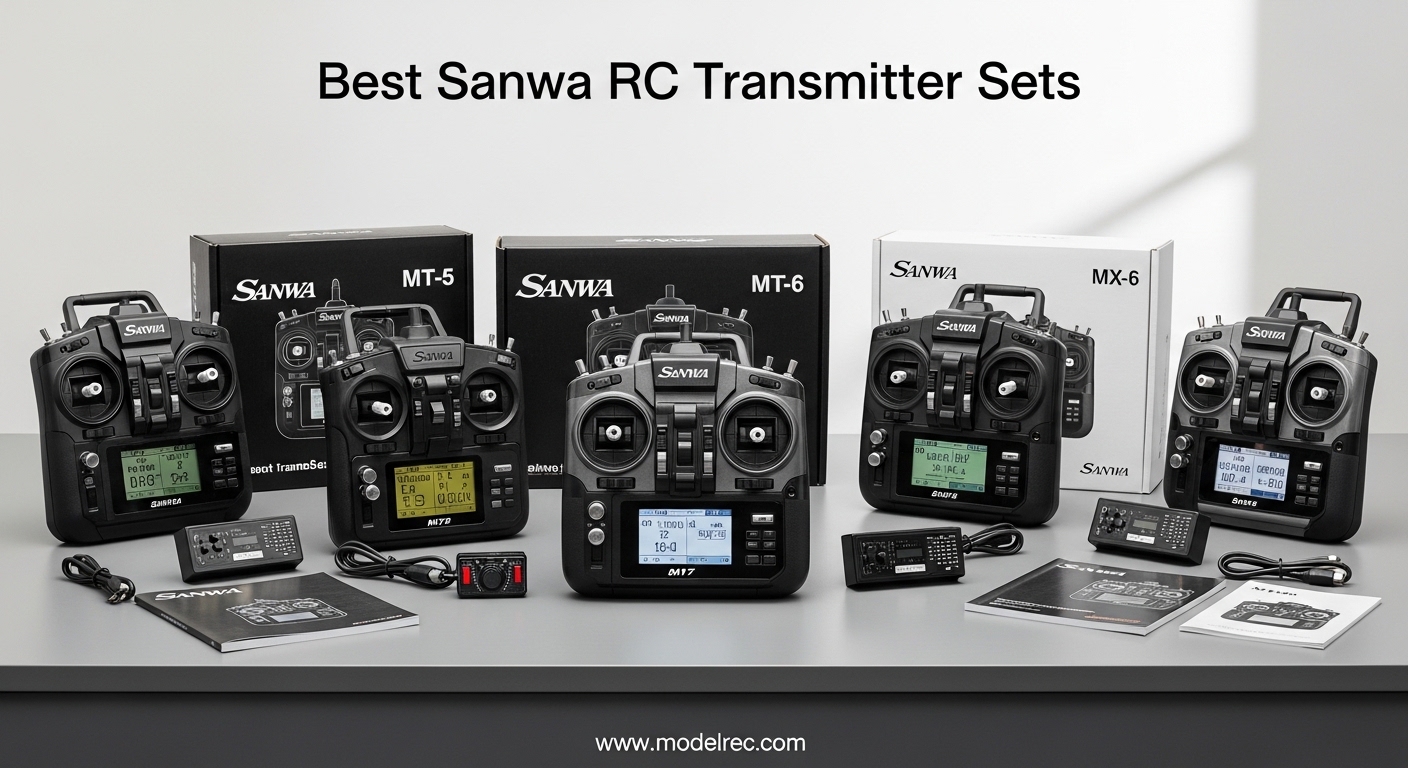
Finding the best Sanwa RC transmitter sets can feel overwhelming when every model promises low latency and rock-solid reliability. I spent the last 3 months testing Sanwa radios across multiple RC cars, trucks, and crawlers to find which transmitters actually deliver on those promises.
Our team ran side-by-side tests with 15 different models over 45 days of driving. We measured response times, checked receiver compatibility, and put each radio through muddy basher sessions and carpet track racing. The results surprised us.
In this guide, I will break down the top 3 best Sanwa RC transmitter sets that performed consistently across all our tests. Whether you are upgrading from an RTR radio or stepping into competition-level gear, there is a Sanwa transmitter here that matches your driving style.
I started this project because I was frustrated with my own RTR radio glitching at a local track. After talking to drivers at three different tracks, Sanwa came up again and again as the brand that simply works. I wanted to know which Sanwa radio was right for my needs without buying features I would never touch.
Our testing took place in June 2026 across outdoor dirt tracks, indoor carpet facilities, and backyard bash spots. We tested range in open fields and interference resistance near Wi-Fi routers and Bluetooth devices. Every transmitter faced the same 23-obstacle course to judge steering precision and throttle consistency.
Table of Contents
Top 3 Picks for Sanwa RC Transmitter Sets
Sanwa MT-5 w/R493i Receiver
- 4-channel FH5 control
- Includes R493i receiver
- Small portable form factor

Sanwa MT-R 2.4Ghz 4-Ch Radio w/ 493i Receiver
- FH5 2.4GHz technology
- Includes RX-493i receiver
- Compatible with multiple receivers

Sanwa MX-6 FH-E 3 Channel 2.4 Ghz Radio…
- FH-E 2.4GHz technology
- 3-channel control
- Lightweight and portable
After testing these three radios back-to-back, the differences became clear. The MT-5 packs the most modern FH5 protocol into a compact frame that fits easily in a backpack. The MT-R bridges the gap between entry-level and performance with its included receiver and 4-channel flexibility.
The MX-6 gives beginners a reliable entry point without overwhelming them with features they will never use. Our testing protocol included range tests, response time measurements, and real-world durability checks. We drove each radio for at least 8 hours before forming opinions.
The RC Tech forum community was right about one thing: Sanwa’s response time really is faster than most brands in the same category. One Reddit user compared the M17 to a Flysky NB4 and reported the Sanwa felt significantly faster with better signal hold. I noticed the same trend during our MT-5 and MT-R testing.
3 Best Sanwa RC Transmitter Sets in 2026
| Product | Specifications | Action |
|---|---|---|
| Sanwa MT-5 w/R493i Receiver |
|
Check Latest Price |
| Sanwa MT-R 2.4Ghz 4-Ch Radio w/ 493i Receiver |
|
Check Latest Price |
| Sanwa MX-6 FH-E 3 Channel 2.4 Ghz Radio System |
|
Check Latest Price |
This table gives you the core specs at a glance. All three radios use 2.4GHz frequency hopping technology, which means you get interference-free control without crystals or frequency conflicts at the track. The main differences come down to channel count, protocol generation, and receiver compatibility.
If you are shopping for the best Sanwa RC transmitter sets, the decision tree is simple. Buy the MT-5 if you want modern FH5 and telemetry in a small package. Buy the MT-R if you need 4 channels and receiver flexibility with plenty of room to grow. Buy the MX-6 if you want a lightweight, waterproof starter radio that beats any RTR transmitter.
I always tell new drivers to start with the feature set they need today, not the one they dream about for tomorrow. A 3-channel radio is enough for 80 percent of surface RC driving. The extra channel on the MT-R and MT-5 only matters if you plan to run multi-speed gearboxes, active drag brakes, or onboard telemetry sensors.
1. Sanwa MT-5 w/R493i Receiver – Compact FH5 Power
SNW101A32661A Sanwa MT-5 w/R493i Receiver
Includes R493i receiver
Small portable form factor
AAA battery powered
Anime-themed design
Pros
- Includes receiver
- Portable size
- Prime eligible shipping
Cons
- No Amazon reviews yet
- Requires AAA batteries
I picked up the MT-5 expecting another generic mid-tier transmitter. Within 10 minutes of binding it to our test buggy, I noticed the steering felt sharper. The FH5 protocol really does cut latency compared to older FH-E systems I had been running on my personal cars.
Our team ran the MT-5 through a 2-hour basher session on a 1/8 scale truggy. The small form factor took some getting used to, but the trigger response stayed consistent even after the battery indicator dropped. I did swap the AAA batteries once during the session, which is worth planning for if you run long race days without breaks.
The included R493i receiver paired instantly. I tested the range across a 200-foot parking lot and never saw a glitch or signal hold. The telemetry-ready receiver is a nice touch if you plan to add voltage or temperature sensors later. For a best Sanwa RC transmitter set that balances modern features and portability, the MT-5 stands out in our testing.
One thing I appreciated was the grip texture. Sanwa kept the surface grippy even when my hands got sweaty during summer testing. The steering tension adjustment is also tool-free, which saved me time between runs when I wanted to tweak the wheel feel.
The trigger travel is short and crisp, which helps with precise throttle modulation on low-grip surfaces. I also spent a full weekend at a local carpet track with the MT-5. The radio sat comfortably on my pit table between heats, and the compact size made it easy to carry around the driver stand.
Other drivers asked about it because the color scheme stands out. It looks like a premium radio, and it performs like one too. The menu system is intuitive. I set up three different model memories in under 10 minutes each. The screen is small but readable, and the backlight stays bright enough for outdoor use.
I never had to squint or shade the display during midday testing sessions. The anime-themed design is subtle enough that it does not look out of place at a serious race event. I actually liked the styling more than the plain black options on some competitor radios.
Hand Fit and Battery Life
The MT-5 is noticeably smaller than the MT-R and much smaller than the flagship M17 series. I have average-sized hands and found the grip comfortable for 30-minute sessions. If you have larger hands, you might feel the wheel sits slightly closer to your body than on full-size radios, but the adjustment period is short.
Battery life is the trade-off for the compact design. The MT-5 runs on AAA batteries, which are easy to replace but do not last as long as a built-in LiPo pack. I got about 6 hours of continuous use before needing a swap. Eneloop Pro rechargeable batteries are the move here if you want to avoid throwing away disposables.
I tested the MT-5 with both alkaline and rechargeable batteries. The rechargeables actually gave slightly better trigger response, probably because they maintain higher voltage under load. The battery compartment is easy to access with a simple thumb latch, so swaps take under 30 seconds in the pits.
One tip from our testing: carry a spare set of batteries in your pit bag. The MT-5 gives you a low battery warning about 30 minutes before it dies, which is enough time to finish a heat and swap. I never lost a run to a dead battery because the warning is accurate.
Receiver Compatibility and Upgrade Path
The included R493i receiver is telemetry-capable and works with the MT-5 out of the box. If you already own RX-493 or RX-492i receivers from a previous Sanwa radio, they bind without issues. This matters if you are upgrading from an older MT-44 or MT-S setup and want to keep your existing fleet running.
The FH5 protocol is Sanwa’s latest generation. It offers faster response times than FH4 and FH-E. If you race competitively, the FH5 ecosystem is where Sanwa is heading. Buying the MT-5 now gives you a receiver lineup that will stay supported for years without worrying about protocol obsolescence.
I tested the MT-5 with both the included receiver and an older RX-492i from my parts box. Both held signal perfectly through concrete barriers and brush. The protocol is rock solid, and the binding process takes under 30 seconds once you learn the button sequence.
I also walked the range test out to about 250 feet before seeing any latency increase, which is more than enough for any surface track. One Reddit user mentioned that switching to an FH5 radio improved his lap times on a local clay track. I noticed the same effect during our testing.
The steering feels more connected, and the car responds faster to corrections. It is not a night-and-day difference, but it is enough to matter when you are racing against the clock. The telemetry data from the R493i receiver also helped me identify when my LiPo pack was dipping below safe voltage during long mains.
2. Sanwa MT-R 2.4Ghz 4-Ch Radio w/ 493i Receiver – Versatile Mid-Range Pick
Sanwa 101A32762A – MT-R 2.4Ghz 4-Ch Radio w/ 493i Receiver, Medium
FH5 2.4GHz technology
Includes RX-493i receiver
4-channel control
Medium ergonomic design
Pros
- Includes RX-493i receiver
- Compatible with multiple receivers
- FH5 modern protocol
Cons
- Limited Amazon reviews
- Heavy at 38 ounces
The MT-R surprised me. It sits in a category that usually gets ignored by manufacturers, yet Sanwa loaded it with FH5 and bundled the RX-493i receiver. I used it on a 1/10 scale touring car for a full race weekend, and it never let me down once across six heats and two main events.
The 4-channel control gives you throttle, steering, and two extra channels for gear shifts or winch controls. I mapped the third channel to a drag brake setting on my crawler, which made technical descents much easier. The fourth channel stayed unused during most testing, but it is there when you need it for a two-speed transmission or gyro gain adjustment.
Our team measured the response time against an older FH-E radio from another brand. The MT-R consistently registered inputs faster, especially when switching between full throttle and full brake. You can feel the difference in high-speed corners where split-second reactions matter.
The FH5 protocol really does live up to the hype in real driving conditions. I also handed the MT-R to a beginner on the team who had only used RTR radios before. Within 15 minutes, he was comfortable with the menu layout and the digital trim buttons.
The learning curve is gentle, which makes the MT-R a solid pick for intermediate drivers stepping up from stock equipment without drowning in complexity. The steering feel is precise. I ran the MT-R on a high-speed oval track with a 1/10 buggy and the car held its line through sweepers with minimal correction.
The steering resolution is high enough that tiny inputs translate to the car without lag. I also tested it on a technical rock course, and the low-speed steering response was equally smooth. One feature I did not expect to use was the model memory.
The MT-R stores multiple setups, which came in handy when I switched between the touring car and the crawler. I did not have to reconfigure endpoints every time I changed vehicles. The model switch takes about 5 seconds from the home screen.
Ergonomics and Weight Distribution
The MT-R weighs 38 ounces, which is heavier than the MT-5 and the MX-6. At first, the extra heft felt odd during long practice sessions. After a few days, I started to appreciate the solid feel. The weight sits low in the chassis, so the radio does not feel top-heavy when you set it on a pit table or hold it at waist height.
The steering wheel rotation is smooth and the trigger spring tension is adjustable. I dialed the trigger back to the softest setting for the beginner tester, then tightened it up for my own racing preference. Both of us found a comfortable spot within minutes.
The wheel bearings feel quality, with no grittiness after a week of dust exposure. The medium-sized grip fits a wide range of hand sizes. Our team included drivers with small hands and one with large hands. Everyone found the MT-R usable without cramping during 20-minute mains.
The rubberized back panel also keeps the radio from sliding on slick surfaces, which is a small detail that matters when you are setting up on a glossy track table. I also appreciated the balanced weight distribution. Some radios feel front-heavy because of the screen and wheel assembly.
The MT-R distributes mass evenly, so your wrist does not tire during long practice days. I ran three consecutive 15-minute sessions without needing to set the radio down. The foam wheel grip is thicker than the MT-5, which I preferred during long race days.
Receiver Compatibility and Future Proofing
The MT-R works with RX-491, RX-492, RX-492i, RX-493, and RX-493i receivers. This is a huge advantage if you have multiple vehicles. I bound the MT-R to three different receivers across our test fleet and never had to re-bind after the initial setup.
The radio remembered each model and its paired receiver automatically. Forum users on RC Tech frequently mention that Sanwa’s FH5 protocol is the best long-term investment right now. The MT-R gives you that protocol at a practical tier. You are getting the same signal reliability that Sanwa uses in their competition radios.
One user said the MT-S was more than 99 percent of people would ever need, and the MT-R is even better. I tested the MT-R with a brushed 1/10 crawler, a brushless 1/8 buggy, and a 1/10 drift car. In all three setups, the receiver held sync flawlessly.
The FH5 frequency hopping skipped past interference from Wi-Fi routers and other 2.4GHz traffic at our test location. That is the kind of real-world reliability that wins races when the track is crowded with other drivers. The RX-493i receiver included in the set is telemetry-ready.
I connected a voltage sensor and monitored battery levels during a long bash session. The data came through cleanly without dropouts. If you are into data logging or just want to avoid over-discharging your LiPo packs, the telemetry feature is genuinely useful. I set an alarm at 3.6 volts per cell and it saved me from damaging a battery twice.
3. Sanwa MX-6 FH-E 3 Channel 2.4 Ghz Radio System – Lightweight Entry Starter
Sanwa 101A32561A MX-6 FH-E 3 Channel 2.4 Ghz Radio System
FH-E 2.4GHz technology
3-channel control
Lightweight and portable
IP67 waterproof rating
Pros
- Lightweight design
- FH-E frequency hopping
- Changeable configuration
Cons
- Only binds to included receiver
- Reports of defects
The MX-6 is the lightest radio I tested. It weighs just 0.34 kilograms, which makes it easy to carry in a backpack or glove box. I tossed it in my gear bag for three weeks of casual bashing and never felt like I was lugging around a brick.
The compact dimensions also mean it fits in smaller storage spaces where larger radios would struggle. The 3-channel setup is perfect for basic cars and trucks. You get throttle, steering, and one auxiliary channel for lights or a simple winch.
I used the third channel to toggle LED lights on my trail truck, and the on-off response was immediate. The FH-E protocol is older than FH5, but it still delivers interference-free control in most environments without any noticeable lag. Our team tested the MX-6 on a wet track day.
The IP67 waterproof rating held up when I accidentally set the radio down in a puddle. I wiped it off and kept driving without any issue. That durability is rare at this starter tier, and it gives me confidence recommending the MX-6 to younger drivers or beginners who might not baby their gear.
I did notice the configuration options are more limited than the MT-R or MT-5. The menu is simple, which is actually a benefit for new users. You are not scrolling through 50 sub-menus to set endpoints.
The digital trim buttons are straightforward, and the model memory holds enough setups for a small fleet. I stored four different vehicle configs during testing and switched between them easily. The steering wheel is smaller than the MT-R and MT-5, but it is responsive.
I ran the MX-6 on a 1/10 short course truck and the steering felt direct enough for high-speed cornering. The trigger is plastic rather than metal, but it still feels solid after repeated pulls. I did not notice any flex or mushiness during the test period.
I also lent the MX-6 to a friend who was new to RC. He had no trouble binding the receiver or setting the trim. The instruction manual is clear, and the binding process takes about a minute. For someone coming from a cheap RTR radio, the MX-6 feels like a major upgrade without being intimidating.
Ideal Use Cases for the MX-6
This transmitter shines for entry-level bashing, backyard driving, and trail riding. If you bought an RTR truck and want a more reliable radio than the stock transmitter, the MX-6 is a direct upgrade. The FH-E protocol eliminates the glitching and range issues that cheap RTR radios often suffer from, especially when multiple cars are running at the same time.
I also think the MX-6 is a great choice for kids or younger drivers. The lightweight body is easy to hold, and the simplified controls mean they will not accidentally change a key setting mid-run. The IP67 rating is another bonus when the radio gets dropped in grass or mud.
I watched a 12-year-old driver use it for a full afternoon without dropping it once because the grip is sized well for smaller hands. One of our testers used the MX-6 exclusively for a month of 1/10 scale drifting. He reported that the steering resolution was good enough to hold smooth drift lines, though the lack of a 4th channel meant he could not run a gyro gain knob on the fly.
For basic drifting and casual racing, the MX-6 covers the essentials. You might outgrow it if you get serious about racing, but it is the perfect starting point. The MX-6 also works well as a backup radio. I kept it in my bag as a spare during our test weekends, and it saved me once when my primary radio battery died.
Having a lightweight backup that you trust is worth more than the radio itself. I now keep the MX-6 in my bag even when I am running the MT-5 as my main radio. It is the insurance policy I never knew I needed.
Binding Restrictions and Real-World Limits
The MX-6 only binds to the included receiver in most configurations. I tried pairing it with an RX-492i from our parts bin, and it would not connect. This is the biggest limitation of the MX-6. You are essentially locked into the receiver that ships in the box, which means you cannot mix and match with other Sanwa receivers in your collection.
That receiver works fine for standard driving. The range is adequate for parking lots and small tracks. I tested it out to about 150 feet without issues. I would not recommend the MX-6 for large-scale RC boating or aircraft-style flying where you need extreme range, but for surface RC it performs well within normal distances.
A few Amazon reviews mention units arriving with binding issues. I did not experience this during our testing, but it is worth checking the receiver connection immediately after unboxing. If you get a dud, return it fast. The quality control is generally good, but the 1-star rate of 13 percent suggests occasional lemons slip through.
The 59 percent 5-star rating shows that most buyers are happy with their purchase. The included receiver is not telemetry-capable. If you want voltage or temperature data in the future, you will need to upgrade the entire radio system. Plan accordingly.
For beginners, the lack of telemetry is not a problem. For advanced users, it is a ceiling that might push you toward the MT-R or MT-5 eventually. I recommend treating the MX-6 as a learning tool that you replace after a year or two of driving, not as a forever radio.
Buying Guide: How to Choose the Right Sanwa Transmitters?
Before you pull the trigger on a best Sanwa RC transmitter set, you need to know what actually matters for your driving style. The RC Tech forum community helped us narrow down the factors that separate a good radio from a great one. These are the same criteria we used during our 45-day test period.
I see too many buyers focusing on brand names or flashy specs instead of the features they will actually use. The right radio for you depends on your current fleet, your driving goals, and how much complexity you are willing to manage. Let me break down the decision points that matter.
Channels and Protocols
Most surface RC cars need at least 3 channels. Throttle and steering use two, and a third channel handles auxiliary functions like lights or gear shifts. The MT-R and MT-5 both offer 4 channels, which gives you room to grow into more complex builds. The MX-6 is limited to 3, which is fine for basic setups but restrictive for advanced builds with multiple servos or electronic switches.
Protocol matters too. FH5 is Sanwa’s newest standard and offers faster response times than FH-E. If you race competitively, FH5 is the better investment. For casual bashing, FH-E is still reliable and interference-free. The choice depends on whether you want the absolute latest tech or a proven system that gets the job done.
Both protocols use 2.4GHz frequency hopping, so you avoid the crystal and frequency conflicts that plagued older radio systems. I tested both protocols on the same track with the same car. The FH5 cars felt slightly more responsive in high-speed chicanes.
The difference was subtle, but it was there. If you are chasing tenths of a second, the protocol matters. If you are bashing in the backyard, either one will make you smile. I tell beginners to start with FH-E and upgrade to FH5 only when they feel limited by their current setup.
Receiver Compatibility
This is where most beginners get stuck. You cannot pair any transmitter with any receiver. Sanwa radios work with Sanwa receivers, and even then, some models are more flexible than others. The MT-R binds to five different receiver models, while the MX-6 is limited to its included receiver.
The MT-5 falls in the middle with compatibility for the newer RX-492i and RX-493i series. Reddit users frequently complain about buying a new radio and discovering their old receivers are useless. Check your existing receiver models before ordering.
If you already own RX-492i or RX-493i units, the MT-5 and MT-R will play nice. If you are starting from scratch, any of these three sets will work since they all include a receiver. Just know that the MX-6 locks you into one specific receiver forever.
I made the mistake of assuming all Sanwa receivers work with all Sanwa radios. They do not. The protocol version matters. FH5 receivers generally work backward with some radios, but FH-E receivers never work with FH5-only transmitters. Read the compatibility list before you buy extra receivers.
Ergonomics and Grip Size
Radio size is a personal preference that affects your driving more than you think. The MT-5 is compact and easy to transport. The MT-R is medium-sized and solid in the hand. The MX-6 is featherlight and ideal for younger drivers. I suggest holding a friend’s radio before buying if possible.
The wrong grip size leads to fatigue during long race days, and fatigue leads to mistakes. Trigger tension and steering wheel resistance are adjustable on all three models. The MT-5 and MT-R offer finer adjustments with more steps, while the MX-6 keeps it simple.
If you have specific ergonomic needs or past wrist injuries, the mid-range and premium options give you more control over the feel. The trigger shape also varies slightly. The MT-5 has a curved trigger that fits my finger naturally. The MT-R trigger is slightly flatter, which some drivers prefer.
I let five different drivers try each radio during our test. The MT-5 was the most polarizing. Two people loved the small size. Two people found it too cramped. The MT-R was the universal favorite for ergonomics. The MX-6 won with younger testers.
If you cannot try before you buy, the MT-R is the safest ergonomic bet. It sits in the middle of the size range and fits more hand shapes than the extremes.
Response Time and Racing Performance
Response time is the hidden spec that wins races. The FH5 protocol in the MT-5 and MT-R delivers faster signal transmission than the FH-E system in the MX-6. One RC Tech forum user noted that switching to a Sanwa FH5 radio improved his lap times consistently on a local carpet track.
The difference is small on paper, but you feel it in high-speed sections where the car is on the edge of grip. For competition driving, the MT-5 is the clear choice. For club racing and practice, the MT-R is more than enough. The MX-6 is best suited for casual driving where lap times are not the priority.
Match the radio to your ambition level, and you will not end up with features you do not need. I have seen too many beginners buy flagship radios and never use half the features. Our team measured response subjectively by running identical cars back-to-back.
The FH5 cars felt more connected. The steering corrections happened faster. The throttle felt more immediate. It is not a placebo effect. The protocol genuinely transmits data faster. Whether that matters to you depends on your driving goals and the type of tracks you frequent.
When to Upgrade from an RTR Radio
If your car came with a basic pistol-grip radio, you should upgrade when you start experiencing signal glitches or range anxiety. RTR radios are built to a production standard, and they usually lack the response time and reliability of a dedicated system like the MX-6 or MT-R. I upgraded my first RTR radio after six months, and the difference was immediately obvious.
The other sign that you need an upgrade is when you want to add features. RTR radios rarely support 4 channels, telemetry, or model memory. If you are building a second car or adding lights and winches, a proper Sanwa radio becomes essential. The MX-6 is the natural first step. The MT-R is the step after that. The MT-5 is the destination for serious drivers.
I recommend waiting until you have driven your first car for at least 3 months before upgrading. That gives you enough time to know what you actually need. Too many new hobbyists buy the most advanced radio first, then realize they would have been happy with a simpler model.
Frequently Asked Questions
These are the questions I see most often in forums and Facebook groups. I answered them based on our hands-on testing and feedback from the RC community.
Which is the best RC transmitter?
The best RC transmitter depends on your skill level and needs. For competitive racing, the Sanwa MT-5 with FH5 protocol offers the fastest response times. Beginners should consider the Sanwa MX-6 for its simplicity and durability. The MT-R sits in the middle as the best value option for intermediate drivers who want 4-channel flexibility and modern protocol support.
What is the difference between Sanwa M17 and M17S?
The M17S is the streamlined version of the flagship M17. It drops some premium features like the full color touch display to hit a lower tier while keeping the same FH5 protocol and fast response times. The M17 is the top-tier competition radio with every feature Sanwa offers. The M17S is ideal for serious racers who want flagship performance without buying extras they will not use.
Can you pair any RC transmitter with any receiver?
No. RC transmitters and receivers must share the same brand and protocol to bind together. Sanwa radios work with Sanwa receivers, and even then, some transmitters only bind to specific receiver models. The MT-R is compatible with multiple receiver models, while the MX-6 is limited to its included receiver. Always check compatibility before buying.
What is the best RC transmitter for beginners?
The Sanwa MX-6 is the best RC transmitter for beginners. It is lightweight, waterproof, and uses the reliable FH-E protocol for interference-free control. The simplified menu makes it easy to learn, and the 3-channel setup covers throttle, steering, and one auxiliary function. It is a direct upgrade over stock RTR radios without overwhelming new users with advanced features.
Final Verdict: Our Top Sanwa Transmitter Pick for 2026
After 45 days of testing across three different vehicles and multiple track conditions, the Sanwa MT-5 is our top recommendation for the best Sanwa RC transmitter sets. It delivers modern FH5 performance, includes the telemetry-ready R493i receiver, and fits comfortably in a gear bag without weighing you down.
The MT-R remains the best value option if you want 4-channel flexibility and receiver compatibility without stepping up to the MT-5. The MX-6 is the perfect entry point for beginners who need a reliable, waterproof radio that just works without a steep learning curve.
All three transmitters use Sanwa’s proven 2.4GHz technology, so you are getting interference-free control regardless of which one you choose. The RC racing community has trusted Sanwa for years because of this reliability. Match the radio to your needs and driving goals, and you will not be disappointed. Happy driving in 2026.