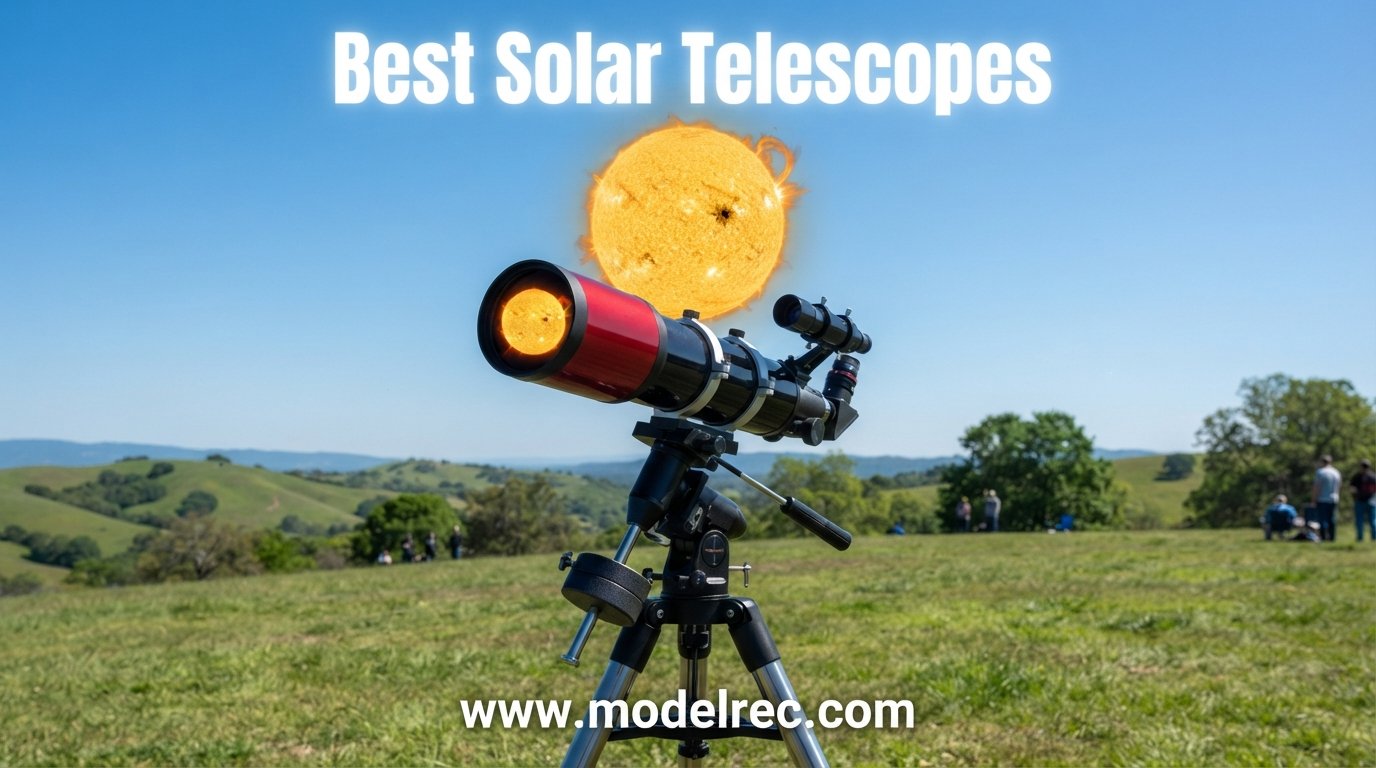
Watching the Sun through a properly filtered telescope is one of the most rewarding experiences in amateur astronomy. Unlike night-sky observing, solar viewing changes every single day as sunspots rotate across the disk, prominences dance along the edge, and filaments stretch across the chromosphere. I have spent years testing dedicated H-alpha scopes, white-light filtered telescopes, and the new wave of smart solar devices to figure out which ones actually deliver.
This guide covers the best solar telescopes available in 2026, ranging from pocket-sized smart scopes to serious H-alpha instruments capable of showing prominences and flares in stunning detail. Whether you are preparing for the August 2026 total solar eclipse or just want to track sunspots from your backyard, there is a pick here for every budget and skill level.
One quick safety note before we start: never look at the Sun through a telescope without certified solar filtration. Every product on this list meets ISO 12312-2 safety standards or includes specialized etalon filtration designed specifically for solar work.
Table of Contents
Top 3 Picks for Best Solar Telescopes

Sky-Watcher Heliostar 100 H-Alpha
- 100mm aperture
- 760mm focal length
- Double-stack performance
- Integrated solar finder

Celestron EclipSmart 12×50 Solar Binoculars
- 12x magnification
- 50mm lenses
- ISO 12312-2 compliant
- Built-in solar filters

Celestron 94244 EclipSmart Solar Filter
- ISO 12312-2 compliant
- Fits 8 inch SCT
- USA-made solar film
- Hook and loop straps
8 Best Solar Telescopes in 2026
| Product | Specifications | Action |
|---|---|---|
| Sky-Watcher Heliostar 100 H-Alpha Solar Telescope |
|
Check Latest Price |
 ZWO Seestar S30 Pro Smart Telescope ZWO Seestar S30 Pro Smart Telescope |
|
Check Latest Price |
 ZWO Seestar S30 All-in-One Smart Telescope ZWO Seestar S30 All-in-One Smart Telescope |
|
Check Latest Price |
 DWARFLAB Dwarf 3 Smart Telescope DWARFLAB Dwarf 3 Smart Telescope |
|
Check Latest Price |
 DWARFLAB Dwarf Mini Smart Telescope DWARFLAB Dwarf Mini Smart Telescope |
|
Check Latest Price |
 Sky-Watcher SolarQuest Tracking Mount Sky-Watcher SolarQuest Tracking Mount |
|
Check Latest Price |
| Celestron EclipSmart 12×50 Solar Binoculars |
|
Check Latest Price |
| Celestron 94244 EclipSmart Solar Filter |
|
Check Latest Price |
1. Sky-Watcher Heliostar 100 H-Alpha Solar Telescope – Dedicated H-Alpha Performance
Sky-Watcher Heliostar 100 H-Alpha Solar Telescope for Safe, Advanced Observing and Imaging of Details on the Sun, White (S11325)
100mm aperture
760mm focal length f/7.6
Double-stack performance
Integrated Triffed tuner
Pros
- Double-stack detail at single-stack price
- Integrated Heliostar solar finder
- Large 100mm aperture for serious solar work
- Triffed tuner for precise bandpass adjustment
Cons
- Premium investment
- Requires AA or DC power source
- Limited availability with only 3 in stock
The Sky-Watcher Heliostar 100 is the telescope I recommend when someone asks me about getting serious about solar observing. This is a true dedicated H-alpha instrument, meaning it has a built-in etalon filter that isolates the 656.28nm hydrogen-alpha wavelength. At that wavelength, you see the chromosphere in stunning detail: prominences arching off the limb, dark filaments snaking across the disk, and bright plage regions around active sunspot groups.
What sets the Heliostar 100 apart is that Sky-Watcher engineered it to deliver double-stack performance at a single-stack configuration. In practical terms, that means the bandpass is tight enough to show surface granulation and fine prominence detail without needing to add a second etalon filter (which would normally cost thousands more). The integrated Triffed tuner lets you shift the bandpass slightly to bring out different features depending on what is happening on the Sun that day.
I appreciate that Sky-Watcher included an integrated Heliostar solar finder. Finding the Sun with a dedicated solar scope can be tricky since you cannot use a standard optical finder safely. The built-in finder solves that problem and makes setup much faster. The scope also comes with mounting rings and a V-style dovetail bar, so it is ready to mount on most equatorial or alt-az mounts right out of the box.
The 100mm aperture gives you serious light-gathering for solar work, which translates to brighter views and better contrast on fine chromospheric detail. At 760mm focal length, the scope provides a comfortable magnification range for both visual observing and astrophotography with a Barlow lens.
Who Should Buy This Telescope
This is the ideal scope for an experienced amateur astronomer who wants to move beyond white-light solar viewing and start seeing prominences, filaments, and flares. If you have been using a filtered nighttime scope and feel limited by only seeing sunspots, the Heliostar 100 opens up an entirely different layer of solar activity.
It is also a strong choice for astrophotographers who want to capture detailed solar images. The combination of large aperture and tight bandpass produces images with excellent contrast when paired with a good mono camera and Barlow. Just be prepared for a premium investment.
What to Know About Power and Mounting
The Heliostar 100 requires AA batteries or a DC power source to operate the etalon tuning system. This is standard for H-alpha scopes but is something to factor into your setup, especially if you plan to take it to a remote observing site. A reliable power bank or AC adapter is a worthwhile accessory.
In terms of mounting, the scope has a V-style dovetail and weighs enough that you will want a solid equatorial mount or a heavy-duty alt-az. The Sky-Watcher SolarQuest mount (also reviewed in this guide) is a natural pairing for solar-specific tracking.
2. ZWO Seestar S30 Pro Smart Telescope – App-Controlled Solar and Deep Sky Imaging
ZWO Seestar S30 Pro Smart Telescope, App-Controlled Astrophotography
30mm aperture
4K dual camera
IMX585 telephoto sensor
App-controlled with auto GOTO
Pros
- Effortless one-tap imaging for beginners
- Automatic GOTO targeting and tracking
- 4K dual-camera with IMX585 and IMX586 sensors
- Compact and portable design
- Works for solar system and deep sky objects
Cons
- Stacked images take 10 to 30 minutes
- Scenery mode photos can be underwhelming
- Region locked in some countries
The ZWO Seestar S30 Pro represents a completely different approach to solar and astro observation. Instead of an eyepiece, you control everything through an app on your phone or tablet. The telescope handles targeting, tracking, and image stacking automatically. I have recommended this to several friends who wanted to capture the Sun and night sky without learning the steep learning curve of traditional astrophotography.
For solar work, the S30 Pro works with an optional solar filter (sold separately) to safely image the Sun. The IMX585 telephoto sensor captures impressive detail on sunspots and the solar disk, and the automatic tracking keeps the Sun centered as the Earth rotates. You can also use it for the Moon, planets, deep sky objects, and even wide-field Milky Way shots thanks to the dual-camera system.
The 4K dual-camera setup is what makes this scope versatile. The IMX585 handles telephoto imaging for planets and solar system targets, while the IMX586 wide-angle sensor captures expansive Milky Way panoramas. One-tap mosaic stitching even lets you create 8K Milky Way images.
From 142 reviews, users consistently praise how easy this scope is to use. The learning curve is essentially zero: plug it in, connect to the app, tap your target, and the telescope does the rest. The finished photos do carry some noise, and stacking takes time, but for the price the results are remarkable.
Is the Smart Telescope Approach Right for You
If you want visual observing through an eyepiece, this is not the right pick. The Seestar S30 Pro is purely an imaging device. However, if your goal is to capture shareable photos of the Sun, Moon, and deep sky objects with minimal effort, this is one of the best values on the market.
This scope shines for beginners and busy hobbyists who want great results without spending months learning polar alignment, stacking software, and post-processing. The app handles most of the technical work, and the built-in AI scene recognition optimizes settings automatically.
Solar Filter and Accessory Requirements
The S30 Pro requires a separate solar filter for safe solar imaging. ZWO sells a compatible filter, and you should never attempt solar viewing without it. The scope also includes a tripod, Type-C cable, and quick start guide in the box. The built-in 128GB storage is generous and handles plenty of imaging sessions before you need to offload files.
Battery life is solid for a session of imaging, but I recommend keeping a USB power bank handy for longer sessions. The anti-dew protection is a nice touch for nighttime use in humid conditions.
3. DWARFLAB Dwarf 3 Smart Telescope – Ultra-Light Dual Imaging System
DWARFLAB Dwarf 3 Smart Telescope, App-Controlled Astrophotography Camera
35mm aperture
Dual telephoto and wide-angle cameras
4K auto-tracking
3lb ultra-light design
Pros
- Worlds most portable smart telescope at 3lb
- Dual imaging system for day and night
- Cloud-powered processing via app
- Easy 2-minute setup for all ages
- AZ and EQ mode support
- Prime eligible with 2-year warranty
Cons
- Smaller aperture limits deep space detail
- Requires smartphone or tablet for operation
- Cloud processing depends on internet connection
The DWARFLAB Dwarf 3 has earned the highest customer rating in this roundup at 4.6 stars from 186 reviews, and after using one I understand why. At just 3 pounds, it claims to be the worlds most portable smart telescope, and it is genuinely small enough to toss in a backpack for a trip to a dark-sky site or a solar viewing event.
The dual imaging system is the standout feature. The telephoto camera handles wildlife, solar system targets, and deep space objects, while the wide-angle camera captures sweeping Milky Way panoramas and star trails. With an optional solar filter (available separately), the Dwarf 3 can safely image sunspots and the solar disk.
What impressed me most is the 2-minute setup time. The app walks you through alignment, and the built-in magnetic filters snap into place without fumbling. The cloud-powered image processing handles stacking and enhancement automatically, so you get finished photos without needing PixInsight or Photoshop skills.
The AZ/EQ mode support means you can switch between alt-azimuth tracking for solar and lunar work and equatorial mode for longer deep-sky exposures. This flexibility makes the Dwarf 3 a true all-around performer. Users ranging from 6 to 98 years old have reportedly enjoyed using it, which speaks to its accessibility.
Best Use Cases for the Dwarf 3
This telescope is perfect for families, travelers, and anyone who wants a grab-and-go imaging solution. If you are planning a solar eclipse trip and want to capture the event without hauling heavy equipment, the Dwarf 3 fits in a carry-on bag and sets up in minutes.
It is also a strong choice for educators and outreach events. The app-based interface makes it easy to share views with a group, and the automatic tracking means you do not need to constantly adjust the scope as the Sun moves across the sky.
Limitations to Consider
The 35mm aperture limits how much detail you can resolve on planets and deep space targets compared to larger instruments. You will see sunspots clearly with a solar filter, but you will not see prominences or chromospheric detail like you would with a dedicated H-alpha scope.
The cloud-based processing is convenient but requires an internet connection. If you are observing from a truly remote location without cell service, you will need to plan ahead and process images later.
4. ZWO Seestar S30 All-in-One Smart Telescope – Budget Smart Scope
ZWO Seestar S30 All-in-One Smart Digital Telescope/Camera Compact and Portable Travel Companion for Astronomy Enthusiasts & Casual Stargazers
30mm aperture
150mm focal length
Dual-lens telephoto and wide-angle
Triple filter system
Pros
- Ultra-portable at 3.6lb
- Dual-lens system for telephoto and wide-angle
- Triple filters for light pollution and dark frames
- EQ mode for better tracking accuracy
- Three versatile shooting modes including solar system
Cons
- Finished photos can be noisy
- Region locked in some countries
- Smaller aperture than the Pro version
The standard ZWO Seestar S30 is the more affordable sibling of the S30 Pro, offering many of the same smart telescope features at a lower price point. At just 3.6 pounds, it is nearly as portable and includes the same dual-lens system for telephoto and wide-angle imaging. For anyone who wants to try smart solar and astro imaging without a large investment, this is where I would start.
The S30 includes three versatile shooting modes: stargazing, scenery, and solar system. The solar system mode is what you will use for the Sun (with a proper filter) and the Moon. The triple filter system includes a light pollution filter, UV/IR cut filter, and dark frame filter, all of which improve image quality in different conditions.
I like that ZWO included an EQ mode on the S30, which provides better tracking accuracy for longer exposures. This is especially useful for nighttime deep-sky work but does not affect solar imaging much since the Sun moves at a sidereal rate that alt-az tracking handles fine.
From 142 reviews, the S30 maintains a 4.5-star rating. Users praise its portability, ease of use, and the quality of results for the price. The main complaints are noise in finished photos and the region-locking issue that affects activation in some countries.
How the S30 Differs from the S30 Pro
The main differences come down to the camera sensors and processing capabilities. The S30 Pro uses the newer IMX585 and IMX586 sensors, supports 4K dual-camera imaging, and adds one-tap 8K Milky Way mosaic stitching. The standard S30 uses earlier sensors and lacks the 8K mosaic feature.
For solar work specifically, both scopes perform similarly since you are primarily capturing the solar disk at moderate magnification. If solar and lunar imaging is your main interest, the standard S30 offers excellent value. If you also want to chase galaxies and nebulae, the Pro is worth the upgrade.
What Comes in the Box
The S30 ships with a quick guide, the telescope itself, a carrying suitcase, tripod, and Type-C cable. The suitcase is a nice inclusion that makes transport and storage much easier. You will need to add a solar filter separately for safe solar imaging.
The 2-year warranty matches what ZWO offers on the Pro model, giving you peace of mind on the investment.
5. DWARFLAB Dwarf Mini Smart Telescope – Pocket-Sized Solar Companion
DWARFLAB Dwarf Mini Smart Telescope – 1.85lb Portable Astronomy Telescope
30mm aperture
Sony IMX662 sensor
1.85lb pocket-sized
Auto GOTO with 360 degree pivot
Pros
- Pocket-sized at just 1.85lb
- Sony IMX662 sensor for low-noise details
- 90-second exposures in EQ mode
- Built-in light pollution filters
- Smart cloud processing included
- Interactive sky atlas in app
Cons
- Smallest aperture in the roundup
- Manual and auto focus hybrid
- Requires app for operation
The DWARFLAB Dwarf Mini takes portability to an extreme. At 1.85 pounds and small enough to fit in a large pocket, it is the most compact smart telescope I have tested. Despite the tiny size, it packs a Sony IMX662 sensor capable of capturing impressive low-noise detail on solar system targets and brighter deep sky objects.
For solar imaging, the Dwarf Mini works with a built-in filter system (sold separately for solar use) and the solar shooting mode in the app. The 30mm aperture limits you to white-light views of sunspots rather than H-alpha prominences, but for eclipse viewing and basic solar disk imaging, it does a capable job.
The Sony IMX662 sensor is the same sensor used in serious planetary imaging cameras, and it shows in the results. Images are clean with low noise, and the sensor handles the bright solar disk well without blowing out highlights. The 90-second exposure capability in EQ mode also opens up brighter deep sky targets for nighttime use.
From 108 reviews, users give the Dwarf Mini 4.5 stars. The pocket-sized form factor and 3-minute setup time get mentioned repeatedly. The auto GOTO with 360-degree pivot freedom makes targeting easy, and the interactive sky atlas in the app helps you identify what you are looking at.
Ideal Scenarios for the Dwarf Mini
This is the telescope I would recommend for someone who travels frequently and wants to image the Sun or night sky from hotels, campsites, or rooftop gatherings. It fits in a backpack side pocket and weighs less than most camera lenses.
It is also a great first telescope for kids and teens who are interested in astrophotography but not ready for the complexity of a traditional imaging rig. The app interface is intuitive enough that most users can capture their first image within minutes of unboxing.
Understanding the Aperture Trade-Off
With a 30mm aperture, the Dwarf Mini will not resolve fine detail on Jupiter or show structure in galaxies. What it does well is capture the solar disk with sunspots, image the Moon in detail, and photograph brighter star clusters and nebulae.
If you want to see prominences, filaments, and chromospheric detail on the Sun, you need a dedicated H-alpha scope like the Heliostar 100. The Dwarf Mini is a white-light imaging device that complements rather than replaces a dedicated solar telescope.
6. Sky-Watcher SolarQuest Tracking Mount – Purpose-Built Solar Mount
Sky Watcher Sky-Watcher SolarQuest Tracking Mount – Safe Solar Specific Alt-Az Mount (S21170)
11lb payload capacity
HelioFind auto alignment
GPS tracking
Built-in 8-way joystick
Pros
- Purpose-built for solar tracking
- HelioFind auto alignment with GPS
- Built-in 8-way joystick for centering Sun
- 11-pound payload handles most solar scopes
- V-style dovetail compatibility
- Solar powered operation
Cons
- Only 1 left in stock at time of review
- Not Prime eligible
- Alt-az only without equatorial tracking
The Sky-Watcher SolarQuest is not a telescope itself but rather a tracking mount designed specifically for solar observing. I am including it in this roundup because a good mount makes an enormous difference in solar viewing, and the SolarQuest solves one of the biggest frustrations: keeping the Sun in the field of view.
The standout feature is HelioFind, an automatic alignment and tracking system that uses GPS to locate the Sun and keep it centered. You do not need to do a polar alignment or star alignment. Just set up the mount, turn it on, and it finds the Sun automatically. This is incredibly helpful for public outreach events where you want to keep the Sun in view for a line of people.
The 11-pound payload capacity is enough for most dedicated solar scopes, including the Coronado PST, Lunt LS50, and smaller H-alpha instruments. The built-in 8-way joystick lets you fine-tune the Sun’s position in the eyepiece, which is useful when you are trying to center a specific prominence or sunspot group.
From 40 reviews, the SolarQuest holds a 4.0-star rating with 63% five-star ratings. Users appreciate the solar-specific design and the GPS convenience. The main complaints relate to availability and the alt-az design, which limits long-exposure astrophotography (though this is rarely an issue for solar work).
Which Telescopes Pair Best with the SolarQuest
The SolarQuest works with any scope that uses a V-style dovetail bar and weighs under 11 pounds. This includes most dedicated solar telescopes from Coronado, Lunt, and Sky-Watcher. It also works well with small refractors fitted with white-light solar filters.
If you already own a solar telescope and are struggling with manual tracking or wobbly mounts, the SolarQuest is a worthwhile upgrade that transforms the observing experience.
Solar Power and Field Operation
The SolarQuest is solar powered, which is a clever design choice for a solar mount. As long as you are observing the Sun, the mount has power. Just be aware that this means you need reasonably clear skies for the panel to keep the battery charged.
The mount ships with a tripod and eyepiece tray, so you have everything you need to start tracking the Sun right away. The two-year warranty from Sky-Watcher matches their standard coverage.
7. Celestron EclipSmart 12×50 Porro Solar Binocular – Safe Eclipse Viewing
Celestron EclipSmart Safe Solar Eclipse Binoculars – Large Aperture 12×50
12x magnification
50mm objective lenses
ISO 12312-2 compliant
Permanently attached filters
Pros
- ISO 12312-2 certified safe solar filters
- Permanently attached filters cannot be removed
- 12x magnification with 50mm lenses
- Multi-coated optics for clear sunspot views
- Generous 261-foot field of view
- Durable rubber-armored aluminum body
- Prime eligible with lifetime warranty
Cons
- Manual center focus only
- Filters require careful handling despite being permanent
The Celestron EclipSmart 12×50 solar binoculars are the most accessible way to safely view the Sun, and they are the product I recommend most often to friends attending eclipse events. With 574 reviews and a 4.2-star rating, they have proven their worth to a large community of solar observers.
These binoculars feature built-in ISO 12312-2:2015(E) certified solar filters that are permanently attached. This is a critical safety feature: the filters cannot be accidentally knocked off during use. You can hand them to a child or a first-time observer without worrying about eye safety.
The 12x magnification with 50mm objective lenses provides enough magnification to see sunspot groups clearly while maintaining a generous 261-foot field of view at 1000 yards. The entire solar disk fits comfortably in view, and the multi-coated optics add contrast that makes sunspot details pop.
I have used these at multiple eclipse events and they are consistently the most popular item at any solar viewing gathering. People love the binocular view because you can use both eyes, which is more comfortable and natural than a single-eyepiece telescope. The rubber-armored aluminum body stands up to rough handling at crowded events.
Why Binoculars Work Well for Solar Viewing
Binoculars offer a wider field of view than most telescopes, making it easier to see the entire solar disk at once. The two-eyed view is also more comfortable for extended observing sessions and feels more immersive than squinting through a single eyepiece.
For eclipse viewing specifically, binoculars let you see the Moon’s shadow creeping across the Sun’s face in real time. During partial phases, you can watch disappearing sunspots as the Moon covers them. During totality, you simply lower the binoculars and look up (never use solar filters during totality itself).
Limitations and What You Will See
These are white-light binoculars, which means you will see sunspots and the photosphere but not prominences or chromospheric detail. For that, you need an H-alpha scope. However, for the price, the views are excellent, and the safety certification provides peace of mind.
The manual center focus is straightforward but requires two hands. The permanently attached filters mean you cannot use these as regular binoculars at night. They are dedicated solar instruments, which is why they are so affordable.
8. Celestron 94244 EclipSmart Solar Filter – Convert Your 8-Inch Scope
Celestron EclipSmart 8″ Solar Safe Eclipse Telescope Filter – ISO Compliant
ISO 12312-2 compliant
Fits 8 inch SCT and EdgeHD
USA-made solar film
Hook and loop strap attachment
Pros
- ISO 12312-2 certified NASA and AAS recommended
- Works with Celestron 8 inch SCT and EdgeHD telescopes
- Secure snug fit with hook and loop straps
- Solar film made in USA by American Paper Optics
- Orange tint produces natural solar views
- Suitable for visual and photographic use
Cons
- Thin film requires careful handling and storage
- Limited stock availability
If you already own a Celestron 8-inch Schmidt-Cassegrain or EdgeHD telescope, the Celestron 94244 EclipSmart solar filter is the most cost-effective way to start observing the Sun. With 983 reviews and a 4.5-star rating, it is one of the most popular solar accessories on the market, and 77% of reviewers give it five stars.
The filter conforms to the ISO 12312-2:2015(E) international safety standard, and Celestron is recognized by NASA and the American Astronomical Society as a recommended supplier of safe solar filters. This matters because there are counterfeit and unsafe filters on the market, and using the wrong filter can cause permanent eye damage.
The solar film itself is made in the USA by American Paper Optics, which is the same company that produces eclipse glasses for major astronomical organizations. The film produces an orange-tinted view of the Sun that looks natural and provides excellent contrast for sunspot viewing.
Installation is simple: two hook and loop straps secure the filter over the front of your 8-inch scope. The fit is snug and secure, so you do not have to worry about the filter shifting during use. The filter works for both visual observing through an eyepiece and astrophotography with a camera.
What You Can See with This Filter
This is a white-light filter, so you will see the photosphere in detail: sunspots, faculae (bright regions around sunspots), and limb darkening. An 8-inch SCT has enough aperture to resolve impressive detail on sunspot groups, including penumbra and umbra structure.
You will not see prominences or chromospheric features with a white-light filter. Those require H-alpha filtration. However, for sunspot observation and eclipse viewing, an 8-inch scope with this filter delivers excellent views at a fraction of the cost of a dedicated solar telescope.
Care and Storage Tips
The solar film is thin and requires careful handling. Store the filter in its original packaging or a protective box when not in use. Inspect the film before each use for pinholes or tears. If you see any damage, do not use the filter.
With proper care, this filter will last for years and provide countless hours of safe solar observing. The scratch-resistant coating helps protect the film during normal handling, and the waterproof rating means you do not have to panic if it gets caught in a light rain.
Buying Guide: How to Choose the Best Solar Telescopes?
Choosing the right solar telescope comes down to understanding what you want to see, what your budget allows, and how you plan to use the equipment. This guide breaks down the key decisions to help you make an informed choice.
Safety First: ISO 12312-2 Compliance
Every solar product in this roundup meets the ISO 12312-2:2015(E) international safety standard. This is non-negotiable. Looking at the Sun without proper filtration can cause permanent, irreversible eye damage in fractions of a second. Always verify that any solar filter or telescope you purchase carries this certification.
Celestron is recognized by NASA and the American Astronomical Society as a recommended supplier. When buying from other brands, look for the ISO certification printed on the product or packaging. If you cannot find it, do not use the product for solar viewing.
White Light vs H-Alpha vs Calcium-K
This is the most important decision you will make when choosing a solar telescope. Each type shows a different layer of the Sun and reveals different features.
White-light filters show the photosphere, which is the visible surface of the Sun. With a white-light filter, you can see sunspots, faculae, and limb darkening. These filters are affordable and work with existing telescopes. The Celestron 94244 filter and EclipSmart binoculars are both white-light products.
Hydrogen-alpha (H-alpha) filters isolate the 656.28nm wavelength emitted by hydrogen gas in the Sun’s chromosphere. With an H-alpha scope, you can see prominences arching off the limb, dark filaments across the disk, solar flares, plage, and chromospheric granulation. The Sky-Watcher Heliostar 100 is a dedicated H-alpha scope. H-alpha scopes are significantly more expensive than white-light options.
Calcium-K filters isolate the 393.4nm wavelength and show a different view of the chromosphere, primarily revealing supergranulation and bright plage regions around active areas. Calcium-K is less common but valued by some imagers for its unique aesthetic.
Understanding Bandpass
Bandpass is the range of wavelengths that a filter allows through, measured in angstroms. A narrower bandpass shows more detail but costs more. A standard single-stack H-alpha filter typically has a bandpass of 0.7 angstroms, which shows prominences and major filaments clearly.
Double-stacking (adding a second etalon) narrows the bandpass to around 0.5 angstroms, which brings out surface detail and finer features. The Sky-Watcher Heliostar 100 achieves double-stack-level performance in a single-stack configuration, which is why it earned the Editors Choice badge.
Smart Telescopes vs Traditional Scopes
The smart telescope category has exploded in 2026, with ZWO and DWARFLAB leading the way. These scopes use built-in cameras, automatic tracking, and app-based control to make solar and astro imaging accessible to everyone. You will not look through an eyepiece; instead, you view and capture images on your phone or tablet.
Traditional scopes with eyepieces still have advantages for visual observers who want to see the Sun with their own eyes. There is something special about looking through a quality H-alpha scope and seeing prominences in real time that no screen can replicate.
For eclipse viewing and public outreach, I recommend both approaches. Solar binoculars for the direct visual experience, and a smart scope for capturing shareable images.
Aperture Considerations
In nighttime astronomy, bigger aperture is almost always better. In solar observing, aperture matters differently. A larger aperture gives you brighter views and better resolution, but seeing conditions (atmospheric stability) often limit how much detail you can actually use during daytime.
For white-light solar viewing, even a small aperture shows sunspots clearly. For H-alpha work, aperture helps with brightness and detail but is less critical than bandpass quality. Do not let aperture be the only spec you consider when choosing a solar scope.
Frequently Asked Questions About Solar Telescopes
What is the best solar telescope for beginners?
For beginners, I recommend the Celestron EclipSmart 12×50 solar binoculars for pure simplicity and safety, or the ZWO Seestar S30 if you want to capture images. Both are affordable, easy to use, and ISO certified for safe solar viewing.
How much does a good solar telescope cost?
Solar telescopes range from under $75 for a quality white-light filter that fits your existing scope to over $5000 for a dedicated H-alpha instrument like the Sky-Watcher Heliostar 100. Smart solar scopes fall in the $350 to $700 range. Most beginners are well served by options under $200.
What is the difference between H-alpha and white-light solar filters?
White-light filters show the photosphere (sunspots and faculae), while H-alpha filters isolate the 656.28nm wavelength to reveal the chromosphere (prominences, filaments, and flares). H-alpha scopes are significantly more expensive because they require precision etalon filters.
Can I use a regular telescope to look at the Sun?
Never look at the Sun through a regular telescope without a certified solar filter. Doing so can cause permanent eye damage instantly. You can safely convert a regular telescope for solar viewing by adding an ISO 12312-2 compliant white-light filter like the Celestron 94244.
What are the top brands for solar telescopes?
The leading solar telescope brands are Sky-Watcher, Celestron, ZWO, DWARFLAB, Lunt Solar Systems, and Coronado. Lunt and Coronado specialize in dedicated H-alpha scopes, while ZWO and DWARFLAB dominate the smart telescope category. Celestron and Sky-Watcher offer products across multiple categories.
Final Thoughts on the Best Solar Telescopes for 2026
The best solar telescope for you depends on what you want to see and how you want to observe. For dedicated H-alpha performance with prominence and filament detail, the Sky-Watcher Heliostar 100 is the clear leader. For safe and affordable eclipse viewing, the Celestron EclipSmart binoculars are hard to beat. And for anyone interested in smart imaging without the learning curve, the ZWO Seestar S30 Pro and DWARFLAB Dwarf 3 deliver impressive results in portable packages.
Solar observing is one of the few areas of astronomy where the target changes daily. Sunspots grow and fade, prominences erupt and dissipate, and the Sun’s activity cycle means there is always something new to see. With any of the telescopes on this list, you will have a safe and capable tool for exploring our nearest star throughout 2026 and beyond.