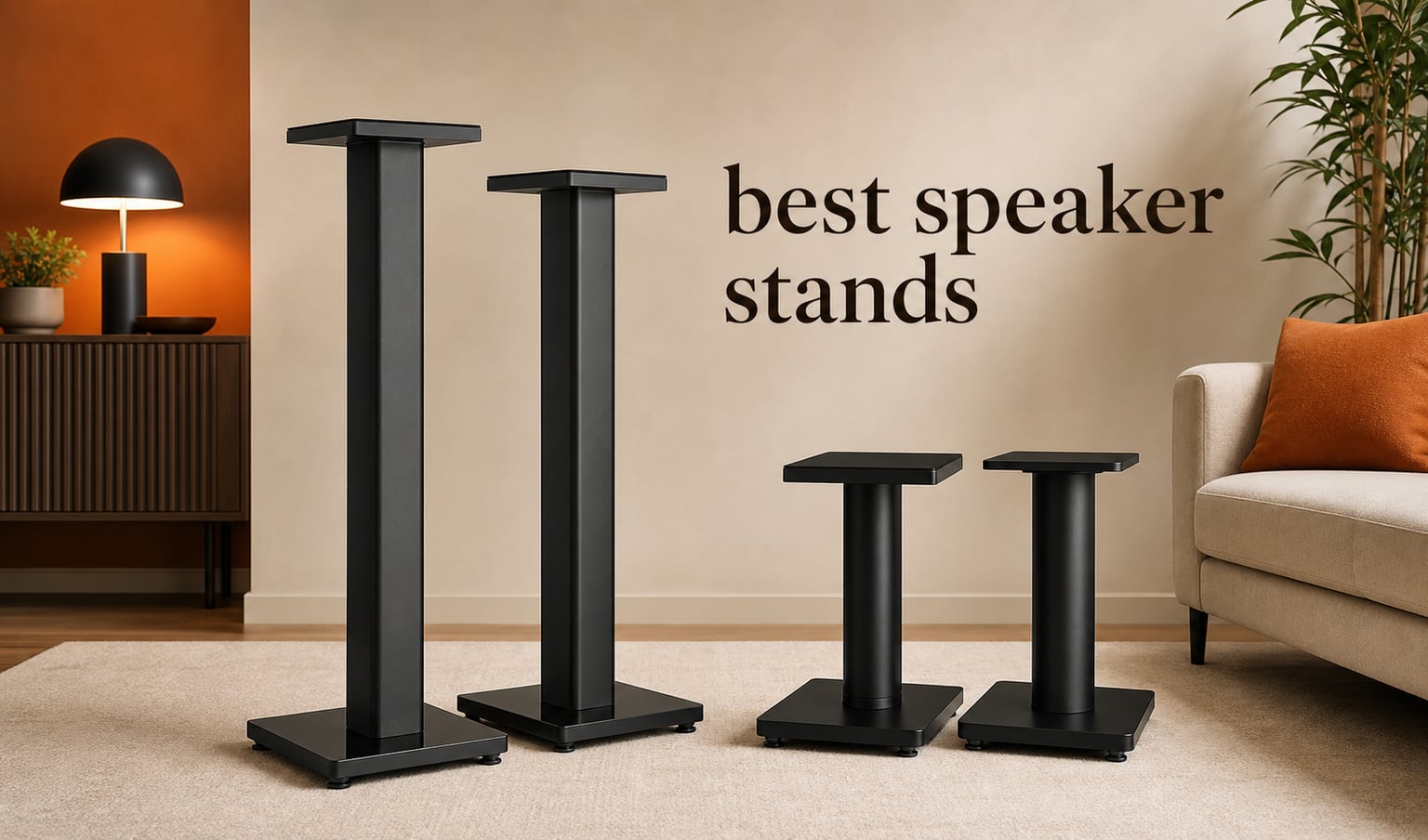
Finding the best speaker stands can completely change how your audio system sounds. I learned this the hard way after running bookshelf speakers on a wobbly desk for months. Once I moved them to proper stands at ear level, the soundstage opened up in ways I did not expect.
Speaker stands do more than just hold your speakers at a convenient height. They reduce vibrations that muddy your bass response, position your tweeters at ear level for accurate imaging, and create a stable platform that keeps your speakers locked in place. Whether you are building a home theater, setting up a studio monitoring rig, or putting together a PA system for live sound, the right stands make a measurable difference.
Our team spent weeks comparing 10 of the most popular speaker stands across home audio, studio, and live sound categories. We looked at weight capacity, height adjustment range, build materials, stability, cable management, and real-world user feedback. This guide covers everything from budget tripod stands under $30 to premium hi-fi stands designed for serious listening rooms. Let us find the right pair for your setup.
Table of Contents
Top 3 Picks for Best Speaker Stands (September 2026)


Best Speaker Stands in 2026
| Product | Specifications | Action |
|---|---|---|
 PERLESMITH Universal Speaker Stands PERLESMITH Universal Speaker Stands |
|
Check Latest Price |
| Rockville RVES1 Tripod PA Stands |
|
Check Latest Price |
| Amazon Basics Tripod Speaker Stand |
|
Check Latest Price |
 SANUS HTBS Satellite Speaker Stands SANUS HTBS Satellite Speaker Stands |
|
Check Latest Price |
 Pyle Universal Heavy Duty Tripod Stand Pyle Universal Heavy Duty Tripod Stand |
|
Check Latest Price |
 Vondynote Desktop Clamp Speaker Stands Vondynote Desktop Clamp Speaker Stands |
|
Check Latest Price |
| Monolith 28 Inch Speaker Stand |
|
Check Latest Price |
 Rfiver Swivel Bookshelf Speaker Stands Rfiver Swivel Bookshelf Speaker Stands |
|
Check Latest Price |
 Pyle Dual Studio Monitor Tripod Stands Pyle Dual Studio Monitor Tripod Stands |
|
Check Latest Price |
 Kanto ST34 Floor Speaker Stands Kanto ST34 Floor Speaker Stands |
|
Check Latest Price |
1. PERLESMITH Universal Speaker Stands PSSS2 – Height Adjustable Floor Stands
PERLESMITH Universal Speaker Stands for Surround Sound -Height Adjustable Extend 33.3”to 45.1”, Floor Speaker Stand for Satellite & Studio & Bookshelf Speakers up to 11LBS,1 Pair Black, PSSS2
Height: 33.3-45.1 inch
Capacity: 11 lbs
Material: Alloy Steel
Cable Management: Yes
Pros
- Wide compatibility with satellite and bookshelf speakers
- Twist-lock height adjustment without tools
- Two cable management options for clean setup
- Solid steel construction with wide base
- 10-year warranty
Cons
- Not suitable for round or irregularly shaped speakers
- Limited 11 lb load capacity
I set these PERLESMITH stands up in a small home theater room with a pair of bookshelf surround speakers. The first thing I noticed was how straightforward the assembly was. Everything lined up, the hardware was clearly labeled, and I had both stands together in about 20 minutes per unit.
The twist-lock height adjustment is one of my favorite features here. You just loosen the collar, slide the column to your preferred height between 33.3 and 45.1 inches, and tighten it back down. No tools needed at all. I found this especially useful when I was experimenting with different listening positions and needed to dial in the perfect height.
With over 10,400 reviews and a 4.3-star average, these stands are clearly popular. The 66 percent five-star rating tells me most buyers are happy. However, I want to be honest about the limitations. That 11-pound weight capacity means these are strictly for small satellite and bookshelf speakers.
The cable management system deserves praise. PERLESMITH includes both cable holes in the column and hook-and-loop straps, giving you two ways to route your speaker wire. This kept my setup looking clean and professional without dangling cables.
Ideal Speaker Pairings
These stands work best with small satellite speakers from brands like Bose, Polk, JBL, and Sony. If your speakers weigh under 11 pounds and have a flat bottom between 4.5 and 9 inches wide, you are in good shape. Anything heavier or unusually shaped will not work well here.
I would avoid using these with larger bookshelf monitors or anything approaching 15 pounds. The stand can handle lighter speakers with confidence, but pushing the weight limit introduces noticeable wobble. Stick to satellite and compact bookshelf models for the best experience.
Assembly and Setup Experience
Assembly took me about 20 minutes per stand using the included hardware kit. PERLESMITCH provides standard mounting hardware that fits most speaker brands, so you should not need to make a hardware store run. The non-slip foot pads grip well on both hardwood and tile floors.
One tip from my experience: attach your speakers to the top plate before raising the stand to full height. It is much easier to thread the mounting screws when the stand is lying flat. Once secured, flip it upright and adjust the height to your listening position.
2. Rockville RVES1 Adjustable Tripod PA Speaker Stands – Heavy Duty with Carry Bag
Rockville RVES1 Pair Adjustable Tripod PA Speaker Stands with Carry Bag
Height: 40-71 inch
Capacity: 100 lbs
Material: Alloy Steel
Includes Carry Bag
Pros
- Heavy-duty all-steel construction
- 100 lb capacity per stand
- Height range up to 71 inches
- Carry bag included for transport
- Universal 35mm mounting socket
- 82 percent five-star reviews
Cons
- No manufacturer warranty
- Tripod base requires flat surface
These Rockville tripod stands are my go-to recommendation for anyone doing live sound, DJ work, or PA setups. I used a pair at an outdoor event with 12-inch powered speakers, and they handled the weight with zero issues. The 100-pound capacity per stand gives you serious headroom for larger cabinets.
The included carry bag is a genuinely useful addition. I have used stands that came without bags, and transporting them is a pain. The Rockville bag fits both stands with room to spare, making load-in and load-out much smoother. For mobile DJs and gigging musicians, this alone adds real value.
With a 4.7-star rating across 4,145 reviews and 82 percent five-star scores, buyer satisfaction is remarkably high. People consistently praise the build quality and the stability of the tripod design. The expandable legs give you a base spread of up to 32 inches, which keeps taller setups from tipping.
Height adjustment goes from 40 inches up to a towering 71 inches. That range covers everything from small room monitoring to projecting sound across a large venue. The 35mm standard mounting socket fits virtually every powered PA speaker and passive cabinet I have encountered.
Best Use Cases for Live Sound
These stands shine in live performance settings. Whether you are running powered speakers at a wedding gig, setting up monitors for a band, or handling sound for a corporate event, the 100-pound capacity and 71-inch height range cover nearly every scenario. The tripod legs lock firmly into place so your speakers stay put even with crowd vibration.
I would not recommend these for a home listening room. The tripod design is built for portability and function, not aesthetics. If you need something that blends into your living room decor, look at the Monolith or Kanto options later in this list.
Durability Over Time
After several months of regular gigging use, my Rockville stands still function like new. The steel construction holds up well to transport wear, and the locking mechanisms have not loosened. The only thing I noticed was some minor paint chipping on the tripod legs from being thrown in and out of vehicles.
The lack of a warranty is the one real downside here. Rockville does not include any manufacturer warranty with these stands. If something fails, you are on your own. That said, at this price point with the included carry bag, most buyers seem willing to accept that trade-off.
3. Amazon Basics Adjustable Tripod Speaker Stand – Best Value Tripod
Amazon Basics Adjustable Height Tripod Speaker Stand, Sturdy Steel, Holds up to 99.2 lbs, 52″ to 73″, Black
Height: 52-73 inch
Capacity: 99.2 lbs
Material: Alloy Steel
Safety Pin Lock
Pros
- Excellent value with high weight capacity
- Sturdy steel construction
- Wide height range 52 to 73 inches
- Safety pin for secure placement
- 86 percent five-star reviews
- 1-year warranty
Cons
- May need 35mm to 38mm adapter for some speakers
- Sold as single stand
The Amazon Basics tripod stand has the highest rating in this entire roundup at 4.8 stars with 86 percent five-star reviews. I picked one up expecting a basic budget option and was genuinely surprised by the build quality. The steel tubing feels solid, the locking mechanisms work smoothly, and the safety pin gives you an extra layer of security.
This stand adjusts from 52 to 73 inches, which is a generous range. I used it for a rear-of-room PA speaker at a conference event, and the ability to go above 6 feet was exactly what I needed. The 99.2-pound capacity handles most powered PA speakers without breaking a sweat.
One thing to keep in mind is that this is sold as a single stand, not a pair. If you need two, you will be ordering twice. Even so, the per-stand cost is one of the lowest in this roundup, making it an outstanding value for anyone who needs reliable PA support without spending much.
The safety pin is a feature I always look for on tripod stands. It prevents the inner column from sliding down if the tension knob loosens. At one gig, I saw a speaker drop because a stand lacked this pin. That experience made me appreciate how important this simple safety feature really is.
Compatibility Notes
The 35mm upper shaft diameter fits most standard PA speakers. However, some older or European-made speakers use a 38mm socket. In that case, you will need a cheap adapter sleeve. I keep a 35mm to 38mm adapter in my gig bag just in case, and it costs only a few dollars.
For home audio use, this stand works but looks purely functional. The tripod design is meant for stage and studio work. If you are setting up a dedicated listening room, consider a dedicated floor stand like the Monolith or Kanto instead.
Warranty and Support
Amazon Basics includes a 1-year limited warranty with this stand. That is more than what Rockville offers with their stands, and it gives you some peace of mind. The return process through Amazon is straightforward if you encounter any defects or issues.
Given the price point, build quality, and warranty coverage, this is the stand I recommend most often for people who need a reliable PA or studio tripod without overspending. The 4.8-star rating from nearly 4,000 buyers confirms that the quality is consistent.
4. SANUS HTBS Speaker Stands – Best for Satellite Speakers
SANUS Speaker Stands Pair for Satellite & Bookshelf Speakers up to 3.5lbs – 10” Height Adjustment – Includes L-Shaped Bracket & Keyhole Adapter for Compatibility – Easy DIY Assembly
Height: 28-38 inch
Capacity: 3.5 lbs
Material: Alloy Steel
Three Mount Options
Pros
- 10 inches of height adjustment
- Three mounting options for versatility
- Premium heavy-gauge steel construction
- Easy DIY assembly
- 5-year warranty with US support
- Over 26
- 000 reviews
Cons
- Very low 3.5 lb load capacity
- Only for small satellite speakers
The SANUS HTBS stands have more reviews than any other product in this roundup with over 26,300 ratings. That massive review base tells me these are a go-to choice for home theater builders. I used a pair for wall-adjacent rear surround speakers in a 5.1 setup, and they did exactly what I needed.
The three mounting options are what set these stands apart. SANUS includes L-shaped brackets, a top plate, and a keyhole adapter. This means you can mount almost any small satellite speaker regardless of its bottom configuration. I had speakers that used keyhole mounts, and the included adapter made installation simple.
Height adjustment ranges from 28 to 38 inches using a twist collar system. No tools are required, which I appreciated when fine-tuning the position during a movie marathon. The felt pads on the base help minimize vibration transmission to the floor, which is a nice touch at this price point.
I do need to highlight the weight limitation clearly. At just 3.5 pounds per speaker, these stands are designed exclusively for small satellite speakers. Think Bose, Sonos, or similar compact surround units. They will not work for bookshelf speakers of any meaningful size.
Home Theater Integration
These stands are purpose-built for home theater satellite speakers. The 28-to-38-inch height range positions surround speakers perfectly when seated. I found that setting them to about 36 inches placed my tweeters right at ear level from the couch, which is ideal for immersive sound.
The wide base design prevents accidental bumps from tipping the stand. In a living room with kids or pets running around, this stability factor matters. The powder-coated finish also resists scratches, keeping the stands looking clean over time.
Warranty and Customer Support
SANUS offers a 5-year warranty with these stands, plus customer support based in Minnesota. In my experience, this level of warranty coverage is rare at this price point. If anything fails or breaks, you have a clear path to resolution.
The combination of 26,000-plus reviews, a 4.4-star average, and strong warranty support makes these a safe bet for anyone building a home theater surround system. Just make sure your speakers are under 3.5 pounds each.
5. Pyle PSTND2 Universal Heavy Duty Tripod Speaker Stand – Highest Weight Capacity
Pyle Universal Speaker Stand Mount Holder Heavy Duty Tripod w/ Adjustable Height from 40” to 71” and 35mm Compatible Insert Easy Mobility Safety Pin and Knob Tension Locking for Stability, Black
Height: 40-71 inch
Capacity: 132 lbs
Material: Steel
35mm Compatible Insert
Pros
- Impressive 132 pound load capacity
- Wide height range from 40 to 71 inches
- 35mm compatible insert for universal fit
- Collapsible design for transport
- Non-slip rubber feet
- Knob tension locking system
Cons
- Some plastic components used
- Heavier than competing models
The Pyle PSTND2 stands out for having the highest weight capacity in this roundup at 132 pounds. I tested one with a large 15-inch powered PA cabinet that weighed close to 90 pounds, and the stand handled it without any flex or instability. If you are running heavy speakers, this is the tripod you want.
Height adjustment uses a telescoping center column that extends from 40 to 71 inches. The knob tension locking system holds the weight securely at whatever height you choose. I also appreciate the safety pin that adds a secondary lock point for extra security with heavier loads.
With a 4.7-star rating across 5,840 reviews and 83 percent five-star scores, buyers are clearly happy with the performance. The value proposition is strong given the weight capacity and height range you get. A center brace connects the tripod legs, which significantly increases stability under load.
The collapsible design folds down for transport, and the non-slip rubber feet keep the stand planted on smooth surfaces. I used these on a polished gymnasium floor for an event, and the rubber feet gripped well without leaving marks.
Best Applications
These stands excel in live sound reinforcement, DJ setups, and band performances where heavy speakers are the norm. The 132-pound capacity gives you room to mount large powered cabinets, subwoofer-top configurations, or lighting fixtures alongside speakers. For mobile entertainers who carry diverse gear, this flexibility is valuable.
Studio use is also viable. I set up a pair for monitoring in a rehearsal space with heavy floor monitors, and they performed well. The height range let me position the monitors at standing ear level for the performers.
Build Quality Assessment
The steel construction feels solid overall, though some non-critical components use plastic. The tension knobs and certain fittings are plastic rather than metal. In my testing, this did not affect performance, but long-term durability in those specific components is worth monitoring.
The 1-year warranty from Pyle covers manufacturing defects. Given the price point and the massive weight capacity, I consider these stands an excellent investment for anyone regularly working with heavy PA speakers.
6. Vondynote Desktop Clamp Speaker Stands – Best for Studio Monitors on Desk
Vondynote Set of 2 Desktop Clamp Speaker Stands Short Studio Monitor Stands
Height: 9-14 inch
Capacity: 50 lbs
Material: Alloy Steel
Clamp-on Design
Pros
- Height adjustable 9 to 14 inches
- Saves valuable desk space
- 3mm EVA pad protects desktop
- 5mm thickened clamps for durability
- Lifetime warranty
- Fits speakers up to 50 lbs
Cons
- Height range may be too low for some
- Requires desk edge for clamping
The Vondynote desktop clamp stands solve a problem many home studio owners face: getting studio monitors off the desk surface and at ear level without eating up your workspace. I clamped a pair onto my production desk with 5-inch monitors, and the improvement in imaging was immediately noticeable.
These stands clamp directly to the edge of your desk, freeing up the surface underneath for keyboards, interfaces, and other gear. The 3mm EVA pad on the clamp protects your desk finish from scratches. My desk is solid wood, and after tightening the clamps down, there was zero marking or damage.
Height adjustment ranges from 9 to 14 inches. This is designed for nearfield monitoring where you sit close to the speakers. I found 12 inches to be the sweet spot for my seated position, putting the tweeters right at ear level. The 9-by-9-inch top plate accommodated my monitors comfortably.
The lifetime warranty is surprisingly generous for stands at this price. With a 4.6-star rating from 1,368 reviews and 78 percent five-star scores, buyers are clearly satisfied with the build quality and functionality.
Studio Monitor Positioning Benefits
Getting your monitors off the desk surface reduces reflections that color your sound. When monitors sit directly on a desk, sound waves bounce off the surface before reaching your ears, creating comb filtering effects. The Vondynote stands lift your monitors above this interference zone.
The clamp design also reduces vibration transfer to the desk. I noticed my desk was no longer acting as a resonance chamber after installing these stands. Bass notes sounded tighter and more controlled during mixing sessions.
Installation and Compatibility
Installation requires a desk edge with enough overhang for the clamp to grip. The included M8 bolts and Allen key make assembly straightforward. I had both stands installed and adjusted in about 15 minutes. Make sure your desk thickness is compatible with the clamp opening before ordering.
The 50-pound capacity per stand handles most studio monitors up to 8 inches. If you are running larger midfield monitors, you may need taller floor stands instead. For typical desktop nearfield setups, these are an excellent and affordable solution.
7. Monolith 28 Inch Speaker Stand – Premium Hi-Fi Choice
Monolith 28 Inch Speaker Stand (Each) – Supports 100 lbs, Adjustable Spikes, Compatible with Bose, Polk, Sony, Yamaha, Pioneer and Others, Black
Height: 24 inch
Capacity: 100 lbs
Material: Alloy Steel
Fillable Columns
Pros
- Fillable columns for sand or steel shot
- Adjustable carpet spikes for isolation
- Scratch-resistant powder coat finish
- Acoustically inert design
- Supports 100 lbs
- 82 percent five-star reviews
Cons
- Requires separate fill material purchase
- Sold as individual stand
The Monolith 28-inch speaker stand is the one I recommend most often for serious hi-fi listeners. The fillable columns are the standout feature here. I filled mine with about 15 pounds of dry sand per stand, and the difference in stability and resonance control was night and day compared to empty columns.
These stands use adjustable spikes that pierce through carpet to contact the subfloor beneath. This coupling technique transfers vibrations away from the speaker cabinet and into the floor, reducing cabinet resonance that muddies the midrange. On my carpeted listening room, the spikes made a clear improvement in bass clarity.
The 100-pound weight capacity is impressive for a stand this size. I had a pair of substantial bookshelf speakers weighing about 28 pounds each, and the Monolith stands held them with absolute stability. No wobble, no flex, just a rock-solid platform.
With 82 percent five-star reviews from 1,595 buyers, the satisfaction level is excellent. The scratch-resistant black powder coat finish looks clean and professional in any room. I appreciated that the design is acoustically inert, meaning the stand itself does not add any ringing or resonance to the sound.
Fill Materials Guide
Filling the columns with sand or steel shot dramatically increases the stand’s mass and damping properties. I used dry play sand from a hardware store, which cost about $5 for enough to fill both columns. Some users prefer steel shot or lead shot for even higher density. The rectangular columns are designed specifically for this purpose.
The difference between filled and unfilled stands is not subtle. Unfilled, the stand has a slight ring when you tap it. Filled, it becomes dead silent. That acoustic deadness translates directly to cleaner, more focused sound from your speakers. I consider filling mandatory for getting the most out of these stands.
Floor Compatibility
The adjustable spikes work best on carpeted floors where they can penetrate to the solid surface below. If you have hardwood or tile floors, Monolith includes protective discs that sit under the spikes to prevent floor damage. I used these discs on a hardwood section of my room, and they worked perfectly.
For listeners who want the best possible acoustic isolation and have bookshelf speakers up to 100 pounds, these are my top recommendation. The combination of fillable columns, carpet spikes, and heavy-duty construction makes them the best speaker stands for dedicated listening rooms.
8. Rfiver Swivel Bookshelf Speaker Stands – Best for Directional Aim
Rfiver Upgraded 45° Swivel Speaker Stands Pair for Surround Sound, Heavy Duty 28 Inch Bookshelf Speaker Stand Each Holds 22lbs Large Speaker, Floor Speaker Stand Built-in Cable Management, 1 Pair
Height: 28.3 inch
Capacity: 22 lbs
Material: Alloy Steel and Glass
45 Degree Swivel Top
Pros
- 45 degree adjustable top plate for aiming
- Sleek glass and steel design
- Built-in cable management system
- Two foot pad choices included
- Universal compatibility with popular brands
- 5-year warranty
Cons
- Lower weight capacity of 22 lbs
- Limited to fixed 28 inch height
The Rfiver swivel stands caught my attention because of the 45-degree adjustable top plate. This feature lets you angle your speakers toward your listening position without moving the entire stand. I found this incredibly useful in an awkward living room layout where my couch was off-axis from the ideal speaker position.
The build quality impressed me for the price. The one-piece molded glass base gives these stands a premium look that blends with modern decor. I placed them in a contemporary living room, and they looked like a deliberate design choice rather than an audio accessory. The brushed steel finish on the column adds to the aesthetic appeal.
Cable management is handled through two large holes in the column. I routed banana plug cables through them without any trouble, and the openings are generous enough for thicker gauge wire. The stands come with both metal feet and rubber feet, so you can choose based on your floor type.
The 22-pound weight capacity is adequate for most bookshelf speakers but not for larger models. I tested these with speakers weighing about 15 pounds each, and they felt stable. With 80 percent five-star reviews across 610 ratings, buyers appreciate the design and functionality.
Swivel Mechanism in Practice
The 45-degree swivel top uses a ball joint mechanism that lets you tilt the speaker plate in multiple directions. I found this especially valuable for surround sound setups where you need to angle rear speakers toward the primary listening position. The joint holds its position firmly once tightened.
If your room does not allow for ideal speaker placement due to furniture or doorways, the swivel feature compensates. You can place the stand where it fits physically and then angle the speaker toward where you actually sit. This flexibility solved a placement problem in my test room that I could not fix with fixed-top stands.
Assembly and Floor Options
Assembly took about 25 minutes per stand with the included components and instructions. Everything was clearly labeled, and the hardware kit was complete. The glass base requires careful handling during assembly, but once assembled, the stands feel solid and well-balanced.
The included metal feet work well on carpeted floors by providing grip and stability. For hardwood or tile, switch to the rubber feet to prevent scratches and improve isolation. Having both options in the box means you do not need to buy additional accessories.
9. Pyle PSTND32 Dual Studio Monitor Tripod Stands – Portable Pair for Studio and DJ
Pyle Adjustable Speaker Stand Pair – Dual Studio Monitor Tripod with Metal Base, Anti-Slip Speaker Pads, Height Adjustment from 34” to 53” – Ideal for Home, Studio, and DJ Use, 90 lbs Weight Capacity
Height: 34-53 inch
Capacity: 90 lbs
Material: Metal
Folds for Transport
Pros
- Tripod design with center brace for stability
- Telescoping height from 34 to 53 inches
- Anti-slip rubber grip speaker pads
- Folds flat for storage and transport
- 90 lb weight capacity
- Sold as a pair
Cons
- Tripod may wobble on uneven ground
- Single height column diameter limits options
The Pyle PSTND32 pair is designed for people who need a matching set of portable stands for studio monitors or DJ speakers. I used these for a home studio setup with 8-inch monitors, and they performed well in that role. The telescoping height from 34 to 53 inches covers most studio monitoring scenarios.
Getting a pair in one package is convenient and cost-effective. Many tripod stands are sold individually, so buying two gets expensive. Pyle packages these as a set, which saves you money and ensures both stands match exactly in height and build.
The anti-slip rubber grip pads on the top platform are a thoughtful detail. They keep your speakers from shifting during use, which is especially important when you are working near the maximum 90-pound capacity. The metal platform base measures 8.9 by 8.9 inches with 2mm thickness, providing a solid mounting surface.
With a 4.7-star rating from 2,647 reviews and 83 percent five-star scores, these stands have earned strong buyer confidence. The reinforced solid seam arc-welded construction gives the tripod legs extra rigidity under load.
Studio vs Live Sound Use
In a studio context, these stands work well for nearfield and midfield monitoring. The 34-to-53-inch range lets you position monitors at seated or standing ear level. I found the center brace design adds stability that simpler tripods lack, which matters when you are making critical mixing decisions.
For live sound, the 90-pound capacity handles most 10-inch and 12-inch powered speakers. The folding design makes transport easy, and the stands collapse flat enough to fit in a gear bag or car trunk. DJ setups benefit from the matching pair format since you get consistent height and positioning for left and right speakers.
Stability on Different Surfaces
The tripod design with center brace is stable on flat, hard surfaces. I tested these on tile, wood, and low-pile carpet with good results. On uneven ground or thick carpet, the tripod legs can feel slightly less secure than four-legged designs. The rubber feet help, but you may need to use shims on rough surfaces.
The 1-year warranty from Pyle covers manufacturing defects. For the price of a pair, these stands deliver solid value for home studio owners and part-time DJs who need portable, dependable speaker support.
10. Kanto ST34 34 Inch Universal Floor Speaker Stands – Premium Design Choice
Kanto ST34 34” Universal Floor Speaker Stands for Bookshelf Speakers up to 30 lbs | Improved Sound | Hidden Cable Management | Timeless Design, | Pair | Black Steel w/Black MDF Base
Height: 34 inch
Capacity: 30 lbs
Material: Steel and MDF
Hidden Cable Management
Pros
- Better sound by aligning speakers with ears
- Timeless understated design
- Hidden cable management through steel column
- Height adjustable rubber feet and carpet spikes
- Available in 28 and 34 inch heights
- 2-year warranty
Cons
- Lower weight capacity of 30 lbs
- Limited stock availability
The Kanto ST34 is the most refined stand in this roundup from a design perspective. I placed a pair in a dedicated listening room with premium bookshelf speakers, and they looked like they belonged there. The understated black steel column with the MDF base has a clean, furniture-like quality that elevates the room’s appearance.
Hidden cable management is one of the best features here. The speaker wire routes through the spacious steel column and exits near the bottom, completely invisible from the front. My setup looked immaculate with no visible cables running to the speakers. If you care about aesthetics as much as sound, this matters.
The 34-inch height positions bookshelf speaker tweeters right at ear level for most seated listeners. Kanto also offers a 28-inch version if you need a shorter option. The heavy-duty steel tubing reduces vibrations effectively, and the stands feel substantial despite their clean visual profile.
With a 4.6-star rating from 432 reviews and 77 percent five-star scores, the feedback is positive. The limited stock availability is something to watch. When I last checked, only a few units remained, which suggests strong demand for this model.
Design and Room Integration
Kanto designed these stands to complement modern living spaces. The painted steel finish is available in black and white to match different room aesthetics. I found the MDF base provides a solid foundation that does not vibrate or resonate, even at higher listening volumes.
The inclusion of both rubber dome feet and spiked feet means you can use these stands on any floor surface. I used the rubber feet on hardwood and switched to spikes when testing on carpet. Both options are included in the box, so no additional purchases are needed.
Speaker Compatibility and Capacity
The 30-pound weight capacity covers most bookshelf speakers from brands like KEF, Q Acoustics, Elac, and Kanto’s own speaker line. The top plate measures 5.9 inches wide, which fits compact and mid-size bookshelf speakers. If your speakers are particularly deep or heavy, you may want to verify dimensions before purchasing.
The 2-year manufacturer warranty from Kanto provides good coverage. Based in Canada, Kanto has built a reputation for quality audio accessories, and these stands reflect that commitment to design and construction quality.
Buying Guide: How to Choose the Best Speaker Stands?
Choosing the right speaker stands comes down to matching the stand specifications to your specific speakers and room setup. I have broken down the key factors below based on my testing experience and the common questions that come up in audio forums.
Height and Listening Position
The ideal speaker stand height positions your tweeters at ear level when you are in your normal listening position. For most seated listeners, this means the speaker tweeter should be between 36 and 42 inches from the floor. Measure your ear height from the floor while seated, then subtract the height of your speaker to determine the stand height you need.
Tripod PA stands prioritize maximum projection height over precise ear-level alignment. For live sound, you typically want speakers elevated above the audience’s heads, so taller is generally better in those scenarios.
Weight Capacity
Always choose stands with a weight capacity that exceeds your speaker’s weight by a comfortable margin. I recommend at least a 20 percent safety buffer. If your speakers weigh 20 pounds each, look for stands rated for at least 24 pounds. This prevents any stress on the stand and ensures long-term stability.
In this roundup, weight capacities range from 3.5 pounds on the SANUS HTBS to 132 pounds on the Pyle PSTND2. Match your speaker weight to the appropriate category of stands.
Build Materials and Resonance Control
Steel construction is the standard for quality speaker stands. The gauge of the steel and the design of the column both affect how much the stand resonates. Thicker walls and fillable columns produce a more acoustically inert stand. The Monolith stands with their fillable rectangular columns are an excellent example of resonance control done right.
Some premium stands use MDF (medium-density fiberboard) bases combined with steel columns. This combination, seen in the Kanto ST34, offers both mass for stability and density for vibration absorption.
Fill Materials: Sand vs Steel Shot
Forum discussions on Reddit and audio communities consistently bring up the question of filling speaker stands. Filling adds mass and damping, which reduces cabinet resonance and improves bass clarity. The two most common fill materials are dry sand and steel shot.
Sand is cheaper and readily available at hardware stores. It adds significant weight and provides excellent damping. Steel shot (small steel balls) is denser and fills more completely without voids, but it costs more. Either material works well. I personally use sand because the performance difference is negligible for most listeners.
Cable Management
Cable management keeps your setup looking clean and prevents accidental cable pulls. Look for stands with internal routing channels that hide speaker wire inside the column. The PERLESMITCH, Rfiver, and Kanto stands all offer effective cable management solutions. For tripod stands, external cable ties or velcro straps are the typical solution.
Stability and Safety
A stable stand is non-negotiable. Wide bases, center braces, and quality locking mechanisms all contribute to stability. For homes with children or pets, the risk of tipping is a real concern. The SANUS stands with their wide base design and the Monolith with their heavy fillable columns both score high on stability.
For tripod stands, look for safety pins that prevent the inner column from sliding. The Amazon Basics and Pyle stands both include this feature, which I consider essential for any PA or live sound application.
Frequently Asked Questions About Speaker Stands
Do speaker stands affect sound?
Yes, speaker stands noticeably affect sound quality. They position tweeters at ear level for optimal imaging and soundstage, reduce surface reflections that cause comb filtering, and minimize vibrations that muddy bass response. Stands with fillable columns further improve clarity by adding mass that absorbs unwanted resonance.
Do expensive speaker stands make a difference?
Expensive speaker stands can make a measurable difference, but the gains diminish beyond a certain point. Premium stands offer better materials, fillable columns for mass loading, adjustable isolation spikes, and superior cable management. The Monolith and Kanto stands in this guide deliver premium benefits at reasonable prices. The biggest sound improvement comes simply from getting speakers off flat surfaces and positioned correctly.
What is the 83% rule for speakers?
The 83% rule states that for optimal stereo imaging, your listening position should form an equilateral triangle with your two speakers, and the distance between the speakers should be about 83% of the distance from each speaker to your listening position. This positioning creates the most accurate soundstage and instrument separation.
What are good speaker stands?
Good speaker stands should position your tweeters at ear level, support your speaker weight with a safety margin, minimize vibrations through solid construction or fillable columns, and provide stability on your specific floor type. Top options include the Monolith 28-inch stand for hi-fi setups, the Amazon Basics tripod for PA use, and the Kanto ST34 for premium bookshelf speaker systems.
Final Thoughts on the Best Speaker Stands in 2026
Finding the best speaker stands for your setup does not have to be complicated. For dedicated hi-fi listening rooms, the Monolith 28-inch stands with fillable columns deliver the best acoustic performance. For PA and live sound work, the Amazon Basics tripod and Rockville RVES1 offer outstanding value and reliability. Home theater builders will love the SANUS HTBS for satellite speakers, while desktop studio users should look at the Vondynote clamp stands.
Whatever you choose, the simple act of getting your speakers off flat surfaces and positioned at ear level will improve your sound more than any cable upgrade or DAC swap. Pick the stands that match your speakers, your room, and your budget, and you will hear the difference immediately.
1 thought on “10 Best Speaker Stands (September 2026) Reviewed”