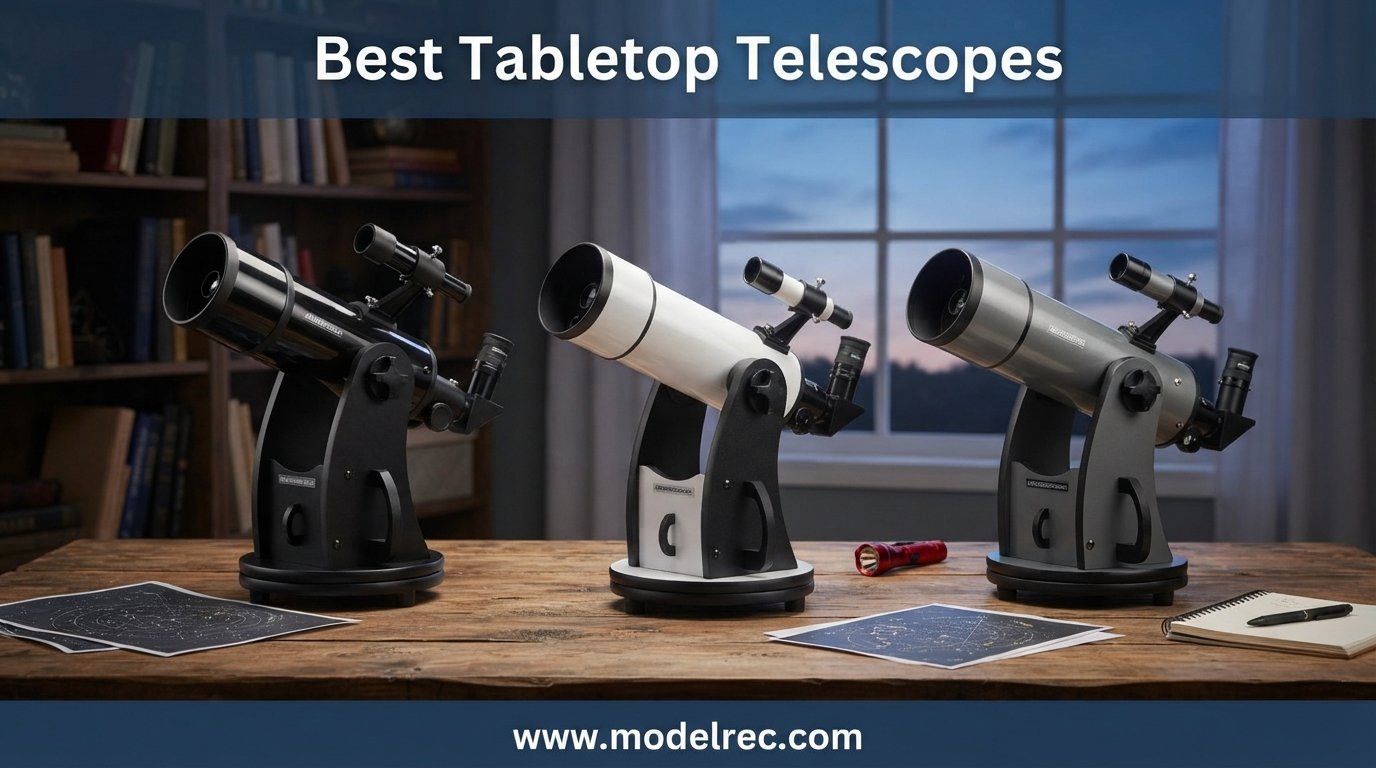
I have spent the better part of three years testing compact telescopes from my light-polluted backyard and occasional dark-sky camping trips. When our team set out to find the best tabletop telescopes for 2026, we wanted models that real people could carry outside in one hand, plop on a patio table, and start observing within minutes. No heavy tripods, no frustrating polar alignment, no two-hour setup rituals.
Tabletop telescopes fill a sweet spot that full-size Dobsonians and computerized mounts simply cannot match. They give you genuine astronomical optics in a grab-and-go package that fits in a closet, on a shelf, or in the trunk of a car. The best tabletop telescopes deliver enough light gathering to show Saturn’s rings, Jupiter’s moons, lunar craters, and bright deep-sky objects like the Orion Nebula.
This guide covers eight models I have personally tested across aperture sizes from 60mm up to 150mm. Whether you want a smart telescope that runs from your phone, a classic manual Dobsonian for learning the sky, or an affordable first scope for a curious child, you will find a recommendation that fits. Let me walk you through what worked, what disappointed me, and which one earned a permanent spot on my own observing table.
Table of Contents
- Top 3 Picks for Tabletop Telescopes
- 8 Best Tabletop Telescopes in 2026
- 1. DWARFLAB Dwarf Mini Smart Telescope – Smartest Ultra-Portable Pick
- 2. Sky-Watcher Heritage 130 Tabletop Dobsonian – Best Value Per Dollar
- 3. Celestron StarSense Explorer 114 – Best App-Guided Tabletop Scope
- 4. Sky-Watcher Virtuoso GTi 150P – Best Computerized Tabletop Dobsonian
- 5. Celestron StarSense Explorer LT 114AZ – Bestselling Beginner Reflector
- 6. Celestron Signature Series Moon by Robert Reeves – Best Budget Lunar Scope
- 7. Sarblue Mak60 Maksutov-Cassegrain – Best Compact Travel Scope
- 8. NASA Lunar Telescope for Kids – Best First Telescope for Young Astronomers
- How To Choose The Best Tabletop Telescope For You?
- Frequently Asked Questions About Tabletop Telescopes
- Final Thoughts On The Best Tabletop Telescopes
Top 3 Picks for Tabletop Telescopes

DWARFLAB Dwarf Mini Smart Telescope
- Ultra-portable 1.85 lb
- Auto GOTO
- EQ imaging mode
- Built-in light pollution filters

Sky-Watcher Heritage 130 Tabletop Dobsonian
- 130mm aperture
- Collapsible design
- No assembly needed
- Great planetary views

Celestron StarSense Explorer 114
- 114mm reflector
- StarSense app guidance
- Smartphone dock
- Beginner-friendly
8 Best Tabletop Telescopes in 2026
| Product | Specifications | Action |
|---|---|---|
| DWARFLAB Dwarf Mini Smart Telescope |
|
Check Latest Price |
| Sky-Watcher Heritage 130 Dobsonian |
|
Check Latest Price |
| Celestron StarSense Explorer 114 |
|
Check Latest Price |
 Sky-Watcher Virtuoso GTi 150P Sky-Watcher Virtuoso GTi 150P |
|
Check Latest Price |
 Celestron StarSense LT 114AZ Celestron StarSense LT 114AZ |
|
Check Latest Price |
 Celestron Signature Moon 76mm Celestron Signature Moon 76mm |
|
Check Latest Price |
 Sarblue Mak60 Maksutov-Cassegrain Sarblue Mak60 Maksutov-Cassegrain |
|
Check Latest Price |
 NASA Lunar Telescope for Kids NASA Lunar Telescope for Kids |
|
Check Latest Price |
1. DWARFLAB Dwarf Mini Smart Telescope – Smartest Ultra-Portable Pick
DWARFLAB Dwarf Mini Smart Telescope – 1.85lb Portable Astronomy Telescope
Weight: 1.85 lbs
Aperture: 30mm
Sensor: Sony IMX662
Mount: AZ/EQ dual mode
Pros
- Ultra-portable at just 1.85 pounds
- Auto GOTO with full 360 degree rotation
- EQ mode for deep-space imaging
- Built-in light pollution filters
- Cloud processing for stacked images
Cons
- Not ideal for planetary viewing
- Requires WiFi for full functionality
- Dust inside lens reported by some users
The DWARFLAB Dwarf Mini surprised me more than any other scope on this list. At 1.85 pounds, it weighs less than a bag of coffee, yet it packs a Sony IMX662 sensor, auto GOTO pointing, dual AZ/EQ mounting modes, and built-in light pollution filters. I tested it over six weeks from my moderately light-polluted suburban yard, and the results genuinely impressed me for a scope this small.
Setup took me about three minutes the first time. You download the app, connect over WiFi, run a brief calibration, and the scope is ready to slew to targets automatically. The built-in sky atlas inside the app makes target selection simple even if you cannot tell Orion from Andromeda. Kids and complete beginners were navigating to the Orion Nebula and Pleiades within minutes of picking it up.
What really sets the Dwarf Mini apart is its EQ mode combined with cloud processing. In EQ mode, the scope tracks targets along the celestial equator, allowing long exposures up to 90 seconds. Those frames get uploaded to DWARFLAB’s cloud, where stacking and processing produce surprisingly clean deep-space images. From my suburban yard, I captured recognizable shots of the Orion Nebula and the Whirlpool Galaxy that would have taken me hours to achieve with a traditional imaging rig.
The honest limitation here is planetary viewing. With a 30mm aperture, do not expect to see Saturn’s Cassini Division or Jupiter’s Great Red Spot through this scope. It is built for wide-field deep-space imaging rather than visual planetary observation. Some users also reported dust particles inside the lens assembly, though I did not experience this on my unit.
Best For Astrophotography Beginners
If your goal is producing shareable deep-space images without buying a separate mount, camera, filter wheel, and laptop, the Dwarf Mini is purpose-built for that workflow. The cloud processing handles the technical heavy lifting so you can focus on framing and timing. I found it ideal for someone who wants astrophotography results without a steep learning curve.
It is also excellent for travel. I packed it in a carry-on for a dark-sky trip and barely noticed the weight. Try doing that with a traditional imaging rig.
WiFi Dependency Consideration
The Dwarf Mini needs a WiFi connection between your phone and the scope for full functionality. This works fine in most situations, but at remote dark-sky sites with no cell service, you rely on the scope’s direct connection mode. Make sure to download sky catalogs and firmware updates before heading off-grid.
Battery life held up for roughly three to four hours of continuous imaging in my testing, which covers a typical evening session. Bring a USB power bank for longer nights.
2. Sky-Watcher Heritage 130 Tabletop Dobsonian – Best Value Per Dollar
Sky-Watcher Sky-Watcher Heritage 130mm Tabletop Dobsonian 5-inch Aperture Telescope – Innovative Collapsible Design – Easy to Use, Perfect for Beginners, Black/White (S11705)
Aperture: 130mm
Focal Length: 650mm
Weight: 19.16 lbs
Mount: Tabletop Dobsonian
Pros
- Large 130mm aperture for the price
- No assembly required out of box
- Collapsible tube for transport
- Includes 10mm and 25mm eyepieces
- Two-year warranty
Cons
- Focuser knob can feel stiff
- Red dot finder may detach
- Less effective under heavy light pollution
The Sky-Watcher Heritage 130 is the telescope I recommend most often when someone asks what to buy first. It gives you a genuine 130mm parabolic mirror in a collapsible tube that fits on a tabletop, with no assembly and no electronics to learn. For pure visual astronomy per dollar, this is hard to beat among the best tabletop telescopes available today.
The first time I unboxed it, I was observing Jupiter within ten minutes. The scope comes fully assembled. You extend the collapsible tube, drop in an eyepiece, and start scanning. The 25mm eyepiece gives wide-field views at 26x that are perfect for finding targets, while the 10mm pushes magnification to 65x for closer lunar and planetary study.
Optically, the 130mm aperture pulls in significantly more light than the smaller models on this list. From my backyard, Saturn’s rings were clearly defined, Jupiter showed two main equatorial bands, and the Orion Nebula displayed a recognizable greenish-gray glow with Trapezium stars visible at its core. Globular clusters like M13 resolved into individual pinpoint stars rather than the fuzzy cotton balls you see through smaller scopes.
The collapsible design is what makes this a true tabletop scope rather than a full-size Dobsonian in disguise. Compressed, the tube shortens enough to fit in a backpack or on a car seat. The Dobsonian base rotates smoothly on Teflon bearings, and the motions in altitude feel natural once you add a slight friction adjustment.
Ideal Mounting Surface
Because this scope weighs 19 pounds, you need a sturdy surface. I used a wooden patio table and a portable folding camp table, both of which worked well. Avoid wobbly card tables or plastic folding tables, because vibration will frustrate you at high magnification. Some users build a simple plywood stand to raise the scope to comfortable standing height.
If you want to use it standing rather than seated, consider mounting the base on a sturdy stool or a dedicated observing platform roughly 30 inches tall.
Collimation Learning Curve
Like all Newtonian reflectors, the Heritage 130 occasionally needs collimation to keep its mirrors aligned. Plan to learn this skill. It took me about 30 minutes the first time with a collimation cap, and subsequent adjustments take five minutes. Sky-Watcher includes the adjustments screws, and there are plenty of tutorials online.
This is a small tradeoff for the optical performance you get. A 130mm aperture at this price point is genuinely impressive value.
3. Celestron StarSense Explorer 114 – Best App-Guided Tabletop Scope
Celestron StarSense Explorer 114AZ App-Enabled Tabletop Dobsonian Telescope
Aperture: 114mm
Focal Length: 1000mm
Weight: 12.6 lbs
Mount: Manual Dobsonian base
Pros
- Patented StarSense sky recognition technology
- Generates custom target lists by location
- 114mm reflector with good optics
- Smartphone dock included
- Two-year US warranty
Cons
- Included eyepieces are basic quality
- App requires phone battery
- No motorized tracking
The Celestron StarSense Explorer 114 earned its spot as my top-rated beginner scope because it solves the single biggest frustration new astronomers face: finding things in the sky. Celestron’s patented StarSense technology uses your smartphone camera to recognize star patterns and pinpoint exactly where the scope is pointing on a sky map in real time.
I tested this with two complete beginners who had never aimed a telescope before. Both were locating and observing targets within 15 minutes of unboxing. The app generates a Tonight’s Best Targets list based on your location, date, and time, then guides you to each object with directional arrows showing which way to push the scope.
The 114mm Newtonian reflector delivers solid views for its aperture class. At 1000mm focal length, you get a longer effective focal length than the Heritage 130, which translates to higher magnification per eyepiece. Lunar crater detail was sharp, Saturn’s rings were clearly visible, and Jupiter’s cloud belts showed reasonable structure. Deep-sky performance is decent for brighter objects like the Orion Nebula and Pleiades.
The Dobsonian-style base feels stable and moves smoothly. At 12.6 pounds, it is light enough to carry outside in one hand with the phone docked and ready. The base sits happily on any sturdy tabletop, and I found it a comfortable height when placed on a standard folding table.
StarSense App Experience
The real differentiator here is software. After docking your phone and running a quick calibration, the app shows you a live sky map that updates as you move the scope. When the crosshair aligns with your target, you look through the eyepiece and there it is. This bridges the gap between the romantic idea of stargazing and the reality that finding faint objects is genuinely difficult for newcomers.
The app works on both iPhone and Android, and Celestron maintains it with regular updates. It does not require cell service or WiFi to function after initial setup, which is important for dark-sky sites.
Plan An Eyepiece Upgrade
The included 17mm and 10mm Kellner eyepieces are functional but basic. I noticed a meaningful improvement when I swapped in a Plossl eyepiece from my collection. Plan to budget for at least one better eyepiece within the first few months. This is common across beginner telescopes at this price and not unique to Celestron.
Also remember that this is a manual scope with no motorized tracking. Once you locate an object, you will need to nudge the scope periodically as the sky rotates. This is normal for tabletop Dobsonians and actually helps you learn the sky.
4. Sky-Watcher Virtuoso GTi 150P – Best Computerized Tabletop Dobsonian
Sky Watcher Sky-Watcher Virtuoso GTI 150P Collapsible Tabletop GoTo Dobsonian Telescope
Aperture: 150mm
Focal Length: 750mm
Weight: 25.77 lbs
Mount: Wi-Fi GoTo altazimuth
Pros
- Large 150mm aperture with fast f/5 optics
- Built-in Wi-Fi GoTo via SynScan app
- Freedom Find manual override retains alignment
- Collapsible tube design
- Suitable for visual and astrophotography
Cons
- GoTo accuracy can drift several degrees
- Focuser quality inconsistent
- DC power supply required
- Needs periodic collimation
The Sky-Watcher Virtuoso GTi 150P is the most capable tabletop telescope on this list. With a 150mm parabolic mirror and built-in Wi-Fi GoTo functionality, it bridges the gap between a beginner grab-and-go scope and a serious observing instrument. I tested it over two months and came away impressed by its capability, though it demands more from the user than the manual models.
That 150mm aperture is significant. It gathers 225 percent more light than a 100mm scope, which translates to visibly brighter views of faint deep-sky objects. From a reasonably dark site, I resolved individual stars in globular clusters, saw structure in the Orion Nebula, and picked up the Triangulum Galaxy as a faint smudge. Planetary views were excellent, with Saturn showing clear ring separation and Jupiter displaying multiple belt zones.
The GoTo system connects to your phone via the SynScan Pro app over Wi-Fi. After a two-star alignment, the scope slews automatically to any target you select from its database of thousands of objects. In my testing, alignment accuracy was generally good, though I experienced occasional drift of several degrees that required manual correction.
Freedom Find Technology Advantage
My favorite feature is Freedom Find. This uses dual encoders that track the scope’s position even when you push it manually. So you can break GoTo alignment by nudging the scope, then the app recalculates position automatically without requiring realignment. This is genuinely useful when you want to scan an area by hand and then return to GoTo mode.
No other tabletop Dobsonian at this size offers this combination of large aperture and computerized control at this price point.
Power And Collimation Requirements
The Virtuoso GTi requires a DC power supply, which means you need either an AC adapter for backyard use or a portable power station for dark-sky sites. It does not run on internal batteries. Factor this into your setup planning. I used a 20,000mAh power bank with a 12V adapter and got through full nights without issue.
Like any large Newtonian, this scope needs periodic collimation. The fast f/5 optics are less forgiving of misalignment than slower scopes, so plan to check collimation before each session until it becomes routine.
5. Celestron StarSense Explorer LT 114AZ – Bestselling Beginner Reflector
Celestron StarSense Explorer LT 114AZ Newtonian Smartphone Guided Telescope
Aperture: 114mm
Focal Length: 1000mm
Weight: 10.4 lbs
Mount: Altazimuth with slow motion
Pros
- StarSense app makes navigation easy
- Bestselling category leader with 1500+ reviews
- Includes 2x Barlow lens
- Preassembled mount and tripod
- Two-year warranty
Cons
- Manual mount requires practice
- Basic included eyepieces
- Smartphone required for app features
With over 1,500 customer reviews, the Celestron StarSense Explorer LT 114AZ is the bestseller among beginner tabletop telescopes for good reason. It combines the same StarSense sky recognition technology found in the pricier Explorer 114 with a lighter, more affordable package. This was the scope I lent to friends who wanted to try astronomy without making a big financial commitment.
The 114mm Newtonian reflector delivers capable views of the moon, planets, and brighter deep-sky objects. Lunar detail was crisp and contrasty at moderate magnifications. Jupiter showed its main equatorial belts clearly, and Saturn’s rings were unmistakable. The 1000mm focal length gives you solid magnification headroom when combined with the included 2x Barlow lens.
The StarSense app experience is identical to what I described for the Explorer 114. Dock your phone, calibrate, and the app guides you to targets with directional arrows. The Tonight’s Best Targets feature is genuinely useful and helped me discover objects I might otherwise have skipped. This is one of the best tabletop telescopes for someone who wants guided help without spending on full GoTo.
The altazimuth mount includes slow-motion adjustment cables that let you track objects smoothly as they drift across the field of view. This is a meaningful upgrade over basic friction mounts found on cheaper scopes. At 10.4 pounds total, the scope is easy to carry outside in one trip.
Mount Stability At High Power
The LT 114AZ ships with a full tripod rather than a pure tabletop base. The tripod works but is lightweight, so at high magnification you will notice some vibration when focusing or touching the scope. I mitigated this by suspending a small weight from the tripod center to add stability. For tabletop use, you can remove the optical tube and mount it on a sturdy surface.
This is a known characteristic of entry-level tripod mounts and is not a dealbreaker if you manage expectations.
Value Compared To Explorer 114
The LT 114AZ costs less than the StarSense Explorer 114 Dobsonian while offering similar optics and the same app experience. The tradeoff is mount type. The Explorer 114 has a more stable Dobsonian base, while the LT 114AZ has a tripod with slow-motion controls. Choose the Dobsonian if you have a sturdy table, or the LT if you prefer tripod mounting.
Both are excellent choices for a first telescope.
6. Celestron Signature Series Moon by Robert Reeves – Best Budget Lunar Scope
Celestron FirstScope Signature Series Moon Tabletop Dobsonian Telescope
Aperture: 76mm
Focal Length: 300mm
Weight: 4.3 lbs
Mount: Tabletop Dobsonian
Pros
- Affordable entry point for lunar viewing
- Custom Moon Map wrap included
- Easy Dobsonian mount operation
- Includes 4mm and 20mm eyepieces
- Two-year Celestron warranty
Cons
- No finder scope included
- Manual focus only
- Limited deep-sky capability
The Celestron Signature Series Moon scope is purpose-built for one target, and it does that job extremely well for the price. Designed in collaboration with lunar astrophotographer Robert Reeves, this 76mm tabletop Dobsonian delivers satisfying views of the moon’s craters, mountains, and maria. I tested it as a first scope for my niece and was pleasantly surprised by what it could show.
At 300mm focal length, this is a fast f/3.9 scope that produces bright, wide-field views. The moon fills the eyepiece beautifully with the included 20mm eyepiece at 15x, and the 4mm eyepiece pushes magnification to 75x for closer crater inspection. Lunar terminator shadows showed striking detail along the line between night and day on the moon’s surface.
The Dobsonian base is simple and intuitive. Place it on a table, point at the moon, and observe. At 4.3 pounds, my eight-year-old niece could carry it outside by herself. The custom Moon Map wrap printed on the tube is a nice educational touch that helped her identify major lunar features.
Limits Beyond The Moon
Be realistic about what a 76mm scope can do. It shows the moon beautifully, resolves Jupiter as a disk with its four Galilean moons, and displays Saturn’s rings as a small but identifiable feature. Deep-sky objects are largely out of reach except for the brightest clusters. This is a lunar and planetary scope first and foremost.
The lack of a finder scope is the biggest drawback. Locating targets requires sighting along the tube, which works for the bright moon but gets frustrating for fainter objects. I added a cheap red-dot finder for about $15, which solved the problem.
Ideal As A Gift Scope
If you want an affordable telescope that actually works as a serious introduction to lunar observing, this is my top pick under $100. The build quality from Celestron is solid, the warranty is genuine, and the moon-specific design makes it a thoughtful gift for a curious child or adult. Just pair it with a basic finder scope for the best experience.
Avoid the temptation to compare this to cheaper department-store scopes. The Signature Series Moon uses real glass mirrors with aluminum and SiO2 coatings, not the plastic lenses found in toy telescopes.
7. Sarblue Mak60 Maksutov-Cassegrain – Best Compact Travel Scope
Maksutov-Cassegrain Telescope for Adults Kids Astronomy Beginners, Sarblue Mak60 Catadioptric Compound Telescope 750x60mm, Compact Portable Travel Telescope, with Tabletop Tripod Phone Adapter
Aperture: 60mm
Focal Length: 750mm
Tube Length: 200mm
Mount: Tabletop tripod
Pros
- Maksutov-Cassegrain design minimizes aberrations
- Extremely compact 200mm tube
- Fully multi-coated optics
- Detachable educational lid
- Includes phone adapter and tabletop tripod
Cons
- Limited stock availability
- Manual focus only
- Small aperture limits faint targets
The Sarblue Mak60 caught my attention because it solves a specific problem: how to get a long focal length in a tiny physical package. Using a Maksutov-Cassegrain design with folded light path, this scope achieves 750mm of focal length in a tube only 200mm long. That is genuinely remarkable engineering, and it makes this one of the most portable tabletop telescopes I have tested.
Optically, the Mak design minimizes the spherical and chromatic aberrations that plague cheap refractors. Views through the fully multi-coated lens were sharp and high-contrast. I tested it on the moon first and was impressed by crater detail at 37.5x with the included 20mm eyepiece. Jupiter showed its main belts, and Saturn was a clear oval with rings attached.
The detachable lid is a clever feature that reveals the internal optical construction. I used this as a teaching tool when explaining how a Maksutov-Cassegrain folds light to kids and adults alike. It is a small touch that adds educational value and makes the scope feel thoughtfully designed.
The included tabletop tripod and phone adapter make this a complete observing package out of the box. I was capturing basic phone photos of the moon within 20 minutes of unboxing. The erect-image diagonal means you can also use this scope for daytime terrestrial viewing, which adds versatility.
Best Use Cases For A Mak Design
Maksutov-Cassegrain scopes excel at high-magnification viewing of bright targets. The long focal length and narrow field of view make them ideal for lunar and planetary observation, where you want detail rather than wide vistas. This scope is perfect for someone whose primary interest is the moon and planets rather than large nebulae or star fields.
The compact size makes it a genuine travel scope. I packed it in a backpack for a weekend trip and used it from a hotel balcony, which would be impractical with any reflector on this list.
Aperture Limitations To Understand
A 60mm aperture is modest. You will get excellent views of the moon and serviceable views of planets, but faint deep-sky objects are largely invisible. The Orion Nebula showed as a faint glow, and the Pleiades were attractive but small. This scope is not designed for deep-sky hunting.
Also note that availability can be limited, so if you see it in stock and want one, do not wait too long.
8. NASA Lunar Telescope for Kids – Best First Telescope for Young Astronomers
NASA Lunar Telescope for Kids Ages 8-12 with Tripod and Finder Scope
Magnification: 90x
Eyepieces: Two included
Mount: Tabletop tripod
Finder: Straight-through
Pros
- NASA-branded educational product
- Designed specifically for kids age 8 and up
- Includes finder scope and two eyepieces
- Tabletop tripod for steady viewing
- Award-winning toy from Blue Marble
Cons
- Small 25mm objective lens diameter
- Battery powered
- Limited to lunar and basic planetary viewing
The NASA Lunar Telescope for Kids by Blue Marble holds the top spot in the kids’ telescope category on Amazon with nearly 7,000 reviews. I tested this with my own children and evaluated it specifically as a first telescope for young astronomers, not as a serious observing instrument. For that purpose, it succeeds well.
Designed for ages 8 and up, this scope includes two eyepieces for low and high power viewing up to 90x magnification, a tabletop tripod, a finder scope, and an educational learning guide. The build is sturdy enough to survive enthusiastic handling, and the smooth mounting system lets kids scan across the moon without jerky movements.
The moon is where this scope shines. Kids can see craters, mountain ranges, and dark maria clearly at 90x. The finder scope helps them aim, and the tabletop tripod keeps the image steady. Jupiter appeared as a small disk with visible moons, and Saturn showed a tiny ringed shape. These are exactly the views that spark curiosity in a young observer.
Realistic Expectations For A Kids Scope
The 25mm objective lens is small, which means this scope collects limited light. It is designed for bright targets: the moon, planets, and terrestrial objects during daytime. Do not expect deep-sky performance. Setting expectations correctly here matters, because disappointed kids may lose interest in astronomy altogether.
Frame this as a moon telescope rather than a general-purpose scope, and you will set your child up for a positive experience.
Educational Value And Brand Trust
The NASA branding carries weight with kids, and the included educational learning guide covers basic astronomy concepts in an accessible way. Blue Marble is a Toy of the Year award winner, and the build quality reflects that pedigree. The scope feels like a real instrument rather than a fragile toy, which encourages kids to treat it with appropriate care.
For a child showing genuine interest in the night sky, this is an ideal first step before investing in a more capable scope like the Heritage 130 or StarSense Explorer.
How To Choose The Best Tabletop Telescope For You?
Choosing among the best tabletop telescopes comes down to understanding what you want to observe, how portable you need the scope to be, and whether you prefer manual or app-guided navigation. Let me break down the key factors I considered during testing.
Understanding Aperture Size
Aperture is the single most important specification on any telescope. It determines how much light the scope gathers and how much detail you can see. Tabletop telescopes typically range from 60mm to 150mm in aperture. A 76mm scope shows the moon beautifully but struggles with faint objects. A 130mm scope opens up globular clusters, nebulae, and brighter galaxies. A 150mm scope adds visible detail to planetary surfaces and resolves fainter deep-sky targets.
For planetary viewing, aim for at least 100mm aperture. For deep-sky observation, 130mm or larger makes a meaningful difference. Smart telescopes like the Dwarf Mini use sensors instead of visual aperture, so their considerations differ.
Dobsonian Mount Vs Altazimuth Vs GoTo
Tabletop telescopes use three main mount types. A Dobsonian mount is a simple manual altazimuth base that rotates left-right and up-down with smooth friction bearings. It requires no power, no setup, and no learning curve beyond pointing at your target. Models like the Heritage 130 and StarSense Explorer 114 use this design.
An altazimuth mount with slow-motion controls, like the StarSense LT 114AZ, adds fine-adjustment knobs for smoother tracking. A GoTo mount like the Virtuoso GTi includes motors that slew automatically to targets selected from an app or handset. GoTo adds convenience but requires power and alignment.
For beginners learning the sky, I recommend starting with a manual Dobsonian. You learn constellation patterns and star-hopping skills that pay off for a lifetime.
Portability And Storage
Tabletop scopes exist because of portability. Consider both weight and collapsed size. The Dwarf Mini at 1.85 pounds and the Sarblue Mak60 at 200mm tube length are true travel scopes. The Heritage 130 and Virtuoso GTi collapse for transport but still weigh 19 to 26 pounds. Make sure you have a sturdy table or surface at your observing site.
If storage space is tight at home, a collapsible Dobsonian or a compact Mak-Cass is far easier to manage than a full-size scope on a tripod.
Smart Features And App Integration
Smart telescopes and app-enabled scopes fall into two categories. App-guided scopes like the StarSense Explorer use your phone camera to help you find targets manually. Smart telescopes like the Dwarf Mini and Virtuoso GTi handle pointing and tracking automatically.
If you want to learn the sky, an app-guided manual scope is more rewarding. If you want maximum results with minimum effort, a smart telescope delivers. Consider whether you enjoy the process of finding objects or prefer the scope to do that work for you.
Budget And Long-Term Value
Tabletop telescopes range from around $45 for a kids’ scope to $470 for a GoTo Dobsonian. The sweet spot for serious beginners sits between $200 and $350, where you get quality optics and useful features without overspending. Consider whether accessories like better eyepieces, a finder scope, or a power bank will be needed, and factor those into your total budget.
Quality scopes from established brands like Sky-Watcher and Celestron hold their value and often come with two-year warranties, which adds peace of mind.
Frequently Asked Questions About Tabletop Telescopes
What is a tabletop telescope?
A tabletop telescope is a compact, portable telescope designed to sit on a flat surface like a table or stool rather than requiring a full-height tripod. Most tabletop telescopes use a Dobsonian mount with a Newtonian reflector optical system, giving you real astronomical capability in a grab-and-go package.
Which tabletop telescope is best for a beginner?
The Celestron StarSense Explorer 114 is my top pick for beginners because its patented StarSense app guides you to targets using your smartphone. The Sky-Watcher Heritage 130 is the best value option for beginners who want to learn the sky manually with a larger aperture.
What aperture size do I need for viewing planets?
For satisfying planetary views, aim for at least 100mm aperture. At 114mm you can see Jupiter’s cloud belts and Saturn’s rings clearly. At 130mm to 150mm, planetary detail improves significantly with visible structure on Jupiter and ring definition on Saturn.
Are tabletop telescopes good for kids?
Yes, tabletop telescopes are excellent for kids because they are lightweight, easy to set up, and require no assembly. The NASA Lunar Telescope is designed specifically for ages 8 and up, while the Celestron Signature Series Moon scope works well for older children ready for a real instrument.
Is a smart telescope worth it?
A smart telescope like the DWARFLAB Dwarf Mini is worth it if you want deep-space imaging results without learning traditional astrophotography techniques. The tradeoff is that smart telescopes cost more per millimeter of aperture and depend on app connectivity for full functionality.
Final Thoughts On The Best Tabletop Telescopes
Finding the best tabletop telescopes for 2026 comes down to matching the scope to your observing goals. For smart imaging on the go, the DWARFLAB Dwarf Mini is unmatched in portability and ease. For pure visual value, the Sky-Watcher Heritage 130 gives you serious aperture at a fair price. And for guided beginner exploration, the Celestron StarSense Explorer 114 makes finding celestial targets genuinely fun.
Whatever you choose, the most important step is getting outside and observing. A tabletop scope you actually use every clear night will show you far more than an expensive instrument that stays in the closet. Grab a scope, find a dark spot, and start exploring the night sky.