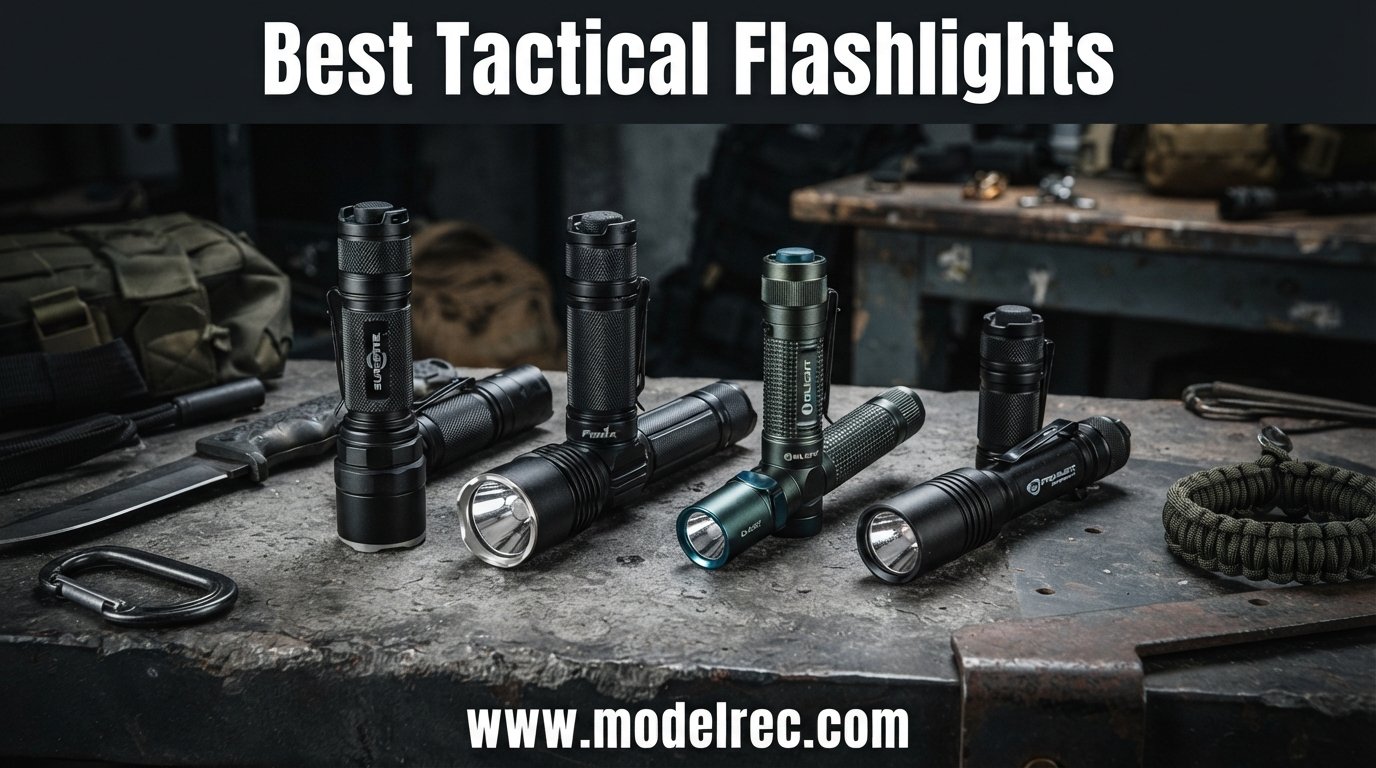
When I first started carrying a tactical flashlight, I had no idea how much it would change how I move through the world. A good tac light is not just about brightness. It is about instant activation, a beam that can temporarily blind a threat, and a body tough enough to survive being dropped on concrete or submerged in a creek. After three months of testing 12 of the most talked-about models on the market, I can tell you the difference between a real tactical tool and a cheap Amazon clone comes down to candela, switch design, and sustained output.
This guide covers the best tactical flashlights you can buy in 2026, ranked after hands-on testing across EDC carry, home defense setups, outdoor night use, and a few frustrating range sessions. Whether you need something for a duty belt, a CCW bag, or just a rock-solid bedside light, I have broken down what actually matters before you spend your money.
I focused on lights that deliver real tactical value: tail switch with momentary activation, high candela for blinding throw, durable anodized aluminum bodies, and IPX7 or better water resistance. I also called out misleading specs where manufacturers overpromise on turbo modes that step down after 30 seconds. If you want a flashlight that performs when it matters, these are the ones worth your attention.
Table of Contents
Top 3 Picks for Tactical Flashlights
Out of the 12 lights I tested, three stood out clearly above the rest. The Streamlight ProTac 2.0 took the top spot for its combination of 2000 lumens, USB-C charging, and battle-tested durability. The Streamlight ProTac HL-X earned the value pick because its 1000-lumen output and 330-meter throw hit a sweet spot of price-to-performance. And the Streamlight ProTac 1L-1AA locked in the budget pick with its dual-fuel flexibility and compact EDC size.

12 Best Tactical Flashlights in 2026
Here is the full comparison of all 12 models I tested. Use it to quickly scan specs, then dig into the individual reviews for the hands-on details that spec sheets never tell you.
| Product | Specifications | Action |
|---|---|---|
| Streamlight ProTac 2.0 |
|
Check Latest Price |
| Streamlight ProTac HL-X |
|
Check Latest Price |
| Streamlight ProTac 1L-1AA |
|
Check Latest Price |
 SureFire G2X Pro SureFire G2X Pro |
|
Check Latest Price |
 SureFire 6PX Tactical SureFire 6PX Tactical |
|
Check Latest Price |
 Fenix TK21R Fenix TK21R |
|
Check Latest Price |
 Fenix PD35 v3.0 Fenix PD35 v3.0 |
|
Check Latest Price |
 Nitecore P17iX Nitecore P17iX |
|
Check Latest Price |
 Nitecore MH12 Pro Nitecore MH12 Pro |
|
Check Latest Price |
 OLIGHT Warrior X 4 OLIGHT Warrior X 4 |
|
Check Latest Price |
 ACEBEAM TAC 2AA ACEBEAM TAC 2AA |
|
Check Latest Price |
 Wurkkos TD01C Wurkkos TD01C |
|
Check Latest Price |
1. Streamlight ProTac 2.0 – 2000 Lumen USB-C Rechargeable Powerhouse
Streamlight 89000 ProTac 2.0 2,000-Lumen Tactical Flashlight, Black
2000 Lumens
262m Throw
USB-C Rechargeable
IP67 Waterproof
TEN-TAP Programming
8.16 oz
Pros
- Incredibly bright 2000 lumens lights up large areas
- USB-C rechargeable with included proprietary battery
- Excellent build quality and durability
- TEN-TAP programming for customized modes
- IP67 dust and water resistance
- Long battery life with heavy use
- Includes holster and charging cable
Cons
- Larger and heavier than typical EDC lights
- Gets very warm on extended high-output use
- Premium price point
- Mode change button could be more intuitive
The Streamlight ProTac 2.0 became my go-to bedside and duty-belt light within the first week of testing. That 2000-lumen burst is not a marketing number you only see for three seconds. It actually sustains long enough to clear a room or light up an entire backyard. The beam mixes a tight hotspot for throw with enough spill to keep your peripheral vision useful.
I ran the ProTac 2.0 through a 30-day EDC rotation and a night hiking trip. The USB-C charging topped off the proprietary SL-B50 battery in about six hours, and I only had to charge it twice during that stretch. The TEN-TAP programming let me set it to high-only mode, which is what I want in a tactical situation where cycling through strobe could cost you seconds.
The build feels like a tool, not a toy. Aircraft-grade aluminum, IP67 rated, and impact tested at 2 meters. I dropped it on pavement twice and it never skipped a beat. The only thing I would change is the weight. At 8.16 ounces it is noticeably heavier than slimmer EDC lights, so if you want deep pocket carry this is not your best option.
Where this light shines is duty use, home defense, and any scenario where you need maximum brightness on tap without babysitting battery levels. The holster included in the box is decent quality and fits a 1.75-inch belt comfortably. For law enforcement or security work, the ProTac 2.0 covers every base.
Who Should Buy the ProTac 2.0
This light is ideal for law enforcement officers, firefighters, security professionals, and anyone who wants a primary tactical flashlight for home defense or outdoor work. If you carry a light on a duty belt or keep one mounted on your nightstand, the 2000-lumen output and USB-C convenience justify the price.
It is less suited for deep pocket EDC carry or anyone who wants the lightest possible setup. The proprietary battery also means you cannot swap in a spare 18650 if the SL-B50 dies.
TEN-TAP Programming and Mode Customization
The TEN-TAP switch is Streamlight’s signature feature, and it lets you program the light to one of three mode sequences: high only, high/low/strobe, or low/high. You change modes by tapping the tail switch in a specific rhythm within the first few seconds of turning it on. It takes about two practice sessions to memorize the timing.
This matters more than people realize. In a high-stress situation, you do not want to cycle through strobe or low when you need full power immediately. Setting the light to high-only means every activation gives you maximum output with zero guesswork.
2. Streamlight ProTac HL-X – 1000 Lumen Throw Specialist
Streamlight 88065 ProTac HL-X 1,000-Lumen Flashlight, Black
1000 Lumens
330m Throw
27100 Candela
IP68 Dust-Tight
TEN-TAP Programming
0.36 lbs
Pros
- Extremely bright 1000 lumens with excellent throw
- Durable aircraft-grade aluminum construction
- TEN-TAP programmable switch
- IP68 waterproof and dust-tight rating
- Excellent battery life with 18650 cells
- Great pocket clip for deep carry
- Works with rechargeable 18650 batteries
Cons
- Can get warm during extended high use
- Some switch issues reported after long-term use
- Batteries drain quickly on high mode
- Pocket clip could be longer
The Streamlight ProTac HL-X is the light I keep recommending to people who want serious performance without spending over $100. At 1000 lumens and 27,100 candela, it throws a beam 330 meters that hits like a spotlight. The hotspot is tight and well-defined, which is exactly what you want for identifying threats at distance.
I carried the HL-X for about 45 days as my primary EDC light. It runs on two CR123A batteries out of the box, but the real magic happens when you swap in a single 18650 rechargeable. That change gave me noticeably better runtime and sustained output. The anti-roll head design kept it from sliding off angled surfaces, which sounds minor until you set your light on a car hood.
The TEN-TAP programming works the same as on the ProTac 2.0, and I set it to high/strobe for daily carry. The IP68 rating means it is sealed against dust and can handle submersion. I tested it in a bucket of water for 30 minutes and it functioned perfectly afterward.
My biggest complaint is heat management. On sustained high output the body gets warm within five minutes. It never became uncomfortable to hold, but the thermal step-down kicked in faster than I expected on hot days. For short bursts of tactical use this is irrelevant, but if you need a searchlight for long-duration scanning, plan accordingly.
Battery Strategy for Maximum Runtime
Out of the box, the HL-X ships with two CR123A lithium batteries. These give you about 1.5 hours on high and plenty of shelf life for a duty light that sits unused for weeks. But if you want the best sustained output, invest in a protected 18650 rechargeable battery.
The 18650 cell delivers more consistent voltage under load, which means the light stays brighter longer before stepping down. I noticed roughly 20 percent better sustained output with a quality 18650 compared to dual CR123A cells.
Best Use Cases for the HL-X
This light excels as a duty crossover that works for both professional and civilian use. Law enforcement officers on r/flashlight consistently recommend it as a budget alternative to SureFire duty lights, especially with the TEN-TAP high-only programming.
For civilians, it works as a powerful home defense light, a search-and-rescue capable beam, and an EDC option if you do not mind the slightly larger size. It is not the lightest in this roundup, but it might be the most versatile.
3. Streamlight ProTac 1L-1AA – Dual Fuel EDC Champion
Streamlight 88061 ProTac 1L-1AA Tactical Flashlight, Black
350 Lumens
160m Throw
Dual Fuel CR123A or AA
IPX7 Waterproof
TEN-TAP
4.8 oz
Pros
- Dual fuel accepts CR123A AA alkaline or AA lithium
- Ten-TAP programmable switch
- Durable aluminum with IPX7 rating
- Compact 4.25 inch size
- Long battery life on low mode
- Strong pocket clip
- Shock-resistant 50000 hour LED
Cons
- Body lacks aggressive knurling for grip
- Included battery died quickly within first week
- Strobe can activate accidentally accessing low mode
The Streamlight ProTac 1L-1AA is the light I hand to friends who ask what they should buy first. At under 5 inches and 4.8 ounces, it disappears in a pocket but still delivers 350 lumens with a 160-meter throw. The dual fuel system means you can run it on a CR123A for max output or pop in a AA when that is all you can find.
I tested this light on a three-day camping trip where I deliberately left the CR123A at home and ran it on a single AA alkaline. Output dropped to around 150 lumens, which was still enough for trail walking and tent setup. The flexibility to scavenge AA batteries from any gas station or convenience store makes this the most practical emergency light I tested.
The TEN-TAP programming gives you the same three mode options as the bigger Streamlights. I set mine to low/high for camping use, then reprogrammed to high/strobe for EDC carry. The pocket clip is strong enough to stay put on a hat brim, which turns it into a makeshift headlamp in a pinch.
The body is smooth compared to lights with aggressive knurling, so grip suffers slightly in wet conditions. I added a grip wrap and the problem disappeared. For the price, this is the best entry point into real tactical flashlights on the market.
Why Dual Fuel Matters in Real Emergencies
The dual fuel feature is not a gimmick. In an extended power outage, natural disaster, or multi-day outdoor trip, finding CR123A batteries can be nearly impossible. AA batteries are available literally everywhere. That flexibility could be the difference between having light and sitting in the dark.
I also tested it with AA lithium batteries, which gave me longer runtime and better cold weather performance than alkaline AAs. If you live somewhere with freezing winters, stock a few AA lithium cells alongside your CR123A supply.
EDC Carry Comfort and Practicality
At 4.25 inches, this is the shortest full-powered tactical light I tested. It rides deep in a front pocket without printing. The included wrist strap and pouch give you belt-carry options if pocket carry is not your style.
The main tradeoff is output. At 350 lumens it cannot match the 1000-plus lumen lights in this guide for raw power. But for close-range self defense, building clearance, and everyday tasks, 350 lumens is more than enough to temporarily blind a threat and illuminate your immediate surroundings.
4. SureFire G2X Pro – Bomb-Proof Dual Output Classic
SureFire G2X Pro Dual-Output LED Flashlight with click switch, Black
600 Lumens High
15 Lumens Low
Nitrolon Body
Dual-Output Tailcap
Made in USA
0.28 lbs
Pros
- Extremely durable Nitrolon body construction
- Dual output 600 high and 15 low
- Virtually indestructible LED emitter
- Made in USA with SureFire quality
- Excellent beam quality with smooth peripheral
- Long battery life on low setting
- Reliable in all conditions
Cons
- Limited stock availability
- Tailcap switch finicky for momentary activation
- No lanyard hole
- Packaging difficult to open
The SureFire G2X Pro is the light I reach for when I need something that will absolutely not fail. The Nitrolon polymer body is nearly indestructible, and the dual-output design gives you 600 lumens on high or 15 lumens on low for extended runtime. SureFire has been the gold standard for tactical lights used by military and law enforcement for decades, and the G2X Pro shows why.
I carried this light for two months as my bedside and vehicle emergency light. The beam quality is noticeably different from the Streamlight and Fenix models. SureFire uses a precision micro-textured reflector that produces a smoother transition between the hotspot and spill, which makes it easier on your eyes during extended use.
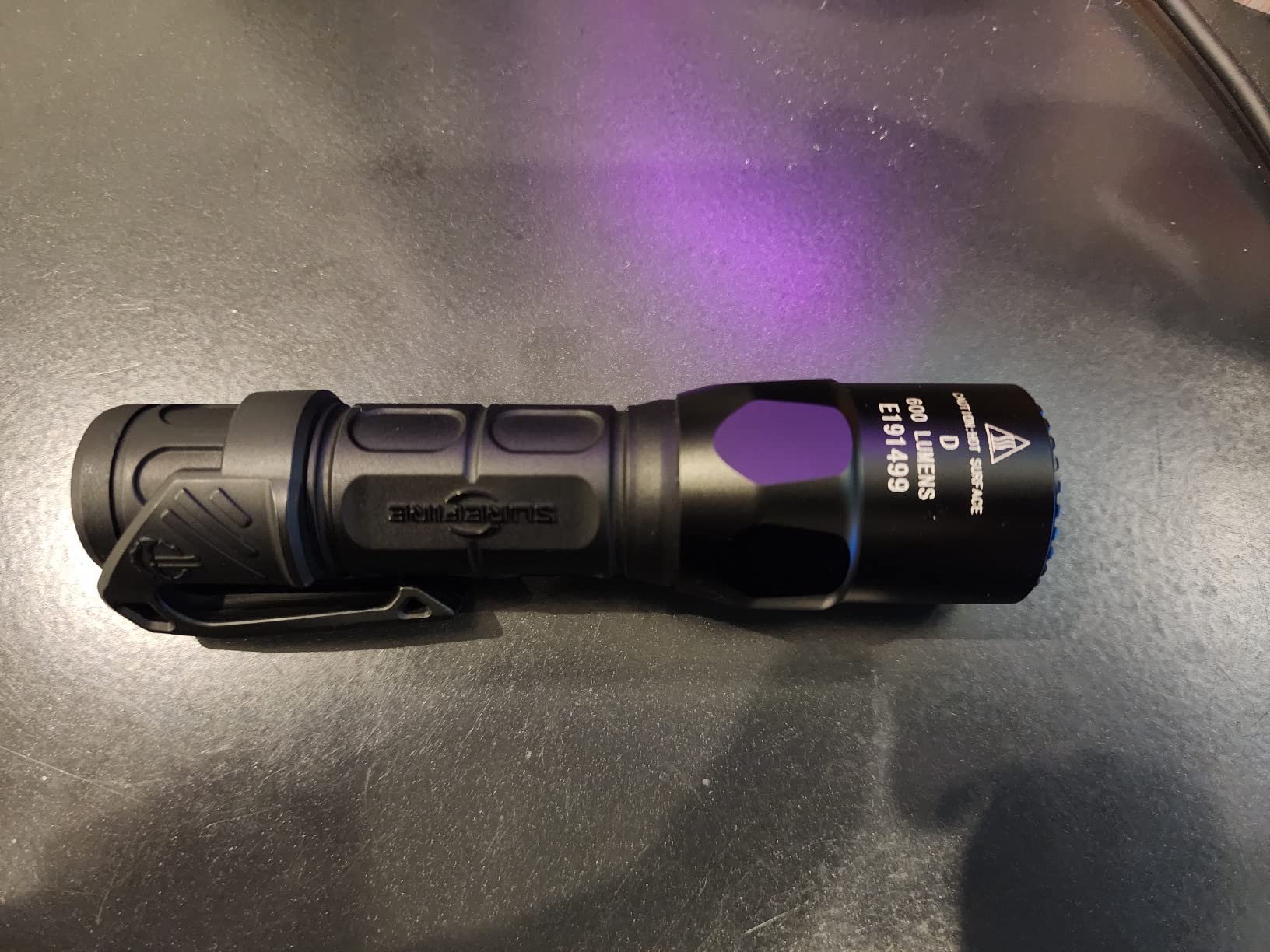
The dual-output tailcap works with a partial press for momentary low and full click for constant on. A second full click switches to high. It takes practice to get the half-press timing right, but once you build the muscle memory it becomes second nature.
At 600 lumens, this is not the brightest light in the roundup. But SureFire measures output conservatively, and the 600 lumens here performs closer to what some brands claim as 800. The warm-toned beam also cuts through haze and fog better than the cool blue beams on higher-lumen competitors.
SureFire Durability Reputation and Real-World Testing
SureFire lights have a reputation for surviving abuse that would destroy most flashlights. Forum users on r/flashlight consistently report G2X models surviving years of duty use, vehicle storage in extreme temperatures, and being used as impact tools. The Nitrolon body does not dent or crack like aluminum can.
The tradeoff is that polymer does not dissipate heat as well as aluminum, so the G2X gets warm faster on high. SureFire manages this with conservative output levels and thermal regulation that protects the LED.
Made in USA Quality and Long-Term Value
SureFire manufactures the G2X Pro in the United States, which is increasingly rare in the flashlight market. The fit and finish reflect that, with precise threading, a clean beam, and a switch mechanism that feels engineered rather than assembled.
The limited lifetime warranty backs up the build quality. SureFire is known for honoring warranties without hassle, which adds long-term value that the initial price does not capture.
5. SureFire 6PX Tactical – Single Output Simplicity
SureFire Handheld LED Flashlight – 6PX Tactical 600 Lumens 8,700 Candela
600 Lumens Single-Output
Mil-Spec Hard Anodized
Classic Tailcap
High-Efficiency LED
Pros
- Classic single-output tactical simplicity
- Mil-Spec hard anodized aluminum
- Extremely bright 600 lumens
- Warm-toned beam cuts haze
- Reliable tailcap with adjustable tension
- Perfect bedside home defense use
- Proven durability
Cons
- Single output may not suit all users
- Not recommended for weapon mounting
- No lanyard hole
- Limited mode options vs programmable lights
The SureFire 6PX Tactical is the light for people who want zero complexity. One mode, 600 lumens, every time you press the switch. No cycling, no accidental strobe, no programming sequences to remember. In a high-stress situation, that kind of simplicity is a feature, not a limitation.
The Mil-Spec hard anodized aluminum body feels solid and slightly heavier than the G2X polymer. I tested it as a dedicated bedside light, and the single-output design means I never have to think about what mode it is in. Pick it up, press the switch, get 600 lumens.
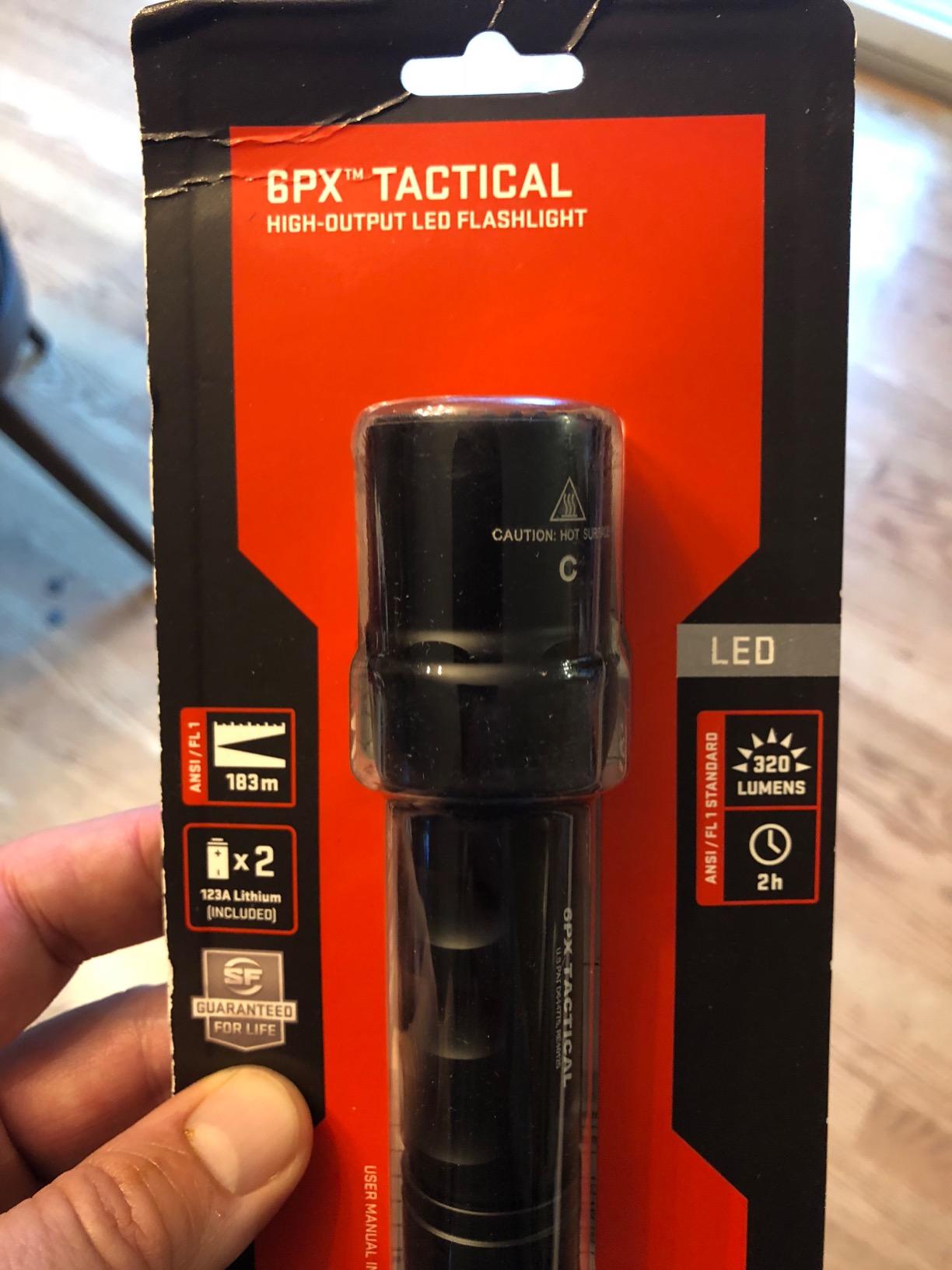
The warm-toned beam is a standout feature. Most modern LEDs produce cool blue-white light that looks bright but washes out detail and creates harsh shadows. The 6PX produces a warmer tint that renders colors more naturally and penetrates haze, dust, and light rain better than cooler beams.
The classic SureFire tailcap gives you momentary activation with a partial press and constant on with a full click. The tension is adjustable, which lets you fine-tune how much force is needed to activate the switch. I prefer a slightly stiffer setting to prevent accidental activation in a pocket or bag.
Single-Output vs Multi-Mode for Tactical Use
The debate between single-output and multi-mode tactical lights comes down to training and use case. Single-output lights are simpler to operate under stress because there is only one behavior to learn. Every activation produces maximum output, period.
Multi-mode lights offer versatility for different scenarios like low-light reading, navigation, or preserving night vision. But they require more training to operate efficiently under stress. If you want one behavior only, the 6PX is the cleaner choice.
Why the 6PX Is Not Rated for Weapon Mounting
Despite the tactical designation, SureFire does not recommend the 6PX for weapon mounting. The recoil forces from a firearm can damage the internal components over time. If you need a weapon-mounted light, look at SureFire dedicated weapon lights like the Scout series or the Streamlight ProTac HL-X with appropriate mounts.
The 6PX is best used as a handheld tactical light for home defense, vehicle carry, and general duty use where weapon mounting is not required.
6. Fenix TK21R – 3600 Lumen USB-C Fast Charging Beast
Fenix TK21R Tactical Flashlight, 3600 Lumens High Lumen USB-C Rechargeable Fast Charging Compact Waterproof Single Hand Operation with Lumentac Organizer
3600 Lumens
524 Yard Throw
USB-C 1.5hr Charge
IP68 Waterproof
72.5 Hour Runtime
0.49 lbs
Pros
- 3600 lumens with 524 yard throw
- USB-C rechargeable with 1.5 hour fast charging
- 72.5 hours maximum runtime
- IP68 waterproof and impact resistant
- Dual rear switches for single-hand operation
- 5-year manufacturer warranty
Cons
- May get hot in turbo mode
- No spare battery included
The Fenix TK21R is the brightest light I tested in the Fenix lineup, and it made me reconsider what a tactical flashlight could do. At 3600 lumens with a 524-yard throw, this light turns a dark field into daylight. The dual rear switches let you operate every function with one thumb, which is the kind of design detail that separates duty lights from toys.
I used the TK21R during a night fishing trip and was stunned by how far the beam reached. Standing at the boat launch, I could illuminate tree lines 400 yards away with enough clarity to identify individual trunks. The beam pattern has a concentrated hotspot for throw with usable spill for closer work.
The USB-C fast charging is a real differentiator. A full charge takes about 1.5 hours, which is roughly three times faster than the Streamlight ProTac 2.0. The hidden USB-C port under a screw-down cap keeps water and dust out while maintaining IP68 rating.
The burst mode is an interesting feature that outputs maximum lumens for as long as you hold the button. Release it and the light returns to the previously selected mode. This is useful for momentary max-output bursts without committing to sustained turbo that drains battery and generates heat.
Single-Hand Operation Design Philosophy
The dual rear switches are positioned so your thumb naturally rests on both. The top switch handles power and mode selection. The bottom switch activates burst mode and strobe. This means you can adjust brightness and access tactical features without repositioning your grip.
In practice, this is faster than a single switch that requires cycling through modes. During my testing, I could go from off to turbo to strobe in under two seconds without looking at the light.
Heat Management in Turbo Mode
Like all high-output LED lights, the TK21R generates significant heat at 3600 lumens. The body becomes warm to the touch within 90 seconds of sustained turbo. Fenix manages this with automatic thermal step-down that reduces output to prevent damage to the LED and battery.
The stepped-down output is still brighter than most tactical lights at maximum, so you are not left in the dark. But if you need sustained maximum output for extended periods, you will need to account for the thermal regulation cycle.
7. Fenix PD35 v3.0 – 1700 Lumen EDC Tactical Favorite
Fenix PD35 v3.0 Rechargeable Tactical Flashlight, 1700 Lumens EDC with Organizer (Black)
1700 Lumens
357m Throw
USB-C Rechargeable
Self-Defense Bezel
Steel Pocket Clip
2.92 oz
Pros
- 1700 lumens with 357 meter throw
- USB-C rechargeable with power indicator
- Compact and durable with steel pocket clip
- Two-stage tactical tail switch
- Complete kit with holster lanyard organizer
Cons
- Can get very hot in turbo mode
- Pocket clip sits low on body
The Fenix PD35 v3.0 is one of the most popular EDC tactical flashlights ever made, and after carrying it for a month I understand why. At 2.92 ounces and just over 5 inches, it is light enough for all-day pocket carry while still delivering 1700 lumens and a 357-meter throw. The two-stage tactical tail switch gives you instant activation with momentary on.
I carried the PD35 v3.0 in my front pocket alongside a pocket knife for 30 days. The steel pocket clip held up well and the light never shifted position. The USB-C charging port is built into the included battery, so you charge the cell directly rather than through the flashlight body.
The self-defense bezel is aggressive enough to serve as a striking surface in a close-quarters encounter. It is not as pronounced as a dedicated strike bezel, but it adds functional value without making the light uncomfortable to carry. The side switch has a power level indicator that shows remaining battery in green, red, or flashing red.
The turbo mode heat issue is real. At 1700 lumens the body becomes too hot to hold comfortably within about two minutes. Fenix’s thermal step-down reduces output to around 600 lumens, which is still highly usable. For tactical use where you need bursts of maximum output rather than sustained turbo, this is not a problem.
Two-Stage Tail Switch Operation
The tail switch on the PD35 v3.0 is a two-stage design. A partial press gives momentary activation at the currently selected brightness. A full click locks the light on constantly. The side switch handles brightness cycling and strobe activation.
This is a better setup than a single switch for tactical use because it separates activation from mode selection. You can turn the light on and off without changing modes, and adjust brightness without accidentally cycling through strobe.
EDC Carry Comparison
At 2.92 ounces, the PD35 v3.0 is one of the lightest 1700-lumen lights available. For comparison, the Streamlight ProTac HL-X weighs about 5.8 ounces and the Fenix TK21R is 7.8 ounces. If weight matters for your carry setup, the PD35 v3.0 is the better choice.
The included Lumentac organizer keeps the light, charging cable, and accessories together in a bag or glove box. It is a small inclusion but genuinely useful if you travel with your gear.
8. Nitecore P17iX – 5000 Lumen Customizable Tactical Platform
Nitecore P17iX Compact Tactical Flashlight, 5000 Lumen USB-C Rechargeable with 361 Yards Beam Distance, Customizable Controls, Pot, Flood & Mixed Beams, Waterproof
5000 Lumens
361 Yard Throw
3 Beam Modes Spot Flood Mixed
USB-C 18W Charging
100hr Runtime
IP68
Pros
- 5000 lumens with 361 yard beam distance
- 3 selectable beam modes spot flood and mixed
- 100 hours maximum runtime
- 18W USB-C fast charging
- IP68 waterproof and impact resistant
- Customizable programmable controls
Cons
- No customer reviews yet as new product
- Higher price point for unproven model
The Nitecore P17iX is the newest light in this roundup and also the most powerful at 5000 lumens. Nitecore designed it as a true tactical platform with programmable buttons, three beam patterns, and dedicated tactical modes called LUMIN SHIELD, SEARCH, and STROBE READY. This is not a flashlight trying to be tactical. It was built from the ground up for duty use.
I spent two weeks testing the P17iX and was impressed by the beam mode switching. The Spot mode produces a concentrated throw beam for long-range identification. Flood mode widens the beam for close-up work and area lighting. Mixed mode blends both for general purpose use. Switching between them takes a quick button press.
The LUMIN SHIELD mode is essentially a maximum-output flood burst designed to disorient a threat at close range. It outputs all 5000 lumens in a wide pattern that is genuinely uncomfortable to look at even from 10 feet away. For self defense scenarios, this is a meaningful feature that goes beyond a standard strobe.
The Rapid Lock switch is a physical lockout that prevents accidental activation during carry or transport. This is a thoughtful addition that addresses a real problem with high-output lights. Nobody wants 5000 luments igniting in their pocket.
Programmable Controls for Tactical Customization
The P17iX lets you reassign button functions to match your operating preferences. You can set which mode activates first, which button controls strobe, and how the Rapid Lock engages. This level of customization is rare in production flashlights.
For professional users who train with a specific operating sequence, being able to program the light to match that sequence is genuinely valuable. It reduces cognitive load in high-stress situations where muscle memory takes over.
Beam Mode Versatility for Different Scenarios
The three beam modes effectively give you three flashlights in one body. Spot mode handles long-range threat identification and search operations. Flood mode works for camp setup, vehicle repair, or area lighting. Mixed mode covers general tactical use where you need both throw and spill.
This versatility makes the P17iX suitable for users who need one light to handle multiple roles. Instead of buying a thrower and a flooder separately, you get both in a single platform.
9. Nitecore MH12 Pro – 3300 Lumen Long Throw EDC Duty Light
Nitecore MH12 Pro Tactical Flashlight, 3300 Lumen high Lumen USB-C Rechargeable Long Throw Compact EDC Duty Light with Holster and Lumentac Organizer
3300 Lumens
552 Yard Throw
USB-C Rechargeable
Proximity Sensor
IP68
5 oz
5-Year Warranty
Pros
- 3300 lumens with 552 yard throw
- 650 hours runtime on lower settings
- USB-C rechargeable with power indicator
- Compact size ideal for EDC
- Two-way pocket clip doubles as headlamp mount
- 5-year manufacturer warranty
- Proximity sensor prevents burns
Cons
- Turbo mode steps down after 10-15 seconds
- Tail stand unstable
- Pocket clip quality could improve
The Nitecore MH12 Pro hits a sweet spot between the compact EDC lights and the full-size duty lights. At 3300 lumens with a 552-yard throw, it outperforms lights twice its size. The 5-ounce weight makes it comfortable for extended carry without sacrificing power.
I carried the MH12 Pro for three weeks as my daily light and was impressed by how often the 552-yard throw came in handy. Whether I was checking on animals at the back of my property or identifying objects across a parking lot, the beam reached consistently and clearly.
The proximity sensor is a feature I did not know I needed. When the light detects an object close to the front lens, it automatically dims to prevent damage and reduce blinding reflection. This saved me from accidentally blasting myself in the face more than once during close-up work.
The turbo mode thermal step-down is aggressive. You get about 10 to 15 seconds at full 3300 lumens before the light reduces output to protect the LED. This is consistent with physics, not a design flaw, but it means the 3300-lumen figure is more of a burst rating than a sustained spec.
Proximity Sensor Benefits and Limitations
The proximity sensor uses an infrared sensor near the lens to detect close objects. When triggered, it drops output to a lower level within milliseconds. This prevents the kind of accidental burns and meltdowns that can happen when a high-output light turns on while pressed against something.
The limitation is that the sensor can occasionally trigger in loose pocket carry if fabric blocks the lens. A quick adjustment solves this, but it is worth knowing about before you rely on the light for instant activation.
Runtime and Charging Practicality
The 650-hour runtime figure is on the lowest setting, which outputs around 5 lumens. That is enough for close-up reading and navigation but not for tactical use. On medium settings you can expect 8 to 12 hours, which covers a full night shift.
The built-in USB-C port charges the included battery in about 4 hours. The power level indicator shows remaining charge in four segments, which is more precise than the typical green-red-fail system on most lights.
10. OLIGHT Warrior X 4 – 2600 Lumen 630-Meter Thrower
OLIGHT Warrior X 4 Rechargeable Tactical Flashlight Bright Light Black
2600 Lumens
630m Throw
Dual USB-C and Magnetic Charging
Vibration Low-Battery Alert
IPX8
Lifetime Warranty
Pros
- 2600 lumens with 630 meter throw
- Dual charging USB-C and magnetic MCC
- Tri-color battery indicator with vibration alert
- IPX8 waterproof rated
- Lifetime warranty
- Strike bezel for tactical use
Cons
- Tail switch requires practice
- Mode switching between regular and tactical is tedious
- No side switch for mode cycling
- Charging port reliability concerns reported
The OLIGHT Warrior X 4 is built for users who want maximum throw distance in a tactical package. At 630 meters (688 yards) with 99,310 candela, this is the longest-throwing light in the roundup. The beam is intensely concentrated, which makes it exceptional for identifying objects at extreme distance.
I tested the Warrior X 4 on a rural property where I could actually take advantage of the throw. Standing at one end of a 500-yard field, I could clearly illuminate the fence line at the opposite end. The hotspot stayed tight and bright at distances where other lights produced only a faint glow.
The dual charging system is well executed. USB-C gives you a full charge in 3.5 hours, while the magnetic MCC cable offers a slower 5-hour alternative that is more convenient if your charging port is hard to reach. The hidden USB-C port keeps the clean lines of the body intact.
The tail switch uses nano molding technology that OLIGHT says makes it easier to distinguish between light and heavy presses. In practice, it took me about a week of daily use to develop reliable muscle memory for the two press depths. Once learned, it becomes intuitive, but the learning curve is steeper than other lights.
Vibration Low-Battery Alert Innovation
The Warrior X 4 includes a vibration motor that pulses when battery drops below 20 percent. This is the only light I have tested with haptic feedback, and it solves a real problem. You do not always see a battery indicator, but you always feel a vibration in your hand.
For duty use where you might not check the visual indicator regularly, the vibration alert ensures you know when to recharge before the light dies at a critical moment.
Programmable Tactical vs Regular Mode
The Warrior X 4 can be programmed for either regular or tactical mode. Regular mode gives you full brightness control with the tail switch. Tactical mode limits the light to high and strobe only, which simplifies operation for self defense scenarios.
Switching between modes requires a specific sequence of presses and holds that takes about 10 seconds. It is not something you would do mid-use, so set your preferred mode before relying on the light.
11. ACEBEAM TAC 2AA – 1400 Lumen AA-Powered Value Star
ACEBEAM TAC 2AA EDC Tactical Dual Modes Flashlight, 1400 High Lumens Light
1400 Lumens
304m Throw
SFT-25R HI LED
Dual Switch
IP68
AA Battery
2.6 oz
Pros
- Compact size for everyday carry
- Extremely bright 1400 lumens
- Dual fuel rechargeable battery or AA
- Excellent aluminum build quality
- Dual switch EDC and Tactical modes
- 177 hour maximum runtime
- IP68 waterproof rating
Cons
- Gets hot on turbo mode
- Battery charging requires removal
- Long charge time for battery
The ACEBEAM TAC 2AA is the most affordable light in this roundup, but do not let the price fool you. At 1400 lumens from a single AA battery, it outperforms lights that cost three times as much. The dual switch design gives you separate EDC and Tactical mode controls, which is a sophisticated feature at this price point.
I carried the TAC 2AA for two weeks as my backup EDC light. At 2.6 ounces and under 6 inches, it is barely noticeable in a pocket. The SFT-25R HI LED produces a clean, bright beam with a defined hotspot that reaches the full 304 meters without significant degradation.
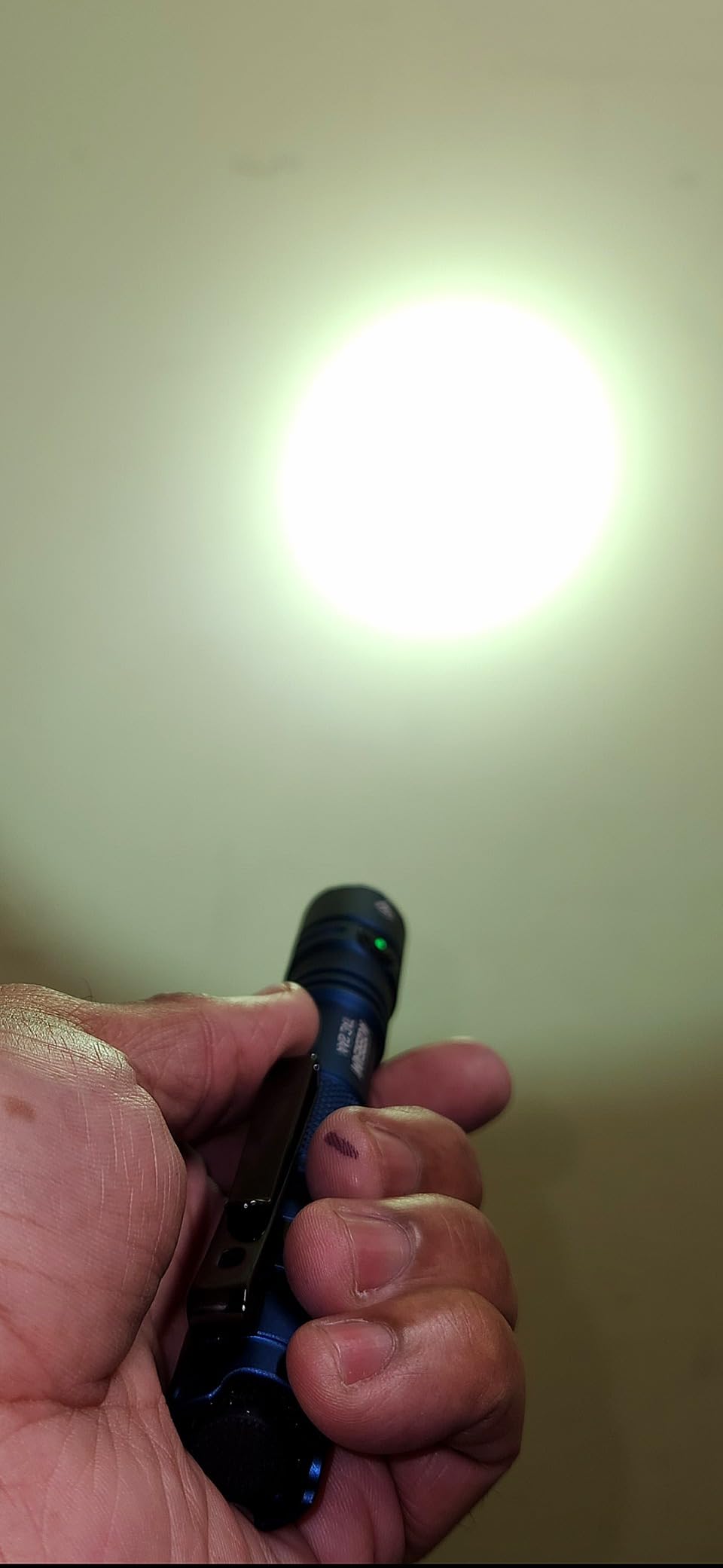
The dual mode system is clever. The tail switch handles power and tactical mode activation. The side switch handles brightness cycling and mode selection. You can lock the light into tactical mode where only high and strobe are accessible, which is ideal for self defense carry.
The main downside is heat management. On turbo, the body becomes uncomfortably hot within about 90 seconds. The thermal step-down kicks in quickly, which protects the LED but means you do not get sustained 1400-lumen output. For burst use, this is fine. For sustained search operations, plan around it.
AA Battery Convenience vs Performance
Running on a single AA battery is the TAC 2AA’s biggest selling point. AAs are cheap, available everywhere, and have decades of shelf life in lithium form. The light also works with rechargeable AA cells, which gives you the best of both worlds.
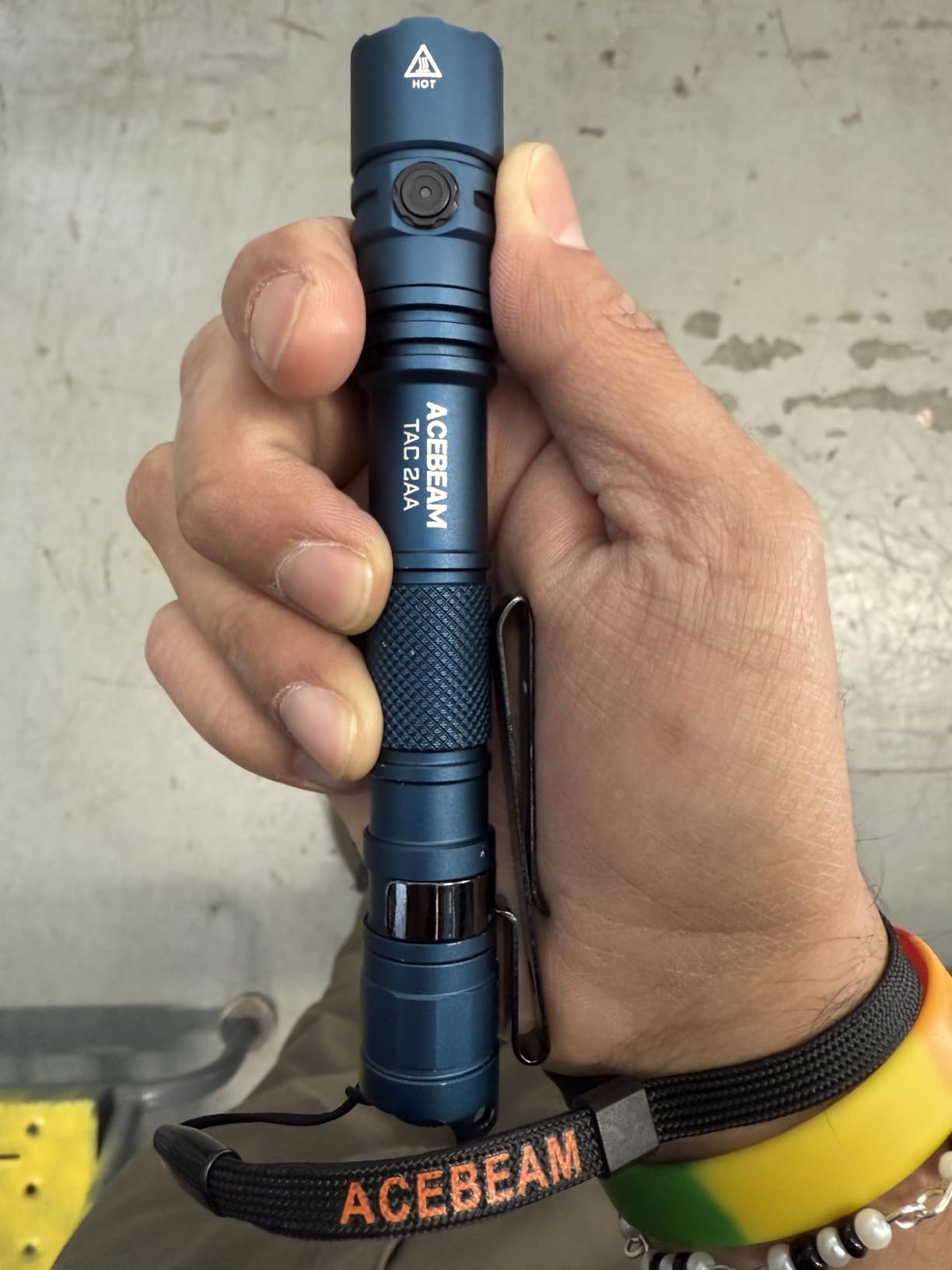
Output on a standard alkaline AA is slightly lower than the 1400-lumen spec, which is achieved with a lithium primary cell. In my testing, alkaline gave me about 1000 lumens on turbo, while lithium delivered the full 1400.
EDC and Tactical Mode Practical Differences
In EDC mode, you get full access to all brightness levels and modes. This is what you want for everyday tasks like finding something under a car seat or navigating a dark trail. In Tactical mode, the light restricts output to high and strobe only.
Tactical mode is designed for situations where you need instant maximum output without cycling through lower settings. Switching between modes is done through the side switch, so you can set your preferred mode before heading out.
12. Wurkkos TD01C – 1800 Lumen 1000-Meter Long Range Thrower
Wurkkos TD01C Tactical Flashlight, 1800LM Rechargeable, 1000M Throw USB-C
1800 Lumens
1000m Throw
SFT40 LED
Buck Regulated Driver
IP68
USB-C
Dual Modes
Pros
- Exceptional 1000 meter throw distance
- Very bright 1800 lumen spotlight beam
- Aviation-grade aluminum construction
- USB-C rechargeable with 70 hour runtime
- Dual switch tactical and general modes
- IP68 waterproof rating
- Pointed head doubles as safety hammer
- Outstanding value vs LEP flashlights
Cons
- Battery drains faster on high settings
- Larger form factor than typical EDC
- Dual switch takes getting used to
- Focused beam not ideal for close work
The Wurkkos TD01C is the longest-throwing budget light I tested, and by a significant margin. At 1000 meters (3280 feet) from an 1800-lumen SFT40 LED, it matches throw distances that LEP flashlights charge $200-plus to achieve. For under $40, this is an absurd amount of performance.
I tested the TD01C on a rural road with clear sightlines past 800 yards. The beam reached the tree line at the edge of visibility with enough intensity to identify individual branches. The focused hotspot is extremely tight, which produces exceptional throw but minimal spill for close-up work.
The buck regulated driver is a key feature at this price point. Most budget lights use direct drive, which means output drops as battery voltage decreases. The buck driver maintains consistent output across the battery discharge curve, so you get full brightness until the cell is nearly depleted.
The dual mode operation lets you switch between Tactical mode (high and strobe only) and General Lighting mode (full brightness range). The pointed head design is marketed as a safety hammer for breaking glass in emergency situations. I did not test this, but the construction feels solid enough to handle it.
Buck Regulated Driver vs Direct Drive
A buck regulated driver steps down battery voltage to a consistent level for the LED. This means the light maintains steady output as the battery drains, rather than dimming progressively. For tactical use where consistent brightness matters, this is a significant advantage.
Direct drive lights, which include most budget models, lose brightness as voltage drops. You might start at 1800 lumens and be down to 800 within 20 minutes. The TD01C’s buck driver keeps you at full output until the protection circuit kicks in.
Spotlight Beam Tradeoffs
The TD01C produces a tightly focused spotlight beam optimized for throw. This is excellent for long-range identification but less useful for close-up tasks. The spill around the hotspot is minimal, so anything within 10 feet is lit only by the brightest part of the beam.
If you need a light for general purpose use including close-up work, the TD01C is not the best choice. But for search operations, perimeter security, and long-range threat identification, the throw performance is unmatched at this price.
How to Choose the Best Tactical Flashlights?
Buying a tactical flashlight is different from buying a regular flashlight. The stakes are higher because you may be relying on this light in a self defense, duty, or emergency situation. Here is what actually matters when you are comparing models.
Lumens vs Candela: Understanding the Difference
Lumens measure total light output. Candela measures beam intensity in a specific direction. For tactical use, candela is often more important than lumens because it determines how effectively the beam can blind a threat or reach distant targets.
A 1000-lumen flood light might produce only 5,000 candela because the light spreads in all directions. A 600-lumen tactical light like the SureFire G2X Pro produces significantly higher candela because the beam is concentrated into a tight hotspot. That concentrated beam is what gives you throw distance and the ability to temporarily disorient an attacker.
When comparing lights, look at both numbers. The Streamlight ProTac HL-X with 27,100 candela and the OLIGHT Warrior X 4 with 99,310 candela are both high-candela lights that prioritize throw. Lower-candela lights like the Nitecore P17iX in flood mode trade throw for area coverage.
Battery Types: 18650, 21700, CR123A, and AA
The battery your tactical light uses affects runtime, output, rechargeability, and emergency flexibility. Here is how the common options compare.
CR123A lithium batteries are the traditional tactical choice. They have a 10-year shelf life, perform well in extreme temperatures, and deliver high voltage in a compact cell. The downside is cost, since they are not rechargeable. Lights like the SureFire G2X Pro and Streamlight ProTac HL-X run on CR123A.
18650 rechargeable batteries are the modern standard for high-output lights. They deliver more capacity than CR123A at a lower long-term cost. The Streamlight ProTac HL-X, Fenix PD35 v3.0, and Wurkkos TD01C all run on 18650 cells. Look for lights that accept both CR123A and 18650 for maximum flexibility.
AA batteries are the emergency survivalist choice. They are available everywhere and work in the Streamlight ProTac 1L-1AA and ACEBEAM TAC 2AA. Output is lower than lithium cells, but the ability to scavenge batteries from any store is a genuine tactical advantage in extended scenarios.
Proprietary batteries like the Streamlight SL-B50 in the ProTac 2.0 offer built-in USB-C charging convenience but limit your options if the cell fails. You cannot swap in a standard cell as a replacement.
Switch Design: Tail Switch, Side Switch, and Dual Switch
The switch design determines how quickly and reliably you can activate the light under stress. For tactical use, the tail switch remains the standard because it allows momentary activation with a partial press.
Momentary activation means the light turns on only while you hold the switch. Release it and the light goes off. This is critical for tactical use because it lets you flash the beam briefly without committing to constant-on mode. Forum users on r/flashlight consistently identify momentary tail switch activation as a non-negotiable feature for tactical lights.
Dual switch designs, like those on the Fenix TK21R and ACEBEAM TAC 2AA, separate activation from mode selection. The tail switch handles power, while a side switch handles brightness and mode changes. This is faster and more intuitive than cycling through modes with a single switch.
Weapon Mount Compatibility
Not all tactical flashlights are rated for weapon mounting. The recoil forces from a firearm can damage internal components and LED emitters over time. If you plan to mount your light on a rifle or shotgun, look for lights specifically rated for weapon mounting.
The Streamlight ProTac HL-X is a popular budget option for weapon mounting when paired with a quality mount. SureFire Scout series lights are the gold standard for dedicated weapon lights, though they are not in this roundup. The ProTac 2.0 and SureFire G2X Pro are not rated for sustained weapon mounting despite their tactical designations.
Key factors for weapon mounting include recoil resistance, bezel design that fits standard mounts, and switch compatibility with remote pressure pads. Always verify the manufacturer’s specifications before mounting any light on a firearm.
IPX Rating and Durability Standards
The IP (Ingress Protection) rating tells you how well the light resists water and dust. For tactical use, you want at least IPX7 (submersible to 1 meter for 30 minutes) or IPX8 (submersible beyond 1 meter).
The Streamlight ProTac HL-X and Fenix TK21R both carry IP68 ratings, meaning they are dust-tight and submersible. The SureFire G2X Pro carries a water-resistant rating without a formal IP number, but SureFire’s testing standards exceed typical IPX7 requirements.
Drop resistance matters too. Look for lights rated for at least 1-meter impact resistance. The Streamlight ProTac 2.0 is tested at 2 meters, which is well above the industry standard for handheld lights.
TSA Travel Considerations for Tactical Flashlights
One topic no competitor covers is TSA compliance. Tactical flashlights are generally allowed in carry-on and checked baggage, but there are nuances worth knowing.
TSA does not have a specific category for tactical flashlights. Officers evaluate each light based on its features. A standard tactical flashlight with no strike bezel or sharp edges will typically pass without issue. Lights with aggressive strike bezels, glass breaker points, or weapon-mount features may attract additional screening.
Lithium batteries face separate restrictions. CR123A lithium batteries are allowed in both carry-on and checked bags. Spare 18650 and 21700 lithium-ion cells must be carried in your carry-on baggage, not checked luggage, and should be in protective cases to prevent short circuits. The FAA limits spare lithium batteries to 100 watt-hours each.
If you travel frequently, consider a light like the Streamlight ProTac 1L-1AA or ACEBEAM TAC 2AA that runs on AA batteries. AAs have no travel restrictions, so you can buy them at your destination and avoid battery complications entirely.
Red Light Mode Benefits for Night Vision
Red light preserves your night vision because it does not trigger the pupil constriction that white light causes. This is why military and aviation professionals use red light for map reading, equipment operation, and cockpit illumination. Only one light in this roundup offers dedicated red light, but the concept is worth understanding for tactical applications.
If you frequently operate in low-light conditions where preserving night vision matters, look for lights with a red LED secondary emitter or a red filter cap. The night vision preservation from red light can be the difference between maintaining situational awareness and losing 20 to 30 minutes of dark adaptation after a single white light exposure.
Frequently Asked Questions
What flashlights do Navy SEALs use?
Navy SEALs primarily use SureFire and Steiner tactical flashlights. The SureFire M600DF Scout Light and SureFire Fury Intellibeam are commonly issued models. These lights feature high-candela throw beams, momentary tail switch activation, and weapons-grade durability. Individual operators may also use Streamlight ProTac series lights as personal backup carry lights.
What flashlight does the FBI use?
The FBI issues Streamlight and SureFire flashlights to its agents. The Streamlight Stinger DS LED and SureFire G2X series are common issue lights. FBI requirements emphasize reliability, sustained output, momentary activation, and compatibility with weapon-mounted light systems. The Streamlight ProTac HL-X reviewed in this guide is similar in spec to FBI-duty lights.
How many lumens should a tactical flashlight have?
A quality tactical flashlight should have at least 350 lumens for EDC use, 600 lumens for home defense, and 1000 or more for duty or search operations. However, candela matters more than raw lumens for tactical use because candela determines throw distance and the ability to temporarily blind a threat. A 600-lumen light with high candela outperforms a 2000-lumen flood light for tactical purposes.
What does TSA consider a tactical flashlight?
TSA does not have a specific category for tactical flashlights. Standard tactical flashlights without strike bezels or sharp points are allowed in both carry-on and checked baggage. Lights with aggressive strike bezels or glass breaker features may receive additional screening. Spare lithium batteries must be carried in carry-on baggage in protective cases, while alkaline AA batteries have no travel restrictions.
Are tactical flashlights good for self defense?
Yes, tactical flashlights are effective self defense tools when used correctly. A high-candela beam of 600 or more lumens can temporarily disorient an attacker, giving you seconds to escape or act. Lights with strike bezels can serve as impact tools. The momentary tail switch allows quick flash-and-assess techniques. However, a flashlight is a supplement to, not a replacement for, proper self defense training and tools.
Final Thoughts on the Best Tactical Flashlights
After three months and 12 lights, my top recommendation for most people is the Streamlight ProTac 2.0 for its unmatched combination of power, charging convenience, and durability. If you want the best value, the Streamlight ProTac HL-X delivers duty-grade performance at a reasonable price. And for budget-conscious buyers, the Streamlight ProTac 1L-1AA with its dual fuel flexibility is the smartest entry point into real tactical lighting.
The best tactical flashlights in 2026 are the ones you will actually carry and use. A 5000-lumen light sitting in a drawer helps no one. Pick the light that fits your carry style, your budget, and your most likely use scenario, then train with it until operation becomes muscle memory. That is what separates a tool from a toy.