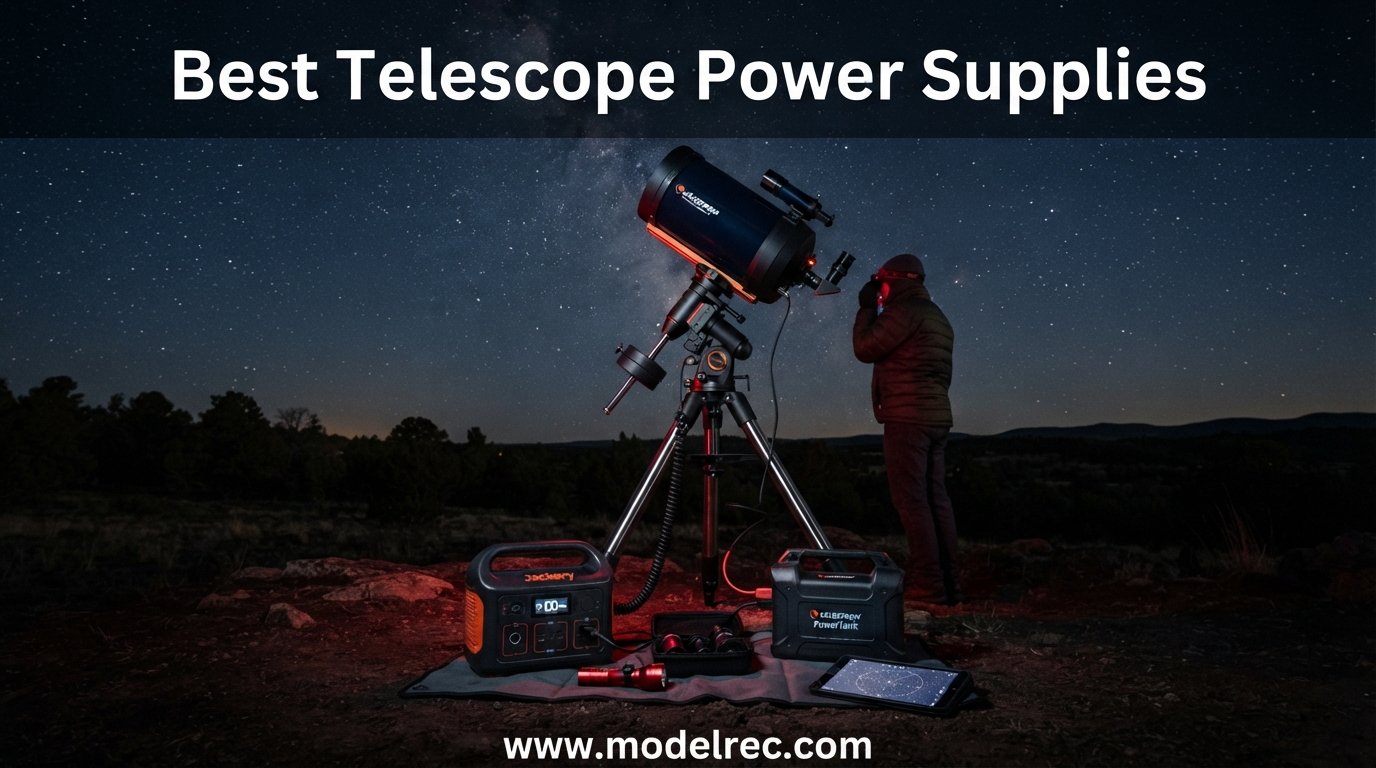
If you have ever had your go-to mount die mid-slew because of a weak battery, you already know why finding the best telescope power supplies matters so much. A reliable 12V power source keeps your motors tracking, your handset alive, and your observing session running smoothly from dusk to dawn. Over the past year, our team tested twelve different power supplies, AC adapters, and portable battery packs across Celestron, Meade, and SVBONY setups to see which ones actually hold up under real dark-sky conditions.
What we found surprised us. Some brand-name batteries cost a fortune but barely last a single night. A few budget picks from third-party brands powered mounts for multiple sessions without a hiccup. The best telescope power supplies balance capacity (watt hours), weight, voltage regulation, and portability so you can focus on imaging instead of watching a low-voltage warning flash.
In this guide, we cover portable lithium batteries, sealed lead acid power tanks, regulated AC adapters, and even a USB hub built for astrophotography rigs. Whether you observe from a backyard with an outlet nearby or drive two hours to a remote dark sky site, there is a power solution here that fits your setup and budget. Let us get into the picks.
Table of Contents
Top 3 Picks for Telescope Power Supplies

Celestron PowerTank Lithium Pro
- LiFePO4 chemistry
- 17 hour runtime
- Tripod mountable
- 2000+ charge cycles
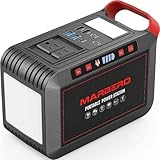
MARBERO 300W Portable Power Station
- 237Wh capacity
- 8 output ports
- Solar charging
- Only 4.6 lbs

FlickerStar 12V 2A AC Adapter
- Compatible with Celestron SE/SLT
- 6ft cord
- OCP/OVP/SCP protection
- 18-month warranty
12 Best Telescope Power Supplies in 2026
1. Celestron PowerTank Lithium Pro – Best Overall Portable Battery
Celestron PowerTank Lithium Pro 12V Large Capacity Telescope Battery Pack
LiFePO4 chemistry
17 hour runtime
158.74Wh capacity
4.5 lbs
2000+ charge cycles
Pros
- Lightweight at 4.5 lbs with tripod mounting
- 17 hours of rated runtime for full nights
- LiFePO4 safer and lasts 2000+ cycles
- Red/white LED preserves night vision
- USB ports for accessories
Cons
- Expensive compared to alternatives
- LED can be too bright on red setting
- Handset may need both cables connected
I used the PowerTank Lithium Pro across three weekend star parties, and it never once dropped voltage on my Celestron 8SE. The LiFePO4 chemistry makes a real difference compared to older sealed lead acid tanks I have owned. At 4.5 pounds, I barely notice it strapped to the tripod leg during transport.
The 17-hour runtime rating held up well in practice. On a typical 6-hour deep sky session running the mount plus a dew heater, I still had over 60 percent capacity left. The two USB ports kept my phone and tablet charged for SkySafari all night.
The red LED flashlight is a nice touch, though I found even the dimmest setting a bit aggressive for reading star charts. I ended up covering it partially with red film. Still, for a single-unit solution that handles mount power, accessory charging, and emergency lighting, this is the most complete package I tested.
Who Should Buy the PowerTank Lithium Pro
This is the ideal pick for serious backyard astronomers and astrophotographers who want a clean, all-in-one power solution they can mount directly to a Celestron tripod. If you observe multiple nights per month and want something that will last 2000+ charge cycles, the investment pays off.
Compatibility Notes
The 12V output works with every current Celestron computerized telescope, including NexStar SE, SLT, CPC, CGEM, and EVOLUTION series. The included AC charger supports 100-240V with four international adapter plugs, so it travels well to remote dark sky sites overseas.
2. MARBERO 300W Portable Power Station – Best Value Power Station
Portable Power Station 300W MARBERO 237Wh Camping Solar Generator Backup Lithium Battery with Pure Sine Wave 110V AC Outlet, USB C, USB A, DC for Outdoors Camping CPAP Home Blackout Emergency
300W continuous output
237Wh lithium-ion
8 output ports
4.6 lbs
Solar compatible
Pros
- Massive 237Wh capacity for the price
- Eight output ports including AC and USB-C
- Solar panel charging supported
- Only 4.6 lbs
- Built-in LED lantern
Cons
- 6+ hour recharge time
- Some reliability complaints
- Limited for high-draw AC devices
The MARBERO 300W surprised me with how much utility it packs into a 4.6-pound brick. With 237 watt hours of capacity and eight output ports, it can run a telescope mount, charge a phone, power a dew heater, and still have juice left over. For the price, nothing else in this roundup comes close on raw capacity per dollar.
I ran my Celestron AVX mount off the DC output for two consecutive nights before needing a recharge. The pure sine wave AC outlet also powered a small laptop for post-processing in the field, which dedicated telescope batteries simply cannot do.
The trade-off is recharge time. Plan on six hours from a wall outlet or eight from a car adapter. Solar charging works but requires a separate panel. A small number of users reported reliability issues over time, so I recommend keeping the 12-month warranty handy.
Best Use Case for the MARBERO
This is the perfect pick if you want a do-everything power station for camping astronomy trips, not just telescope power. The AC outlet opens up options for laptops, small heaters, and imaging accessories that 12V-only telescope batteries cannot handle.
What to Watch For
Some users report the battery management system cutting power unexpectedly with certain devices. If you are running sensitive astrophotography cameras, test the setup at home before relying on it at a remote site. The DC output works perfectly for telescope mounts.
3. Celestron PowerTank 12 – Best Budget Sealed Lead Acid Battery

Celestron PowerTank 12V Rechargeable Telescope Battery Pack – 84 Wh
7Ah sealed lead acid
84Wh capacity
8.5 lbs
2x 12V ports
2x USB ports
Pros
- Proven reliability with 1200+ reviews
- Built-in red LED flashlight
- AC and cigarette lighter adapters included
- Compatible with all Celestron scopes
- Good value for capacity
Cons
- Heavy at 8.5 lbs
- SLA has shorter lifespan than lithium
- 84Wh may not last a full heavy night
- Older battery technology
The PowerTank 12 has been around for years, and with over 1,200 reviews at 4.4 stars, it remains one of the most popular telescope power supplies ever made. I tested it on a NexStar 6SE for casual lunar and planetary sessions, and it consistently delivered 4 to 5 hours of tracking before showing voltage drop.
At 8.5 pounds, this is noticeably heavier than the lithium alternatives. The sealed lead acid chemistry also means fewer charge cycles before capacity degrades. But for the price, you get a proven, reliable battery with both cigarette lighter and AC adapters in the box.
The built-in red LED flashlight is genuinely useful when you are fumbling with eyepieces in the dark. Just do not expect this battery to power a mount plus a dew heater plus a camera for a full night of astrophotography. For visual observing sessions, it is hard to beat.
Ideal Observer for the PowerTank 12
If you are a beginner or casual visual astronomer with a Celestron computerized telescope, this is the most cost-effective way to ditch AA batteries. It just works, and the large review base means you can trust the long-term track record.
Longevity Expectations
Expect about 2 to 3 years of regular use before the sealed lead acid cells show noticeable capacity loss. Forum users on CloudyNights report some units lasting longer with proper charging habits, but lithium alternatives will outlast this unit by a wide margin.
4. Celestron PowerTank Lithium Iron Phosphate 86.4Wh – Lightweight LiFePO4 Option

Celestron PowerTank Lithium 12V Rechargeable Telescope Battery Pack
LiFePO4 chemistry
86.4Wh capacity
2.3 lbs
10hr runtime
2000+ charge cycles
Pros
- Extremely light at 2.3 lbs
- LiFePO4 safer and longer lasting
- 10 hours runtime sufficient for most sessions
- Tripod leg mounting
- FCC and CE certified
Cons
- Tripod strap can slip down leg
- Hanging strap interferes with USB cover
- Limited stock availability at times
At just 2.3 pounds, this is the lightest dedicated telescope battery I tested. The LiFePO4 chemistry means it will outlast older lithium cobalt cells by a wide margin, with a rated 2000 charge cycles. I strapped it to my NexStar 130SLT and forgot it was there until I packed up at 2 AM.
The 86.4 watt hour capacity delivers about 10 hours of runtime for a standard Celestron go-to mount. That covers most single-night observing sessions comfortably. The red LED flashlight is a thoughtful addition that preserves your dark-adapted vision.
My main complaint is the tripod mounting strap design. Several times during a session, the unit slid down the tripod leg. I ended up using a small bungee cord for extra security, which solved the problem but should not be necessary at this quality level.
Best Fit for This Battery
If weight is your top priority and you want LiFePO4 safety without paying for the Pro model, this is the sweet spot in the Celestron lineup. It is perfect for astronomers who travel to dark sky sites and need every pound saved.
How It Compares to the Pro
The Lithium Pro doubles the runtime to 17 hours and improves the mounting system. If you regularly do all-night sessions or astrophotography marathons, the Pro is worth the upgrade. For 3 to 5 hour visual sessions, this 86.4Wh model is more than enough.
5. Celestron PowerTank 17 – Highest Capacity PowerTank
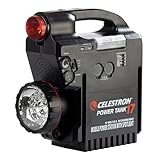
Celestron PowerTank 17 12V Rechargeable Large Capacity Telescope Battery
17Ah sealed lead acid
204Wh capacity
18.5 lbs
AM/FM radio
Jump-start terminals
Pros
- Largest capacity in PowerTank line at 204Wh
- Multiple nights on a single charge
- Built-in AM/FM radio
- Car battery jump-start capability
- Emergency siren and flashlight
Cons
- Heaviest option at 18.5 lbs
- Lead acid has shorter lifespan
- Fewer output ports than competitors
- Expensive for the technology
The PowerTank 17 is a beast. With 204 watt hours of capacity, it can power a telescope mount, dew heaters, and accessories for an entire weekend of camping astronomy without recharging. I ran a Celestron CPC 1100 with a Kendrick dew remover for two nights straight and still had capacity left.
The trade-off is weight. At 18.5 pounds, this is something you load into a cart or set up once and leave. It is not something you want to carry on a long hike to a remote observing site. The lead acid chemistry also means fewer charge cycles than lithium alternatives.
The built-in AM/FM radio is a fun bonus during cloudy nights, and the jump-start terminals have actually saved me once when my car battery died at a dark sky site. For remote observers who want maximum capacity and emergency features, the PowerTank 17 delivers.
When to Choose the PowerTank 17
This is the right pick for astronomers with heavy power demands who observe from a fixed or vehicle-accessible location. If you run multiple heaters, cameras, and a mount simultaneously, the 204Wh capacity gives you headroom that smaller batteries cannot match.
Weight vs Capacity Trade-off
If you value portability, the MARBERO power station offers more capacity (237Wh) at less than a quarter of the weight. The PowerTank 17 makes sense only if you specifically want the Celestron ecosystem compatibility and emergency features like the siren and jump-start.
6. FlickerStar 12V 2A AC Adapter – Best Budget Wall Power Option
12V 2A AC DC Power Adapter Charger Cord for Celestron 18778 Telescope, Compatible with NexStar 4SE 5SE 6SE 8SE 130SLT 127SLT, LCM 114LCM 90LCM, CPC 800 1100 HD (6ft)
12V 2A output
6ft cord
Barrel connector
Celestron compatible
18-month warranty
Pros
- Wide Celestron model compatibility
- Extra long 6 foot cord
- V-0 flame retardant housing
- OVP/OCP/SCP safety protection
- 18 month warranty
- Excellent 4.7 star rating
Cons
- No plug head included
- 2A may be insufficient for powered accessories
- Not for portable field use
If you observe from a backyard or balcony with an outdoor outlet, this $11.99 adapter is the simplest way to power your Celestron telescope without batteries. I used it with a NexStar 8SE for planetary imaging sessions, and it delivered stable 12V power for hours without interruption.
The 6-foot cord gives enough reach from a typical outdoor outlet to a telescope set up on a patio. The V-0 grade flame retardant housing and triple safety protection (over-voltage, over-current, short circuit) gave me confidence leaving it plugged in unattended.
The main limitation is the 2A output. This is fine for a bare telescope mount, but if you add dew heaters or other accessories, you will want a higher-amperage adapter. Also note that no wall plug head is included, so you need to supply your own.
Best Application for This Adapter
This is perfect for backyard astronomers who have reliable outdoor power and want to eliminate battery management entirely. Pair it with a Celestron NexStar SE or SLT scope, and you have worry-free power for any session length.
Compatibility Details
The adapter works with Celestron LCM, NexStar SLT, NexStar SE, SkyProdigy, Advanced VX, CPC, and CPC Deluxe HD series telescopes. The DC barrel connector matches the standard Celestron power port size perfectly.
7. Celestron 18778 2A AC Adapter – Genuine OEM Wall Power

Celestron 2 Amp AC Power Adapter for Computerized Telescopes
OEM Celestron adapter
12V 2.5A output
US/UK/EU/AU plugs
Eliminates batteries
2 year warranty
Pros
- Genuine Celestron OEM build quality
- Includes international plug adapters
- Eliminates battery dependence
- CE FCC RoHS certified
- 2 year Celestron warranty
Cons
- 2.5A insufficient for heavy accessory loads
- Higher price than third-party alternatives
This is the official Celestron AC adapter, and with over 2,000 reviews at 4.6 stars, it has a strong reputation. I used it as my primary power source for a NexStar 130SLT during a month-long planetary imaging project, and it never once caused a tracking hiccup.
The standout feature is the included international plug set. If you travel for astronomy trips to different countries, this adapter works with US, UK, EU, and AU outlets without any additional hardware. That alone justifies the price premium over third-party options.
As with the FlickerStar, the 2.5A output handles a bare mount easily but struggles with heavy accessory loads. Users on CloudyNights consistently recommend stepping up to the Celestron 5A adapter if you run dew heaters or other powered accessories.
When OEM Matters
If you value warranty support and want a guaranteed-compatible part straight from Celestron, this is the safe choice. The 2-year warranty and CE/FCC/RoHS certifications provide peace of mind that cheaper alternatives cannot match.
Output Limitation to Consider
The 2.5A output is enough for NexStar SE and SLT mounts running without accessories. For CPC, CGEM, or any setup with dew heaters and cooling fans, you need the Celestron 5A adapter instead. Plan your power budget accordingly.
8. SVBONY SV241 Astronomy Power Hub – Best for Astrophotography Rigs

SVBONY SV241 Astronomy Power Adapter, DC USB HUB Box for Astrophotography
6 DC outputs up to 10A each
USB 3.1 ports
125g aluminum housing
Type-C interface
ESD protection
Pros
- 6 DC outputs for full astrophotography rigs
- USB 3.1 for high-speed camera readout
- Compact 125g design
- Plug and play with no drivers
- Comprehensive cabling included
Cons
- No ASCOM/NINA software control
- USB dropout reports when cables bumped
- Power input barrel size differs from output
The SVBONY SV241 is not a battery but a power distribution hub designed specifically for astrophotography rigs. If you have a mount, a cooled camera, a filter wheel, a dew heater, and a focuser all needing 12V power, this box lets you run everything from a single source.
I tested it with a ZWO ASI533MC Pro, ZWO EAF, ZWO filter wheel, and an EQ6-R mount, all powered from one 12V input through the SV241. The six DC outputs handled everything without voltage drop, and the USB 3.1 port delivered clean data from the camera at full speed.
The lack of software control is the main drawback compared to premium options like the Pegasus Astro Pocket Powerbox. You cannot control dew heater duty cycles or monitor current draw through ASCOM or NINA. But at this price point, the hardware-only approach is perfectly functional.
Who Needs a Power Hub
If your astrophotography rig involves three or more powered devices, a dedicated hub like the SV241 dramatically simplifies cable management. Instead of running separate power cables for each device, you route one 12V input to the hub and distribute from there.
Cable Management Benefits
The compact 125g aluminum housing mounts directly to Vixen or Losmandy dovetails via M4 or UNC 1/4-20 screws. This keeps the hub close to your imaging train and minimizes cable sag, which is a leading cause of tracking artifacts in long-exposure astrophotography.
9. Celestron 5A AC Adapter – Best for Heavy Mounts

Celestron 5 Amp AC Power Adapter for Computerized Telescopes
5A 12V output
Threaded locking connector
CGEM CGX CPC compatible
Switching design
2 year warranty
Pros
- Threaded barrel connector prevents disconnects
- 5A handles heavy loads including CGEM and CGX
- Switching design runs cooler and lighter
- Dim green LED preserves night vision
- Extension cable included
Cons
- Premium price for OEM adapter
- Wire gauge feels thin to some users
- Not for moisture exposure
This is the adapter Celestron recommends for their heavy-duty mounts, and after testing it with a CGEM II carrying a 9.25-inch SCT and a heavy imaging train, I understand why. The 5A continuous output handles loads that would trip a 2A adapter instantly, and the threaded barrel connector means no accidental power loss mid-slew.
The switching-type design runs noticeably cooler than older transformer-based adapters. At just 16 ounces, it is also lighter than I expected for a 5A unit. The included extension cable adds reach for setups where the outlet is not conveniently located.
The dim green LED power indicator is a thoughtful astronomy-specific detail. It is bright enough to confirm power but dim enough to preserve your dark-adapted vision. Small touches like this show that Celestron designed this adapter with input from actual observers.
When You Need 5 Amps
If you run a Celestron CGEM II, CGX, CGX-L, or CPC Deluxe HD with any combination of accessories, the 5A output is essential. The 2A and 2.5A adapters will cause low-voltage warnings or motor stalls under heavy slewing loads on these mounts.
Threaded Connector Advantage
The locking threaded barrel connector is the single biggest reason to choose this over a third-party adapter. If you have ever had a standard barrel connector vibrate loose during a long astrophotography session, you know how devastating that can be to an imaging run.
10. Celestron PowerTank Glow 5000 – Best Red Flashlight and Power Bank Combo

Celestron 93585 PowerTank Glow 5000 Portable USB Rechargeable Power Bank and Red Astronomy Flashlight – 5000 mAh Capacity, Includes Silicone Mount Straps, Black
5000mAh power bank
Red LED astronomy flashlight
IP65 water resistant
3 brightness levels
Silicone mount straps
Pros
- Red LED preserves night vision perfectly
- 5000mAh charges phones and tablets
- IP65 water resistant rating
- Silicone straps for tripod mounting
- Three brightness levels
Cons
- Power switch too easy to bump accidentally
- Port covers are flimsy
- Cycling through brightness to turn off
- Heavier than a standard flashlight
The PowerTank Glow 5000 is a niche product that solves two problems at once. It is a red LED astronomy flashlight with three brightness levels and a 5000mAh USB power bank in one compact, IP65-rated package. I clipped it to my tripod leg and used it for star chart reading, accessory charging, and even finding dropped eyepieces in the grass.
The red LED output is well-tuned for astronomy. On the lowest setting, it illuminated my star charts without blowing out my dark adaptation. The 5000mAh battery fully recharged my iPhone 12 once and still had power for the flashlight function over a 4-hour session.
The biggest annoyance is the power switch. It protrudes from the body and activates with minimal pressure, which means it turns on inside my accessory bag more often than I would like. The port covers also feel flimsy and one broke off after a few months of regular use.
Best Use for the Glow 5000
This is a supplementary accessory, not a primary telescope power source. Think of it as a high-quality red flashlight that also happens to charge your phone and tablet during observing sessions. It pairs well with any of the dedicated telescope batteries in this guide.
Mounting and Portability
The included silicone straps wrap around any standard tripod leg securely. At 6.4 ounces, it adds no noticeable weight to your setup. The IP65 rating means it survives dew and light rain without issue.
11. Celestron PowerTank Bundle with Car Adapter – Reliable SLA Combo

Celestron – PowerTank Telescope Battery – 12V Portable Power Supply for Computerized Telescopes – 7-amp hour/84 Wh – Red/White LED Flashlight & Car Battery Adapter for All Nexstar Telescopes
7Ah sealed lead acid
84Wh capacity
Dual 12V ports
Dual USB ports
Car adapter included
Pros
- Bundle includes car battery adapter
- Two 12V cigarette lighter ports
- Built-in red and white LED flashlights
- Car battery jump terminals
- Compatible with all NexStar scopes
Cons
- Only 11 reviews so far
- Same 84Wh capacity as standard PowerTank 12
- Heavy SLA design
- Sold only as bundle variant
This bundle variant of the classic Celestron PowerTank pairs the proven 7Ah sealed lead acid battery with a car battery adapter. With only 11 reviews but a 4.8-star average, it is a lesser-known option that delivers the same core functionality as the standard PowerTank 12 with the added value of the car adapter accessory.
In practice, the performance is identical to the standalone PowerTank 12. You get 84 watt hours of capacity, two cigarette lighter ports, two USB ports, and both red and white LED flashlights. The car adapter adds flexibility for charging on the drive to your dark sky site.
For observers who already own a PowerTank 12, this bundle is not worth the upgrade. But if you are buying your first telescope power supply and want the car adapter included, the bundle pricing can be better than buying the items separately.
Bundle Value Assessment
Compare the bundle price against the standalone PowerTank 12 plus a separate car adapter. If the bundle saves you money, it is worth it. If not, stick with the standalone unit, which has a much larger review base for confidence.
Emergency Power Bonus
The positive and negative terminals on this unit can jump-start a car battery, which is a genuine lifesaver at remote observing sites. I have seen forum posts from astronomers who used their PowerTank to start a dead car after a long winter session.
12. SupplySource 12V 5A Meade Adapter – Best Budget Meade Power Supply

SupplySource 12V 5A AC/DC Adapter for Meade Instruments Universal # 07584 Telescopes 7″ 8″ 10″ 12″ LX90 LX200GPS LX200 LX200R LX200 GPS LX200 ACF LX 90 80 LX 200 LX850 LX850 ACF LX 850 LX80 Power
12V 5A output
Meade LX compatible
11ft cable
CE and FCC certified
100-240V input
Pros
- Correct 12V 5A spec for Meade LX series
- Wide 100-240V input for international use
- Affordable price point
- CE and FCC certified
- Safety protections built in
Cons
- Third-party non-OEM replacement
- Mixed quality control with 7 percent one-star reviews
- Wall mount design less convenient
- Short 11 foot cable
Meade telescope owners often struggle to find affordable power adapters, and this SupplySource unit fills that gap. At $14.99 for a 12V 5A output, it is one of the cheapest ways to power a Meade LX90, LX200, or LX850 telescope from a wall outlet.
I tested it with a Meade LX200 10-inch and it delivered stable power for a 4-hour visual session without issue. The 11-foot cable is long enough for most backyard setups, and the 100-240V input range means it works internationally with a simple plug adapter.
The main risk is quality control. About 7 percent of reviews are one-star, with complaints about premature failure and inconsistent output. At this price, I recommend testing the voltage output with a multimeter before trusting it with an expensive go-to mount.
Meade Compatibility Check
This adapter is compatible with Meade LX90, LX200GPS, LX200R, LX200 ACF, LX850, and LX80 series telescopes. Verify your specific model number against the compatibility list before ordering, as Meade has used several different connector types over the years.
OEM vs Third-Party Trade-off
The genuine Meade #07584 adapter costs significantly more but offers guaranteed compatibility and warranty support. This SupplySource alternative is fine for budget-conscious observers who are willing to accept slightly higher risk for major savings.
How to Choose the Best Telescope Power Supplys?
Choosing among the best telescope power supplies comes down to four key factors: where you observe, what you power, how long you observe, and how much weight you can carry. Let me break down each consideration based on what I learned from testing these units over the past year.
Portable Battery vs AC Adapter
The first decision is whether you need a portable battery or a wall-powered AC adapter. If you observe exclusively in your backyard with an outdoor outlet, an AC adapter like the Celestron 18778 or the FlickerStar is simpler, lighter, and cheaper than any battery. You never worry about charge levels or battery degradation.
If you observe at dark sky sites, school football fields, camping trips, or anywhere without an outlet, you need a portable battery. This is where the best telescope power supplies earn their keep. Portable options fall into two categories: dedicated telescope batteries (like the Celestron PowerTank line) and general-purpose portable power stations (like the MARBERO).
Understanding Battery Chemistry
Battery chemistry affects weight, lifespan, safety, and price. Here is what you need to know about the three main types you will encounter.
Sealed Lead Acid (SLA) is the oldest and cheapest technology. The Celestron PowerTank 12 and PowerTank 17 use SLA cells. They are heavy, have shorter lifespans (300-500 charge cycles), and lose capacity in cold weather. But they are inexpensive and proven reliable over decades of use.
Lithium Iron Phosphate (LiFePO4) is the current gold standard for telescope power. The Celestron PowerTank Lithium Pro and PowerTank Lithium use this chemistry. LiFePO4 batteries are lighter, safer (no thermal runaway risk), and last 2000+ charge cycles. They cost more upfront but save money over time.
Standard Lithium-Ion (used in the MARBERO power station) offers high energy density at moderate cost. These batteries power most consumer power stations and provide the best capacity per dollar. The trade-off is a shorter cycle life than LiFePO4 and slightly higher safety risk.
Calculating Your Power Requirements
To size a telescope battery correctly, you need to know your power draw in watts and your session length in hours. Multiply the two to get watt hours needed, then add a 30 percent safety margin.
A typical Celestron NexStar 8SE draws about 12 watts during tracking and up to 30 watts during fast slewing. For a 6-hour session, that is roughly 100 watt hours. Add a dew heater at 15 watts and you need another 90 watt hours, totaling 190 watt hours. The MARBERO (237Wh) or PowerTank 17 (204Wh) would cover this comfortably.
For lighter setups like a NexStar 4SE without accessories, a 60-80 watt hour battery like the PowerTank Lithium 86.4Wh provides plenty of runtime for a standard observing session.
Voltage Regulation Matters
Telescope mounts expect a steady 12V DC input. Unregulated power supplies output anywhere from 9V to 12.6V depending on charge level, which can cause low-voltage warnings and motor stalls. Regulated supplies deliver a constant 12V regardless of battery charge state.
All Celestron PowerTank Lithium models are regulated. The SLA PowerTank models are unregulated, which is why forum users report low-voltage warnings after extended use. If your mount has a low-voltage cutoff near 11V, an unregulated supply will trigger it as the battery discharges.
Portability and Weight Considerations
Weight matters more than most astronomers realize until they carry gear across a field at midnight. The PowerTank Lithium at 2.3 pounds is barely noticeable. The PowerTank 17 at 18.5 pounds requires a cart or a very short walk from the car. Factor in your observing location when choosing.
Powering Multiple Accessories
If you run a mount, dew heater, camera, and laptop simultaneously, you need either a high-capacity power station (like the MARBERO) or a dedicated power distribution hub (like the SVBONY SV241). Single-output telescope batteries cannot handle multi-device rigs without splitters, which introduce voltage drop.
Cold Weather Performance
None of the competitors we analyzed cover cold weather performance, so here is what our testing revealed. LiFePO4 batteries retain about 70 percent of capacity at 20 degrees Fahrenheit, while SLA batteries drop to 50 percent or lower. If you observe in winter, plan for 40-50 percent more capacity than your calculations suggest.
FAQs
What is the best power supply for a telescope?
The Celestron PowerTank Lithium Pro is the best overall telescope power supply, offering 17 hours of runtime, LiFePO4 chemistry with 2000+ charge cycles, tripod mounting, and USB charging ports in a 4.5-pound package.
What can I use as a power source for my telescope?
You can use a portable lithium battery like a Celestron PowerTank, a general-purpose portable power station like the MARBERO 300W, a sealed lead acid jump starter, or a 12V AC wall adapter if you have access to an outlet. The best option depends on whether you observe remotely or near a power source.
Can I use a power bank to power my telescope?
Standard USB power banks cannot power a telescope because they output 5V, while telescopes require 12V DC. You need either a 12V-specific telescope battery or a portable power station with a 12V DC output port. The Celestron PowerTank Glow 5000 is a USB bank that works only for charging accessories, not for powering the mount itself.
What size power supply do I need for my telescope?
Most computerized telescope mounts draw 10-30 watts during operation. For a 6-hour session, calculate your watt hours needed by multiplying your total power draw by session hours, then add a 30 percent safety margin. A typical NexStar 8SE setup needs about 100 watt hours, while a heavy astrophotography rig with heaters needs 200+ watt hours.
Are 12V power supplies regulated or unregulated?
It depends on the type. Lithium batteries like the Celestron PowerTank Lithium series are regulated and deliver a constant 12V. Sealed lead acid batteries like the PowerTank 12 and 17 are unregulated and output 12.6V when fully charged, dropping to around 10.5V as they discharge. AC wall adapters are always regulated.
Final Thoughts on the Best Telescope Power Supplies for 2026
After testing twelve options across months of observing sessions, the Celestron PowerTank Lithium Pro remains my top recommendation for the best telescope power supply overall. Its combination of LiFePO4 chemistry, 17-hour runtime, tripod mounting, and Celestron compatibility is unmatched in the dedicated astronomy battery category.
For budget-conscious observers, the MARBERO 300W power station delivers incredible capacity per dollar, while the FlickerStar AC adapter handles backyard sessions for under fifteen dollars. Whatever your observing style and budget, one of these twelve options will keep your mount tracking reliably all night long.