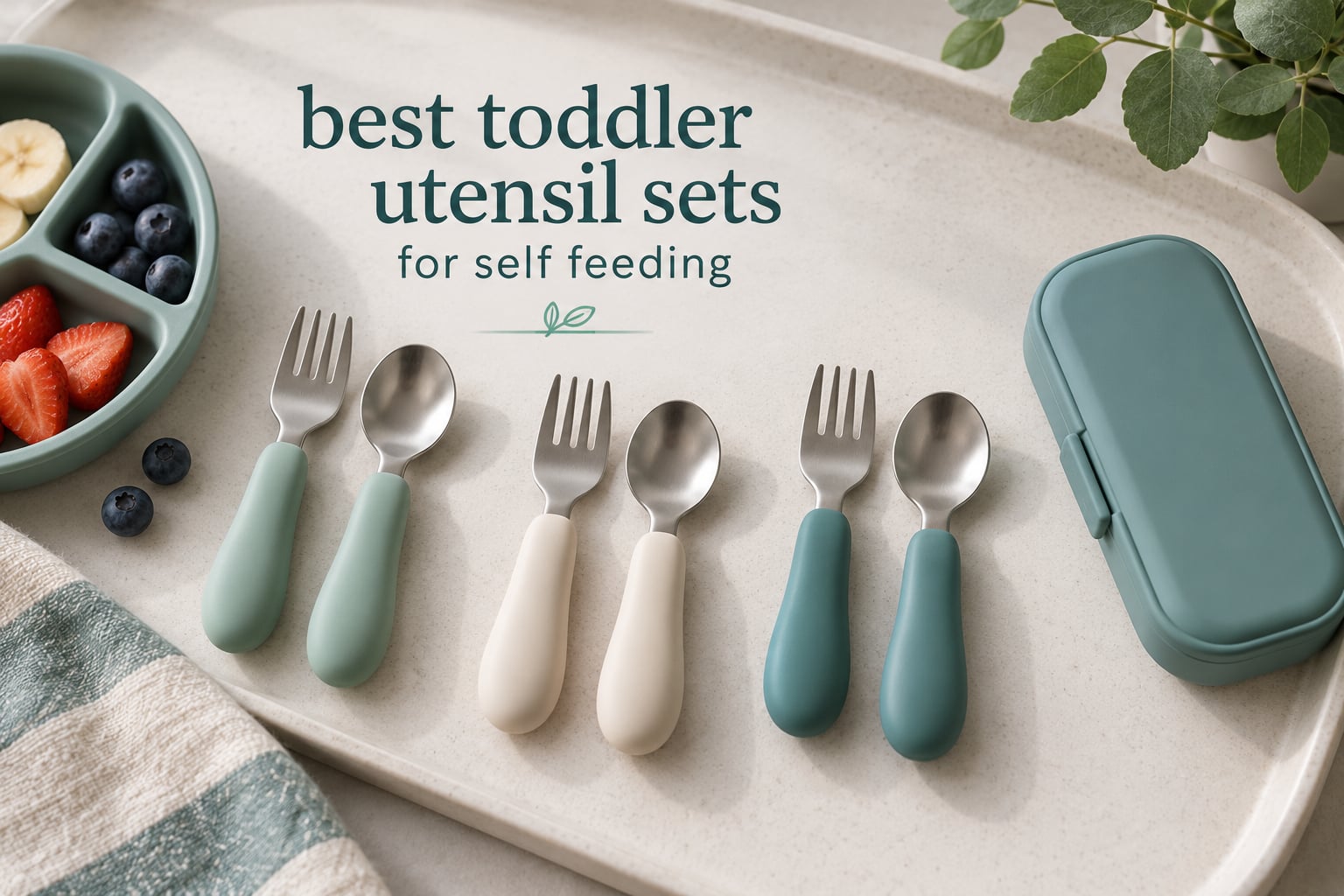
A toddler utensil set is a small fork and spoon, sometimes with a blunt knife, sized and shaped for a developing grip. The best toddler utensil sets for self feeding share two things: a short, thick handle a small hand can actually close around, and a head that is easy to get into a mouth without a fight.
Those two features matter more than anything else on the box. A beautiful set with a long handle will end up on the high chair tray, unused, because the child cannot steer it. If your toddler is at the stage where chewing things is more interesting than eating with them, our toddler toy picks cover the parallel distraction problem.
We spent weeks comparing twelve sets across material, handle geometry, grip, cleaning and how they hold up once a toddler chews on them. Every set below was chosen because it solves a specific problem, whether that is a grippy silicone handle, a wider scoop for chunkier food, or a twelve-piece count that survives daycare losses.
This guide covers everything from first spoon practice at nine months through the two-to-three-year-old stage when kids start cutting their own food. We also explain when to move past baby spoons, why two-piece silicone handles need special attention in the dishwasher, and how to tell the difference between a utensil built for parent feeding and one built for a toddler’s fist.
Table of Contents
Top 3 Best Toddler Utensil Sets for Self Feeding in October

Munchkin Raise Fork and Spoon Set
- Raised base keeps tips off the tray
- Four pieces
- Top-rack dishwasher safe
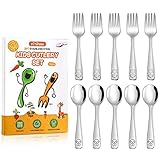
VITEVER 10-Piece Stainless Steel Set
- 18/0 stainless steel
- Five forks and five spoons
- Dishwasher safe

OXO Tot On-the-Go Fork and Spoon Set
- Weighted non-slip handles
- Deep spoon bowl
- Compact case included
All 12 Best Toddler Utensil Sets for Self Feeding in 2026
The table below covers every set in this roundup. Use it to narrow the field before reading the full reviews.
| Product | Specifications | Action |
|---|---|---|
| Munchkin Raise Fork and Spoon Set |
|
Check Latest Price |
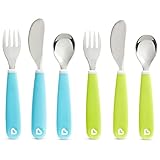 Munchkin Splash Fork, Knife and Spoon Set Munchkin Splash Fork, Knife and Spoon Set |
|
Check Latest Price |
| VITEVER 10-Piece Stainless Steel Set |
|
Check Latest Price |
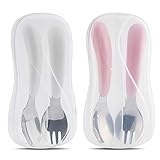 Kirecoo 2 Set With Travel Case Kirecoo 2 Set With Travel Case |
|
Check Latest Price |
 Elk and Friends Silicone Handle Set Elk and Friends Silicone Handle Set |
|
Check Latest Price |
 VITEVER 18/8 Silicone Handle Set VITEVER 18/8 Silicone Handle Set |
|
Check Latest Price |
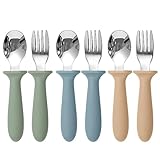 Eascrozn 6 Pack Silicone Handle Set Eascrozn 6 Pack Silicone Handle Set |
|
Check Latest Price |
 PandaEar Anti-Choke 6 Pack PandaEar Anti-Choke 6 Pack |
|
Check Latest Price |
 DRKIO 12 Piece Stainless Steel Set DRKIO 12 Piece Stainless Steel Set |
|
Check Latest Price |
| OXO Tot On-the-Go Set |
|
Check Latest Price |
 doddl Ergonomic Fork and Spoon Set doddl Ergonomic Fork and Spoon Set |
|
Check Latest Price |
 Nuby Spoons and Forks 4 Count Nuby Spoons and Forks 4 Count |
|
Check Latest Price |
How We Tested 12 Toddler Utensil Sets
We ordered each set and used it across typical toddler meals: yogurt, cut soft fruit, pasta, scrambled eggs and rice. That mix matters because a shallow spoon that handles yogurt can fail completely on rice.
For each set we scored four things. First, grip: can a small hand hold it through a full meal without the parent taking over. Second, function: does the spoon bowl hold a real scoop, and does the fork spear anything. Third, cleaning: dishwasher cycles, stain behaviour and what happens to the seam where two materials meet. Fourth, durability after weeks of being dropped, chewed and dragged across a tray.
Owner reviews shaped our verdict as much as hands-on time. We read the recurring complaints on each product, and any issue that shows up repeatedly in reviews gets named in the cons below, even when we did not reproduce it ourselves.
One caution before you buy. Almost no toddler masters a fork before 30 months. A toddler who cannot spear peas at 18 months is completely normal, and a toddler who spits food out regardless of the utensil may simply not be hungry.
1. Munchkin Raise Toddler Fork and Spoon Set: Best Overall for Self-Feeding
Munchkin® Raise™ Toddler Fork and Spoon Set, BPA Free, 4 Pack
2 forks and 2 spoons
Plastic with stainless steel heads
BPA free
Top rack dishwasher
Pros
- Raised base keeps utensil tips off the table
- Shapes well to small toddler hands
- Picks up food without much effort
- Four pieces per pack
- Top rack dishwasher safe
Cons
- Plastic handles less grippy than silicone
- Only two forks and two spoons per pack
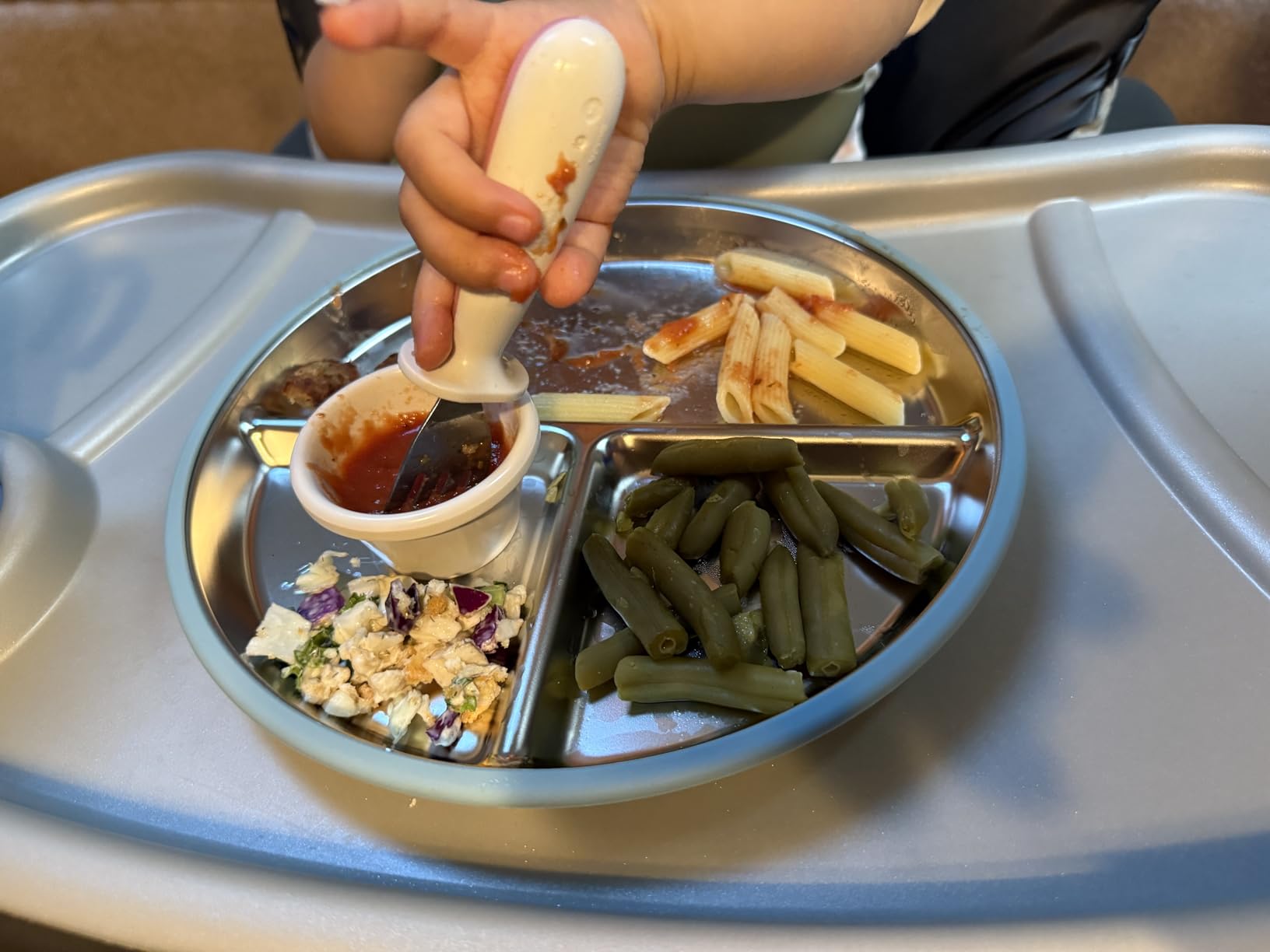
This is the set we hand to parents who want one decision made for them. Four pieces, two colours, and a detail that solves a problem most competitors ignore: the handle is wide enough that the utensil rests on its own base, so the tip never touches the tray or the floor.
That rest feature turned out to matter more than we expected. Without it, a dropped spoon carries whatever was on the high chair tray straight into the gap beside the child’s fingers. With it, the food stays off the surface.
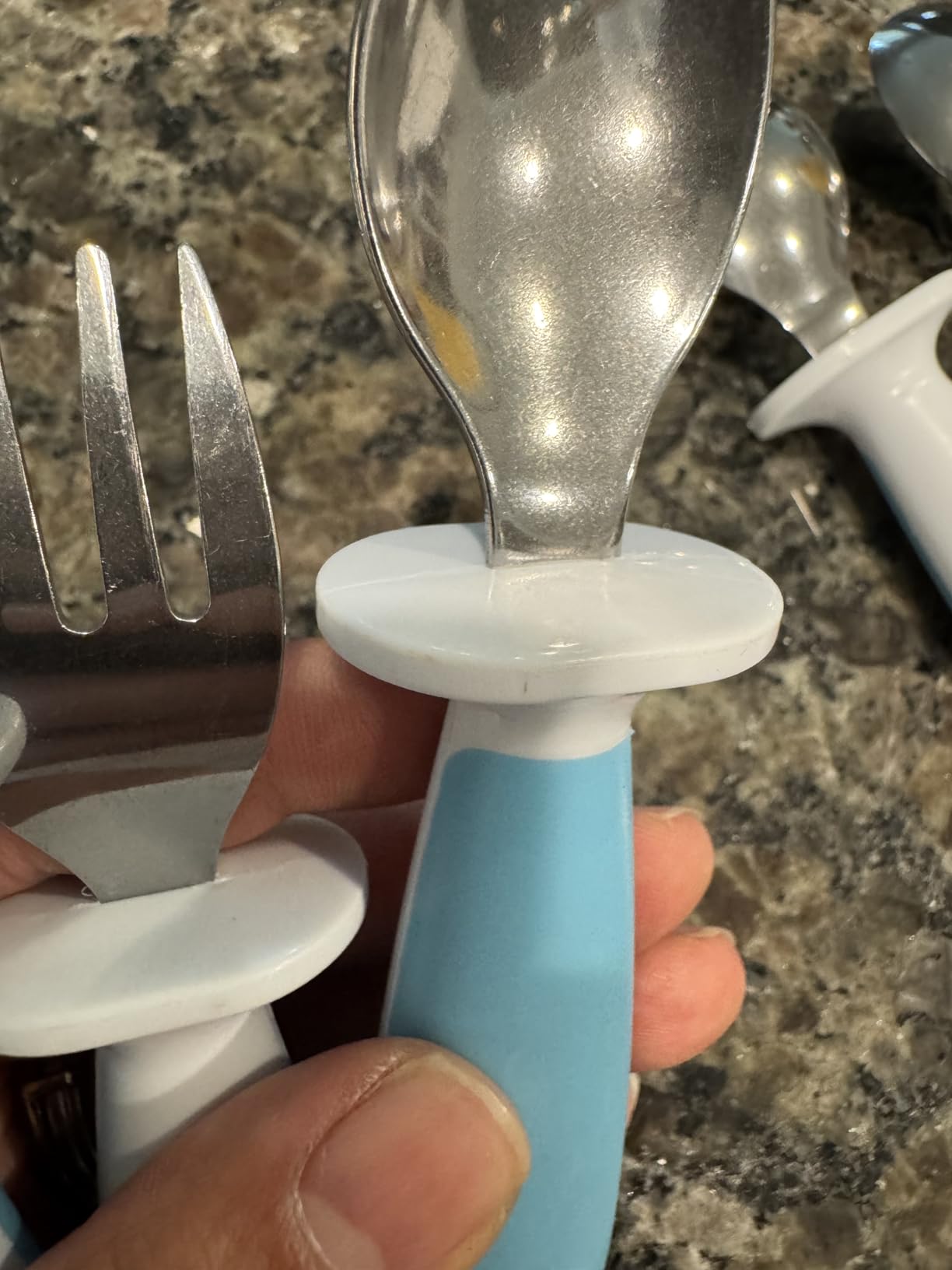
The heads are stainless steel and the handles are plastic. In our testing the spoon bowl picked up scrambled egg and soft rice without tipping over, which is more than we could say for the flat-bowl plastic sets in this price bracket.
Cleaning is straightforward. Everything went through the top rack for six weeks without warping or dulling, and the plastic wiped clean with a damp cloth after every meal.
What works well for young feeders
The wide base means a child can drop the spoon mid-meal and it lands safely, which encourages the drop-and-retrieve motion that self-feeding depends on. Most toddlers who were previously spoon-fed by an adult will start picking this one up because nothing bad happens when they let go of it.
It is also the easiest transition out of a baby spoon. The head is smaller than an adult spoon but shaped like one, so a child moving from rubber-tipped baby spoons to real cutlery has less to adjust to.
Where it falls short for some families
The plastic handle is smooth. Once a toddler’s hands are wet or greasy, grip drops noticeably compared with the silicone-handled sets in this roundup, and we saw more spoon-swiping and knocking over during the stickier meals.
It is also a two-and-two configuration, not a knife set. Once your child is cutting soft food at 18 months, you will need a second set with a blunt knife.
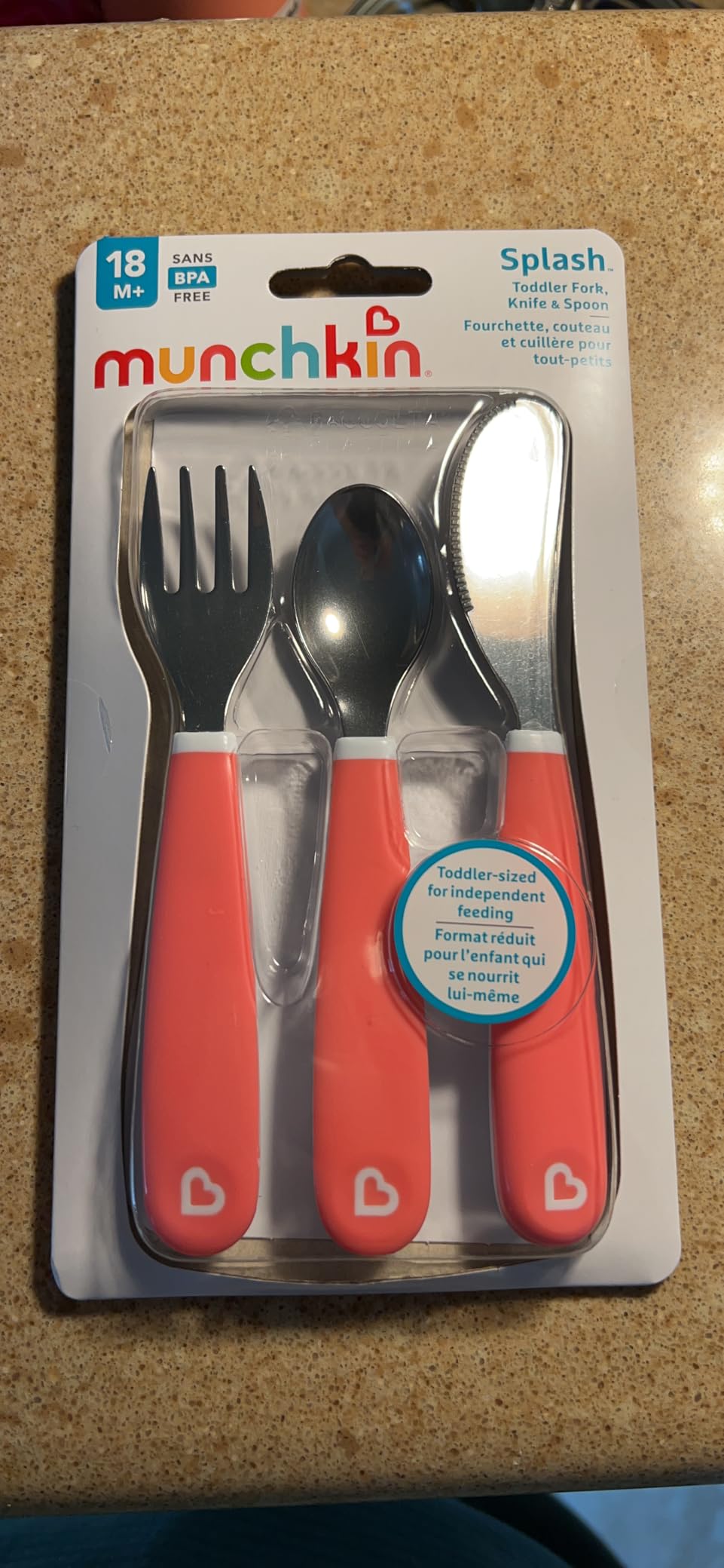
2. Munchkin Splash Fork, Knife and Spoon Set: Best for Cutting Practice
Munchkin® Splash™ Toddler Utensils Set, Fork Knife Spoon, 6 Pack
2 forks 2 knives 2 spoons
Child-safe knife edge
Ages 18 months and up
BPA free
Pros
- Includes two knives for cutting practice
- Handles sized for toddler grip
- Knife edge blunt enough for small hands
- Dishwasher safe
- Bright blue and green colours
Cons
- Plastic handles less grippy than silicone
- Spoon and fork bowls carry less food
- Weak choice for soups and cereals
The reason to buy this set is the knives. Most toddler cutlery in this roundup is fork and spoon only, which leaves a gap at 18 months and beyond when children are ready to start cutting soft food themselves and cannot.
We used the knives on cooked pasta, bananas, soft cheese and steamed vegetables. They cut with almost no pressure and the edge is noticeably blunt when you run a finger along it, which is what you want in a hand that is still developing grip strength.
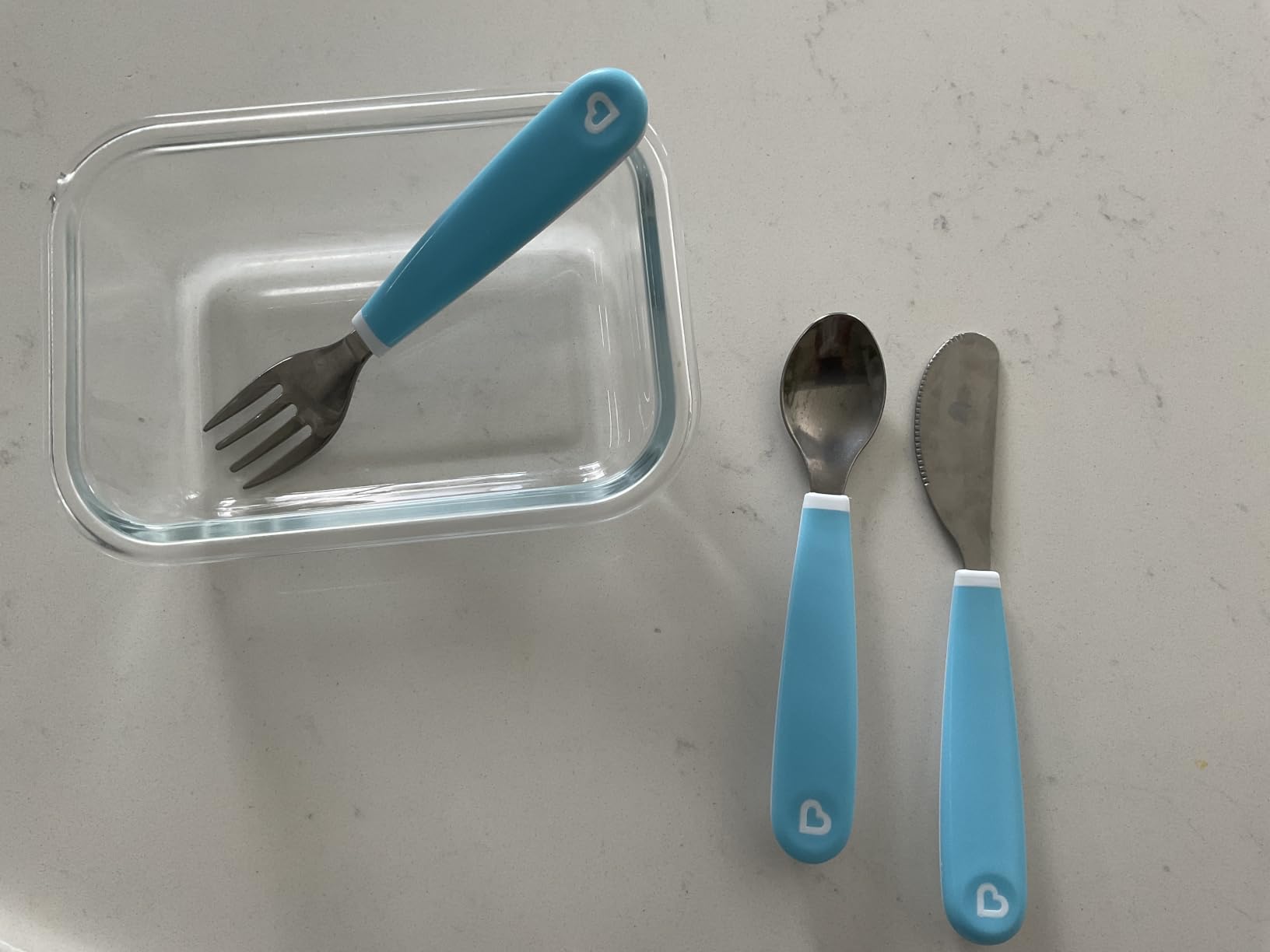
Six pieces across blue and green is a good count for the kitchen, and you can send one pair to daycare without cutting your household supply in half.
Where it falls short is capacity. The spoon and fork bowls are shallow, so you take smaller bites. Yogurt and thin cereal drip more than they would with a deeper bowl.
Best for toddlers ready to cut
The age marking on this set is 18 months, and that is a sensible floor. Before that, most children are still doing the scoop-and-scoop motion and a knife just becomes something to hit the plate with.
For a child around 18 to 30 months, having a safe knife in the same set as the spoon and fork makes a real difference. We saw a two-year-old independently cut a banana into pieces with the same set she uses for everything else.
Where it is the wrong choice
If your child eats a lot of soup, porridge or yogurt, the shallow bowls will disappoint you. Move up to a deeper-bowl set for those meals rather than fighting with this one.
The handles are hard plastic and get slippery with wet hands. On messy meals this needed more prompting than the silicone-handled options.
3. VITEVER 10-Piece Stainless Steel Set: Best Value
VITEVER 10-Piece Toddler Utensils, Kids Stainless Steel Silverware Set, Children Safe Forks and Spoons – Mirror Polished, Dishwasher Safe
5 forks and 5 spoons
18/0 stainless steel
Rounded edges
Dishwasher safe
Pros
- Ten pieces give plenty of spares
- Animal motifs encourage self-feeding
- Rounded edges and short tines
- 18/0 stainless steel resists rust
- Easily cleaned in the dishwasher
Cons
- All metal with no grippy handle
- May feel heavy for the youngest toddlers
- No case for travel
Ten pieces is the count that changes daily life. Pieces get dropped down radiators, pushed behind cots and abandoned at grandparents houses. A ten-piece set absorbs that loss without you restocking, which is why this set shows up so often in daycare and travel conversations.
The stainless heads are mirror polished with short, rounded fork tines. We pressed the tines against our palms and they felt blunt rather than sharp, and nothing snagged or tore when a tine was dragged across a thumb.
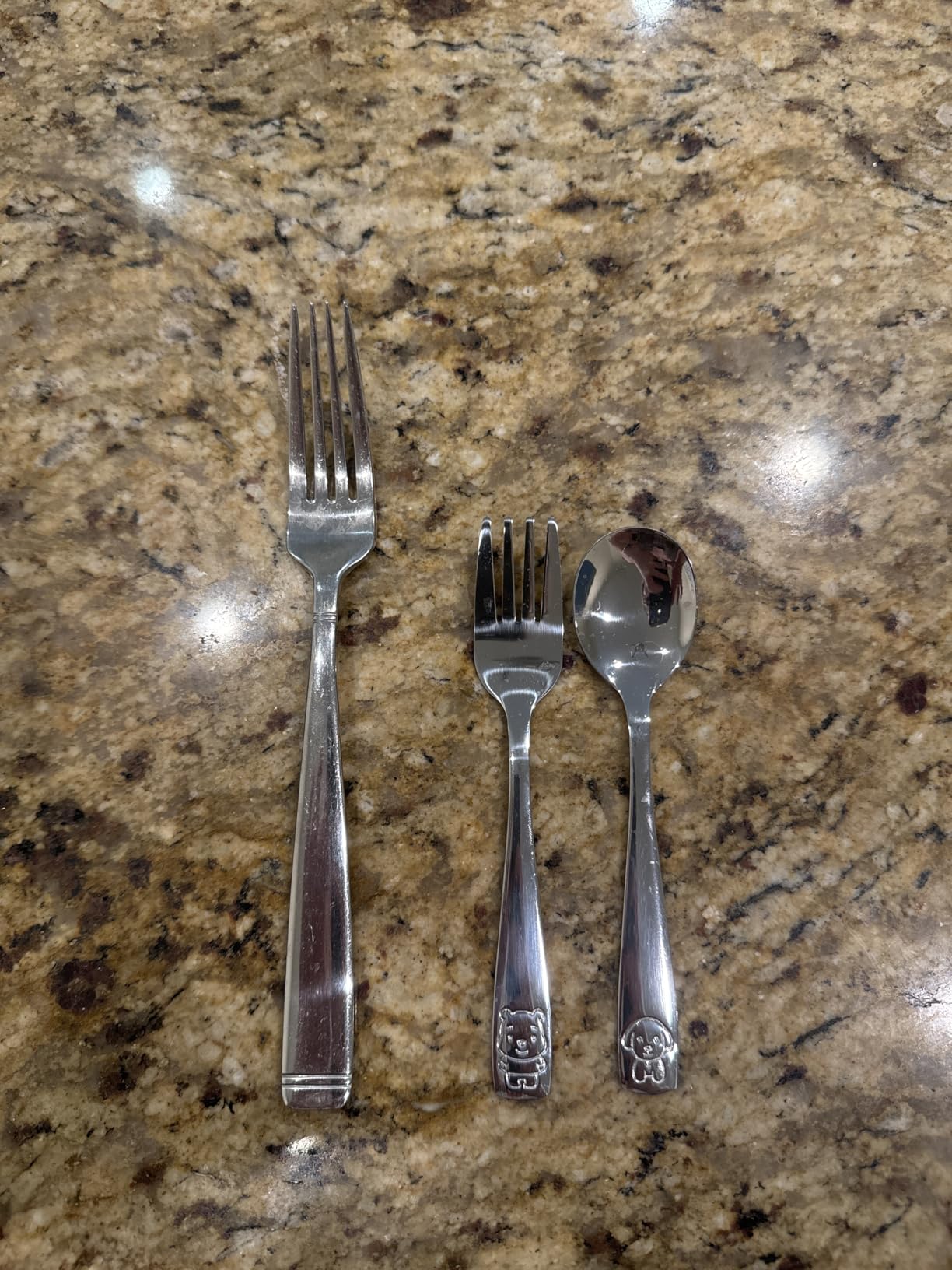
The embossed animal motifs are a small touch that genuinely works. A two-year-old who refused a plain fork picked these up without argument, because the puppy and bear handles read as toys rather than cutlery.
Everything went through the dishwasher repeatedly with no clouding and no staining from tomato sauce or berry yoghurt.
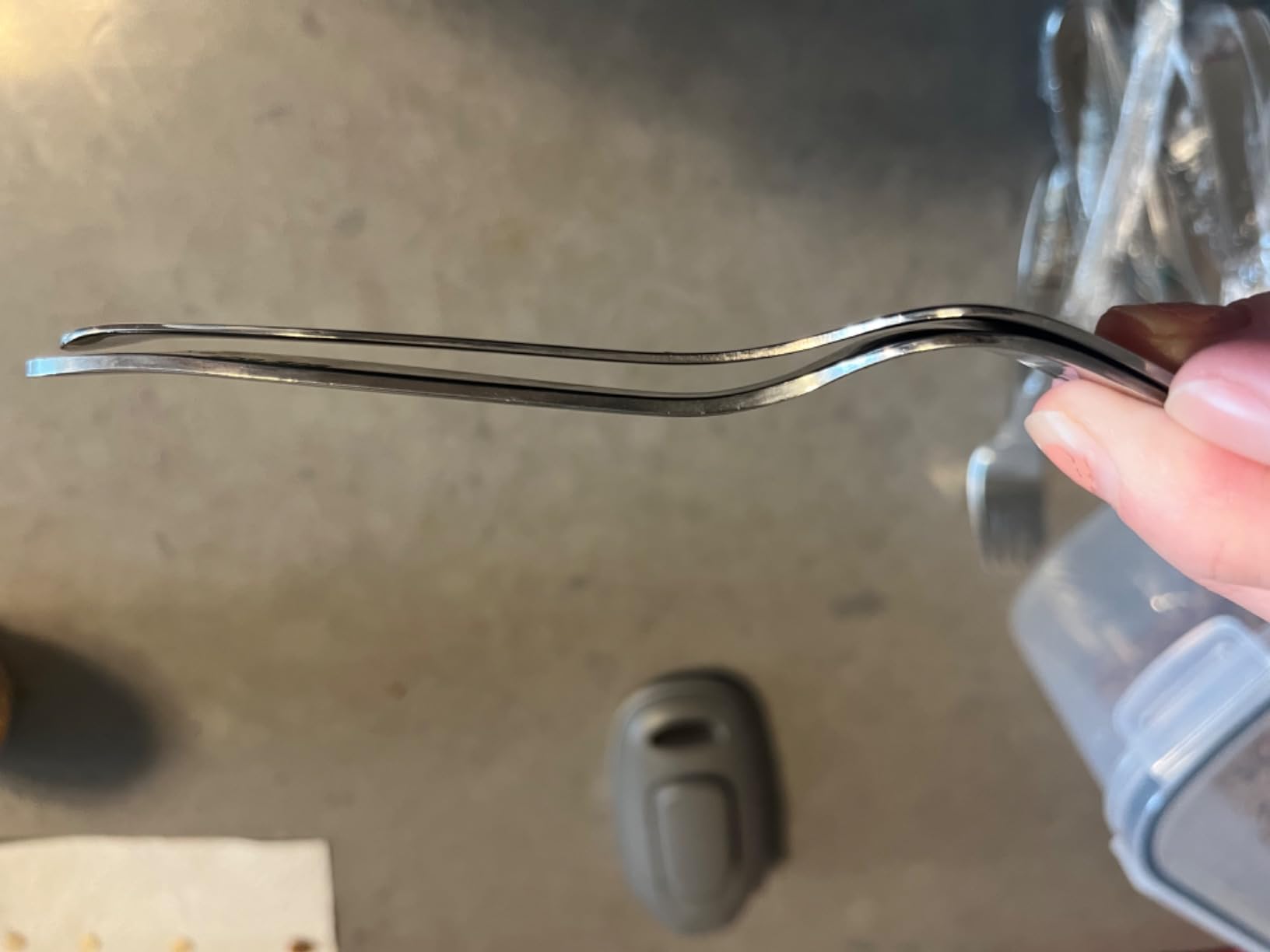
Why parents keep buying replacements of this one
Because the sizes are transitional. These are smaller than adult cutlery but closer to it than a baby spoon, so a child can move from this set to standard flatware around age four instead of jumping from a stubby toddler spoon.
Ten pieces also means you can split the set across locations: a pair in the diaper bag, a pair at daycare, and the rest at the table.
Where the all-metal design frustrates parents
There is no silicone or plastic grip. The handles are shaped for fingers but they are smooth metal, and they become slippery when food oil or water is on them.
Reviewers also note the weight can feel heavy for a toddler under 18 months who is still developing grip strength. This is a set for 18 months and up rather than a first-spoon set.
4. Kirecoo 2 Set Stainless Steel With Travel Case: Best for Daycare
Kirecoo 2 Set Stainless Steel Toddler Utensils with Travel Case
Two sets of fork and spoon
BPA, lead, latex and phthalate free
Two travel cases
Dishwasher safe
Pros
- Two complete sets in one pack
- Includes two travel cases
- Curved handles suit small hands
- Deeper spoon bowl than most rivals
- No sharp edges anywhere
Cons
- Only four pieces total
- Plastic grips can be slippery when wet
- No case included beyond the two sleeves
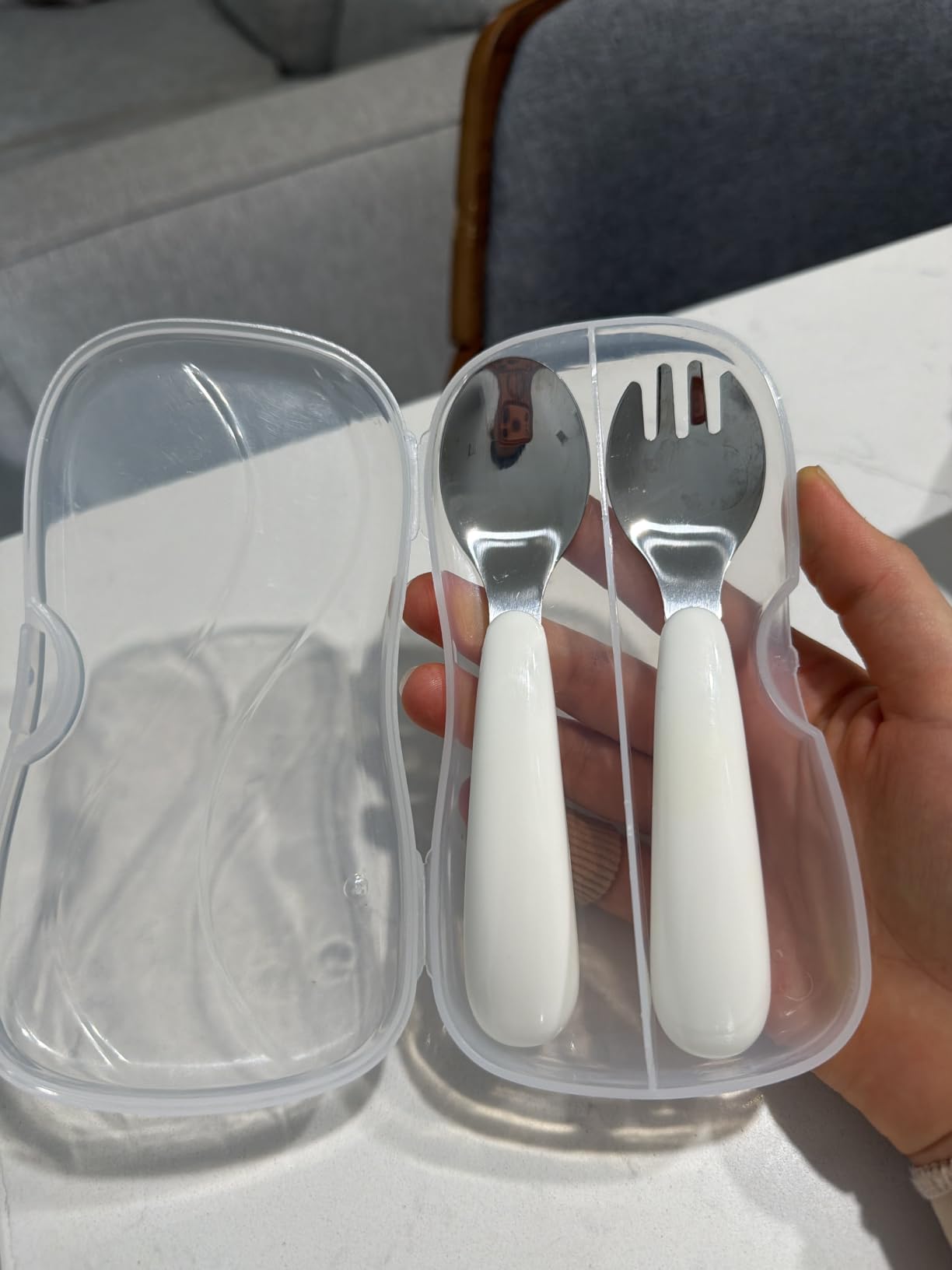
This is the daycare pick. You get two complete sets in one pack, so one stays home and one lives in the daycare bag, and each set comes with its own case. That solves the losing-a-single-utensil problem better than any other option here.
The spoon bowl is deeper than most of the plastic sets in this roundup, which meant it carried more rice and more thick porridge in our testing. For a child who scoops rather than smears, that is the difference between a useful bite and a dropped one.
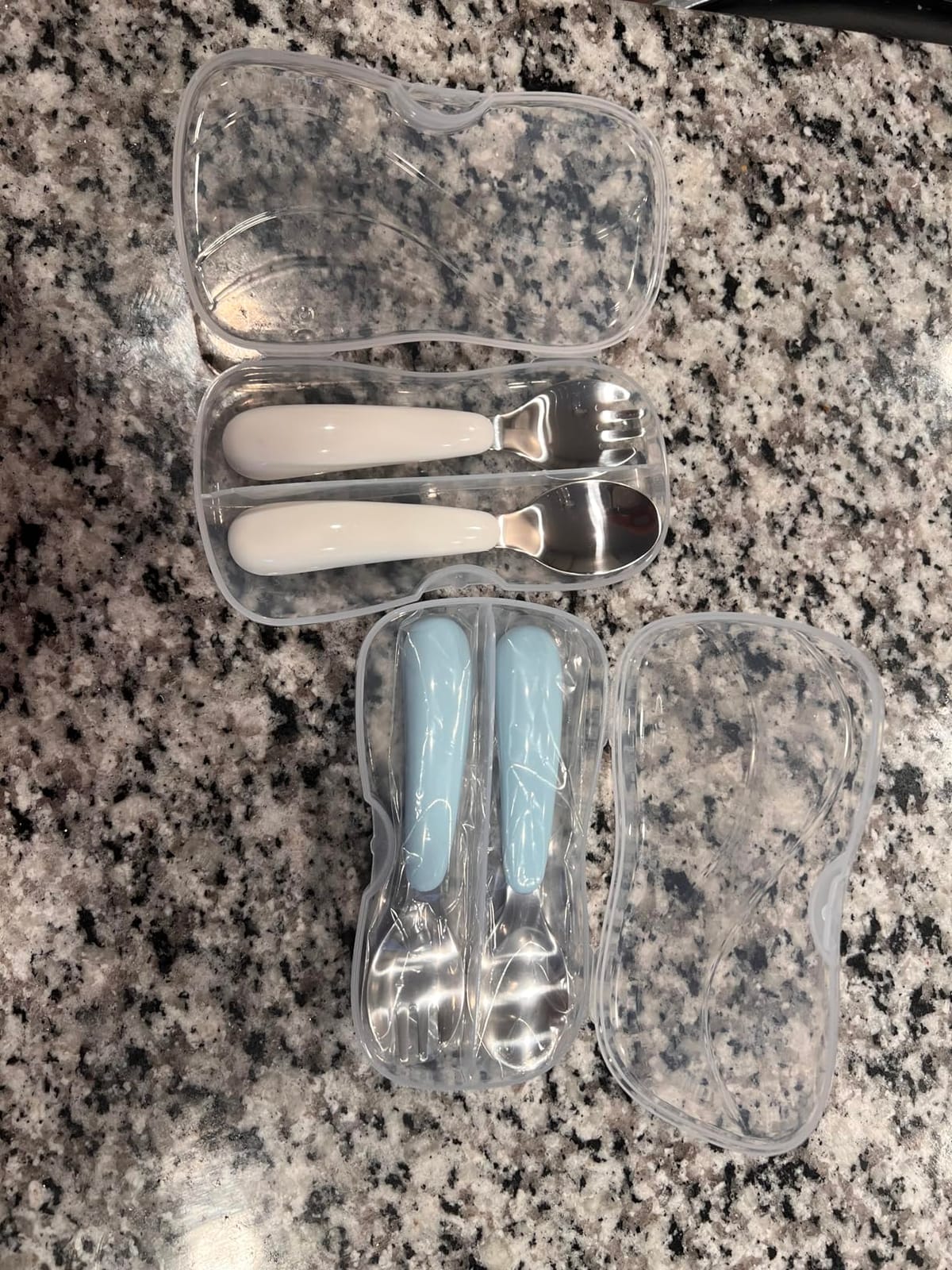
Material-wise these are polypropylene and stainless steel, and the listing states they are free of BPA, lead, latex and phthalates. The edges are smooth, with no point anywhere on the fork or spoon.
Both sets went through the dishwasher for weeks with no change in colour or finish.
Where the two-set layout pays off
Daycare, grandparents house, restaurant table, car glovebox. Four locations, four pieces, no arguing. Parents in parent groups frequently describe buying multi-packs for exactly this reason once a toddler starts eating independently in more than one place.
The cases also matter for travel. They keep the pieces together in a diaper bag where a loose spoon would otherwise be found weeks later.
Where parents wish it had more pieces
Four pieces is thin. If one goes missing at daycare you have a spare set but a spare spoon is not always in the bag, so many parents end up buying a second pack anyway.
The handles are plastic over a metal core, and reviewers report they can feel slick once a child’s hands are wet or greasy.
5. Elk and Friends Silicone Handle Set: Best Grippy Handles
Elk and Friends Baby/Toddler Silverware with Silicone Handles | 6pcs
18/8 stainless steel heads
Anti-slip silicone handles
Heart-shaped rest
Dishwasher safe
Pros
- Anti-slip silicone handles hold well with wet hands
- Heart-shaped rest keeps tips off the table
- Deep scoop on the spoon
- Rounded narrow tips
- Multiple colour variants
Cons
- Silicone handles can loosen over time
- Moisture can collect inside the handle sleeve
- Higher cost than plastic sets
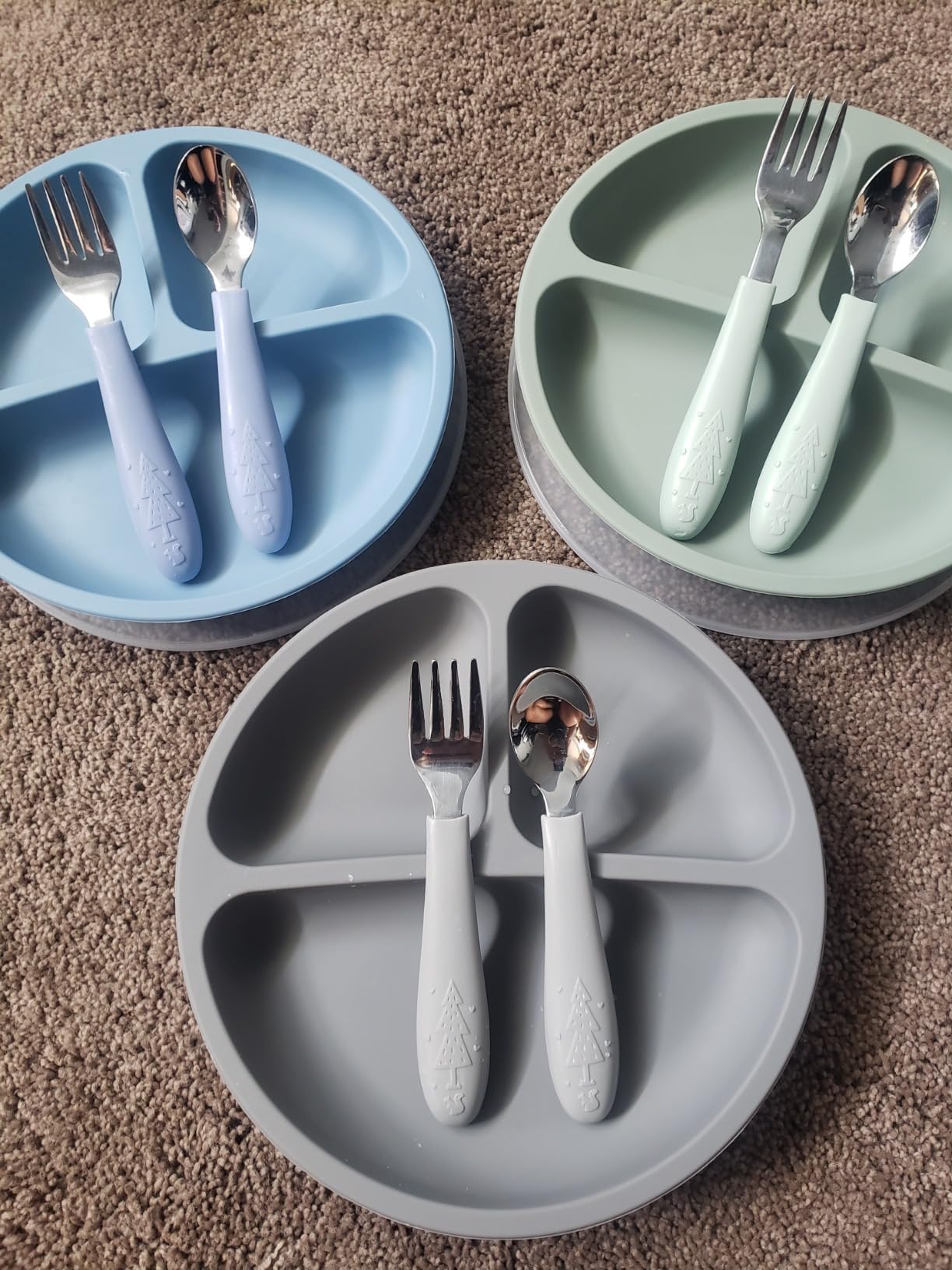
If your toddler’s hands are always wet or greasy, grip is the deciding factor, and this is the set we would choose. The silicone handles are noticeably textured and stayed in a small fist through a full meal of messy finger food.
The heart-shaped rest is the second thing worth paying for. It props the utensil up so the head rests above the tray surface, keeping food off the surface and making it easier to wipe the tray afterwards.
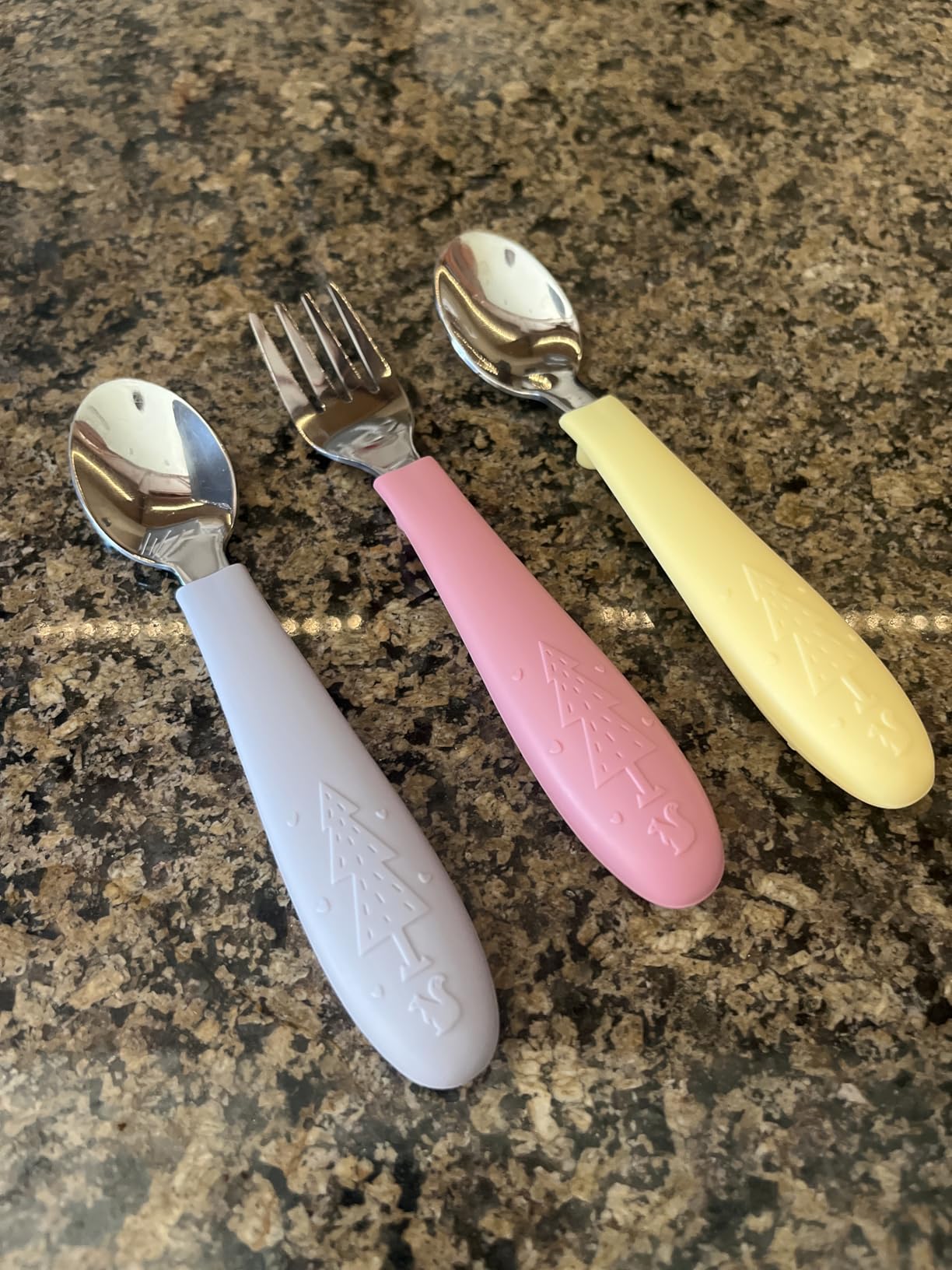
The heads are stainless steel with rounded edges and a narrow tip, plus a deeper scoop than most sets in this roundup. It carried a full spoonful of thick yoghurt without slipping off.
Three spoons, three forks and the silicone sleeves make up the six pieces. Several colour combinations are available, which helps if you are buying for a specific child.
What makes this set work for messy eaters
Texture on the handle is the difference between holding on and losing the spoon halfway to the mouth. We counted fewer drops with this set than with any of the smooth plastic-handled options we tested.
The narrow tip also suits children who push food too far back. It is a smaller target inside the mouth, and it makes the approach to the lips easier to control.
Where the two-piece construction bites back
The metal inserts into a silicone sleeve, which means there is a seam. Water and food particles can work into that seam over time, and owners do report loosening handles after many months of dishwasher use.
See our cleaning note below. If you buy any sleeve-handled set, wash the seam by hand once a week rather than relying on the dishwasher alone.
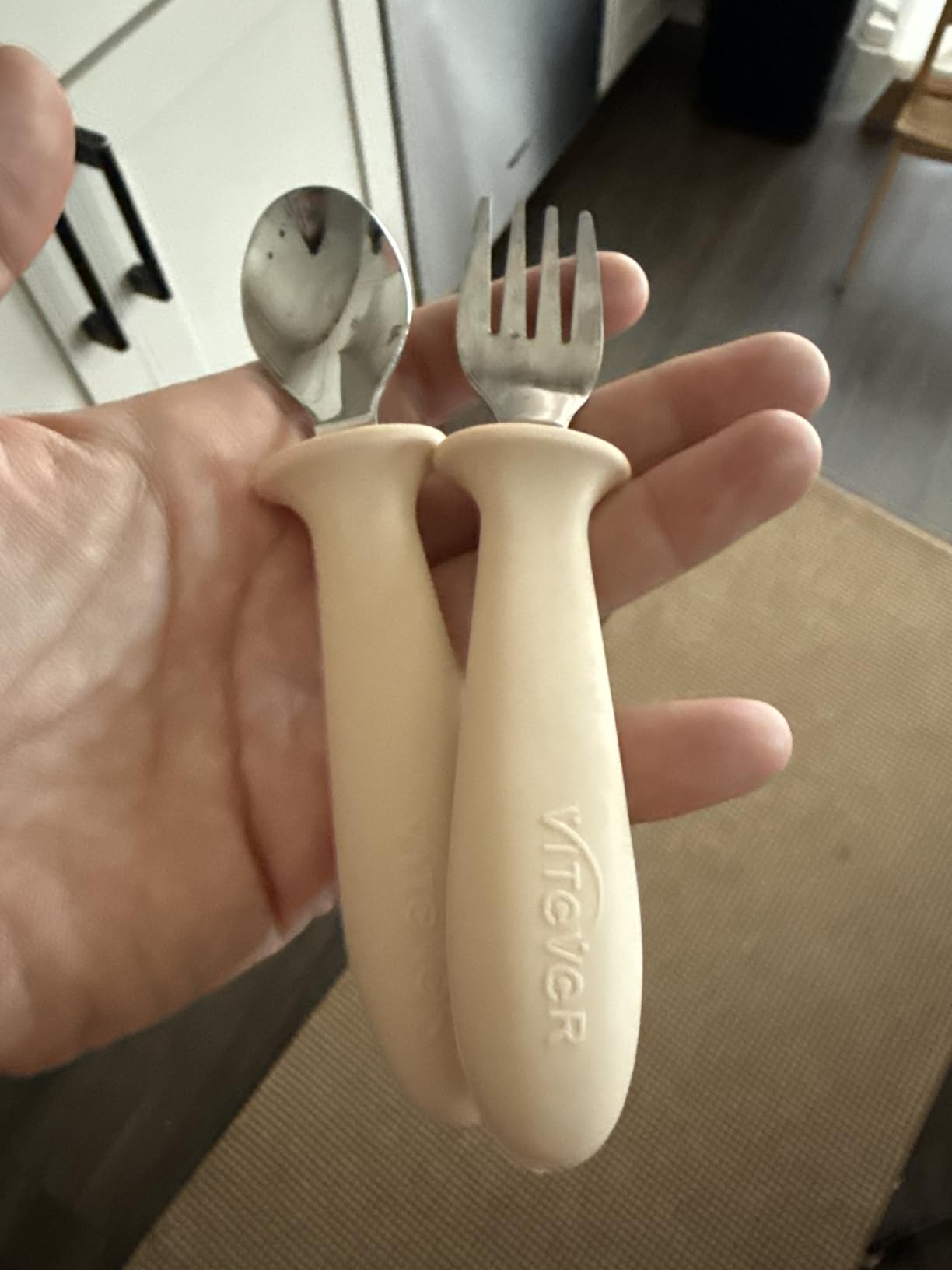
6. VITEVER 18/8 Stainless Steel and Silicone Set: Best Anti-Choke Design
6 Pieces Toddler Utensils, Kids Safe Spoons and Forks, Children Silverware Set with Silicone Handle, 18/8 Stainless Steel, Food-grade Silicone,BPA Free – Dishwasher Safe
Three colour sets with spoon and fork
18/8 stainless steel
Food-grade silicone shield
Dishwasher safe
Pros
- Shield-like barrier limits how deep the utensil goes
- Food-grade silicone handles
- Non-toxic and phthalate free
- Heat resistant
- Dishwasher safe
Cons
- Silicone handles can separate from the metal over time
- Shield gets in the way of scraping the last of a bowl
- Weight not listed by the maker
The defining feature here is the barrier between the handle and the metal head. It physically limits how far the utensil can go into a mouth, which is the point anti-choke guards are supposed to make. Most parents worry about the back end of a spoon disappearing into a toddler’s mouth during a refusal, and this stops that.
The 18/8 stainless steel heads pair with food-grade silicone handles, a stronger material combination than most sets at this level, and the handles are flat and non-slip rather than round.
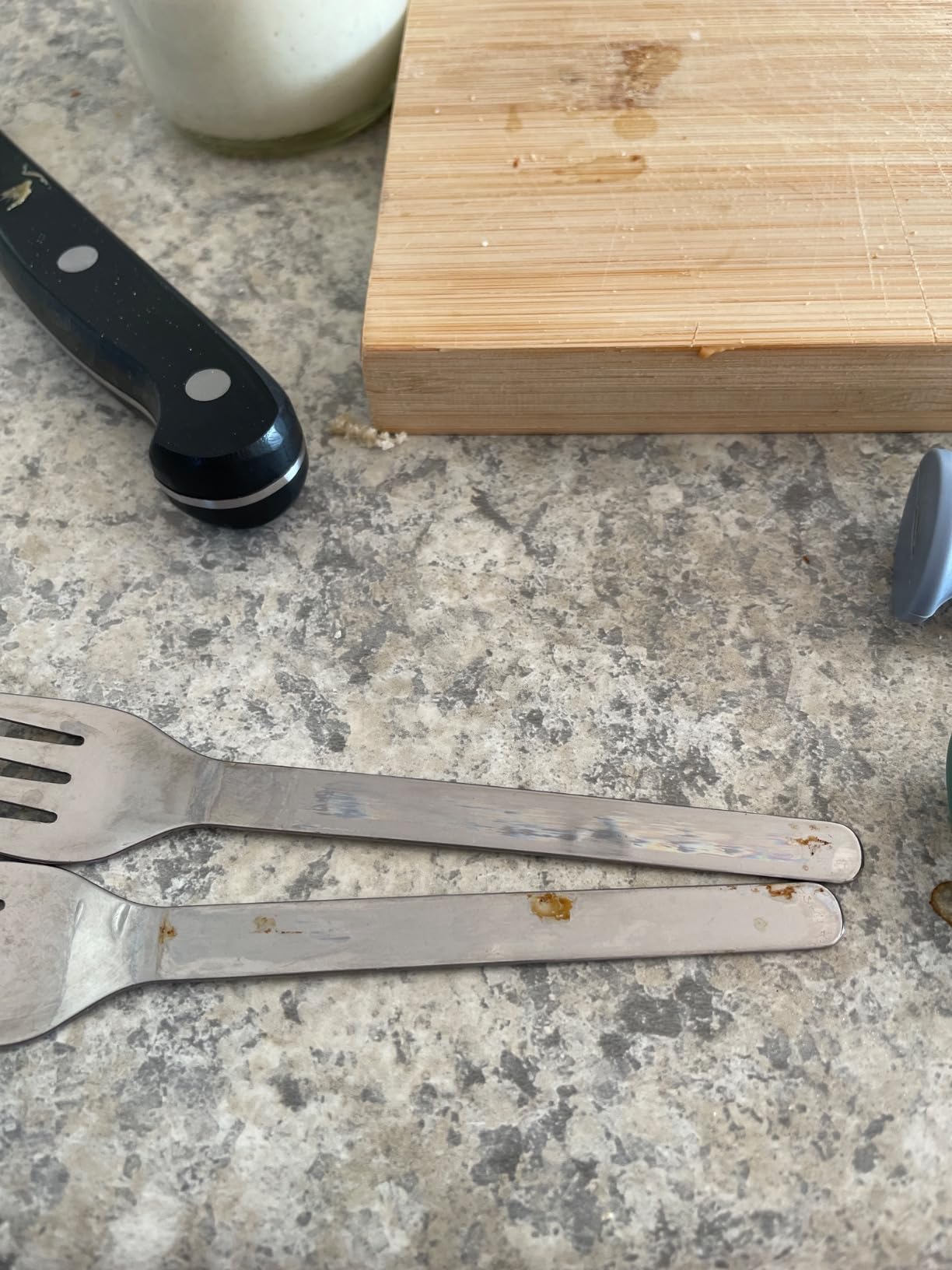
Three colour sets give you six pieces, so a pair can live in a daycare bag while another stays on the tray.
They are heat resistant as well as dishwasher safe, which matters when food arrives straight from the microwave.
When the anti-choke barrier actually helps
It helps most with a toddler who runs the spoon deep into their mouth to stop the feeding. The barrier caps depth so the child can still gag and clear their throat, which is exactly what should happen.
It is genuinely useful during the toddler stage, from about 12 months up, when that behaviour is common and the mouth is still being used as a reflex rather than a tool.
When the same barrier gets in the way
It stops the spoon lying flat against the bottom of a bowl, so getting the last of a yoghurt or the thickest part of a meal takes a scraping motion instead of a clean sweep. Some parents find the seal creates a pocket where sauce collects.
Owners also report the silicone can begin to separate from the metal after extended use. Inspect the joint before handing it to a child who chews handles.
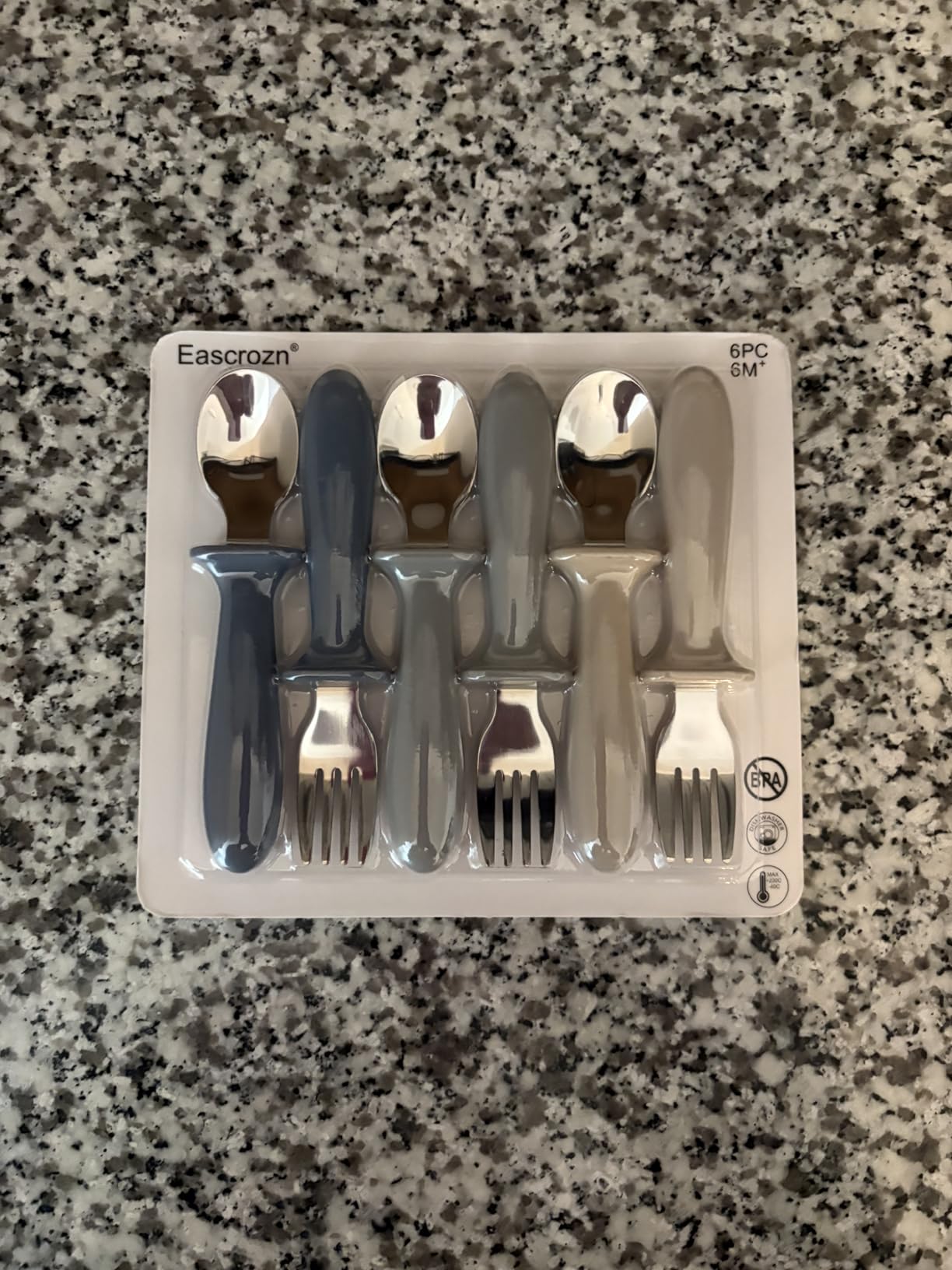
7. Eascrozn 6 Pack Silicone Handle Set: Best Budget Six-Piece Set
Eascrozn Toddler Utensils, 6 Pack Children Safe Forks and Spoons Set
3 forks and 3 spoons
18/8 stainless steel and silicone
BPA free
Boil and dishwasher safe
Pros
- Thick non-slip silicone handles
- Protective barrier against deep insertion
- Three colour sets included
- BPA free and boil safe
- Four colour variants available
Cons
- Metal insert can separate from the silicone handle
- Moisture can enter at the connection point
- Six pieces only
The Eascrozn set covers the same ground as the previous pick at a lower cost, and it currently holds the number one position in the toddler flatware category on Amazon. That ranking reflects owner satisfaction more than anything we can measure, and the reviews back it up.
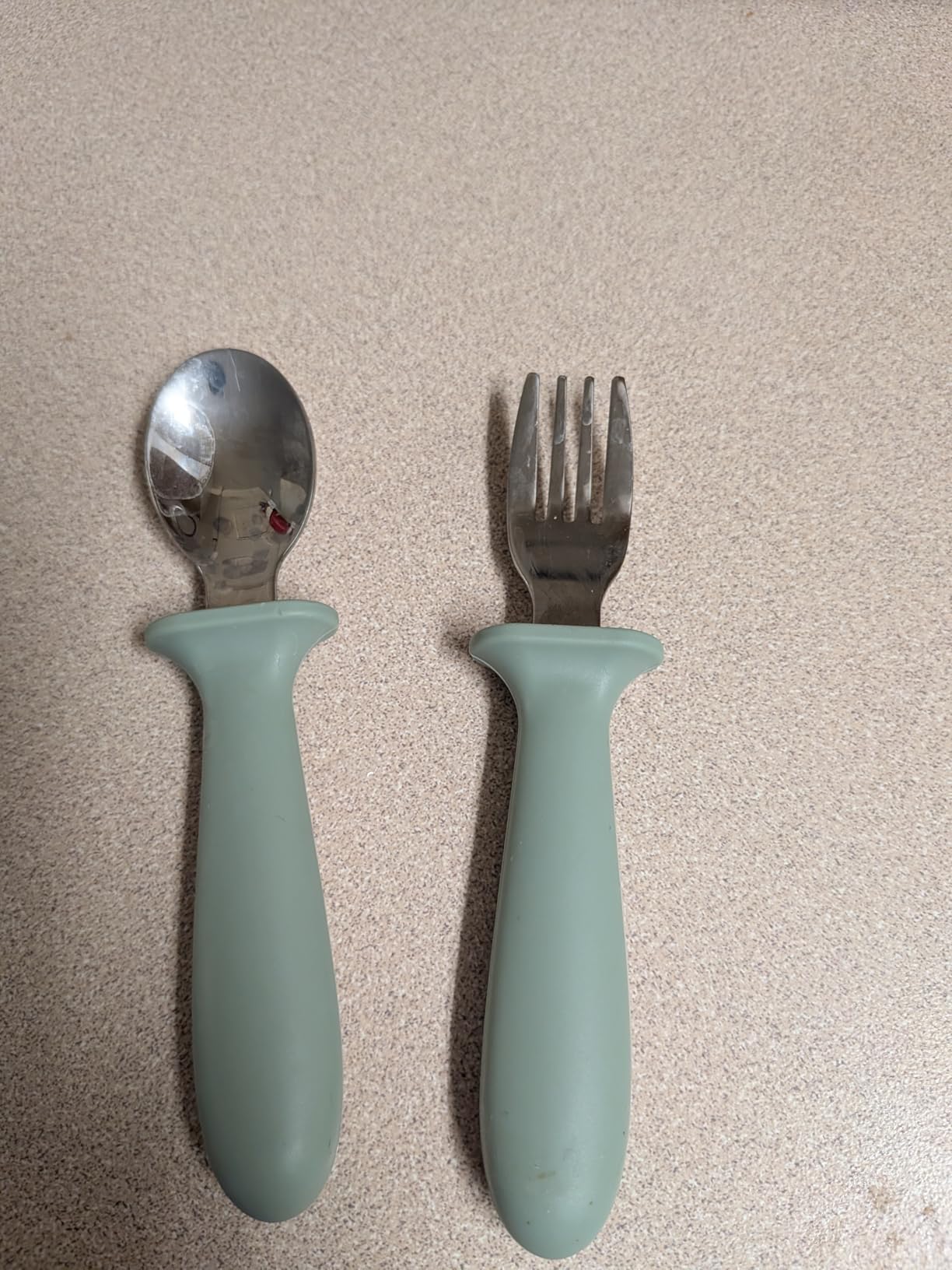
The handles are thick, which matters for a palmar grasp. A chunkier handle is easier for a whole fist to close around than a slim one, and we had noticeably fewer drops with this set than with slimmer-handled metal sets.
Boil safety is a quiet extra. Being able to sterilise by boiling gives you a real option for the first year, when the recommended ages overlap with the stage when sterilising matters most.
Four colour variants are listed, which is unusual at this level and helps if you want one set per child.
What this set does better than its cost suggests
The barrier between handle and tip is closer to the handle than on many competing sets, so it stops deep insertion earlier. For a child who regularly rammed a spoon into the back of their mouth, that difference was visible.
Eighteen-eight stainless steel heads with rounded edges and thick silicone grips give you the two material qualities that matter most without the premium-tier finish.
Where the seam between materials causes worry
The metal insert can separate from the silicone, and moisture can enter at the connection point. Most owners report no problems after months of use, but it is the part of this design to check.
Six pieces is enough for one child at one table plus one spare pair. It is not enough for splitting across several locations.
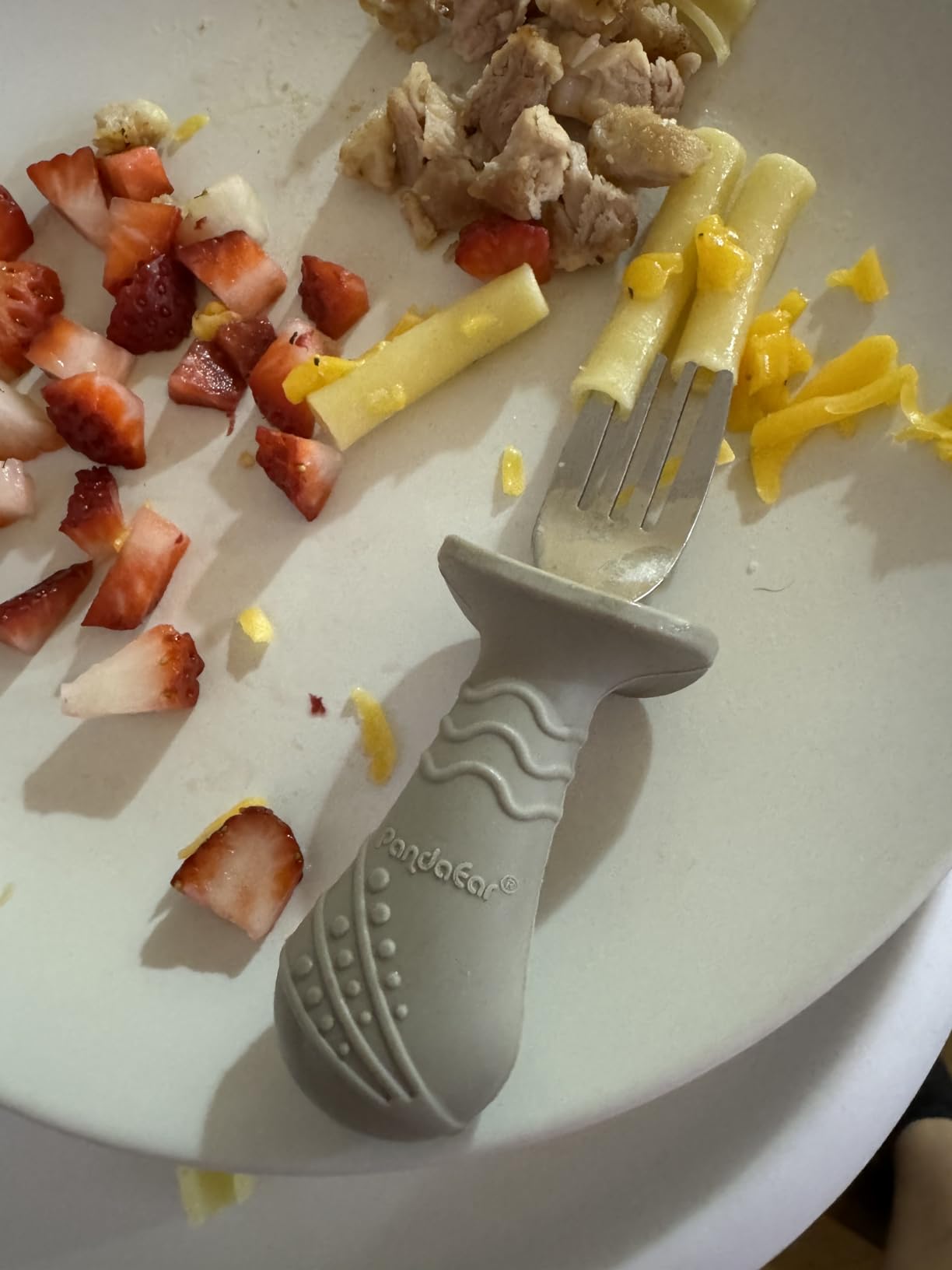
8. PandaEar Anti-Choke 6 Pack: Best Lightweight Set
PandaEar Baby Toddler Fork and Spoon Utensil Set, 6 Pack Silicone Stainless Steel Silverware Spoon Fork for Babies Toddler, BPA Free with Silicone Holding Anti-Choke Design (Green Blue Brown)
Stainless steel heads
Anti-choke silicone collar
0.21 kg per six-piece set
Dishwasher safe
Pros
- Lightweight for small hands
- Anti-choke collar on every piece
- Curved body sits well in a fist
- Three spoons and three forks
- Rounded edges and tines
Cons
- Small gaps where metal meets handle
- Handle can be pulled from the insert
- Occasional reports of surface rust after long use
This set weighs 0.21 kg across six pieces, so each piece is light enough for a young hand to keep hold of. Weight is a real reason a toddler cannot use an adult-sized or all-metal utensil, and grams per piece change whether the spoon stays in the hand or ends up on the floor.
Owners describe using this set from around ten months and passing it on past the two-year mark, which is a longer useful life than most plastic options.
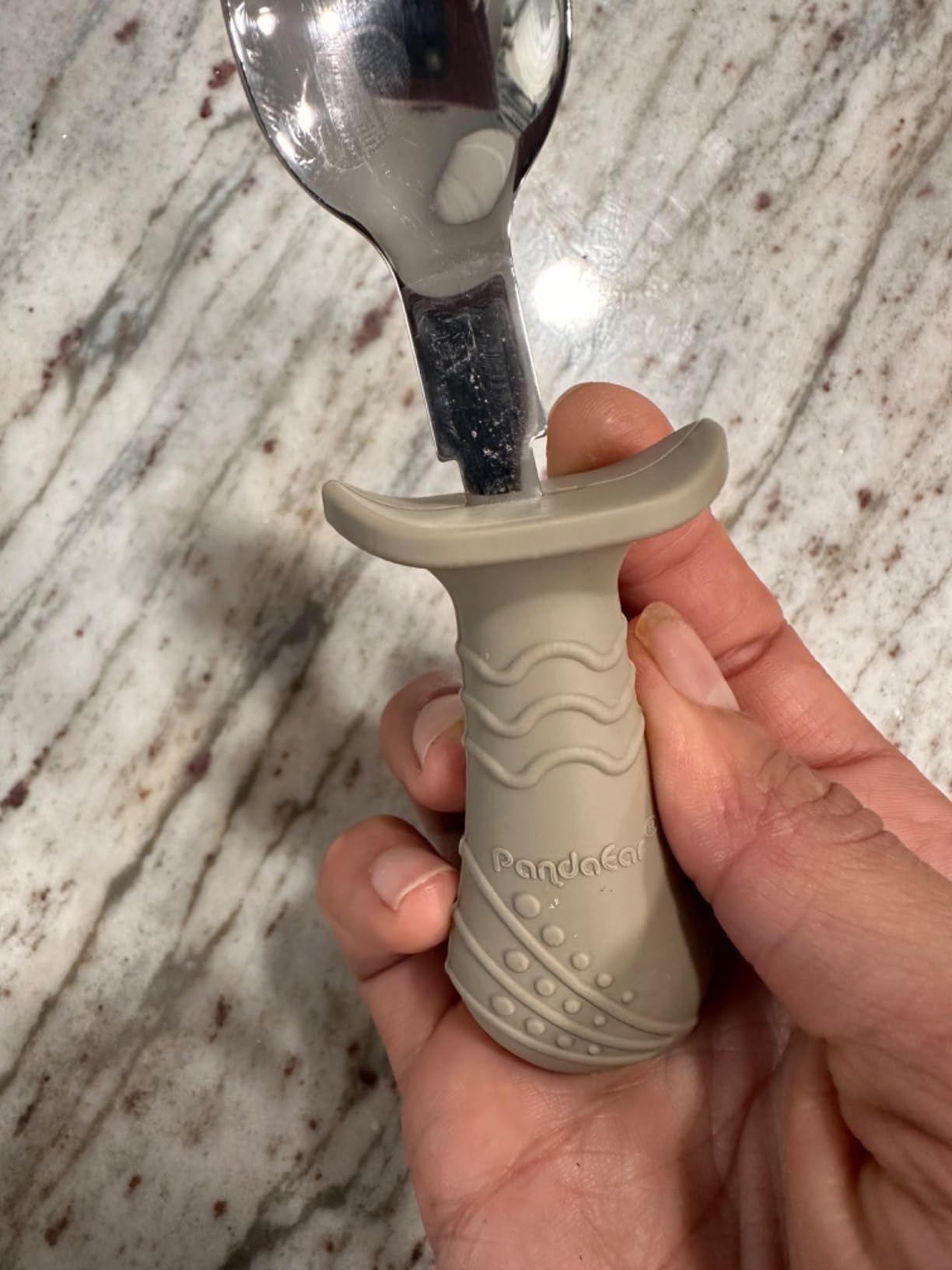
The anti-choke collar sits close to the handle, so the usable length is short. That limits depth and it also means a child cannot carry the whole utensil in a fist and use it at the same angle.
Three spoons and three forks come in three colours, which gives you a usable rotation at a single table.
Why lightness matters more than parents expect
Small hands tire fast. A heavy spoon gets dropped at bite two and the child stops trying. A set with less weight per piece keeps a toddler picking the spoon back up after a drop without an adult offering it again.
The curved body is the other quiet advantage. It sits against a closed fist at a natural angle, so the spoon head lines up with the mouth without wrist twisting.
Where owners report problems
There are small gaps where the metal enters the handle, and owners mention water collecting there. Hand-wash those joints weekly and let them dry fully rather than leaving them wet overnight.
Some owners report the metal can be pulled from the handle, and a few mention light surface rust after very long use. Inspect the joint and the head before use if your child chews handles habitually.
9. DRKIO 12 Piece Stainless Steel Set: Best for Siblings
DRKIO 12Pcs Stainless Steel Toddler Utensils Small Metal Kids Silverware
6 forks and 6 spoons
18/0 stainless steel
Mirror-polished finish
Dishwasher safe
Pros
- Twelve pieces cover two children
- 18/0 stainless steel resists rust
- Short rounded forks for small mouths
- Animal motifs appeal to toddlers
- No seams to trap moisture
Cons
- All metal with no grippy handle
- May run small past three or four years old
- Silver finish shows scratches
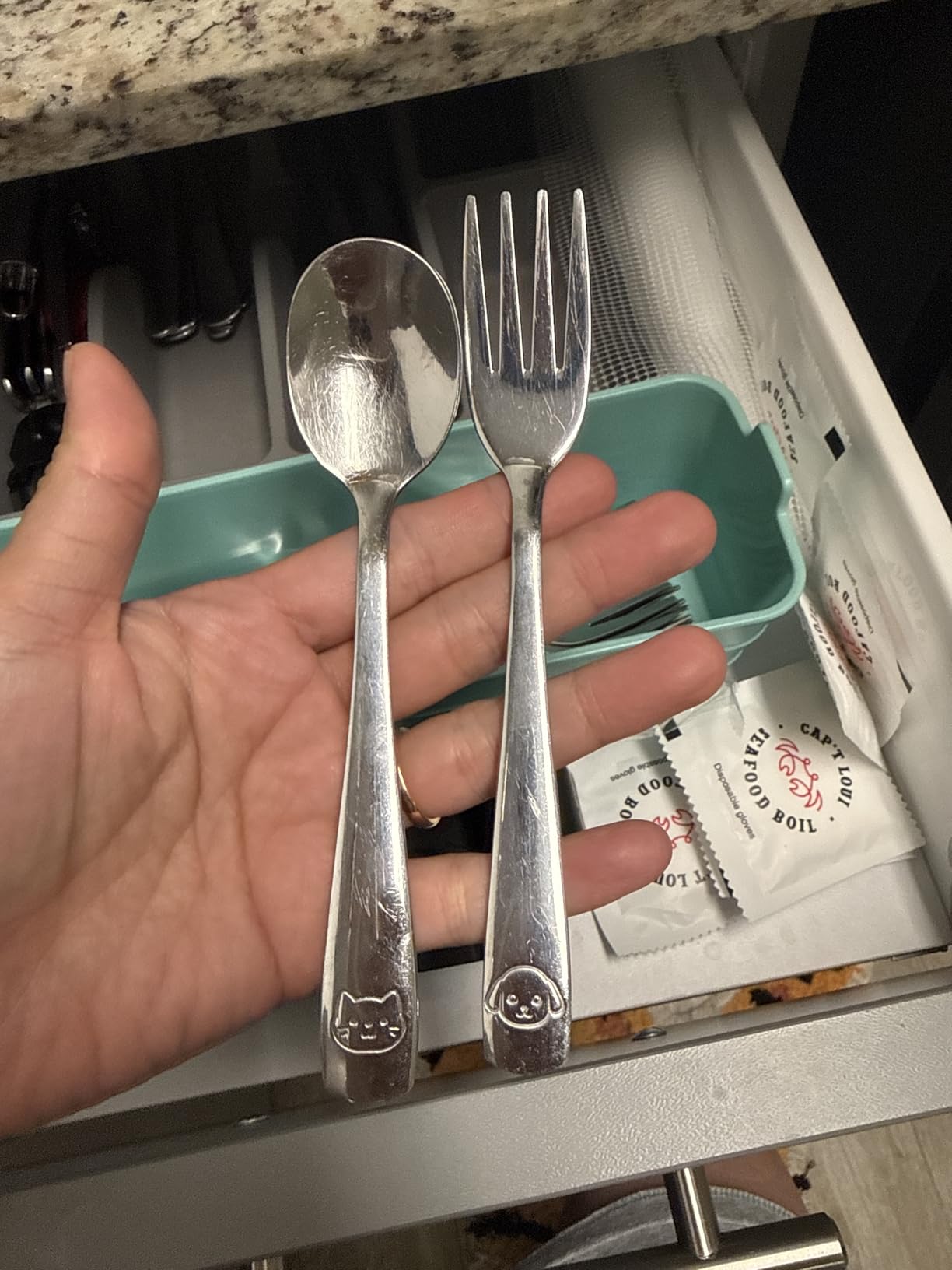
Twelve pieces is six forks and six spoons, a count large enough to serve two children eating at the same table. Parents with an 18-month-old and a three-year-old will get a full set each rather than sharing.
There are no silicone sleeves and no seams. That is the quiet strength of an all-metal design: nothing to loosen, nothing for water to sit inside, nothing to come apart.
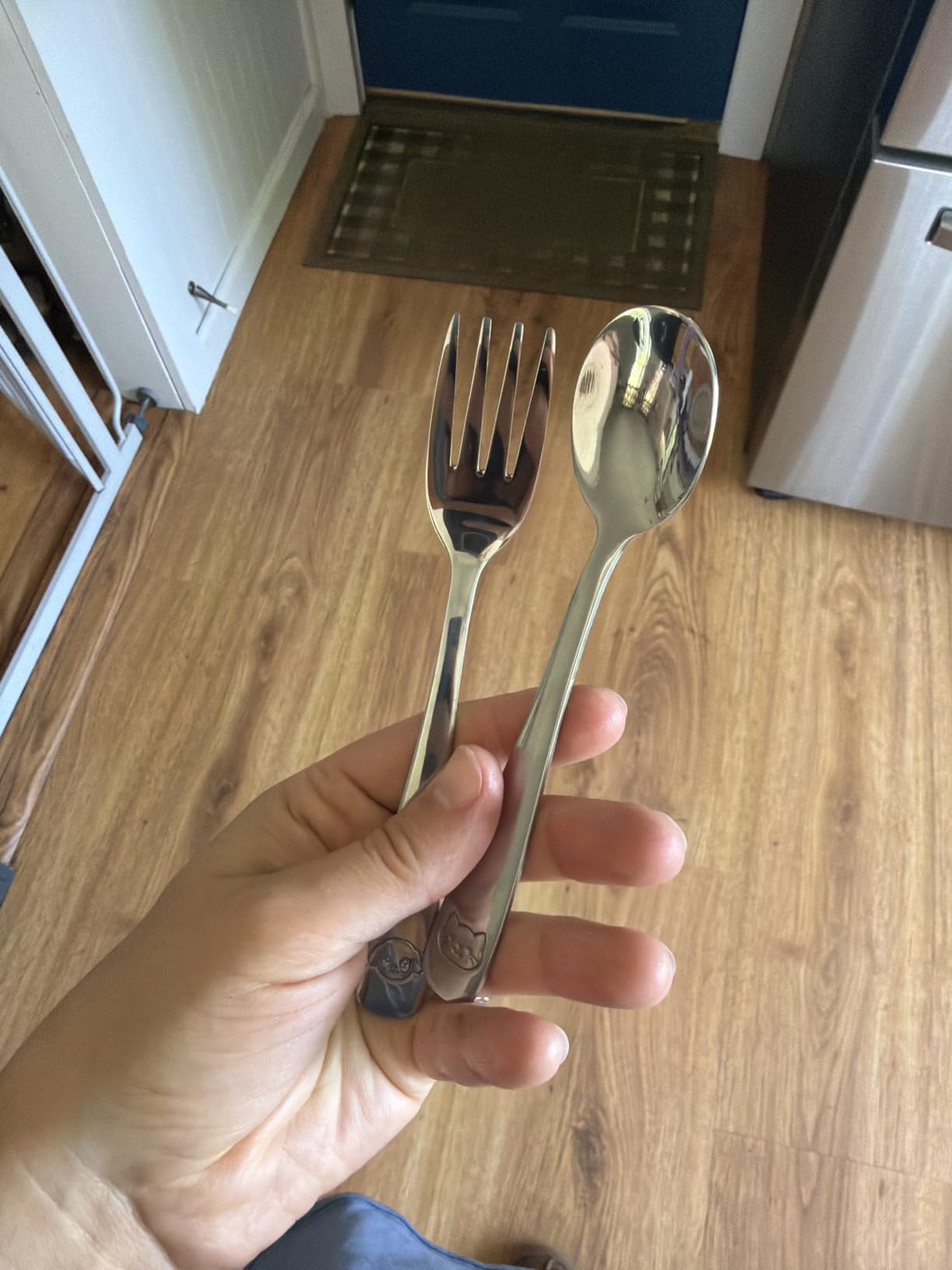
The kitten and puppy motifs make the set feel like a toy rather than cutlery, and the mirror polish survived our stain test with tomato sauce and berry yoghurt without dulling.
Short rounded forks and small spoons are the right transition size for this age, and they will carry a toddler into preschool.
What twelve pieces actually solves
Family meals. Every family meal. One set per child plus spares means nobody is waiting for a utensil to be washed, which removes a common reason a toddler does not finish a meal.
It also handles the sibling question directly. These are the pieces that can be passed down rather than binned after the first child chews them.
Where parents push back
All metal means no grippy handle, and reviewers report these can be slippery when wet. That is a real drawback for a toddler eating wet, slippery food.
Owners also note the size runs small for children past three or four, so if you expect a five-year-old to use the same pieces, budget for a larger set later.
10. OXO Tot On-the-Go Fork and Spoon Set: Best for Travel
OXO Tot On-the-Go Fork and Spoon Set, Dusk
1 fork and 1 spoon
Weighted curved stainless steel handles
Compact case included
Dishwasher safe
Pros
- Weighted handles help a toddler keep hold
- Deep spoon bowl scooped well in testing
- Compact case fits a nappy bag
- Fork tines spear food without being sharp
- Dishwasher safe
Cons
- Only two pieces per set
- Handle backs can stain from food
- One set means no spare while one is being washed
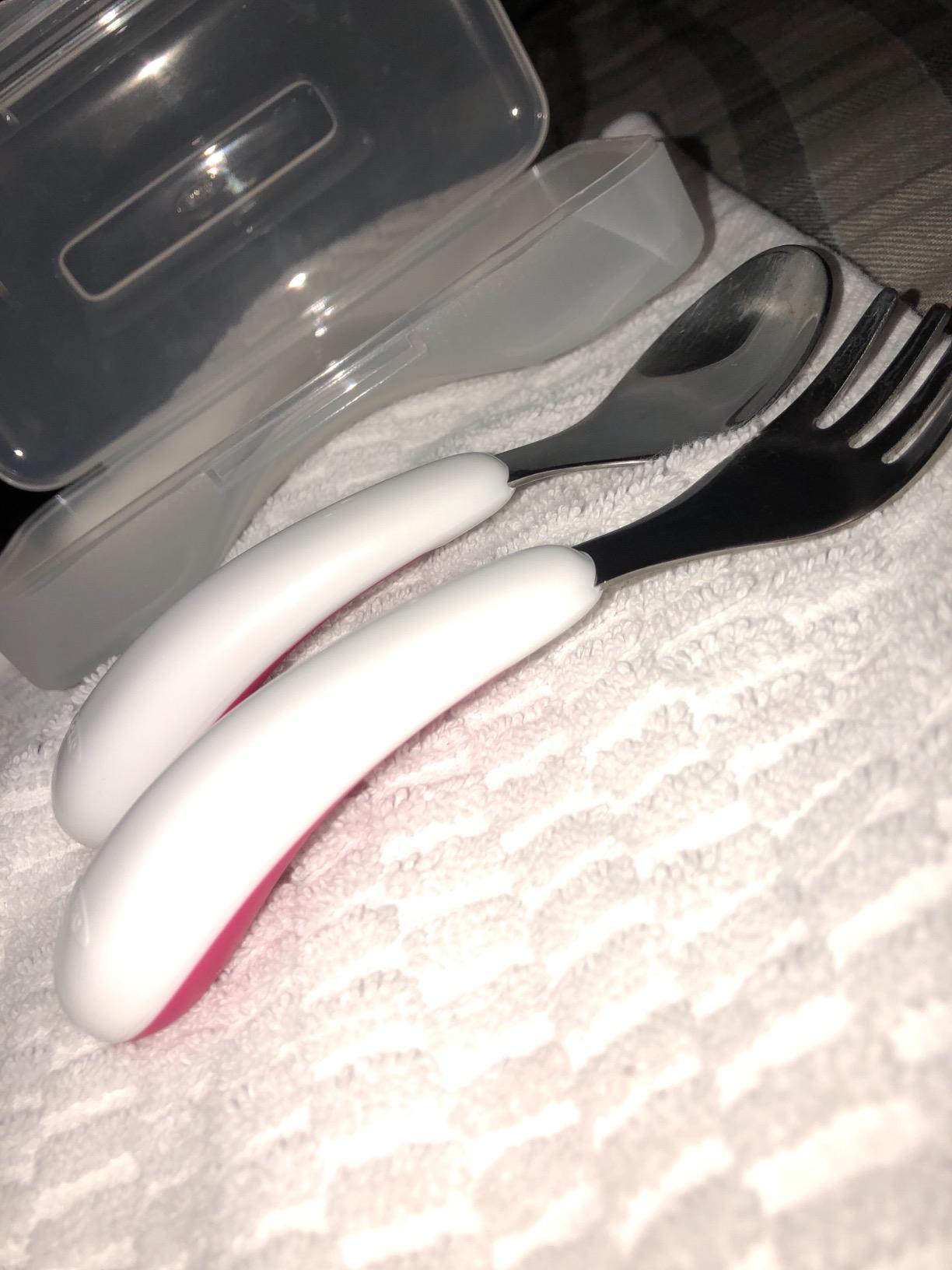
This is the one to pack. The case is genuinely compact, sitting flat in a nappy bag or lunchbox, and it keeps the two pieces together so a loose spoon does not disappear into the bag lining.
The handles are curved and weighted. That weight is deliberate: a slightly heavier handle gives a small hand better control of where the head goes, which is why this set gets the fork into a mouth more consistently than lighter plastic options.
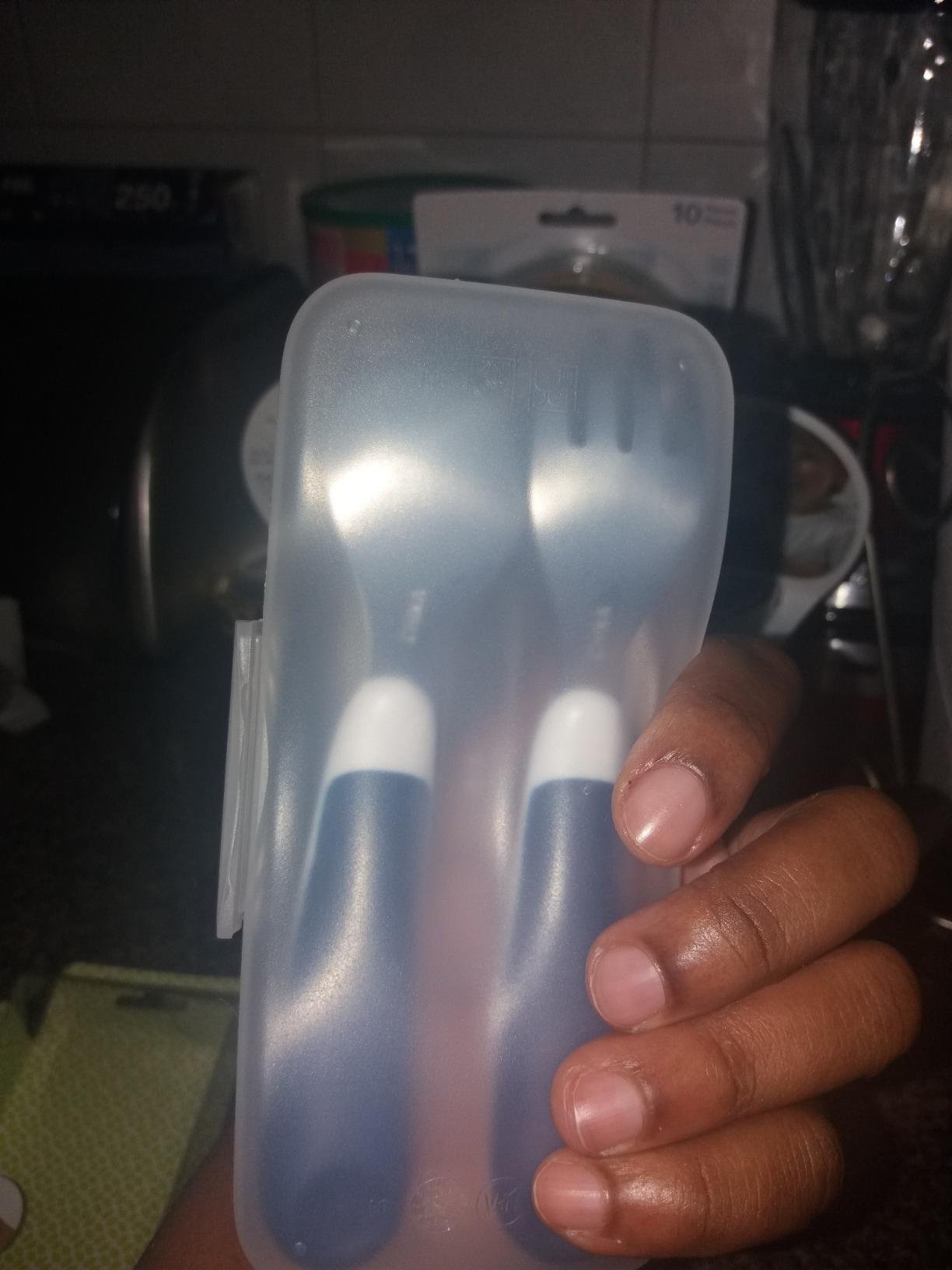
The spoon bowl is deep and held a proper scoop of yoghurt and rice. The fork tines actually speared food, which most toddler forks in this roundup do not manage reliably.
Dishwasher safe and stainless steel heads, so it survives being scrubbed after restaurant food.
What makes the case worth having
Travel and restaurant meals are where cheap plastic usually shows its weakness first, because a dropped piece is gone. A cased set changes the maths: the loss is a real loss, so you notice it, and you can deliberately pack two sets. On longer trips, sleep setup matters too, and we have covered that in our toddler travel bed guide.
The weighted handle is the other reason. Travel meals are often served in unfamiliar settings where a slippery spoon is more likely to be dropped.
Where two pieces falls short
One fork and one spoon means no spare during the day. On a long trip you are washing at midday or accepting a plastic restaurant fork instead.
Owners also report staining on the backs of the handles from strongly coloured food. It does not affect use, but it shows on the parts a child looks at most.
11. doddl Ergonomic Fork and Spoon Set: Best for Hardest Grips
doddl Toddler Utensils, Ergonomic Fork and Spoon Set for Self Feeding, Stainless Steel Silverware for 1-3 Year Olds, BPA Free, Dishwasher Safe (Aqua)
1 fork and 1 spoon
Short contoured stainless steel handles
Ages 1 to 3
BPA and phthalate free
Pros
- Short contoured handles teach cutlery use quickly
- Supports fine motor development
- Food-safe stainless steel
- Travel case included
- Dishwasher safe
Cons
- Highest cost per piece in this roundup
- Only two pieces
- Unusual shape may not fit standard utensil holders
- Small size is easy to lose
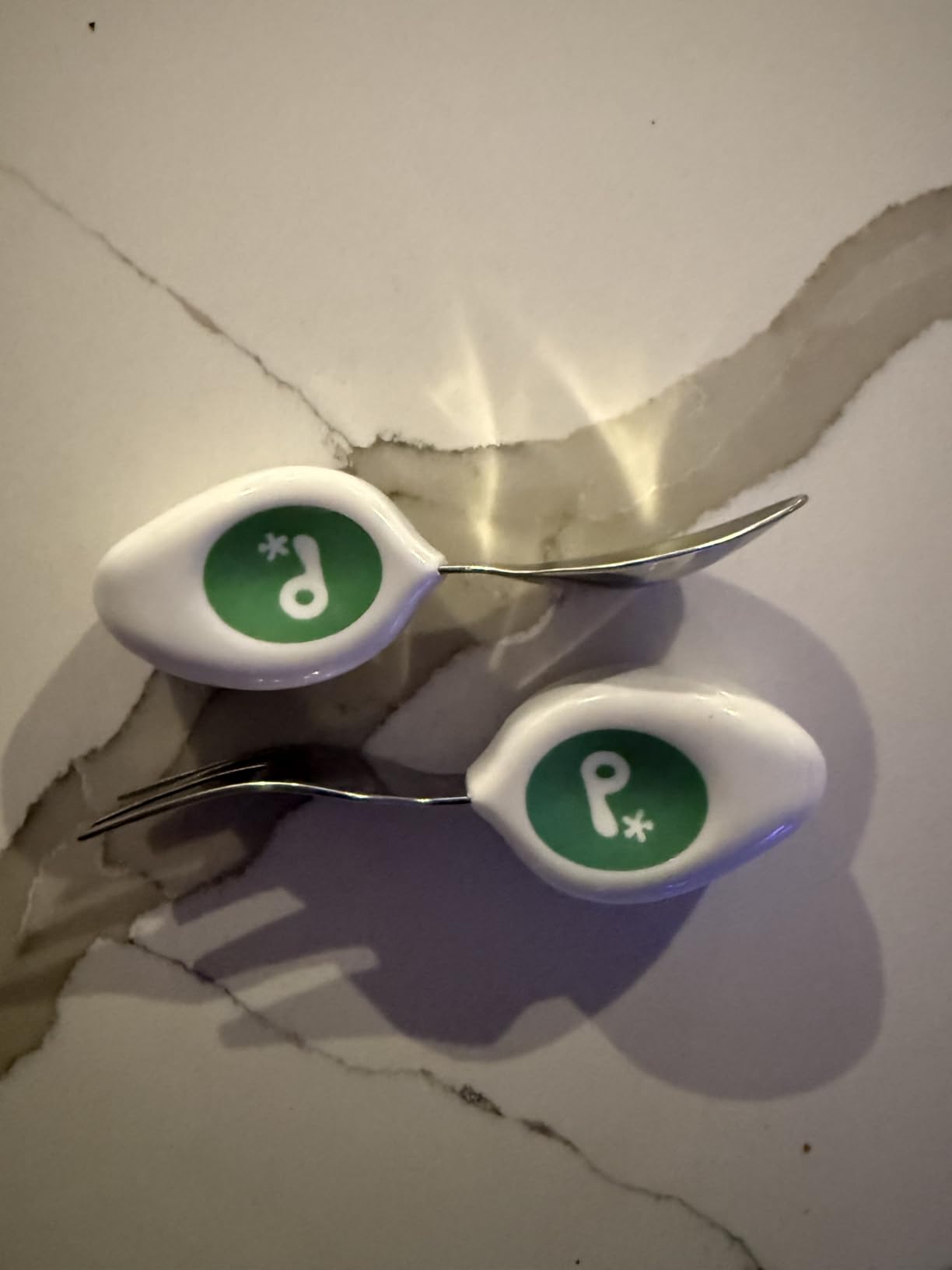
The doddl set takes a completely different approach to handle shape. The handles are short, wide and contoured with a dip that sits against a child’s palm, so the utensil stays put without the child having to grip hard.
In our testing this was the set that most quickly moved from mouthing to actual eating.
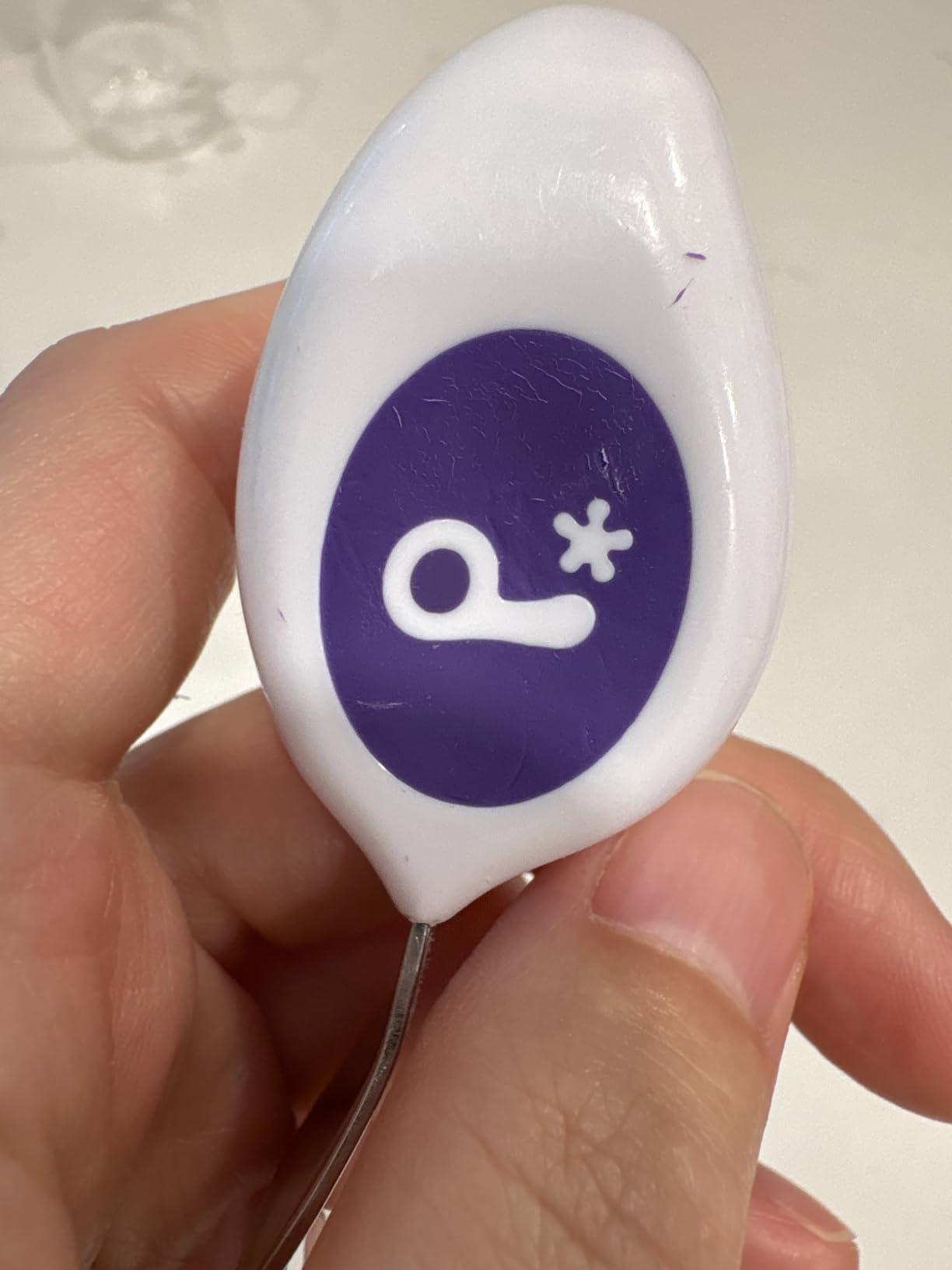
The stainless steel construction is BPA and phthalate free, and the whole set goes in the dishwasher without damage.
A travel case is included, which partly offsets the fact that you only get one fork and one spoon.
Why the contoured handle changes behaviour
Fine motor development happens when a child repeats a movement that works. A handle that keeps the utensil aligned lets the child succeed on the first few attempts, and successful attempts are what builds the skill. That is the whole argument for this shape.
It is also short enough to sit in a fist without the back end sticking out far, which reduces the clumsy swinging we saw with longer sets.
Where the drawbacks are real
This is the priciest set in the roundup, and reviewers say so directly. If your child is already eating independently with a cheaper set, the upgrade is harder to justify.
The odd shape means it will not stand in a standard utensil holder, and two pieces in a travel case is easy to leave behind. Parents report losing the set more than once.
12. Nuby Spoons and Forks 4 Count: Best for First Spoon Practice
Nuby Spoons and Forks – 4 Count
2 forks and 2 spoons
Lightweight plastic
Top rack dishwasher safe
Multiple colour pairs
Pros
- Lightest and easiest for new eaters to hold
- Bright colours keep attention
- Top rack dishwasher safe
- Meets government safety standards
- Six colour pairings listed
Cons
- All plastic wears and scratches over time
- Only four pieces
- Chewing quickly marks the handles
- Less durable than stainless steel
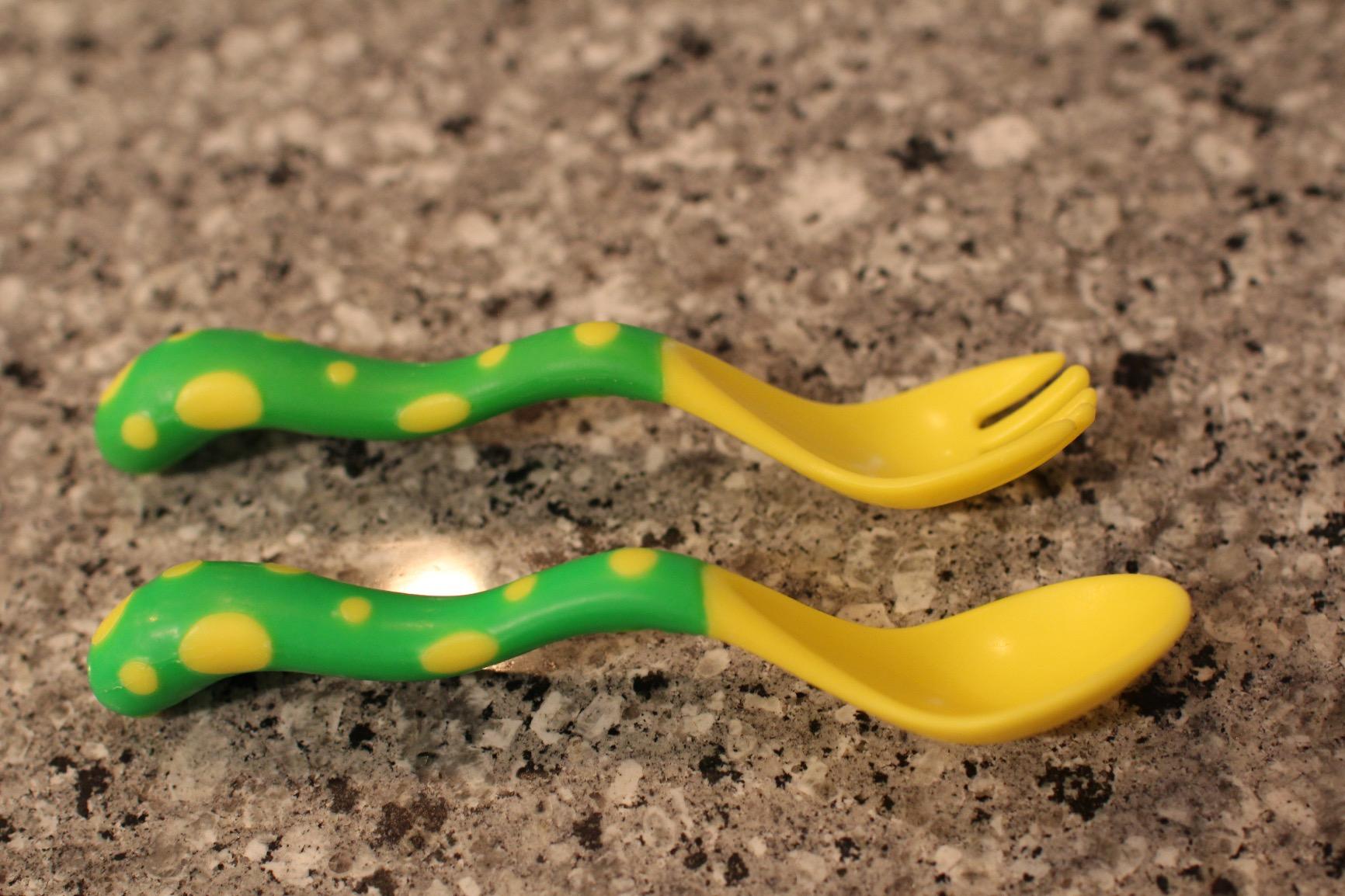
The Nuby set is the earliest-stage option here. Four pieces together weigh 2.4 ounces, which is a low build for a set this size, and weight matters when a child is at the very start of holding an utensil rather than using one.
The rounded handles suit a palmar grasp, the whole fist wrapped around the handle rather than fingertips. That is the grip a nine to twelve month old uses naturally, so this set fits the stage before a pinch grip develops.
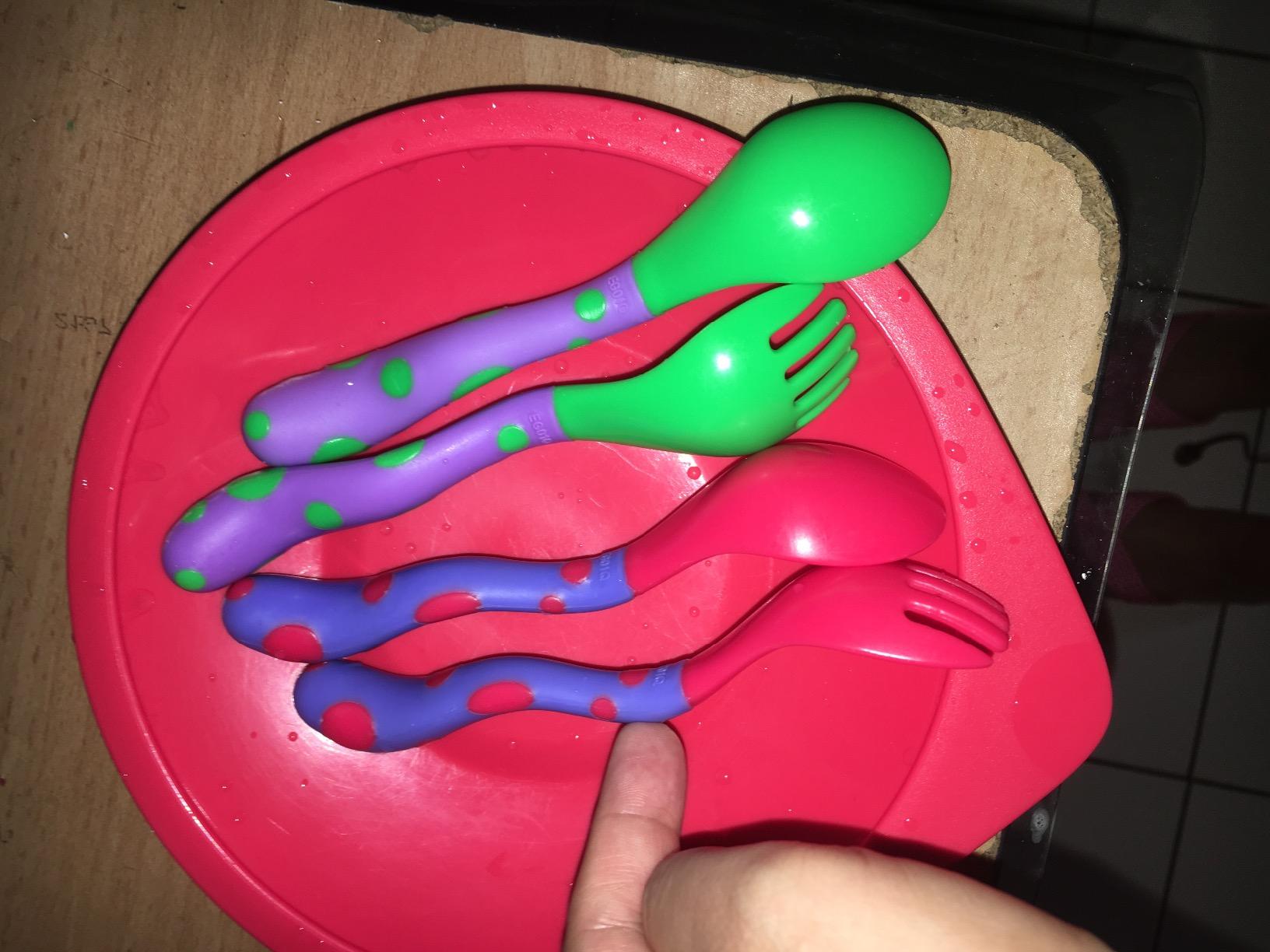
Bright colours are not decoration here. A child who will not look at a plain utensil will often accept a brightly coloured one without argument, which is half the battle at this age.
Cleaning is easy. Top rack dishwasher safe, and there are no seams or joins to trap moisture.
Where this fits in the timeline
Use it while the child is still mouthing utensils and not yet getting food to the mouth reliably. The low weight and full-handle diameter make it easy to hold, and dropping it does no damage.
It is also a good first step for children moving off rubber-tipped baby spoons, because the shape is recognisably a spoon while the weight stays low.
Where the plastic shows its limits
Owners report chew marks and surface wear within months. Every toddler chews utensils, and plastic shows that more obviously than steel does.
Four pieces is a small count for a household with more than one eating location. Expect to move up to a stainless or silicone-handled set once self-feeding becomes reliable.
7 Criteria for Choosing a Toddler Utensil Set
Handle length and thickness come first. A handle under about five and a half inches total suits a toddler’s fist. Long handles are parent-feeding tools, and buying one for a self-feeding child is the most common mistake we see. If you are sorting out adult-sized kitchen tools for the cook rather than the child, our kitchen utensil set guide covers those separately.
Second, spoon bowl depth. A flat bowl is fine for thin foods and terrible for rice, yogurt and anything thick. A deeper bowl carries more but is harder to clear completely, so pick a middle ground unless meals are mostly one texture.
Third, fork tine safety. Look for short, rounded tines that cannot travel far into the mouth. The VITEVER set has explicitly short rounded tines; the DRKIO set has short round forks; both are safer shapes than a long narrow tine.
Fourth, material. 18/8 stainless steel resists corrosion better than 18/0, silicone grips best, and plastic is lightest but wears fastest. More on this below.
Fifth, construction. One-piece sets have nothing to come apart and nowhere for water to sit. Two-piece sets grip better but create a seam that needs hand washing.
Sixth, piece count and locations. Two pieces suits eating out. Four suits home with a spare. Six to twelve suits daycare, travel and siblings.
Seventh, dishwasher tolerance. Every set here is top rack or fully dishwasher safe, but that only applies to the head and handle separately if the set has a silicone sleeve.
The Seam Cleaning Problem Nobody Mentions
If you buy a set with a silicone handle sleeve over a metal insert, water will eventually work into the join. That is the mechanism behind the mold and loosening complaints owners report on sleeve-handled sets such as the Elk and Friends, the PandaEar and the Eascrozn.
Our rule is simple. Put sleeve-handled sets in the dishwasher for everyday cleaning, but once a week take a brush or an old toothbrush to the seam, rinse it, and leave the handle open and dry on a rack overnight. Do not put it away wet.
One-piece sets skip this entirely. That is worth more than it sounds if you are already doing a full dishwasher load every evening.
Materials Explained: Silicone, Stainless Steel and Plastic
Stainless steel is the durable choice. 18/8, as used in the Elk and Friends, Eascrozn and VITEVER sets, holds up to acid foods and resists rust better than 18/0. 18/0, used in the DRKIO and VITEVER ten-piece sets, is perfectly safe food-grade steel and is slightly softer.
Neither metal is sharp if the edges and tines are properly rounded, and both are the option that survives being chewed, dropped and handed to a sibling. The trade-off is weight and coldness, and there is no grippy surface without a sleeve.
Silicone handles solve grip and are the reason two of our picks rank where they do. Silicone is soft enough for a new fist to close around and textured enough to hold with wet hands. The downside is odour and soap smell retention over long periods, plus the seam problem above.
Plastic is the lightest option and the easiest to replace, which is why the Nuby and Munchkin sets work so well for a child who is still mouthing utensils. Plastic also shows wear from chewing sooner than anything else in this roundup, so treat it as a first-stage set rather than a forever set.
When to Introduce Utensils by Age Stage
At six to nine months, most children are being spoon-fed by an adult. Handing over a utensil at this stage is normal and healthy. It is not the point at which self-feeding is expected, and expecting a scoop at this age sets everyone up for frustration.
At nine to eighteen months, self-feeding practice begins in earnest. Children dip, drag and mouth utensils, and many meals end with food on the floor. That is developmentally normal, and the right response is a low-mess meal on a tray plus patience, not a different utensil.
At eighteen to thirty-six months, most children can scoop reliably with a short-handled set. Fork use typically arrives later, often between 30 and 36 months. If your toddler uses the spoon well and rejects the fork, that is normal and not a reason to buy another set.
Hand feeding alongside spoon feeding stays developmentally normal throughout. There is no evidence that letting a baby hold an utensil delays oral motor development, and babies who self-feed often take to solids faster.
Frequently Asked Questions
When should a toddler feed themselves with utensils?
Most children begin self-feeding practice between 9 and 18 months. Earlier is fine too, but do not expect scooping before 12 months. Offer a short-handled toddler set at around 9 months alongside adult spoon feeding, and expect mess and mouthing rather than successful scooping at first.
What utensils should a 2 year old use?
A 2 year old should use a short, thick-handled toddler fork and spoon, ideally with a deep spoon bowl. At this age add a blunt child knife for soft foods, since most two-year-olds are ready to start cutting. Avoid long-handled adult utensils, which toddlers cannot steer.
Should a 2 year old be able to feed themselves?
Yes, most two-year-olds can scoop soft food with a toddler spoon, and many still cannot use a fork reliably. Fork mastery usually arrives between 30 and 36 months. Spilling, dropping utensils and eating with fingers are all normal at this stage.
What is the best self-feeding spoon for babies?
For a baby starting out, the best self-feeding spoon is a lightweight plastic spoon with a rounded handle sized for a full-fist grip, such as the Nuby 4-piece set. Once the child can hold an utensil with a pinch grip, move to a short-handled stainless steel or silicone-handle set.
Are stainless steel or silicone toddler utensils better?
Stainless steel is more durable and lasts longer, but has no grippy surface. Silicone handles grip much better with wet or greasy hands, but add a seam where water can collect. Many parents use stainless heads with silicone handles to get both.
Are metal utensils safe for toddlers?
Yes, as long as edges and fork tines are rounded. The stainless sets in this roundup have short rounded tines and smooth edges that do not tear skin. Inspect for sharp spots after months of use, and supervise any child who chews utensils.
Which Toddler Utensil Set Should You Buy?
Start with the Munchkin Raise set if you want one purchase that solves the most problems, or the Elk and Friends set if your toddler’s hands are wet and messy from start to finish. Both are among the best toddler utensil sets for self feeding because the handle is short and thick enough for a real fist to hold.
Buy the Munchkin Splash set when cutting matters, the Kirecoo set when pieces travel between home and daycare, and the DRKIO twelve-piece when two children eat at the same table. If grip is the sticking point above everything else, the doddl set is the one that changes behaviour fastest.
Whichever you choose, replace baby spoons when the novelty wears off around 12 to 18 months, and expect the first few weeks to be messier than spoon feeding by an adult. That stage is the point of the purchase.