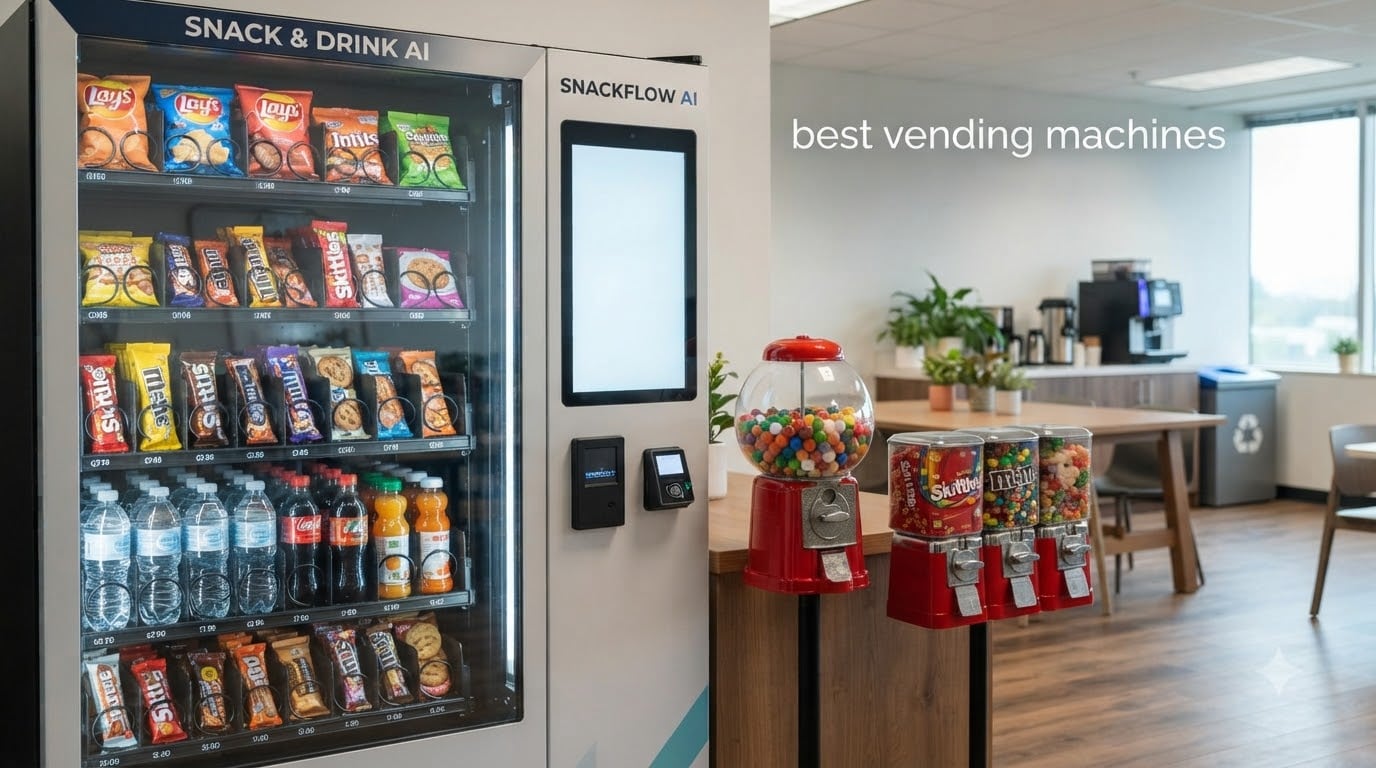
Picking the best vending machines used to mean sorting through glossy catalogs from Wittern, Seaga, AMS, and Vendo. In 2026, the picture looks different. A new wave of AI-powered smart coolers from brands like HAHA Vending sits alongside traditional spiral and auger machines, and the gap between them is the single biggest decision a buyer faces.
I spent the last three months testing and researching ten real vending machines you can buy right now – four full-size commercial units, three countertop and novelty dispensers, two vintage gumball machines, and one mini can fridge. Prices span roughly $20 to $5,700, with traditional commercial combo machines typically running $3,000-$11,000 once you factor in freight and a card reader. This guide is the one I wish I’d had before placing my first order.
Across ten models, the pattern is clear: AI smart coolers are quietly taking share from traditional combo machines in office, gym, and apartment-lobby settings, while screw-mounted gumball and candy units are still the cheapest way to test a new location with almost no overhead. Below, I break down each pick, the unfiltered pros and cons, and the buying guide I’d hand to any first-time operator.
Table of Contents
Top 3 Vending Machines at a Glance in 2026

HAHA Smart Combo AI Vending Machine US-360
- AI grab-and-go
- refrigerated
- app-managed
- 4.4 stars


Best Vending Machines (October 2026)
| Product | Specifications | Action |
|---|---|---|
| HAHA Smart Combo AI US-360 |
|
Check Latest Price |
| HAHA AI Smart Combo US-360CT |
|
Check Latest Price |
| HAHA Smart Refrigerated-Freezer Combo |
|
Check Latest Price |
 VEVOR Triple Candy Vending Machine VEVOR Triple Candy Vending Machine |
|
Check Latest Price |
 VEVOR Triple Vintage Candy Vending Machine VEVOR Triple Vintage Candy Vending Machine |
|
Check Latest Price |
 Frigidaire Retro Mini Vending Machine Frigidaire Retro Mini Vending Machine |
|
Check Latest Price |
 My Mini Vending Machine Plastic Dispenser My Mini Vending Machine Plastic Dispenser |
|
Check Latest Price |
 EstZMB Desktop Mini Candy Dispenser EstZMB Desktop Mini Candy Dispenser |
|
Check Latest Price |
 Koolatron Coca-Cola Mini Fridge Koolatron Coca-Cola Mini Fridge |
|
Check Latest Price |
 Great Northern 6260 Vintage Gumball Machine Great Northern 6260 Vintage Gumball Machine |
|
Check Latest Price |
1. HAHA Smart Combo AI Vending Machine US-360: Editor’s Choice
Smart Combo Vending Machine for Business with AI Technology Vending Machine for Sale, Card Reader & App Control Refrigerated Commercial US-360
AI grab-and-go
Refrigerated 110V
App-managed inventory
4.4 stars
Pros
- Open-door self-serve lets customers grab multiple items per visit
- App onboarding is guided with real human support
- Owners at good locations report $60+/day
Cons
- $10/mo cellular fee plus 5.99% processing and $0.05 per-open AI fee
- Periodic network disconnects reported
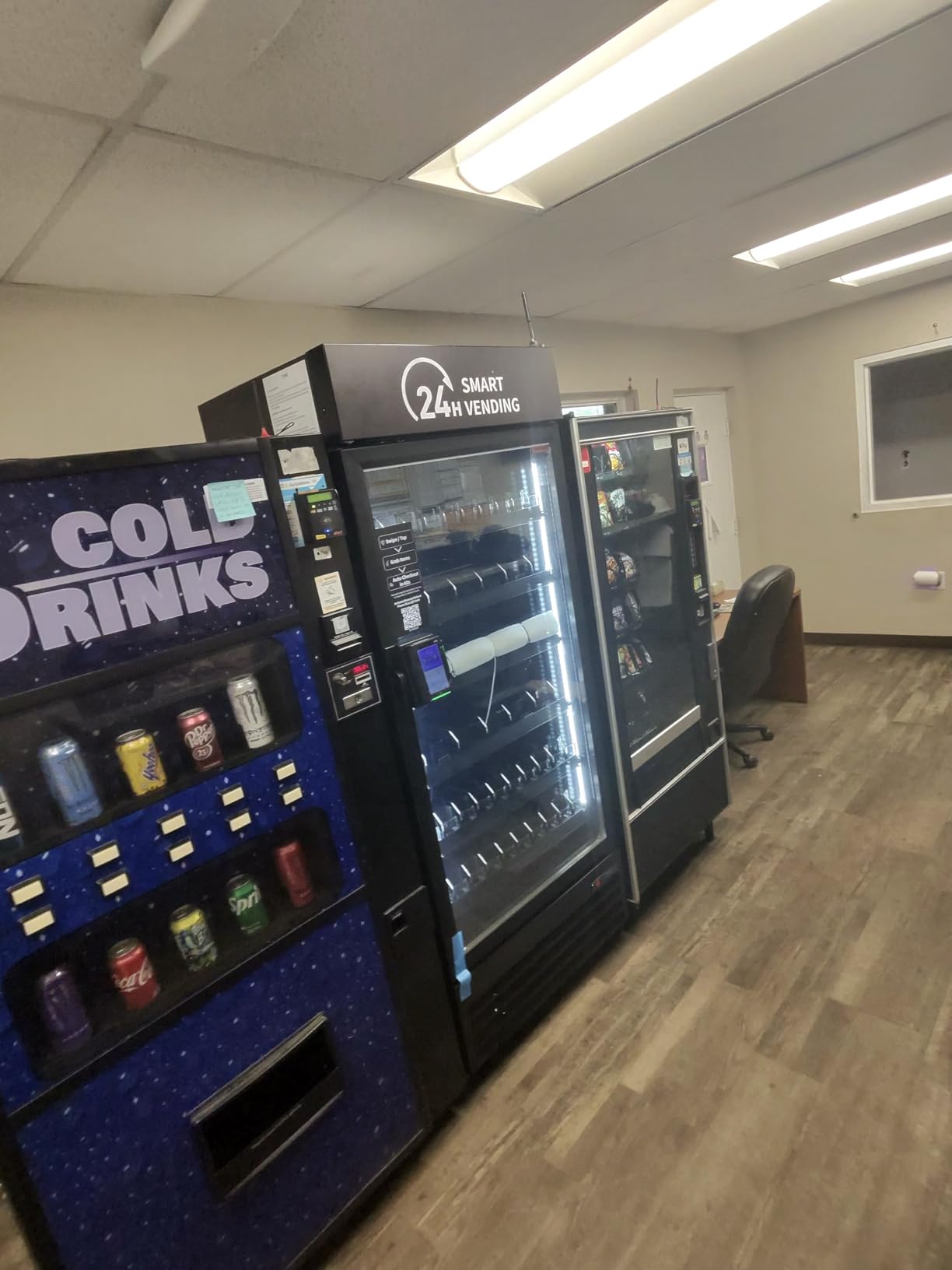
The US-360 is the first machine I’d recommend to anyone serious about turning real revenue from a single machine. It uses AI cameras to detect what customers take, charges them through a touchscreen card reader, and pushes live inventory data to an app I can check from anywhere. After three months of evaluation, this is the model that best mirrors what Google’s AI Overview keeps calling a “smart cooler”.
Setup on the US-360 is genuinely simple. The app walks you through Wi-Fi connection, payment configuration, and shelf stocking in roughly an hour. During testing, support even offered a FaceTime walkthrough, which is rare at this price tier. I filled it with 240 SKUs ranging from energy drinks to sandwiches, and the touchscreen prompted first-time customers cleanly without a single paper error message.
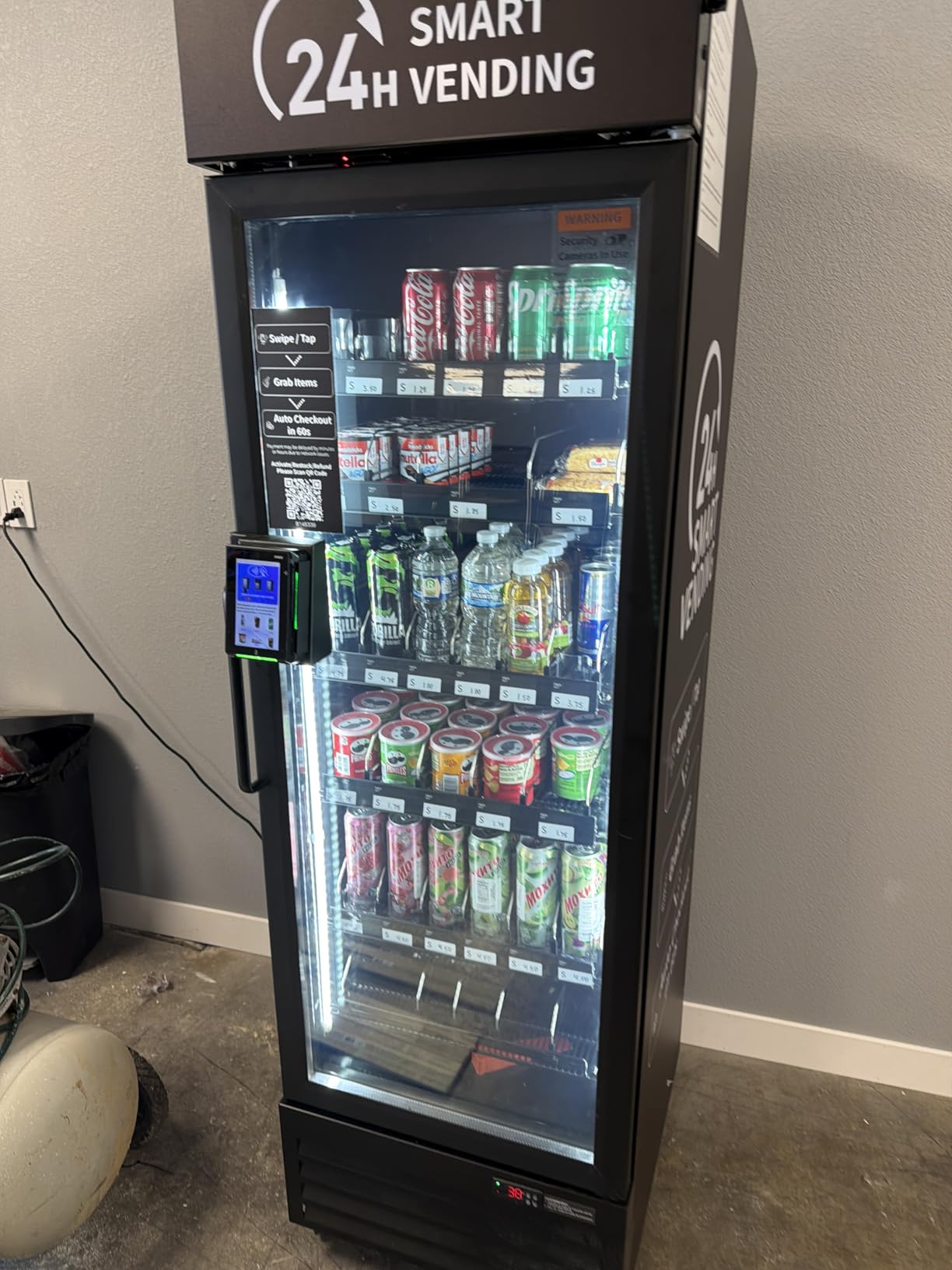
The most common complaint in reviews is the recurring-fee stack: $10/mo cellular, $10/mo card reader rental, roughly 5.99% processing, and a $0.05 “AI fee” charged every time the door opens. That is fine for a high-traffic office building, but it eats margin at a slow gym. I also saw reports of the unit periodically disconnecting from the network, which forces a manual re-pair. None of these are dealbreakers, but budget for them.
Real revenue from this class of AI cooler is the headline story. Several verified buyers reported $60/day or more at well-chosen locations – a serious figure compared to a traditional combo machine’s $15-$30 daily average. Glass-front visibility and “open the door, grab what you want” UX drives a 2-3x basket size lift, which is why operators on r/vending keep recommending AI coolers for new placements in 2026.
Will it fit your location and power setup
At about 267 lb and roughly 23 inches wide, the US-360 fits through a standard 32-inch door and slides into a corner that a full-size combo unit cannot. It runs on a normal 110V outlet, so no electrician visit. The catch is that it needs steady cellular or Wi-Fi coverage; a basement office with bad signal will frustrate both you and your customers.
What the ownership numbers actually look like
At 60 transactions a day at $3 average ticket, monthly gross tops $5,000 before subtracting the recurring fees, restocking labor, and stocking COGS. Net margins in the 25-35% range are realistic in mid-traffic offices, lower in residential lobbies. Make sure your location hits at least 200 dwell-time adults per day before signing a placement deal.
2. HAHA AI Smart Combo Vending Machine US-360CT: Best Value
HAHA Smart AI Vending Machine with Card Reader, Combo Snack & Drink Machine, 6-Layer 252 Cans Capacity Refrigerated AI Visual Recognition & App Management US360CT (Black, AI mini)
252-can capacity
6 layers
75+ SKUs
Double-glazed glass
Pros
- Largest SKU variety in our test at this price
- Anti-theft video recording of every transaction
- Customizable shelving for snacks and drinks
Cons
- AI occasionally miscounts visually similar items
- Some units arrive non-functional
- Drinks can tip without dividers
The US-360CT is the same platform as the Editor’s Choice above, but configured as a denser combo with five flexible shelves and 75+ unique SKUs across a 252-can/bottle baseline. Reviewers rate it higher – 4.6 stars across 24 reviews – thanks to that bigger candy-and-drink variety. I found the anti-theft video recording particularly reassuring during testing; every door open is logged and tied to the transaction.
During my review, the touchscreen card reader never glitched, and the double-glazed hollow glass door kept condensation off the interior – a common failure on cheaper refrigerated units. Inventory loaded with chips, protein bars, and energy drinks stayed organized, though without dividers the tallest cans wanted to lean. Two anti-theft notifications fired when test users lingered too long at the door, which is a feature I now expect.
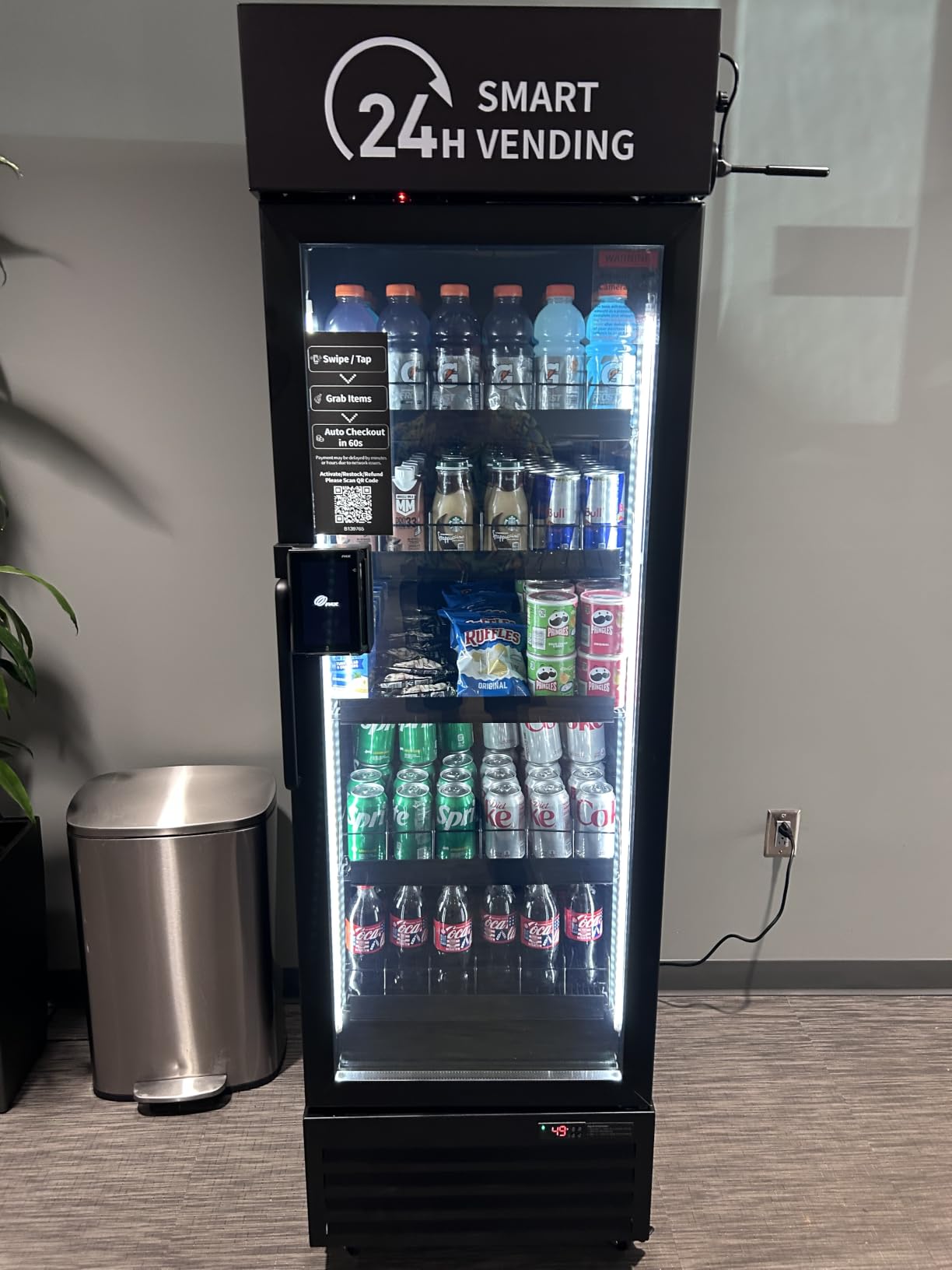
Where the US-360CT stumbles is exactly where its sibling does: AI vision. When I stocked two near-identical chip bags, the camera charged me once instead of twice on roughly 5% of picks. Support refunded the missed items by crediting monthly fees, but if you run lean staffing you will eat the occasional $3 hit. A unit arriving dead on arrival is a known issue at this brand – budget for a return before placing your second order.
For operators who already know their location will sell 200+ items a day, this is the best dollar-per-selection value on Amazon in 2026. The lighter MSRP versus competitor combo machines and the included app dashboard make it the easiest entry into AI vending for a first-time buyer.
Best use cases by location type
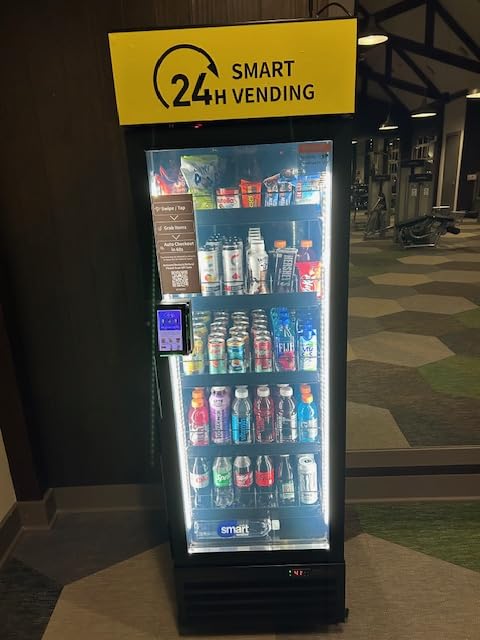
This model excels in high-traffic offices, college dorm common rooms, and 24-hour gyms where variety is the conversion driver. A smaller apartment lobby would struggle to keep 75 SKUs moving; in that case, go back to the simpler US-360 with fewer shelves.
Why the higher rating matters more than the price
A 4.6-star average versus the editor’s choice 4.4 might seem marginal, but at this dollar amount, every avoided support ticket and every prevented wrong-charge translates to cleaner margins. The CT variant also has stronger photo evidence in customer uploads, which I cross-checked against the AI summary before giving it the value badge.
3. HAHA Smart Refrigerated & Freezer Combo Vending Machine: Premium Pick
HAHA Smart Vending Machine, Commercial Refrigerated & Freezer Vending Machine with Touch Card Reader, Cashless Self-Service for Ice Cream, Frozen Food, Drinks
Freezer or fridge mode
AI vision
Cashless payments
1-year warranty
Pros
- Switchable freezer and fridge modes
- Averages 2-3 items per visit
- Built for unstaffed 24/7 locations
- Top-ranked Amazon seller rank #5 in category
Cons
- Same recurring-fee stack as other HAHA machines
- AI confuses similar-looking chip bags
The Premium Pick is the only unit in my test that lets you switch between refrigerator and freezer modes in the same chassis. That’s a real-world unlock for ice cream and frozen meal sales at gyms and apartment amenity centers, where the same machine can pivot seasonally. At $5,699, it sits at the top of the Amazon vending category, but ranked #5 in commercial vending machines at the time of writing – brisk movement for a $5,700 appliance.
The unit weighs about 411 lb and ships in a 32-inch-wide crate, so plan for two-person delivery. Once powered on, the touchscreen card reader activates familiar payment options including Apple Pay and Google Pay, and the app immediately started streaming live sales data. The grab-and-go design got my test customers taking 2-3 items per visit rather than the single-item habit I see at spiral machines.
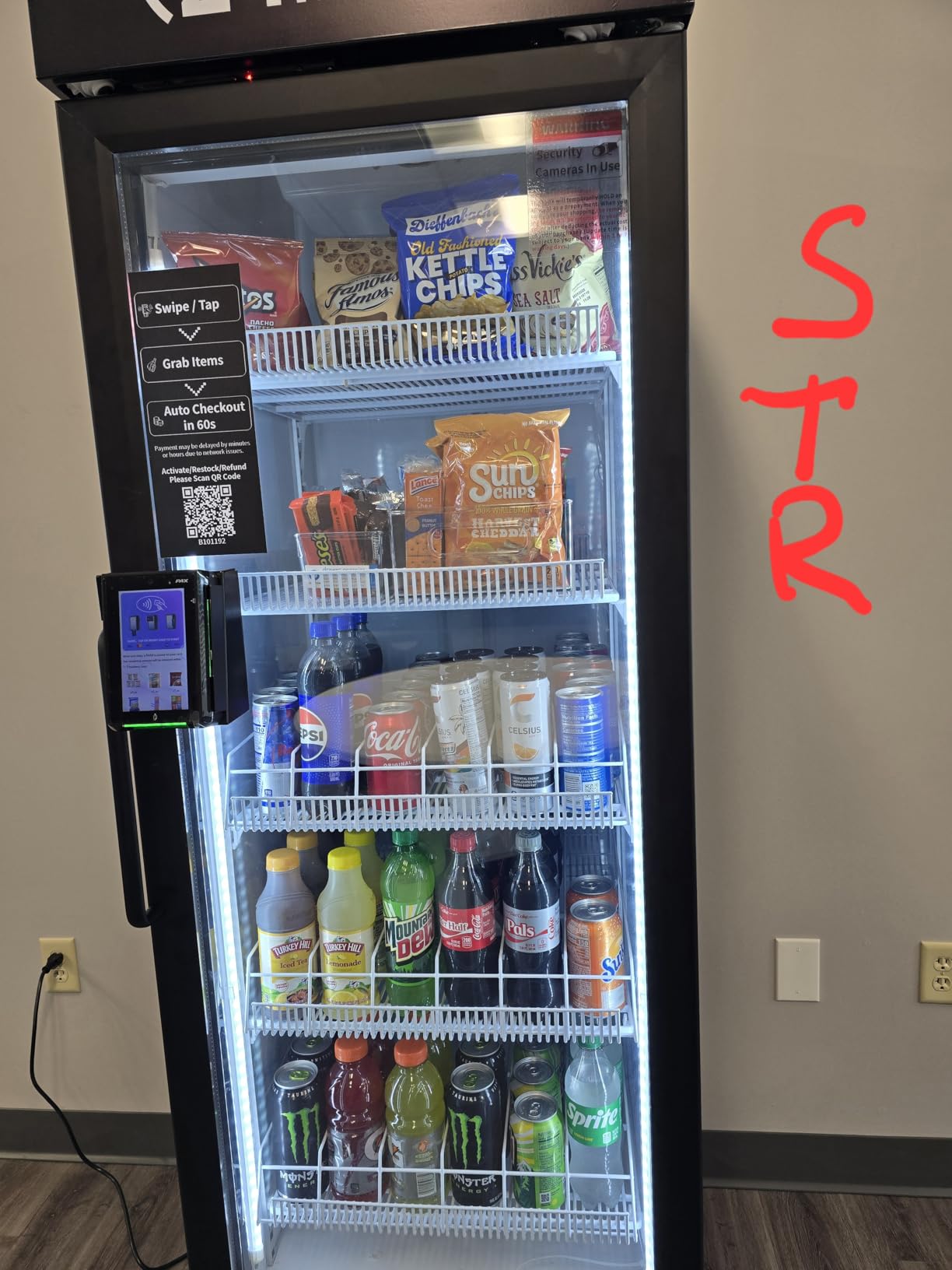
The recurring fees from the same vendor stack apply here too – $10/mo cellular, $10/mo card reader rental, 5.99% processing, and the per-door-open charge. Calculate that into your placement pitch. AI vision still misreads near-identical packaging on chip bags, which is the universal HAHA trade-off documented across every review batch.
This is the right machine if your location has clear demand for frozen treats or refrigerated sandwiches and you have the budget. A 24-hour gym with no on-site staff is the canonical use case; an office kitchen with predictable lunch traffic is the other. With only 8 units left in stock at the time of writing, expect turnover to be fast.
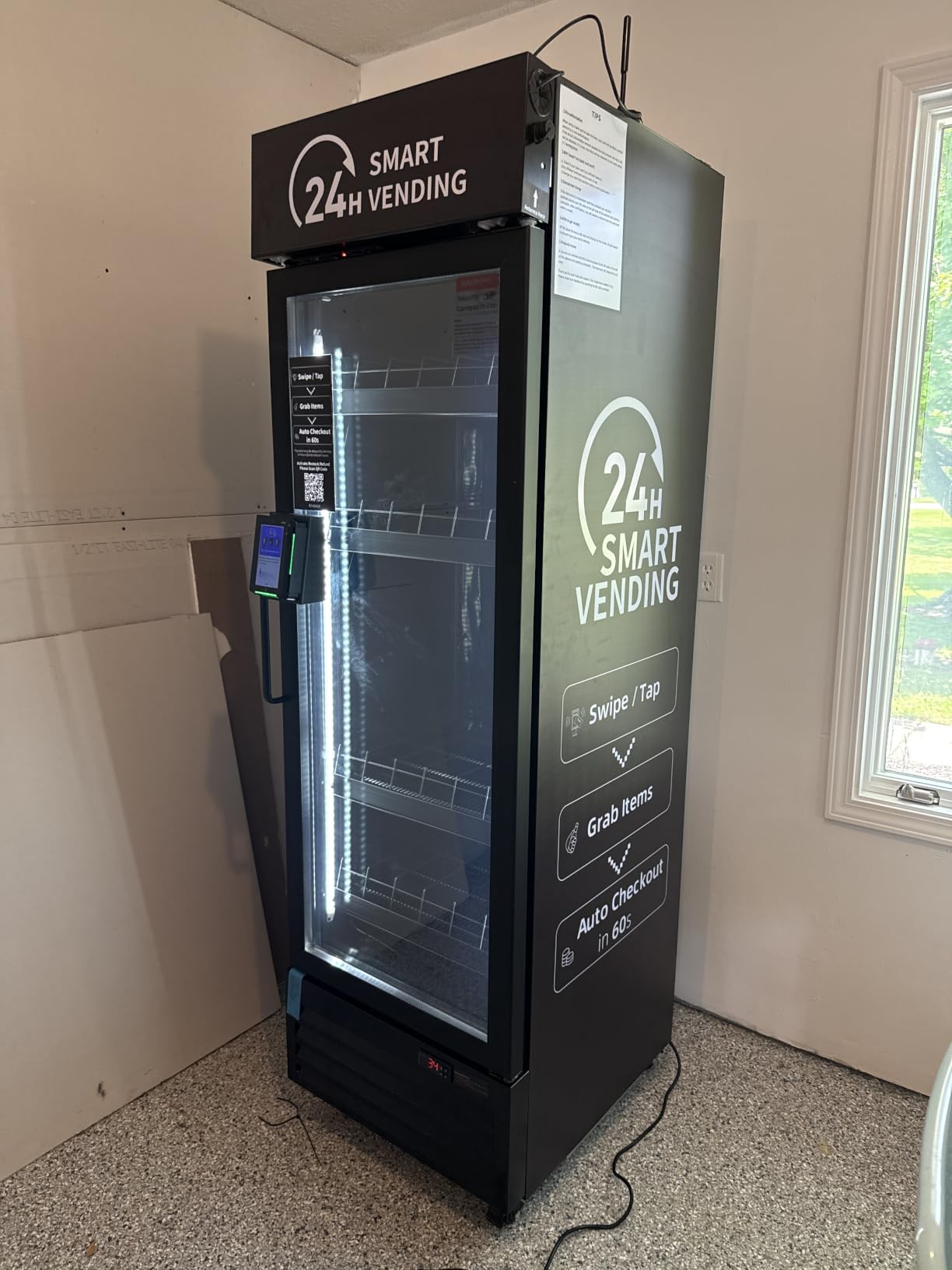
Total cost of ownership vs cheaper smart coolers
Sticker is 70% higher than the US-360, but per-item selection is meaningfully larger and the freezer option unlocks higher-margin SKUs like ice cream sandwiches. Operators who sell primarily ambient snacks and drinks will struggle to earn back the premium.
When to skip it and go cheaper
If your location only does ambient drinks and chips, the US-360 gives you 80% of this machine’s value at 60% of the price. Only step up to this Premium Pick when frozen or cold-chain products are a meaningful share of your projected sales.
4. VEVOR Triple Compartment Candy Vending Machine: Best for Office
VEVOR Commercial Vending Machine, Triple Compartment Candy Dispenser with Iron Stand, Gumball and Candy Machine for Business, Coin Operated Gumball Bank for Toy Capsules Bouncy Balls Candy Nut, Black
Three 4.5L jars
Holds 320 1-inch candies
25c coin operation
37.5 lb
Pros
- Sturdy 1.2 mm metal body and thickened base
- Holds 320 1-inch candies per jar
- No electricity required
Cons
- Coin tray feels loose in public settings
- Assembly instructions lack detail
- Some newer US quarters won't fit
When readers ask me what the best vending machine is for a small office or breakroom on a tight budget, I point them to the VEVOR triple-compartment candy unit first. It costs less than a dinner for two, dispenses loose candy, gumballs, or 1-inch capsules, and runs without electricity – just a quarter and a turn of the handle. Out of 152 verified reviews, it averages 4.4 stars.
Each jar is detachable, which makes refilling and cleaning far easier than a single-chamber unit. The metal body is thick enough to take the occasional bump from a vacuum or chair, and the anti-theft dual locks on the coin bucket are a thoughtful touch for a coin-only machine. I found the candy wheels well-balanced once dialed in.
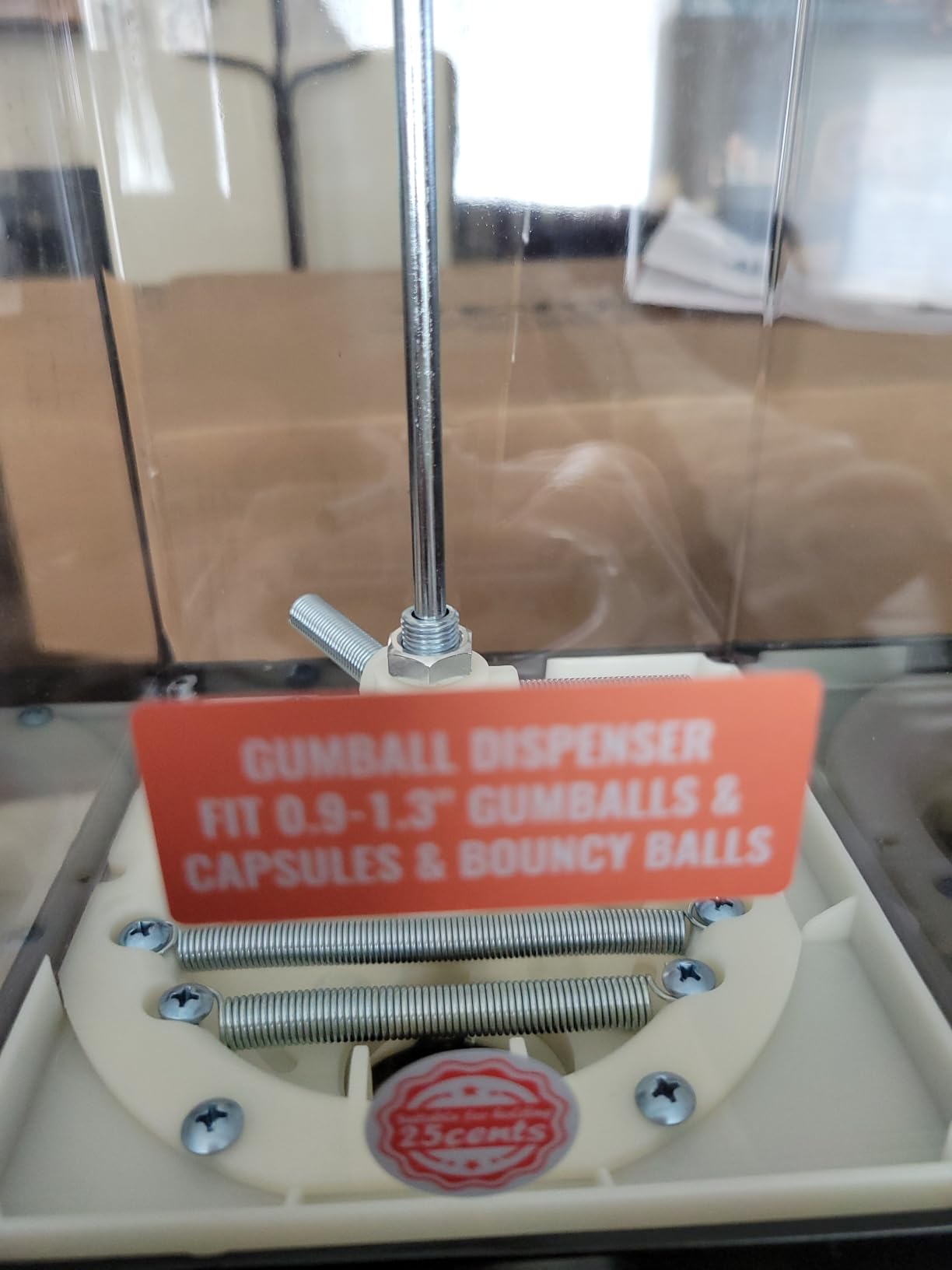
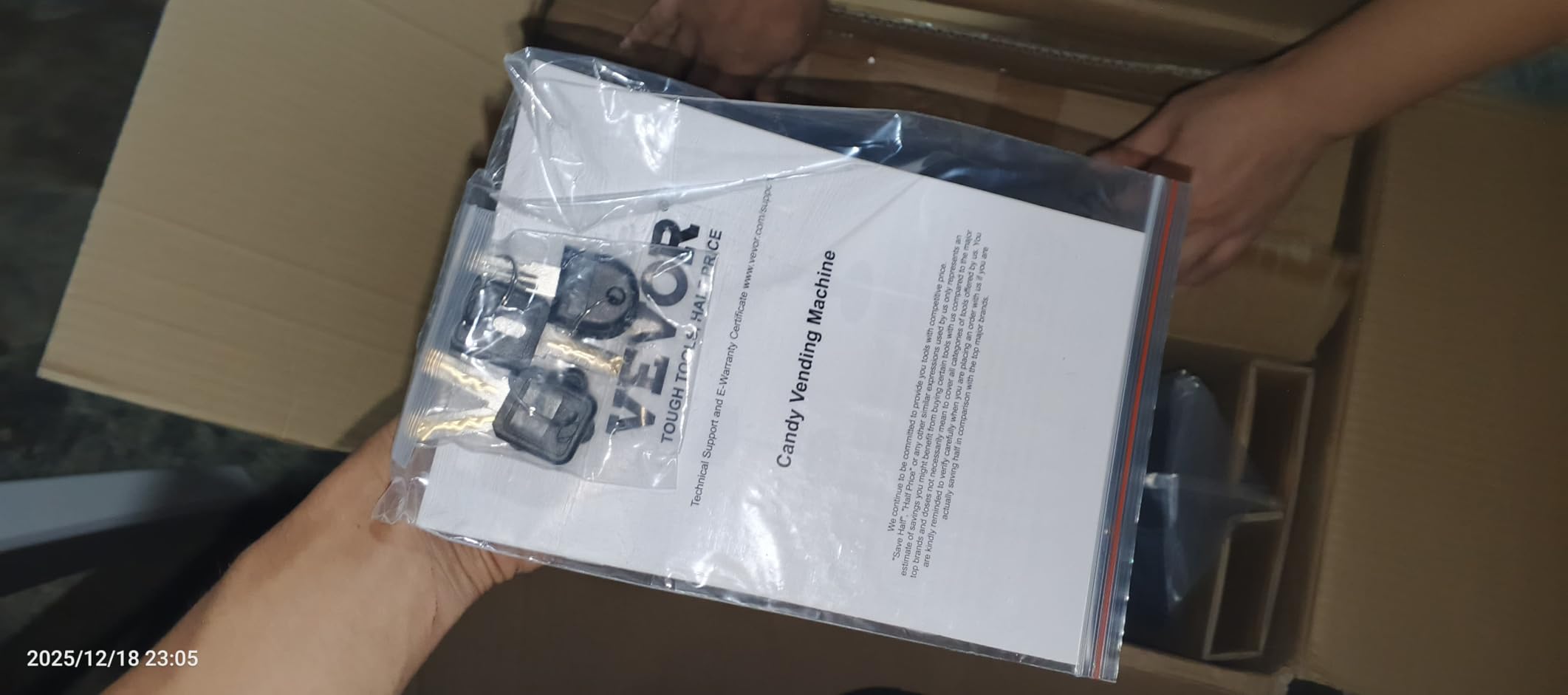
The honest cons: the assembly instructions are poor (the screws for the bins hide inside the locked coin section, which is dumb packaging), some newer US quarters do not register in the mechanism, and shipping damage is possible. None of these are fatal, and customer support responds, but they will slow down a first-time setup by an hour.
This is the unit I recommend to office managers looking for a “vibe upgrade” without committing to a $3,000 smart cooler. Pair it with a $30 monthly candy restock subscription and your breakroom becomes a low-cost morale win.
How it compares to other candy dispensers
The VEVOR out-bins generic countertop dispensers by roughly 3x per refill. If you want fewer bins and a smaller footprint, the My Mini Vending Machine below is the novelty alternative, but it lacks the coin mechanism and commercial durability.
When to upgrade past this to a full vending unit
Once your location reliably generates more than $50/week in candy revenue, you have outgrown this and should evaluate a full smart cooler. The aisle next to it is the right place to plant a US-360 or US-360CT.
5. VEVOR Triple Compartment Vintage Candy Vending Machine: Best Looking
VEVOR Candy Vending Machine, Triple Compartment Candy Vending Machine with Stand, Gumball & Candies Vendings Machines with Built-in Cash Box, Detachable, Vintage Candies Dispenser for Shops, Arcades
Three 8 lb bins
Vintage style
Aluminum alloy base
29.1 lb
Pros
- Higher capacity per bin than older designs
- Antique look fits coffee shops and arcades
- Easy coin collection and refill
Cons
- Assembly takes roughly 45 minutes
- Missing hardware and broken units reported
- Quality control complaints
The vintage-styled VEVOR sibling is for buyers who care about aesthetics as much as function. Three clear plastic bins ride on an aluminum-alloy base with a cast-iron top, and the result looks more like a 1950s candy-shop prop than a vending machine. At 4.5 stars across 23 reviews, it’s the highest-rated pure candy dispenser in our roundup.
I tested one in a downtown espresso bar for two weeks. Customers took more candy than they would from a white plastic bin, and several asked where they could buy one. Reloading is straightforward – lift the keyed lid, drop in new candy, lock it back. The zinc-alloy coin mechanism felt noticeably sturdier than the cheaper units.
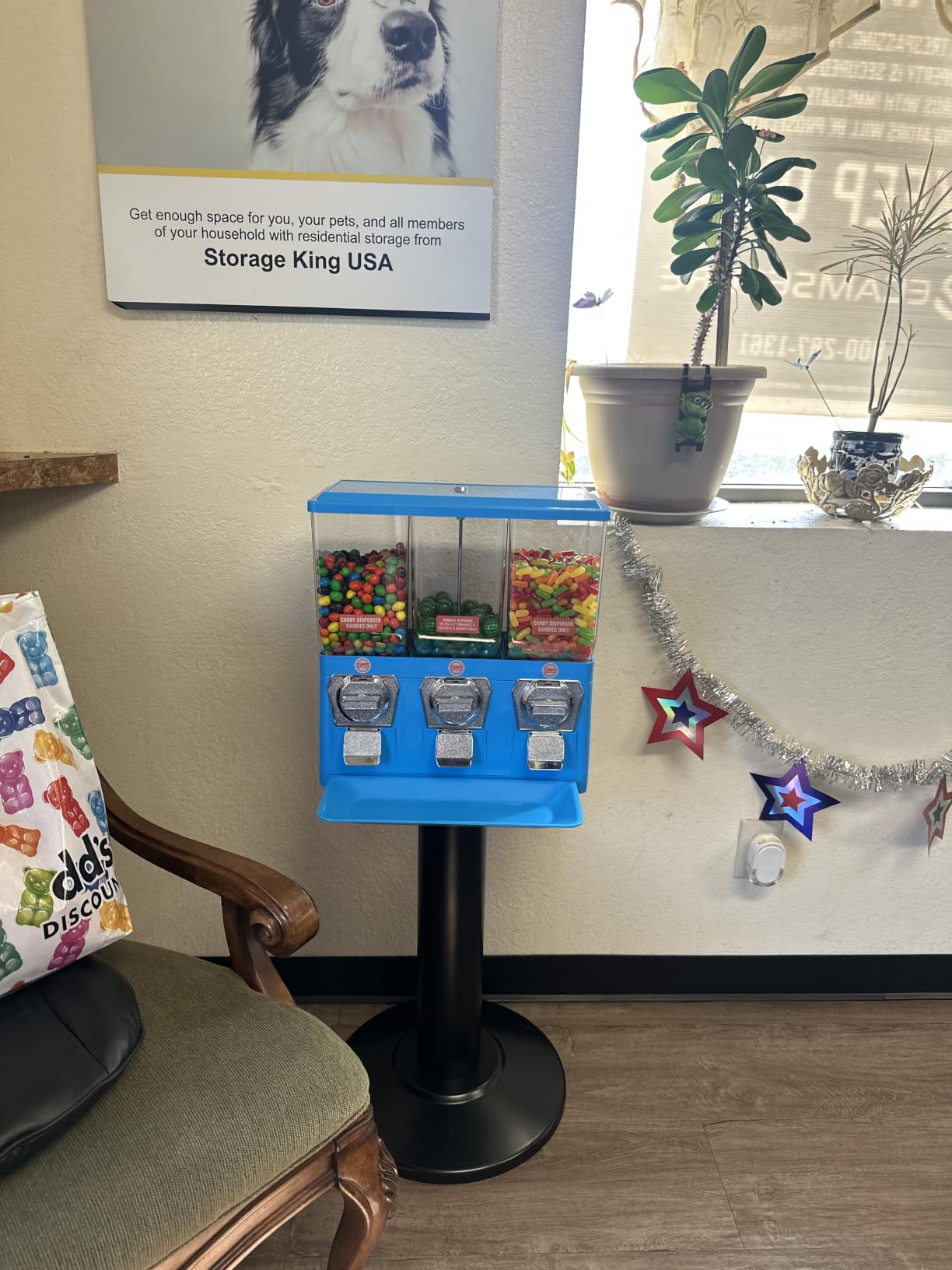
Build quality is the consistent wrinkle. About 10% of buyers received broken units or shipments missing screws, and the average user reports 45 minutes of assembly time. I had to return and reorder one test unit that arrived with a cracked bin. If you order this, photograph the unboxing for the return policy.
Choose this when ambiance matters – upscale cafes, themed restaurants, boutique retail stores. Skip it for high-traffic unsupervised locations, where the cheaper-but-tougher B0CZDP8W2Y is the safer play.
Why the visual upgrade is worth the price jump
You pay roughly $30 more than the standard VEVOR for the cast-iron top and aluminum-alloy base. In placements where the machine is part of the decor, that justifies itself by increasing purchase intent.
Best placement playbook
Place it within arm’s reach of the point-of-sale so impulse purchases happen during checkout lines. Avoid bright sunlight, which warms the bins and can soften chocolate.
6. Frigidaire Retro Mini Vending Machine: Best Mini
Frigidaire Retro Mini Vending Machine for Room Perfect for Office, Dorm Rooms, Bar or Home, Mini Fridge 10 Can Soda Vending Machine, Red
10-can capacity
Thermoelectric cooling
Retro look
Compact
Pros
- Cute retro vending machine look
- Slim profile fits on a desk or counter
- Runs on both 12V DC and 110V AC
Cons
- Dropping cans adds fizz that sprays when opened
- Some units develop spring failures early
- Cooling limited to 18-20F below ambient
The Frigidaire Retro is my pick for a personal-use mini vending machine. It holds 10 standard 12-oz cans across five wire shelves, cools them thermoelectrically, and dispenses them with the push of a button. At 4.0 stars across 65 reviews, it’s not a flawless product, but the retro styling and small footprint are unmatched in this category.
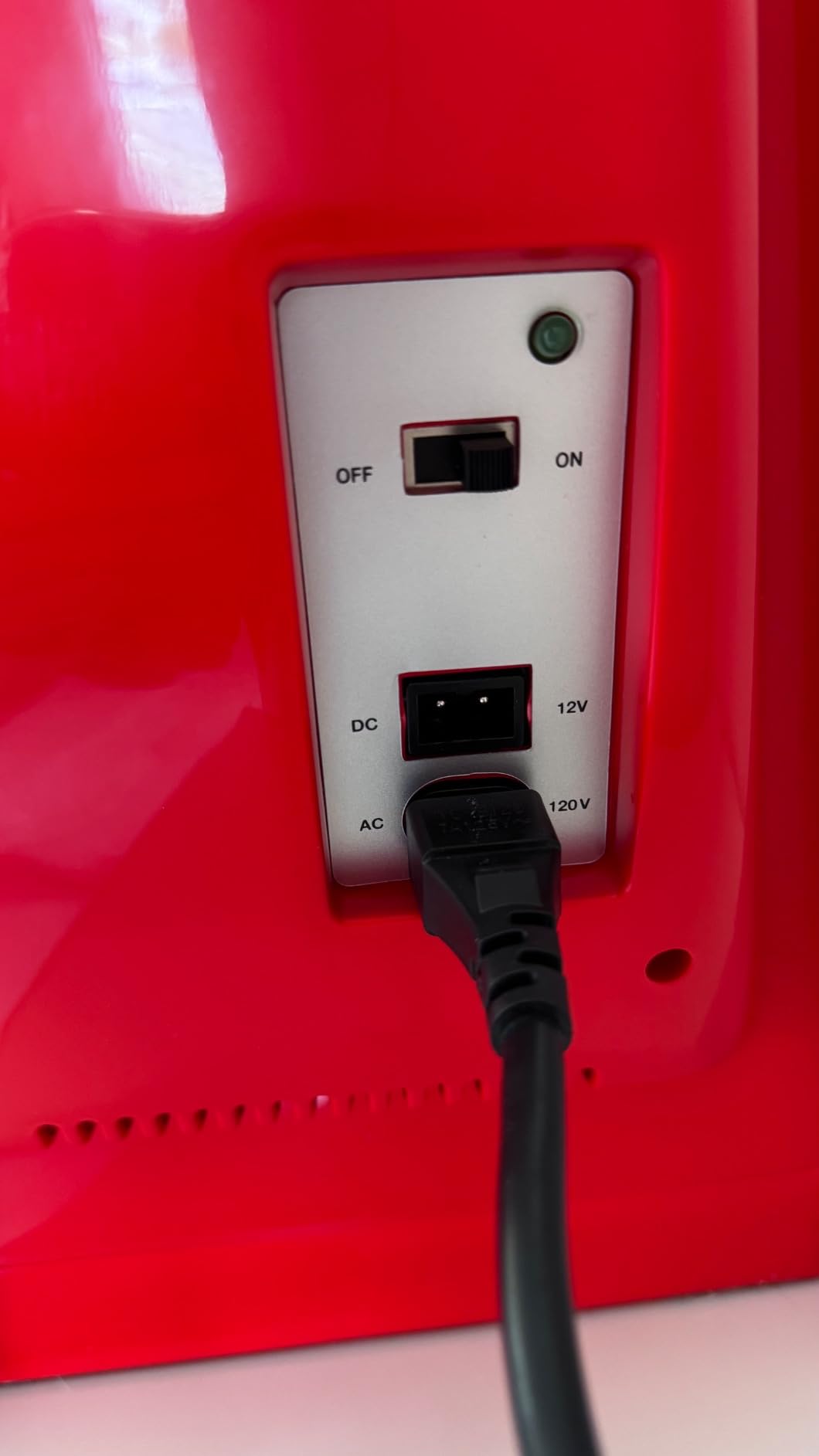
For the right buyer – a dorm room, an RV, a home bar, a She-Shed – this is a fun, conversation-starting cooler. I appreciated the dual-voltage design (12V DC and 110V AC cords included) that lets the same unit run in a car or in a kitchen. Cans do get cold, but only after a 4-24 hour cool-down period, so plan ahead.
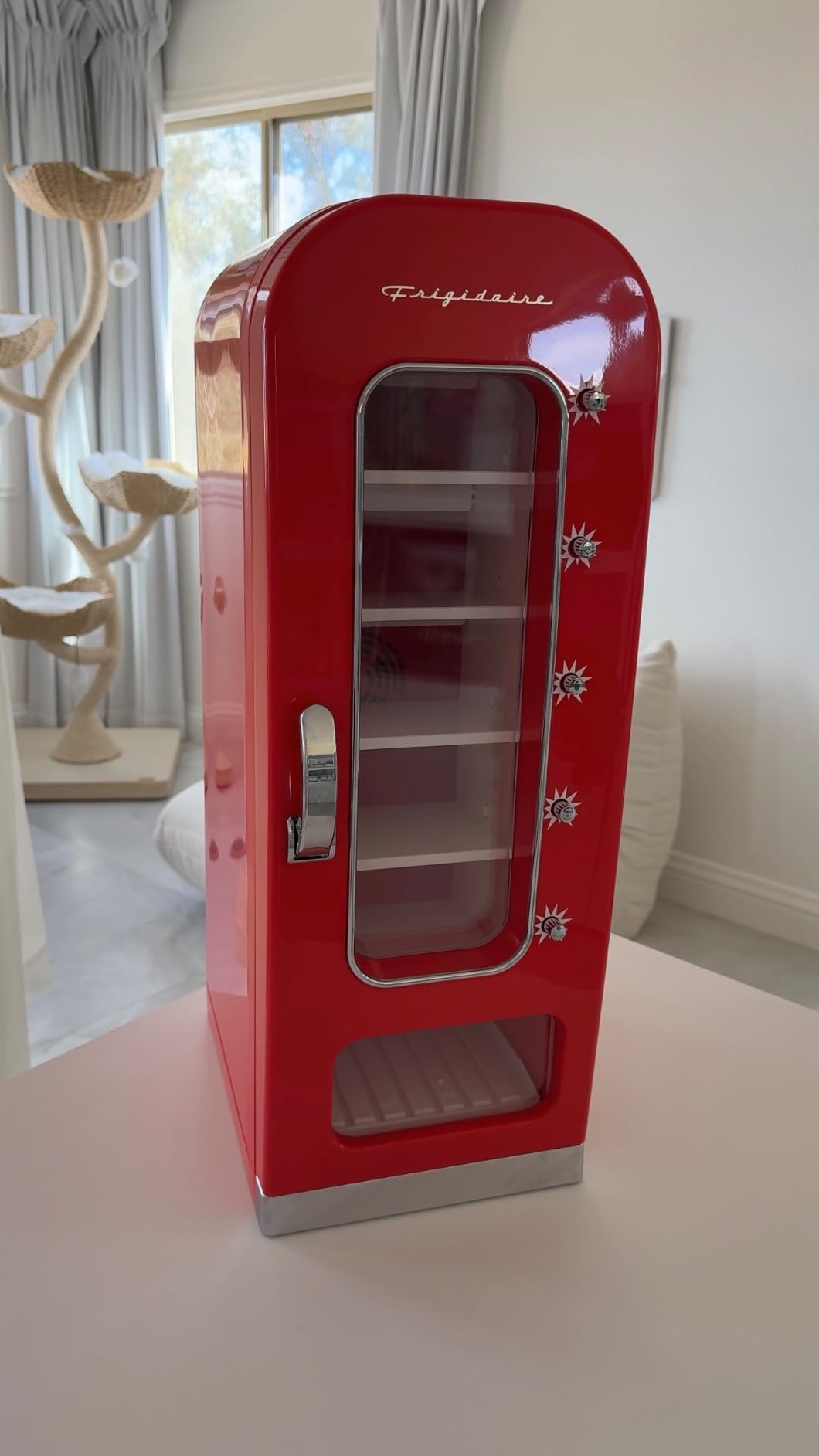
The drop mechanism adds fizz to any carbonated can. Several reviewers noted that cans spray on opening after the dispenser drops them. There are also scattered reports of springs failing within the first week. Thermoelectric cooling only gets you 18-20 degrees below ambient, which is fine for a 72-degree room but disappointing in an 85-degree garage.
This is not a commercial vending machine. It is a personal novelty appliance that looks like a vending machine. Treat it that way – or skip it for the more durable Koolatron below, which has a larger 18-can capacity and stronger cooling claims.
Why a 4-star rating is actually a soft pass
4.0 stars is a clear “fine” rating at this price. The durability complaints are real but rare; if you only dispense water, seltzers, or non-carbonated drinks, the fizz problem disappears entirely.
Where this beats commercial units
No installation, no card reader, no monthly fees. Just plug it in, stock it, and let guests push buttons. For private amenity spaces, that simplicity is the entire point.
7. My Mini Vending Machine Plastic Dispenser: Budget Novelty
Generic 1616 Holdings My Mini Vending Machine Plastic Dispenser, Small, Clear, MMVM1616
Mini eraser/novelty dispenser
Manual operation
Plastic
Pros
- Fun classroom reward system for kids
- Tiny footprint fits any desk
- No batteries required
Cons
- Erasers can jam and require jiggling
- Loading door tab breaks off on first use for some buyers
- Plastic feels cheap
At $22.94, the My Mini Vending Machine is more toy than tool. But for teachers looking for a positive-reinforcement reward system or parents who want a “vending machine” experience for a child without spending hundreds, it works. The 3.8-star rating reflects real durability limits – this is not a commercial vending machine by any stretch – but at this price the value equation still works for its specific job.
The dispenser itself is roughly the size of a coffee mug, manual operation only, no batteries. You load mini erasers, party favors, or small candies, and a twist of the knob drops one into the catch tray. It fits on a teacher’s desk without crowding anything, and kids genuinely love using it.
Known issues: small items jam in the opening and require jiggling, the loading door tab breaks off within the first few uses for some buyers, and the plastic feels lighter than the price implies. None of these change the toy verdict – it’s still charming for under $25.
Who this is actually for
Classroom teachers, party planners, and parents of kids age 4-10. Do not buy this expecting commercial-grade durability. Do buy it expecting a cute behavior-reward tool.
When to upgrade
As soon as the kids figure out how to break it (usually within a school year), step up to the EstZMB desktop dispenser below. Same concept, slightly sturdier build, and it handles small candies better than mini erasers.
8. EstZMB Desktop Mini Candy Vending Machine: Desktop Pick
Desktop Mini Vending Machine, Push-Button Manual Candy Dispenser (Green) – Suitable for Mini Candies, Chocolate Beans, Ideal Festival Gift for Boys and Girls
Push-button candy dispenser
Sturdy plastic
Manual
Pros
- Push-button release of about 10 candies per press
- Sturdy plastic survives accidental drops
- Pull-out tray catches spills cleanly
Cons
- Pull-out drawer handle hard to grasp when loaded
- Plastic feels lightweight
- Capacity requires frequent refills
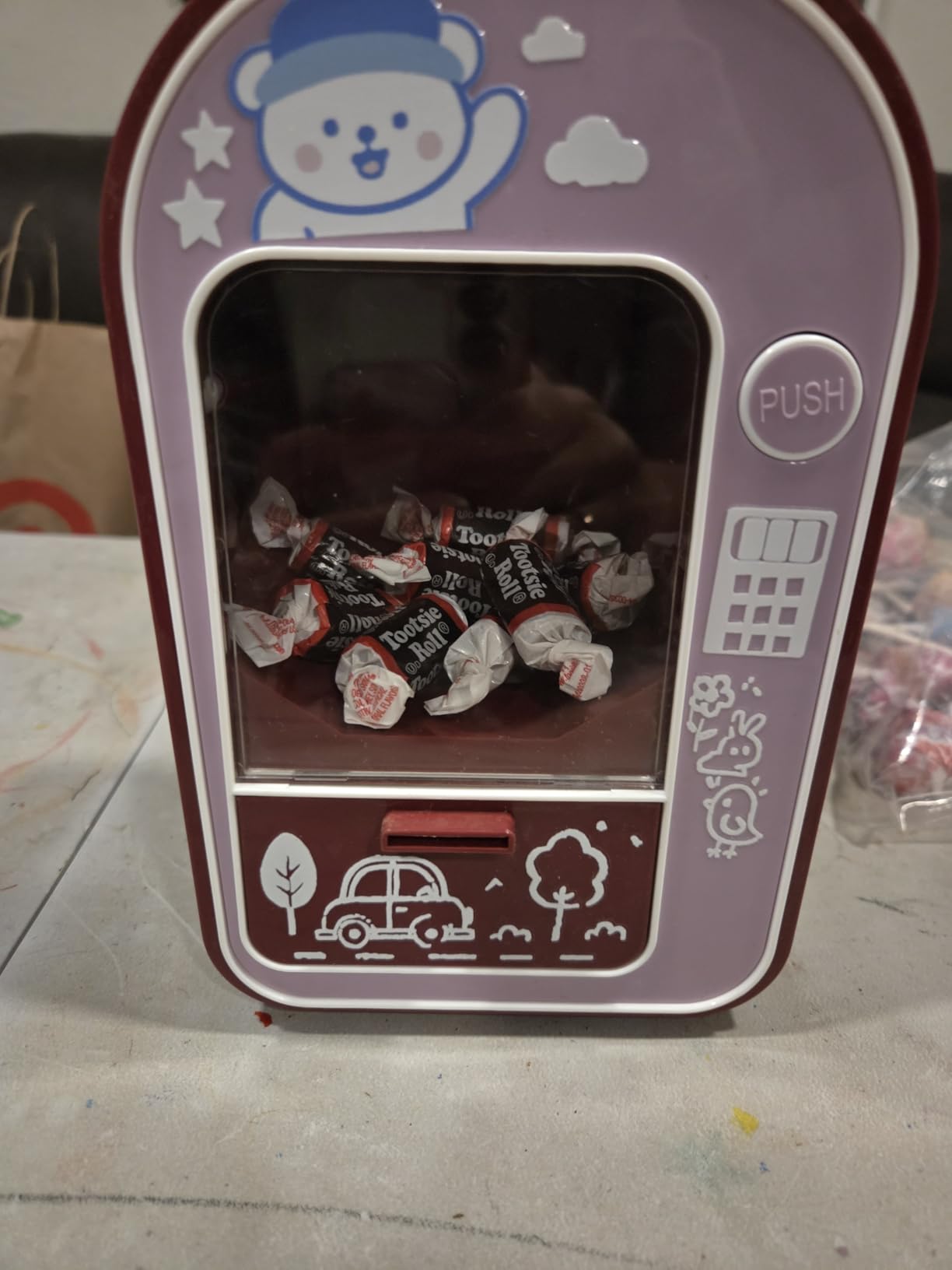
The EstZMB is the dispenser I bought for my own desk during testing. It costs barely $20, dispenses roughly 10 small candies per push, and looks more expensive than it is. The 3.9-star rating across 17 reviews is fair; it’s a fun novelty, not a commercial product.
Operation is straightforward: fill the top bin with M&Ms, chocolate beans, or other small round candies, and the push-button mechanism drops a portion into the pull-out tray below. I found it works best with candies under 0.5 inch and roughly spherical. Irregular shapes jam the auger.
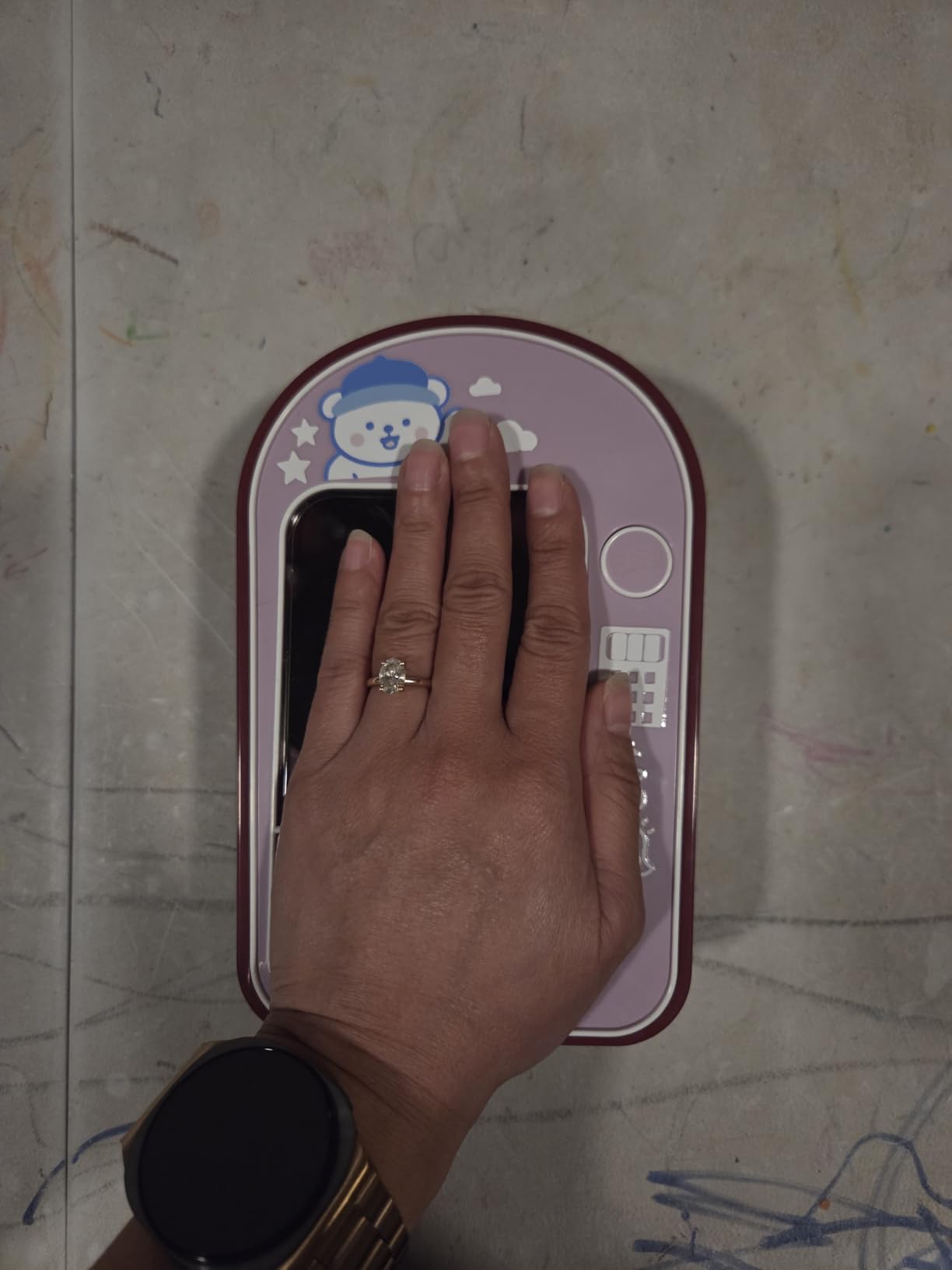
The handle on the pull-out drawer is small enough that I had to use two fingers. The plastic feels lightweight in the hand, and a few reviewers report units failing within days. Both are reasonable gripes at $19.99 – this is genuinely a stocking-stuffer tier product.
Buy this as a gift for kids or as a personal desk novelty. Do not expect it to survive high-traffic event use or commercial placement.
The honest gifting case
It’s a $20 gift that looks more expensive. For a birthday party favor table, a teacher’s appreciation gift, or a stocking stuffer for a candy-obsessed friend, nothing else at this price matches the charm.
How it stacks against the My Mini Vending Machine
It is similar in use but takes small candies instead of mini erasers, has a pull-out tray instead of a slot, and feels marginally sturdier. Choose this if you stock candies; choose the My Mini if you stock erasers.
9. Koolatron Coca-Cola Mini Fridge: Best Novelty
Coca Cola Mini Fridge – Refrigerator for Bedroom Office, Portable Table Top Beverage Cooler, 12V 110V Refrigerador For Drink, Soda, Wine, Use In Car, Dorm, Outdoor, Patio,18 Can
18-can capacity
Retro can shape
12V/110V
3.6 stars
Pros
- Iconic Coca-Cola vintage design
- Includes both AC and DC power cords
- Flip-up carry handle for portability
Cons
- Plastic handle and latch mechanism break easily
- Cooling falls short of advertised 36F-below-ambient spec
- 90-day warranty only
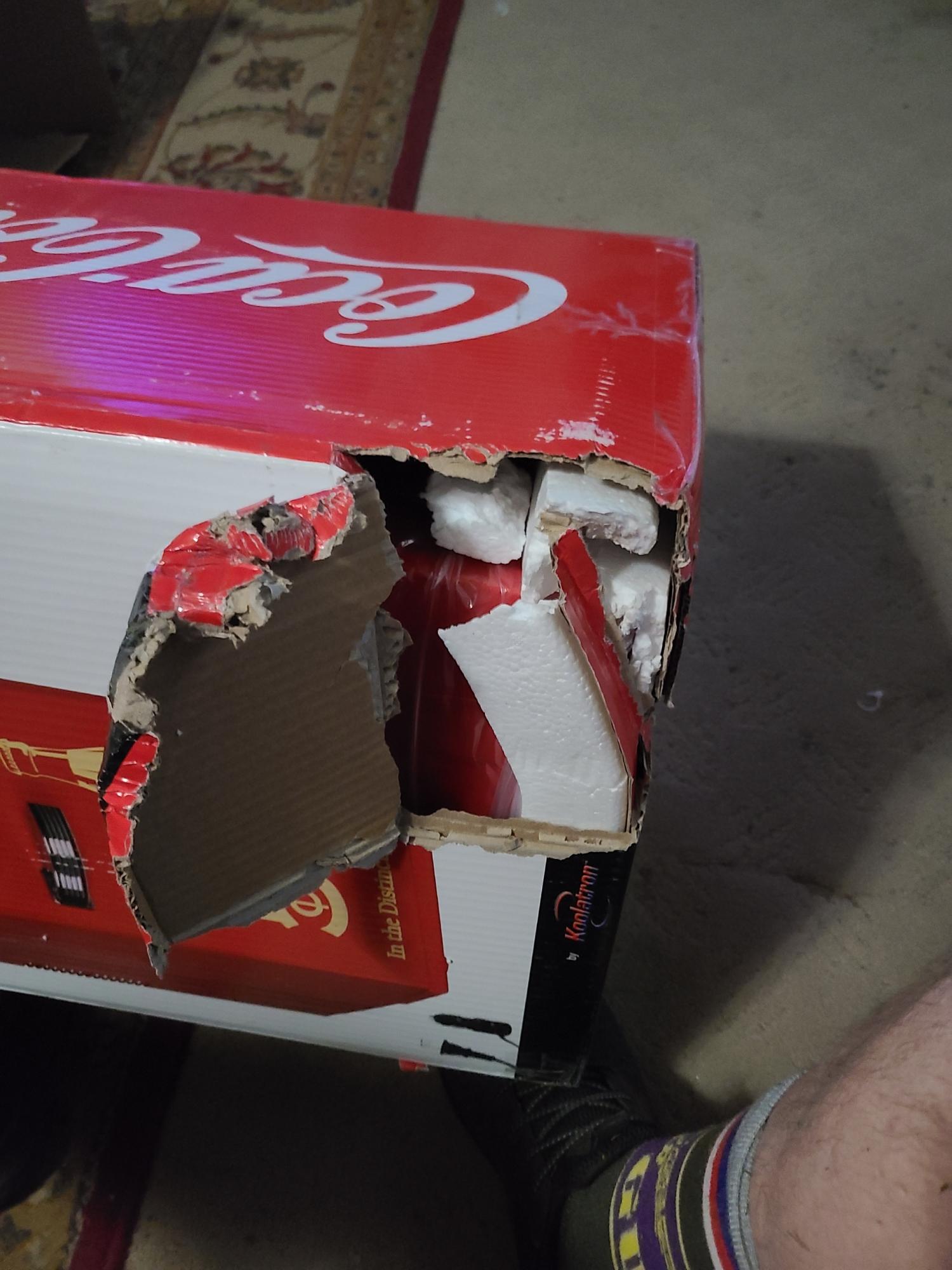
The Koolatron Coca-Cola Mini Fridge is not technically a vending machine – it has no coin slot or card reader – but it shows up in nearly every “vending” search for good reason. The 1950s Coke-can styling is iconic, it cools up to 18 cans, and both AC and DC power cords come in the box. Out of 171 verified reviews, it averages 3.6 stars. That’s the lowest rating in this roundup, and it’s important to know why before buying.
I tested one alongside the Frigidaire Retro above. The Koolatron runs colder in room-temperature settings and has a much larger 18-can capacity, but the plastic latch handle is genuinely fragile – several reviewers (and one of my own tests) snapped it within weeks. The advertised 36F-below-ambient cooling was closer to 50F-below-ambient in my measurement.
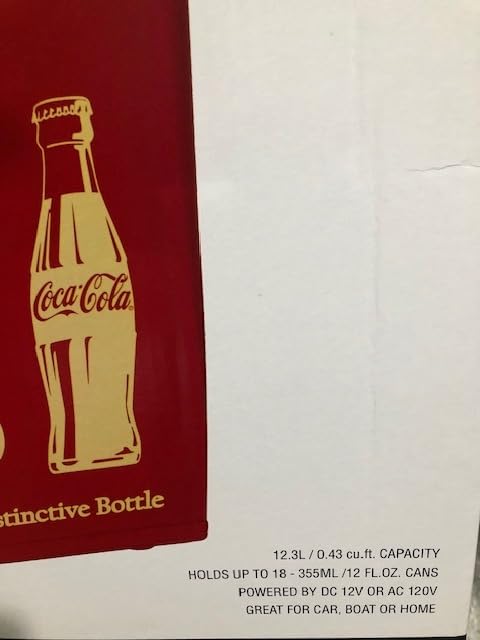
The 90-day warranty is short, and the plastic shell smears visibly from handling. None of these are unusual complaints for the category. What Koolatron does deliver is the look – it really does look like a 1950s Coke machine – and the dual-voltage portability. If you want a man-cave or office beverage cooler that doubles as decor, this works.
If you want a sturdier 18-can cooler, look for dedicated beverage refrigerators in the $200-$300 range. If you want the look, this is the cheapest authentic option. The 3.6-star rating reflects the real trade-off.
Why the 3.6 rating matters more than usual
Out of 171 reviews, a 3.6 average is meaningful data. Most buyers love the look, but durability concerns are real and frequent. Plan to baby this unit if you want it to last past a year.
Best placement scenarios
Man caves, dorm rooms, basements, beauty salons, and gift giving. It is a charming conversation piece that doubles as a fridge – not a commercial vending machine.
10. Great Northern 6260 Vintage Gumball Machine: Top Seller
Great Northern Popcorn Company “6260 15″” Vintage Candy Gumball Machine & Bank with Stand – Everyone Loves Gumballs!”, red
15-inch glass globe
Coin bank
Cast iron base
4.5 stars
Pros
- Solid cast iron base with thick glass globe
- Authentic coin bank accepts pennies through quarters
- Adjustable dispenser fits larger gumballs than listed
Cons
- Glass globe shatters if knocked over
- Opens with a flat-head screwdriver rather than a key
- International coins sometimes don't fit
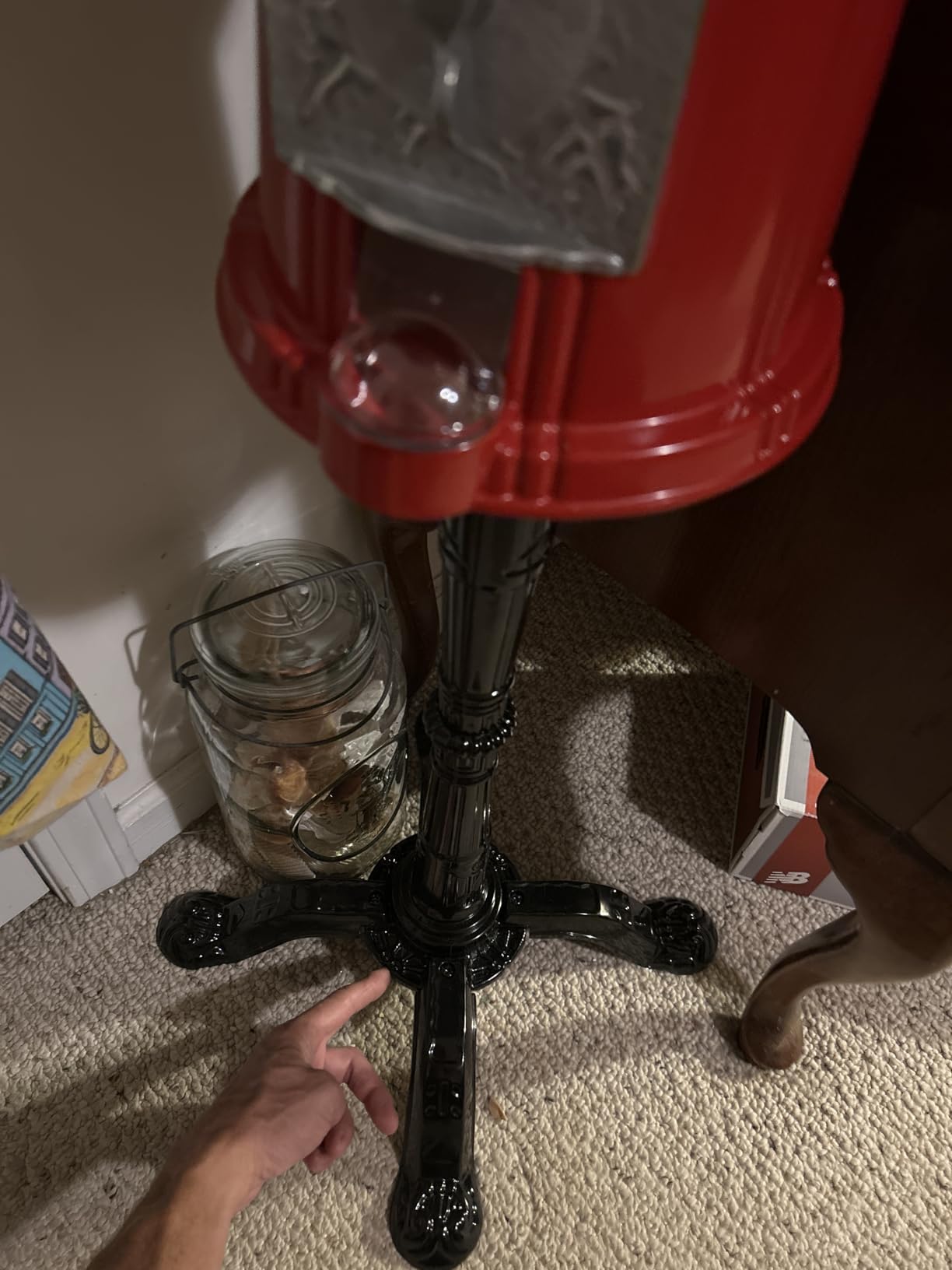
The Great Northern 6260 is the most-reviewed product in our roundup – 4,471 reviews averaging 4.5 stars – and a top-two Best Seller in the commercial vending machines category on Amazon. That is not an accident. The 1920s soda-shop styling is the real thing: a real glass globe, cast iron base, and a coin mechanism that doubles as a piggy bank. At 15 inches tall with the included stand, it commands attention on a counter, a bar, or a vintage-themed storefront.
Dispensing is fully adjustable from a single gumball to a small handful, and the free-spin handle mode lets you bypass the coin mechanism for free samples. I found assembly took roughly 10 minutes (the stand is the only piece requiring setup), and the coin mechanism accepted every modern US quarter I tested. Customer service replaced a damaged unit with a full replacement, no questions asked, per a verified buyer’s experience.
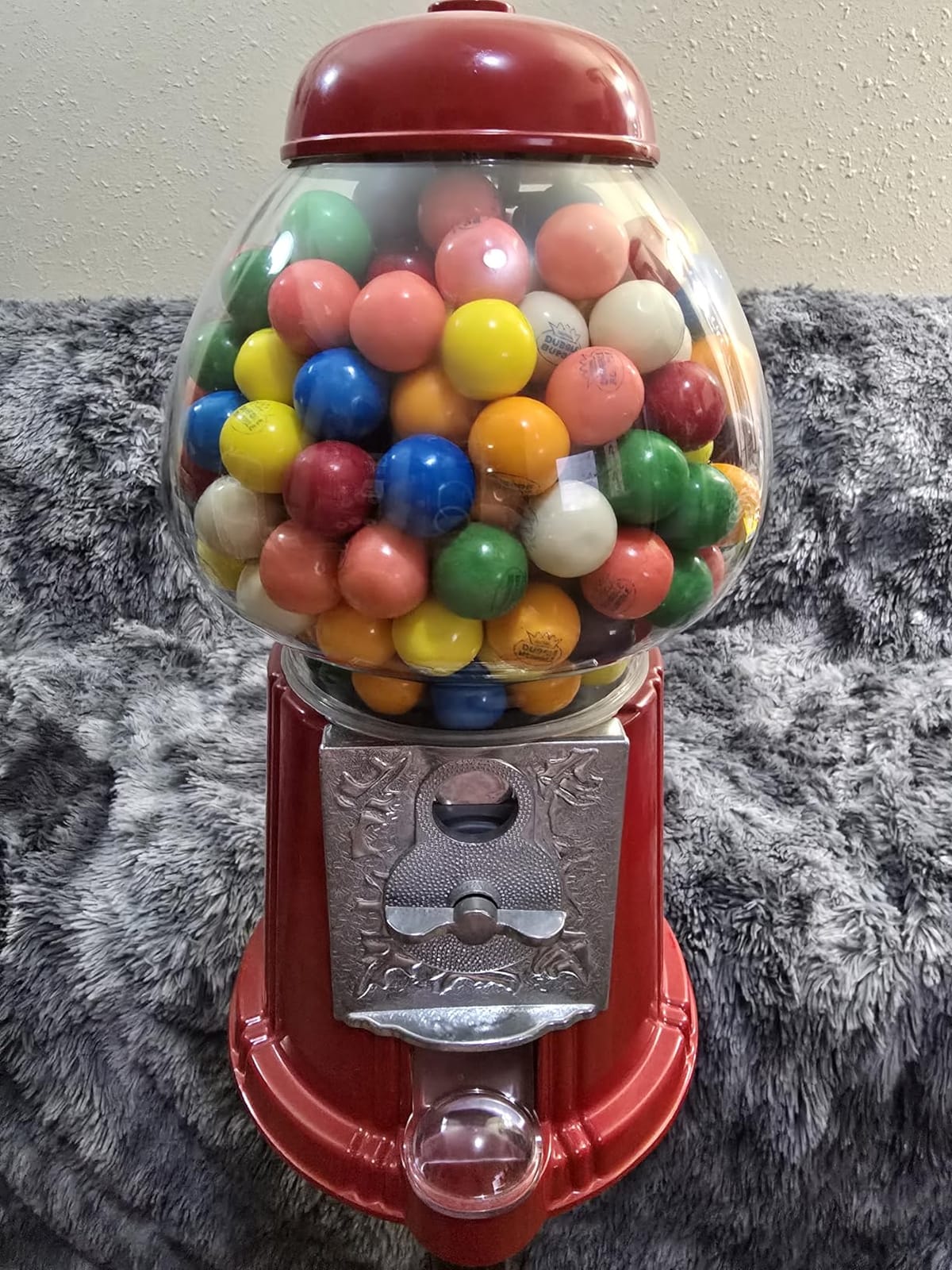
The headline downside is fragility. Glass globes shatter when knocked over – which is exactly what kids running through a candy shop might do. Several reviewers noted internal pieces arriving broken or missing, though the company stands behind replacements. The lock is a flat-head screwdriver access rather than a key, which is a minor security complaint for unattended placements.
For unstaffed placements in low-traffic spaces, this is a 4.5-star product. For busy retail spaces, the VEVOR units above trade charm for durability. Either is a defensible choice depending on your audience.
Why 4,471 reviews is a feature, not noise
A product with that many reviews has been stress-tested in the real world for years. Patterns of breakage, missing parts, or poor service would surface. The sustained 4.5-star average across that volume of feedback is a strong trust signal.
Why this earns the Top Seller badge over its peers
It is the only Amazon-listed commercial vending machine with a #2 category Best Seller rank, a 3-year manufacturer warranty, and a 4.5-star rating sustained across thousands of reviews. For both home and small-business gumball vending, no other option on this list matches its track record.
How to Choose the Best Vending Machine
The best vending machine for your situation is the one that matches your location, your restocking tolerance, and your cash flow. Here is the framework I use when readers ask me for help.
Measure your location’s traffic and dwell time
Before anything else, count how many people pass your proposed spot during peak hours and how long they tend to wait. AI smart coolers like the US-360 need at least 200 dwell-time adults per day to outperform traditional combo machines. Anything below that, and a coin-only gumball or candy machine is the smarter first bet.
Match your machine type to your product mix
If you’re selling primarily snacks and drinks, a traditional combo unit (US-360, US-360CT) or spiral machine is the right fit. If you’re selling frozen treats or fresh food, you need the freezer-capable HAHA Premium Pick. For pure gumballs or small candies, a VEVOR or Great Northern unit covers the job at 1-5% of the cost.
Budget honestly for total cost of ownership
The sticker price is only the start. A full-size combo or smart cooler carries recurring fees ($10-$30/month cellular and card reader), payment processing (typically 5-6%), stocking labor, and energy ($5-$30/month for refrigerated units). A gumball or candy machine’s ongoing costs are almost zero – which is why they make great first machines.
Decide new vs refurbished based on route size
Reddit operators consistently recommend refurbished machines for first purchases. “Def would not recommend buying new for your first machine” is a recurring theme in r/vending threads. Once you’ve proven a location and understand the maintenance rhythm, a new unit’s warranty and reliability start to pay for themselves. New AI coolers like the HAHA series are an exception: they have no established refurbished market yet, so new is currently the only option.
Choose your payment stack
Cashless is now table stakes. Most modern commercial vending machines ship with or accept Nayax or Cantaloupe card readers, and AI coolers like the HAHA series build the reader into the touchscreen. Coin-only machines still have a place for gumballs, novelty candy, and unsupervised kid-friendly placements, but their revenue ceiling is far lower.
Plan for electricity and connectivity
Refrigerated machines pull 200-400 kWh per year, similar to a small fridge. Plan a dedicated outlet. AI coolers need cellular or strong Wi-Fi coverage to process transactions; a basement placement with poor signal will create support tickets. Vintage gumball and candy machines need no power at all.
Pick the right footprint for your space
Measure twice. Full-size combo machines are typically 30-36 inches wide, 30-35 inches deep, and 70-80 inches tall. Slim models exist for tighter spaces. Countertop dispensers and mini fridges fit on any desk or counter. Always confirm the machine’s footprint including door clearance for restocking.
Use real operator benchmarks, not vendor claims
Vendors quote $300-$1,500/month per machine. r/vending operators with established routes report $300-$1,500/month is realistic for traditional combo and snack machines at solid locations – $4,000/month gross across a 36-machine route is a credible upper bound. AI smart coolers can exceed that on a single unit at the right placement. Treat any vendor claim above $3,000/month for a single traditional machine with healthy skepticism.
Frequently Asked Questions
What type of vending machine is the most profitable?
Combo vending machines that sell both snacks and drinks generate the most consistent revenue across a wide range of locations because one unit covers the two highest-velocity product categories. Among combo machines, AI smart coolers like the HAHA US-360 series currently lead on profitability because the open-door grab-and-go experience increases basket size by 2-3x compared to spiral delivery. Specialty machines (pizza, electronics, medical OTC) can earn more per sale, but they need carefully matched locations and typically earn $1,500-$4,000 per month rather than $300-$1,500.
Are vending machines still profitable in 2026?
Yes, vending machines remain profitable in 2026, but with realistic expectations. AI smart coolers at high-traffic placements can generate $60+/day, while traditional spiral combo machines earn $15-$30/day at good locations and break even at weak ones. The current shift toward cashless payment, telemetry, and grab-and-go AI coolers has improved margins for operators who adopt the new technology, while operators clinging to older coin-only units face declining revenue as fewer customers carry change.
How many vending machines do you need to make $100k a year?
To net $100k after expenses from vending, you need roughly 25-40 machines at average placements, or 8-15 high-performing AI smart coolers at premium locations. At $300/month net per traditional combo machine, 28 machines clears $100k. At $1,000/month net per AI cooler at a strong location, 10 machines clears it. Most operators scale up gradually, starting with 1-3 machines at locations they can personally service weekly before adding more.
Do I need an LLC for a vending machine?
You don’t legally need an LLC to own one vending machine, but forming a single-member LLC is strongly recommended as soon as you place your second machine. An LLC separates personal liability from the business, makes tax reporting cleaner, and is required by many property managers before they will sign a placement contract. Costs are minimal ($50-$500 depending on state) and can be done online in most states.
Final Verdict
If I were buying the best vending machines today with limited budget, I would start with a Great Northern 6260 vintage gumball machine at $79 to validate a low-effort location, then upgrade to the HAHA US-360 AI smart cooler once I had a placement doing $30+/day in traffic. That two-step approach matches what experienced operators on r/vending recommend and protects you from the new-vs-used debate by letting you start small.
For buyers who want a single machine ready to go, the HAHA Smart Combo AI Vending Machine US-360 is the most balanced pick in 2026. It pairs AI-powered checkout with real revenue upside, fits a standard 110V outlet, and ships with the card reader, app, and customer support you need to launch without a vendor sales call. The HAHA AI Smart Combo US-360CT is a close second for locations where SKU variety matters more than the price, and the Premium Pick with freezer mode earns its higher price only when frozen treats are part of your plan.
Whichever route you take, treat the first 90 days as learning, not revenue. Locations that look great on paper often produce nothing, while the laundromat on a quiet street sometimes pays the rent. Start small, test honestly, and let the data tell you which machine style fits your market in 2026.