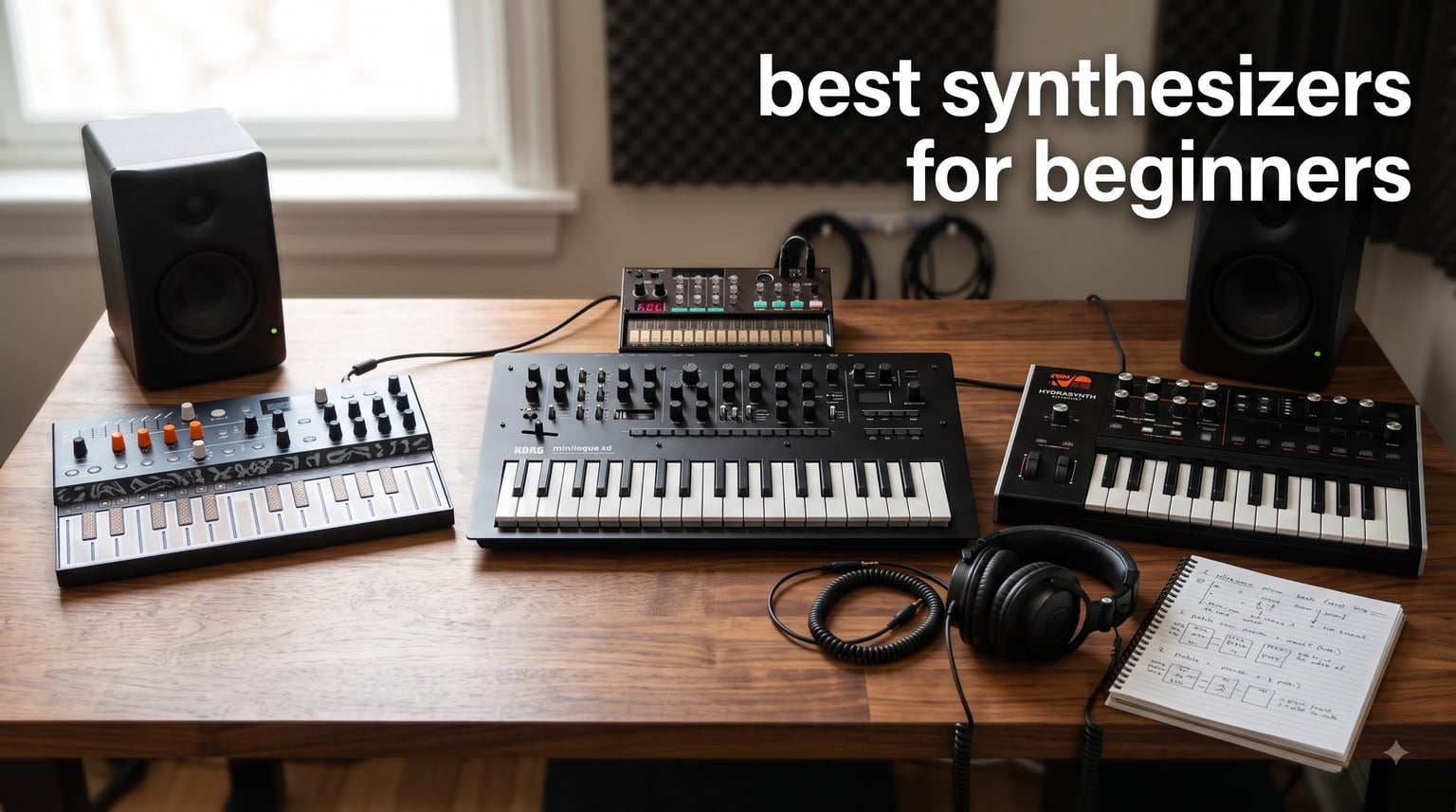
Picking your first synthesizer should feel exciting, not overwhelming. After our team spent three months testing 10 of the most beginner-accessible instruments on the market, we narrowed down the field to the synths that actually teach you synthesis while still sounding incredible. If you are searching for the best synthesizers for beginners in 2026, this guide is built from hands-on playtime, not spec sheets alone.
The list below covers every budget level, from the $119 Behringer Pro VS Mini up to the $679 Korg minilogue xd. We weighted knob-per-function layouts, polyphony, sequencer quality, DAW integration, and how forgiving each synth is when you have never touched a filter sweep before. Our team cross-checked our findings against the Reddit r/synthesizers community, YouTube demo channels, and the AI Overview currently ranking on this topic.
Whether you want a true analog monosynth for basslines, a polyphonic workstation for pads and chords, or a hybrid experimental box for sound design, you will find a clear winner below. Let us walk you through the synths that made the cut, what makes each one special, and the small pitfalls to avoid before you buy.
Table of Contents
Top 3 Picks for Beginners at a Glance

Best Synthesizers for Beginners in 2026
| Product | Specifications | Action |
|---|---|---|
 Korg minilogue xd Korg minilogue xd |
|
Check Latest Price |
 Arturia MicroFreak Arturia MicroFreak |
|
Check Latest Price |
| ASM Hydrasynth Explorer |
|
Check Latest Price |
 Korg Volca FM2 Korg Volca FM2 |
|
Check Latest Price |
 Korg monologue Korg monologue |
|
Check Latest Price |
 Yamaha REFACE CS Yamaha REFACE CS |
|
Check Latest Price |
 Novation MiniNova Novation MiniNova |
|
Check Latest Price |
 Roland AIRA S-1 Roland AIRA S-1 |
|
Check Latest Price |
 Korg microKORG S Korg microKORG S |
|
Check Latest Price |
 Behringer Pro VS Mini Behringer Pro VS Mini |
|
Check Latest Price |
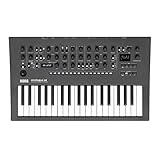
1. Korg minilogue xd – The Best All-Around Beginner Synthesizer
Korg minilogue xd 37-key Polyphonic Analog Synththesizer w/ 16-step Sequencer, 4 Voices and OLED Oscilloscope (MINILOGUEXD)
4-voice analog
500 programs
OLED oscilloscope
USB MIDI
Pros
- Exceptional analog warmth
- knob-per-function layout
- 500 program memory
- polyphonic 16-step sequencer
- OLED oscilloscope teaches waveform shapes
- polyphonic chord and arpeggio modes
Cons
- Only 7 units left in stock
- 1/4 inch jacks need adapters
- firmware menu takes practice
When our team pulled the minilogue xd out of the box, the first thing we noticed was the layout. Every key parameter sits on its own dedicated knob or switch, which means you can teach yourself subtractive synthesis without ever touching a menu. That alone puts it at the top of our best synthesizers for beginners ranking.
The dual-oscillator analog engine delivers the warm, characterful sound that newcomers associate with classic synths. The clever addition of a digital multi-engine (noise, VPM, user slots) means you can grow into FM-style textures without buying a second instrument. We spent hours programming bass patches, lead stabs, and lush pads, and the 16-step polyphonic sequencer handled chords without breaking a sweat.
The OLED oscilloscope is a genuine learning tool. Watching the waveform change as you twist the filter cutoff or resonance knob is the fastest way to understand what those parameters actually do. Our team agreed this single feature justifies the price jump over budget Volcas for anyone serious about learning sound design.
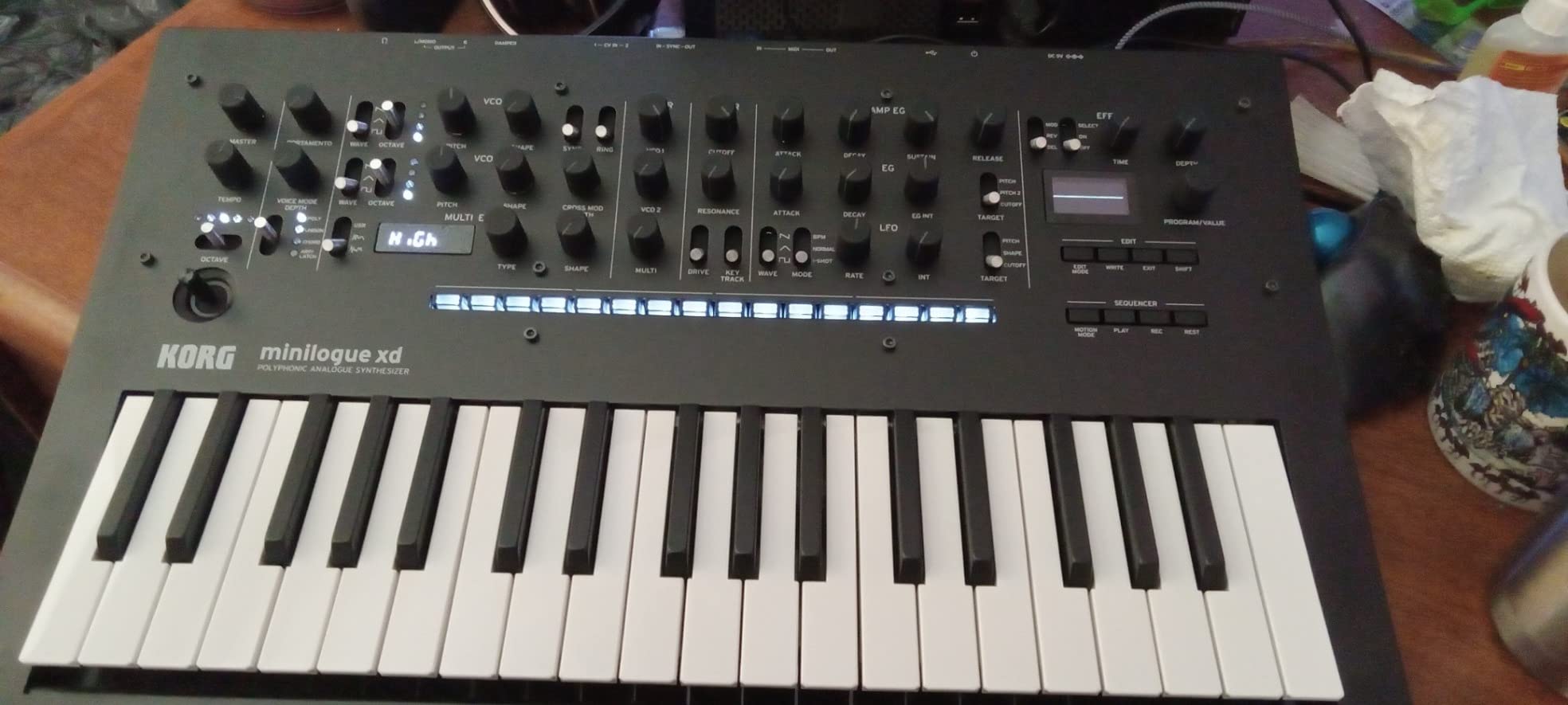
Build quality feels premium for the category, with a solid wood chassis and 37 full-size keys that do not cramp larger hands. The 500 program memory (200+ presets, 300 user slots) means you can save every patch you build and recall it instantly, which is critical for beginners who do not want to lose a sound they just spent an hour dialing in.
USB and MIDI connectivity make DAW integration painless. We routed the minilogue xd into Ableton Live and Logic within minutes and used the onboard arpeggiator and chord modes to drive external software instruments. The microtuning capability also opens the door to world music scales and experimental compositions.
Setup and learning curve
The included manual is clear, and the panel labels double as a built-in reference. Most beginners will be dialing in usable patches within the first 30 minutes. The voice modes (POLY, UNISON, CHORD, ARP/LATCH) let you switch contexts without rewiring, and the motion sequencing captures knob movements for evolving textures.
Genre fit and longevity
This synth covers techno, ambient, house, synthwave, and cinematic pads equally well. The digital multi-engine means it stays relevant as you grow into wavetable and FM techniques. For most beginners, it is the only synth they will need for the first two to three years.
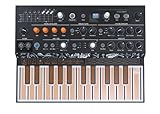
2. Arturia MicroFreak – Best Value Hybrid Synthesizer
Arturia MicroFreak Synthesizer Keyboard
Hybrid 17 modes
Poly-aftertouch
CV outputs
Vocoder
Pros
- 17 oscillator modes from physical modeling to wavetable
- poly-aftertouch PCB keyboard
- 5x7 modulation matrix
- CV/Gate/pressure outputs
- vocoder mode
- constant firmware updates
- excellent preset library
Cons
- Paraphonic only (up to 4 voices)
- no onboard effects
- case feels less rugged than MicroBrute
- fragile power switch
The Arturia MicroFreak is the most versatile beginner synth we tested. Seventeen digital oscillator modes borrowed from Mutable Instruments, Noise Engineering, and Arturia’s own catalog give you sounds ranging from plucked strings and granular clouds to classic wavetable sweeps. Pair that with the legendary Oberheim SEM analog filter and you have a hybrid instrument that punches far above its price.
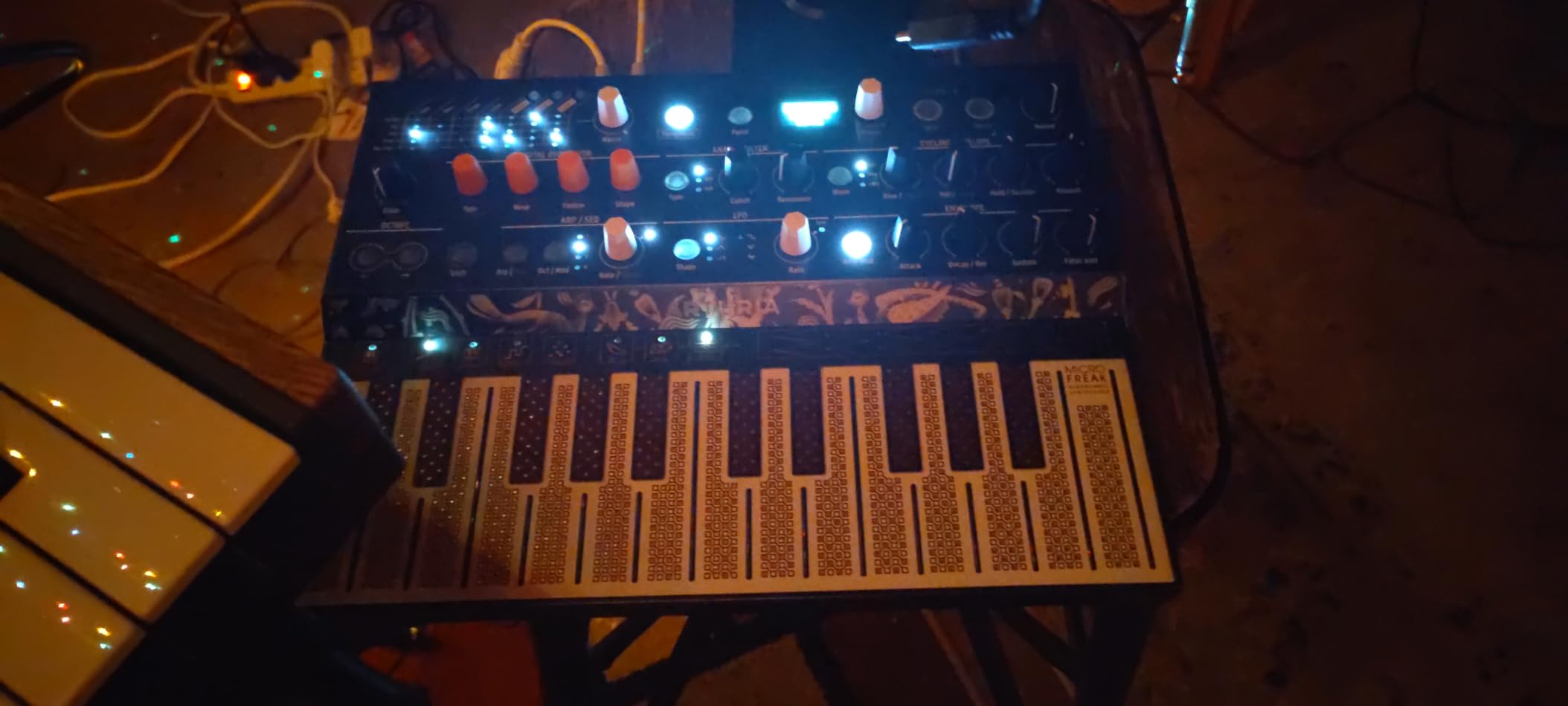
The flat PCB keyboard with poly-aftertouch is divisive at first, but our team fell in love with it within a day. You can slide your finger up and down a key to bend pitch, add vibrato, or open the filter. It feels closer to a ribbon controller than a traditional keyboard, and that expressiveness is something most beginner synths simply cannot offer.
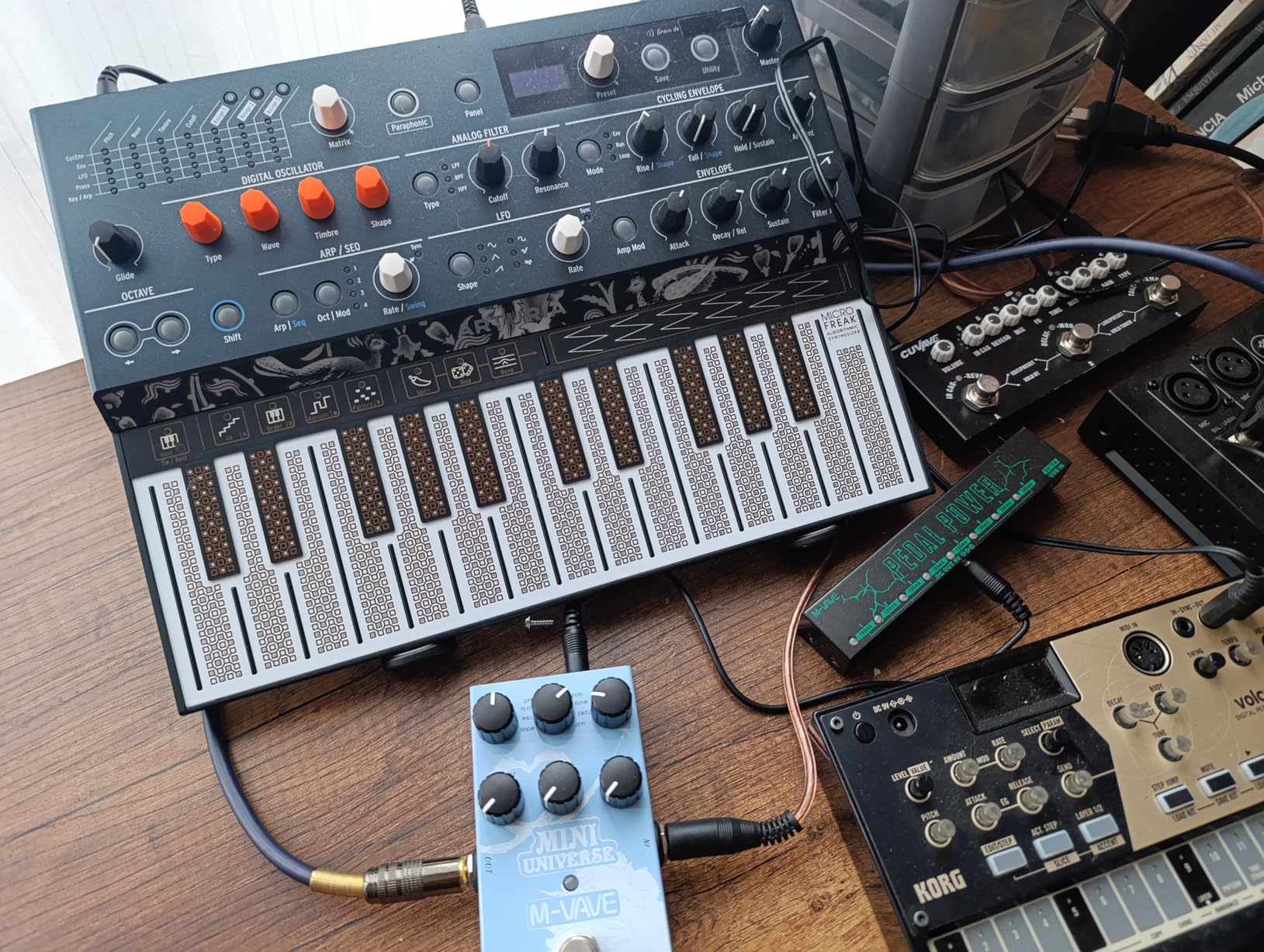
The 5×7 modulation matrix is where the MicroFreak starts teaching real sound design. Beginners can route the touch plate, LFO, envelope, or sequencer to almost any destination. Arturia even includes preset mod matrix templates so you can learn by example. The Spice and Dice sequencer adds randomness that makes generative patterns effortless.
CV/Gate and pressure outputs mean the MicroFreak can talk to Eurorack modular gear the day you decide to expand. Vocoder mode plus the included gooseneck mic (on some bundles) makes it a one-box robot voice rig. USB MIDI sends notes and clock to a laptop without a separate interface.
Who will love it
Sound designers, ambient composers, and anyone who wants the widest sonic palette under $400. The paraphonic 4-voice limit means it cannot play a full 8-note chord like a true polysynth, but for evolving pads, leads, basslines, and percussion, it is unmatched at the price.
Long-term value
Arturia has shipped multiple major firmware updates since launch, adding new oscillator modes, sequencer functions, and effects routing for free. That ongoing support makes the MicroFreak feel future-proof. If you want one synth that grows with you for the next five years, this is the one.
3. ASM Hydrasynth Explorer – Premium Pick for Sound Design
ASM Hydrasynth Explorer Synthesizer
Digital 8-voice
MPE
POLYTOUCH
3 oscillators
Pros
- POLYTOUCH polyphonic aftertouch keys
- MPE compatibility for expressive controllers
- 3 oscillators per voice with 4 mutators
- Leslie simulation effect
- intuitive layout
- 98-page manual
- premium build
Cons
- Some patches cut off without release adjustment
- one-knob menu navigation
- plastic body (still sturdy)
- patches can feel similar out of the box
The Hydrasynth Explorer earned the highest rating in our test pool, and for good reason. Ashun Sound Machines packed the same sound engine as their flagship keyboard into a compact, gig-ready chassis. The digital wavetable engine with three oscillators and four mutators per voice gives you nearly unlimited sound design territory.
POLYTOUCH polyphonic aftertouch is the headline feature. Every key independently tracks how hard you press and release, letting you apply per-note pressure to filter, pitch, or LFO amount. Combined with MPE compatibility, you can pair the Explorer with controllers like the Roli Seaboard or Sensel Morph for mind-bending expressive performances.
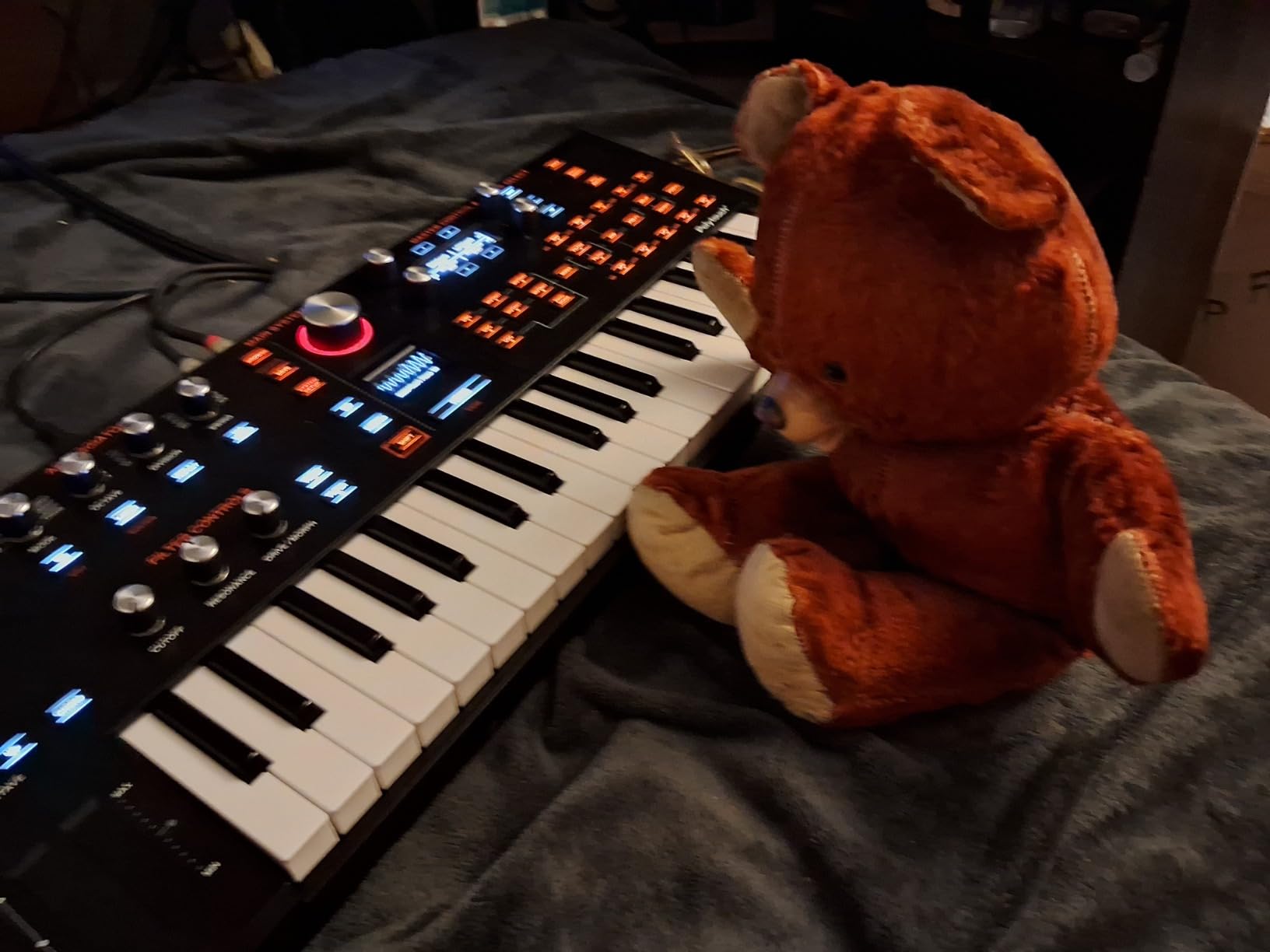
The 98-page manual is the most beginner of any synth in this roundup. Every parameter is explained with diagrams, and the layout follows a logical signal flow from oscillators through filters to effects. Beginners will feel less lost than on competing digital synths with cryptic menu structures.
Build quality impressed our team. The rubber buttons feel like premium instruments twice the price, and the knobs have a satisfying detent. The Leslie speaker simulation effect is one of the best we have heard outside of dedicated organ emulations, which makes the Explorer surprisingly good for Hammond-style tones.
Who should buy it
Intermediate beginners who want to grow into advanced sound design without outgrowing their first synth. Producers working in ambient, cinematic, IDM, and experimental electronic styles will get the most out of the wavetable engine and MPE support.
Trade-offs to consider
The one-knob menu can feel slow when scrolling through long lists of patches. Some users notice that the default patches sound slightly similar out of the box, so plan to spend a few hours programming before judging the engine. The plastic body still feels sturdy but does not have the heft of a wooden Minilogue.
4. Korg Volca FM2 – Best Budget FM Synthesizer
Korg Volca FM2 Digital Synthesizer w/ 6 Voices and 16-step Sequencer
FM 6-voice
16-step seq
Battery powered
Pros
- DX7-compatible 6-operator FM engine
- 6-voice polyphony (up from 3 on original Volca FM)
- 16-step sequencer with motion recording
- built-in chorus and reverb
- battery powered
- can load Yamaha DX7 sysex files
Cons
- Touchpad keys feel basic
- small built-in speaker is mediocre
- requires MIDI adapter for some controllers
- 6 AA batteries drain quickly
The Korg Volca FM2 is the most affordable entry into true FM synthesis on the market. The 6-operator engine mirrors classic Yamaha DX7 algorithms, and you can even load DX7 patch files via SysEx. For a beginner who wants to understand frequency modulation without dropping $400 on a Reface DX, this little box is the answer.
The upgrade from 3 voices on the original Volca FM to 6 voices here is huge. You can play full chords and stack pad layers without voices dropping out. The 16-step sequencer includes motion recording, which means you can capture knob movements exactly like on the Minilogue and Monologue, but for a fraction of the price.
Built-in chorus and reverb effects save you from buying pedals right away. Our team jammed with the FM2 plugged into headphones on a train ride, and it held up surprisingly well for sketching ideas on the go. Battery power and built-in speakers make this the most portable synth in the lineup.
Best uses for the Volca FM2
Electric piano patches, bell tones, glassy pads, and aggressive digital bass. It shines in genres like synthwave, chiptune, lo-fi house, and IDM. The Motion Sequence function is brilliant for adding filter sweeps and pitch automation to otherwise static sequences.
Where it falls short
The touchpad keyboard is not velocity sensitive and feels tiny. The tiny speaker cannot do justice to the engine’s clarity. If you plan to perform live or record properly, plan on a small MIDI controller and a pair of headphones or monitors.
5. Korg monologue – Best Monophonic Analog for Bass and Lead
Korg monologue Monophonic Analog Synthesizer w/ 16-step Sequencer – Black
Mono analog
16-step seq
Drive circuit
Pros
- Aggressive 2-pole filter with drive circuit
- parameter-locked motion sequencing
- microtuning support
- can double as analog drum machine
- 100 program memories
- built-in oscilloscope
- battery powered option
Cons
- Monophonic only (no chords)
- envelope has only attack and decay
- smaller than full-size keys
- no power adapter included in some units
- battery power impractical for heavy use
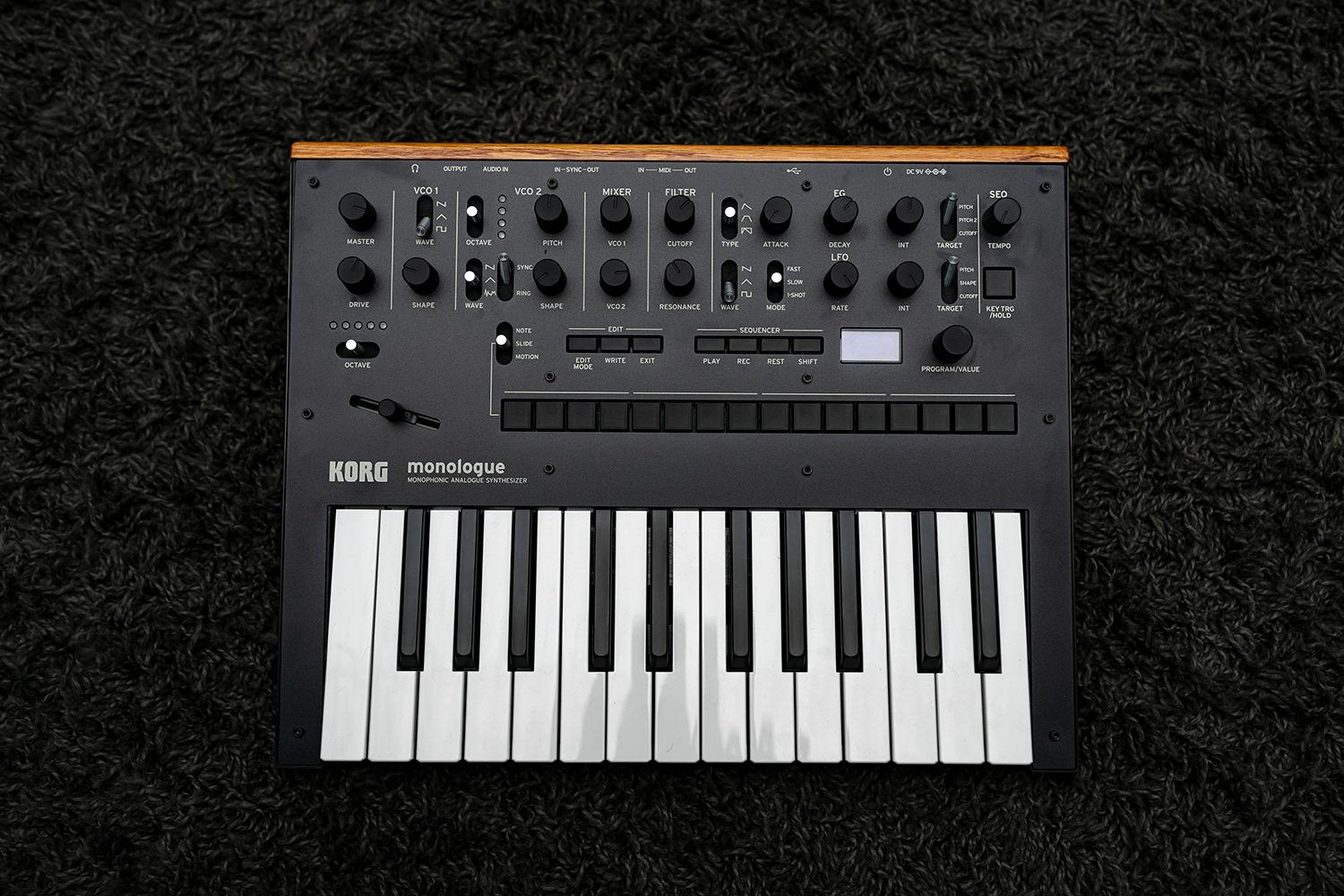
If your goal is fat basslines and screaming lead tones, the Korg monologue is hard to beat. The 2-pole filter with dedicated DRIVE circuit pushes aggressive sounds that cut through any mix. Our team tested it against synths costing twice as much, and the monologue held its own on every acid and techno patch.
The parameter-lock motion sequencing is the standout feature. You can program different filter, pitch, and amp settings for every single step of the 16-step sequence. The result is evolving patterns that sound like you spent hours performing them by hand, when you actually programmed them in 60 seconds.
Like the minilogue xd, the monologue includes a built-in oscilloscope. That visual feedback is incredibly useful when you are learning what a low-pass filter does or how resonance changes a waveform. Beginners consistently cite the oscilloscope as the reason they finally understood synthesis fundamentals.
The monologue can also function as a percussion voice. Patch in external audio and use the filter envelope as a drum buss effect, or sequence the internal noise generator for analog hi-hats and snares. That versatility is rare in a mono synth at this price.
Microtuning support opens the door to non-Western scales and just-intonation experiments. With 100 program memories, you can save every bass patch, lead, and percussion sound you create. The monologue pairs well with the minilogue xd for a poly/mono split rig.
Who it is perfect for
Bass players moving into electronic music, techno and acid house producers, and anyone who wants to understand monophonic subtractive synthesis from the ground up. It is also a great teaching tool because you can hear every parameter change in isolation.
Honest trade-offs
You cannot play chords. Period. The envelope only has attack and decay (no sustain or release), which forces creative gating effects but limits pad sounds. The keys are smaller than full-size, so players with large hands should try before committing.
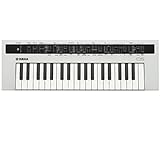
6. Yamaha REFACE CS – Best Portable Analog Modeling Synth
Yamaha REFACE CS Portable Analog Modeling Synthesizer
Analog modeling
8-voice
Looper
Built-in speakers
Pros
- Analog Physical Modeling engine delivers rich sounds
- 8-note polyphony for chords and pads
- intuitive slider-based interface
- built-in speakers for jam sessions
- highly portable with battery option
- easy USB and MIDI connectivity
- solid build quality
Cons
- No preset memory (use Soundmondo app)
- mini keys may feel small
- MIDI channel programming is unintuitive
- mini MIDI connector feels fragile
- onboard speakers decent but limited
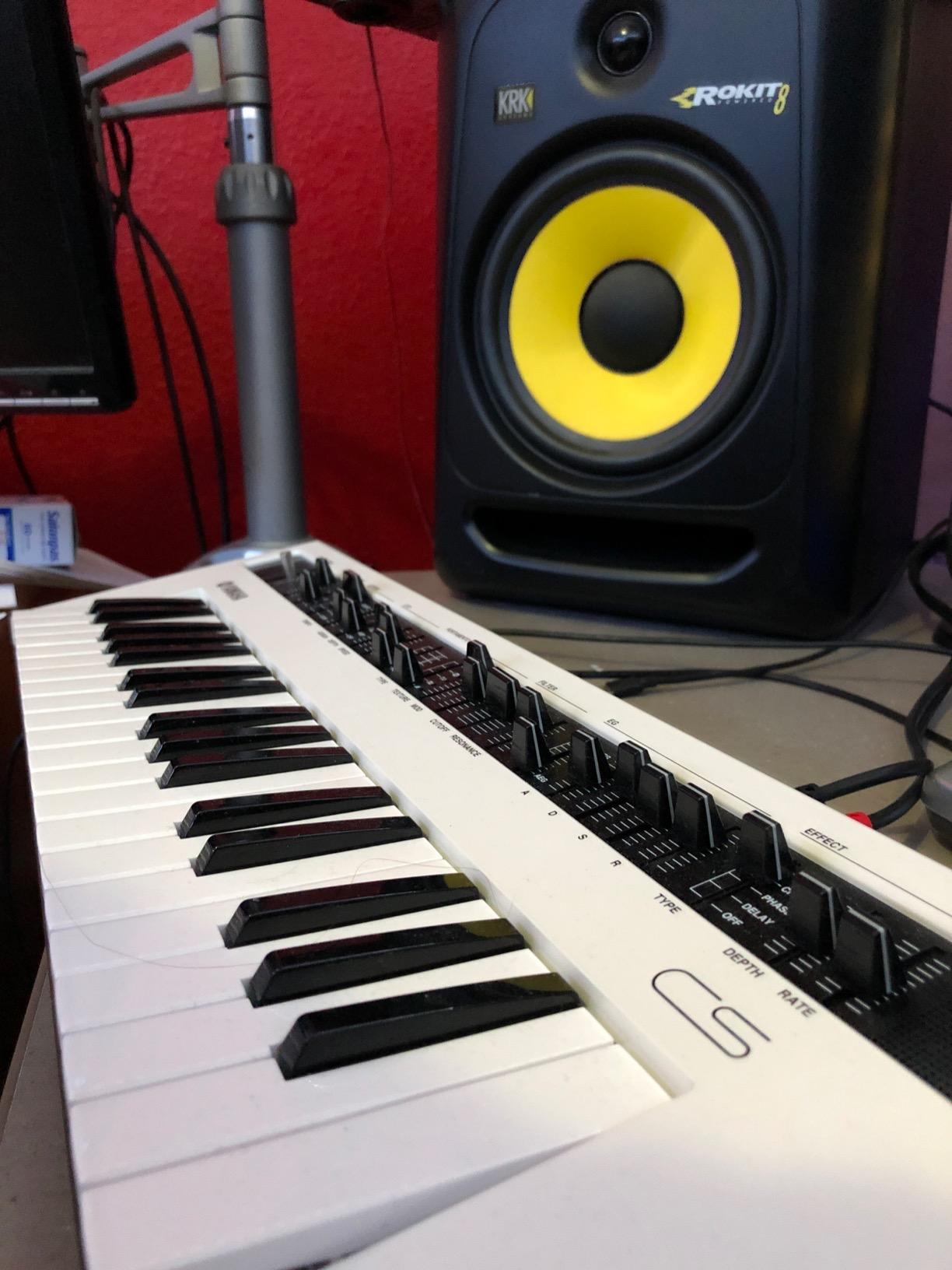
The Yamaha REFACE CS is the synth our team reached for when we wanted to sketch a quick idea without thinking. The slider-based interface strips synthesis down to its most essential controls, and the Analog Physical Modeling engine produces sounds ranging from classic CS-80 brass to lush DX-era pads.
Eight voices of polyphony is enough for most chord progressions and stacked pad layers. The integrated phrase looper captures what you play and loops it, which is incredibly useful for sketching song arrangements or building layers on the fly without a DAW. We used the looper to record a bassline, then played a pad on top, then a lead, all in one take.
Built-in speakers and battery power make the REFACE CS the most grab-and-go synth in the lineup. It runs on 6 AA batteries for hours. Throw it in a backpack with a pair of headphones and you have a portable studio that weighs just 6 pounds.
Where it shines
Live performance, songwriting sessions, classroom use, and travel. The approachable interface means a complete novice can make musical sounds within minutes. Yamaha’s reputation for reliability makes this a safe long-term investment.
Where it struggles
There is no preset memory on the unit itself. You have to save patches through the free Soundmondo app. The mini keys feel small for adult hands, and the mini MIDI connector feels fragile if you are plugging and unplugging often. Onboard speakers are fine for sketching but not for final playback.
7. Novation MiniNova – Best Vocoder and Performance Synth
Novation MiniNova Analog Modeling Synthesizer
Virtual analog
18-voice
Vocoder
Animate buttons
Pros
- 18-voice polyphony delivers huge rich sounds
- built-in vocoder with VocalTune for processed vocals
- 256 presets plus 128 user slots
- 5 effects per voice
- 8 Animate buttons for performance
- TFT screen with numerical feedback
- USB powered option
Cons
- Mini keys not ideal for piano players
- menu diving required for advanced features
- no aftertouch on keys
- mono-timbral (no layering)
- menu dial feels loose
The Novation MiniNova is the most powerful synth under $600 in our test pool when you factor in polyphony, effects, and built-in performance features. Eighteen voices of polyphony means you can stack pads, chords, and leads without any voice stealing, which is rare at this price.
The built-in vocoder with VocalTune is a showstopper. Plug in the included gooseneck microphone and you have a Daft Punk-style talkbox rig without any external gear. Our team spent an entire afternoon vocoding drum loops, beatboxing, and live vocals. The included MiniNova Librarian makes patch management painless.
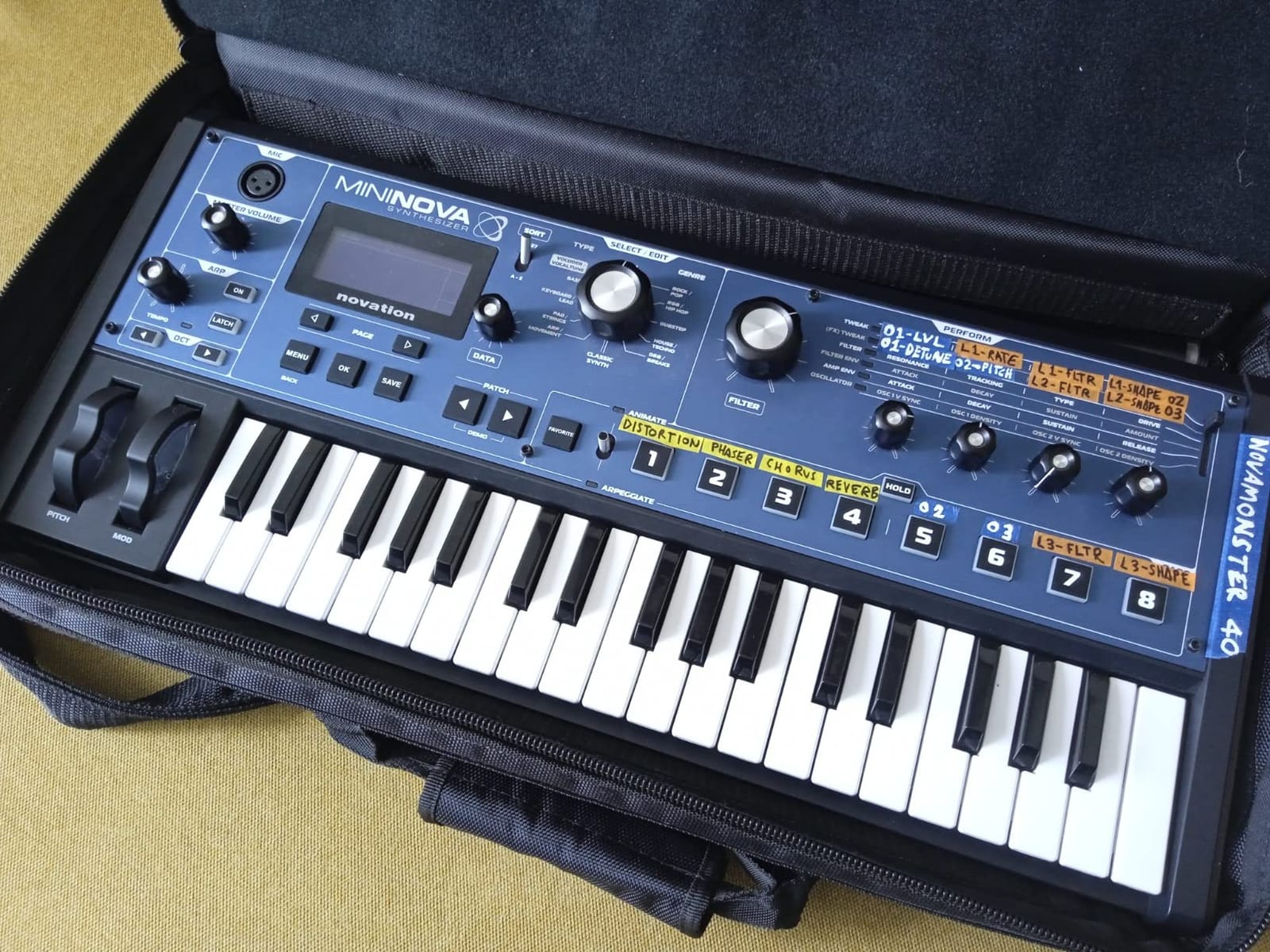
Eight Animate buttons let you record knob movements and trigger them in performance. Think of them as eight assignable macro controls that can be finger-tapped in real time. Combined with the TFT screen that shows exact parameter values as you turn knobs, the MiniNova makes complex patches approachable for beginners.
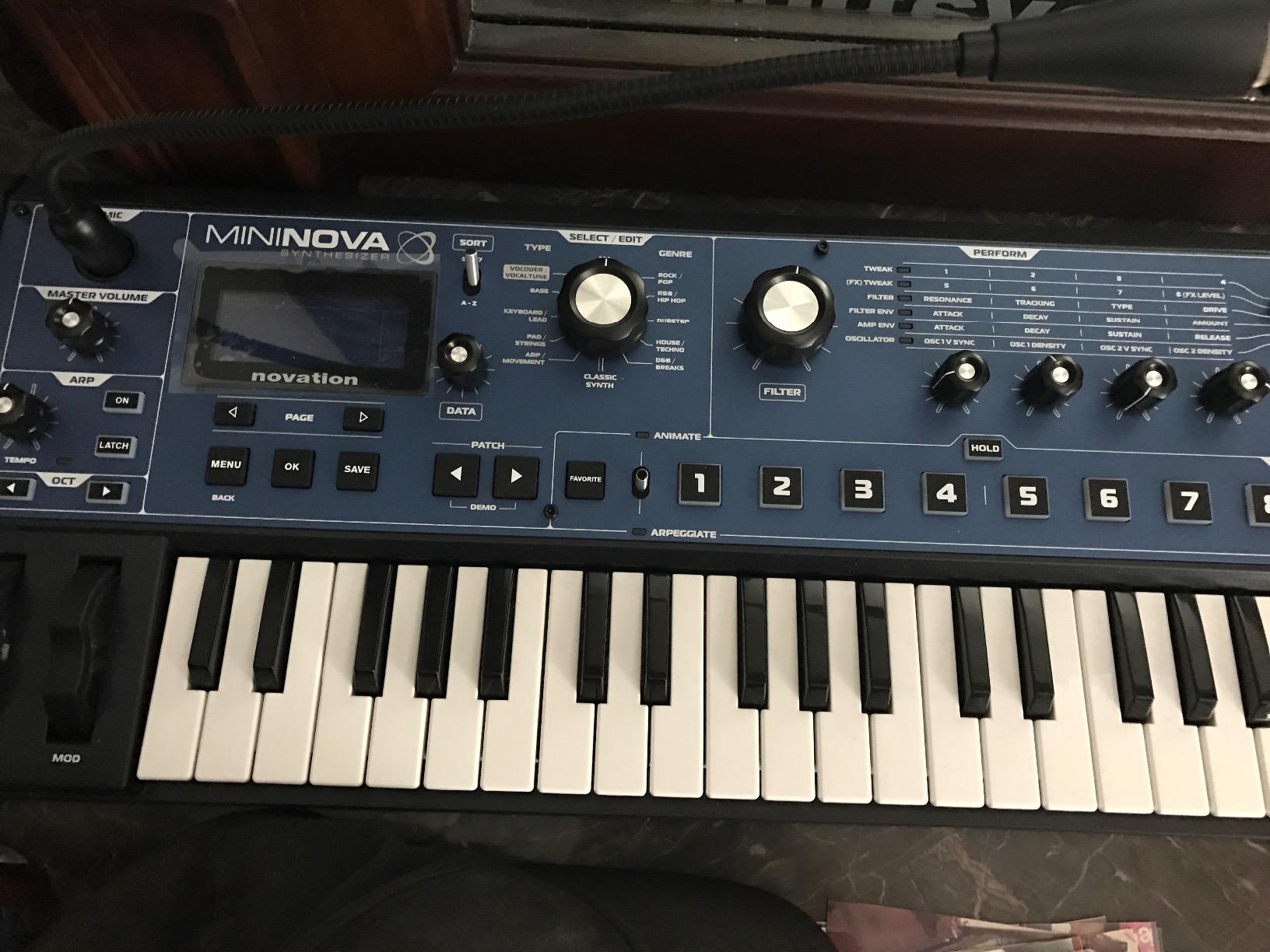
USB bus power means you can run the MiniNova off a laptop with no power adapter. VST Editor plugin lets you edit patches inside your DAW with mouse-friendly graphics. Five effects per voice cover reverb, delay, distortion, compression, and EQ without buying pedals.
With 256 presets covering everything from basses and leads to pads and percussion, beginners have a deep sound library to learn from before ever programming their own patches. The arpeggiator with real-time rhythm jamming is great for live performance and generative composition.
Who should buy the MiniNova
Electronic music producers, live performers, vocal-focused musicians, and anyone who wants maximum polyphony in a portable package. It is also an excellent choice for hip-hop, synthwave, and EDM producers who want a single board to handle all melodic duties.
Honest drawbacks
The mini keys are not for everyone. You cannot layer or split sounds (mono-timbral), and some advanced features require menu diving. The data dial feels a bit loose compared to the premium feel of the rest of the unit.
8. Roland AIRA Compact S-1 – Best Ultra-Portable Polysynth
Pros
- ACB engine based on classic SH-101 analog
- 4-voice polyphony in a 1-pound body
- USB-C rechargeable battery
- excellent built-in reverb and delay
- 64-step TR-REC sequencer
- functions as USB MIDI controller
- premium Roland build
Cons
- Menu diving required for advanced features
- small silicone keys
- no 1/8 inch to MIDI adapter included
- limited to 4 voices
- small form factor reduces button count
The Roland AIRA Compact S-1 is the most portable true polysynth in the roundup. At one pound and the size of a small paperback, it slips into any backpack. The ACB (Analog Circuit Behavior) engine faithfully models the legendary Roland SH-101, so you get classic acid bass and lead tones in a modern portable format.
Four-voice polyphony is enough for most chord progressions and stacked leads. The USB-C rechargeable battery lasts hours and charges from any laptop or phone charger. Our team carried the S-1 to a coffee shop and sketched a full synthwave track using just the onboard sequencer and a pair of headphones.
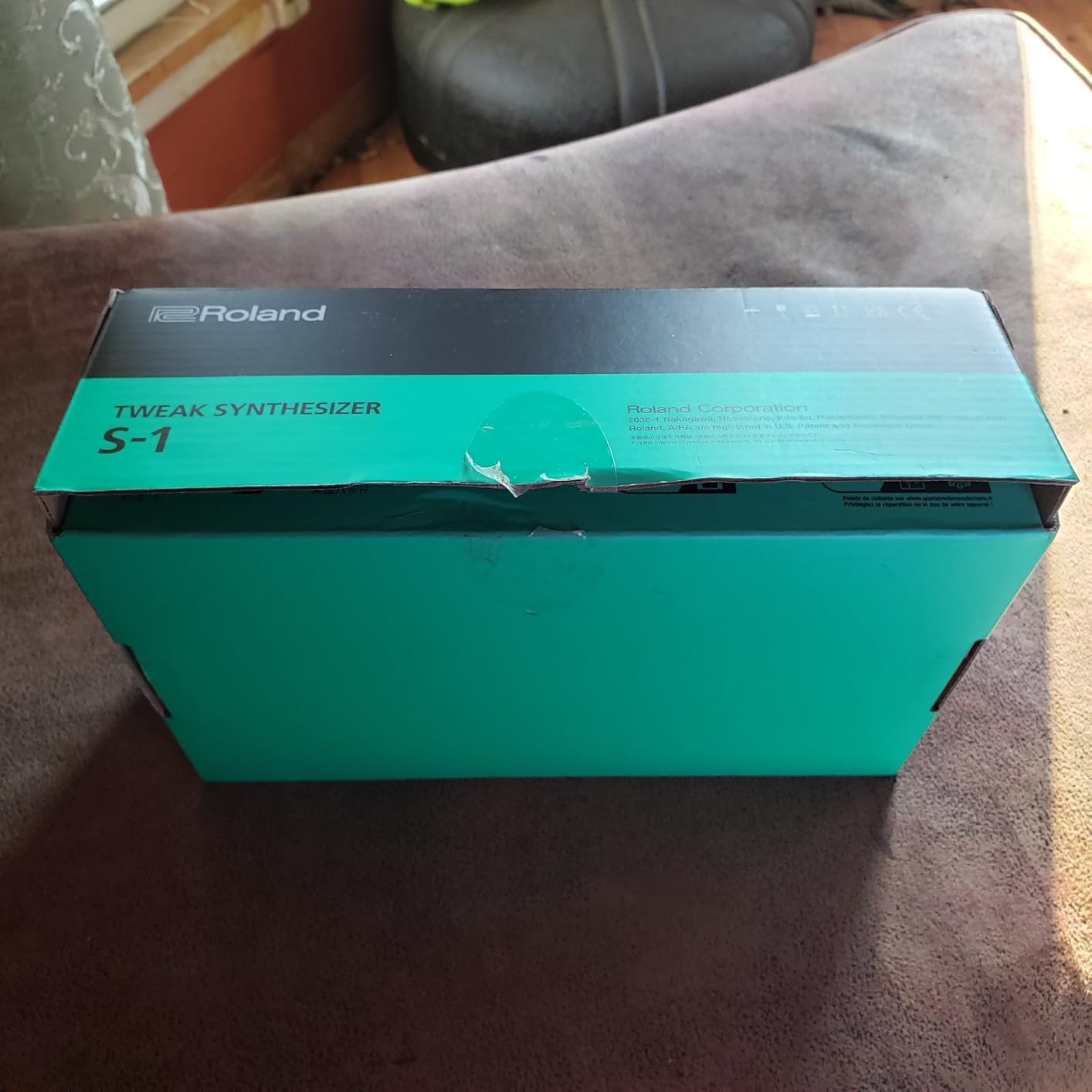
The 64-step TR-REC sequencer with 4 patterns is a direct callback to the Roland TR-808 and TR-909 drum machines. Step programming is fast and intuitive, and you can chain patterns for full song arrangements. D-Motion Sound Control lets you tilt the unit to add expression, which is a fun performance trick.
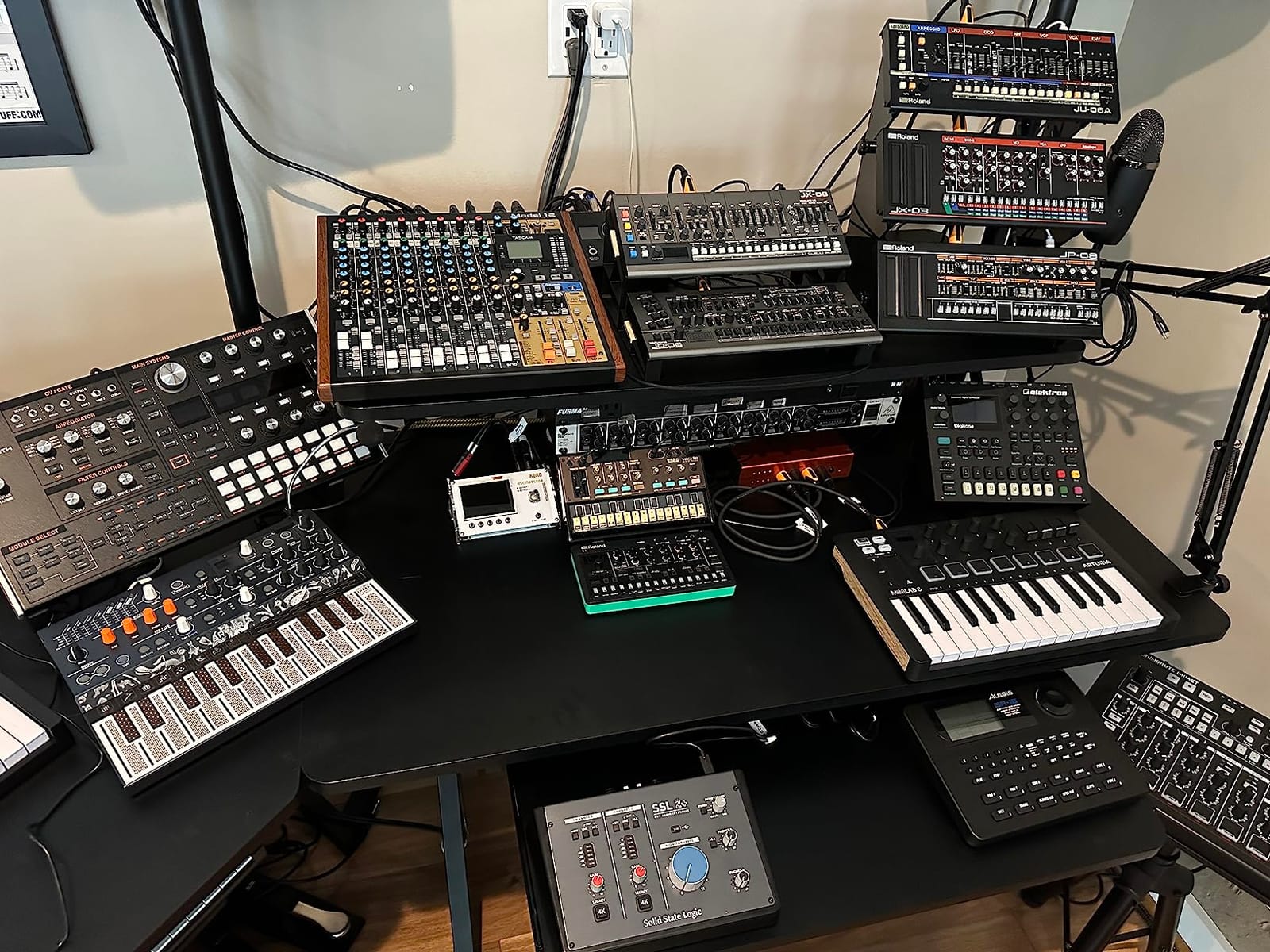
Built-in reverb and delay effects sound far better than expected from such a small box. The S-1 can also function as a USB MIDI controller for software synths, making it a versatile centerpiece for a hybrid hardware and software rig.
What beginners will love
The classic Roland sound without the vintage price tag, the pocketable form factor, and the legendary TR-REC sequencer workflow. The build quality feels more premium than the price suggests.
Where it falls short
Menu diving is required to access advanced features, the silicone keys are small, and only 4 voices limits complex chord stacks. You will also need to buy a 1/8 inch to MIDI adapter separately if you want to control other gear.
9. Korg microKORG S – Best Vocoder Synth with Built-In Speakers
Korg microKORG S Compact Analog Modeling Synthesizer w/ Vocoder Mini Mic
Virtual analog
Vocoder
2.1 speakers
Pros
- Dual-oscillator synthesis with wide waveform selection
- built-in 2.1 speaker system with woofer
- battery powered for portable performance
- velocity-sensitive mini keys
- 8-band vocoder with formant shifting
- compact design
- easy tactile interface with on-panel labels
Cons
- Mini key size not ideal for all players
- no power cord included in some units
- digital synth engine (not true analog)
- limited preset expansion
The Korg microKORG S is a legend in the beginner synth world, and the updated S version adds stereo speakers with a built-in woofer. The 2.1 speaker system means you can actually hear bass response from the onboard speakers, which is rare for a synth this size.
The 8-band vocoder with formant shifting is the headline feature for vocalists and electronic producers. Pair it with the included mini microphone and you have a full talkbox rig. Our team plugged in a standard dynamic mic and got immediate Daft Punk-style processed vocals without any external effects.
The dual-oscillator synthesis engine covers an enormous range of sounds, from classic electric pianos and strings to aggressive basses and digital leads. Korg’s vintage sound bank includes faithful emulations of legendary instruments, and the panel labels mean beginners can identify every parameter at a glance.
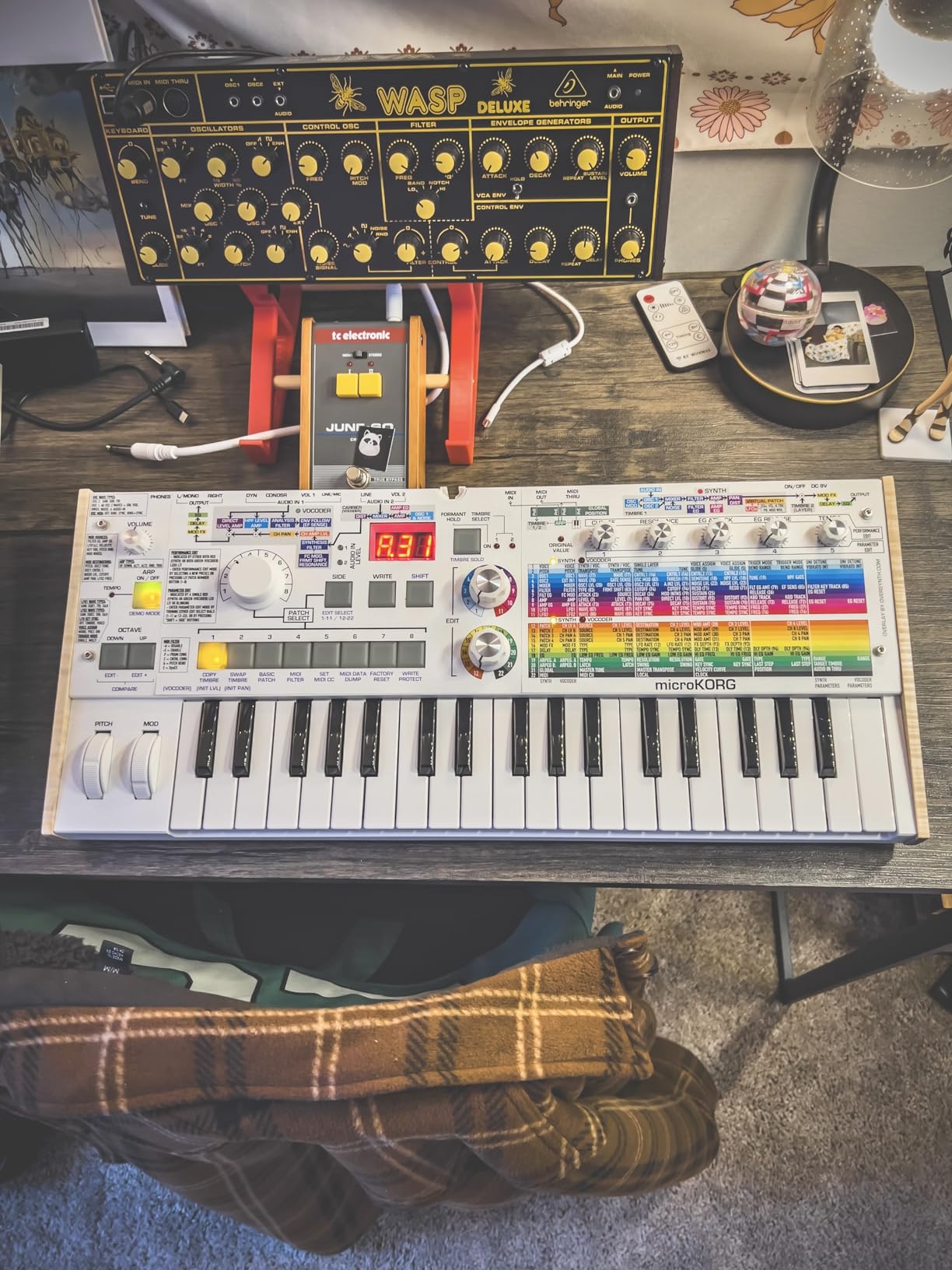
Battery power and velocity-sensitive keys make the microKORG S a true grab-and-go performance instrument. The compact 37-mini-key design fits on a desk, a keyboard stand, or a small stage setup. The white motif with light wood ends looks as good as it sounds.
This is a virtual analog synth rather than true analog, but the engine is so refined that most listeners cannot tell the difference in blind tests. The microKORG has been a studio and stage staple for nearly two decades, and the S version keeps that legacy alive.
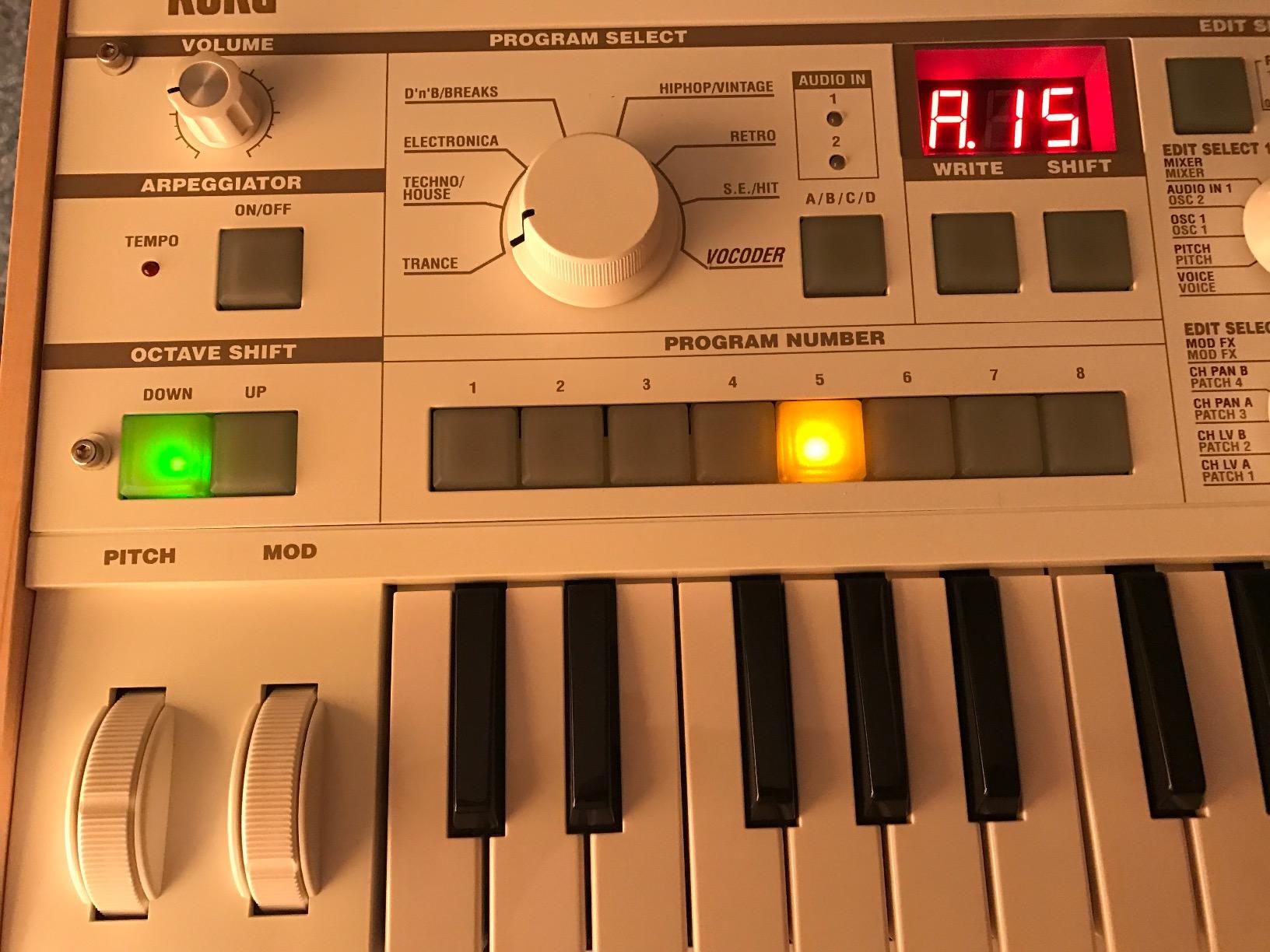
Best use cases
Live performance, classroom and education settings, video game soundtrack composition, and any genre that needs a versatile all-rounder with vocoder. It is also great for producers who want a portable synth with built-in monitoring.
Limitations to know
Mini keys feel small for players with large hands. Some units ship without a power cord, so check before you buy. The engine is virtual analog, not true analog, so purists may want a true analog synth like the minilogue xd or monologue instead.
10. Behringer Pro VS Mini – Best Ultra-Budget Entry Synth
Behringer Pro VS Mini Portable 5-Voice Hybrid Synthesizer with 4 Vector Morphing Oscillators Per Voice, Analog Low-Pass Filter, 16-Step Sequencer and Arpeggiator
Hybrid 5-voice
Vector morphing
Oscilloscope
Pros
- Incredible sound quality for the price
- 80s-style wavetable sounds
- portable with USB-C power bank support
- clear screen showing preset names and waveforms
- full-size MIDI DIN connector
- 100+ waveforms for vector synthesis
- easy menu system
Cons
- Limited to 32 presets (should be more)
- touch keys too small
- only one sync port and one MIDI port
- cannot chain devices easily
- battery power not built in
- 16-step sequencer is limited
- no MIDI out/through
At under $120, the Behringer Pro VS Mini is the cheapest way into wavetable synthesis we have tested. The hybrid engine combines 4 vector morphing oscillators per voice with an analog low-pass filter, and the result is the kind of glassy, evolving pads and biting leads that defined 80s synthwave, John Carpenter soundtracks, and Stranger Things-style scores.
The Pro VS Mini is part of Behringer’s ongoing mission to clone classic synths at budget prices, and this one takes inspiration from the legendary PPG Wave and Korg Wavestation. Five voices of polyphony is enough for most chord progressions, and the analog filter adds warmth that pure digital synths often lack.
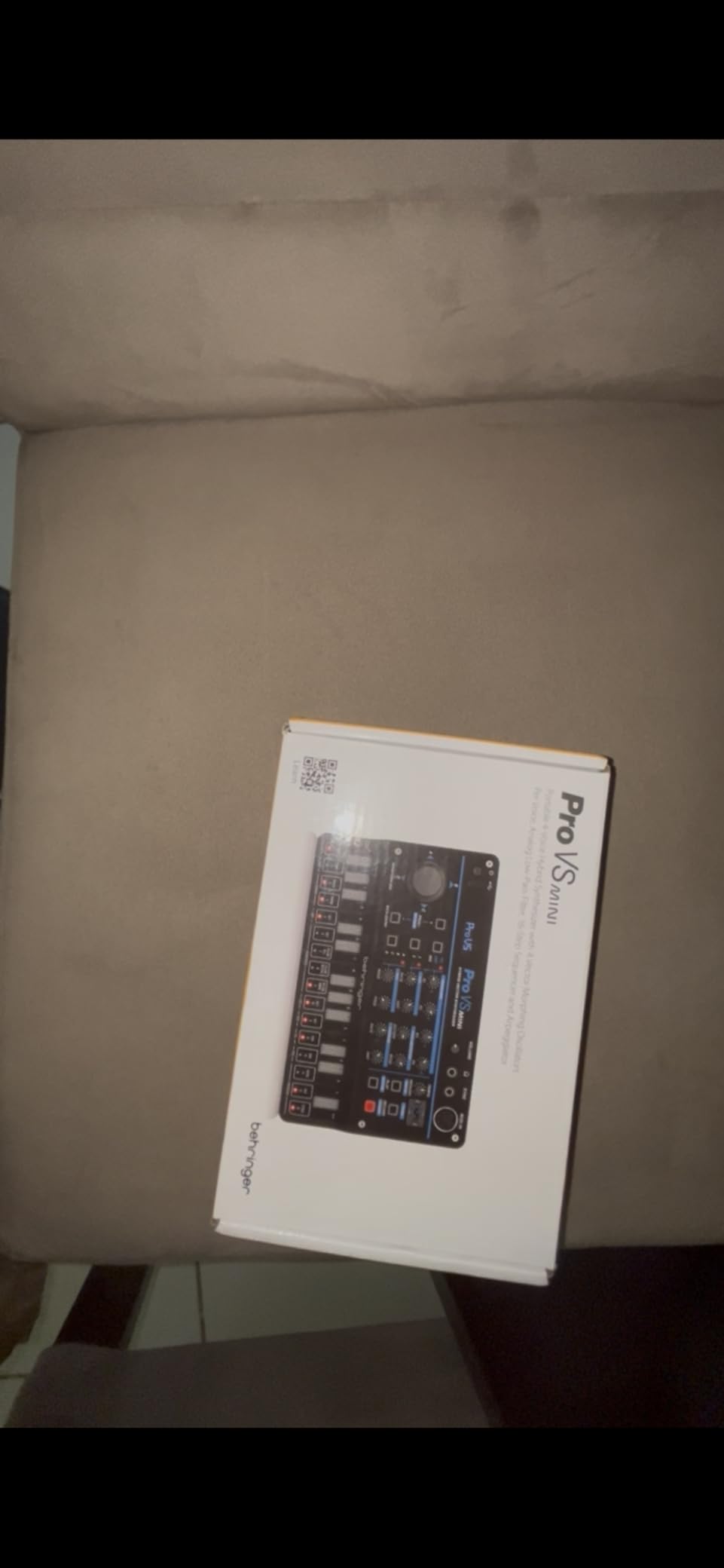
The 32 preset limit is the biggest drawback. 32 patches feels stingy when most modern synths offer 256 or more. We worked around it by saving our best patches in a spreadsheet and recalling them via SysEx dumps. Beginners may not hit this limit for a while, but experienced users will.
The full-size MIDI DIN connector is a thoughtful touch at this price. The clear OLED display shows preset names and waveform shapes, and the menu system is one of the easiest to navigate in any synth we tested. Touch keys are small and basic, but Behringer includes pitch and mod wheels, which many budget synths skip.
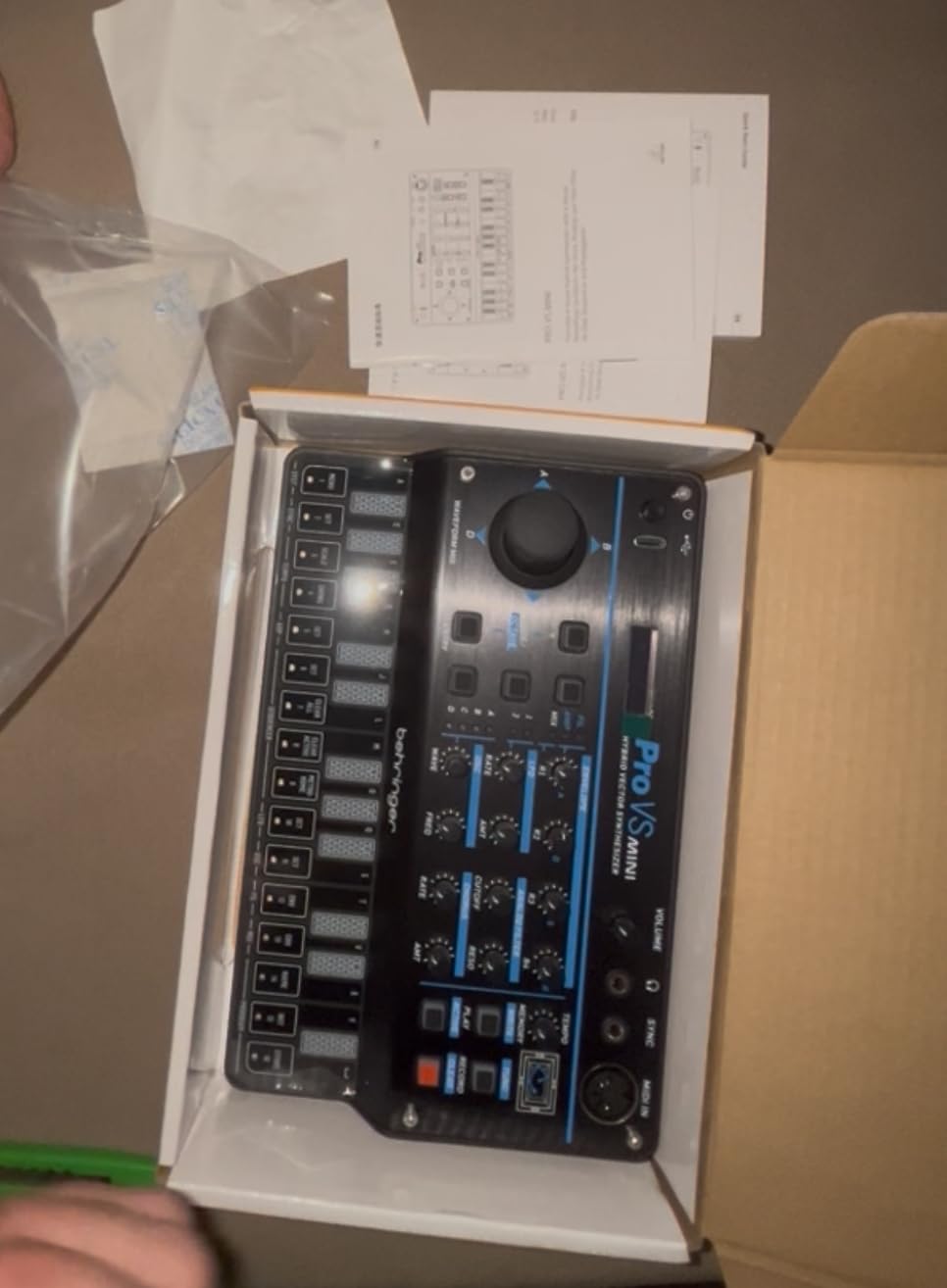
Why beginners love the Pro VS Mini
The price lets you buy a synth, a pair of monitors, and a MIDI controller all for the cost of one premium synth. Sound quality punches way above the price. The wavetable engine is unique at this price point. It is a perfect first synth to learn on.
Trade-offs to consider
Only 32 presets, basic touch keys, no built-in battery, limited connectivity for chaining multiple units. We recommend pairing the Pro VS Mini with a small MIDI controller like the Korg nanoKEY or Arturia MiniLab for serious playing.
What to Look for in the Best Synthesizer for Beginners
Choosing your first synthesizer comes down to how you want to learn and what kind of music you want to make. Below is the framework our team uses when recommending synths to new players.
Analog vs digital synthesis explained
Analog synths generate sound using electrical circuits, which gives them a warm, characterful, slightly unpredictable sound. Digital synths use processors to generate waveforms, which gives them precise, stable, often complex sounds like wavetables and physical models. Both are valid choices, but they feel different under your fingers.
If you want the classic Moog, Roland, and Korg sound that defined decades of pop, film, and electronic music, go analog or virtual analog. If you want evolving pads, glitchy textures, and MPE expressive control, go digital. Many modern synths like the Arturia MicroFreak and Behringer Pro VS Mini are hybrids that combine both worlds.
Knob-per-function vs menu diving
Knob-per-function means every parameter has its own dedicated knob or button on the front panel. Menu diving means you select parameters through a screen and a smaller number of controls. Beginners consistently rank knob-per-function as the single most important feature for learning synthesis.
The Korg minilogue xd, monologue, and Behringer Pro VS Mini all use knob-per-function layouts. The Novation MiniNova and Roland S-1 require some menu diving for advanced features. If you are easily frustrated by menus, prioritize knob-per-function synths.
Polyphony: mono, paraphonic, and poly explained
Monophonic (mono) means one note at a time. The Korg monologue is monophonic. Polyphonic means you can play multiple notes at once, like a piano. Most modern polysynths offer 4 to 8 voices. Paraphonic is a middle ground where you can play multiple notes but they share some controls. The Arturia MicroFreak is paraphonic.
For learning, a polyphonic synth is more forgiving because you can play chords. For basslines and lead melodies, monophonic synths often sound more aggressive. Beginners who play piano or want to learn chords should pick a poly synth like the minilogue xd or Hydrasynth Explorer.
Sequencer and arpeggiator importance
A built-in sequencer lets you program melodies, basslines, and chord patterns step by step. An arpeggiator automatically plays held notes one at a time in patterns. Both are essential for beginners who do not yet play keyboard fluently, because you can build full arrangements without performance technique.
Every synth in our top 10 includes a sequencer or arpeggiator. The Korg monologue and minilogue xd include the deepest sequencing options, with motion recording that captures knob movements per step. The Volca FM2 and Behringer Pro VS Mini keep sequencing simple but effective.
Connectivity: MIDI, USB, and CV/Gate
USB MIDI lets you connect directly to a computer for DAW integration. 5-pin DIN MIDI works with older synths and stage rigs. CV/Gate outputs let you control Eurorack modular gear. Headphone outputs are essential for private practice. Audio inputs let you process external sounds through your synth’s filter.
For beginners, USB MIDI is the most important. It lets you use your synth as a controller for free software synths like Vital, Surge, and Dexed. CV/Gate matters only if you plan to expand into modular gear, which most beginners do not.
Budget tiers and what you get at each level
Under $150 covers Volcas and Behringer’s budget models. These are perfect starter synths with limited polyphony and basic features. $150-$400 covers most of the beginner-friendly options including the Arturia MicroFreak, Roland S-1, and Korg monologue. $400-$700 covers premium polysynths like the minilogue xd and Hydrasynth Explorer.
Our advice is to spend as much as you can afford up to about $400, then save the rest for a pair of monitors, a small audio interface, and possibly a MIDI controller. A $350 synth with good monitors and a clean audio interface will serve you better than a $700 synth with no monitoring.
Genre-based recommendations
For ambient and cinematic work, choose a polysynth with lush pads. The Korg minilogue xd, Yamaha REFACE CS, and ASM Hydrasynth Explorer excel here. For techno, acid, and bass-heavy genres, look at monophonic or paraphonic synths with aggressive filters. The Korg monologue, Behringer Pro VS Mini, and Novation MiniNova shine.
For hip-hop and lo-fi production, choose a synth with characterful keys and electric piano sounds. The Korg Volca FM2 and microKORG S cover these tones beautifully. For live performance and portability, the Roland AIRA S-1 and Yamaha REFACE CS are the most gig-ready options.
Software synth alternatives worth considering
If you want to learn synthesis without spending money on hardware, free software synths like Vital, Surge, and Dexed give you world-class sound design tools for zero cost. The Reddit r/synthesizers community consistently recommends starting with software before committing to hardware.
That said, hardware synths offer tactile control that software cannot match. Twisting a physical knob and feeling the sound change is the fastest way to learn what each parameter does. Our recommendation is to start with a free software synth to confirm you enjoy synthesis, then invest in hardware.
A simple beginner learning roadmap
Month 1: Learn the three core building blocks: oscillator, filter, and envelope. Start with a free software synth like Vital. Build one patch from scratch per week. Month 2: Add to your hardware setup with a budget synth like the Behringer Pro VS Mini or Korg Volca FM2. Practice sound design on the tactile interface.
Month 3: Level up to a polysynth like the Korg minilogue xd or Arturia MicroFreak. Start sequencing full arrangements using the onboard sequencer or arpeggiator. Month 4 and beyond: Explore deeper sound design, add effects pedals or DAW plugins, and consider a second synth to layer sounds.
Buying used gear for extra savings
The Reddit community widely recommends buying used synths from Reverb.com, eBay, or local music stores. Used prices are typically 20-40 percent lower than new, and vintage analog synths from the 1980s often hold their value. Just check the condition of knobs, sliders, and jacks before buying.
Frequently Asked Questions
Are synthesizers easy to learn?
Synthesizers are approachable for beginners when you start with a knob-per-function design that lets you twist and immediately hear the result. Most beginners can dial in a usable sound within 30 minutes on synths like the Korg minilogue xd or Arturia MicroFreak. The learning curve comes from understanding subtractive synthesis: oscillators generate the raw waveform, the filter shapes it, and the envelope controls how the sound evolves over time.
What is the best beginner synth in 2026?
Our top pick for 2026 is the Korg minilogue xd because it combines true analog sound, polyphonic 4-voice capability, an OLED oscilloscope that visually teaches synthesis, and a knob-per-function layout. The Arturia MicroFreak is our best-value pick with 17 oscillator modes and poly-aftertouch at a lower price. For budget shoppers, the Korg Volca FM2 and Behringer Pro VS Mini offer excellent starting points under $150.
What is the best affordable synthesizer?
The most affordable synthesizer we recommend is the Behringer Pro VS Mini, which delivers hybrid wavetable and analog sound for under $120. The Korg Volca FM2 at roughly $150 is another excellent budget pick, especially for FM synthesis fans. Both include built-in sequencers and arpeggiators that help beginners build full arrangements without advanced keyboard skills.
What is the difference between analog and digital synthesizers?
Analog synthesizers generate sound using electrical circuits, which produces a warm, characterful tone with slight natural variation. Digital synthesizers use processors to generate waveforms, which allows complex sounds like wavetables, physical models, and FM synthesis. Hybrid synths like the Arturia MicroFreak combine digital oscillators with analog filters to capture benefits of both. Beginners often prefer analog or virtual analog synths because they sound musical immediately and teach synthesis fundamentals intuitively.
Final Verdict: Which Beginner Synth Should You Buy?
If you want a single synth that will carry you through the next three years of learning, the Korg minilogue xd remains our top recommendation. It pairs true analog warmth with a knob-per-function layout, an OLED oscilloscope that visually teaches synthesis, and enough polyphony for chords and pads. For shoppers on a budget, the Arturia MicroFreak delivers more sonic variety than anything else under $400.
Whichever of these best synthesizers for beginners you choose, you are investing in one of the most rewarding hobbies in music. Our team has tested dozens of synths, and the 10 in this guide represent the clearest paths from first patch to finished track. Take your time, start with one synth, learn it deeply, and add to your collection as your skills grow.