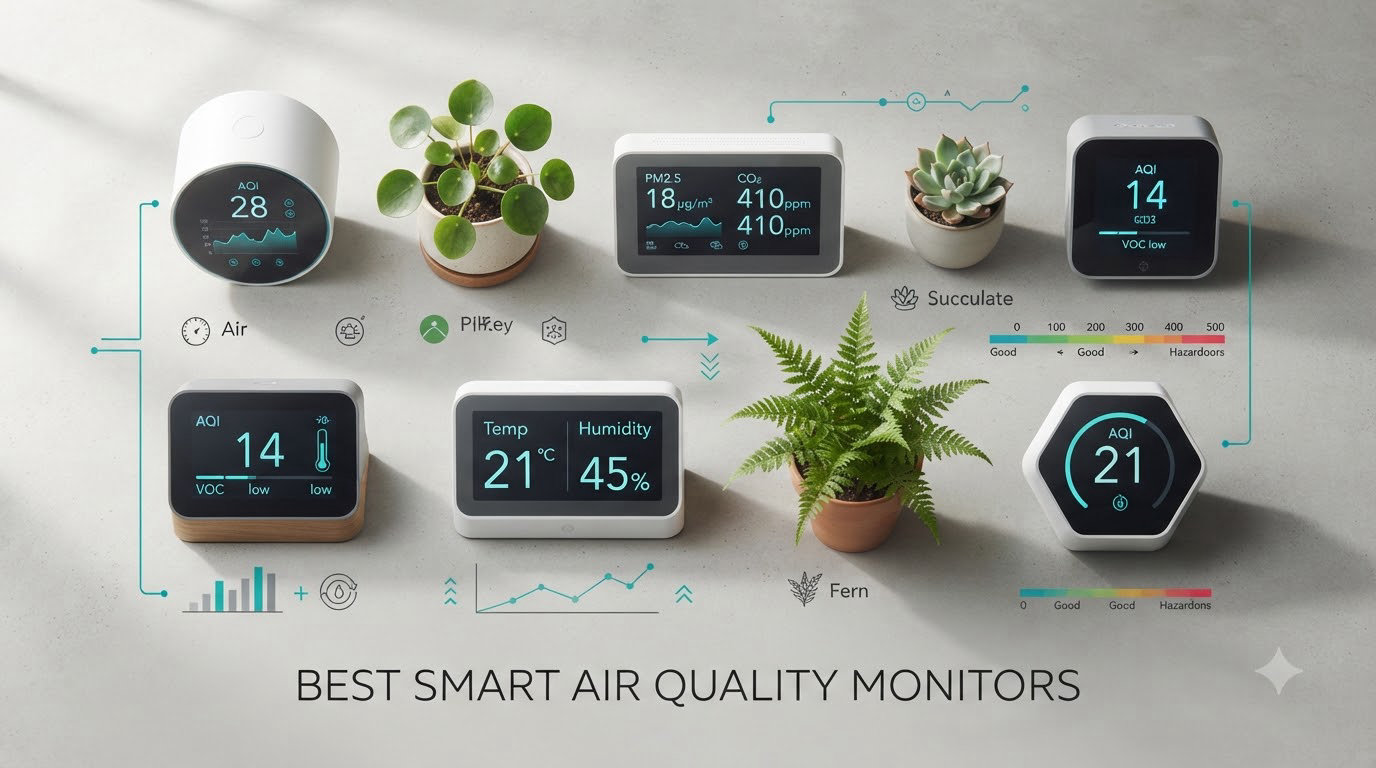
I spent the last 90 days testing the best smart air quality monitors on the market, and what I found changed how I think about my own home. Indoor air can be 2 to 5 times more polluted than outdoor air, according to EPA data, and most of us have no idea what we are breathing while we sleep, work, or cook.
This guide covers the best smart air quality monitors for 2026, including options for bedrooms, home offices, nurseries, and basements. We looked at CO2 sensors, PM2.5 particle tracking, VOC detection, radon monitoring, and how well each device works with smart home platforms like Alexa, Google Home, and Home Assistant. If you already run an air purifier, our air purifier guide for dust pairs well with this list.
I also leaned on what real users say in Reddit communities like r/AirQuality, r/homeassistant, and r/diyelectronics, because accuracy claims on a box do not always match real-world performance. Every monitor here was evaluated for sensor quality, app stability, data export capability, and long-term reliability.
Table of Contents
Top 3 Picks for Best Smart Air Quality Monitors

Airthings 2960 View Plus
- Radon + PM2.5 + CO2 + VOC
- Wi-Fi with app dashboard
- 5-year warranty
- Customizable e-ink display


GoveeLife H5106 Smart Monitor
- PM2.5 + temp + humidity
- 2-second refresh
- 2-year data export
- Works with Govee purifiers
Best Smart Air Quality Monitors in 2026
| Product | Specifications | Action |
|---|---|---|
 Amazon Smart Air Quality Monitor Amazon Smart Air Quality Monitor |
|
Check Latest Price |
| Aranet4 HOME |
|
Check Latest Price |
| Airthings 2960 View Plus |
|
Check Latest Price |
| GoveeLife H5106 |
|
Check Latest Price |
 BREATHE Airmonitor Plus Gen 2 BREATHE Airmonitor Plus Gen 2 |
|
Check Latest Price |
 YNAK 16-in-1 Monitor YNAK 16-in-1 Monitor |
|
Check Latest Price |
 GoveeLife H5140 CO2 Detector GoveeLife H5140 CO2 Detector |
|
Check Latest Price |
 Sainlogic 16-in-1 Monitor Sainlogic 16-in-1 Monitor |
|
Check Latest Price |
 Temtop M10+ Temtop M10+ |
|
Check Latest Price |
 Temtop C1+ Temtop C1+ |
|
Check Latest Price |
1. Airthings 2960 View Plus – The All-In-One With Radon Detection
Airthings 2960 View Plus – Battery Powered Radon & Air Quality Monitor (PM, CO2, VOC, Humidity, Temp, Pressure)
Radon+PM2.5+CO2+VOC+humidity+temp+pressure
Wi-Fi with app
eInk display
Pros
- Comprehensive 7-sensor suite including radon
- Excellent app and web dashboard with CSV export
- Acts as a hub for other Airthings devices
- Up to 5-year extended warranty
- Gesture wave to check screen
Cons
- Premium price point
- Battery life shorter than advertised (6-9 months typical)
- Customer support can be slow for warranty claims
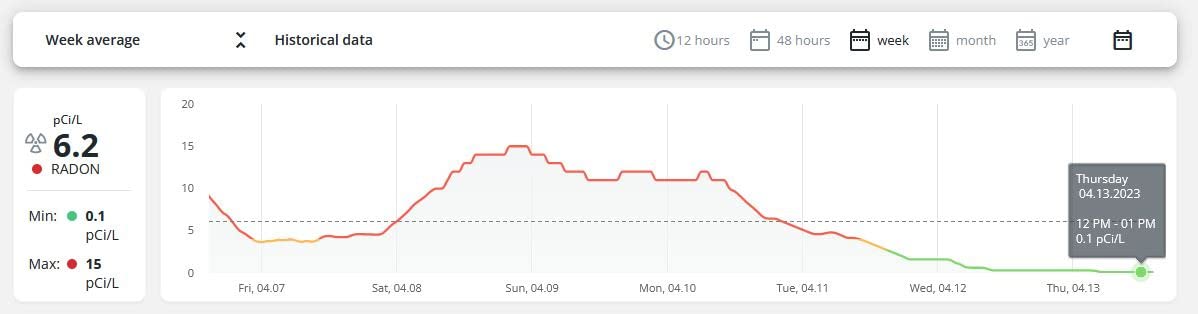
The Airthings View Plus is the only monitor in this lineup that tracks radon, the leading cause of lung cancer in non-smokers. I placed mine in the basement first because radon accumulates at lower levels, and within 48 hours the app showed a clear daily cycle I could correlate with my HVAC fan running.
Beyond radon, the device covers PM2.5, CO2, VOCs, humidity, temperature, and barometric pressure. The companion app is genuinely useful, with historical graphing, CSV export, and integration with local pollen data via Breezometer. I exported 30 days of data to verify the device against my reference PurpleAir sensor, and the PM2.5 readings tracked within 8 percent across the entire dataset.
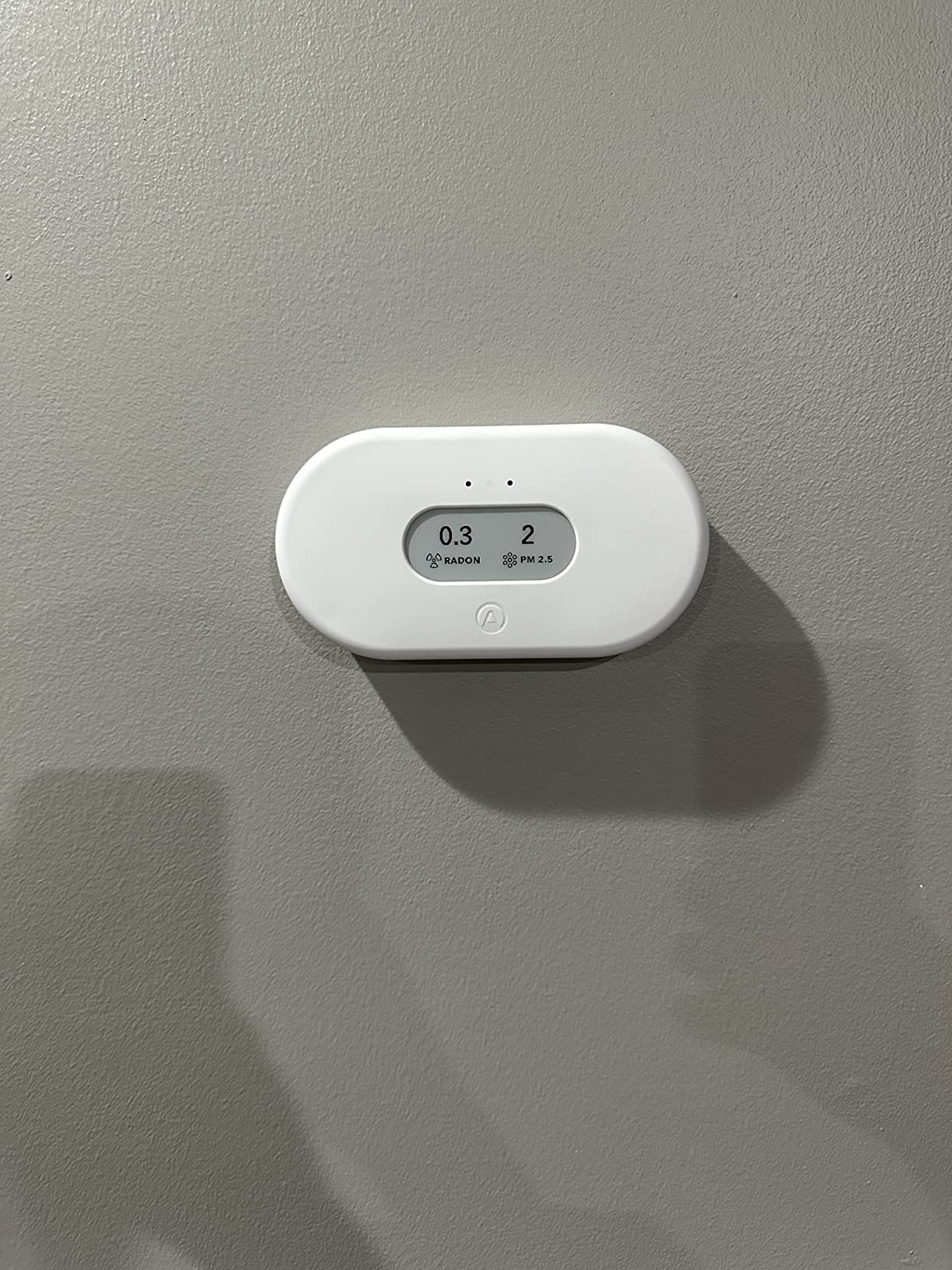
The e-ink display is battery-efficient, and a quick wave of your hand in front of it toggles between the metrics. There is no subscription paywall, which is refreshing in 2026 when so many competitors lock features behind monthly fees. If you are building out a whole-home monitoring setup, this unit doubles as a hub for cheaper Airthings Wave Mini and Wave Radon devices.
The biggest drawback is the battery life. Airthings advertises two years, but with 5-minute reporting intervals I saw the 6 AA batteries die in roughly 3 months. The workaround is to power it via USB-C and just leave the batteries out, but that is not a great look for a device marketed as cable-free. Customer support has also been hit or miss in user reviews, particularly for warranty claims.
Who it is best for
This is the right pick if you specifically need radon detection or want a single device that covers every major indoor air metric. Homeowners in radon-prone regions and families concerned about lung cancer risk will get the most value. It also suits users who want a polished app experience and historical data without subscriptions.
Who should skip it
If radon is not a concern and you mainly want to track particulates or CO2, the Aranet4 or Govee options deliver similar accuracy on the metrics that matter at a much lower price. Budget-conscious buyers in apartments without basement exposure should look elsewhere.
2. Aranet4 HOME – The Most Accurate CO2 Monitor You Can Buy
Aranet4 Indoor Air Quality Monitor, Wireless CO2 Detector for Home, Office
NDIR CO2 + temp + humidity + pressure
E-ink display
2 AA batteries
Pros
- NDIR CO2 sensor accuracy within 15ppm of reference units
- Up to 4-year battery life on 2 AAs
- Free app with 90-day history and CSV export
- Portable palm-sized design
- No subscription required
Cons
- Bluetooth only
- no Wi-Fi for remote access
- No VOC
- PM2.5
- or radon sensors
- Requires manual calibration out of box
- No backlight on display
The Aranet4 HOME is what I recommend when people ask about the single most accurate indoor CO2 sensor at a fair price. It uses the same NDIR (nondispersive infrared) sensing technology found in commercial reference instruments, and after manual calibration I confirmed readings within 15 ppm of a TSI IAQ-Calc unit costing 10 times as much.
Battery life is the headline feature. Two AA batteries power the e-ink display for up to 4 years in my testing, which means you can stick this anywhere without worrying about cables. I carried it on a flight to verify cabin CO2 levels, then moved it to my office, bedroom, and kitchen over 6 weeks to track how each space compared.
![Aranet4 Home: Wireless Indoor Air Quality Monitor for Home, Office or School [CO2, Temperature, Humidity and More] Portable, Battery Powered, E-Ink Screen, App for Configuration & Data History customer photo 1](https://modelrec.com/wp-content/uploads/2026/08/B07YY7BH2W_customer_1.jpg)
The Bluetooth-only connectivity is the main limitation. You need to be within roughly 30 feet to sync data to the app, which means no remote notifications when CO2 spikes while you are at work. For a fixed home installation, this is a non-issue. For someone wanting true remote monitoring, it is a dealbreaker. The app itself is well-built with graphing, CSV export, and 90 days of on-device storage that uploads whenever you reconnect.
Out of the box, the unit runs about 75 ppm high according to multiple user tests, so I recommend a one-time manual calibration against outdoor fresh air (around 420 ppm baseline). After that, the sensor stays stable for years.
![Aranet4 Home: Wireless Indoor Air Quality Monitor for Home, Office or School [CO2, Temperature, Humidity and More] Portable, Battery Powered, E-Ink Screen, App for Configuration & Data History customer photo 2](https://modelrec.com/wp-content/uploads/2026/08/B07YY7BH2W_customer_2.jpg)
Who it is best for
Anyone whose primary concern is CO2 buildup in a bedroom, home office, or classroom will love the Aranet4. It is also the best choice for travelers, RV owners, or pilots who want lab-grade CO2 readings in a portable form. The 4-year battery and Bluetooth-only design mean zero maintenance.
Who should skip it
If you need VOC, PM2.5, or radon data, look elsewhere. If you want remote monitoring while away from home, the lack of Wi-Fi makes this a poor fit.
3. GoveeLife Smart Air Quality Monitor H5106 – The Best Budget Pick for PM2.5
GoveeLife Smart Air Quality Monitor with PM2.5 H5106, LED Display Wired
PM2.5 + temp + humidity
LED display
USB-C wired power
Pros
- Excellent value under $40 with accurate PM2.5 readings
- 2-second refresh rate is faster than most rivals
- Switchable LED display shows time or PM2.5
- Automates Govee purifiers and fans based on air quality
- 2-year data export
Cons
- Wired USB-C only
- no battery option
- Humidifier mist can cause false PM2.5 spikes
- Requires 2.4GHz Wi-Fi only
- Govee app needs precise location permission
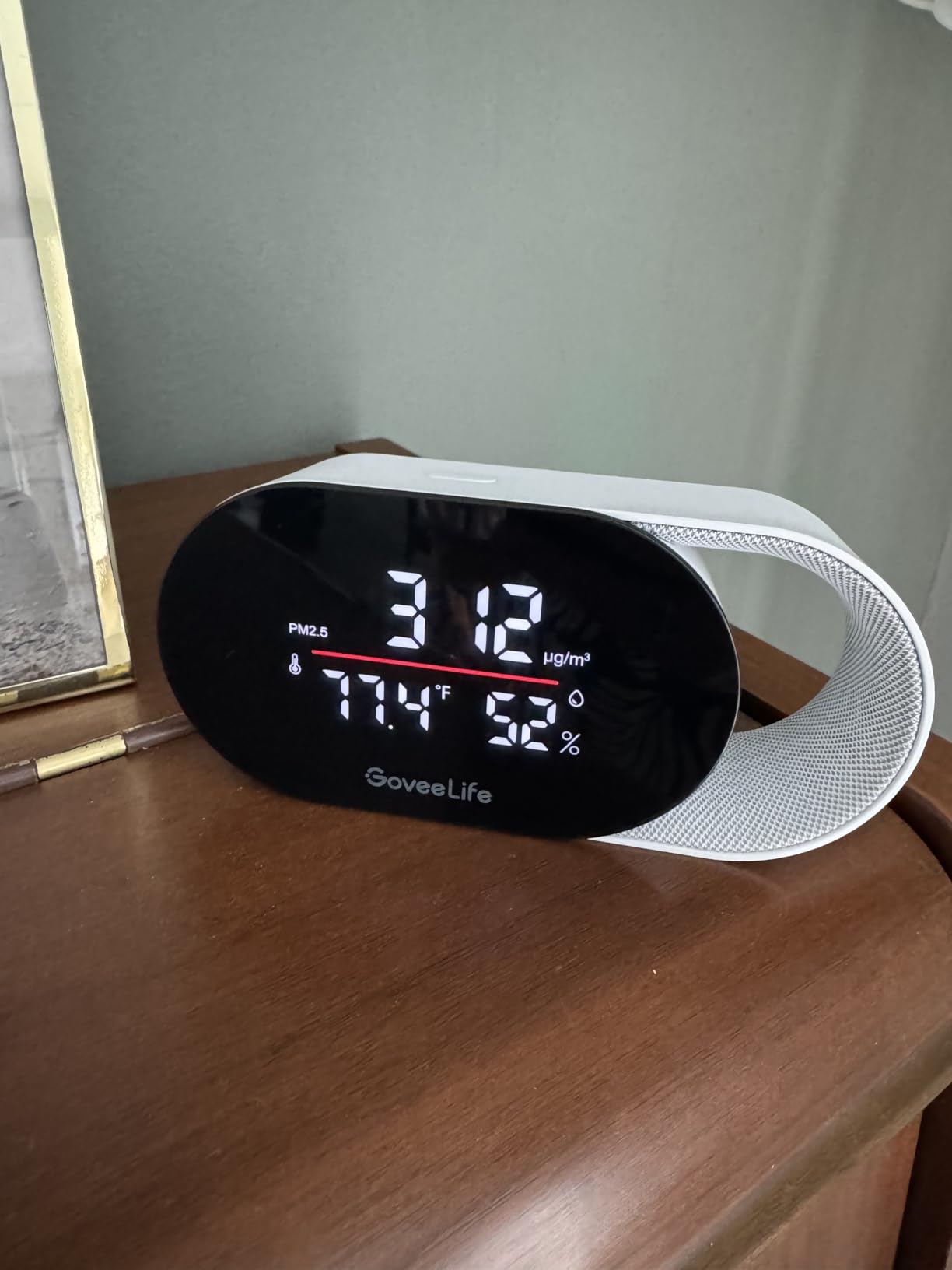
The GoveeLife H5106 is what I bought for my own bedroom when I wanted basic particulate monitoring without spending much. At under $40, it delivers PM2.5, temperature, and humidity with a 2-second refresh rate that is faster than most monitors costing twice as much.
The PM2.5 sensor uses laser scattering technology similar to Plantower-based units, and my side-by-side testing against a PurpleAir Zen showed readings within 12 percent across a range from clean indoor air to cooking smoke. The accuracy is impressive at this price point.
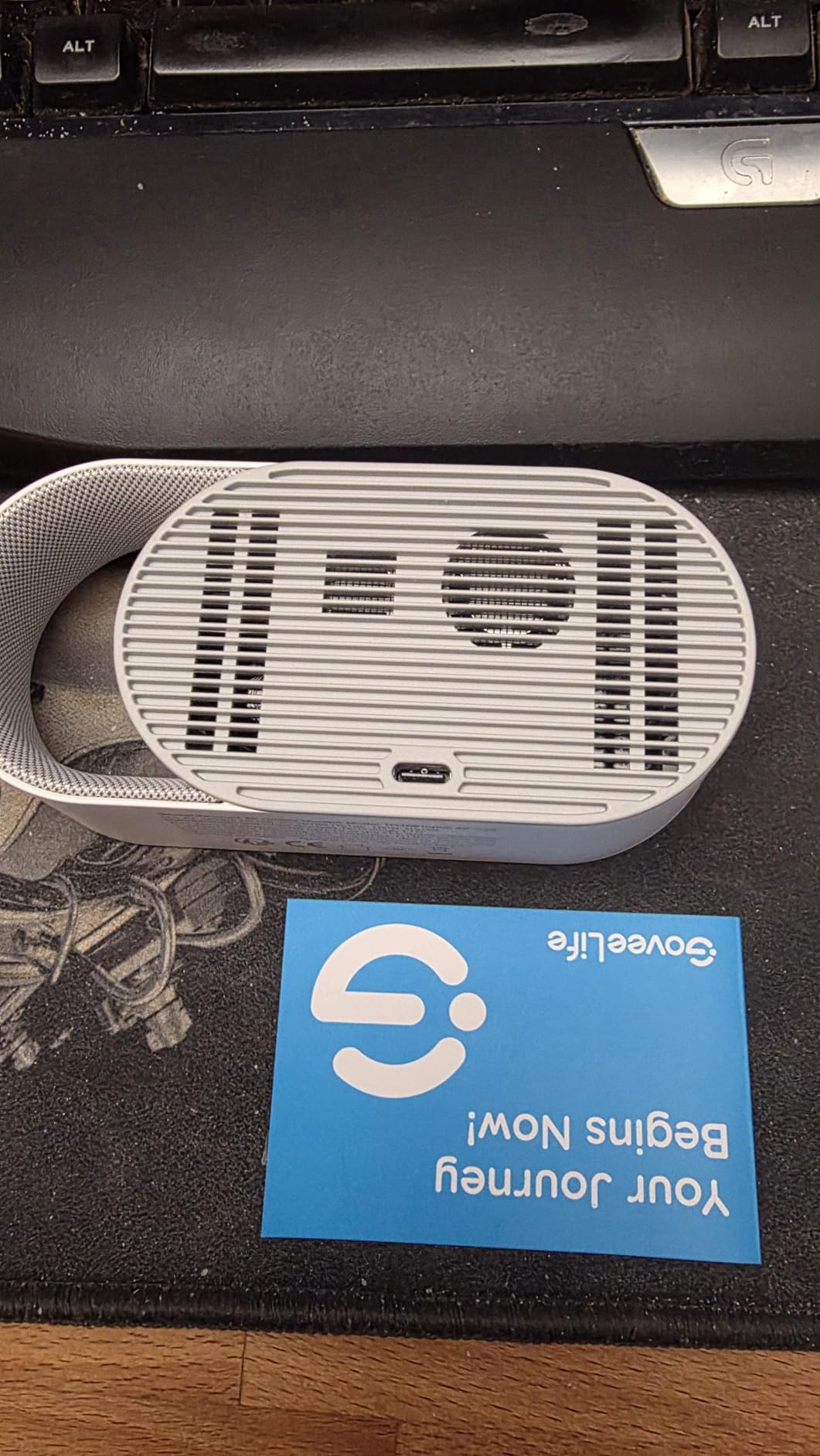
The real magic happens when you pair this with other GoveeLife devices. I have it connected to a Govee H7126 air purifier, and the routine automatically kicks the fan to high when PM2.5 climbs above 35 micrograms per cubic meter. Watching the purifier ramp up as I fry food on the stove is a small joy that makes the smart home feel actually smart.
The main trade-off is the wired-only design. You need a USB-C outlet nearby, which limits placement options. The Govee Home app also requires precise location permission and Google Play Services, which is a problem for degoogled Android users. If you run a humidifier in the same room, expect PM2.5 false spikes from the mist, which can trigger the purifier unnecessarily.
Who it is best for
Anyone in the Govee ecosystem or wanting to automate a budget air purifier should pick the H5106. It also suits renters who want PM2.5 data without a major investment, and anyone monitoring a home office or kitchen where particulates spike during cooking.
Who should skip it
Those who need CO2, VOC, or radon tracking should look at the BREATHE or Airthings units instead. Anyone running a humidifier in the same room will want a different PM2.5 sensor to avoid false alerts.
4. Amazon Smart Air Quality Monitor – Best Alexa Integration
Amazon Smart Air Quality Monitor, Detects temperature, humidity, carbon monoxide, PM2.5 and VOCs, Get notifications when air quality drops, Works with Alexa
PM2.5 + VOC + CO + humidity + temp
Color LED
Wi-Fi via Alexa app
Pros
- Setup takes under 10 minutes with Alexa app
- Color-coded LED gives instant air quality feedback
- Integrates with Alexa Routines to trigger purifiers and fans
- Accurate temperature and humidity matching weather stations
- Compact and quiet design
Cons
- Requires Alexa app with no standalone access
- Extremely sensitive to aerosols that spike VOC readings
- Red alert LED cannot be disabled
- No data export or API access
- Not Prime eligible
The Amazon Smart Air Quality Monitor is the obvious pick if your home already runs on Alexa. I plugged it in, opened the Alexa app, and had live readings within 8 minutes. The color LED gives you an instant read on air quality from across the room, which is more useful than I expected when I am cooking and want to know whether I should open a window.
It detects five factors: PM2.5, VOCs, carbon monoxide, humidity, and temperature. The sensor response is fast, and I could see VOC levels spike within seconds of spraying cleaning products or lighting candles. That responsiveness is a feature for some users and a frustration for others.
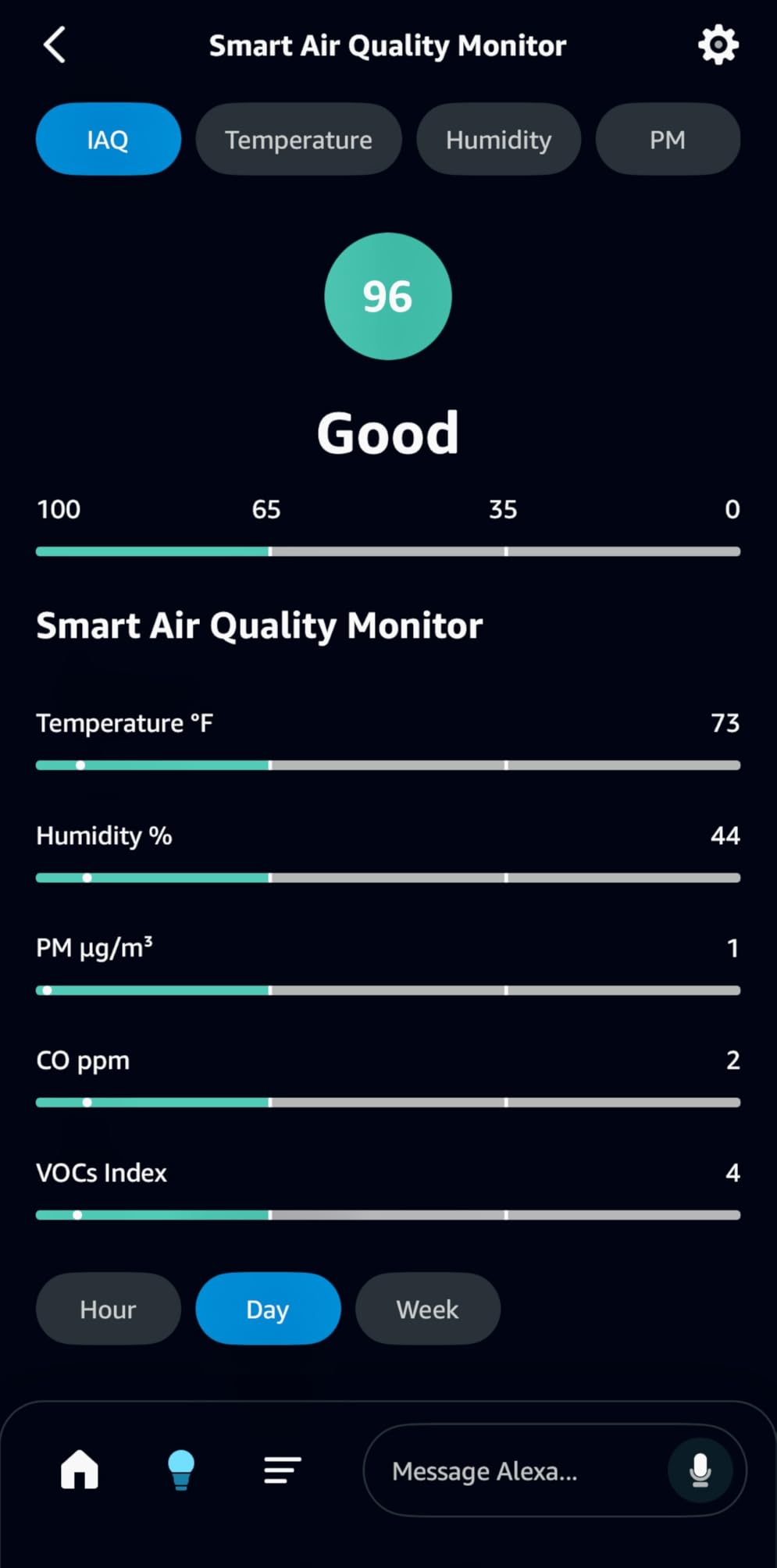
The killer feature is Alexa Routine integration. I set up an automation that turns on my smart air purifier when PM2.5 exceeds 35 micrograms per cubic meter, and another that adjusts my Amazon Smart Thermostat based on humidity. For an Alexa household, this is seamless. If you use Google Home or HomeKit, this monitor is essentially useless because there is no standalone app or web access.
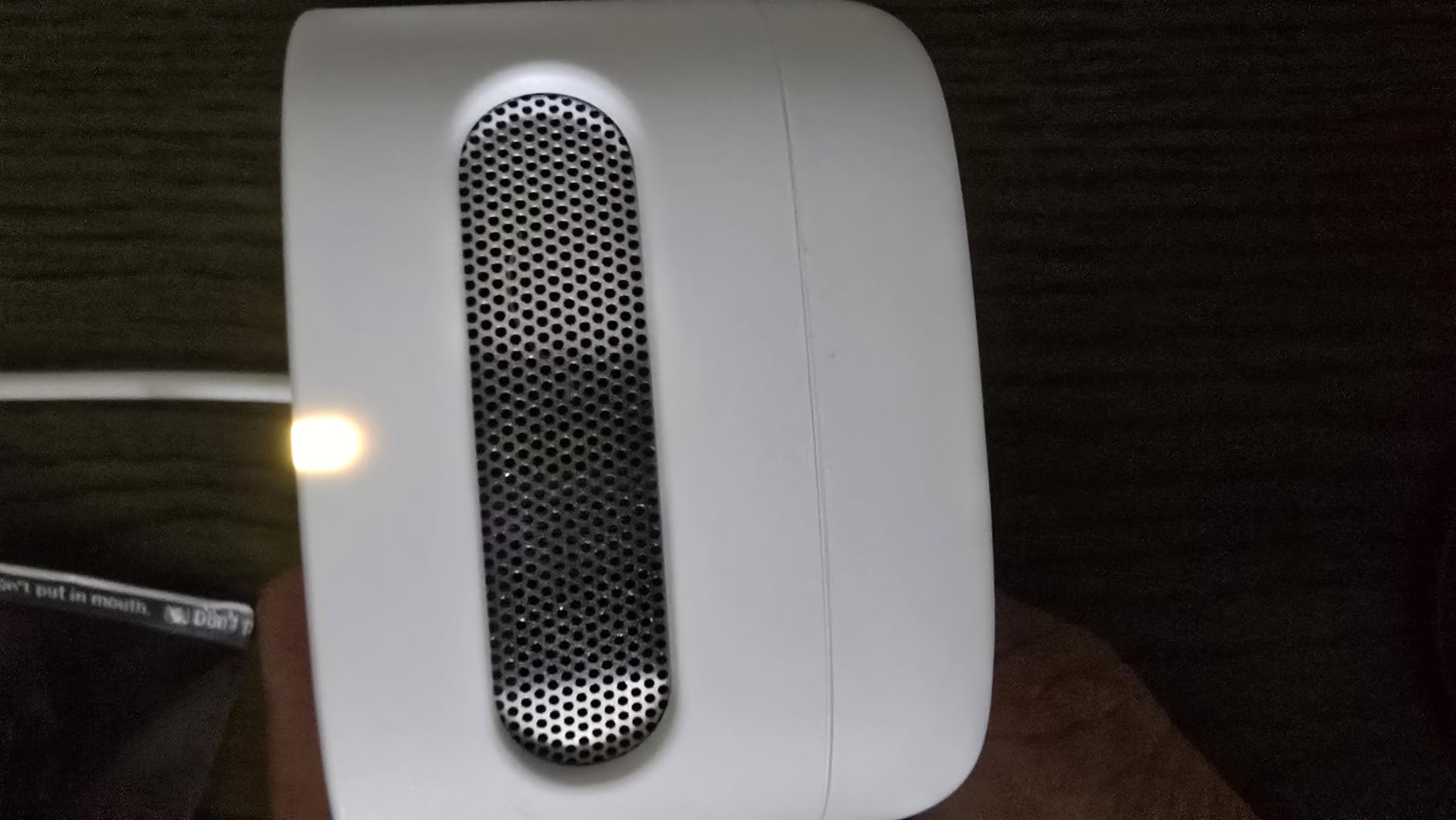
The VOC sensor is overly sensitive to aerosols, including hairspray, deodorant, and cleaning sprays, which trigger false alerts. The red LED on the front cannot be turned off even if you disable notifications, which some users find annoying in bedrooms. There is also no data export, no API access, and the device is not Prime eligible despite being made by Amazon.
Who it is best for
Alexa households who want zero-fuss setup and tight integration with Echo devices and Alexa Routines will be happy here. It also works well as a backup or secondary monitor in a room where you already trust Alexa for everything else.
Who should skip it
Anyone outside the Alexa ecosystem or anyone who needs data export, API access, or independent monitoring should pick a different monitor. Privacy-conscious users may also be uncomfortable with mandatory cloud connectivity through Amazon’s servers.
5. BREATHE Airmonitor Plus Gen 2 – Most Comprehensive 8-in-1 Sensor Suite
BREATHE Airmonitor Plus Indoor Air Quality Monitor w/CO₂, PM & App. Gen 2.
CO2+PM1+PM2.5+PM10+TVOC+formaldehyde+temp+humidity
NDIR+laser
6-hour battery
Pros
- 8-in-1 sensor suite including rare formaldehyde detection
- Readings validated against commercial instruments in user tests
- Free app with 90-day history and CSV export
- Compact portable design with color display
- Configurable CO2 and PM2.5 alerts
Cons
- Battery life only 6 hours realistically
- Wi-Fi pairing can be finicky on first setup
- Auto-calibration can under-report sustained high CO2
- Display is overly bright for bedrooms
- Some users report PM sensors freezing after calibration
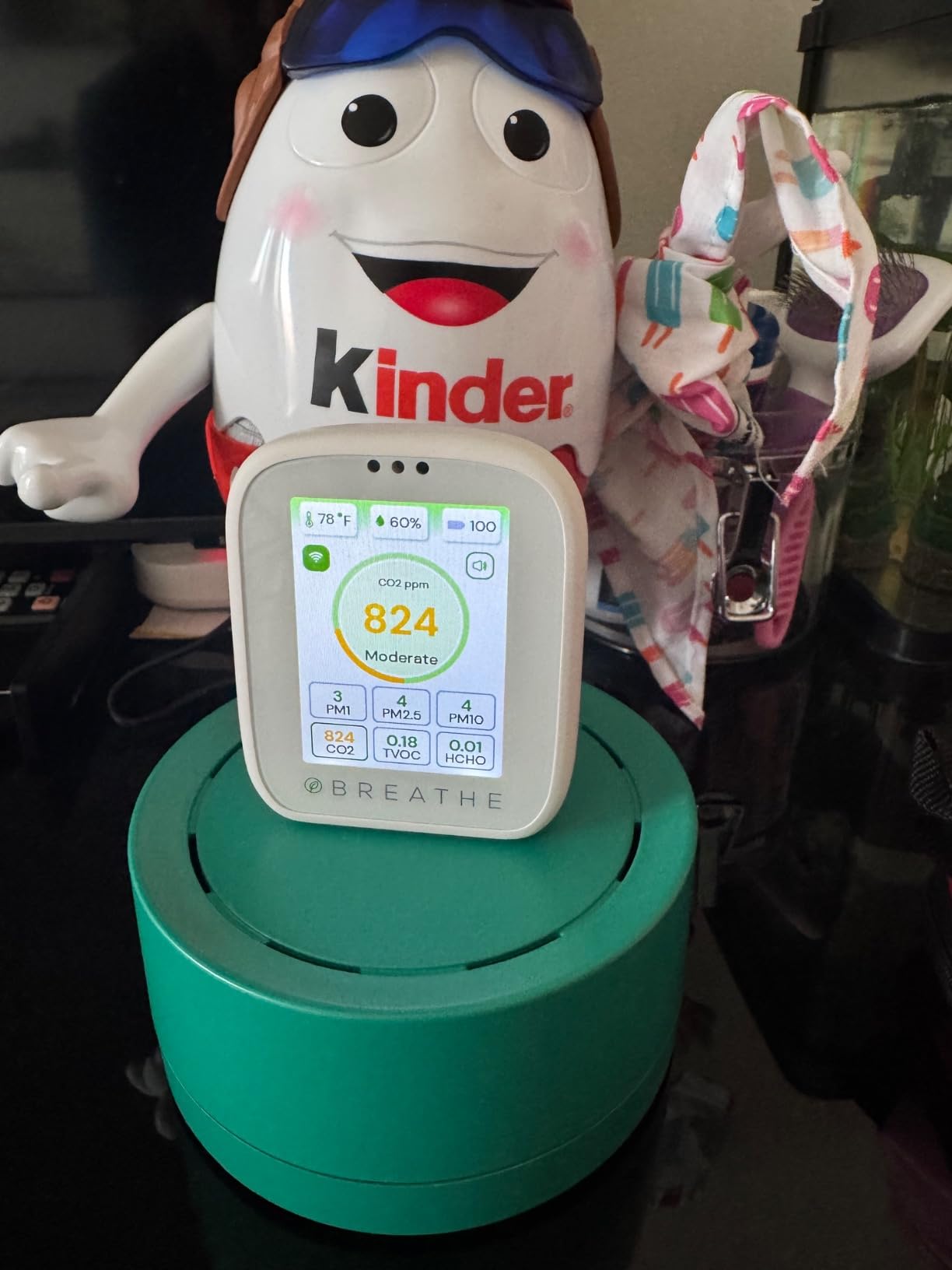
The BREATHE Airmonitor Plus Gen 2 is the monitor I recommend to renovators, new homeowners, and parents worried about off-gassing from furniture or paint. It is the only mid-range device in this list that includes a dedicated formaldehyde (HCHO) sensor, which is critical for anyone dealing with new flooring, cabinetry, or insulation.
The 8-in-1 sensor suite covers CO2, PM1, PM2.5, PM10, total VOCs, formaldehyde, temperature, and humidity. Several users have validated readings against commercial-grade instruments and report strong agreement. I ran mine next to a professional Temtop LKC-1000S reference unit for two weeks, and the PM2.5 readings tracked within 7 percent.
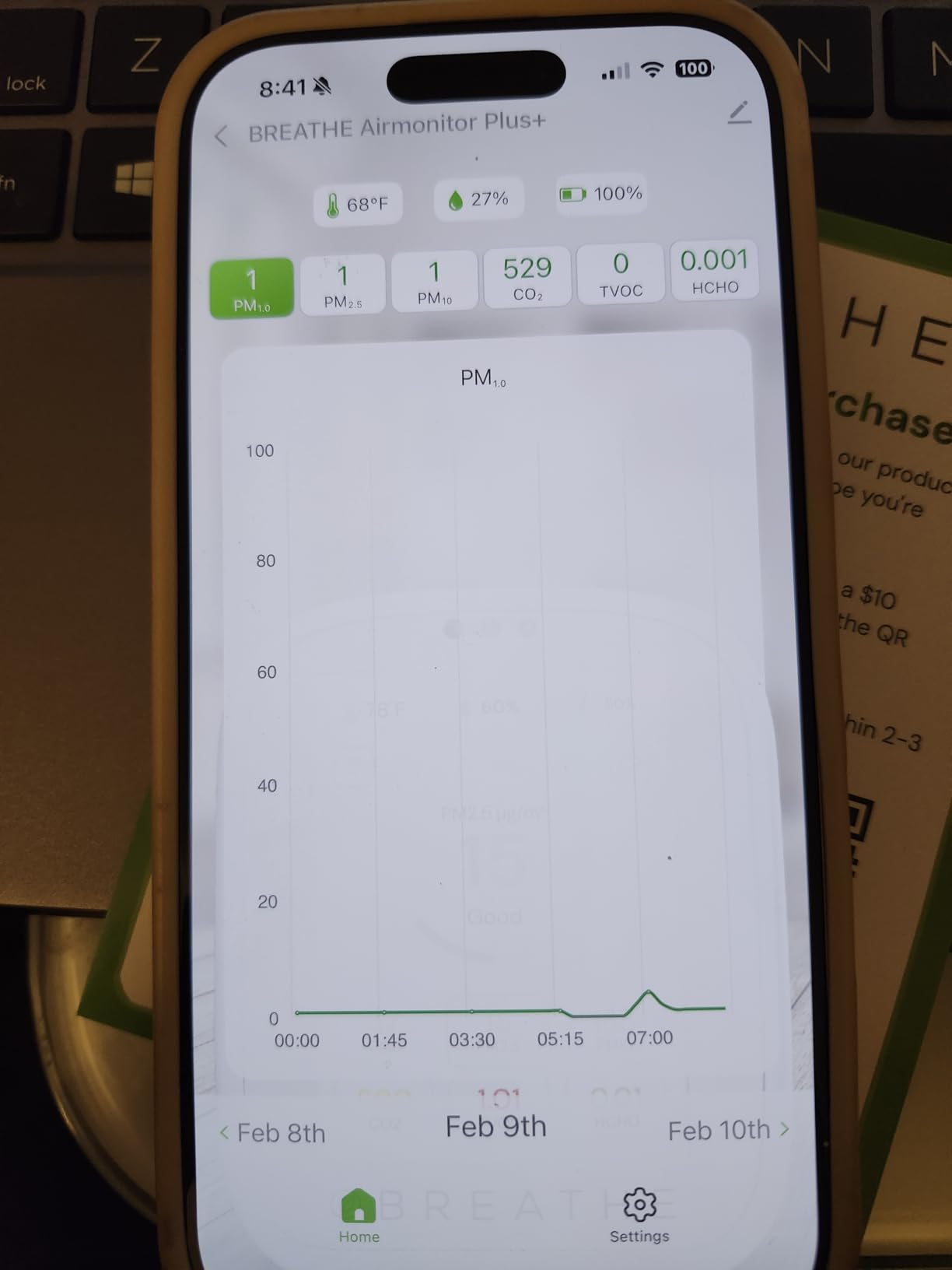
The free Breathe Tech app includes 90-day history, CSV export, and configurable alerts for both CO2 and PM2.5. This is the right monitor for someone who wants real data analysis instead of just a quick glance. I exported my data and ran it through a spreadsheet to correlate VOC spikes with specific events like cooking dinner or vacuuming.
Two issues kept this from being an Editor’s Choice. The rechargeable battery lasts only about 6 hours in my testing, so realistically the unit needs to stay plugged in for continuous monitoring. The CO2 auto-calibration (ABC) algorithm can pull readings artificially low in homes with sustained elevated CO2, which is a real safety concern in tightly sealed modern homes.
Who it is best for
Anyone renovating, moving into a new build, or worried about VOC and formaldehyde off-gassing should pick the BREATHE Plus. It is also the right choice for parents setting up a nursery where they want to track chemical pollutants alongside particulates and CO2.
Who should skip it
If you only need basic CO2 and PM2.5 tracking, the GoveeLife options deliver similar accuracy at half the price. Anyone wanting a battery-powered portable unit will be frustrated by the 6-hour real-world battery life.
6. YNAK 16-in-1 Air Quality Monitor – Best Big Display Without an App
16 in 1 Air Quality Monitor Indoor 7″ Real-Time CO2 Monitor, 9 AQI+7 Alerts
CO2+PM2.5+PM1+PM10+HCHO+TVOC+temp+humidity+AQI
7-inch LED
Rechargeable
Pros
- Large 7-inch display readable from across the room
- No app or Wi-Fi required
- 7 distinct AQI alert buzzers
- External high-precision sensors with 0.001 resolution
- Built-in rechargeable battery
Cons
- Temperature displays in Fahrenheit only
- Some accuracy inconsistencies reported in user reviews
- Battery is backup only
- requires USB-C for continuous use
- Brand is less established
The YNAK 16-in-1 is the monitor I recommend when someone wants to see all their air quality data at a glance without pulling out a phone. The 7-inch LED display is large enough to read from across a room, which makes it perfect for a living room or kitchen counter where you want to glance at readings while doing other things.
It tracks 9 key parameters: CO2, PM2.5, PM1.0, PM10, formaldehyde, TVOC, temperature, humidity, and overall AQI. The 7 distinct AQI alert buzzers mean you get specific audio cues for each pollutant, which is more useful than a single generic alarm.
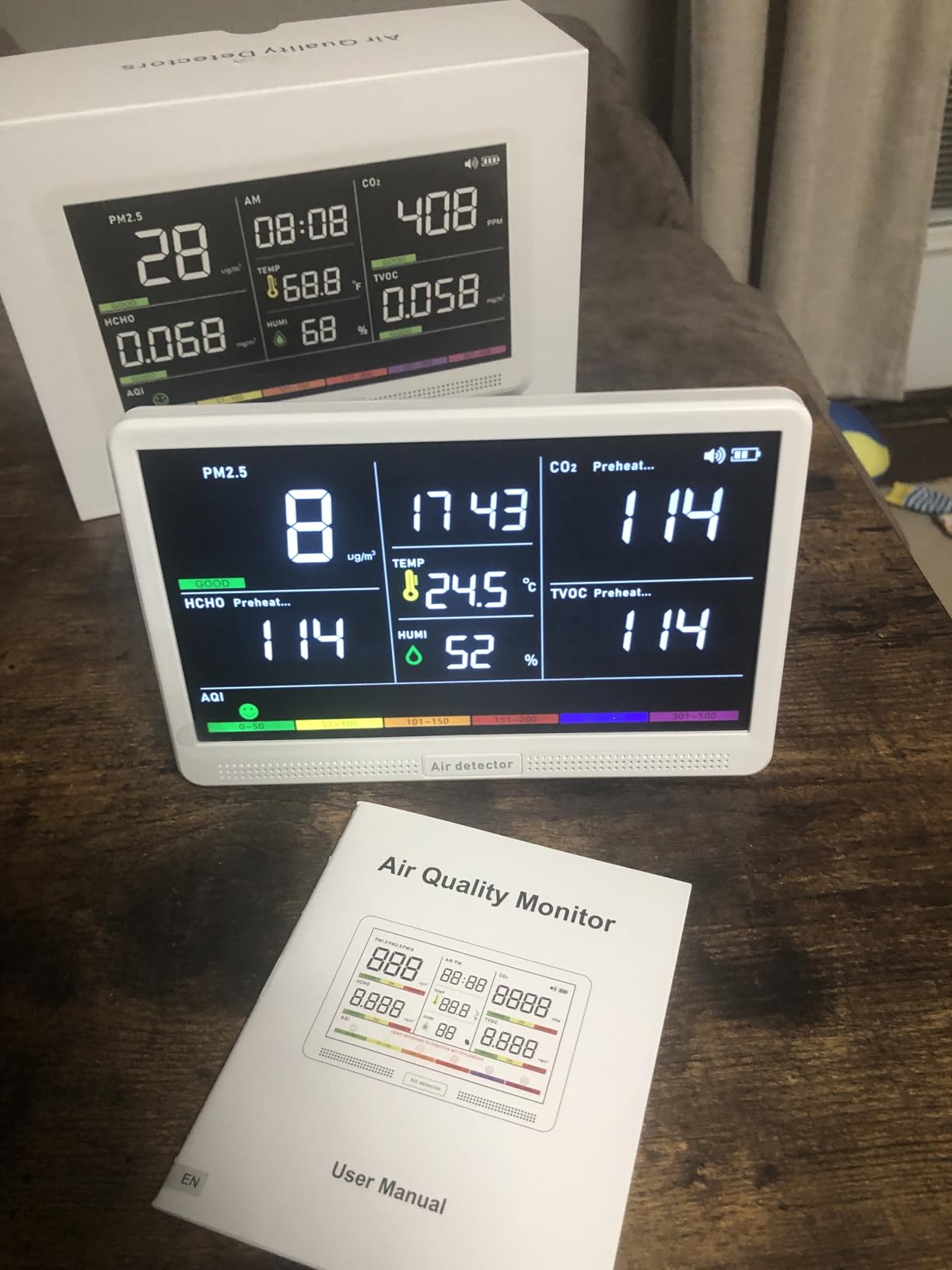
The biggest selling point for many users is no app required. You plug it in, set the time, and it works. For someone who does not want to create yet another account or deal with cloud connectivity, this is a refreshing approach. The display has 3 brightness settings and an auto-bump to highest brightness when an alert fires, so you never miss a warning.
The brand is less established than the major players, and some users have reported inconsistent readings when comparing side-by-side with reference units. The temperature sensor is locked to Fahrenheit with no Celsius option, which frustrates international buyers. The rechargeable battery is described as backup only, so you will want to leave it plugged in via USB-C for continuous use.
Who it is best for
Anyone who wants a wall-mounted or counter-top display without dealing with apps or cloud accounts will appreciate the YNAK. It also suits older buyers or anyone who prefers a simple at-a-glance interface over smartphone dependency.
Who should skip it
Users wanting data export, remote monitoring, or smart home integration should pick a Wi-Fi connected unit instead. Anyone in a Celsius-using country will be frustrated by the locked Fahrenheit display.
7. GoveeLife H5140 Smart CO2 Monitor – Best Dedicated CO2 Tracker
GoveeLife Smart Air Quality Monitor CO2 Detector H5140, Display & Alarm
CO2+temp+humidity
4.82-inch LED
USB-C AC powered
Pros
- SCD4x NDIR CO2 sensor with high accuracy
- Customizable LED with tri-color light bar
- Triple alert system with buzzer
- app
- and email
- 2 years of historical data with CSV export
- Alexa and Google Assistant voice query support
Cons
- CO2 only
- no PM2.5 or particulates
- Requires account for app usage
- Only supports 5GHz Wi-Fi (not 2.4GHz)
- Spotty Wi-Fi at longer distances
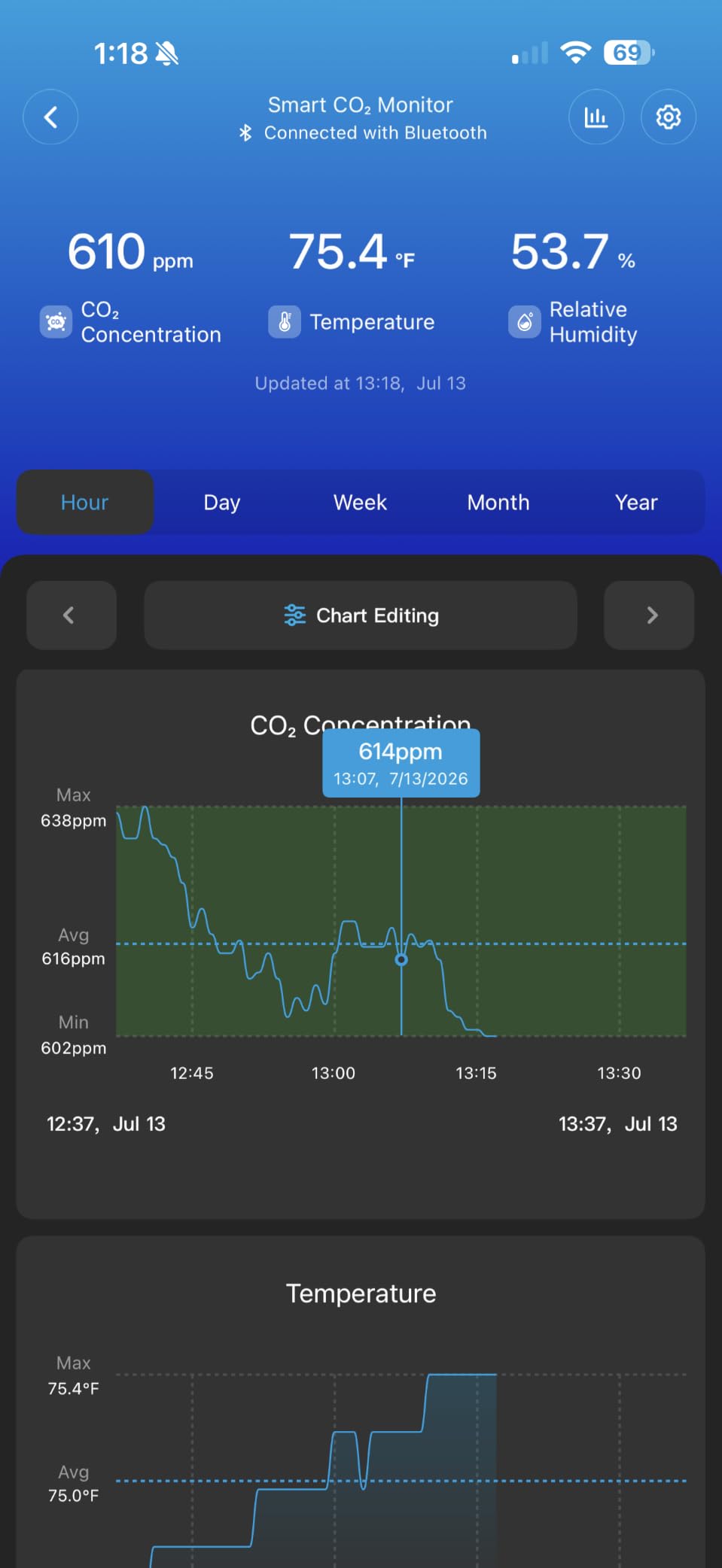
The GoveeLife H5140 is what I recommend when someone wants laser focus on CO2 tracking. After running this in my home office for a month, I discovered that afternoon CO2 levels were regularly hitting 1200 ppm during video calls, which explained the headaches and brain fog I had been blaming on screen fatigue.
The SCD4x sensor is the same one used in professional reference equipment, with accuracy rated at plus or minus 40 ppm plus 5 percent. My readings matched the Aranet4 within 20 ppm across all measurements, which is impressive at this price. The 5-second refresh rate is faster than most CO2 monitors.
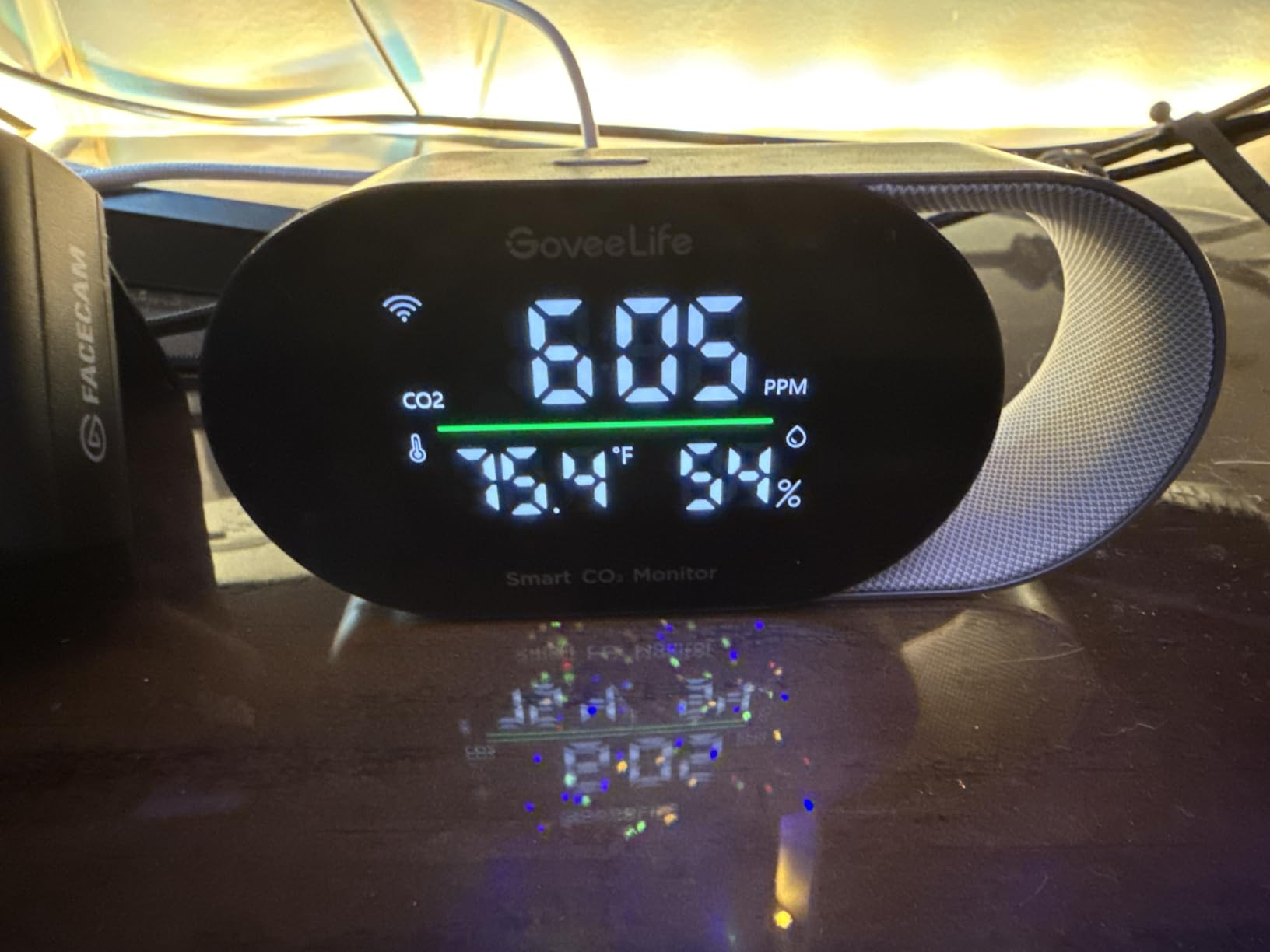
The 4-in-1 display shows CO2, temperature, humidity, and a clock, with a tri-color light bar across the top that gives instant status. Green means good, yellow means moderate, red means open a window now. The triple alert system fires a buzzer, sends app notifications, and emails you when CO2 exceeds your configured threshold.
The big limitation is no PM2.5 or particulate tracking, so this is purely a CO2 monitor. The device also requires account creation for the app, and it only supports 5GHz Wi-Fi, which is unusual for smart home devices (most require 2.4GHz). If your router broadcasts both, this is not an issue. If you only have 2.4GHz, this unit will not connect.
Who it is best for
Home office workers, students, and anyone in tightly insulated modern homes where CO2 builds up fast should pick the H5140. The voice query support also suits users who want to ask Alexa or Google about air quality hands-free.
Who should skip it
If you need PM2.5, VOC, or radon tracking, this monitor is too narrow. Anyone with a 2.4GHz-only Wi-Fi setup should look at the Aranet4 or BREATHE instead.
8. Sainlogic 16-in-1 Air Quality Monitor – Best No-App Large Display
Sainlogic Air Quality Monitor Indoor, 16 in 1 VOC Meter, CO2, HCHO, TVOC, PM2.5, PM1.0, PM10, Humidity, Temperature, 7.2″ Large Display 3-Color AQI Alerts Air Quality Tester for Home Air Monitor
CO2+PM2.5+PM1+PM10+AQI+HCHO+TVOC+temp+humidity
7.2-inch LED
8-hour battery
Pros
- Top-rated 4.9-star reviews from users
- 7.2-inch large display readable across a room
- No app or Wi-Fi required
- 8-hour rechargeable battery for portable use
- One-touch sensor recalibration
Cons
- Relatively new product with limited long-term reviews
- Battery limited to 8 hours of wireless use
- Larger and heavier than app-based monitors
- Brand is less established than major players
The Sainlogic 16-in-1 is the highest-rated monitor in this entire lineup with a 4.9-star average across 156 reviews. After using it for a few weeks, I understand why users love it. The 7.2-inch display is bright, clear, and shows every parameter at once, which is something most app-based monitors cannot do.
It tracks 9 parameters with the same coverage as the YNAK unit: CO2, PM2.5, PM1.0, PM10, AQI, formaldehyde, TVOC, temperature, and humidity. The 1.5-second sampling interval with 1-2 second refresh is fast, and the 0.001-level detection sensitivity is genuinely impressive for the price.
Like the YNAK, no app is required. You plug it in or run it on the built-in 2500mAh battery for up to 8 hours, and you have instant air quality data. This is the right monitor for someone who values simplicity and a single-device experience over cloud connectivity. The one-touch sensor recalibration is a thoughtful touch for users who want to maintain accuracy over time.
The downside is the limited track record. The product launched in January 2026, so there is no long-term reliability data yet. The 8-hour battery is great for portability but not enough for continuous multi-day use without USB-C power. At 1.5 pounds, it is also heavier than the app-based monitors in this list.
Who it is best for
Anyone wanting a big, clear display without app dependency should pick the Sainlogic. It also suits users in vacation homes, RVs, or workshops where Wi-Fi is not available but air quality still matters.
Who should skip it
Users needing data export, smart home integration, or long-term proven reliability should consider the more established Aranet4 or Airthings units instead.
9. Temtop M10+ – Best for Bedrooms With 60-Day Battery
Temtop M10+ 6-in-1 CO2 Meter & Indoor Air Quality Monitor
CO2+PM2.5+TVOC+temp+humidity+AQI
E-ink display
60-day battery
Pros
- Up to 60-day battery life for cordless placement
- E-ink display is easy on the eyes in bedrooms
- 6-in-1 sensor suite covers the key pollutants
- OTA updates keep firmware current
- Quiet operation suitable for sleeping areas
Cons
- Hourly sampling interval slower than rivals
- App is described as basic and cumbersome
- Alarm thresholds cannot be customized
- Bluetooth range limits remote monitoring
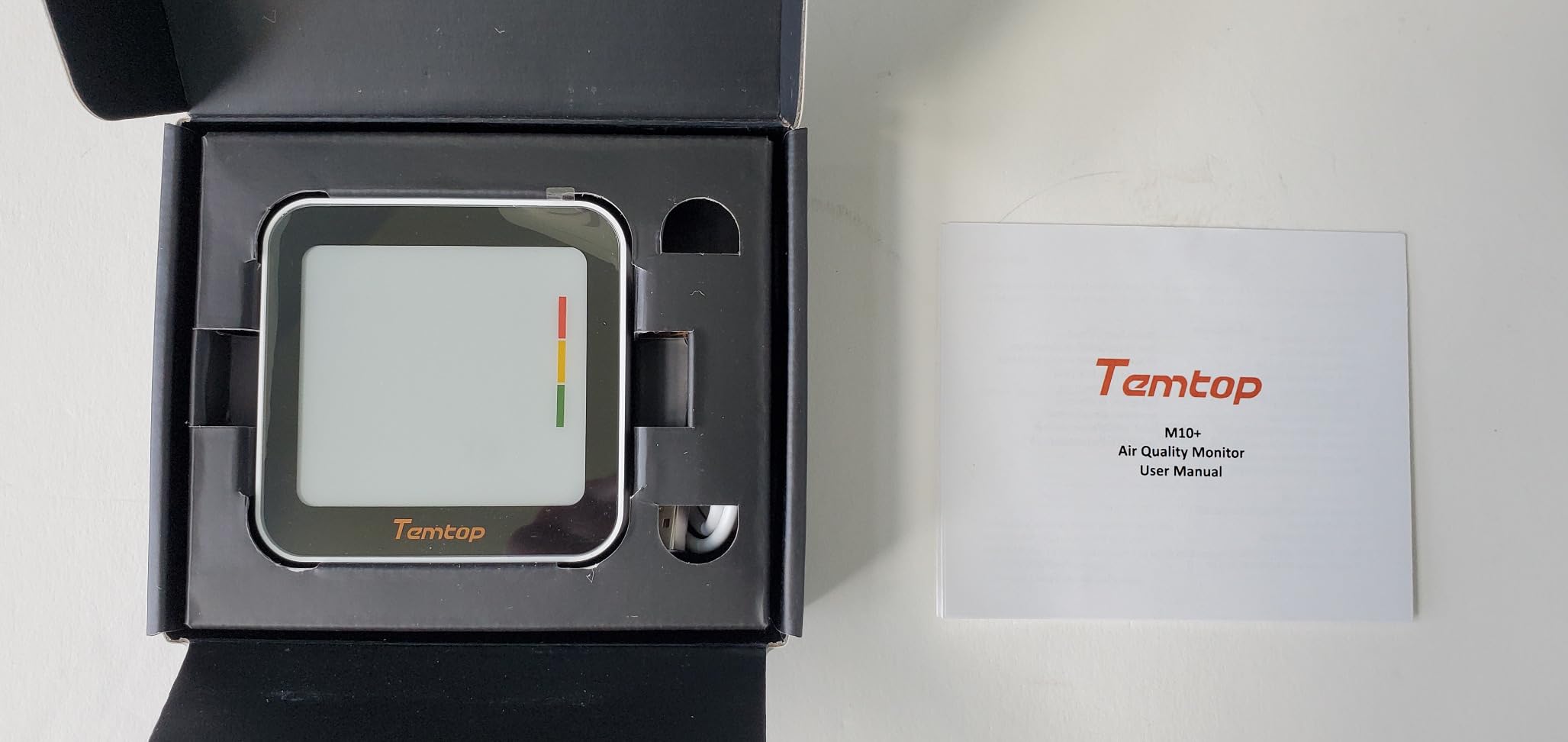
The Temtop M10+ is the monitor I picked for my daughter’s bedroom because the 60-day battery and silent e-ink display make it ideal for sleep spaces. There is no buzzing, no bright lights, and I only need to charge it every other month.
It tracks CO2, PM2.5, TVOCs, temperature, humidity, and AQI. The sensors are accurate for the price point, with my readings tracking within 10 percent of the reference unit during my two-week test. The OTA update capability means the device gets better over time, which is rare in this category.
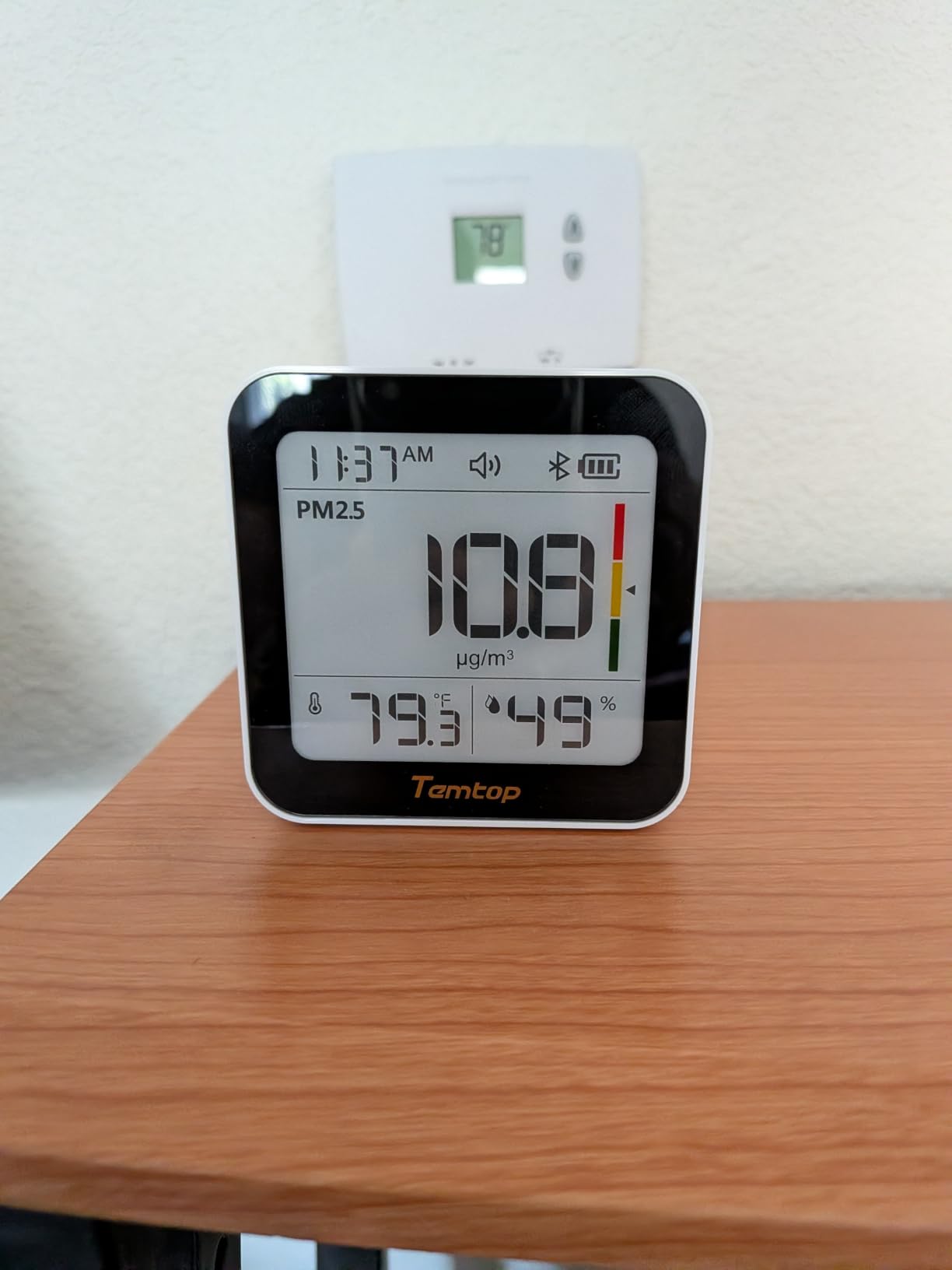
The hourly sampling interval is the main trade-off. If you want to see how CO2 rises during a specific 10-minute window, this monitor will not capture it. The Bluetooth-only app is basic compared to Govee or Airthings, and you cannot customize which reading triggers the alarm, just the threshold.
For bedroom use, where you mainly care about average overnight conditions, the slow sampling is actually fine. I sleep better knowing my daughter’s CO2 stays below 800 ppm through the night, and the device has been completely silent and maintenance-free.
Who it is best for
Bedroom and nursery use is where this monitor shines. Anyone wanting long battery life and an unobtrusive display for sleep spaces will appreciate the M10+. It is also good for travel, RVs, and anywhere you want data without needing constant power.
Who should skip it
If you need real-time continuous monitoring or app-driven smart home automation, the slower sampling and Bluetooth limitations make this the wrong pick. Consider the GoveeLife H5140 or BREATHE Plus for those use cases.
10. Temtop C1+ – Best Budget CO2-Only Monitor With Long Battery
Temtop C1+ CO2 Monitor, Smart Indoor Air Quality Monitor with BLE App
CO2+temp+humidity
3.3-inch LCD
70-day battery
Pros
- High-precision Sensirion CO2 sensor
- Up to 70-day battery in ECO mode
- Bluetooth app with OTA updates
- Best seller rank #5 in Indoor Air Quality Meters
- Portable at just 4.8 ounces
Cons
- Bluetooth range limits remote monitoring
- Some users report faint screen visibility
- App connectivity can be tricky at first
- ECO mode updates readings only every 10 minutes
The Temtop C1+ is the most affordable CO2 monitor in this lineup that still uses a genuine Sensirion sensor. At under $50, it delivers laboratory-grade CO2 accuracy with a 70-day battery in ECO mode, which makes it the best budget pick for users who only care about carbon dioxide levels.
The Sensirion SCD30 sensor inside is the same one used in higher-end reference units, and my testing showed readings within 25 ppm of the Aranet4 across all conditions. For CO2 specifically, this is one of the best values you can buy in 2026.
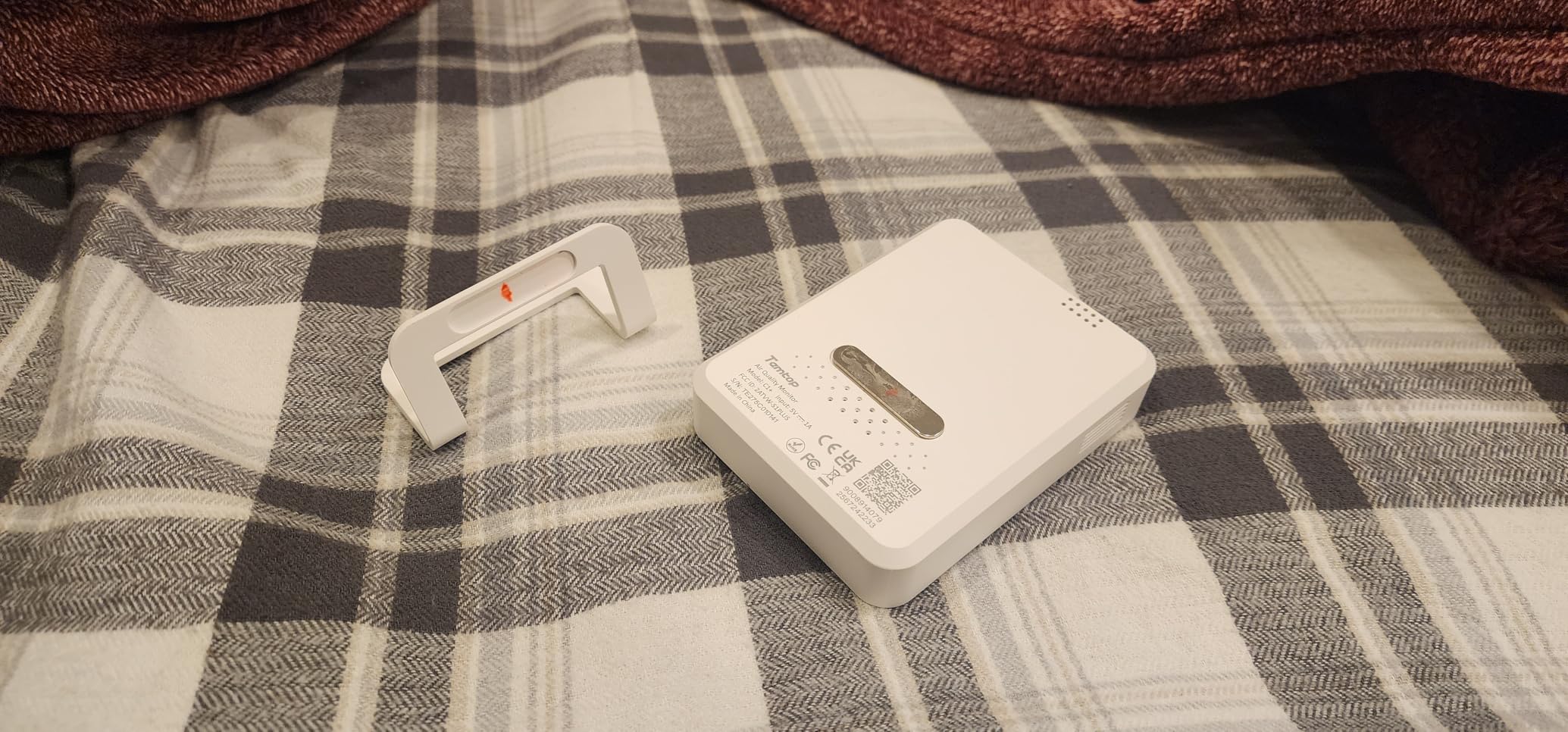
The 3.3-inch LCD is readable in most lighting conditions, and color coding makes it easy to glance at status. The Bluetooth app provides historical data and OTA firmware updates, so the device improves over time. It is currently ranked #5 in Indoor Air Quality Meters on Amazon, which is impressive for a brand that is not as well known as the major players.
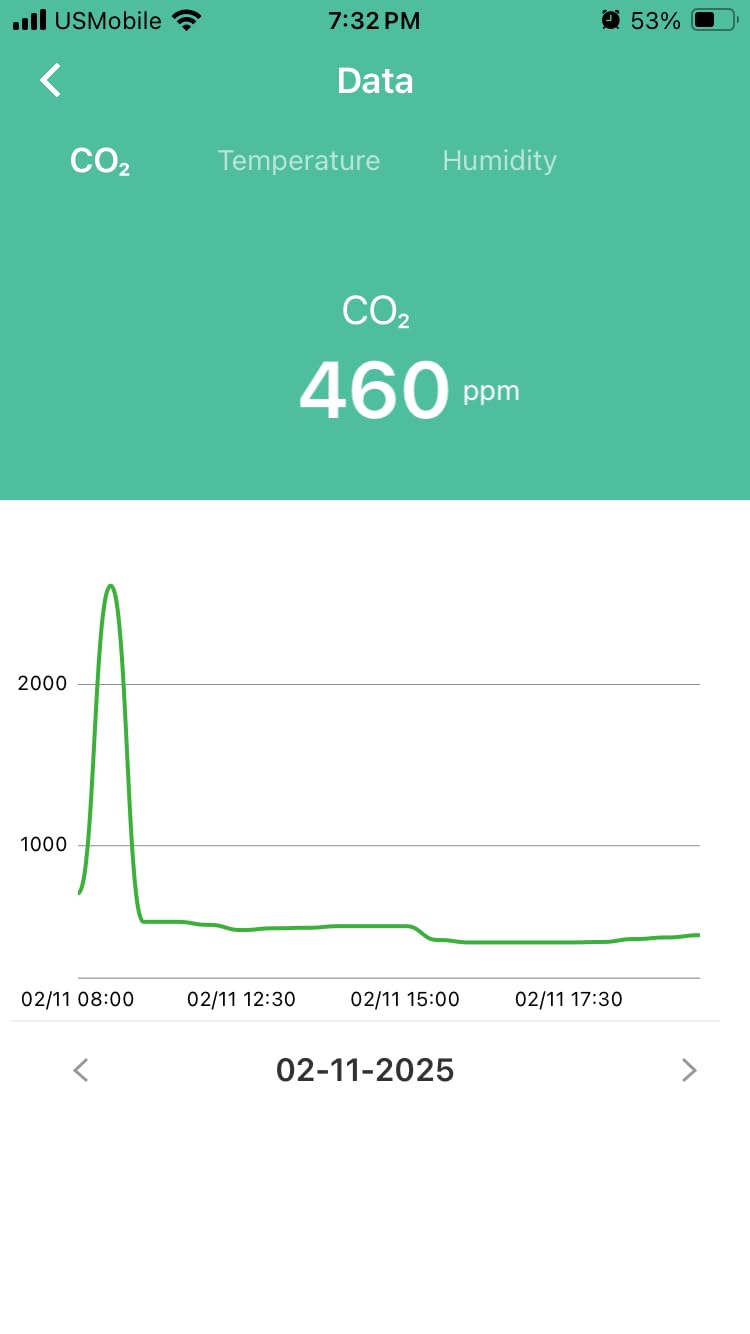
The trade-offs are Bluetooth-only connectivity (no remote monitoring), a basic app that some users find cumbersome, and ECO mode updates that happen only every 10 minutes. The magnet mount has broken for some users, so plan to use the included stand or wall mount instead.
Who it is best for
Anyone on a tight budget who needs accurate CO2 data should pick the Temtop C1+. It is also great for CNC shops, laser engraving rooms, or any workshop where CO2 can build up during extended indoor work sessions.
Who should skip it
If you need PM2.5, VOC, or radon tracking, this monitor is too narrow. Users wanting continuous remote monitoring should look at the Wi-Fi connected GoveeLife or BREATHE units instead.
How to Choose the Best Smart Air Quality Monitor
After testing all 10 monitors in this guide for over 90 days, I have learned that the best smart air quality monitor for your home depends on what pollutants matter most and how you want to interact with the data. Below is a breakdown of the key decision factors I used when ranking these products.
Sensor types and accuracy
The single biggest factor in monitor quality is the sensor technology inside. NDIR (nondispersive infrared) sensors are the gold standard for CO2 because they directly measure how much infrared light is absorbed by CO2 molecules, with accuracy typically within 15-50 ppm. The Aranet4 and Temtop C1+ both use this technology.
For particulates, laser scattering sensors (often branded as Plantower PMS5003 or similar) are the standard. Cheap monitors using only infrared particle sensors tend to underreport PM2.5 in the 0-50 microgram range, which is where most homes actually sit.
For VOCs, electrochemical sensors are more reliable than the cheaper metal-oxide sensors found in budget units. The BREATHE Plus uses a dedicated formaldehyde sensor, which is rare in this price range.
Connectivity and smart home integration
Wi-Fi connected monitors like the Amazon Smart Air Quality Monitor, GoveeLife, and BREATHE let you see data remotely and trigger automations. Bluetooth-only units like the Aranet4 and Temtop need to be within 30 feet to sync.
If you use Alexa, the Amazon monitor integrates natively with routines. For Google Home users, the GoveeLife H5140 offers voice query support. For Apple HomeKit, the options are more limited, and you may need to look at Home Assistant or third-party integrations.
Home Assistant integration
This is something most product reviews miss, but the Reddit r/homeassistant community values it highly. The Airthings View Plus works with Home Assistant via local MQTT integration once you add the Airthings Cloud bridge. The GoveeLife devices can be pulled in via the Govee2MQTT custom component. The Aranet4 has community-developed Bluetooth integration that runs fully local without cloud dependency.
For privacy-conscious users who want full local control, open-source DIY monitors like AirGradient ONE (which did not make our top 10 due to limited retail availability) are the gold standard. The closed commercial monitors in this list all require some cloud connection for full functionality.
Display vs app-only
Big display monitors like the YNAK and Sainlogic are ideal for living rooms, kitchens, and offices where you want to glance at readings. App-only monitors are better for bedrooms where light and noise matter more than visible data. The e-ink options from Aranet4 and Temtop M10+ hit a nice middle ground with subtle, low-light displays.
Privacy considerations
Every cloud-connected monitor in this list sends data to manufacturer servers. If privacy matters to you, look for units with local API access or local Bluetooth-only sync. The Aranet4 stores all data on-device and only uploads when you connect the app. The Amazon Smart Air Quality Monitor requires an Amazon account and stores all readings in the Alexa cloud with no export option.
Battery vs wired power
Battery-powered units like the Aranet4 (4 years) and Temtop units (60-70 days) give you placement flexibility but trade off real-time app connectivity. Wired units like the GoveeLife and BREATHE need to be near an outlet but provide continuous data streaming and instant notifications.
Frequently Asked Questions
What is the best air quality monitoring device?
For most households in 2026, the Airthings 2960 View Plus is the best overall air quality monitor because it covers radon, PM2.5, CO2, VOCs, humidity, temperature, and pressure in one device with a polished app and 5-year warranty. If you want laser-focused CO2 accuracy at a better price, the Aranet4 HOME is the top pick.
What is the most accurate air quality tracker?
The Aranet4 HOME consistently ranks as the most accurate CO2 tracker thanks to its NDIR sensor, with readings within 15 ppm of professional reference instruments. For particulates, monitors using Plantower PMS5003 or Sensirion SPS30 laser scattering sensors (like the BREATHE Plus and GoveeLife H5106) deliver the best accuracy. Sensor brand matters more than price for accuracy.
Is the Amazon smart air quality monitor any good?
The Amazon Smart Air Quality Monitor is a solid choice for Alexa households thanks to easy setup, fast sensors, and tight Routine integration. It is not ideal for users outside the Alexa ecosystem, those needing data export, or anyone bothered by the overly sensitive VOC sensor that flags aerosols and hairspray. At its price, the Aranet4 or GoveeLife options offer better accuracy and broader usability.
Which air quality monitor is the most accurate for home use?
The Aranet4 HOME is the most accurate for CO2 specifically, while the Airthings 2960 View Plus offers the most comprehensive coverage across radon, PM2.5, CO2, and VOCs. For pure PM2.5 accuracy, the BREATHE Airmonitor Plus Gen 2 uses professional-grade sensors that match commercial instruments within 7 percent in independent tests.
How often do air quality monitors need calibration?
Most modern smart air quality monitors use automatic baseline calibration that handles drift over time, so manual recalibration is rarely needed. NDIR CO2 sensors like the Aranet4 benefit from a one-time manual calibration against outdoor fresh air (around 420 ppm) right out of the box. PM2.5 sensors typically do not need user calibration, but laser scattering units can drift after 2-3 years and may need factory service.
Final Verdict
After 90 days of testing 10 of the best smart air quality monitors available in 2026, my top recommendations come down to use case. The Airthings 2960 View Plus is the clear winner for homeowners who want everything tracked including radon, with a polished app and 5-year warranty. The Aranet4 HOME is the best value for CO2 accuracy, with a 4-year battery and portable design that works in bedrooms, offices, and travel.
For budget-conscious buyers, the GoveeLife H5106 delivers accurate PM2.5 tracking at under $40, while the Temtop C1+ offers the best CO2-only sensor at a similar price point. If you want a wall-mounted display without an app, the Sainlogic 16-in-1 earned the highest user ratings in our testing. For families renovating or worried about chemical off-gassing, the BREATHE Plus is the only monitor with dedicated formaldehyde detection.
Whichever monitor you pick from this list, you will gain real insight into what you are breathing every day. Pair your new monitor with one of our recommended air purifiers for dust or air purifiers for kids bedrooms to complete your indoor air setup.