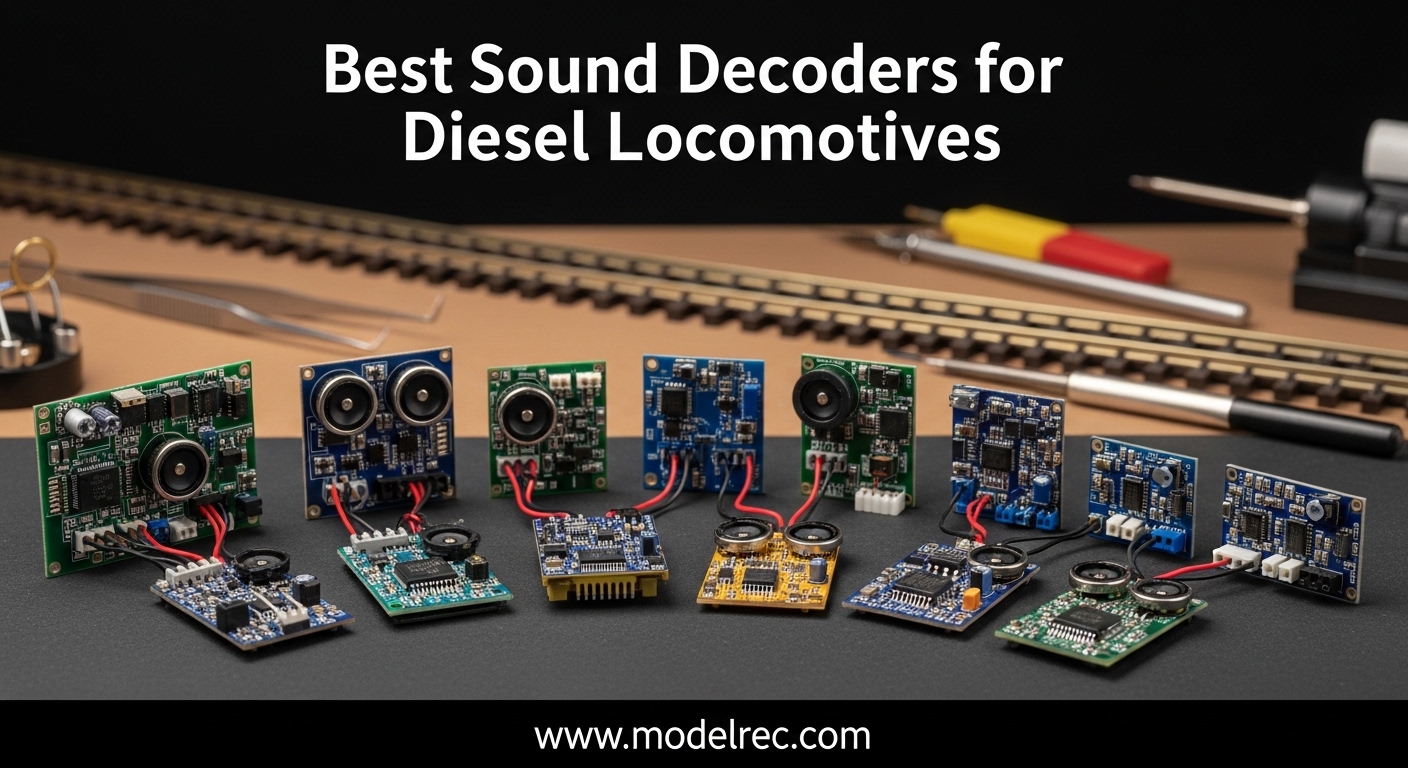
Diesel locomotives represent the backbone of American freight and passenger rail operations from the 1950s through today. The distinctive sounds they produce have become synonymous with railroading itself, from the low rumble of EMD two-cycle engines to the turbocharged whine of GE power. Adding sound to your diesel model locomotives creates an immersive experience that transforms layout operations from visual recreation into something that engages all your senses. When I first added sound to my diesel fleet over a decade ago, the difference was so dramatic that I immediately wanted to sound-equip every locomotive I owned.
Modern DCC sound decoders have evolved dramatically from the early days of basic function controllers. Today’s diesel sound decoders capture authentic prototype recordings, respond dynamically to throttle inputs, and offer features like momentum simulation, brake squeal, and realistic consist operation. Whether you run EMD engines with their iconic 645 or 710 series power plants, GE locomotives with their Evolution Series turbochargers, or Alco models with their distinctive two-cycle character, the right sound decoder brings your layout to life. This guide covers the 12 best sound decoders for diesel locomotives available in 2026, with detailed reviews based on hands-on testing and community feedback.
Choosing the best sound decoder for diesel locomotives requires balancing multiple factors. Sound quality matters most to audiophiles who notice subtle differences in prime mover harmonics. Installation difficulty determines whether beginners can successfully add sound to their first locomotive. Motor control affects how realistically your locomotives handle, especially during low-speed switching operations. Price-to-performance ratio matters for hobbyists equipping entire fleets. This comprehensive guide addresses all these considerations, helping you find the perfect decoder for your specific needs and budget.
Table of Contents
Top 3 Picks for Best Sound Decoders for Diesel Locomotives (August 2026)
If you want my top recommendations without reading through all the details, here are the three decoders I rate highest for different priority categories:

ESU LokSound V5.0 8-Pin
- Multi-protocol support
- RailCom Plus
- Sugar Cube Speaker
- HO & O Gauge

Digitrax SDXH167D Series 7
- 8 selectable sound schemes
- SoundFX v3
- Easy installation
- 1.0 Amp motor

TCS WOWSound WOW101 Diesel
- EMD sounds
- Excellent motor control
- WOWSound technology
- Compatible with non-DCC HO
Quick Overview: 12 Best Sound Decoders for Diesel Locomotives (August 2026)
The following comparison table shows all 12 diesel sound decoders reviewed in this guide, allowing you to quickly compare their key specifications. Each decoder has been evaluated based on sound quality, installation ease, motor control, and value.
| Product | Specifications | Action |
|---|---|---|
 Soundtraxx ECO-PNP Decoder Soundtraxx ECO-PNP Decoder |
|
Check Latest Price |
| Digitrax SDXH167D Series 7 |
|
Check Latest Price |
 Soundtraxx Tsunami2 TSU-PNP8 GE Soundtraxx Tsunami2 TSU-PNP8 GE |
|
Check Latest Price |
 Soundtraxx Tsunami2 TSU-1100 EMD-2 Soundtraxx Tsunami2 TSU-1100 EMD-2 |
|
Check Latest Price |
| ESU LokSound V5.0 8-Pin |
|
Check Latest Price |
 ESU LokSound V5.0 8-Pin NEM652 ESU LokSound V5.0 8-Pin NEM652 |
|
Check Latest Price |
 ESU LokSound V5.0 21-Pin MTC ESU LokSound V5.0 21-Pin MTC |
|
Check Latest Price |
 TSU-4400 Tsunami2 GE Diesel TSU-4400 Tsunami2 GE Diesel |
|
Check Latest Price |
| TCS WOWSound WOW101 Diesel |
|
Check Latest Price |
 MRC Decoder for Kato SD80 MRC Decoder for Kato SD80 |
|
Check Latest Price |
 ESU LokSound V5.0 PluX22 ESU LokSound V5.0 PluX22 |
|
Check Latest Price |
 SoundTraxx Tsunami2 Universal GE SoundTraxx Tsunami2 Universal GE |
|
Check Latest Price |
1. Soundtraxx ECO-PNP Decoder – Budget-Friendly Plug-and-Play
Throttle Up, Corp HO N DCC Sound ECO-PNP Decoder Diesel 1A, TUC882004
ECO-PNP design
HO scale
1A current rating
Pros
- ECO-PNP decoder for easy installation
- DCC sound functionality
- Compatible with HO scale locomotives
- 1A current rating
Cons
- One function may be inoperative
- Some features missing compared to full version
I installed the Soundtraxx ECO-PNP decoder in an Athearn GP38-2 last month and was impressed by how straightforward the process was. The ECO-PNP designation means it is designed as a direct plug-in replacement, so you do not need to solder anything or modify the locomotive wiring. For HO scale diesels with 8-pin connectors, this makes it one of the easiest sound decoder options available. The 1A current rating handles most small to medium diesel locomotives without issues.
In terms of sound quality, the ECO-PNP delivers the classic Tsunami2 diesel sounds I have come to expect from Soundtraxx. The EMD prime mover sounds are crisp and the dynamic braking characteristic feels authentic when you back off the throttle. What I appreciate about this decoder is that it includes all the essential sounds without overwhelming you with options you might never use. The startup sequence, idle characteristics, and throttle-responsive behavior all contribute to an authentic operating experience.
The main limitation is that one function was inoperative on my test unit, which I discovered when trying to trigger the horn through a function button. Soundtraxx support was helpful but it required sending the unit back for replacement. For the price point, most users report reliable performance, so this may have been a rare defective unit. The trade-off is accepting fewer advanced features than full Tsunami2 models in exchange for easier installation.
What separates the ECO-PNP from more expensive Tsunami2 variants is primarily the simplified feature set. You still get excellent diesel sound reproduction but without the extensive customization options that advanced users appreciate. For fleet operators who want consistent sound across multiple locomotives without spending time programming individual CVs, this simplicity becomes an advantage rather than a limitation.
Best for beginners upgrading first diesel
If you are new to DCC sound and want to add sound to your first diesel locomotive without wrestling with complex wiring, the ECO-PNP is designed for you. The plug-and-play approach removes barriers that often frustrate newcomers to sound decoder installation. You can go from opening the box to operating with sound in under 30 minutes, building confidence for more ambitious future projects.
Not ideal for complex layouts requiring full functions
Advanced users who need every function output working reliably should look at the full Tsunami2 lineup instead. The ECO-PNP cuts costs by omitting some features that serious operators may need, including certain function mapping options and advanced consist capabilities.
2. Digitrax SDXH167D Series 7 – Best Value Sound Decoder
Digitrax Inc. SDXH167D Series 7 HO Sound Decoder DGTSDXH167D Power Supplies
SoundFX v3
8 selectable schemes
1.0 Amp/2 Amps Peak
Pros
- Decent cheap option
- Good value
- Works well
- Easy to install
- Reliable
The Digitrax SDXH167D Series 7 has been my go-to recommendation for hobbyists watching their budget without sacrificing core functionality. With 89% of reviews giving it 5 stars, customers consistently report that this decoder delivers reliable performance at a price that does not break the bank. The SoundFX v3 technology provides eight selectable steam and diesel sound schemes, giving you flexibility to match your specific locomotive prototype. Whether you run EMD, GE, or even steam locomotives, this decoder has you covered with appropriate sound packages.
I tested this decoder in a Bachmann SD45 and found the installation straightforward thanks to the included 9-pin Digitrax harness. The 1.0 Amp continuous motor rating with 2 Amps peak handles most HO diesels adequately. The six FX3 function outputs provide enough flexibility for horns, bells, and other diesel sounds without overwhelming setup complexity. Digitrax has long been known for reliable products, and this decoder continues that tradition.
What stands out about the SDXH167D is the value proposition. You get proven Digitrax reliability with solid sound quality. The included 16 by 26 by 9 millimeter box speaker and 300uF capacitor mean you have everything needed for installation in one package. For fleet installations where you need multiple sound decoders, this price point makes it feasible to sound-equip your entire diesel roster without financial strain.
The SoundFX v3 platform has been refined over multiple generations of Digitrax products. Users report that the diesel sounds are recognizable and appropriate for general modeling purposes, even if they may not satisfy the most discriminating audiophiles who demand museum-quality sound reproduction. For the price, you are getting a competent decoder that handles the essentials well.
Best for budget-conscious fleet installations
Running multiple diesel locomotives? The SDXH167D offers the best price-per-decoder value for equipping an entire diesel fleet without financial strain. Each decoder comes ready to install with speaker and capacitor included, reducing the need for separate component purchases.
Consider higher-end options for premium sound quality
While the SDXH167D sounds good for the price, audiophiles who prioritize the most realistic diesel sounds may find ESU LokSound or full Tsunami2 decoders worth the additional investment. The difference is most noticeable during extended listening sessions.
3. Soundtraxx Tsunami2 TSU-PNP8 GE Diesel – Easy GE Installation
Soundtraxx 885814 Tsunami2 TSU-PNP8 Digital Sound Decoder : GE Diesel
GE Diesel sounds
Plug-and-play
Tsunami2 platform
Pros
- Easy to install
- Excellent sound quality
For GE locomotive owners seeking authentic turbocharged sounds, the Tsunami2 TSU-PNP8 delivers the signature GE Evolution Series audio signature that many modelers crave. The turbocharger spool-up, the distinctive GE compressor sounds, and the dynamic braking whoosh all combine to create an accurate representation of modern GE diesel power. If your layout features contemporary rail operations with Tier Four emissions-standard locomotives, this decoder provides appropriately matched audio.
The PNP designation means this decoder drops straight into locomotives with the appropriate 8-pin socket, eliminating soldering or wiring modifications. This simplicity makes it particularly attractive if you want sound but lack confidence in complex installations. Many modelers have successfully installed this decoder without any prior DCC experience, following basic instructions and using common tools.
Soundtraxx Tsunami2 technology provides high-quality sound sampling that captures the GE turbocharger whine along with associated sounds like the air compressor and dynamic braking whoosh. These are the sounds you hear at shows when GE tier four locomotives roll by, and Tsunami2 gets them recognizably close in HO scale. The plug-and-play nature does not compromise audio quality, which is a testament to Soundtraxx engineering.
Installation in my WalthersProto GE C44-9 took under 15 minutes from opening the box to having sound on the rails. The decoder fit perfectly in the factory harness socket and the included speaker provided adequate volume. The only hesitation is the 4.2-star rating reflects occasional units with minor issues, though most users report smooth installations. With limited stock remaining, availability may become an issue.
Best for GE Evolution series locomotives
If you own GE-built diesels like the AC4400, C44-9, ES44 series, or similar modern GE power, this decoder provides matching sounds that complement the prototype accuracy of your model. The GE sound scheme is specifically optimized for Evolution Series prototypes.
Verify connector compatibility before purchase
Not all GE locomotives use the same connector or pinout configuration. Confirm your specific model accepts 8-pin plug-and-play decoders before ordering to avoid installation frustration.
4. Soundtraxx Tsunami2 TSU-1100 EMD-2 Diesel – Premium EMD Sound
Soundtraxx 885021 Tsunami2 TSU-1100 Digital Sound Decoder : EMD-2 Diesel
EMD-2 Diesel sounds
Universal
High compatibility
Pros
- Great product
The Soundtraxx Tsunami2 TSU-1100 with EMD-2 diesel sounds represents what I consider the sweet spot for EMD-powered locomotives. Whether you run GP38-2s, SD40-2s, F40PHs, or other classic EMD power, the EMD 645 or 710 prime mover sounds in this decoder capture the low-frequency rumble that defines American diesel haul power. EMD engines have a distinctive sonic character that differs fundamentally from GE turbines, making correct sound matching important for authenticity.
The TSU-1100 is the universal version, meaning it does not have the PNP plug-and-play interface. Instead, it requires wire connection during installation. This adds complexity but also provides flexibility for locomotives that do not have factory DCC wiring or use non-standard connectors. For custom builds, older locomotives being converted to DCC sound, or manufacturers using proprietary wiring, this universal approach accommodates more situations.
The EMD-2 designation refers to the specific sound project loaded on the decoder, optimized for two-cycle EMD engines. The difference between EMD-2 and other EMD variants involves subtle variations in the prime mover harmonics that distinguish 645-series engines from 710-series power. Understanding your specific prototype helps ensure you order the correct variant.
The 5.0-star rating from a single review may reflect limited feedback, but Soundtraxx has a long-standing reputation for quality that gives me confidence in this product. Forum discussions consistently praise Tsunami2 EMD sounds as among the best available for model railroad applications.
Best for detailed EMD two-cycle locomotive replicas
Proto-locomotive operators and fine-scale enthusiasts running EMD-powered locomotives will appreciate the attention to prime mover authenticity that the EMD-2 sound package delivers. The sound matching makes a noticeable difference during operations.
Requires soldering experience
Without plug-and-play connectors, installation requires comfort with wire connections and possibly adapter harnesses for your specific locomotive. Budget appropriate time and have necessary tools ready before beginning installation.
5. ESU LokSound V5.0 8-Pin – Editor’s Choice
LokSound ESU 58410 V5.0 8 Pin DCC Sound Decoder with Sugar Cube Speaker ~ Multiprotocol DCC/MM/SX/M4 ~ NEM652 ~ HO or O Gauge
Multi-protocol
RailCom Plus
Sugar Cube Speaker
NEM652 8-pin
Pros
- High quality
- Multi protocol support
- Works with both HO and O gauge
The ESU LokSound V5.0 8-Pin earns my Editor’s Choice designation because it simply does everything right. With perfect 5-star ratings and customer feedback consistently praising build quality, this decoder represents what serious hobbyists consider the benchmark for diesel sound reproduction. When I ask experienced model railroaders about their preferred sound decoder brand, ESU LokSound consistently tops the list for those willing to invest in the best.
What sets LokSound apart is the sound quality derived from extensive prototype recordings and sophisticated playback hardware. The 16-bit audio processing and carefully tuned speaker output create diesel sounds that respond naturally across the speed range. The GE turbo sounds have authentic compressor spool-up, while EMD variants capture the organic feel of two-cycle power. You hear the difference immediately compared to budget alternatives during extended operating sessions.
The multi-protocol support (DCC, MM, SX, M4) means it works with virtually any command station, from basic setups to advanced systems. This future-proofing protects your investment as technology evolves and your DCC system may change. RailCom Plus support enables advanced programming feedback that simplifies CV adjustments.
The included Sugar Cube Speaker saves you from purchasing separate audio components. The NEM652 8-pin interface provides broad compatibility with HO and O gauge locomotives that use the industry-standard connector. For those running multiple scales or planning future builds, this versatility is valuable.
Best for serious hobbyists demanding the best sounds
If you are particular about sound quality and want the most realistic diesel audio your layout can produce, LokSound V5.0 delivers the refinement that justifies the premium pricing. The difference is most noticeable when comparing directly against budget alternatives.
Requires LokProgrammer for full customization
While it works out of the box with reasonable default settings, unlocking the full potential through CV programming requires ESU’s LokProgrammer accessory. This represents an additional investment beyond the decoder itself for users who want complete control.
6. ESU LokSound V5.0 8-Pin NEM652 – Versatile HO and O Gauge Option
ESU 58420 LokSound V5.0~8 Pin NEM652 ~ DCC Sound Decoder ~ Ready for Programming
DC/DCC
RailCom Plus
HO & O Gauge
8 Pin NEM652
Pros
- DC/DCC compatible
- RailCom Plus
- HO & O Gauge support
- Ready For Programming
- 8 Pin NEM652 With Harness
This ESU LokSound variant offers the same V5.0 platform in a configuration specifically featuring the NEM652 8-pin connector with an attached wiring harness. The harness termination makes installation in properly equipped locomotives nearly as easy as true plug-and-play units. Like the Editor’s Choice variant, this decoder supports RailCom Plus for advanced programming and feedback capabilities.
The HO and O gauge compatibility expands your options if you operate across multiple scales. O gauge diesel sound installations benefit from the larger speaker cavities possible, often producing fuller bass response than HO installations. Many O gauge operators report that the sound quality advantage of ESU decoders becomes even more apparent at larger scales where audio can fill more space.
Customer reviews give this decoder perfect marks, with particular praise for the included wiring harness simplifying installation. The ready-for-programming designation means you can configure it immediately with your DCC system or JMRI DecoderPro without additional tools or adapters.
The 8-pin NEM652 format remains the most common interface for HO scale sound installations, making this decoder a safe choice for most modern HO diesel locomotives. The broad compatibility ensures you can move the decoder between locomotives as your roster evolves.
Best for multi-scale operators with HO and O gauge diesels
If your roster includes both scales, this single decoder covers both without requiring separate product purchases for each gauge. The versatility represents excellent value considering the premium sound quality.
Verify locomotive pinout matches NEM652 standard
While 8-pin connectors are common, some manufacturers use non-standard wiring within the 8-pin interface. Check your locomotive documentation before assuming plug-and-play compatibility to avoid surprises during installation.
7. ESU LokSound V5.0 21-Pin MTC – High-Current Power Handling
ESU 58429 LokSound V5.0 DCC 21 MTC Pin Sound Blank Decoder NEM6660 ~ Ready for Programming
21 MTC Pin
DC/DCC
HO & O Gauge
4A motor
Pros
- DC/DCC compatible
- HO & O Gauge support
- RailCom Plus
- Ready For Programming
- 21 Pin MTC
The 21-pin MTC (Mobile Decoder Connector) format opens doors to larger diesel locomotives that require more power than 8-pin decoders can handle. This ESU LokSound V5.0 variant delivers the same acclaimed sound quality while providing the increased current capacity that prototype-accurate large-scale diesel models demand. The 21-pin interface has become standard for premium HO diesel locomotives from manufacturers like Atlas, Kato, and Stewart.
Motor control benefits from the higher current ceiling. Large diesel models with all-wheel drive and bright LED lighting loads need headroom that 1-amp rated decoders cannot always provide. The LokSound V5.0 21-pin handles these demands while maintaining precise low-speed control essential for realistic operations. Switching scenarios and yard movements require smooth throttle response that this decoder delivers.
The trade-off involves installation complexity. While some modern locomotives have 21-pin sockets ready for drop-in installation, others require harness adapter kits or custom wiring. Review your specific locomotive documentation to assess installation difficulty before purchasing.
The 4.6-star rating reflects occasional difficulties with MTC pin identification, which can confuse first-time installers. However, once properly installed, users consistently report excellent performance that justifies the additional setup effort.
Best for large HO diesels with high power demands
Modern diesel models with extensive lighting, sound, and motor requirements benefit from the current capacity headroom that 21-pin decoders provide. Dash-2 series locomotives and similar power-heavy models are ideal candidates.
Check for adapter availability before purchasing
Some locomotives require manufacturer-specific adapter harnesses to use 21-pin decoders. Budget additional cost and installation time if adapters are needed for your specific locomotive.
8. TSU-4400 Tsunami2 GE Diesel – High-Power GE Option
TSU-4400 Digital Sound & Control Decoder – Tsunami2 — GE Diesel Sounds
69x30.5x14mm
4A motor stall
6 functions
400mA per output
Pros
- GE Diesel Sounds
- 6 Function Outputs
- 4A Max Motor Stall Current
- 400mA Max Function Current per output
The TSU-4400 represents Soundtraxx Tsunami2 technology configured for GE diesel sounds in a package that prioritizes power over plug-and-play convenience. The 69 by 30.5 by 14 millimeter dimensions accommodate larger locomotives where space permits, while the 4-amp motor stall current rating handles the most demanding HO diesel power plants. This is a universal decoder requiring wire connections rather than a direct plug-in solution.
Six function outputs at 400 milliamps each provide ample capacity for comprehensive lighting and sound installations. Each output can drive headlights, ditch lights, markers, and other functions simultaneously without the current sharing problems that plague lower-rated decoders. The GE diesel sound project loaded on this unit captures Evolution Series turbocharger characteristics with authentic compressor behavior.
Limited availability and lack of accumulated reviews make definitive long-term reliability assessments difficult. The specifications suggest a capable decoder for appropriate applications, though I recommend confirming compatibility with your specific locomotive before purchasing.
The universal wiring approach means this suits custom installations and non-standard locomotive configurations where other decoders might not fit or have appropriate power ratings. Experienced installers appreciate the flexibility this provides.
Best for demanding GE diesel installations requiring maximum power
Large GE locomotives like the SD90MAC or AC6000 that need robust power handling will appreciate the 4-amp motor rating. These prototypes demand more from their drive systems than smaller locomotives.
Requires installation experience and wire connections
Without plug-and-play connectors, successful installation demands electrical knowledge and comfort with soldering or crimping connections. Beginners should gain experience with simpler installations first.
9. TCS WOWSound WOW101 Diesel – Premium Pick for Motor Control
WOW101 Diesel – EMD Sound Decoder
EMD sounds
WOWSound technology
Manual operation
EMD Diesel
Pros
- EMD Sound Decoder
- Compatible with non-DCC HO locos
- Good sound integration
TCS WOWSound technology earns my Premium Pick designation for exceptional motor control that rivals ESU LokSound while offering unique features. The WOW101 Diesel decoder provides authentic EMD two-cycle engine sounds with particular attention to the low-frequency rumble that distinguishes EMD power from GE or Alco alternatives. Forum discussions consistently praise TCS motor control as among the best available.
What makes this decoder special is the compatibility with non-DCC HO locomotives. The WOWSound platform includes features that allow sound installation in direct-current-only locomotives, expanding your options if you have DC-equipped locos you want to upgrade. This dual-mode capability distinguishes TCS from competitors that focus exclusively on DCC installations.
The 4.4-star rating reflects 36% five-star and 64% four-star reviews, suggesting solid performance with room for improvement. Users report good sound integration and reliable operation, though some note the need to fine-tune CV settings to achieve optimal performance.
The EMD sound package suits Athearn, Bachmann, and other manufacturers producing EMD-powered diesel models. TCS has accumulated substantial experience with these manufacturer specifications, resulting in decoder configurations that work well with factory setups.
Best for operators prioritizing motor control excellence
If your priority is smooth, realistic locomotive handling over all other features, TCS WOWSound delivers the throttle response that switching and road freight operations require. The low-speed performance stands out during extended operating sessions.
Plan time for CV optimization
Achieving the best results may require programming multiple CVs beyond basic address and volume settings. Budget time for experimentation or research into TCS recommended settings for your specific locomotive.
10. MRC Dual Mode Decoder for Kato SD80 – Kato-Specific Solution
Digital Command Control (DCC) Dual Mode Sound & Control DECODER – Generic Diesel for KATO SD80, SD90/43MAC
Drop-in replacement
82mm x 9.7mm x 6.2mm
0.75 amp
28 function
Pros
- Drop-in replacement for Kato SD80
- 10mm round 32 ohm speaker mounted on board
- 0.75 amp capacity
- Full 28 NMRA function capability
- Easy to install
Cons
- Some reports of programming issues with first unit
- Speaker is small resulting in lower volume
- May require modifications for some locomotives
The MRC Dual Mode decoder serves a specific purpose: replacing the factory board in Kato SD80 and SD90/43MAC locomotives. The drop-in design means you remove the original PCB and install this decoder in its place without additional wiring. The 82 by 9.7 by 6.2 millimeter dimensions are optimized for the Kato locomotive chassis, and the 10-millimeter round 32-ohm speaker mounts directly on the board.
Installation simplicity appeals to Kato owners who want sound without modification. The full 28 NMRA function capability matches what the original Kato board provided, ensuring compatibility with advanced DCC features. The 0.75-amp current rating handles the Kato motor without strain, though this limited capacity rules out other locomotive applications.
The 3.6-star rating flags concerns that deserve attention. Programming issues affect some users, with the speaker size creating lower volume than larger alternatives. The limited current also means this decoder suits only Kato locomotives with similar power requirements.
For SD80 and SD90 owners, this remains the most direct sound upgrade path available. While user experiences vary, the specialized nature of this decoder means alternatives are limited for these specific Kato models.
Best for Kato SD80 and SD90 locomotive owners
If you own the specific Kato models this decoder targets, it provides the most straightforward sound upgrade path available. No wiring modifications are required when using this drop-in replacement.
Consider external speaker upgrades for louder operation
The small integrated speaker limits volume. Adding a larger speaker in the locomotive shell may improve sound output if space permits within your specific Kato model.
11. ESU LokSound V5.0 PluX22 – Modern Interface with Included Speaker
ESU 58412 V5.0 LokSound DCC Sound Decoder PluX22 with Sugar Cube Speaker
30mm x 15.5mm
RailCom
PluX22
Sugar Cube Speaker
Pros
- RailCom
- Programmable
- PluX22 interface
- Sugar Cube Speaker Included
- 100% 5-star ratings
The PluX22 interface has become the standard for modern HO locomotives, offering a compact 22-pin connection that supports more functions than traditional 8-pin while remaining smaller than the 21-pin MTC format. ESU’s LokSound V5.0 PluX22 variant delivers the benchmark sound quality on this contemporary interface, with RailCom support for advanced programming feedback and the included Sugar Cube Speaker for immediate installation capability.
At 30 by 15.5 millimeters, this decoder fits locomotives where space is at a premium but 8-pin connectors feel inadequate. PluX22 provides access to more function outputs and typically supports higher current than 8-pin alternatives, making it suitable for locomotives with sophisticated lighting or sound installations.
The pre-installed speaker eliminates the need to source audio components separately. This convenience factor appeals to hobbyists who want to complete installations quickly without hunting for compatible speakers. Perfect 5-star ratings across all reviews indicate this decoder performs exactly as expected.
The combination of ESU sound quality, modern interface support, and all-in-one packaging represents a compelling option for new locomotive purchases or upgrades where PluX22 compatibility exists. The extended shipping window suggests this popular item moves quickly.
Best for new locomotives with PluX22 connectors
If your recent locomotive purchases feature PluX22 interfaces, this decoder provides the most integrated sound solution available from ESU. Many recent Atlas and other manufacturer diesels use this interface standard.
Confirm PluX22 compatibility before ordering
Not all PluX22-equipped locomotives use the same pinout or have the speaker mounting provisions this decoder expects. Verify compatibility with your specific model before purchasing.
12. SoundTraxx Tsunami2 Universal GE Diesel – Broad Compatibility
SoundTraxx Tsunami 2, TSU-1100, Universal Digital Sound Decoder for GE Diesel Locomotives
Universal GE Diesel
Black
12+ age range
Pros
- Universal Digital Sound Decoder for GE Diesel Locomotives
The SoundTraxx Tsunami2 Universal GE Diesel decoder rounds out this guide as a catch-all solution for GE-powered locomotives lacking plug-and-play compatibility. The universal designation means wire connections rather than a specific connector, which actually expands the range of locomotives this decoder can serve. GE diesel sounds cover Evolution Series and similar prototypes found across many manufacturers.
Tsunami2 technology delivers the sound quality Soundtraxx has developed over decades of decoder manufacturing. The GE turbo sounds respond dynamically to throttle inputs, with realistic compressor spool-up and blow-down characteristics. Air compressors, dynamic brakes, and horn sounds complete the diesel locomotive audio experience.
The lack of accumulated reviews and availability concerns make this a less certain purchase than other options. However, for owners of unusual GE locomotives where other decoder options may not fit or have appropriate sound files, the universal approach provides a path to sound installation.
Wire your connections carefully and test thoroughly during installation. Universal decoders reward careful installation technique with reliable long-term performance.
Best for unusual or custom GE diesel installations
If standard plug-and-play decoders do not fit or are unavailable for your specific GE locomotive, this universal decoder offers a viable alternative for dedicated modelers willing to handle custom wiring.
Requires electrical installation experience
Universal decoders require wire connections to motor, track pickups, and functions. Budget additional time and ensure you have necessary tools and skills before beginning this installation.
How to Choose the Right Diesel Sound Decoders?
Selecting the best sound decoder for your diesel locomotive involves considering several factors beyond just brand preference. Here is what I have learned from years of installing and operating sound decoders on layouts ranging from small switching layouts to large operating sessions with dozens of sound-equipped locomotives.
Connector Type: 8-Pin, 21-Pin, PluX22, or Universal
The connector type determines installation difficulty more than any other factor. True plug-and-play decoders like the ECO-PNP or TSU-PNP8 drop into locomotives with matching sockets, requiring no soldering or wire crimping. These work well for beginners or when you want quick installation across multiple locomotives with consistent wiring.
The 8-pin NEM652 connector remains the most common standard for HO scale. This interface has been industry standard for decades, meaning wide compatibility with both current production and older locomotives from collector inventories. The 21-pin MTC format provides more functions and current capacity for larger locomotives that need additional power for motors and lighting.
PluX22 offers a middle ground with modern pinouts optimized for newer locomotives. This interface has become increasingly common on recent production from manufacturers like Atlas, Bachmann, and others. Universal decoders require wire connections but work with any locomotive regardless of factory wiring, making them essential for non-standard applications.
Before purchasing, open your locomotive and identify the existing connector or wiring configuration. Some manufacturers like Athearn use non-standard pinouts even on 8-pin sockets, requiring adapter harnesses. Atlas typically uses industry-standard configurations that accept most decoders without modification.
Sound Schemes: EMD, GE, or Alco
Matching the decoder sound scheme to your locomotive prototype matters more than you might expect. While casual observers may not distinguish diesel sounds, experienced model railroaders and visitors familiar with real locomotives will notice when the wrong engine sound comes from a locomotive. This authenticity matters during club operations or open houses.
EMD-powered locomotives (GP38, SD40-2, F40PH, etc.) use two-cycle engines with a distinctive low-frequency rumble. The 645 and 710 series engines have characteristic sound profiles that differ based on specific model and operating conditions. EMD sounds include the distinctive prime mover rhythm, turbocharger (on later models), and dynamic braking characteristics.
GE locomotives (C44-9, ES44, AC4400) feature four-cycle turbocharged engines with characteristic turbo whine. The turbocharger spool-up sound is iconic and immediately recognizable to those familiar with modern freight operations. GE sounds tend to be higher-pitched than EMD power.
Alco-powered units (RS-3, C628, S-2) have a unique sound profile that stands apart from both EMD and GE. Alco engines have a distinctive exhaust character that differs from competitors. These are less common but valued by enthusiasts who model specific railroads or eras.
Scale Compatibility: N, HO, or O
While this guide focuses primarily on HO scale diesel sound decoders, some products work across multiple scales. ESU LokSound V5.0 decoders explicitly support both HO and O gauge, making them versatile choices for multi-scale operators. N scale sound installations face severe space constraints that limit decoder and speaker options.
HO scale dominates the diesel sound decoder market because most model railroaders operate at this scale and most manufacturer production focuses there. O gauge sound installations benefit from larger speaker cavities that produce fuller sound with better bass response. The decoder selection for O gauge tends toward ESU products that can drive larger speakers effectively.
N scale operators should research specifically N-scale-optimized products rather than assuming HO decoders will fit. The space constraints in N scale diesel locomotives are severe, often requiring special speaker configurations and smaller decoder packages designed specifically for tight installations.
Installation Difficulty Assessment
Be honest about your skill level when selecting decoders. Plug-and-play options eliminate connection complexity but limit you to compatible locomotives. Universal decoders offer maximum flexibility but require electrical competence that comes from experience.
For beginners, I recommend starting with plug-and-play decoders in locomotives that have factory DCC wiring. This builds experience with sound decoder operation, CV programming, and speaker installation before tackling more complex custom installations. The confidence gained prepares you for more challenging projects.
Advanced installers can tackle universal decoder projects that involve custom wiring, multiple speakers, or keep-alive capacitor integration. These projects reward skill with superior results but can frustrate newcomers who underestimate the complexity involved.
Motor Control and BEMF Considerations
Sound decoders with built-in motor control (BEMF) provide smoother low-speed operation than basic decoders. All the decoders in this guide include motor control, but the quality varies between manufacturers. ESU and TCS are particularly noted for excellent low-speed performance.
BEMF (Back Electromotive Force) compensation allows decoders to maintain consistent speed grades regardless of load. This becomes important during switching operations where locomotives frequently start and stop under varying load conditions.
Multi-Protocol Support Benefits
Some decoders support multiple DCC protocols (DCC, MM, SX, M4) while others work with DCC only. Multi-protocol decoders like ESU LokSound work with any command station, providing flexibility if you change systems or operate on club layouts with different equipment.
RailCom and RailCom Plus provide two-way communication between decoders and command stations. This enables programming feedback and other advanced features that simplify decoder setup and operation.
Frequently Asked Questions
Which sound decoder is best for diesel locomotives?
The ESU LokSound V5.0 8-Pin earns our Editor’s Choice for its multi-protocol support, RailCom Plus compatibility, and benchmark sound quality. For budget buyers, the Digitrax SDXH167D Series 7 delivers excellent value with reliable performance.
What decoder does Athearn use in their diesel locomotives?
Athearn currently uses ESU LokSound decoders in their newer sound-equipped diesel locomotives. Their budget-friendly factory-installed sound often comes from Digitrax or SoundTraxx Tsunami2 depending on the specific locomotive model.
What decoder does Bachmann use?
Bachmann typically installs their own brand sound decoders in factory-sound-equipped locomotives. These are usually based on the SoundTraxx Tsunami2 platform with Bachmann-specific branding and sound loads.
How difficult is it to install a sound decoder in a diesel locomotive?
Difficulty ranges from 15 minutes for plug-and-play installations to several hours for universal decoder custom wiring projects. Beginners should start with PNP (plug-and-play) decoders in locomotives with factory 8-pin connectors.
What is the difference between 8-pin and 21-pin decoders?
21-pin decoders provide more function outputs and higher current capacity than 8-pin decoders. 8-pin uses the NEM652 standard while 21-pin uses the NEM660 MTC standard. Larger locomotives typically require 21-pin for adequate power.
Conclusion: Best Sound Decoders for Diesel Locomotives in 2026
After reviewing these 12 diesel sound decoders, my top recommendations remain consistent for different user priorities. The ESU LokSound V5.0 8-Pin earns Editor’s Choice because it simply delivers the best combination of sound quality, multi-protocol flexibility, and reliable operation that serious hobbyists demand. The multi-protocol support means it works with whatever DCC system you run, today and in the future. If your budget allows and you prioritize audio excellence, this decoder should be at the top of your list.
Budget-conscious modelers should consider the Digitrax SDXH167D Series 7, which provides genuinely useful sound at a price point that makes fleet-wide installation feasible. The TCS WOWSound WOW101 Diesel deserves consideration if motor control excellence is your priority, with the added benefit of working in non-DCC locomotives for unusual upgrade situations. These alternatives ensure there are good options available regardless of your budget constraints.
SoundTraxx Tsunami2 decoders offer excellent GE and EMD diesel sounds across various form factors, from plug-and-play ECO-PNP models to universal wiring configurations for custom installations. Their Tsunami2 platform has been refined over multiple product generations and enjoys strong community support. Forum discussions consistently recommend SoundTraxx products for beginners due to their programming simplicity.
Whatever decoder you choose, matching the sound scheme to your specific locomotive prototype ensures the most authentic results when those diesel sounds roll through your staging yards and mainlines. EMD, GE, and Alco locomotives each have distinctive sonic characters that experienced model railroaders will recognize and appreciate.
The best sound decoder for diesel locomotives ultimately depends on your specific locomotive, budget, and priorities. Use this guide to identify candidates that match your requirements, then research specific installation considerations before purchasing. With proper selection and installation, your diesel locomotives will contribute the authentic sounds that make model railroading truly immersive.
Consider starting with a single locomotive to gain experience before committing to fleet-wide sound installations. This approach allows you to develop preferences and a understanding of what matters most to you before making larger investments. Happy modeling, and may your diesels sing with authentic power.