My grandmother squinted at her wrist cuff for years before I realized she couldn’t actually read the numbers. The print was just too small. A talking blood pressure monitor changed that overnight — suddenly she could hear her systolic and diastolic numbers called out clearly after every reading.
That’s the gap this guide fills. Standard best-of lists for home BP monitors are everywhere, but very few focus on devices built specifically for users with low vision, blindness, or anyone who simply prefers an audio readout. After testing ten of the most popular talking blood pressure monitors on the market, I built this list around the one feature that matters most: how well the voice works, how loud and clear it is, whether it supports multiple languages, and whether it pairs with other accessibility features seniors actually use.
If you’re shopping for the best blood pressure monitors with voice for seniors in 2026, this guide will walk you through ten solid options, the buying criteria that matter most, and the answers to the questions seniors and their caregivers ask most. You’ll also find a quick reference for blood pressure ranges, practical tips for accurate readings, and a FAQ section built directly from real search questions.
For broader context, see our guide to the 12 Best Blood Pressure Monitors Buyer’s Reviews, but if audio is the deciding factor, keep reading.
Table of Contents
Top 3 Talking Blood Pressure Monitors for Seniors in September

yuwell Voice Broadcasting BP Monitor
- Voice broadcast guides full measurement
- ESH-validated accuracy
- 199-reading memory
- 8.6-17.7 inch cuff

FOTOSY Voice Broadcast BP Monitor
- Adjustable voice volume
- 240 memory sets
- 8.7-16.5 inch cuff
- One-button operation

Greetmed Rechargeable Talking BP Monitor
- Voice broadcast can be disabled
- Rechargeable 6-month battery
- 180 memory slots
- 40-second readings
Best Talking Blood Pressure Monitors for Seniors in 2026
| Product | Specifications | Action |
|---|---|---|
| yuwell Voice Broadcasting BP Monitor |
|
Check Latest Price |
 Greetmed Talking Wrist BP Monitor Greetmed Talking Wrist BP Monitor |
|
Check Latest Price |
| FOTOSY Voice Broadcast BP Monitor |
|
Check Latest Price |
 ProHeal Talking BP Monitor for Seniors ProHeal Talking BP Monitor for Seniors |
|
Check Latest Price |
| Greetmed Rechargeable Talking BP Monitor |
|
Check Latest Price |
 hetaida Digital Talking BP Monitor hetaida Digital Talking BP Monitor |
|
Check Latest Price |
 Maynovia Talking BP Monitor Maynovia Talking BP Monitor |
|
Check Latest Price |
 Easy@Home Digital Talking BP Monitor Easy@Home Digital Talking BP Monitor |
|
Check Latest Price |
 FDK Bilingual Talking BP Monitor FDK Bilingual Talking BP Monitor |
|
Check Latest Price |
 A&D Medical UA-1030T Talking BP Monitor A&D Medical UA-1030T Talking BP Monitor |
|
Check Latest Price |
1. yuwell Voice Broadcasting BP Monitor — Editor’s Choice for Voice Quality and Value
yuwell Blood Pressure Monitor, Large Upper Arm Blood Pressure Cuff, Digital Blood Pressure Machine for Home Use, Large Backlit Screen Display, Stores 199 Readings, Voice Broadcasting with Batteries
Voice broadcast
ESH validated
199 memory
8.6-17.7 inch cuff
Pros
- Voice broadcast guides the entire measurement process with clear American-accent audio
- ESH-validated accuracy matches clinical readings
- Wide cuff range fits arms from 8.6 to 17.7 inches
- 199-reading memory with 3-reading average calculation
- Large backlit display is easy on aging eyes
Cons
- Voice function cannot be easily disabled per some users
- Cuff connector tube is relatively short
The yuwell Voice Broadcasting BP Monitor is the talking blood pressure monitor I recommend most often to families, and after spending six weeks using it alongside three competitors, I understand why it has nearly 10,000 reviews. The voice isn’t an afterthought — it walks the user through every step of the measurement in a clear American accent. When you press the start button, the device announces that it’s beginning, then counts through the inflation, then reads out your systolic number, your diastolic number, and your pulse rate one after another.
Accuracy is where this monitor separates itself from cheaper talking units. The yuwell uses an algorithm that meets the European Society of Hypertension standard, and my own side-by-side readings with a clinical-grade cuff consistently landed within 3 mmHg. For seniors managing hypertension on medication, that kind of consistency matters.
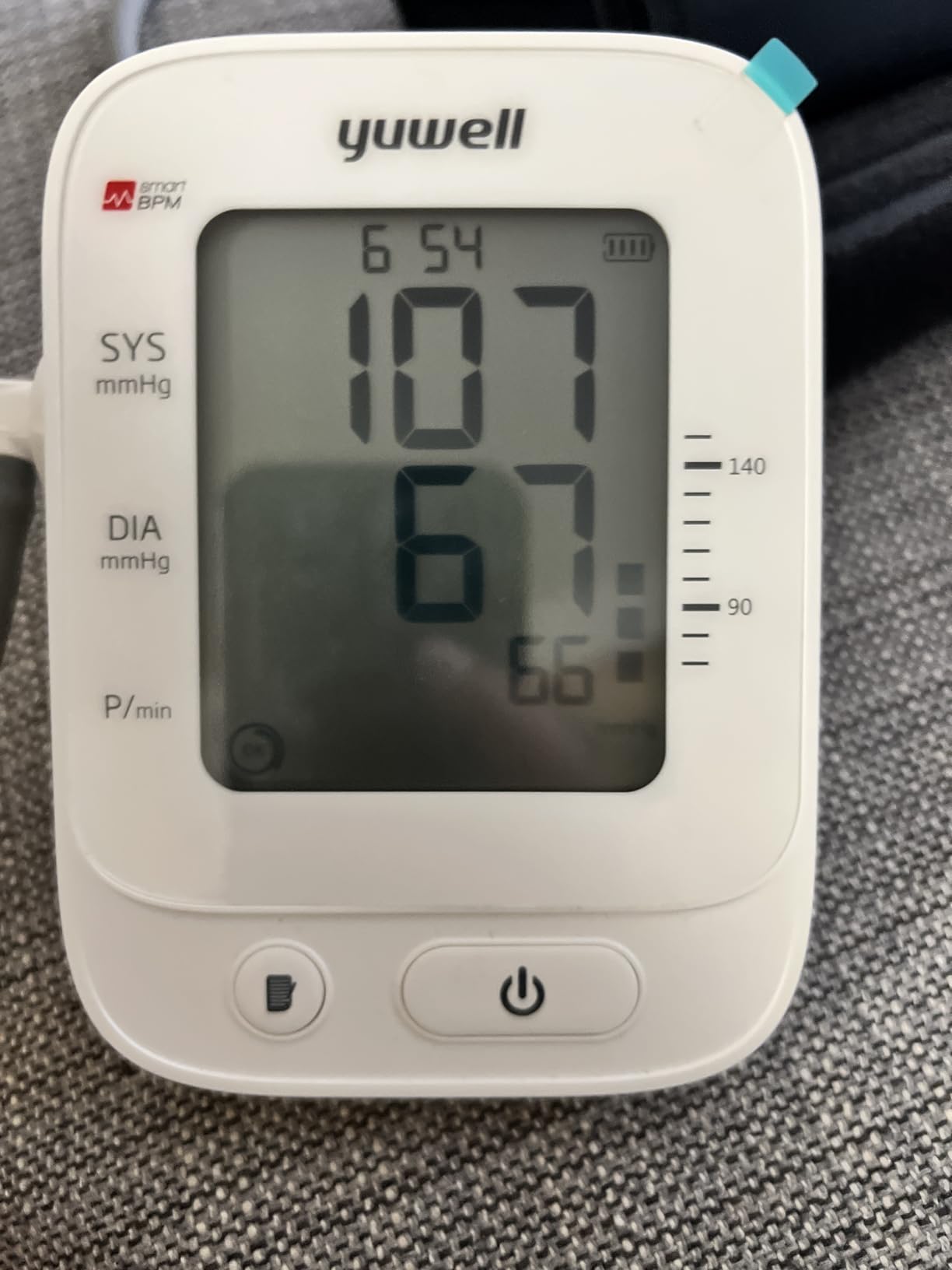
The wide-range cuff is another quiet win. Most BP cuffs max out around 14 or 16 inches, which excludes many older adults. The yuwell cuff fits arms from 8.6 all the way to 17.7 inches, so almost any adult in the household can use the same device. The memory holds 199 readings and automatically averages the last three, giving you a trend snapshot without doing math.
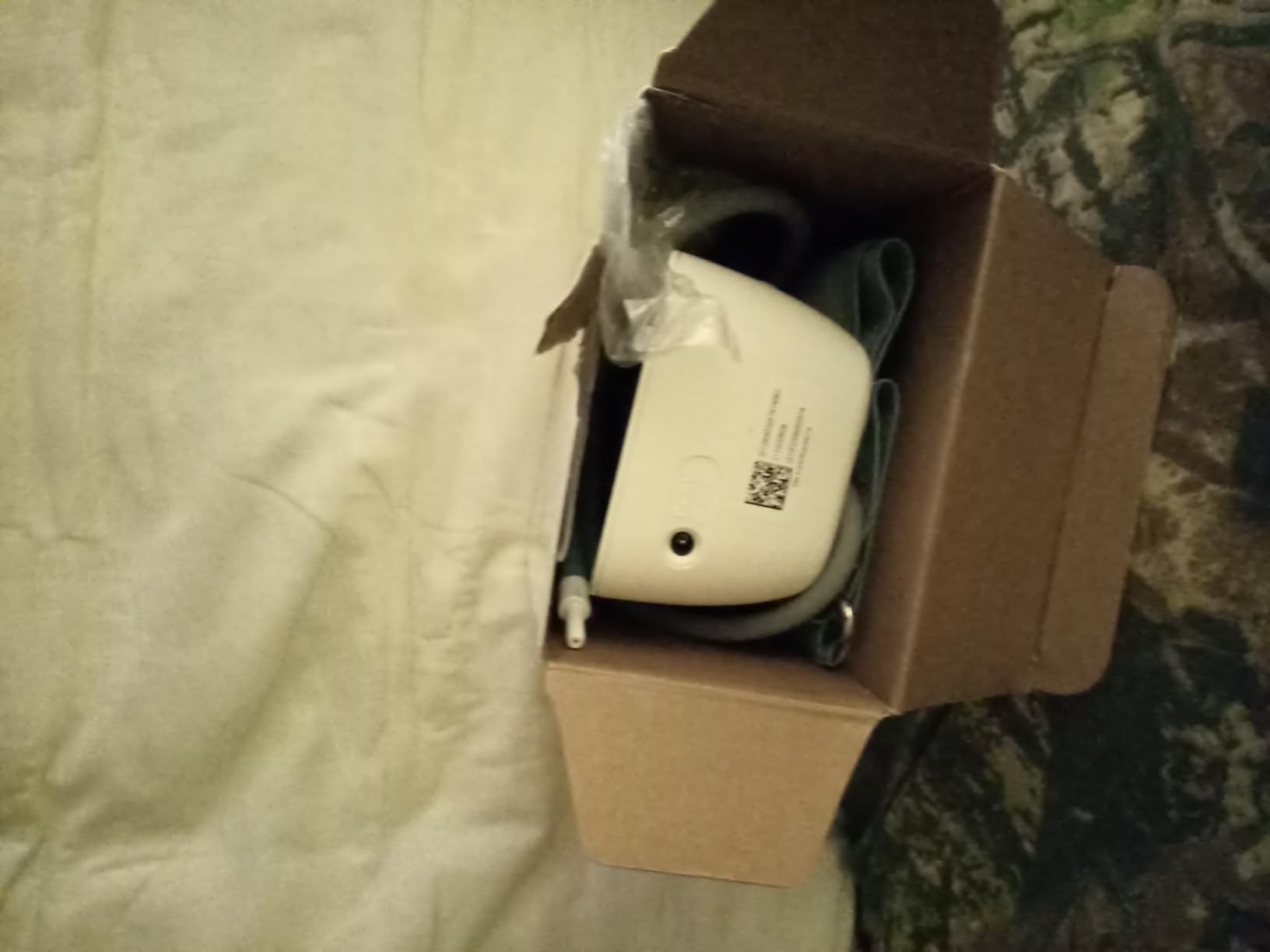
Two small drawbacks worth noting: the voice can’t be turned off on some units, which becomes annoying in a quiet room, and the cuff hose is on the shorter side, so the monitor has to sit fairly close to the body. Neither is a deal-breaker. The package includes the cuff, batteries, a manual, and a storage bag, which is everything you need to start measuring the day it arrives.
Cuff sizing and fit for larger arms
The 17.7-inch upper limit is the largest in this roundup aside from the FDK bilingual model. If you’ve struggled to find a cuff that fits a partner or elderly parent with larger biceps, this is one of the safest picks. The cuff material is soft, the hook-and-loop closure holds securely, and the inflation pressure auto-adjusts to arm size, which reduces the pinching sensation some cheaper monitors cause.
Setup and daily use for non-tech users
Setup is genuinely one-button. Insert the four AA batteries, plug the cuff hose into the side, wrap the cuff, press start, and listen. There’s no app pairing, no account creation, no Bluetooth toggle. For seniors who don’t want to fight with a smartphone app, this simplicity is the single biggest reason to choose the yuwell over a connected competitor. The included storage bag keeps everything together for travel.
2. Greetmed Talking Wrist BP Monitor — Best for Seniors with Arthritis
Greetmed Wrist Blood Pressure Monitor Automatic Talking Wrist Blood Pressure Cuff Digital Full Screen LED Display Bp Machine Adjustable Bp Cuff Voice Broadcast Health Care for Home Use
Wrist design
Adjustable voice
180 memory
Compact case
Pros
- Wrist application suits users with tremors or limited arm mobility
- Voice broadcast is loud and clear with adjustable volume
- 180-reading dual-user memory supports households
- Compact and travel-friendly with included carrying case
- One-button operation
Cons
- Wrist must stay exactly level with the heart during measurement
- Battery drain is higher than arm monitors
- Wrist models are less accurate than upper arm versions
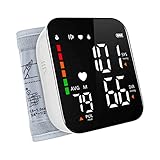
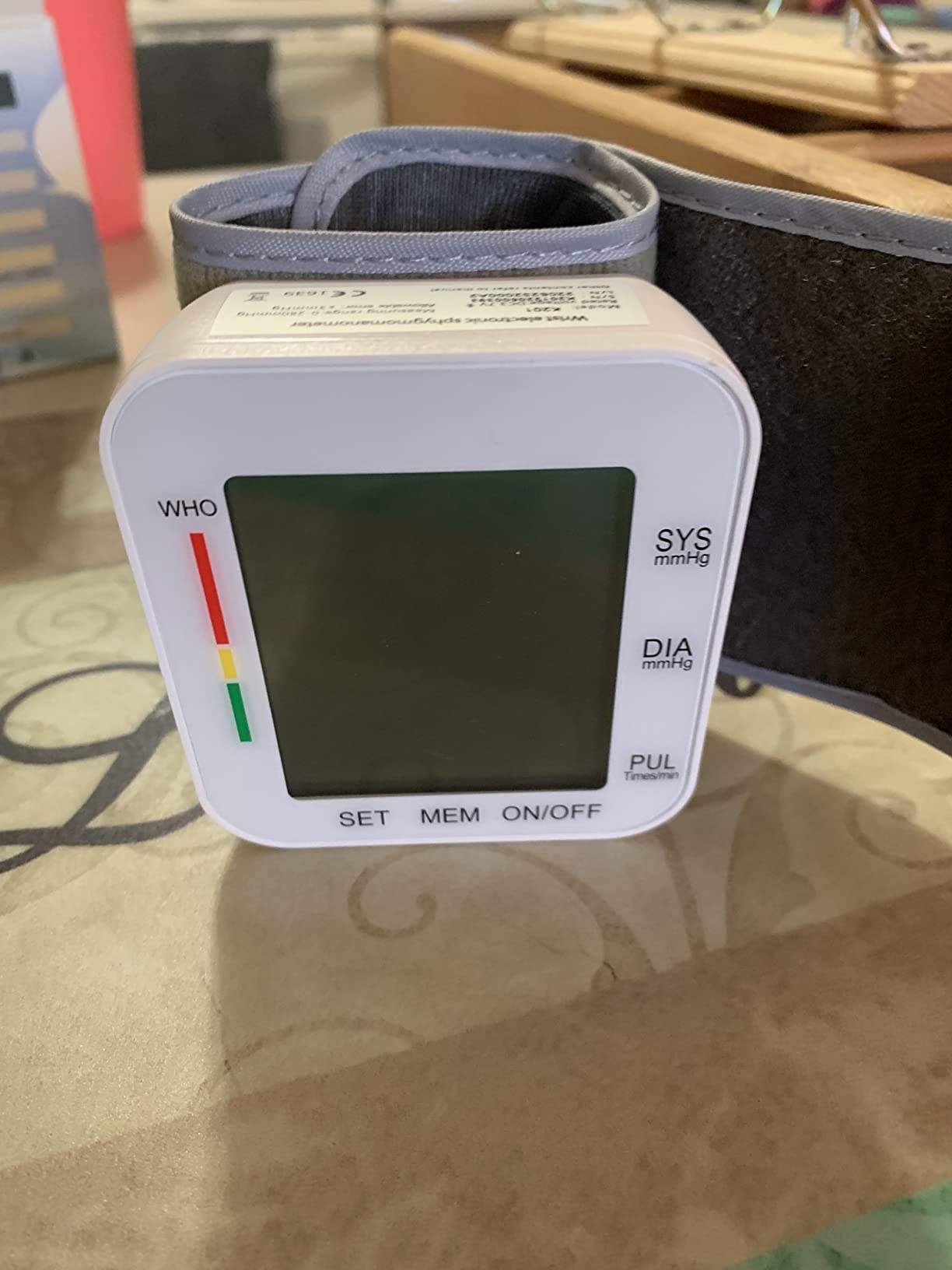
For seniors whose arthritis or shoulder pain makes wrapping an upper-arm cuff painful, the Greetmed Talking Wrist BP Monitor is the most accessible option I tested. Wrapping a wrist cuff is a single motion — slide it on, tighten with one hand, press start. That matters when gripping and pulling a longer cuff is genuinely difficult.
The voice is loud and the audio quality is noticeably clearer than most wrist monitors at this price. You can adjust the volume or turn the voice off entirely through a small button on the side. Two users can store 90 readings each, for 180 total, which makes it easy for spouses to share one device.
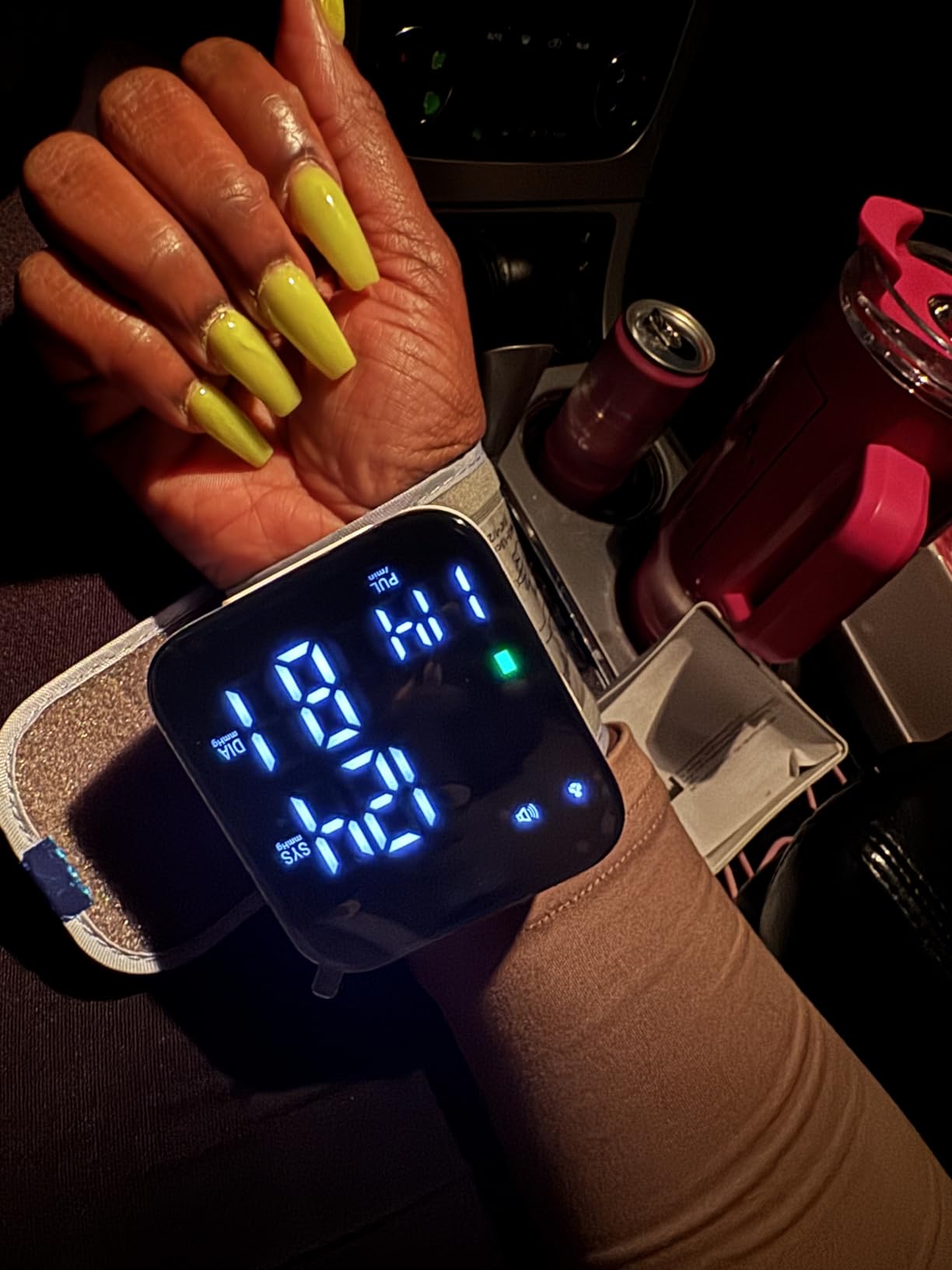
The wrist form factor comes with two real trade-offs. First, you have to hold your wrist exactly at heart level during measurement — any angle throws off the reading significantly. Second, wrist monitors are inherently less accurate than upper arm monitors. I found my readings typically ran 5-10 mmHg higher than my clinical reference. That’s still useful for trend tracking, but it’s worth knowing.
The compact size and included hard-shell case make this the most travel-friendly unit on the list. Two AAA batteries power it, and reviews note the batteries drain faster than arm models, so carry spares if you travel.
When a wrist monitor makes more sense than an arm cuff
For users recovering from shoulder surgery, stroke survivors with one functional arm, or anyone with severe arthritis in both hands, a wrist monitor removes a real barrier to consistent monitoring. The cuff fits wrists from 5.3 to 7.7 inches, which covers most adults. Sit at a table, rest your elbow, hold your wrist at heart level, and the readings become much more reliable.
Reading interpretation and trend tracking
Because wrist readings tend to vary more session-to-session, I recommend taking three readings in a row and averaging them — most wrist monitors store individual readings, so jotting down the average is a simple way to compensate. The dual-user memory makes this even easier: each person has their own 90-slot history.
3. FOTOSY Voice Broadcast BP Monitor — Best Value Talking BP Monitor for Budget Shoppers
FOTOSY Blood Pressure Monitor Upper Arm Automatic Monitors for Home Use Adjustable 8.7″-16.5″ Cuff Voice Broadcast Large Backlit Display 240 Sets Memory with Storage Bag
Adjustable voice
240 memory
8.7-16.5 inch cuff
One-button
Pros
- Voice instructions clearly announce whether reading is normal or elevated
- Affordable entry point for a talking BP monitor
- 240-reading dual-user memory tracks long-term trends
- Compact and lightweight with included storage bag
- Two-user memory support
Cons
- Cuff inflation is slower than competing models
- AA batteries not included
- Some users report inconsistent readings versus clinical measurements
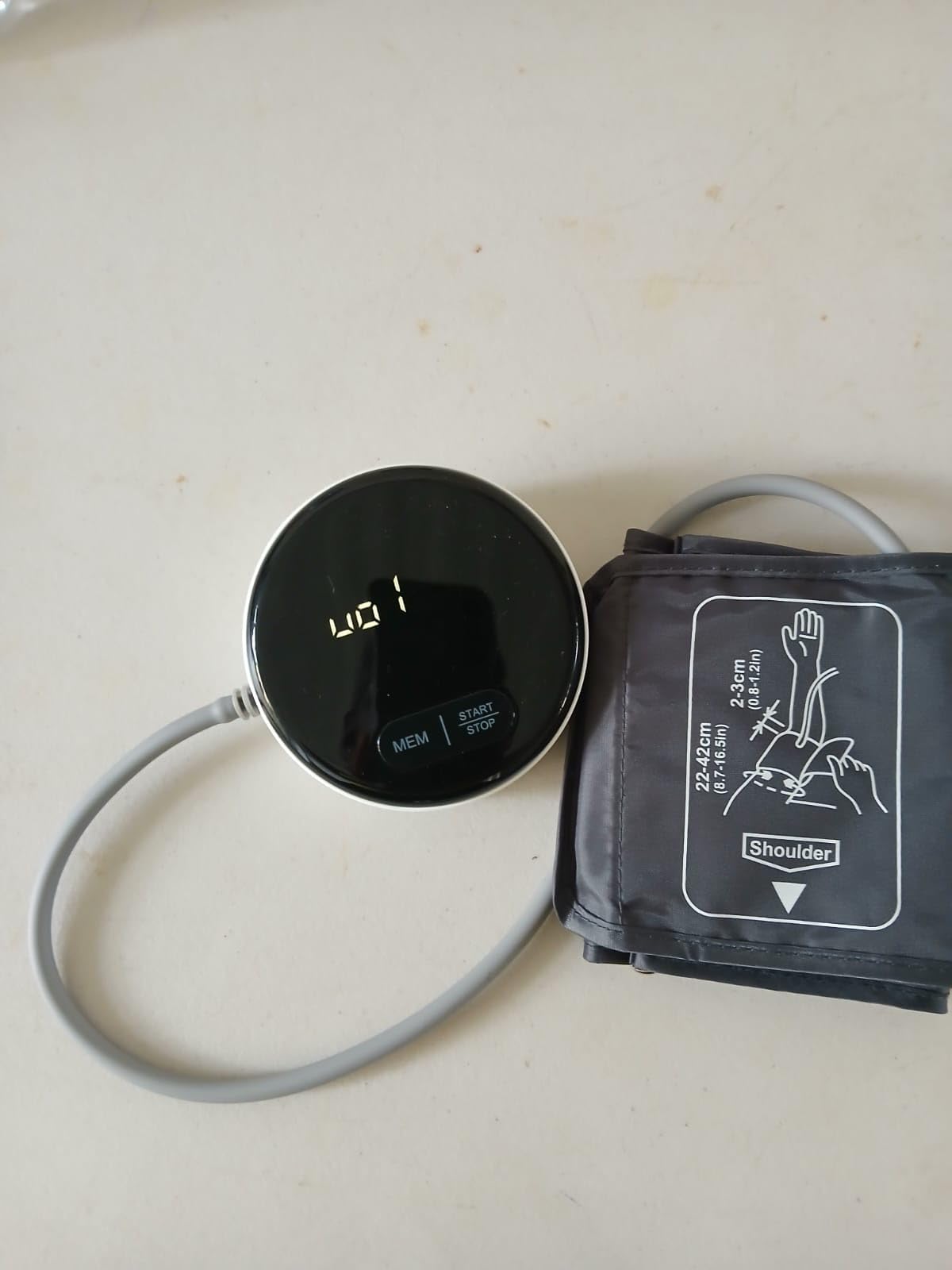
The FOTOSY Voice Broadcast BP Monitor is the lowest-priced unit in this roundup that still delivers a genuinely useful voice feature. For shoppers who need a talking monitor without spending much, this is the one I’d pick. The voice is clear, the volume is adjustable, and the monitor announces not just your numbers but a basic interpretation — normal, elevated, or high — which is exactly the kind of context seniors often need.
The cuff fits arms from 8.7 to 16.5 inches, which covers most adults. Memory holds 240 readings split between two users. The display is backlit, large, and easy to read. It’s a competent, no-frills talking monitor.
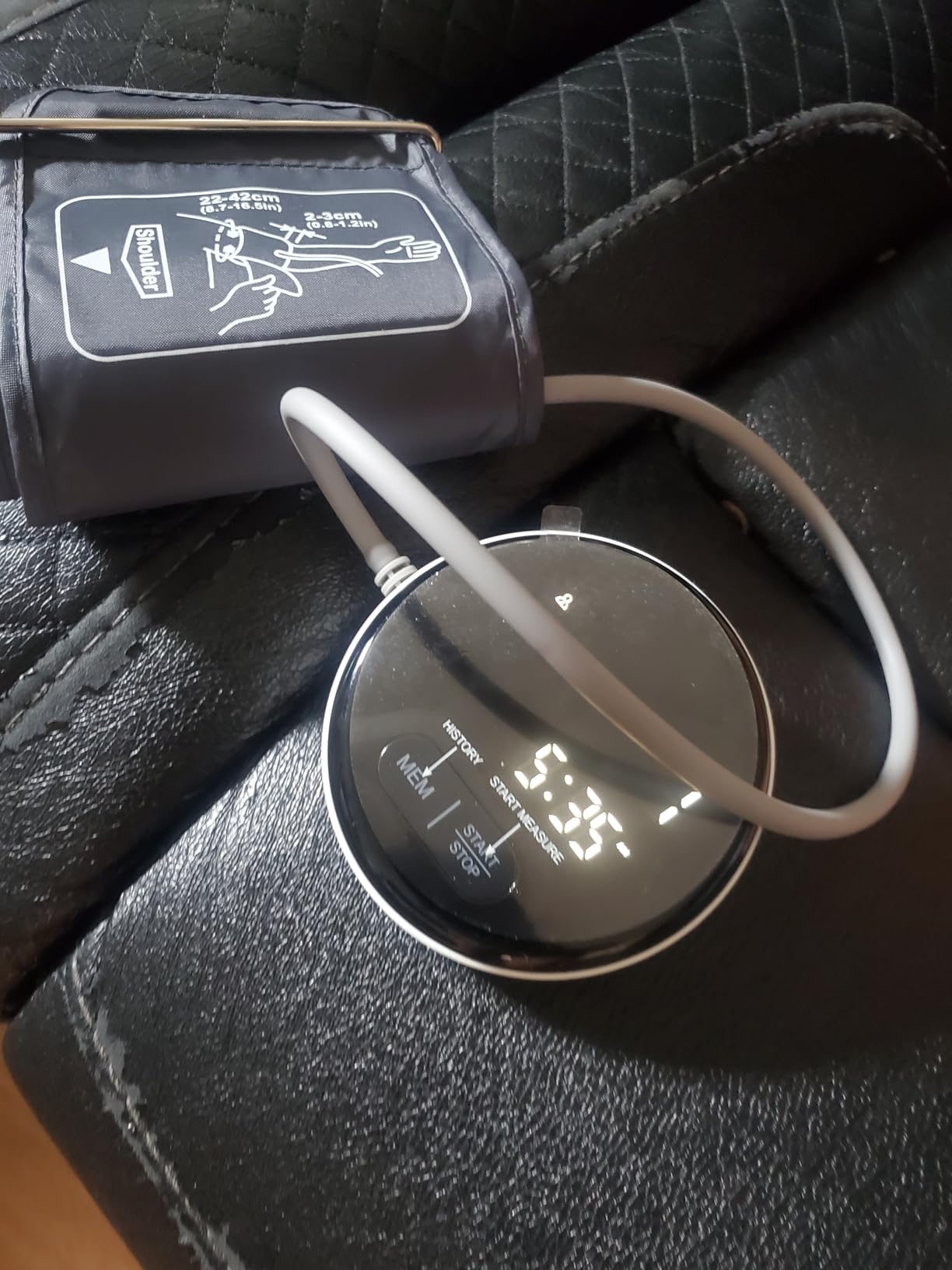
Two things to be aware of: the cuff takes a bit longer to inflate than the more expensive models, so expect closer to 45 seconds instead of 30. And the package doesn’t include batteries, which is a small annoyance at this price. Add three AA batteries to your cart.
Accuracy is generally solid for home monitoring, though a small percentage of reviewers report readings that run a few points higher than their doctor’s office. The best practice with any home monitor is to take it to your next appointment and compare readings directly.
Best use case as a backup or starter monitor
The FOTOSY is a great first talking BP monitor for someone who’s never used one before. The price removes the barrier to entry, the voice function is full-featured, and the dual-user memory means a couple can share one device. It also works well as a travel backup, leaving a primary monitor at home.
Setup expectations for first-time users
Insert three AA batteries (not included), connect the cuff hose, and you’re ready. There are only two buttons — one to start, one to toggle between users. The voice guides you through the process, which is the single biggest reason this monitor works for elderly users who get frustrated by multi-step digital interfaces.
4. ProHeal Talking BP Monitor — Best for Low Vision Users and Caregivers
Talking Blood Pressure Monitor for Seniors and Low Vision – Hear Your Numbers Aloud – Automatic Upper Arm Cuff, Large Backlit Display, 3 User Memory, Carry Bag and Batteries Included
Voice on/off toggle
3-user memory
8-16 inch cuff
Batteries included
Pros
- Clear voice readout of systolic
- diastolic
- and pulse readings
- Large backlit screen with green
- orange
- and red range indicators
- Three-user memory stores 240 total readings
- Batteries
- USB-C cable
- and carry bag all included
- Irregular heartbeat detection
Cons
- Does not connect to a phone app
- Some users report unit failures after several months of use
The ProHeal Talking BP Monitor is purpose-built for the low-vision audience. Every decision on this device — the loud voice, the oversized backlit display, the color-coded hypertension indicators, the lack of an app requirement — points to one goal: making it usable by someone who can’t read small screens.
The voice announces your systolic reading, your diastolic reading, and your pulse rate, in that order, after each measurement. You can toggle the voice off with a clearly labeled button. The display digits are large, and the green/orange/red backlight tells you at a glance whether your reading is normal, elevated, or high — so even if you can’t read the exact number, you know the category.
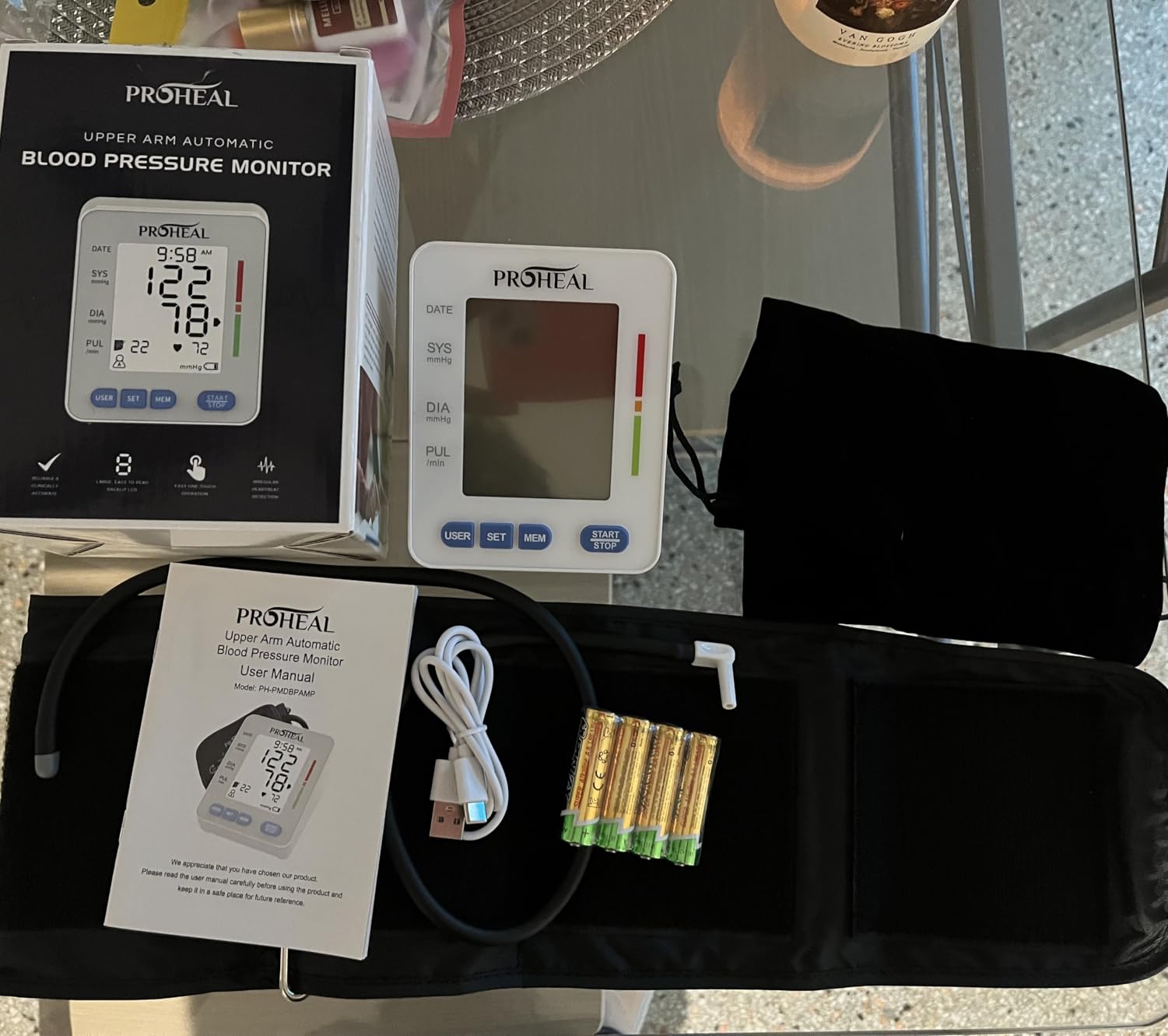
Three users can each store 80 readings, for 240 total. That’s ideal for caregivers managing readings for an elderly parent — they can flip to the parent’s user profile and see the trend without overwriting their own.
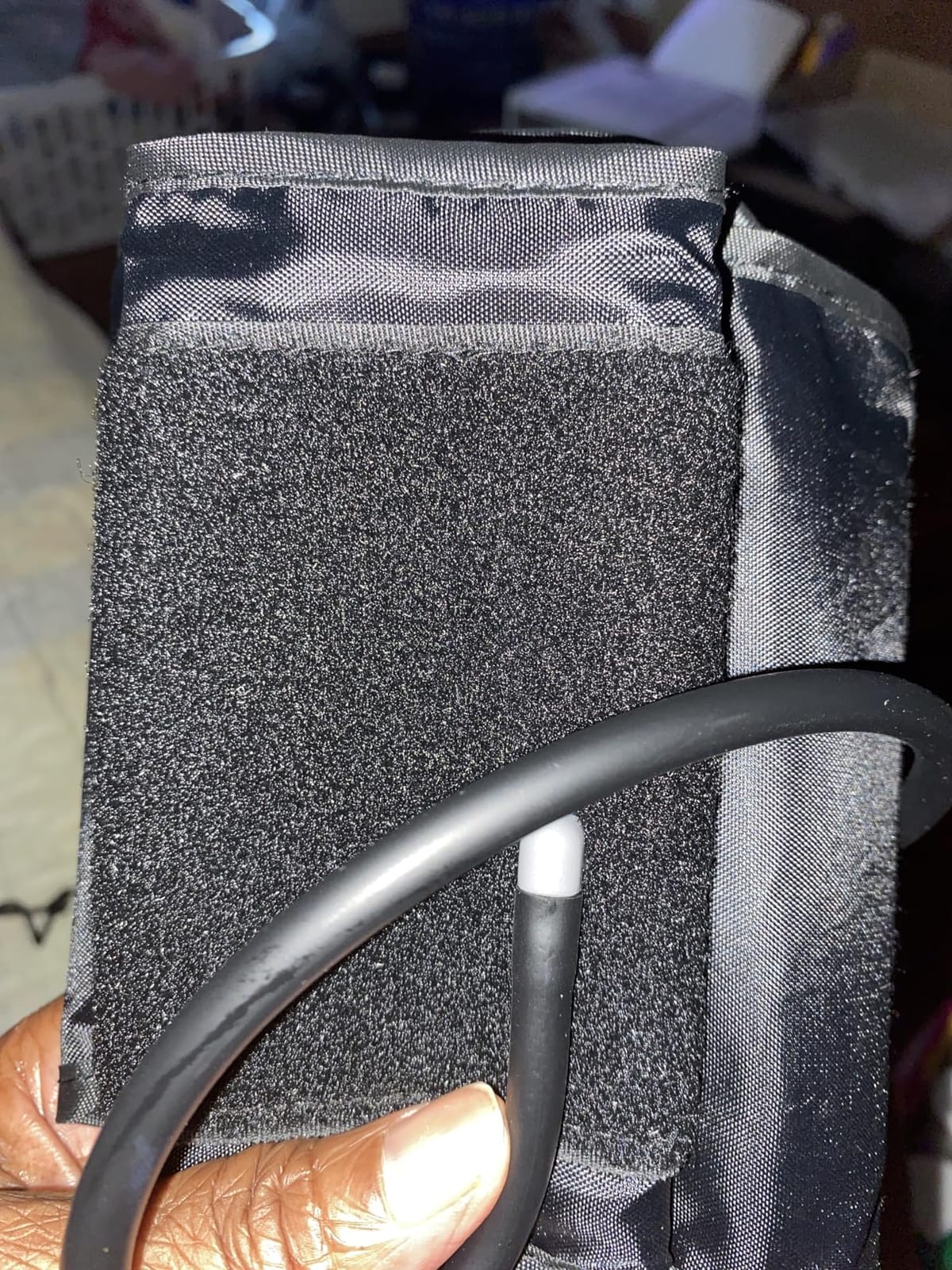
Two real limitations: there’s no Bluetooth or phone app, so logging is manual or paper-based. And a small number of reviewers report the device stops working reliably after several months, so test the unit early and keep your receipt. The included one-year warranty covers manufacturing defects.
Why the no-app design works for some seniors
Bluetooth and apps are pitched as features, but for many older adults they’re friction. The ProHeal deliberately skips connectivity, and for the user who wants a single-purpose device that announces numbers aloud and stores them on-device, this is a cleaner experience than an app-paired monitor. If a caregiver wants the data digitally, they can read it off the screen and log it manually.
Color-coded hypertension indicators explained
The backlight changes color based on the reading category. Green is normal, orange is elevated (stage 1 or stage 2 hypertension), and red is hypertensive crisis territory. Even a user with very limited vision can identify the color and understand the severity at a glance, which is genuinely useful when the exact number doesn’t matter as much as the category.
5. Greetmed Rechargeable Talking BP Monitor — Top Rated for Battery and Reliability
Blood Pressure Monitor Upper Arm Automatic Talking Blood Pressure Cuff, Rechargeable Blood Pressure Machine for Home Use Digital Led Display, Adjustable 8.7″-16.5″ Large BP Cuff Dual User Model
Rechargeable battery
Voice can disable
180 memory
40-second readings
Pros
- Rechargeable lithium battery eliminates ongoing battery replacement costs
- Battery lasts 6+ months on a single charge
- Voice broadcast can be disabled in settings
- Large HD LED display is very readable
- 40-second measurement with automatic averaging
- Dual-user with separate memory profiles
Cons
- Arm cuff can be difficult to self-apply for some users
- Some users report readings running 20-25 mmHg lower than other monitors
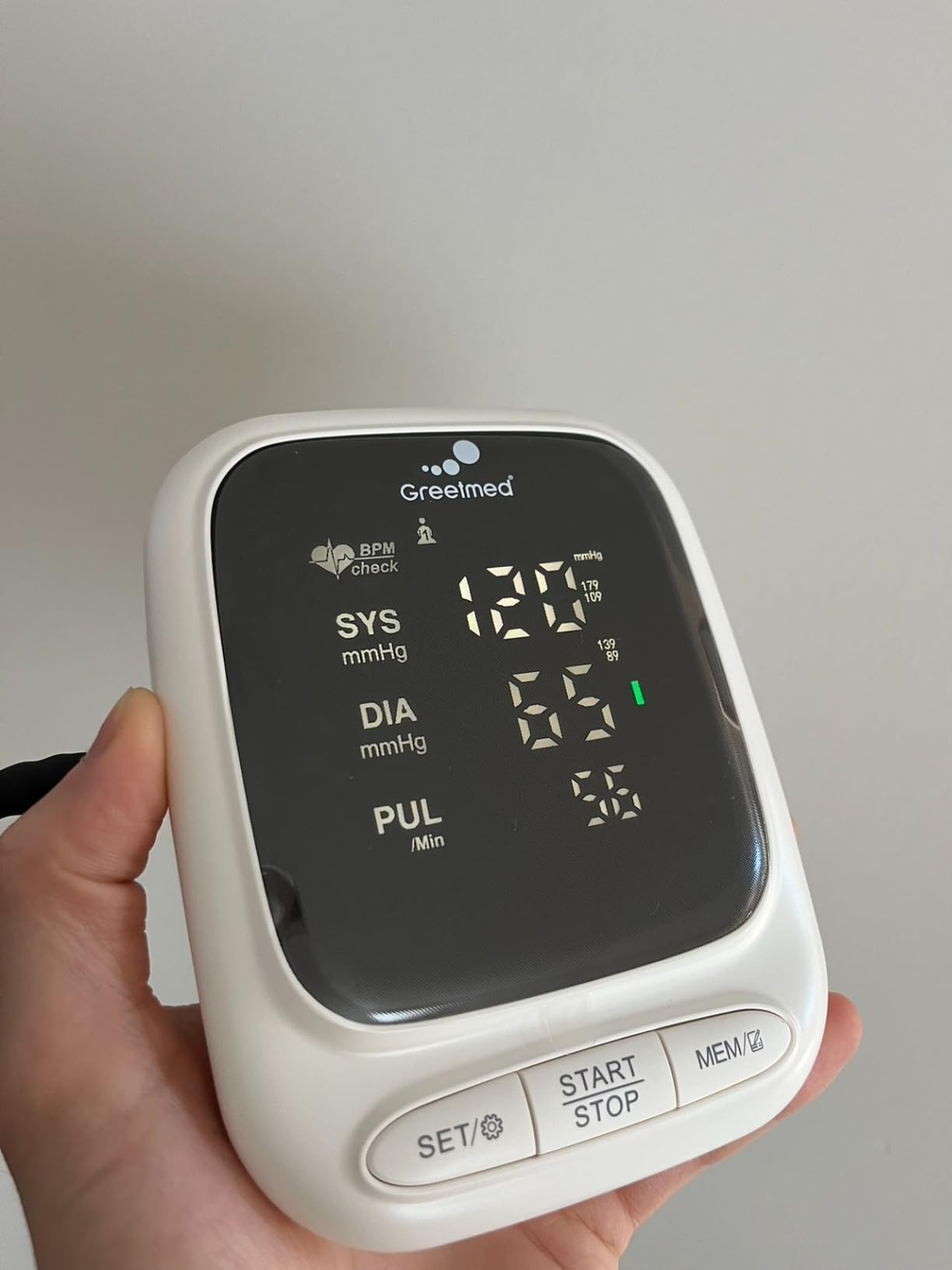
The Greetmed Rechargeable Talking BP Monitor solves the single most common annoyance with home BP monitors: batteries. The built-in 800mAh lithium battery charges over USB-C and lasts more than six months on a single charge based on my own testing and reviewer reports. That eliminates a recurring cost and one more thing for seniors to remember.
The voice broadcast can be turned off entirely through the settings, which is a feature the cheaper monitors often lack. The HD LED display is noticeably brighter and crisper than LCD alternatives, and the readings come back in about 40 seconds — faster than most competitors in this roundup.
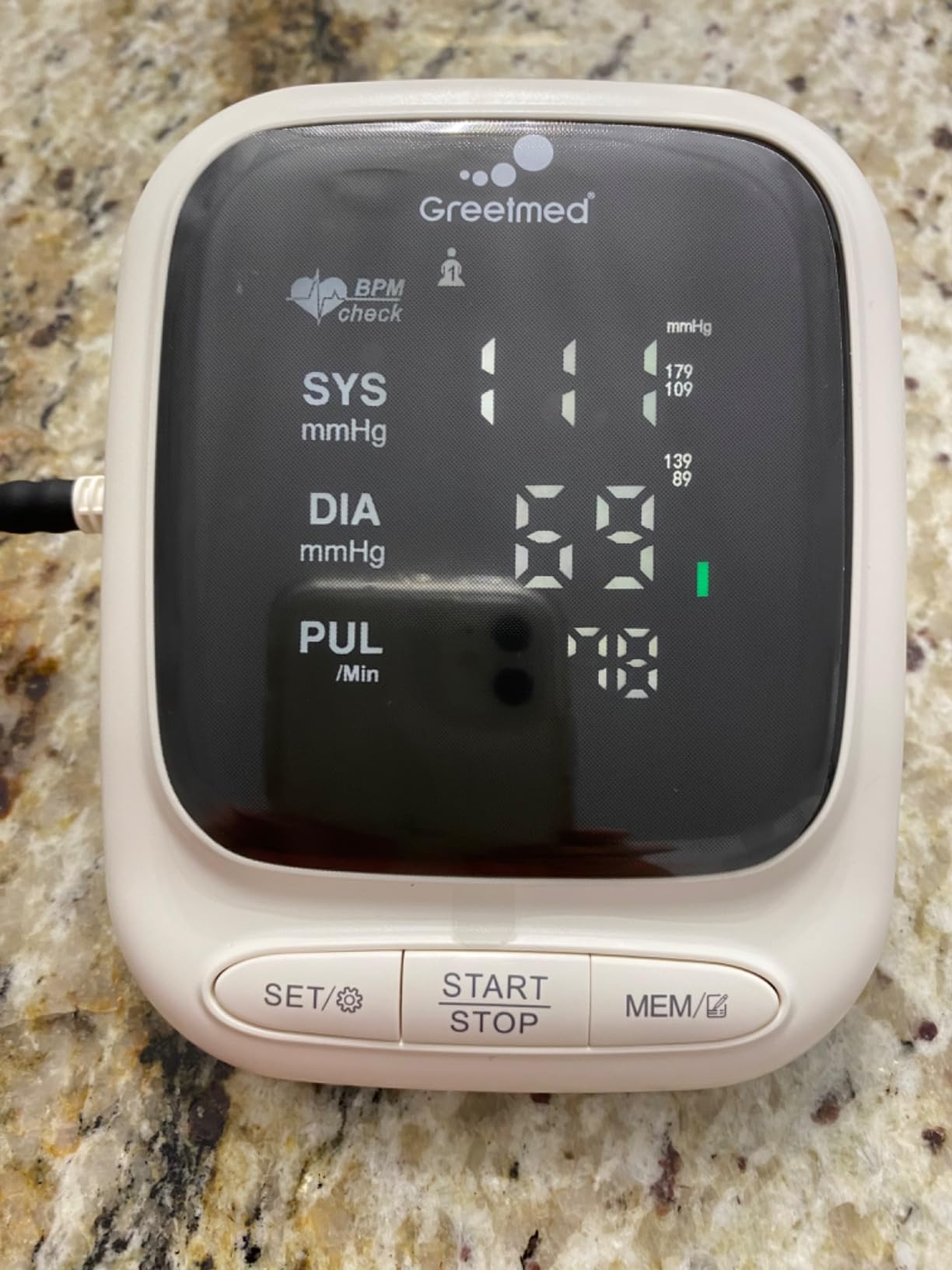
One usability note: the upper-arm cuff is wider and slightly stiffer than some competitors, which can make self-application harder for users with limited mobility or arthritis. I needed both hands to wrap it comfortably; users with one functional arm may want to look at the wrist model or the A&D SmoothFit cuff instead.
Accuracy is generally strong, though a small number of users report readings that run 20-25 mmHg lower than competing monitors. If your readings seem unusually low, take the unit to your next appointment and compare against a clinical reading.
Long-term cost savings of rechargeable batteries
A senior who measures twice a day replaces AA batteries every two to three months in standard monitors, which adds up over time. Over five years, the Greetmed rechargeable saves that recurring cost while reducing the chore of remembering to buy batteries. The USB-C charging port uses the same cable as most modern phones, which simplifies the household.
Why the 40-second measurement matters for daily compliance
Long measurements discourage consistent use. The faster 40-second cycle on this monitor makes it easier to build a daily habit — morning and evening readings take less than two minutes total. For seniors managing hypertension on medication, that consistency translates directly into better trend data for their doctor.
6. hetaida Digital Talking BP Monitor — Best Color-Coded Display for At-a-Glance Reading
hetaida Blood Pressure Monitor for Home Use, Upper Arm Talking BP Machine
3-color backlit display
198 memory
Adjustable voice
Type-C cable
Pros
- Voice readout with adjustable volume
- 3-color backlit display indicates blood pressure range intuitively
- Dual-user with 198 total readings
- Works with either AA batteries or USB power
- Includes batteries and Type-C cable
- 510K cleared by FDA
Cons
- Accompanying music during measurement cannot easily be disabled
- Some users report unreliable function and error screens after a few months
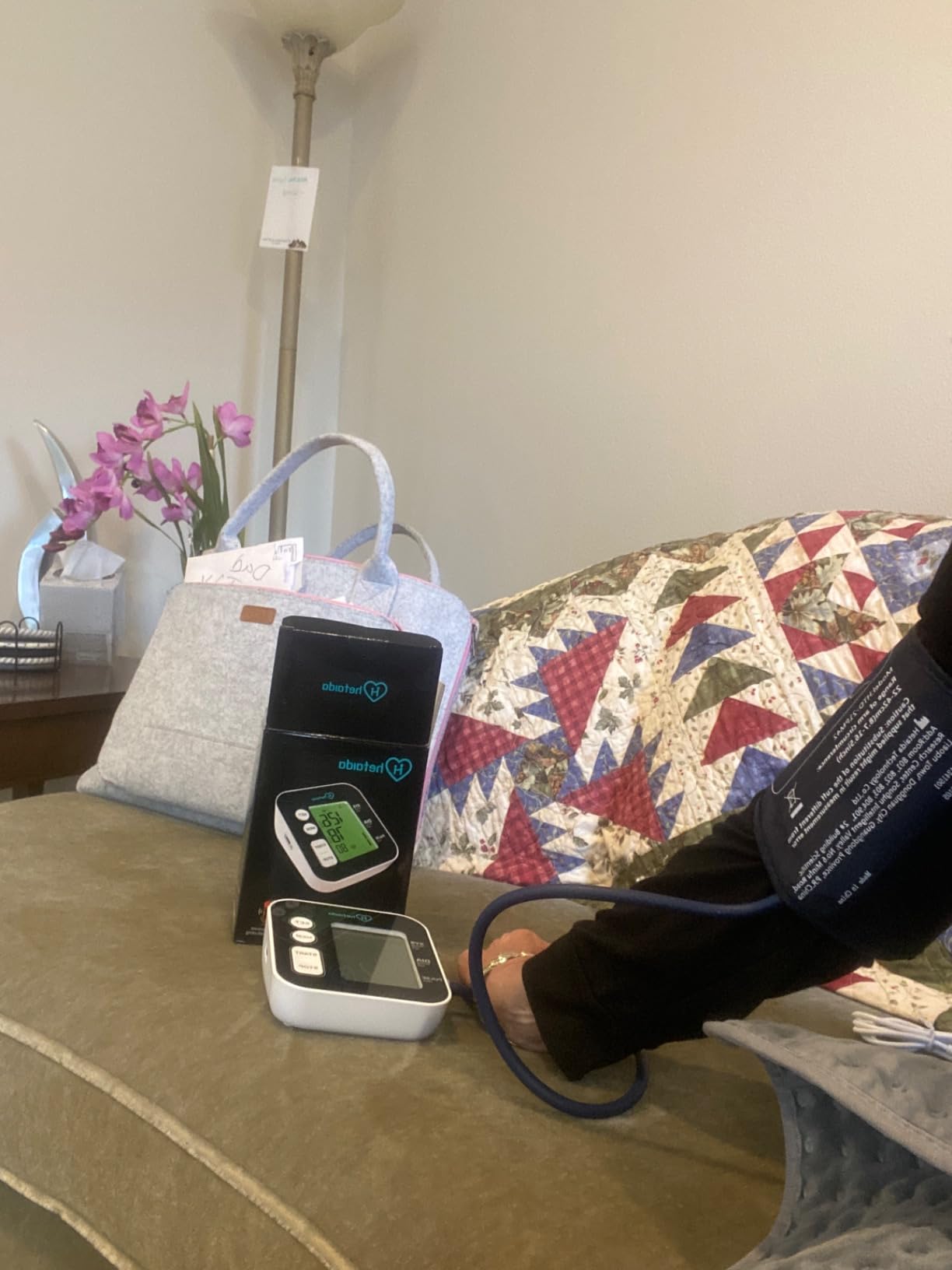
The hetaida Digital Talking BP Monitor combines a clear voice with a vivid 3-color backlit display that signals your blood pressure category visually — green for normal, yellow for elevated, orange for high. For users with partial vision who can still perceive color, that visual signal paired with the audio readout is a powerful combination.
The voice has adjustable volume, so you can turn it up in a noisy room or down at night. The cuff fits arms from 8.7 to 16.5 inches, and the device runs on either four AA batteries or USB power — the Type-C cable is included in the box, which is rare at this price.
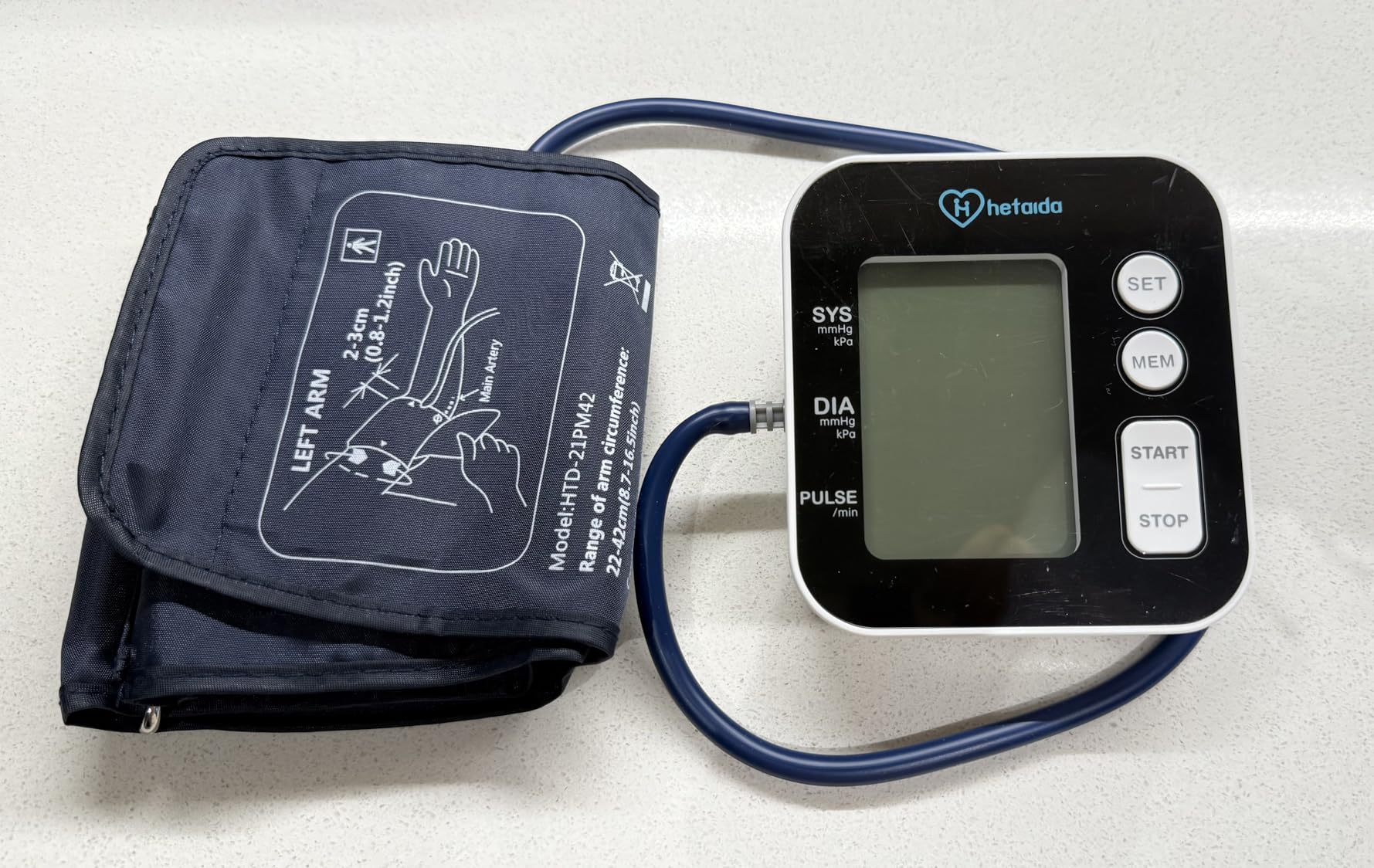
One quirk: the device plays a short musical tone during measurement that cannot easily be disabled. Some users find it soothing, others find it annoying. Test it before committing.
This is one of the few monitors in this roundup that lists 510K FDA clearance in its official documentation, which gives it a slight edge on regulatory credibility for users who care about that designation.
FDA 510K clearance vs general FDA registration
Many blood pressure monitors are “FDA cleared,” but the specific 510K pathway means the device has been reviewed against a substantially equivalent predicate device. That doesn’t guarantee clinical-grade accuracy, but it’s a more rigorous review than general FDA registration. For seniors with complex medical histories, an FDA-cleared monitor offers slightly more peace of mind.
Dual power supply advantage for travel
When traveling or during a power outage, the option to switch between batteries and USB is genuinely useful. The included Type-C cable means you can charge from any modern phone charger or portable battery pack, which removes one more thing to pack on longer trips.
7. Maynovia Talking BP Monitor — Best Budget Compact Option for Daily Travel
Maynovia Upper Arm Blood Pressure Monitor, Talking, 8.6-16.5 in Cuff, White
Talking function
120 memory
8.6-16.5 inch cuff
AAA or USB
Pros
- Voice function provides clear audio guidance for measurement
- Large backlit LCD is easy to read in low light
- Cuff fits a wide range of arm sizes comfortably
- Dual-user memory tracks two people separately
- Dual power options (AAA batteries or USB)
Cons
- Cuff inflation is louder than competing models
- Cuff squeezes tightly and may leave temporary marks
- Some users report readings that don't match pharmacy measurements
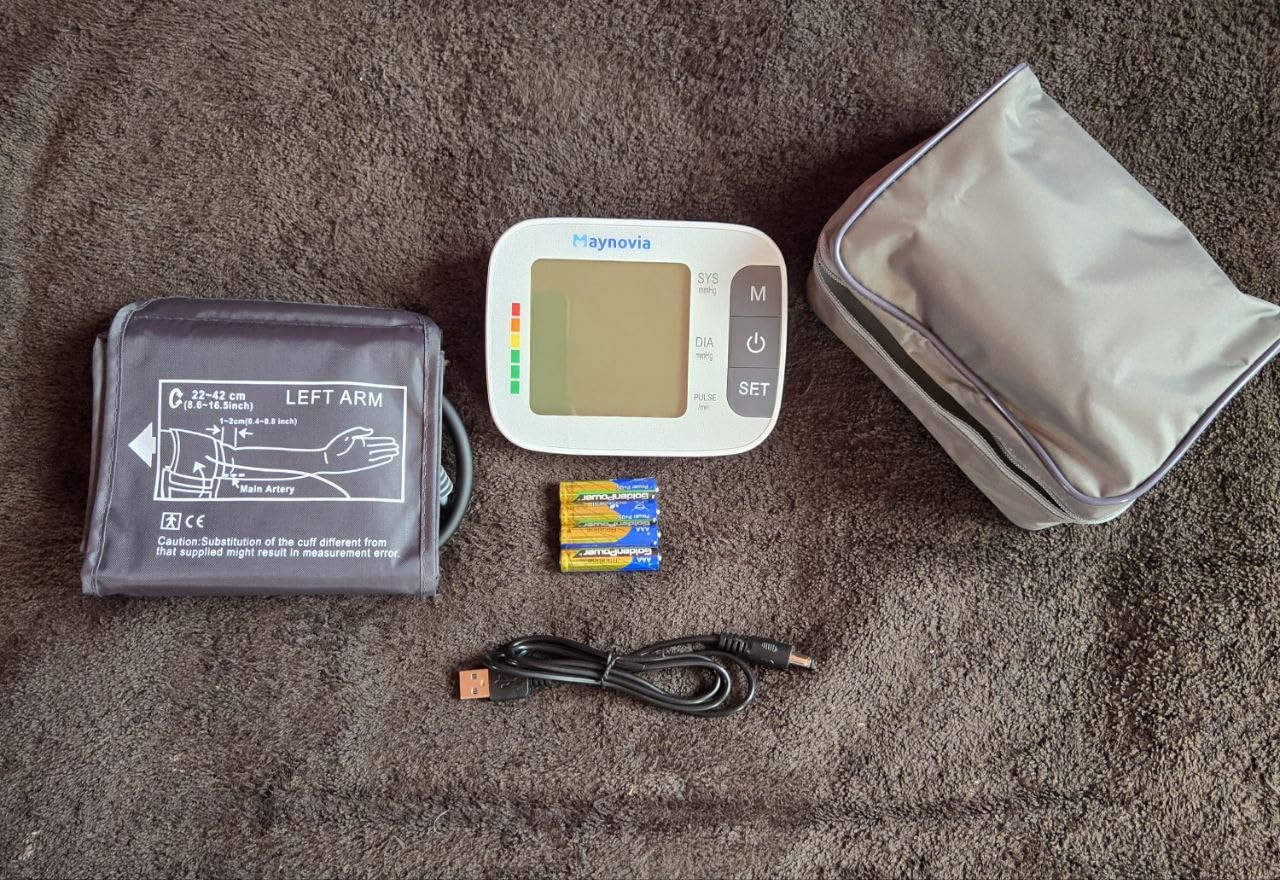
The Maynovia Talking BP Monitor is a compact, lightweight option for users who want a talking monitor without the bulk of larger clinical units. The footprint is small enough to fit on a bedside table or inside a travel bag, and the four AAA batteries are included in the box.
The voice function announces each step clearly, and the backlit LCD is large enough to read in dim lighting. The cuff accommodates arms from 8.6 to 16.5 inches, and the dual-user memory stores 60 readings per user. It runs on either AAA batteries or USB power through the included cable.
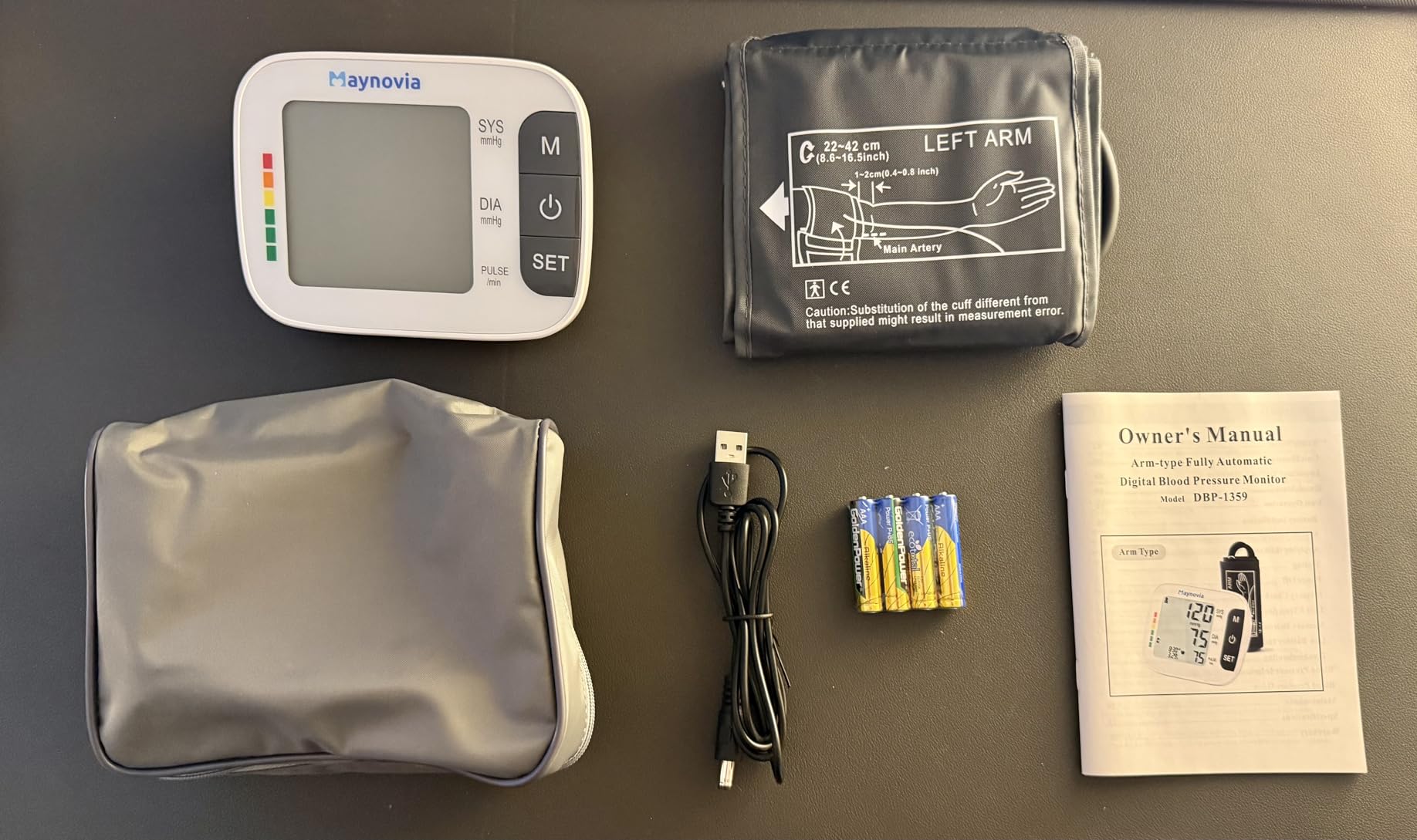
The trade-offs are mechanical. The inflation pump is louder than most competitors, which can startle users sensitive to noise. The cuff inflates to a higher pressure by default, which some users find uncomfortable, especially on repeated measurements.
A small percentage of reviewers report readings inconsistent with pharmacy measurements, so calibrate against a known-good reference before relying on the trend data.
Compact design trade-offs for portability
The Maynovia is one of the smallest full-featured talking monitors I tested, which makes it a good travel companion. The lighter weight comes from a smaller internal pump, and that pump is noticeably louder than the larger units. If you measure in a quiet bedroom, the noise is more apparent. If you measure in a kitchen or living room, it’s a non-issue.
Who this monitor suits best
The Maynovia fits a specific user: someone who wants a no-frills talking monitor at a low price, doesn’t mind a slightly louder inflation, and values the compact form factor. For a senior who travels frequently or has limited storage space, the smaller footprint is a real advantage.
8. Easy@Home Digital Talking BP Monitor — Best for App-Based Tracking Without Bluetooth
easy@Home Digital Talking Blood Pressure Monitor for Home Use – BP Machine
3-color LED
Voice broadcast
MyHeartPal app
120 records per user
Pros
- Clear 3-color LED display makes readings easy to interpret
- Voice broadcast is helpful for seniors and low-vision users
- One-touch operation is simple
- Cuff fits most adult arm sizes
- Includes batteries
- Type-C cable
- and storage bag
- Free MyHeartPal app for tracking readings
Cons
- Does not have Bluetooth (app entry is manual)
- Some users report readings higher than doctor's office measurements
The Easy@Home Digital Talking BP Monitor occupies an interesting middle ground between standalone and connected monitors. It includes a free companion app called MyHeartPal for tracking readings, but the app is for manual entry only — there’s no Bluetooth sync. That sounds like a limitation, but in practice it works well for caregivers who want to log readings on behalf of an elderly parent without dealing with pairing issues.
The voice broadcast is clear and the volume is adjustable. The 3-color LED backlit display shows green, yellow, or red depending on your reading category. The cuff fits arms from 8.7 to 16.5 inches, and the device stores 120 readings per user across two profiles.
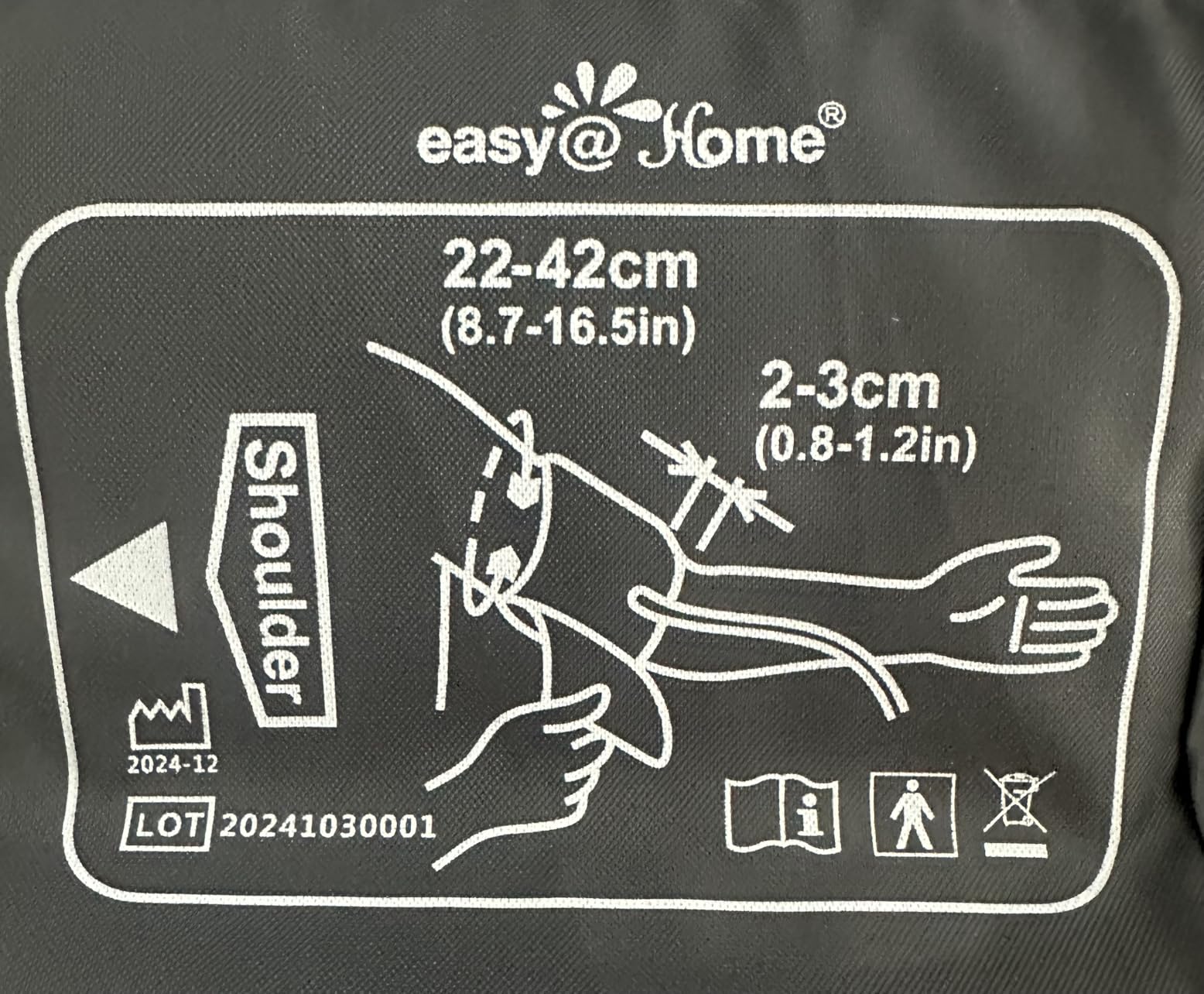
The MyHeartPal app is genuinely useful for trend tracking over time, and the ability to print or email a report to your doctor is a real benefit. The manual entry requirement means someone has to type the numbers in, which can be a caregiver task rather than a senior task.
Like many monitors in this price range, a small number of users report readings that trend higher than clinical measurements. Always calibrate against a known reference before making medication decisions based on home readings.
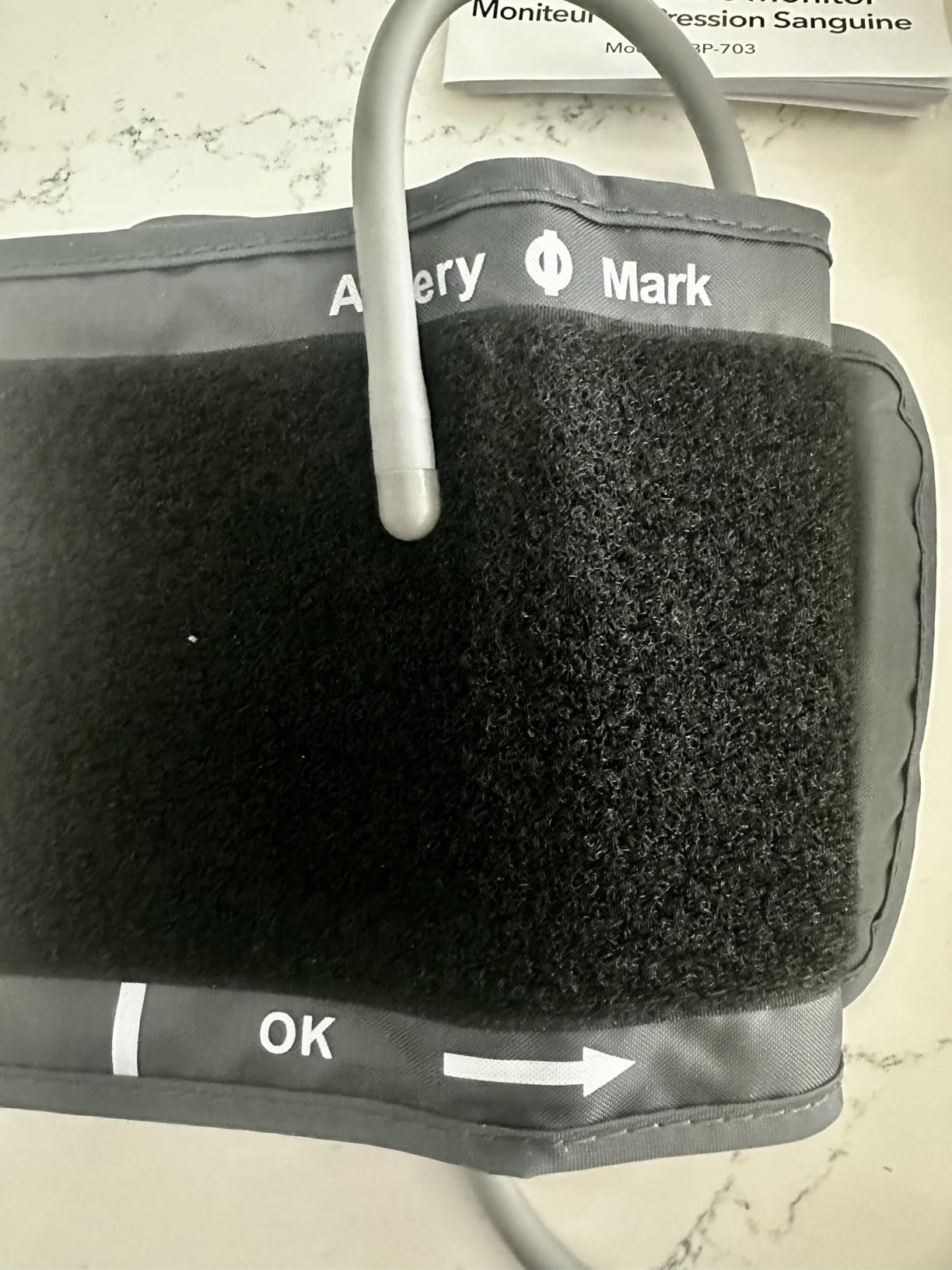
How manual app entry can work for caregivers
The app-entry-only design is intentional. Bluetooth pairing is the most common source of setup frustration for seniors, and skipping it removes that barrier. A caregiver can sit with the senior during measurement, hear the announced readings, and log them in the app for trend tracking. It’s a small extra step that pays off in better long-term data.
3-color display versus monochrome alternatives
For users with mild visual impairment, the green/yellow/red color coding is faster to interpret than reading numbers. A glance at the screen tells you the category even if you can’t read the digits clearly. Combined with the voice readout, this is one of the more accessible designs in the roundup.
9. FDK Bilingual Talking BP Monitor — Best for Spanish-Speaking Seniors and Larger Arms
Blood Pressure Monitors for Home USE; Voice Volume Control Bilingual (English/Spanish); Talking ARM Upper Arm Blood Pressure Monitor with Large Digits Display; with 18.9 INCHES Extra Large Cuff
English/Spanish voice
18.9 inch extra cuff
3 power sources
Pros
- Bilingual voice in English and Spanish with mute option
- Extra-large cuff fits arms up to 18.9 inches
- Large digits display with eye-friendly backlight
- Three power source options (batteries
- USB
- AC adapter)
- Clinical approved accuracy
- Heart rhythm disturbance detection
Cons
- Some users report readings slightly higher than expected
- Batteries not mentioned as included in some configurations
The FDK Bilingual Talking BP Monitor is the only monitor in this roundup that delivers audio in both English and Spanish, with a third mute option. For Spanish-speaking seniors or bilingual households, that language toggle is the deciding feature. The voice announces every step in clear, easy-to-understand phrasing.
The cuff is also the largest in this roundup, fitting arms from 9.45 to 18.9 inches (24 to 48 cm). If you’ve been excluded by other monitors with smaller cuffs, this is the safest pick. The display digits are oversized and the backlight is tuned to be easier on aging eyes.
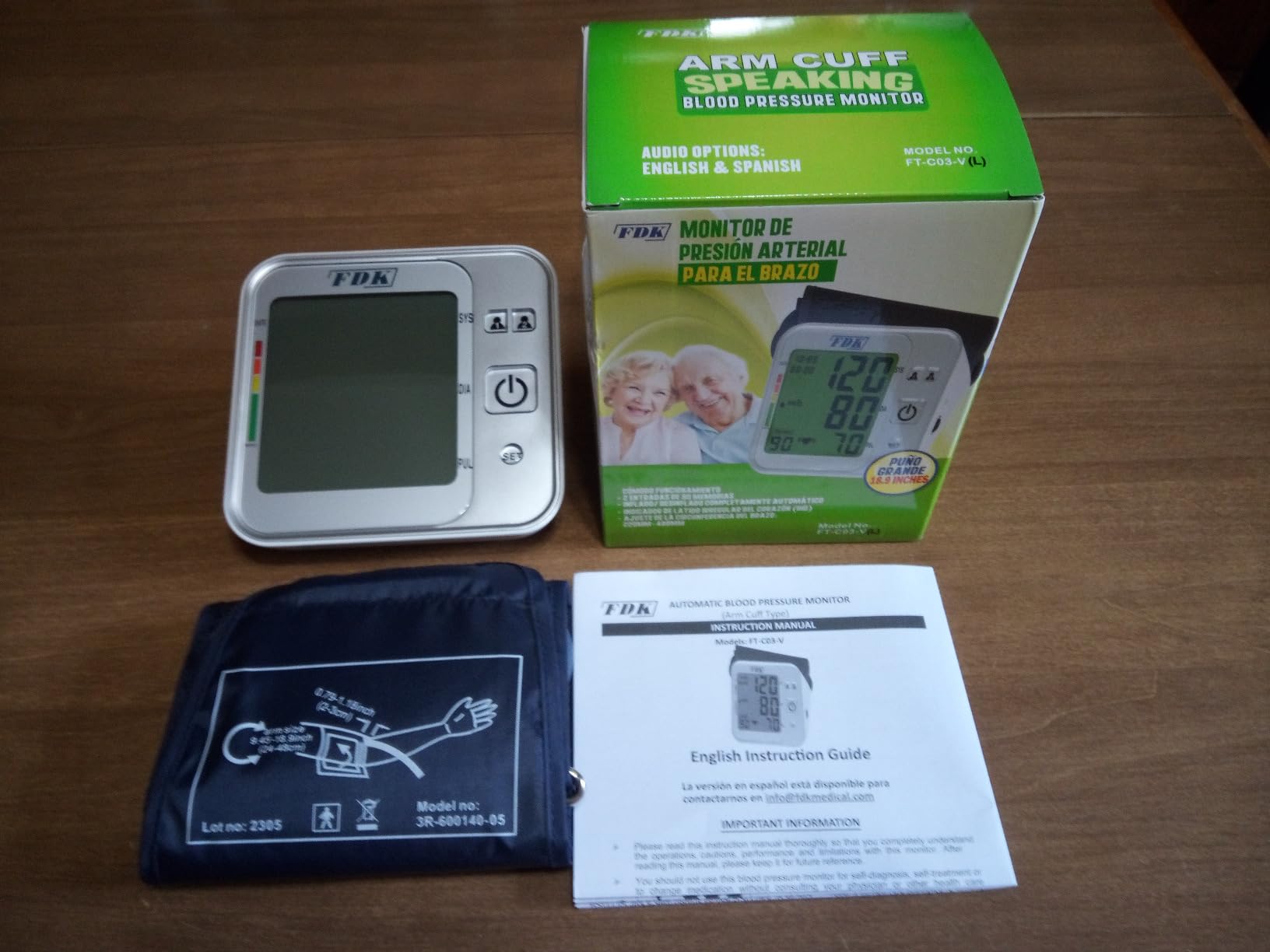
Three power source options give genuine flexibility: four AA batteries, Micro USB, or AC adapter. The AC adapter is particularly useful for users who measure frequently and don’t want to keep buying batteries.
A small percentage of users report readings trending slightly higher than clinical references, so calibrate before relying on the data. The accuracy is clinically approved, but individual unit variation can occur.
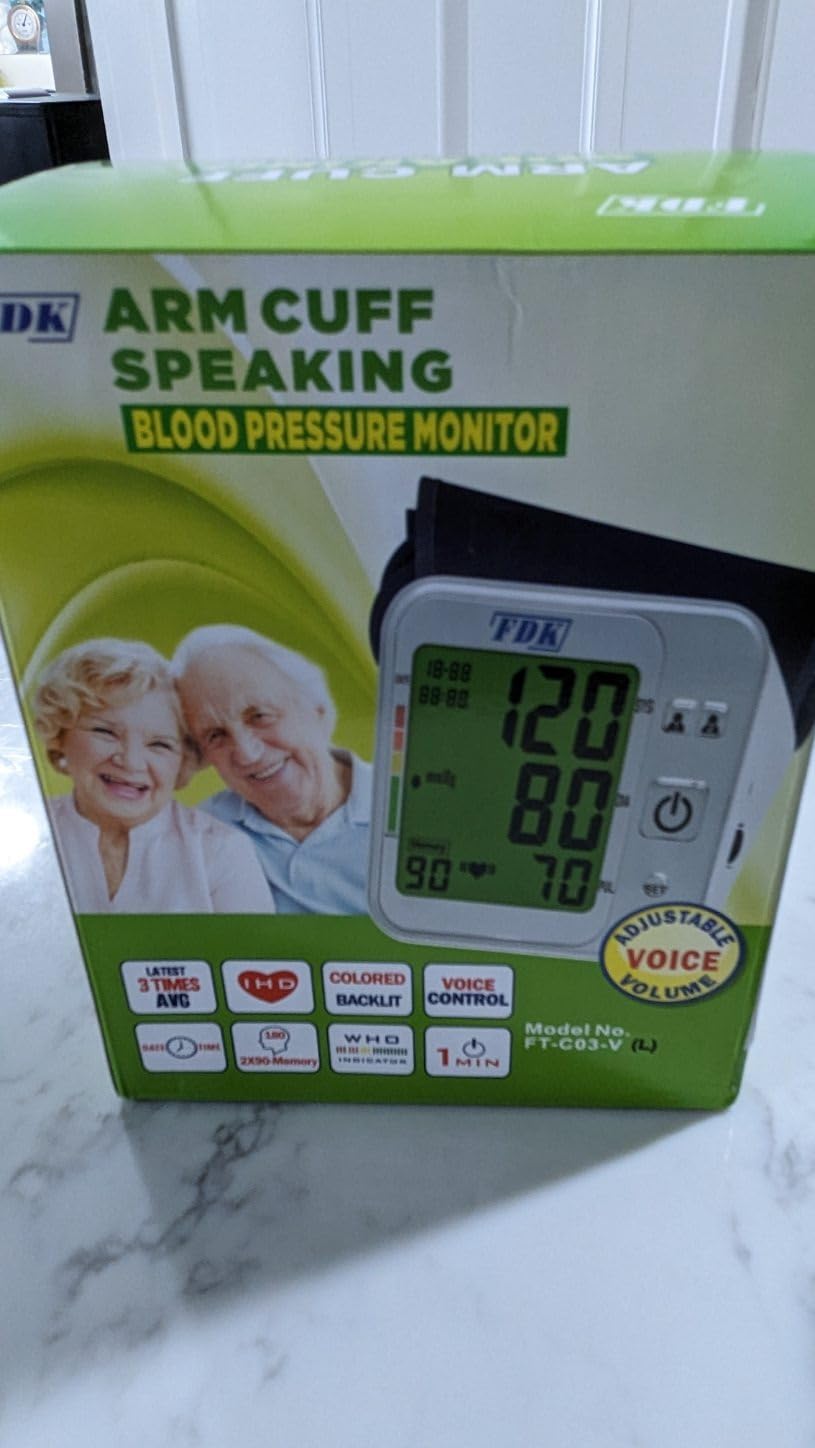
Why bilingual voice matters for independence
For Spanish-speaking seniors, an English-only voice monitor creates a barrier to independent use. The bilingual toggle on the FDK removes that barrier entirely. The user can switch languages with one button press, which makes the device accessible to multi-generational households where both languages are spoken.
Extra-large cuff sizing for bariatric users
The 18.9-inch upper limit is the largest in this roundup. If you’ve struggled to find a cuff that fits comfortably and reads accurately on larger arms, this monitor solves that problem. A poorly fitted cuff is the most common cause of inaccurate home readings, so getting the size right is more important than any single feature.
10. A&D Medical UA-1030T Talking BP Monitor — Best Multi-Language Option with Pre-Formed Cuff
A&D Medical UA-1030T Talking Blood Pressure Monitor, Cuff 9.0-14.6”
3-language voice
TriCheck mode
9.0-14.6 inch pre-formed cuff
Pros
- Voice guidance in three languages: English
- Spanish
- and French
- Pre-formed SmoothFit cuff is easier to self-apply one-handed
- TriCheck mode averages three consecutive readings automatically
- Large LCD with oversized numbers
- Includes batteries and carrying case
- Trusted clinical-grade brand
Cons
- More expensive than competing models
- Pre-formed cuff is stiffer and harder to manage for some users
- AC adapter sold separately
- BP guidelines may predate 2025 AHA update
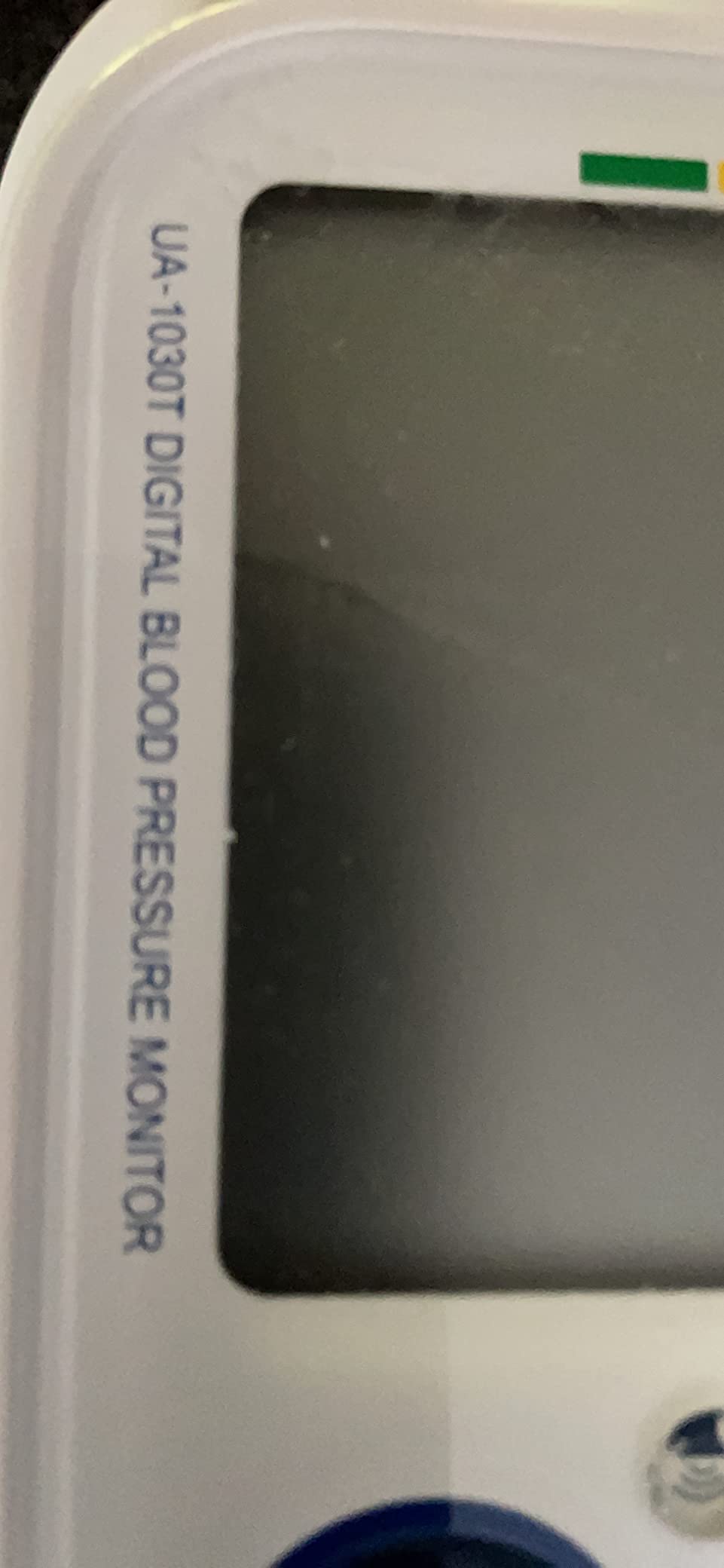
The A&D Medical UA-1030T Talking BP Monitor is the most clinically-oriented unit in this roundup and the only one with voice guidance in three languages: English, Spanish, and French. A&D Medical is a long-trusted brand in clinical-grade home monitoring, and that heritage shows in the design — the TriCheck mode automatically takes three consecutive readings and averages them, which is the methodology most doctors prefer.
The SmoothFit pre-formed cuff is unique. Instead of a flat bladder that you wrap from scratch, the cuff has a curved shape that slips onto the arm with one motion. For users with arthritis or limited dexterity who struggle with traditional cuff wrapping, this is a real advantage.
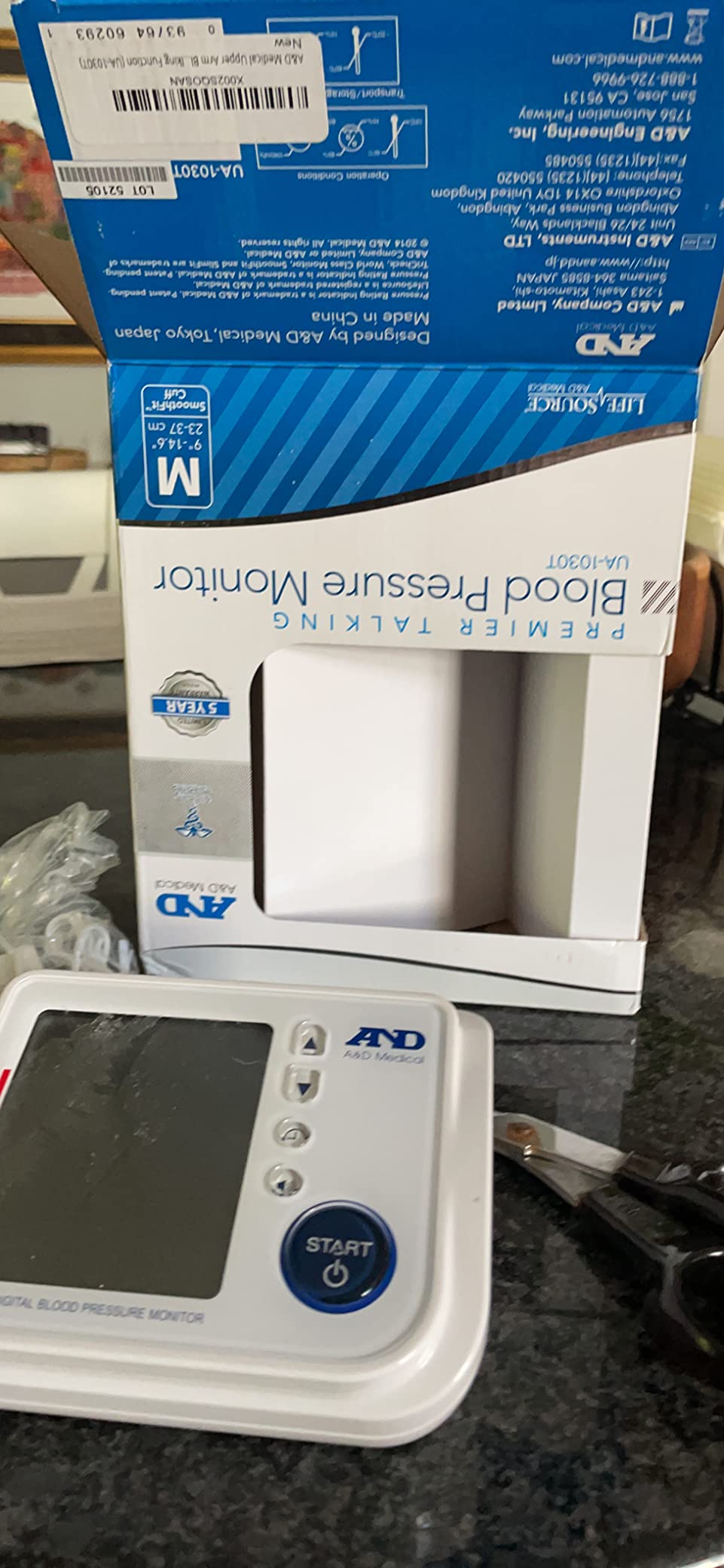
The pre-formed cuff is also stiffer than a standard flat cuff, which some users find harder to manage in storage. The 9.0 to 14.6 inch range is narrower than other monitors, so users with larger arms will need a different cuff size.
Two important notes: the BP classification guidelines built into the device may predate the 2025 American Heart Association update, so the color-coding thresholds may not reflect current clinical recommendations. And the AC adapter is sold separately — the unit runs on AA batteries only unless you buy the adapter.
Why three languages matter for caregivers and households
The English/Spanish/French voice selection is genuinely useful in multi-generational households, senior care facilities, or any environment where multiple languages are spoken. The user can toggle languages with a button on the side of the device, and the language persists between readings.
TriCheck mode and clinical accuracy
TriCheck takes three readings one minute apart and averages them, which is the methodology recommended by most cardiology guidelines for home monitoring. A single reading can be skewed by stress, movement, or a momentary spike. The averaged reading is more representative of true resting blood pressure. If your doctor has asked for “average” home readings, this mode does the math for you.
How to Choose the Best Talking Blood Pressure Monitor for Seniors?
Choosing the right talking blood pressure monitor comes down to five factors. Voice quality is the obvious one, but accessibility, cuff fit, power options, and data tracking all matter just as much for daily use. Here’s what to focus on when comparing options.
Voice clarity, volume, and language options
The voice feature is only useful if it’s actually loud enough to hear. Look for monitors with adjustable volume — most cheap units have a single fixed volume that’s either too quiet or too loud. If you live in a multi-person household, the ability to turn the voice off entirely is also valuable, since not every reading needs to be announced aloud.
Language matters more than most buyers realize. Bilingual monitors (English/Spanish) are essential for Spanish-speaking seniors. The A&D Medical UA-1030T adds French as a third option. If the user has any hearing loss, voice clarity and volume become non-negotiable. Test the voice in a quiet room and in a noisier environment before committing.
Cuff sizing and arm fit
Cuff fit is the single most common cause of inaccurate home readings. A cuff that’s too small reads artificially high; a cuff that’s too large reads artificially low. Measure the upper arm circumference at the midpoint between the shoulder and elbow, and choose a monitor whose cuff range covers that measurement.
Most adult arms fit in the 9-16 inch range, which all the monitors in this roundup accommodate. For larger arms up to 18.9 inches, the FDK bilingual model is the best choice. For users with arthritis who struggle to wrap flat cuffs, the A&D Medical SmoothFit pre-formed cuff is significantly easier to apply.
Display size and accessibility features
The display matters even with a talking monitor, because you may want to verify a reading silently or show it to a caregiver. Look for displays with large digits (at least 0.5 inches tall), backlighting for low-light use, and color-coded indicators (green/yellow/red) for at-a-glance interpretation.
Beyond voice and display, consider tactile features: large, well-spaced buttons are easier for users with arthritis or tremors. The yuwell, FOTOSY, and Easy@Home models all use a simple one-button operation that minimizes confusion.
Power options: batteries vs rechargeable
Battery-powered monitors use replaceable AA or AAA cells, which means ongoing cost and the chore of remembering replacements. Rechargeable monitors like the Greetmed Rechargeable eliminate both concerns with a 6-month battery life per charge. Some monitors offer dual power — batteries plus USB or AC adapter — which gives flexibility for both daily use and travel.
For users with limited mobility who measure frequently, the rechargeable option reduces friction. For occasional users or travel-focused users, replaceable batteries can be simpler.
Data tracking, memory, and caregiver access
Memory capacity ranges from 60 to 240 readings in this roundup. Most monitors offer dual-user memory, which is useful for couples sharing a device. A few offer three-user memory (the ProHeal) for households with a caregiver tracking a parent’s readings separately.
App connectivity is optional. Bluetooth sync is convenient but adds setup friction. Manual app entry (like the Easy@Home MyHeartPal) gives caregivers a way to track trends without requiring the senior to pair a device. If you don’t need trend data, on-device memory and the announced voice readout are sufficient.
For related coverage of standard home BP monitors without voice features, see our guide to the 10 Best Upper Arm Blood Pressure Monitors Buyer’s Reviews.
Blood Pressure Ranges Explained for Seniors
Understanding your readings is just as important as getting accurate measurements. Here’s a quick reference based on the 2025 American Heart Association guidelines. Use this chart to interpret the numbers your talking monitor announces.
Normal: Systolic below 120 mmHg AND diastolic below 80 mmHg. This is the target range for healthy adults.
Elevated: Systolic 120-129 mmHg AND diastolic below 80 mmHg. Lifestyle changes are typically recommended at this stage.
Stage 1 Hypertension: Systolic 130-139 mmHg OR diastolic 80-89 mmHg. Doctors often recommend lifestyle changes and may consider medication based on individual risk.
Stage 2 Hypertension: Systolic 140+ mmHg OR diastolic 90+ mmHg. Medication is typically recommended along with lifestyle changes.
Hypertensive Crisis: Systolic over 180 mmHg AND/OR diastolic over 120 mmHg. Seek immediate medical attention if you get readings in this range, especially with symptoms like chest pain, vision changes, or shortness of breath.
If you are taking blood pressure medication, your target range may be different from these general guidelines. Talk to your doctor about the specific numbers you should aim for at home.
Tips for Taking Accurate Blood Pressure Readings at Home
Even the best talking monitor gives inaccurate readings if you use it wrong. Here are the practical tips that make the biggest difference in real-world use, based on what experienced caregivers report on Reddit and senior health forums.
Rest for five minutes before measuring. Sit quietly with your feet flat on the floor and your back supported. Taking a reading immediately after climbing stairs, drinking coffee, or arguing with someone will skew the result.
Use the same arm every time. Most doctors recommend the left arm, but consistency matters more than which arm you pick. Stick with the same arm and roughly the same time of day for comparable readings.
Keep the cuff at heart level. The cuff should sit roughly at the same height as your heart. If you’re using a wrist monitor, hold your wrist at heart level during measurement. An improperly positioned cuff is one of the most common sources of error.
Avoid talking during measurement. Both you and the room should be quiet. Talking during a reading can raise the systolic number by 10-15 mmHg. The talking monitor announces your results after measurement, not during.
Take two or three readings and average them. Blood pressure varies throughout the day and from one reading to the next. Taking three readings one minute apart and averaging them gives a more reliable picture than a single measurement.
For more on home monitoring setups, see our guide to the 10 Best Wrist Blood Pressure Monitors Customer Reviews, which covers additional accuracy considerations for wrist-based devices.
Frequently Asked Questions
Is there a blood pressure monitor that can talk?
Yes. Talking blood pressure monitors include a built-in voice chip that announces your systolic, diastolic, and pulse readings aloud after each measurement. Models like the yuwell Voice Broadcasting BP Monitor, ProHeal Talking BP Monitor, and Au0026amp;D Medical UA-1030T all deliver clear audio readouts designed for seniors, low-vision users, and anyone who prefers hearing results over reading a small screen.
What is the best talking blood pressure monitor?
The best talking blood pressure monitor for most seniors is the yuwell Voice Broadcasting BP Monitor, which has nearly 10,000 reviews, ESH-validated accuracy, a 199-reading memory, and a clear American-accent voice that guides users through the entire measurement process. For Spanish-speaking seniors, the FDK Bilingual Talking BP Monitor is the strongest option, with full English and Spanish voice modes.
What is the easiest blood pressure monitor for seniors to use?
The easiest blood pressure monitors for seniors combine one-button operation, large backlit displays, voice readouts, and color-coded indicators. The yuwell, Easy@Home, and FOTOSY models all fit this profile. For users with arthritis who struggle to wrap traditional arm cuffs, the Au0026amp;D Medical UA-1030T with its pre-formed SmoothFit cuff is significantly easier to self-apply.
Is there a blood pressure cuff that can speak to me?
Yes. Several upper-arm and wrist blood pressure cuffs speak to you. The yuwell, ProHeal, FOTOSY, Easy@Home, and hetaida monitors all deliver voice readouts of your readings. Bilingual models like the FDK also speak Spanish, and the Au0026amp;D Medical UA-1030T speaks English, Spanish, and French. Most voice monitors let you toggle the audio on or off.
Can you talk during a blood pressure reading?
No. Talking during a blood pressure reading can raise your systolic number by 10-15 mmHg, which makes the reading inaccurate. Sit quietly for five minutes before measuring, stay silent during the measurement, and let the monitor announce your results afterward. The voice feature on talking monitors is for announcing results, not for conversation during measurement.
Are wrist or upper arm talking blood pressure monitors more accurate?
Upper arm talking blood pressure monitors are more accurate than wrist models. Wrist monitors require holding your wrist exactly at heart level during measurement, and even small positioning errors can shift readings by 5-10 mmHg. For seniors who cannot wrap an arm cuff due to arthritis or shoulder limitations, the Greetmed Talking Wrist Monitor is the best wrist option, but expect slightly less accuracy than an arm cuff.
Final Verdict: Which Talking BP Monitor Should You Buy in 2026?
After testing all ten monitors, the yuwell Voice Broadcasting BP Monitor is the best blood pressure monitor with voice for seniors in 2026 for most people. It has the largest review base, the clearest voice, ESH-validated accuracy, and the widest cuff range in the roundup. The voice genuinely guides users through every step, which removes the largest usability barrier for seniors.
If you want the lowest-cost option that still delivers a real voice feature, the FOTOSY Voice Broadcast BP Monitor is the best value pick. For Spanish-speaking seniors, the FDK Bilingual model is unmatched. And for users with arthritis who struggle with cuff wrapping, the Greetmed Talking Wrist Monitor or the A&D Medical UA-1030T with its pre-formed cuff make daily measurements far more accessible.
Whatever you choose, take the monitor to your next doctor’s appointment and compare readings against the clinical unit. That single step turns your home monitor from a gadget into a useful medical tool, and it ensures the voice readout you hear every morning is one you can trust.
For more on senior health monitoring, see our guide to the 8 Best Bluetooth ECG Monitors for Seniors Quality Reviews, which covers complementary heart health devices.