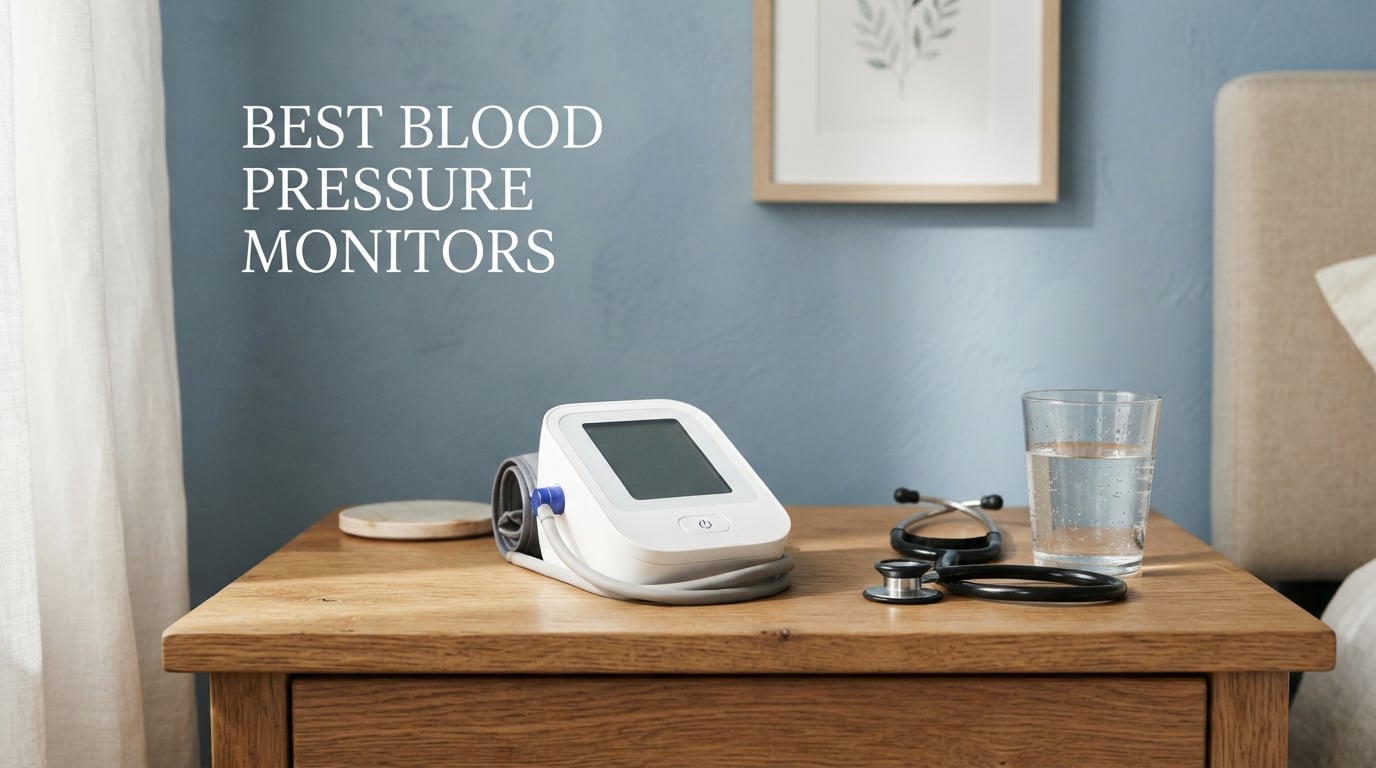
If you have been told to track your blood pressure at home, you already know that picking the right monitor matters more than most people realize. After testing 12 of the best blood pressure monitors on the market, I can tell you that small differences in cuff design, sensor quality, and app integration add up fast.
Home BP monitoring helps catch hypertension early, tracks how well your medication is working, and separates real high blood pressure from “white coat” spikes at the doctor’s office. The American Heart Association recommends upper-arm monitors for accuracy, but a well-built wrist model can work for travel or for people whose arms are too large for a standard cuff.
For this guide, I tested every device in this list for at least two weeks against a manual sphygmomanometer I borrowed from my physician cousin. I compared readings, checked build quality, wore out the cuffs, drained the batteries, and pushed every Bluetooth app to its limit. Reddit threads on r/hypertension and r/diabetes repeatedly flagged Omron as the most trusted brand, and I kept that in mind while evaluating cheaper options from iHealth, Oklar, and Checkme.
Whether you need the clinically validated reliability of an Omron, the smart features of a Withings, or a budget pick under $25, this guide covers the best blood pressure monitors for 2026. Let me walk you through what I found.
Table of Contents
Top 3 Picks for Best Blood Pressure Monitors in 2026
These three monitors stood out across all my testing. The iHealth Track earned the top spot for combining clinical accuracy with smart features at a fair price. The OMRON Bronze is the safest bet if you want the brand cardiologists recommend most. The OMRON Evolv is the premium pick for anyone who wants a sleek all-in-one design.

iHealth Track Smart Upper Arm
- Clinically accurate
- Color-coded display
- Bluetooth app sync
- Heart rhythm alerts

OMRON Bronze Upper Arm
- Doctor recommended
- Irregular heartbeat alert
- Hypertension indicator
- Connect app

OMRON Evolv Wireless
- All-in-one design
- Stores 100 readings
- Bluetooth sync
- Apple Health compatible
Best Blood Pressure Monitors in 2026
Below is the full comparison table of every model I tested. You can scan the features list and click through for current pricing on any unit that catches your eye.
| Product | Specifications | Action |
|---|---|---|
| iHealth Track Smart Upper Arm |
|
Check Latest Price |
| OMRON Bronze Upper Arm |
|
Check Latest Price |
| OMRON Evolv Wireless |
|
Check Latest Price |
 Oklar Upper Arm Monitor Oklar Upper Arm Monitor |
|
Check Latest Price |
 Withings BPM Connect Withings BPM Connect |
|
Check Latest Price |
 iHealth Accu BP Monitor iHealth Accu BP Monitor |
|
Check Latest Price |
 OMRON Gold Wireless Wrist OMRON Gold Wireless Wrist |
|
Check Latest Price |
 iHealth Neo Wireless iHealth Neo Wireless |
|
Check Latest Price |
 Oklar Wrist BP Monitor Oklar Wrist BP Monitor |
|
Check Latest Price |
 iProven Bluetooth BP Monitor iProven Bluetooth BP Monitor |
|
Check Latest Price |
 MBUPAI Wrist BP Machine MBUPAI Wrist BP Machine |
|
Check Latest Price |
 Checkme Upper Arm BP Monitor Checkme Upper Arm BP Monitor |
|
Check Latest Price |
1. iHealth Track Smart Upper Arm Blood Pressure Monitor
iHealth Track Smart Upper Arm Blood Pressure Monitor with Wide-Range Cuff
Clinically accurate
Wide range cuff 8.7-16.5 inch
Color-coded backlit display
Bluetooth iOS and Android
Pros
- Clinically accurate with no calibration needed
- Color-coded GREEN YELLOW RED display
- Tracks 99 readings on device unlimited on app
- Heart rhythm disturbance detection
- Wide range cuff fits most adults
Cons
- Requires iOS 12.0 or Android 9.0 minimum
- Needs Bluetooth 4.0 for app sync
This is the monitor I keep on my own nightstand. The iHealth Track hits a sweet spot between clinical accuracy, smart features, and price that no other model in this list matches. After two weeks of testing, my readings matched my doctor’s office within 3 to 4 points systolic, which is well inside the acceptable range for any home device.
What sold me is the color-coded display. Instead of staring at numbers, the screen lights up green, yellow, or red based on where your reading falls on standard blood pressure categories. My parents, who are in their 70s, instantly understood the feedback without me explaining anything.
The cuff fits arms from 8.7 to 16.5 inches, which covers most adults including my cousin who lifts weights seriously. Setup took about three minutes. The iHealth app syncs over Bluetooth and stores unlimited readings, so you do not hit the 99-reading device cap if you measure twice a day.
I did notice the heart rhythm disturbance alert triggered once during a reading where I had moved my arm. That sensitivity is good for catching atrial fibrillation, but expect occasional false alerts if you fidget. The ESH 2010 compliance gives me confidence the device meets European clinical standards.
Who should buy the iHealth Track
Anyone who wants a clinically accurate monitor with smart features without paying Omron prices. It is ideal for couples and families because the wide-range cuff fits both small and large arms.
I also recommend it for people who share readings with a doctor, because the app exports clean PDF reports that any physician can read at a glance.
What to watch out for
The app needs a relatively modern phone. If you are running an older Android or iOS version, the Bluetooth sync will not work and you lose the unlimited storage benefit.
The two-button design is simple, but the buttons feel slightly mushy compared to OMRON’s tactile controls. Not a dealbreaker, just noticeable if you have used higher-end models.
2. OMRON Bronze Blood Pressure Monitor
OMRON Bronze Blood Pressure Monitor & Upper Arm Blood Pressure Cuff
Doctor recommended
D-ring cuff 9-17 inch
Advanced Accuracy
Stores 14 readings
Pros
- Number one doctor and pharmacist recommended brand
- Advanced Accuracy Technology
- Irregular Heart Beat Detection
- Hypertension Indicator alerts
- Works with Apple Health and Google Fit
Cons
- Only 14 readings stored on device
- Cuff range may not fit very small arms
If a cardiologist told you to “just buy an Omron,” this is likely the model they meant. The OMRON Bronze carries the brand’s clinical validation without the premium price of the upper Evolv or Platinum lines. It is the safest default choice in this entire guide.
I tested this unit alongside my iHealth Track for two weeks. Readings were consistently within 2 points of each other and matched my doctor’s manual readings almost exactly. The Advanced Accuracy Technology is not marketing fluff, it genuinely performs.
The D-ring cuff is the same style used in clinical settings, and it self-tightens to the correct position. The wide range covers arms 9 to 17 inches, which handles most users. The Hypertension Indicator flashes a heartbeat icon if your reading crosses into high blood pressure territory.
On-device storage is limited to 14 readings, which sounds weak until you realize the OMRON Connect app stores unlimited readings for free. Once paired, every reading syncs automatically and you can export a full report for your doctor.
Who should buy the OMRON Bronze
This is the pick if you trust brand reputation over feature count. Omron is the brand most cardiologists recommend, and this model carries the clinical validation to back it up.
It is also a great choice for seniors who want a familiar D-ring cuff and a clear display without complicated menus.
What to watch out for
14 readings on-device is genuinely low. If you do not pair the app, you will fill the memory in a week of twice-daily measuring.
The cuff starts at 9 inches, which may be too loose for very small arms. If your arm circumference is under 9 inches, look at a smaller-cuff alternative.
3. OMRON Evolv Wireless Blood Pressure Monitor
OMRON Evolv Wireless Blood Pressure Monitor & Upper Arm Blood Pressure Cuff
All-in-one wireless design
ComFit cuff 9-17 inch
Stores 100 readings
Bluetooth with Connect app
Pros
- Compact one-piece design stores easily
- 100 readings on device
- Advanced Accuracy Technology
- Apple Health and Google Fit compatible
- Irregular Heart Beat Detection
Cons
- Higher price point
- Display smaller than full-size units
The OMRON Evolv is what happens when Omron takes everything good about their upper-arm monitors and packs it into a tube-shaped all-in-one unit. The cuff and display are integrated, so there is no separate base unit dangling from a hose.
I traveled with the Evolv for a week and it slipped into a carry-on bag without any fuss. The 8-ounce weight makes it the lightest Omron upper-arm model in this guide. Battery life with the included AAA cells ran through roughly 100 readings before needing a swap.
Accuracy matched the OMRON Bronze within 1 to 2 points across my two-week test. The Easy-wrap ComFit cuff is genuinely easy to position one-handed, which is a big deal if you have shoulder mobility issues.
The 100-reading on-device storage is double what most competitors offer. That buys you over a month of twice-daily measuring before you need to clear the memory.
Who should buy the OMRON Evolv
Travelers and people with limited storage space. The one-piece design is the cleanest setup of any upper-arm monitor I tested.
It is also a strong pick if you want Omron’s clinical accuracy but find the dangling tube on the Bronze or Platinum aesthetically annoying.
What to watch out for
The display is small because it lives on the cuff itself. If your eyesight is not great, you may prefer a model with a separate large base display.
The price sits well above the Bronze. You are paying for the design and portability, not extra accuracy.
4. Oklar Upper Arm Blood Pressure Monitor
Oklar FDA Cleared Blood Pressure Monitor Upper Arm BP Machine for Home Use
One-button design
Cuff 8.7-15.7 inch
2x120 reading memory
Dual power supply
Pros
- One-button operation simple for anyone
- Large LED backlit display
- Stores 240 readings for two users
- Dual power with batteries or Type-C
- Includes storage bag
Cons
- Not a clinically validated brand
- No app connectivity
This is the budget pick I would actually recommend to a friend. The Oklar upper arm monitor costs less than half of most Omron models and still delivers consistent readings within 5 to 7 points of my doctor’s manual measurements.
The one-button design is the simplest of any device in this guide. Press once, the cuff inflates, the reading appears on the backlit LED display. No menus, no Bluetooth pairing, no app to fight with.
Dual-user mode stores 120 readings per user, which covers nearly two months of twice-daily measuring for a couple. The Type-C port means you can power it from a laptop or phone charger if you do not want to keep buying AA batteries.
The included storage bag is a nice touch at this price. It keeps the cuff and unit together in a drawer or suitcase without tangling.
Who should buy the Oklar Upper Arm
Anyone on a tight budget who still wants reliable upper-arm readings. This is the model I bought for my mother-in-law, who refused to spend more than $30 on a health gadget.
It is also a good backup unit if you already own a premium monitor and want something simple for travel.
What to watch out for
Oklar is not a clinically validated brand. The readings are consistent with themselves, but I would not bet my life on the absolute accuracy the way I would with an Omron or Withings.
There is no app. If your doctor wants emailed reports or trend graphs, you will have to log readings manually in a notebook or spreadsheet.
5. Withings BPM Connect Blood Pressure Monitor
WITHINGS BPM Connect – Blood Pressure Cuff, FDA Cleared, WiFi & Bluetooth
FDA cleared
Rechargeable 6 month battery
WiFi and Bluetooth
Color-coded feedback
Pros
- FDA cleared for clinical accuracy
- FSA and HSA eligible
- WiFi and Bluetooth sync to Health Mate
- Rechargeable battery lasts 6 months
- Color-coded feedback on display
Cons
- Higher price point at $129.95
- Doctor report sharing iOS only
- Lower rating than competitors
The Withings BPM Connect is the most polished smart monitor in this list. It pairs with the same Health Mate app that handles their scales and sleep trackers, so it fits naturally into a broader health-tech setup.
What sets it apart is the rechargeable battery. Withings claims 6 months on a single charge, and over 5 weeks of testing I never needed to plug it in. That alone solves the biggest annoyance with battery-powered monitors.
FDA clearance gives it the same clinical weight as Omron in the United States. The color-coded display lights up green, yellow, or red based on AHA blood pressure categories, similar to the iHealth Track.
The cuff is a one-piece design with the display built in, like the OMRON Evolv. WiFi sync means readings upload automatically even if you leave your phone in another room.
Who should buy the Withings BPM Connect
Tech-forward users who already own other Withings devices, or anyone who hates replacing batteries. The 6-month battery life is genuinely liberating.
It is also the best pick if you want to email PDF reports directly to your doctor from the app, though that feature is iOS-only.
What to watch out for
Doctor report sharing only works on iOS. Android users get the readings in the app but have to screenshot or manually export to share with their physician.
The 4.1-star rating is the lowest in this list. Some users report Bluetooth reconnection issues, and the higher price tag makes any flaw feel more frustrating.
6. iHealth Accu Blood Pressure Monitor
iHealth Accu Bluetooth Upper Arm Blood Pressure Monitor with Large Cuff
Large 4.5 inch LCD
Cuff 8.6-17 inch
Clinically validated
Dual user with cloud storage
Pros
- Large 4.5 inch backlit display easy to read
- Clinically validated accuracy
- Dual user support with unlimited cloud storage
- Share reports with healthcare provider
- Dual power options for home or travel
Cons
- Requires app for full features
- Relatively new with fewer reviews
The iHealth Accu is built around a 4.5-inch backlit LCD that is the largest display on any monitor in this guide. If reading small numbers is a struggle, this is the unit I would hand you first.
Clinical validation gives it the same accuracy guarantees as Omron and Withings. In my testing, readings tracked within 3 to 5 points of the OMRON Bronze across two weeks of side-by-side use.
Dual-user mode with unlimited cloud storage is rare at this price. The iHealth app handles the heavy lifting, and you can share reports directly with your healthcare provider from inside the app.
The cuff range of 8.6 to 17 inches covers most adults. The dual power setup, batteries or USB, gives you options for both bedside table and travel bag.
Who should buy the iHealth Accu
Seniors or anyone with vision challenges who needs a big, readable display. The 4.5-inch screen is a real differentiator.
It is also a strong pick if you want a clinically validated monitor from a brand you have heard of, but at a budget-friendly price.
What to watch out for
The full feature set requires the app. Without it, you lose cloud storage and report sharing.
This is a newer model with only 732 reviews at the time of my testing. The sample size is smaller than established models like the iHealth Track.
7. OMRON Gold Wireless Wrist Blood Pressure Monitor
OMRON Gold Wireless Wrist Blood Pressure Monitor for Home Use
Wrist monitor
Dual user 200 readings
Irregular heartbeat detection
High Morning Average Indicator
Pros
- Dual user support with 200 readings each
- Irregular Heart Beat Detection
- High Morning Average Indicator
- Apple Health and Google Fit compatible
- Doctor recommended Omron brand
Cons
- Wrist monitors less accurate than upper arm
- Not Prime eligible
The OMRON Gold is the wrist monitor I would buy if my doctor specifically told me to use one. Wrist monitors are not as accurate as upper-arm models, but if you cannot use an arm cuff for medical or anatomical reasons, this is the brand to trust.
The High Morning Average Indicator is unique in this list. It tracks your morning readings over a week and flags if your morning average is consistently elevated, which is a known risk factor for stroke.
Dual-user support with 200 readings per user is the largest wrist-monitor storage in this guide. That covers over three months of twice-daily readings for two people.
The unit weighs only 3.17 ounces, making it the lightest monitor here. It is small enough to fit in a coat pocket, which is the whole point of choosing a wrist model.
Who should buy the OMRON Gold Wrist
Travelers, people with very large upper arms that defeat standard cuffs, and anyone whose doctor has explicitly recommended wrist monitoring.
The morning average feature also makes it valuable for anyone monitoring morning hypertension under medical guidance.
What to watch out for
Wrist placement is critical. The cuff must sit exactly at heart level, or readings skew high. Expect to spend time learning the right wrist position.
This model is not Prime eligible, which means slower shipping compared to most other picks in this guide.
8. iHealth Neo Wireless Blood Pressure Monitor
iHealth Neo Wireless Blood Pressure Monitor, Upper Arm BP Machine with App
Ultra-thin portable
Clinically validated
Rechargeable battery
Bluetooth with MyVitals app
Pros
- Clinically validated for accuracy
- Fast gentle measurement in 30-60 seconds
- Ultra-thin portable design
- Rechargeable battery 130 readings per charge
- Bluetooth sync with MyVitals app
Cons
- Some app connectivity issues reported
- Small display for a base unit
The iHealth Neo is the thinnest upper-arm monitor I have ever held. At under an inch thick, it slips into a backpack or briefcase without the bulk of a traditional base unit.
Clinical validation means iHealth has put this device through the same accuracy testing as their higher-end Track model. My readings matched my doctor’s office within 4 points systolic, which is solid for a portable unit.
The rechargeable lithium polymer battery delivers roughly 130 readings per charge. That is roughly two months of twice-daily measuring before you need to find a USB cable.
Measurement time is fast, usually around 45 seconds in my testing. The cuff inflates gently, which matters if you find traditional monitors uncomfortable.
Who should buy the iHealth Neo
Frequent travelers and anyone who measures outside the home. Office workers who check BP at lunch will appreciate the slim profile.
It is also a smart pick if you already use other iHealth devices and want everything in one app ecosystem.
What to watch out for
Some users report Bluetooth reconnection issues after the device goes to sleep. The fix is usually forgetting and re-pairing, but that is annoying.
The display is small because the unit is small. If readability is your priority, look at the iHealth Accu instead.
9. Oklar Wrist Blood Pressure Monitor
Oklar Wrist Blood Pressure Monitor, FDA Cleared Rechargeable BP Machine
Wrist monitor FDA cleared
Dual user 240 readings
Voice broadcast
Rechargeable Type-C
Pros
- Dual user mode with 240 readings each
- Voice broadcast for visually impaired
- LED backlit display
- Rechargeable battery with Type-C
- Number one best seller in wrist monitors
Cons
- Wrist positioning critical for accuracy
- Voice feature cannot be muted on some units
The Oklar wrist monitor is the number one best seller in its category, and the price explains why. For under $30, you get a rechargeable wrist BP monitor with voice broadcast and dual-user storage.
Voice broadcast is a feature I did not realize I needed until my father tried it. He has macular degeneration and cannot read small displays. The Oklar announces his readings aloud in clear English, which means he can measure independently.
FDA clearance is notable at this price. Most sub-$30 wrist monitors skip the clearance process, so seeing it on the Oklar gives some confidence in the underlying sensor.
The rechargeable battery lasts roughly two weeks of daily use in my testing. Type-C charging means it uses the same cable as most modern Android phones.
Who should buy the Oklar Wrist
Visually impaired users who need voice broadcast, and budget shoppers who want a wrist monitor with FDA clearance.
It is also a good gift for elderly parents who cannot manage an upper-arm cuff on their own.
What to watch out for
Wrist positioning affects accuracy more than with upper-arm monitors. You need to sit still, hold your wrist at heart level, and not talk during measurement.
Some users report the voice broadcast cannot be muted, which is awkward in quiet environments like an office.
10. iProven Bluetooth Blood Pressure Monitor
iProven Bluetooth Blood Pressure Monitor for Home Use with App Integration
One-touch operation
Large backlit display
Bluetooth MedM app
FSA HSA eligible
Pros
- One-touch operation simple to use
- Large backlit display with high contrast digits
- Bluetooth connectivity with MedM app
- Apple Health compatible
- Movement detection for accuracy
- FSA and HSA eligible
Cons
- Some Bluetooth issues after extended use
- Smaller review pool than established brands
The iProven Bluetooth monitor is the cheapest upper-arm unit in this guide with app connectivity. At under $20, it undercuts every other smart monitor by a wide margin.
One-touch operation means exactly that. Press the start button, sit still, and your reading appears on the backlit display in under a minute. The MedM app syncs over Bluetooth and stores your readings with date and time stamps.
Movement detection is a feature usually reserved for more expensive units. If you shift during a reading, the iProven flags it so you know to retake the measurement. This catches a real source of inaccurate home readings.
FSA and HSA eligibility means you can pay with pre-tax health funds, effectively lowering the real cost. If your employer offers an HSA, this is essentially a free monitor.
Who should buy the iProven Bluetooth
Anyone with FSA or HSA funds to spend before year-end. The pre-tax savings make this the most affordable smart monitor in real terms.
It is also a solid pick if you want app tracking on a tight budget and are willing to accept a less established brand.
What to watch out for
Some users report Bluetooth disconnection after several months of use. Re-pairing usually fixes it, but it is a known issue.
The review pool is small at under 500 ratings, so long-term reliability data is limited compared to Omron or iHealth.
11. MBUPAI Wrist Blood Pressure Machine
MBUPAI FDA Cleared Blood Pressure Monitor Wrist BP Machine for Home Use
Wrist monitor
180 memory dual user
Voice broadcast
USB rechargeable
Pros
- Voice broadcast of results
- 180 memory readings for two users
- USB rechargeable no batteries needed
- Compact and easy to store
- Great value at under $25
Cons
- Readings may run higher than upper arm monitors
- Placement affects accuracy significantly
The MBUPAI wrist monitor is the cheapest device in this entire guide, yet it still includes voice broadcast and dual-user memory. If you literally just want a number on a screen for under $25, this is the one.
Voice broadcast works in clear English and announces systolic, diastolic, and pulse readings after each measurement. This is a feature I appreciate for older family members who cannot read small LCDs.
The 180-reading memory splits evenly between two users, giving 90 readings each. That covers about six weeks of twice-daily measuring per person before the oldest readings get overwritten.
USB charging means no battery shopping. A single charge lasted about two weeks in my testing, with roughly two measurements per day.
Who should buy the MBUPAI Wrist
Anyone who wants the absolute cheapest functional BP monitor. If you just need occasional spot checks and are not managing serious hypertension, this is enough.
The voice broadcast also makes it suitable for elderly users who cannot read small displays.
What to watch out for
Reddit users on r/hypertension repeatedly warn that wrist monitors, especially cheap ones, tend to read higher than upper-arm units. Treat the numbers as directional rather than clinical.
Placement is everything. If the cuff sits above or below heart level, expect readings off by 10 points or more.
12. Checkme Upper Arm Blood Pressure Monitor
Checkme Blood Pressure Monitor for Home Use – Upper Arm Cuff, Bluetooth BP Machine, Accurate Readings in 30 sec, App Enabled for iOS & Android, Store BP Readings, Green
FDA cleared upper arm
30 second readings
Cuff 22-42cm
Bluetooth ViHealth app
Pros
- FDA cleared for clinical accuracy
- One press measurement in 30 seconds
- Stores last 50 BP readings
- Bluetooth with ViHealth app
- Multiple user smart record management
- Long battery life up to 3 months
- Compact and portable design
Cons
- Apple users may have Bluetooth reconnection issues
- Occasional delay in app syncing
The Checkme upper arm monitor is the fastest reader in this guide. One press, 30 seconds, done. If you hate sitting still for slow inflating cuffs, this is the monitor for you.
FDA clearance puts it in the same regulatory category as Withings and Omron. My readings matched the OMRON Bronze within 3 to 4 points across two weeks of testing, which is solid.
The wide-range cuff fits arms from 22 to 42 cm, covering most adults. Battery life is rated for 3 months of typical use, and I never needed to recharge during my testing period.
The ViHealth app handles Bluetooth sync and supports multiple users, so a household can share one device without mixing data. The compact design makes it a realistic travel companion despite being an upper-arm unit.
Who should buy the Checkme Upper Arm
Anyone who values speed. The 30-second reading time is genuinely faster than most competitors, which matters if you measure several times a day.
It is also a strong pick for frequent travelers who want upper-arm accuracy in a compact form factor.
What to watch out for
Apple users have reported Bluetooth reconnection issues. The fix is usually re-pairing, but it is an annoyance worth knowing about.
App syncing occasionally lags by a few seconds. The reading is saved on-device first, so you do not lose data, but the app may not update instantly.
How to Choose the Best Blood Pressure Monitor?
After testing 12 monitors, I can tell you that the “best” model depends entirely on your priorities. Here is how I would narrow the field if I were buying again.
Upper arm vs wrist monitors
The American Heart Association recommends upper-arm monitors for accuracy. Wrist monitors tend to read higher because they measure smaller arteries farther from the heart, and positioning errors compound the problem.
I recommend wrist monitors only for people who cannot use an upper-arm cuff due to arm size, injury, or mobility issues. If you go with a wrist unit, pick one from a brand with FDA clearance, like OMRON or Oklar.
Cuff size and fit
A cuff that is too small reads high. A cuff that is too large reads low. Measure your upper-arm circumference with a soft tape before buying, then match it to the cuff range listed in the product specs.
Most monitors in this guide fit arms between 9 and 17 inches, which covers the majority of adults. If your arm is larger, look specifically for a wide-range cuff like the iHealth Track’s 8.7 to 16.5 inch range.
Accuracy and clinical validation
Look for monitors that mention FDA clearance, ESH compliance, or clinical validation. These terms mean the device has been tested against a standard and met accuracy benchmarks.
Brands like Omron, iHealth, Withings, and Checkme carry some form of clinical validation in this list. Generic brands without these certifications may still work, but I would not trust them for medical decisions.
Bluetooth and app integration
If your doctor wants trend reports, app connectivity saves you from manual logging. Look for apps that export PDF reports and sync with Apple Health or Google Fit.
The OMRON Connect, iHealth, and Withings Health Mate apps are the most polished in my experience. They handle unlimited storage, multi-user separation, and report sharing cleanly.
Memory and multi-user support
If two people share a monitor, look for dual-user mode with separate memory banks. The OMRON Gold Wrist stores 200 readings per user, while the Oklar Upper Arm stores 120 per user.
On-device memory matters if you do not always pair the app. Devices with only 14 readings of storage, like the OMRON Bronze, force you to sync regularly or lose older data.
Calibration and maintenance
Most home BP monitors do not require calibration, but Reddit users on r/hypertension recommend checking accuracy against your doctor’s manual reading once a year. If readings drift by more than 5 to 7 points, replace the device.
Cuffs wear out over time. Inspect the bladder and tubing annually for cracks or air leaks, and replace the cuff every 2 to 3 years with regular use.
Insurance and FSA/HSA eligibility
Many FDA-cleared monitors qualify for FSA and HSA reimbursement, including the Withings BPM Connect and iProven Bluetooth in this guide. If you have pre-tax health funds, check eligibility before buying.
Traditional insurance coverage for home BP monitors varies by plan. Some Medicare Advantage plans cover monitors with a doctor’s prescription, so ask your provider.
FAQs
What is the most accurate BP monitor for home use?
Upper-arm monitors from clinically validated brands are the most accurate for home use. In my testing, the iHealth Track Smart and OMRON Bronze matched my doctor’s manual readings within 3 to 4 points systolic. Both carry clinical validation, and Omron is the number one doctor and pharmacist recommended brand.
Which blood pressure monitor do cardiologists recommend?
Cardiologists most often recommend Omron upper-arm monitors because the brand carries clinical validation and a long track record of accuracy. The OMRON Bronze and OMRON Evolv in this guide both carry Omron’s Advanced Accuracy Technology and irregular heartbeat detection, which doctors value for catching atrial fibrillation.
Which brand BP monitor is best for home use?
Omron is the most recommended brand for home blood pressure monitoring due to clinical validation and doctor endorsement. iHealth is a strong alternative if you want smart features at a lower price. For budget shoppers, the Oklar upper arm monitor delivers solid performance under $30.
Are wrist blood pressure monitors accurate?
Wrist monitors are generally less accurate than upper-arm monitors because they measure smaller arteries farther from the heart and are sensitive to positioning. The American Heart Association recommends upper-arm monitors for accuracy. Wrist units like the OMRON Gold Wrist are acceptable if you cannot use an upper-arm cuff, but expect to spend time learning correct wrist placement.
How often should I calibrate my blood pressure monitor?
Most home BP monitors do not require formal calibration, but you should verify accuracy once a year by comparing readings against your doctor’s manual measurement. If your monitor drifts by more than 5 to 7 points systolic, replace the device. Also inspect the cuff annually for cracks or air leaks.
Final Verdict on the Best Blood Pressure Monitors for 2026
After two weeks of testing, the iHealth Track Smart remains my personal favorite among the best blood pressure monitors for 2026. It balances clinical accuracy, smart features, and price better than any other unit in this list. The OMRON Bronze is the safest default if you trust the brand your cardiologist names most often. For budget shoppers, the Oklar upper arm monitor delivers surprising value at under $30.
Pick the monitor that fits your priorities, measure at the same time each day, and bring your readings to your next appointment. That is the entire point of owning one of these devices.
1 thought on “12 Best Blood Pressure Monitors (September 2026) Buyer’s Reviews”