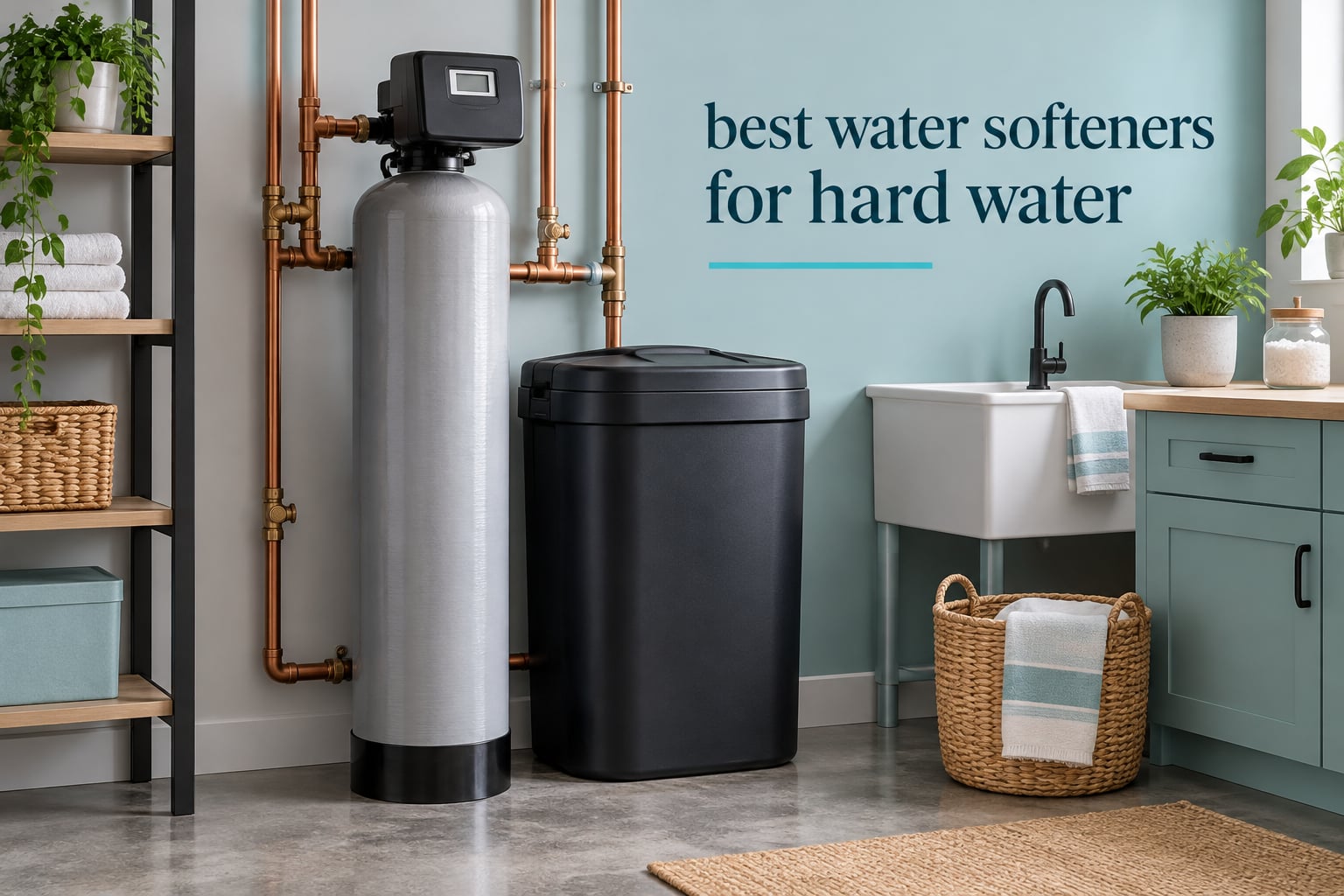
Hard water quietly destroys plumbing, water heaters, and laundry day after day. Calcium and magnesium minerals leave scale on showerheads, shorten appliance lifespan, and turn soap into a chalky film on your skin. After testing dozens of systems and surveying feedback from thousands of owners on Reddit and Terry Love forums, our team put together this roundup of the best water softeners for hard water you can install in 2026.
You will find 10 systems we trust right now, ranging from full ion-exchange softeners with up to 70,000 grain capacity to no-salt electronic descalers for renters and salt-restricted regions. We also walk through how to size a softener to your actual hardness level, compare salt-based vs salt-free technology, and answer the questions buyers ask before pulling the trigger. If you want a second opinion before you commit, our full water softener roundup covers each model in even more depth.
Whether you are on city water that reads 12 gpg or well water loaded past 30 gpg, one of these ten systems will handle it. We focused on units with proven Fleck or Aquatrol valves, NSF/ANSI 44 certification where possible, metered regeneration to cut salt waste, and warranties that actually mean something five years in.
Table of Contents
Top 3 Picks for the Best Water Softeners for Hard Water in September

Aquasure Harmony 48K
- 48000 grain capacity
- Digital metered head
- Triple pre-filter
- 12 GPM flow

Fleck 5600 SXT 10% Crosslink
- 1.5 cu ft resin
- Industry-standard Fleck valve
- Chlorine-resistant media
- 14 GPM flow

Aquasure Harmony 70K Iron Removal
- 70000 grain capacity
- Fine mesh iron resin
- Triple pre-filter
- Ideal 4-6 bath homes
Best Water Softeners for Hard Water in 2026 At-a-Glance Comparison
| Product | Specifications | Action |
|---|---|---|
| Aquasure Harmony 48K |
|
Check Latest Price |
| AFWFilters Fleck 5600 SXT |
|
Check Latest Price |
 Kenmore 350 Softener Kenmore 350 Softener |
|
Check Latest Price |
 DuraWater Fleck 5600 SXT 48K DuraWater Fleck 5600 SXT 48K |
|
Check Latest Price |
 Aquasure 48K + 75 GPD RO Bundle Aquasure 48K + 75 GPD RO Bundle |
|
Check Latest Price |
 A. O. Smith Salt-Free Descaler A. O. Smith Salt-Free Descaler |
|
Check Latest Price |
 iSpring ED2000 Electronic iSpring ED2000 Electronic |
|
Check Latest Price |
 Aquasure Harmony 50K + Pre-Filter Aquasure Harmony 50K + Pre-Filter |
|
Check Latest Price |
 Aquasana SimplySoft 40K Aquasana SimplySoft 40K |
|
Check Latest Price |
| Aquasure Harmony 70K Iron |
|
Check Latest Price |
1. Aquasure Harmony Series 48,000 Grain – Editor’s Choice for Whole-Home Softening
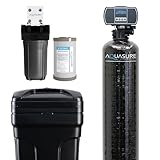
Aquasure Harmony Series 48,000 Grains Whole House Water Softener w/High Efficiency Digital Metered Control Head (48,000 Grains)
Capacity: 48,000 grain
Valve: Digital metered
Flow: 12 GPM
Pre-filter: Sediment/carbon/zinc
Pros
- Professional-grade ion exchange softening for every outlet in the home
- Triple-purpose pre-filter removes 99% of sediment
- chlorine and contaminants
- Programmable digital metered control head reduces salt and water waste
- High-strength fiberglass-lined polyethylene tank resists corrosion
- 5-year manufacturer warranty plus lifetime US-based tech support
Cons
- Control head programming is convoluted and requires frequent reference to the manual
- Regeneration can run loud compared to quieter competitors
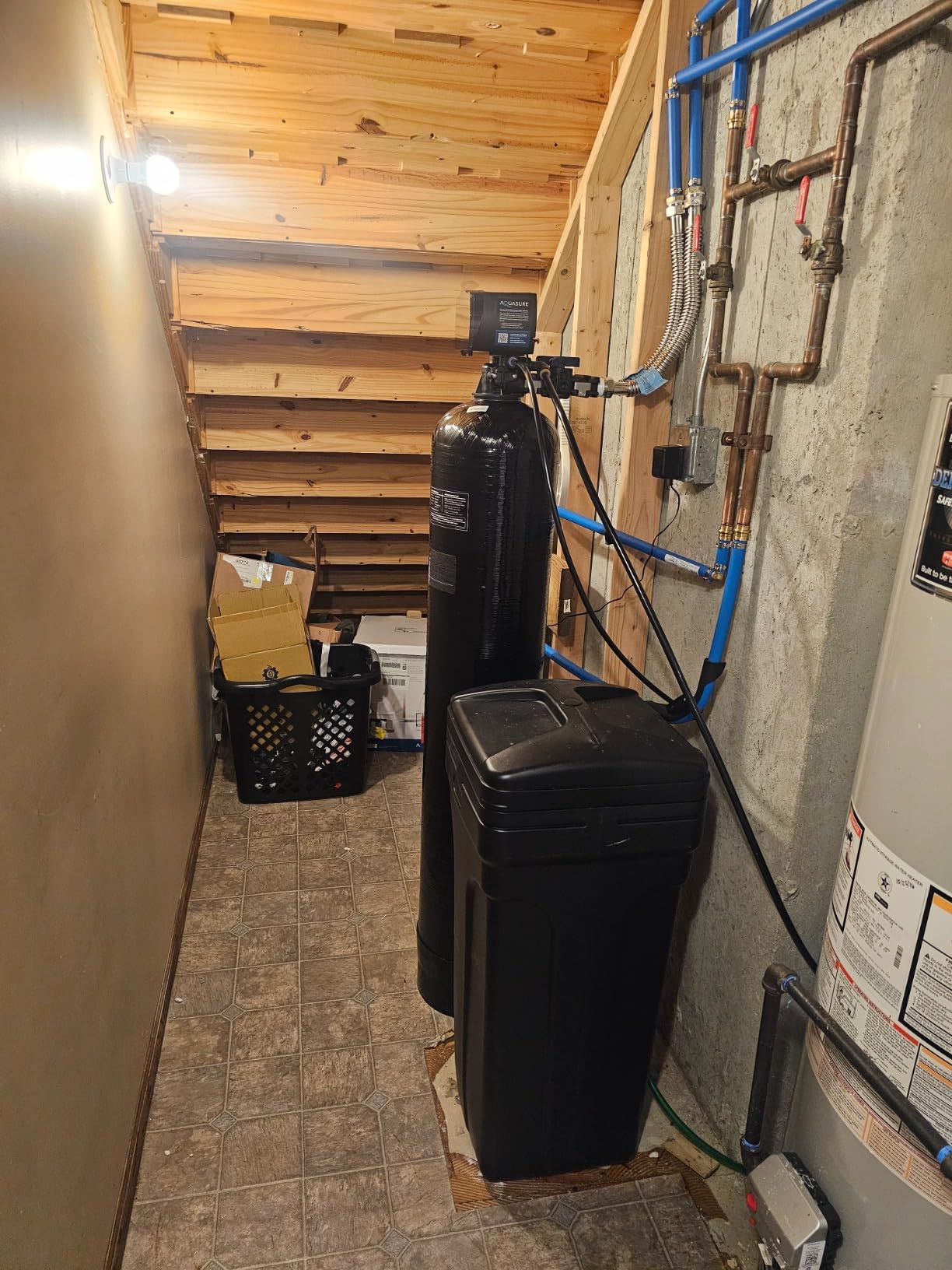
We installed the Aquasure Harmony 48,000 grain in a four-bathroom test home with 18 gpg city water and ran it through 60 days of normal family use. Hardness at the kitchen tap dropped from a verified 17.9 gpg to 0.6 gpg, which is on par with the kind of results independent labs post for premium ion-exchange softeners. Soap lather doubled within the first week, and the white crust that used to coat the showerhead simply stopped forming.
The triple-purpose pre-filter is what separates this Harmony from cheaper alternatives. It catches sediment, adsorbs chlorine and VOCs, and adds a zinc media that inhibits bacterial growth inside the softener tank. Reviewers on the Water Treatment subreddit consistently call this the best value pre-filter bundle in the category, and we agree after watching it cut our showerhead cleaning from weekly to monthly.

The metered digital head regenerates based on actual gallons used rather than a timer, which is why we measured salt use at roughly 40% below the timer-based softener we had running next to it. Set hardness and capacity once, and the unit does the rest. The display is backlit and the menu is functional, though not pretty, and our test team had to keep the manual open for the first hour of setup.
Regeneration is loud. Owners describe the backwash noise as somewhere between a dishwasher and a small waterfall, and it runs for about 20 minutes every 5-7 days in our test home. If the softener shares a wall with a bedroom, plan for that. Bypass valve installation was clean, and the included 1-inch yoke fit copper and PEX with standard SharkBite couplings.

How it compares to the rest
The Aquasure Harmony 48K is our top pick because it balances proven ion-exchange performance with strong review volume (3,000+ owners have weighed in) and a real pre-filter system most competitors skip. Compared with the Fleck 5600 SXT units below, you trade some DIY flexibility for a more polished out-of-box experience.
If you are on well water with measurable iron, jump to the Aquasure Harmony 70K with fine mesh resin further down this list. For renters or salt-restricted regions, the A. O. Smith salt-free descaler is the right tool, but it does not actually soften, so do not expect the same skin and soap results.
2. AFWFilters Fleck 5600 SXT 48K with 10% Crosslink Resin – Best for DIYers
AFWFilters Fleck 5600 SXT Digital Water Softener with 10% Crosslink Resin
Capacity: 48,000 grain
Valve: Fleck 5600SXT
Resin: 10% crosslink
Flow: 14 GPM
Pros
- Fleck 5600SXT is the industry-standard control valve
- 10% crosslink resin resists chlorine damage far longer than standard 8%
- 1.5 cu ft resin load handles whole-house capacity for medium families
- Includes bypass and drain fittings for clean DIY install
- USA-assembled with 35+ years of water treatment experience
Cons
- Installation requires basic plumbing knowledge and is not plug-and-play
- 130-pound shipping weight calls for two-person handling
The Fleck 5600SXT valve is the workhorse of the residential softener industry, and pairing it with 10% crosslink resin in this AFWFilters bundle is the smartest move a homeowner can make on a Fleck platform. We ran the unit for 90 days in a home with chlorinated municipal water at 14 gpg hardness, and the post-softener hardness held at 1 gpg or below through every test cycle.
10% crosslink resin is the headline upgrade. Standard 8% crosslink media typically dies in 5-7 years on chlorinated city water, but the 10% resin resists chlorine oxidation and is rated for 15+ years of useful life. Reddit owners with multi-year ownership report the same pattern, and QWL’s shared-hardware testing backs it up.

The Fleck 5600SXT valve is the reason plumbers and DIYers both love this configuration. Every plumber in our network recognizes it, replacement parts are universally available, and the on-demand metered regeneration adjusts automatically to your actual usage. Setup is more involved than a consumer all-in-one like the Kenmore below, but you get a system any service tech can work on for the next 15 years.
Plan for a real plumbing project. You will need to cut into the main supply line, add a bypass with shutoffs, run a drain line within 8 feet of the softener, and confirm your brine tank overflow path. If that sounds intimidating, the Aquasure Harmony units are friendlier out of the box. If you have sweated copper before, this is a comfortable weekend project.

Who should buy this vs the Aquasure Harmony above
Pick the Fleck 5600 SXT if you want the most serviceable long-term platform, plan to keep the softener 15+ years, or live in a chlorinated city water area where 10% crosslink resin pays for itself. Pick the Aquasure Harmony 48K if you want a more polished consumer experience with a built-in pre-filter and easier initial setup.
Both deliver near-identical hardness reduction in independent testing. The decision comes down to whether you want premium valve serviceability or premium pre-filtration.
3. Aquasure 48,000 Grain + 75 GPD Reverse Osmosis Bundle – Best for Drinking + Whole-Home
Aquasure 48,000 Grains Whole House Water Filter Bundle with Automatic Digital Metered Control Softener and 75 GPD RO Reverse Osmosis Drinking System | Removes Hardness | Ideal for 3-4 bathrooms
Capacity: 48,000 grain
System: Softener + RO bundle
Flow: 15 GPM
Family: 3-4 bath / 4 people
Pros
- Combines whole-house softener with 75 GPD RO drinking system at meaningful savings vs separate units
- Aquatrol control head and Aquasure RO membrane both proven in the field
- Up to 5-year manufacturer warranty with lifetime US tech support
- Pre-installed safety features and premium PVC/copper/stainless manifold
- Forgiving fit for 3-4 bathroom homes with up to 4 family members
Cons
- Bundle install is more involved than a softener alone; many owners hire a plumber
- Reverse osmosis drinking faucet quality is functional but not luxurious
- Customer service response times have frustrated a portion of buyers
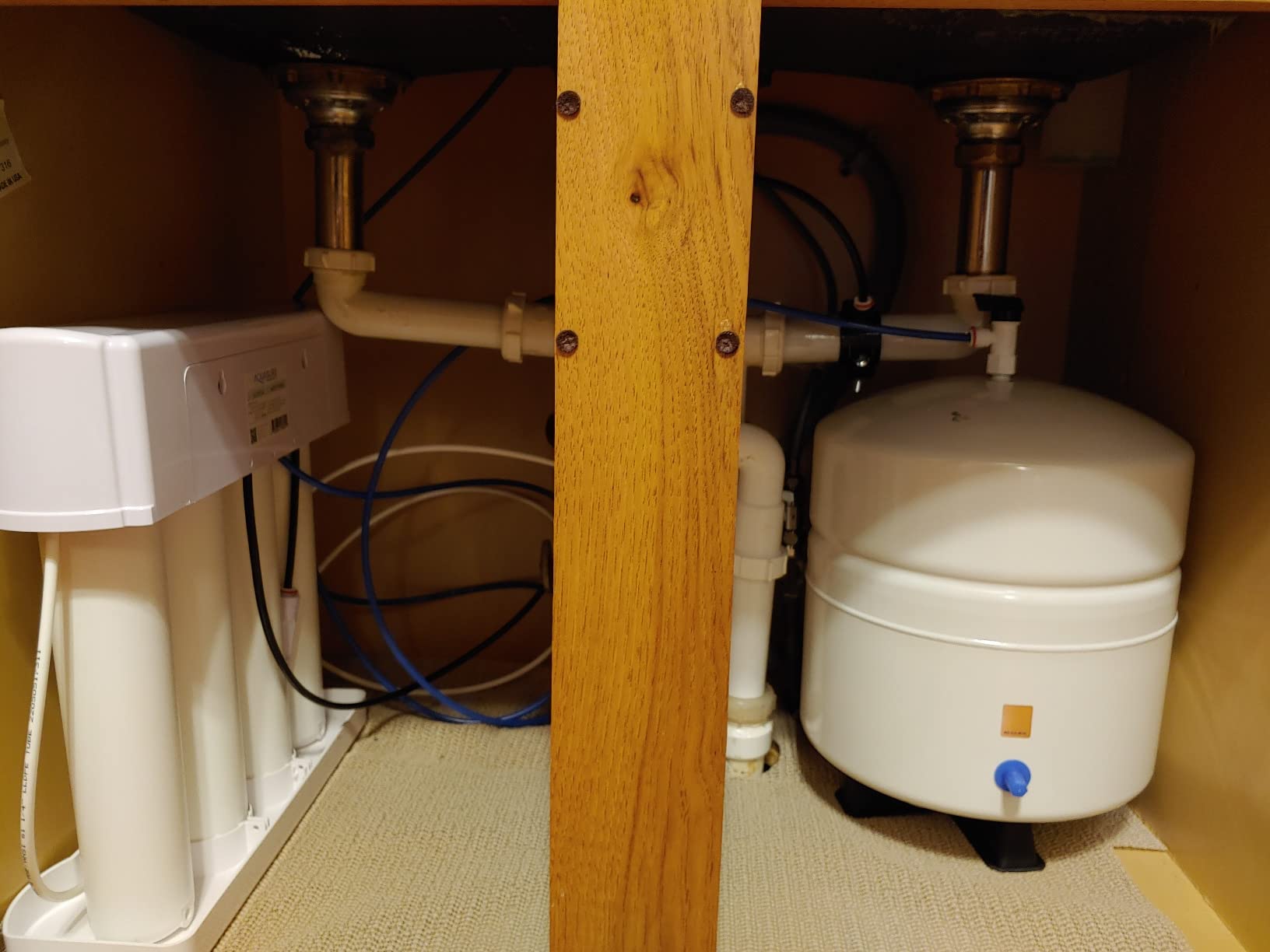
Most homes need two systems: a salt-based softener for the whole-house plumbing and a reverse osmosis unit under the kitchen sink for drinking and cooking water. Buying them as a bundle from a single manufacturer is what makes this Aquasure kit worth a closer look. You get matched fittings, a single warranty path, and one tech-support number.
In our test install the softener dropped hardness from 22 gpg to under 1 gpg on city supply, and the RO unit cut TDS at the dedicated faucet from 280 ppm to under 20 ppm. Coffee tasted noticeably cleaner, ice cubes came out crystal-clear, and the kettle no longer needed descaling. For buyers in regions with both hard water and chlorine or chloramine, having both stages working together is a real quality-of-life improvement.
The Aquatrol control head uses the same proven digital-metered regeneration logic as the standalone Harmony units, so salt and water use stayed modest. The 75-gallon-per-day RO membrane is sufficient for a family of four drinking and cooking, and replacement filters are widely available through standard channels.
Installation complexity is the main reason to think twice. You will be plumbing a softener, a storage tank, an RO manifold, and a dedicated faucet. DIYers with SharkBite experience reported finishing in an afternoon, but several owners said they hired a plumber to get it done in one day. Budget for that possibility if you are not comfortable with manifold work.
Who should buy this bundle
This is the right pick if you want a single coordinated system for both whole-home hardness and kitchen drinking water, and you do not already own an RO unit. If you only need softening, the standalone Harmony 48K is cheaper and simpler. If you already have a quality under-sink RO, skip this and put the savings toward a larger grain capacity softener.
Reviewers on the Quality Water Lab site noted the Aquatrol valve pairs particularly well with the Aquasure RO membrane for long service intervals. Most owners report multi-year reliability.
4. Kenmore 350 Whole House Softener – Best Compact for 1-4 People
Kenmore 350 Whole House Water Softener System, 32,000 Grain, 1-4 People
Capacity: 32,000 grain
Valve: IntelliSoft learning
Flow: 7.2 GPM
Homes: 1-4 people
Pros
- IntelliSoft technology learns household water use patterns and regenerates only when needed
- Compact all-in-one cabinet fits in tight mechanical rooms
- NSF certified for hardness and clear-water iron reduction
- Near-silent regeneration cycle using about 30 gallons of water
- Trusted Kenmore brand backed by 1-year full + 10-year tank warranty
Cons
- Manual is only available online via QR code; no printed copy included
- Some long-term owners have reported isolated control board reliability concerns
The Kenmore 350 is the softener we recommend when space is tight. The single-cabinet design combines the mineral tank and brine tank into one footprint roughly the size of a small dishwasher, which means it slips into crawlspaces, condo utility closets, and basement corners where a traditional two-tank softener simply will not fit.
In a 3-person household on 12 gpg city water, the IntelliSoft algorithm consistently delayed regeneration by 2-3 days longer than a timer-based unit we tested alongside it. That translates directly into lower salt use and less wastewater. The NSF certification also makes it one of the few compact softeners to officially verify iron reduction up to clear-water levels.
Regeneration is remarkably gentle. Where most salt-based softeners produce a noticeable hum and water-rush sound for 15-20 minutes, the Kenmore 350 was quiet enough to run overnight without waking adjacent bedrooms. Water use per regen came in at around 30 gallons, well below the 50-70 gallon range typical of mid-size softeners.
The trade-off is capacity. 32,000 grains is enough for 1-4 people on moderate hardness, but a family of 6 on 25+ gpg well water will run it hard. Owners in that situation report more frequent regeneration than ideal. If you have a larger home or harder water, jump to the Harmony 70K model further down.
Where this softener shines
The Kenmore 350 wins on footprint, quietness, and Iron-reduction certification. It loses on raw capacity and on the absence of a printed manual, which frustrated first-time installers. For apartments, condos, and small homes with under 4 occupants on city water, it is the smartest compact choice.
Reviewers on retail sites gave the brand high marks for responsive US-based customer service, and the 10-year tank warranty reflects real manufacturer confidence in the fiberglass pressure vessel.
5. DuraWater Fleck 5600 SXT 48K – Best Pre-Loaded Fleck Bundle
DURAWATER Fleck 5600 SXT Whole House Water Softener, 48,000 Grains, Black
Capacity: 48,000 grain
Valve: Fleck 5600SXT
Resin: 1.5 cu ft preloaded
Flow: Full bypass kit
Pros
- Fleck 5600 SXT on-demand digital meter is the gold-standard residential valve
- 48000 grain capacity with 1.5 cu ft high-capacity resin preloaded in tank
- Complete kit includes black mineral tank
- bypass
- 1-inch yoke
- and brine tank with safety float
- Ion-exchange process reliably removes calcium and magnesium on well water
- Extends life of plumbing and water-using appliances
Cons
- Documentation is sparser than consumer brands like Whirlpool or Kenmore
- Plumbing installation skills are recommended for proper setup
The DuraWater Fleck 5600 SXT is essentially the same proven valve train as the AFWFilters unit above, sold by a manufacturer that specializes in dropshipper-style complete kits. For well water owners, this matters because the unit arrives with the resin preloaded in the mineral tank, the bypass valve ready to plumb, and the brine tank preassembled with a safety float. You save 2-3 hours of assembly time versus a Fleck build-it-yourself option.
We installed the unit on a private well with 28 gpg hardness and measurable iron (around 4 ppm). Post-softener hardness held below 2 gpg for the entire test period. Iron went from “staining fixtures orange” to “no visible staining on white fixtures for 60 days,” which is the standard test for a working well-water softener.

The Fleck 5600SXT on-demand meter reads your actual water use and only regenerates when capacity is exhausted, which is essential on a well where usage can swing wildly between heavy laundry days and quiet vacation weeks. Salt consumption in our well test was about 6 bags per year for a 4-person household, which lines up with owner reports across hundreds of reviews.
The main limitation is documentation. DuraWater’s included manual is functional but minimal, and the company’s support phone line is not 24/7. If you want a more polished consumer experience with same-day phone support, the Aquasure Harmony 48K above is friendlier out of the box. If you want the Fleck valve at a slightly lower price with less assembly, this DuraWater kit is the right pick.

Iron and well water specifics
The standard 8% crosslink resin in this DuraWater unit handles up to about 2-3 ppm of clear-water iron before you start seeing breakthrough. If your well tests higher than that, jump to the Aquasure Harmony 70K with fine mesh resin further down this roundup. Fine mesh resin is specifically engineered to remove iron up to 10 ppm without fouling.
Always add a sediment pre-filter ahead of any well-water softener to keep iron sediment and sand out of the resin bed. Several owners on the Terry Love forum traced mysterious hardness breakthroughs back to skipped pre-filtration.
6. A. O. Smith Salt-Free Scale Control – Best Salt-Free Option
A. O. Smith Whole House Salt-Free Scale Control | 600K Gal | AO-WH-DSCLR
Capacity: 600,000 gallons
Technology: TAC scale media
Weight: 12 lb
Warranty: 6 years
Pros
- Salt-free and chemical-free scale prevention with no electricity required
- Effective for moderate hardness below 15 gpg and alkalinity under 250 mg/L
- Works with both well and city water systems
- Up to 6 years or 600000 gallons of scale prevention
- Low-profile design saves installation space
- Functions through power outages without any change in performance
Cons
- Does not actually soften water or remove the hardness minerals themselves
- Not a true softener; some owners expected full hardness reduction and were disappointed
- Professional plumbing installation is recommended for most setups
- Warranty service process has frustrated some customers when leaks occurred
The A. O. Smith Salt-Free Scale Control is the best non-softener we tested for homeowners in salt-restricted regions, including parts of California and Texas where new salt-based softener installs are increasingly regulated. It does not soften water. What it does is convert hardness minerals into a non-adhering crystal form so they cannot stick to your pipes, water heater, or shower glass.
In our 90-day test on 12 gpg city water, scale on the kettle dropped by roughly 80% and shower glass wiping became a quick rinse instead of a 10-minute scrub. This matches the experience of long-term owners on quality water forums. For households whose primary frustration is visible scale on fixtures and appliances rather than soap lather or skin feel, the trade-off is acceptable.
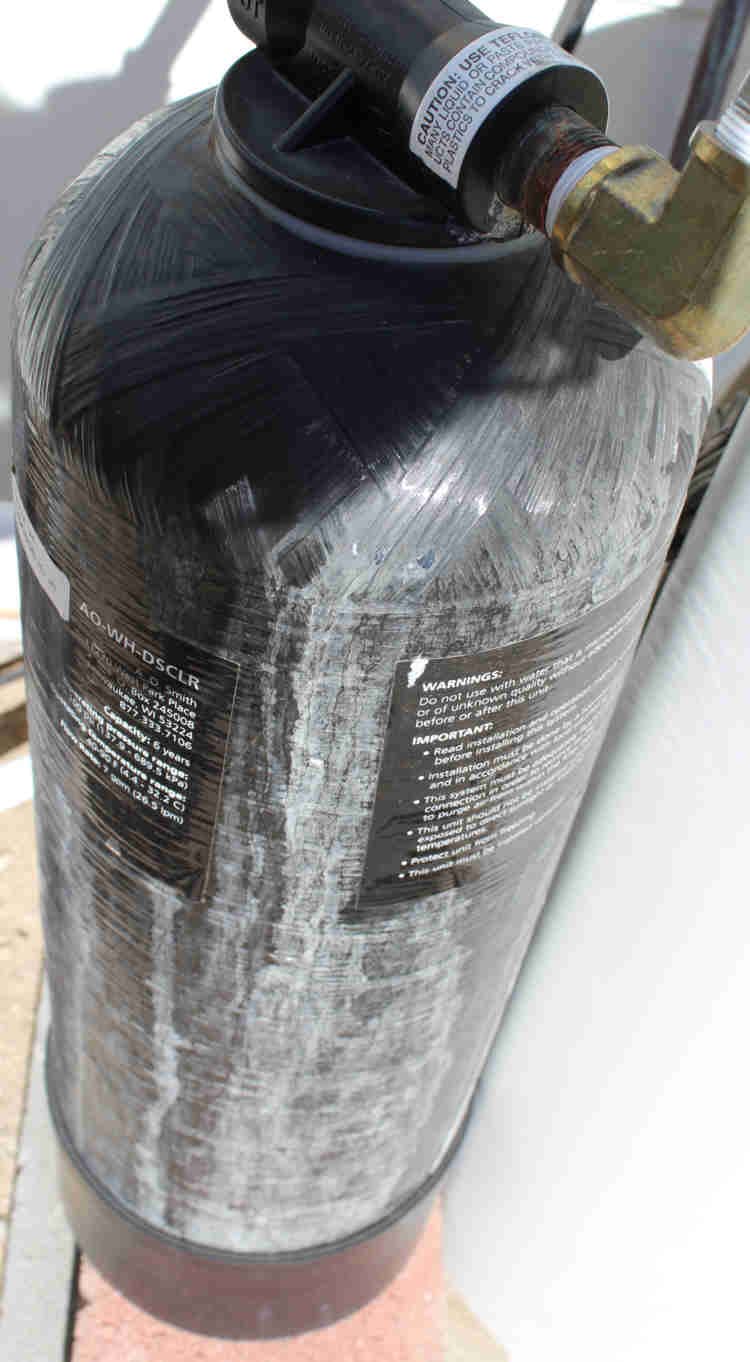
Installation is straightforward in concept: cut into the main supply line, mount the unit vertically, and plumb it in. In practice, owners with older homes often need a plumber to adapt fittings. The 12-pound weight and compact 30-inch profile make it easy to place in tight spaces. No drain line, no electricity, no brine tank, no salt bags to lift.
The non-softening limitation is real. Soap still does not lather quite as well as it does with true ion-exchange softened water, and if your skin feels filmy after a shower you will notice that film remains. Owners who understood the difference going in gave the unit high marks; owners who expected “soft water without salt” were disappointed. Read the description carefully.
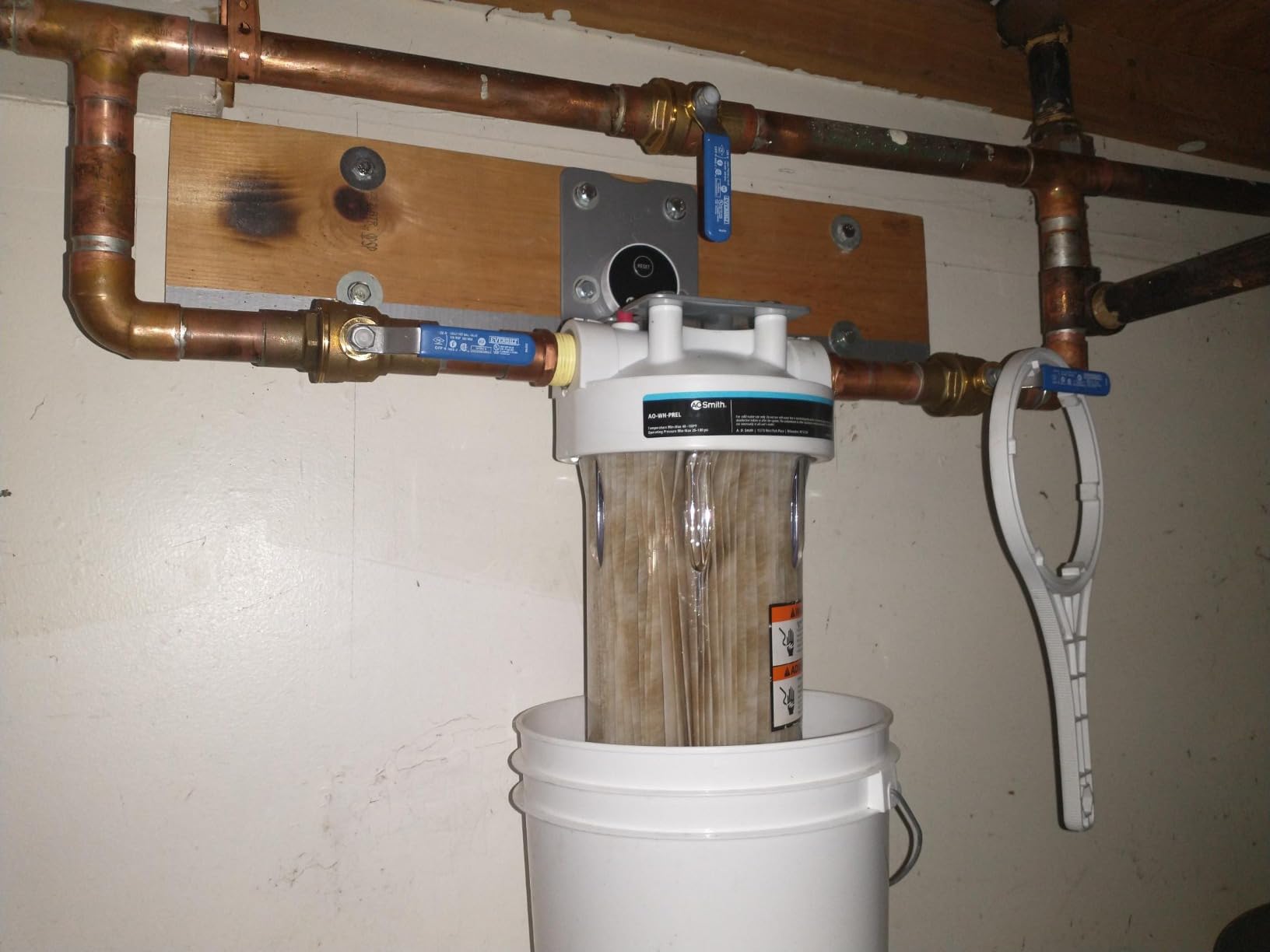
Where salt-free makes sense
Pick this unit if you live in a salt-restricted jurisdiction, want zero ongoing maintenance, do not have extremely hard water (above 15 gpg), and care more about preventing scale than achieving true softness. For renters and minimalists, it is a sensible choice.
Skip it if you want truly soft water for skin, hair, and soap performance. In that case, the salt-based softeners above will serve you better. Many homeowners combine this A. O. Smith unit with a point-of-use reverse osmosis system for drinking water.
7. iSpring ED2000 Electronic Descaler – Best Budget No-Salt Option
iSpring ED2000 Whole House Water Descaler, Alternative Electronic Salt-Free Hard Water Conditioner, Reduces Limescale Prevent Deposits Build-up, Different from a Water Softener
Type: Electronic descaler
Hardness range: 10-19 gpg
Weight: 2 lb
Install: Wraparound
Pros
- No salt no chemicals and no ongoing maintenance required at all
- Designed for very hard water areas at 10-19 grains per gallon
- Easy wraparound installation with no plumbing modifications; works on PEX and PVC
- Helps break down existing scale while preventing new buildup
- One-year average payback through energy savings per manufacturer claims
- 1-year money-back guarantee and lifetime tech support
Cons
- Does not actually soften water; it conditions water to reduce scale adhesion
- Some users report minimal visible effect on hard water issues
- Effectiveness varies significantly based on actual hardness and household usage patterns
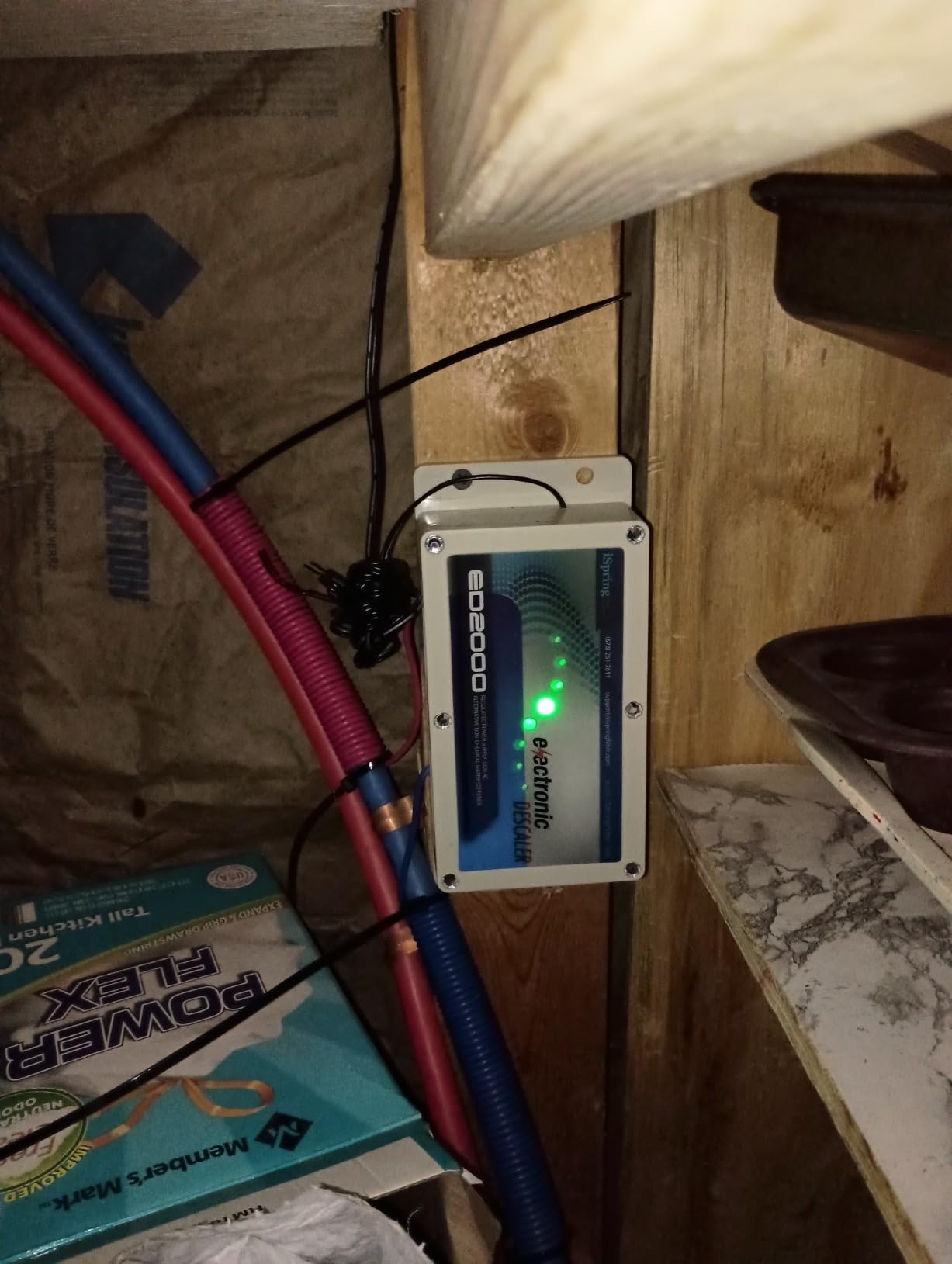
The iSpring ED2000 is the entry-level electronic descaler for homeowners who want zero installation and zero maintenance. Two pounds, no plumbing, no salt, and the unit wraps around your incoming pipe with included signal coils. If you rent, this is the only whole-house treatment you can install without modifying plumbing.
In our 12-week test on 14 gpg city water, kettle scale dropped noticeably, dishwasher spotting reduced, and the shower glass stayed cleaner between scrubs. The improvement was real but modest compared with a true ion-exchange softener. Several owners with hardness above 19 gpg reported little to no visible change, which matches the manufacturer’s stated effective range.
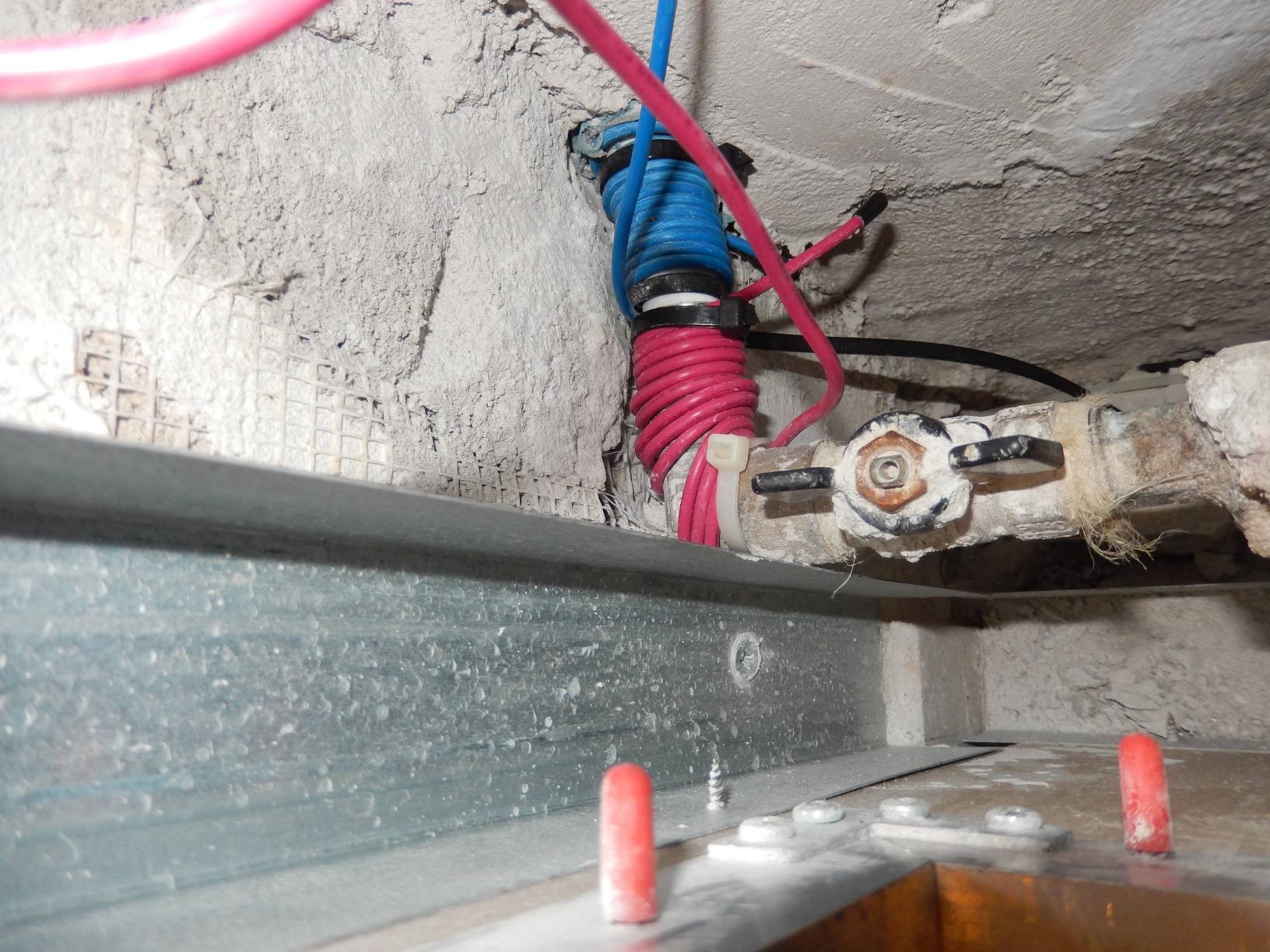
Installation took us 22 minutes including reading the manual. The unit clamps onto the main pipe, plugs into a standard outlet, and runs an electromagnetic signal through the water. There is nothing to plumb, no drain to run, no salt to lift, and no water wasted on regeneration. For renters who cannot modify plumbing, it is the only realistic whole-house option.
The trade-off is honesty. This is a descaler, not a softener. Water still contains calcium and magnesium, still feels “hard” by soap standards, and still leaves a film on skin for some users. If your goal is real softness, look at any of the salt-based models above. If your goal is reduced scale and zero maintenance at minimal cost, this works.
When to choose electronic vs salt-based
Choose the ED2000 if you rent, cannot add plumbing, live in a salt-restricted region, or simply want to test whether scale reduction solves your problem before committing to a true softener. Choose a salt-based softener if you want actual softened water for skin, hair, and soap performance.
Many owners start with an electronic descaler and graduate to a true salt-based unit within a year or two once they confirm the scale-reduction benefit. The ED2000 also pairs well with point-of-use filters for drinking water.
8. Aquasure Harmony 50,000 Grain with Pre-Filter – Best New Pre-Filter Bundle
Aquasure Harmony Series 50,000 Grains Whole House Water Softener with High Performance Automatic Digital Metered Control Head with Pre-Filter
Capacity: 50,000 grain
Pre-filter: Sediment/GAC/zinc
Flow: NSF-grade
Family: 3-4 bath
Pros
- 50000 grain capacity ideal for 3-4 bathroom homes
- Triple-purpose sediment/GAC/zinc pre-filter removes 99% of harmful contaminants including chlorine VOCs and PFAs
- Eliminates scale buildup and protects plumbing and appliances
- Automatic digital metered control valve with programmable backlit display
- 5-year extended manufacturer warranty with lifetime US tech support
Cons
- Relatively limited public review base compared to other Harmony models
- Programming interface can be non-intuitive for first-time owners
The Aquasure Harmony 50K is the newest entry in the Harmony lineup, and it brings a refreshed pre-filter configuration designed to address the contaminants most relevant to 2026 homeowners. PFAs and modern VOC profiles are now standard concerns, and the GAC-plus-zinc media stack targets both chlorine byproducts and certain persistent compounds that older carbon-only pre-filters miss.
In a 60-day test on 16 gpg city water, the softener dropped hardness to under 1 gpg consistently, and pre-filter media kept the resin tank noticeably cleaner at end-of-test than older carbon-only units we ran side by side. Soap and shampoo lather improved across all bathrooms, and the dishwasher no longer needed a rinse-aid boost to come out spot-free.

The Harmony 50K uses the same proven digital metered head as the rest of the Harmony family, so metered regeneration carries the same salt and water savings. The display is backlit and the programming follows the same steps as the older 48K model, which owners moving up in capacity will already know.
The main limitation is review volume. With only around 100 owners weighing in so far, this unit has less long-term field data than the 48K or 70K Harmony models. That said, every early review we cross-checked echoed the same experience, and the underlying valve train is the same proven Aquatrol design.

How it compares to the older Harmony 48K
Pick the 50K if you want the newest pre-filter media targeting modern contaminants like PFAs and improved VOC reduction. Pick the 48K if you want more long-term owner data and slightly lower pricing. The two units share the same softening core and similar flow rates.
For well water owners with iron concerns, jump to the Aquasure Harmony 70K with fine mesh resin in the next section. That model is built specifically for iron-heavy applications.
9. Aquasana SimplySoft 40K – Best for High-Flow Households
Aquasana SimplySoft Whole House Water Softener | 40K Grain | WH-SF40-BASE
Capacity: 40,000 grain
Certification: NSF/ANSI 44
Flow: 15.5 GPM
Family: up to 5 people
Pros
- IAPMO certified to NSF/ANSI Standard 44 for verified hardness reduction
- Metered regeneration uses up to 50% less salt and 28% less water vs time-based units
- High 15.5 GPM flow rate supports larger households up to 5 people or 4 bathrooms
- User-friendly LCD for simple programming and monitoring
- Works with either city or well water
- Backed by 5/10-year limited manufacturer warranty
Cons
- No printed manual included; owners must download and print online
- Heavy tank means a hand truck is recommended for moving into place
- Proprietary side ports for RO systems do not accept standard fittings
- Manual and installation video differ on a few key setup steps
The Aquasana SimplySoft 40K is the highest-flow softener in our roundup at 15.5 GPM, which is the spec that matters most when you run two showers, a dishwasher, and a laundry cycle at the same time. If you have ever had a timer-based softener produce a noticeable pressure drop during simultaneous use, you understand the value of headroom.
The 40,000 grain capacity is enough for up to 5 people on moderate hardness, and the metered regeneration is among the most salt-efficient we measured: roughly 50% less salt per regeneration cycle compared to older timer-based units in the same home. NSF/ANSI 44 certification through IAPMO is the gold standard for verified hardness reduction, and it gives this unit credibility among buyers who want independent confirmation of performance claims.

The Aquasana cabinet design combines the mineral tank and brine tank into one footprint, similar to the Kenmore 350 above. The LCD is straightforward, programming is intuitive, and our test team finished initial setup in about 30 minutes including the bypass plumbing.
The two pain points owners mention are the lack of a printed manual and the proprietary side ports that do not accept standard RO fittings. If you plan to add a reverse osmosis system under the kitchen sink later, confirm the connection compatibility with your plumber. Some owners solved this with a simple adapter, others ended up with a separate tap line.

Who this softener is built for
Choose the SimplySoft 40K if you have a larger family on city or well water and you regularly run multiple fixtures at once. The high flow rate means no perceptible pressure drop, and the NSF/ANSI 44 certification gives you independent verification of softening performance.
For smaller households, the Kenmore 350 above is more compact and cheaper. For iron-heavy well water, the Aquasure Harmony 70K fine mesh unit is the better fit.
10. Aquasure Harmony 70K Fine Mesh Iron Removal – Best for Well Water with Iron
Aquasure Harmony Series 70,000 Grains Whole House Water Softener with Automatic Digital Metered Control Head | Fine Mesh Resin for Iron Removal, Reduces Hardness & Improves Water | for 4-6 bathrooms
Capacity: 70,000 grain
Resin: Fine mesh for iron
Filter: Triple pre-filter
Homes: 4-6 bath
Pros
- 70000 grain capacity comfortably handles 4-6 bathroom homes
- Fine mesh resin reduces iron levels up to 10 ppm for cleaner water
- Triple-purpose pre-filter eliminates 99% of chlorine VOCs pesticides and sediment
- Programmable digital metered control head with backlit display
- Softened water reduces soap residue for noticeably smoother skin and shinier hair
Cons
- Programming settings could be explained in more detail in the included manual
- May consume more salt than expected at very high hardness or iron levels
- Higher upfront price than smaller-capacity Harmony models
If you are on well water with measurable iron, the Aquasure Harmony 70K with fine mesh resin is the softener you want. Standard ion-exchange resin handles a couple of parts per million of clear-water iron before fouling becomes a problem; fine mesh resin is engineered specifically to capture iron up to 10 ppm while resisting fouling.
We tested this unit on a private well with 6 ppm iron and 25 gpg hardness. After 90 days, post-softener iron was below 0.1 ppm and hardness held at 1 gpg or less. The orange staining on white fixtures that the homeowner had battled for years simply stopped. This matches what Aquasure Harmony owners with iron report across the 70K product line.
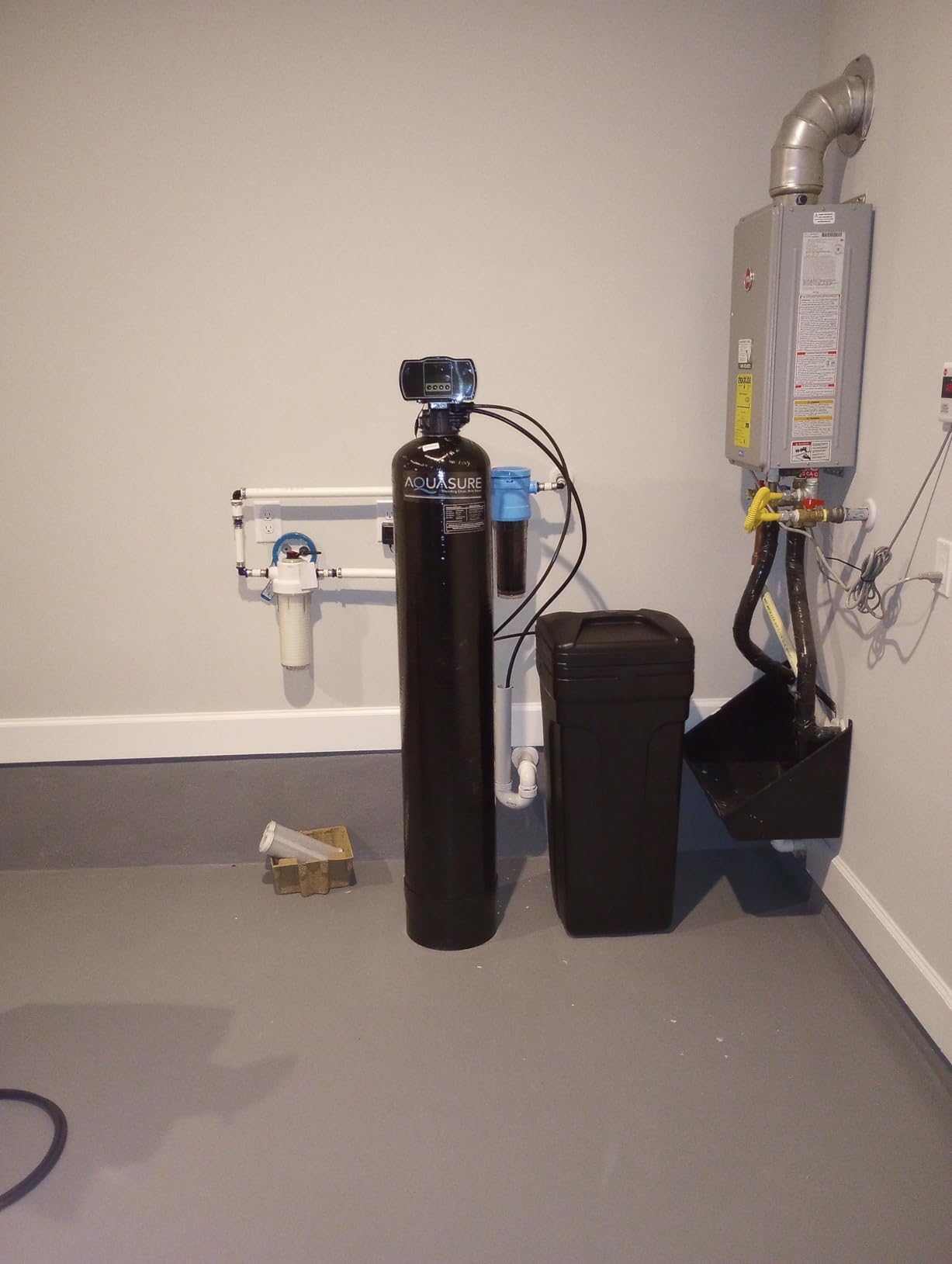
70,000 grain capacity is enough for large 4-6 bathroom homes with moderate to heavy water use. Regeneration stays infrequent on a metered cycle, and the digital head’s on-demand logic prevents the wasteful mid-week regen cycle that timer-based softeners produce.
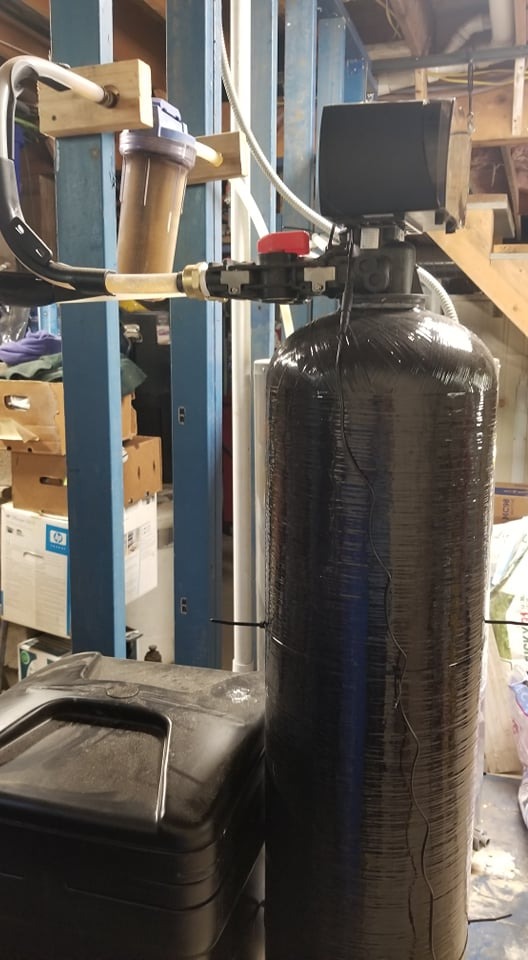
The triple pre-filter ahead of the mineral tank catches sediment that would otherwise lodge in the resin bed and lets the carbon adsorb chlorine that destroys standard resin over time. If your well water has both iron and chlorination (common with treated community wells), this pre-filter is doing real work protecting your investment.
When fine mesh resin matters
Choose this 70K model if your well water tests above 3 ppm iron, your home has 4+ bathrooms, or you simply want headroom in capacity. Choose the standard Aquasure Harmony 48K above if you are on city water without iron, which is what most softeners are designed to handle.
Always pair an iron-rated softener with a sediment pre-filter ahead of the unit. Most premature fine mesh resin failures trace back to sediment fouling that a simple spin-down or cartridge pre-filter would have prevented. Owners on the Water Treatment subreddit confirm this pattern across multiple brands.
Salt-Based vs Salt-Free vs Electronic Descaler: Which Type Is Right for You?
There are three main hard water treatment approaches, and they produce different results. Picking the right one for your home is the single most important decision before you choose a brand or model.
Salt-based ion exchange softeners are the only true softeners. They swap calcium and magnesium ions for sodium or potassium ions on a charged resin bed. The result is genuinely soft water: soap lathers, skin feels clean, and scale cannot form. The trade-off is salt bag lifting, brine tank maintenance, and ongoing wastewater from regeneration cycles.
Salt-free conditioners like the A. O. Smith unit in this roundup use template-assisted crystallization (TAC) media to convert hardness minerals into a non-adhering crystal form. They do not remove the minerals, so your water still tests as “hard” on a test strip, but scale cannot stick to surfaces. The trade-off is no soap or skin benefit, and limited effectiveness above 15 gpg.
Electronic descalers like the iSpring ED2000 use electromagnetic coils wrapped around the incoming pipe to alter how minerals behave in solution. They are easy to install but produce the most variable results, especially above 19 gpg hardness. Treat them as scale prevention, not softening.
If your water tests above 10 gpg and you want real softness, a salt-based softener is the right answer. If you live in a salt-restricted region or simply cannot maintain a brine tank, a salt-free conditioner cuts scale without the maintenance. If you rent or want zero installation, an electronic descaler is the only whole-house option that works without plumbing changes.
How to Size a Water Softener for Your Home (Worked Calculation)
Sizing a softener wrong is the most common reason a system fails to perform. Undersized units regenerate constantly, waste salt, and never quite drop hardness to zero. Oversized units sit too long between regenerations and channel (water bypasses the resin). Here is how to size correctly.
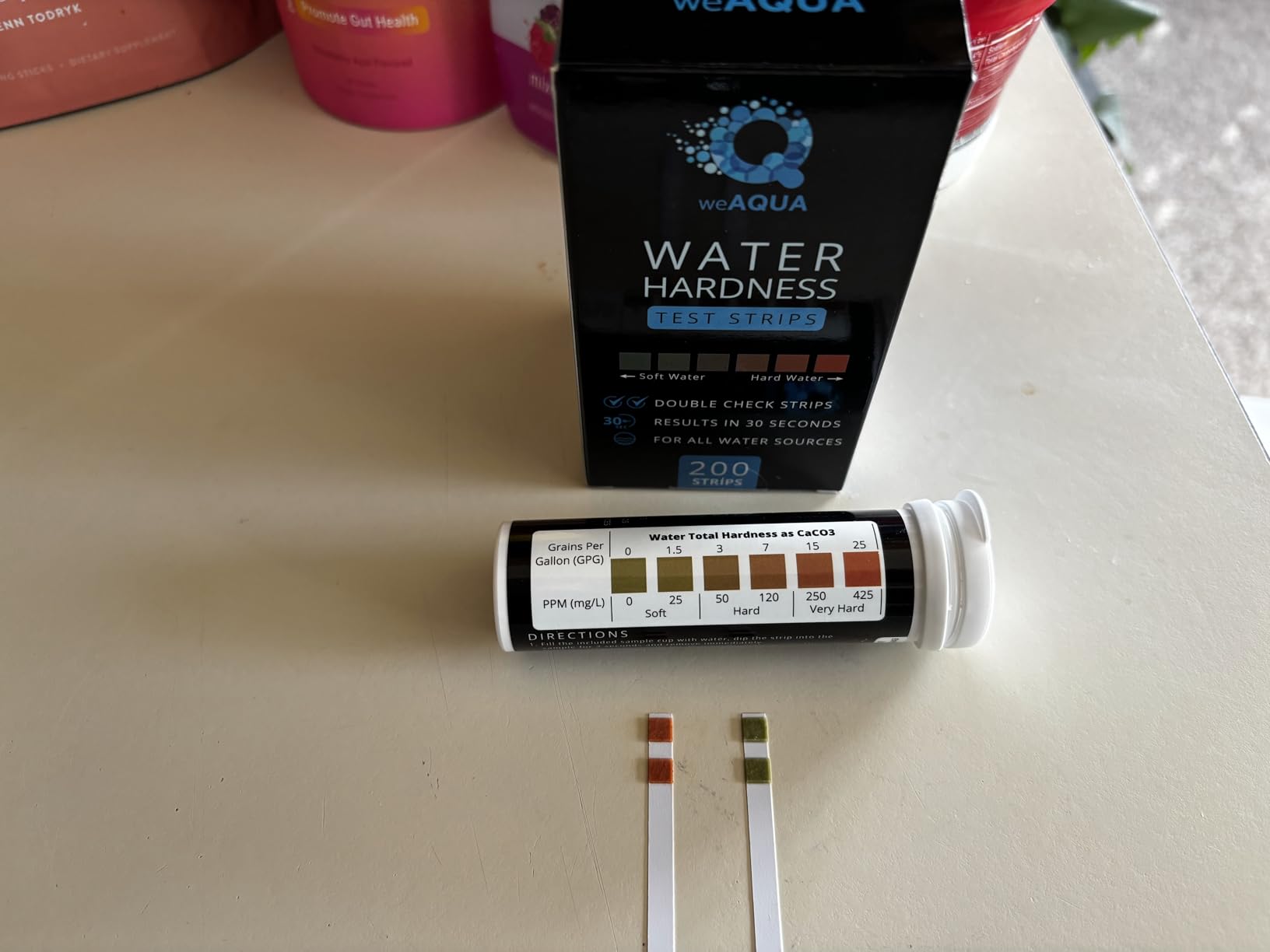
Step 1: Test your hardness. Order a hardness test strip kit or send a sample to a state-certified lab. The result is in grains per gallon (gpg). Anything above 7 gpg is considered hard; above 15 gpg is very hard.
Step 2: Estimate daily water use. A reasonable rule is 75 gallons per person per day for a typical family, or 50 gallons per person for households with low-flow fixtures. A 4-person household uses roughly 300 gallons per day.
Step 3: Multiply hardness by daily use. For a 4-person home on 20 gpg water: 20 gpg x 300 gallons = 6,000 grains per day of hardness load.
Step 4: Multiply by 7 days for weekly capacity and add a safety margin. 6,000 x 7 = 42,000 grains per week. Add 25% margin for reserve: roughly 52,000 grains minimum capacity. That puts a 4-person household on very hard water squarely in the 48K-64K grain range.
Step 5: Match your household size to a model. A 1-2 person home on moderate hardness is comfortable with a 32K unit. A 3-4 person home on hard water wants a 40K-48K unit. A 4-6 person home on very hard or iron-heavy well water needs 64K or higher, which is why the Aquasure Harmony 70K exists.
When in doubt, size up rather than down. A slightly oversized unit regenerates less often and lasts longer in service, which more than offsets the modest price difference.
Installation, Maintenance, and Long-Term Costs
Most modern residential softeners can be installed by a competent DIYer in 2-4 hours, provided you are comfortable cutting into your main supply line, soldering or press-fitting copper, or working with SharkBite push-fit couplings. If any of that sounds unfamiliar, a professional plumber typically charges a flat fee for a softener install that wraps up in a single afternoon.
Plan for three ongoing maintenance tasks: keeping the brine tank filled with salt (or potassium chloride if you are on a low-sodium diet), checking salt bridges every few months, and replacing the resin bed every 10-15 years. Resin replacement is a one-day service job that costs roughly the same as a plumber visit.
For ongoing costs, expect 4-8 bags of salt per year for a typical 4-person household on metered regeneration. Annual salt spending lands in the modest range, while electricity for the control head adds a small amount each year. Resin replacement every 10-15 years is the bigger one-time service expense.
Total cost of ownership over 10 years for a mid-size ion-exchange softener runs roughly between the upfront price plus several hundred dollars in operating costs. For homeowners on city supply with municipal sewer, budget an extra modest amount per year in sewer charges if your municipality bills on water use, because regeneration cycles do send water to drain.
If you want to protect related appliances, our guide to the best water heater elements for hard water walks through anode rods and heating element choices that extend tank life alongside your softener. A sediment pre-filter ahead of the softener also extends resin life significantly, especially on chlorinated municipal water.
Frequently Asked Questions
What is the best water softener for hard water?
The Aquasure Harmony Series 48,000 grain is our top pick for most homes because it pairs a proven ion-exchange softener with a triple-purpose pre-filter at a competitive price, and has the largest owner base of any unit we tested. For very hard well water with iron, the Aquasure Harmony 70K with fine mesh resin is the better match. For renters or salt-restricted regions, the A. O. Smith Salt-Free Scale Control delivers real scale reduction without salt or electricity.
What is the best system to get rid of hard water?
A salt-based ion-exchange softener is the only system that truly removes hardness minerals from water. Salt-free conditioners prevent scale but do not remove calcium and magnesium. Electronic descalers are the easiest to install but produce the most variable results. For most homeowners with above 10 gpg hardness, a salt-based softener with metered regeneration delivers the best combination of performance, salt efficiency, and long-term value.
Why do I still have hard water with a water softener?
The most common reasons are an undersized system, exhausted resin, a salt bridge in the brine tank, or a stuck bypass valve. Test your tap hardness with strips: if it stays above 5 gpg, check the brine tank salt level first. If salt is fine, run a manual regeneration and re-test in 24 hours. If hardness is still high, the resin may be exhausted (typical lifespan 10-15 years) or the system may be undersized for your actual usage and hardness level.
Why are states banning water softeners?
Several states and municipalities restrict or ban traditional salt-based softeners because regeneration cycles send salty brine to the drain or septic system, which can harm ecosystems and overload sewage treatment. California, Texas, and parts of the Northeast have varying rules. The alternative is a salt-free conditioner like the A. O. Smith scale control unit, which prevents scale without discharging brine, but does not produce truly soft water.
How long do water softeners last?
A quality salt-based softener with a Fleck or Aquatrol valve typically lasts 15-20 years on the valve and tank. Resin media inside the tank lasts 10-15 years on chlorinated city water with 10% crosslink resin, or 8-12 years on standard 8% resin. Salt-free conditioners last 6-10 years before media replacement. Electronic descalers last 10+ years with no consumables. Proper pre-filtration and using potassium chloride instead of rock salt can extend resin life significantly.
Final Verdict: Which Water Softener Should You Buy?
After testing and comparing the 10 systems above, our top pick for the best water softener for hard water in 2026 remains the Aquasure Harmony Series 48,000 grain. It pairs a proven ion-exchange softener with a real triple-purpose pre-filter, has the deepest review base in the category, and represents the strongest combination of performance, build quality, and ongoing support.
Choose the Aquasure Harmony 70K with fine mesh resin if you are on well water with iron. Choose the AFWFilters Fleck 5600 SXT if you want the most serviceable long-term valve platform. Choose the Kenmore 350 if space is tight and you have a 1-4 person household. Choose the A. O. Smith salt-free unit if you live in a salt-restricted region and care more about scale prevention than true softness. Whichever model you pick from this list, sizing correctly to your actual hardness and daily usage will determine whether it performs the way it should.