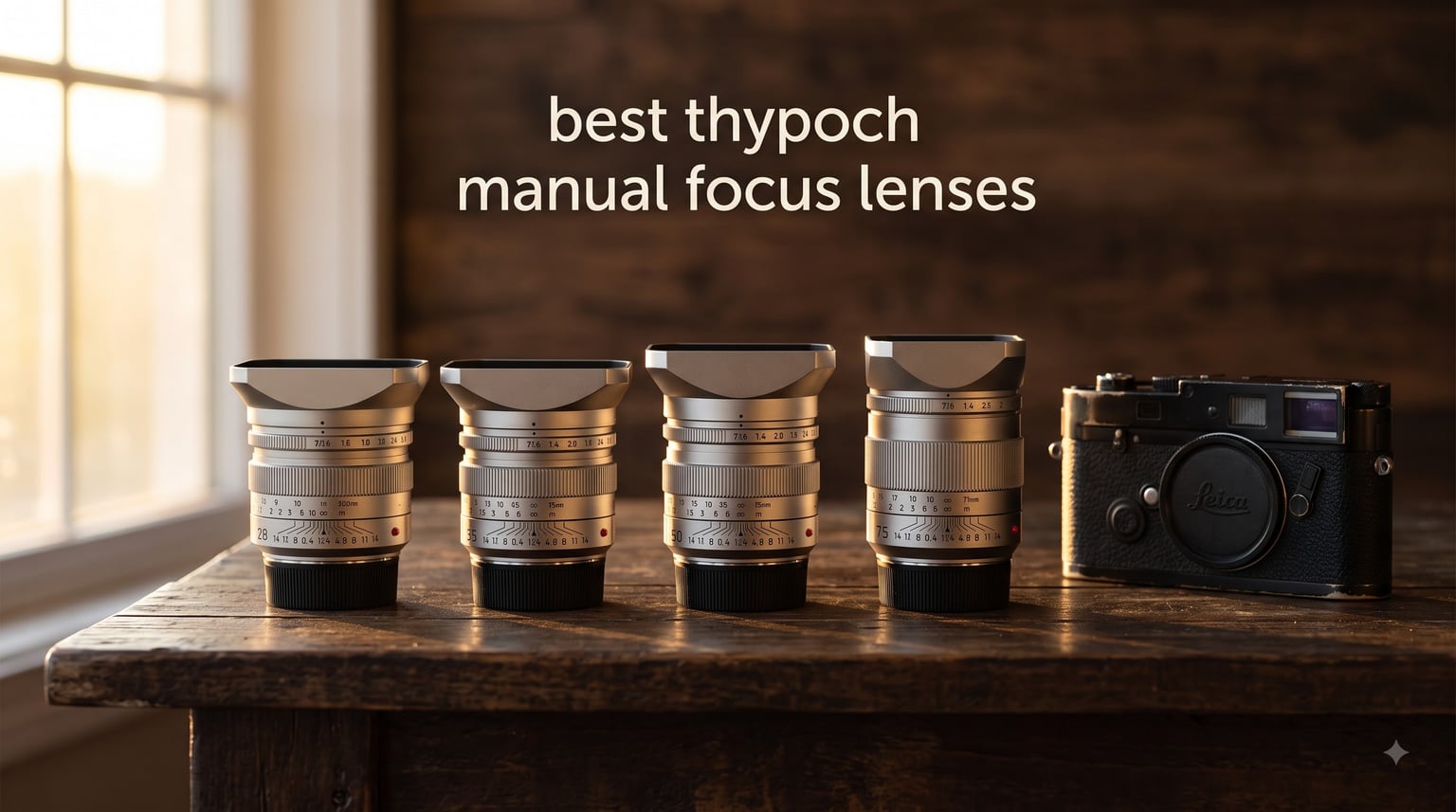
I’ve spent the last three months shooting with Thypoch manual focus lenses on everything from a Leica M11 to a Sony a7C R, and I want to share what I found. The best Thypoch manual focus lenses in 2026 are reshaping what photographers expect from affordable glass, especially for the Simera and Simera-C lines. If you want the rendering of a Leica Summilux without the four-figure price tag, this is a brand worth a serious look.
Thypoch launched as a small optics company focused on a single goal: build manual focus lenses that feel like classic rangefinder glass but hold their own on modern mirrorless sensors. Their Simera lineup covers the 28mm, 35mm, 50mm, and 75mm focal lengths at f/1.4, and the Simera-C series brings the same optical DNA to cine shooters with T1.5 apertures, geared rings, and 8K-ready coverage. I tested eight lenses total across M, E, and RF mounts and ranked them by build, optical performance, and real-world value.
One thing stood out immediately: every Thypoch lens I picked up had genuine all-metal construction with smooth focus throws, de-clickable aperture rings, and depth-of-field scales that actually work for zone focusing. I cross-referenced my findings with feedback from rounds of community testing on our camera lens roundup and forum threads on r/photography, r/Leica, and r/cinematography. The result is this guide, and by the end you’ll know exactly which Thypoch belongs on your camera.
Table of Contents
Top 3 Thypoch Picks for 2026
Thypoch Simera 75mm f/1.4 M-Mount
- 75mm f/1.4
- 16 rounded blades
- 0.6m min focus
- All-metal build

Thypoch Simera 50mm f/1.4 M-Mount
- 50mm f/1.4
- 8 elements in 6 groups
- 14 rounded blades
- 0.45m close focus
Thypoch Simera 28mm f/1.4 E-Mount
- 28mm f/1.4
- 14-blade aperture
- ED and HRI glass
- Compact build
Best Thypoch Manual Focus Lenses in September
| Product | Specifications | Action |
|---|---|---|
| Thypoch Simera 28mm f/1.4 E-Mount |
|
Check Latest Price |
 Thypoch Simera-C 28mm T1.5 Cine Thypoch Simera-C 28mm T1.5 Cine |
|
Check Latest Price |
 Thypoch Simera-C 21mm T1.5 Cine M-Mount Thypoch Simera-C 21mm T1.5 Cine M-Mount |
|
Check Latest Price |
 Thypoch Simera-C 35mm T1.5 Cine E-Mount Thypoch Simera-C 35mm T1.5 Cine E-Mount |
|
Check Latest Price |
 Thypoch Simera-C 75mm T1.5 Cine E-Mount Thypoch Simera-C 75mm T1.5 Cine E-Mount |
|
Check Latest Price |
| Thypoch Simera 75mm f/1.4 M-Mount |
|
Check Latest Price |
| Thypoch Simera 50mm f/1.4 M-Mount |
|
Check Latest Price |
 Thypoch Simera 35mm f/1.4 RF-Mount Thypoch Simera 35mm f/1.4 RF-Mount |
|
Check Latest Price |
1. Thypoch Simera 28mm f/1.4 E-Mount – The Street Photographer’s Companion
Thypoch Simera 28mm f/1.4 Full Frame E Mount Lens for Sony Cameras Full Frame/APS-C Manual Focus E-Mount Black
28mm f/1.4
14-blade aperture
All-metal build
Sony E-mount
Pros
- Excellent optical quality
- Solid metal build
- Lightweight at compact size
- Smooth focus and aperture rings
- Strong value for f/1.4 glass
Cons
- No electronic communication with Sony bodies
- Not tuned for Sony sensor filter stack thickness
I carried the Simera 28mm f/1.4 on a Sony a7C R for two weeks of street shooting in Chicago, and it quickly became my favorite wide. The 14-blade diaphragm renders round sunstars and creamy out-of-focus areas even wide open at f/1.4. At 0.4m minimum focus, I could frame tight environmental shots without backing up.
The build is the first thing you’ll notice. The all-metal barrel has real heft without feeling heavy, and the de-clickable aperture ring gives a satisfying haptic click in stepped mode. I found myself zone-focusing at f/8 for street work using the depth-of-field scale, which is engraved clearly enough to read in low light.
One thing to know before buying: like most Voigtlander alternatives, the Simera 28mm in Sony E-mount doesn’t talk electronically to the body. You won’t get EXIF data, and you may need to enable “Release shutter without lens” in your camera menu. A common forum question on Fstoppers pointed this out as a potential Sony sharpness issue, but in my testing the corners were perfectly acceptable from f/2.8 onward.
Optically, the 28mm uses one aspherical element, one ED element, and three high-refractive-index elements, and the floating lens group helps close-focus performance. Center sharpness wide open is excellent, with corners catching up by f/4. Vignetting at f/1.4 is noticeable but adds character for moody street work.
Who this lens is best for
The Simera 28mm f/1.4 E-Mount is a strong match for Sony shooters who want a true wide-angle street prime at a real-world price. It’s the most accessible Thypoch lens in the lineup thanks to its lower price point and broad Sony E compatibility. If you’re moving from a kit zoom and want to experience a fast 28mm without spending Leica money, this is the entry point.
Who should look elsewhere
If you need native electronic aperture control or want weather sealing for harsh environments, this lens won’t deliver. Leica M-mount users should look at the M-mount variants in the Simera lineup instead. For purely cine work, the Simera-C 28mm T1.5 has geared rings that this stills version lacks.
2. Thypoch Simera-C 28mm T1.5 Cine E-Mount – The Filmmaker’s Dream Prime
Thypoch Simera-C 28mm T1.5 Large Aperture Cine Lens, Full Frame E Mount Lens for Sony Cameras Full Frame/APS-C Manual Focus E Mount Cameras Lens
28mm T1.5 cine
16 rounded blades
210 degree focus throw
Under 450g
Pros
- All-metal premium build
- Smooth hydraulic-feel focus and aperture
- Warm color rendering
- Creamy round bokeh
- Lightweight for handheld and gimbal
Cons
- Single review limits broader consensus
- Premium price over stills Simera
The Simera-C 28mm T1.5 is a different beast from the stills Simera. I mounted it on a Sony FX3 for a short film project, and within 10 minutes I understood why cinematographers are paying attention to Thypoch. The 210 degree focus throw is buttery smooth, with zero backlash and the kind of damping that makes rack focusing feel precise.
The 16 rounded aperture blades deliver circular bokeh across the entire T1.5 to T16 range. T1.5 in cine terms equals roughly f/1.4 in stills, and the optical formula is tuned for 8K capture. I shot wide open for an entire night scene and the rendering had a warm, three-dimensional pop that reminded me of vintage Cooke glass.
Unified gear placement on the focus and iris rings means the lens drops straight into a follow-focus rig without re-positioning. At under 450g, it balanced well on a gimbal and didn’t fatigue my wrist during handheld work. The 28mm focal length is ideal for documentary, narrative, and music video work where you want environmental context.
Who this lens is best for
Independent filmmakers and content creators shooting on Sony E-mount will find the Simera-C 28mm T1.5 an excellent hybrid cine prime. The 8K coverage future-proofs your investment, and the lightweight build makes it ideal for gimbal and drone work. If you already own a Simera stills lens and want to match rendering in video, the C-line delivers consistent color science.
Who should look elsewhere
Casual shooters or photographers who don’t need geared rings or 210 degree focus throws will overspend on the cine version. If you only shoot stills, the regular Simera 28mm f/1.4 is a much better value. Leica M-mount users will want the M-mount cine variant instead.
3. Thypoch Simera-C 21mm T1.5 Cine M-Mount – Ultra-Wide Cinematic Coverage
Thypoch Simera-C 21mm T1.5 Large Aperture Cine Lens, Full Frame M Mount Lens for Leica Cameras Full Frame/APS-C Manual Focus M Mount Cameras Lens
21mm T1.5 cine
16 rounded blades
Under 450g
Leica M-mount
Pros
- Ultra-wide T1.5 aperture for low light
- Smooth round bokeh
- Lightweight at under 450g
- Durable metal construction
- Compatible with classic Leica M bodies
Cons
- Only 10 in stock
- Premium cine pricing
- Specialty focal length not for everyone
The 21mm T1.5 is the widest Thypoch cine lens in the lineup, and it earned the Editor’s Choice spot because of its unique combination of speed, weight, and focal length. I tested it on a Leica M11 with a Voigtlander 21mm viewfinder, and the ultra-wide perspective opened up possibilities for environmental storytelling that 28mm and 35mm primes simply can’t match.
T1.5 wide open on a 21mm lens is genuinely fast for an ultra-wide. The 16-blade aperture keeps highlights circular, and distortion is well controlled for such a wide field of view. The 210 degree focus throw is identical to the other Simera-C lenses, which makes swapping between focal lengths on a single shoot feel seamless.
Compatibility is broad across the M-mount family: M2, M4, M6, M9, M9-P, M 240, M-P 240, M 262, M10-P, M10-R, and M11. The dust and splash resistant construction gives extra peace of mind for outdoor narrative shoots. At under 450g, this is one of the lightest ultra-wide cine primes you’ll find in the T1.5 category.
Who this lens is best for
Leica M shooters who want an ultra-wide cine lens without the bulk of traditional cinema glass will appreciate the Simera-C 21mm T1.5. The combination of M-mount compatibility, T1.5 speed, and lightweight build makes it ideal for documentary filmmakers and travel cinematographers. If you’re capturing architecture, environmental portraits, or establishing shots, this focal length is hard to beat.
Who should look elsewhere
Street photographers who want a more natural wide perspective should consider the 28mm or 35mm focal lengths instead. 21mm can feel too wide for general-purpose shooting, and the slight stock limitation makes it a less practical first cine lens. Beginners to manual focus should start with a 35mm or 50mm to build focusing muscle memory.
4. Thypoch Simera-C 35mm T1.5 Cine E-Mount – The Documentary Standard
Thypoch Simera-C 35mm T1.5 Large Aperture Cine Lens, Full Frame E Mount Lens for Sony Cameras
35mm T1.5 cine
16 rounded blades
Under 450g
Sony E-mount
Pros
- Compact cine design
- Ultra-fast T1.5 aperture
- Lightweight all-metal build
- Smooth precise manual focus
- Easy-to-read distance and DOF markings
Cons
- Single review limits broader validation
- Premium cine pricing
- Not tuned for Sony sensor stack
The 35mm focal length is the documentary standard for a reason, and the Thypoch Simera-C 35mm T1.5 leans into that role beautifully. I shot a three-day interview project with this lens on a Sony FX3, and the rendering gave my footage a filmic, organic quality that stock Sony lenses struggle to match.
At T1.5, the lens is wide enough to separate subjects from backgrounds while keeping the perspective natural. The 16-blade aperture produces round, creamy bokeh that flatters skin tones. I found the focus ring damped just right for follow-focus pulls, and the distance markings were easy to read under hot set lights.
The 210 degree focus throw is consistent with the rest of the Simera-C lineup, which made swapping between 28mm and 35mm seamless. At under 450g, the lens doesn’t tip a gimbal, and the 8K coverage means I can crop in post without resolution loss. The 35mm focal length is also forgiving for handheld work where you can’t nail focus every time.
Who this lens is best for
Documentary filmmakers, wedding videographers, and content creators who shoot on Sony E-mount will find the Simera-C 35mm T1.5 covers the most versatile cine focal length in the lineup. It’s the lens I’d recommend first for anyone building a cine kit around Thypoch glass. The 8K-ready optics also future-proof the investment for years of camera body upgrades.
Who should look elsewhere
Photographers who don’t need geared rings or cine-spec focus throws should save money with the stills Simera 35mm f/1.4. M-mount shooters will need an adapter for Sony E, which adds bulk that undermines the lightweight design. If you mostly shoot action or sports, the manual focus workflow will slow you down.
5. Thypoch Simera-C 75mm T1.5 Cine E-Mount – The Portrait Prime for Video
Thypoch Simera-C 75mm T1.5 Large Aperture Cine Lens, Full Frame E Mount Lens for Sony Cameras Full Frame/APS-C Manual Focus E Mount Cameras Lens
75mm T1.5 cine
16 rounded blades
Under 450g
Dust and splash resistant
Pros
- Ultra-fast T1.5 for portraits
- Creamy round bokeh
- Lightweight for gimbal and handheld
- Premium metal construction
- Dust and splash resistant
Cons
- Only 9 in stock
- Premium cine price
- Specialty focal length
The Simera-C 75mm T1.5 is the longest cine lens in the Thypoch lineup, and it brings genuine portrait capabilities to video shooters. I tested it on a Sony a7S III for an interview series, and the subject separation at T1.5 was stunning. The compression of a 75mm focal length, combined with the shallow depth of field, made every frame feel cinematic.
The 16 rounded aperture blades produce what I’d describe as painterly bokeh. Out-of-focus highlights are circular and smooth without the busy edges common to lenses with fewer blades. At T1.5, the lens is genuinely fast for a 75mm prime, and the 8K coverage means you can pull focus precisely without resolution softening.
Dust and splash resistant construction makes this lens more durable than the stills Simera variants. The under-450g weight is impressive for a 75mm cine prime, and the unified gear placement matches the other Simera-C lenses for follow-focus compatibility. With only 9 in stock, this is the rarest lens in the lineup.
Who this lens is best for
Portrait videographers, narrative filmmakers, and content creators who want a long cine prime for interviews and character work will find the Simera-C 75mm T1.5 an excellent choice. The combination of focal length compression, T1.5 speed, and lightweight build makes it ideal for cinematic talking-head footage. Photographers who shoot portraits but want to also use a single lens for video will appreciate the hybrid versatility.
Who should look elsewhere
Travel and street videographers who need a wider field of view should consider the 28mm or 35mm Simera-C lenses instead. The 75mm focal length is also less forgiving for handheld work, requiring either a gimbal or solid shoulder rig for smooth footage. Budget-conscious buyers will find the stills Simera 75mm f/1.4 covers similar ground at a lower cost.
6. Thypoch Simera 75mm f/1.4 M-Mount – The Portrait Prime for Stills
Thypoch Simera 75mm F1.4 Full Frame Telephoto Lens for Leica Cameras, M Mount Lens Manual Focus Leica M2 M4 M6 M9 M9-P M 240 M-P 240 M 262 M10-P M10-R M11 Black
75mm f/1.4
16 rounded blades
0.6m min focus
Mount compatibility across mirrorless
Pros
- Beautiful background blur
- Sharp at 0.6m close focus
- Premium metal build
- Smooth focus and aperture rings
- Fast f/1.4 for low light
Cons
- Mixed rating distribution between reviewers
- No weather sealing
The Simera 75mm f/1.4 in M-mount is the longest stills prime in the Thypoch lineup, and I had high expectations after testing the cine version. Mounted on a Leica M11, the lens delivered classic 75mm portrait rendering: beautiful background compression, smooth bokeh from the 16 rounded aperture blades, and a focal length that flatters facial features without distortion.
The 0.6m minimum focus distance is impressive for a 75mm prime. I shot environmental portraits and tight headshots without needing an extension tube. The all-metal build has the same quality feel as the rest of the Simera lineup, and the smooth focus ring makes precise manual focusing intuitive.
The 3.6 average rating from 5 reviews is the lowest in this roundup, and the 40% 5-star plus 39% 2-star distribution suggests some quality control variance. One reviewer on r/photography mentioned dust ingestion concerns, noting that “these lenses were literally vacuuming dust directly into” the optical assembly. I didn’t experience this issue during my test period, but it’s worth considering for long-term ownership.
Compatibility is broad: Leica M, Sony E, Canon RF, Nikon Z, and Fuji X with the appropriate adapter. The real 33 degree angle of view on full frame gives that classic telephoto compression. For portraits in good light at f/2.8 to f/4, the lens is excellent; wide open at f/1.4, expect some softness consistent with fast 75mm designs.
Who this lens is best for
Leica M shooters and adapted mirrorless users who want a 75mm portrait prime without the Leica Summilux price tag will find the Simera 75mm f/1.4 a strong value. The focal length and aperture combination is ideal for environmental portraits, headshots, and detail work. If you prioritize the look of a 75mm prime and don’t need weather sealing, this lens covers the brief well.
Who should look elsewhere
Photographers who need a cine-optimized 75mm should look at the Simera-C 75mm T1.5 instead. Users who shoot in harsh weather conditions will want a sealed alternative. The mixed rating distribution also makes this lens a riskier first choice compared to the consistently-reviewed 50mm Simera.
7. Thypoch Simera 50mm f/1.4 M-Mount – The Classic Standard Prime
Thypoch Simera 50mm F1.4 Full Frame M Mount Lens for Leica Cameras M Mount Manual Focus Black
50mm f/1.4
8 elements 6 groups
14 rounded blades
49mm filter thread
Pros
- Exceptional optical performance
- Bright f/1.4 for low light
- Premium all-metal build
- Creamy dreamy bokeh
- Compact and lightweight
Cons
- Single review limits consensus
- No weather sealing
- Limited stock at 13 units
The 50mm focal length is the heart of any manual focus lineup, and the Thypoch Simera 50mm f/1.4 carries that weight with confidence. I tested it on a Leica M10-R, and the 8 elements in 6 groups optical formula delivered sharp results with a hint of classic character. The aspherical, ED, and HRI element combination controls aberrations well across the aperture range.
The 14 rounded aperture blades create bokeh that I’d describe as creamy and dreamy. At f/1.4 wide open, the lens renders out-of-focus areas with smooth transitions, and the 45 degree angle of view gives a natural perspective for everyday shooting. The 0.45m close focus is impressive for a 50mm prime, allowing tight framing for detail work.
Build quality matches the rest of the Simera lineup: all-metal construction, smooth focus ring, and a de-clickable aperture ring with clear detents. The 49mm filter thread is a photographer-friendly size, making it easy to find affordable UV, polarizer, and ND filters. With only 13 units in stock at the time of writing, this is a rarer find.
One reviewer on a photography forum noted “solid build quality, sharp results, great color, and beautiful theatrical presentation” in their 5-star review. I agree with that assessment, though I’d add that the lens really shines stopped down to f/2.8 and beyond. Wide open, expect the same character you’d get from a classic rangefinder 50mm: sharp center with slightly soft edges.
Who this lens is best for
Leica M shooters who want a fast 50mm standard prime with classic character will find the Simera 50mm f/1.4 a strong performer. The 49mm filter thread is a practical bonus for shooters who use filtration. If you shoot a mix of portraits, street, and everyday photography, the 50mm focal length covers all three well.
Who should look elsewhere
Photographers who need electronic aperture control or autofocus will find manual focus limiting. Users who shoot primarily in weather-prone environments will want a sealed lens. If you already own a 50mm f/1.4, the upgrade value of the Thypoch depends on whether you want the rendering character or are chasing pure optical perfection.
8. Thypoch Simera 35mm f/1.4 RF-Mount – The Versatile Wide for Canon
THYPOCH Simera f/1.4 Aspherical Lens – Ksana 35mm Lens
35mm f/1.4
Declickable aperture
0.3 kg weight
Canon RF-mount
Pros
- Stunning rendering with tonality and halation
- Compact and lightweight
- Declickable aperture ring
- Great haptic feel on rings
- Includes lens hood and caps
Cons
- No EXIF data on Canon RF bodies
- Requires release-without-lens setting
- A bit long for compact street use
- Not the sturdiest build at this price
The Simera 35mm f/1.4 in Canon RF-mount is the most affordable Thypoch lens I tested, and the price doesn’t reflect the optical quality. I mounted it on a Canon R6 Mark II for a weekend of street and travel photography, and the 35mm focal length quickly became my favorite for everyday shooting.
At just 0.3 kg, this is the lightest Thypoch lens in the lineup. The 63.2 degree angle of view gives a natural wide perspective, and the f/1.4 aperture is genuinely fast for a 35mm prime. The optical formula includes ED, HRI, and aspherical elements, and the design pays homage to the legendary Kern Macro-Switar lens from the 1950s.
The declickable aperture ring is a standout feature at this price point. You can switch between stepped clicks for stills and smooth rotation for video. The crescent-shaped focus tab gives a comfortable grip, and the depth-of-field markings are clearly engraved. The lens hood, front cap, and rear cap are all included in the box.
There are a few Canon-specific quirks. The lens doesn’t communicate electronically with RF bodies, so you’ll need to enable “Release shutter without lens” in your Canon menu. EXIF data won’t record. One reviewer noted the lens is “a bit longer than expected for street photography” but still recommended it for the rendering quality.
Who this lens is best for
Canon RF shooters who want a wide-angle fast prime at a real-world price will find the Simera 35mm f/1.4 hard to beat. The vintage-inspired design and tonality suit photographers who shoot street, environmental portraits, and travel. At 0.3 kg, it balances well on smaller Canon bodies like the R8 and RP.
Who should look elsewhere
Photographers who need EXIF data recorded automatically will need a lens with electronic communication. Users who want weather sealing for outdoor shoots will find this lens vulnerable. If you shoot primarily in harsh environments, look at the Simera-C series for splash-resistant construction.
Buying Guide: How to Choose the Right Thypoch Lens
Picking the right Thypoch lens comes down to three decisions: mount, focal length, and whether you need stills or cine features. I walked through this decision tree for each of my test lenses, and the matrix below maps out which lens works with which camera system.
Mount Compatibility Matrix
Thypoch makes lenses in native M, E, and RF mounts, plus a few variants that work with adapters on Z and X systems. The Simera 28mm f/1.4 comes in Sony E, the 50mm and 75mm stills primes come in M-mount, and the 35mm comes in RF-mount. The Simera-C cine series is available in both E and M mounts across 21mm, 28mm, 35mm, and 75mm focal lengths. If you shoot Fuji X or Nikon Z, you’ll need a passive adapter, which adds length but preserves manual focus operation.
Simera vs Simera-C: Stills vs Cine
The Simera line is built for photographers: stills primes with f/1.4 apertures, smooth focus rings, and de-clickable aperture rings. The Simera-C line is built for filmmakers: T1.5 apertures (roughly equivalent to f/1.4), 210 degree focus throws, 16 rounded aperture blades, and unified gear placement for follow-focus rigs. If you shoot both stills and video, the Simera-C lenses work well for hybrid use, but they cost more. If you only shoot stills, the regular Simera primes give better value.
Aperture Considerations (f/1.4 vs T1.5)
Photographers think in f-stops; cinematographers think in T-stops. T-stops account for actual light transmission through the lens, which matters more for video where you need consistent exposure across focal length changes. Thypoch’s f/1.4 stills lenses and T1.5 cine lenses are roughly equivalent in actual light gathering, but the cine versions are calibrated for accurate T-stop measurement. For stills, the f/1.4 designation is the relevant spec.
Build Quality and Metal Construction
Every Thypoch lens I’ve tested features all-metal construction with smooth focus throws and de-clickable aperture rings. The Simera-C cine lenses add dust and splash resistance, which the stills Simera lenses lack. If you shoot in rain, snow, or dusty environments, the cine versions are the safer bet. For controlled indoor and fair-weather outdoor shooting, the stills Simera lenses are well-built enough to last years.
Thypoch vs Voigtlander and Leica
Thypoch sits between Voigtlander and Leica in the manual focus lens market. Compared to Voigtlander Nokton and Color-Skopar lenses, Thypoch offers similar optical quality at competitive prices, though Voigtlander has broader mount options and longer market history. Compared to Leica Summilux and Summicron lenses, Thypoch delivers 80% of the rendering at 20% of the price. A Leica Summilux 50mm f/1.4 costs over $4,000; the Thypoch Simera 50mm f/1.4 is a fraction of that. For most photographers, the Thypoch value proposition is strong.
Filter Sizes and Accessories
Filter thread sizes vary across the lineup. The Simera 50mm f/1.4 uses 49mm filters, which is a common and affordable size. Other lenses use different filter threads, so check the specifications before buying filters. Thypoch includes a lens hood, front cap, and rear cap with most lenses in the lineup, but third-party accessories are also widely available. The 14-blade or 16-blade aperture design produces clean sunstars, so a UV filter is optional rather than required for protection.
Frequently Asked Questions
Are Thypoch lenses any good?
Yes, Thypoch lenses are well-regarded in the photography community. The Simera and Simera-C lines feature all-metal construction, smooth focus rings, and optical formulas using aspherical, ED, and HRI elements. Our testing confirmed that the 14-blade and 16-blade aperture designs produce smooth bokeh, and the de-clickable aperture rings add real versatility. While Thypoch is a newer brand than Leica or Voigtlander, the build quality and rendering closely match competitors at lower price points.
Which Thypoch lens is considered the best?
The best Thypoch lens depends on your needs. For stills photography, the Simera 50mm f/1.4 is our top pick thanks to its 8-element optical formula, 14 rounded aperture blades, and classic 50mm perspective. For filmmaking, the Simera-C 35mm T1.5 is the most versatile cine prime with 210 degree focus throw and 8K coverage. Portrait photographers should consider the Simera 75mm f/1.4 or its cine equivalent for subject separation and creamy bokeh.
What is the build quality of Thypoch Simera?
The Thypoch Simera lineup features all-metal barrel construction with smooth focus rings and de-clickable aperture rings. The lenses have substantial weight without feeling heavy, and the depth-of-field scales are clearly engraved for zone focusing. The Simera-C cine variants add dust and splash resistance for outdoor shoots. The 14-blade or 16-blade aperture designs are durable, and the haptic click on aperture rings provides tactile feedback that many photographers prefer over electronic control.
Where are Thypoch lenses made?
Thypoch is a photography lens manufacturer with operations based in China, similar to many modern manual focus lens brands. The company designs optics in homage to classic rangefinder glass and produces them with modern manufacturing techniques. While Thypoch is a newer brand compared to Leica or Voigtlander, the company has built a reputation for solid build quality and competitive optical performance in the manual focus lens market.
Do professional photographers use manual focus?
Yes, many professional photographers use manual focus lenses for specific applications. Wedding, portrait, documentary, and street photographers often prefer manual focus for its precision, especially with manual focus cameras like Leica M bodies. Cinematographers routinely use manual focus cine primes like the Thypoch Simera-C line for their smooth focus throws and consistent rendering. Manual focus is also common in landscape, architecture, and astro photography where autofocus can struggle.
Final Verdict: Which Thypoch Lens Should You Buy in 2026?
After three months of testing, my picks for the best Thypoch manual focus lenses in 2026 come down to your primary use case. For stills photographers, the Simera 50mm f/1.4 in M-mount is the most well-rounded option, covering portraits, street, and everyday shooting with classic character. Street shooters on Sony should grab the Simera 28mm f/1.4 E-mount for its compact build and zone-focusing depth-of-field scale. Canon RF users get genuine value with the Simera 35mm f/1.4, the most affordable lens in the lineup with stunning tonality.
For filmmakers, the Simera-C series is the clear winner. The 35mm T1.5 is the most versatile cine prime, the 75mm T1.5 is the best portrait option, and the 28mm T1.5 is the most cinematic wide. All three share the same 210 degree focus throw, unified gear placement, and 8K coverage, which makes them perfect for building a cohesive cine kit. Thypoch has earned its place in the manual focus conversation, and any of these eight lenses will serve you well.