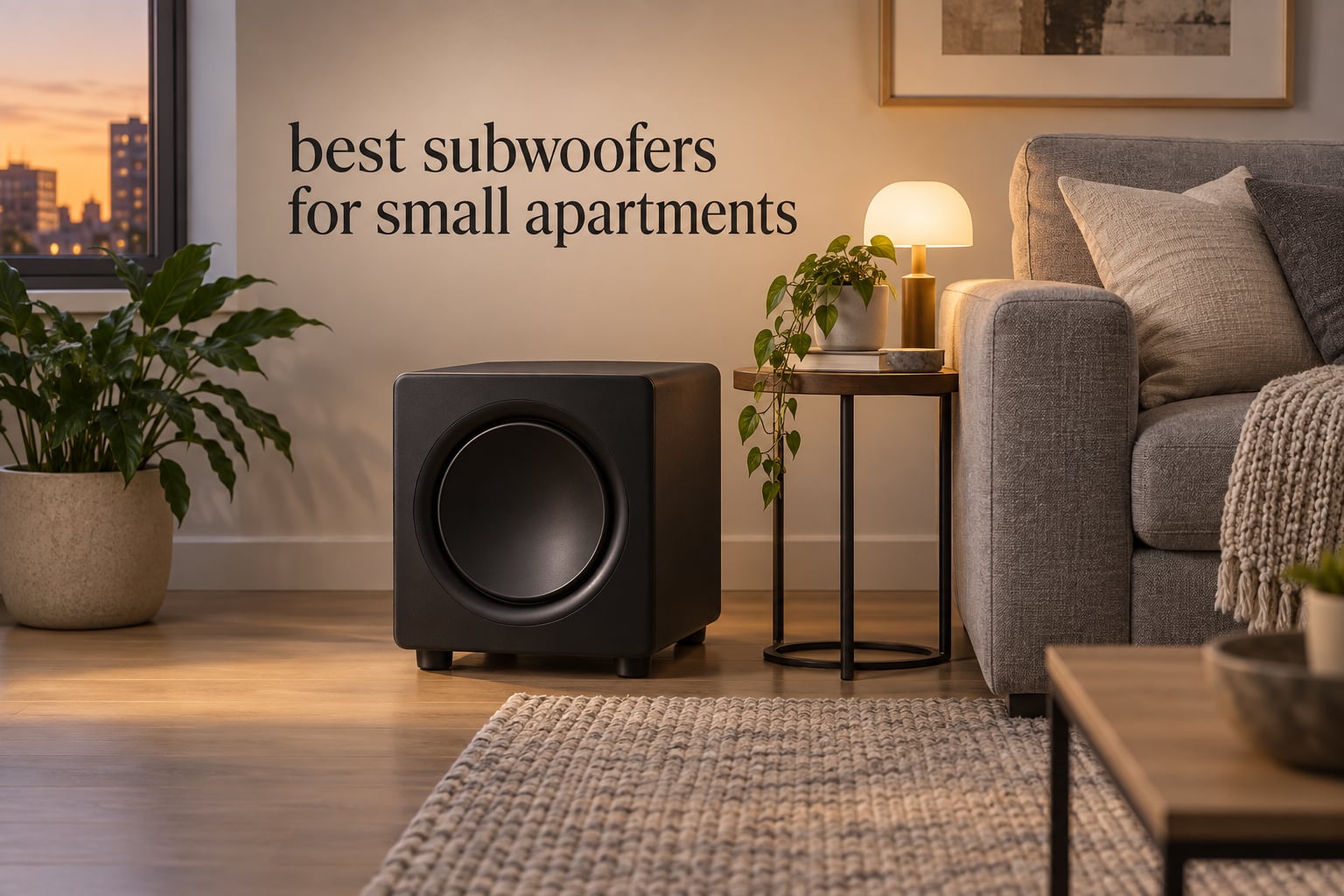
Most people shopping for a subwoofer in an apartment do it backwards. They find the biggest driver they can fit against the wall, push the volume until the couch vibrates, and then spend the next month wondering why someone below filed a complaint. The truth is the opposite: small rooms need less subwoofer, not more.
A 10 by 12 living room has walls close on every side and a ceiling two and a half metres overhead. Those surfaces reflect and reinforce low frequencies back at you, a phenomenon listeners call room gain. Because the room is already adding output, a modest amplifier that would sound weak in a detached house sounds entirely adequate here — and anything more is headroom you will never use except to make the neighbours unhappy.
That is the logic behind our list of the best subwoofers for small apartments in 2026. We picked ten powered subs whose cabinets actually fit in a normal room, whose low-pass filters you can adjust, and whose output you can tame without losing the sense of weight under a film. Every pick below is a real wired or wireless unit with published response data, and each one gets a plain-language verdict, the specs that matter in a small space, and an honest note on who should skip it.
If you are still working out the room, our guides to 10-inch subwoofers for apartments and subwoofers for small living rooms go deeper on driver size and placement. And if your floor space is the real constraint, start with compact sofas for studio apartments so the sub has somewhere to live.
Table of Contents
Top 3 Picks for Best Subwoofers for Small Apartments in 2026

Polk Audio PSW10
- 10-inch woofer with 50W RMS amp
- Variable 80-160 Hz crossover
- Line and speaker-level inputs
- Compact 14.5-inch cabinet

Klipsch R-100SW
- 10-inch spun-copper IMG woofer
- All-digital amp with 300W peak
- Low-pass plus 0-180 phase
- Auto power-on

Yamaha NS-SW050BL
- 8-inch woofer with Advanced YST II
- Twisted flare port
- 100W dynamic power
- 12-inch cube cabinet
The Polk PSW10 takes the overall spot because it is the least compromise option in this group: a 10-inch driver, a continuously variable crossover, a phase toggle, and both line-level and speaker-level connections in a cabinet that measures 14.5 inches on its tallest edge. It has the largest review count of any product we cover, which means its strengths and its weaknesses are both well documented rather than hidden.
The Klipsch R-100SW is the pick if you want more reach per watt and do not mind a larger box. Its all-digital amplifier is rated to 300 watts peak with a documented response down to 32 Hz, and it has a phase control and an auto power-on circuit that the cheaper Polk lacks.
The Yamaha NS-SW050BL is the value choice. An 8-inch cone in a 12-inch cube with a twisted flare port, it disappears into a corner and adds weight under dialogue and music without the boom a bigger ported design can bring.
All 10 Subwoofers at a Glance in October
| Product | Specifications | Action |
|---|---|---|
| Polk Audio PSW10 |
|
Check Latest Price |
| Klipsch R-100SW |
|
Check Latest Price |
| Yamaha NS-SW050BL |
|
Check Latest Price |
 Yamaha NS-SW100BL Yamaha NS-SW100BL |
|
Check Latest Price |
 Klipsch Sub-100 Klipsch Sub-100 |
|
Check Latest Price |
 Sonos Sub Mini Sonos Sub Mini |
|
Check Latest Price |
 Monoprice 60-Watt 8-Inch Monoprice 60-Watt 8-Inch |
|
Check Latest Price |
 Audioengine S6 Mini Audioengine S6 Mini |
|
Check Latest Price |
 Klipsch Reference R-8SW Klipsch Reference R-8SW |
|
Check Latest Price |
 Edifier T5s Edifier T5s |
|
Check Latest Price |
Specs below are manufacturer-published figures rather than independent lab measurements, so treat wattage comparisons between brands with suspicion and pay closer attention to response range, cabinet depth and whether a phase control is present. Our detailed verdict on each one follows.
1. Polk Audio PSW10 — Best Overall for Small Apartments
Polk Audio PSW10 10″ Subwoofer, Big Bass Compact Design, Up to 100 Watts
10-inch Dynamic Balance woofer
50W RMS amplifier
40-160 Hz response at -3dB
17 x 14.25 x 14.5 inch
Pros
- Continuous 80-160 Hz crossover gives real control in a small room
- Phase toggle switch for blending with bookshelf speakers
- Both line-level and speaker-level connections
- Compact 14.5-inch tall cabinet
Cons
- Low end can turn boomy when the sub level is pushed past half
- No wireless or HDMI options at all
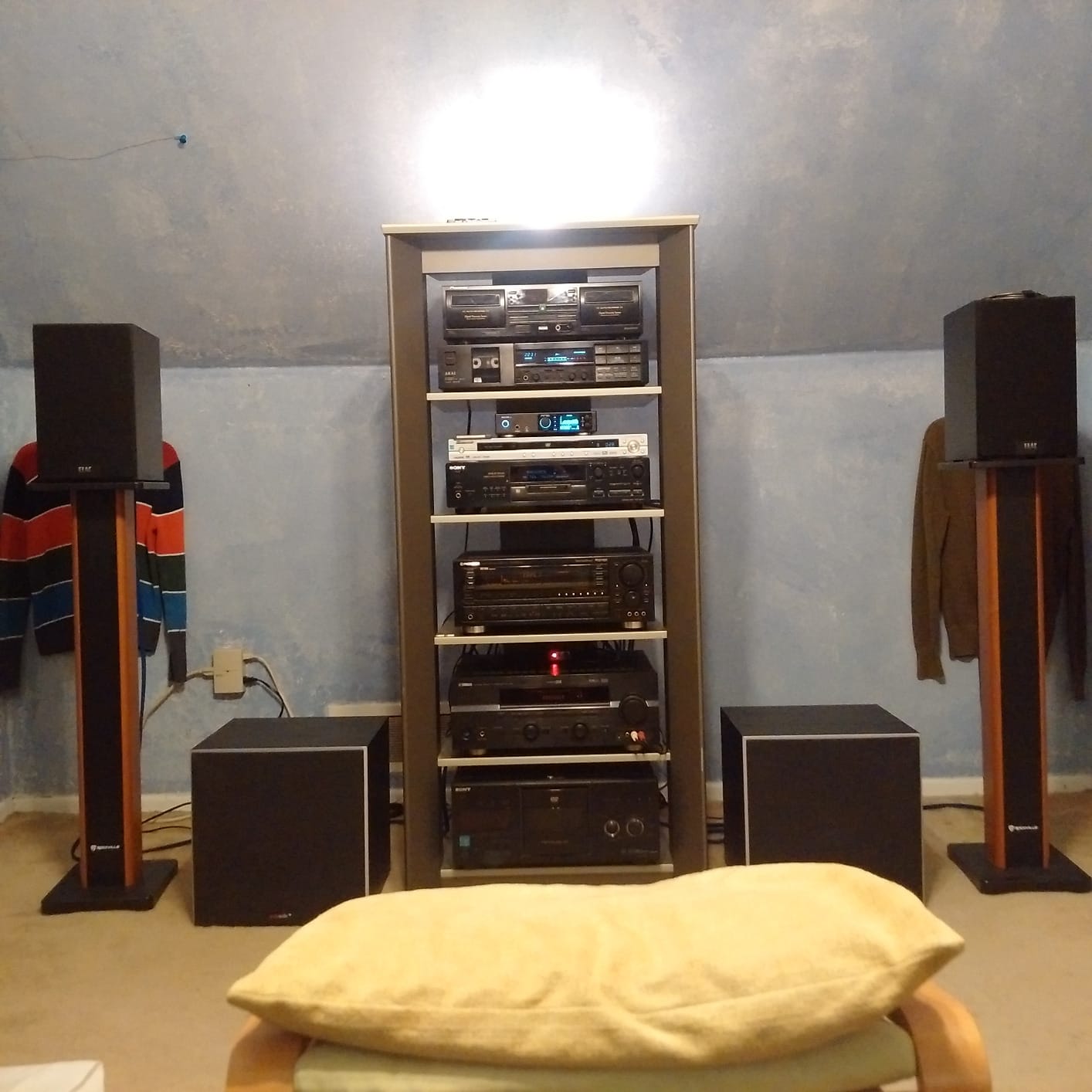
This is the sub I keep coming back to for apartment-sized rooms, and the reason is boring: it gives you control rather than raw force. The 80 to 160 Hz crossover is continuously variable, so you can set the handover point higher than the usual 80 Hz when your neighbours are home, which thins out exactly the band that travels through structure.
Specs worth knowing: a 10-inch Dynamic Balance dynamic driver, a built-in 50 watt RMS amplifier rated up to 100 watts, and a documented response from 40 to 160 Hz at minus 3 dB. The cabinet is 17 inches deep, 14.25 inches wide and 14.5 inches tall, which fits beside a sofa arm rather than demanding a corner of its own.
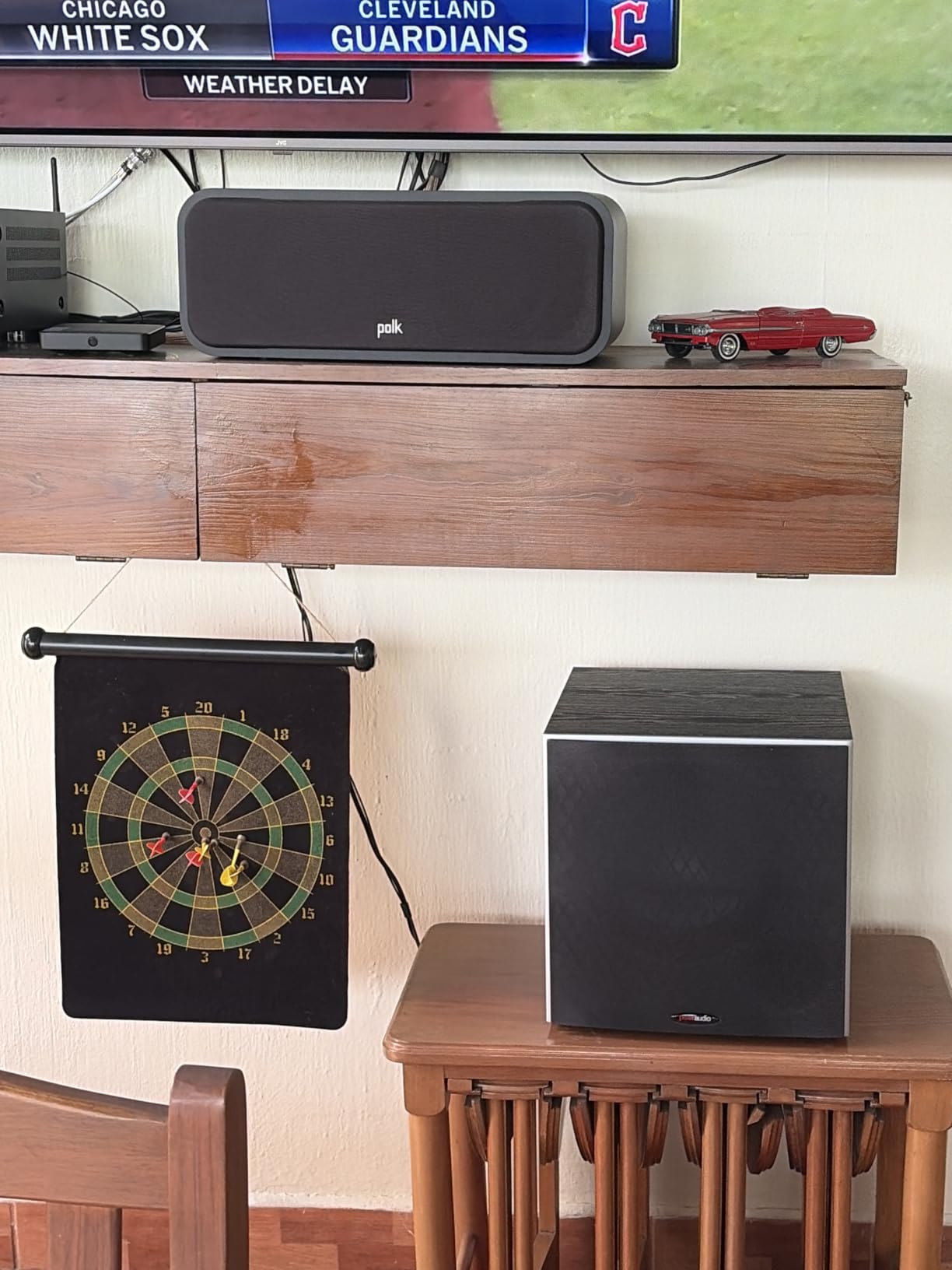
The reason the PSW10 has accumulated well over fifteen thousand reviews is that it never pretends to be something it is not. Owners describe clean low-frequency output for small and mid-size rooms, easy hookup to an existing receiver, and a bass response that reinforces films without dominating music. The detachable grille is a small touch that matters if the sub is living in an open-plan space.
Warranty is the strongest in this group: five years on the cabinet and driver, three on the amplifier, parts and labour included. That matters more in an apartment than a spec sheet, because the main failure mode for any sub is a dead amplifier and you do not want to haul a heavy box back to a counter.
Best for: mixed music and film in a room under 200 square feet
This is the one to buy if your system is a 2.1 stereo setup or a modest 5.1 in a flat, and you want to be able to dial the bass back when the building gets quiet. The variable crossover and the phase switch are the two features you will use most, and the speaker-level inputs mean it will work even with an older amplifier that has no dedicated sub output.
Skip it if: you want deep sub-30 Hz extension or wireless operation
The bottom end is a 40 Hz minus 3 dB figure, which is plenty for effects but will not deliver the deepest rumble on a modern sound mix. There is also no Bluetooth, no Wi-Fi and no HDMI, so if your plan was to stream from a phone or a TV directly, this is the wrong cabinet.
2. Klipsch R-100SW — Best for Deeper Reach per Watt
Klipsch R-100SW 10″ Subwoofer, Incredibly Deep Bass and an All-digital Amplifier,14 5″ x 12 5″ x 16 4″
10-inch front-firing IMG woofer
150W continuous, 300W peak
32-120 Hz at -3dB
14.5 x 12.5 x 16.4 in
Pros
- Reaches down to 32 Hz at -3dB which is the deepest rated response here
- Volume plus low-pass plus 0-180 degree phase on the rear panel
- Auto power-on removes the power-switch step
- Solid-feeling enclosure at 26 pounds
Cons
- Some listeners still find it boomy on music at higher sub volume
- Basement-style extension is shallower than larger drivers in the range
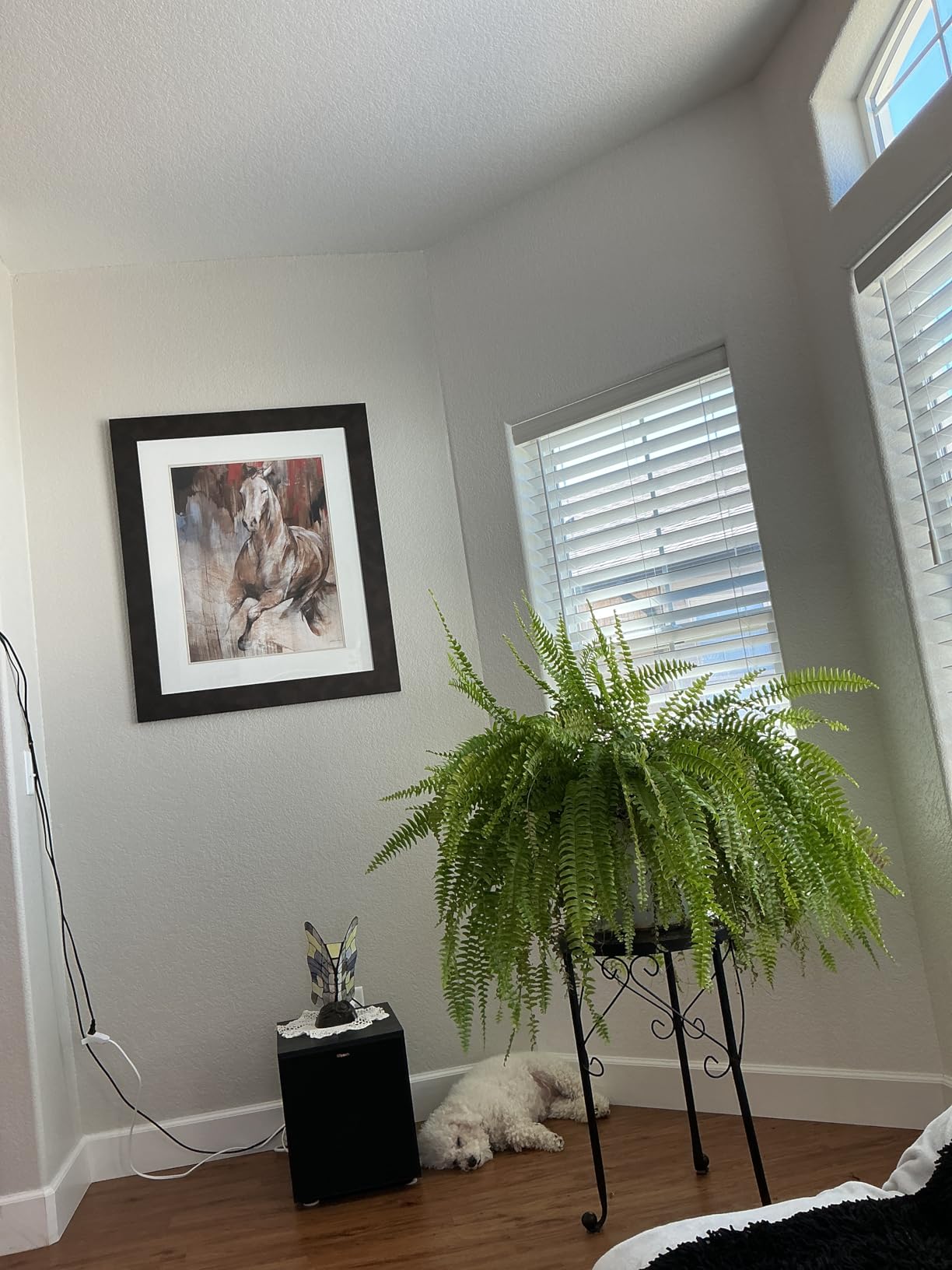
The Klipsch is the pick when your room is small but you still want to feel the low effects rather than merely hear them. Its documented response runs from 32 to 120 Hz at minus 3 dB, which is a meaningfully deeper starting point than most of the budget ported designs in this roundup.
The amplifier is an all-digital design rated 150 watts continuous and 300 watts peak, driving a 10-inch front-firing spun-copper IMG woofer. Rear panel controls cover volume, low-pass crossover and phase from 0 to 180 degrees, plus an auto power-on switch that wakes the unit when a signal arrives — a genuinely useful feature when you are listening late and do not want to reach behind the cabinet.
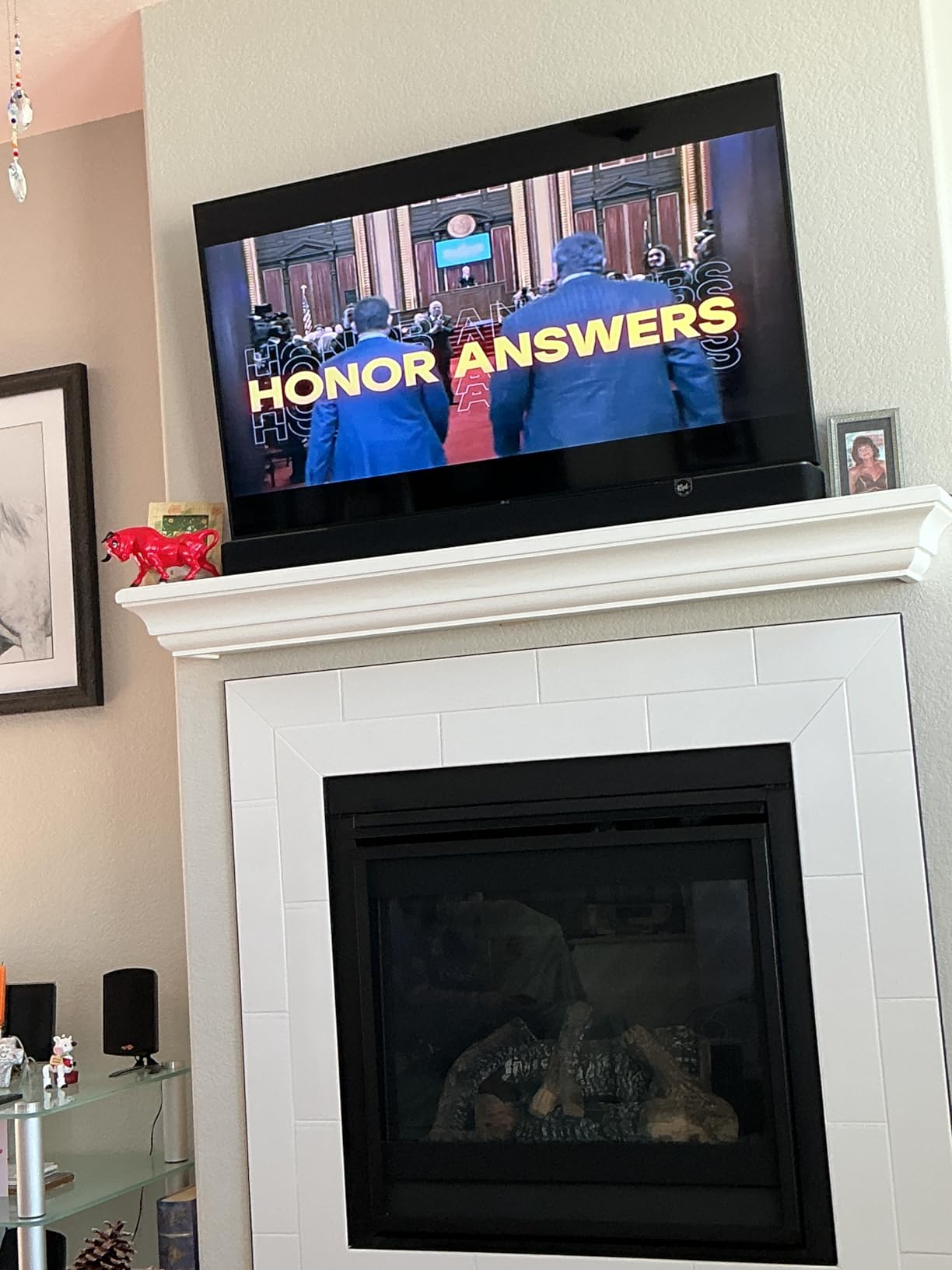
Reviewers rate it 4.7 out of 5 across more than three thousand ratings, with 86 percent five-star. The recurring theme is a solid-feeling enclosure with real weight to it, easy gain and crossover adjustment, and a sub that blends with bookshelf or floorstanding speakers in small to medium rooms rather than bulldozing them.
That blending matters more than raw output in a flat. If you set the crossover at 80 Hz and trim the level, the Klipsch sits under your main speakers instead of announcing itself. Warranty is five years on the woofer and two on the amplifier.
Best for: home theatre in a small apartment where effects still need to land
Choose this if you watch films more than you listen to music and you want that sub-40 Hz layer for engine roars and impacts. The auto power-on and the front-firing driver make it easy to tuck into a corner or push against the front wall, which is where a ported design of this size performs best.
Skip it if: the cabinet will not fit or you listen at very low levels
At 16.4 inches tall and 26 pounds, this is a bigger object than a small apartment may allow. It also has no soft power-down, so some owners report an audible pop when the signal cuts off, which is noticeable in a quiet building late at night.
3. Yamaha NS-SW050BL — Best Value 8-Inch for Bedrooms and Desks
YAMAHA 8″ 100W Powered Subwoofer – Black (NS-SW050BL)
8-inch cone woofer
Advanced YST II amplification
100W dynamic at 5 ohms
12 x 14 x 12 inch
Pros
- Twisted flare port keeps port noise down at higher levels
- Compact 12-inch cube that fits most corners
- Consistent build quality with a two-year warranty
- Clear and tight bass rather than boom
Cons
- Onboard controls are sparse and depend on the receiver handling crossover and phase
- No wireless connectivity despite listings that suggest otherwise
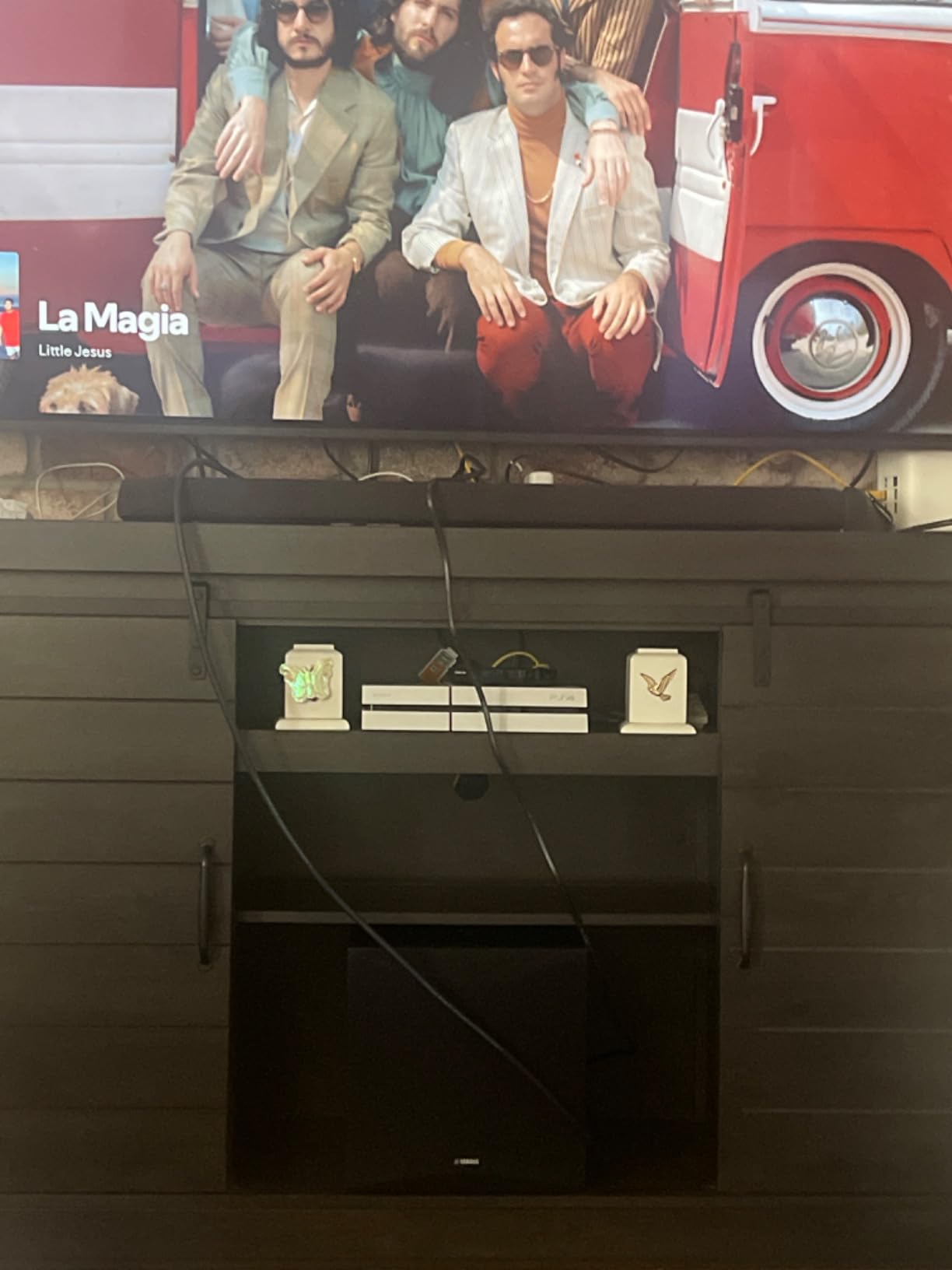
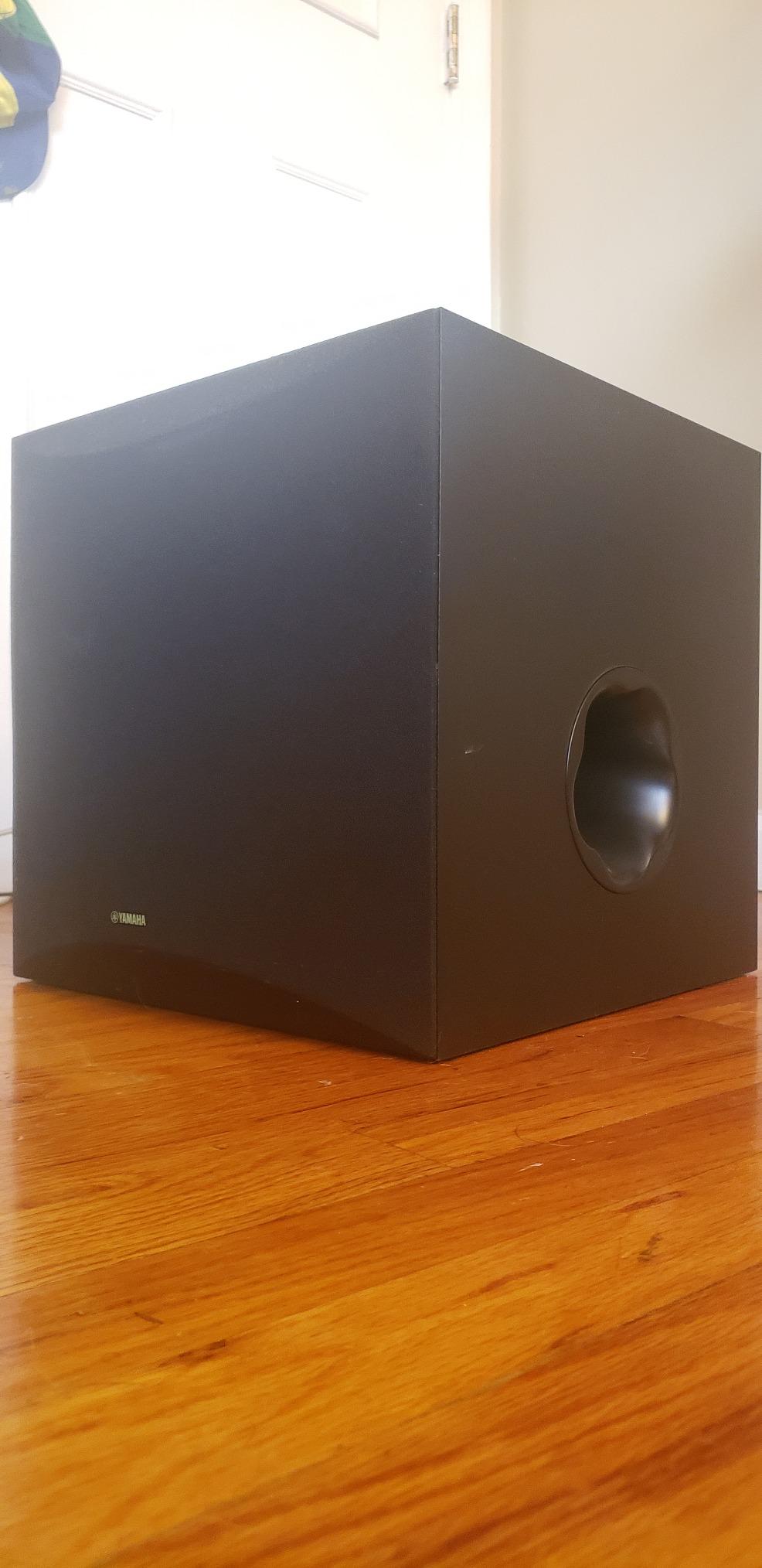
The Yamaha is the one I recommend to people whose main worry is a neighbour rather than a missing deep effect. An 8-inch cone driven by Yamaha’s Advanced YST II active servo technology delivers bass that is fast and controlled, and the twisted flare port shape keeps the port from chuffing audibly at higher volumes — a real problem with cheaper ported cabinets.
Physical size is the headline. At 12 inches deep by 14 wide by 12 tall and 18.7 pounds, it is one of the smallest cabinets here that still delivers genuine low-frequency weight, and it disappears behind a sofa arm or into a corner without dominating the room’s footprint.
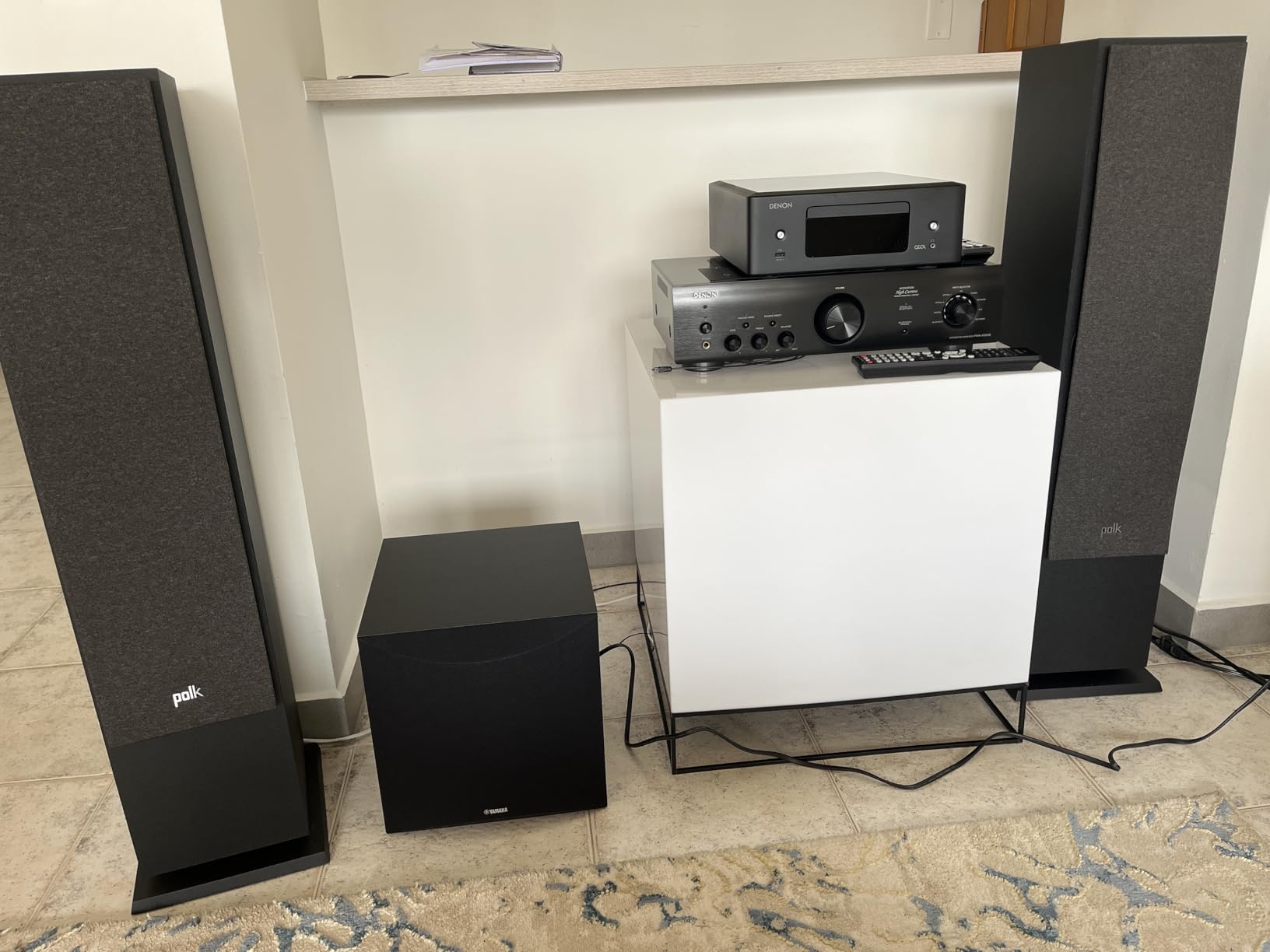
Owners rate it 4.6 out of 5 across more than eighteen hundred ratings, with 81 percent five-star. The common thread is a small footprint paired with clear, tight bass, and plenty of mention of pairing it with a soundbar or a compact stereo system in an apartment or bedroom. Rated dynamic power is 100 watts at 5 ohms.
The honest limitation is control. There is no variable crossover and no phase switch on the cabinet, which means the sub works best with a receiver or amplifier that handles both. If your system is a soundbar with a single sub out, that is fine. If you are running a bare amplifier, you have less to adjust.
Best for: bedrooms, dorm rooms and small stereo systems
This is the pick for a room where you want bass you can hear in the room but not necessarily feel through the floor. The compact sealed-feeling behaviour of an 8-inch driver in a small cabinet means it settles quickly, which makes late-night listening far less risky than a larger ported design at the same perceived loudness.
Skip it if: you have no receiver to handle crossover and phase
Owners with a bare stereo amplifier report having less control than they want, and there is no Bluetooth or wireless path even though some retail listings suggest one. If you need app control or room EQ, look at the Sonos Sub Mini instead.
4. Yamaha NS-SW100BL — Best for Soundbar Pairing Without Setup Friction
Yamaha Audio 10″ 100W Powered Subwoofer – Black (NS-SW100BL)
10-inch cone woofer
Advanced YST II with twisted flare port
100W output
17.5-inch cube
Pros
- Plugs into a soundbar or receiver with no crossover setup to configure
- 10-inch cone delivers more thump than the smaller 8-inch sibling
- Owners report enough headroom for small to mid-size rooms at moderate settings
- Tight bass from the twisted flare port
Cons
- No built-in crossover or phase control at all
- No auto-standby so it must be switched off manually
- Heaviest and bulkiest cabinet here at 17.5 inches square
If your entire system is a soundbar with one sub output and you want the simplest possible upgrade, this is the Yamaha to buy. There is nothing to configure on the cabinet itself: no crossover dial, no phase switch, no menu. You run the cable, set the level on the soundbar, and the sub does the rest.
Underneath that simplicity is a 10-inch cone with Advanced YST II drive and the same twisted flare port used on the smaller Yamaha, rated to 100 watts of maximum output. Owners frequently pair it with a soundbar in a small or mid-size space and describe the result as deep, felt-not-heard bass on films.
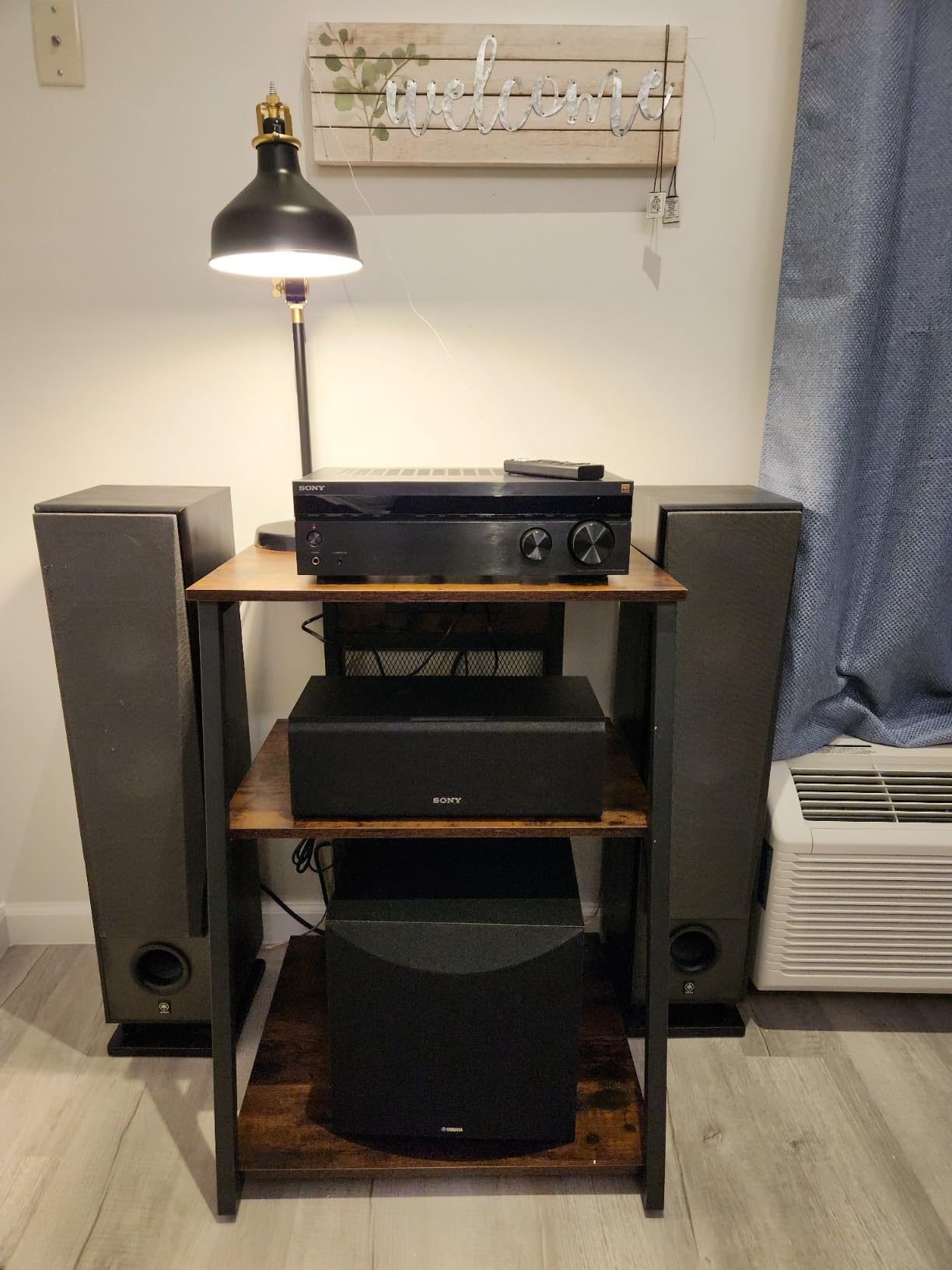
The trade-off is real. At 17.5 inches on each face and 26.5 pounds, this is one of the bulkier cabinets in a roundup otherwise built around compactness, and in a studio flat that footprint is a genuine cost. There is also no signal-sensing standby, so if you like the sub off when nothing is playing, you have to reach the switch.
Ratings sit at 4.6 out of 5 across more than fifteen hundred reviews, with 80 percent five-star. Reviewers consistently mention plug-and-play integration with soundbars and AV receivers as the reason they are satisfied.
Best for: soundbar owners who want more weight without reading a manual
Pick this if you want a single cable and nothing else on your evening setup routine. The 10-inch cone gives noticeably more than an 8-inch alternative at the same level, which means you can keep the volume lower in the app and still get the effect you want — a quieter sub transmits less through walls.
Skip it if: floor space is tight or you need to shape the bass yourself
With no crossover, no phase control and no auto-standby, you cannot raise the handover frequency or flip the phase if the sub and main speakers fight in your room. In a shared-wall apartment where you want to roll off below 50 Hz at night, that absence is a real limitation.
5. Klipsch Sub-100 — Best for Corner Placement in a Deeper Room
Klipsch Synergy Black Label Sub-100 10” Front-Firing Subwoofer with 150 Watts of continuous power, 300 watts of Dynamic Power, and All-Digital Amplifier for Powerful Home Theater Bass
10-inch Cerametallic woofer
150W continuous, 300W dynamic
15.7 x 12.5 x 14 in
Pros
- Spun-copper Cerametallic driver gives articulate and accurate bass
- All-digital amplifier rated 150W continuous and 300W dynamic
- Corner placement recommended by the manufacturer
- Removable grille and a finish that blends into a room
Cons
- Connection wires are not included in the box
- Must be driven by a receiver or pre-amp so it cannot run standalone
The Sub-100 is the Klipsch to choose if you have a receiver and want a front-firing driver that benefits from being shoved in a corner. The manufacturer explicitly recommends corner placement, and the 10-inch spun-copper Cerametallic woofer takes advantage of the extra boundary gain a corner provides — one of the cheapest ways to gain several decibels without adding amplifier cost.
Power is rated 150 watts continuous and 300 watts dynamic through an all-digital amplifier. The cabinet measures 15.7 inches deep, 12.5 wide and 14 tall at 25.5 pounds, which is comparable to other 10-inch models in this roundup rather than dramatically larger.

Buyers rate it 4.7 out of 5 across a little over eleven hundred ratings, 85 percent of them five-star. The repeated highlights are powerful yet controlled home theatre bass, straightforward corner setup and good value against the step-up models in the same line.
Two practical notes. First, connection wires are not included, so budget for a sub cable before you start. Second, it must be fed from an AV receiver, processor or pre-amp — there is no onboard low-pass or phase control here, which means all signal shaping happens upstream. Warranty coverage is five years on labour and parts.

Best for: home theatre rooms where a corner is free and a receiver handles the settings
If your layout leaves a corner open and your receiver has a proper sub out with adjustable crossover and phase, this is a strong match. The dynamic power figure gives it more headroom for film peaks than the 50-watt amplifier in the Polk, which is useful if you want to avoid the sub straining on effects.
Skip it if: you are running a soundbar or a bare amplifier
With no onboard crossover or phase controls, an under-specified source device means you have no way to blend it. In a small apartment where you specifically want to cut the deepest bass after 10pm, that is not the tool for the job.
6. Sonos Sub Mini — Best for Wireless Setups and Hidden Placement
Sonos Sub Mini – Black – Compact Wireless Subwoofer
Dual 6-inch force-cancelling woofers
Sealed cabinet
Reaches 25 Hz
Wi-Fi wireless connection
Pros
- Dual force-cancelling woofers cut distortion and cabinet vibration
- Trueplay tuning adapts the low end to a small room and wall placement
- No cables to run across an apartment
- Compact cylinder tucks under a side table or into a corner
Cons
- Works only inside the Sonos ecosystem with no conventional line-in
- App-based setup and Trueplay require an iOS device
- Subtle out of the box so the level usually needs raising
The Sub Mini solves a problem the wired subs in this list create: where does the cable go? Two inward-facing 6-inch woofers in a sealed polycarbonate cabinet cancel their own output forces, which means less cabinet rattle and far less transmission into shared walls for the same perceived loudness. That is a genuinely apartment-relevant design choice, not a marketing flourish.
It reaches down to 25 Hz, the lowest rated low-frequency figure in this group, and delivers 250 watts of maximum output. The body is a cylinder measuring 8.98 by 8.98 by 11.93 inches at about 6.35 kilograms, which means it can genuinely go under a side table rather than sitting out in the open.

Owners rate it 4.6 out of 5 across more than a thousand ratings, with 84 percent five-star. Reviews from people in small bedrooms, home offices and media rooms mention the clean, non-muddy bass, the ability to hide the unit in a corner, and wireless pairing that removes the cable-run problem entirely. Trueplay room tuning then adapts the low end to your specific walls.
The lock-in is the catch, and it is a real one rather than a footnote. This sub has no conventional line input, so it cannot be paired with a standard receiver or a pair of bookshelf speakers. Setup runs through the app, and Trueplay needs an iOS device. Many owners also note it sounds restrained out of the box and needs the level raised several notches before it does much.

Best for: Sonos users in small rooms who refuse to run cables
If you already own Beam, Ray or Arc and want bass from a corner without a single cable, this is the answer. The force-cancelling opposed drivers are the feature to lean on in an apartment, because reduced cabinet movement means less structure-borne noise for a neighbour to feel through the floor.
Skip it if: you run any non-Sonos component
The absence of a line input is absolute, and buyers who expected a conventional sub cable are the ones who return it. The one-year warranty is also the shortest in this roundup, and the app dependency makes it a poor fit if you prefer physical controls on the cabinet.
7. Monoprice 60-Watt 8-Inch — Best Budget Pick for a First Sub
Monoprice 60-Watt Powered Subwoofer – 8 Inch With Auto-On Function, For Studio And Home Theater Black
8-inch front-firing powered driver
60W RMS
50-250 Hz, low-pass 50-150 Hz
13.75 x 11.75 x 11.75 in
Pros
- Genuinely functional 8-inch powered driver at the lowest cost in this roundup
- Adjustable 50-150 Hz low-pass plus gain and frequency knobs
- High-level and line-level inputs with matching outputs
- Auto-On function wakes it with a signal
Cons
- Lowest output in the group and deep cinematic effects are limited
- 60W RMS and a 50 Hz bottom end will not shake a room like the larger 10-inch models
- Lowest star rating here with a larger share of three-star and one-star reviews
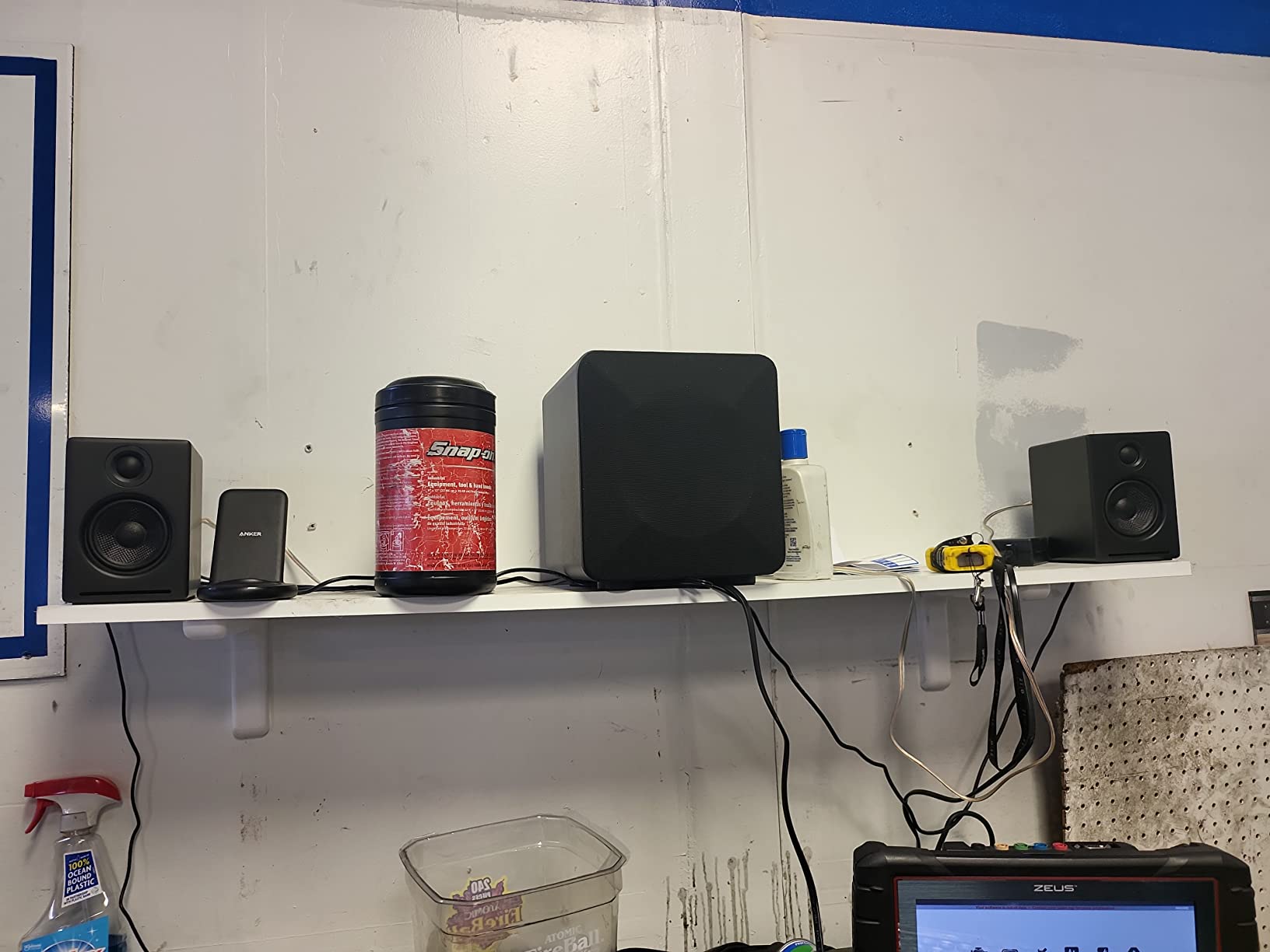
The Monoprice is the honest budget floor. An 8-inch front-firing powered driver producing 60 watts RMS, with an adjustable low-pass crossover from 50 to 150 Hz, gain and frequency knobs on the control panel, and a wood cabinet behind a cloth grille that looks far more finished than the norm at this tier.
It also has the connection options budget subs often lack: high-level inputs plus line-level inputs, each with matching outputs, so it can sit in a chain with other equipment. The auto-On function with impedance matching wakes it when a signal appears and is designed to preserve your front speaker output at the same time.
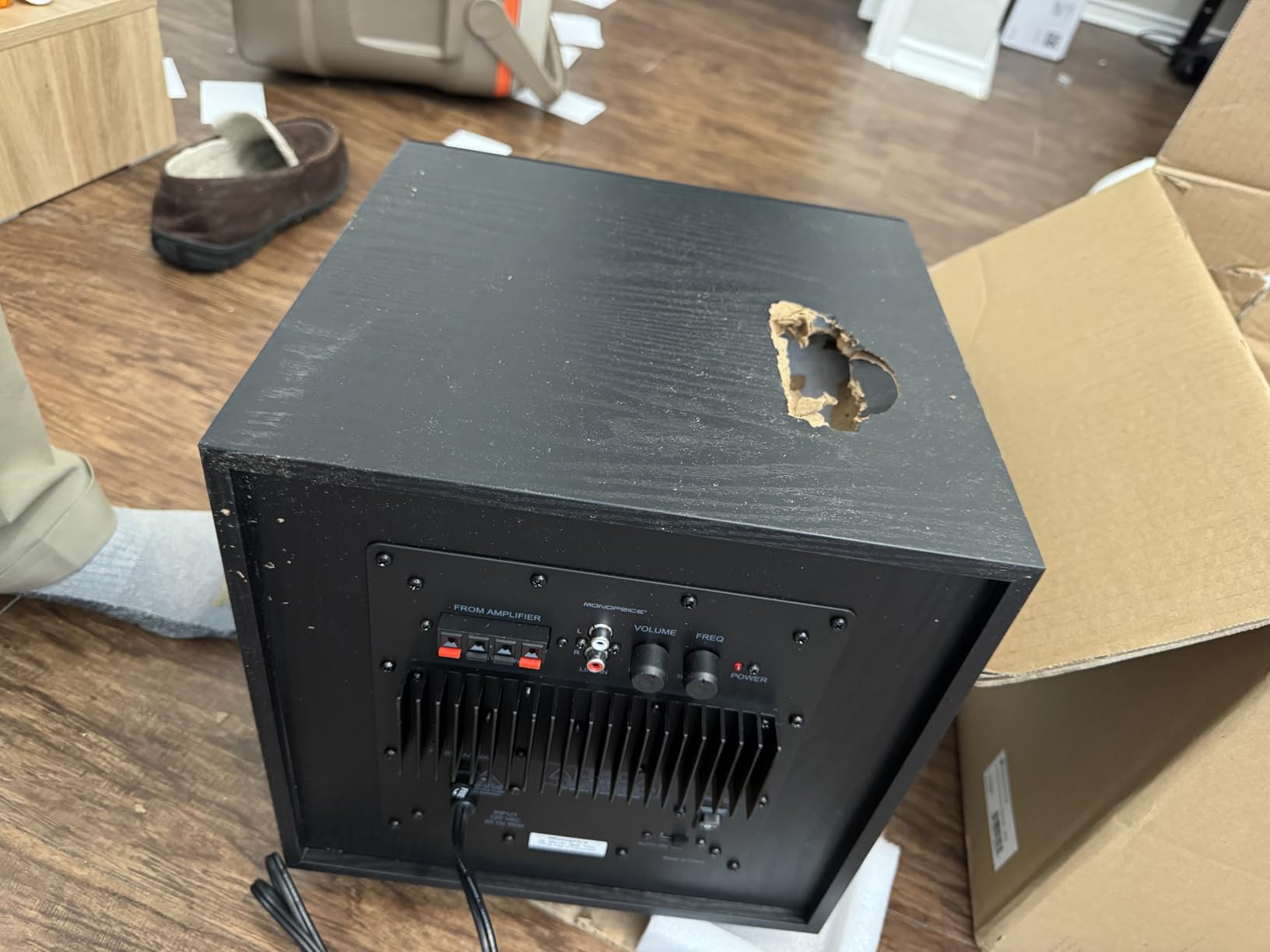
At 13.75 by 11.75 by 11.75 inches and 19.1 pounds, it is compact enough for a bedroom. Reviewers treat it as a budget filler for studio monitors and small-room home theatre, appreciating the auto-On convenience and the adjustability while noting it lacks the output of the 10-inch models elsewhere in this list.
Be clear-eyed about the rating. It holds 4.3 out of 5 across more than two thousand reviews, with 65 percent five-star and 19 percent four-star — the lowest score here, with a visibly larger share of three-star and one-star feedback than any other product on this list. Warranty is one year.
Best for: filling out an existing 2.1 studio or bedroom system on a tight budget
If you already have speakers that handle the low mids well and you only need a little weight under them, this does the job. The variable low-pass lets you hand the very lowest frequencies back to your main speakers if they can manage it, which also means less energy aimed at your shared walls.
Skip it if: you watch films and want impact
With 60 watts RMS and a 50 Hz bottom end, deep cinematic effects will not land. The 8-inch driver relies on excursion to produce low output, which is also why some owners report audible port noise at higher levels. For movies in a flat, spend up a tier.
8. Audioengine S6 Mini — Best for Desk and Desktop 2.1 Setups
Audioengine S6 Mini Subwoofer – Compact 210W Powered Bass Speaker
6-inch front-firing driver
210W output
95 dB signal-to-noise
9.92 x 8.74 x 9.96 in
Pros
- Slim cabinet fits under a desk beside a sofa or in a tight corner
- 210W of front-firing output gives more headroom than typical mini subs
- 95 dB signal-to-noise ratio for clean low-noise output
- Multiple finish options to match existing speakers
Cons
- Smallest driver in this group so sub-30 Hz effects are limited
- Wired connection only since Bluetooth needs the separate W3 adapter
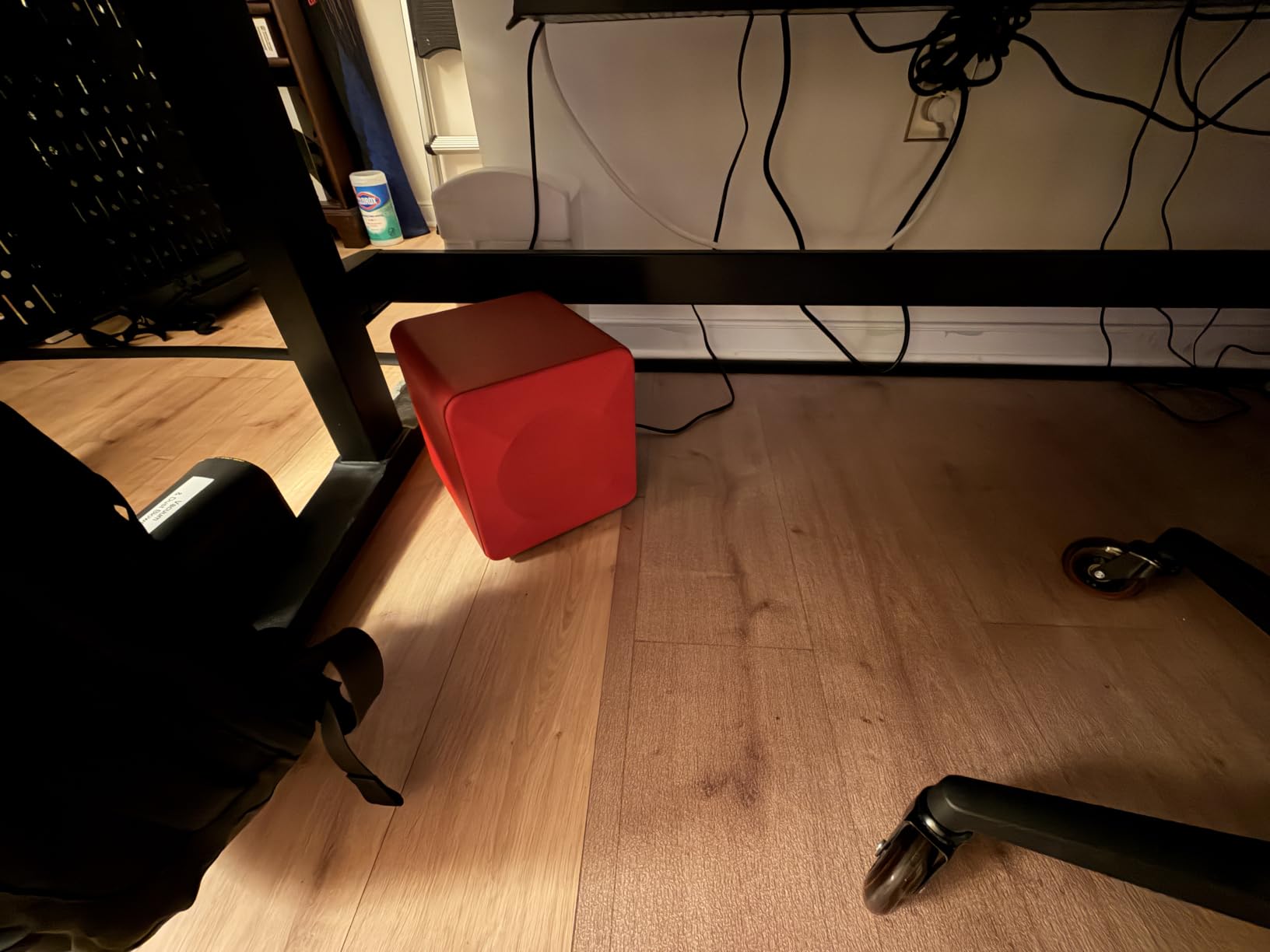
The Audioengine is built for the smallest space in this roundup: a home office desk. At 9.92 inches deep by 8.74 wide by 9.96 tall and 15.4 pounds, it genuinely fits beneath a work surface, which no 10-inch cabinet in this list does.
Despite the 6-inch driver, output is rated to 210 watts, more than several of the 8-inch and 10-inch models here. The signal-to-noise ratio is published at 95 dB, which matters more than people expect on a desktop system, because a noisy amplifier floor becomes obvious at the low listening levels you use while working.
It carries a 4.7 star average with 88 percent five-star ratings, the highest proportion of top marks in this group, though from a smaller pool of a little over two hundred reviews. Owners point to the compact footprint, clean and accurate reproduction for both music and films, and multiple finish options that let it match existing speakers.
Wireless is the caveat. Bluetooth requires the separate Audioengine W3 adapter, so out of the box this is a wired sub with RCA and auxiliary connections. Its response is documented down to 33 Hz, which is respectable for the size but will not deliver the deepest rumble.
Best for: desktop 2.1 systems and rooms with no floor space
Pick this for a home office, a dorm room or a living room where the only free surface is a shelf or a desk. The 6-inch driver will not hit like a 10-inch model, but at desk distances the difference is far smaller than the driver size suggests, and you will never be asked to leave it off the walls.
Skip it if: you need deep effects or want wireless out of the box
A 6-inch driver cannot reproduce sub-30 Hz content, so modern film mixes will feel light on the biggest impacts. If you want wireless you must buy the W3 adapter separately, which pushes the total cost past some wired alternatives in this list.
9. Klipsch Reference R-8SW — Best Down-Firing Design for Multi-Tenant Buildings
Klipsch Reference R-8SW Surround Subwoofer, 150 Watts Peak Power (Brushed Black Vinyl, 8-Inch)
8-inch down-firing IMG woofer
150W peak digital amp
LFE and RCA inputs
15.75 x 11.75 x 13.25 in
Pros
- Smallest Klipsch cabinet in the range and sized for apartments
- Clean bass that blends with surrounds instead of overpowering them
- One sub cable plus gain adjustment is all the setup needed
- Owners report it fills a room without rattling walls at moderate settings
Cons
- Rely on excursion of a small 8-inch woofer so deep punch is limited
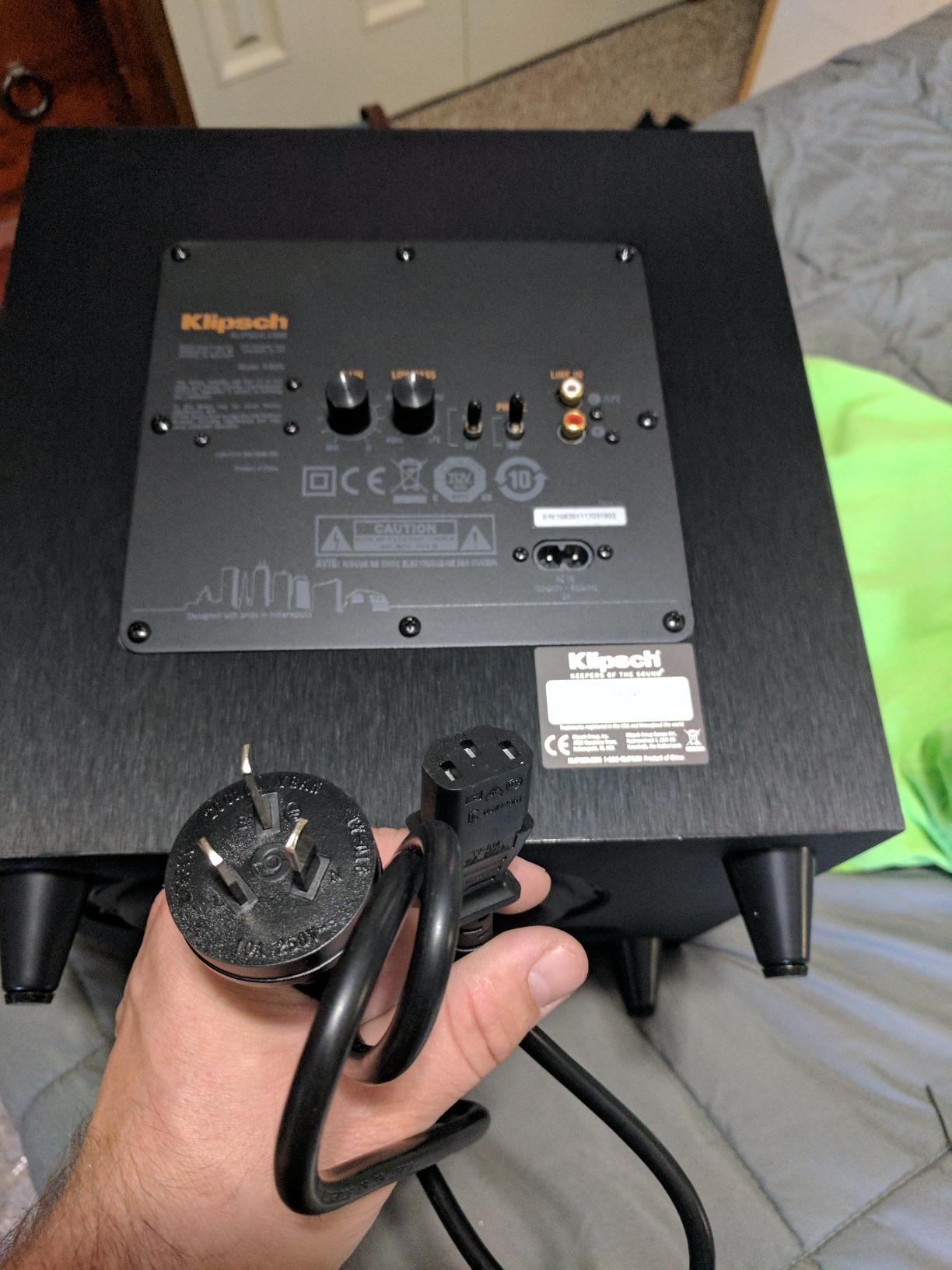
- No soft power-down and there can be an audible pop when the signal cuts
- Not wireless
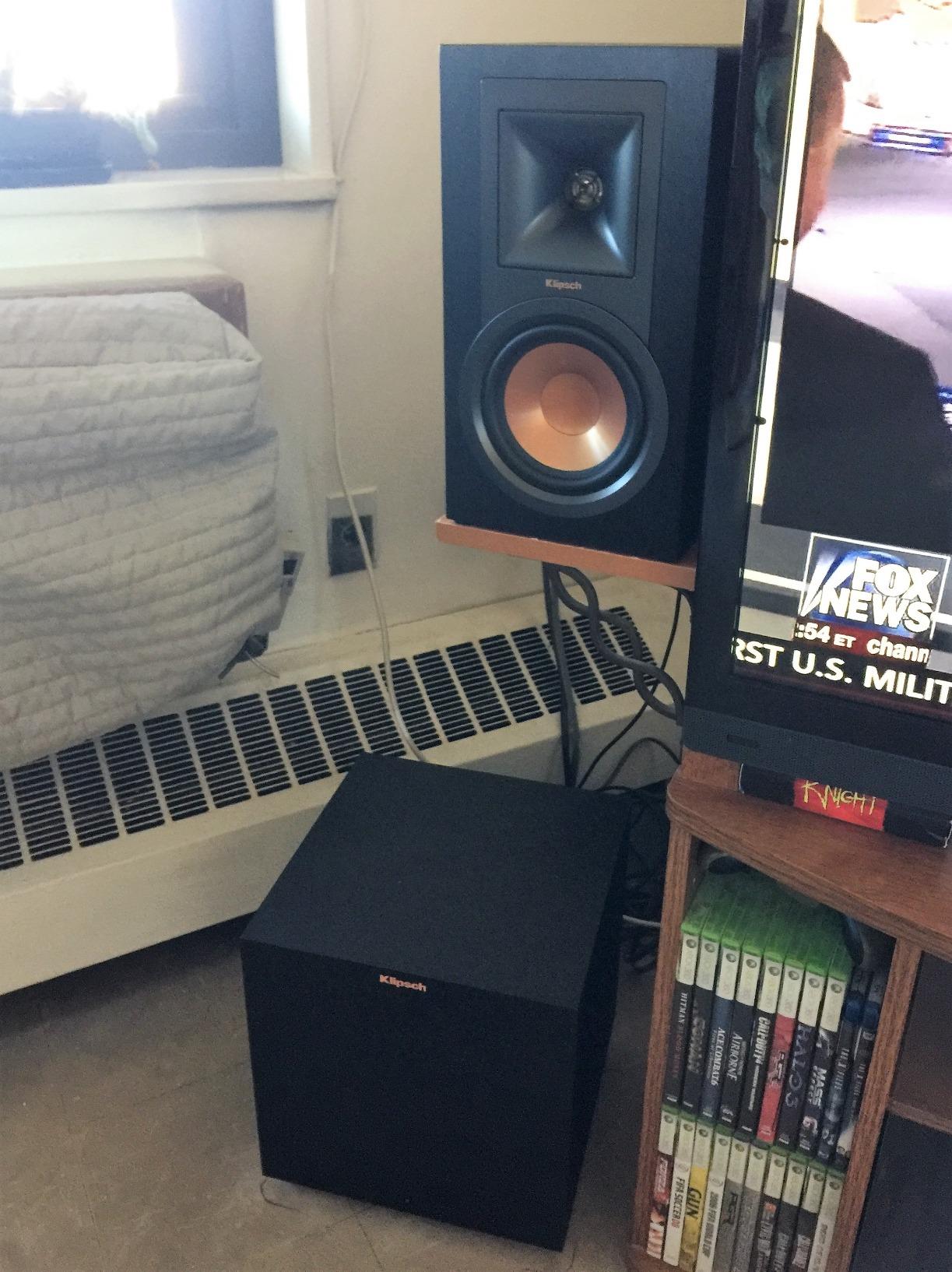
The R-8SW is the one down-firing design here, and in a building with shared walls that architecture is worth thinking about. A down-firing driver couples to the floor, which spreads output more evenly through a small room rather than firing a narrow beam straight at your listening position — and it means nothing is pointed at the wall behind the cabinet.
The driver is an 8-inch down-firing spun-copper IMG woofer fed by an all-digital amplifier rated to 150 watts peak. Connections cover both LFE and RCA, so it works with a receiver’s dedicated sub output or with a stereo amplifier through speaker-level wiring. Cabinet dimensions are 15.75 inches deep by 11.75 wide by 13.25 tall at 15 pounds.
Owners rate it 4.6 out of 5, with 79 percent five-star and 13 percent four-star. Several reviews specifically frame it as an apartment choice, describing clean, musical bass at moderate settings that blends with surround speakers rather than rattling the walls, and recommending a crossover around 80 Hz.
Two limitations to plan for. There is no soft power-down, so there can be an audible pop when the signal cuts off — noticeable at 11pm with a neighbour through the wall. And the 8-inch driver reaches its low end through excursion, so it lacks the deep punch of a 10-inch model. Warranty coverage is one year.
Best for: small media rooms and shared-wall apartments
This is the pick if you listen at moderate levels and want a sub that stays integrated rather than dominating. Reviewers consistently describe it as the least rattle-prone option they have owned, and the down-firing layout means no cabinet sits directly against a wall pushing energy into the structure behind it.
Skip it if: you want deep home theatre impact
At 8 inches it will not deliver the sub-30 Hz layer that modern film effects rely on, and the single-year warranty is the shortest alongside the Sonos. The pop on power-down is worth factoring in if you turn the system off while neighbours are asleep.
10. Edifier T5s — Best for Narrow Spaces and Shelves
Edifier T5s Powered Subwoofer, 70W RMS, 8″ Woofer, 35Hz Deep Bass, Black
8-inch long-throw woofer, 35 Hz
70W RMS Class-D
Low-pass 30-160 Hz with 0/180 phase
Pros
- Only 6.69 inches wide so it fits narrow shelves and desk spaces
- 35 Hz extension from an 8-inch long-throw driver
- Adjustable 30-160 Hz low-pass filter and a 0 or 180 degree phase selector
- Auto-standby after 15 minutes plus included RCA and 3.5mm cables
Cons
- Bluetooth USB and optical sources are not supported on the series connection path
- Only 70W RMS and less powerful than the 100W-plus models in this roundup
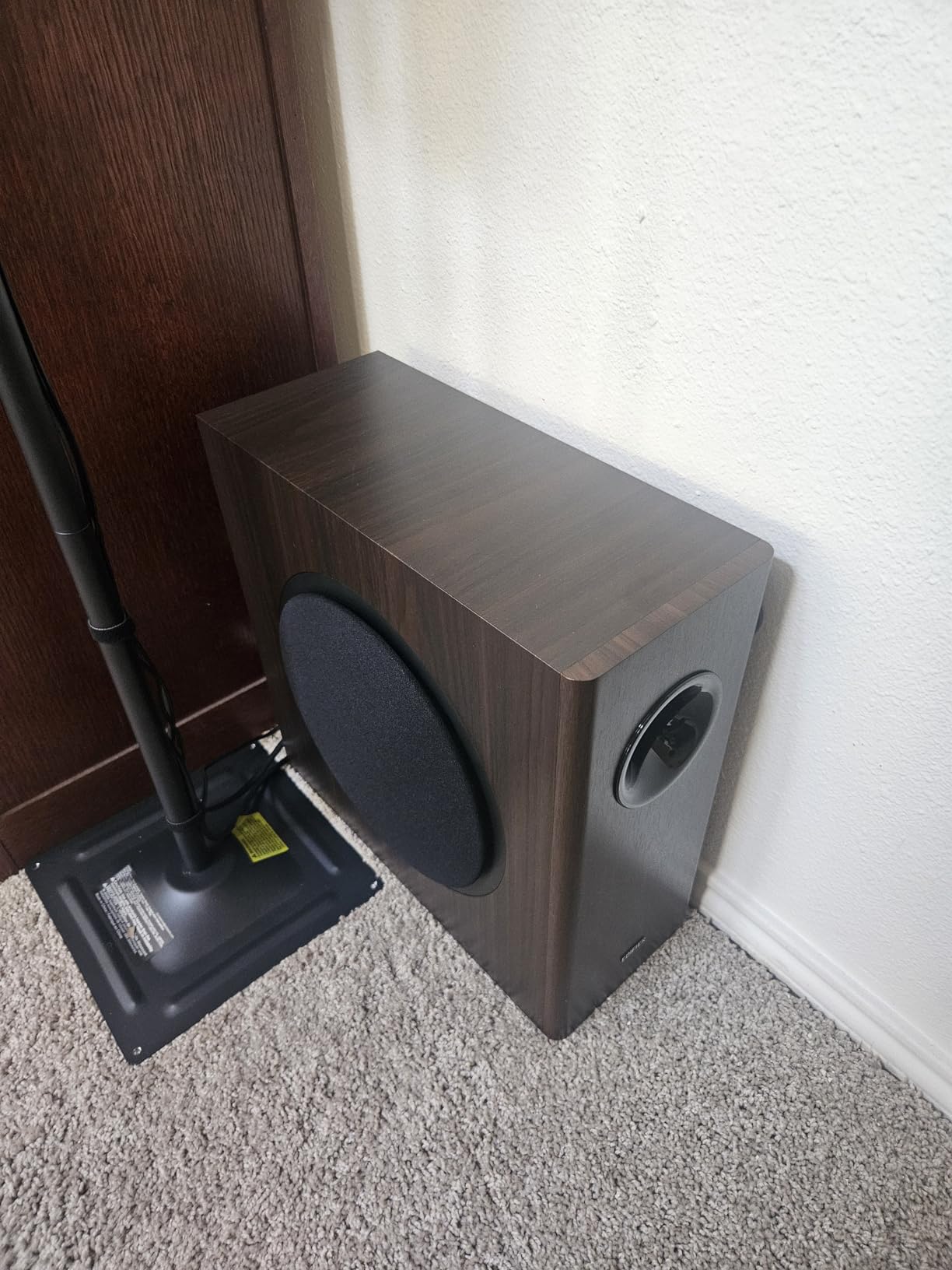
The Edifier solves a different space problem: not floor area but width. At 6.69 inches across, it is the slimmest cabinet here by a wide margin, built from 18mm MDF with a front-firing driver and a right-facing acoustic port. That side-facing port means you can push the sub into a corner where a front-ported cabinet would be blocked.
Output is 70 watts RMS from a Class-D amplifier driving an 8-inch long-throw woofer, rated to reach 35 Hz. Controls are unusually complete for the tier: a low-pass filter adjustable from 30 to 160 Hz, which lets you roll off the bottom at night, and a 0 or 180 degree phase selector.
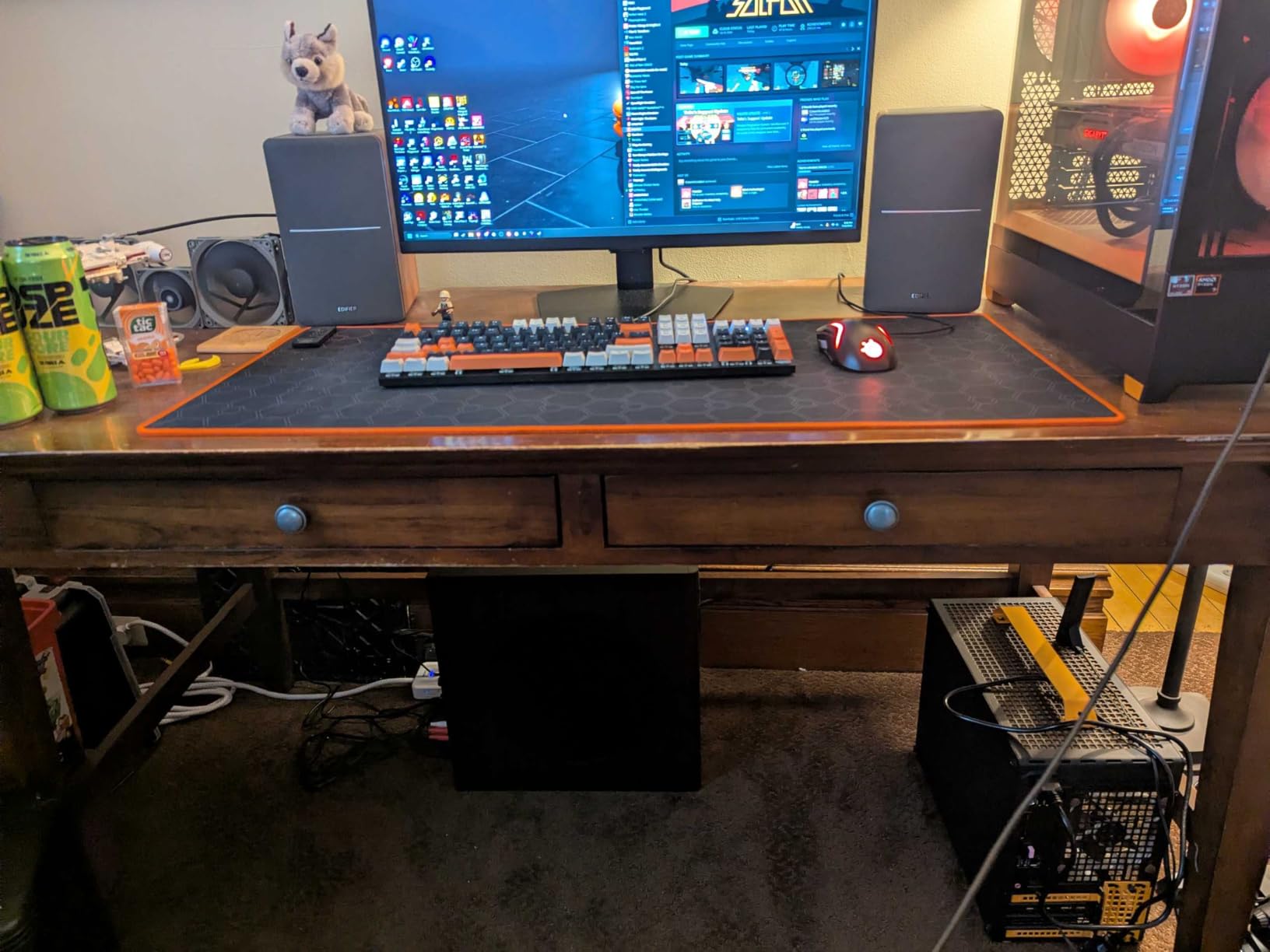
It sits at 4.5 out of 5 across a little over four hundred ratings, with 79 percent five-star. Reviewers single out the slim footprint for small rooms, the deeper-than-expected low extension for its size, the built-in amplifier for plug-and-play use, and the auto-standby after fifteen minutes that older budget subs often lack.
Two connection paths are offered: RCA signal in from a sub out, or a series connection through signal in and signal out, which lets it pair with speakers that lack a dedicated sub output as long as they have a LINE IN. Note that Bluetooth, USB and optical sources are not supported on that series path. Warranty is two years.
Best for: bookshelves, narrow gaps beside a sofa and dorm rooms
Choose this where width, not depth, is the limiting dimension. The adjustable low-pass down to 30 Hz is the feature apartment dwellers should care about most, because it lets you set a steep roll-off that removes the frequencies which travel through walls while keeping the bass audible in the room.
Skip it if: you need serious output for films
Seventy watts RMS is below every 10-inch model here, so big effects will not have the same impact. And if your main speakers connect over Bluetooth, USB or optical rather than analog, the series connection path will not accept them.
How to Keep a Subwoofer From Disturbing Your Neighbours
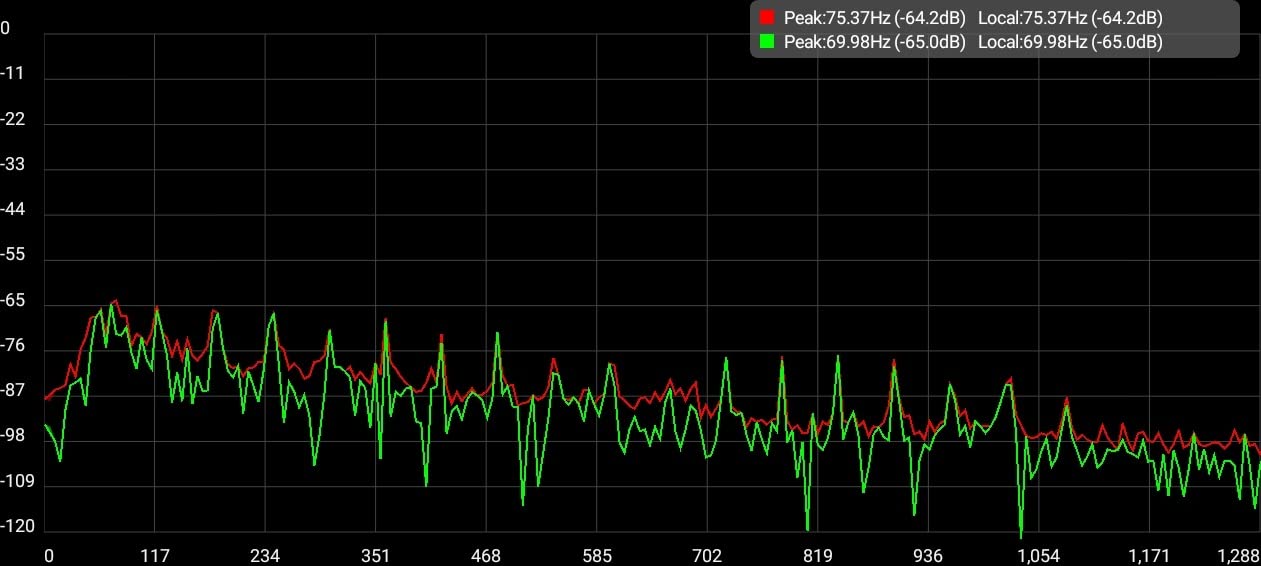
Bass does not travel through air the way a hi-fi reviewer implies. Below roughly 80 Hz, wavelengths become long enough that the dominant path is through the building structure itself — through the floor joists, along wall studs and into the next unit. That is why a neighbour can complain about the physical tremble long before they can hear the note, and why turning the volume down only partly helps.
Forum threads on r/audiophile and r/hometheater return to this constantly. One r/hometheater account described an 8-inch Jamo sub drawing neighbour complaints specifically about the tremble rather than the loudness, which is the pattern almost every complaint follows. The remedies below are the ones that come up again and again as actually working.
1. Move the sub closer to your seat. This is the single most effective move. Structure-borne transmission scales with the level at the cabinet, so pulling the sub into the middle of the room lets you hear the same bass from a lower setting.
2. Keep it 6 to 12 inches off shared walls. Pushing a sub flat against a party wall couples it directly to the studs. Leaving a gap breaks the rigid connection and reduces transmitted energy, even though it slightly reduces the boundary gain you get from the wall.
3. Put isolation feet or a decoupling stand under it. The most-upvoted answer in r/audiophile neighbour threads is mechanical decoupling, with isolation pucks named repeatedly as the concrete fix. Vibrations that never enter the cabinet floor cannot travel into the building frame.
4. Set the crossover at 80 Hz or higher. A higher handover lets your main speakers carry more of the low mids and confines the sub to the band where it does the most good. If your sub has a variable low-pass, this is the first control to reach for.
5. Roll off below 40 to 50 Hz for late-night listening. The deepest octave is what people feel rather than hear, and it is what generates complaints. The Edifier’s filter reaches down to 30 Hz and the Monoprice’s to 50 Hz precisely so you can steepen that roll-off after 10pm.
6. Crawl for position, not volume. Once wired up, push the sub along the front wall a few inches at a time and listen for where the bass peaks. That spot is where the room’s modes reinforce it most, which means you can hit the same perceived level at a lower setting.
How to Choose a Subwoofer for a Small Apartment
Match driver size to floor area rather than to ambition. A rough mapping that holds up across the compact powered subs we reviewed: under 80 square feet suits a 6-inch driver, 80 to 150 square feet suits 8-inch, 150 to 250 square feet suits a 10-inch, and anything above 250 square feet is where a larger driver starts to earn its cabinet. Going bigger than your room mostly buys headroom you will not use, and headroom you do not use becomes the knob neighbours notice.
Read RMS watts, not peak watts. Peak ratings count momentary bursts and routinely run two to eight times the continuous figure. The Polk’s 50 watt RMS amplifier is a better guide to sustained output than its 100 watt headline, and it is exactly enough for a small room because room gain supplies the rest.
Sealed versus ported matters more in apartments than anywhere else. A sealed cabinet rolls off gently at 12 dB per octave and stops cleanly, so it does not dump a single peak of energy into a party wall. A ported cabinet moves far more air at low frequencies, which is louder in the room and more likely to travel through structure, though port tuning below about 30 Hz gives you audible port noise at high levels. Sealed or force-cancelling designs — the Sonos, the Audioengine, the small Yamahas — are the conservative choice.
Then check the controls you will actually use. A variable low-pass filter lets you raise the crossover or steepen the night-time roll-off. A phase switch resolves the situation where the sub and your main speakers cancel each other because they sit in different acoustic positions. Auto power-on or auto-standby removes a small nightly friction. Units with none of these, such as the Yamaha NS-SW100BL, force you to rely entirely on your source device.
Decide wired or wireless honestly. Wireless removes the cable-run problem that dominates small apartments, which is why the Sonos Sub Mini is on this list at all, but it locks you into one ecosystem with no conventional line input. A wired sub costs you a cable and about ten minutes, and works with anything.
Finally, check the warranty and the auto shut-off behaviour. The Polk carries five years on the cabinet and three on the amplifier; the Sonos and the Klipsch R-8SW carry one year. Forum reports repeatedly flag budget subs cutting out mid-film when the signal dips during a quiet passage, so a unit with a manual power switch you control, or a reliable auto-on circuit, is worth more than it sounds.
Frequently Asked Questions
What is the best subwoofer for small rooms?
The Polk Audio PSW10 is the best all-round choice for small rooms. Its 10-inch driver, continuously variable 80-160 Hz crossover and phase toggle give you real control in a compact 14.5-inch cabinet, and it works with either a receiver’s sub out or speaker-level wiring.
Is a subwoofer okay in an apartment?
Yes, as long as it is sized and set up for the room. Small rooms reinforce low frequencies, so a modest sub is plenty. Keep it 6 to 12 inches off shared walls, put isolation feet underneath, and set the crossover at 80 Hz or higher so the mains carry most of the low mids.
Is a subwoofer too loud for an apartment?
A sub is only too loud if the cabinet is too close to a shared wall. Bass travels through the building structure rather than the air, so the fix is to move the sub closer to your seat so you can lower the setting, add decoupling feet, and roll off below 40 to 50 Hz after 10pm.
Do 10 or 12 inch subs hit harder?
A 10-inch driver does hit harder than an 8-inch because it moves more air per excursion, but in a small room the difference shrinks. Below about 150 square feet, a well-set 8-inch sub often sounds better because it can be run at a lower setting, and that is the quieter option for neighbours.
Is an 8 inch subwoofer too small?
No, not for a room under about 150 square feet. An 8-inch driver that reaches 35 Hz and can be crossed over cleanly will handle films and music in a bedroom or a small living room. It reaches its lowest output through excursion, so it lacks the sub-30 Hz punch of a 10-inch model.
Final Verdict: Which Subwoofer Fits Your Apartment
After working through ten candidates, the best subwoofers for small apartments come down to control and footprint rather than raw output. The Polk Audio PSW10 wins overall because it gives you a variable crossover, a phase switch and a five-year warranty in a cabinet that fits beside a sofa. Buy the Klipsch R-100SW if you want deeper reach and can live with a bigger box, and buy the Yamaha NS-SW050BL if a 12-inch cube and quiet, controlled bass matter more than extension.
Whichever you choose, set it up for the building rather than the show: sub pulled away from shared walls, isolation feet underneath, crossover at 80 Hz or above, and a night-time roll-off below 50 Hz. Do that work and the neighbours never have to know you own one.