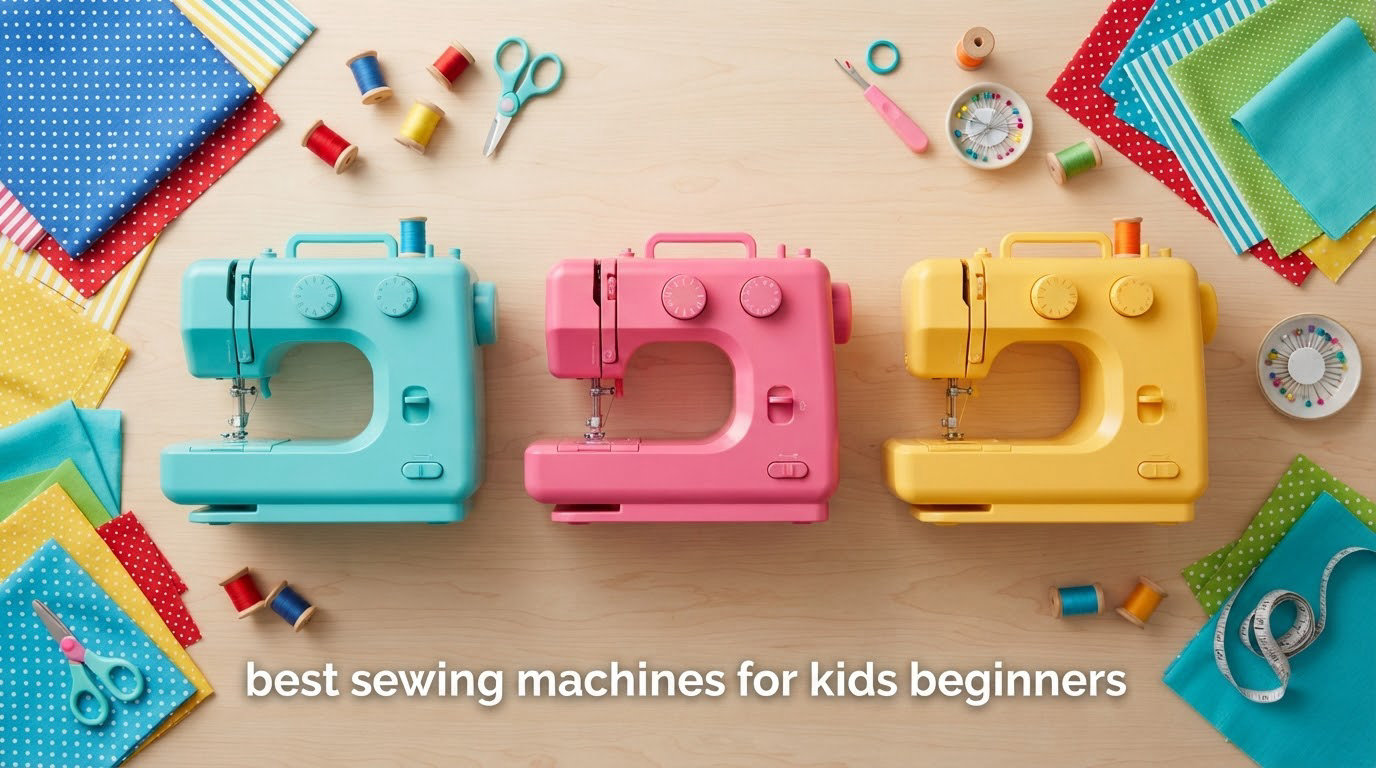
Ask any parent whose child has just received a first sewing machine and you will hear the same two stories. One ends with a child sewing doll clothing on a machine that never jams. The other ends with a toy in a closet and a parent wishing they had spent differently. The difference is rarely the child. It is the machine.
We spent weeks going through the specs, review patterns and failure reports on ten compact machines aimed at children and first-time sewists, so you can skip the trial and error. This is our guide to the best sewing machines for kids and beginners in 2026, covering everything from a four-year-old’s first yarn project to a twelve-year-old hemming her own jeans.
One framing note before we start, because it changes every recommendation that follows. A plastic toy with a hand crank and a pre-loaded plastic card is not a small sewing machine, it is a toy. It cannot hold a straight seam, it cannot be threaded, and it teaches nothing that transfers to a real machine. The machines below all sew actual thread through actual fabric with a presser foot and a feed track, at a size a child can control.
What is the best beginner sewing machine for kids? The Chunara 42-piece machine is our top pick: it has a free arm, 12 built-in stitches, two-speed control and a foot pedal, and it carries a 4.8 rating across more than 1,400 reviews. For a child under six, we start with supervised handwork and a craft kit rather than any powered machine.
Table of Contents
Top 3 Picks for the Best Sewing Machines for Kids and Beginners in October

Chunara Mini Sewing Machine
- Free arm
- 12 built-in stitches
- Two-speed with foot pedal
- 42-piece kit


The three above cover the range most families actually need. The Chunara wins on capability per unit of desk space. The CraftBud wins on everything that arrives in the box, which matters enormously when the person sewing is eight. The Sew Mighty wins on portability and on having the longest track record of the ten.
Best Sewing Machines for Kids and Beginners at a Glance in 2026
| Product | Specifications | Action |
|---|---|---|
| Chunara Mini Sewing Machine, 42-Piece Kit |
|
Check Latest Price |
| CraftBud Mini Sewing Machine with 122-Piece Kit |
|
Check Latest Price |
| Sew Mighty Portable Mini Sewing Machine |
|
Check Latest Price |
 HJWTCQL 12-Stitch Mini Sewing Machine HJWTCQL 12-Stitch Mini Sewing Machine |
|
Check Latest Price |
 Royalsellpro 123-Piece Mini Sewing Machine Royalsellpro 123-Piece Mini Sewing Machine |
|
Check Latest Price |
 Marirao 12-Stitch Mini Sewing Machine Marirao 12-Stitch Mini Sewing Machine |
|
Check Latest Price |
 COSMIUS 14-Stitch Portable Mini Machine COSMIUS 14-Stitch Portable Mini Machine |
|
Check Latest Price |
 Stoigeld Compact 12-Stitch Machine Stoigeld Compact 12-Stitch Machine |
|
Check Latest Price |
 TUZT 22-Piece Mini Sewing Craft Kit TUZT 22-Piece Mini Sewing Craft Kit |
|
Check Latest Price |
 Verdanika Beginner Tabletop Mini Machine Verdanika Beginner Tabletop Mini Machine |
|
Check Latest Price |
Two columns in that table deserve a note. First, stitch count: anything at or above 12 gives a child enough variety to hem, seam and add a decorative line without adult help. Second, the extension table, which turns a cylinder-shaped body into a flat-bed machine when a child is working on something larger than a pocket.
1. Chunara Mini Sewing Machine: Best Overall for Kids and Beginners
Sewing Machine for Beginners, mini Electric Sewing Machine with Dual Speed, 12 Built-in Stitches, Foot Pedal and 42-Piece Sewing Kit for Home DIY Projects
Free arm
12 built-in stitches
Two-speed with foot pedal
42-piece kit
Pros
- Free arm handles sleeves and pant legs
- Two-speed control lets a child start slow
- Automatic thread rewind and thread cutter
- 12 stitches including zigzag
- 84 percent of reviews are five-star
Cons
- Compact ABS body suits light-duty work
- ABS plastic body rather than metal
This is the machine we kept coming back to. The Chunara measures 12 by 11 by 6 inches, which is small enough for a child’s table and large enough that the needle plate and thread path are visible to a pair of eight-year-old eyes. It runs on batteries or mains power, and the foot pedal plus a two-speed switch means an adult can hand over control gradually instead of all at once.
What separates it from the field is the free arm. Sewing Mighty, CraftBud and Royalsellpro all describe their bodies as portable or compact, but the Chunara is the one here with a proper free arm for feeding sleeves, cuffs and pant legs around a narrow section. That is the single feature a child hits first when they want to fix a pair of shorts, and on most mini machines they simply cannot do it.
The 12 built-in stitches include straight and zigzag, which is enough for seams, hems and simple decoration. Automatic thread rewind, a built-in thread cutter and a tension dial remove the three setup steps that cause most first-session frustration. The 42-piece kit covers the basics, so nothing else needs buying before the first session.
We are not claiming it sews heavy cloth. The ABS body is built for light-duty home projects, and a parent moving a child into denim or multilayer fabric will outgrow it. Within its intended range, though, the feature density and the 4.8 rating across 1,421 reviews make it the safest bet of the ten.
What parents should check before buying this machine
Measure the desk first. At 12 inches deep it needs a real footprint, and we have seen more than one sewing corner start on the dining table and end abandoned because the machine had nowhere to live between sessions. A dedicated shelf, even a small one, does more for consistency than any accessory.
Where this machine falls short
The plastic construction is the honest limitation. It will not last a teenager sewing denim every weekend, and the metal-framed alternatives here are built tougher. For light crafts, doll clothing and beginner alterations, that difference rarely shows up inside the first year.
Second, the extension table is not included, unlike the CraftBud. Larger flat projects need a workaround. If your child is heading straight for aprons and bags rather than seams, look at a bundled kit instead.
2. CraftBud Mini Sewing Machine: Best Value for Learning at Home
CraftBud Mini Sewing Machine for Beginners, Adults and Kids Sewing Machine
122-piece kit
10 project patterns
Dual speed
Extension table
Pros
- Largest accessory bundle we tested
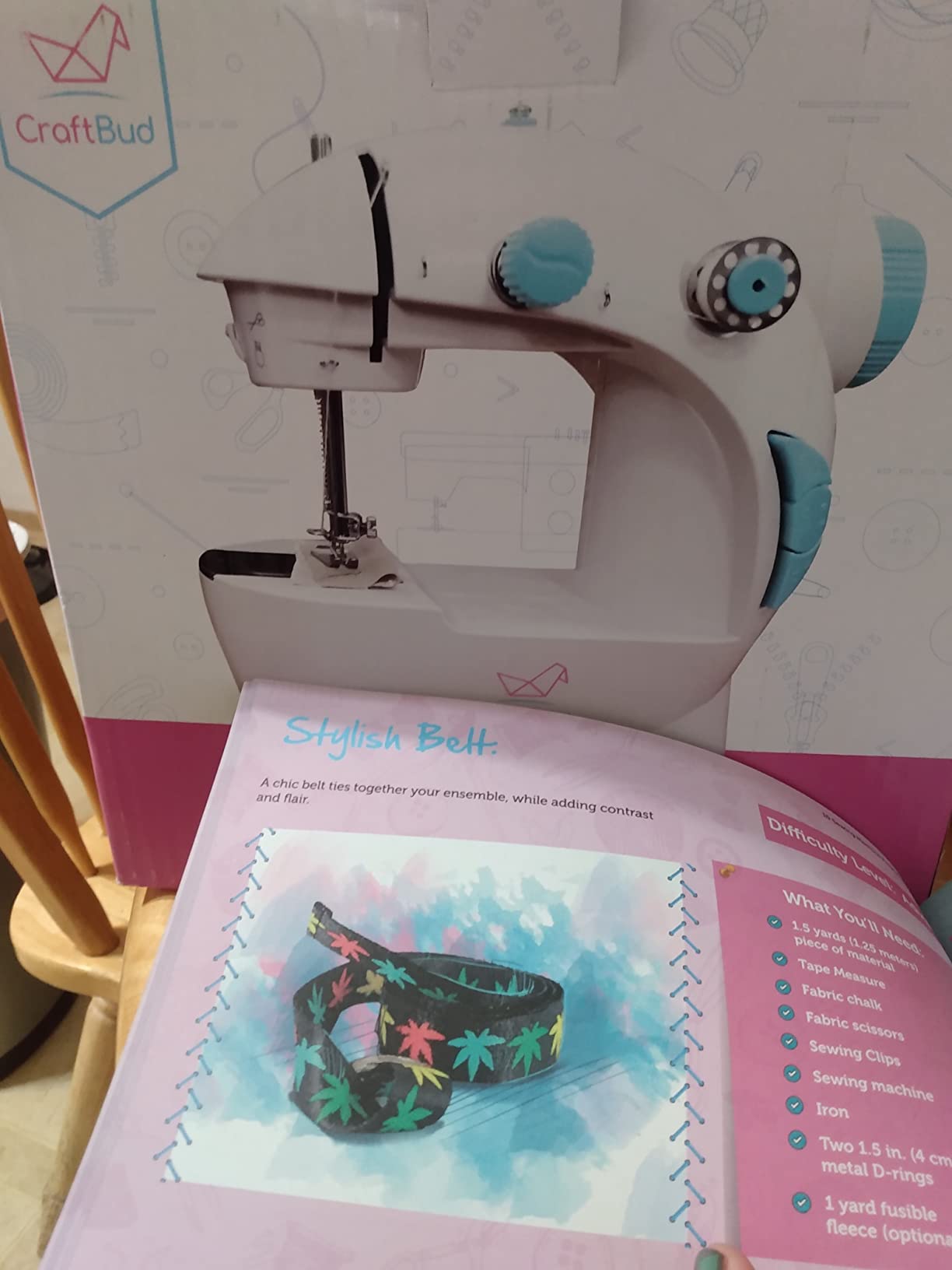
- Illustrated guide book with 10 real patterns
- Sized specifically for a child's first machine
- Extension table and foot pedal included
- Basic and Premium set options
Cons
- Only one stitch pattern available
- Top thread disconnects mid-seam
- Bobbin and needle failures reported
- Plastic body
CraftBud solves a problem the others ignore: the child needs supplies, not just a machine. The Premium Set includes 122 pieces, among them 50 ten-inch fabric squares, 16 threaded bobbins, 16 spools of thread, sewing clips, a thimble, a needle threader, a seam ripper, tape measure, chalk pencil and a foldable ruler. For a parent who would otherwise make a supply run the week before the birthday, that is the whole setup in one box.
The illustrated guide book is the part we did not expect. It contains ten project patterns with clear instructions, which turns the machine into a curriculum rather than a novelty. Experienced sewists repeatedly advise against a cheap machine for a young sewist, because frustration arrives long before the child reaches a real seam.
The body weighs two pounds and measures 10.4 by 6.5 by 10.2 inches, and it is genuinely designed for a child rather than a downsized adult machine. Dual speed, an extension table, a foot pedal and a built-in light cover the features a beginner needs as they progress past the first month.
Then there is the single-stitch limitation, which is the reason this is second and not first. Every multi-stitch machine here gives a child room to grow without a new purchase. The CraftBud sews one straight line, well, with a decent accessory kit around it.
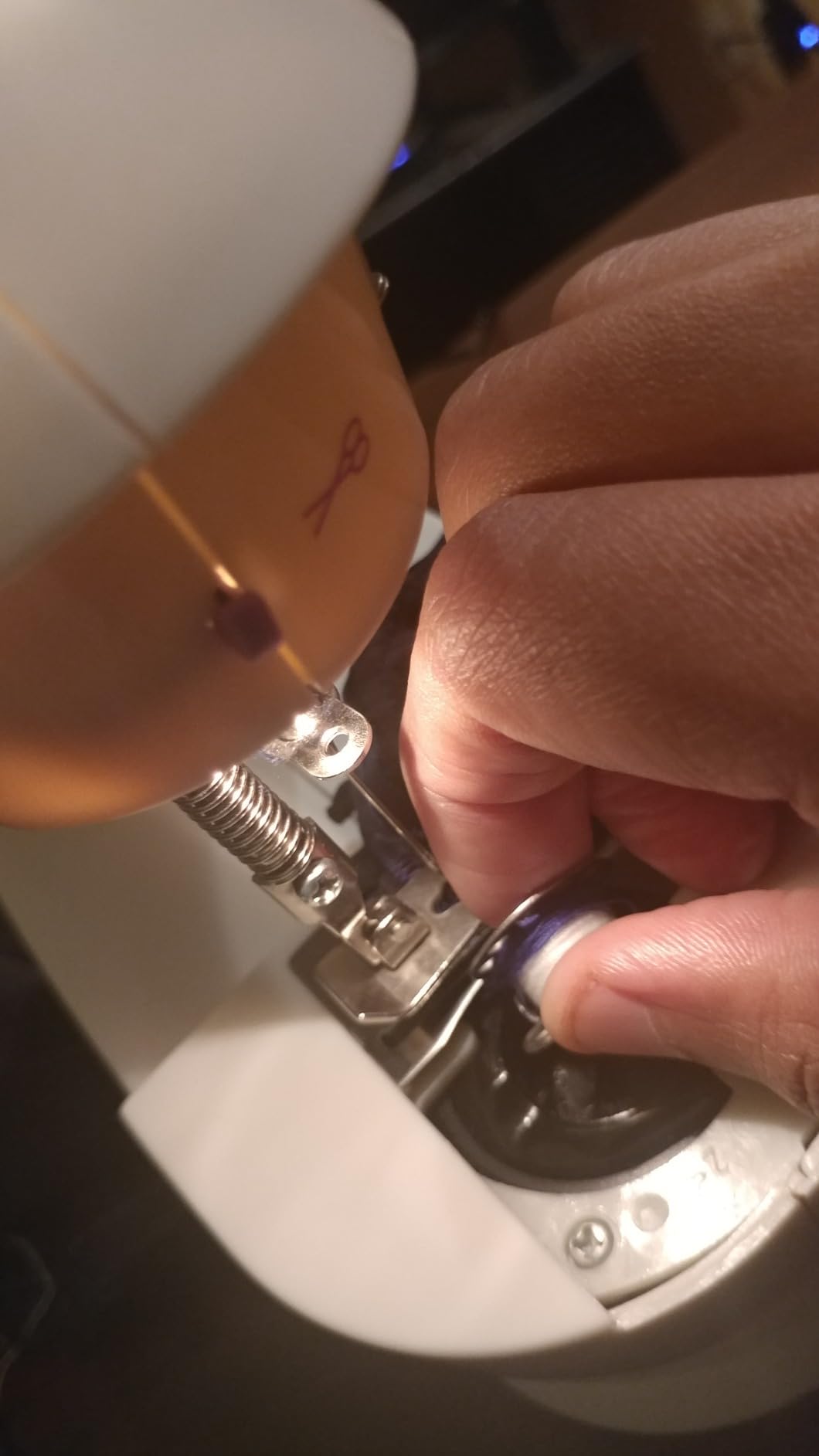
The 15 percent one-star share is worth taking seriously, and it is not about features. It is about hardware longevity: bobbin hook failures after a single day, a broken needle after a third project, and top thread that repeatedly drops out mid-seam. Budget for a possible needle replacement in the first year.
Several buyers use this as an adult second machine for quick repairs precisely because it stores in a drawer. Just do not expect decorative stitching or a buttonhole from it.
Who this machine suits
It suits a child between roughly six and nine who will sew alongside an adult and needs materials more than options. It also suits a household where the sewing happens at a shared table in bursts, because the extension table flattens the bed and the whole unit stores away between sessions.
Who should look elsewhere
A child who wants to make clothes, or a teenager who already sews, will stall quickly on one stitch pattern. If the machine will be used unsupervised, skip it too, because the reported tension dropouts are demoralising for a nine-year-old who thinks they broke it.
3. Sew Mighty Portable Mini Sewing Machine: Best for Travel and Quick Repairs
Sew Mighty Mini Sewing Machine for Kids, Beginners, Travel & More- Portable, Battery Powered, use for Traveling, Quick Repairs, Small Projects & Children– Dual-Speed, AC & DC power, Foot Pedal & More
Two-speed
Automatic bobbin winder
Work light
Cuff notch
AC or battery
Pros
- Runs on mains power or four AA batteries
- Metal construction at this price
- Automatic bobbin winder and work light
- Foot pedal included but optional
- Highest review count of the ten at 1691
Cons
- Single stitch with no decorative options
- AC and battery power cannot combine
- Light-duty mending and small projects only
At 399 grams, the Sew Mighty is the one we would put in a bag to take to a grandparent’s house, a craft night or a holiday. It runs on 110V AC or four AA batteries, and the seller is explicit that the two power sources cannot be used at the same time. That dual-power flexibility is unusual in this group and it is the reason the machine has held a large install base for years.
It is also metal rather than all-plastic, which we did not expect at this level. The features a child actually notices are the automatic bobbin winder, the integrated work light and the cuff notch, a small cut-out on the flat bed that lets you match a trouser hem in minutes without measuring.
The foot pedal is included but optional, and the machine runs without it. That matters for the child who is not ready for pedal control.
The trade is capacity. It is a single-stitch machine, and the wide rating spread across 1,691 reviews is largely a matter of expectations, but the low end of that spread is a real group of buyers who wanted a full sewing machine. Experienced sewists often describe older workhorse machines in almost exactly this way: not fancy, very noisy, but they finish the job.
Dimension data is listed inconsistently across sources, so measure the storage spot before you commit. We would plan on a machine that takes up about the footprint of a shoebox, not a microwave.
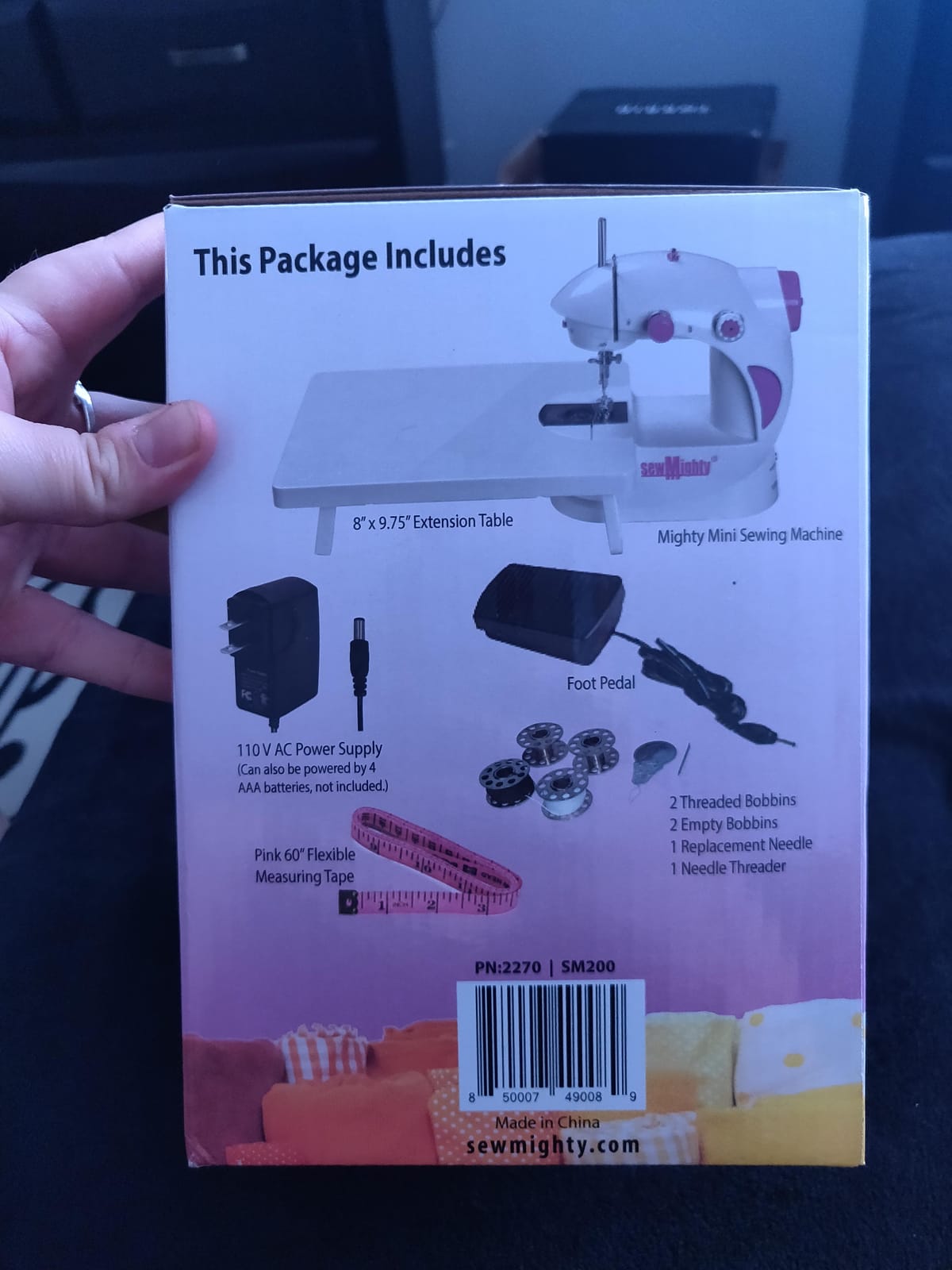
It is available with or without a sewing kit, and the box includes pre-wound bobbins in black and white, two empty bobbins and a replacement needle. That replacement needle matters more than it sounds, because it is the most common early casualty on any machine at this level.
Where it beats the bigger machines
Portability is not a minor benefit when a child learns from someone else. Taking the machine to a grandmother’s, a Saturday class or a shared crafting table means the child practises where the sewing actually happens, rather than waiting for a machine to be unpacked.
It is also the least intimidating object of the ten for a young child. Small, light and simple, with one thing to do.
What you give up
Straight seams only, and genuinely light duty. No zigzag, no buttonhole, no decorative line, and multiple layers, denim and canvas are all outside its brief.
4. HJWTCQL 12-Stitch Mini Sewing Machine: Best for Stitch Variety on a Budget
HJWTCQL Mini Sewing Machine for Beginners,Kids Small Sewing Machines 12 Built-in Stitches with Reverse Sewing,Portable Sewing Machines with 27pc Accessory Kit Included 2 Speed Double Thread Foot Pedal
12 stitches plus reverse
Button and foot switch
Thread cutter and light
5.37 lb
Pros
- Widest stitch range in this budget group
- Button switch lets a child sew without a pedal
- Reverse sewing
- Built-in thread cutter and light
- Compact and easy to store
Cons
- Threading is the most common failure point
- Some owners report jamming within seconds
- Often described as toy-like
- No manufacturer warranty
- Thread breaks past the fabric edge
Twelve stitch patterns including straight lines, decorative lines, buttonhole and blind hem, plus reverse sewing, is the broadest feature set you will find under a very modest spend. The button switch mode is the sleeper feature here: a child can run a seam by pressing a button on the machine body instead of working a foot pedal, which removes the coordination problem entirely.
Preset stitch widths and lengths mean a child picks a stitch and it just does what it says. A built-in thread cutter and a sewing light remove two more setup steps. The 27-piece kit brings 14 colours of thread, needles, a tape measure, scissors and buttons.
At 5.37 pounds it is one of the two heaviest machines here, and a child will feel that when trying to move it between rooms. It is compact enough to store, but it is not the machine a small child carries to a table without help.
Documentation is the real problem. Threading is the most common failure point across reviews, and incorrect instructions have left owners with loose, poor stitches. One owner had a professional re-thread it and correct the stitch quality, which tells you the machine can do the job but the manual cannot explain it.
Several owners also report squeaking, jamming within seconds or stopping mid-seam, and there is no manufacturer warranty to cover recurring faults. Handed to a beginner alone, the threading step is where sessions die.
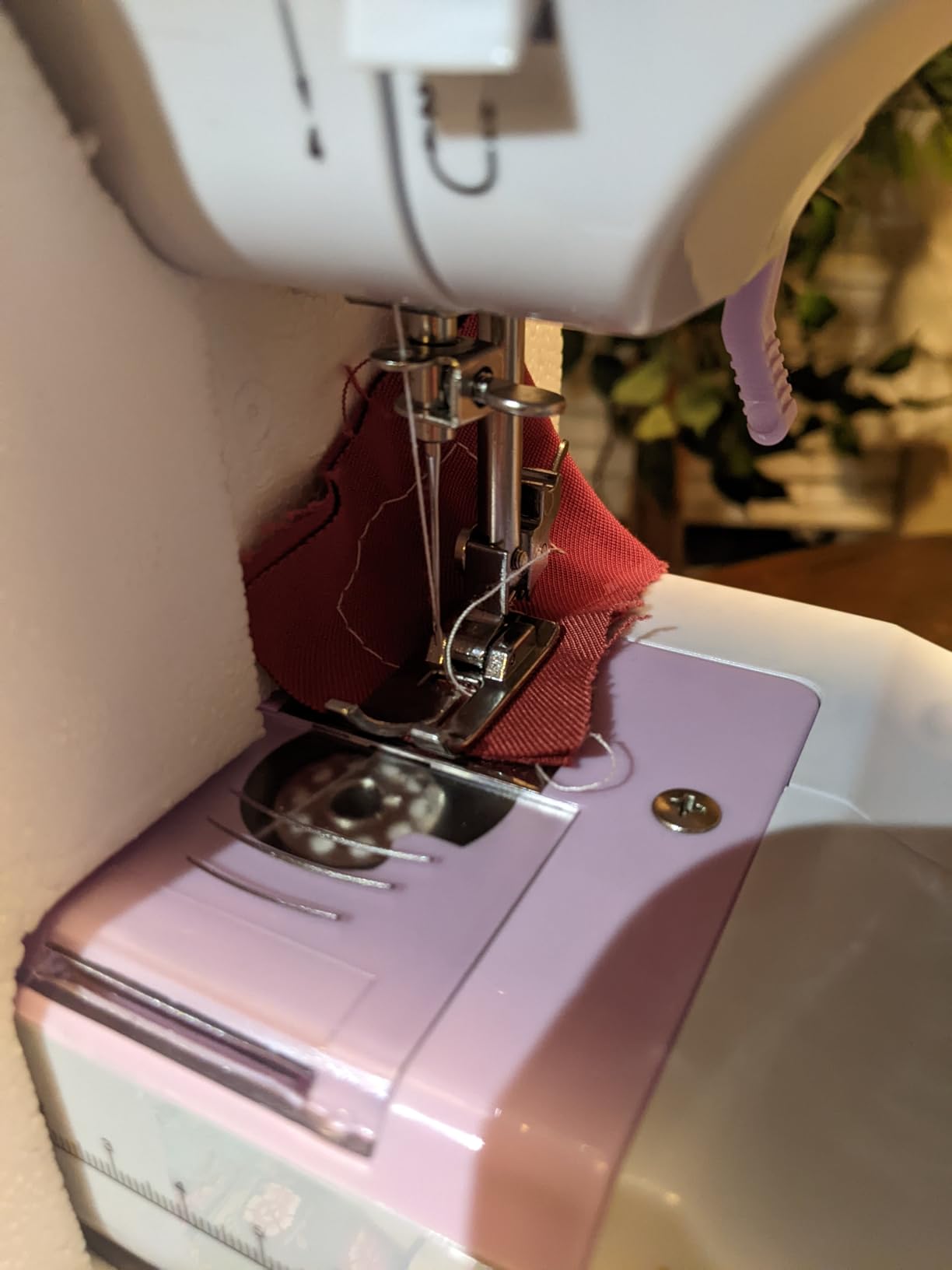
One detail worth knowing: each machine ships with a piece of test fabric used for pre-delivery performance testing. That is a sign of a factory test, not a used machine, and it is worth explaining to a child who wonders why there is a scrap of stitched cloth in the box.
Best fit for a confident beginner
This suits a child who has already sewed on something else and wants a wider stitch range without moving to a full-size machine. The buttonhole and blind hem capability matter for anyone starting simple clothes alterations.
Reasons to pass
No warranty is a real risk on a machine that reportedly jams. The weight is a problem for a five- or six-year-old who needs to move it themselves. And the threading difficulty is not a minor inconvenience, it is the first thing a child has to master.
5. Royalsellpro 123-Piece Mini Sewing Machine: Best Safety Features
Royalsellpro Mini Sewing Machine with 123 Pcs Sewing Kit for Beginners, Dual Speed Portable Sewing Machine with Light and Finger Guard Suitable for Household, Travel
Finger guard
High and low speed
Extension table
Dual power
10.23 x 8.81 x 6.53 in
Pros
- Most child-safety-focused specification of the ten
- Tutorial eBook with 12 graded projects
- Extension table adds stability
- Battery or plug-in power for school or travel
- Warranty and after-sales support
Cons
- Bobbin threading frustrates several buyers
- Many small parts including a needle-change screw
- Clunky feel and basic stitch quality
- DC power only
This is the machine to buy if safety is your first filter. It has the most explicitly child-focused specification in the group: a built-in finger guard plus adjustable high and low speed for supervised use, and a built-in sewing light for low-light visibility. Parents of six-to-ten-year-olds dominate the positive reviews specifically because of the guard.
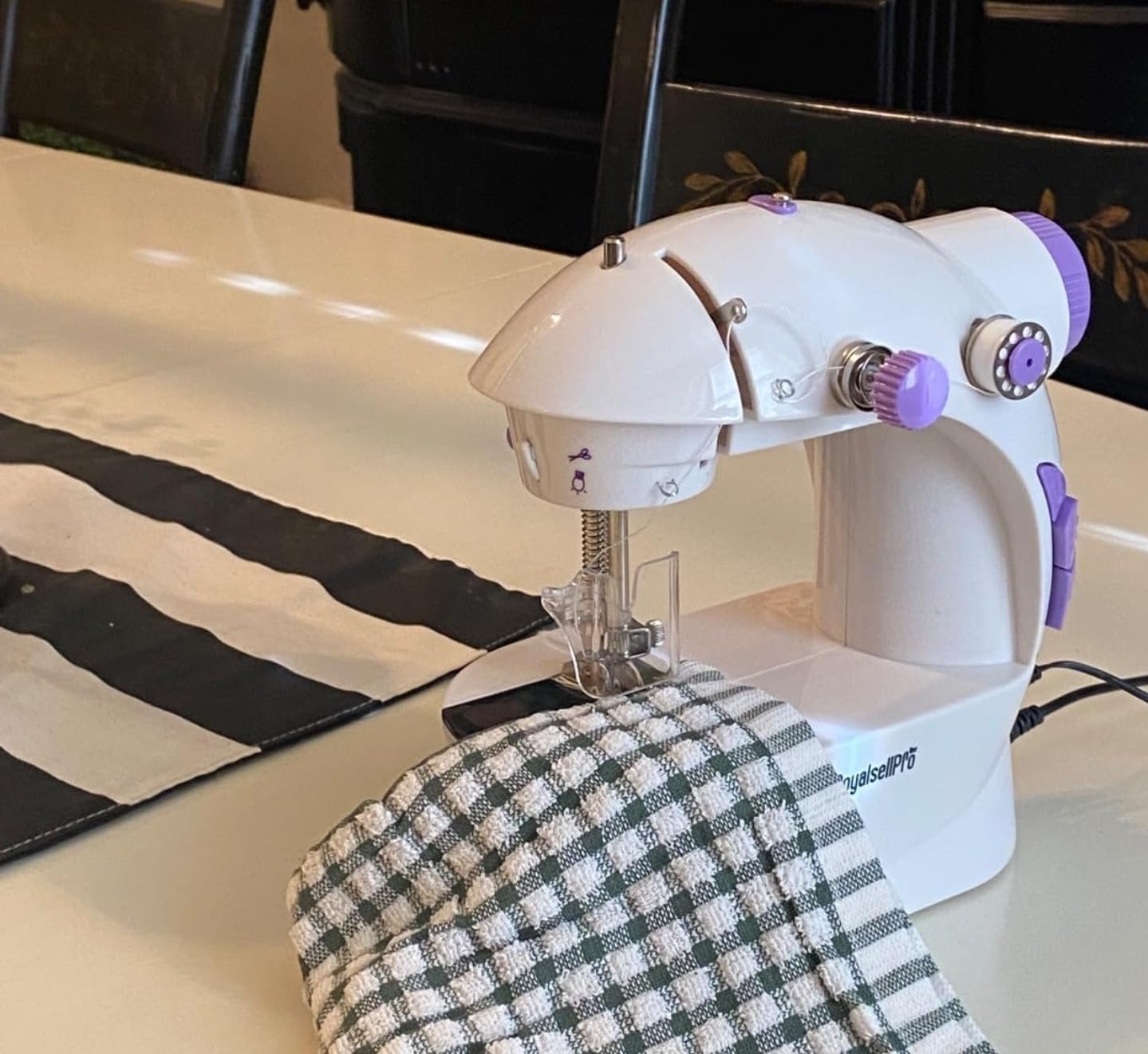
The 123-piece kit includes 16 coloured threads, five needles, scissors, a tape measure, an extension table and a full tool set, plus a sewing tutorial eBook with twelve graded projects that run from simple crafts to aprons, shopping bags and dolls. That eBook is a genuine learning path rather than a parts list.
Dual power means it can run on batteries or plug-in, so it works at a school, a library or while travelling. The extension table stabilises larger work, which most machines in this class skip.
Bobbin threading is the consistent complaint, and it is the important one for you to know. One buyer spent hours on it, and another, an experienced sewist, could not get it to thread at all. Test the bobbin before the child does, not after.
There are also many small parts including a needle-change screw, which is hard work for anyone with limited hand dexterity or vision. And the machine runs on DC power only, which limits use without the adapter.
One reviewer received a box with missing accessories, so check the kit contents against the list on arrival. Warranty and after-sales support are offered, which is a meaningful difference from machines that ship with none.
Why the finger guard changes the maths
Safety is the most repeated parent concern in every sewing forum thread we looked at, and the honest answer is that no machine makes a needle safe. What a guard does is keep small fingers at a distance while the fabric feeds, and what adjustable low speed does is make it possible for you to hand over control without the machine lurching forward. Together they let a parent sit beside a six-year-old rather than standing over them.
Where it disappoints
The bobbin. If your child cannot be shown how to thread the bobbin once, twice, early, this machine will stall before it starts. And basic stitch quality is fine for crafts but thin for anything you would wear.
6. Marirao 12-Stitch Mini Sewing Machine: Best for Making Clothes
Marirao Sewing Machine for Beginners, Portable Mini Small Sewing Machine with 50 Pcs Fabric and 32 Pcs Sewing Threads Kit, 12 Built-in Stitches 2 Speed with Foot Pedal
12 stitch patterns
2-speed
Foot pedal or button
Threading marks on body
Pros
- Handles thicker fabric than most machines of this size
- 12 stitch patterns with 2-speed control
- Threading indicator marks printed on the body
- One owner used it six months with no degradation
- Lightweight at 2.4 kg
Cons
- Runs loud and vibrates
- Thread tension proved hard to set
- Foot pedal cord is very short
- Can start stitching on its own at the faster speed
Among the compact machines here, the Marirao gets the most consistent reports of handling fabric heavier than expected for its size, which is why we rate it best for a child moving into clothes-making rather than crafts. One parent specifically recommended it for a child learning to sew their own clothes, and one owner ran it for six months with no degradation.
Twelve stitch patterns, two-speed control, and both foot-pedal and body-button operation give a child a sensible progression path. The threading indicator marks printed on the machine body are a small thing that removes a lot of guesswork for a first-timer.
Shipping includes 50 pieces of fabric and 32 spools of thread, so the material problem is solved at the box. Each unit is factory tested and ships with a small threaded cloth, so test marks in the box are expected, not defects.
Now the honest list. It runs loud and vibrates noticeably, and thread snaps easily because of how rough the mechanism runs. One owner could not set the thread tension to their satisfaction even after following the manual, after which the machine stopped stitching properly. Tension is the thing to test in the first ten minutes.
The foot pedal cord is very short, so plan the machine’s position around the cable rather than the other way around. And it can stitch on its own at the faster speed once switched on, which is genuinely unsettling for a child at a table. Keep the speed switch on low until they are confident.
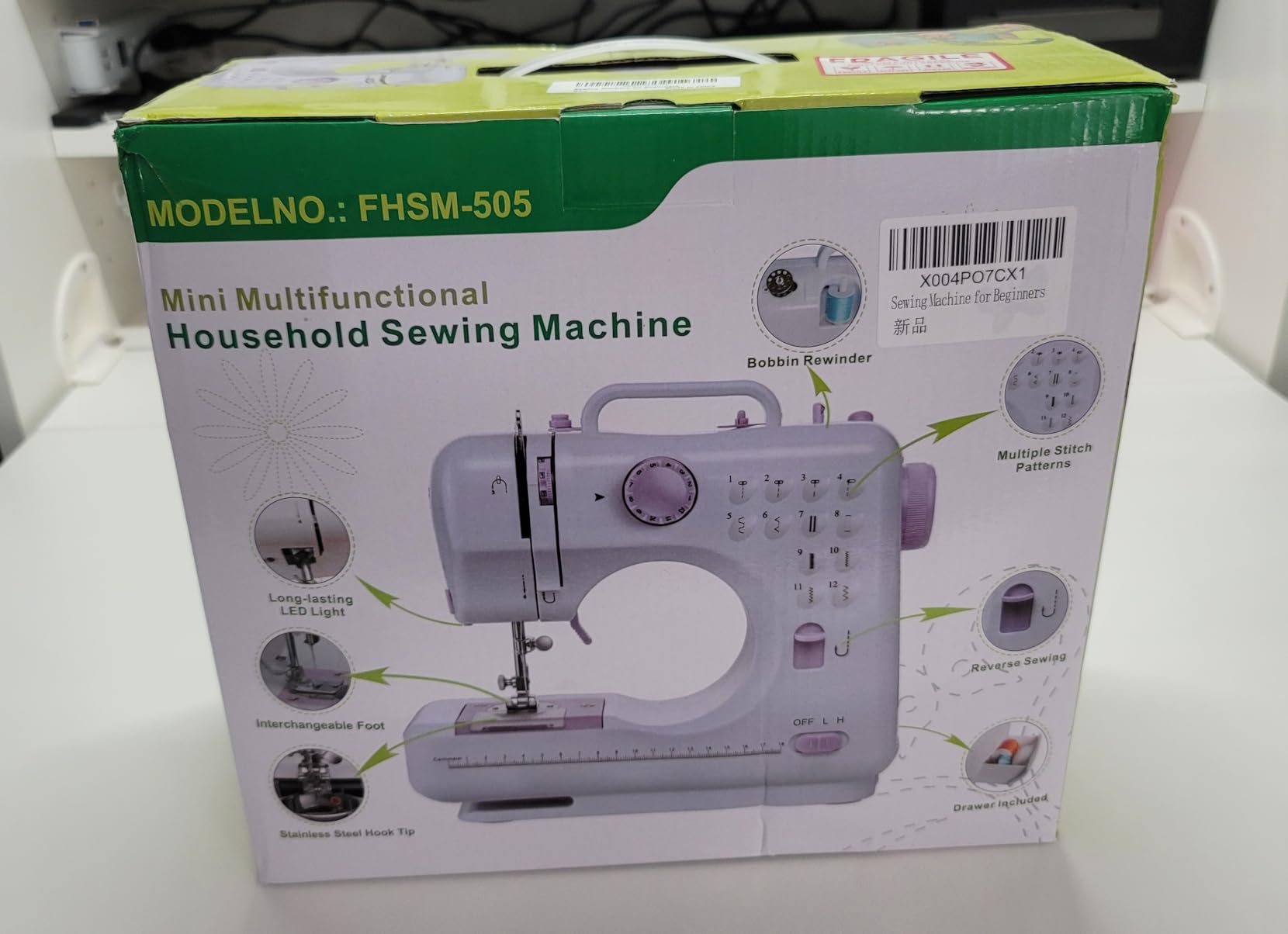
Seller support includes one-on-one operating guidance by request, which given the tension complaints is worth using before your child does. Dual power runs on an AC adapter or four AA batteries, and the two modes must not be used together or the motor may be damaged.
Why we rate it best for clothes
It is the combination of fabric tolerance, stitch range and speed control. A child hemming trousers or attaching an elastic waist needs a machine that can take a seam through folded layers without stalling, and that is the complaint that appears least often here. Slow speed is for guiding around a curve, fast speed is for the straight run, and children learn that distinction faster with a machine that offers both.
Reasons to pick something else
Noise and vibration make it a poor choice for a shared flat or a late evening, and a short pedal cord is a daily irritation. The tension complaint is also unresolved, and tension is exactly what makes stitch quality fall apart on a first garment.
7. COSMIUS 14-Stitch Portable Mini Machine: Best for Small Spaces
Portable Mini Sewing Machine for Beginners, 14 Stitches, Easy Dial Control, LED Light & Extension Table, Compact Lightweight for Home DIY Mending, Ideal Gift for Kids Adults Bright pink
14 stitch patterns
Dial control
Extension table
LED light
5.5 lb
Pros
- Highest stitch count among compact beginner machines
- Slow speed designed for children learning
- Simple dial control and easy threading
- Compact for apartments and dorm rooms
- Metal and plastic build
- No one-star reviews in the distribution
Cons
- Bobbin thread is hard to bring up and comes undone mid-seam
- Not suitable for thick fabrics
- AC power only
Fourteen built-in stitch patterns covering hemming, patching and craft work is the highest stitch count among the compact machines we reviewed, and it is paired with a deliberately simple dial control instead of a menu. For a child, a dial is the right interface: turn it until the symbol on the stitch chart matches the one you want.
Two speeds, with the slow setting intended for children learning, came up positively in reviews, including one grandparent who praised it specifically for keeping fingers safe. A built-in LED light and an extension table cover visibility and larger pieces.
The 4.4 rating is the second-highest average in the group, and the distribution shows no one-star reviews at all. We want to be straight with you: that is on a base of 36 reviews, the smallest here, so treat it as encouraging rather than proven.
The recurring complaint is bobbin thread. It is hard to bring up and often comes undone mid-seam even after watching tutorials. Again, this is the thing to sort before handing over the machine, not after.
Metal-and-plastic construction feels more durable than the all-plastic mini machines, and at 5.5 pounds it is the heaviest machine of the ten here.
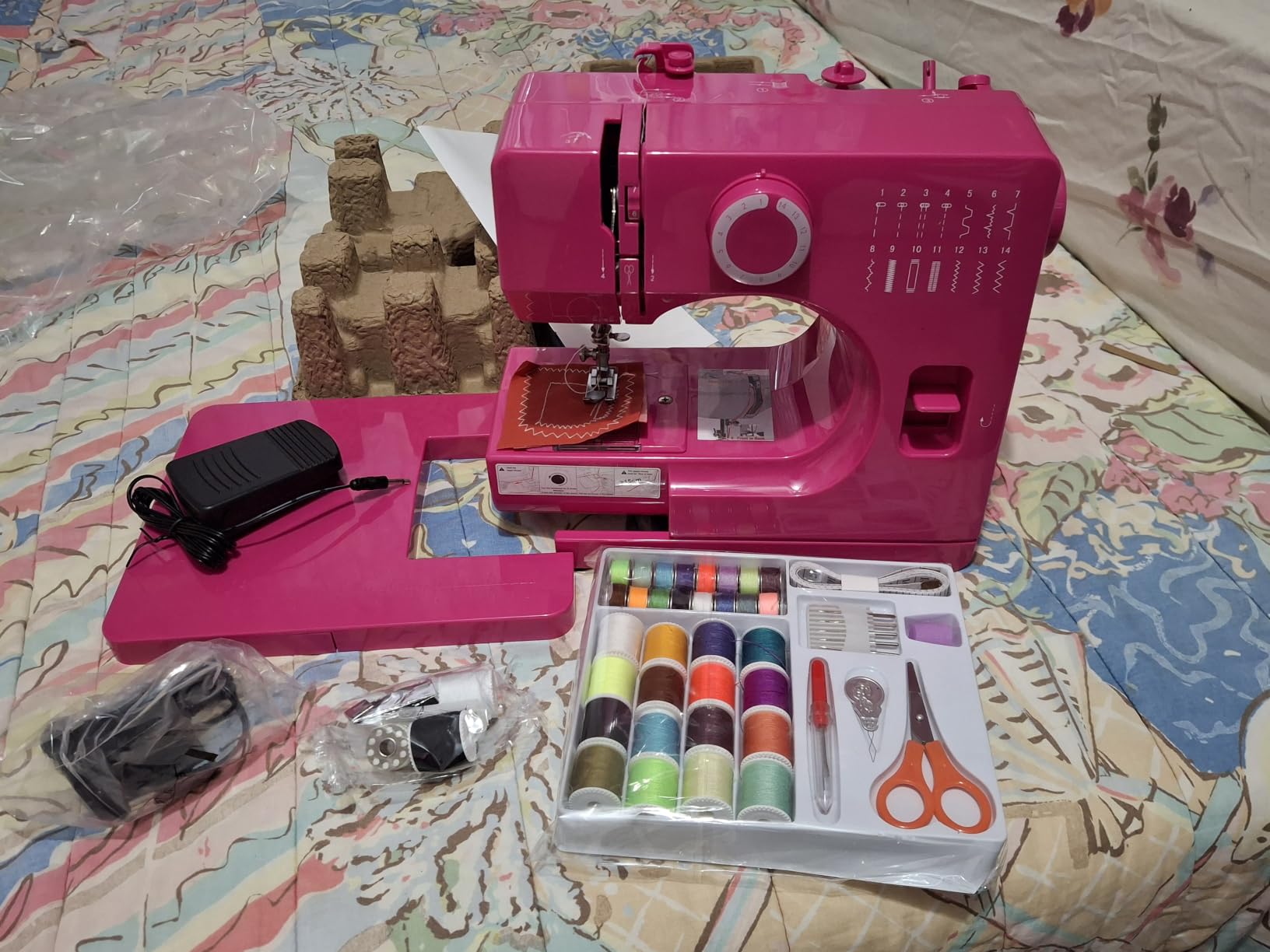
One buyer bought two machines so a class of grandchildren could each have one, which tells you something about how it behaves with several children sharing a room. Available in bright pink, white and blue, and white and pink, because for a shared family machine a colour a child picks themselves is a small thing that gets the box opened.
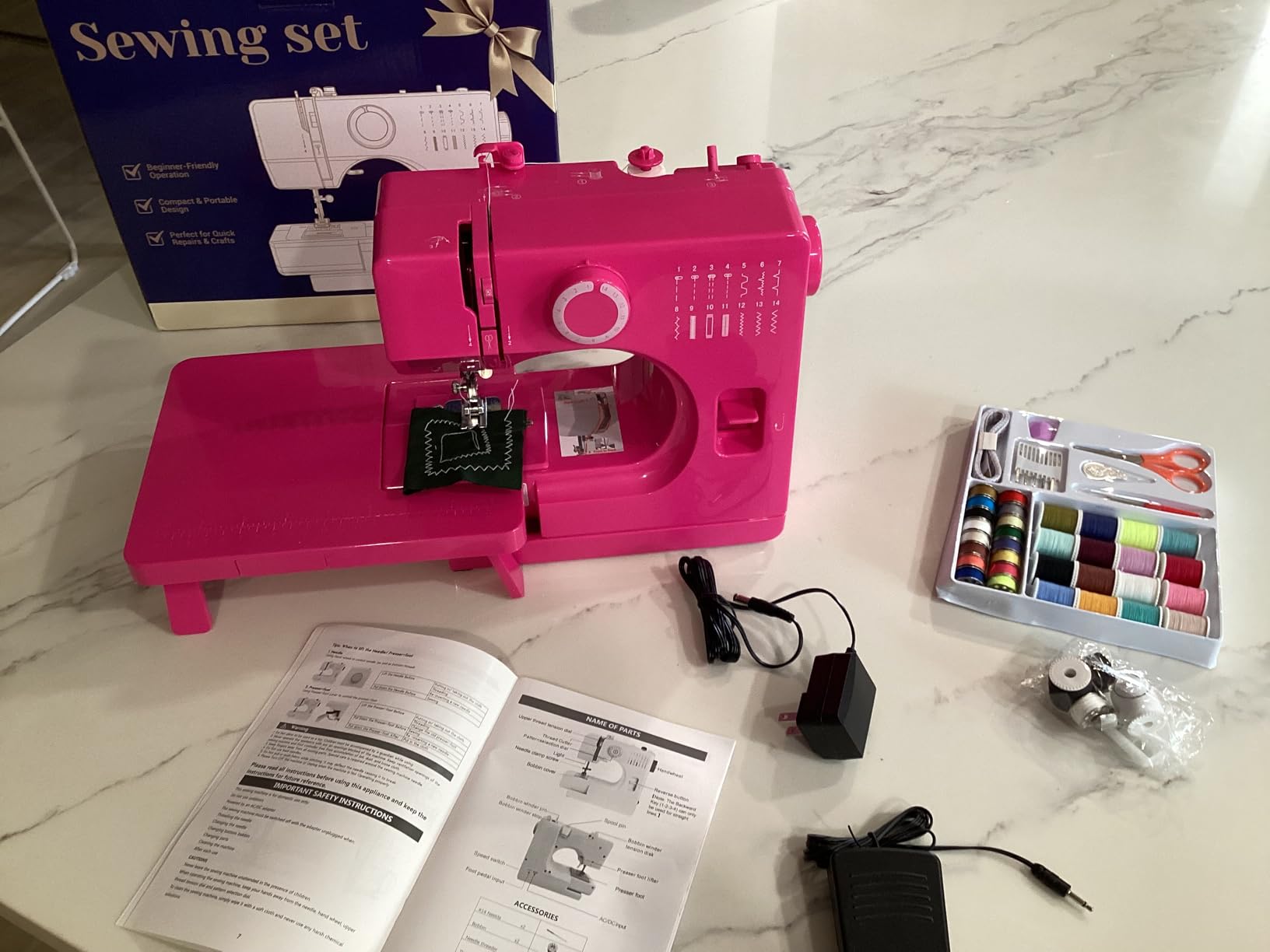
What makes it suit small spaces
At 11.2 by 5.3 by 9.7 inches it is one of the narrower bodies here, and the extension table gives back the flat working surface only when a project needs it. The LED light matters more in small rooms than people expect, because sewing corners are usually the dim corner.
Where it falls short
Bobbin pickup is a real recurring problem and it is the first thing a child will hit. AC-only power removes the flexibility parents like for trips and classes. And it is not a thick-fabric machine, so a child heading toward denim will need the next step up.
8. Stoigeld Compact 12-Stitch Machine: Best Thread Kit Included
Small Sewing Machine for Beginners, Portable sewing Kit for Light Fabrics
32 thread spools
Foot pedal
12 stitches including overlock
2-speed
4.2 lb
Pros
- 32 colours of thread included so nothing else is needed
- 2-speed control with a slow setting for children
- Compact at 10.3 x 9.5 x 4.4 inches
- Handles light fabrics up to 4-6 layers
Cons
- Jams frequently on longer runs
- Strains and heats up on extended sessions
- Intended for light fabrics only
- Needle seen as hard to replace and see
The headline here is 32 spools of thread. Combined with the foot pedal, power cord, bobbins, needles and a threader, a family buying this has everything needed to start, and colour choice stops being an argument in the shop. For a child who wants to pick their own thread, that is not a small detail.
Twelve built-in stitches cover straight, zigzag, overlock and reverse, which is a well-chosen set for mending and light craft fabric. Two-speed control with a low speed intended for beginners is the right starting arrangement, and 4.2 pounds is light enough for a child to shift between rooms.
Owners generally treat it as a capable compact home machine for everyday mending, cross-stitching and light craft fabric. Buyers also report it worked straight out of the box, and that the build looks better in person than the listing photos suggest.
The durability picture is the caution: it jams frequently on longer runs, and it strains, heats up and smells on extended sessions. Design intent is explicitly light fabrics, up to four to six layers, and it jams on denim and canvas.
One review is worth repeating for parents of older children: an eleven-year-old found the needle hard to replace, hard to see and hard to handle. The small work light and fine needle make this a machine for hands that can manage a fine motor task.
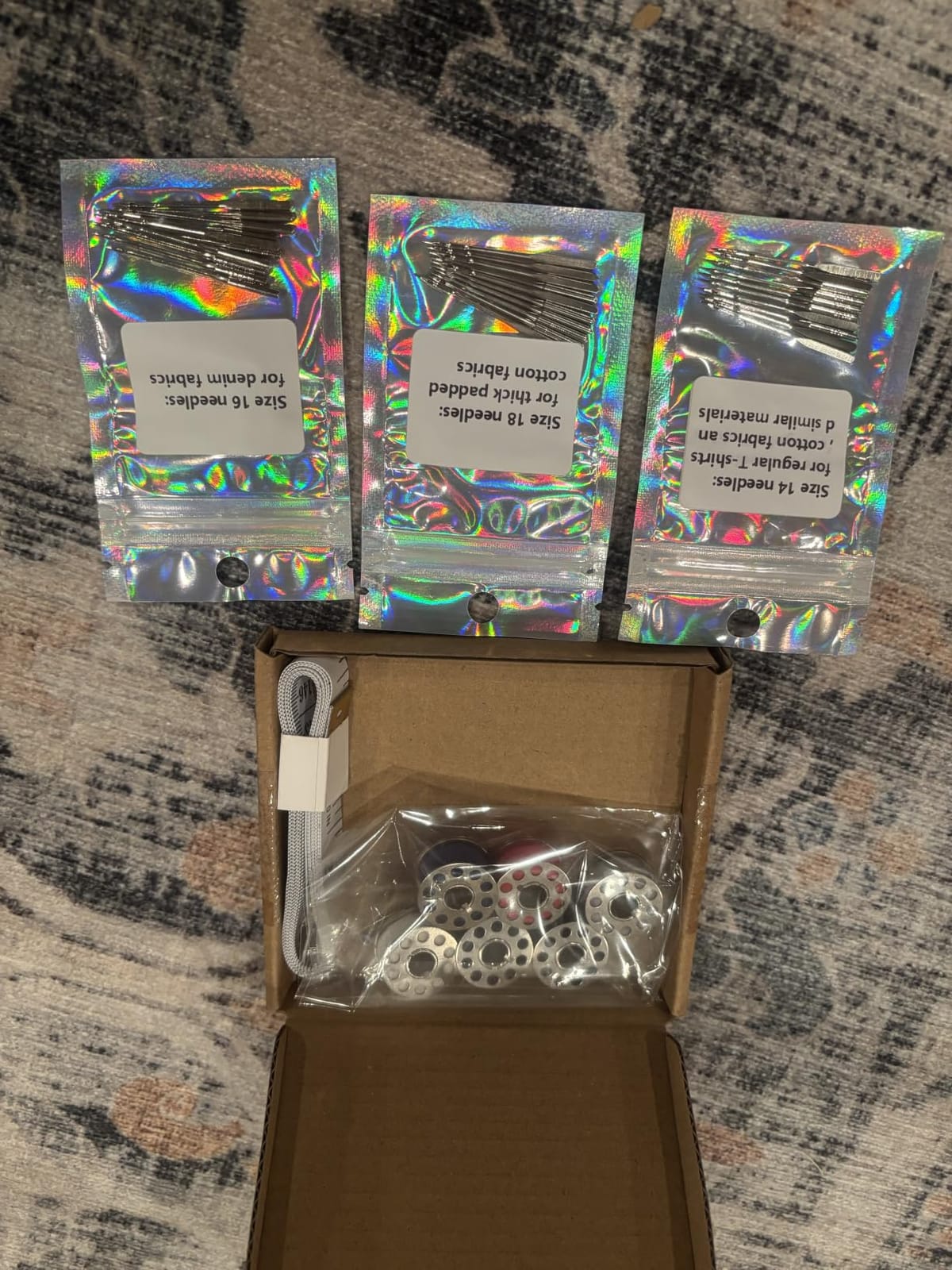
One buyer received a returned unit that still contained the previous owner’s test sample and was unthreaded, so inspect on arrival. A 30-day return policy is a reasonable safety net for a machine with these jam reports.
Where it earns its place
It suits a household starting from nothing, where the first purchase is usually a machine plus a pile of thread anyway, and a child doing repeated small mends, since short jobs mean fewer long runs and fewer jams.
Reasons to look elsewhere
If your child sews continuously, heating and jam reports are a poor fit. If the child is under about ten, the needle-change difficulty is worth avoiding. And for anything thicker than quilting cotton, this is the wrong tool.
9. TUZT 22-Piece Mini Sewing Craft Kit: Best for Kids Under 6
TUZT Mini Sewing Machine Toy Kit for Kids Beginners, 22pcs Portable Electric Sewing Machine with Sewing Kit, Light and Finger Guard, Birthday Christmas Gift for Kids Girls 4-12
22-piece kit
Built-in light and finger guard
Battery or USB
10 x 2 x 2.72 in listing
Pros
- Genuinely portable at under a pound
- Built-in light and finger guard
- Arrives fully assembled with pre-cut fabrics
- Enough for six finished craft projects
- Visual manual children can follow
Cons
- Uses yarn rather than thread and does not form a true stitch
- Yarn comes off the feed track and needs adult help
- Short 18-inch cord needs a separate adapter
- Some units arrived with snapped needles
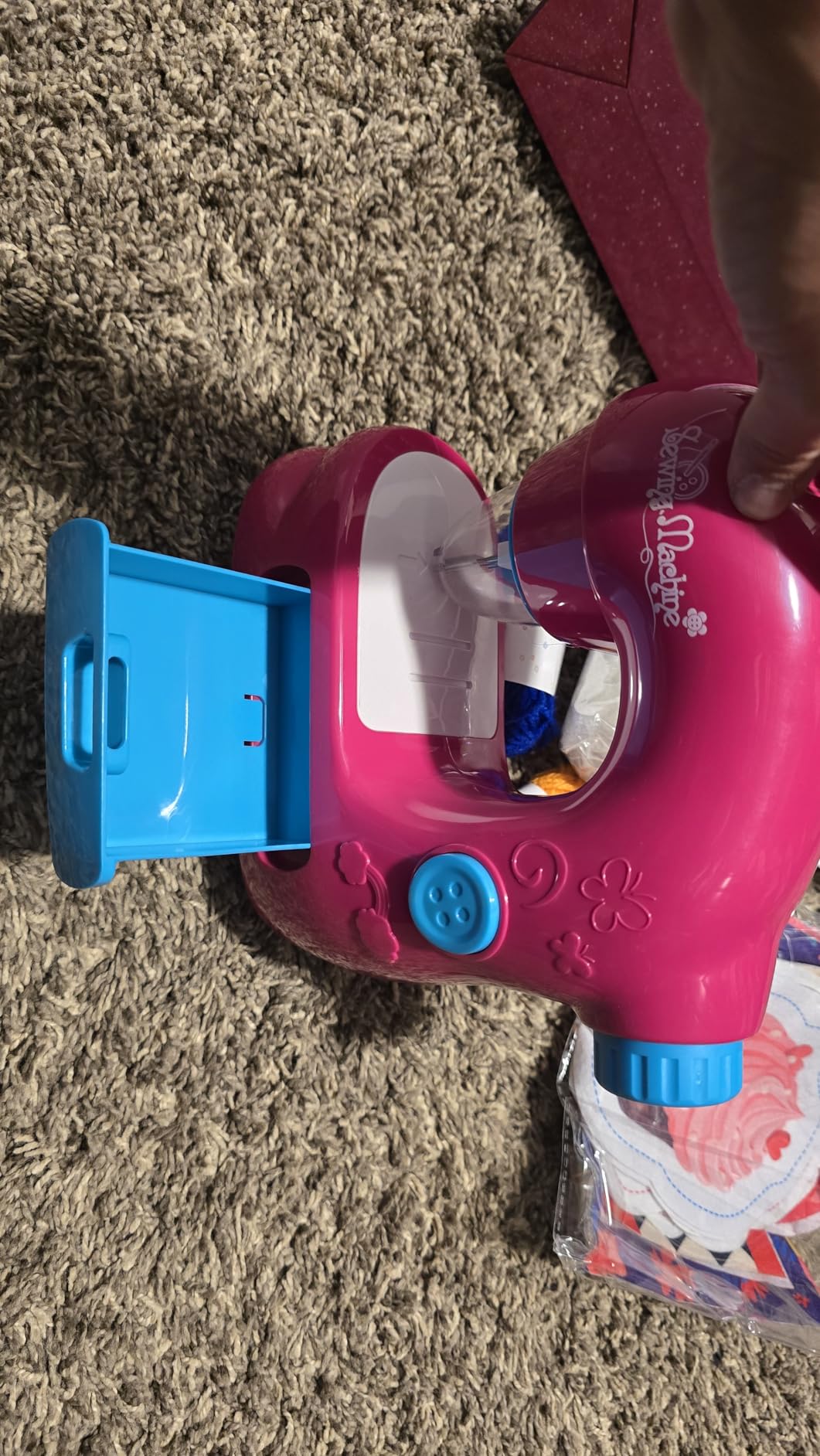
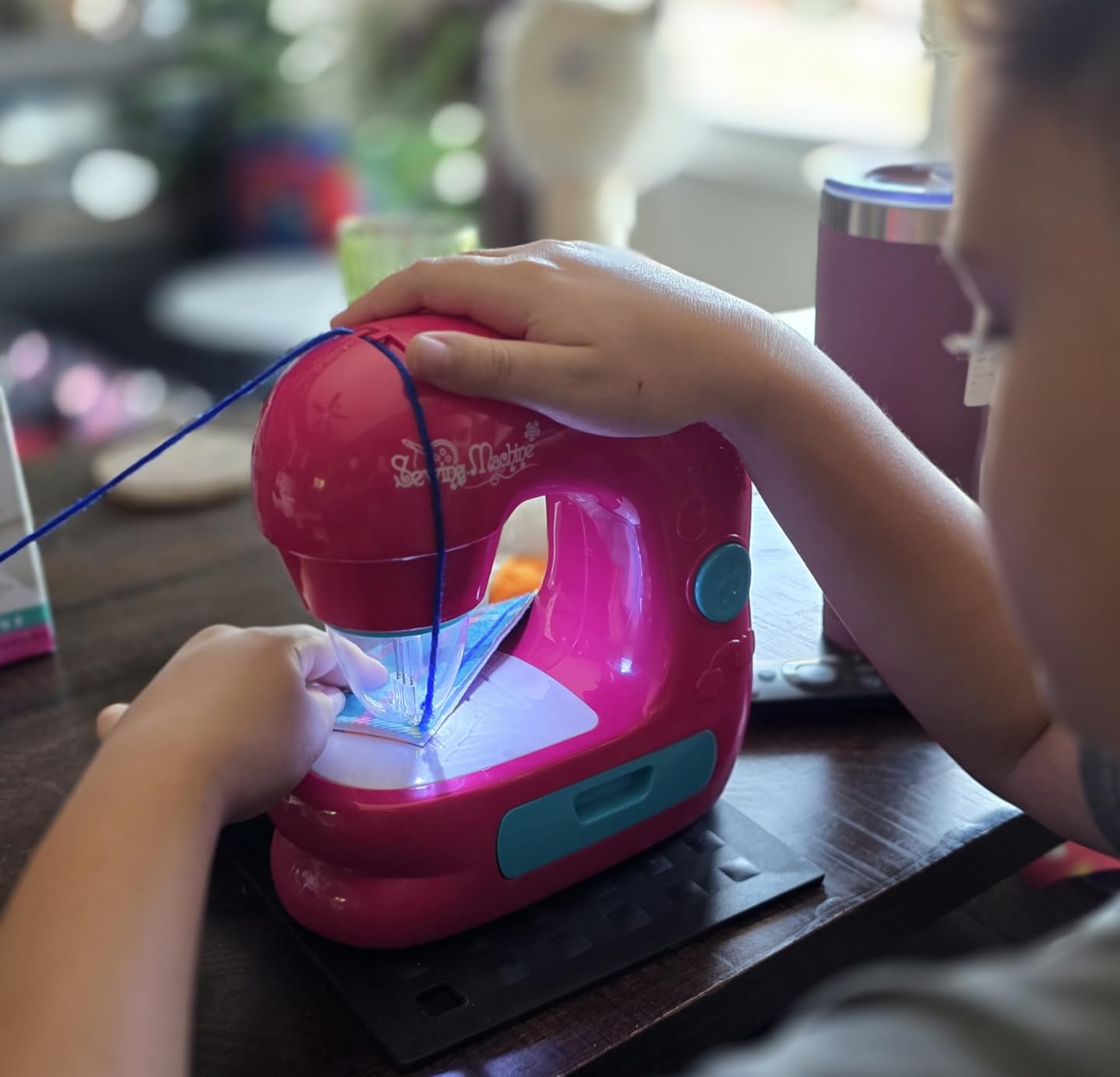
We are including this one deliberately, and the heading is the message: this is for kids under 6, not a first sewing machine. The machine measures about 7 by 7.8 by 3.7 inches, weighs under a pound, and arrives fully assembled with pre-cut doll cloth, fabric squares, chain, thread and mini scissors. A four-year-old can be making something in the first ten minutes.
The built-in light and finger guard give parents the reassurance they are looking for, and the manual uses precise visual instructions that several reviewers said their child could follow without help. Six complete craft projects are achievable, and parents report kids finishing them in a single session.
Now the limitation, and it is fundamental. This machine uses yarn rather than real thread and pushes the yarn through the fabric without forming a true stitch. The yarn frequently comes off the feed track, so a child needs an adult’s hands nearby the whole time. Nothing sewn here transfers to real machine work.
It also runs on a short 18-inch cord that needs a separate USB or wall adapter, and batteries drain quickly. Some units arrived with snapped needles and a non-moving needle bar, so check the needle mechanism before the first session.
The 4.2 rating across 142 reviews splits sharply into two camps. Parents who wanted a light first craft experience for a three-to-eight-year-old were delighted. Parents who expected a working sewing machine found the yarn feed unreliable. Know which one you are before the box is opened.
Our recommendation: start here if your child is four, five or six and has never used a needle, and move to a machine like the Chunara at seven or eight. If your child is six and already comfortable hand sewing a running stitch, go straight to a real machine, because hand-sewing competence is the single biggest predictor of a child getting something out of a powered machine on day one.
What it is genuinely good for
Motor skills, cause and effect, and finishing a thing. A child who completes a doll apron in one sitting has learned that they can start something and see it through, which is the actual skill that keeps an eight-year-old sewing six months later. It is also the cheapest way to test whether a child is interested at all, before committing to a machine that will sit on a shelf.
What it is not for
It cannot sew a straight seam, it cannot sew clothing, and it does not teach the mechanics a child needs later. Treat it as a craft kit, and be honest with your child about that so it is not a disappointment later.
10. Verdanika Beginner Tabletop Mini Machine: Best for Everyday Fabrics
Portable Tabletop Beginner Mini Sewing Machine for Home Use, Compact & Easy-to-Use Sewing Machine for Quick Repairs, DIY Crafts & Alterations, Giftable Sewing Machine for Beginners, Kids & Adults
Internal metal frame
12 stitches
9-level tension
Automatic bobbin wind
2-speed
Pros
- Internal metal frame adds stability on cotton and denim
- 9-level thread tension and reverse stitching
- Automatic bobbin winding and LED light
- Compact and easy to store
- Footswitch or power switch
Cons
- Smallest review base here at 57 reviews
- AC power only with no battery option
- Can start sewing without deliberate pedal input
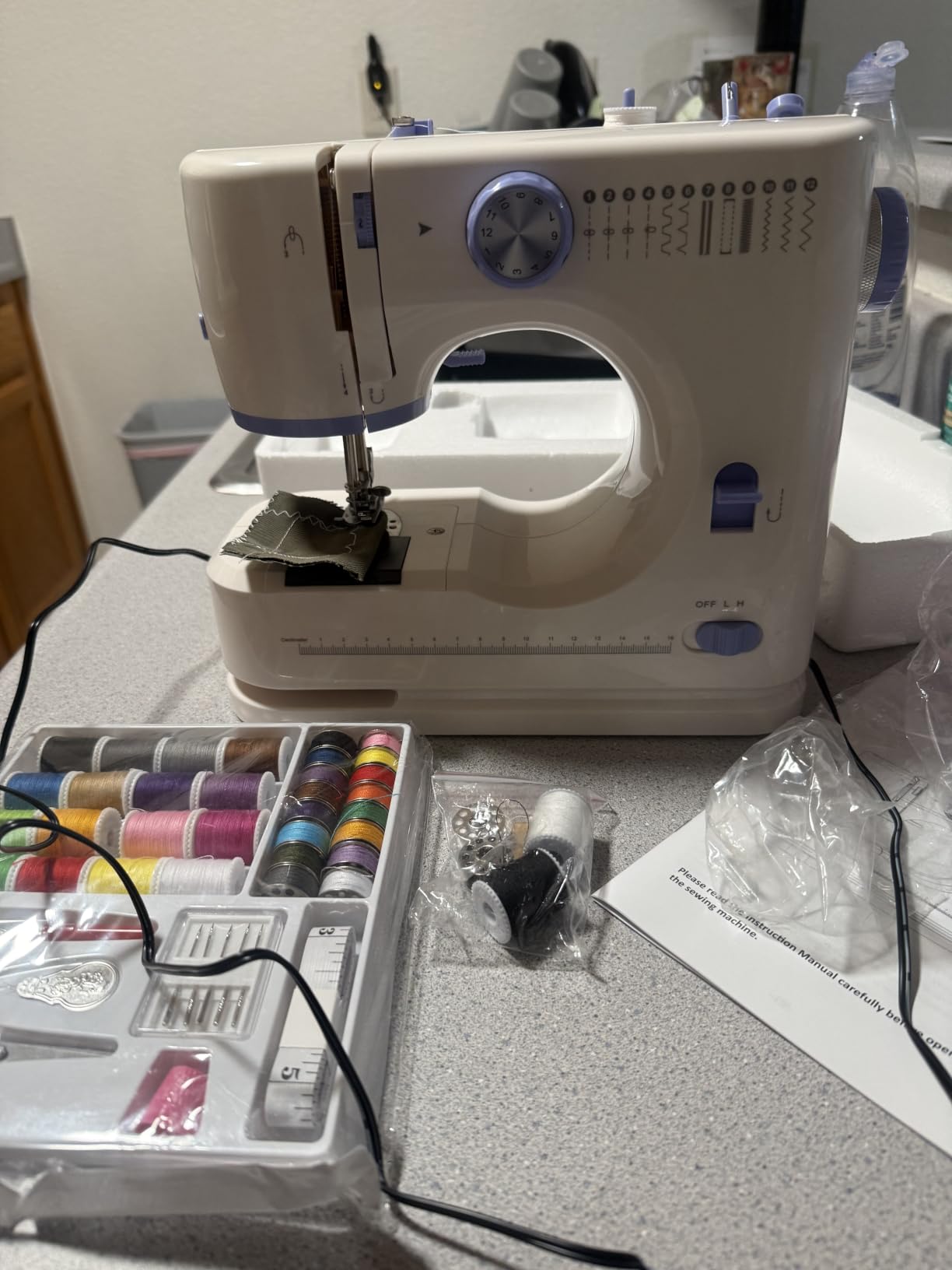
The reason this machine is interesting is the internal metal frame. Most machines in this class are plastic, and a metal frame adds the stability needed to sew cotton, denim, linen and polyester rather than only cotton. For a child who wants to alter their own clothes, that is the difference between a machine you use and a machine you fight.
Twelve built-in stitch patterns cover seams, hems, edges and buttonholes. A clear stitch selector, 9-level thread tension adjustment and reverse stitching give noticeably more control than most machines here, and the 9-level tension in particular is what lets you adjust to different fabrics instead of guessing.
Two-speed control has a low setting intended for beginners, and the machine runs from the foot pedal or a built-in power switch. Automatic bobbin winding and a built-in LED light cut setup time, which matters more to a child than any feature on a spec sheet.
Be careful with the trust signals here. At 57 reviews this has the smallest base of the ten, so long-term reliability data is thin, and the 14 percent one-star share is worth weighing. Reviews that are too few cannot tell you what happens in year two. It is also AC power only, and running the motor at the faster speed can start sewing without deliberate pedal input, so keep the speed switch on low until the child has the pedal under control.
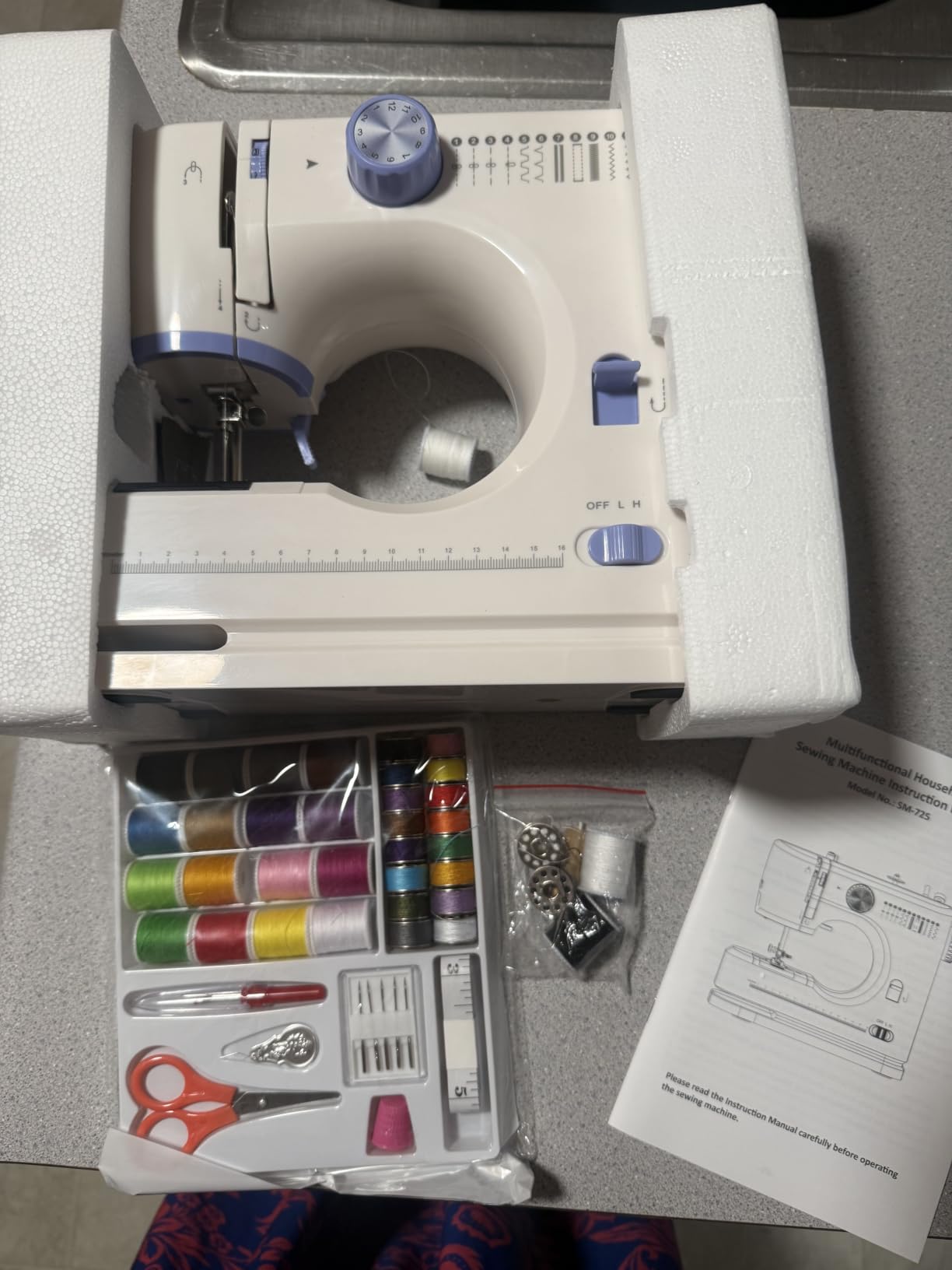
The starter kit is a real one: presser feet, needles, bobbins, thread spools, foot pedal and power adapter. At 10.82 by 6.1 by 9.33 inches the footprint is compact and easy to store between sessions.
Why the frame matters more than the stitch count
Stitch count tells you what a machine can make. Frame rigidity tells you whether it can keep making it. A plastic body that flexes under a thick seam produces uneven stitches, and uneven stitches on a first garment read as failure, even when the child did everything right. This is the machine we would pick for a nine-year-old who is already bored with doll clothing and wants to shorten a sleeve.
Reasons to pause
The review base is thin, and we would want to see it in a shop before buying for a child who cannot troubleshoot. AC-only power removes the travel and class option. And the fast-speed auto-start needs supervising until the child is confident.
How to Choose a Sewing Machine for a Child: 7 Things to Check
The short answer is that most parents over-weight stitch count and under-weight threading. Here is the order we would actually use, and it differs from the spec sheet order.
1. Threading and bobbin access. If a child cannot get the bobbin in on the third try with a parent watching, the machine is finished. Several machines here mention the bobbin as the recurring complaint, and the fix is not a better child, it is a better bobbin design. Test it in a shop if you can.
2. Speed control. Two speeds is the minimum. A child starting at full speed and being asked to slow down instantly is how fabric bunches, hands get near the needle and confidence collapses. Machines with a slow-start setting are worth more than machines with three extra decorative stitches.
3. Foot pedal or button. Pedal control is the real skill, and small feet make it jerky. Every machine here runs with a pedal, and the best ones also run on a body button. The consistent advice is that a child should sit with both feet flat and the machine on a surface at their seated height.
4. Free arm. This is the feature that decides whether a child can sew a sleeve or a pant leg. Check for a narrow free arm, not just a compact body. We cover the definition in more detail in our mini sewing machine guide.
5. Footprint and weight. A machine a child cannot lift, carry or store themselves becomes an adult-only machine. We flagged every weight in the reviews above, and anything over five pounds is a real consideration for a child under nine.
6. What is in the box. Fabric, thread, bobbins, needles, clips, a seam ripper and a foot pedal together can equal the cost of the machine. A child with a full kit will sew in week one; a child with an empty box will not.
7. Hand dominance. Standard machines feed fabric from one side, and a child who sews left-handed ends up guiding the fabric while looking at the wrong edge. There is no clean fix in this class, so let the child try one in a shop before you buy. Our note is that this matters far less than parents expect, because a left-handed child who chose the machine themselves will adapt.
One more thing the buying guides rarely mention: the upgrade path. A compact machine is a two-to-three-year tool for most children. When they reach roughly twelve and are sewing garments regularly, they will need a full-size mechanical machine, and nothing in a compact machine prepares them for a free arm, a proper bobbin winder or a heavier frame. We would buy the first machine knowing that, and we cover the adult step-up in our beginner machine guide.
Sewing Machine Safety for Kids: A Supervision Checklist
No sewing machine is safe for unsupervised use, at any price, at any age. That is the first thing to accept as a parent, and it is the thing that lets you stop worrying about the rest. The job of a machine’s safety features is to shorten the distance between your hand and the needle, not to replace you.
Finger guard. Only two of the machines reviewed here have one. A guard keeps small fingers away from the feed area while fabric moves, which buys seconds rather than safety, and it is worth a real premium on a machine used by a child under eight.
Needle position and visibility. A built-in sewing light is not a luxury. Parents report children struggling to see the needle, and a child sewing blind is a child sewing near a finger. Look for a light aimed at the needle plate specifically.
Slow-speed start. Set the speed to low for the first month every time. It is a five-second habit that removes most of the worst-case scenarios described across reviews.
Pedal versus button. For a child under about eight, start on the body button. A foot pedal is a coordination skill, and a child who cannot yet keep their foot steady should not have one in reach.
Hand position. Teach the flat palm on the fabric and fingers to the side of the presser foot from the first session, even if it feels slower. It becomes automatic in a way that an instruction repeated once does not.
Age thresholds. Hand sewing and play sewing fit around four to five. A real machine with an adult sitting beside the child fits from about seven. Independent use, meaning the child sets up, threads and sews without you in the room, is a ten-plus milestone and depends more on the child than the machine.
First Sewing Projects to Try, by Age
The single best predictor of whether a child still sews in six months is whether they finished something in the first month. So start short. The projects below are ordered by age and each one is deliberately a little harder than the last.
Ages 4 to 5 (with an adult, often a toy machine or hand sewing):
Pre-sewn shapes with a needle and yarn
Simple felt cutouts with a craft knife adult-handled
Simple doll blanket with a running stitch by hand
Stacking and lacing activities to build fine motor control
Ages 6 to 7 (with an adult, on a real machine with a button switch):
Straight seams in two layers of cotton, guided by an adult
A simple pillowcase or a rectangle bag
Simple doll clothing from felt or cotton
A zigzag seam on two fabric edges to show stretch
Ages 8 to 10 (semi-supervised, on a machine with a foot pedal):
Elastic-waist pyjama pants (free arm, elastic casing)
A simple A-line skirt or a tote bag from a pattern
A stuffed toy with a simple body shape
A buttonhole practice strip
Ages 11 to 12 (closer to independent):
A simple garment with a zip
A lined skirt or a shirt with a collar
A zip and a blind hem on a garment for themselves
The single most useful piece of advice for the first project: sew a line on scrap fabric first, twice, before anything else. The goal of session one is not a project, it is the muscle memory of guiding fabric with a foot pedal. A child who sews three wonky lines on scrap will sew a straight one by the fourth try; a child handed a project will jam or feel defeated in the first ten minutes.
Frequently Asked Questions
What is the best beginner sewing machine for kids?
The Chunara 42-piece mini machine is our top pick for a first sewing machine for kids, with a free arm, 12 built-in stitches, two-speed control and a foot pedal, rated 4.8 across 1,421 reviews. It is small enough for a child table, sews real thread through real fabric, and is a size a child can physically control.
Which sewing machine is best for a 7 year old?
At seven, look for a machine with a body button so the child is not starting with foot-pedal coordination, plus a slow speed setting. The CraftBud 122-piece kit suits this age well because the fabric, thread and clips are all included, so the first session is not delayed by a supply run. Sit beside the child for every session at this age.
What is the best sewing machine for an 8-year-old?
For an 8-year-old the best sewing machine is one with 12 or more built-in stitches, two-speed control, an extension table and a bundled supply kit. The CraftBud is our pick for an 8-year-old on value, and the Chunara for a child heading toward clothes. Test the bobbin threading yourself before the first session, because that is the most common stumbling block.
What is a good first sewing project for an 8-year-old?
A good first sewing project for an 8-year-old is a straight seam in two layers of cotton, guided by an adult, followed by a simple pillowcase or a small rectangle bag. Keep the first session short and let the goal be guiding fabric with the foot pedal, not a finished item. Many children sew three wonky lines on scrap fabric before they attempt anything else, and that is enough practice to move on.
At what age is it best for a child to start using a sewing machine?
Hand sewing and play sewing fit around ages four to five. A real powered machine with an adult sitting beside the child fits from about seven. Independent use, where the child sets up, threads and sews without an adult in the room, is a ten-plus milestone. No machine should be used unsupervised at any age, and the switch to independent use depends more on the child than on the model.
Which Sewing Machine Should You Buy First?
The best sewing machines for kids and beginners in 2026 come down to one clear choice and four age-banded shortcuts. The winner is the Chunara 42-piece machine, for its free arm, 12 stitches, two-speed control and a 4.8 rating across 1,421 reviews. It is the machine most likely to still be working when the child moves on to something harder.
For a child under six, start with hand sewing and a craft kit like the TUZT, then move to a real machine at seven. For a child aged 7 or 8 on a budget, the CraftBud 122-piece kit is the best value, because the supplies are what a beginner actually runs out of. For a child heading straight into clothes-making, the Marirao or the Verdanika handle everyday fabrics better than the plastic-bodied machines. And for the machine that travels between homes, the Sew Mighty runs on mains or batteries.
Whichever you choose, the deciding factor is not the spec sheet. It is whether your child can thread the bobbin, see the needle and start the machine slowly without help. Test those three things on day one, and the rest takes care of itself.
To see how these compare on a wider scale, we also track the best sewing machines for adults and the best sewing machines for designers, but for a child’s first machine, simplicity beats everything else.