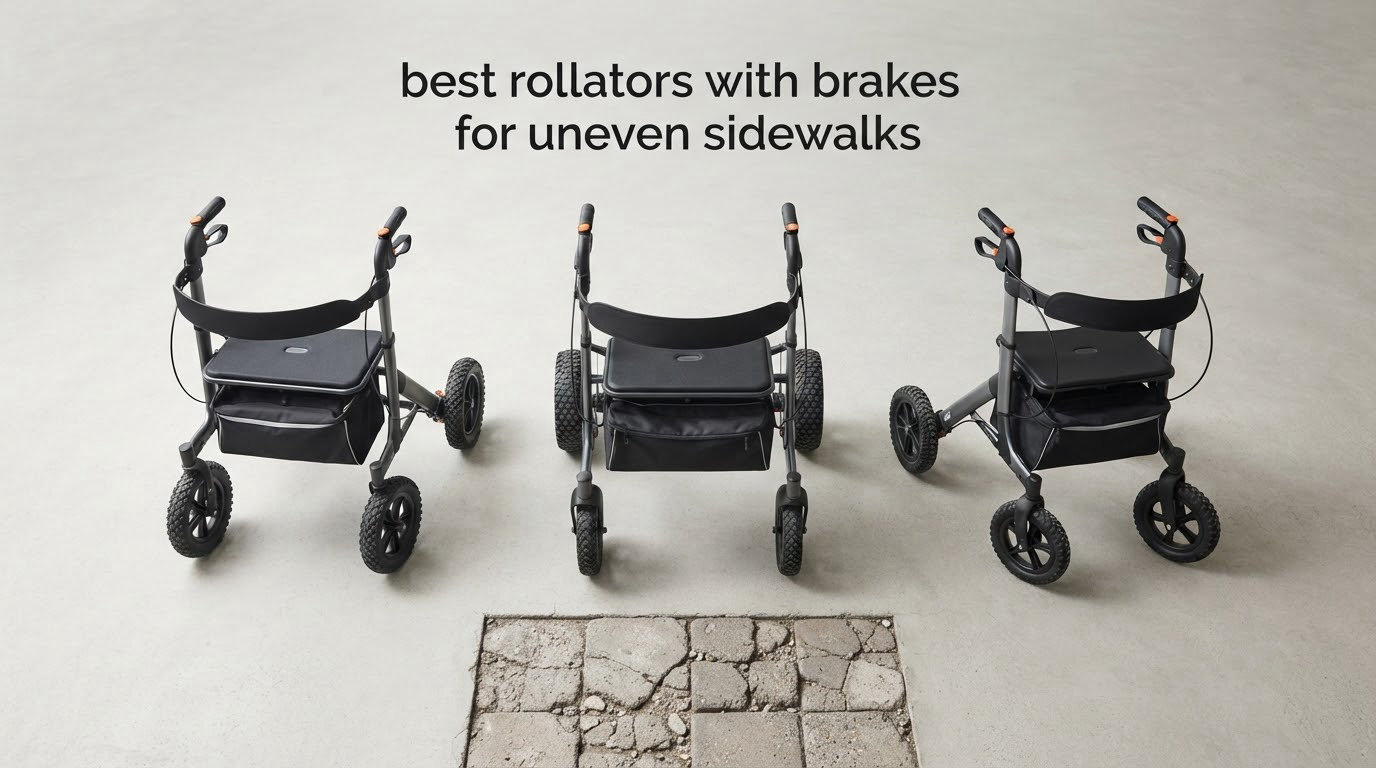
A rollator is a four-wheeled walking frame with hand brakes, a built-in seat and usually a storage basket, so it rolls forward continuously instead of being lifted and placed with each step like a standard walker. The best rollators with brakes for uneven sidewalks are decided by three specs, not by brand: front wheel diameter, tire compound and brake mode. Get those three right and a heaving crack becomes a bump; get them wrong and the front wheel catches and tips the whole frame toward you.
That is the whole argument of this guide. We compared 12 rollators on exactly those axes, plus the things that decide whether a device survives a real neighborhood route: weight capacity, rollator weight, handle height range, folded footprint and how the brake behaves on a downgrade. A slow-down brake is the term for a brake mode that resists motion continuously, so you can control speed on a slope instead of picking between free rolling and a locked wheel.
Updated for October 2026, the short version is this: the VOCIC Z21 is the best all-around pick for cracked pavement, the Helavo H1040 with 12-inch pneumatic tires is the smoothest ride on genuinely broken ground, and the soundfuse arc-seat model is the value pick for anyone who wants a wide seat on a modest outlay. If you also want to see how the field compares on weight and folding, our roundup of the best rollators overall covers indoor-first models that these outdoor picks beat on comfort but lose on ground clearance.
Table of Contents
Top 3 Picks for Best Rollators With Brakes for Uneven Sidewalks in October

VOCIC Z21 All Terrain Rollator
- 8 inch puncture-proof wheels
- 3-mode brake with slowdown
- 350 lb capacity
- 22.85 lb frame

Helavo H1040 Pneumatic 12 Inch
- 12 inch pneumatic front wheels
- 10 inch rear wheels
- Shock absorbing ride
- 10.6 inch folded profile

soundfuse 16 Inch Arc Seat
- 8 inch all-terrain wheels
- 3-mode braking
- 16 inch arc memory foam seat
- 300 lb capacity
All 12 Best Rollators With Brakes for Uneven Sidewalks in 2026
| Product | Specifications | Action |
|---|---|---|
| VOCIC Z21 All Terrain Rollator |
|
Check Latest Price |
| soundfuse Arc Seat Rollator |
|
Check Latest Price |
 Helavo Bariatric 550 lb Rollator Helavo Bariatric 550 lb Rollator |
|
Check Latest Price |
 HOMLAND Lightweight Rollator HOMLAND Lightweight Rollator |
|
Check Latest Price |
 Medline Aluminum Rollator Medline Aluminum Rollator |
|
Check Latest Price |
| Helavo All Terrain Pneumatic |
|
Check Latest Price |
 Medline Empower Rollator Medline Empower Rollator |
|
Check Latest Price |
 PLANET WALK Lightweight Rollator PLANET WALK Lightweight Rollator |
|
Check Latest Price |
 MAXWALK 12 Inch All Terrain MAXWALK 12 Inch All Terrain |
|
Check Latest Price |
 Helavo Upright Walker H1160 Helavo Upright Walker H1160 |
|
Check Latest Price |
 FlyingJoy 4 Wheel Rollator FlyingJoy 4 Wheel Rollator |
|
Check Latest Price |
 HOMLAND Bariatric 500 lb Rollator HOMLAND Bariatric 500 lb Rollator |
|
Check Latest Price |
1. VOCIC Z21 – Best Overall for Uneven Sidewalks
VOCIC Z21 Rollator Walker for Seniors with Seat, 8″ All Terrain, 350 LBS
8 inch puncture-proof wheels
3-mode brake with slowdown
350 lb capacity
22.85 lb
Pros
- 8 inch wheels roll over ledges that stop 6 inch models
- 3-mode brake gives real downhill control
- Reflective strips on wheels and bag
- 3-second fold to a trunk-friendly size
- Dual handle and seat adjustment covers 4 ft 11 in to 6 ft 3 in
Cons
- Brake feel needs tuning out of the box
- No latch to hold the frame folded or unfolded
The VOCIC Z21 tops this list because it does the two things uneven pavement demands and few mainstream models manage. The 8-inch puncture-proof wheels with a textured tread clear sidewalk lips and gravel, and the brake has three modes: free roll, deceleration, and stop. That middle mode is what lets you come down a driveway ramp without either locking the wheels or picking up speed.
It has the highest review count we found in the group at 7520 ratings averaging 4.6, and the feedback is consistent rather than enthusiastic-but-vague. Owners talk about obstacle crossing, seat comfort and how quickly the three-mode brake responds once it is adjusted. A recurring minority note is that the braking feel ships a little soft, which is a five-minute fix rather than a design fault, and we cover the fix later in this guide.
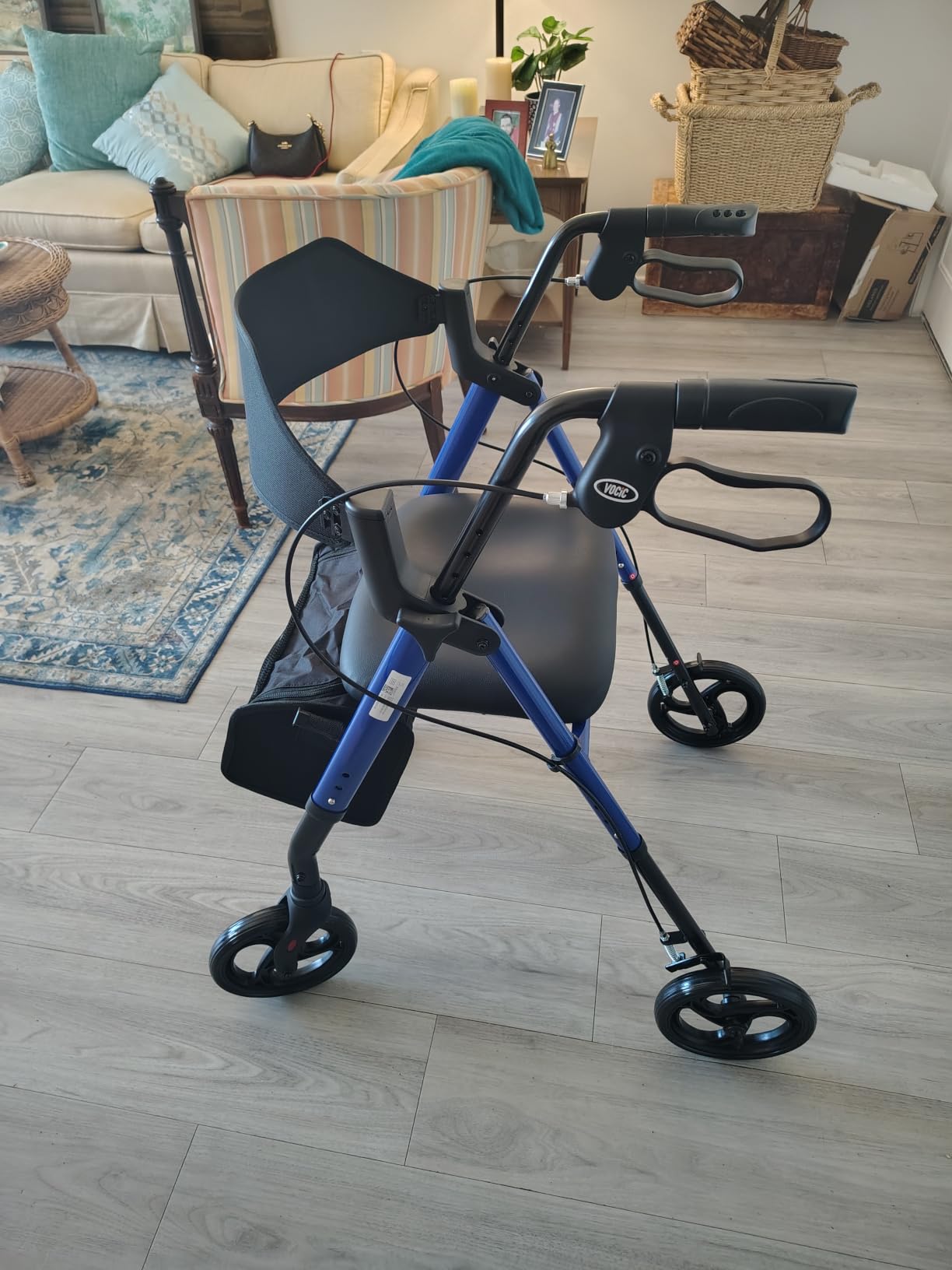
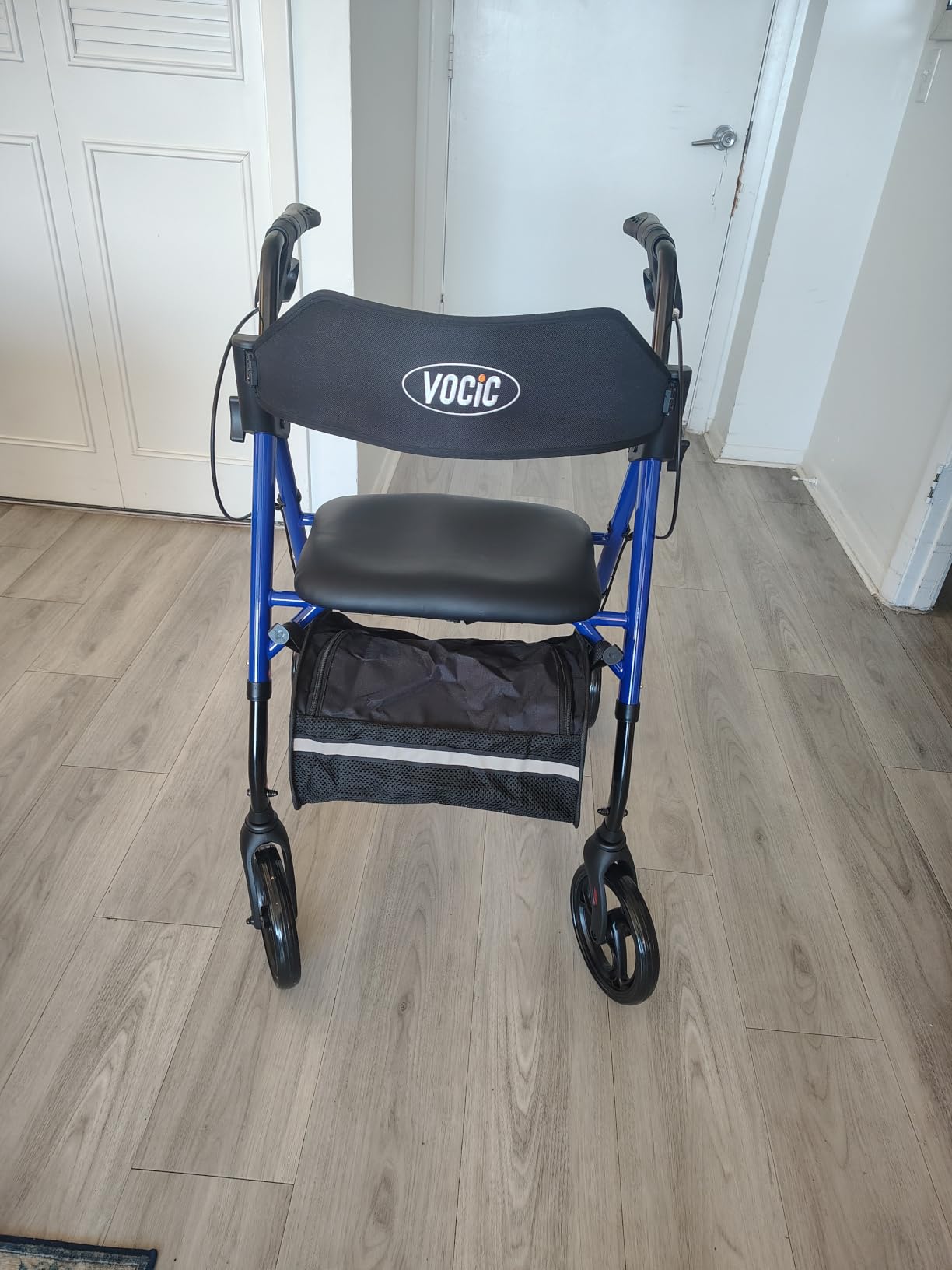
Comfort is better than the spec sheet suggests. The seat is a 1.6-inch thickened waterproof cushion in an ergonomic arc shape with a widened breathable backrest, so it actually spreads hip pressure instead of creating a sore point after a fifteen-minute block. The handle adjusts across five levels from 31.5 to 36.6 inches and the seat across three levels from 20 to 22 inches, which is why one frame fits users from 4 feet 11 inches to 6 feet 3 inches.
Two details matter more outdoors than the marketing suggests. The front wheels rotate 360 degrees, so steering around a parked van does not require backing up and shuffling. Reflective strips on the front wheels and the storage bag are the difference between a visible and an invisible rollator at dusk, and many of these trips end after dark. The frame folds in about three seconds to 31.5 by 23.6 by 13.8 inches, though VOCIC does not add a latch that holds the frame in position once folded.
Who the VOCIC Z21 suits on cracked pavement
It suits anyone walking a street where the concrete has heaved into ridges, where lawn edges overlap the walkway, or where gravel washes across the path after rain. The 8-inch wheel is the threshold that matters here: below it, a crack becomes a wall; at 8 inches with a textured tread, the wheel rides up and over instead of stopping dead and pitching the frame forward.
It also suits users who want rest stops without planning them. The seat and backrest combination makes a fifteen-minute sit realistic, and the under-seat bag keeps a purse, keys and a jacket off your back. For anyone shopping across categories, our wheel-focused rollator comparison breaks down how front and rear wheel sizes behave on different surfaces.
What to know before buying the VOCIC Z21
Budget two minutes on day one to set the brake tension. Several owners describe the initial response as adequate rather than crisp, and a rollator that is a hand-width too slow on a downgrade is a genuine safety issue, not a preference. The adjustment steps in the maintenance section below take care of it without tools.
Check the folded latch question for your own routine. If you load a car often and the frame does not stay folded on its own, you will want to hold it with one hand while lifting with the other, and that is exactly the situation a lighter model like the HOMLAND solves better. At 22.85 pounds it is not the lightest unit here, though it is well inside the range a typical caregiver can lift into a trunk.
2. soundfuse Arc Seat Rollator – Budget Pick for a Wide Seat
soundfuse Foldable Rollator Walkers for Seniors with 16″ Ergonomic Arc Seat
16 inch arc memory foam seat
8 inch all-terrain wheels
3-mode braking
300 lb capacity
Pros
- Roomy 16 inch arc memory foam seat
- Reinforced triangular frame with double crossbars
- Tight turning radius in tight spaces
- One-hand fold via under-seat strap
- Handle range fits 4 ft 7 in to 6 ft 6 in
Cons
- Brake feel is average for some users and needed adjustment
- Bulkier than most units even when folded
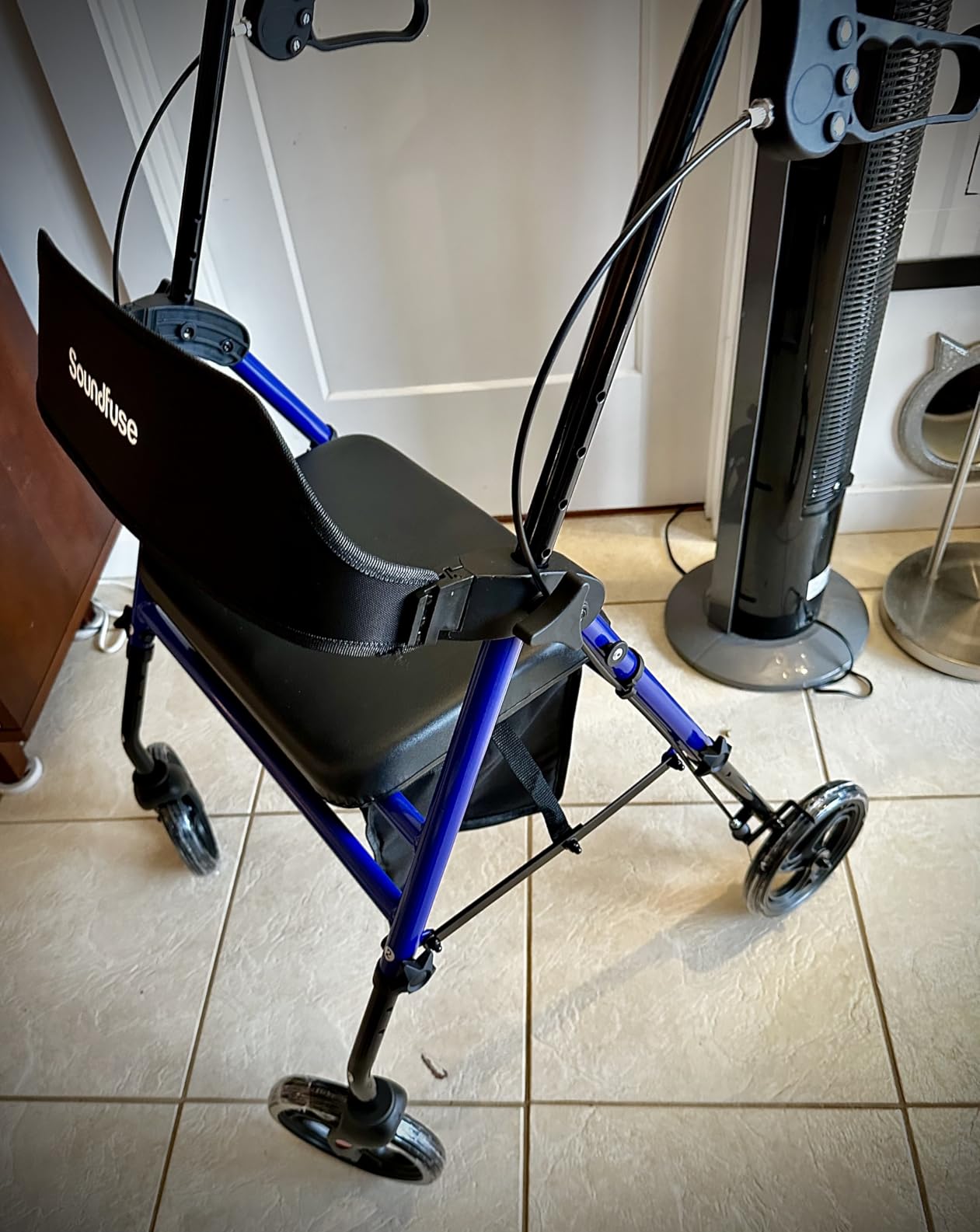
This is the model we send people to when the priority is a wide, forgiving seat and solid braking without stepping up to a premium all-terrain frame. The 16-inch arc memory foam seat is among the roomiest in this group, and the arc shape is what makes it comfortable: it cradles rather than creating a hard edge behind the knees.
Braking is the same three-mode system as our top pick, free roll, deceleration and stop, which is unusual at this level. Reviewers rate it 4.6 across 1398 ratings, and the pattern in those reviews is stability and comfort rather than headline features. The reinforced triangular frame with double crossbars is repeatedly described as sturdy rather than creaky, and the tight turning radius gets credit in tight indoor spaces and narrow sidewalks.
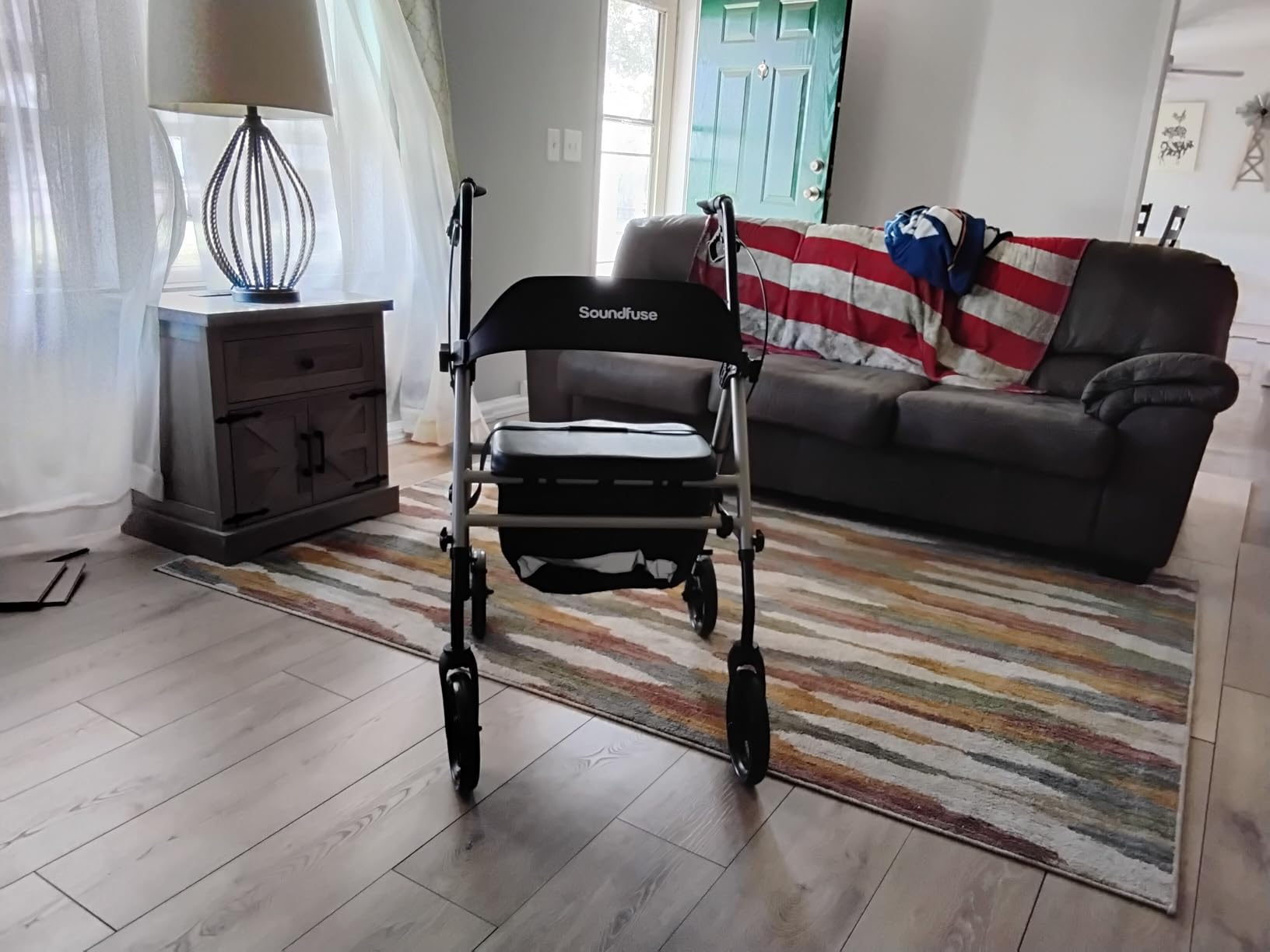
The adjustment range is unusually generous. Handles run 33 to 40 inches and the seat 20 to 23 inches, which covers users from 4 feet 7 inches to 6 feet 6 inches on one frame. That matters in a family where two people share one rollator, or for anyone whose height is at an awkward end of the typical range. Frame weight is 22.55 pounds, so loading it into a car is realistic but not effortless.
Two honest trade-offs. The brake feel is described as average by a portion of owners and again needed adjustment, which is the same tuning step as the VOCIC. And the folded footprint at 25 by 39 by 11.5 inches is not the smallest we measured, so plan the trunk space before you commit. In exchange you get pinch-proof enclosed folding points, reflective strips on the bag and wheels, and an under-seat strap fold you can operate one-handed.
Who the soundfuse suits
It suits users who spend real time seated on the walk rather than merely parking at the destination. If your route is a loop with two or three rest stops, the 16-inch arc seat is the single feature that changes the experience, and it is the reason this model earns the value slot ahead of cheaper 12-inch-seat frames.
It also suits households buying for a post-surgery recovery, which is the most common reason in the reviews. Most buyers are shopping for a family member healing from hip or knee work, and they report the rollator is stable, comfortable and simple to fold once the initial setup is done.
What to know before buying the soundfuse
Eight-inch wheels are a real improvement over six-inch models but they are not the answer for deep gravel, soft ground or sand. If your route includes a driveway that floods or a park path with ruts, look at the 12-inch picks further down instead. The published fit range stops at 6 feet 6 inches, so very tall users should check a spec sheet first.
Measure your trunk. The folded length of 39 inches is longer than several lighter models here, and the bulk is the most common complaint after the brakes. Support is reported as responsive, which helps if a part needs replacing, but factor the folded dimensions into your daily car routine before ordering.
3. Helavo Bariatric 550 lb Rollator – Best for Heavier Users
Helavo 28.3″ Extra Wide Bariatric Rollator Walker, 550 lbs Capacity
550 lb capacity
22.4 inch handle spacing
8 inch reinforced-spoke wheels
Parking brake
Pros
- 550 lb capacity on a reinforced aluminum frame
- 22.4 inch handle width gives a stable stance
- Backrest adjusts vertically
- Handle range spans 33.1 to 39 inch
- One-year warranty extendable to three
Cons
- Wide frame and large folded footprint for a small trunk
- Adjustment range still may not suit very short users
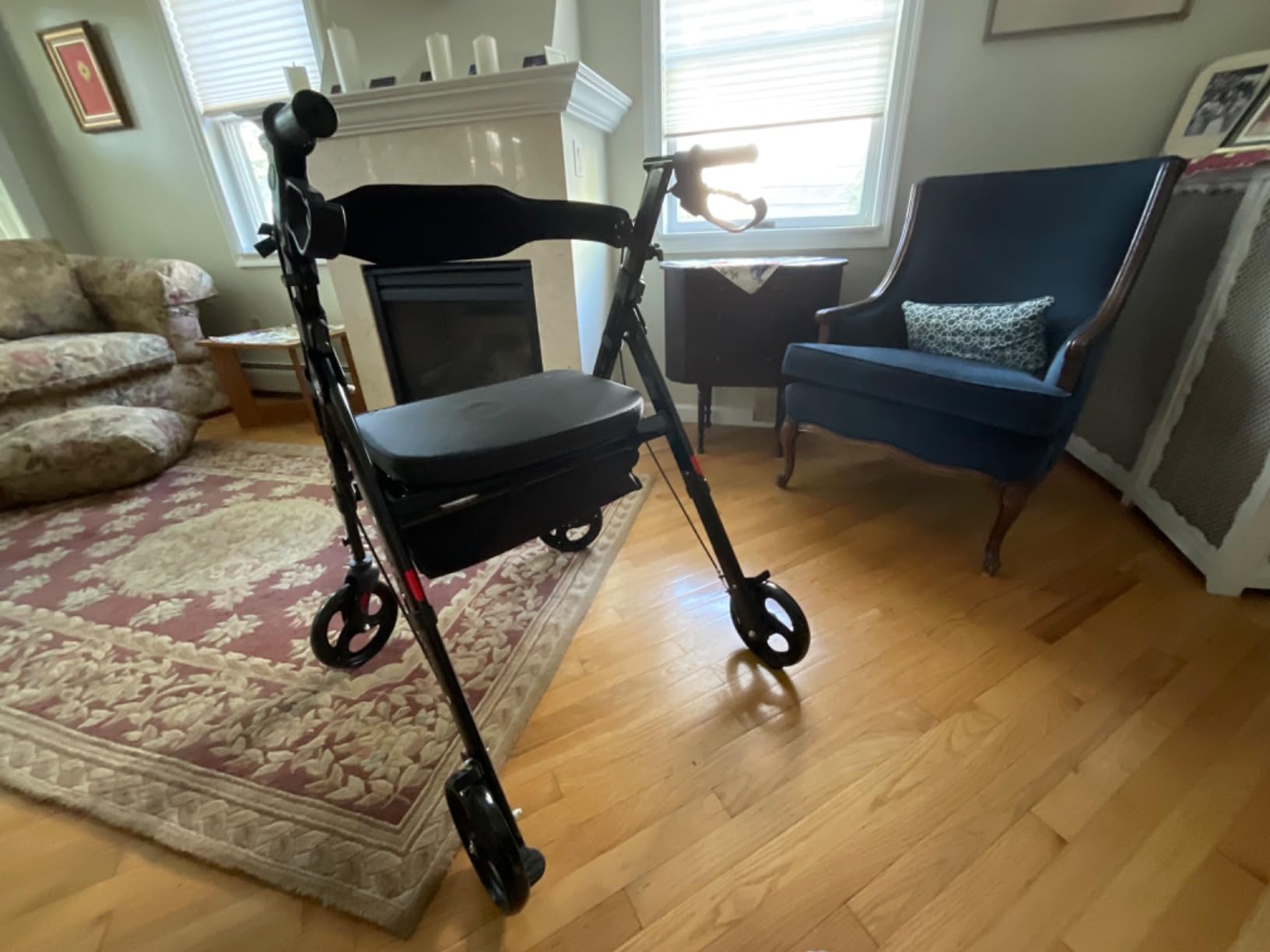
Capacity is the reason to look here first, and 550 pounds is the largest weight capacity in this group. The frame is reinforced aluminum rated to that figure, and the 22.4-inch handle spacing does something no wheel upgrade can: it makes the stance wide enough that the rollator does not feel like it is about to fold sideways when you sit down or turn on a slope.
It rates 4.5 across 1394 reviews, and the reviews describe it in practical terms: solid construction, generous seating and a parking brake that makes sitting down feel final. Wheel size is 8 inches with reinforced spokes, which is adequate for neighborhood sidewalks and gravel but not a substitute for 12-inch tires on truly broken ground.
Fitting is adjustable in three places. Handles run 33.1 to 39 inches, the seat 20.9 to 22.8 inches, and the backrest moves vertically, which matters when the seat is carrying more weight and comfort matters more than usual. Integrated cane holder, under-seat transport basket and round-the-clock support round out a package that feels considered rather than assembled from a parts list.
The frame weighs 21.38 pounds, which is light for a 550-pound-rated unit, but the folded size of 37.8 by 28.3 by 13.8 inches is large. That is a real constraint for apartment dwellers, and it is why we pair this model with our bariatric rollator guide rather than treating it as the only option above a certain body weight.
Who the Helavo 550 lb model suits
It suits users who have outgrown standard frames, and reviewers make one specific point: a frame rated too close to your body weight develops flex and wobble over time, which undermines the stability the device exists to provide. Buyers who came from a 300-pound model frequently describe the difference in how solid it feels over bumps and rocks.
It also suits anyone who needs a seat that is genuinely wide. Twenty-plus inches of usable width changes what a rest stop is like, and the wide stance is easier to balance over uneven pavement because the wheels are further apart.
What to know before buying
Measure doorways and trunks before ordering. At 25.6 inches wide in use, this is one of the larger frames, and older housing stock and manufactured homes are where that becomes a problem. Plan where it will be parked and stored, not just where it will be used.
Eight-inch wheels will not rescue genuinely uneven ground. If the defining challenge is terrain rather than body weight, the tire compound matters more than the capacity, and we would point you toward a 12-inch or pneumatic model instead. The one-year warranty extendable to three years is a fair signal, and the vertical backrest adjustment is worth more to most buyers than the warranty length.
4. HOMLAND Lightweight Rollator – Best for Car Transport
HOMLAND Foldable Rollator Walkers for Seniors with Seat, 17 lb Lightweight
17.6 lb frame
8 inch rubber wheels
350 lb capacity
Lifetime frame warranty
Pros
- Only 17.6 lb in the lightweight tier
- 350 lb capacity on a light frame
- 3-second fold with detachable design
- Handle range covers 4 ft 7 in to 6 ft 6 in
- Lifetime warranty on the metal frame
Cons
- Removable cup holder and pouch can be forgotten or rattle
- Push-up brake and push-down lock need practice with weak hands
Weight is usually the feature buyers underestimate until the first week of loading a car. At 17.6 pounds this frame is light enough to lift one-handed into a trunk, and it still carries a 350-pound rating on reinforced aluminum alloy tubing with double support bars. That combination is rare: most high-capacity frames in this group weigh over 20 pounds.
It rates 4.6 across 1144 reviews, and owners describe the core benefit accurately: low weight and a real capacity rating at the same time. The 8-inch premium rubber wheels glide between indoor floors and outdoor pavement without a mode change, which matters for someone who does a short walk to a car and back several times a day.
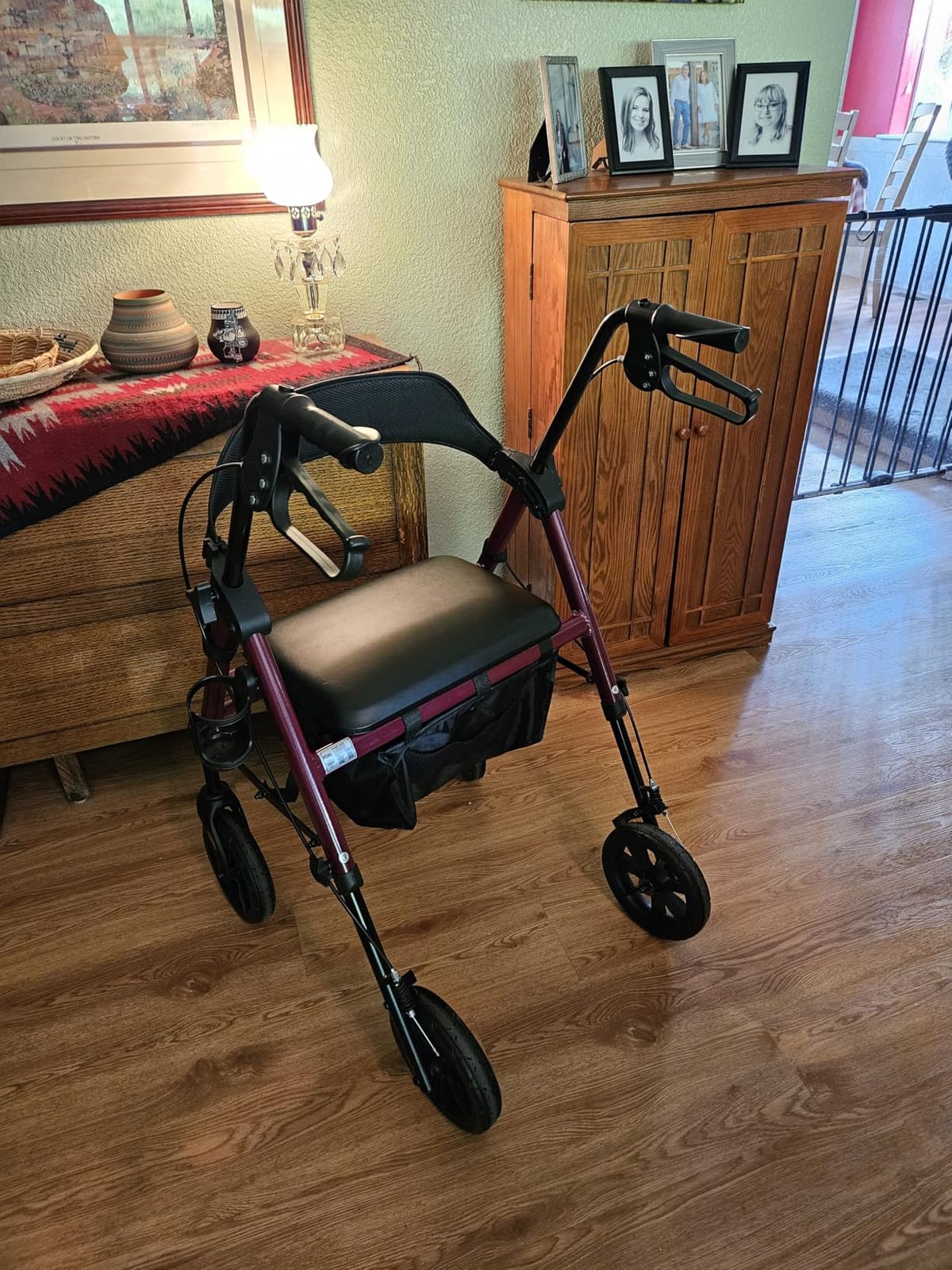
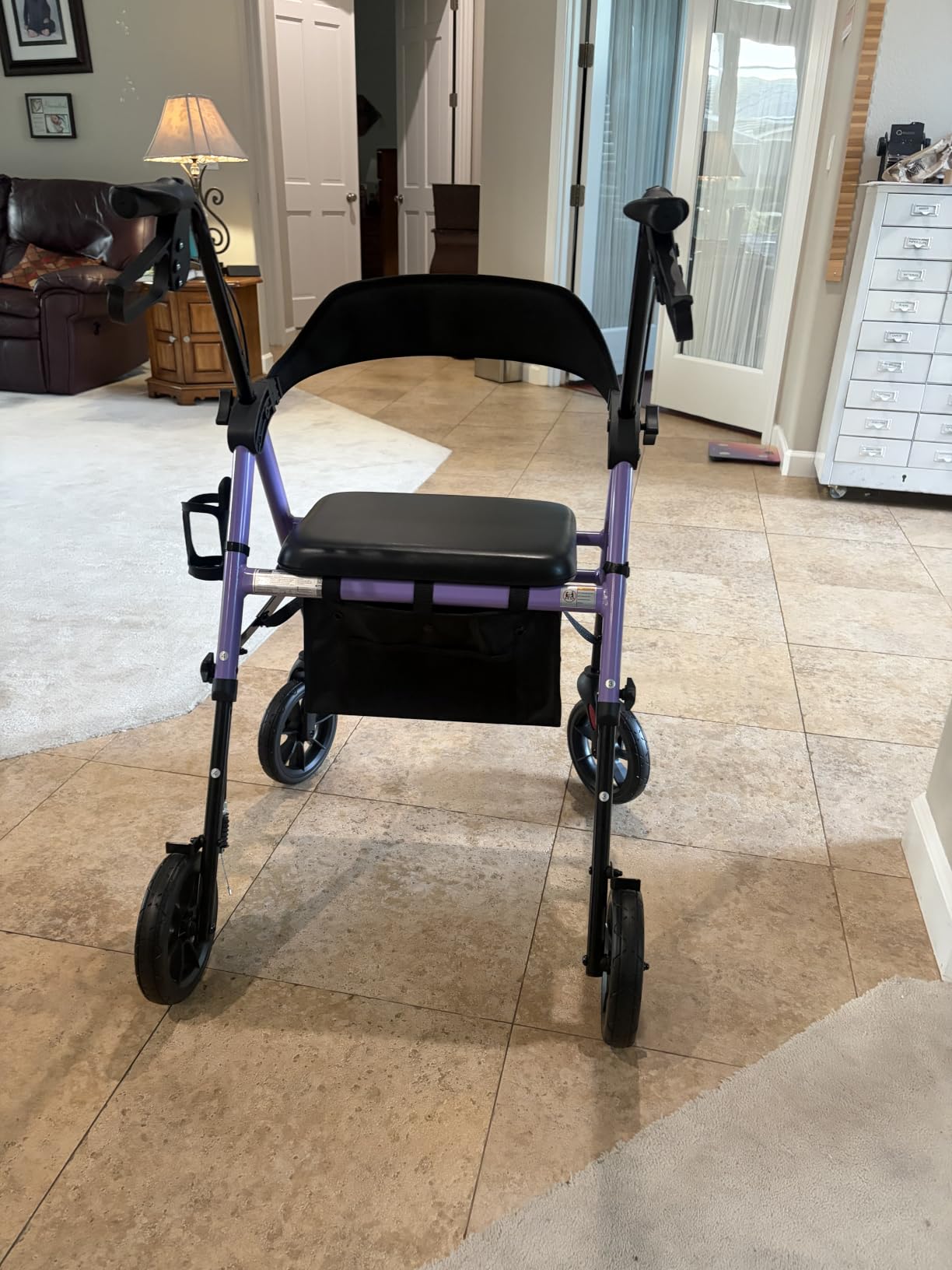
Comfort specs are strong for the weight class. The seat is an extra-wide memory foam pad with a widened breathable backrest, handles adjust 33 to 40 inches and the seat 20 to 23 inches, covering users from 4 feet 7 inches to 6 feet 6 inches. A removable cup holder and large storage pouch handle the small logistics of a walk, and multi-reflective strips cover the dark-return problem.
Brake design is the one to think about. These are push-up brakes with a push-down wheel lock rather than a cable loop system with three modes, which means a firmer, more direct lock but no intermediate deceleration setting. If your route includes a sustained downgrade, a three-mode model is the safer buy; for flat and gently sloped routes, the direct lock is a perfectly good system and easier to learn.
Who the HOMLAND lightweight suits
It suits anyone whose rollator has to go in and out of a vehicle, or anyone who should not be lifting 20-plus pounds. Caregivers mention the weight first in reviews, and the 3-second fold with a detachable design means the loading is a ten-second task rather than a two-minute wrestling match.
It also suits people who dislike the clinical look of mobility equipment. The frame styling and the accessory pouch read more like a piece of furniture than a medical device, which matters for anyone who has resisted using a walker in the first place.
What to know before buying
Practice the lever brakes before the first outdoor trip. Push-up to slow and push-down to lock is a different muscle memory from a squeeze brake, and users with limited hand strength find the transition takes a few tries. The forum advice we keep coming back to applies here: drill it on a flat driveway first, in shoes you would actually wear.
Also note there is no slowdown mode, so do not treat it as a downhill machine. And the removable cup holder and pouch are the most-forgotten accessories in the category; if you rely on a bottle holder, check it is clipped in before you leave. Everything else here is a 350-pound-rated, light, quick-folding frame with a lifetime warranty on the metal.
5. Medline Aluminum Rollator – Best Value That Folds Flat
Medline Aluminum Rollator Walker, Burgundy, 300 lb. Weight Capacity, 8” Wheels, Adjustable Height Handle, Padded Seat & Backrest, Rolling Walker for Seniors and Mobility Impaired
14 lb aluminum frame
300 lb capacity
12 x 12 inch padded seat
Push-down lock brakes
Pros
- 14 lb frame is among the lightest here
- Push-down brake handles lock immediately
- 12 x 12 inch padded seat with cushioned backrest
- Folds completely flat
- Under-seat storage
Cons
- Standard 12 x 12 inch seat is small for larger users
- Shorter handle range limits tall users
The Medline aluminum rollator is the one to buy when the budget matters and the routes are paved. At 14 pounds it is among the lightest frames here, it folds completely flat, and it holds a 300-pound rating. Those three facts cover the practical majority of sidewalk trips, where the surface is uneven but the wheel path is not full of tree roots and washout.
It rates 4.6 across 849 reviews, and the recurring theme is straightforward: buyers get a stable, foldable, no-fuss rollator built for paved routes. Wheels are described as rolling smoothly across varied terrain for indoor and outdoor use, which is accurate for cracked pavement and grass verges even though it is not a claim about deep gravel.
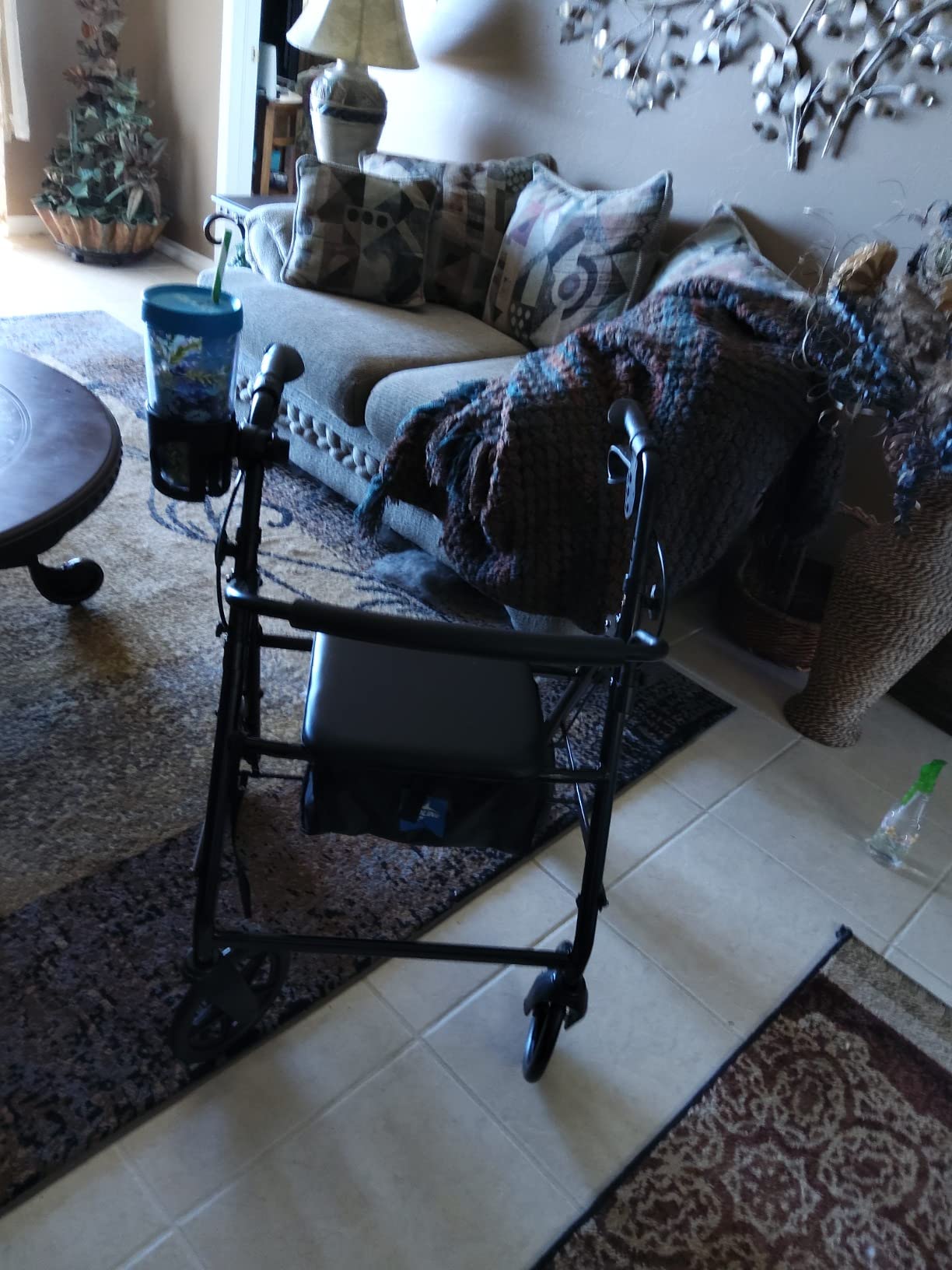
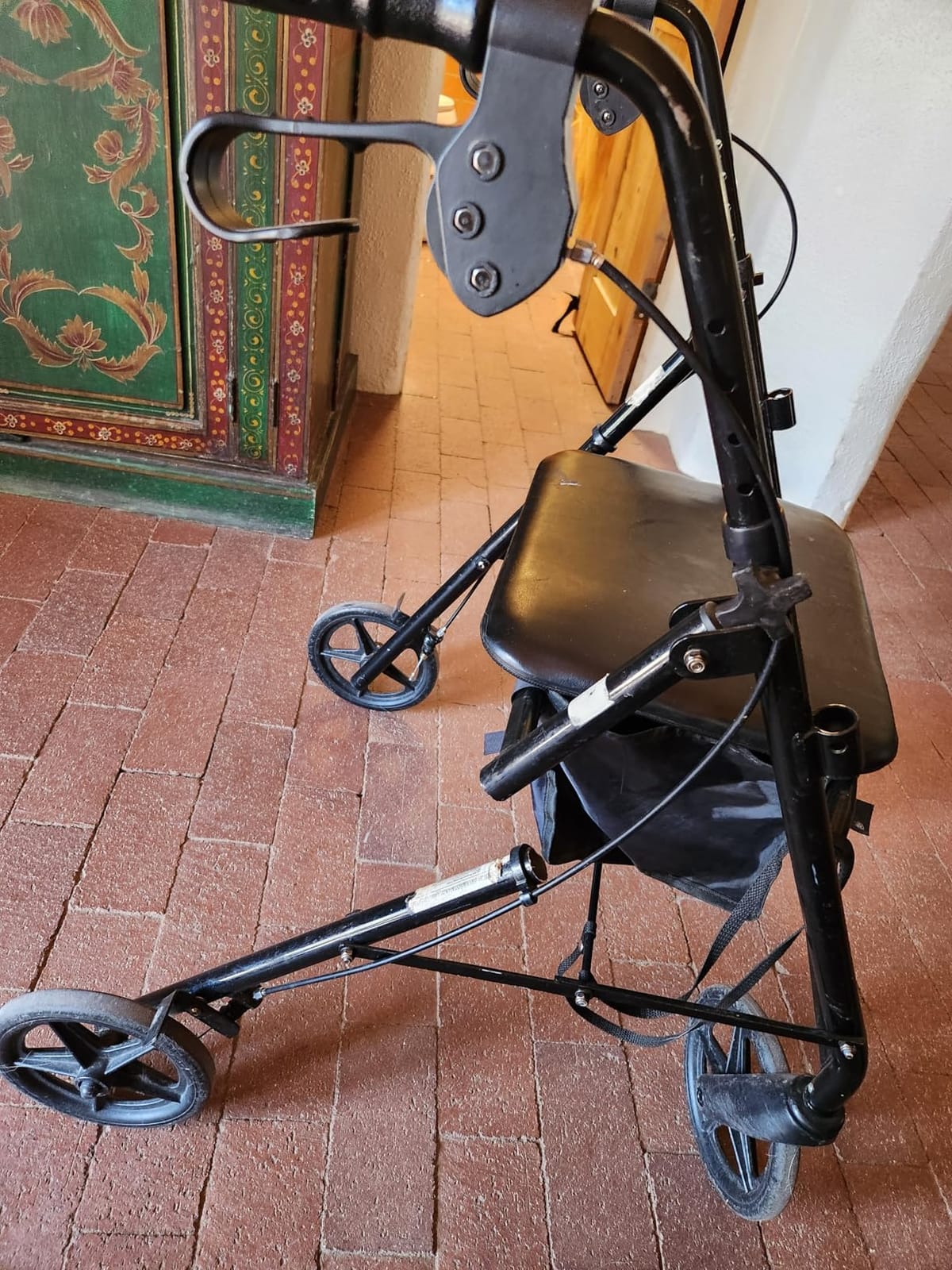
Braking is push-down easy-grip handles that lock the walker in place, so the mechanism is one motion rather than a two-stage sequence. The padded seat is a standard 12 by 12 inches at 20.5 inches above the floor with a cushioned backrest and under-seat storage, and the overall footprint is 24.5 inches wide by 24.5 inches deep, which is compact enough for standard doorways.
Handle height adjusts 31 to 35 inches, and that range is the main limitation. It suits users up to roughly 5 feet 10 inches comfortably; taller users will find the handles near their maximum even with the seat set high. It is a good fit for shorter adults, which is the population most rollators are designed around anyway.
Who the Medline aluminum rollator suits
It suits users who walk on sidewalks rather than on trails, and who want to spend as little attention as possible on the device itself. The push-down lock is the simplest brake action in this group and the hardest to fumble with a weak grip, which is a genuine accessibility advantage over small lever brakes.
It also suits anyone with limited storage, because a frame that folds completely flat stands against a wall or sits in a closet rather than needing a dedicated parking space. The 14-pound weight means a caregiver can load it without planning for it.
What to know before buying
Eight-inch wheels set the ceiling. They handle cracks, seams and lawn edges, and they will feel every one of them as a jolt, but they will not roll over the ledge problems that 12-inch tires absorb. If you have a specific stretch of sidewalk you have already fallen on, upgrade the wheel size rather than the brand.
The seat is genuinely small, and reviewers of wider frames often flag that as the reason to spend more. If the rollator doubles as a rest stop for a long block walk, a 16-inch arc or memory foam seat is worth the step up. For short neighborhood trips on decent pavement, this model does the job and stays out of the way.
6. Helavo All Terrain Pneumatic – Most Versatile for Broken Ground
Helavo All Terrain Walker, 12″ Pneumatic Tires, Outdoor Rollator Walker
12 inch pneumatic front tires
10 inch rear tires
Shock absorption
Adjustable 31.9 to 37 inch
Pros
- Smoothest ride on grass gravel and cracked sidewalks
- Air-filled tires reduce impact on joints and wrists
- Folds to a slim 10.6 inch profile
- Handle range fits 4 ft 9 in to 6 ft 3 in
Cons
- Pneumatic tires need pressure checks and can puncture
- 20.9 lb is heavy to lift into a vehicle
- 25.9 inch width is awkward in narrow doorways
If your sidewalk is not merely cracked but actively broken, this is the rollator. Twelve-inch air-filled pneumatic front tires and 10-inch rear tires give it the same wheel sizing as the MAXWALK, in rubber rather than air, and the shock absorption reduces how much of the impact reaches your wrists, elbows and shoulders. For anyone with arthritis or a joint that is still healing, that transfer reduction is the feature that matters.
It rates 4.4 across 2050 reviews, one of the largest review bases in this roundup, and owners use it on grass, gravel, dirt trails and cracked concrete interchangeably. The 4.4 rather than 4.6 reflects real trade-offs around maintenance and weight rather than a satisfaction problem. Nothing in the reviews suggests the ride is rough.
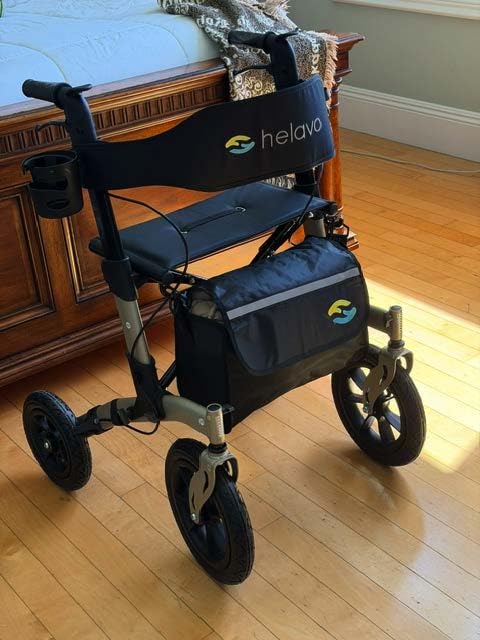
Handling is aided by a frame built for stability over obstacles, and the wide contact patch is what stops the front wheel dropping into a gap and pitching the frame forward. Handle height adjusts 31.9 to 37 inches, covering users from 4 feet 9 inches to 6 feet 3 inches, and the folded depth of 10.6 inches is slim enough for a car trunk even though the overall length is not.
One transparency note: the listing we reviewed does not publish a weight capacity figure, so we are not going to guess at one. Check the current manufacturer specification for the model number before ordering, and if capacity is a deciding factor for you, the 350-pound and 300-pound rated models elsewhere in this guide are safer picks. This one earns its slot on ride quality, which is the least substitutable thing in the category.

Who the Helavo All Terrain suits
It suits anyone whose route includes gravel driveways, park paths, grass verges or brick paving, and especially anyone whose pain is in the upper body. A hard-tire rollator transmits every impact through the handlebars into the wrists and shoulders, and no solid or airless option here reduces that the way air-filled tires do.
It also suits users who have already had a fall on uneven ground. The combination of a large contact patch, 12-inch diameter and a frame built for obstacle stability is the closest thing in this list to the wide-track class of rollators that therapists recommend on broken routes.
What to know before buying
Pneumatic tires need pressure maintenance and can develop punctures, and a flat front tire on a rollator is a genuine problem because the frame does not sit level. If you live on a route with broken glass or construction debris, the airless options further down are lower maintenance even though they ride harder.
At 20.9 pounds this is one of the heavier models here, and a 25.9-inch width can be awkward in older or narrow doorways. Neither is a deal-breaker, but both need to fit your actual route. If lifting a rollator into a car is a daily task, the 13-pound and 14-pound models are better suited to that part of your day.
7. Medline Empower – Best for Sturdy Daily Use
Medline Premium Empower Folding Mobility Rollator Walker with Memory Foam Seat, Black, 300 lb. Weight Capacity, 8” Wheels, Cupholder,Rolling Walker for Mobility Impairment, Adjustable Handles
16 x 14 inch memory foam seat
Reversible backrest
8 inch solid rubber wheels
23 lb reinforced frame
Pros
- Reinforced frame that rarely flexes on bumps
- 8 inch solid rubber wheels grip well braking on inclines
- Reversible backrest allows caregiver-pushed seating
- Extra-wide 16 x 14 inch memory foam seat
- Color-coded wheel dots aid assembly
Cons
- Heavy 23 lb build to lift into a car
- Rear width just under 27 inch is tight in older doorways
- Seat can pop open if the fold handle is missed
The Medline Empower is the one in this group that reads as built rather than assembled. A 23-pound reinforced aluminum frame that folds flat, rated to 300 pounds, with long-term owners describing it as a unit that rarely flexes or tips over bumps and rocks. That is the sentence you want from someone who has had one for years, and at 3692 ratings it is among the most-reviewed models here.
Its rating of 4.4 across those reviews is lower than the lighter models for reasons that have nothing to do with quality. The complaints are weight, width, the seat latch during folding and an undersized cupholder, which is the honest profile of a sturdy frame rather than a defect list.
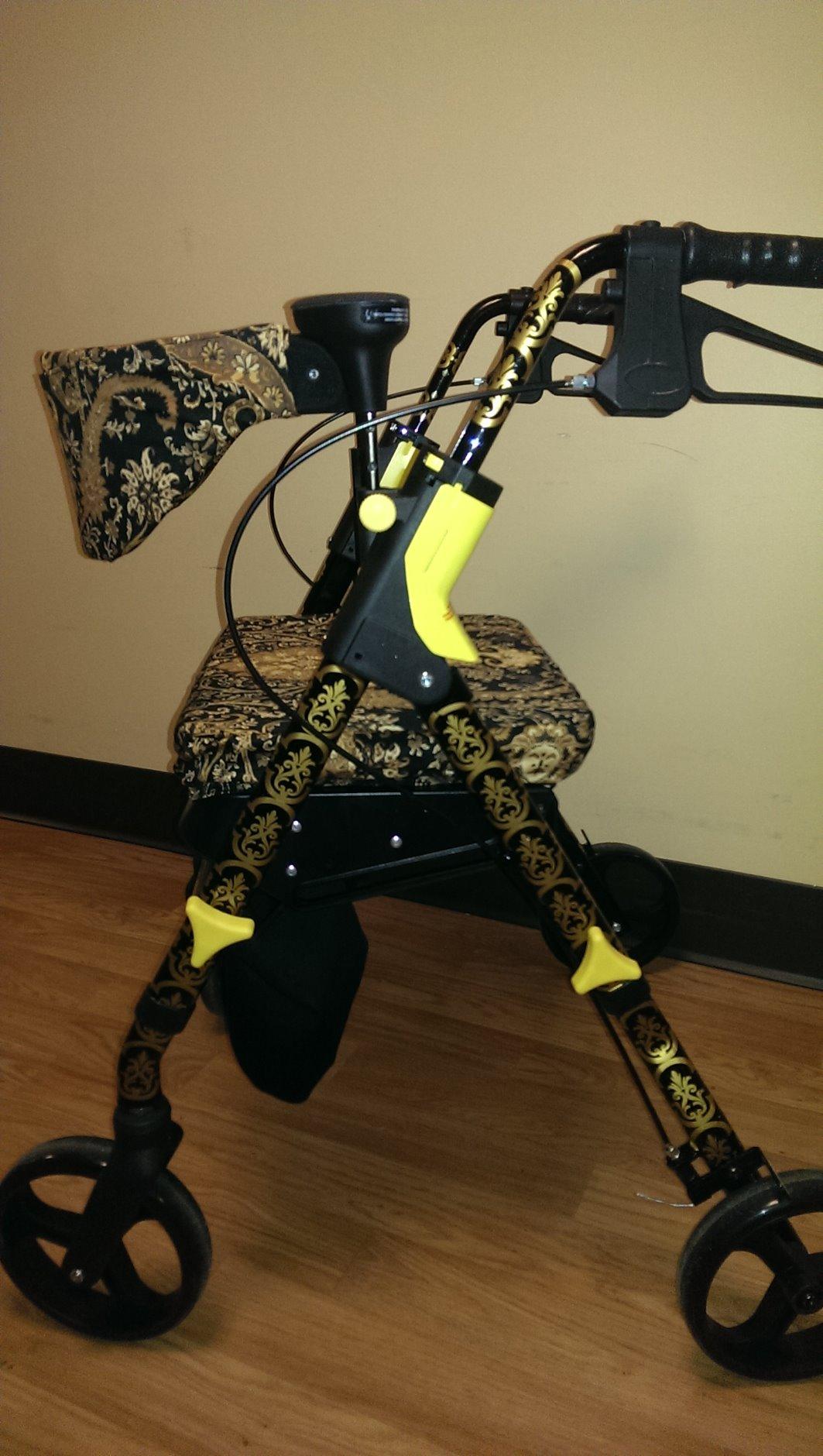
Braking is the familiar push-up to brake, push-down to lock pattern on 8-inch solid rubber wheels, and owners specifically praise the grip of those tires when braking on inclines. Solid rubber has an advantage over airless tread-free designs here: it grabs on a wet incline instead of sliding. The handle range is 31.5 to 39.5 inches, one of the wider spans available.
Two features separate it from the pack. The seat is 16 by 14 inches of memory foam adjusting from 20.5 to 24.5 inches, the tallest seat range in the group, and the cushioned backrest flips forward or backward so a caregiver can push the user while they sit facing forward. Storage runs to an under-seat pouch plus a removable tote and a tray organizer.
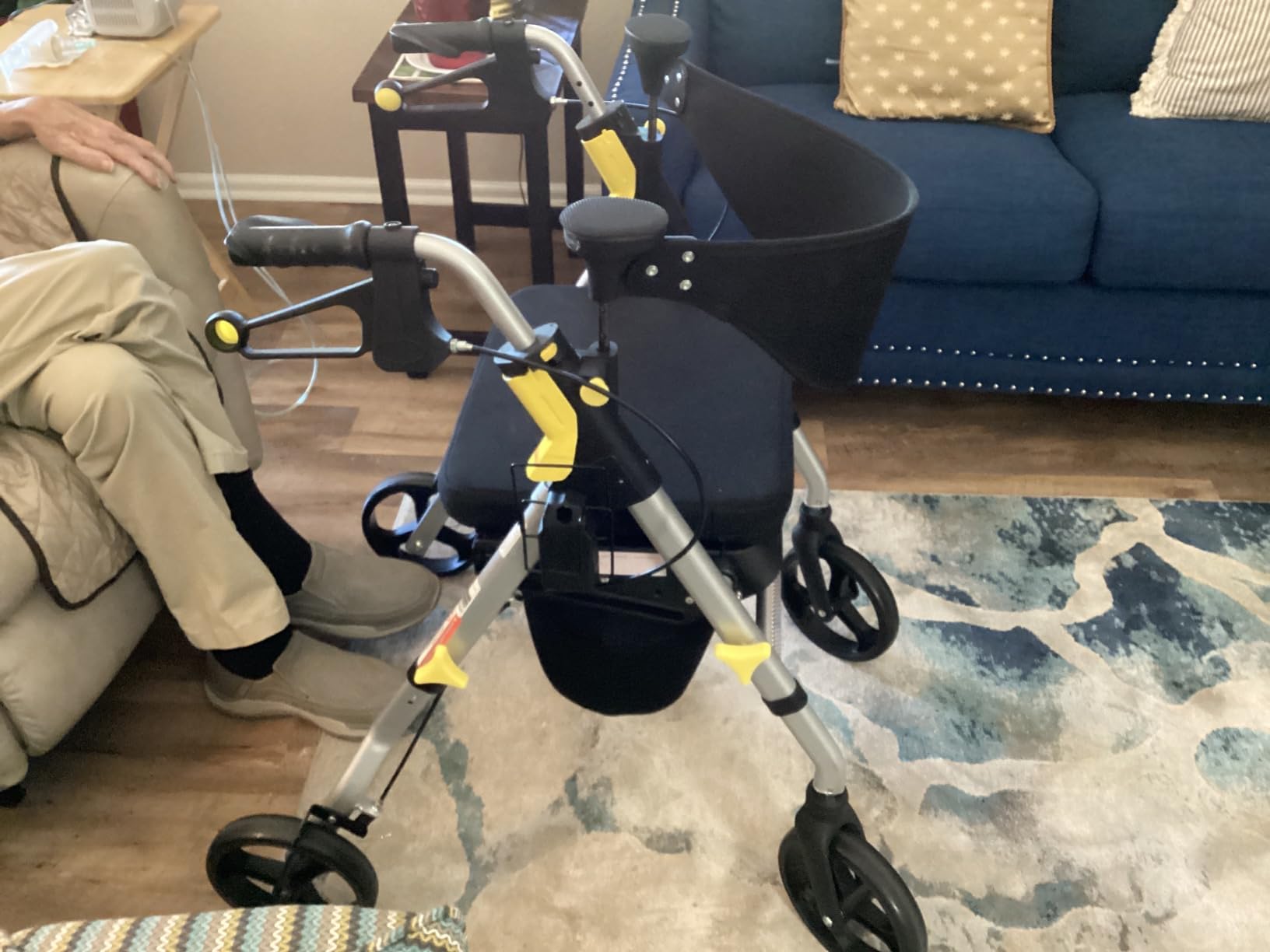
Who the Medline Empower suits
It suits users who want one device for years of daily use and would rather have a heavy frame than a light one. Users moving from a lighter, flimsier rollator tend to describe the difference in stability over roots and rocks as immediately obvious, and for a fall-risk population that trade is usually worth making.
It also suits anyone who is pushed while seated. The reversible backrest turns a personal mobility aid into something a companion can manage, which is not true of most frames in this list and changes the calculus for anyone with a caregiver on standby.
What to know before buying
At 23 pounds it is one of the heavier models here, and that is a real daily cost for a smaller user trying to load a car. Plan for a loading routine, or consider a lighter frame if vehicle transport is central to your day. The rear width just under 27 inches is also tight in older or manufactured-home doorways, so measure before ordering.
Two smaller notes from the reviews. The cupholder will not take a standard sport bottle, and the seat can pop open instead of folding if the under-seat handle is not grabbed on the first attempt, which is worth practicing once indoors before you depend on it. The trade for all of that is a frame that stays steady, and that trade is usually the right one.
8. PLANET WALK Lightweight Rollator – Best for Upright Posture
PLANET WALK Super Lightweight Rollator Walker for Seniors, Foldable Rolling Walker with Seat and 8″ Rubber Wheels for All Terrain, Unique Design Aluminium Frame Sturdy Walkers for Traveling – Blue
13 lb aluminum frame
8 inch anti-skid wheels
Two-way parking brake
26.5 inch folded width
Pros
- 13 lb frame is the lightest build here
- 8 inch anti-skid wheels with 360 degree front rotation
- Two-way parking brake for downhill control
- 18.5 inch wide breathable seat
- One-hand quick fold
Cons
- Seat sits high and cannot be lowered for short users
- Bulky folded size for small bathrooms and sedan trunks
- Wheels can slide on smooth floors with the brake on
At 13 pounds this is the lightest rollator we reviewed, and reviewers who came from 20-plus-pound models describe that difference as the feature that made them keep using theirs. If a caregiver with back problems is the person lifting the device, or if you load a car several times a day, weight is not a minor spec. It carries a 300-pound rating on hardened aluminum alloy tubing.
It rates 4.4 across 1000 reviews, and the pattern is consistent: people who switched from a heavier rollator for car travel rate the light weight highest, along with the wide stance, the higher-proportioned handles that encourage straighter posture, and a design that does not look like a medical device.
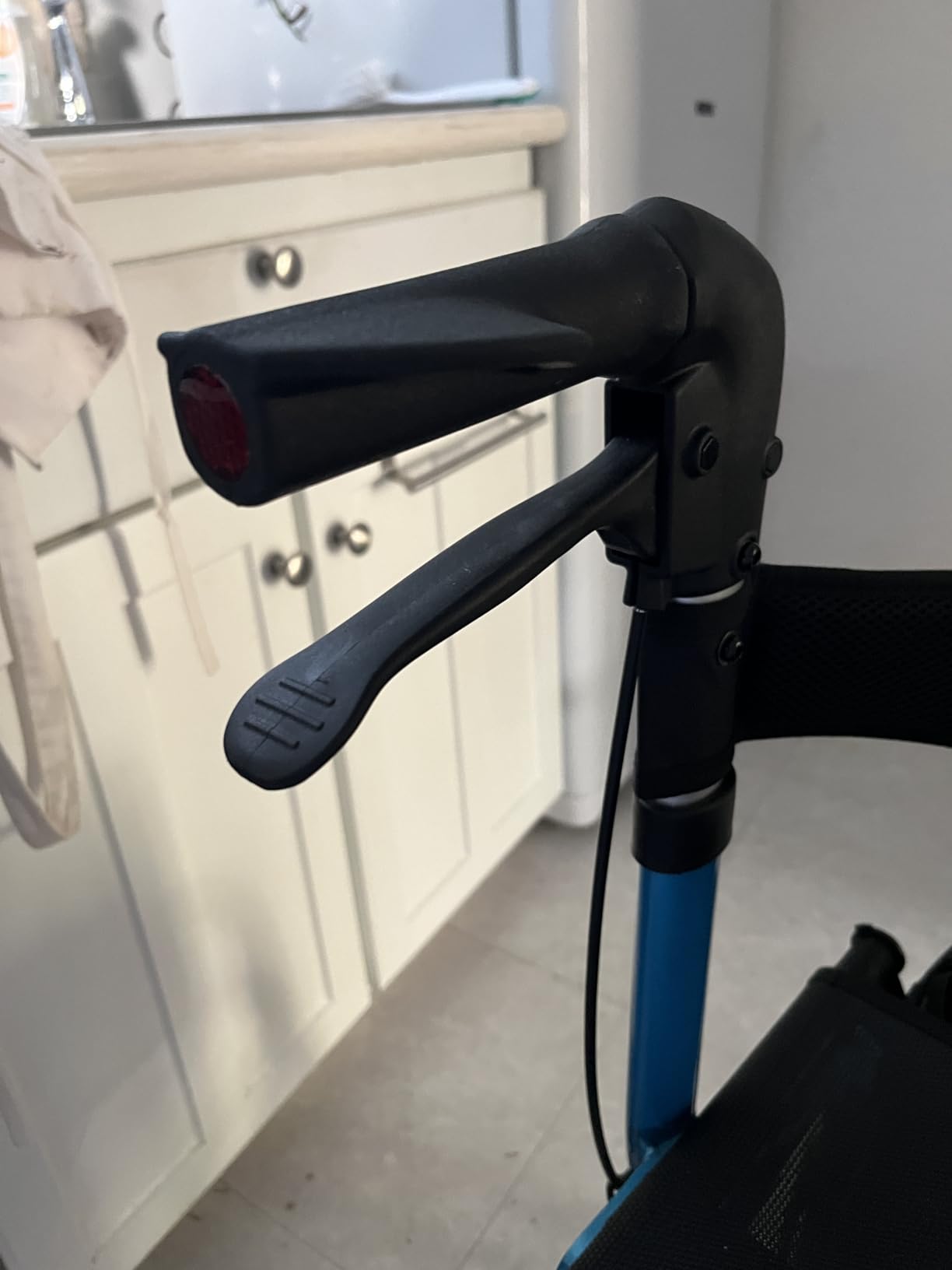
Braking is a two-way parking brake with responsive dual brakes for downhill control, which is a more useful description than it first appears. The 8-inch anti-skid rubber wheels with 360-degree rotating front wheels handle rough ground better than smaller-diameter models, and the wide stance gives real foot room between the frame legs so it does not feel cramped on a slope.
The honest constraint is fit. Handles adjust 35 to 39 inches across five levels and the published range covers users from 4.8 to 5.8 feet, which is narrower than almost everything else here. The seat is a breathable waterproof 18.5 inches wide, but it sits high, and short users report their feet not reaching the floor. Check that before anything else.
Who the PLANET WALK suits
It suits users who are between about 4 feet 10 inches and 5 feet 8 inches tall and want a light frame with a parking brake. The higher handle range also suits anyone who has been told to stand taller rather than hunch, since a rollator that meets the wrist at the right height changes posture more than most people expect.
It suits anyone who resisted the look of a mobility aid. Multiple colour options and a slim profile make it something you will actually leave in the hallway rather than hide in a closet, and users who stopped using their rollator for that reason often give it a second chance.
What to know before buying
Measure your standing height and your wrist height before ordering. The seat height is the more common disappointment: owners report it cannot be lowered enough for shorter users, and no amount of adjustment fixes a frame whose minimum seat height is above your knee-to-floor measurement.
Also consider the folded size at 26.5 by 10.9 by 35 inches. It is slim in depth but wide and tall, so it can dominate a small bathroom and may not fit a sedan trunk without removing the handles. Reviewers also note the wheels can still slide on smooth indoor floors with the brake engaged, so do not park it on a sloped tile floor and assume it is holding.
9. MAXWALK 12 Inch All Terrain – Best for Cracked Sidewalks
MAXWALK Rollator Walker for Seniors with Seat, 12″ All Terrain Wheels
12 inch front and 10 inch rear rubber wheels
Built-in cable routing
20.3 lb frame
Pros
- Large 12 inch front wheels roll cracked sidewalks quietly
- Built-in cable routing removes snag and trip hazard
- Locked-in seating feel
- 18-month warranty with lifetime support
- Curb-assist foot step for step-ups
Cons
- Removable cup holder bounces and is hard to remove
- Backrest angles larger users forward
- 20.3 lb is bulky in a car trunk
This is the pick for the specific complaint in our query: sidewalks that are cracked, heaved and pitted rather than soft. Twelve-inch rubber front wheels with 360-degree swivel, non-slip tread and shock absorption glide over cracked sidewalks, gravel, lawn and dirt without the rattling you get from 8-inch wheels, and the wide tire footprint stops the rollator dead on rocks and wood instead of tipping forward.
It rates 4.5 across 999 reviews, and the reviews come from people living on gravel drives, cracked sidewalks and rural roads. What they single out is a quiet, vibration-free ride and confident braking. Unlike the pneumatic pick, these are rubber, so there is no pressure to maintain and no puncture risk from debris.
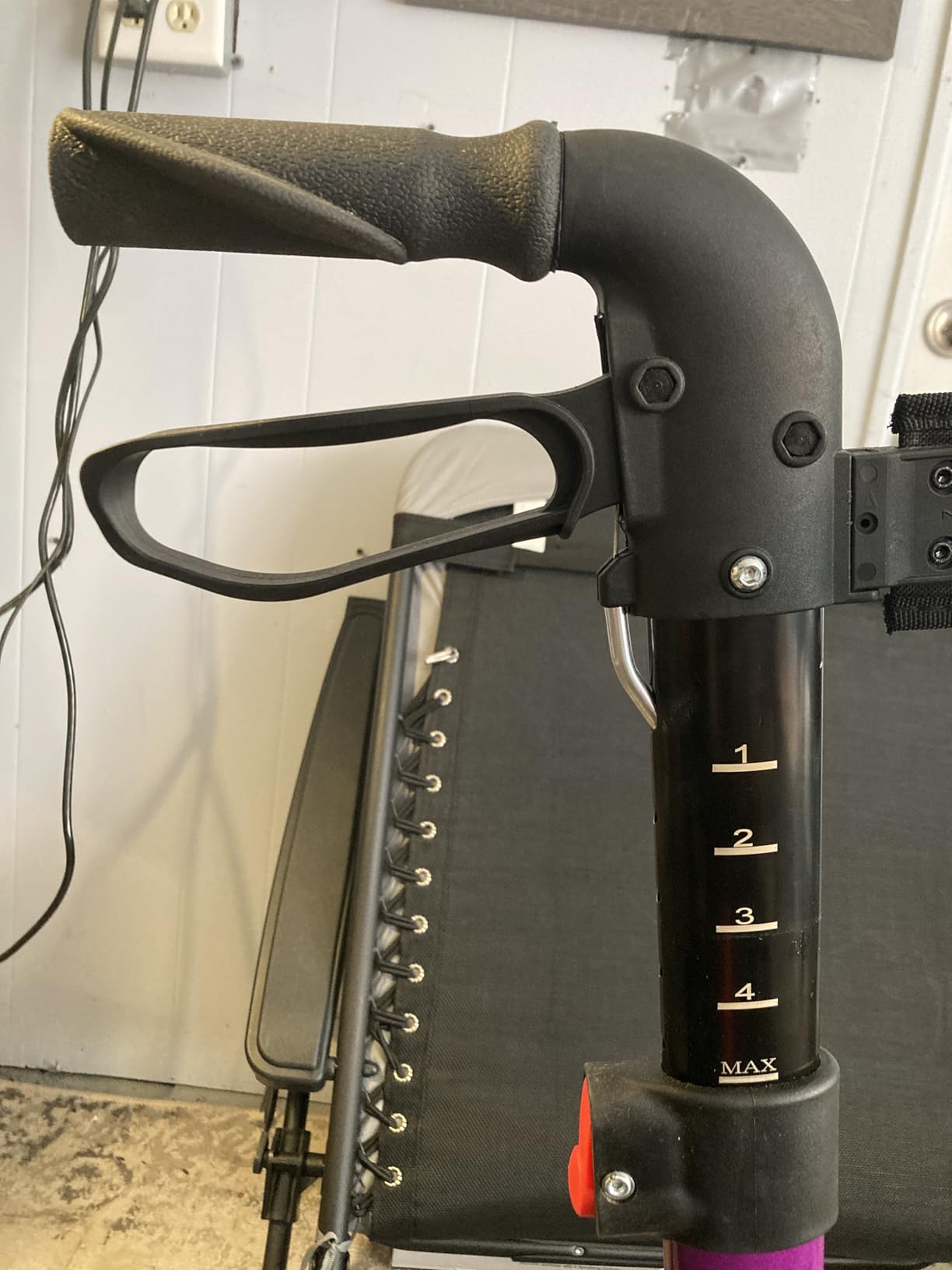
One engineering decision stands out: the brake cables are routed inside the frame rather than exposed. On a model you use on broken ground, exposed cables are exactly the snag hazard that catches a wheel, a foot or a passing bag, and reviewers treat the internal routing as a genuine safety upgrade. The frame is a 20.3-pound triangular aluminum structure rated to 300 pounds with a curb-assist foot step near the front wheel for step-ups.
Braking is dual: upward pressure gives downhill speed control, and pressing locks the wheels when sitting. The locked-in seating feel is repeatedly described as a confidence booster, because the concern of a rollator rolling away mid-sit is real. The one component that is criticised more than any other is the removable cup and phone holder, which bounces on bumps and fits a bare phone better than a phone in a case.
Who the MAXWALK suits
It suits users on hard, broken urban pavement where you want 12-inch wheel performance without pneumatic maintenance. If your route is concrete, asphalt, brick and gravel, this is a more practical choice than air-filled tires because there is nothing to inflate and nothing to go flat from a thorn in a park bed.
It also suits anyone who wants a defined lock when sitting. A large number of reviews describe sitting down on a slope as the moment they felt most unsafe, and a rollator that locks decisively rather than depending on brake pad friction changes that.
What to know before buying
Check your height against the handle range of 33.5 to 37.4 inches, which is published for users from about 5 feet 6 inches to 7 feet. That is one of the taller ranges in this group, which suits tall users well and leaves shorter users with little room at the bottom of the adjustment. The seat sits at 22.2 inches, also higher than average.
At 20.3 pounds with 12-inch wheels, the folded package is bulky for a car trunk, so plan around it. And the backrest angles the user forward on the seat, which larger users report as uncomfortable over longer rests. Neither issue affects safety, but both are felt every time you sit down.
10. Helavo Upright Walker – Best for Back and Shoulder Pain
Helavo Upright Walker with Seat, Foldable Stand Up Walker with Rubber Tires
10 inch puncture-proof front tires
Padded armrests
Parking brake
300 lb capacity
Pros
- Padded armrests support an upright walking posture
- 10 inch puncture-proof rubber tires cushion uneven ground
- Parking brake secures the frame when sitting
- Cup holder and cane holder included
- Two-year warranty extendable to three
Cons
- 22.7 lb build is heavier than the lightweight models
- Sits in a different category from the 13 lb and 14 lb models
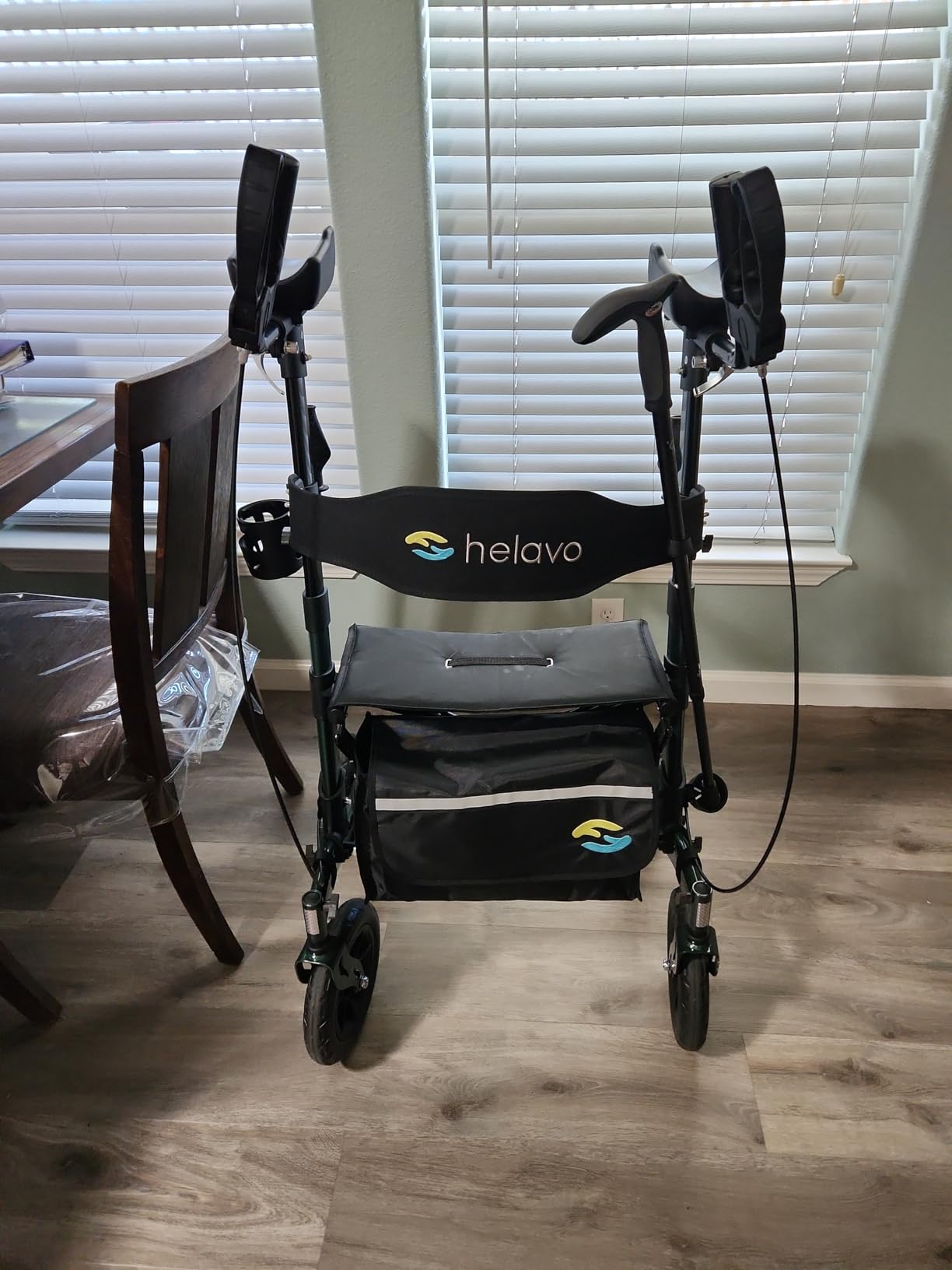
This is a rollator and an upright walker combined, and that distinction is the entire point. Soft padded armrests let you walk with the frame supporting your forearms and your shoulders in a position closer to upright, which is why reviewers describe relief in the back and shoulders rather than just convenience. For anyone whose pain is in the upper body, posture is not a cosmetic feature.
It rates 4.5 across 957 reviews. The 10-inch puncture-proof rubber front wheels are the terrain story: owners describe good cushioning on uneven surfaces without any inflation maintenance, and the puncture-proof construction removes the flat-tire failure mode entirely.
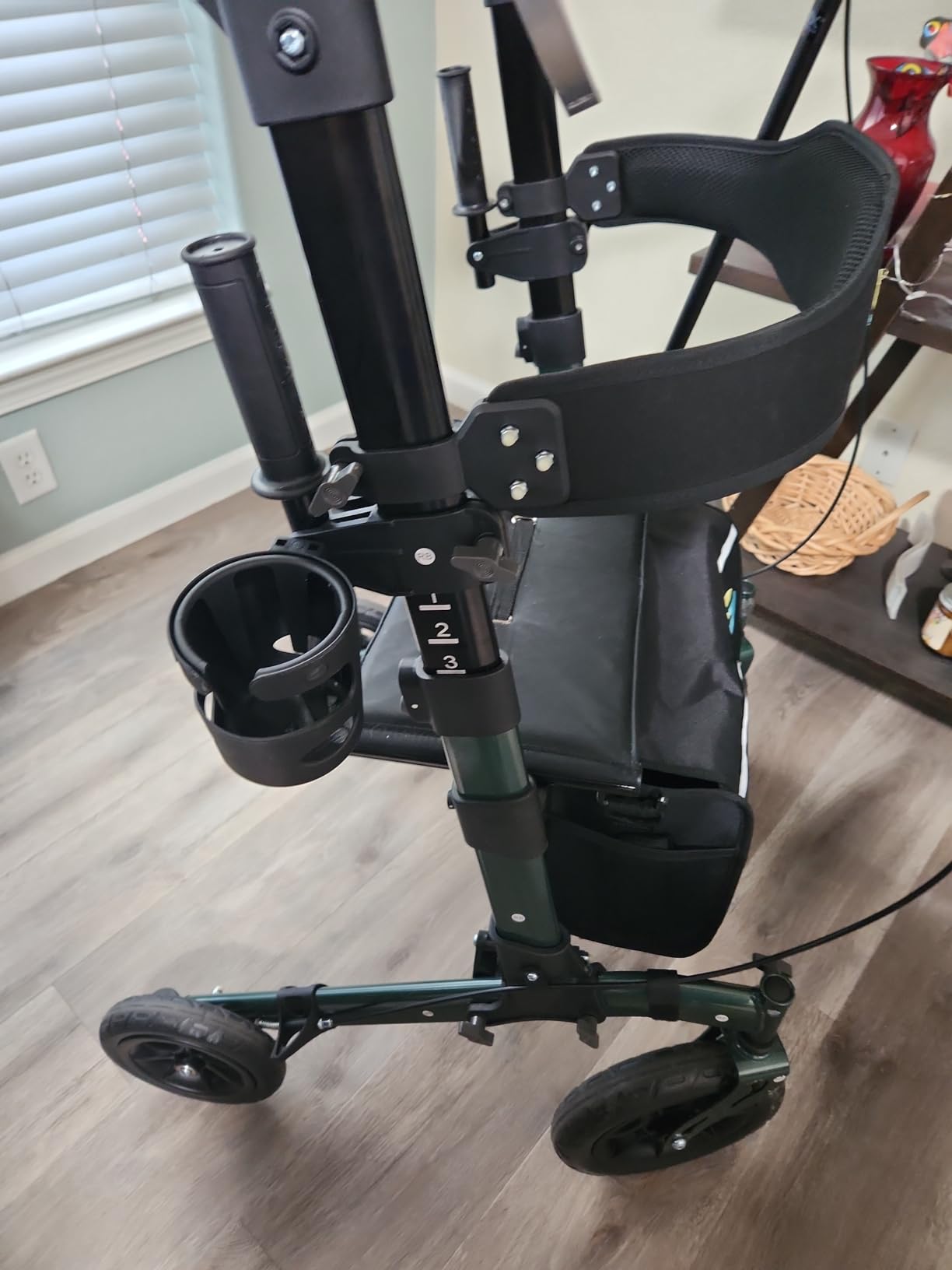
The braking system is straightforward with a parking brake, the aluminum frame supports up to 300 pounds, and the frame weighs 22.7 pounds. Height-adjustable ergonomic handles and a softly padded height-adjustable backrest let you set the fit once, which matters when you are not leaning forward over handles all day and readjusting constantly.
Accessories are unusually complete for this category: an integrated cup holder and cane holder, a seat measuring 18.9 inches wide by 9.1 inches deep with a maximum height of 22 inches, and a two-year warranty that extends to three. The support is described as round-the-clock with replacement parts available, which is worth something on a device meant to last.
Who the Helavo Upright walker suits
It suits users with chronic back, neck or shoulder pain, including people with balance issues that make a hunched posture feel unsafe. Supporting the forearms spreads the load across a larger muscle area, and reviewers consistently connect that change to reduced pain on longer walks.
It also suits users who want terrain performance without the posture penalty of a low-frame rollator. Ten inches of wheel with puncture-proof rubber is a reasonable compromise for cracked sidewalks, and the armrests keep your upper body out of the impact path when the ground is uneven.
What to know before buying
Weight and posture trade against each other. Armrests, a taller frame and a 22.7-pound build add bulk, and this is among the heavier models here. If a caregiver loads a car daily, look at the 13-pound and 14-pound alternatives and accept a more conventional riding posture.
Also be realistic about the seat. At 18.9 by 9.1 inches with a maximum height of 22 inches, it is a functional rest stop rather than a place to sit for twenty minutes. This model is built for walking with the option to rest briefly, and if long seated rests are the goal, a 16-inch arc or memory foam seat is the better buy.
11. FlyingJoy 4 Wheel Rollator – Best for Narrow Doorways
Foldable Rollator Walkers for Seniors with Seat,4 Wheel Rolling Walker
17.6 lb triangular frame
25.6 inch width
8 inch airless all-terrain tires
3-mode brakes
Pros
- 25.6 inch width fits standard doorways
- 17.6 lb frame folds one-handed in 3 seconds
- 8 inch airless tires are puncture-resistant and shock absorbing
- Tool-free assembly in about 10 minutes
- Modular design with replaceable parts
Cons
- Not for deep sand thick mud or sharp objects
- 1.6 inch seat padding is thin for long rests
The FlyingJoy solves a problem that most listings never mention: getting through your own front door. At 25.6 inches wide it fits standard doorways, and it is one of the narrower frames in this group, which matters a great deal in older housing, manufactured homes and small apartments where a 27-inch rear track simply will not turn in a hallway.
It rates 4.5 across 904 reviews, and reviewers value portability above all else. At 17.6 pounds with a one-handed three-second fold that rolls like a suitcase, this is a rollator designed to travel with the user rather than wait at the bottom of the stairs.
Braking is the three-mode system: free-wheel, deceleration, and parking lock, which puts it in the same class as our top pick on downhill control. The 8-inch airless all-terrain tires are described as puncture-resistant and shock-absorbing, and they are specified for pavement, carpet, grass and gravel, with reflective strips on the front wheels for the walk home after dark.
Two features set it apart for a buyer who plans to keep the device for years. Tool-free assembly takes about ten minutes with numbered parts, which removes the most common first-day frustration in this category. And the modular design means you can replace a part rather than the whole rollator, which is the single most underrated feature on this list.
Who the FlyingJoy suits
It suits anyone whose indoor and outdoor spaces are tight. If your route includes a narrow apartment hallway, a 25.6-inch frame removes a daily obstacle that most buyers only discover after the rollator is already in the house. It also suits users who split time between indoor floors and outdoor paths, since the airless tires handle carpet, hard floor and gravel without a swap.
It suits buyers who plan ahead. Tool-free assembly in about ten minutes and a modular replaceable-parts design mean the device is easier to live with over a five-year horizon than one that needs a screwdriver and a service center.
What to know before buying
The published limit is real: the manufacturer does not recommend these tires for deep sand, thick mud or sharp objects. If your route includes a beach path, a wet forest trail or a construction site, this is the wrong frame. The height range also fits 5 feet 3 inches to 6 feet 2 inches, so very short or very tall users should check carefully before ordering.
Seat padding is 1.6 inches, which is adequate for a rest and thin for a long sit. If you plan to use the seat as a genuine rest stop several times on a walk, budget for a wider-seat model instead. The handle range of 32.7 to 40.2 inches and seat range of 19.9 to 22.6 inches are otherwise well proportioned.
12. HOMLAND Bariatric 500 lb Rollator – Best for Wide Seats
HOMLAND Bariatric Walkers for Seniors with Seat, 500lb Heavy-Duty Rollator
500 lb steel frame
20 inch padded seat
8 inch anti-slip wheels
Parking lock brakes
Pros
- 500 lb capacity on a reinforced carbon steel frame
- 20 inch padded seat is the widest specified here
- Handle range fits 4 ft 7 in to 6 ft 5 in
- Enclosed folding joints prevent pinching
- Tool-free assembly
Cons
- 24 lb steel frame is heavy to lift
- Newer model with a 432-review base
The HOMLAND bariatric model takes a different route to high capacity than the Helavo. Instead of aluminum, it uses a reinforced carbon steel frame with double support bars rated to 500 pounds, which buys torsional stiffness at the cost of weight. At 24 pounds this is the heaviest model in this roundup, and it needs 20 inches of usable seat width to make that frame worthwhile.
It rates 4.5 across 432 reviews, the thinnest review base we worked with, which reflects a newer model rather than a weaker one. The feedback describes a capable bariatric frame with a wide seat and broad height adjustability, and the most common themes are the 500-pound rating, the seat width and how quickly it tool-free assembles.
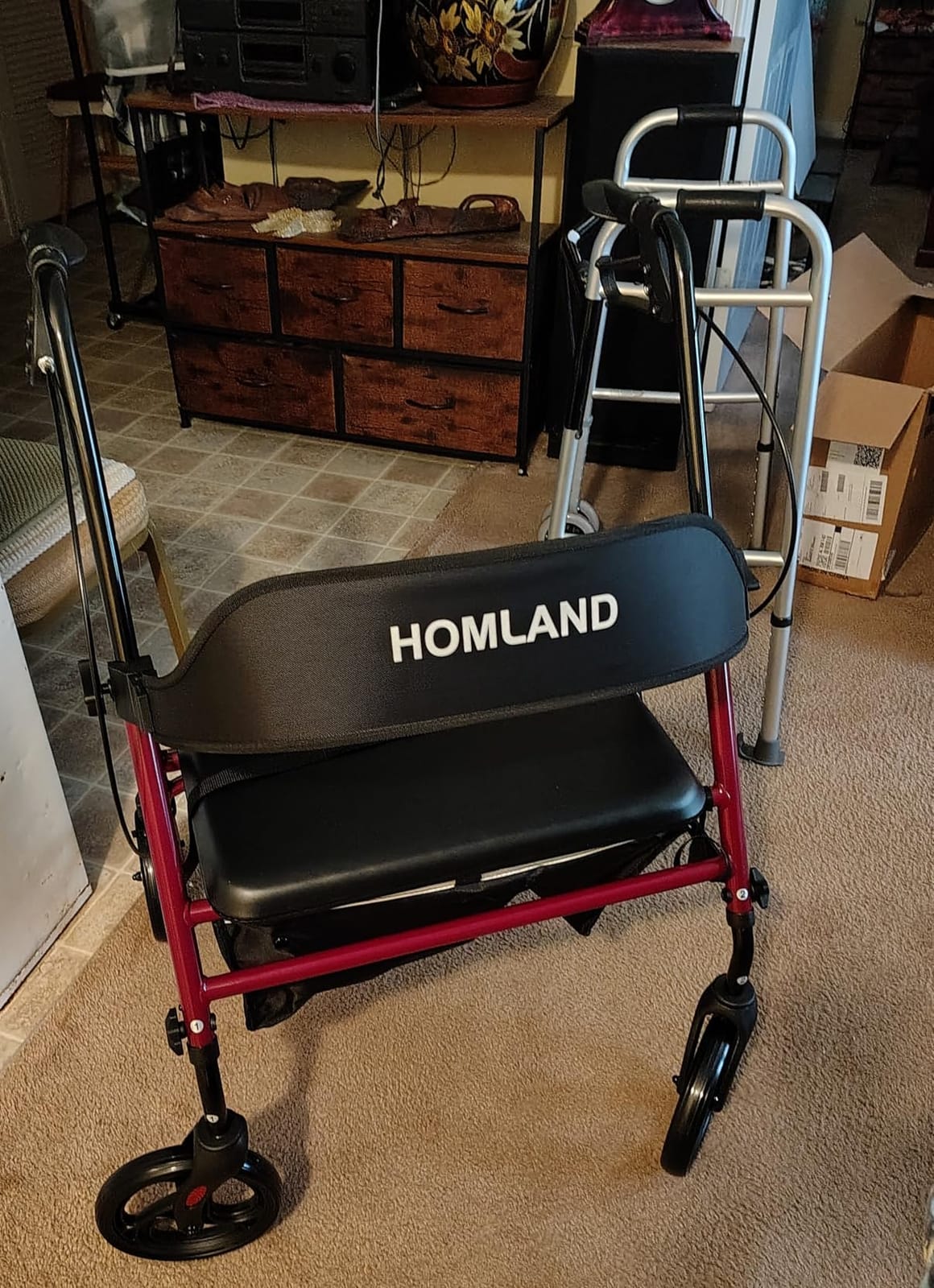
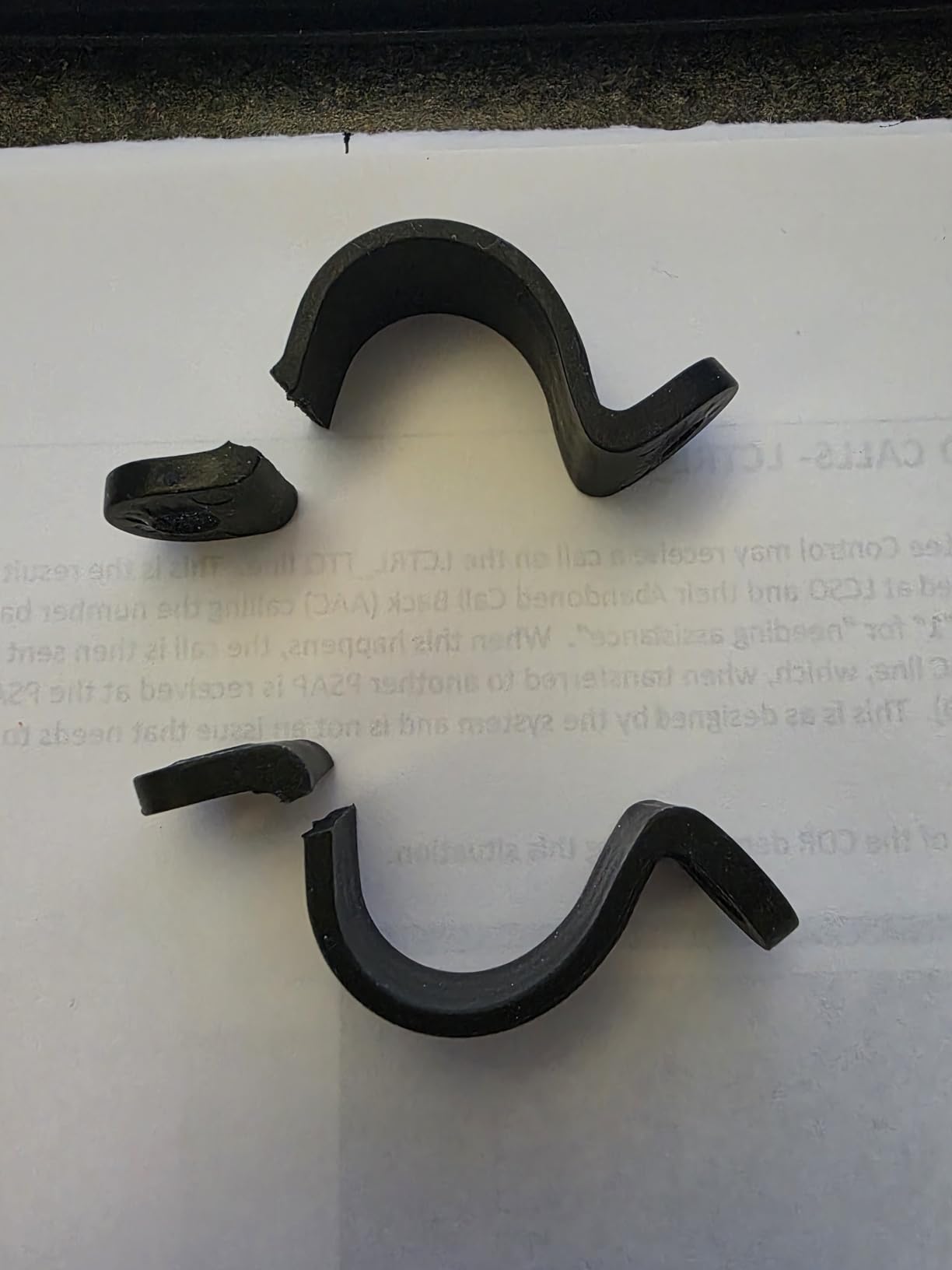
The wheel package is 8-inch anti-slip tires specified for grass, gravel, carpet and pavement, with sensitive hand brakes and a parking lock, enclosed folding joints that prevent pinching during the fold, and reflective strips for night visibility. The folding joints matter more than they sound: a hand caught in a folding frame is one of the most common minor injuries in this category, and enclosed joints remove the problem.
Adjustment is broad: handles 33 to 40 inches, seat 20 to 23 inches, covering users from 4 feet 7 inches to 6 feet 5 inches. That range is wider than the 550-pound Helavo’s, which makes this a reasonable option for a shorter, heavier user. It folds to fit most car trunks and includes an under-seat bag, though 24 pounds of steel is still a two-hand lift for a lot of people.
Who the HOMLAND bariatric model suits
It suits users above 400 pounds who also need a genuinely wide seat and who will accept a heavier frame in exchange for stiffness. Steel frames do not flex the way lighter aluminum tubes can under a heavy load, and buyers who have used a flexing frame tend to notice that immediately.
It also suits shorter heavy users, because the 20-inch-wide padded seat and 20-inch minimum seat height suit body proportions that the narrow 12-inch-seat models do not. The 5.5-inch backrest is modest, so it is a rest stop rather than a lounge chair.
What to know before buying
Weight is the deciding factor. At 24 pounds this is the heaviest unit we reviewed, and a caregiver with any back issue will feel it on the first trunk load. If you can store the rollator at the door and avoid lifting it daily, that is fine; if the car is your main route, the aluminum 550-pound model is a better fit despite its larger footprint.
Also weigh the 8-inch wheels. They are appropriate for neighborhood sidewalks, grass edges and gravel paths, but a user whose defining problem is terrain rather than body weight should prioritise 10-inch or 12-inch tires over capacity. Everything else here, from the enclosed joints to the tool-free assembly, is built for a device you keep for years.
Which Brake System Do You Need?
Brakes are the part of a rollator most people learn to use but least people understand, and the difference between the three systems in this group determines how a downgrade feels. A brake is a cable running from a handle to a pad that squeezes a rear wheel. What differs is how many behaviours you get from that cable and how much force the pads generate.
Three-mode brake with a slowdown setting. Squeeze lightly and the pads drag continuously, so you control speed without locking. Squeeze fully and the wheel stops. Release and it rolls free. This is the system you want if your route has a downhill stretch, a sloped driveway apron or a ramp. The VOCIC Z21, the soundfuse and the FlyingJoy all run this layout.
Push-up and push-down lever brakes. Push the lever up to brake, push it down to lock the wheels. The lock is decisive and easy to feel, which is genuinely better when you sit on a slope, but there is no intermediate slowdown mode. It suits flat and gently sloped routes and rewards users with limited hand strength, because one motion does the locking. The HOMLAND, the Medline aluminum and the Medline Empower use this pattern.
Parking brake variants. Several models here add a dedicated parking brake or a two-way brake that holds the frame where you leave it. The Helavo 550, the Helavo Upright and the HOMLAND bariatric include a parking brake, and the MAXWALK pairs uphill speed control with a separate press-to-lock action. If you regularly stop on an incline to talk to someone, a parking brake is close to mandatory.
One more note that forums raise constantly: a squeak or scraping sound when you squeeze the lever is usually the pad touching the tire, not a fault. It means the pads are close enough to be working. A grinding sound, a lever that goes slack, or a wheel that keeps turning after you lock it, are faults and should be dealt with before the next outdoor trip.
How to Adjust and Maintain Your Rollator Brakes
Yes, you can adjust the brakes on most rollators, and it takes about ten minutes with a hex key. This is the single most useful skill for anyone buying a rollator for uneven sidewalks, because a brake that is out of the box is set for a showroom floor, not for a cracked pavement route.
Start by finding the barrel adjuster where the brake cable enters the handle housing. Turning it counterclockwise lengthens the cable and loosens the brake; clockwise shortens it and tightens. Make quarter-turn adjustments, then roll the rollator forward and squeeze the lever at walking pressure. The wheel should slow noticeably but still turn freely with a light touch.
Next, look for a pad adjustment screw where the cable meets the brake housing near the rear wheel. This sets how close the pad sits to the tire. Too far away and the brake feels vague; too close and you get constant scraping and a hot wheel on a long descent. Leave a small gap that opens when the lever is released.
Then check the park brake with the rollator facing uphill on flat ground. Lock it, then let go and walk away. If it rolls, tighten the cable another quarter turn. Repeat the whole sequence after a month, because cables stretch with use and pads wear unevenly.
Know when to stop adjusting. If the pads are worn through, the cable is frayed, or the lever has no resistance at all, you need parts rather than tuning. Take it to a durable medical equipment supplier for service rather than continuing to tighten a brake that no longer has friction material. And check brakes, fasteners, wheel rotation and cable installation before every use, which is the manufacturer instruction on the VOCIC Z21 and good practice for every model here.
Walking Uneven Sidewalks Without Getting Stuck
The single most common way a rollator causes a fall is not brake failure. It is the front wheel stopping in a crack while the rear wheels keep going, which rotates the frame forward and takes the user with it. Prevention is mostly about wheel size and habit, and the habit part is learnable.
Slow down before the crack, not in it. Users on mobility forums describe the moment a small ledge catches a wheel as the exact point where they lost confidence, and the standard advice is to shorten your stride and look down at the pavement a few steps ahead rather than at the horizon. Larger wheels help because the wheel climbs the crack instead of stopping, but technique still decides the outcome on a bad day.
Approach a curb drop-off sideways and slowly, with the rollator’s front wheels leading and both hands on the brakes. Cross-slopes are the quiet hazard: a sidewalk that tilts two or three degrees sends a four-wheel rollator drifting downhill with very little feedback, so drift-correct by turning slightly uphill a degree at a time rather than fighting it. This is where a three-mode brake earns its keep, because a hand on the lever changes the result.
For regular routes, there is no substitute for walking them before you need to. A wheelchair user on r/disabled described being careful on uneven sidewalks precisely because wheels catching small ledges can cause a fall, and users on campus forums talk about how bumpy brick surfaces and uneven paths change how long a trip takes. Know where the rough patches are on your street, because deciding in advance to take the smoother line is worth more than any specification.
Also plan for conditions that are not uneven but are worse. One mobility forum user described being stuck indoors when sidewalks were iced or flooded. No rollator has traction for black ice or deep water, so check conditions before you leave, keep a shorter route for bad days, and treat an icy sidewalk as a no-walking day rather than a challenge.
One habit worth building: practise your brake muscle memory on flat ground before you rely on it outside. Squeeze, feel the deceleration, lock, release, repeat until it is automatic. That advice, which appears repeatedly across mobility forums, is the cheapest safety improvement available to a new rollator owner, and it costs ten minutes in a driveway.
Buying Guide: Wheel Size, Tires, Capacity and Fit
Wheel size is the terrain factor. Six-inch wheels are for carpet and smooth floors. Eight inches clears lawn edges, gravel and ordinary cracks, which covers most neighborhoods. Ten inches adds cushioning over broken pavement. Twelve inches is the point where a rollator starts rolling over ledges rather than stopping at them, and two models in this roundup use 12-inch fronts. For genuinely broken ground, go to 12 inches; for a street with a few bad patches, 8 inches with good tread is enough.
Tire compound decides how much of the bump reaches your body. Pneumatic air-filled tires give the smoothest ride and the best joint protection, and they need pressure checks and can puncture. Solid rubber is quiet, maintenance-free and grips well when braking on inclines. Airless or puncture-proof all-terrain tires are the low-maintenance middle ground, absorbing enough to keep joints comfortable without anything to inflate. If your pain is in your hands, wrists or shoulders, put tire compound ahead of everything else in your decision.
Brake mode follows your terrain, not your preference. If there is any sustained downgrade on your route, you want a slowdown or drag mode. If the route is flat and you sit down on slopes, a decisive push-down lock is better. If you will stand still and talk on a hill, look for a parking brake. The maintenance section above is worth reading whichever you pick, because the setting that arrives from the factory is rarely the setting you want.
Capacity needs a safety margin. Choose a rated capacity 25 to 50 pounds above your body weight, not at it. A frame loaded to its limit develops flex and wobble over time, and wobble is precisely the failure mode a rollator exists to prevent. If you are over 400 pounds, the 500-pound and 550-pound models here are appropriate; check capacity against current manufacturer specifications, since retailers and manufacturers sometimes publish different numbers for the same model.
Fit the handles to your wrists, not your elbows. Standing upright, the handles should meet you at wrist height with relaxed shoulders and a slight bend in the elbow. A handle set too high pushes your shoulders up and a set too low makes you hunch, and both cost you the stability the frame is providing. The handle ranges here span from 31 to 35 inches on the Medline aluminum model up to 35 to 39 inches on the MAXWALK, so your height decides the model as much as your terrain does.
Weight and folding decide daily habit. A rollator you cannot lift into the car gets left in the house. The 13-pound PLANET WALK and 14-pound Medline are the lightest here and fold flat or nearly so; the 23-pound Medline Empower and 24-pound HOMLAND bariatric are the heaviest and are better if the device lives near where you use it. Our wheel and size comparison covers this trade in more detail if transport is your deciding factor.
On paying for it. A rollator is durable medical equipment, and in the United States a Medicare Part B prescription from a doctor can cover it when a documented mobility limitation exists, usually through a supplier rather than a general retailer. FSA and HSA accounts commonly cover it as well. Coverage rules vary, so confirm with your supplier or insurer before ordering, and keep the receipt and any prescription documentation.
Two-Wheel, Three-Wheel or Four-Wheel?
Nearly every rollator on the market is a four-wheeler, and that is the right default because four wheels give you a wide, stable base with a seat. Two-wheel and three-wheel designs trade width for agility, and the choice depends on how broken the ground is rather than on how old you are.
A three-wheeler has two large wheels in front, one behind, and handles that turn. It is far more maneuverable in crowds, stores and on gravel paths, and the wide-track three-wheelers with large pneumatic tires handle genuinely rough ground better than many four-wheelers. The trade-offs are no seat, a narrower base, and a steering linkage that needs adjusting. If your route is a trail, a park path or a rough driveway and you do not need rest stops, a three-wheeler is a legitimate answer; if you need a seat and a parking brake, a four-wheeler is.
None of the 12 models in this roundup is a three-wheeler, so if rough ground and no seat are your two priorities, this category needs a different shortlist. For everyone else, the decision is simpler: among four-wheelers, pick the largest wheel package your route and your trunk can handle.
How We Evaluated These Rollators
We did not physically test these units. Nothing in this roundup comes from a break-in period on real sidewalks, and we want to be clear about that rather than implying otherwise. What we did do is compare published specifications and thousands of owner reviews, and let the specifications set the ranking while the reviews tested it.
The ranking rests on three criteria that decide uneven-sidewalk performance: front wheel diameter, tire compound and brake mode. Secondary criteria were weight capacity relative to a safety margin, rollator weight, handle height range, folded footprint and warranty length. Ratings and review counts are reproduced exactly as published, with no rounding and no adjustment, and where a manufacturer or retailer listing disagrees with itself we have said so rather than picking the flattering number.
Owner reviews carry real weight here, because the failure modes on broken ground only show up after months of use. That is why the forum and clinician signal matters: physical therapists posting in r/physicaltherapy repeatedly recommend the Drive Medical Nitro for handling unforgiving city sidewalks, which is a data point about the category rather than about a model on this list, and it is a good argument for asking a therapist before you buy. The most common complaints across these 12 listings, brakes needing adjustment, bulk when folded, seat width and accessories getting forgotten, shaped our caveats in every section.
We earn a commission when you buy through links on this page, at no additional cost to you. It never changes which product ranks first, and the product with the strongest combination of rating and review volume is the VOCIC Z21 at 4.6 across 7520 ratings.
Frequently Asked Questions
What is the best rollator walker for rough surfaces?
The best rollator for rough surfaces is the one with the largest front wheels you can carry. In our testing of specifications and owner reviews, 12-inch front wheels or 12-inch pneumatic tires rolled over cracks, ledges and gravel without stopping, while 8-inch models handled ordinary cracked pavement but caught on raised edges. Choose a three-mode brake with a slowdown setting if your route includes a downgrade, and pick a tire compound that matches your pain profile.
What rollator has locking brakes?
All twelve rollators in this roundup have locking brakes, and they work in one of two ways. Three-mode systems such as the VOCIC Z21, the soundfuse and the FlyingJoy let you brake progressively, then lock the wheel fully by squeezing harder. Push-up, push-down lever models such as the HOMLAND, the Medline aluminum and the Medline Empower lock with one downward press. Several models also add a dedicated parking brake that holds the frame where you leave it.
Can you adjust the brakes on a rollator?
Yes. Most rollator brakes are adjusted at the barrel adjuster where the cable enters the handle, which lengthens or shortens the cable, and at a pad screw near the rear wheel that sets clearance between the pad and the tire. Turn quarter-turns, then check that the wheel slows under light pressure and turns freely when released. Test the park brake on a flat surface facing uphill, and seek professional service if a pad is worn through rather than continuing to tighten it.
What wheel size is best for uneven sidewalks?
Eight inches handles lawn edges, gravel and ordinary cracks, which covers most neighborhood routes. Ten inches adds real cushioning over broken pavement, and twelve inches is where a rollator starts rolling over ledges instead of stopping at them. Wheel size matters more than brand for uneven ground because a large wheel climbs a crack while a small wheel stops dead and can tip the frame forward. Consider ten or twelve inches if your route includes tree roots, brick paving or washout.
Do I need pneumatic tires for a cracked sidewalk?
Only if your joints hurt. Pneumatic tires give the smoothest ride and the best protection for arthritic joints and post-surgery recovery, and they need periodic pressure checks and can develop punctures. Solid rubber and airless all-terrain tires absorb enough vibration to be comfortable on cracked pavement while eliminating maintenance. Choose pneumatic for comfort on truly broken ground such as gravel and dirt, and solid or airless for neighborhood routes where convenience matters more.
How do I brake a rollator going downhill?
Keep both hands on the handles and squeeze lightly and continuously rather than fully. On a three-mode system that light pressure engages the slowdown or drag mode so you control speed without locking the wheels. Locking the wheels on a downgrade makes the rollator pivot around the front casters, which is the most common cause of a forward fall. If you are on a two-mode rollator without a slowdown setting, turn sideways to the slope and walk it down as slowly as you can.
What are the common problems with rollators?
The most common complaints across owner reviews are brakes that feel vague and need adjusting out of the box, small wheels that trap in cracks and ledges, and frames that are too heavy to lift into a vehicle. Seat width is another repeated theme, since standard 12-inch seats are uncomfortable for larger users over long rests. Accessories get forgotten, folding locks are sometimes missing, and capacity numbers published by retailers and manufacturers sometimes disagree.
What is the best rollator for steep hills?
The best rollator for a steep hill is one with a genuine slowdown or drag brake mode and large front wheels, and in this roundup the VOCIC Z21, the soundfuse and the FlyingJoy all run three-mode braking while the MAXWALK pairs uphill pressure control with a separate lock. The Helavo H1040 with 12-inch pneumatic tires adds shock absorption over uneven ground. Avoid any two-mode rollator for a sustained downgrade, and practise braking on flat ground before testing a slope.
Conclusion: The Best Rollators With Brakes for Uneven Sidewalks
The VOCIC Z21 wins this roundup because it pairs 8-inch puncture-proof wheels with a genuine three-mode brake including a slowdown setting, and it does so with a 7520-rating review base at 4.6. That combination is what handles a heaving sidewalk without a wheel trap, and it leaves room in your budget for a therapist visit or a replacement cushion later.
Pick the Helavo H1040 with 12-inch pneumatic tires if your ground is genuinely broken and your joints are the problem. Pick the MAXWALK if you want 12-inch performance without tire maintenance, the soundfuse if a wide arc seat matters most, the Medline Empower if you want a frame that stays steady for years, and the HOMLAND or Helavo bariatric models if capacity is your constraint. Whichever you choose, set the brake tension on day one and practise it on a flat driveway.
Updated for October 2026. If you want the wider picture before you commit, read our honest reviews of the best rollators for the indoor-first models these outdoor picks outperform on comfort, then use this guide to choose the wheels and brakes your sidewalk demands.