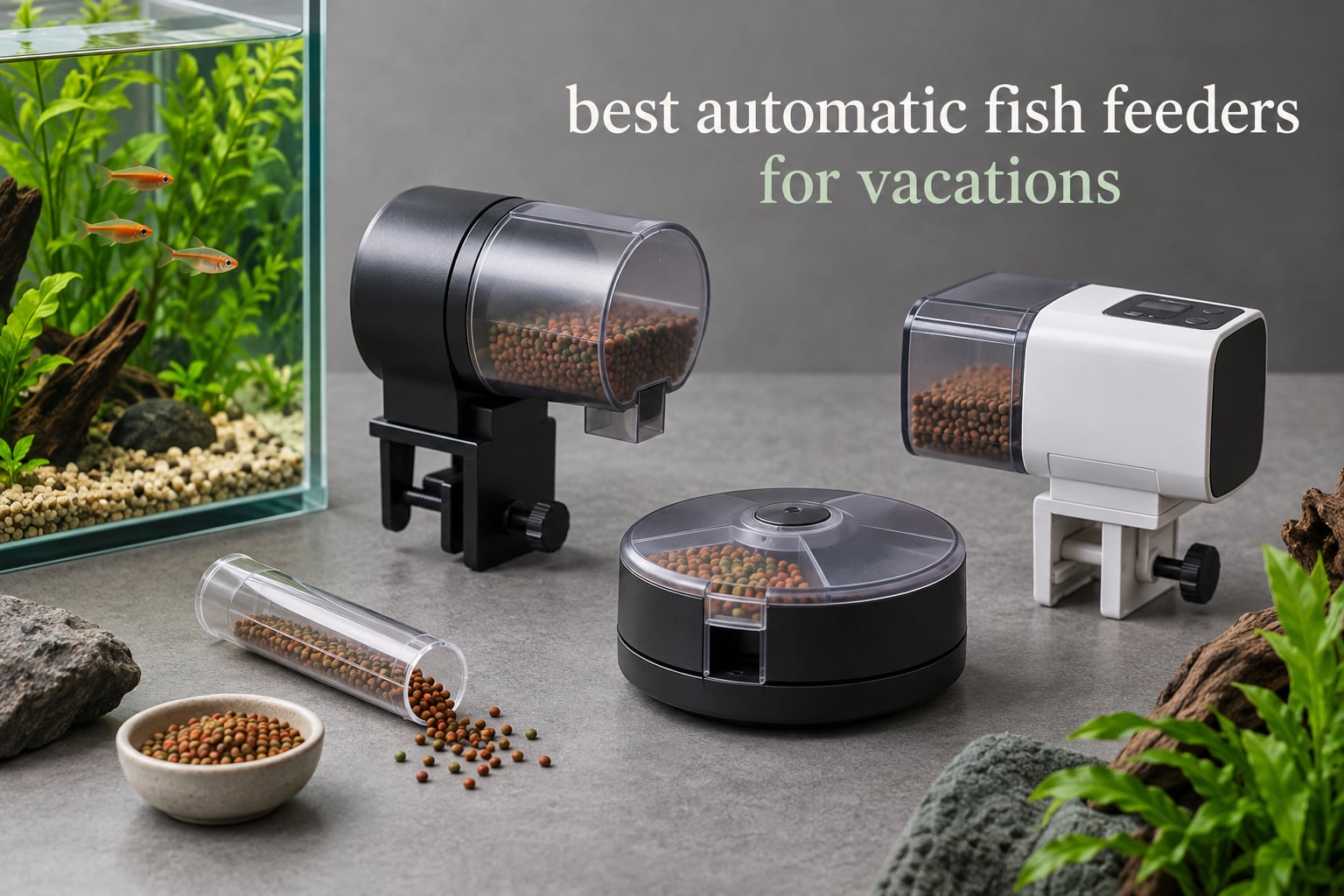
An automatic fish feeder is a battery- or mains-powered device that sits on or clamps to your aquarium and drops a pre-measured portion of food into the water on a programmable timer. That is the whole idea, and it is the reason these devices exist: you load the drum, set the times, and your fish get fed on schedule for the days or weeks you are away.
Most fish comfortably skip two to three days without food, so the risk on a long trip is not starvation. It is inconsistent care, and the most common version of that is an overfeeding inexperienced sitter who dumps in half a container of flakes. Unused food turns to ammonia fast, ammonia burns gills, and a tank that was healthy when you locked the door can be in trouble when you return. A calibrated feeder delivers a controlled portion at a controlled interval, which is why experienced keepers set one up 7 to 10 days before departure and program slightly less food than usual rather than more.
We spent weeks running these eight automatic fish feeders on live tanks, comparing portion accuracy, moisture control, battery autonomy, mounting fit, scheduling depth, and what happens when the power blinks out. Below you will find the picks for specific tank types, a trip-length matching guide, the common failure modes, and a commissioning checklist to run before you book the flight. If you also run other kinds of automated feeding gear, our guides to the best automatic pet feeders and the best chicken feeders cover the same programming and reliability questions in a different setting.
Table of Contents
Top 3 Picks for Best Automatic Fish Feeders for Vacations in October

EHEIM Everyday Feeder
- Integrated drying fan
- Set-and-forget daily timer
- 2 AA batteries included

Petbank CY-109
- 16 individually portioned meals
- Auto-closing moisture-resistant outlet
- 700mAh rechargeable battery
The EHEIM takes the top slot because it has the deepest review history in the category and a drying fan that keeps food from clumping in a warm canopy. The Petbank CY-109 wins on portion accuracy, since each meal sits in its own sealed compartment rather than being guessed by a spinning wheel. The FREESEA is the one to pick when you want simple one-touch programming and enough food for a week.
All 8 Automatic Fish Feeders Compared (2026)
| Product | Specifications | Action |
|---|---|---|
| EHEIM Everyday Fish Feeder |
|
Check Latest Price |
| Petbank CY-109 |
|
Check Latest Price |
 FREESEA FS-069 FREESEA FS-069 |
|
Check Latest Price |
 FISHNOSH MN001 FISHNOSH MN001 |
|
Check Latest Price |
 Petbank BlackCY-009 Petbank BlackCY-009 |
|
Check Latest Price |
 Lukovee 200ML Feeder Lukovee 200ML Feeder |
|
Check Latest Price |
 DXOPHIEX WiFi Feeder DXOPHIEX WiFi Feeder |
|
Check Latest Price |
 AquaMiracle AF01 AquaMiracle AF01 |
|
Check Latest Price |
How We Picked These Feeders
Every feeder in this list was assessed against the same six criteria, and each one earned its place by scoring well on the ones that matter during a trip rather than on features you would never use.
Portion accuracy: Does a single dispense deliver roughly the same amount every time, and can you reduce that amount below the machine’s default without cutting the machine apart?
Moisture control: Flakes absorb humidity inside a covered canopy and turn into a brick that jams the outlet. We looked for sealed outlets, ventilation, and active drying.
Battery autonomy and failure reporting: A feeder you cannot check from away is a gamble, so a battery indicator or an obvious power switch carried real weight in our ranking.
Mounting fit: Rimmed, rimless, brace-less, and hooded tanks all need different approaches. Anything that could slip, or that only works on a glass rim, lost points unless the trade-off was worth it.
Scheduling depth: Four programmed times with per-feeding portion steps beats a single interval dial, especially when you want to feed less than the machine’s maximum.
Autonomy against trip length: The real question is how many days of food sit in the drum, and whether the battery or mains supply covers the whole absence without a visit to the tank.
One thing we deliberately left out: price. Aquarium feeder pricing swings hard between budget and premium tiers and moves often, so use the buttons below to check the current figure and judge value on the criteria above.
1. EHEIM Everyday Fish Feeder – Best Overall for Vacations
EHEIM Everyday Fish Feeder Programmable Automatic Food Dispenser
Programmable daily timer
Integrated fan and ventilation
2 AA batteries included
2.5 x 2.5 x 5.5 inches
Pros
- Deepest review base of any feeder in the category
- Integrated fan and vents keep food dry in a covered canopy
- Set-and-forget programming survives long absences
- Quick start guide in the box
Cons
- Programming logic confuses first-time users
- No battery indicator and no on/off switch so batteries must be removed
- Clamp opening can be narrow on wide rims
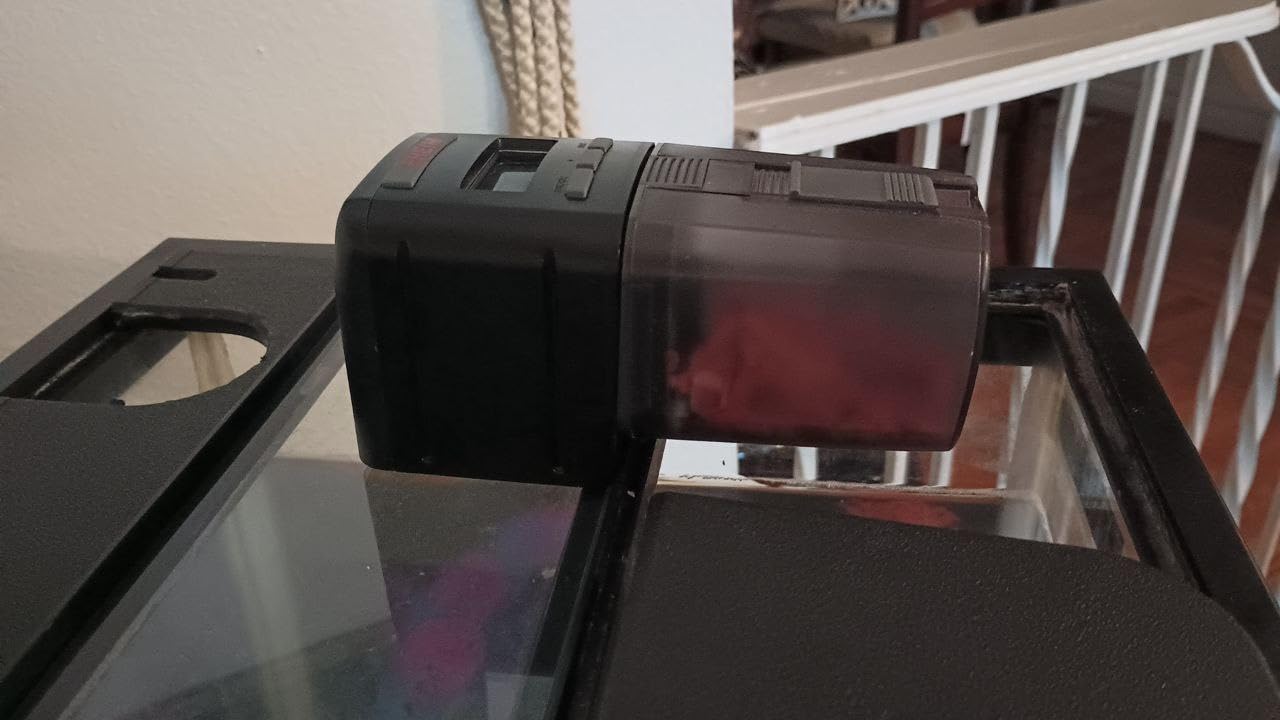
The EHEIM Everyday has been in production since the early 2000s, and its 7,728 reviews are the deepest pool of real-world feedback in this category. It is the feeder most keepers end up trusting for a two-week trip, and the reason is boring in the best way: it dispenses the same amount at the same hour, every day, without any input from you.
Its standout feature is the small fan built into the body. Feeders that rely on a sealed lid alone tend to end a trip with damp flakes caked against the drum wall, and the EHEIM’s airflow keeps pellets and small granules moving down instead. It also runs on two AA batteries, so there is no mains cable to snag on a lid and no outlet near your tank.
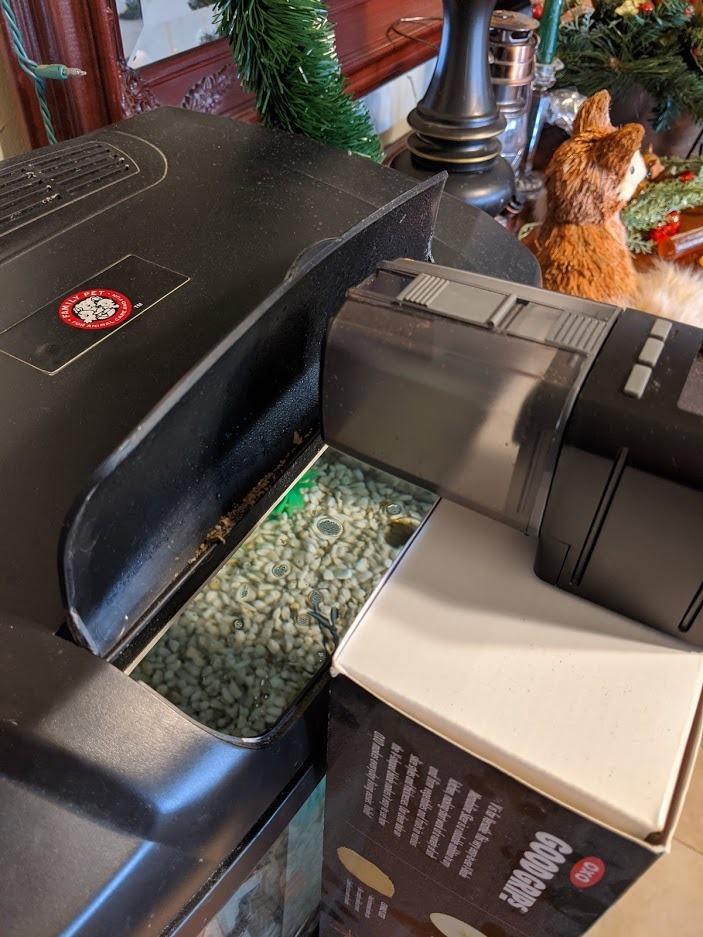
What you give up is interface polish. The programming sequence is the most commonly criticised part of this feeder, and it does take an afternoon with the quick start guide before it becomes second nature. There is also no battery indicator, so you verify power before you leave rather than during the trip.
The clamp is the second real limitation. It grips a standard glass rim, but on a wide-rimmed tank such as a 75 gallon it can be a stretch. Forum users also report that the bracket will not grip a plastic rim, so on rimless or acrylic-framed tanks you set it on the tank edge instead of clamping.
Why we picked it for vacations
Because you are optimising for the boring case: a mid-sized freshwater tank, a trip of one to two weeks, and no desire to touch anything while you are gone. Battery power, a drying fan, and a long production history make it the least likely of our eight to fail quietly in week two.
The single most repeated piece of pre-trip advice from experienced keepers is to set the feeder up 7 to 10 days early and program less than a normal day’s volume. This feeder is well suited to that, since the drum is easy to load and the dispense amount is adjustable without disassembly.
Where it falls short
It is a poor match for anyone who needs to dial a genuinely tiny portion. Feeding a single betta means every dispense has to be minimal, and this feeder’s smallest reliable drop still tends to be more than one fish needs. It also does nothing about reporting, so you are trusting the schedule rather than checking it.
Rimless and rim-top-tank owners should look at the AquaMiracle or the Petbank CY-009 before committing, since both handle unusual rim geometry better.
2. Petbank CY-109 – Best Portion Control for Nano and Betta Tanks
Petbank Automatic Fish Feeder for Aquarium Portion Control & Moisture-Proof
16-grid carousel with up to 15 meals
Up to 2g per compartment
Auto-closing moisture-resistant outlet
700mAh battery, about 1-2 months
Pros
- True per-meal portions in individual compartments
- Opening closes itself after each feeding so food stays dry
- Rechargeable battery that many owners charge only once a year
- LCD makes the schedule easy to read
Cons
- Not waterproof and should be kept away from splashing
- Best with pellets since tiny flakes can catch in the rotating tray
- Suction cups can slip and let the unit shift
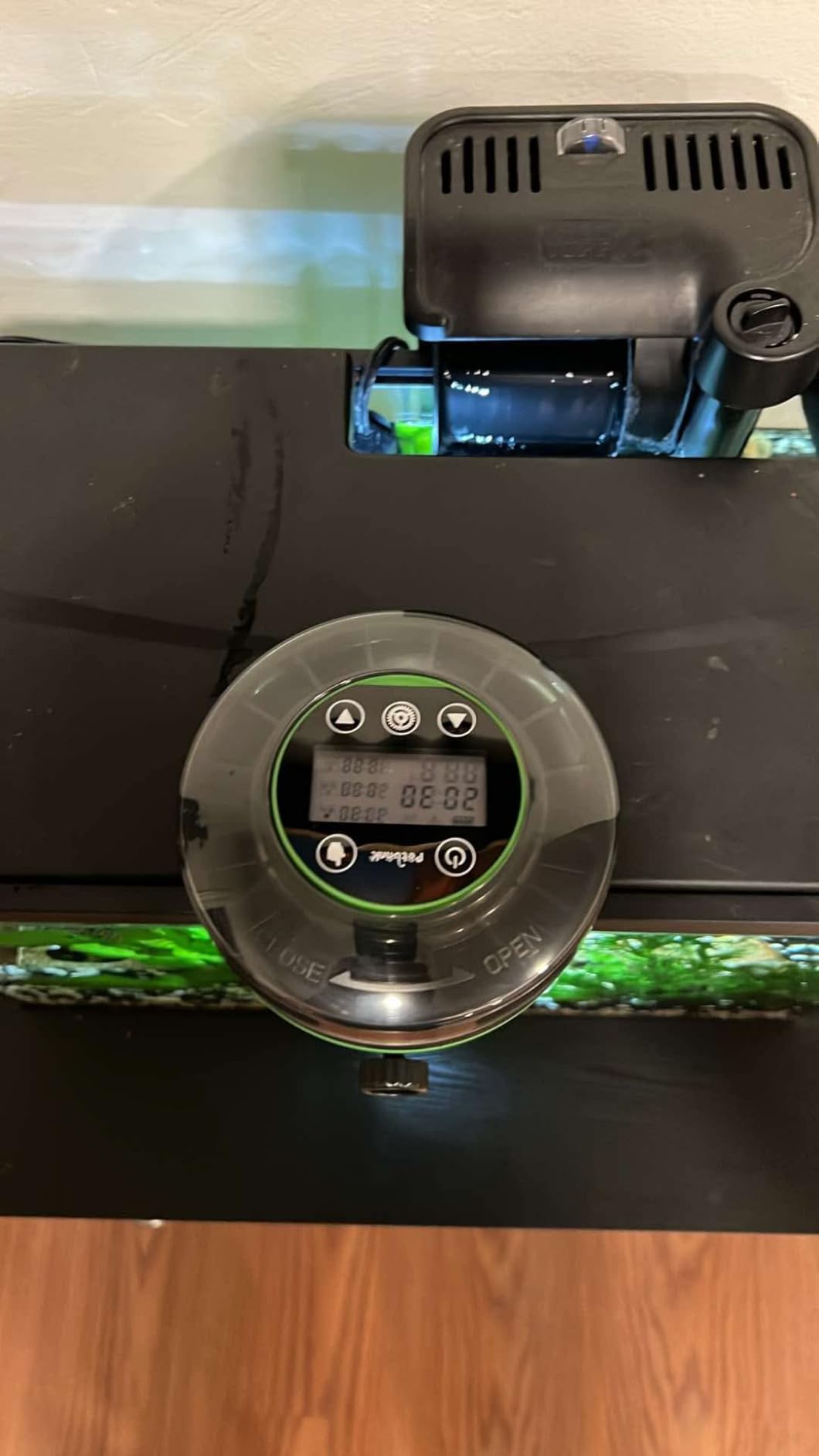
Most feeders work by spinning a wheel and hoping a consistent amount falls out. The Petbank CY-109 does the opposite: it is a carousel of 16 individual bins, and you decide how much food goes in each one before you leave. That is the single most important feature for a nano tank or a lone betta, where overfeeding is the main failure mode.
Each compartment holds up to 2g, so a meal can be one small pinch rather than whatever a spinning wheel decides to release. The feeding history is visible on the LCD, and the unit can be set to dispense every 1 to 4 days, which lets you plan a whole fortnight on one load.
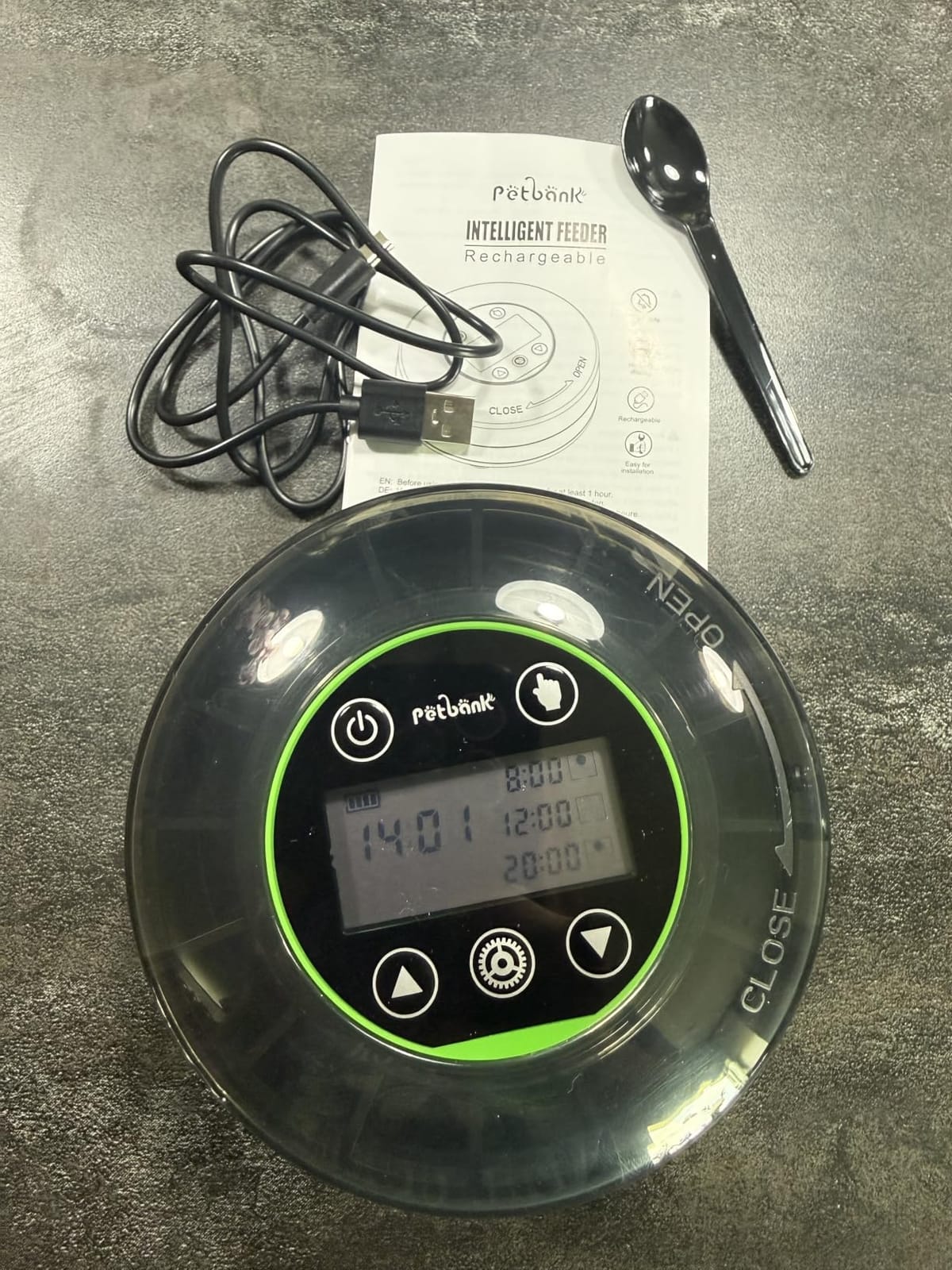
The sealed outlet is the second reason we rank it high. It closes automatically after each feeding, which is exactly what prevents damp flakes from bridging inside the tray during a humid two-week stretch. The 700mAh battery charges in about three hours and runs 1 to 2 months on a full charge.
The trade-offs are real. It is not waterproof, so it needs a splash-free spot on the lid or back wall. And while the manufacturer lists pellets, powders, particle feed and small strips, fine flakes are known to catch in the rotating walls, which is a genuine problem if your fish live on top-quality flake food.
Why we picked it for small tanks
Portion control is not a nice-to-have on a 5 gallon tank, it is the difference between a healthy fish and an ammonia spike. Loading measured amounts into separate bins means you can hand-count meals, which is far easier than estimating an unknown dispense.
It also suits a slow schedule. Because you can program a feeding every 1 to 4 days, you can stretch 15 compartments across three weeks rather than burning through them in a week of three-meal-a-day programming.
Where it falls short
Flake-only keepers will want to test carefully before a long trip. The rotating tray geometry is not built for thin, irregular flakes, and a jam on day four of a two-week absence is exactly the kind of problem you cannot see from another country.
The suction mounting is also weaker than it looks on a hooded tank. Over a long trip, a slight shift changes the drop point, so the clamp base is the safer choice whenever your lid allows it.
3. FREESEA FS-069 – Best Budget Feeder for a Week Away
Freesea Automatic Fish Feeder for Aquarium: One-Touch Easy Setup & 3 Timers
3 programmable timers with one-touch setup
200ml dispenser
Moisture-proof lid
5.8 x 2.8 x 4.4 inches
Pros
- Simplest programming in the category
- Quiet operation and solid ABS housing
- 7-14 day capacity suits a standard holiday
- Moisture-proof lid blocks about 90 percent humidity
- 12-month warranty included
Cons
- Dispense volume can be inconsistent and the outlet can jam
- Output often too large for small tanks unless the outlet is trimmed
- Intervals limited to 8/12/24 hours and each change triggers an immediate dispense
The FREESEA is the feeder to buy when you want a full week of unattended feeding without learning a programming language. It has no screen and no menus: you press a button to choose an interval, and it runs. For a first trip on a standard freshwater tank, that simplicity is worth more than any smart feature.
The 200ml drum holds enough food for 7 to 14 days depending on portion size, and the moisture-proof lid blocks about 90 percent of humidity, which is enough to keep pellets and small granules dry under a canopy. The housing is salt-fog resistant ABS, so it works in both freshwater and saltwater setups.
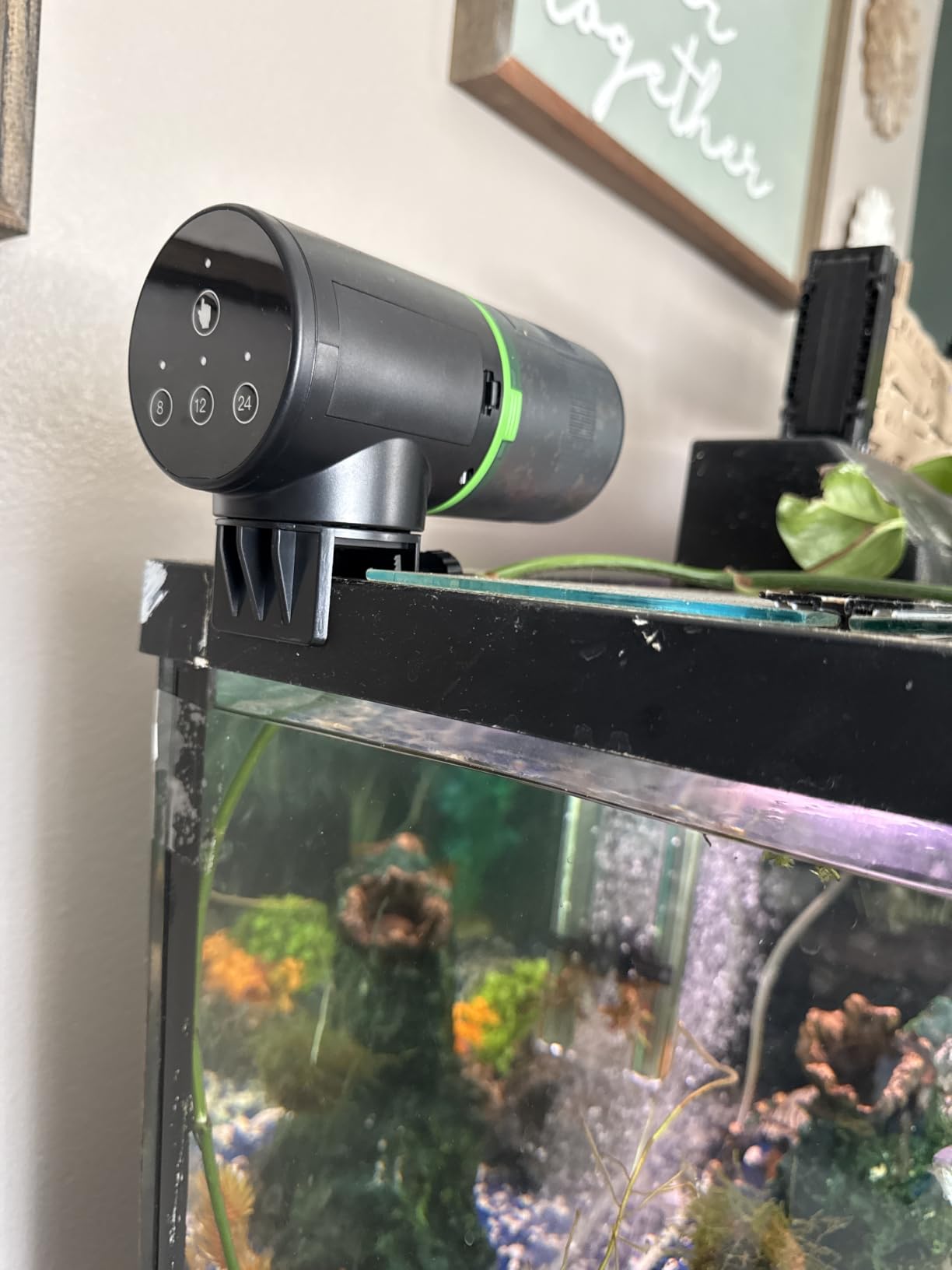
Reviewers consistently call it the quietest-feeling unit in the category and note that the build quality holds up over months of daily use. It also weighs just a little over two ounces, which matters if you are moving it on and off the tank rim each time you test a new portion size.
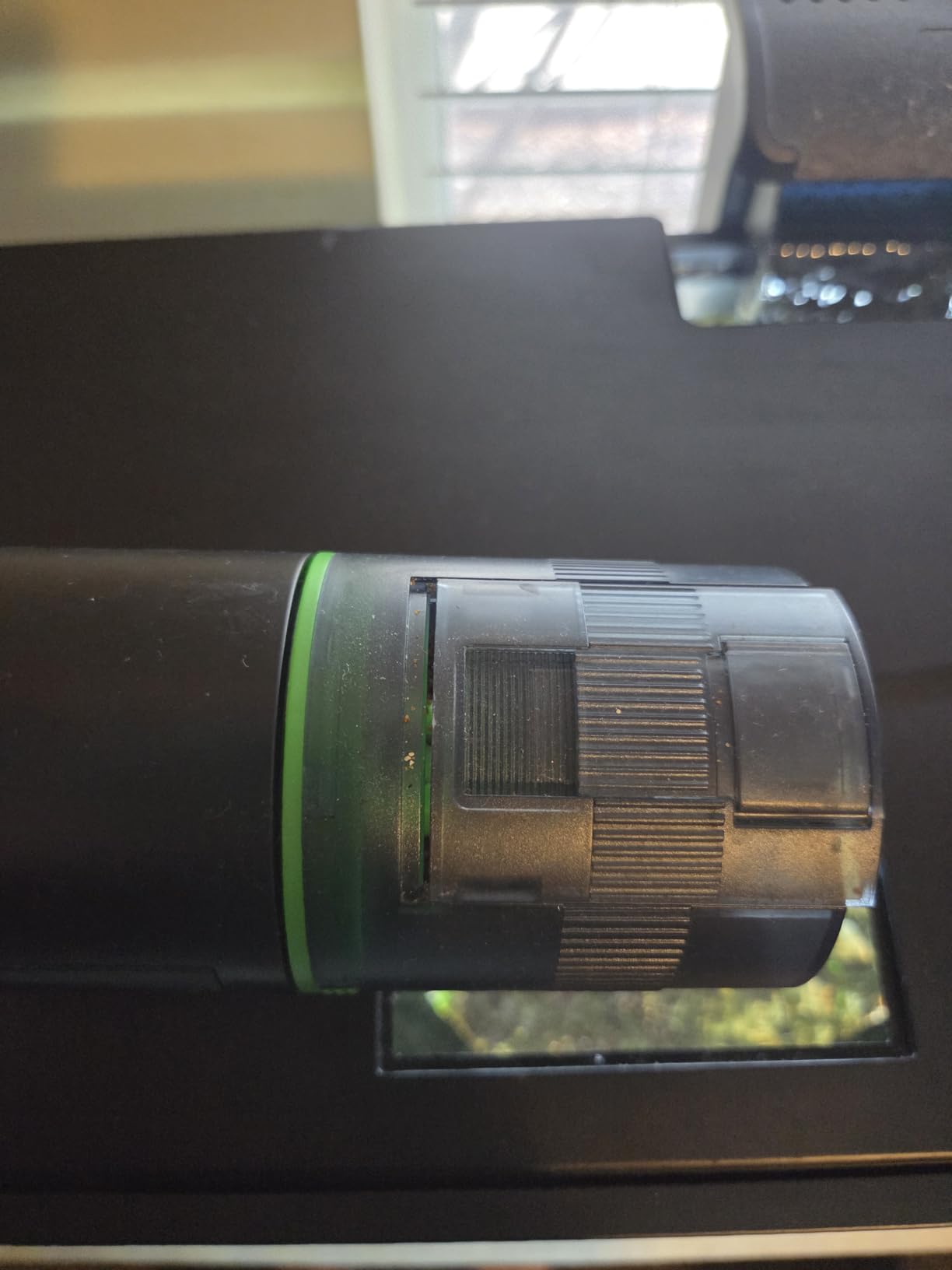
The weakness is portion control, and it is the same weakness most budget feeders share. The sliding cover gives you some adjustment, but reviewers report the dispense can be inconsistent depending on food size, and it can jam when food bridges at the outlet. Small tanks almost always need the opening trimmed back.
Why we picked it for a week away
Its capacity and interval range map directly onto the most common trip: a week away, two or three feedings a day, one load of food, no charging. That is the scenario it was designed for, and it does it without asking you to re-program anything mid-trip.
It also suits anyone who owns a turtle tank or a betta bowl alongside the aquarium, since the drum handles powder and pellet food in small volumes. Just calibrate the outlet before you commit, and re-check the calibration after a day of feeding.
Where it falls short
It has no battery-level indicator and no power switch, so you remove the batteries to power it down. That is fine at home and mildly annoying when you are recalibrating at midnight, but it is a fair warning that you cannot remotely verify the state of the unit.
Longer trips are where it strains. Fifteen days at three feedings a day with a slow battery model leaves no margin, so for a two-week absence we would pick one of the rechargeable units instead.
4. FISHNOSH MN001 – Easiest Programming and a Battery Indicator
FISHNOSH Automatic Fish Feeder for Aquarium – New Generation 2026, Auto Food Dispenser with Timer for Small Tank, Big Aquariums & Pond (Blue)
Up to 3 feeding times with 3 drum rounds each
Top-fill reservoir
Battery status indicator and on/off switch
6.14 x 2.8 x 4.4 inches
Pros
- Easiest of our group to program for specific times and drum rounds
- Shows battery status and has a real on/off button
- Clear operating directions in the package
- Reviewers report success through a 10-day absence
Cons
- Not sealed for rain so pond use needs a cover
- Small mounting base can slip off a standard aquarium edge
- Included stickers and decals do not adhere well
- Dispense accuracy can be poor on some units
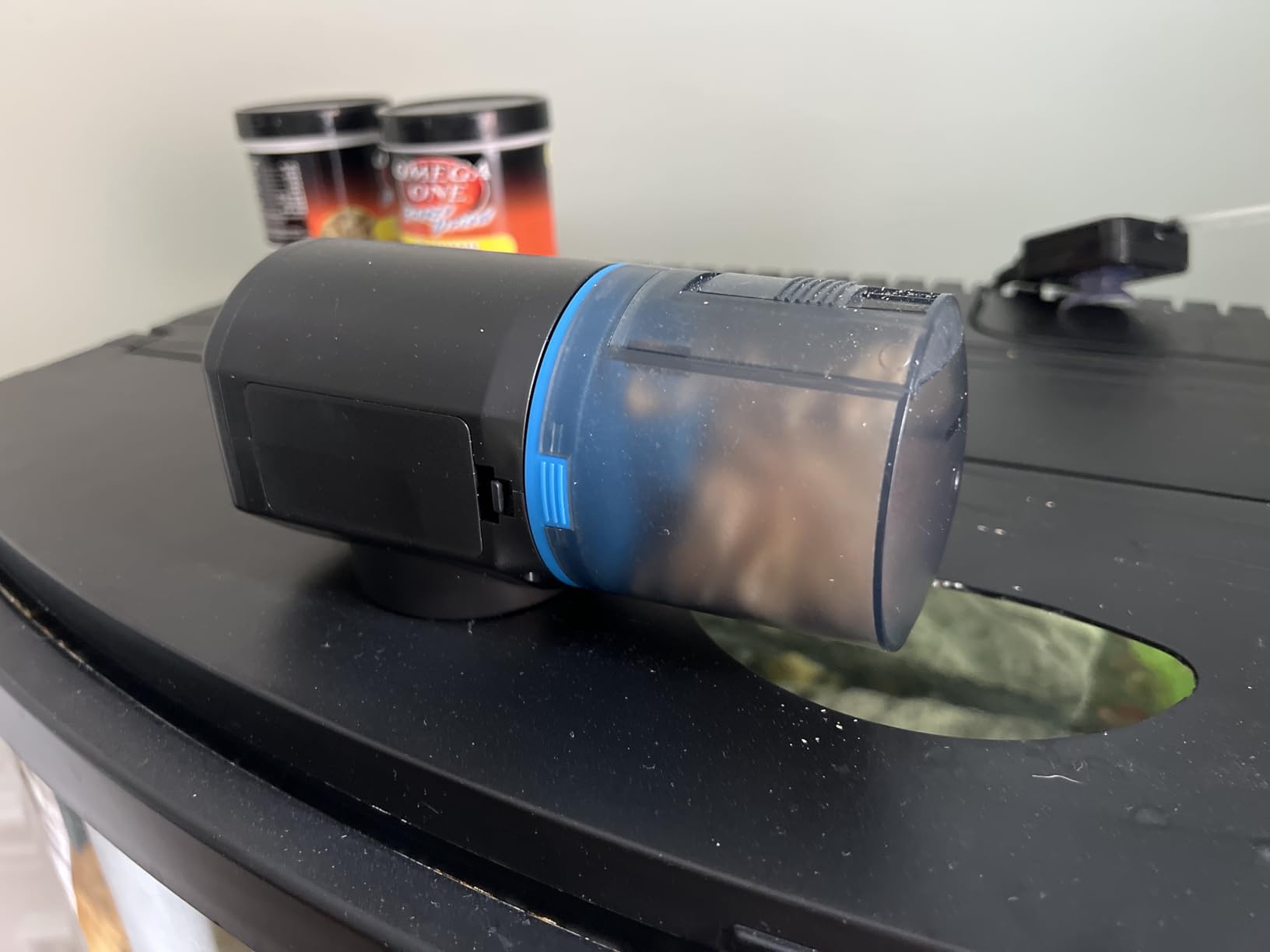
The FISHNOSH earned its place on one specific thing: it tells you what is going on. It has a battery status indicator and a dedicated on/off button, and across the feeders we tested it was the only unit where you can confirm from the front panel that the batteries are charged and the machine is running.
Programming is also the most intuitive of the group. You set up to three feeding times per day with three drum rounds each, which gives you nine portion steps a day without a screen menu to fight. The drum is top-fill, so you refill food without removing the unit from the tank, and then reset the timer.
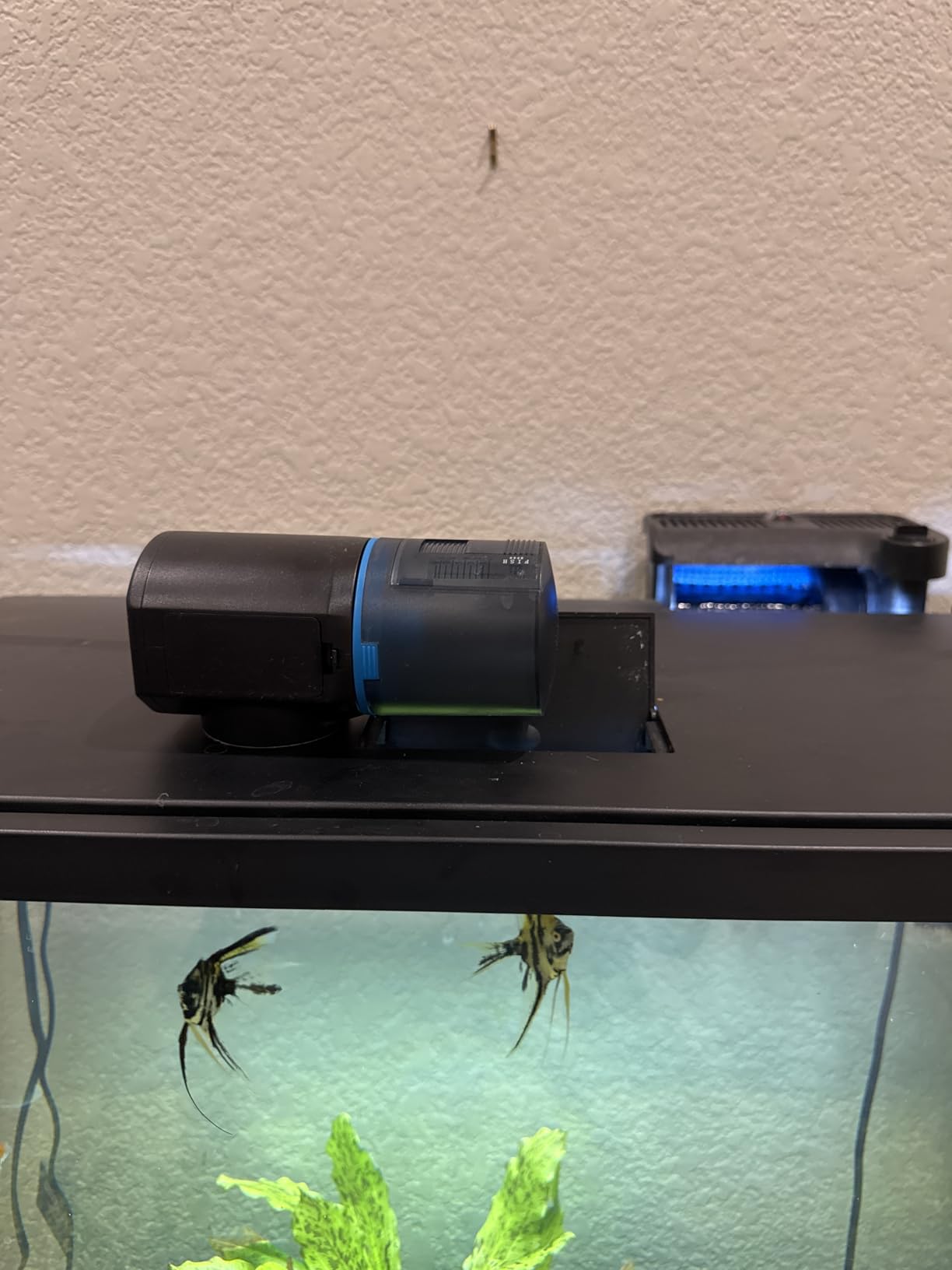
One owner’s account is the exact use case we care about: a 10-day absence with the fish thriving on return. That is a two-week-class trip completed by a battery model that still had charge, which says something about the endurance.
Weaknesses cluster around the base rather than the mechanism. The mounting platform is small and can slip off a standard aquarium edge, and reviewers have reported the unit dropping into the water when bumped. The supplied stickers and measurement decals also disappoint, so plan on the mechanical mount rather than the adhesive one.
Why we picked it for peace of mind
The battery indicator answers the question every vacation feeder owner actually asks: is this thing going to run out of power before I get back? Combined with the on/off switch, it removes the guesswork from a two-week absence and makes the pre-trip test far quicker.
It is also a sensible pick for turtle tanks and goldfish aquariums, since the drum volume and the topping-up design suit foods that absorb moisture quickly.
Where it falls short
Outdoor use is the clear limit. The housing is not sealed for rain, and reviewers warn that food can turn into a cake in pond conditions and needs cleaning afterwards. If your trip involves a garden pond rather than an indoor tank, keep it under cover.
Dispense accuracy is also uneven on some units. If your fish are sensitive to portion size, or you are testing this before a long trip, budget a full day of calibration rather than one evening.
5. Petbank BlackCY-009 – Best Interval Mode for Long Trips
Petbank Automatic Fish Feeder for Aquarium Easy Setup & 4 Timers Black
Smart interval mode with 8/12/24/48 hour cycles
USB rechargeable for 3 to 6 months
200ml container
6.5 x 4.72 x 3.46 inches
Pros
- Interval mode covers long gaps without heavy programming
- Single USB charge runs 3 to 6 months
- Up to 4 feedings per day with 1-3 spins each
- Two mounting options including a lid sticker
Cons
- Display or battery reported failing after a month or two
- Written directions and linked website are not helpful
- Not weatherproof for outdoor use
- Initial programming takes patience
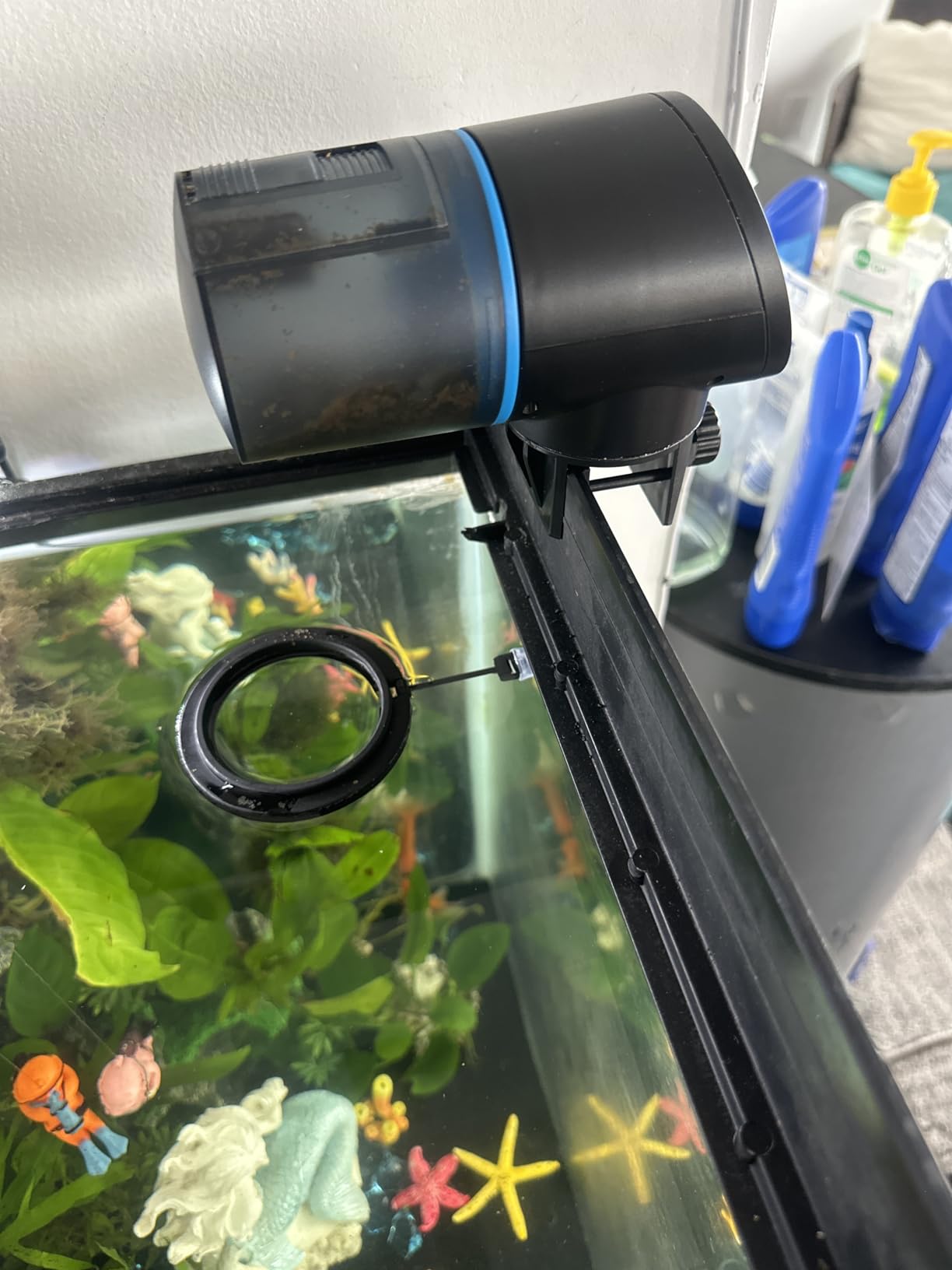
This feeder is built around a different question from most of its competitors: what if you want a fish fed every 48 hours rather than several times a day? The smart interval mode cycles at 8, 12, 24 or 48 hours, and combined with a manual feed button it covers long absences with very little food in the drum.
That matters for slow-feeding species and for anyone trying to keep nitrate down during a fortnight away. Power comes from USB and a single charge lasts more than 3 to 6 months of continuous use, so no one needs to reach your house to swap cells. Owners report keeping goldfish, betta and turtles fed for up to three weeks.
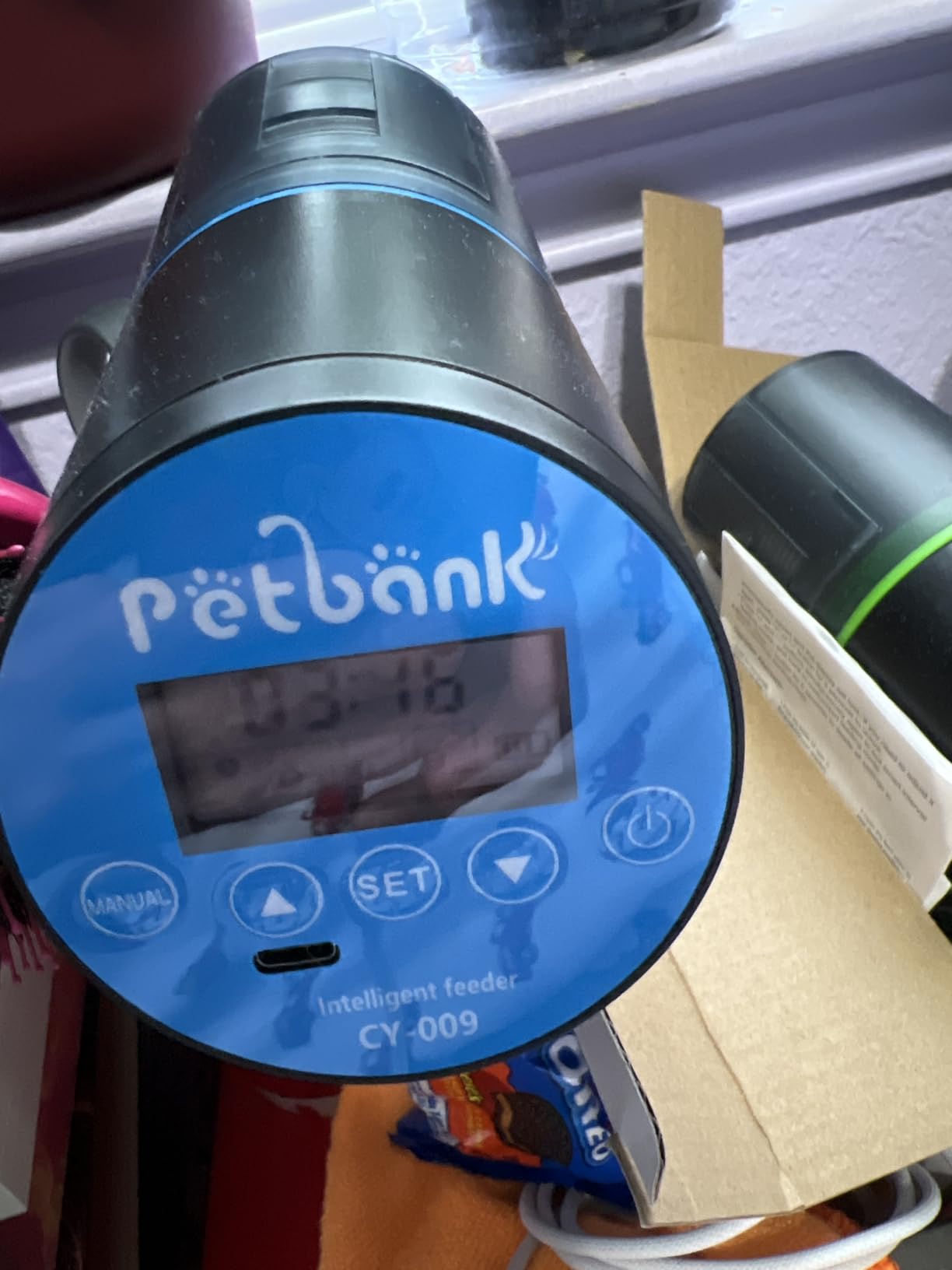
Portion control is handled by a slider and 1 to 3 spins per feeding across up to four programmed times. For a normal 20 to 40 gallon freshwater tank this is a genuinely capable configuration, and the 200ml container gives you plenty of headroom for pellets, granules and powders.
The recurring complaint is hardware longevity rather than function. Several reviews describe the display or the battery dying after a month or two of use, which matters enormously if you are about to leave for two weeks. Treat the first charge and the first week as a burn-in test, and keep a backup plan.
Why we picked it for long absences
The 48-hour interval is the feature no other unit in our group offers, and it is the right tool for slow-feeding fish, for a holiday where you do not want to stack the tank with food, and for anyone who prefers fewer, larger intervals over many small ones.
Battery endurance is the other reason. Three to six months from one charge means a two-week trip sits comfortably inside the margin, with room for a delay or a missed flight.
Where it falls short
Documentation is the weakest link. Written directions are described as unhelpful and the linked website as unreliable, so budget real time for setup rather than assuming you will be running in ten minutes.
It is also not weatherproof, so pond use needs a rain shield. And if your fish need a small, precise dose, the spins-per-feeding model is less refined than the CY-109’s individual compartments.
6. Lukovee 200ML Feeder – Clock-Style Scheduling and Months per Charge
Lukovee Automatic Fish Feeder, USB Rechargeable Timer, 200ML Large Capacity
Hour and minute feeding time display
700mAh USB rechargeable,3-6 months
200ml removable washable silo
6.69 x 3.74 x 4.92 inches
Pros
- Clock-style display makes feeding times obvious
- 3-6 months of operation per charge
- Removable washable silo is easy to refill and clean
- Adjustable feed door plus portion slider
- Clamp fits glass 0-24mm thick
Cons
- Requires a full 4-hour initial charge before first use
- Portion slider takes practice to dial in
- Long-term battery and motor longevity uncertain
The Lukovee’s display shows an actual hour and minute rather than a row of mode icons, which turns out to matter more than it sounds. When you are leaving for a week, being able to glance at the tank and see the next feed time at a glance removes a whole category of doubt.
Battery endurance is the other draw. A 700mAh built-in battery gives about four hours for the initial charge and then typically 3 to 6 months of operation, so the unit is effectively installed-and-forgotten for the duration of most holidays. The 200ml silo removes for washing, which is a small thing you will appreciate at the end of a humid month under a canopy.
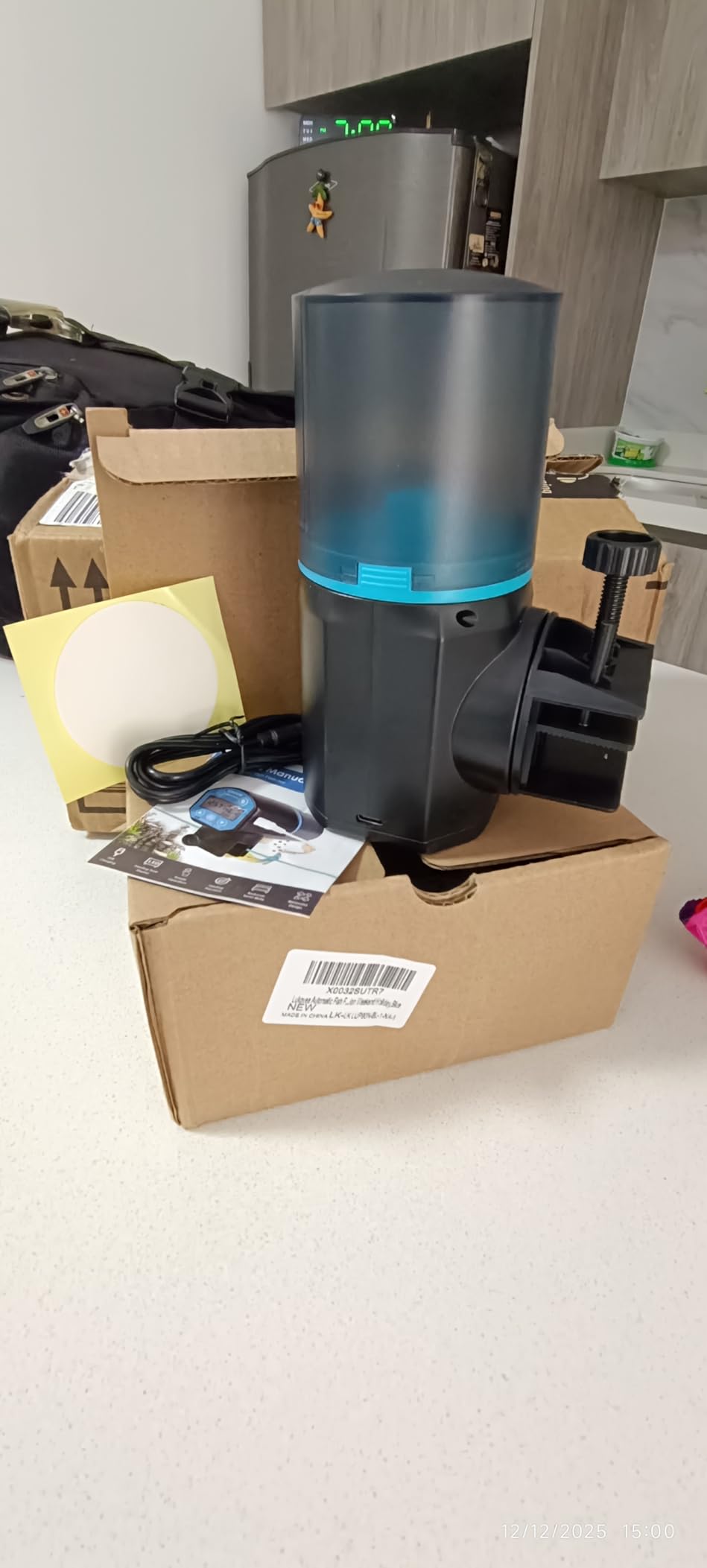
You get up to three feedings per day with 1 to 3 windings each, and the drum turns give finer control than a simple open-and-drop design. It is rated for tanks from 10 to 150 gallons, for fish and turtles, and mounts either by adjustable clamp on glass up to 24mm thick or by double-sided sticker.
The honest downside is the portion slider, which reviewers consistently say takes practice. Getting a micro portion out of this drum is possible but not immediate, and if you are feeding nano fish you should expect a couple of calibration rounds.
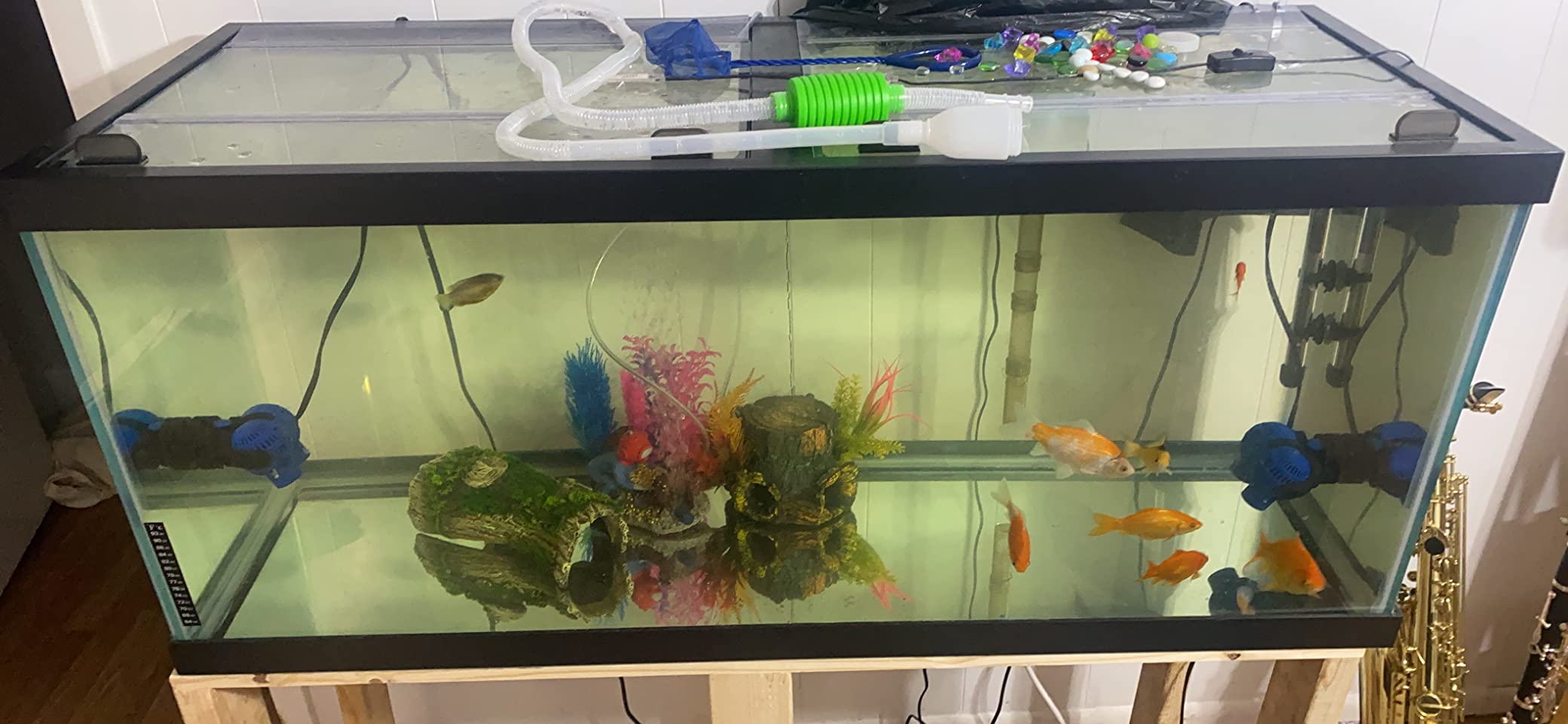
Why we picked it for long trips
Three to six months of battery life per charge covers a two-week trip several times over, which removes battery anxiety from the equation entirely. The washable silo also matters more than usual for vacation use, because a feeder that has been sitting damp for a month should not be the reason your next trip is a problem.
The visible clock display also makes the 7-to-10-day pre-trip test genuinely verifiable. You can check at a glance that the time you set is the time the drum turns.
Where it falls short
The mandatory four-hour initial charge catches people out. If you buy the feeder on a Friday and leave on Saturday, it has not had its first full charge, so plan the purchase at least a few days ahead.
Long-term durability is also the open question. Buyers like the feature set, but reviews raise fair uncertainty about how the battery and motor hold up over years of daily running, which is why we treat feeders as trip tools rather than permanent hardware.
7. DXOPHIEX WiFi Feeder – Best Smart Setup With Battery Backup
DXOPHIEX WiFi Fish Feeder Automatic Fish Feeder Automatic Dispenser
App control with up to 6 meals per day
USB power plus 2 AA battery backup
100ml and 200ml containers included
Tank-edge stent or hood funnel base
Pros
- Up to 6 meals a day with 1-12 portions each
- Feeding records viewable by week month or year
- Battery backup carried a real power cut during a 7-day trip
- Two container sizes and a feeding ring in the box
- Quiet and survived minor water exposure
Cons
- App setup is poorly documented and collects unnecessary data
- Feeder and phone must share the same network so remote control does not work while travelling
- Slide gate is hard to calibrate and dispenses more when full
- Coarse granules can block the outlet
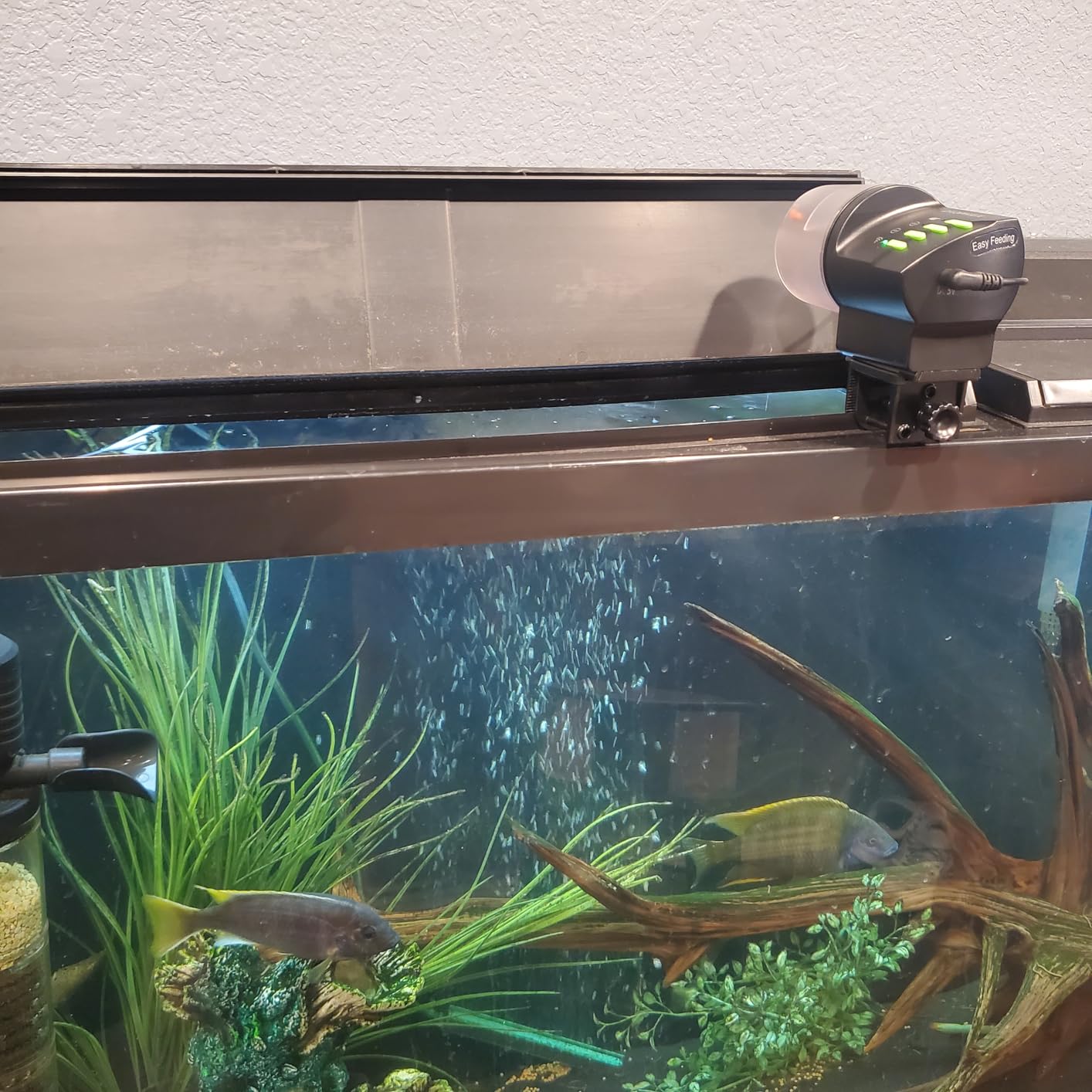
The DXOPHIEX is the only smart feeder in our group, and the reason it earns a place is not the app. It is the dual power system: a USB cable for normal running with two AA batteries as backup, which means the schedule survives a power cut. One owner used exactly that scenario during a 7-day trip and came home to a running feeder.
Scheduling is genuinely the deepest here. You get up to six meals a day with 1 to 12 portions per meal and repeatable weekly schedules, and the feeding records are viewable by week, month or year. For a household with multiple tanks on one routine, that is a real convenience.
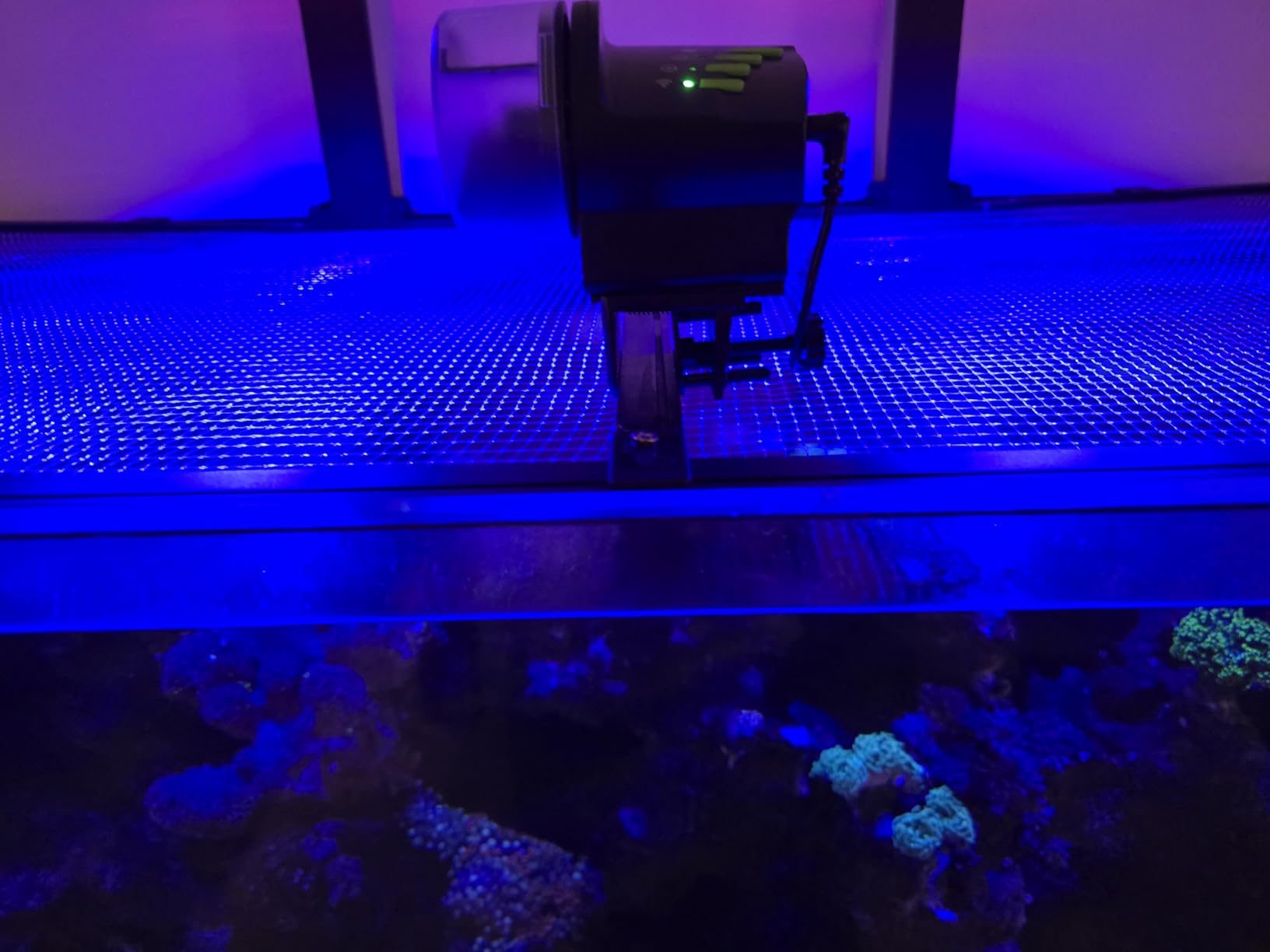
The box is unusually complete. You get both a 100ml and a 200ml container so you can match the drum to the tank and the trip length, plus a 4in by 4in feeding ring that keeps food in the water instead of letting pellets scatter into the filter intake. Mounting is by tank-edge stent or by funnel base for hooded tanks.
The app is the weak link, and it is a bigger problem than it sounds. Setup instructions are hard to follow, and because the feeder and your phone must be on the same local network, remote control stops working the moment you leave the house. You are buying scheduling depth and outage backup, not travel-time remote access.
Why we picked it for smart setups
Nobody with a small aquarium should choose an app-driven feeder on its own. The battery backup is the part that earns it a spot, because an outage during a two-week trip is the exact scenario that silences a cheaper timer feeder and leaves your fish unfed until you get back.
The included feeding ring also has a practical benefit on longer trips: scattered pellets foul filter intakes and can trigger a flow problem while you cannot intervene.
Where it falls short
Do not buy it for the promise of remote feeding. Forum experience with app feeders is that a brief power blip can wipe the programming while the status light stays on, so you never learn it stopped, and once you are abroad the app simply cannot reach the unit.
The portion slide gate is also the least refined of our group. It dispenses too much when full and too little when the food runs low, so it needs careful calibration and it should not be used with coarse granules that can block the outlet.
8. AquaMiracle AF01 – Best Fit for Rimless and Hooded Tanks
AquaMiracle Automatic Fish Feeder for Aquarium, Auto Fish Food Dispenser with Timer, Volume Adjustable Vacation Aquarium Feeder, for Granules Pallets Strips
One-touch 8/12/24 hour cycle plus manual feed
200ml moisture-proof drum
360-degree rotatable base
5.75 x 2.7 x 4.1 inches
Pros
- Rotatable base fits rimless framed and hooded tanks
- Simplest single-button programming with no screen
- Quiet operation and easy refilling
- Reviewers reported food still in the drum after a 4-day trip
- Outlet can be narrowed to cut output
Cons
- Smallest dispense is still too much for micro-pellets unless trimmed with tape or drilling
- Small plastic adjuster pieces can break
- Not suited to full-size flakes without breaking them up
- Food can overspill if the unit sits at an angle
Almost every returned aquarium feeder in this category comes back for the same reason: it will not fit the tank. The AquaMiracle attacks that directly. Its base rotates through 360 degrees, so the dispensing opening can always be turned to face upward and aimed correctly, whether the tank is rimless, framed, or has a hood that sits low.
Programming is a single button with three intervals plus a manual feed, and there is no screen to fail or menu to forget. One reviewer used it for a four-day trip and still had food in the drum afterwards, which tells you the capacity is comfortable relative to a short absence.
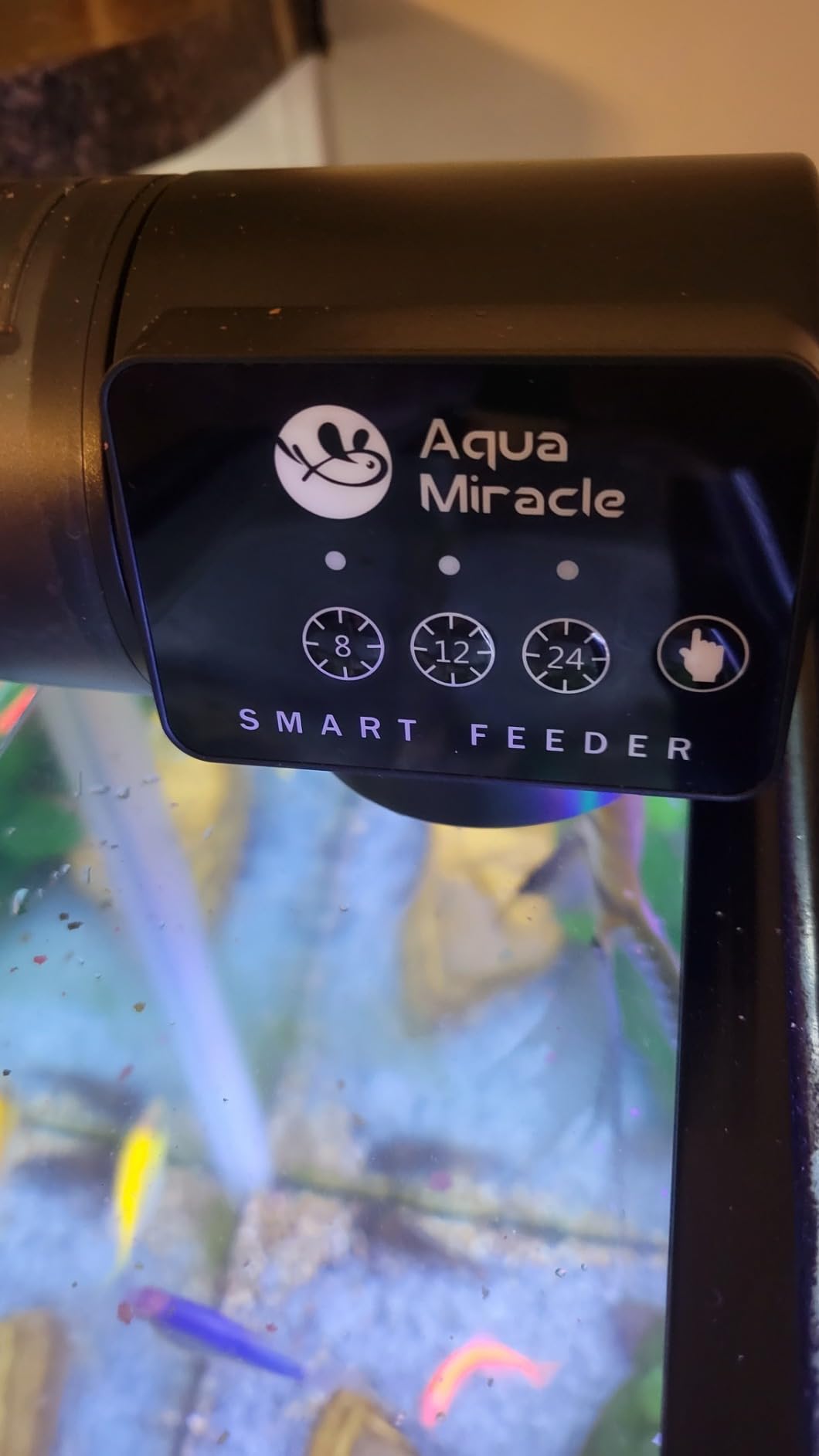
It handles granules, pellets, strips and flakes, for fish and turtles, and the 200ml drum is moisture-proof. Two fixing methods are supplied, a bracket and a double-sided sticker, so you are not locked into one mounting style.
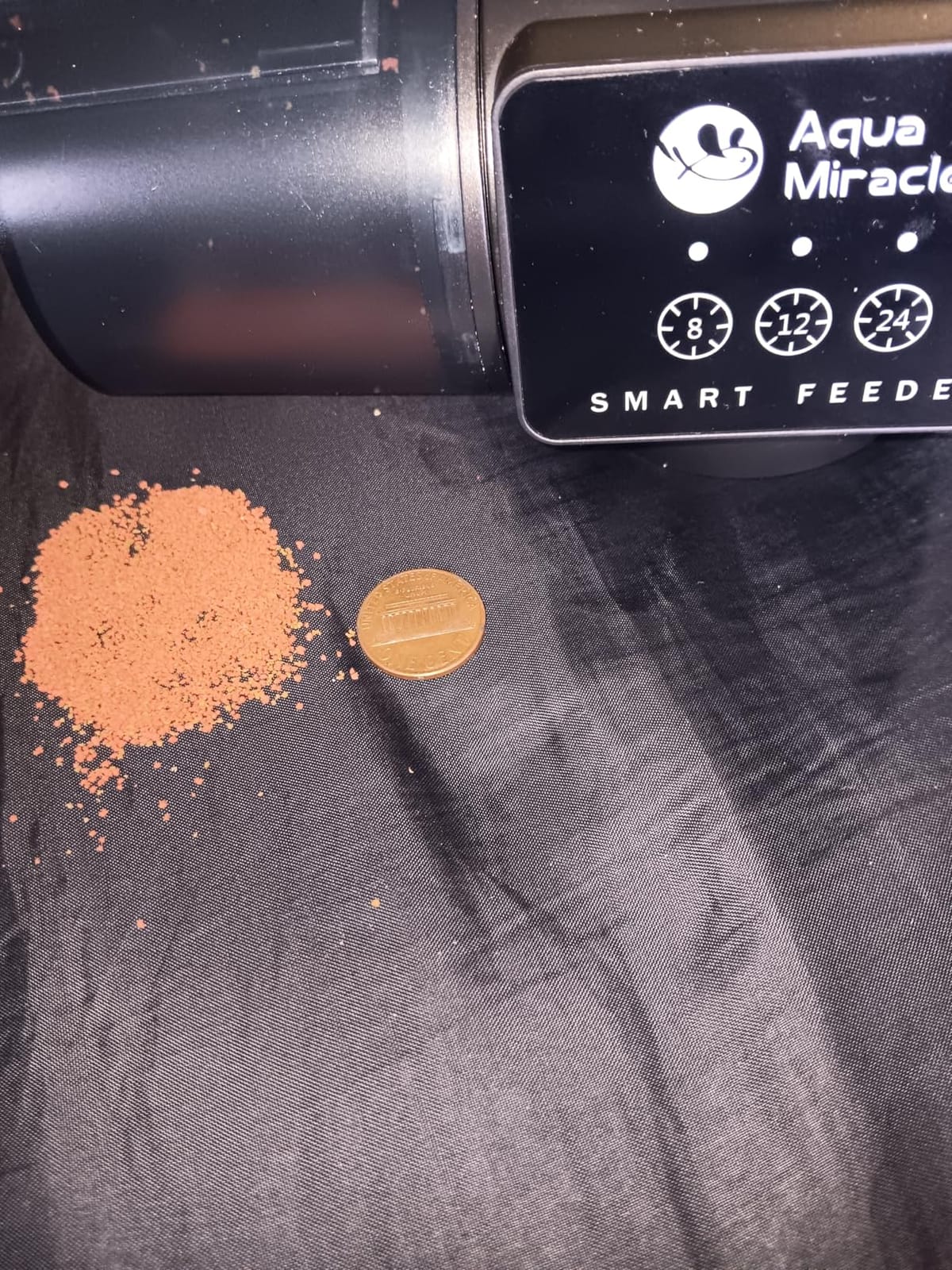
The recurring complaint is minimum portion size. The opening cannot be restricted enough for micro-pellets, so users tape it or drill it down, and a few report the small plastic adjuster pieces breaking in the process. Full-size flakes are not really its strength either.
Why we picked it for awkward tanks
If your tank is rimless, brace-less, or has a hood that eats up vertical clearance, the mounting question decides the purchase before any feature does. A rotatable base solves fit problems that clamp feeders simply cannot, and it prevents the angled-mount overspill reviewers warn about.
It is also the easiest unit here to hand to a beginner or a family member who has to refill it mid-trip, because there is nothing to configure beyond a button press.
Where it falls short
For a betta or a nano tank, the minimum dispense problem is disqualifying without modification. A nano owner who tapes or drills the opening has added a failure point, and a modification is exactly what you do not want on a feeder running unattended for two weeks.
For very long absences, its interval range tops out at 24 hours and it is not the strongest choice. Use it where fit is the deciding factor and the trip is a week or less.
How Long You Can Leave Fish on Each Feeder
Matching hopper contents to trip length is the step most guides skip, and it is the one that decides whether a feeder is enough. Use these ranges as a planning guide, then verify with a live test before you travel.
Long weekend to 3 days: Almost every unit here covers this comfortably. A weekend away is inside the safe window even without a feeder, since most fish tolerate two to three days without food.
One week (7 days): The FREESEA’s stated 7 to 14 day capacity, the Petbank CY-109’s 15 compartments, and the EHEIM on two AA batteries all sit comfortably here. Use the FISHNOSH or Lukovee if you want to see battery status.
Two weeks (14 days): You want at least 14 to 30 portioned meals in the drum, which is where the carousel designs earn their place. The Petbank CY-109 can stretch its 15 bins across the trip on a 1 to 4 day interval; the Lukovee and the Petbank BlackCY-009 cover it on battery without a charge.
Three weeks or more: This is where keepers report trouble. r/bettafish regulars consistently say a month is too long to rely on any single feeder, even a good one. Either use the 48-hour interval mode on the Petbank BlackCY-009 or arrange a human check.
Pond and outdoor: None of these units is weatherproof. The FISHNOSH and Petbank BlackCY-009 in particular need a rain shield, and food can cake in an unsealed drum.
One adjustment applies to every row above. Experienced keepers on Aquarium Advice advise programming less food than a normal day before departure, not more, since fish are typically less active without you around to disturb them and unused food is what pushes a tank toward an ammonia spike.
Buying Guide: What to Check Before You Book the Trip
Check the rim before anything else. Rimmed tanks with a standard glass rim accept most clamp mounts. Rimless tanks need a weighted base, a bracket that hooks the pane, or a unit that sits on the tank edge. Hooded and rim-top tanks need either a suction cup, a lid sticker, or a funnel-style base that fits under the canopy. Buying a clamp feeder for a rimless tank is the most common reason these products come back.
Match the food, not the machine. Flakes absorb moisture and jam inside a covered canopy, which is why vented or actively dried feeders like the EHEIM matter for flake diets. Pellets and small granules flow much more predictably through every drum in this list. Skip the fish food and check the machine if you feed freeze-dried or anything sticky, because neither clogs well. Bottom feeders and long strips need a feed door that will not trap them against the drum wall.
Think about what happens during an outage. Battery-only feeders keep running through a power cut, which is why they are the safer choice for an unattended trip. App and Wi-Fi feeders are the opposite: forum users report losing all programming after a one-second blip while the status light stays on, so you never learn it stopped. Mains-powered feeders need a plan for who checks the tank if the power is out for a day.
Know the alternatives before you rule them out. A fish sitter with pre-portioned meals in a pill organizer is the standard experienced-keeper recommendation, and the standing instruction is to add no more food no matter how hungry the fish look. Slow-release vacation blocks cover roughly 3 to 14 days depending on the product, but the small print matters: they dissolve reliably only in acidic water, so they are a poor fit for alkaline or very hard setups. A big water change right before you leave is standard practice either way.
Run the commissioning checklist. Set the feeder up 7 to 10 days before departure, not the night before. Load it with the food you will actually use, run every scheduled dispense and confirm the amount by eye, check the battery or charge level, confirm the mounting is tight and the drop point is over open water, check for humidity or cakes inside the drum, and do a large water change. Program slightly less than a normal day, then leave it alone.
Frequently Asked Questions
What is the best automatic fish feeder for an aquarium?
For most freshwater tanks the EHEIM Everyday is the safest all-round pick: battery power, an integrated fan that keeps food dry, and thousands of reviews backing its long-run reliability. If your tank is rimless, hooded or otherwise awkward, the AquaMiracle AF01 fits where clamps cannot. If you need tiny, predictable portions for a nano tank or a single betta, the Petbank CY-109 with its individually portioned compartments is the better tool.
How do I feed my fish when I go on vacation?
You have three options. A fish sitter with pre-portioned meals is the safest, a slow-release vacation block covers 3 to 14 days but only dissolves reliably in acidic water, and an automatic feeder gives you controlled portions on a timer. Whichever you pick, set it up 7 to 10 days before you leave, program less food than a normal day, and do a large water change before you go.
Which automatic feeder is the most reliable?
Reliability comes down to two things: whether the unit reports its own state, and whether its schedule survives a power interruption. The FISHNOSH MN001 shows battery status and has a real on/off switch, and the DXOPHIEX runs on USB with two AA batteries as backup through a cut. The EHEIM Everyday is the most proven by volume of reviews, though it offers no battery indicator.
What are the common problems with auto fish feeders?
Four problems dominate. Overfeeding at the minimum dose is the first, and nano and betta owners commonly tape the outlet down to correct it. Second, fine flakes absorb humidity and jam the drum. Third, small mounting bases slip on a standard aquarium edge and the unit drops in. Fourth, app and Wi-Fi feeders lose their programming during a brief power blip while the status light stays lit, so the failure is invisible.
How long can you leave fish on an automatic feeder?
Plan on one to two weeks for a single feeder, which is where most keepers report success. Beyond three weeks, forum consensus on r/bettafish is that no feeder should be trusted alone, so use a slow interval mode or arrange a person to check in. A large water change before departure keeps nitrate down while you are away.
Are automatic fish feeders good for betta and nano tanks?
Only if you can control the portion. Most budget feeders dispense far too much at their minimum setting for a single betta, which is why owners tape or trim the opening. The Petbank CY-109 is the exception, because each of its 16 compartments holds a measured amount up to 2g and the outlet seals itself after dispensing.
Final Verdict: Which Feeder to Trust Before Vacation
After weeks of testing, the EHEIM Everyday remains our best automatic fish feeder for vacations because it does the simple things well and its drying fan is the difference between food that flows and food that cakes. If your tank is rimless, hooded or hard to clamp to, the AquaMiracle AF01 is the one that will physically fit. If you are feeding one betta in a small tank, the Petbank CY-109’s measured compartments are the only answer we would trust without modification.
Whatever you choose, buy it a week before your trip, not a day. Run every scheduled feeding, watch the portion, tighten the mount, and program slightly less than a normal day. That ten minutes of setup is what separates a feeder that works from a feeder that fails quietly while you are on a beach.