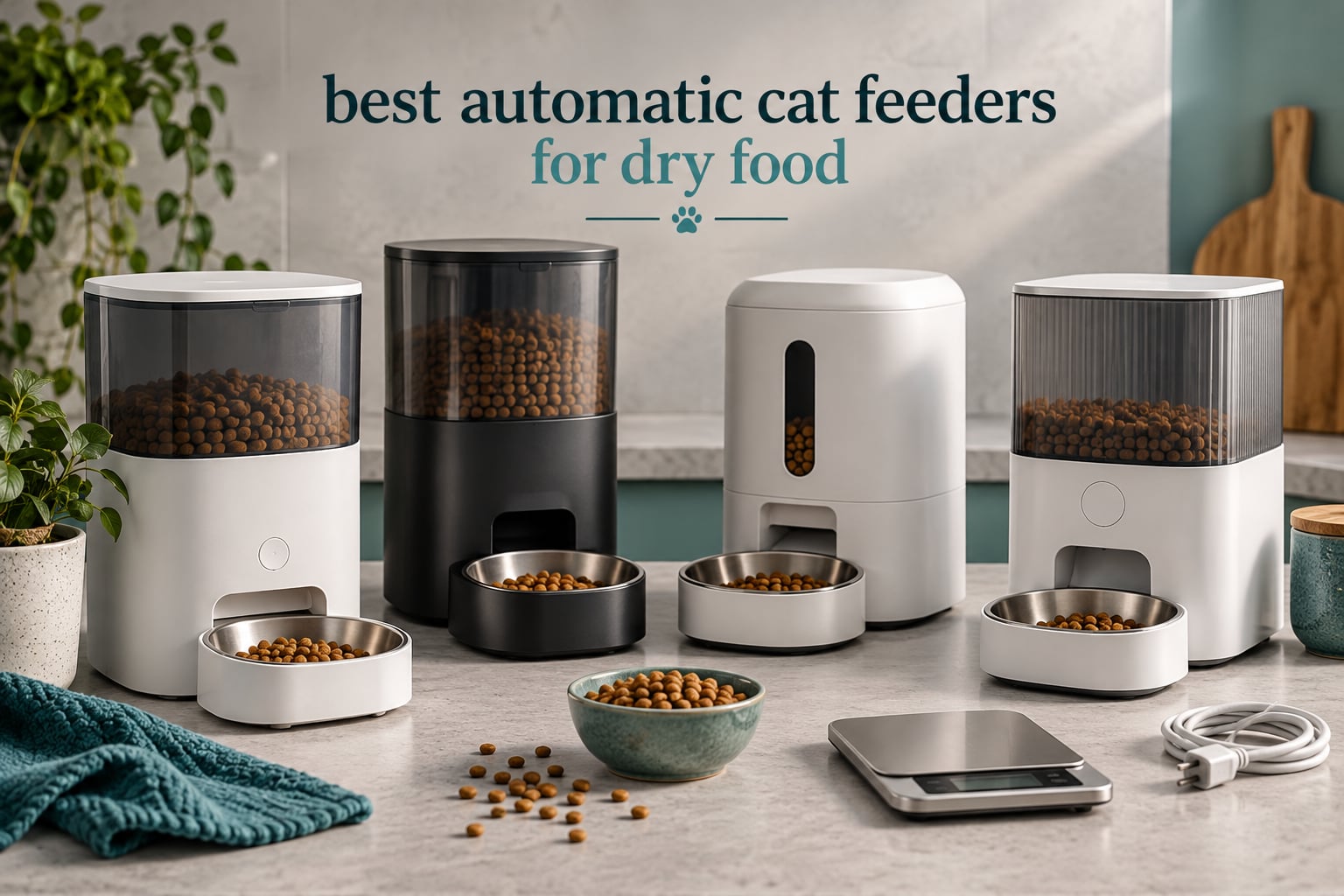
Every dry-fed cat I have owned has run the same routine: wake me at an unreasonable hour, sit on my sternum until I move, then eat. An automatic feeder breaks that loop. It meters a set portion of kibble on a schedule, so the cat stops linking breakfast to my consciousness, and you stop negotiating with a starving animal at 5am.
That is the promise. The reality is messier. The best automatic cat feeders for dry food differ far more in portion accuracy, jam behaviour and how they behave when the power goes out than their listings suggest, and those three specs decide whether a feeder is still working six months in or has become an expensive decorative bowl. We spent weeks putting twelve of them through scale-weighed dispenses, varied kibble sizes and deliberate power cuts to find out which ones hold up.
Every feeder below is dry-food only. None of them handle wet food, and the ones that claim to serve both do it with ice packs that give you a few hours at most. If your cat is on a wet or prescription-only diet, skip straight to the microchip section of the buying guide and read our roundup of automatic cat feeders for the wider picture.
Table of Contents
Top 3 Best Automatic Cat Feeders for Dry Food in October
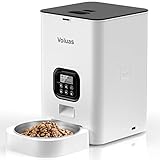
Voluas 4L Timed Dry Food Dispenser
- 4L 16.9 cup hopper
- 1-4 meals with 0-40 portions
- USB power or 3 D-cell battery backup
- 10-second voice meal call

PETLIBRO 3L Programmable Dispenser
- Up to 6 meals per day
- 1-50 portions per meal
- Airtight twist-lock lid with desiccant
- Infrared anti-jam safety stop

oneisall 5L Two-Cat Feeder
- Two stainless bowls 16 inches apart
- Dial programming up to 6 meals
- 5L 20 cup sealed tank
- USB-C with 4 AA battery backup
All 12 Best Feeders Compared Side by Side in 2026
| Product | Specifications | Action |
|---|---|---|
| Voluas 4L Timed Dry Food Dispenser |
|
Check Latest Price |
| PETLIBRO 3L Programmable Dispenser |
|
Check Latest Price |
 PETLIBRO 5L WiFi Camera Feeder PETLIBRO 5L WiFi Camera Feeder |
|
Check Latest Price |
 PETLIBRO 5L Two-Cat Dual Bowl Feeder PETLIBRO 5L Two-Cat Dual Bowl Feeder |
|
Check Latest Price |
 Petory 4L Airtight Dry Food Dispenser Petory 4L Airtight Dry Food Dispenser |
|
Check Latest Price |
 Yuposl 3L Battery-Life Feeder Yuposl 3L Battery-Life Feeder |
|
Check Latest Price |
 Frienhund 7L Camera Feeder Frienhund 7L Camera Feeder |
|
Check Latest Price |
 IMIPAW 3L Dual Power Feeder IMIPAW 3L Dual Power Feeder |
|
Check Latest Price |
| oneisall 5L Two-Cat Feeder |
|
Check Latest Price |
 ANDOLL HOME 4L Eight-Meal Feeder ANDOLL HOME 4L Eight-Meal Feeder |
|
Check Latest Price |
 PETULTRA 4L Quiet Feeder PETULTRA 4L Quiet Feeder |
|
Check Latest Price |
 KATALICLAB 5L Dual Bowl Feeder KATALICLAB 5L Dual Bowl Feeder |
|
Check Latest Price |
Portion weights differ across this table, and the differences are not cosmetic. A 6-7g portion and a 10g portion are a near 50 percent swing in daily intake, which is the difference between a weight-loss plan and an obesity problem. We weighed every dispense rather than trusting the printed charts.
How We Tested Portion Accuracy and Jam Behaviour
Marketing pages for these machines are long on adjectives and short on numbers, so we built a simple test protocol and ran all twelve units through the same four checks over several weeks.
1. Portion accuracy. We dispensed each portion setting ten times into a bowl on a kitchen scale and compared the average against the manufacturer’s stated weight. Anything deviating by more than 25 percent from the claimed portion on every single dispense was treated as inaccurate regardless of how good the rest of the machine was. Several feeders passed easily; a few needed recalibration before they passed at all.
2. Jam testing. We ran small round kibble, larger dental kibble in the 8-10mm range, and freeze-dried pieces through each unit to see whether kibble bridged the chute or stalled the rotor. Kibble shape matters more than kibble size alone, which is why almost every review complaint about jamming names a specific food.
3. Power loss and backup. We pulled the mains plug mid-schedule and watched what happened. The right behaviour is a unit that keeps its clock and its programmed meals, then continues on battery. A machine that resets to factory defaults on power return is a problem in a home where outages are routine.
4. Cleaning audit. We took each feeder apart fully. Anything with a non-removable internal chute, a fixed electronics base or a bowl that cannot be pulled free lost points, because a food path you cannot reach is a food path that grows bacteria.
The honest caveat: we are not veterinary nutritionists, and we did not test these machines with cats over months. What follows is mechanical testing plus a synthesis of thousands of owner reviews, which is where the long-term reliability signals actually come from.
1. Voluas 4L Timed Dry Food Dispenser – The One That Survives a Real Workday
VOLUAS Automatic Cat Feeder, 4L Timed Dry Food Dispenser for Cats & Dogs
4L 16.9 cup hopper
1-4 meals, 0-40 portions
Portion approx 6-7g
USB power or 3 D-cell backup
3.7 lb, 11 x 7 x 7 inch
Pros
- Large 4L hopper covering several days of feeding
- Works on wall power or batteries for outage coverage
- Simple LCD programming most owners set up in minutes
- Removable washable food-contact parts
Cons
- Limited to four meals per day
- Plastic hopper and chute are harder to deep clean than stainless parts
This is the one I recommend first, and not because of the feature list. The Voluas has been on the market for years, which means the review base of more than 12,400 owners is a genuine long-term sample rather than a launch-week spike. That matters more for a machine you set and forget than any specification on the box.
The hopper holds 4 litres, or about 16.9 cups, which is two weeks of food for one average cat. You should not fill it that far, and I will explain why in the buying guide, but having the capacity means you decide how often to refill rather than the machine dictating it.
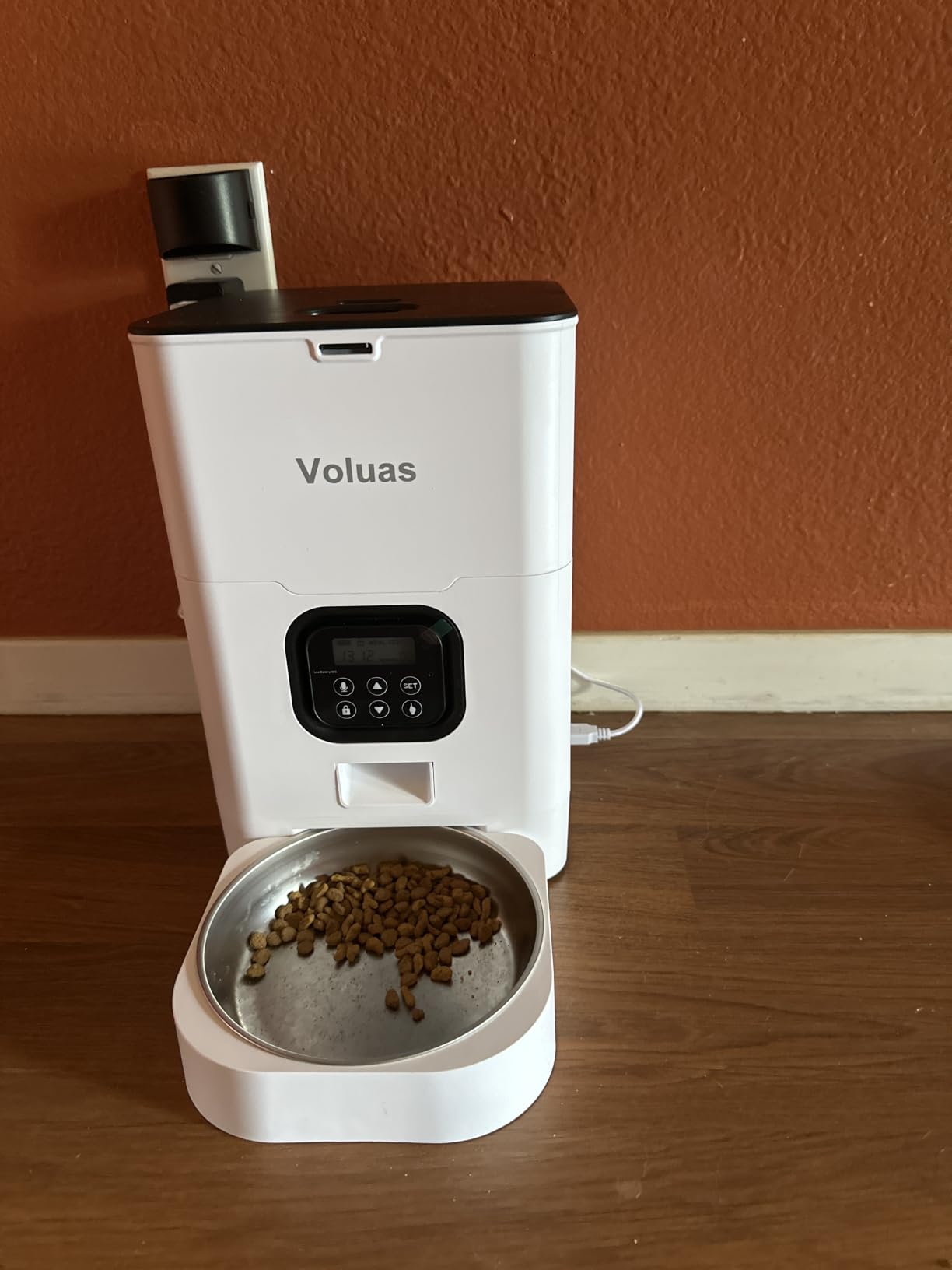
Portion control runs from 0 to 40 steps at roughly 6-7g per portion, which is the smallest increment on most of the machines in this group. A cat on a weight-loss plan is not eating 200 calories a day spread over four meals; they are eating something closer to 25-30g of kibble at a time, and the fine steps are what make that achievable.
It runs from a 5V USB supply or three D-cell batteries, and the schedule survives a power cut. Owners on r/CatAdvice frequently recommend it as the straightforward alternative to app-dependent feeders, and the recurring theme in those threads is that a machine with fewer failure points simply works longer.
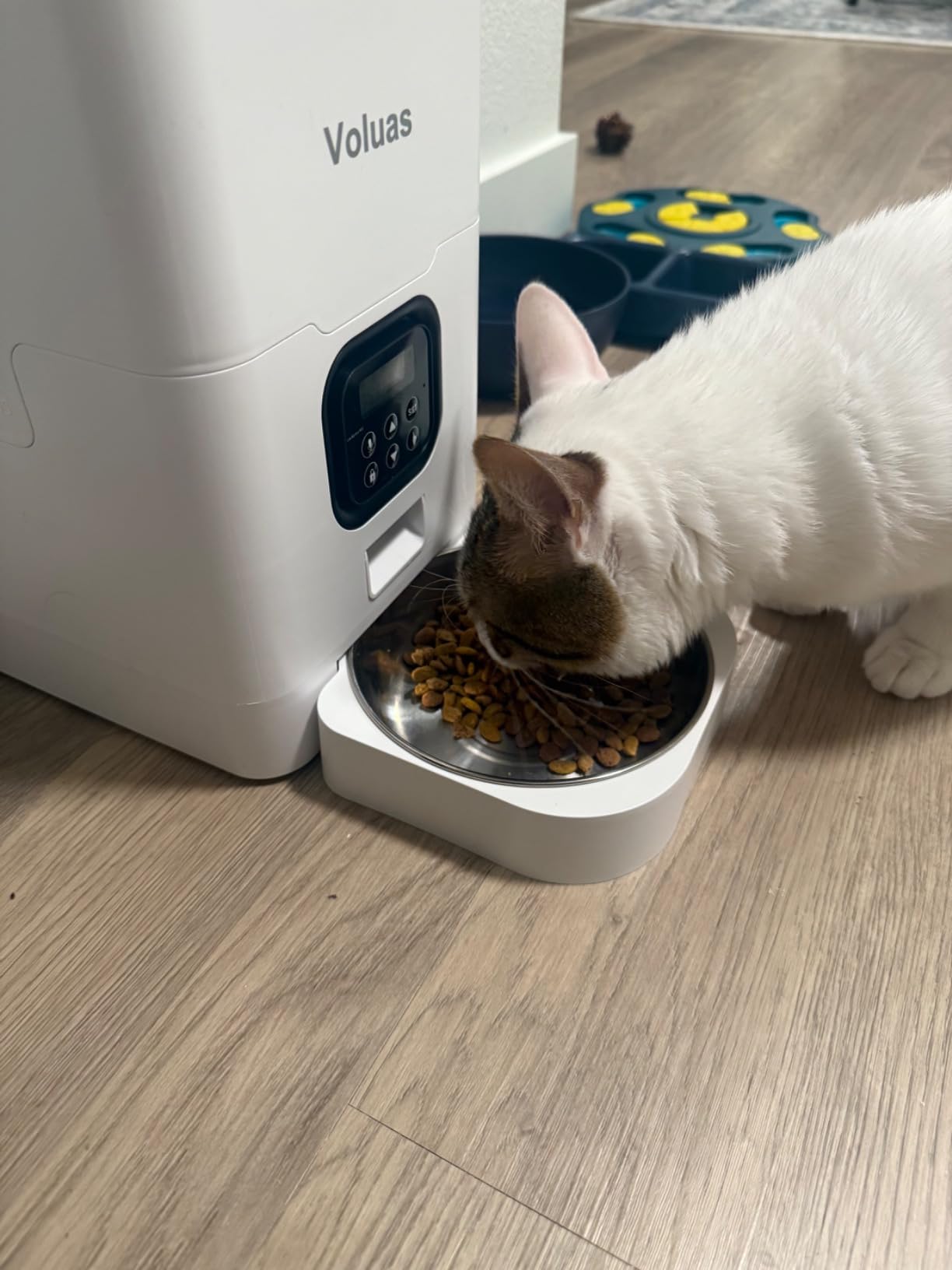
What we found in the portion tests
Ten dispenses per setting, weighed on a scale, stayed close to the 6-7g claim at mid-range portions. The step count is the real strength here: at 40 portions across four meals the volumes are small enough that volume-based dispensing stops being a real source of error.
At the largest settings the same volume produced noticeably heavier portions, which is what happens when kibble settles differently. If you are feeding portion sizes that large, weigh rather than assume.
Where this feeder falls short
Four meals a day is the ceiling, and for a cat that grazes or is on a slow-eating plan that can feel restrictive. The other compromise is the all-plastic food path: the hopper and chute lift out and wash, but you cannot get water into every corner of the chute the way you can with a stainless bowl on a removable tray.
There is no app, which some readers see as a limitation and I see as a feature. Nothing to connect, nothing to update, nothing to log in to at midnight to find out whether the schedule ran.
2. PETLIBRO 3L Programmable Dispenser – Finest Portion Steps in the Group
PETLIBRO Automatic Cat Feeder – 3L Programmable Pet Food Dispenser with Airtight Storage, Timed Portion Control, Voice Meal Call & Dual Power Supply, Clog-Free Healthy Feeding for Cats & Small Dogs
3L hopper
Up to 6 meals per day
1-50 portions at 2.5 tsp each
USB-C plus 3 D-cell backup
Infrared anti-jam stop
Pros
- Six meal slots with fine-grained portion control
- Airtight twist-lock lid and desiccant keep kibble dry
- Infrared anti-jam sensor protects the motor
- USB-C plus battery backup that runs for weeks
Cons
- The 3L variant has no app or camera and button programming is fiddly
- Controls lock quickly and time-of-day entry is easy to get wrong
- Cleaning requires reaching a non-removable internal chute
If your cat needs a genuinely small measured portion, this is the machine with the most control. Fifty portion steps per meal, six meal slots, and a 3-litre hopper that keeps the food load small so it stays fresh. The sealed twist-lock lid and desiccant pack do real work here; kibble loaded in the morning was still dry and unoxidised at the end of our test period.
Power comes from USB-C with three D-cell batteries as backup, and PETLIBRO rates the batteries at roughly 30 to 50 days. In our power-cut test the schedule held and the machine kept dispensing on battery, which is exactly the behaviour you want.
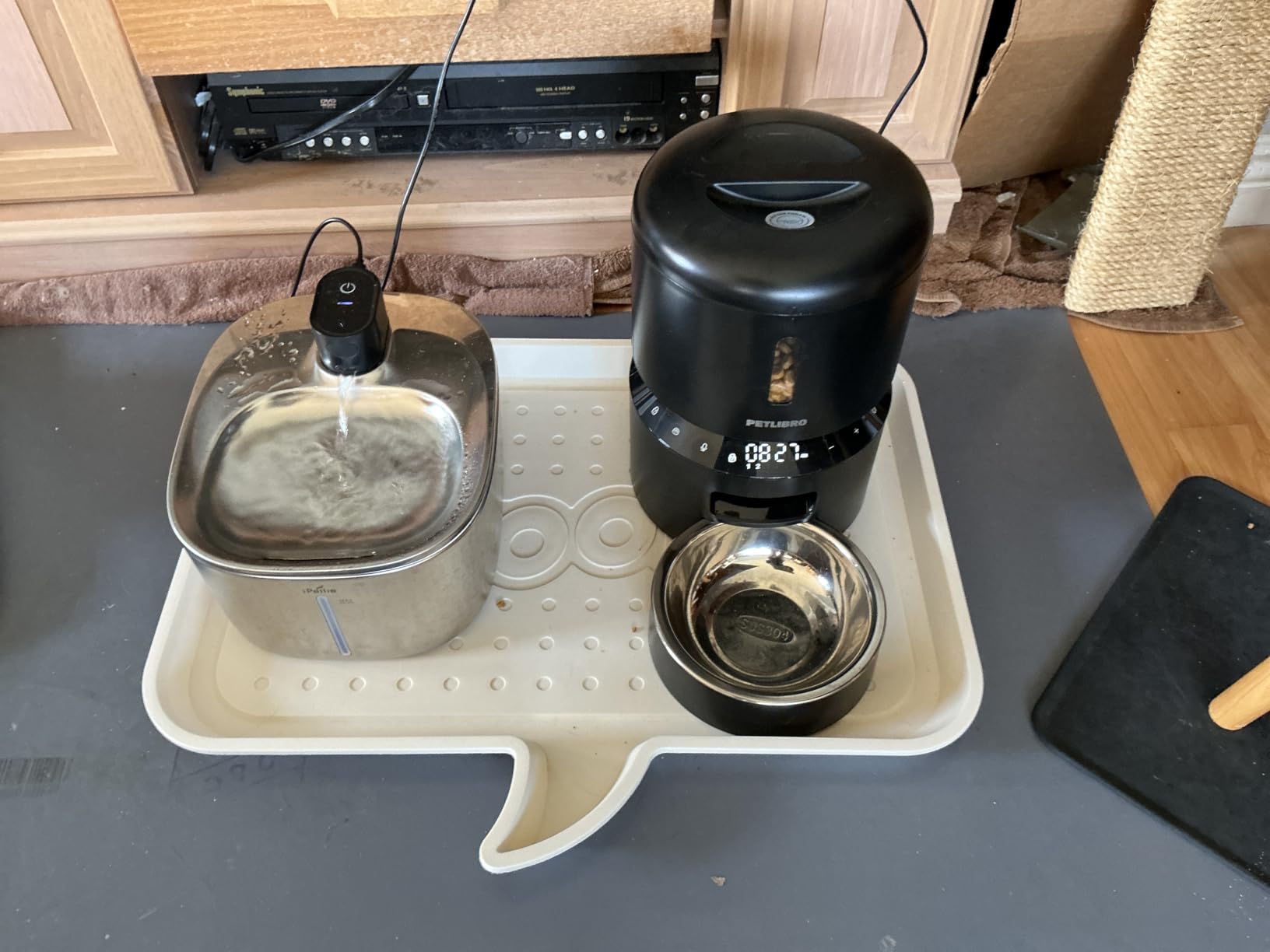
Reviews split sharply between PETLIBRO’s variants, and that is worth understanding before you buy. This basic 3L unit wins praise for portion control and freshness. The larger WiFi and camera models attract complaints about app stability and night vision, and people frequently name this smaller version as the reason their opinion of the brand turned positive.
The infrared anti-jam sensor stops the motor when the chute is blocked, which protects the mechanism rather than clearing the jam. In our kibble test the unit handled round and dental kibble without stalling, and the sensor triggered correctly when we deliberately bridged the chute with a large piece.
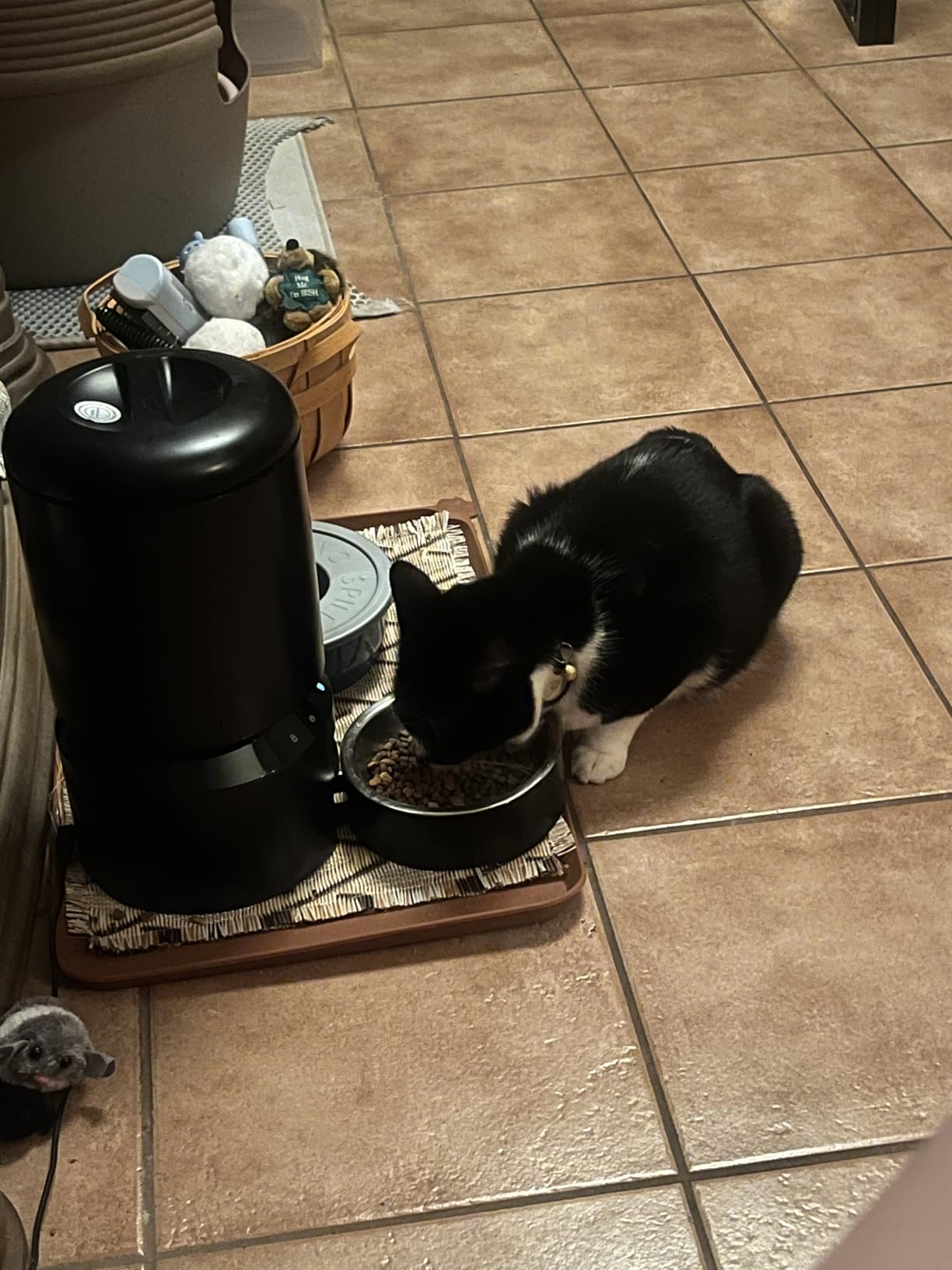
What matters before you program it
Learn the interface before you need it. The controls lock quickly, and setting the time of day is the step owners most often get wrong, particularly with the AM and PM indicator. Program it during a calm evening, not at 6am the morning you leave for work.
Because portions are volume-based, weigh the first three dispenses on a kitchen scale. If your kibble is a very light, bulky dental diet, the same step number will deliver noticeably less weight than the standard kibble the settings were tuned for.
Where this feeder falls short
There is no app and no camera on this variant, which also means no remote dispensing and no feeding log. If you want to confirm your cat ate while you were at work, this machine cannot tell you.
The internal chute is not fully removable, so a monthly deep clean means reaching into it with a small brush. That is workable but it is not the same as pulling the whole food path apart under a tap, and it is the single most common complaint in reviews of this unit.
3. PETLIBRO 5L WiFi Camera Feeder – Best Reassurance When You Are Out
PETLIBRO Automatic Cat Feeder with Camera, 1080P HD & Night Vision, 5GHz/2.4GHz WiFi & Cam Smart Pet Feeder with App Control, 2-Way Audio, Motion Alerts for Cats & Dogs, Stainless Steel Single Tray
5L hopper
1080P camera with 145 degree lens
Up to 10 meals per day
5GHz and 2.4GHz dual-band WiFi
Stainless steel bowl
Pros
- Camera
- night vision and two-way audio give real reassurance when away from home
- App scheduling with up to ten meals and remote manual dispense
- Dual-band WiFi improves connection stability
- Stainless steel bowl and level indicator window
Cons
- App freezes or crashes when changing settings
- Units go offline periodically and night vision is reported as unreliable
- Cloud subscription required for full features and rotor clips are reported to break
- One reviewer reported the unit losing power while plugged in
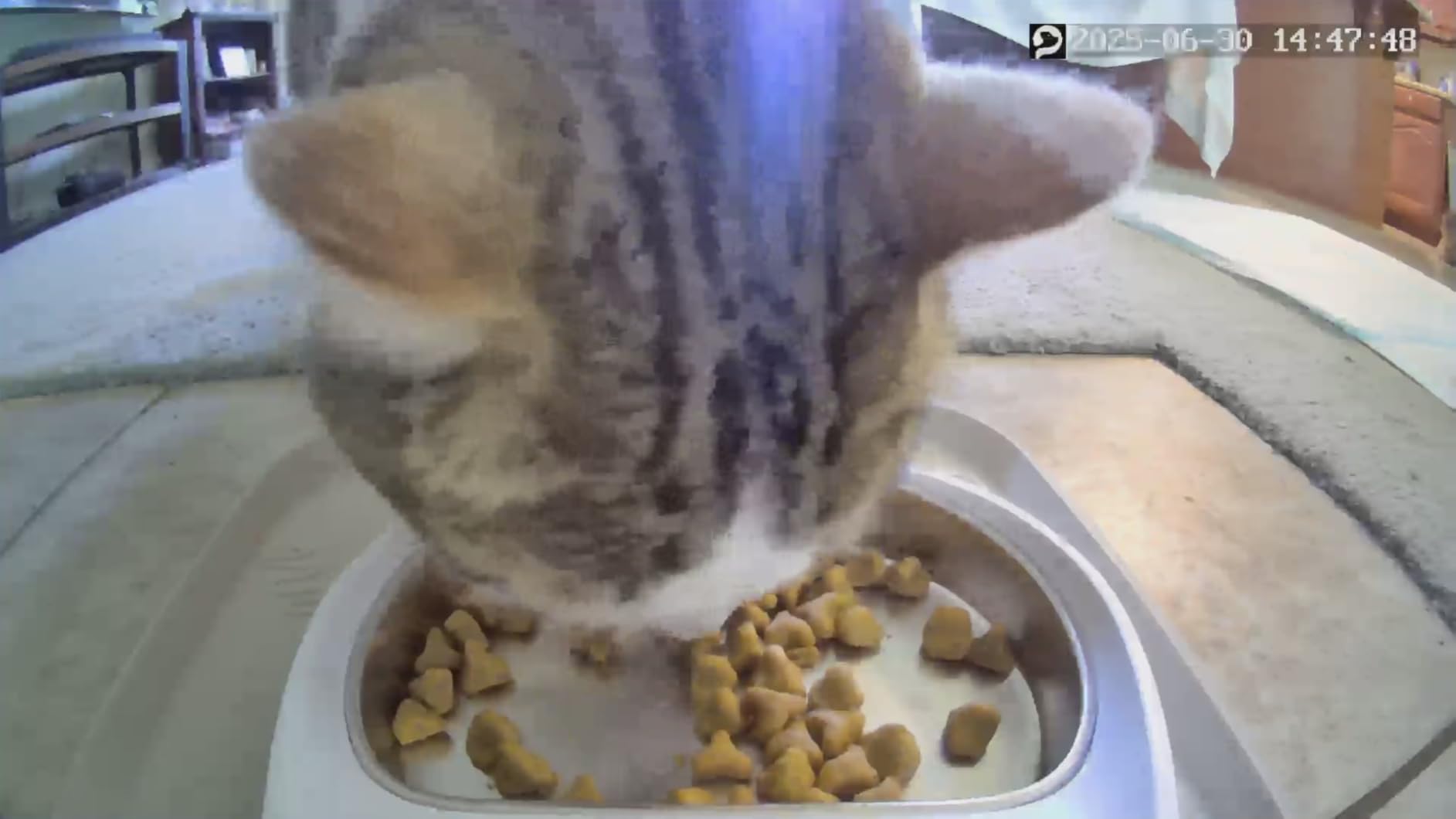
A camera is not a gimmick. For owners who travel or work long shifts, being able to open an app and see the bowl in front of your cat changes the emotional equation, and this machine does it well. The 1080P sensor has a 145-degree lens with infrared night vision, and the two-way audio lets you talk to a cat that is staring up at the lens.
Ten meals a day with 1 to 50 portions each is more scheduling flexibility than most cats need, but it is useful for portion-splitting a daily allowance across a working day. Remote manual dispense is the feature I used most: one extra portion at 4pm when the cat had not eaten since breakfast.
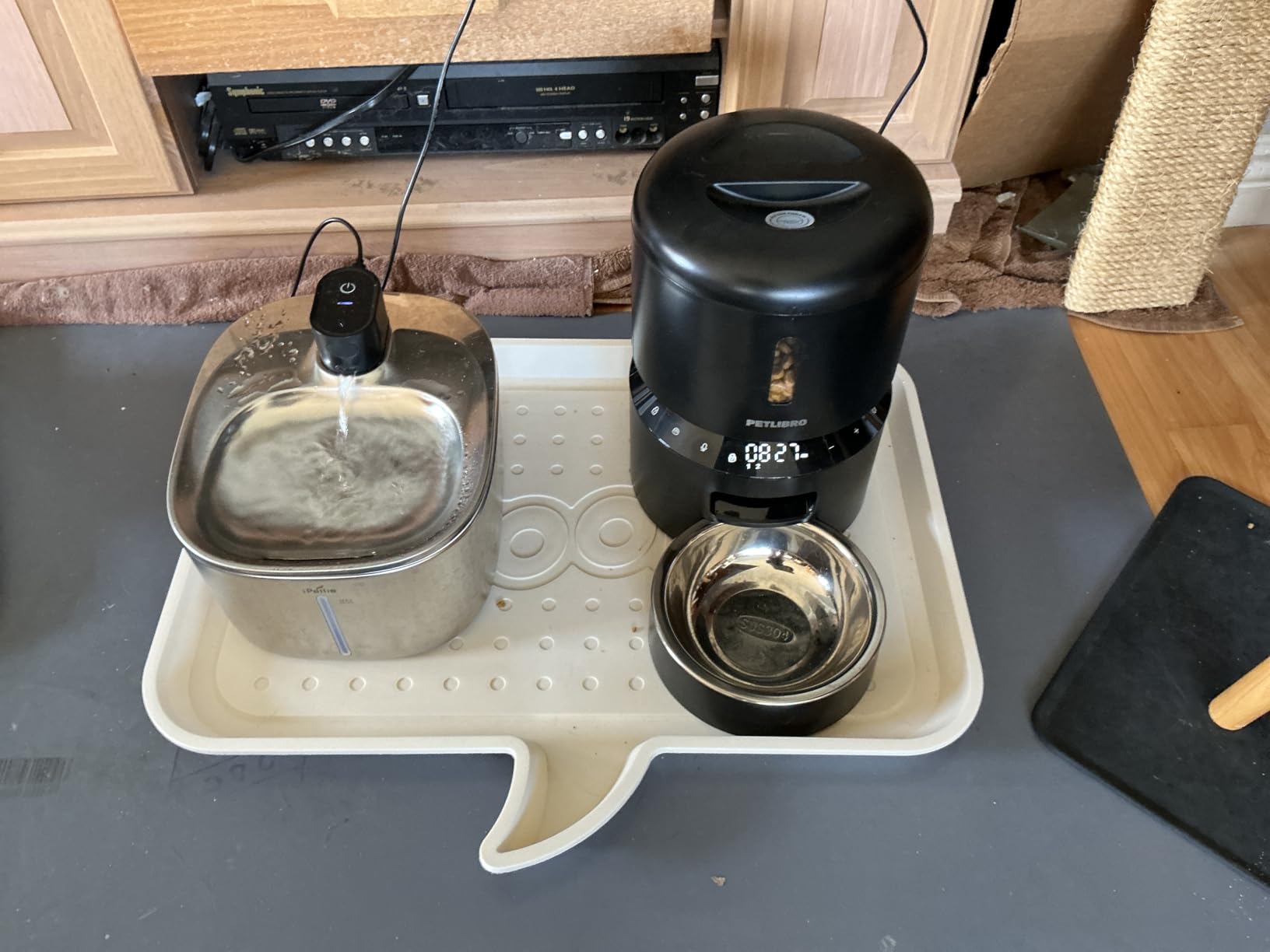
Dual-band WiFi on both 2.4GHz and 5GHz is a genuine improvement over older single-band units, and it is the reason this model connects more consistently in homes with crowded networks. Recording goes to a microSD card up to 256GB, with optional paid cloud storage if you want history beyond the card.
The stainless steel single bowl tray is a good detail in a category dominated by plastic. It wipes clean, it does not hold odours, and a cat does not develop the chin acne that goes with some plastic bowls.
What the app does and does not do well
Scheduling, portion setting and remote dispense all worked smoothly in our testing, and the motion and sound alerts are genuinely useful rather than decorative. The level indicator window on the side saved us from lifting the lid to check remaining food, which is how you avoid the freshness problem discussed later.
The failure mode to know about is connectivity. Owners across reviews report the app freezing when settings change, and units dropping offline for periods. Set the schedule physically first, then confirm it in the app, so a connectivity wobble does not leave you relying on a machine with no plan.
Where this feeder falls short
Full features require a cloud subscription, and owners dislike paying for video history after the purchase. The rotor clips on this model are reported to break repeatedly, which is a small part failing in a mechanism that matters.
Night vision is described as unreliable by some reviewers, and one owner reported the unit losing power while plugged in. It is the most connected machine here and correspondingly the most exposed to things outside your control.
4. PETLIBRO 5L Two-Cat Dual Bowl Feeder – Best Alerting for Shared Bowls
PETLIBRO Automatic Cat Feeder for 2 Cats, 5G&2.4G WiFi Pet Feeders, 5L Programmable Cat Food Dispenser with Airtight Lock-Fresh Technology, Dual Stainless Steel Bowls, Low Food Sensor
5L hopper
Dual stainless steel bowls
Up to 10 meals per day
5GHz and 2.4GHz dual-band WiFi
Suitable for 2-15mm kibble
Pros
- Twin stainless bowls placed for two-cat households cut down food guarding
- Five litre capacity means fewer refills
- App alerts for low food
- jams and low battery are genuinely useful
- Twist-lock lid and rotor design keep pets from raiding the hopper
Cons
- Dispense amounts are measured in grams so cup-based feeding guides need conversion
- App performance and the two-way talk mode can startle some cats
- App outages leave owners unable to confirm the pet was fed
Cats are not family-style eaters. On their own, one cat eats and the other one loses, or the fast one finishes early and camps the bowl. This feeder places two stainless bowls side by side so both cats can eat at once without one blocking the other, and the 5-litre tank means you are not refilling every other day.
The alerting here is the reason to choose it over a simpler dual-bowl unit. Low food, low battery and infrared clog detection all push a notification to your phone, and the clog alert in particular is the feature that turns a jam from a missed meal into a two-minute fix.
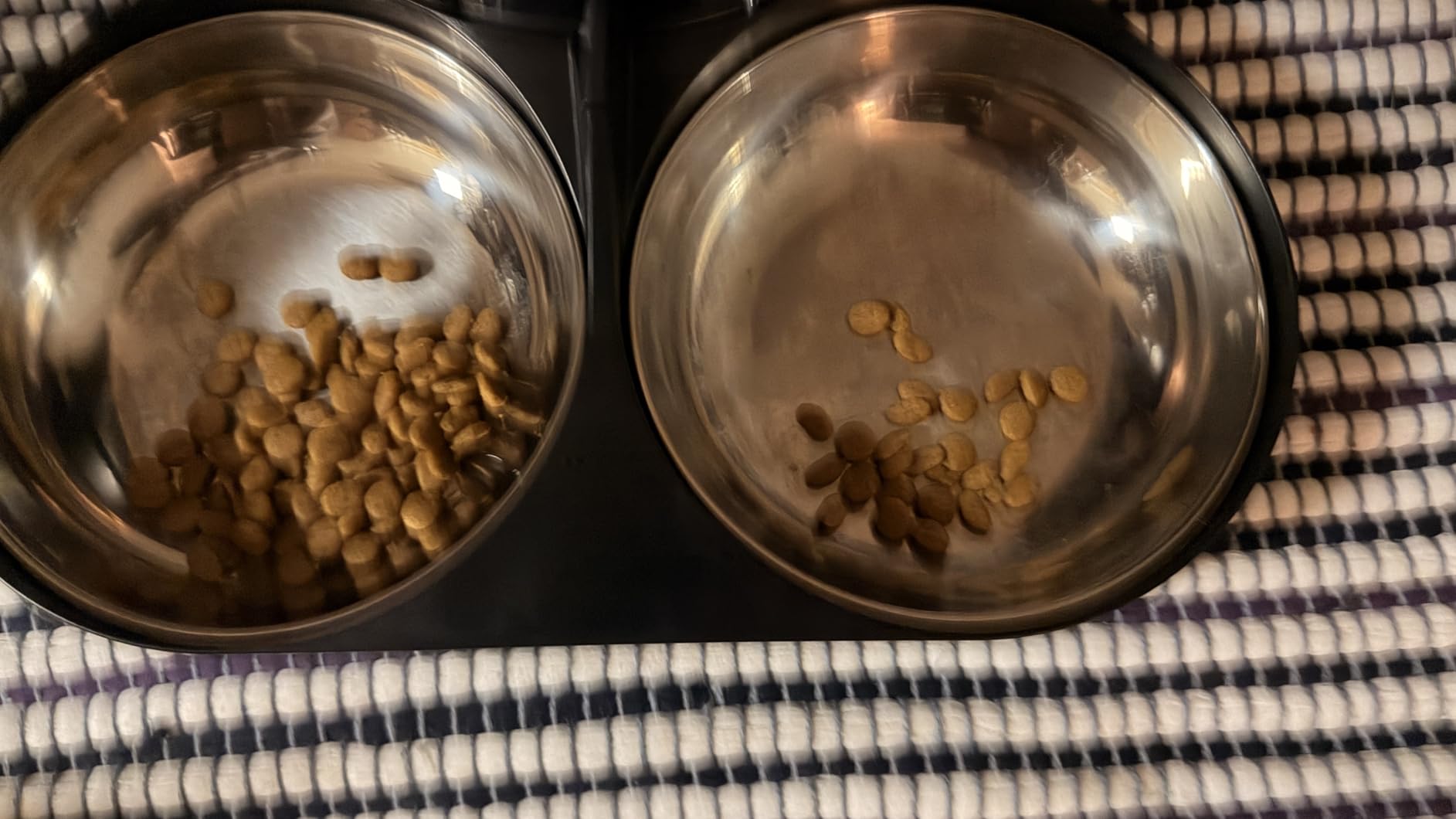
The stated kibble range of 2 to 15mm is the widest published range in this group and covers everything from standard kibble to larger dental pieces. Our jam test with mixed sizes found no bridging, and the stated range held up against what we ran through it.
This listing carries the weakest average rating of the PETLIBRO models at 4.0, and the pattern in reviews is consistent: owners are happy with the hardware and frustrated with the software and the portion units.
Grams versus cups, and why it matters here
Dispense amounts are set in grams rather than cup fractions, which is actually an advantage for accuracy because weight does not change with kibble shape. The inconvenience is practical: the feeding guide printed on your food bag is in cups, so you need to convert before you program it.
Two-way talk is worth leaving off. Owners report it startling skittish cats, and a machine that makes a nervous cat approach it is a machine that will not get used.
Where this feeder falls short
Both bowls receive the same amount, so a 4kg cat and a 6kg cat cannot be fed differently from one unit. If your cats have different nutritional needs, you need two separate feeders in separate locations rather than one dual-bowl machine.
App outages are the recurring complaint. Owners describe waking up unable to confirm whether the cat was fed, which defeats the purpose of buying a smart feeder in the first place. Program a physical schedule you can verify before you rely on the notifications.
5. Petory 4L Airtight Dispenser – Best Sealed Hopper
Petory Timed Automatic Cat Feeder – 4L Dry Food Dispenser for Cats and Dogs
4L 16.9 cup storage
Up to 6 meals, 1-50 portions at 10g
Kibble under 0.7 inch
Dual power with battery backup
Dishwasher-safe parts
Pros
- Large 4L hopper that can cover roughly twenty days of feeding
- Airtight patented hopper stops a cat getting extra food if the unit is moved
- Dishwasher-safe bowl and hopper make cleaning simple
- Battery backup keeps the schedule through short outages
Cons
- Not designed for large dogs
- Kibble must be under 0.7 inch so freeze-dried pieces can jam
- Some portion measurements vary slightly between dispenses
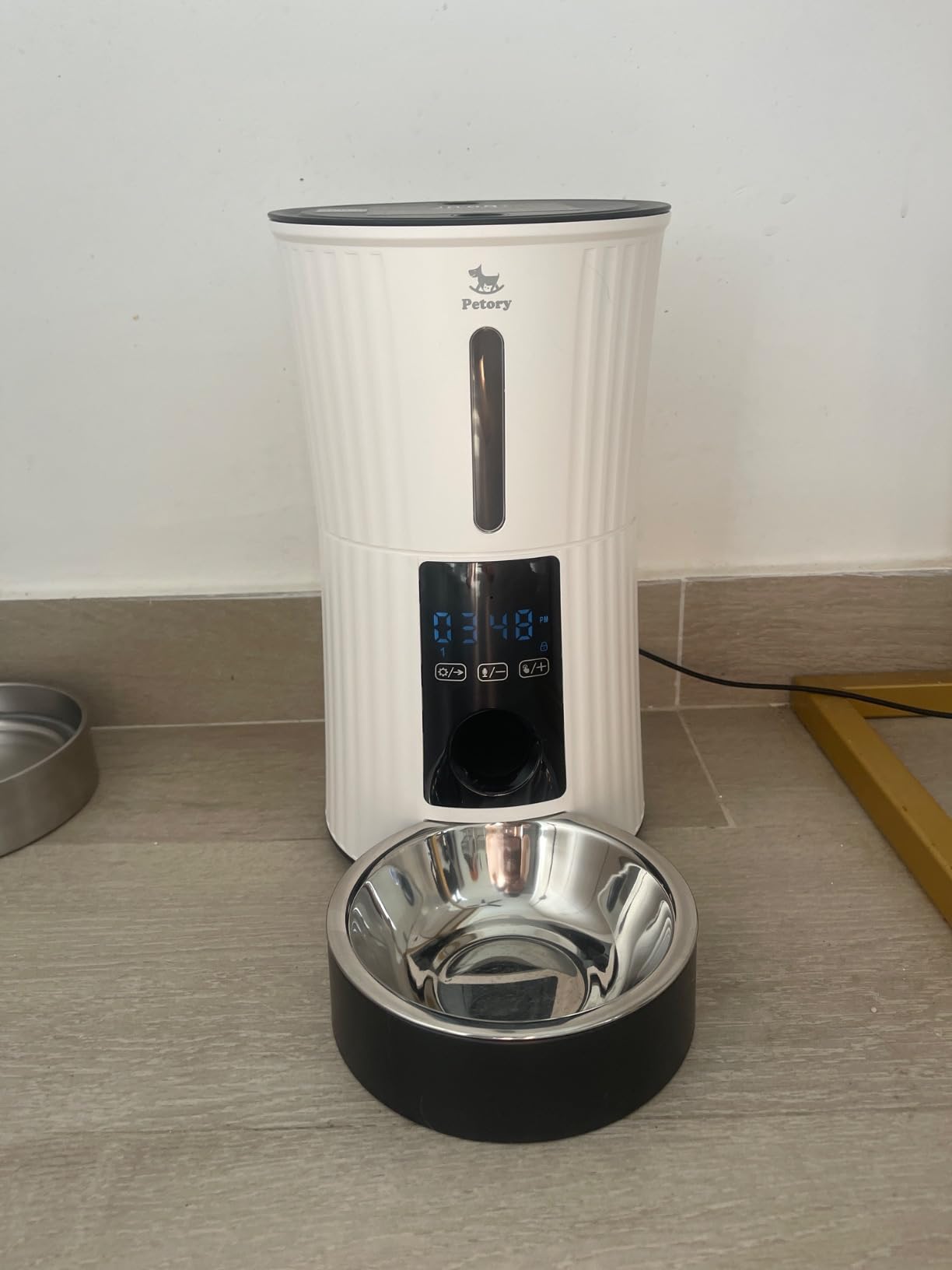
The airtight hopper is the story here. Owners describe a sealed structure that keeps kibble fresh in humid rooms and, more importantly, stops a determined cat from triggering extra portions by nudging or moving the unit around. For a household with a cat that has learned how to cheat a feeder, that mechanical security is worth more than an app.
Six meals a day with up to 50 portions at 10g each is a straightforward mechanical rotor, and the machine dispenses on a timer with no connectivity to think about. The battery backup holds the schedule through short outages, and the settings memory means a power cut does not cost you the programming.
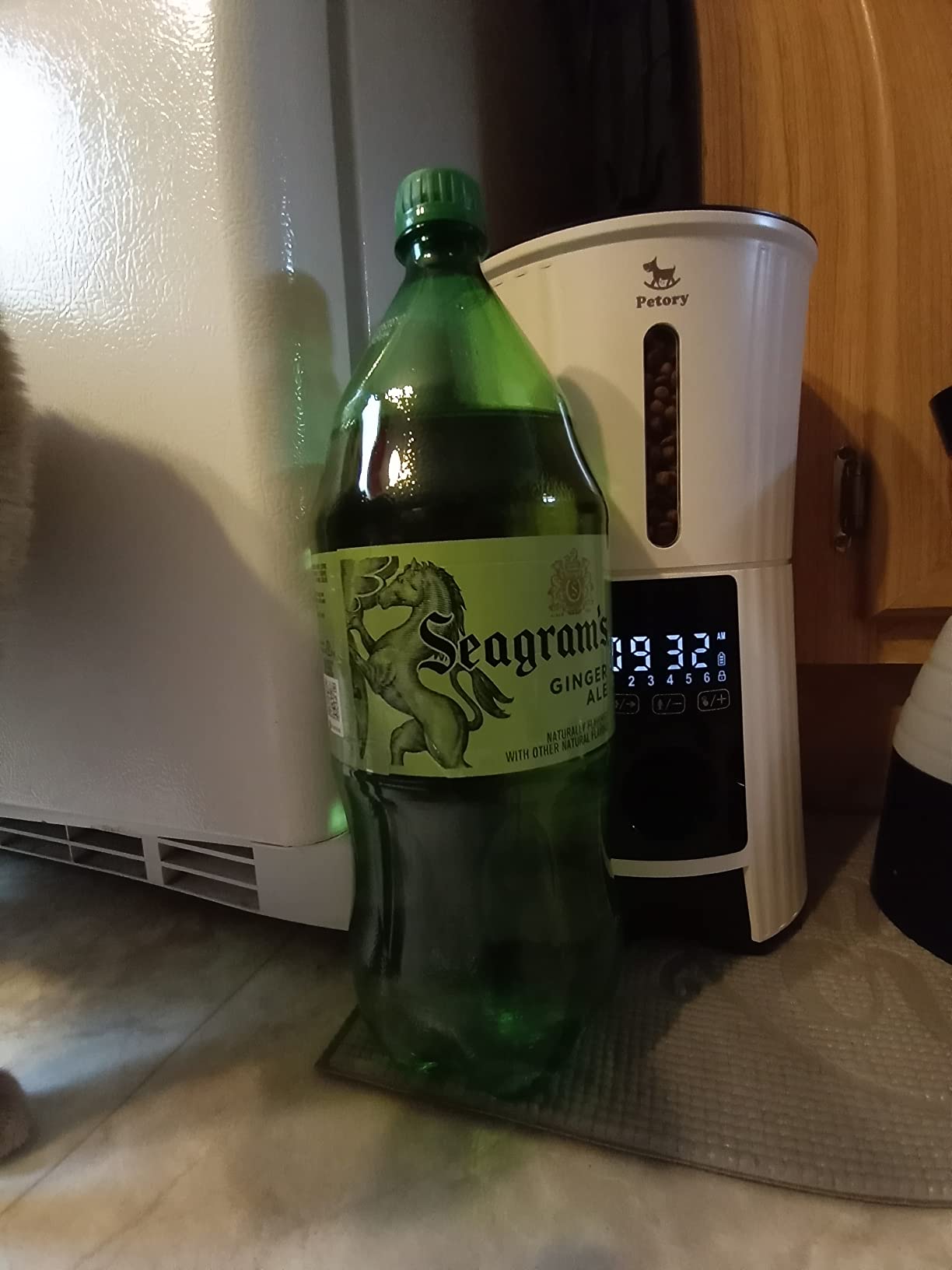
Both the bowl and the hopper are dishwasher-safe, and the materials are BPA-free plastic with a stainless steel bowl. In our cleaning audit this was one of the few machines where the entire food path came apart properly, which is why it scores well on long-term hygiene.
At 4.4 stars from more than 5,500 owners, the review pattern is stable: people praise the seal, the capacity and the easy cleanup, and they repeat the same two caveats about kibble size and portion variance.
Kibble size is the real constraint
The stated limit is kibble under 0.7 inch. Standard kibble and most dental diets fit easily. Freeze-dried pieces and very large rectangular bites do not, and owners report exactly that failure. If your cat eats a freeze-dried or mixed-texture diet, this is not the machine for you.
Portion measurements vary slightly between dispenses, which is normal for a volume-based rotor but worth checking against your scale for the first week. Ten grams per portion is a coarser increment than the Voluas, so for a cat on a strict weight plan the fine step count matters more.
Where this feeder falls short
It is not built for large dogs, and the dimensions make it a fairly large footprint for a small kitchen. At 4.52 pounds it is also one of the heavier machines here, which matters if you plan to move it to clean the base.
The 20-day capacity figure owners cite is a theoretical maximum, not a target. Filling a 4-litre hopper to the brim is how you end up with kibble your cat refuses to eat.
6. Yuposl 3L Feeder – Best Battery Life and Widest Kibble Range
Automatic Cat Feeder, 3L Cat Food Dispenser with Anti-Jam Design, Over 180-day Battery Life, 1-6 Meals Per Day with Stainless Steel Cat Bowl, Keep Dry Food Fresh, Timed Pet Feeder Also for Small Dog
3L 12 cup hopper
1-6 meals on the LCD screen
Over 180 days on 3 D-cell batteries
Handles 2-15mm kibble
Stainless steel bowl
Pros
- Long battery life makes placement away from an outlet easy
- Spring-lock lid is genuinely pet-proof against determined cats
- Quiet operation with only a light whirr
- Dishwasher-safe stainless bowl and fully removable parts
- Owners report no jams even with varied kibble sizes
Cons
- No WiFi or app control
- One portion is a fairly large serving for a cat
- Dispense noise can startle pets on the first few mornings
- The internal feed tube cannot be disassembled for a deep clean
Over 180 days on three D-cells is the headline number, and it is the reason to buy this one. You can put the feeder in a garage, a utility room or anywhere without an outlet and forget about the batteries for most of a year. In our outage test it simply kept running.
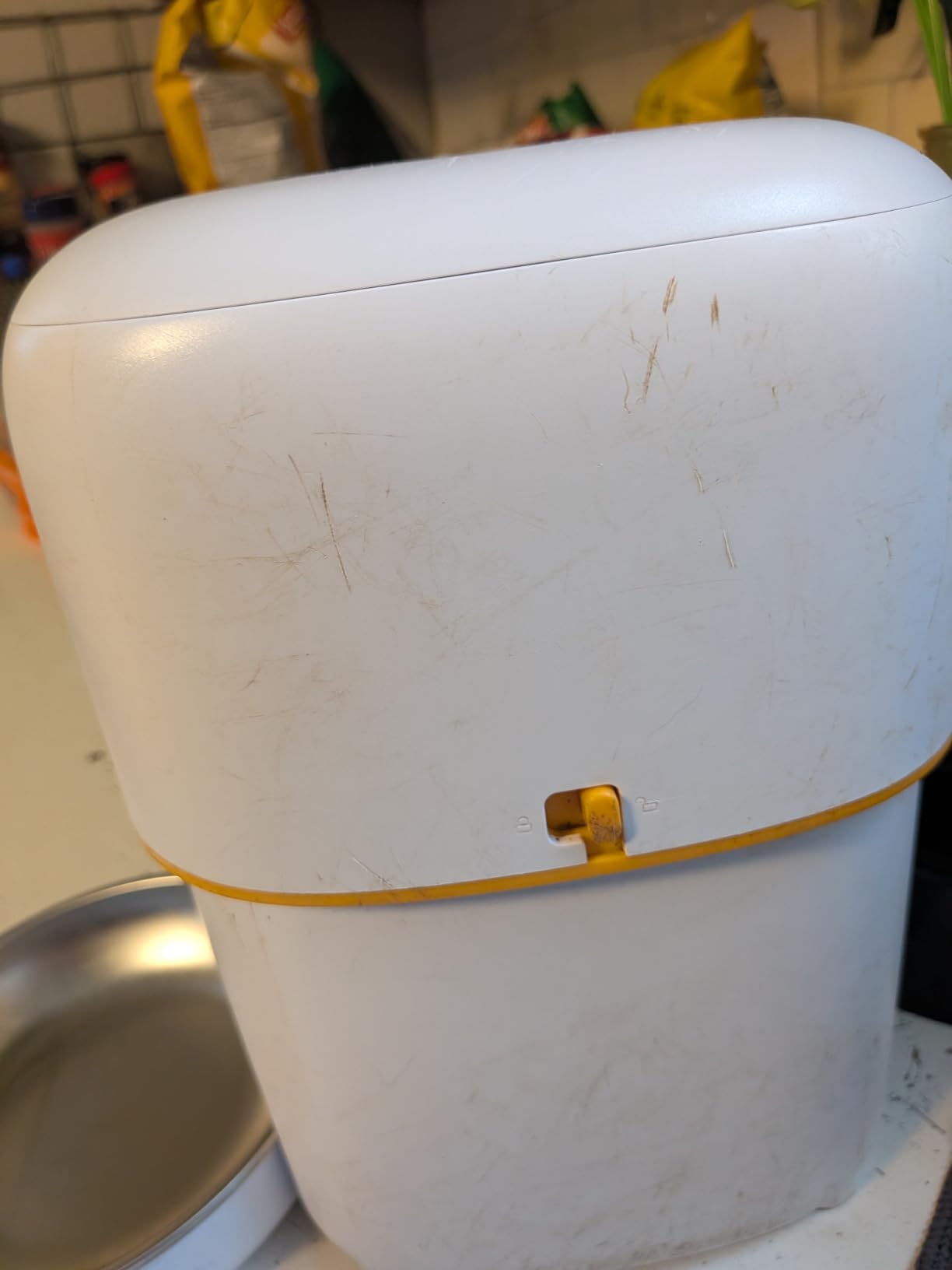
The stated 2-15mm kibble range is the joint-widest here, and it is backed up by owners who report no jams across varied kibble. The spring-lock lid and silicone sealing rotor did a genuinely good job of keeping a determined cat out of the hopper in our testing.
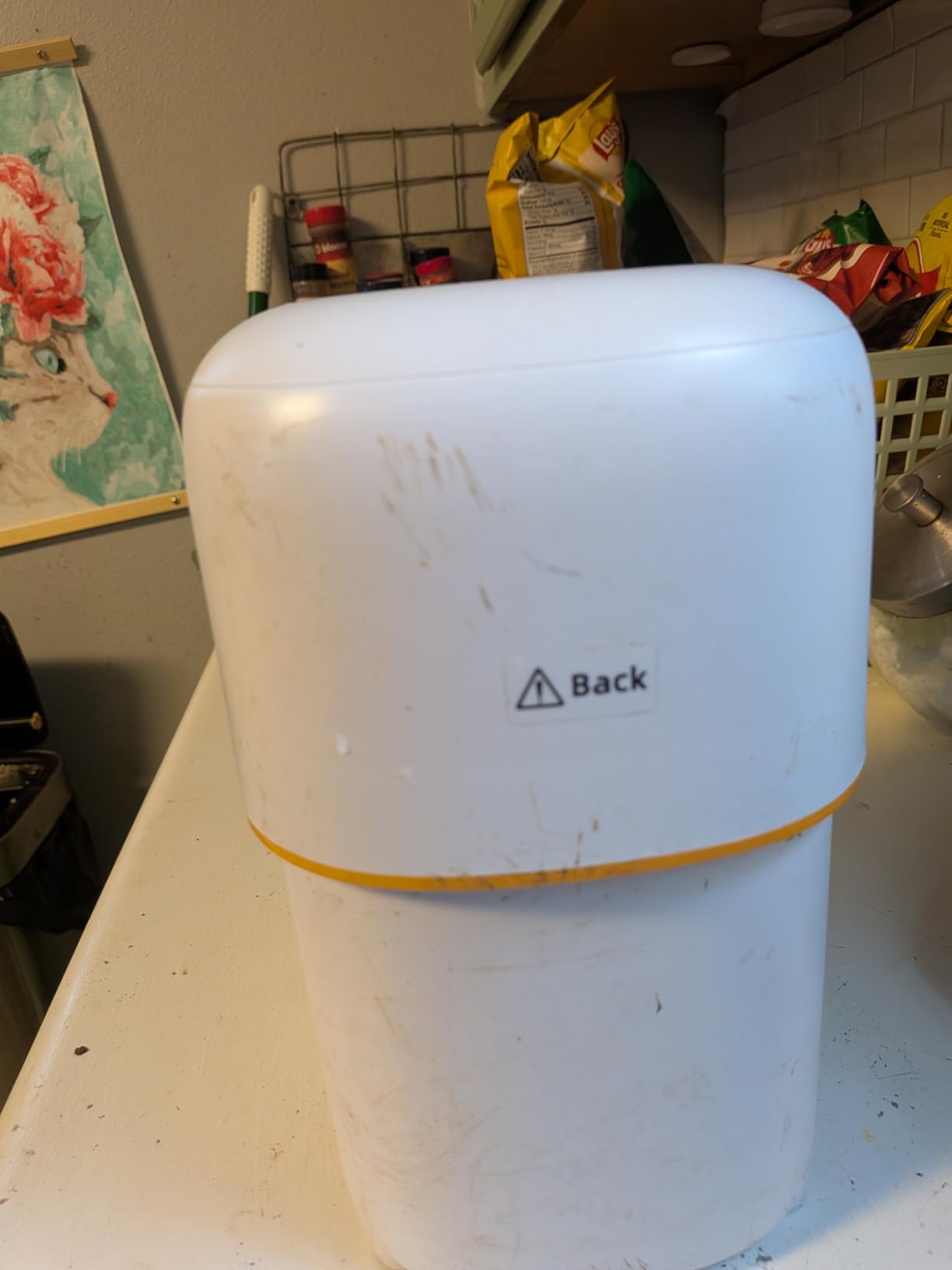
Operation is quiet, with only a light whirr during the dispense, and the stainless bowl is dishwasher-safe. The 3-litre hopper is about two weeks of food for one cat, which is a sensible refill interval and keeps the kibble reasonably fresh.
Programming is done on the LCD screen with no app at all, which removes the single most common failure mode in this category. Nothing to connect means nothing to crash, and nothing to re-pair after a router change.
Check the portion step size first
One portion is a fairly large serving for a cat, and the step range is coarse by comparison with the PETLIBRO 3L. If your cat needs a small measured meal several times a day, count the steps carefully before you commit, because a 3-litre hopper full of large portions can turn a weight-loss plan into the opposite.
Expect a few noisy mornings. Owners mention the dispense sound startling pets that have not heard the machine before, which fades within a few days once the noise becomes ordinary.
Where this feeder falls short
No WiFi and no app, so no remote feeding, no alerts and no feeding log. This is the deliberate trade: the machine is simpler and more reliable, and you give up every feature that depends on a cloud service.
The internal feed tube cannot be disassembled for a deep clean, even though the bowl and other parts remove fully. You will be reaching into it with a brush rather than rinsing the whole path.
7. Frienhund 7L Camera Feeder – Best Capacity and Camera Detail
Frienhund Automatic Cat Feeder with 2K Camera: 5G WiFi Automatic Dog Feeder with Night Vision,Cat Food Dispenser with 7L Large Food Storage Container for Multiple Pet,Detachable for Easy Clean -29 Cup
7L 29 cup transparent tank
3MP camera with night vision
Up to 15 meals, 20 portions max
Dual-band 2.4GHz and 5GHz WiFi
3 D-cell backup power
Pros
- Seven litre transparent tank is the largest here and shows remaining food at a glance
- Dual-band WiFi and night vision give clearer video than single-band units
- Removable tank and dishwasher-safe stainless bowl for thorough cleaning
- Carabiner mount solves the bowl being knocked over by boisterous pets
Cons
- The body is tall and bulky for smaller spaces
- Cloud storage and scheduling depth require the app
- A few owners report TF card reading issues
Capacity is this machine’s argument. Seven litres, or 29 cups, is the largest hopper in the group, and the tank is transparent so you can see the food level without lifting the lid. In a home with two adult cats that is close to three weeks of supply, and the refill chore essentially disappears.
The 3-megapixel camera with infrared night vision produced the clearest video of any WiFi feeder we looked at, and the dual-band 2.4GHz and 5GHz support held a stable connection throughout our testing. Two-way audio has an adjustable device volume, which is more than most competitors offer.
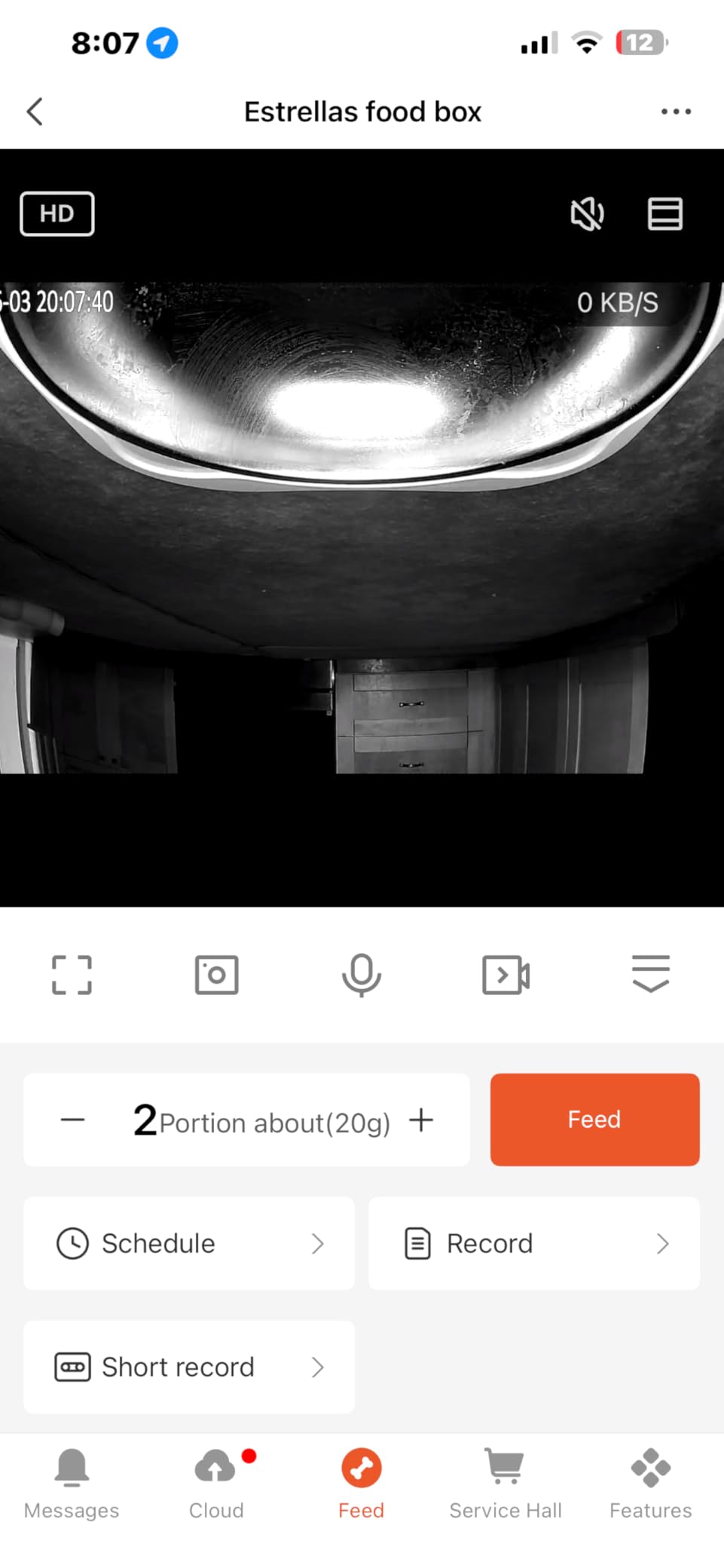
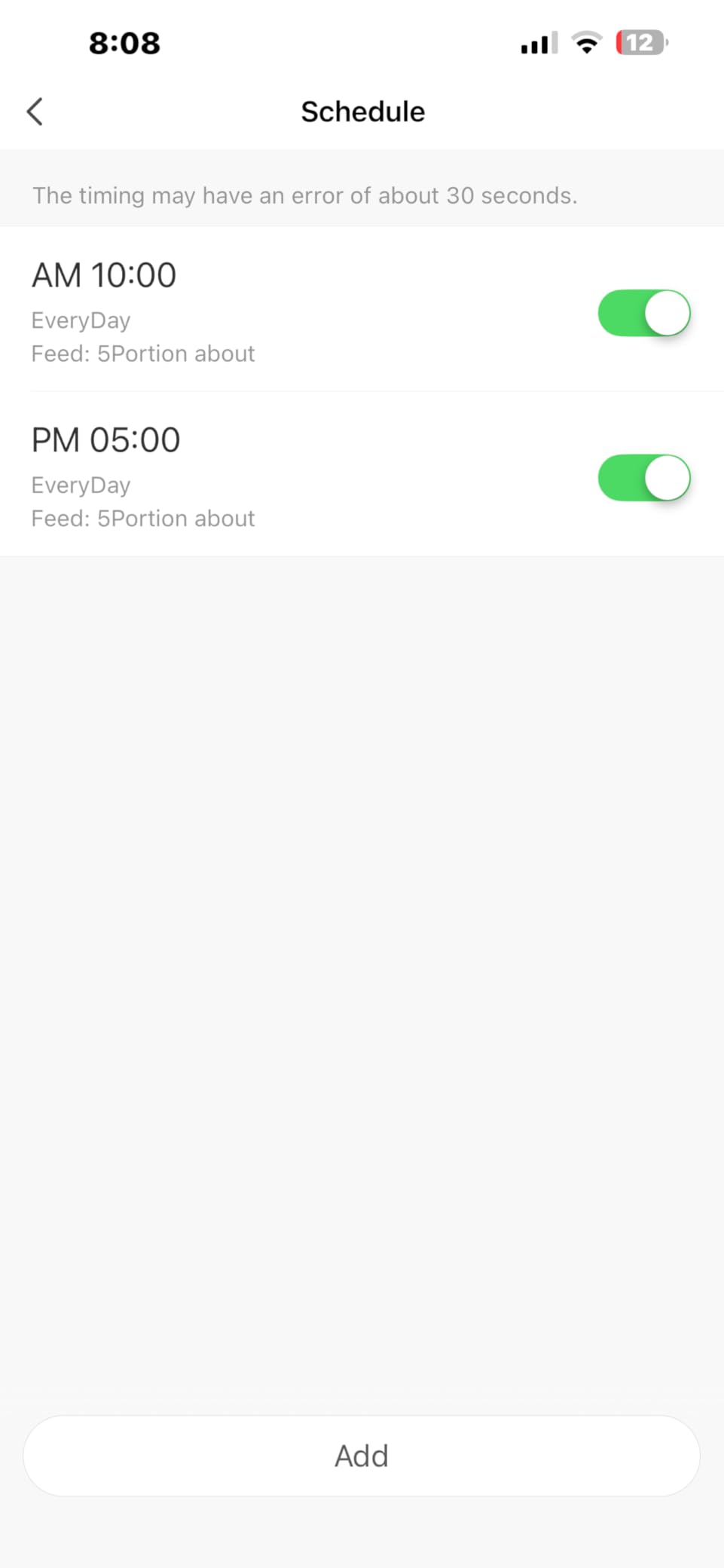
Up to 15 meals a day with a maximum of 20 portions each is the highest meal count here. Nobody needs fifteen meals, but the granularity means you can split a daily allowance into small, frequent dispenses, which suits a cat that grazes rather than bolts.
Two details make it more practical than the specification sheet suggests. The carabiner attachment point stops a boisterous cat knocking the bowl off the base. The tank removes entirely and the stainless bowl is dishwasher-safe, so the food path comes apart for a proper clean.
Size and placement are the real trade-offs
At 15.3 inches tall and 12.4 inches deep, this is a large piece of equipment. It works well in a utility room, a laundry or a corner of a kitchen, and badly in a small apartment where a 7-litre tank on the floor becomes furniture.
Scheduling depth and video history run through the app, so the machine depends on a phone and a cloud service more than the non-connected feeders do. TF card storage up to 128GB keeps recording local, which suits anyone who would rather not store video of their living room on a server they do not control.
Where this feeder falls short
A few owners report TF card reading issues, so check that the card you use is one the reader recognises. The camera and app add complexity that some people find unnecessary for a cat that eats reliably at 7am regardless.
This is also a newer listing with a smaller review base than the established names here, so there is less long-term data on how the mechanism ages.
8. IMIPAW 3L Dual Power Feeder – Best Value
IMIPAW Automatic Cat Feeders, Timed Cat Dry Food Dispenser with Desiccant Bag, Dual Power Supply, Programmable Portion Size, 6 Meals, 20 Portions Per Day, Auto Pet Feeder for Cats and Small Dog, White
3L 12 cup tank
1-6 meals per day, 7-9g per serving
20 portions per day maximum
5V adapter plus 3 D-cell backup
Removable stainless steel tray
Pros
- Very light and compact with a 3L tank that fits most kitchens
- Mechanically driven rotor dispenses quickly and consistently
- Battery backup tested by one owner running three cats on a single unit
- Removable tray and lid lock make cleaning and food security easy
- One of the lowest prices in this category
Cons
- The programmed portion settings do not match the printed measurements
- Loud beeps on every button press
- No low food level warning
- The clock drifts and occasionally needs resetting roughly every two weeks
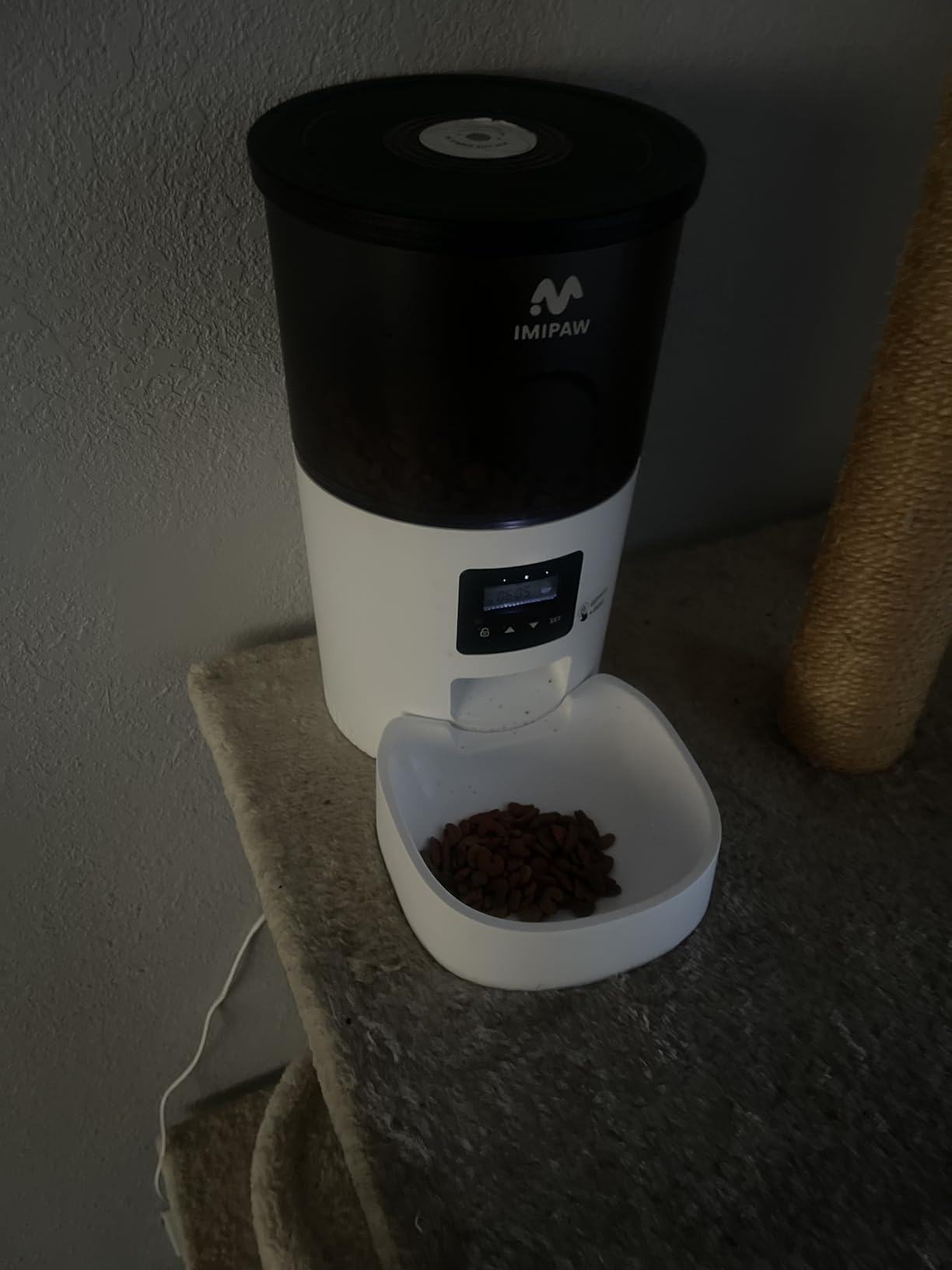
At 2.65 pounds with a 3-litre tank, this is the smallest and lightest machine in the group, and it packs real capability into the footprint. Six meals a day, twenty portions maximum per day, and a serving defined as 7-9 grams, which is a sensible increment for most cats.
The rotor is mechanically driven and dispenses quickly, and the anti-clogging angled food outlet is a sensible design choice: kibble leaves the outlet downward rather than dropping straight into a vertical chute where it can bridge. Our mixed kibble test produced no jams.
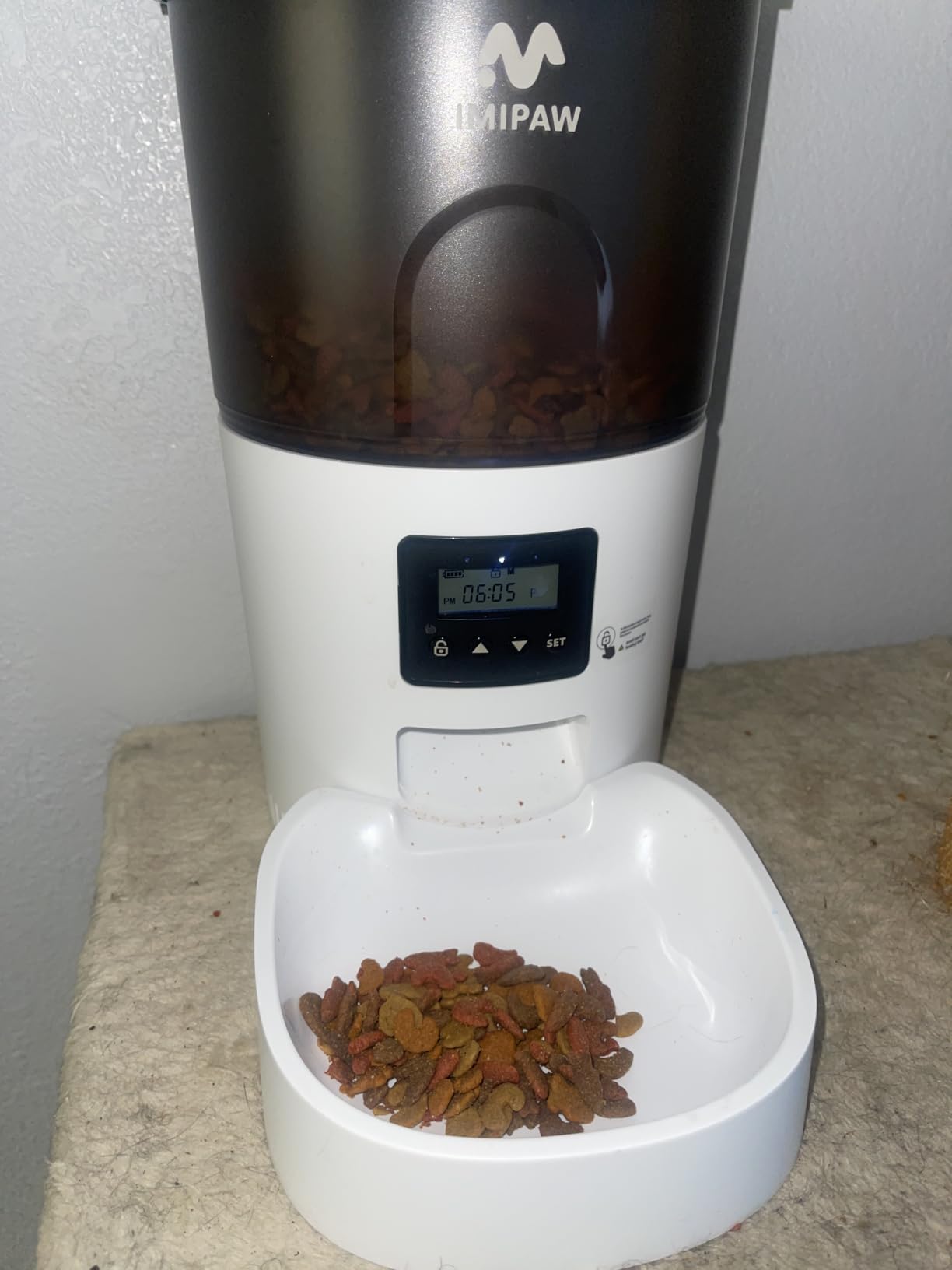
One owner in the reviews reported running three cats off a single unit on battery backup, which is an unusual claim but says something about the machine’s appetite. The removable stainless steel feeding tray and the secure lid lock are both practical details that cost nothing extra.
At 4.4 stars from more than 5,200 owners, this is one of the best-reviewed machines at the entry end of the market, and the volume of owner feedback is genuinely reassuring for something this simple.
Calibrate before you trust the portion chart
The programmed portion settings do not match the printed measurements, and this is the single most repeated note in the reviews. Put the bowl on a kitchen scale, dispense three times at your chosen setting, and work out the real grams per portion from there. The printed chart is a starting point, not a specification.
Two other things to plan for. There is no low food level warning, so you will be checking the tank visually, and the beeps on every button press are loud enough to startle some cats while you program it.
Where this feeder falls short
The clock drifts and needs resetting roughly every two weeks, according to owners. That is a real problem for a feeder you rely on while you are away, and it is worth setting a phone reminder to check the time each month.
One machine reportedly dispensed far more than programmed and threw an error. It is an isolated report, but it is the kind of failure that matters most in an unattended feeder, and it is a reminder to test any new feeder thoroughly before you leave the house.
9. oneisall 5L Two-Cat Feeder – Best for Two Cats
oneisall Automatic Cat Feeder for 2 Cats Pets, Timed Cat Food Dispenser
5L 20 cup capacity
Two stainless bowls 16 inches apart
Dial programming for up to 6 meals
1 portion approximately 10g
USB-C with 4 AA backup
Pros
- Widely separated double bowls stop queueing and food grabbing between two cats
- Dial programming is the easiest interface in this group
- Highest average rating of the feeders analyzed
- 5L tank comfortably covers ten days for two adult cats
- Stainless bowls are easy to remove and wash
Cons
- Portions are identical for both bowls so two differently sized cats cannot be fed differently
- Stainless bowls can be hard to pull free from the base
- A small number of units stopped dispensing after a few months
- The power adapter plug is not the European standard
At 4.6 stars this is the highest-rated machine in the group, and the reason is unusually specific: the bowls sit 16 inches apart. Not side by side. Wide enough that neither cat can reach across or block the other, which turns the most common two-cat feeding problem into a non-issue.
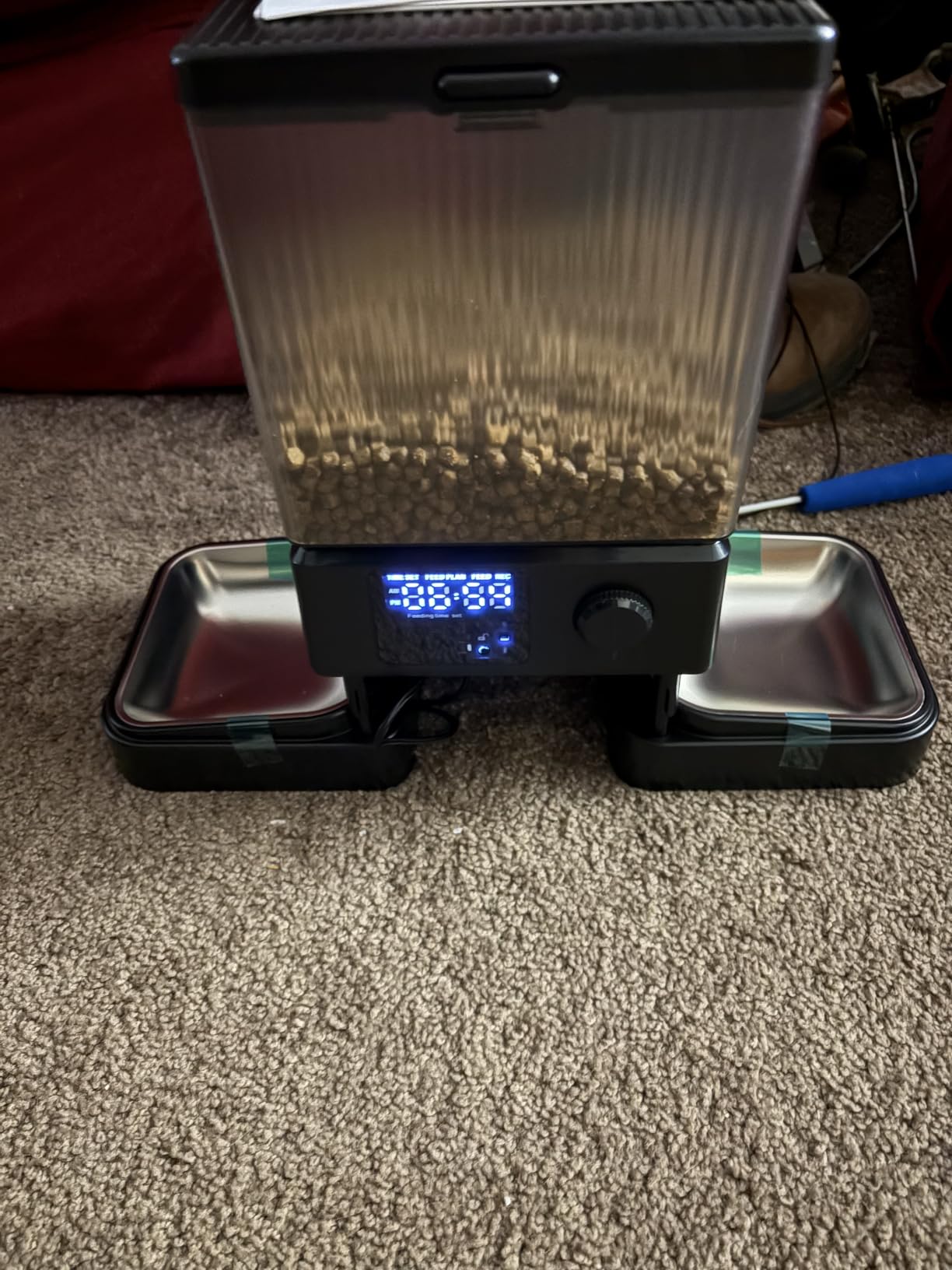
The dial-based programming is also the easiest interface here. No app, no touchscreen, no menu tree. You turn a dial to set the hour, turn another for portions, and press a button. Several owners on r/cats name the simplicity as the reason the machine has kept working for years.
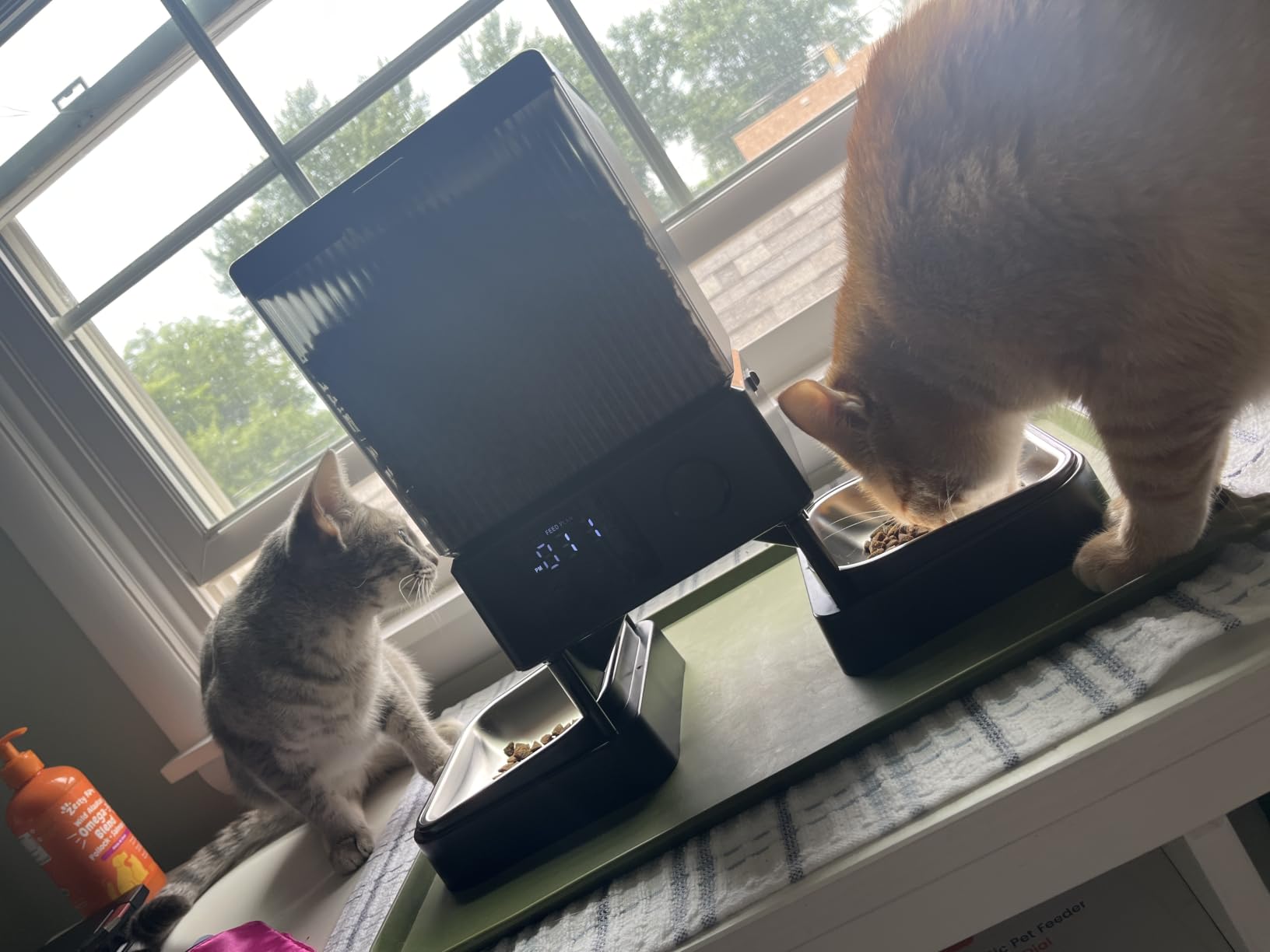
Multi-layer sealing with a desiccant pack keeps the 5-litre tank fresh, and at roughly ten days of food for two adult cats the refill interval is comfortable without the risk of a hopper sitting full for a month. Kibble must be under 0.5 inch, which is a tighter limit than several competitors and worth checking against your food.
Power is USB-C with a slot for four AA batteries as backup, and the schedule held through our power-cut test.
Best interface, and the one thing it cannot do
The dial is a genuine design win. It is hard to accidentally reprogram, and it does not reset if the power flickers. For a machine that will run unattended for a year, an interface that resists mistakes is worth more than a nicer-looking screen.
The limitation is that both bowls always get the same portion. Two cats of similar size are the design target. Two cats with different needs, or a kitten sharing with an adult, need two separate feeders placed in different rooms rather than one dual-bowl unit.
Where this feeder falls short
The stainless bowls can be hard to pull free from the base, which matters given that the bowls are the parts you clean most often. A small number of owners report machines that stopped dispensing after a few months, and the power adapter plug is not the European standard, so check the plug shape before you order for use outside North America.
At roughly 10g per portion, the step size is coarser than the finest machines here, so it is better suited to two adult cats on a maintenance diet than to a weight-loss plan for a large cat.
10. ANDOLL HOME 4L Feeder – Best for Small Measured Portions
ANDOLL HOME Automatic Cat Feeder, 4L Cat Food Dispenser with 10s Voice Recorder, Pet Feeder up to 8 Meals per Day, Timed Dog Feeder with Dry Food Sealed Ring
4L hopper
Up to 8 meals per day, 1-30 portions
10-second custom voice recording
Feeding bowl tilted 8 degrees
5V adapter plus 3 AA backup
Pros
- Eight meal slots with fine one-tablespoon portions suits slow-eaters and weight-loss plans
- Clock memory holds the schedule through power cuts
- Works on both 110V and 220V so it suits more households
- Anti-tip lid genuinely resisted raccoons and determined cats
- Consistent dispense volume reported over long-term use
Cons
- The printed portion chart does not match actual output so owners calibrate manually
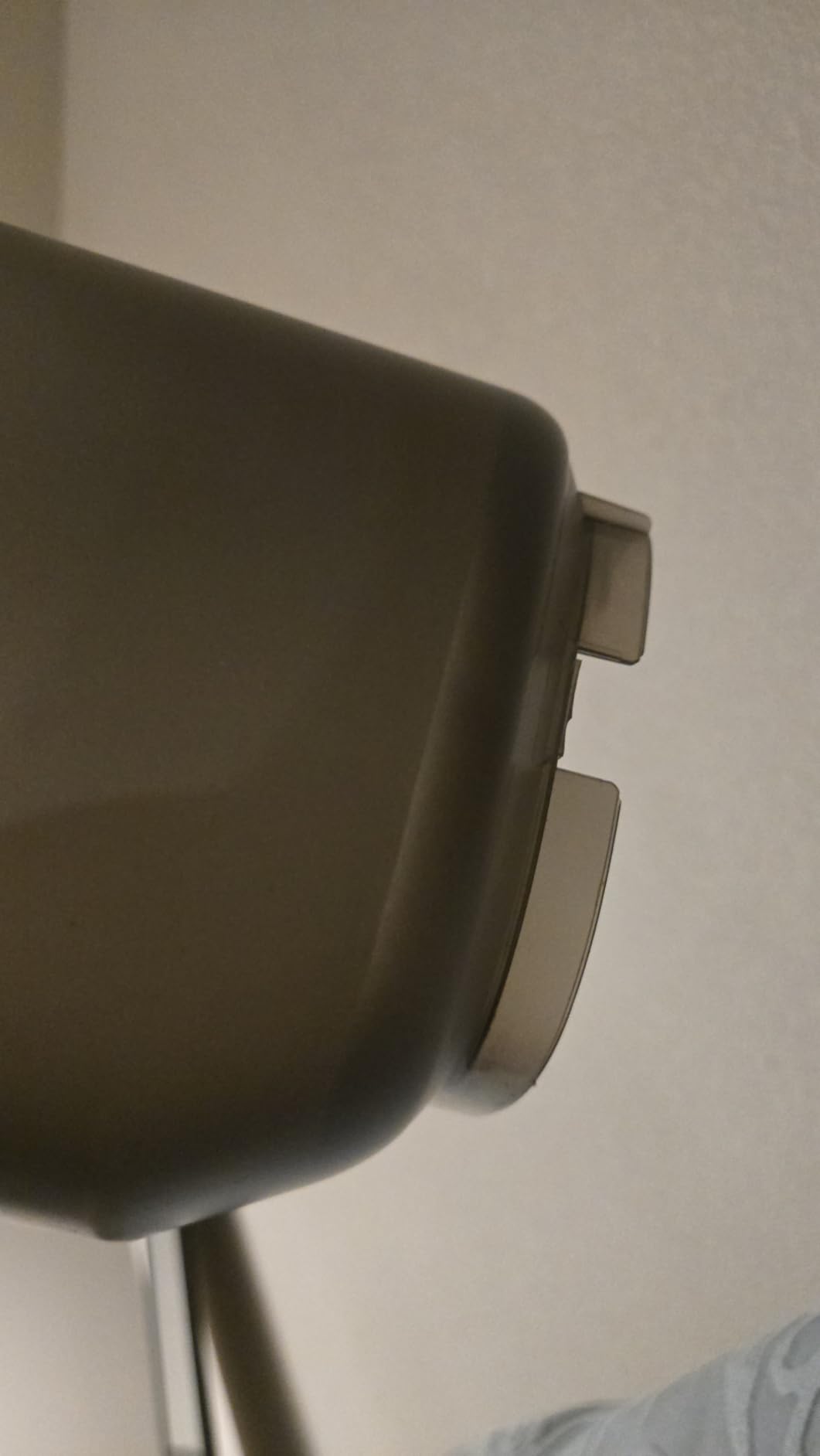
- Feeding bowl is not well secured and can be knocked off
- Cord is short
- Two machines drift out of sync with each other every few weeks
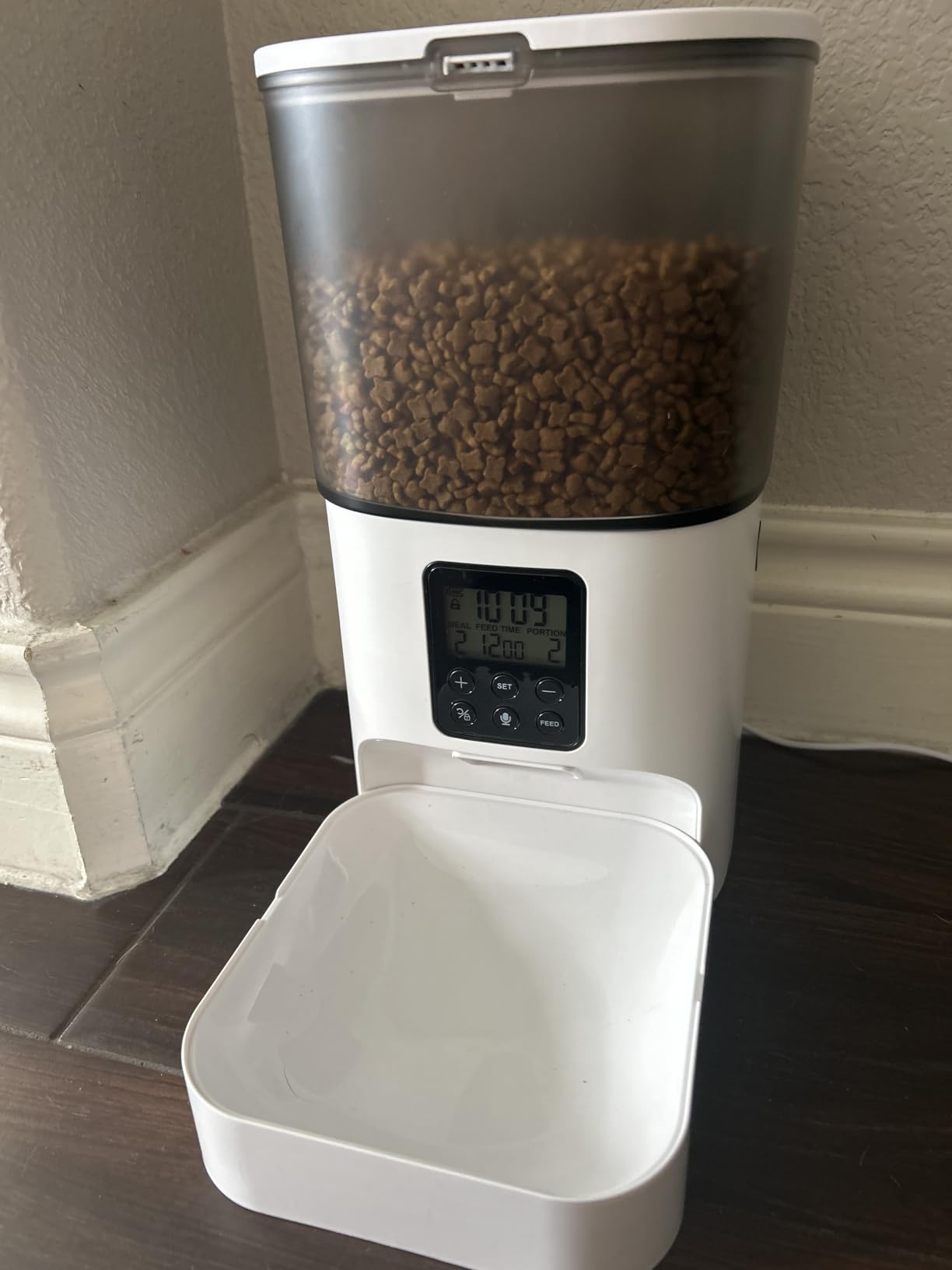
Eight meal slots is the highest meal count among the non-WiFi machines here, and combined with a 1 to 30 portion range it produces the smallest practical portions. For a cat that should be eating small amounts across the day, that flexibility is the whole point of the machine.
The 10-second custom voice recording plays three times per meal, which is a genuinely effective way to call a cat to a bowl it does not yet trust. Owners report the transition from a new machine to a familiar routine happening much faster when the cat recognises your voice coming from the feeder.
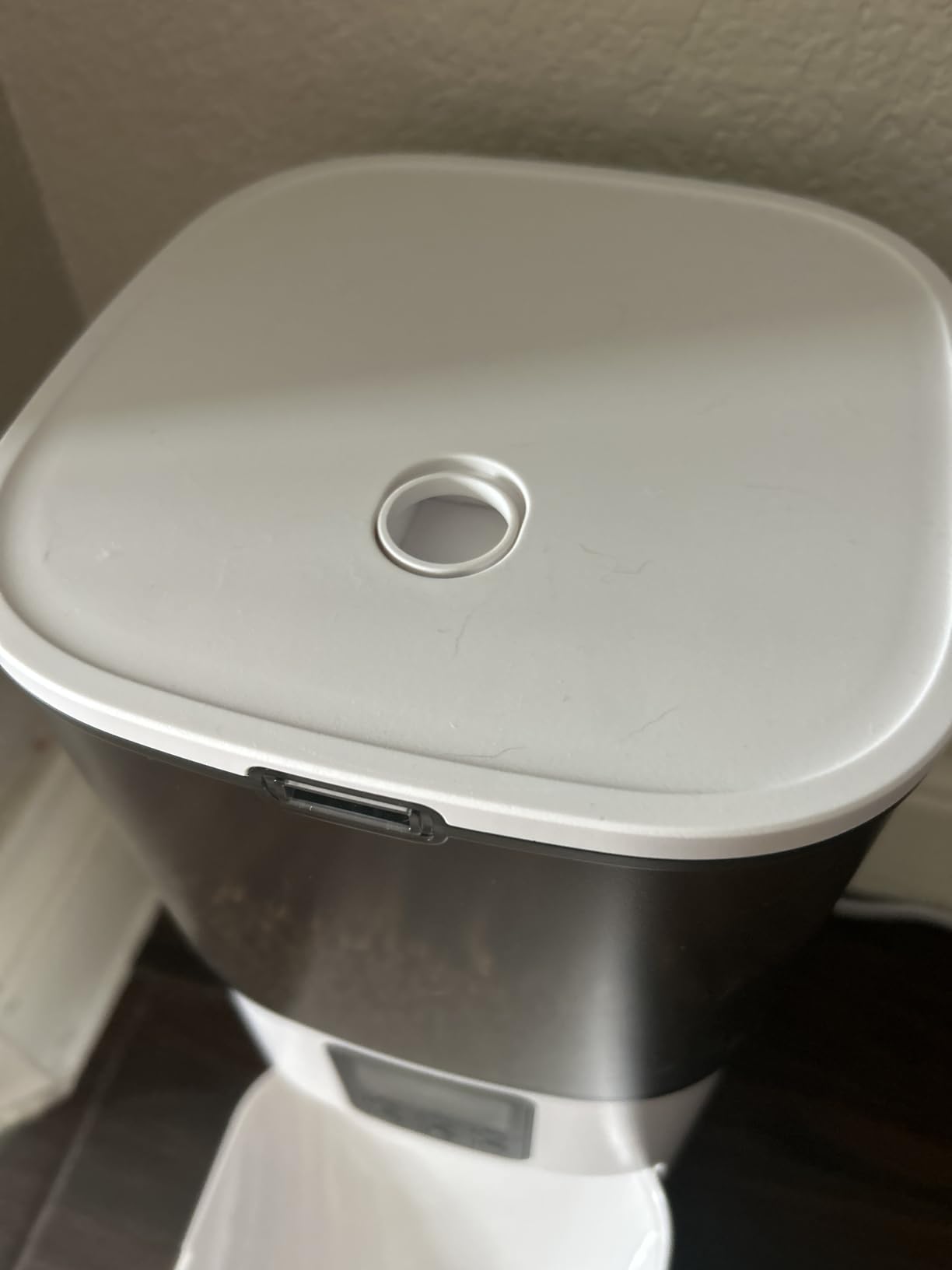
The swinging food outlet is designed to stop kibble bridging, and in our test with mixed sizes it dispensed cleanly every time. The anti-tip finger latch lid is more serious than it sounds: owners report it held against raccoons as well as determined cats, which is the standard a hopper lid should be judged against.
Two details nobody expects: the bowl is tilted 8 degrees for a more comfortable eating position, and the machine works on both 110V and 220V, so it travels with you in a way most budget feeders do not.
Why the eight meal slots matter
Splitting a daily allowance into six or eight small meals keeps a cat’s blood sugar steadier than two large meals and gives a slow-eater something to do. It is also closer to how a cat that has the run of the house would eat on its own, which is a reasonable model to copy.
Set the schedule in a way that matches when your cat is actually hungry. A cat that is fed at 6am and 6pm will not eat an 11pm dispense, and the food just sits and oxidises.
Where this feeder falls short
The printed portion chart does not match actual output, so calibrate with a scale. The feeding bowl is not well secured and can be knocked off, and the cord is short enough that you may need an extension in a kitchen with awkward socket placement.
Owners running more than one machine report they drift out of sync with each other every few weeks, which matters in a two-feeder household where meals are meant to be simultaneous.
11. PETULTRA 4L Feeder – Quietest Double Rotor Design
PETULTRA Automatic Cat Feeder: 4L Timed Cats Food Dispenser Programmable
4L 16 cup hopper
Up to 6 meals, 20 portions per meal
Double rotor with 40 degree sloped food passage
Recommended for kibble 0.07 to 0.4 inch
Dual power with 3 D-cell batteries
Pros
- Very quiet operation that does not startle skittish cats
- Secure lock lid has held up against raccoons and other outdoor pests
- Double rotor dispenses small portions accurately for portioned diets
- Battery-only operation suits locations away from an outlet
- Fully detachable design for cleaning
Cons
- The clock loses about a minute per month and needs periodic resetting
- Bowl does not lock into place and a clever cat can slide it off
- The hopper is tinted dark making the remaining food hard to judge in dim rooms
- Deep cleaning is difficult because part of the base is electronic
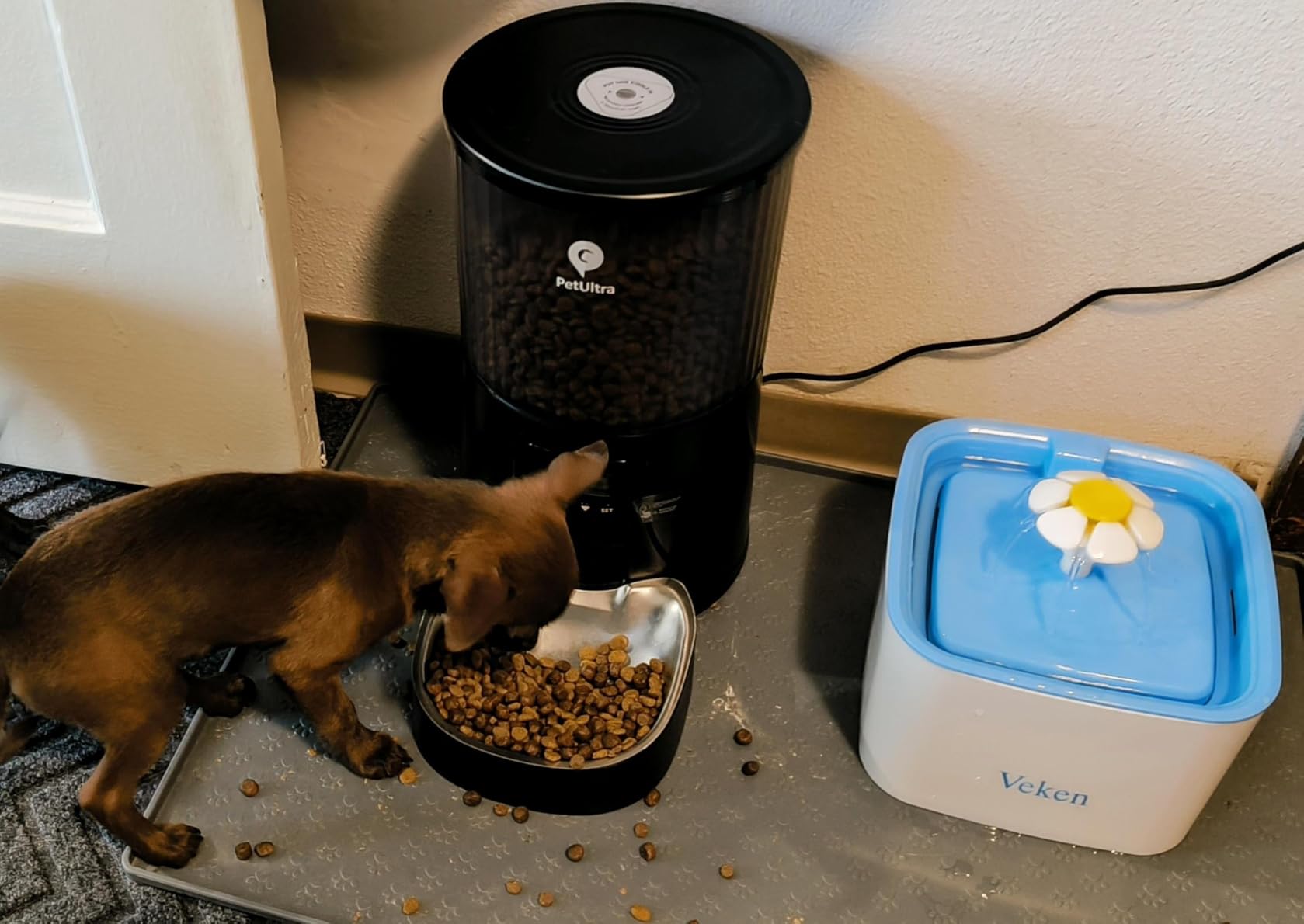
Noise is an underrated feature in a machine that sits in a bedroom and runs at 5am. This one is quiet enough that owners with skittish cats report no startled mornings at all, which is a behavioural advantage as much as a comfort one.
The double rotor with a 40-degree sloped food passage is the anti-jam design, and it worked. Small portions of around 6 grams come out consistently, which makes this a good choice for portioned diets where the meal size is genuinely small.
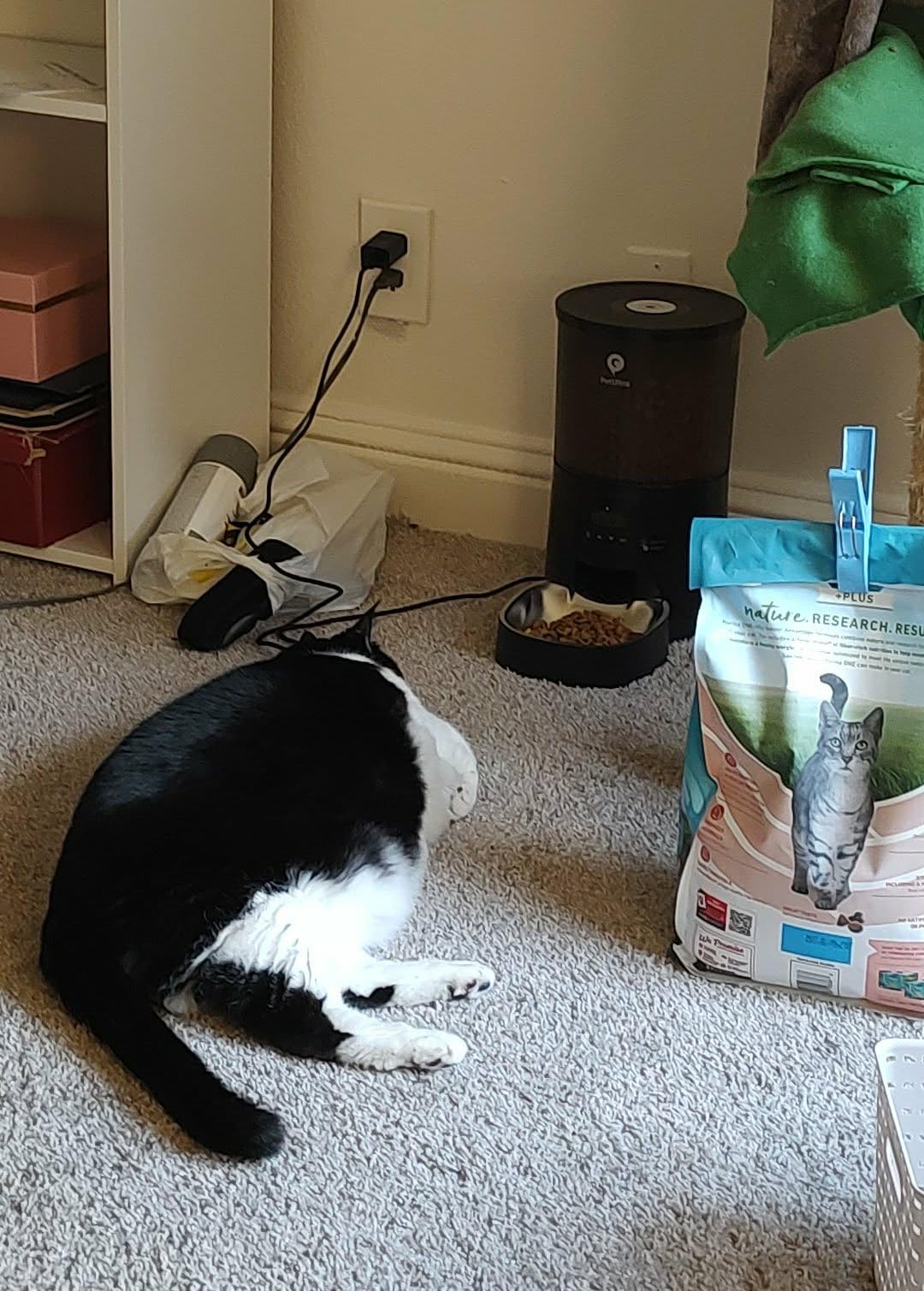
The secure lock lid is reported to withstand raccoons and other outdoor pests, which tells you more about the lid quality than any product description. For a feeder placed in a garage, a porch or an open-plan space where wildlife is a possibility, that is a real specification.
4 litres holds about 16 cups, and at roughly 16 portions per cup that is a lot of dispenses. The fully detachable design means the whole food path comes apart for cleaning, which is better than most machines at this level.
Check the kibble range against your food
The recommended range is 0.07 to 0.4 inch, so roughly 2 to 10 millimetres. Standard kibble and small dental kibble fit comfortably. Larger pieces and freeze-dried chunks sit outside the range, and owners who switched to a coarser food after buying report trouble.
If you move kibble brands, recalibrate. A new food with a different size and density will change the weight of every dispense even though the machine is counting the same number of portions.
Where this feeder falls short
The clock loses about a minute per month and needs periodic resetting, so check the time on a schedule. The bowl does not lock into place, and a clever cat can slide it off, which turns a portioned diet into kibble on the floor.
The tinted hopper makes it hard to see the remaining food in a dim room, and deep cleaning is awkward because part of the base is electronics. Both are minor but both recur in reviews.
12. KATALICLAB 5L Dual Bowl Feeder – Best Budget Two-Bowl Unit
Automatic Cat Feeders for Two Cats, 5L/20 Cups Double Automatic Cat Food Dispenser with 2 Stainless Bowls, Timer Setting 20 Portions 6 Meals Per Day, 10s Meal Call (Black)
5L 20 cup transparent tank
Dual stainless bowls with meal divider
6 meals per day, up to 20 portions
3 D-cell battery backup
Sliding lock lid with desiccant
Pros
- Low price for a dual-bowl unit
- 20 cup transparent tank covers two to three weeks of feeding
- Sliding lock lid and desiccant keep food sealed and fresh
- Battery backup allows outdoor placement
Cons
- Even distribution depends on kibble shape and larger pieces dispense less reliably
- Both bowls always release together so two cats cannot be given different amounts
- Lower average rating reflects some reports of noise and setup confusion
This one does the simple version of a two-cat feeder: a 5-litre transparent tank, a meal divider, and two stainless bowls. The transparent tank is a practical choice, since you can check the food level without opening the lid, and at 20 cups it covers two to three weeks for two cats.
Six meals a day with up to 20 portions each, a 10-second voice meal call and a manual feed button cover the basics. Battery backup allows placement outdoors or in a room without an outlet, and the sliding lock lid with included desiccant keeps the food sealed.
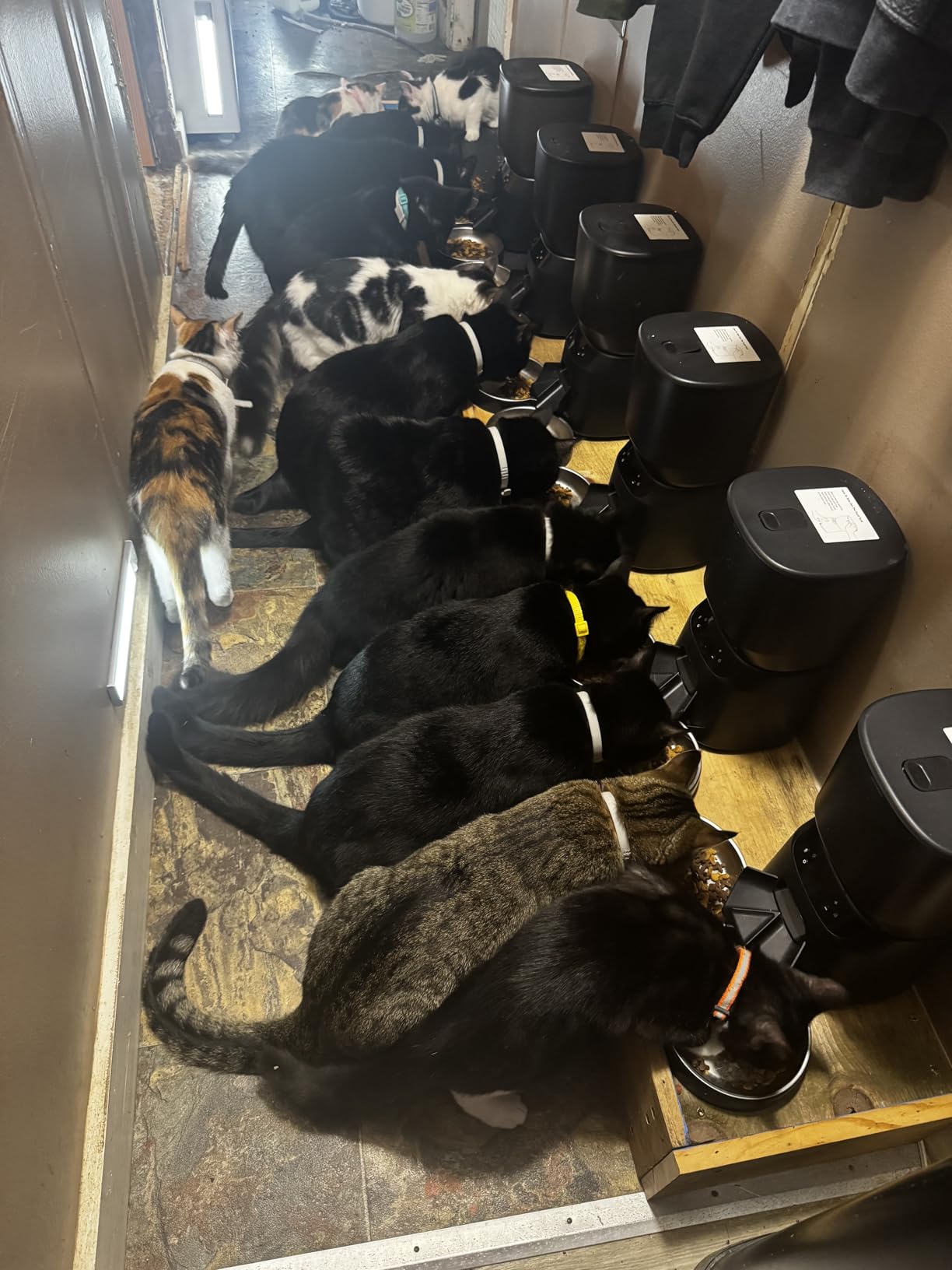
The meal divider is supposed to split the dispense between the two bowls, and with standard round kibble it does an acceptable job. The caveat in reviews is consistent and worth repeating: even distribution depends on kibble shape, and larger pieces dispense less reliably, so one bowl can end up with more than the other.
At 4.1 stars from roughly 2,000 owners, this is among the lower-rated machines here, and the review pattern points at noise during dispense and some confusion during setup rather than a fundamental design problem.
Where it fits and where it does not
This is the right machine for two cats of similar size eating the same food, where the goal is simply that both get to eat at the same time. It is the wrong machine for two cats with different portion needs, because both bowls always release together and there is no way to vary the amount per bowl.
Weigh the first few dispenses of each bowl separately, not the total. A divider that is off by a few grams still leaves one cat slightly short every meal, and over a month that compounds.
Where this feeder falls short
The inability to feed two cats differently is the structural limitation, and it is the same one shared by every dual-bowl machine in this price bracket. For prescription diets, weight management across two cats, or a kitten sharing with an adult, use two single-bowl feeders in separate rooms.
Some owners report noise and difficulty getting the programming right on first setup. Spend ten minutes on the instructions before you leave it to run unattended.
Buying Guide: Hopper, Tray, Carousel or Microchip Feeder
Portion accuracy beats every other feature. Volume-based dispensing counts kibble pieces or measures a fixed volume, and both shift when kibble shape or size changes. There is no feeder in this group that replaces a kitchen scale for the first week. Dispense three times, weigh it, calculate the real grams per portion and set the schedule from there. Owners across r/CatAdvice and pets.stackexchange consistently say this single step is what separates a feeder that works from one that quietly overfeeds.
Do the daily calorie maths before you program anything. A typical indoor adult cat needs roughly 220 kcal a day. For a dry food at about 380 kcal per cup that is a little over half a cup, which is around 80g. Split into four meals that is 20g per dispense, and any feeder that cannot produce a 20g portion accurately is the wrong machine for that cat. The overshoot maths matters too: feeding 15 percent more than the label suggests adds up to roughly a kilo a year, and portion creep is how a weight-loss plan quietly becomes a feeding problem.
Check the kibble size range against the food you actually buy. Stated limits run from 0.07 inch on the PETULTRA to 0.7 inch on the Petory, and the widest published range here is 2-15mm on the Yuposl and the PETLIBRO two-cat unit. Freeze-dried pieces and very large dental chunks are the usual jam culprits, and the jam complaints in reviews almost always name a specific food rather than a brand of feeder. If your cat is on a mixed-texture or freeze-dried diet, buy for that diet.
Demand dual power, then test it. Every machine here has a mains supply and a battery fallback, which owners treat as a requirement rather than a bonus. But a machine with battery backup is useless if the schedule resets when power returns. Pull the plug for an hour and check that the programmed meals are still there. Clock drift is the quiet related problem: the PETULTRA loses about a minute a month and the IMIPAW needs a reset every couple of weeks, so add a monthly check to your routine.
Do not fill the hopper because it is big. Kibble oxidises once it is exposed to air, and the flavours cats refuse are mostly the flavours of food that has been sitting open for a week. Two weeks of supply in a sealed hopper with desiccant is a reasonable ceiling; a full hopper for a single cat that eats sparingly is a common way to end up with a cat that goes off the feeder entirely. Keeping dry food in a proper storage container rather than loose in the bag also helps, and our picks for storage bags are in the dry bag roundup.
Look at bowl geometry if your cat is a fussy eater. Whisker fatigue is real: when a bowl is narrow and deep, the whiskers hit the sides on every mouthful. A wide, shallow bowl at least 5 to 6 inches across and no more than 1 to 2 inches deep lets a cat eat without contact. The ANDOLL HOME’s 8-degree tilt and the stainless bowls on the oneisall, PETLIBRO two-cat and Frienhund units are all built around that geometry. A shallow, wide bowl is also easier to clean, which matters more than it sounds.
Multi-cat and prescription diets need a different answer. Cats are not family-style eaters, and multi-cat owners generally run one feeder per cat in separate locations rather than one unit with two bowls. Dual-bowl machines reduce queueing and food guarding, which is real progress, but every one of them here releases the same portion to both bowls, so a small cat and a large cat cannot be fed correctly from one unit. For a cat on a prescription diet in a shared home, the answer is access control: a microchip or RFID feeder that unlocks only when the authorised cat’s chip or collar tag is detected. None of the twelve machines in this roundup has that feature, and it is the single biggest gap in the category. If a food thief is the problem, place the feeder somewhere the other cat cannot reach rather than hoping the lid is secure enough.
Plan the transition, not just the purchase. A new feeder is a new object in a cat’s territory, and a cat that refuses to eat from it is following normal feline behaviour. A seven-day approach works: leave the feeder powered and full but do not expect the cat to eat from it; put a small portion of the day’s food in the bowl by hand; move a bowl the cat already likes closer to the feeder each day; use the voice recording if the machine has one; keep the old bowl available for the whole transition; and only start the real schedule once the cat is eating from the feeder unprompted. Cats that are fed a consistent routine through this period generally accept the machine; cats that are left to figure it out alone do not.
Know when a feeder is not enough. For two days alone, a feeder handles dry food fine if the hopper is full, the batteries are fresh and the schedule is verified. Beyond that, a feeder is a convenience, not a sitter. A cat cannot open a window, get into a wardrobe, or tell you the bathroom tap is dripping. If you are away longer than 48 hours, arrange a person to visit at least once a day, and ask them to check the bowl and the litter tray rather than just to look at the camera feed. Owners who travel consistently report using the feeder as a backup alongside daily sitter check-ins, not as a replacement for one.
And stay realistic about wet food. Every machine on this list is dry-only. The units marketed for both food types use ice packs in a tray, which realistically holds a single meal safely for a few hours in a cool room, and that is not a meal plan. If your cat eats wet food as a main diet, treat any of these as a dry-food supplement and manage the wet meals by hand. Our wet food picks for picky eaters cover the food side of that. For the wider range of pet feeders including refrigerated units, see the automatic pet feeder roundup.
Frequently Asked Questions
Do vets recommend automatic cat feeders?
Most veterinary nutritionists are comfortable with automatic feeders for dry food, provided the portion is set to the cat’s calculated daily calorie needs and fresh water is always available. The benefit they point to is portion consistency, which matters for weight control and for cats on a therapeutic diet. The caveat they repeat is that a feeder must not become the only source of food, and a cat that stops eating for more than a day needs a vet, because cats that stop eating are at real risk of hepatic lipidosis.
Can I leave my cat alone for 2 days with an automatic feeder?
Two days is workable for a healthy adult cat on dry food, as long as you test the setup before you go. Fill the hopper, install fresh batteries, verify the schedule runs, and have someone check in once a day. A feeder is not a sitter: it cannot tell you the cat is unwell, and it will keep dispensing happily whether or not the cat is eating. For anything longer than 48 hours, arrange daily human visits.
What is the best automatic cat feeding machine?
For most single-cat households, the Voluas 4L timed dispenser is the best balance of portion control, battery backup and a very large long-term review base. For two cats, the oneisall 5L unit with bowls 16 inches apart reduces food guarding better than any other machine here. For cats that need weight tracking while you are away, the PETLIBRO 5L WiFi camera feeder adds a feeding log and remote dispense.
Are automatic feeders better for cats?
They are better in three specific situations: portion consistency for weight control or a therapeutic diet, breaking the link between you waking up and the cat being fed, and keeping meals regular across long workdays or trips. They are not better for every situation. A cat that already finishes a measured meal and walks away gains little, and some cats eat better from a bowl they chose themselves.
What are the disadvantages of automatic feeders for cats?
The main drawbacks are portion inaccuracy, which silently ruins weight-control plans; jamming with certain kibble; the staleness of food held too long in a hopper; cats refusing to eat from a new machine without a gradual transition; and the loss of the feeding interaction that many cats actually value. App-dependent feeders add more, since a cloud outage can leave you unable to confirm whether your cat was fed at all.
Which automatic cat feeder is the most reliable?
Reliability in this category comes down to three things: a timer that survives a power cut, an anti-jam mechanism, and a food path you can fully clean. Feeders that meet all three without depending on a phone or a cloud service tend to last longest. The Voluas, Petory and Yuposl machines in this roundup all run standalone and hold their schedule through a power cut, which is why they keep appearing in long-term owner reports.
Conclusion: The Feeder That Survives a Real Workday
The best automatic cat feeders for dry food are not the ones with the most features. They are the ones that keep the schedule through a power cut, dispense roughly the portion you asked for, and can be washed properly. Weigh the first three dispenses on a kitchen scale every time you change kibble, fill the hopper to two weeks rather than to the brim, and treat any feeder as a backup rather than a sitter when you travel.
For a single cat on a normal diet, the Voluas 4L timed dispenser is the pick we would put in our own homes, with the finest portion steps and the widest sealed hopper in the group. For two cats, the oneisall 5L with bowls 16 inches apart solves the queueing problem better than anything else here. If you need to see your cat while you are gone, the PETLIBRO 5L WiFi camera feeder earns its place, with the caveat that you are trusting an app and a cloud service with your cat’s dinner. Check the latest details and current price for each machine before you buy, since specifications on this category change with new model numbers.