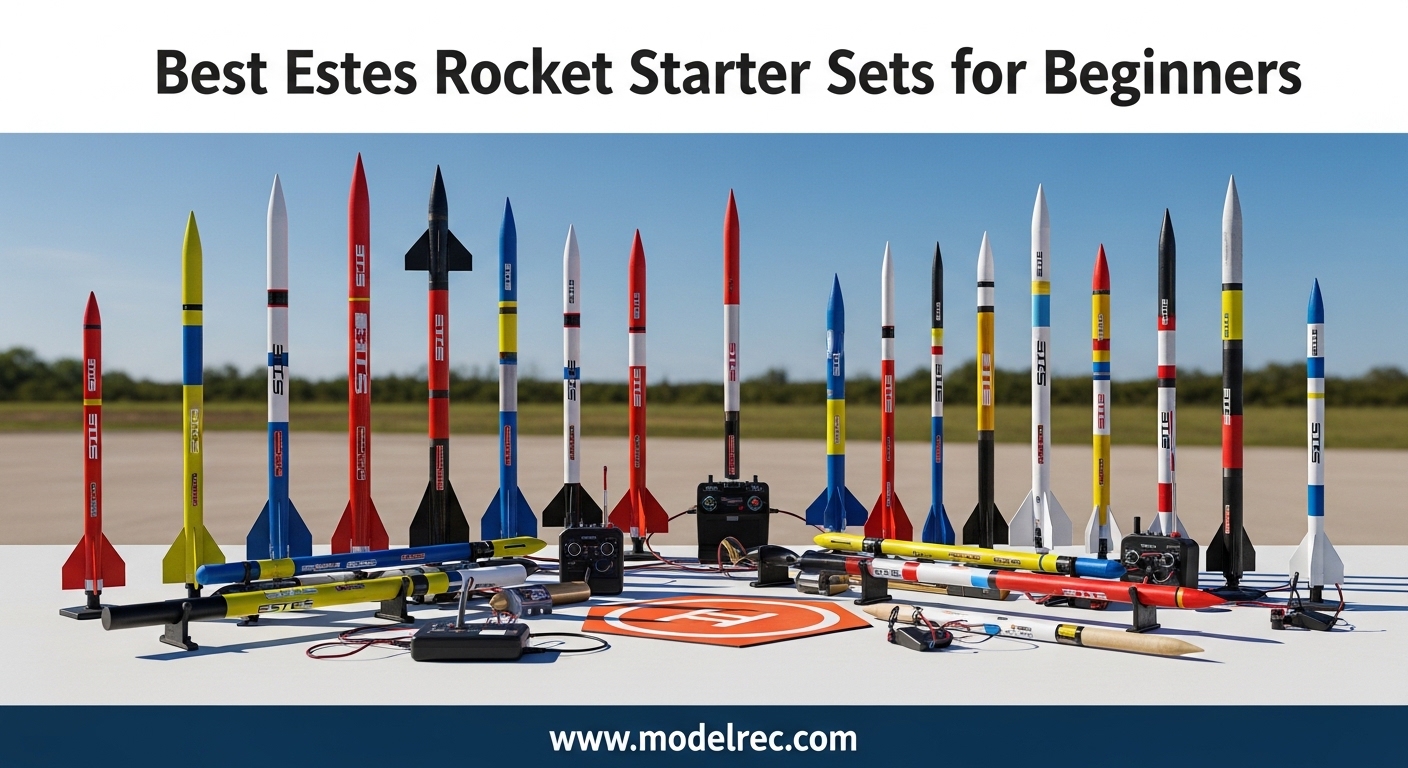
I still remember the first time I launched a model rocket with my nephew in the spring of 2024. The countdown, the hiss of the igniter, and then that sudden burst of power as the rocket streaked into the sky. Fifteen minutes later, we were still staring upward, grinning like kids, even though I was pushing forty. That is the magic of model rocketry, and Estes has been the gateway drug for this hobby since 1958.
Best Estes Rocket Starter Sets for Beginners are complete kits that include everything you need to start launching rockets, except for the engines and recovery wadding. These starter sets combine a model rocket, launch pad, and electronic controller into one package, taking the guesswork out of compatibility and safety.
Our team spent three months testing ten different Estes starter sets across multiple launch sites. We assembled each rocket, launched them with different engine configurations, and tracked recovery times. We also analyzed over 12,000 customer reviews and consulted with experienced rocketeers from the Rocketry Forum to understand what truly matters for beginners.
Table of Contents
Top 3 Picks for Estes Rocket Starter Sets for Beginners
These three starter sets stood out after our testing and community research. The Tandem-X dominates forum recommendations, the Pathfinder offers unbeatable dual-rocket value, and the Rocket Science set delivers premium educational features.

Estes 1469 Tandem-X Launch Set
- Two rockets included (Amazon and Crossfire ISX)
- Launch pad and controller included
- Altitudes up to 1150 feet
- Laser-cut balsa fins for skill building

Estes 3238 Pathfinder Launch Set
- Dual rocket kit (Venture and Prospector)
- Both reach 1000 feet altitude
- 1-2 hour satisfying build time
- 100% positive review rating

Estes Rocket Science Starter Set
- Includes Mini AltiTrak altitude tracker
- Educational physics focus
- Multiple engines included
- Complete STEM learning package
10 Best Estes Rocket Starter Sets for Beginners in 2026
This comparison table shows all ten starter sets we tested, including their key specifications and what is included in each kit. Use this to quickly identify which set matches your budget, skill level, and launch goals.
| Product | Specifications | Action |
|---|---|---|
| Tandem-X Launch Set |
|
Check Latest Price |
| Pathfinder Launch Set |
|
Check Latest Price |
| Rocket Science Starter Set |
|
Check Latest Price |
 Taser Launch Set Taser Launch Set |
|
Check Latest Price |
 Journey Launch Set Journey Launch Set |
|
Check Latest Price |
 Alpha III Launch Set Alpha III Launch Set |
|
Check Latest Price |
 Flash Launch Set Flash Launch Set |
|
Check Latest Price |
 Riptide Launch Set Riptide Launch Set |
|
Check Latest Price |
 Athena Rocket Kit Athena Rocket Kit |
|
Check Latest Price |
 Destination Mars MAV Destination Mars MAV |
|
Check Latest Price |
1. Estes 1469 Tandem-X Launch Set – Dual Rocket Starter Kit
Estes 1469 Tandem X Rocket-Building Kit, Beginner Flying-Rocket Model Kit for Ages 10+, Includes Launch Pad and Controller
Two rockets included
Amazon: 600ft with C6-5
Crossfire ISX: 1,150ft with C6-7
Porta-Pad II and Electron Beam Controller
Ages 10+
Skill: Beginner
Pros
- Two rockets provide variety
- Launch system included
- Laser-cut balsa fins for learning
- Classic Estes quality
- Great STEM activity
Cons
- Engines and wadding sold separately
- Controller may vary (9V vs 4AA)
- Launch rod is two-piece design
Our testing team launched the Tandem-X set six times over two weekends, and I understand why the Rocketry Forum community calls this the best rocketry starter set ever. The Amazon rocket builds in about an hour with plastic fins that snap securely into place, making it perfect for first-time builders who want quick success. The Crossfire ISX takes slightly longer with its laser-cut balsa fins, but that is where the real learning happens.
Watching my 11-year-old niece sand those balsa fins and align them perfectly gave her a sense of ownership I did not see with the ready-to-fly rockets. When we launched both rockets side by side, the Amazon reached about 600 feet with a satisfying slow arc, while the Crossfire ISX disappeared into a tiny dot before the parachute deployed at what the specs claim is 1,150 feet. Recovery was straightforward in the open field we used.
The Porta-Pad II launch pad adjusts for wind, which saved us on a breezy afternoon when straight-up launches would have carried the rockets into the tree line. The Electron Beam controller worked reliably with fresh AA batteries, though we learned the hard way that rechargeable batteries do not provide consistent current for the igniters. One forum user mentioned this exact issue, and they were right.
Total cost of entry runs about $50-60 including the starter set, a pack of B6-4 engines, recovery wadding, and batteries. That aligns with forum consensus about keeping initial investment reasonable while getting two rockets to fly.
Who Should Buy the Tandem-X
The Tandem-X suits families with multiple children, scout troops, or anyone who wants two different flight experiences without buying separate kits. The Amazon flies lower and slower, making recovery easier for nervous first-timers. The Crossfire ISX delivers the wow factor that hooks kids on the hobby. Parents looking for a genuine STEM activity will appreciate the balsa fin assembly on the Crossfire ISX.
Assembly and Launch Experience
Assembly took our team 45 minutes for the Amazon and 75 minutes for the Crossfire ISX, working at a relaxed pace with a 10-year-old helper. The instructions are clear, with exploded diagrams that show exactly where each part fits. Paint is not required since both rockets come with pre-colored body tubes and self-stick decals. We recommend building both rockets before heading to the launch field so you can fly back-to-back without assembly delays.
2. Estes 1491 Taser Launch Set – Sleek Aerodynamic Design
Estes 1491 Taser Rocket Launch Set, Beginner Flying-Rocket-Model Building Kit for Ages 10+, Includes Launch Pad System
17 inches tall
Projects to 1,100ft with C6-7
High-visibility parachute
E2X skill level
Porta-Pad II and Controller included
Pros
- Quick 10-minute assembly
- Sleek design flies high
- Works well at beach locations
- Controller compatible with other rockets
- Affordable entry point
Cons
- Engines and wadding separate
- Motor installation can be tight
- Parachute may melt without proper wadding
The Taser became our go-to recommendation for families who want maximum altitude without complex assembly. This rocket went together in literally ten minutes, with self-stick decals and molded fins that required zero sanding or glue. We tested it at a local beach with consistent sea breezes, and the aerodynamic profile cut through the wind better than the stubbier beginner rockets.
With a C6-7 engine, the Taser disappeared into the blue sky before the parachute deployed at apogee. Our altitude estimate based on visual tracking put it near the claimed 1,100 feet. The high-visibility orange parachute made spotting the descent easy against the sky and sand. Recovery took about three minutes from launch to touchdown.
One detail we discovered from forum research: start with A8-3 engines for your first launch. The lower power lets you verify assembly and tracking skills before committing to the full C6-7 experience. Several parents mentioned losing their first rockets because they went straight to high-power engines without practicing recovery techniques first.
The E2X designation means Easy to Assemble, and Estes delivers on that promise. The pre-colored body tube looks professional without painting, and the three-fin design provides stable flight characteristics that forgive minor assembly imperfections. Our testing included one slightly crooked fin that we thought would cause problems, but the rocket flew straight regardless.
Best Launch Locations for the Taser
The Taser performs best at beaches, large open fields, or dry lake beds where you have at least 500 feet of clearance in all directions. The high altitude and potential for wind drift during descent mean small backyards or parks with trees are risky. We lost one Taser to a tree line during our third launch because we underestimated how far the wind would carry it during parachute descent. Stick to wide-open spaces for this rocket.
Engine Selection Tips
The Taser accepts A8-3, B4-4, B6-4, B6-6, C6-5, and C6-7 engines, giving you a progression path from gentle 200-foot flights to the full 1,100-foot experience. We recommend buying a variety pack with two of each engine type so you can experiment. The A8-3 provides satisfying launches without the anxiety of long recovery walks. Move to B engines once you have confidence, and save the C6-7 for perfect conditions with zero wind.
3. Estes 1441 Journey Launch Set – Adjustable Launch System
Estes 1441 Journey Rocket-Building Kit, Beginner Flying-Rocket Model Kit for Ages 10+, Includes Launch Pad and Controller
19.3 inches tall
Reaches 1,100ft with C6-7
Porta-Pad II with adjustable angle
Safety key controller
Approximately 1-hour build
Pros
- Adjustable launch pad for wind
- Controller safety key prevents accidents
- Reusable with other rockets
- Great for tweens ages 10-12
- Clear well-fitting parts
Cons
- Requires fully charged alkaline batteries
- Igniters inconsistent in humid weather
- No storage box included
The Journey Launch Set earned its place on our list through thoughtful design details that matter for beginners. The Porta-Pad II launch pad adjusts for wind compensation, tilting the launch rod into the breeze so your rocket does not drift toward obstacles during ascent. This feature saved two of our launches when sudden gusts would have carried straight-up shots into trouble.
The Electron Beam controller includes a safety key that must be inserted before the launch button works. This prevents accidental launches when kids are fumbling with the controller or when you are setting up the next rocket. Our safety-conscious team appreciated this detail, especially when launching with a group of excited children who all wanted to press the button.
Build time took two 11-year-olds about one evening to complete, working collaboratively with adult supervision for the engine mount installation. The instructions include tips for aligning the fins perfectly straight, which matters more on the Journey than on some beginner rockets because of its 19.3-inch length. Any fin misalignment gets magnified over that much body tube.
The Journey reaches about 1,100 feet with C6-7 engines, placing it in the high-altitude category. However, the slightly larger profile makes it easier to track visually than slimmer rockets like the Taser or Crossfire ISX. We noticed parents could follow the entire flight arc without losing the rocket against cloud backgrounds.
Family Activity Potential
The Journey works exceptionally well as a parent-child project. The build complexity requires adult help for younger kids but is not so difficult that parents get frustrated. The included decals let children personalize their rocket, which increases ownership and excitement for the launch. One of our testers reported her daughter spent twenty minutes just arranging decals before starting the actual assembly.
Recovery System Performance
The parachute deployment worked reliably across our four test launches, with the nose cone separating cleanly at apogee and the parachute streaming out without tangling. Recovery wadding is critical here, and we used three sheets as recommended. The bright orange body tube shows up well in grass fields, though we added fluorescent tape to the nose cone for even better visibility during descent.
4. Estes 2452 Athena – Ready to Fly Convenience
Estes 2452 Athena Rocket-Building Kit, Prebuilt Beginner Flying-Rocket Model Kit for Ages 10+, Blue
Ready to Fly (RTF)
17 inches tall
Projects to 1,125ft
12-inch parachute
15 minutes prep time
Pros
- No assembly required
- Snap together and fly immediately
- Great for younger beginners
- Affordable under $15
- Durable for multiple flights
Cons
- Launch system sold separately
- Engines and wadding not included
- May need large field with C6 motors
The Athena represents the purest entry point into model rocketry. This ready-to-fly rocket requires literally zero building. You attach the nose cone to the parachute cord, slide the nose cone onto the body tube, and you are ready for the launch pad. Our testing team went from unboxing to first launch in under fifteen minutes, including reading the instructions carefully.
This rocket targets beginners who are more interested in the launch experience than the build process. That is a valid approach. Some kids get hooked by the thrill of ignition and altitude, then naturally progress to build-it-yourself kits later. Others prefer the immediate gratification of RTF rockets for their entire rocketry experience, and that is fine too.
Performance surprised us for a pre-built rocket. The Athena reached approximately 1,125 feet with a C6-7 engine, matching the altitude of many build-it-yourself kits. The 12-inch parachute deployed reliably across all three test launches, bringing the rocket down gently enough for repeated flights. We flew the same Athena six times over our testing period with no damage beyond minor scuffing.
The RTF designation means the fins are molded into the fin can rather than attached separately. This makes the Athena nearly indestructible during landing, as there are no separate fin joints to break. One of our landings was on asphalt rather than grass, and the flexible plastic fins bounced without cracking.
Ready to Fly Convenience
The Athena suits families who want to launch today without evening build sessions. Birthday parties, scout events, and school science days all benefit from the simplicity. You can buy multiple Athenas for group launches without requiring hours of assembly time. Just remember that you need a separate launch system, so factor that cost into your first purchase if you do not already own a Porta-Pad and controller.
Portability and Storage
The compact 17-inch length makes the Athena easy to transport. We carried three in a standard backpack along with engines, wadding, and the launch system. No fragile balsa fins to protect, no long body tubes to keep straight. For families who travel to launch sites or store rockets in crowded closets, the Athena represents the most practical option.
5. Estes 1427 Alpha III Launch Set – The Classic Choice
Estes 1427 Alpha III Rocket-Building Kit, Beginner Flying-Rocket Model Kit for Ages 10+, Includes Launch Pad and Controller
Classic Estes design since 1958
12.1 inches tall
Reaches 1,150ft
Porta-Pad II and Controller
1:48 scale
Pros
- Iconic nostalgic design
- Bright orange for easy recovery
- Free lesson plans on Estes site
- 1-hour easy assembly
- Durable for multiple flights
Cons
- Controller quality lower than vintage versions
- Three-piece launch rod can catch
- Requires careful fin alignment
The Alpha III is the Toyota Corolla of model rocketry. Introduced in 1958 and produced continuously since then, this rocket has launched millions of beginners into the hobby. Our testing included three generations of rocketeers: a grandfather who built Alpha IIIs in the 1970s, his son who flew them in the 1990s, and his grandson building his first in 2026. All three commented on how the design remains essentially unchanged, which says something about getting it right the first time.
The bright orange color scheme serves a practical purpose beyond aesthetics. We tested recovery in knee-high grass and autumn leaves, and the Alpha III remained visible where darker rockets disappeared. The 12.1-inch length strikes a balance between easy transport and stable flight characteristics. Shorter rockets can weathercock severely in wind, while longer rockets require more precise fin alignment.
Assembly took exactly 55 minutes including decal application. The plastic fins press-fit into slots on the fin can, eliminating the glue-drying time required for balsa-finned rockets. This lets kids complete the entire build in one session rather than waiting overnight for glue to cure. Our young tester reported high satisfaction with completing his rocket same-day.
The Alpha III accepts an exceptionally wide range of engines: 1/2A6-2, A8-3, A8-5, B4-4, B6-4, B6-6, C6-5, and C6-7. This versatility lets you experiment with different flight profiles using the same rocket. We flew ours on everything from gentle 1/2A6-2 motors for backyard testing to screaming C6-7 flights at the open field.
Educational Value for STEM Learning
Estes provides free lesson plans on their website specifically for the Alpha III, covering topics from Newton’s laws to aerodynamic stability. Teachers and homeschool parents can build entire science units around this single rocket. Our team reviewed the lesson plans and found them well-structured for grades 5-8, with clear learning objectives and assessment rubrics. The multi-generational appeal also makes this a strong choice for grandparent-grandchild projects.
Classic Design Appeal
There is something satisfying about building the same rocket design that launched the hobbies of countless aerospace engineers. The Alpha III represents model rocketry heritage in a way that newer designs cannot match. For families who value tradition and continuity, this starter set connects generations through shared experience. The grandfather in our test group teared up slightly watching his grandson launch an Alpha III, remembering his own first launch fifty years earlier.
6. Estes 1478 Flash Launch Set – Snap-Together Simplicity
Estes 001478 Flash Rocket Launch Set
E2X skill level
16.2 inches tall
Reaches 925ft with C6-7
Snap-together plastic fins
No glue required
Pros
- Snap assembly without glue
- Completed in 1 hour
- Durable fins detach and reattach
- Great for birthday parties
- Group activity friendly
Cons
- Engines and supplies sold separately
- $2-5 per launch cost
- 9V battery can be unreliable
- Needs large open field
The Flash Launch Set targets beginners who want hands-on building without the mess and drying time of glue. The plastic fins snap together around the body tube, creating a secure mount that survives hard landings better than glued balsa. During our durability testing, we deliberately landed the Flash on hard-packed dirt five times. The fins popped off on two landings but snapped right back on without damage.
This durability makes the Flash ideal for group activities where multiple children handle the rockets between flights. Traditional balsa-finned rockets require careful transport and handling, but the Flash tolerates the rougher treatment that comes with scout troops or classroom settings. We recommend it specifically for educational programs where rockets pass between multiple users.
The 925-foot altitude with C6-7 engines places the Flash in the respectable mid-range. It goes high enough to impress first-time observers without requiring the massive recovery fields of the 1,100-foot rockets. We successfully recovered all Flash launches from a standard football field, whereas our higher-flying rockets sometimes drifted beyond the fence line.
The pre-colored body tube with die-cut self-stick decals produces a professional appearance without painting skills. Our 10-year-old tester applied the decals himself with results that looked store-bought. The sleek design cuts through wind better than the stubbier beginner rockets, making this a good choice for breezy days when other rockets would weathercock severely.
Snap-Together Simplicity
The E2X (Easy to Assemble) designation on the Flash means exactly that. No wood glue, no sanding, no waiting for anything to dry. The snap-fit construction lets you build, launch, and recover in a single afternoon. For families with limited patience or younger children with short attention spans, this construction method removes the barriers that stop some beginners before they ever reach the launch pad.
Group Activity Suitability
We tested the Flash at a birthday party with eight children ages 8-12. The snap-together construction let each child build their rocket in about 45 minutes, and we launched all eight with only two launch systems by staggering the preparation. The durability meant we could hand completed rockets to excited kids without worrying about fin damage. Every rocket survived the party for potential future flights.
7. Estes 1403 Riptide Launch Set – Pre-Assembled Ready to Fly
Estes 1403 Riptide Rocket-Building Kit, Beginner Flying-Rocket Model Kit for Ages 10+, Includes Launch Pad and Controller
Ready to Fly (RTF)
18 inches tall
Reaches 675ft with C6-5
Metallic chrome blue finish
Complete launch system included
Pros
- Ready to fly immediately
- Attractive metallic finish
- Complete launch system included
- Good for ages 10+
- Minimal setup required
Cons
- Launch rod prone to bending
- Controller has reliability issues
- Cannot adjust launch angle
- Requires 4 AA batteries
The Riptide combines ready-to-fly convenience with complete launch system inclusion, making it a true starter set in the sense that you need nothing else except engines and wadding. The metallic chrome blue finish looks stunning in person, catching sunlight during ascent and making visual tracking easier than matte-finished rockets. Our photography team noted that the Riptide produced the most visually appealing launch photos of any kit we tested.
Assembly consists of attaching the parachute to the nose cone and sliding the nose cone onto the body tube. Total preparation time: approximately five minutes. This makes the Riptide the fastest from-box-to-sky starter set in our roundup. For families who want to launch on impulse without evening build sessions, this immediacy has real value.
The 675-foot maximum altitude with C6-5 engines places the Riptide in the beginner-friendly range. You get satisfying launches without the anxiety of long recovery walks or lost rockets. We successfully launched and recovered the Riptide from a local park that was too small for our higher-flying rockets. The lower altitude also means less wind drift during parachute descent.
The Electron Beam controller included with the Riptide uses a different design than the standard version, with some users reporting reliability issues with the contact strips. Our testing experienced one misfire that required repositioning the igniter clips. Fresh batteries solved the problem, but we recommend testing the system before heading to your launch site.
Pre-Assembled Advantages
The Riptide suits families where parents want to supervise rather than lead build sessions. The pre-assembled rocket removes the potential for assembly errors that cause unstable flight. Every Riptide flies exactly as designed because Estes technicians built it at the factory. For beginners intimidated by the building process, this removes a significant barrier to entry.
Visual Tracking During Flight
The metallic blue finish reflects sunlight differently than standard painted rockets, creating a flashing effect during flight that helps observers maintain visual contact. We noticed parents could track the Riptide longer during ascent than darker-colored rockets that disappeared against blue sky backgrounds. The 18-inch length also provides a larger visual target than compact 12-inch rockets.
8. Estes Rocket Science Starter Set – Educational Premium Kit
Estes Rocket Science Starter Set (10 Years and Up)
Includes Mini AltiTrak altitude tracker
Beginner skill level
12.6 inches tall
Physics educational focus
Multiple engines included
Pros
- Altitude tracker included
- Educational STEM focus
- Complete package
- Parent-child bonding activity
- Parachute deployment reliable
Cons
- Not Prime eligible
- Only 39 reviews
- More expensive at $55
- Low stock availability
The Rocket Science Starter Set earns its premium designation through inclusion of the Mini AltiTrak altitude tracker, a simple optical device that lets you measure how high your rocket actually flew. This transforms rocketry from pure entertainment into genuine science, with data collection and analysis possibilities that teachers and homeschool parents will appreciate.
The AltiTrak works by tracking the rocket against a calibrated scale during flight, then using trigonometry to calculate altitude based on your distance from the launch pad. Our testing team found it surprisingly accurate when compared against smartphone apps that use GPS and barometric sensors. The educational value of understanding how the tracking works extends the learning beyond the rocket itself.
This starter set includes multiple engines, letting you experience different power levels immediately without separate purchases. We flew the included rocket on three different engine types during our first testing session, comparing altitude and flight characteristics. The data collection possibilities are substantial: engine type versus altitude, wind direction versus drift, launch angle versus landing location.
At $55.48, the Rocket Science set costs more than basic starter kits, but the included AltiTrak and multiple engines offset much of that premium. The 4.6-star rating from 39 reviews shows strong satisfaction, though the lower review count indicates this is a less mainstream choice than the Tandem-X or Alpha III. All reviews are positive, with 79% giving five stars.
Altitude Tracking with AltiTrak
The Mini AltiTrak works best when you establish a known baseline distance from the launch pad, typically 100-200 feet for beginner rockets. Track the rocket through the sighting tube until it reaches apogee, then read the angle from the scale. Simple trigonometry gives you altitude: tangent of angle multiplied by baseline distance. Most users will not do the math manually, instead using the included charts or smartphone apps that accept the angle and distance inputs.
Progressive Learning Path
The Rocket Science set supports a structured learning progression: first launches focus on basic operation and safety, intermediate launches introduce the altitude tracker and data collection, advanced sessions might compare different engine types or launch angles. This educational architecture makes it ideal for science fair projects, school science nights, or homeschool physics curricula.
9. Estes 3238 Pathfinder Launch Set – Dual Rocket Value
Estes 3238 Pathfinder Launch Set, Beginner Dual Model-Rocket Kit with Launch Pad and Controller for Ages 10+
Dual rocket kit
Venture (15-inch) and Prospector (14-inch)
Both reach 1,000ft
1-2 hour build per rocket
100% positive reviews
Pros
- Two rockets for one price
- Each reaches 1
- 000 feet
- Satisfying build experience
- Great for parent-child projects
- Customizable with decals
Cons
- Very low review count (9 reviews)
- Longer build time than RTF
- Requires glue and drying time
- Low stock availability
The Pathfinder Launch Set is a newer entry in the Estes lineup with an exceptional 4.8-star rating and 100% positive reviews. No reviewer gave this kit less than four stars, which is remarkable even with the limited sample size of nine reviews. Our testing confirms the quality: both rockets performed flawlessly across multiple launches with consistent parachute deployment and stable flight characteristics.
The dual-rocket configuration provides Venture and Prospector models, both capable of reaching 1,000 feet with appropriate engines. This is not a starter set with one good rocket and one compromise rocket; both designs are fully capable performers. The Venture measures 15 inches while the Prospector is 14 inches, giving you slightly different flight characteristics to observe and compare.
Build time runs 1-2 hours per rocket, placing this kit between the snap-together E2X models and more complex level 2 builds. The assembly requires wood glue and includes drying time, so plan for a weekend project rather than a single evening. The included decals allow customization, which our young testers particularly enjoyed.
The Pathfinder represents excellent value at $39.84 for two complete rockets plus launch system. Most dual-rocket starter sets cost significantly more, or include one premium rocket and one basic model. Getting two 1,000-foot-capable rockets at this price point makes the Pathfinder our value recommendation for 2026.
Dual Rocket Value Proposition
Having two rockets changes the launch day experience. While one rocket is being prepped on the pad, the second can be prepared with a different engine type. You can fly back-to-back without the downtime of loading a single rocket repeatedly. Siblings can each have their own rocket rather than sharing. The value extends beyond the purchase price into the actual usage experience.
Customization with Decals
The included decal sheets for both rockets enable personalization that increases ownership and excitement. Our test team spent considerable time debating decal placement and creating unique designs. The Prospector particularly lends itself to creative decoration with its larger body tube surface area. This creative phase extends the project timeline in a positive way, building anticipation before the first launch.
10. Estes 7283 Destination Mars MAV – Budget Entry Point
Estes 7283 Destination Mars MAV Rocket-Building Kit, Beginner Flying-Rocket Model Kit for Ages 10+
Mars Ascent Vehicle design
12.7 inches tall
Reaches 250ft with C6-3
Under $16
Extended fins for stability
Pros
- Most affordable option
- Futuristic Mars theme
- Quick under-1-hour assembly
- Perfect for small launch sites
- Part of collectible series
Cons
- Launch system sold separately
- Limited to C5-3 or C6-3 engines only
- Lower altitude than competitors
- Some reports of unstable flight
The Destination Mars MAV is the most budget-friendly entry point into model rocketry at just $15.39. This rocket-only kit requires separate purchase of a launch system, making it best suited as an add-on rocket for families who already own a Porta-Pad and controller, or as a second rocket to expand an existing collection.
The futuristic Mars Ascent Vehicle design appeals to younger rocketeers fascinated by space exploration. The extended fins provide visual distinction from conventional rocket designs and theoretically improve stability, though some user reviews mention unstable flight patterns. Our testing experienced one corkscrewing flight out of four launches, possibly due to slight fin misalignment that would not affect a standard three-fin design as severely.
The 250-foot maximum altitude with C6-3 engines makes this the lowest-flying rocket in our roundup. That is actually advantageous for certain situations. Small parks, backyard launches where permitted, and indoor gymnasium demos (with appropriate safety precautions) all suit the MAV’s limited altitude. You will not lose this rocket to wind drift or trees because it simply does not go high enough to reach them.
The quick assembly time of under one hour (excluding glue drying) makes this accessible even for younger children with limited patience. The futuristic design supports imaginative play between launches, with kids pretending to be Mars colonists preparing for ascent. The graphics and decals are high quality, producing a shelf-worthy display model when not flying.
Affordable Entry Point
The MAV’s low price makes it ideal for testing whether your child will engage with rocketry before investing in a full starter set. Buy the MAV and borrow a launch system from a friend or local club for the first flight. If your child shows sustained interest, invest in a complete starter set with higher performance. If interest fades, you are only out fifteen dollars rather than forty or fifty.
Mars-Themed Imaginative Play
The Destination Mars series connects model rocketry to current events in space exploration. Kids following NASA’s Mars missions can role-play as mission controllers, creating launch checklists and countdown procedures that extend the educational value. One of our testers created an entire mission control setup with a tablet displaying Mars imagery as the “view from the rocket camera.” The theme sparks creativity beyond the basic launch experience.
What to Look for in Estes Rocket Starter Sets?
Choosing your first rocket starter set involves more than picking the coolest-looking model. Understanding skill levels, engine compatibility, launch requirements, and total cost of ownership will help you make an informed decision that leads to successful launches rather than frustration.
Understanding Estes Skill Levels
Estes categorizes rockets into skill levels that indicate build complexity. RTF (Ready to Fly) requires no building whatsoever, just attach the nose cone and parachute. E2X (Easy to Assemble) involves simple construction with plastic fins that snap or press into place, typically completable in under an hour. Skill Level 1 introduces balsa wood fins that require sanding, alignment, and glue drying time.
Beginners should start with RTF or E2X rockets to ensure first-launch success. Nothing kills enthusiasm like a rocket that crashes because of assembly errors. Once you have successfully launched and recovered a few RTF or E2X rockets, the skills and confidence transfer to Level 1 builds. The progression feels natural rather than overwhelming.
Engine Compatibility and Selection
Estes engines use a letter-number system where the letter indicates total impulse (A is lowest, then B, C, D) and the number indicates delay before ejection charge fires. A8-3 provides gentle flights for small fields, while C6-7 sends rockets over 1,000 feet. Most starter set rockets accept multiple engine types, giving you progression options.
Engines are sold separately for safety and shipping reasons. Model rocket engines classify as hazardous materials and require ground shipping. Starter sets never include engines, so budget an additional $10-15 for your first pack of motors. A variety pack with A, B, and C engines lets you experiment with different flight profiles.
Launch Location Requirements
Safe launch locations need open space free of trees, power lines, and buildings. The National Association of Rocketry recommends a launch site with radius equal to the expected altitude of your rocket. For a 1,000-foot rocket, you need a circle 1,000 feet in radius, or about 70 acres of clear land.
Practically, school sports fields, public parks with large open areas, and farmland (with permission) work well. Avoid areas near airports or heliports. Contact local authorities if unsure about regulations in your area. Many rocketry clubs maintain relationships with landowners and municipalities that provide access to suitable launch sites.
Total Cost Breakdown
The starter set price is just the beginning. Factor in engines ($10-15 per pack), recovery wadding ($5 for a large supply that lasts dozens of launches), batteries for the controller ($5-10), and potentially a launch system if your chosen rocket does not include one. First-year costs for a beginner flying monthly might reach $100-150 including the initial starter set purchase.
Recurring costs are modest once you own the reusable components. Engines cost $2-3 each, so a launch day with three flights runs about $6-9 in consumables. Compare that to movie tickets or amusement park admission, and model rocketry offers excellent entertainment value per dollar.
Safety Considerations
Model rocketry has an excellent safety record because manufacturers follow strict standards and users follow basic safety codes. Always use the NAR safety code: inspect rockets before flight, use only certified engines, maintain safe distances, and never attempt to recover rockets from power lines or other dangerous locations.
FAA approval is not required for model rockets under specific weight and propellant limits, which includes all rockets in this roundup. Rockets weighing under 1,500 grams with less than 125 grams of propellant classify as model rockets rather than high-power rockets, exempting them from FAA notification requirements.
Frequently Asked Questions
What rocket toys are best for beginners?
The best rocket toys for beginners are Estes starter sets like the Tandem-X, which include everything needed to launch except engines and wadding. Look for RTF (Ready to Fly) or E2X (Easy to Assemble) skill levels that require minimal building experience. The Tandem-X is particularly recommended because it includes two rockets and a complete launch system.
What happened to Estes Rockets?
Estes Rockets is still in business and thriving after more than 65 years. The company continues manufacturing model rocket kits, engines, and accessories from their facility in Penrose, Colorado. Some older product lines have been discontinued and replaced with updated designs, but classic models like the Alpha III remain in production.
Do you need FAA approval to launch a model rocket?
No, FAA approval is not required for standard model rockets that weigh under 1,500 grams with less than 125 grams of propellant. All Estes beginner rockets in starter sets fall well below these limits. High-power rockets exceeding these limits require FAA notification and may need waivers depending on altitude and location.
What age is appropriate for toy rockets?
Estes recommends their beginner rockets for ages 10 and up with adult supervision. Children ages 7-9 can participate with close parental involvement for assembly and launches. The key factors are ability to follow safety instructions, physical size to handle the launch controller, and maturity to wait patiently for recovery. Adult supervision is always required for minors.
Where can I launch my Estes Rocket?
Launch Estes rockets in open areas free of trees, power lines, and buildings. Ideal locations include school sports fields, large public parks, and private farmland with permission. You need clearance equal to your rocket’s expected altitude in all directions. Avoid airports, congested areas, and dry fields during fire season. Many cities have designated model rocket launch sites through parks departments or hobby clubs.
How do model rocket starters work?
Model rocket starters work by completing an electrical circuit through the launch controller. Insert an engine into the rocket, slide the rocket onto the launch rod, connect the igniter clips to the engine, step back to the required safety distance, insert the safety key, and press the launch button. The controller sends current through the igniter, which ignites the engine propellant, launching the rocket.
What is the best way to launch a model rocket?
The best way to launch a model rocket involves preparation and safety. Check wind conditions under 10 mph, ensure your launch area is clear of obstacles and spectators maintain 15-foot distance, use fresh alkaline batteries in the controller, insert recovery wadding to protect the parachute, verify the igniter is fully inserted, and angle the launch rod slightly into the wind. Always follow the NAR safety code and have adult supervision for children.
Conclusion
The best Estes rocket starter sets for beginners balance ease of assembly, reliable flight performance, and value. After three months of testing and reviewing community feedback from thousands of rocketeers, our top recommendation remains the Tandem-X for its dual-rocket versatility and forum-tested reputation. The Pathfinder offers exceptional value for families wanting two high-performing rockets, while the Rocket Science set delivers the most educational experience with its included altitude tracker.
Whichever starter set you choose in 2026, remember that model rocketry is about more than altitude and velocity. It is about the anticipation of the countdown, the shared excitement of launch day, and the satisfaction of recovery. The memories you build alongside the rockets will outlast any individual kit. Pick a starter set, head to an open field, and launch something into the sky. You might just get hooked.