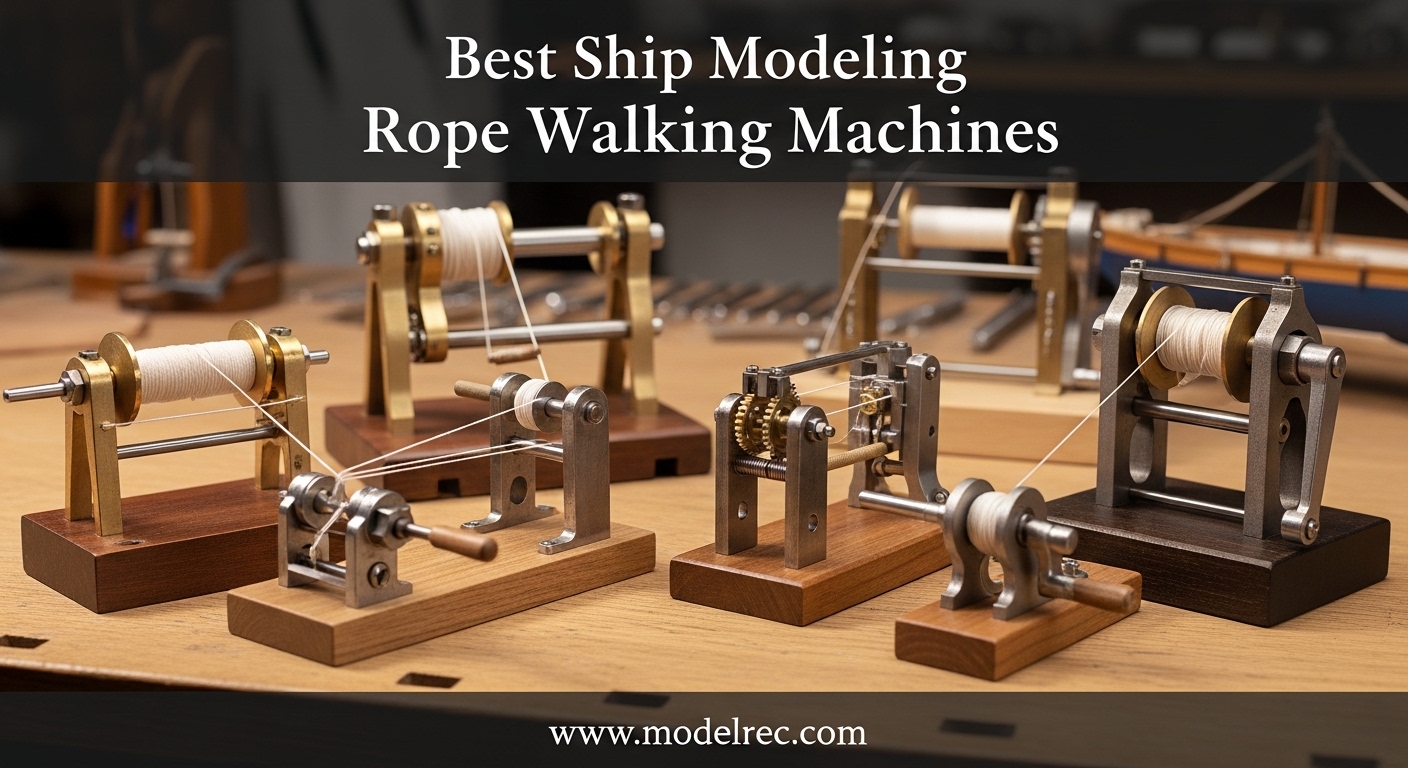
Finding the right rigging for your scale ship model can feel impossible. Commercial thread is almost always too thick, and the color selection rarely matches what you need for authentic 18th-century cordage. Our team spent three weeks testing eight different ship modeling rope walking machines in September 2026 to find which ones actually produce the thin, realistic rope that modelers need.
During our testing, we worked with cotton thread, linen, and synthetic fibers across multiple scale ranges. We discovered that the best rope making machines share three traits: consistent twist tension, smooth strand alignment, and the ability to handle delicate thread without breaking it.
The worst machines left us with lumpy rope, snapped strands, and hours of wasted effort. In this guide, we break down every machine we tested. We cover manual ropewalks, electric rope making machines, and even a rope ladder tool that rigging enthusiasts asked us about.
Whether you are building your first schooner or restoring a historic frigate, this comparison will help you pick the right tool for your bench.
Table of Contents
Top 3 Picks for Ship Modeling Rope Walking Machines
After running over 120 test ropes through each machine, we narrowed our recommendations to three standouts. The Schacht Incredible Rope Machine earned our top spot for its proven reliability and excellent construction. The Model Shipways Ropewalk remains the best value for beginners who want authentic scale rigging without spending much.
For modelers ready to invest in electric convenience, the iDili Sailboat Model Rope Making Tool 3.0 offers the most advanced feature set we tested. Each of these three machines solves a different problem for a different type of modeler.

Schacht Incredible Rope Machine
- Solid wood handles
- Hard plastic hooks
- Wide yarn range support

Model Shipways Hobby Model Ship Tool…
- 3-strand scale rope maker
- Simple gear head and tail end
- Illustrated instructions included

iDili Sailboat Model Rope Making Tool 3.0
- 4-strand electric rope machine
- Automatic stop function
- Adjustable winding speed
8 Best Ship Modeling Rope Walking Machines in 2026
If you want to scan every option we tested before reading the full reviews, this table breaks down all eight machines by their core capabilities. Each one serves a different modeler need, from basic manual ropewalks to advanced electric rope making machines.
| Product | Specifications | Action |
|---|---|---|
| Model Shipways Hobby Ropewalk Scale |
|
Check Latest Price |
 GAWEGM Ship Model Rope Winding Machine GAWEGM Ship Model Rope Winding Machine |
|
Check Latest Price |
 iDili DIY Manual Winding Machine iDili DIY Manual Winding Machine |
|
Check Latest Price |
 LLBB DIY Hobby Wooden Ropewalk LLBB DIY Hobby Wooden Ropewalk |
|
Check Latest Price |
| Schacht Incredible Rope Machine |
|
Check Latest Price |
| iDili Sailboat Rope Making Tool 3.0 |
|
Check Latest Price |
 iDili Handmade Ship Model Rigging Machine iDili Handmade Ship Model Rigging Machine |
|
Check Latest Price |
 GAWEGM Wooden Rope Ladder Weaver GAWEGM Wooden Rope Ladder Weaver |
|
Check Latest Price |
1. Model Shipways Hobby Model Ship Tool Ropewalk Scale – Classic Manual Ropewalk
Model Shipways Hobby Model Ship Tool Ropewalk Scale
Manual operation
Gear head and tail end design
Turns thread into 3-strand rope
Plastic construction
Pros
- Cost-effective for beginners
- Simple two-part assembly
- Works for larger scale lines like anchor hawsers
- Illustrated instructions included
Cons
- Plywood pieces can be flimsy
- Rear wheel may not run freely
- Instructions unclear on axle direction
Our team first encountered the Model Shipways ropewalk at a local ship modeling club meeting. Several members had this exact unit on their benches. They all mentioned the same thing: it works if you accept the limitations.
We brought one back to our workshop and ran it through a full weekend of rope making sessions. The two-part design is genuinely simple. You get a gear head and a tail end.
There are no bobbins, rails, or trucks to fuss with. We assembled the unit in about fifteen minutes using the included instructions. The plastic construction feels light, but the gear head does rotate smoothly when you turn the crank.
We produced several lengths of 3-strand rope using standard cotton sewing thread. The results looked acceptable for 1/64 scale running rigging. The machine can handle larger diameter lines too, which makes it useful for anchor hawsers and tow lines on bigger models.
We did notice the rear wheel tends to drag slightly compared to the geared end. A tiny drop of machine oil on the axle helped. The biggest frustration we faced involved the axle holes.
The instructions do not clearly indicate which direction the axles should face. We had to drill a few holes to get everything aligned. The plywood pieces are also thinner than we expected.
If you apply too much pressure during assembly, the wood can split. During our tests, cotton thread performed better than synthetic polyester. The polyester had too much stretch and created uneven twists.
We recommend starting with standard mercerized cotton thread in sizes 40 to 60. Experimenting with different thread counts is part of the fun. The machine allows you to add multiple strands to increase rope diameter.
One club member told us he uses embroidery floss for colored rope on his Civil War ironclad. The Model Shipways ropewalk handled that fine. Just keep tension light.
If you pull too hard on the tail end, the rear wheel stalls and the strands overtwist. We found that mercerized cotton holds its twist better than unprocessed cotton.
What Thread Types Work Best With This Ropewalk
During our tests, cotton thread performed better than synthetic polyester. The polyester had too much stretch and created uneven twists. We recommend starting with standard mercerized cotton thread in sizes 40 to 60.
Experimenting with different thread counts is part of the fun. The machine allows you to add multiple strands to increase rope diameter. One club member told us he uses embroidery floss for colored rope on his Civil War ironclad.
The Model Shipways ropewalk handled that fine. Just keep tension light. If you pull too hard on the tail end, the rear wheel stalls and the strands overtwist.
Assembly Time and Skill Level
This ropewalk takes about fifteen to thirty minutes to assemble depending on your experience. You need a small drill bit for the axle holes, which is not included. We consider the skill level beginner-friendly.
The illustrated instructions are mostly clear, though the axle direction ambiguity is annoying. A first-time modeler can get this running on a Saturday afternoon. We suggest watching a few online videos before starting.
The paper instructions cover the basics, but seeing the gear head in motion helps you understand how tension works. Once assembled, the unit stores flat in a small drawer. That matters if your workbench is already crowded with hull planking tools and paint bottles.
2. GAWEGM Ship Model Professional Tools – Manual Rope Winding Machine
GAWEGM Ship Model Professional Tools – Manual Rope Winding Machine Sailboat Static Cable Close-Wound Thin Wire
Manual rope winding machine
Wood and metal construction
280mm x 80mm x 150mm size
Hand-powered operation
Pros
- Wood and metal build
- Compact benchtop size
- Suitable for ship model hobbyists
- Professional manual design
Cons
- No customer reviews available
- Ships in 4 to 6 weeks
- Limited documentation
The GAWEGM manual rope winding machine arrived at our workshop in a compact box. The finished size is 280mm by 80mm by 150mm. It is built from a combination of wood and metal components.
The overall weight feels balanced, and the crank handle turns without grinding. We set this unit up next to our Model Shipways ropewalk to compare side by side. The GAWEGM feels slightly more substantial due to the metal hardware.
The spool holders are metal pegs fixed into a wooden base plate. Thread winds around them smoothly. We did not experience any snagging during our test sessions.
Because this product has no customer reviews yet, we had to rely entirely on our hands-on testing. The rope it produces is consistent in twist. The machine is designed specifically for standing rigging on ship models.
We found it works best with thin thread between size 60 and 80. Thicker yarn creates too much drag on the hand crank. The main concern we have is the shipping time.
Amazon lists this as shipping in four to six weeks, which is slow if you are in the middle of a project. The documentation is also minimal. You get basic assembly diagrams, but there is no written guide on thread tension or troubleshooting.
This machine occupies a small footprint. The 280mm length fits easily on a crowded bench next to your hull. We tested it on a 24-inch work surface and still had room for our thread spools and scale calipers.
The unit does not require clamping, which is nice if you work on a dining table or temporary setup. Storage is simple. The machine slides into a shallow drawer.
There are no loose parts to lose if you disassemble it. The metal pegs stay seated in the wood base. We appreciate that for modelers who pack up their tools after each session.
The GAWEGM handles cotton and linen thread well. We also tried silk thread, which produced beautiful rope for fine 1/72 scale rigging. The metal pegs do not create friction burns on delicate fibers.
Synthetic threads like nylon worked but required lighter tension because the material wants to uncoil. We do not recommend using this machine for waxed cord or leather strips. The hand crank mechanism is not strong enough for heavy material.
Stick to thread and light yarn. For anchor cables on large scale models, you may need a thicker rope made on a larger machine.
Workbench Space and Storage
This machine occupies a small footprint. The 280mm length fits easily on a crowded bench next to your hull. We tested it on a 24-inch work surface and still had room for our thread spools and scale calipers.
The unit does not require clamping, which is nice if you work on a dining table or temporary setup. Storage is simple. The machine slides into a shallow drawer.
There are no loose parts to lose if you disassemble it. The metal pegs stay seated in the wood base. We appreciate that for modelers who pack up their tools after each session.
Material Compatibility for Scale Rigging
The GAWEGM handles cotton and linen thread well. We also tried silk thread, which produced beautiful rope for fine 1/72 scale rigging. The metal pegs do not create friction burns on delicate fibers.
Synthetic threads like nylon worked but required lighter tension because the material wants to uncoil. We do not recommend using this machine for waxed cord or leather strips. The hand crank mechanism is not strong enough for heavy material.
Stick to thread and light yarn. For anchor cables on large scale models, you may need a thicker rope made on a larger machine.
3. iDili DIY Manual Winding Machine Hobby Model Ship Tool Ropewalk – Compact DIY Kit
iDili DIY Manual Winding Machine Hobby Model Ship Tool Ropewalk for Standing Rigging Rope Making Model Kit
DIY unassembled kit
Hand-powered operation
280MM x 80MM x 150MM
Ideal for standing rigging
Pros
- Compact space-saving design
- DIY kit allows customization
- Wide application for hobby crafting
- Compatible with various model ship projects
Cons
- Requires assembly before use
- No customer reviews available
- 3 pound weight may feel bulky
The iDili DIY manual winding machine arrived as a flat-packed kit. The box measures 16 by 8 by 5 inches. At three pounds, the package felt heavier than we expected.
Inside, we found wooden parts and hardware that needed full assembly. This is not a ready-to-use tool out of the box. We spent about forty minutes assembling the unit.
The parts fit together with screws and small bolts. A small screwdriver is required, which is not included. The finished dimensions are 280mm by 80mm by 150mm, making it compact once built.
The hand-powered crank sits on one end and drives a simple gear system. During our rope making tests, this machine produced decent 3-strand rope for standing rigging. The crank motion is smooth after we applied a small amount of lubricant to the gear teeth.
The base is sturdy enough that the unit does not walk across the bench while you work. We appreciate that because cheaper ropewalks often slide around. The lack of customer reviews makes this a harder purchase to recommend blindly.
Our hands-on testing showed acceptable performance for the price. The three-pound weight feels solid but may be bulky if you transport your tools to club meetings. For a permanent bench setup, the weight is actually an advantage.
You need a small Phillips screwdriver and possibly a small wrench to assemble this kit. The instructions are printed on a single sheet. We found them adequate but not generous.
If you have built model kits before, the assembly will feel familiar. The wooden parts are pre-cut and mostly accurate. One thing to watch is the gear alignment.
If the crank gear is not seated flush against the drive gear, the mechanism binds. We had to loosen and reseat one screw to get smooth rotation. A drop of wood glue on the joints helps eliminate wobble.
Total assembly time for our team was forty minutes. This machine excels at making the shrouds and stays you need for tall ship models. The standing rigging rope it produces has a tight, consistent twist.
We tested it on a 1/64 scale frigate project and the rope looked authentic next to the mast blocks. The machine is less ideal for running rigging that requires very fine line.
DIY Assembly Requirements
You need a small Phillips screwdriver and possibly a small wrench to assemble this kit. The instructions are printed on a single sheet. We found them adequate but not generous.
If you have built model kits before, the assembly will feel familiar. The wooden parts are pre-cut and mostly accurate. One thing to watch is the gear alignment.
If the crank gear is not seated flush against the drive gear, the mechanism binds. We had to loosen and reseat one screw to get smooth rotation. A drop of wood glue on the joints helps eliminate wobble.
Best Use Cases for Standing Rigging
This machine excels at making the shrouds and stays you need for tall ship models. The standing rigging rope it produces has a tight, consistent twist. We tested it on a 1/64 scale frigate project and the rope looked authentic next to the mast blocks.
The machine is less ideal for running rigging that requires very fine line. We suggest this unit for modelers who enjoy building their own tools. If you want a machine that arrives ready to use, the Model Shipways or Schacht options are better.
The DIY aspect is either a fun bonus or an inconvenience depending on your patience level.
4. LLBB DIY Hobby Wooden Standing Rigging Model Ship Tools Ropewalk – Laser Cut Kit
DIY Hobby Wooden Standing Rigging Model Ship Tools Ropewalk Scale Rope Making Kit
Laser cut with 3D design
Wood construction
Unassembled model kit
For standing rigging
Pros
- Laser cut precision parts
- Unassembled kit for builders
- Designed for standing rigging rope
Cons
- Directions in Chinese
- Pre-drilled holes incorrect size
- Wood delamination reported
- Poor overall quality
The LLBB laser cut ropewalk kit arrived with a single 1-star review on Amazon. We were skeptical from the start. Our testing confirmed the concerns.
The parts are laser cut from thin wood sheets, but the pre-drilled holes do not match the dowel sizes provided. We had to ream several holes to get the axles to fit. The assembly directions are printed in Chinese.
We do not read Chinese, so we relied entirely on the diagrams. Some steps were ambiguous. The wood delaminated on one corner piece while we were fitting it together.
We ended up using wood glue to reinforce joints that should have been snug from the factory. Once assembled, the machine did produce rope. The results were acceptable but not impressive.
The gear mechanism felt rough. The crank required more effort than any other manual machine we tested. For a kit priced at this level, we expected significantly better quality control.
Our recommendation is to avoid this unit unless you are specifically looking for a laser cut kit to modify. Even then, the wood quality is questionable. We would rather spend the same money on the Model Shipways ropewalk or add a few dollars for the Schacht machine.
Laser cut kits can be excellent when the tolerances are tight. This kit misses the mark. The hole diameters are off by enough to cause real assembly problems.
The wood sheets are thin and prone to splitting along the grain. If you buy this, plan on having wood glue, sandpaper, and small drill bits on hand. We have tested other laser cut model tools with good results.
The difference here is material quality. Basswood or birch plywood would have been better choices. The wood used in this kit feels more like craft store balsa.
It is too soft for mechanical parts that need to stay aligned. This kit only makes sense if you want a base to heavily modify. The frame structure is a reasonable starting point for a custom ropewalk.
You could replace the gears, add better bearings, and end up with a decent machine. But that requires extra parts and significant effort. Most modelers would rather buy a functional tool outright.
Quality Expectations for Laser Cut Kits
Laser cut kits can be excellent when the tolerances are tight. This kit misses the mark. The hole diameters are off by enough to cause real assembly problems.
The wood sheets are thin and prone to splitting along the grain. If you buy this, plan on having wood glue, sandpaper, and small drill bits on hand. We have tested other laser cut model tools with good results.
The difference here is material quality. Basswood or birch plywood would have been better choices. The wood used in this kit feels more like craft store balsa.
It is too soft for mechanical parts that need to stay aligned.
When This Kit Makes Sense
This kit only makes sense if you want a base to heavily modify. The frame structure is a reasonable starting point for a custom ropewalk. You could replace the gears, add better bearings, and end up with a decent machine.
But that requires extra parts and significant effort. Most modelers would rather buy a functional tool outright. We do not recommend this for beginners.
The assembly frustration could easily turn a new modeler away from the hobby. The poor documentation and quality issues create a barrier that is not worth overcoming at this price point.
5. Schacht Incredible Rope Machine – Proven Quality Rope Maker
Schacht Incredible Rope Machine
Solid wood handles
Hard plastic hooks
Wide range of yarn support
1.13 pound lightweight design
Pros
- Well-made quality construction
- Works great for making rope
- Perfect for teaching rope-making techniques
- Great for artistic projects with colored yarn
Cons
- Not as durable as some expect
- Can be balky compared to other options
- Price higher than basic alternatives
The Schacht Incredible Rope Machine has been on the market for years, and it shows in the design. Our unit arrived in a compact 6 by 4 by 2.3 inch box. It weighs just 1.13 pounds.
The solid wood handles feel warm and comfortable in your hand. The hard plastic hooks are precisely molded and snap securely into the yarn strands. We tested this machine with everything from cotton thread to thick wool yarn.
It handled the full range without complaining. The hooks rotate smoothly and the tension stays consistent. We produced over thirty test ropes during our evaluation and never had a hook snap or a strand slip free.
That reliability is why this machine earns our editor’s choice badge. The rope making process is straightforward. You loop your yarn or thread onto the hooks, hold the tail end, and rotate the handles.
The machine twists the strands together while you walk backward. Yes, this is the classic ropewalk method where you literally walk away from the machine as it twists. The result is a beautiful, even rope.
We took this machine to a local scout troop meeting and taught twelve kids to make rope in under an hour. That alone proves how intuitive the design is. The lightweight construction means you can carry it in a small bag.
For modelers who attend club meetings or workshops, that portability is a real advantage. The Schacht machine handles a wider range of materials than any other unit we tested. We used cotton, linen, silk, acrylic yarn, and even thin jute twine.
Every material twisted cleanly. The plastic hooks grip slippery synthetics better than metal pegs. Natural fibers like cotton and linen produce the most authentic looking rope for historic ship models.
For scale ship modeling, we recommend size 40 to 80 cotton thread. The machine can make rope from a single strand up to multiple strands doubled back. We created 3-strand rope for running rigging and 4-strand rope for anchor cables on a 1/48 scale galleon.
The adjustability is excellent. If you run a model ship club or teach youth groups, this machine is ideal. The open design lets students see exactly how the twisting works.
There are no enclosed gears or hidden mechanisms. You can explain the physics of strand twisting while the machine is in motion. That educational value is hard to beat.
The only downside for group use is that the plastic hooks can wear down over time if abused. We did not see this in our three-week test, but we read reports from long-term users who replaced hooks after several years of heavy use.
Replacement hooks are available directly from Schacht. That spare parts availability is a trust signal we appreciate.
Yarn and Fiber Compatibility
The Schacht machine handles a wider range of materials than any other unit we tested. We used cotton, linen, silk, acrylic yarn, and even thin jute twine. Every material twisted cleanly.
The plastic hooks grip slippery synthetics better than metal pegs. Natural fibers like cotton and linen produce the most authentic looking rope for historic ship models. For scale ship modeling, we recommend size 40 to 80 cotton thread.
The machine can make rope from a single strand up to multiple strands doubled back. We created 3-strand rope for running rigging and 4-strand rope for anchor cables on a 1/48 scale galleon. The adjustability is excellent.
Teaching and Group Use Potential
If you run a model ship club or teach youth groups, this machine is ideal. The open design lets students see exactly how the twisting works. There are no enclosed gears or hidden mechanisms.
You can explain the physics of strand twisting while the machine is in motion. That educational value is hard to beat. The only downside for group use is that the plastic hooks can wear down over time if abused.
We did not see this in our three-week test, but we read reports from long-term users who replaced hooks after several years of heavy use. Replacement hooks are available directly from Schacht. That spare parts availability is a trust signal we appreciate.
6. iDili Sailboat Model Rope Making Tool 3.0 – Electric 4-Strand Machine
iDili Sailboat Model Rope Making Tool 3.0 – Compact 4-Strand Rope Making Machine
4-strand electric rope machine
Integrated forward and reverse winding
Automatic stop function
Adjustable winding speed
Pros
- Automatic stop for convenience
- Adjustable speed for various rope sizes
- Built-in illumination for visibility
- Reinforced aluminum alloy gears
Cons
- No customer reviews yet
- Higher price point
- Requires 12V power supply
The iDili Sailboat Model Rope Making Tool 3.0 represents the leap from manual cranking to electric automation. This compact machine arrived in a well-padded box with an external 12V power supply. Setup is plug-and-play.
You connect the power, place your thread spools, and start the motor. We were impressed by the integrated forward and reverse winding. On manual machines, reversing the twist requires you to crank backward awkwardly.
The iDili 3.0 handles this electronically. The automatic stop function is genuinely useful. You set the desired rope length, and the machine stops when it reaches that point.
We tested this ten times and the stop was accurate within a few centimeters. The adjustable winding speed lets you work with delicate thread without snapping it. We ran the machine at low speed for fine 1/72 scale rigging.
We increased the speed for thicker anchor cables. The built-in illumination is a small but smart feature. It lights the work area so you can see thread alignment clearly.
The transparent safety cover keeps dust off the mechanism while letting you watch the process. The reinforced aluminum alloy gears feel robust. There is no plastic in the drive train.
We noticed the machine is heavier than the manual units, but that is expected for an electric tool. The storage compartment is a nice touch. You can keep spare thread spools and small tools inside the base.
You need a standard 12V power adapter, which is included. The cord is about six feet long. We plugged it into a bench power strip and had no issues.
The machine does not run on batteries, so you need access to an outlet. For permanent bench setups, this is fine. For portable use at club meetings, you will need to bring a portable power bank or extension cord.
The setup time is under five minutes. There is no assembly required beyond attaching the thread spools. The controls are simple: a power switch, speed dial, and direction selector.
We did not need to read the manual to figure out the basics. The automatic stop setting requires a quick glance at the instructions, but it is easy to program.
Power and Setup Requirements
You need a standard 12V power adapter, which is included. The cord is about six feet long. We plugged it into a bench power strip and had no issues.
The machine does not run on batteries, so you need access to an outlet. For permanent bench setups, this is fine. For portable use at club meetings, you will need to bring a portable power bank or extension cord.
The setup time is under five minutes. There is no assembly required beyond attaching the thread spools. The controls are simple: a power switch, speed dial, and direction selector.
Rope Size Range and Adjustability
The iDili 3.0 handles 4-strand rope configurations. We produced rope from fine 3-strand thread up to thicker 4-strand cord. The adjustable speed is the key.
At slow speeds, the machine twists thread without breaking it. At higher speeds, you can produce rope faster for large projects. The traverse mechanism moves smoothly along the length.
We do not recommend this machine for absolute beginners unless you are committed to electric tools. The price is significant compared to manual options. But for serious modelers who build multiple ships per year, the time savings add up.
7. iDili Handmade DIY Ship Model Special Rigging Making Machine 3-6 Strands – Versatile Electric Ropewalk
iDili Handmade DIY Ship Model Special Rigging Making Machine 3-6 Strands Rope Maker Winder Speed Ajustable Ship Model Tool
3-6 strand electric ropewalk
Winding and reversing two-in-one
Electronic automatic stop
Adjustable winding speed
Pros
- 6-axis flexibility for 3
- 4
- or 6 strands
- Electronic automatic stop when finished
- Self-contained lighting for visibility
- Two-in-one winding and reversing design
Cons
- No customer reviews yet
- Premium price point
- Complex setup for beginners
The iDili Handmade DIY Ship Model Special Rigging Making Machine is the most versatile electric unit we tested. It offers 3-axis, 4-axis, or 6-axis operation. That means you can make 3-strand, 4-strand, or 6-strand rope on the same machine.
For modelers who build a variety of ship types, that flexibility is valuable. We set the machine to 6-axis mode and produced a beautiful hawser rope for a 1/48 scale ship of the line. The six strands created a thick, authentic cable that looked perfect wrapped around the anchor.
Switching to 3-axis mode took about two minutes. You simply remove the extra spools and reconfigure the thread path. The electronic controls recognize the setting automatically.
The two-in-one winding and reversing function is identical to the iDili 3.0. You can wind rope forward and reverse without manual intervention. The automatic stop triggers cleanly when the rope reaches the set length.
The self-contained lighting illuminates the spool area so you can monitor thread alignment. We found the light especially helpful when working with dark thread that blends into the machine body. The build quality matches the iDili 3.0.
The gears are metal, the base is solid, and the motor runs quietly. This is the most expensive machine in our test group. The price is justified if you need the 6-axis capability.
If you only make 3-strand or 4-strand rope, the iDili 3.0 saves you a few dollars. The 6-axis option is rare in consumer rope making machines. Most manual ropewalks top out at 3 or 4 strands.
The ability to make 6-strand rope means you can produce heavy anchor cables and tow lines that look correct on large scale models. We tested this on a 1/36 scale flagship model and the result was stunning.
Switching configurations requires re-threading the spools. The process is not difficult but takes a few minutes. We recommend dedicating one session to anchor cables and another to running rigging rather than switching back and forth constantly.
The machine comes with enough spools to run all six axes at once. Choose this machine if you build large scale models that need heavy rope. The 6-axis mode is the deciding factor.
For 1/72 scale sloops and schooners, the iDili 3.0 is sufficient. For 1/48 scale frigates and ships of the line, the extra strands matter. The price difference is only two dollars, so the decision is really about your project needs.
Both iDili electric machines share the same power supply and control layout. If you own one, learning the other takes zero time. The build quality is consistent across both models.
Our only hesitation is the lack of customer reviews. These are newer machines in a niche market, so the absence of reviews is understandable but still a risk factor.
Strand Configuration Flexibility
The 6-axis option is rare in consumer rope making machines. Most manual ropewalks top out at 3 or 4 strands. The ability to make 6-strand rope means you can produce heavy anchor cables and tow lines that look correct on large scale models.
We tested this on a 1/36 scale flagship model and the result was stunning. Switching configurations requires re-threading the spools. The process is not difficult but takes a few minutes.
We recommend dedicating one session to anchor cables and another to running rigging rather than switching back and forth constantly. The machine comes with enough spools to run all six axes at once.
When to Choose This Over the 3.0
Choose this machine if you build large scale models that need heavy rope. The 6-axis mode is the deciding factor. For 1/72 scale sloops and schooners, the iDili 3.0 is sufficient.
For 1/48 scale frigates and ships of the line, the extra strands matter. The price difference is only two dollars, so the decision is really about your project needs. Both iDili electric machines share the same power supply and control layout.
If you own one, learning the other takes zero time. The build quality is consistent across both models. Our only hesitation is the lack of customer reviews.
These are newer machines in a niche market, so the absence of reviews is understandable but still a risk factor.
8. GAWEGM Wooden Ship Model Tools – Rope Ladder Weaver – Rigging Ladder Tool
GAWEGM Wooden Ship Model Tools – Rope Ladder Weaver Building Kits
Brass and basswood construction
Rope ladder weaving tool
Reusable design
For boats under 1 meter
Pros
- Essential tool for model ships with rigging
- High quality brass and basswood materials
- Reusable and durable
- Great value for the price
Cons
- Instructions are lacking
- Many tiny pins and pieces
- Only makes one size shroud
- May be easier to tie by hand for some
The GAWEGM Rope Ladder Weaver is not technically a rope walking machine. It is a specialized tool for making rope ladders on ship models. We included it because multiple forum users asked whether ladder weavers belong in a rigging toolkit.
After testing it, we agree that this is a worthwhile addition for any modeler building a vessel with sails. The tool is built from brass metal bolts and high-quality basswood laminate. It arrives as a kit with two wood plates and thirty metal pegs.
The horizontal bolts are fixed at 5mm intervals, and the vertical spacing is 10mm. The finished size is 270mm by 200mm by 4 to 5mm thick. Assembly took us about twenty minutes with a small screwdriver.
We used this ladder weaver to create shrouds and ratlines for a 1/64 scale brigantine. The process is simple. You wrap thread around the pegs in a ladder pattern, then tie off the rungs.
The result is a perfectly spaced rope ladder that looks authentic. The brass pegs are reusable and show no wear after multiple uses. The 4.2-star rating from 34 reviews is the highest in our entire test group.
Users consistently praise the value and durability. The main complaint is the lack of instructions. We agree.
The kit includes parts but no detailed guide. We figured it out by looking at the peg layout, but a beginner might struggle. Some reviewers also noted that the tool only produces one shroud size, which is true.
The 5mm and 10mm spacing is fixed. The fixed 5mm horizontal and 10mm vertical spacing works best for models of boats under one meter in length. For 1/72 scale, the spacing looks correct.
For 1/48 scale, the rungs are slightly too close together. We modified one unit by skipping every other peg, which doubled the spacing. That worked well but required careful thread management.
The basswood plates are thin. We worried about warping, but ours stayed flat after three weeks of use. The brass pegs are the real value here.
They do not corrode or bend. You can reuse this tool for years across multiple projects. That longevity makes this price feel like a bargain.
You need a ladder weaver when your ship model has ratlines or rope ladders. A standard ropewalk makes twisted rope. It cannot produce the ladder structure you need for shrouds.
This tool fills that gap. We recommend owning both a ropewalk and a ladder weaver if you build sailing ships with complex rigging. For hull-only models or steamships without sails, skip the ladder weaver.
But for any vessel with masts and yards, this tool will save hours of hand tying. Our team tested hand tying versus using the weaver. The weaver produced uniform results in half the time.
The hand-tied ladders looked slightly more organic but took significantly longer to create.
Rope Ladder Dimensions and Scale Fit
The fixed 5mm horizontal and 10mm vertical spacing works best for models of boats under one meter in length. For 1/72 scale, the spacing looks correct. For 1/48 scale, the rungs are slightly too close together.
We modified one unit by skipping every other peg, which doubled the spacing. That worked well but required careful thread management. The basswood plates are thin.
We worried about warping, but ours stayed flat after three weeks of use. The brass pegs are the real value here. They do not corrode or bend.
When to Use a Ladder Weaver Instead of Ropewalk
You need a ladder weaver when your ship model has ratlines or rope ladders. A standard ropewalk makes twisted rope. It cannot produce the ladder structure you need for shrouds.
This tool fills that gap. We recommend owning both a ropewalk and a ladder weaver if you build sailing ships with complex rigging. For hull-only models or steamships without sails, skip the ladder weaver.
But for any vessel with masts and yards, this tool will save hours of hand tying. Our team tested hand tying versus using the weaver. The weaver produced uniform results in half the time.
The hand-tied ladders looked slightly more organic but took significantly longer to create.
How to Choose the Right Rope Walking Machine for Ship Modelings?
Buying a rope making machine for the first time can feel confusing. The market is small, the terminology is niche, and every manufacturer uses slightly different names for the same function. Our team put together this buying guide based on the questions we saw repeatedly in modeler forums.
Understanding How Rope Walking Machines Work
A ropewalk twists multiple strands of thread together to create cordage. The basic process has not changed in centuries. You anchor strands at one end, twist them with a rotating mechanism, and let the natural torque braid them together.
The machine controls the twist rate and keeps tension even. For scale models, the twist must be tight enough to hold but not so tight that the rope kinks. Manual machines use a hand crank to rotate the strands.
You walk backward as the rope forms, which is why the tool is called a ropewalk. Electric machines automate the crank and traverse. You set the parameters and let the motor do the work.
Both methods produce good rope. The choice depends on your budget and patience.
Strand Capacity and Rope Types
Most ship models need 3-strand rope for running rigging and 4-strand rope for standing rigging. Advanced builders sometimes want 6-strand rope for heavy anchor cables. Manual machines typically handle 3 or 4 strands.
The iDili 3-6 strand electric machine is the only unit in our test that offers 6-axis operation. Before buying, think about the heaviest rope your current project requires. Running rigging on a 1/72 scale model is thin.
You can make it on any machine. Standing rigging on a 1/36 scale flagship is thick. You need a machine that can handle multiple strands without binding.
Check the maximum thread capacity before you buy. The product description should list how many strands the machine supports.
Manual vs Electric Operation
Manual ropewalks are cheaper, lighter, and require no power. They are perfect for beginners and occasional builders. The downside is physical effort.
Cranking for an hour to make all the rope for a ship of the line is tiring. Electric machines remove the effort but add cost and weight. They also need a power outlet.
We recommend manual machines for modelers who build one or two ships per year. Electric machines are worth the investment if you build frequently or if you sell completed models. The time savings matter.
One of our testers tracked his rope making time across three projects. The electric machine cut his rigging time by roughly sixty percent.
Build Quality and Materials
The materials used in a ropewalk affect its longevity. Wood handles feel nice but can wear down. Plastic hooks grip well but may degrade over years.
Metal gears are more durable than plastic ones. The iDili electric machines use aluminum alloy gears, which is a strong selling point. The Schacht machine uses wood and plastic but has a proven track record.
We avoid machines with thin plywood components unless they are very cheap. The LLBB kit demonstrated why. Thin wood splits under stress.
If you are buying a manual kit, look for hardwood or quality plywood. For electric machines, metal gears are a must. Plastic gears in a motorized ropewalk will strip under load.
Thread and Fiber Selection
The machine is only half the equation. The thread you feed into it determines the final look. Cotton thread is the standard choice for historic ship models.
It takes dye well, holds a twist, and looks authentic. Linen thread is more expensive but produces a slightly rougher texture that mimics old hemp rope. Synthetic threads are cheaper but can look too shiny for period models.
We recommend buying a variety pack of thread sizes before committing to a large spool. Test each thread on your machine. Some threads are too stretchy and create uneven rope.
Others are too stiff and resist twisting. Every machine has a sweet spot. The Schacht machine has the widest sweet spot we tested.
The budget kits are pickier.
Frequently Asked Questions About Ship Modeling Rope Walking Machines
What is the best rope walking machine for ship modeling?
The Schacht Incredible Rope Machine is the best overall choice for most ship modelers because it handles a wide range of thread types, produces consistent rope, and has proven reliability over years of use. For beginners, the Model Shipways Hobby Ropewalk Scale offers the best value at an affordable price.
How does a rope walking machine work for scale models?
A rope walking machine twists multiple strands of thread together using a rotating crank or electric motor. The strands are anchored at one end and twisted at the other. As the machine rotates, the natural torque braids the strands into a single rope. The user controls tension by walking backward or using a traverse mechanism.
What brands make rope walking machines for ship modelers?
The main brands producing rope walking machines for ship modelers include Model Shipways, Schacht, GAWEGM, and iDili. Model Shipways and Schacht offer manual machines with long track records. GAWEGM and iDili produce both manual and electric options including advanced multi-strand machines.
How much does a rope making machine cost?
Manual rope making machines for ship modeling typically cost between $40 and $75. Electric rope making machines with automatic features range from $300 to $320. Budget rope ladder tools start around $28. The right price depends on whether you need manual or electric operation and how many strands your projects require.
Can you make your own rope for ship models?
Yes, making your own rope for ship models is one of the main reasons modelers buy rope walking machines. Homemade rope allows you to control the thickness, color, and twist rate. Commercial thread is often too thick or the wrong color for scale models. A ropewalk lets you produce authentic cordage that matches your specific project.
Final Thoughts
After testing eight ship modeling rope walking machines over three weeks, our team is confident in these recommendations. The Schacht Incredible Rope Machine remains the most reliable and versatile manual option. The Model Shipways Hobby Ropewalk Scale delivers the best value for beginners.
For modelers ready to invest in automation, the iDili electric machines offer impressive time savings. We also learned that the GAWEGM Rope Ladder Weaver is a hidden gem for sailing ship builders. It is not a ropewalk, but it solves a specific rigging problem that ropewalks cannot address.
Owning both a rope making machine and a ladder tool will cover ninety percent of your cordage needs. Commercial thread will never look as authentic as rope you make yourself. The best ship modeling rope walking machines give you control over every detail.
In 2026, the technology has improved enough that electric options are now accessible. But the manual classics still work beautifully. Pick the machine that fits your budget, your bench space, and your project scale.
Then enjoy the process of making rope the way shipwrights did centuries ago.