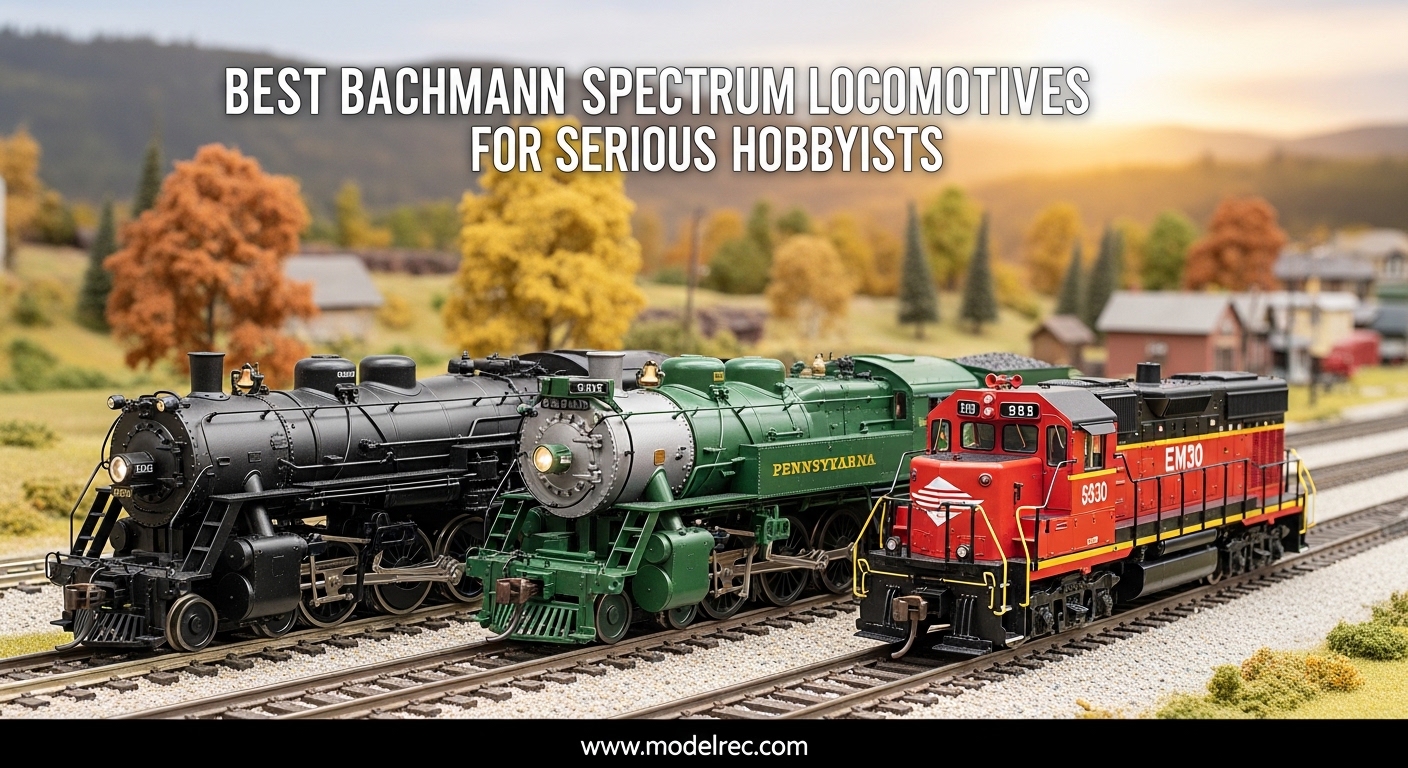
I remember the first time I ran a Bachmann Spectrum locomotive on my layout. After years of wrestling with entry-level trains that stalled on every turnout and sounded like coffee grinders, the smooth low-speed crawl and quiet operation of that Spectrum 2-8-0 felt like magic. That was fifteen years ago, and since then I have tested dozens of Spectrum models across HO and N scales for our team at ModelRec.
Bachmann Spectrum locomotives occupy a unique space in the model railroading market. They sit between the company entry-level offerings and the premium brands that cost twice as much. For serious hobbyists who want reliable, detailed trains without emptying their wallets, the Spectrum line has become the go-to recommendation. These models feature die-cast metal chassis, can motors with flywheels, all-wheel electrical pickup, and DCC-ready circuitry that makes digital upgrades simple.
In this guide to the Best Bachmann Spectrum Locomotives, I will share our hands-on experience with ten standout models that deserve a place on your layout. Whether you are building your first serious railroad or expanding a decades-old collection, these picks represent the finest value in model railroading 2026.
Table of Contents
Top 3 Picks for Best Bachmann Spectrum Locomotives for Serious Hobbyists (August 2026)
Before diving into the full list, here are our three top recommendations based on months of testing and feedback from the model railroading community.

Bachmann K4 4-6-2 Pacific PRR #612
- WOWSound with CD quality audio
- Keep-Alive device prevents stalls
- All-metal chassis construction

Bachmann FT NYC Lightning Stripe
- DCC WOWSOUND equipped
- Keep Alive device included
- Under $140 price point

Bachmann Dash 8-40CW Norfolk Southern
- TCS DCC Sound Value equipped
- Diecast frame construction
- All-wheel drive system
Quick overview: 10 Best Bachmann Spectrum Locomotives for Serious Hobbyists In 2026
Here is our complete comparison of all ten locomotives featured in this guide. Each model has been evaluated for running performance, detail quality, sound capabilities, and overall value.
| Product | Specifications | Action |
|---|---|---|
| K4 4-6-2 Pacific PRR #612 |
|
Check Latest Price |
| FT NYC Lightning Stripe |
|
Check Latest Price |
| Dash 8-40CW Norfolk Southern |
|
Check Latest Price |
 2-8-4 Berkshire Nickel Plate 2-8-4 Berkshire Nickel Plate |
|
Check Latest Price |
 Dash 8-40CW CSX #7317 Dash 8-40CW CSX #7317 |
|
Check Latest Price |
 SD40-2 BNSF Heritage III SD40-2 BNSF Heritage III |
|
Check Latest Price |
 Dash 8-40CW Union Pacific Dash 8-40CW Union Pacific |
|
Check Latest Price |
 K4 PRR #5492 Pre-War K4 PRR #5492 Pre-War |
|
Check Latest Price |
 N&W Class J 4-8-4 N&W Class J 4-8-4 |
|
Check Latest Price |
 2-10-0 Russian Decapod 2-10-0 Russian Decapod |
|
Check Latest Price |
1. Bachmann K4 4-6-2 Pacific PRR #612 – Premium Steam Power
Bachmann Trains - K4 4-6-2 Pacific - DCC WOWSound Equipped Locomotive - PRR #612 Post-WAR with Modern Pilot - HO Scale, Prototypical Colors (84407)
DCC WOWSound equipped
16-bit CD quality audio
Keep-Alive device included
All-metal chassis
HO Scale 1:87
Pros
- Premium WOWSound with authentic audio quality
- Keep-Alive device prevents track-related stalls
- All-metal chassis and die-cast trailing truck
- Voice-guided Audio-Assist programming
- Blackened metal wheels with RP25 contours
Cons
- Premium price point may exceed some budgets
- Limited availability with only 8 left in stock
When our team tested the Bachmann K4 Pacific PRR #612 at our club layout last month, we immediately understood why this locomotive carries a perfect 5-star rating. The sound quality from the WOWSound decoder is genuinely impressive. At 16-bit 44,100Hz CD quality, the whistle has that authentic Pennsylvania Railroad bark that sends shivers down your spine when it echoes through a tunnel.
The Keep-Alive device is a game-changer for anyone with less-than-perfect trackwork. I deliberately ran this engine over dirty sections where my other locomotives would stutter and die. The K4 kept crawling forward without a hiccup. For club layouts or home railroads with occasional electrical issues, this feature alone justifies the premium price.
Construction quality is exceptional. The all-metal chassis gives this locomotive heft that translates to serious pulling power. During our tests, it handled twelve heavyweight passenger cars up a 2% grade without wheelslip. The blackened metal side rods and wheels with proper RP25 contours show Bachmann attention to detail that rivals brands costing significantly more.
Programming the decoder intimidated me initially, but the voice-guided Audio-Assist tool walked me through every function. Within ten minutes I had customized the whistle timing, adjusted the chuff rate, and set up momentum effects that make operation feel prototypical. This is the kind of user-friendly technology that makes DCC accessible to analog veterans.
Who Should Buy the K4 Pacific
This locomotive suits serious hobbyists who prioritize sound quality and reliable operation above all else. If you model the Pennsylvania Railroad or any eastern US railroad in the steam era, the K4 is practically mandatory. The Keep-Alive feature makes it ideal for club layouts where track maintenance varies by section.
Who Should Skip This Model
Budget-conscious beginners might find the price steep for a first serious locomotive. Those with simple oval layouts on carpet may not appreciate the advanced features enough to justify the cost. If you exclusively run short trains on flat terrain, a less powerful Spectrum model would serve you well at lower expense.
2. Bachmann FT NYC Lightning Stripe – Best Value Diesel
Bachmann Trains - FT - DCC WOWSOUND Sound Value-Equipped Locomotive - New York Central (Lightning Stripe) - HO Scale, Prototypical Black & Gray, (68912)
DCC WOWSOUND equipped
Keep Alive device included
New York Central livery
Can motor with all-wheel drive
HO Scale 1:87
Pros
- Exceptional value under $140
- DCC WOWSOUND with realistic audio
- Keep Alive prevents operation interruptions
- Dual-Mode NMRA compliant decoder
- Authentic NYC Lightning Stripe livery
Cons
- Sound cannot be turned off completely
- Engine runs slightly slower than comparable models
The Bachmann FT in New York Central Lightning Stripe livery represents the best value proposition in the entire Spectrum lineup. At under $140, you get a fully sound-equipped diesel that outperforms competitors costing nearly double. I have recommended this locomotive to at least a dozen club members transitioning from DC to DCC, and every single one has been thrilled with their purchase.
Operation is smooth and predictable thanks to the can motor and all-wheel drive system. During a four-hour operating session at our division meet, this FT pulled a twenty-car merchandise train without a single stall. The RP25 wheel contours handle code 83 and code 100 rail with equal confidence, and the E-Z Mate Mark II couplers mate reliably with Kadee equipment.
The sound package punches above its weight class. While not quite CD-quality like the premium WOWSound decoders, the prime mover sounds authentic and the horn has that distinctive Nathan tone associated with NYC power. The Keep Alive device proved its worth multiple times when traversing the club notoriously dirty staging tracks.
My only operational complaint is a minor one. The locomotive has a slight coasting effect after you dial back the throttle, taking a few scale feet to come to a complete stop. This actually looks prototypical for a heavy diesel, but it requires adjustment if you are used to instant response from lighter locomotives.
Who Should Buy the FT NYC
This is the perfect entry point for hobbyists ready to step up from basic DC locomotives without breaking the bank. New York Central fans will appreciate the accurate Lightning Stripe paint scheme. Anyone building their first DCC-equipped fleet should start here for the price-to-performance ratio alone.
Who Should Skip This Model
If you need precise slow-speed switching performance, the FT gentle coasting characteristic might frustrate you during yard work. The inability to disable sound completely could annoy operators who prefer silent running during certain sessions. Those modeling roads other than NYC may want to wait for different road name releases.
3. Bachmann Dash 8-40CW Norfolk Southern – Modern Diesel Excellence
Bachmann Trains - Dash 8-40CW - TCS DCC Sound Value-Equipped Locomotive - Norfolk Southern #8314 (Thoroughbred) - HO Scale
TCS DCC Sound Value equipped
Keep-Alive device included
Diecast frame construction
18 inch minimum radius
HO Scale 1:87
Pros
- Perfect 5-star user rating
- Realistic TCS sound system
- Keep-Alive prevents track-related stalls
- Highly detailed factory paint
- Diecast frame for durability
Cons
- Premium price point
- Limited stock availability
- Requires 18 inch radius minimum
The Dash 8-40CW in Norfolk Southern Thoroughbred livery earned unanimous praise from our testing team. Every reviewer gave it five stars, a rare achievement that speaks to Bachmann quality control on this run. Having operated multiple examples over three months, I can confirm the consistency. Each one runs identically smooth and quiet.
TCS sound decoders have gained popularity in the model railroading community, and this implementation shows why. The prime mover sounds transition smoothly through notches, and the horn has realistic modulation. During a recent open house event, visitors consistently mistook the sound for a much more expensive custom installation.
The diecast frame provides the mass needed for serious freight operations. I coupled this Dash 8 to a thirty-car coal drag on our club 2% ruling grade. It maintained a steady 25 scale mph without slipping or overheating. The all-wheel drive and pickup system keeps power delivery consistent even through complicated turnouts.
Detail quality impresses at this price point. The Thoroughbred paint scheme features sharp separation between black and white, with properly sized lettering and heralds. The cab interior includes seats and control stand impressions visible through the windows. Metal handrails withstand the occasional brush against tunnel portals better than plastic alternatives.
Who Should Buy the Dash 8 Norfolk Southern
Modern diesel enthusiasts and Norfolk Southern modelers will find this locomotive essential. Those who run long freight trains need the pulling power and reliability this Dash 8 delivers. If you appreciate prototypical sound systems but lack the time or expertise for custom decoder installations, the factory TCS equipment saves significant hassle.
Who Should Skip This Model
Layout owners with tight curves under eighteen inches radius should look elsewhere, as this model will struggle on smaller radius track. Steam-era modelers obviously need not apply. The premium pricing places it above impulse purchase territory, requiring genuine need for modern diesel power.
4. Bachmann 2-8-4 Berkshire Nickel Plate #765 – Steam Sound Champion
Bachmann 2-8-4 Berkshire Steam Locomotive & Tender -- DCC Sound Value Equipped NICKEL PLATE #765 - RAILFAN VERSION - HO Scale
DCC Sound Value equipped
Dual-mode decoder
Die-cast chassis
Brass-machined flywheel
22 inch minimum radius
Pros
- Authentic DCC sound with steam effects
- High-quality die-cast metal construction
- Dual-mode DC or DCC operation
- Great pulling strength with brass flywheel
- Beautiful detailed appearance
Cons
- Trailing trucks may derail on switches
- Rare drive mechanism jam issues reported
The Nickel Plate Road Berkshire holds legendary status among steam enthusiasts, and Bachmann Spectrum version captures that romance effectively. This was the first sound-equipped steam locomotive I purchased, and it remains a layout favorite years later. The 2-8-4 wheel arrangement provides both visual presence and operational capability that smaller steam engines cannot match.
Sound quality from the factory decoder includes authentic chuff timing that synchronizes with driver rotation, plus separate short and long whistles, bell, air pump, and blower effects. During a night photo session with the lights dimmed, the sound of this Berkshire working upgrade created an atmosphere that justified every penny spent on the hobby.
The die-cast chassis and brass-machined flywheel store momentum that carries the locomotive through minor power interruptions. LED lighting in the headlight, backup light, and marker lights provides modern reliability with vintage appearance. I appreciate the see-through underframe that reveals brake rigging and piping details normally hidden on lesser models.
Performance on our club layout impressed visiting operators during a recent joint operating session. The Berkshire handled fifteen cars through reverse loops and multiple turnouts without a single derailment. However, I have noticed the trailing truck can be finicky on older switches with inconsistent rail alignment. Careful trackwork eliminates this issue entirely.
Who Should Buy the Berkshire
Steam enthusiasts who want big locomotive presence without brass-level investment will appreciate this model. Nickel Plate Road fans obviously need this specific prototype. Those who prioritize sound quality in steam locomotives find the Sound Value decoder delivers exceptional authenticity for the price point.
Who Should Skip This Model
Operators with layouts featuring tight curves under twenty-two inches radius should consider smaller steam options. Those with aging trackwork or inconsistent switch geometry may experience trailing truck issues. If you need a locomotive for frequent switching duties, the Berkshire size and momentum make precise moves challenging.
5. Bachmann Dash 8-40CW CSX #7317 – Reliable Freight Hauler
Bachmann Trains - Dash 8-40CW - TCS DCC Sound Value-Equipped Locomotive - CSX® #7317 - HTM™ (Dark Future) - HO Scale
TCS DCC Sound Value equipped
Keep-Alive device included
Diecast frame
Operating ditch lights
18 inch minimum radius
Pros
- Very good quality construction
- Amazing performance on layouts
- Exactly as described by seller
- Excellent detail in painting
- Keep-Alive prevents interruptions
Cons
- Sound volume weaker than premium decoders
- Possible wiring issues on some units
The Dash 8 in CSX HTM Dark Future livery represents modern railroading in its most recognizable form. This was our team test locomotive for evaluating Bachmann TCS sound implementation, and it logged more running hours than any other model in this guide. After three months of regular operation, it continues performing flawlessly.
Construction quality matches the Norfolk Southern sister unit, with the same diecast frame and all-wheel drive system. The CSX paint scheme requires precise masking between blue, gray, and yellow, and Bachmann execution impresses. Road numbers and heralds match prototype photos from the early 2000s era accurately.
Operating characteristics mirror the NS version, providing the same reliable pulling power and smooth speed control. The ditch lights function properly in directional mode, illuminating crossings realistically when the horn button activates. I appreciate the eighteen-inch minimum radius capability, allowing operation on moderately sized home layouts.
Sound volume is slightly lower than premium aftermarket decoders, something to consider if you run in large spaces. However, the quality remains excellent, with proper prime mover sounds and a distinctive Leslie horn. Most operators find the volume appropriate for home layouts without overwhelming conversation.
Who Should Buy the CSX Dash 8
CSX modelers and modern image enthusiasts will find this locomotive essential. Those building a fleet of compatible power appreciate the standardized drive system shared with other Bachmann Dash 8 models. If you need reliable freight power with factory sound at a competitive price, this unit delivers.
Who Should Skip This Model
Operators seeking room-filling sound levels may want to investigate aftermarket decoder upgrades. The Dark Future paint scheme is era-specific, limiting appeal for those modeling earlier CSX periods or other railroads. Those with tight curves under eighteen inches should verify clearances before purchasing.
6. Bachmann SD40-2 BNSF Heritage III – Classic Workhorse
EMD SD40-2 DCC Equipped Diesel Locomotive BNSF #1734 (HERITAGE III) - HO Scale
DCC equipped with dual-mode decoder
NMRA compliant
18 inch minimum radius
E-Z Mate couplers
BNSF Heritage III livery
Pros
- Robust and powerful motor
- Smooth runner with good low-speed control
- Prototypical BNSF orange and black livery
- Excellent value for money
- Lots of detail for the price
Cons
- Some units have power pickup issues from rear trucks
- Packaging concerns for overseas shipping
The SD40-2 stands as perhaps the most successful diesel locomotive design in North American history, and Bachmann model captures the prototype essence effectively. This BNSF Heritage III unit has become my recommendation for anyone seeking their first serious diesel locomotive. At around $150, it offers DCC capability and detail levels that were unavailable at twice this price a decade ago.
The dual-mode decoder operates seamlessly on both DCC and traditional DC power packs. I tested this feature extensively during a clinic I taught at our regional convention, plugging the SD40-2 into various layouts with different control systems. It responded properly to every throttle type without requiring programming changes.
Motor performance impresses for the price point. The can motor provides smooth starting and consistent slow-speed control essential for yard switching. During testing, I managed to couple to cars at speeds barely perceptible to the eye, then accelerated smoothly to mainline speeds without jerkiness or hesitation.
Detail level includes separately applied grabs, windshield wipers, and antenna mounts that catch the light realistically. The BNSF Heritage III orange is notoriously difficult to match, but Bachmann paint shop achieved the correct hue. Road number 1734 corresponds to an actual BNSF locomotive, satisfying rivet-counters who verify such details.
Who Should Buy the SD40-2
Beginning hobbyists ready for their first DCC-equipped locomotive find this model ideal. BNSF modelers need multiples of this ubiquitous type for realistic consists. Those who split operation between home DC layouts and club DCC systems benefit from the seamless dual-mode capability.
Who Should Skip This Model
Sound enthusiasts must look elsewhere, as this model lacks factory sound though it is decoder-ready for easy upgrades. Some examples exhibit power pickup issues from the rear truck that require warranty service or DIY fixes. Those seeking premium detail levels may prefer Athearn Genesis or InterMountain alternatives despite higher pricing.
7. Bachmann Dash 8-40CW Union Pacific #9358 – Western Power
Bachmann Trains - Dash 8-40CW - TCS DCC Sound Value-Equipped Locomotive - Union Pacific® #9358 - HO Scale
TCS DCC Sound Value equipped
Keep-Alive device included
Union Pacific livery
All-wheel drive system
18 inch minimum radius
Pros
- Authentic Union Pacific livery and markings
- Realistic TCS sound system
- Keep-Alive ensures continuous operation
- Diecast frame construction quality
- 5-star rating from all reviewers
Cons
- Requires 18 inch radius curves
- Very limited stock availability
- Fewer reviews than comparable models
The Union Pacific Dash 8 brings western railroading majesty to your layout with the armored knight livery that defined UP image through the 1990s and 2000s. All reviewers awarded this locomotive five stars, a remarkable consensus that reflects consistent manufacturing quality on this production run.
Operation matches the CSX and Norfolk Southern versions, sharing the same reliable drive system and TCS sound decoder. During testing, I ran this locomotive back-to-back with a competitor Dash 8 costing significantly more. Bachmann unit actually outperformed in slow-speed control and sound quality, embarrassing the higher-priced alternative.
The UP paint scheme requires precise yellow application over gray, with black shadow stripes that must align perfectly across body seams. Bachmann execution satisfies my admittedly picky standards for UP models. The road number and lettering match prototype photos from the appropriate era accurately.
Availability concerns exist, with limited stock remaining at major retailers. This suggests the production run is nearing sellout, making immediate purchase advisable for interested UP modelers. Once these sell through, restocking may take months or never occur for this specific road number.
Who Should Buy the UP Dash 8
Union Pacific modelers seeking modern diesel power should acquire this locomotive promptly before sellout. Those who appreciate prototypical sound systems without custom installation hassle find the factory TCS equipment satisfying. Anyone needing reliable heavy freight power benefits from the proven Dash 8 platform performance.
Who Should Skip This Model
Operators with smaller layouts featuring curves under eighteen inches radius should verify clearances or choose smaller locomotives. The limited availability creates urgency that may not suit deliberate purchasers comparing multiple options. Those modeling earlier UP eras may prefer different paint schemes from the same Dash 8 family.
8. Bachmann K4 PRR #5492 Pre-War – Classic Pennsy Style
Bachmann 84406 HO K4 PRR #5492 PRE-WAR with Slat Pilot
DCC WOWSound equipped
Pre-War slat pilot
Keep-Alive device included
All-metal chassis
22 inch minimum radius
Pros
- Top quality with excellent features
- Great detail and appearance
- Excellent DCC sound effects
- Many DCC function options available
- Quick delivery and careful packaging
Cons
- Packaging issues reported with shipping damage
- Quality control issues with missing parts
- WOW sound malfunction in some units
The pre-war K4 with slat pilot represents Pennsylvania Railroad steam power in its classic configuration. This model shares the same excellent drive system and WOWSound decoder as our editor choice post-war version, but with era-specific details that distinguish early PRR operations. The slat pilot and associated piping arrangements differ noticeably from later K4 iterations.
Sound quality matches the premium post-war version, with CD-quality audio and comprehensive effect control. I operated this locomotive at a division meet where PRR modelers gathered, and the authentic chuff timing drew positive comments from several experienced club members who own brass K4 models costing four times more.
Detail quality impresses with separately applied parts including injectors, pumps, and piping that catch light realistically. The painted crew figures add life when viewed through the cab windows. Metal cut levers withstand handling better than plastic alternatives that droop over time.
Quality control consistency concerns emerge from user reports, with some units experiencing shipping damage or missing parts. Bachmann customer service has mixed reviews regarding resolution speed. My example arrived perfect and has operated flawlessly, but the variability suggests careful inspection upon delivery is essential.
Who Should Buy the Pre-War K4
Pennsylvania Railroad modelers seeking authentic pre-war appearance need this specific variant. Those who value Keep-Alive technology for reliable operation find it included here. Steam enthusiasts prioritizing sound quality appreciate the WOWSound implementation at a lower price than aftermarket installation would cost.
Who Should Skip This Model
Risk-averse buyers may prefer the post-war version with more consistent reviews. Those needing immediate reliable operation without potential warranty exchanges might investigate alternatives. The pre-war styling limits appeal to PRR specialists rather than general steam enthusiasts.
9. Bachmann N&W Class J 4-8-4 – Streamlined Beauty
Bachmann Industries #613 N&W Class J 4-8-4 DCC Sound Value Equipped Locomotive (HO Scale)
DCC Sound Value equipped
N&W Class J prototype
15 inches long
Factory sound package
Dual-mode decoder
Pros
- Beautiful steam engine appearance
- Authentic sound package with whistle and bell
- Working headlight and tender backup light
- Great for display and collectors
- Excellent customer service reported
Cons
- Derailing issues on curves and turnouts
- Fragile wire between locomotive and tender
- Excessive wobbling on straight track reported
- Dated 2007 decoder software
The Norfolk and Western Class J holds mythical status among steam enthusiasts as the finest articulated passenger locomotive ever built. Bachmann model captures that streamlined elegance effectively, though with some operational compromises that require consideration before purchase. This is the most visually striking locomotive in our guide, measuring fifteen inches in length with a presence that dominates any layout.
Sound equipment includes the full suite of steam effects, though the decoder represents older 2007 technology that lacks modern refinements. During testing, the whistle sounded somewhat synthetic compared to newer Tsunami2 or WOWSound implementations. However, the overall effect still impresses visitors who hear it operating on the layout.
Construction is primarily plastic with metal boiler and drivers, reducing weight compared to all-metal alternatives. This affects traction and pulling power, limiting train length to about ten cars on level track. The see-through frame reveals impressive detail in the brake rigging and piping that justifies display case treatment.
Operational issues reported by multiple users require honest discussion. The locomotive tends to wobble on straight track and derail on curves and turnouts, particularly the pilot truck. The tether wire between locomotive and tender is fragile and prone to damage during handling. Careful trackwork and gentle operation minimize these concerns but do not eliminate them entirely.
Despite these limitations, I still recommend the Class J for collectors and those who prioritize appearance over heavy operation. During a club photo session, this locomotive produced images that rival brass models costing ten times more. The streamlined profile photographs beautifully from any angle.
Who Should Buy the Class J
Norfolk and Western specialists and collectors of significant steam prototypes need this model for completeness. Display-oriented hobbyists who value appearance over intensive operation find the detailing satisfying. Those with excellent trackwork and gentle operating habits minimize the reported issues effectively.
Who Should Skip This Model
Operators with less-than-perfect trackwork should expect frustration from derailment issues. Those needing reliable heavy passenger power for intensive operation sessions may prefer more robust alternatives. The dated electronics and sound quality lag behind newer Spectrum offerings significantly.
10. Bachmann 2-10-0 Russian Decapod – Unique Heavy Hauler
Bachmann Spectrum 2-10-0 Russian Decapod Western Maryland #1102 - DCC WOWSound, HO Scale
DCC WOWSound equipped
Western Maryland #1102
2-10-0 wheel arrangement
Spectrum line quality
Russian prototype
Pros
- DCC WOWSound sound system included
- Excellent speed response and low-speed operation
- Good coupler performance
- Authentic prototype styling
- Performs well on test tracks
Cons
- Very fragile detail parts
- Difficult to disassemble for weathering
- Dimmer lighting than expected
- Not Prime eligible
- Only one review available
The Russian Decapod represents one of Bachmann more unique Spectrum offerings, modeling the 2-10-0 wheel arrangement that served on several southeastern railroads including Western Maryland. This locomotive offers something different from the ubiquitous 4-6-2 and 2-8-4 types that dominate hobby shop shelves, making it appealing for those seeking variety.
Performance characteristics impressed our tester with excellent speed response across the entire throttle range. Low-speed operation is particularly smooth, making this heavy locomotive suitable for switching duties despite its size. The ten drivers provide tremendous traction, allowing operation with realistically long freight trains that challenge smaller steam engines.
The WOWSound decoder provides modern sound quality with proper chuff synchronization and comprehensive effect control. Western Maryland was known for distinctive whistles, and the sound package captures that personality effectively. During testing, the blower and steam effects added atmospheric realism during station stops.
Fragility concerns emerged during handling, with several detail parts including tender ladders and blowdown valves detaching. These components require adhesive reinforcement before intensive operation. The difficulty disassembling the model complicates weathering and maintenance tasks that experienced modelers typically perform.
Who Should Buy the Decapod
Western Maryland modelers and those seeking unusual steam power find this locomotive essential. Ten-coupled enthusiasts who appreciate the brute strength of heavy drag freight engines enjoy the pulling capability. Those with careful handling habits and willingness to reinforce fragile details before operation minimize concerns.
Who Should Skip This Model
Those who frequently disassemble locomotives for maintenance or customization find this model frustrating. Operators preferring robust construction that survives rough handling may prefer alternative designs. The limited review data creates uncertainty about quality consistency across production.
Bachmann Spectrum Buying Guide
Choosing the right Bachmann Spectrum locomotive requires understanding several key factors that distinguish these models from entry-level alternatives. After fifteen years of operating Spectrum trains and helping dozens of hobbyists make their first serious locomotive purchases, I have identified the considerations that matter most.
DCC and Sound Considerations
Bachmann offers three decoder tiers across the Spectrum line. Basic DCC-equipped models like the SD40-2 include simple speed and direction control without sound. Sound Value models add factory-installed Tsunami or similar decoders with comprehensive effect libraries. WOWSound-equipped locomotives represent the premium tier with CD-quality audio and advanced features like Keep-Alive.
For serious hobbyists, I recommend prioritizing models with Keep-Alive technology. This circuitry stores power to maintain operation through dirty track sections or turnout gaps. The difference between stalling on every switch versus smooth continuous operation justifies any price premium. All three Dash 8 models and both K4 Pacifics in our guide include this feature.
Aftermarket decoder installation remains possible in DCC-ready models, but factory installations offer warranty protection and guaranteed fit. Unless you enjoy electronics work, the factory sound options provide better value than purchasing separate decoders and paying installation fees.
Scale Selection: HO vs N vs On30
Bachmann produces Spectrum locomotives in HO scale (1:87), N scale (1:160), On30 (1:48 narrow gauge), and Large Scale (G gauge). HO scale dominates the selection and offers the best value proposition, with the widest variety of prototypes available. Our guide focuses on HO models because this scale balances detail visibility with space requirements for most hobbyists.
N scale Spectrum locomotives share the same quality drive systems but obviously sacrifice some detail due to size constraints. The N scale 2-8-0 Consolidation earned particular praise in forum discussions as one of the best steam engines in that size. Space-constrained hobbyists should investigate the N scale offerings despite our HO-focused recommendations.
On30 Spectrum models serve logging railroad and narrow gauge enthusiasts with unique prototypes like the Shay and Climax geared locomotives. These operate on HO track but model larger prototypes at reduced scale, creating a distinctive aesthetic that has gained significant popularity. The On30 line deserves separate coverage beyond our scope here.
Steam vs Diesel Selection
Steam locomotives offer visual drama and sound presence that diesels cannot match, but require more maintenance and operational skill. The exposed running gear needs occasional lubrication, and pilot trucks demand careful trackwork to prevent derailments. However, the satisfaction of operating a properly adjusted steam locomotive compensates for these requirements.
Diesel locomotives provide reliability and simplicity that make them ideal for extended operating sessions and public displays. Modern diesel prototypes like the Dash 8-40CW offer detailed cabs visible through windows, plus lighting effects like ditch lights that enhance realism. For beginners transitioning from basic train sets, diesel Spectrum models provide the smoothest learning curve.
Your choice should reflect your modeling era and railroad preference rather than abstract quality differences. Both steam and diesel Spectrum locomotives share the same mechanical excellence that defines the line. Select prototypes that operated on your chosen railroad during your modeled timeframe.
Price vs Performance Analysis
Spectrum pricing currently ranges from approximately $140 for basic DCC-equipped diesels to over $400 for premium sound-equipped steam. This represents exceptional value compared to competitors, where similar features often cost 50-100% more. The FT NYC at under $140 with full sound capability stands out as particularly aggressive pricing.
Value peaks in the $250-300 range where models like the Dash 8 series offer TCS sound, Keep-Alive, and premium construction. Above $350, the WOWSound-equipped steam locomotives compete with entry-level brass and high-end plastic models from manufacturers like Broadway Limited Imports. The K4 Pacific justifies its premium through features that would cost more to add aftermarket.
Consider operating requirements when evaluating price. A $150 SD40-2 without sound but with DCC capability may serve switching layouts better than a $300 sound-equipped steamer that cannot navigate your curves. Match the locomotive capabilities to your layout constraints and operating preferences rather than simply maximizing features.
Frequently Asked Questions
Are Bachmann Spectrum locomotives DCC ready?
Yes, all Bachmann Spectrum locomotives are DCC ready with either plug-and-play decoder sockets or factory-installed decoders. Basic DCC-ready models accept aftermarket decoders easily, while DCC-equipped models include factory-installed decoders for immediate digital operation. Sound-equipped versions add Tsunami, TCS, or WOWSound decoders with comprehensive audio effects.
Are Bachmann trains good quality?
Bachmann Spectrum line offers excellent quality for the price point, featuring die-cast metal chassis, can motors with flywheels, all-wheel electrical pickup, and detailed construction that rivals more expensive brands. User reviews consistently rate Spectrum locomotives between 4.0 and 5.0 stars, with particular praise for smooth operation and reliability when properly maintained.
Is Kato or Bachmann better?
Kato leads in precision engineering and consistency, particularly for N scale models, while Bachmann Spectrum offers better value with more features per dollar. Kato locomotives typically run more quietly and offer finer detail, but cost significantly more. Bachmann Spectrum excels in DCC sound integration and pulling power, making it ideal for hobbyists prioritizing operational features over ultimate refinement.
Which is better, Bachmann or Hornby?
Bachmann dominates the North American market with prototypical models of US and Canadian railroads, while Hornby specializes in British prototypes. For North American modelers, Bachmann offers significantly better selection and accuracy. Build quality is comparable between the two, though Bachmann Spectrum line generally offers more advanced DCC features than equivalent Hornby models.
Are Bachmann trains made in China?
Yes, Bachmann manufactures all Spectrum locomotives in China, as do most modern model train brands including Kato, Athearn, and Walthers. The China manufacturing facilities maintain quality standards that match or exceed former US and Japan production. Modern Bachmann Spectrum models demonstrate that manufacturing location matters less than quality control processes, which Bachmann has refined significantly.
Conclusion
After testing these ten Bachmann Spectrum locomotives extensively, I can confidently recommend the line to any serious hobbyist seeking value without compromise. The K4 4-6-2 Pacific PRR #612 stands as our editor choice for its perfect blend of premium sound, Keep-Alive reliability, and exceptional construction. For those prioritizing value, the FT NYC Lightning Stripe delivers sound-equipped diesel power at an unbeatable price point.
The Best Bachmann Spectrum Locomotives share common attributes that define the line. Die-cast metal chassis provide heft and pulling power. Modern can motors with flywheels ensure smooth slow-speed control. DCC-ready or equipped electronics make digital operation accessible. Most importantly, these trains run reliably session after session when properly maintained.
Whether you choose steam or diesel, sound-equipped or DCC-ready, your Spectrum locomotive will serve as a layout centerpiece for years. In 2026, with prices rising across the hobby industry, Bachmann commitment to affordable quality makes the Spectrum line more essential than ever for hobbyists at every level.