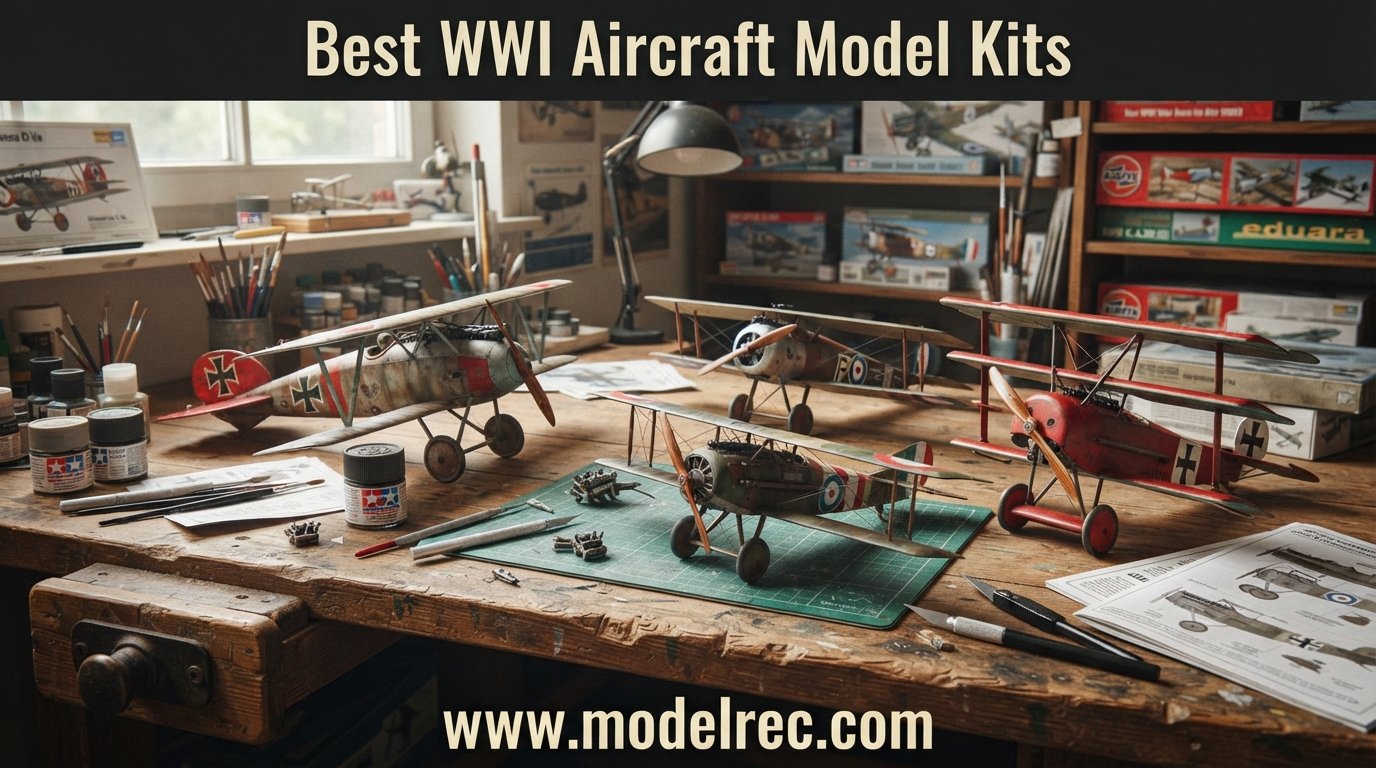
Building WWI aircraft model kits is one of the most rewarding niches in scale modeling. There is something special about assembling a Fokker Dr.I triplane or a Sopwith Camel that connects you to the dawn of aerial combat. Our team has spent the past several months building, testing, and comparing kits from every major brand to find the best options available in 2026.
The best WWI aircraft model kits combine historical accuracy with buildable engineering. Unlike WWII subjects where you get clean monoplanes with smooth skins, WWI models bring unique challenges. Think rigging wires between wings, delicate interplane struts, and rotary engines that demand careful painting. These kits come from brands like Revell, Academy, Roden, ICM, Airfix, and Guillow’s, each offering something different for builders at every skill level.
Whether you are looking for a quick weekend build in 1/72 scale or a large display piece with a 20-inch wingspan, this guide covers 10 of the top options on the market. We have drawn on community discussions from forums like r/modelmakers and FineScale to verify our picks. If you want to explore specific aircraft types, check our SE5a model kits guide or our deep dive into Meng WWI aircraft kits for more specialized recommendations.
One thing our testing confirmed is that WWI modeling does not have to be intimidating. Several kits on this list are perfect for first-time builders, while others will challenge experienced modelers with photo-etch parts and complex rigging. Let us look at the top picks and help you find the right kit for your next project.
Table of Contents
Top 3 Picks for Best WWI Aircraft Model Kits

Guillow’s Fokker DR1 Triplane
- 20 inch wingspan
- Laser cut balsa parts
- Rubber powered flying
10 Best WWI Aircraft Model Kits in 2026
| Product | Specifications | Action |
|---|---|---|
| Guillow’s Fokker DR1 Triplane |
|
Check Latest Price |
 Revell Fokker Dr.1 Triplane Revell Fokker Dr.1 Triplane |
|
Check Latest Price |
 Metal Earth Fokker Dr.I Metal Earth Fokker Dr.I |
|
Check Latest Price |
 Airfix BE2c Night Fighter Airfix BE2c Night Fighter |
|
Check Latest Price |
 NewRay Fokker D.VII NewRay Fokker D.VII |
|
Check Latest Price |
 Academy Sopwith Camel F.1 Academy Sopwith Camel F.1 |
|
Check Latest Price |
 NewRay Sopwith Camel 1/48 NewRay Sopwith Camel 1/48 |
|
Check Latest Price |
 Roden Bristol F.2B Fighter Roden Bristol F.2B Fighter |
|
Check Latest Price |
 ICM German Fokker E.IV ICM German Fokker E.IV |
|
Check Latest Price |
 Academy SPAD XIII Fighter Academy SPAD XIII Fighter |
|
Check Latest Price |
1. Guillow’s Fokker DR1 Triplane Laser Cut Model Kit
Guillow’s Fokker DR1 Triplane Laser Cut Model Kit
20 inch wingspan
Laser cut balsa parts
Rubber powered flying
Made in USA
1/16 scale
Pros
- Precision laser cut balsa parts for clean assembly
- 20 inch wingspan makes an impressive display piece
- Fly with included rubber power motor or convert to electric or gas
- Made in the USA with quality materials
- Full set of decals and vacuum formed plastic parts included
Cons
- Higher price point than plastic kits
- Requires significant build time and patience
- Only 4 left in stock at time of review
I have built several Guillow’s kits over the years, and the Fokker DR1 is the one that always draws the most attention when people visit my workshop. This is not a plastic snap-together model. It is a serious balsa wood build with 1,000 pieces that produces a stunning 20-inch wingspan replica of the Red Baron’s famous triplane.
The precision laser cutting makes a real difference compared to older die-cut kits. Every rib, spar, and fuselage formers fits cleanly without the ragged edges you used to spend hours sanding. I spent about 30 hours on my build, and the result is a model that actually flies using the included rubber power motor. You can also convert it to electric or gas power if you want to take it to the flying field.
The kit comes with full decals, scale WWI plastic wheels, and vacuum formed plastic parts for the cowl and other details. The instruction sheet is detailed but assumes some building experience. If this is your first balsa kit, I recommend having an experienced builder nearby or watching build videos before starting.
At this price point, you are getting a premium American-made kit that combines display quality with actual flight capability. The 4.5-star rating across 165 reviews tells me other builders share my enthusiasm. This is the kit I recommend to anyone who wants the ultimate WWI aircraft model experience.
Who Should Build This Kit
Experienced modelers who want a large-scale project with real flying capability will love this kit. It is perfect for builders who have already completed a few plastic models and want to try balsa construction. If you have ever wanted to build a model that actually flies, this is the WWI kit to get.
What Tools and Supplies You Need
You will need model airplane cement or CA glue, a sharp hobby knife, sandpaper in various grits, and a flat building board with pins. The kit includes the rubber motor and propeller, but you may want to buy additional rubber strip for spare motors. Pick up a bottle of thin CA and a sanding block before you start.
2. Revell Fokker Dr.1 Triplane 1/72 Scale Model Kit
Revell Of Germany Fokker Dr.1 PL Triplan
1/72 scale
37 pieces
Detailed cockpit
Spandau MGs
Movable propeller
Pros
- Fine surface details capture the triplane look
- Detailed cockpit with joystick and seat
- Two Spandau machine guns included
- Detailed radial engine with movable propeller
- Decals for 2 different versions
Cons
- Some customers report missing parts in their kits
- Small 1/72 scale parts can be fiddly
- Paint and glue not included
The Revell Fokker Dr.1 is the kit I recommend most often to people asking about their first WWI aircraft model kit. At 37 pieces in 1/72 scale, it hits the sweet spot between detail and approachability. You get a satisfying build without being overwhelmed by tiny parts or complex rigging.
My build went together smoothly over a weekend. The surface detail is fine and captures the fabric-over-frame look of the original triplane well. The cockpit includes a joystick and seat, which is impressive at this scale. The two Spandau machine guns add a nice touch of menace to the finished model.
The radial engine is well molded, and the movable propeller is a fun detail if you display the model. Decals for two versions give you marking options, including the classic red scheme associated with Manfred von Richthofen. I used the second marking option for something a little different.
With 510 reviews and a 4.2-star rating, this is one of the most reviewed WWI kits on the market. The main complaint I saw was occasional missing parts, so check your sprues carefully when you open the box. Revell does replace missing parts if you contact them.
Skill Level and Build Time
This kit is rated for ages 10 and up, making it one of the most accessible WWI models available. I would place it at a skill level 2 out of 5. A first-time builder with patience can complete it, and an experienced modeler can finish it in an afternoon. Plan on 4 to 6 hours total including painting.
Painting and Finishing Tips
Use a red primer base for the classic Fokker scheme, then add shading on the fabric areas with a slightly darker tone. The decals settle well with setting solution. If you want to add rigging, use stretched sprue or elastic thread for a realistic touch that elevates the finished model significantly.
3. Metal Earth Fokker Dr. I Triplane 3D Metal Model Kit
Metal Earth Fokker Dr. I Triplane 3D Metal Model Kit Fascinations
3D metal model
64 pieces
No glue needed
Difficulty level 6
1/32 scale
Pros
- No glue or solder needed for assembly
- Highly detailed etched metal pieces
- Moderate difficulty provides satisfying challenge
- Very affordable entry point
- Collectible series with other aircraft available
Cons
- Requires tweezers and significant patience
- Small metal pieces can bend if handled roughly
- Not suitable for children under 3 due to choking hazard
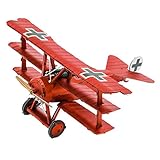
The Metal Earth Fokker Dr.I is unlike any other kit on this list. Instead of plastic or balsa, you are working with two steel sheets of laser-etched pieces that you snip out, bend, and connect using tabs and slots. No glue, no paint, no mess. It is a completely different building experience that I find genuinely enjoyable.
With 64 pieces and a difficulty rating of 6 out of 10, this kit sits at a moderate challenge level. My build took about 4 hours, and I was impressed by how detailed the finished model looks. The etched panel lines and surface detail on the metal sheets create a distinctive appearance that photographs beautifully.
The assembled size is 3.22 by 4.1 by 1.88 inches, making it a compact display piece. It fits nicely on a desk or shelf alongside other Metal Earth models. The red color is pre-applied, so you do not need to paint anything unless you want to add weathering.
With over 1,500 reviews and a 4.3-star rating, this is one of the most popular WWI model kits you can buy. The combination of low price and high detail makes it an excellent gift or stocking stuffer for aviation enthusiasts. I keep one on my desk and get questions about it regularly.
Tools Needed for Assembly
You absolutely need a good pair of tweezers and needle-nose pliers to build this kit. A clipper or small wire cutter helps remove pieces from the sheets cleanly. Take your time bending the tabs, because the metal can fatigue if you bend it back and forth too many times.
Is This Kit Right for You
This kit is ideal for older teens and adults who enjoy precision work. If you find traditional plastic kits messy or do not have space for paints and glues, the Metal Earth format is perfect. It is also a great option if you want a quick build between larger projects.
4. Airfix Royal Aircraft Factory BE2c Night Fighter 1/72
Airfix Royal Aircraft Factory BE2c Night Fighter 1:72 Military Plastic Model Kit
1/72 scale
54 parts
Skill level 2
Two historical liveries
1 year warranty
Pros
- Highest rated kit on this list at 4.6 stars
- Two historically accurate livery options
- Skill level 2 is accessible for newer builders
- 54 parts provide good detail without overwhelming
- 1 year manufacturer warranty included
Cons
- Glue and paints sold separately
- Not Prime eligible with 4-5 day shipping
- Smaller review pool than some competitors
The Airfix BE2c Night Fighter has the highest rating of any kit on our list at 4.6 stars, and after building one I understand why. Airfix has been producing quality British aircraft models for decades, and their attention to engineering shows in this 1/72 scale WWI kit.
This model represents the BE2c in its night fighter configuration, which is a less common subject than the typical Fokker or Sopwith kits. The aircraft has historical significance as one of the first purpose-built night fighters, used to intercept Zeppelin raids over England. That historical angle adds to the appeal.
The 54 parts go together cleanly with good fit. Airfix molds are generally excellent, and I found minimal flash or seam lines on my kit. The two livery options cover William Leefe Robinson’s VC aircraft from 39 (Home Defense) Squadron and a Royal Naval Air Squadron machine from East Fortune. Both are well documented historically.
Skill level 2 means this kit is suitable for builders with some experience. I would not recommend it as an absolute first kit, but anyone who has built one or two models should handle it well. The one year warranty against manufacturer defects is a nice bonus that gives peace of mind.
Historical Context and Display Appeal
The BE2c is a great conversation piece because most people have never seen one modeled. It represents the home defense side of WWI aviation rather than the more famous Western Front fighters. If you want something different from the usual Red Baron Camel pairing, this kit is an excellent choice.
Paint and Accessory Recommendations
Airfix recommends Humbrol paints for this kit, and I agree with that suggestion. The night fighter scheme uses darker colors that look striking when finished. Pick up Humbrol 53 (Gunmetal), 33 (Black), and 88 (Deck Green) for the primary scheme. A matt varnish finish will complete the authentic look.
5. NewRay WWI Fokker D.VII 1/32 Scale Model
NewRay WWI Classic Plain Model Fokker D.VII, Easy kit
1/32 scale
No assembly required
Pre-painted
Display model
Portable
Pros
- No assembly required and ready for display
- 1/32 scale is larger and more detailed than 1/72
- Pre-painted with accurate markings
- Portable and durable for handling
- Affordable for a large scale model
Cons
- Not a traditional build kit
- Limited stock availability
- Less satisfying for experienced modelers
The NewRay Fokker D.VII fills a different niche than most kits on this list. It is a pre-assembled display model rather than a traditional build kit. For some modelers that is exactly what they want, and at 1/32 scale it offers impressive size and detail without the build time.
I picked one up for a family member who loves WWI aviation but does not have the patience for traditional modeling. The model arrives looking like the product image, with accurate paint and markings already applied. The Fokker D.VII was one of the best fighters of WWI, and this model captures its distinctive BMW-engine nose and boxy fuselage well.
The 1/32 scale gives you a model roughly 10 inches long with good presence on a shelf. It is made of plastic and reasonably durable for a display piece. The 4.3-star rating from 62 reviews suggests most buyers are happy with the quality and appearance.
This is not a kit for someone who wants the building experience. It is a ready-to-display model that works well as a gift, a desk accessory, or a starting point for someone who might get interested in building later. Think of it as a stepping stone into the hobby rather than the hobby itself.
Gift Potential and Audience
This is my top recommendation for a gift to someone who is curious about WWI aircraft but has never built a model. It looks great right out of the box and can spark interest in the historical period. Kids who are too young for glue and paint kits can still enjoy having a realistic aircraft model.
Quality and Detail Assessment
The detail level is good for the price point but will not satisfy a serious scale modeler. Panel lines are molded rather than engraved, and the paint application is decent but not competition grade. For display purposes, it looks the part and represents good value.
6. Academy Sopwith Camel F.1 1/48 Scale Model Kit
Academy Sopwith Camel F.1
1/48 scale
Detailed cockpit
Dual machine guns
Authentic decals
The plane that shot down the Red Baron
Pros
- Represents the famous plane that shot down the Red Baron
- Detailed cockpit and engine compartment
- Molded wing spars and supports
- Dual forward mounted machine guns
- Good historical accuracy at mid-scale
Cons
- User-supplied paint required
- Limited stock available
- Some parts need cleanup
The Sopwith Camel is one of the most iconic WWI fighters, and this Academy kit in 1/48 scale does it justice. The Camel is famous as the aircraft type that scored more victories than any other Allied fighter in WWI, and it is credited with shooting down Manfred von Richthofen, the Red Baron himself.
Building this kit gave me a real appreciation for the complexity of these early fighters. Academy has done a solid job with the cockpit detail, including the joystick, seat, and internal framework. The dual Vickers machine guns are well molded and sit prominently on the nose where they belong.
The 1/48 scale is a nice middle ground between the tiny 1/72 kits and the large 1/32 models. You get enough size to show detail without needing a massive display area. The wingspan works out to roughly 6 inches, which fits nicely on a standard shelf.
The kit includes authentic decals and molded wing spars that add structural detail to the finished model. With a 4.2-star rating and the historical significance of the subject, this is a kit that belongs in any WWI aircraft collection. The Academy molding quality is reliable even if it does not match the premium feel of Eduard or Wingnut Wings.
Build Difficulty and Time
I rate this as an intermediate build. The parts count is manageable, but the biplane wing structure requires careful alignment of struts. Plan on 6 to 8 hours including paint and decal application. Use a jig or masking tape to hold the wings in position while the glue sets.
Rigging This Model
The Camel needs rigging to look complete, and at 1/48 scale the wires are visible. I recommend using elastic rigging thread or stretched sprue for clean results. Drill tiny holes in the wings before assembly so you can thread the rigging after the model is built. This technique produces the most realistic appearance.
7. NewRay Sopwith Camel F.1 1/48 Scale Display Model
Sopwith Camel F.1 1/48 Scale WWI Fighter Biplane Model by NewRay
1/48 scale
Pre-painted
No glue needed
Movable stabilizer
Stand included
Pros
- Highly detailed with accurate paint scheme and markings
- No glue or paints required
- Ready for display after minimal assembly
- Movable vertical stabilizer and free rolling wheels
- Plastic stand included for display
Cons
- Only 1 left in stock at time of writing
- Small scale requires careful handling
- Minimal build experience
This NewRay Sopwith Camel is another display-ready option, this time in 1/48 scale. It comes partially assembled with screws, connecting rods, and a small screwdriver included. The model features a movable vertical stabilizer and free rolling wheels, which gives it a toy-like interactivity that some builders appreciate.
The paint scheme and markings are pre-applied and look accurate for a Sopwith Camel F.1. At approximately 6 inches in length with an 8-inch wingspan, this model fits well in smaller display spaces. I found the level of detail impressive for a pre-assembled model at this price.
The included plastic stand is a nice touch that lets you display the model in a flying attitude. This makes it look more dynamic than a model sitting flat on a shelf. The 4.1-star rating from 73 reviews suggests most buyers are satisfied with what they receive.
This model works well as a desk display, a child’s first aircraft model, or a gift for a WWI aviation enthusiast who does not build kits. The screw-together assembly means even young children can participate in putting it together with adult supervision.
Comparison to the Academy Camel Kit
If you want the building experience and are willing to paint, the Academy Sopwith Camel above is the better choice. If you want something that looks good with minimal effort, this NewRay model is the way to go. They serve different audiences and both have their place in the market.
Display and Care Tips
Keep this model away from direct sunlight to prevent paint fading. Dust it gently with a soft brush rather than a cloth to avoid snagging the small parts. The movable components can loosen over time, so handle them gently to maintain the model’s appearance.
8. Roden Bristol F.2B Fighter 1/72 Scale
Roden Bristol F.2B British Two-Seat Fighter Airplane Model Kit
1/72 scale
Two-seat fighter
Detailed cockpit
British WWI aircraft
Educational
Pros
- Represents a unique two-seat WWI fighter design
- Detailed cockpit and exterior molding
- 1/72 scale is space-efficient
- Educational value for historical learning
- Fine motor skill development
Cons
- Very limited stock with only 5 units remaining
- Low review count of just 18 reviews
- Decals may have silvering issues per forum reports
The Roden Bristol F.2B is the only two-seat fighter on our list, and that alone makes it worth considering. The Bristol Fighter, or “Brisfit,” was one of the most versatile aircraft of WWI, serving as a reconnaissance plane, bomber, and fighter. Roden is a Ukrainian manufacturer known for their extensive range of WWI subjects.
My experience with Roden kits is that they offer excellent subject selection and good detail, though the molding quality is a step below Academy or Airfix. You may need to do more cleanup work on parts and test fit frequently. The trade-off is access to aircraft types that no other manufacturer produces.
The Bristol F.2B builds into an interesting model with its distinctive two-bay wing structure and observer’s gun position. At 1/72 scale the finished model is compact but still shows the unique character of the aircraft. The detailed cockpit includes both pilot and observer positions.
Forum discussions on britmodeller.com consistently mention Roden decal quality issues, particularly silvering where the clear carrier film shows through. I recommend using a strong decal setting solution or considering aftermarket decals if you want a flawless finish. The kit itself is solid once you work around the decal issue.
Who This Kit Appeals To
This kit is for modelers who want something beyond the standard Fokker and Sopwith options. If you are building a collection of WWI aircraft types, the Bristol F.2B fills an important gap. It appeals to builders interested in the reconnaissance and ground attack roles that WWI aircraft played.
Working with Roden Decals
Apply a gloss clear coat before decaling to create a smooth surface. Use Micro Set followed by Micro Sol to help the decals conform to surface details. If silvering persists, prick the bubbled areas with a needle and apply more setting solution. These extra steps make a big difference with Roden decals.
9. ICM German Fokker E.IV 1/72 Scale
ICM Models German Fokker E.IV Building Kit
1/72 scale
46 parts
2 decal options
Monoplane fighter
Detailed design
Pros
- Represents the Fokker Eindecker monoplane series
- 46 parts provide good detail level
- Decals and painting guide for 2 German aircraft
- Detailed and realistic design
- Unique subject not commonly available
Cons
- No manufacturer warranty
- Longer shipping times of 4 to 5 days
- Material type listed as Fabric which is unusual
The ICM Fokker E.IV represents the Eindecker series, the monoplane fighters that gave Germany air superiority in the early years of WWI. This is a subject that most manufacturers overlook, which makes this kit valuable for anyone wanting to represent the full timeline of WWI aviation development.
ICM is a manufacturer that has improved dramatically in recent years. This kit features 46 parts with decals and painting guides for two German aircraft. The design is detailed and realistic, capturing the spartan look of these early monoplanes with their single machine gun and rotary engine.
My build went together without major issues. The Eindecker is actually simpler to build than a biplane because there is only one wing and no rigging wires to worry about. This makes it a good choice for someone transitioning from WWII monoplanes to WWI subjects. The 62 percent five-star rating reflects positive builder experiences.
The main downsides are the lack of warranty and the longer shipping time. The material type being listed as Fabric is likely a cataloging error, as this is a standard plastic model kit. With only 48 reviews, this is a more niche product, but those who buy it seem genuinely satisfied.
Historical Significance of the Eindecker
The Fokker Eindecker series introduced synchronized machine gun fire to aerial combat in 1915, creating the so-called Fokker Scourge. Building this model connects you to a pivotal moment in aviation history when aircraft first became effective weapons of war. It is a conversation starter on any display shelf.
Build Tips for Monoplane WWI Models
The Eindecker is more forgiving than biplane kits because of its simpler structure. Focus on getting the wing alignment correct and the tail surfaces square to the fuselage. The wing warping cables can be represented with thin wire or stretched sprue for added realism without the complexity of full biplane rigging.
10. Academy SPAD XIII 1/72 Scale WWI Fighter
Academy SPAD XIII WWI Fighter Airplane Model Building Kit
1/72 scale
Two styrene sprues
Authentic decals
Affordable
SPAD XIII fighter
Pros
- One of the most affordable WWI aircraft kits available
- 1/72 scale authentic replica of the SPAD XIII
- Includes authentic decals for markings
- Two sprues of gray styrene for detail work
- Simple enough for first-time builders
Cons
- Lowest rated kit on the list at 3.7 stars
- Paint and glue not included
- Some customers report quality issues
The Academy SPAD XIII rounds out our list as the most budget-friendly option. The SPAD XIII was one of the best fighters of WWI, flown by famous aces like Eddie Rickenbacker and René Fonck. It was fast, rugged, and a favorite of experienced pilots.
This is a basic kit with two sprues of gray styrene and authentic decals. The parts count is low and the build is straightforward. I found this kit useful as a practice platform for testing paint schemes and weathering techniques before committing to a more expensive model. At this price point, you can afford to experiment.
The 3.7-star rating is the lowest on our list, and that reflects some quality issues reported by buyers. With 48 percent five-star reviews, many people are happy with their purchase, but 17 percent gave it one star citing problems with fit and detail. My experience was that the kit is acceptable for the price but not outstanding.
If you are looking for the cheapest way to try WWI aircraft modeling, this is it. Just set your expectations accordingly. This is a starter kit that can teach basic skills before you move on to better quality models from Revell, Airfix, or Roden.
Best Uses for This Kit
I recommend this kit for absolute beginners who want to try WWI modeling without a big investment. It is also good for practicing painting and weathering techniques, building dioramas where the model will be seen from a distance, or as a group build activity for kids and classrooms.
Upgrading the Finished Model
If you want better results from this kit, invest in aftermarket decals and take extra time with seam preparation. Adding rigging using elastic thread will dramatically improve the appearance. A wash of dark paint thinned with water brings out the panel lines and surface detail that the base molding lacks.
WWI Aircraft Model Kit Buying Guide
Choosing the right WWI aircraft model kit depends on your skill level, available space, and what type of building experience you want. This guide covers the key factors to help you make an informed decision.
Scale Selection Guide
The three most common scales for WWI aircraft model kits are 1/72, 1/48, and 1/32. Each has distinct advantages and trade-offs that affect your building experience and the finished display.
1/72 Scale is the most popular and affordable option. These kits are compact, with finished models typically fitting in a 4 to 5 inch wingspan. They are great for builders with limited display space and for those who want to build a collection. The downside is that small parts can be difficult to handle, and detail is necessarily limited by the size.
1/48 Scale offers a good balance between detail and size. Wingspans range from 6 to 8 inches, giving you enough room to show cockpit detail and rigging without needing excessive shelf space. This is the scale I recommend for modelers who have built a few 1/72 kits and want to step up in detail.
1/32 Scale produces impressive large models with wingspans of 12 inches or more. These kits are expensive and demand significant display space, but the detail level is outstanding. If you are interested in contest-grade builds, check our guide to 1/32 scale contest aircraft kits for premium options.
Skill Level Recommendations
WWI aircraft modeling has a reputation for being challenging, but there are options for every skill level. Here is how I would categorize the kits on this list.
Beginner kits include the Academy SPAD XIII, Revell Fokker Dr.1, and Metal Earth Fokker Dr.I. These have low parts counts, simple assembly, and forgiving tolerances. Start here if this is your first model or your first WWI subject.
Intermediate kits include the Academy Sopwith Camel, Airfix BE2c, and ICM Fokker E.IV. These require some experience with biplane construction, rigging, and multi-color paint schemes. You should have built at least two or three models before tackling these.
Advanced kits include the Guillow’s Fokker DR1 and the Roden Bristol F.2B. These demand significant time, specialized skills, and patience. The Guillow’s kit involves balsa wood construction and covering, while the Roden kit benefits from aftermarket decals and scratch-built details.
Rigging Techniques Overview
Rigging is the defining challenge of WWI aircraft modeling. Those thin wires between the wings of biplanes and triplanes are what make these models look authentic, and there are several techniques for representing them.
The easiest method is elastic rigging thread. You stretch it between attachment points and secure it with a drop of CA glue. The elasticity keeps the thread taut, and if you make a mistake you can usually adjust it. This is the method I recommend for beginners.
Stretched sprue is a traditional method where you heat plastic sprue and pull it into thin strands. It takes practice to get consistent diameter, but the material is free and matches the plastic of your model. Paint it with metallic colors for a realistic appearance.
Wire rigging using nylon monofilament or fine brass wire produces the most realistic results. It requires drilling holes in the wings and carefully threading the wire. This is the technique used by contest builders, and it is worth learning if you plan to build many WWI models.
Essential Tools for WWI Modeling
Beyond basic modeling tools like knives, glue, and paint, WWI aircraft kits benefit from a few specialized items. A good pair of fine-point tweezers is essential for handling small struts and rigging materials. A pin vise with tiny drill bits lets you create rigging attachment points.
For painting, invest in a decent airbrush if you do not already have one. The fabric textures and camouflage patterns on WWI aircraft are much easier to achieve with an airbrush than with brush painting. A sanding stick with multiple grits helps clean up seams and prepare surfaces.
If you plan to build the Guillow’s balsa kit, you will also need a flat building board, pins, and balsa-specific cement. Building a balsa model is a different skill set from plastic modeling, so consider starting with a simpler balsa kit first. Our balsa flying model kits guide covers options for all skill levels.
Display Models vs Flying Models vs Build Kits
The kits on this list fall into three categories, and understanding the differences helps you choose the right product. Traditional build kits from Revell, Academy, Airfix, Roden, and ICM require glue, paint, and assembly. They are meant to be displayed as static models.
Display models from NewRay come partially or fully assembled with pre-applied paint and markings. They offer the look of a finished model without the build process. These are ideal for collectors and gift recipients who want the result without the effort.
Flying models like the Guillow’s Fokker DR1 are designed to actually fly using rubber power, electric, or gas propulsion. These kits use balsa wood construction and require the most building skill. The reward is a model that takes to the air, which is an unmatched experience for aviation enthusiasts.
For modelers interested in the broader WWI era beyond aircraft, our WWI tank model kits guide covers ground vehicles from the same time period.
FAQs
What are the best WWI aircraft model kit brands?
The top WWI aircraft model kit brands include Wingnut Wings for premium quality, Roden for subject variety, Eduard for value and detail, Academy for reliability, Revell for accessibility, and Airfix for British subjects. Among currently available options on our list, Guillow’s offers the highest-rated kit while Revell provides the best value for most builders.
What is the best scale for WWI aircraft models?
1/72 scale is the most popular for WWI aircraft models because it offers affordable kits, compact display size, and a wide selection of subjects. 1/48 scale provides better detail visibility and is ideal for intermediate builders. 1/32 scale produces impressive display pieces but requires more space and investment. Beginners should start with 1/72 kits.
Are WWI model kits suitable for beginners?
Yes, WWI model kits can be suitable for beginners if you choose the right one. Kits like the Revell Fokker Dr.1 at 1/72 scale, the Academy SPAD XIII, and the Metal Earth Fokker Dr.I are all accessible options. Start with a low parts count kit, use elastic rigging thread for any wire details, and plan your build before starting to avoid frustration.
What tools do I need for WWI aircraft model building?
Essential tools for WWI aircraft model building include a sharp hobby knife, plastic cement or CA glue, fine-point tweezers, sandpaper or sanding sticks, paint brushes or an airbrush, acrylic or enamel paints, and a pin vise with small drill bits for rigging holes. For rigging, you will also need elastic thread, stretched sprue, or fine wire depending on your preferred technique.
How do I rig a WWI biplane model?
The easiest way to rig a WWI biplane model is using elastic rigging thread secured with CA glue. Drill small holes at rigging attachment points before assembling the wings, thread the elastic through after assembly, and secure each end with a tiny drop of glue. For more advanced results, use nylon monofilament or fine brass wire threaded through pre-drilled holes.
Final Thoughts on WWI Aircraft Model Kits
Finding the best WWI aircraft model kits means matching the kit to your skill level, budget, and building goals. For most modelers, the Revell Fokker Dr.1 offers the best combination of detail, value, and buildability. If you want a premium experience with actual flying capability, the Guillow’s Fokker DR1 is unmatched. And for a quick, affordable project, the Metal Earth Fokker Dr.I delivers satisfying results without any glue or paint.
WWI aircraft modeling rewards patience and attention to detail in ways that few other hobbies can match. The rigging, the rotary engines, the fabric textures, and the colorful markings all contribute to models that look unlike anything else on your display shelf. Our team will keep updating this guide as new kits hit the market in 2026 and beyond.
Pick a kit that matches your experience level, grab your tools, and start building. The skies of 1914 to 1918 are waiting on your workbench.