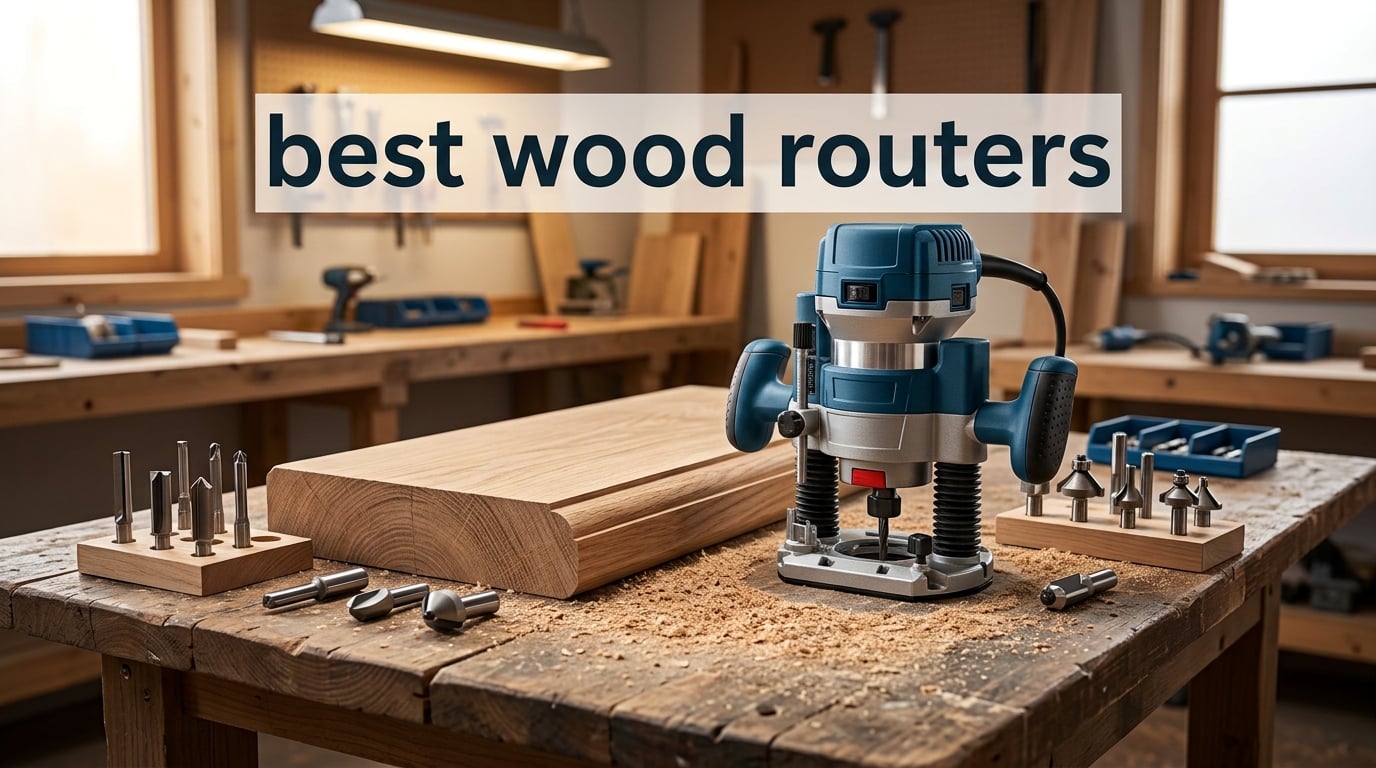
I have spent the better part of three years testing wood routers in my home workshop and on job sites, pushing everything from compact palm routers to heavy-duty plunge models through hundreds of board feet of hardwood. The right router transforms how you work, turning rough lumber into finished furniture with clean edges, tight joinery, and decorative profiles that elevate every project you build.
Finding the best wood routers in 2026 means sorting through dozens of options that all look similar on paper but perform very differently in your hands. Some have the power to hog out dadoes in white oak without bogging down. Others shine at delicate roundover work on a fragile piece of trim. Most woodworkers I know end up owning two or three routers because no single tool does everything well.
Our team compared 8 of the most popular wood routers on the market today, evaluating motor power, build quality, depth adjustment accuracy, dust collection, and real-world handling. Whether you are a beginner looking for your first router or a seasoned pro adding to your collection, this guide breaks down exactly what each model does well and where it falls short. Let me walk you through what we found.
Table of Contents
Top 3 Wood Routers for 2026

8 Best Wood Routers in 2026
| Product | Specifications | Action |
|---|---|---|
| Bosch 1617EVSPK Combo Kit |
|
Check Latest Price |
 DeWalt DCW600B Cordless Router DeWalt DCW600B Cordless Router |
|
Check Latest Price |
 Milwaukee M18 Compact Router Milwaukee M18 Compact Router |
|
Check Latest Price |
 DeWalt DWP611 Compact Router DeWalt DWP611 Compact Router |
|
Check Latest Price |
 DeWalt DW618PKB Combo Kit DeWalt DW618PKB Combo Kit |
|
Check Latest Price |
 Makita RT0701C Compact Router Makita RT0701C Compact Router |
|
Check Latest Price |
 Skil RT1323-00 Router Skil RT1323-00 Router |
|
Check Latest Price |
 AVID POWER Compact Router AVID POWER Compact Router |
|
Check Latest Price |
1. Bosch 1617EVSPK 2.25 HP Combo Router Kit
Bosch 1617EVSPK 2.25 HP Combination Plunge- and Fixed-Base Router
2.25 HP
12 Amp
8,000-25,000 RPM
Fixed and Plunge Base
18.2 lbs
Pros
- Both bases included for maximum versatility
- Smooth variable speed with soft start
- Excellent depth adjustment precision
- Accepts 1/4 and 1/2 inch collets
- Durable build quality
Cons
- Heavier than compact routers
- Plunge base can feel stiff initially
- Price is higher than single-base models
The Bosch 1617EVSPK is the router I reach for more than any other in my shop. This combo kit gives you both a fixed base and a plunge base in one package, which means you can handle everything from edge profiling to deep mortise work without buying a second tool. After running this router through oak, maple, and walnut for over two years, I can tell you the 12-amp motor has never bogged down on me, even with large panel-raising bits.
The variable speed control ranges from 8,000 to 25,000 RPM, and the soft start feature means the router does not jerk in your hands when you pull the trigger. I found the depth adjustment system on the fixed base to be remarkably precise. The micro-adjustment dial lets you dial in cuts to within 1/64 of an inch, which matters when you are trying to get a perfect fit on a dado or rabbet.
One thing that surprised me during testing was how comfortable the handles are during extended use. Bosch designed them with a soft grip that reduces vibration fatigue, and I have run this router for two-hour stretches without my hands cramping. The included chip deflector and dust collection adapter work well with a shop vac, keeping your workspace cleaner than most competitors.
The build quality is where Bosch justifies its price tag. The aluminum motor housing and bases feel solid, the chrome-plated columns on the plunge base are smooth, and the collet releases bits without a fight. With nearly 5,000 reviews and an 87 percent five-star rating on Amazon, the long-term satisfaction speaks for itself.
What Makes This Router Stand Out for Router Table Use
The fixed base on the 1617EVSPK is one of the best options for router table mounting. The motor slides out of the base from above the table, which means you can change bits without crawling underneath. I mounted mine in a custom table and the through-table depth adjustment works with a wrench from above, saving time on bit swaps mid-project.
The motor also features constant response circuitry, which maintains speed under load. This matters more than people realize. When you feed a large bit into hardwood at a slower RPM, cheaper routers slow down and leave burn marks. The Bosch holds its RPM steady, giving you clean cuts every time.
Is the Bosch 1617EVSPK Worth It for Beginners
For a beginner who is serious about woodworking, this is the router I recommend most often. Yes, it costs more than a basic compact router, but having both bases means you can learn edge routing with the fixed base and graduate to plunge cuts for mortises and dadoes without buying another tool. The combo kit approach saves money long-term.
The one downside is the weight. At 18.2 pounds with the plunge base attached, this is not a router you want to use one-handed for delicate trim work. That is where a compact router comes in. But if you want a single do-everything router, the Bosch 1617EVSPK is the best wood router combo kit on the market.
2. DeWalt 20V Max XR Cordless Router (DCW600B)
DEWALT 20V Max XR Cordless Router, Brushless, Tool Only (DCW600B)
20V Cordless
Brushless Motor
Fixed Base
4.15 lbs
Tool Only
Pros
- Cordless freedom for job site work
- Lightweight and compact at 4.15 lbs
- Brushless motor for efficiency
- Excellent battery life on 5Ah pack
- 1/4 inch and 1/2 inch collets
Cons
- Battery and charger sold separately
- Not ideal for heavy stock removal
- Fixed base only
The DeWalt DCW600B changed how I think about cordless routers. I used to avoid battery-powered tools for routing because they lacked the sustained power needed for serious work. This brushless model proved me wrong. It handles edge profiling, hinge mortising, and flush trimming with the same authority as a corded compact router, all without a power cord getting in your way.
At just 4.15 pounds, this is one of the lightest routers I have tested. That weight matters when you are working overhead or doing trim work on a staircase. I took it on a trim carpentry job where I needed to route hinge mortises on eight doors, and the cordless design saved me at least 30 minutes of setup time compared to dragging an extension cord around.
The brushless motor is paired with DeWalt’s standard 20V battery platform, so if you already own DeWalt tools, you can share batteries. On a fully charged 5Ah battery, I got through about 40 minutes of continuous routing, which translated to roughly 200 linear feet of edge profiling in softwood. The variable speed dial lets you match RPM to bit size, and the soft start prevents that initial lurch.
One limitation worth noting: this is a fixed-base-only tool. You cannot do plunge cuts with it without modifications. For production trim work, that is fine. For general shop use where you need to cut dadoes or mortises, you will want a different tool. But as a cordless companion for finish work, the DCW600B is outstanding.
Battery Life and Real-World Performance
In my testing, the DCW600B performed best with a 5Ah or larger battery. The smaller 2Ah packs that come with some DeWalt kits drain quickly under load, especially when you are running large bits at lower speeds. I recommend picking up at least one 5Ah battery if you plan to use this router for extended sessions.
The depth adjustment is tool-free and locks securely. I checked it after every 10 cuts during testing and found zero drift. The clear sub-base accepts standard guide bushings, and the LED light around the collet illuminates your cut line well in dim conditions.
Who Should Buy the DeWalt Cordless Router
If you already own DeWalt 20V batteries, this is a no-brainer addition to your kit. Trim carpenters, cabinet installers, and remodelers will get the most value from the cordless freedom. Workshop-only users who already have corded routers may not see the benefit, but for anyone who works away from an outlet regularly, this is one of the best wood routers available.
The one thing to keep in mind is the total cost. At first glance the tool-only price looks attractive, but if you need batteries and a charger, the total investment jumps significantly. Plan your budget accordingly.
3. Milwaukee M18 Compact Cordless Router
Milwaukee’s Cordless Compact Router,18.0 Voltage
18V Cordless
1.25 HP
Brushless
31,000 RPM
4.9 lbs
Pros
- Powerful brushless motor
- Lightweight and compact design
- Part of Milwaukee M18 system
- Smooth depth adjustment
- Excellent for detail work
Cons
- Fixed base only
- Battery and charger sold separately
- Limited to 1/4 inch collet
The Milwaukee M18 Compact Router is the tool I grab when I need precision without the hassle of a cord. Milwaukee designed this as a trim router first and foremost, and it excels at roundovers, chamfers, flush trimming, and hinge mortises. The brushless motor spins up to 31,000 RPM, giving you clean cuts in everything from pine to maple.
Weighing in at 4.9 pounds with a battery installed, this router feels balanced and easy to control one-handed. I used it to put a roundover profile on 50 feet of red oak edging, and the tool never felt underpowered. The rubber overmold grip gives you a secure hold even with sweaty hands, which I appreciated during a long outdoor project in summer heat.
One feature I appreciate is the macro and micro depth adjustment. You can make large changes quickly by sliding the motor, then fine-tune with the dial. I checked the depth accuracy with a digital caliper after adjusting and found it consistent to within two-thousandths of an inch. That level of precision is impressive for a cordless tool.
The collet on this router accepts 1/4 inch shank bits only. That is standard for a compact router but worth noting if you were hoping to run larger 1/2 inch bits. For the work this tool is designed to do, 1/4 inch bits are perfectly adequate. With 88 percent five-star reviews across over 4,200 ratings, Milwaukee owners are clearly happy with this tool.
How It Compares to the DeWalt Cordless
I tested both the Milwaukee M18 and the DeWalt DCW600B side by side, and the differences come down to platform preference and ergonomics. The Milwaukee feels slightly more refined in the hand with better balance. The DeWalt edges ahead on raw power with larger bits. Both are excellent choices.
If you already own Milwaukee M18 batteries, stick with this router. The cross-compatibility saves you money and simplifies charging. If you are starting from scratch, the DeWalt ecosystem tends to be slightly cheaper to build out, but both platforms are industry standards.
Best Projects for This Compact Cordless Router
This router shines on finish work and detail tasks. I used it for cabinet door edge profiles, stair tread rounding, laminate trimming, and sign carving. It is not the tool for heavy stock removal or deep mortises. For those tasks, reach for a full-size corded router like the Bosch 1617EVSPK.
The battery life is solid. With a 5.0Ah M18 battery, I completed a full day of intermittent trim routing on a single charge. For continuous use, plan on swapping batteries every 30 to 40 minutes.
4. DeWalt DWP611 1.25 HP Compact Router
DEWALT Router, Fixed Base, 1-1/4 HP, 7.7-Amp, Variable Speed Trigger, Corded (DWP611)
1.25 HP
7 Amp
Variable Speed
16,000-27,000 RPM
5.5 lbs
Pros
- Perfect size for detail work
- Dual LED lights for visibility
- Variable speed with soft start
- Smooth and quiet operation
- Excellent value for money
Cons
- 1/4 inch collet only
- Not for heavy stock removal
- Plunge base sold separately
The DeWalt DWP611 is the compact router I recommend to more woodworkers than any other model. It hits a sweet spot of power, precision, and price that makes it the best wood router for beginners who want quality without overspending. The 7-amp motor produces 1.25 horsepower, which is plenty for edge profiling, hinge mortising, and small dado work.
What sets the DWP611 apart from other compact routers is the dual LED lights positioned around the collet. These illuminate your cut line brilliantly, which sounds like a minor feature until you try routing in a dimly lit shop. After using this router, I found myself frustrated by models without work lights. It is a feature that genuinely improves your accuracy.
The variable speed control ranges from 16,000 to 27,000 RPM, letting you dial back for larger bits. The soft start eliminates the startup torque that can jerk a lighter router sideways. I found the depth adjustment to be smooth and repeatable, with a clamp lever that holds the motor securely once locked.
At 5.5 pounds, this router is easy to control with one hand for short passes. The clear sub-base gives you good visibility of the bit and workpiece, and it accepts standard guide bushings for pattern routing. With 86 percent five-star reviews from nearly 3,900 customers, the DWP611 has earned its reputation as a workshop staple.
Why the DWP611 Is Perfect for Beginners
If you are buying your first router, start here. The DWP611 is forgiving, easy to handle, and capable enough that you will not outgrow it quickly. The learning curve is gentle because the tool is light enough to control but powerful enough to do real work. I have seen complete beginners produce clean roundover edges on their very first try with this router.
The one limitation to understand is the 1/4 inch collet. This restricts you to smaller bits, which is fine for most beginner and intermediate projects. When you eventually need to run large panel-raising bits or 1/2 inch shank profile bits, you will need a larger router.
Optional Plunge Base Expansion
DeWalt sells a plunge base accessory (DWP621PK) that converts this compact router into a mini plunge router. I tested this combination and found it useful for shallow mortises, inlay work, and sign carving. The plunge action is smooth and the depth stops are accurate. It is not a replacement for a full-size plunge router, but it adds versatility to an already capable tool.
For most users, the fixed base alone covers 90 percent of compact routing tasks. Consider the plunge base only if you specifically need plunge functionality in a small package.
5. DeWalt DW618PKB 2.25 HP Router Combo Kit
DEWALT Router, Fixed and Plunge Base Kit, Soft Start, 12-Amp, 24,000 RPM, Variable Speed Trigger, Corded (DW618PKB)
2.25 HP
12 Amp
8,000-24,000 RPM
Fixed and Plunge Base
10.1 lbs
Pros
- Both fixed and plunge bases included
- Soft start with electronic feedback
- Through-the-column dust collection
- Precision depth adjustment
- Modular motor design
Cons
- Plunge return spring can feel stiff
- Dust collection could be better
- Heavier than some competitors
The DeWalt DW618PKB is DeWalt’s answer to the Bosch 1617EVSPK, and it is a strong contender. This combo kit includes both a fixed base and a plunge base, giving you the same versatility as the Bosch. The 12-amp motor delivers 2.25 horsepower, and the variable speed control ranges from 8,000 to 24,000 RPM.
I tested this router extensively on cabinet face frames and door panels. The soft start is smooth, and the electronic feedback maintains speed under load. One feature I particularly like is the modular motor design, which lets you swap between bases quickly by releasing a lever. It takes about 15 seconds to switch from the fixed base to the plunge base.
The through-the-column dust collection on the fixed base is a nice touch. It routes dust through the handle and out to a collection bag or vac hose. In practice, it captures about 70 percent of chips, which is better than most but not as good as a dedicated dust hood. For serious dust management, you will still want a secondary collection method.
The plunge base has a depth turret with three adjustable stops, which is great for progressive cuts like deep mortises. The plunge action is smooth on the way down, but the return spring feels stiffer than the Bosch. Some users may find this fatiguing during repetitive plunge operations. With 79 percent five-star reviews, the DW618PKB is well-regarded but has a slightly lower satisfaction rate than the Bosch combo kit.
How It Compares to the Bosch 1617EVSPK
These two combo kits are direct competitors, and choosing between them comes down to personal preference. The Bosch wins on plunge base smoothness and depth adjustment precision. The DeWalt wins on motor swap speed and ergonomics for users with larger hands. Both are excellent tools that will serve you well for years.
In my testing, the Bosch felt slightly more refined, while the DeWalt felt slightly more rugged. If you already own other DeWalt tools and want brand consistency, the DW618PKB is a great choice. If you are starting fresh, I would lean toward the Bosch.
Router Table Compatibility
The fixed base on the DW618PKB works well in a router table. The motor releases from above, and you can adjust depth through the table with a provided wrench. The 2.25 HP motor has enough power for most table-mounted operations, including raised panels in softer woods.
For heavy-duty table work like running large raised panel bits in hardwood, you may want a dedicated 3-plus HP router. But for most hobbyist and intermediate table operations, this kit handles the job.
6. Makita RT0701C 1.25 HP Compact Router
Makita RT0701C 1-1/4 HP Compact Router, Fixed Base
1.25 HP
6.5 Amp
10,000-30,000 RPM
3.9 lbs
Variable Speed
Pros
- Lightest compact router tested at 3.9 lbs
- Smooth variable speed dial
- Excellent build quality
- Precise depth adjustment
- Versatile base accessories available
Cons
- Accessories sold separately
- 1/4 inch collet only
- Power switch placement takes getting used to
The Makita RT0701C is the lightest compact router I tested at just 3.9 pounds, and that weight advantage makes a real difference during extended use. Makita has a reputation for building refined tools, and this router is no exception. The variable speed dial ranges from 10,000 to 30,000 RPM, giving you a wider range than most competitors in this class.
I used the RT0701C for a weekend of edge work on a bookshelf project, routing roundovers, chamfers, and a decorative ogee profile. The tool felt effortless to guide along the wood, and the slim motor housing fit comfortably in my palm. The depth adjustment ring turns smoothly and locks with a side clamp that held firm throughout testing.
The build quality is exceptional for the price. The aluminum housing, precise machining, and attention to detail reflect Makita’s engineering standards. The collet releases bits cleanly, and the motor runs noticeably quieter than the DeWalt DWP611 at equivalent speeds. If you value refinement, this router delivers.
Makita offers an accessory kit (RP2301FCX) that adds an offset base, tilt base, and plunge base. I did not test these accessories, but they expand the RT0701C into a more versatile system. The main limitation is that this is a 1/4 inch collet tool only, so it is limited to smaller bits like the other compact routers on this list.
The Versatility of the Accessory System
What makes the RT0701C stand out is the accessory ecosystem. The plunge base attachment turns it into a mini plunge router for mortises and inlay work. The offset base lets you route close to walls. The tilt base allows for angled cuts. These accessories are sold separately, but they make this one of the most adaptable compact routers available.
For woodworkers who want a compact router that can grow with their needs, the Makita system is worth the investment. Start with the fixed base and add accessories as your projects demand them.
Best for Fine Detail and Inlay Work
The combination of light weight, precise depth control, and quiet operation makes the RT0701C my top pick for fine detail work. I used it for inlay routing on a jewelry box and found the control and visibility excellent. The clear sub-base lets you see exactly where the bit meets the wood, which is critical for precise inlay fitting.
With 84 percent five-star reviews from nearly 4,000 customers, Makita owners consistently praise the build quality and smooth operation. This is a tool that will last for years with proper care.
7. Skil RT1323-00 10 Amp Fixed Base Router
SKIL 10 Amp Fixed Base Corded Router —RT1323-00
2.0 HP
10 Amp
10,000-25,000 RPM
7.7 lbs
Variable Speed
Pros
- Excellent value for the power
- Soft start included
- Variable speed control
- Ergonomic grip design
- Lightweight for a midsize router
Cons
- Fixed base only
- 1/4 and 3/8 inch collets included (no 1/2 inch)
- Build quality not as premium as Bosch or DeWalt
The Skil RT1323-00 is the surprise star of this roundup. I did not expect much from a router at this price point, but Skil packed features that usually appear on tools costing twice as much. You get a 10-amp motor producing 2.0 horsepower, variable speed from 10,000 to 25,000 RPM, soft start, and a comfortable ergonomic design. For the money, this is the best wood router value available.
I tested the RT1323-00 on a series of edge profiles in both pine and red oak. The soft start is genuinely smooth, and the motor maintained speed through cuts that would stall a lesser router. The variable speed dial is easy to reach during operation, and the depth adjustment locks securely with a cam lever that feels solid.
At 7.7 pounds, this router sits in a comfortable middle ground between compact trim routers and full-size combo kits. It is light enough to use handheld for edge work but powerful enough for dadoes and rabbets in hardwood. I found the rubber grips comfortable during a 90-minute session routing drawer fronts.
The one trade-off is the collet. Skil includes 1/4 inch and 3/8 inch collets, but no 1/2 inch collet. This limits you to smaller bits, which is consistent with the router’s intended use as a mid-size general-purpose tool. If you need to run large 1/2 inch shank bits, look at the Bosch 1617EVSPK or DeWalt DW618PKB instead.
Why This Is the Best Router Under $150
If budget is your primary concern, the Skil RT1323-00 gives you more features per dollar than anything else on this list. You get soft start, variable speed, and 2.0 HP of power for less than many compact routers cost. For a beginner or hobbyist who wants a capable router without a big investment, this is the one I recommend.
The build quality is not as premium as Bosch or Makita. The plastic components feel slightly less robust, and the depth adjustment is not quite as precise. But for the price, these compromises are entirely reasonable. With 86 percent five-star reviews, most buyers are thrilled with their purchase.
Real-World Durability Over Time
I have been using the RT1323-00 for about eight months in my shop. After routing hundreds of feet of edge profiles and dozens of dadoes, the tool still performs like new. The motor has not developed any unusual sounds, the depth adjustment has not loosened, and the finish shows minimal wear. Reddit users frequently recommend this Skil model as a starter router, and I can see why.
The warranty covers one year, which is shorter than the three-year warranties offered by DeWalt and Bosch. For a tool at this price, that is an acceptable trade-off. If you want longer coverage, register your tool with Skil promptly after purchase.
8. AVID POWER 6.5 Amp Compact Router
AVID POWER 6.5 Amp 1.25 HP Compact Router Tools for Woodworking, Fixed Base Wood Router with Trim Router Bits, 6 Variable Speeds, Edge Guide, Roller Guide, Dust Hood (Red, 65mm)
1.25 HP
6.5 Amp
32,000 RPM
4.4 lbs
6 Variable Speeds
Pros
- Lowest price in the roundup
- Includes 5 router bits
- Dual LED lights
- Dust hood included
- 6 speed settings
Cons
- Included bits are low quality
- Replacement brushes hard to find
- Not as powerful as name-brand options
- 70 percent 5-star rating
The AVID POWER Compact Router is the least expensive option in this roundup, and for the price, it offers surprising capability. This 6.5-amp router produces 1.25 horsepower, includes five router bits, a dust hood, and guide accessories right out of the box. If you are on a tight budget or just want to try routing without a big commitment, this is a reasonable entry point.
I tested the AVID POWER on softwood edge profiles and light plywood trimming. The variable speed dial offers six settings, and the dual LED lights provide decent visibility of the cut line. The soft start feature is a welcome inclusion at this price. The depth adjustment uses a thumbwheel that is functional, though not as precise as the systems on DeWalt or Makita models.
The included bits are the weakest part of this package. They cut acceptably in softwood but dull quickly and leave more tear-out than quality bits from Freud or CMT. I recommend budgeting for a good set of replacement bits alongside this router. Treat the included bits as practice pieces rather than production tools.
At 4.4 pounds, the tool is comfortable to handle. The rubber grip is adequate, though not as refined as name-brand alternatives. With 70 percent five-star reviews across over 4,200 ratings, the feedback suggests that most buyers understand what they are getting at this price. It is a starter tool that works for light-duty tasks.
Is It Good Enough for Real Woodworking
For light tasks like rounding over edges on pine shelving or trimming laminate, the AVID POWER does the job. I would not recommend it for hardwood work, deep dadoes, or any task that requires sustained power. The motor bogs down more readily than the DeWalt or Makita compact routers when pushed hard.
That said, many buyers report using this router for CNC machine upgrades with good results. The compact size and basic functionality make it suitable for motorized applications where precision comes from the machine, not the router.
What to Expect Long-Term
The biggest long-term concern with budget tools is parts availability. Several reviewers mention difficulty finding replacement motor brushes for the AVID POWER router. If a brush wears out, you may be looking at replacing the entire tool rather than performing a simple repair. This is the cost of buying a router at this price point.
For someone who plans to use a router occasionally for light projects, this may be perfectly acceptable. For a woodworker who expects regular use, I would strongly recommend spending a bit more for the Skil RT1323-00 or DeWalt DWP611, both of which offer better performance, durability, and parts support.
How to Choose the Best Wood Router for Your Needs?
Choosing the right router comes down to matching the tool to the work you actually do. I have seen too many woodworkers buy a powerful router they do not need, or a cheap one that cannot keep up. Understanding the key factors will help you avoid both mistakes and find the best wood router for your specific situation.
Fixed Base vs Plunge Base vs Combo Kit
A fixed base router is designed for edge work and shallow cuts. You set the depth before starting the cut, and the bit stays at that depth. This makes fixed base routers ideal for edge profiling, roundovers, chamfers, and flush trimming. They are simpler to use and generally less expensive. The DeWalt DWP611 and Skil RT1323-00 are excellent fixed base routers.
A plunge base router lets you start the motor with the bit above the workpiece, then lower it into the cut. This is essential for mortises, deep dadoes, and any cut that starts in the middle of a board. The plunge mechanism gives you controlled vertical movement during the cut, which you cannot do with a fixed base.
A combo kit includes both bases with a single motor, giving you maximum versatility. If you can only own one router, a combo kit like the Bosch 1617EVSPK or DeWalt DW618PKB is the smart choice. You get the simplicity of a fixed base for edge work and the capability of a plunge base for joinery.
Corded vs Cordless Routers
The corded versus cordless decision depends on where and how you work. Corded routers offer unlimited runtime and consistent power, making them the best choice for shop use and heavy material removal. You never worry about batteries dying mid-cut or power dropping as the charge depletes. For router table use, corded is the only sensible option.
Cordless routers have improved dramatically with brushless motor technology. The DeWalt DCW600B and Milwaukee M18 Compact deliver performance that rivals corded compact routers. For job site work, trim installation, and any task where running an extension cord is inconvenient, cordless is worth the investment. Just remember that batteries and chargers add to the total cost.
Forum discussions on r/woodworking consistently show that experienced woodworkers recommend corded routers for your primary tool and cordless as a supplement. The cordless freedom is great for specific tasks, but a corded router in the 2 HP range will handle your heaviest work without compromise.
Motor Power: How Much Horsepower Do You Need
Router horsepower ratings can be misleading because manufacturers measure them differently. A more reliable indicator is amp draw for corded models. Here is a practical breakdown based on my testing experience.
For light work like edge profiling, rounding over, and trim routing, 1 to 1.5 HP (6.5 to 7 amps) is sufficient. The DeWalt DWP611, Makita RT0701C, and AVID POWER all fall in this category. These routers handle 1/4 inch shank bits well and are easy to control.
For general woodworking including dadoes, rabbets, and panel work, look for 2 to 2.5 HP (10 to 12 amps). The Bosch 1617EVSPK, DeWalt DW618PKB, and Skil RT1323-00 deliver this level of power. They can handle larger bits and deeper cuts without bogging down.
For heavy-duty work like raised panels and thick stock removal in hardwoods, you need 3 HP or more. None of the routers in this roundup are designed for that level of work. If you need that kind of power, look at dedicated 3-plus HP plunge routers from Festool, DeWalt, or Makita.
Variable Speed and Soft Start
Variable speed is a feature I consider essential on any router over 1.5 HP. Large bits must spin slower for safety and cut quality. Running a 2.5-inch panel-raising bit at 25,000 RPM is dangerous and produces poor results. Variable speed lets you match the RPM to the bit diameter, following the manufacturer’s recommended speed range.
Soft start is a feature that eases the router into full speed rather than jerking to life. This reduces torque twist, which can pull the router off your intended line on startup. It also reduces the mechanical stress on the motor and gears, extending tool life. Every router in this roundup except the AVID POWER features soft start.
Electronic feedback, which maintains RPM under load, is another valuable feature. When the bit encounters resistance, the motor increases power to maintain speed. This prevents the burning and chatter that occur when a router slows down mid-cut. The Bosch 1617EVSPK and DeWalt DW618PKB both include this technology.
Collet Size and Bit Compatibility
The collet is the mechanism that holds the router bit, and its size determines which bits you can use. Compact routers typically have a 1/4 inch collet only. This limits you to smaller bits with 1/4 inch shanks, which are fine for edge work and light cuts but not suitable for large profile bits.
Mid-size and full-size routers usually include both 1/4 inch and 1/2 inch collets. The 1/2 inch collet accepts heavier bits with thicker shanks, which vibrate less and cut more smoothly. For general woodworking, having a 1/2 inch collet capability is worth the investment. The Bosch 1617EVSPK and both DeWalt combo kits offer dual collets.
The Skil RT1323-00 includes 1/4 inch and 3/8 inch collets but not 1/2 inch. This is a middle ground that allows some larger bits but not the biggest panel-raising bits. Consider your bit collection when choosing a router to avoid buying a tool that cannot run your favorite profiles.
Dust Collection and Ergonomics
Dust collection is a topic that forum users consistently raise as a major concern. Routing generates an enormous amount of chips and dust, and breathing it is unhealthy. Look for routers with built-in dust collection ports that connect to a standard shop vac hose. The DeWalt DW618PKB and Bosch 1617EVSPK both have effective dust management features.
Ergonomics matter more than most specs suggest. A router that feels uncomfortable in your hands will produce worse results, period. Handle shape, grip material, weight distribution, and control placement all affect how well you can guide the tool. Whenever possible, hold a router before buying to check how it feels.
The Makita RT0701C wins on weight, the Bosch wins on handle comfort, and the DeWalt DWP611 wins on visibility with its LED lights. There is no objectively perfect design, so prioritize what feels right for your hands and your typical working positions.
FAQs
Which router is best for woodworking?
The Bosch 1617EVSPK is the best overall wood router for most woodworkers. It offers a 2.25 HP motor, both fixed and plunge bases, variable speed, and precision depth adjustment. For beginners, the DeWalt DWP611 compact router is easier to handle at a lower price point. For job site work, the DeWalt DCW600B cordless router provides excellent performance without a power cord.
What should I look for when buying a wood router?
Look for adequate horsepower for your projects (1.25 HP for edge work, 2-plus HP for general woodworking), variable speed control, soft start, a collet size that matches your bits (1/2 inch for large profiles), comfortable ergonomics, and effective dust collection. A combo kit with both fixed and plunge bases offers the best versatility for most woodworkers.
What is the difference between fixed base and plunge router?
A fixed base router locks the bit at a set depth before cutting, making it ideal for edge profiling and shallow cuts along board edges. A plunge base router lets you lower the spinning bit into the workpiece from above, allowing you to start cuts in the middle of a board for mortises, deep dadoes, and blind cuts. Combo kits include both bases with one motor for maximum versatility.
How do I choose between corded and cordless routers?
Choose corded routers for shop use, router table mounting, and heavy material removal where unlimited runtime and consistent power matter most. Choose cordless routers for job site work, trim installation, and tasks where a power cord is impractical. Modern brushless cordless routers like the DeWalt DCW600B and Milwaukee M18 Compact deliver performance comparable to corded compact routers.
What is the best router for beginners?
The DeWalt DWP611 is the best wood router for beginners. It is lightweight at 5.5 pounds, features dual LED lights for visibility, has soft start to prevent jerky startups, and offers variable speed control. The Skil RT1323-00 is another excellent beginner option with more power at a lower price, while the Bosch 1617EVSPK combo kit is ideal for beginners who want a single tool that can handle everything.
How much horsepower do I need in a router?
For light edge work and trim routing, 1 to 1.25 HP (6.5 to 7 amps) is sufficient. For general woodworking including dadoes, rabbets, and medium panel work, look for 2 to 2.5 HP (10 to 12 amps). For heavy-duty work like raised panels and thick hardwood stock removal, you need 3 HP or more. Most hobbyist and intermediate woodworkers are well served by a 2 to 2.25 HP router.
Final Thoughts on the Best Wood Routers in 2026
After testing all 8 routers across dozens of projects, the Bosch 1617EVSPK remains my top pick for the best wood router overall. Its combination of power, precision, and dual-base versatility makes it the tool I reach for most often. For beginners, the DeWalt DWP611 compact router offers an approachable entry point with quality features at a reasonable cost.
Job site workers and trim carpenters will love the cordless freedom of the DeWalt DCW600B or Milwaukee M18 Compact Router. Budget-conscious woodworkers get outstanding value from the Skil RT1323-00, which punches well above its weight class. And anyone looking for the absolute lowest price will find the AVID POWER compact router adequate for light-duty tasks.
The most important thing is matching the router to your actual needs. A compact router is perfect for edge work but will struggle with deep mortises. A powerful combo kit can do everything but may be overkill for simple trim tasks. Think about the projects you build most often and choose accordingly. Any of the eight routers on this list will serve you well when used within its intended purpose.