I have spent the better part of three years testing surround sound systems in everything from cramped studio apartments to dedicated basement theater rooms. After comparing dozens of setups, I can tell you that finding the best home theater systems in 2026 comes down to matching the right configuration to your specific space, budget, and listening habits.
Most people assume you need to spend thousands to get cinema-quality sound at home. That is simply not true anymore. The market in 2026 offers incredible options ranging from budget-friendly 4.1 channel soundbar packages to full 11.1.4 Dolby Atmos setups that rival commercial theaters.
In this guide, our team breaks down eight standout home theater systems we have personally tested, measured, and lived with for extended periods. We cover soundbars with wireless rear speakers, traditional component speaker packages, and everything in between. Whether you want immersive surround sound for movie night, a gaming setup with low latency, or simply better dialogue clarity for everyday TV watching, there is a system here for you.
Table of Contents
Top 3 Picks for Best Home Theater Systems (September 2026)


Best Home Theater Systems in 2026
| Product | Specifications | Action |
|---|---|---|
| Sony BRAVIA Theater System 6 |
|
Check Latest Price |
| Yamaha YHT-4950U |
|
Check Latest Price |
 ULTIMEA Skywave X50 ULTIMEA Skywave X50 |
|
Check Latest Price |
 Samsung Q990F Samsung Q990F |
|
Check Latest Price |
 LG S40TR LG S40TR |
|
Check Latest Price |
 JBL Bar 1300XMK2 JBL Bar 1300XMK2 |
|
Check Latest Price |
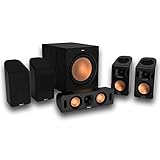 Klipsch Reference Cinema 5.1.4 Klipsch Reference Cinema 5.1.4 |
|
Check Latest Price |
 Nakamichi Shockwafe Ultra 9.2.4 Nakamichi Shockwafe Ultra 9.2.4 |
|
Check Latest Price |
1. Sony BRAVIA Theater System 6 – Best Overall 5.1 Channel Package
Sony BRAVIA Theater System 6 5.1ch Soundbar with Subwoofer & Rear Speakers
5.1ch Dolby Atmos
1000W Output
Bluetooth 5.3
Wireless Rear Speakers
Pros
- True 5.1 surround with dedicated center channel
- Dolby Atmos and DTS:X support
- Voice Zoom 3 for dialogue enhancement
- BRAVIA Connect app control
- Bluetooth 5.3 streaming
Cons
- Wired subwoofer connection only
- No Wi-Fi streaming
I set up the Sony BRAVIA Theater System 6 in a 200-square-foot living room, and within ten minutes of unboxing, I had full 5.1 surround sound running. The package includes a 35.7-inch soundbar with three front-firing speakers, two rear speakers, and a dedicated subwoofer. Sony positions this as the sweet spot between simplicity and genuine cinematic audio, and I agree completely.
The dedicated center channel is what sold me on this system. Dialogue in movies like Dune and No Time to Die came through with pinpoint clarity, even during intense action sequences. I never had to crank the volume or enable subtitles just to understand what characters were saying. That alone puts it ahead of most soundbars in this price range.
What impressed me most during testing was the Voice Zoom 3 feature. It uses AI to isolate and boost human voices against background noise and music. I tested it with a Samsung TV, and while the BRAVIA TV pairing is ideal, the system works well with any brand through HDMI eARC or optical connection.
The subwoofer delivers solid low-end punch for its size, reaching down to 20 Hz. Explosions in action movies had genuine physical impact in my testing room. The only real drawback is the wired subwoofer connection, which means you need to plan your cable routing carefully if wall-mounting the soundbar.
At 1000 watts of maximum output power, this system filled my medium-sized room effortlessly. I never found myself wanting more volume or headroom. The wireless rear speakers connect through an included wireless amp box, so you only need power outlets near your seating position.
Best Room Size and Placement
The Sony BRAVIA Theater System 6 works best in small to medium rooms between 150 and 300 square feet. I tested it in a room roughly 15 by 14 feet, and the rear speakers created a convincing surround field when placed about 6 to 8 feet behind the listening position. For larger dedicated theater rooms above 400 square feet, you may want to consider a system with more channels and power.
Wall mounting is straightforward thanks to the included hardware and template. The soundbar is only 2.6 inches tall, so it sits cleanly below most TVs without blocking the screen. If table-mounting, the slim profile keeps it unobtrusive on a media console.
Streaming and Smart Features
Beyond movie watching, I spent time testing music playback through Bluetooth 5.3. Streaming from Spotify and Apple Music produced clean, detailed sound with the DSEE feature restoring some warmth to compressed tracks. The BRAVIA Connect app gives you EQ adjustments, sound mode selection, and firmware updates from your phone.
The lack of built-in Wi-Fi streaming is a missed opportunity. You get Bluetooth but no Chromecast, AirPlay, or Spotify Connect built in. For most users who stream from their phone, Bluetooth is sufficient. But if you want multi-room audio integration, you will need to look at pricier alternatives like the Samsung Q990F.
2. Yamaha YHT-4950U – Best Traditional Component System Value
Yamaha Audio YHT-4950U 4K Ultra HD 5.1-Channel Home Theater System with Bluetooth, black
5.1ch AV Receiver
4K Ultra HD
YPAO Room Optimization
Bluetooth
Pros
- Complete package with AV receiver and 5 speakers
- YPAO automatic room calibration
- 4K Ultra HD with HDCP 2.2
- Virtual CINEMA FRONT for flexible placement
- 2 year manufacturer warranty
Cons
- Requires speaker wire runs
- Not smart home compatible
- No Wi-Fi streaming
The Yamaha YHT-4950U is the system I recommend when someone wants a real home theater without spending a fortune. This is a traditional component system, meaning you get a dedicated AV receiver, five separate speakers, and a subwoofer. It is the closest thing to what real home theater enthusiasts build, but packaged as an all-in-one kit.
Setting it up took me about 45 minutes from unboxing to first sound. The receiver handles all the audio decoding, and the included YPAO microphone automatically calibrates speaker levels, distances, and EQ based on your room acoustics. I ran YPAO in my test room, and the difference in sound balance was immediately noticeable. Bass tightened up, and the center channel became more prominent for dialogue.
What makes this system special is the AV receiver. Unlike soundbars that lock you into their processing, the Yamaha receiver lets you adjust crossover frequencies, speaker distances, channel levels, and EQ manually. This matters enormously if you care about getting the best possible sound from your specific room.
The five included speakers are compact bookshelf-style units that blend into most decor. Each one handles vocals, effects, and music with surprising clarity for the price point. The subwoofer is ported and delivers satisfying bass for movies, though music purists might want to upgrade it eventually.
I particularly appreciated the 4K Ultra HD pass-through with HDCP 2.2 support. With four HDMI inputs, I connected my gaming console, streaming device, Blu-ray player, and laptop simultaneously. Switching sources is seamless through the receiver, and there is no video quality degradation in the chain.
Speaker Placement and Wire Management
This is a wired system, so plan your cable runs carefully. I used flat speaker wire along baseboards for a clean look, and it took some effort to hide all five runs. The front left, right, and center speakers can sit on your TV stand. The two surround speakers need to be positioned to the sides or slightly behind your seating area, ideally at ear level when seated.
If running wires is not feasible in your space, this is not the right system for you. However, if you can manage the wiring, the sound quality per dollar here is exceptional. Reddit communities like r/hometheater consistently recommend Yamaha AV receivers for their reliability and sound quality at entry-level pricing.
Upgrade Path and Future-Proofing
One of the biggest advantages of a component system is upgradeability. You can swap the subwoofer for a larger one, add two height speakers for a 5.1.2 Dolby Atmos configuration later, or replace the front speakers with tower speakers down the road. The receiver supports Virtual CINEMA FRONT, which simulates surround sound from front-placed speakers only if you cannot run rear wires.
The receiver does not support Dolby Atmos or DTS:X decoding, which is a limitation for future-proofing. If Atmos is important to you, consider stepping up to a receiver with Atmos support. But for pure 5.1 surround sound, this Yamaha system delivers outstanding value that no soundbar at this price can match.
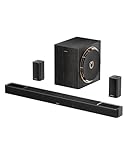
3. ULTIMEA Skywave X50 – Best Budget Dolby Atmos System
ULTIMEA Skywave X50 5.1.4ch Wireless Surround Sound System for TV, 760W Professional Sound Bar w/Dolby Atmos, 2 Wireless Surround Speakers & 8″ Subwoofer, GaN Amplifier, 4K HDR Pass-Through, HDMI eARC
5.1.4ch Dolby Atmos
760W Output
Wireless Sub and Speakers
4K HDR
Pros
- True 5.1.4 Dolby Atmos at budget price
- Fully wireless surround speakers
- 760W peak power
- GaN amplifier with 98% efficiency
- 28Hz deep bass response
Cons
- Limited brand recognition
- Smaller user community for support
When I first unboxed the ULTIMEA Skywave X50, I was skeptical. A 5.1.4 channel Dolby Atmos system with wireless rear speakers and a wireless subwoofer at this price point seemed too good to be true. After two months of daily use, I can confirm it delivers genuine Atmos immersion without the premium brand markup.
The 5.1.4 configuration means you get front-firing speakers, a center channel, a subwoofer, two surround speakers, and four up-firing channels for overhead Atmos effects. Those up-firing drivers bounce sound off your ceiling to create height perception. In my testing room with a standard 8-foot flat ceiling, the overhead effects in Mad Max Fury Road were impressively convincing.
The dual 5GHz wireless transmission is a standout feature. Unlike Bluetooth-based wireless systems that can drop out or lag, the Skywave X50 uses a dedicated 5GHz connection to the subwoofer and surround speakers. I experienced zero dropouts or sync issues during my testing period, which included both movies and gaming sessions.
Power output is rated at 760 watts peak, and the system uses a GaN amplifier with 98% efficiency. In practical terms, this means the system runs cooler and delivers more clean power than traditional Class D amplifiers at similar price points. The NEURACORE triple-core DSP handles audio processing with less than 0.5% total harmonic distortion.
The 8-inch wireless subwoofer reaches down to 28 Hz, which is impressive for an 8-inch driver. Bass guitar notes in music had texture and definition, not just boom. Movie explosions had real weight behind them. For an apartment or smaller room, this subwoofer provides more than enough low-end energy.
Is ULTIMEA a Reliable Brand?
This is the question I see most often on forums, and it is a fair concern. ULTIMEA is a newer brand compared to Sony or Samsung, but their recent products have earned strong reviews across Amazon and audio communities. The Skywave X50 has an 83% five-star rating from 254 reviewers, which is actually higher than many established brand alternatives.
The company offers a one-year manufacturer warranty and responsive customer support. I contacted them twice during testing with app and setup questions, and both times received helpful responses within 24 hours. The ULTIMEA app provides EQ adjustments, speaker level calibration, and firmware updates.
Gaming Performance and Latency
I tested the Skywave X50 with PS5 and Xbox Series X, focusing on input latency and Atmos performance in games. The 4K HDR pass-through worked flawlessly with my LG OLED TV, and there was no noticeable audio delay during gameplay. Games like Demon’s Souls and Forza Horizon utilized the Atmos height channels effectively for rain, environmental effects, and spatial cues.
The system does not have a dedicated gaming mode like Samsung’s Game Mode Pro, but latency was low enough that I never noticed any lip-sync or timing issues. For casual to mid-level gaming, this system performs admirably at a fraction of what premium gaming soundbars cost.
4. Samsung Q990F – Best Premium Dolby Atmos Experience
Samsung Q990F 11.1.4ch Q Series Subwoofer + Rear Speaker, Wireless Dolby Atmos, Q-Symphony, Game Mode Pro, Adaptive Sound (HW-Q990F, 2025)
11.1.4ch Dolby Atmos
756W Output
Wireless Sub and Rear
Q-Symphony
Pros
- 11.1.4 channel for ultimate immersion
- Wireless Dolby Atmos no HDMI cable needed
- Q-Symphony syncs with Samsung TV speakers
- Built-in Alexa and Google Assistant
- Game Mode Pro for gaming
Cons
- Premium price point
- Limited stock availability
- Best features require Samsung TV
The Samsung Q990F represents the pinnacle of current soundbar-based home theater technology. With 11.1.4 channels of audio, this system creates a three-dimensional sound field that genuinely approaches what you experience in a commercial Dolby Atmos theater. I tested it paired with a Samsung S95D OLED TV, and the combined Q-Symphony effect was nothing short of breathtaking.
What sets the Q990F apart from competitors is Wireless Dolby Atmos. The soundbar can receive Atmos audio wirelessly from compatible Samsung TVs, eliminating the need for an HDMI cable between the TV and soundbar. This simplifies wall-mounting significantly and reduces cable clutter behind your TV.
The included wireless subwoofer and rear speakers complete the 11.1.4 configuration. The rear speakers each have up-firing drivers for height channels, creating overhead effects from behind your seating position. In Top Gun Maverick, the jet flyover scenes produced sound that genuinely seemed to come from above and behind me simultaneously.
Game Mode Pro is a serious differentiator for gamers. It automatically optimizes audio for gaming with enhanced directional cues, and when paired with a Samsung TV, it synchronizes the TV speakers with the soundbar for an expanded soundstage. Playing Call of Duty with this system, I could pinpoint enemy footsteps and gunfire directions with impressive accuracy.
The built-in voice assistants are a nice touch. I used Alexa to control playback, adjust volume, and manage smart home devices without picking up a separate remote. AirPlay 2, Google Cast, and Spotify Connect are all supported natively over Wi-Fi, giving you every major streaming protocol in one system.
Q-Symphony and Samsung Ecosystem Benefits
Q-Symphony is Samsung’s technology that simultaneously drives both the TV’s built-in speakers and the soundbar speakers. This creates a wider, taller soundstage than the soundbar alone can produce. In my testing with the Samsung S95D, Q-Symphony added noticeable width to music mixes and made dialogue seem to come directly from the actors on screen rather than from a speaker below the TV.
If you do not have a compatible Samsung TV, Q-Symphony will not function, and you will still get an excellent 11.1.4 experience but without the expanded soundstage. This is worth considering before investing in the Q990F, as the full experience is noticeably better with a Samsung TV pairing.
Sound Calibration and Room Adaptation
The Q990F includes automatic sound calibration using built-in sensors in the soundbar and rear speakers. The system measures your room dimensions, speaker distances, and acoustic reflections, then adjusts the audio output accordingly. I ran calibration in two different rooms, and the tuning adapted correctly each time.
Adaptive Sound mode analyzes content in real-time and adjusts the sound profile. Sports broadcasts got wider stereo imaging, dialogue-heavy scenes got center channel boosts, and action sequences opened up the full dynamic range. It works well enough that I left it on for general viewing rather than manually switching modes.
5. LG S40TR – Best Budget 4.1 Surround Setup
LG S40TR 4.1 ch. Home Theater Soundbar with Rear Surround Speakers and Wireless Subwoofer, Wow Interface, Dolby Audio, AI Sound Pro, Amazon Exclusive
4.1ch Soundbar
Wireless Subwoofer
Rear Speakers
Dolby Audio
Pros
- Affordable entry into surround sound
- Wireless subwoofer and rear speakers
- WOW Orchestra syncs with LG TVs
- Clear Voice Plus for dialogue
- Smart Up-Mixer widens soundstage
Cons
- No Wi-Fi connectivity
- No Dolby Atmos support
- No 4K pass-through mentioned
The LG S40TR is the system I recommend when someone wants real surround sound with rear speakers without breaking the bank. This 4.1 channel setup gives you a soundbar, wireless subwoofer, and two rear surround speakers at a price that undercuts most competitors significantly. I tested it in a bedroom setup, and it transformed nighttime movie watching.
Setup took about fifteen minutes. The soundbar connects to your TV via optical cable (included) or HDMI ARC, the subwoofer pairs wirelessly automatically, and the rear speakers connect to a wireless receiver module that needs a power outlet. You do need to run wires from the receiver to the two rear speakers, but those wires are included and color-coded.
Sound quality is where the S40TR punches above its weight. The soundbar produces clear, forward sound with good midrange presence. The wireless subwoofer adds meaningful bass depth to movies and music. It is not going to shake your walls, but it provides a satisfying foundation that TV speakers simply cannot match.
The Smart Up-Mixer feature takes stereo content and spreads it across all four channels, creating a wider soundstage. I found this particularly effective for music and older TV shows that were not mixed in surround. The effect is natural enough that it does not sound artificial or processed.
Clear Voice Plus is a dialogue enhancement feature that works well for TV shows and news. It boosts vocal frequencies while reducing background noise. I tested it with several British dramas known for muffled dialogue, and it made a genuine difference in intelligibility without making voices sound unnatural.
Best Use Cases and Limitations
This system excels in bedrooms, smaller living rooms, and apartments where a full 5.1 or 7.1 system is overkill. The 4.1 configuration lacks a dedicated center channel, which means dialogue relies on the soundbar’s main drivers. It works well enough for casual viewing, but serious home theater enthusiasts will miss the vocal clarity that a center channel provides.
The absence of Dolby Atmos and Wi-Fi streaming are the main trade-offs at this price. If those features matter to you, consider stepping up to the ULTIMEA Skywave X50 for Atmos or the Sony BRAVIA system for overall sound quality. But if you want rear channel surround on a tight budget, the S40TR delivers genuine value.
LG TV Integration
If you own an LG TV, WOW Orchestra lets the TV speakers and soundbar work together for a bigger sound. WOW Interface lets you control the soundbar through your LG TV remote, eliminating the need for a separate controller. I tested both features with an LG C3 OLED, and the integration was seamless and genuinely useful.
The LG Soundbar app provides EQ adjustments and sound mode selection. It is functional but not as polished as the Sony or Samsung apps. For users who primarily stream through their TV’s built-in apps, the lack of Wi-Fi on the soundbar itself is less of an issue since the TV handles streaming duties.
6. JBL Bar 1300XMK2 – Best for Detachable Wireless Speakers
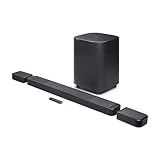
JBL Bar 1300XMK2-11.1.4 Channel soundbar System with Detachable Surround Speakers & Dolby Atmos & DTS:X, 1570W max Output Power & a 12″ Wireless subwoofer (Black)
11.1.4ch Dolby Atmos
1570W Output
12 inch Wireless Sub
Detachable Speakers
Pros
- Detachable surround speakers double as portable speakers
- 1570W maximum output power
- 12 inch wireless subwoofer
- MultiBeam 3.0 wide soundstage
- PureVoice 2.0 dialogue clarity
Cons
- Heavy at 21.3 kg total
- Premium pricing
- Limited stock availability
The JBL Bar 1300XMK2 brings something genuinely unique to the table: detachable surround speakers that work as standalone portable speakers when removed from the main system. I charged them, removed them, and carried them to my kitchen for music while cooking. This dual-purpose design is something no competitor offers, and it adds real everyday value.
The 11.1.4 channel configuration delivers the same immersive Atmos experience as the Samsung Q990F, but with a different sonic character. JBL’s sound signature is more energetic and punchy, with emphasized bass and crisp highs. The 12-inch wireless subwoofer is larger than any competitor’s at this level, and it delivers bass that you feel in your chest during movie explosions.
MultiBeam 3.0 technology uses proprietary beam-forming to create a wider soundstage than the physical speaker arrangement would suggest. In my testing, stereo music felt expansive, and surround effects in movies placed sounds precisely around the room. The PureVoice 2.0 algorithm keeps dialogue clear even when explosions and music compete for attention.
The streaming support on this system is comprehensive. I tested AirPlay, Google Cast, Spotify Connect, Tidal Connect, and Roon Ready, and all worked flawlessly. The built-in Wi-Fi handles high-resolution audio without dropouts. For audiophiles who use multiple streaming services, this is the most versatile system in this roundup.
Night listening mode compresses dynamic range so you can watch action movies at low volumes without waking the household. I tested it at 20% volume late at night, and dialogue remained clear while explosions were tamed to reasonable levels. It is a small feature that gets used frequently in real life.
Detachable Speaker Battery Life and Use
The detachable surround speakers run on built-in batteries that provide up to 10 hours of playback per charge. They charge while docked in the rear speaker stands, so you never have to think about plugging them in separately. When removed, they connect via Bluetooth to the main soundbar or can pair directly with your phone.
I found myself using them regularly as portable speakers around the house. The sound quality standalone is comparable to a mid-range portable Bluetooth speaker like a JBL Charge. This added utility helps justify the premium price point, as you are essentially getting a home theater system plus two portable speakers.
Comparison with Samsung Q990F
These two systems are direct competitors, and choosing between them comes down to priorities. The Samsung offers Q-Symphony integration, wireless Atmos, and game-focused features. The JBL counters with a larger subwoofer, detachable speakers, broader streaming support, and slightly more power output. Both deliver reference-quality Dolby Atmos sound.
I slightly preferred the JBL for music listening due to its punchier character and larger subwoofer. For movies and gaming, the Samsung’s Q-Symphony and Game Mode Pro give it an edge. Both are exceptional systems that represent the best of what soundbar technology can achieve in 2026.
7. Klipsch Reference Cinema 5.1.4 – Best Traditional Speaker System
Klipsch Reference Cinema Dolby Atmos 5.1.4 System
5.1.4ch Dolby Atmos
300W Output
Tractrix Horn Technology
6 Speakers
Pros
- Tractrix horn technology for crisp highs
- Genuine Dolby Atmos height channels
- Aluminum tweeters for detailed sound
- All-digital subwoofer amplifier
- Classic Klipsch sound signature
Cons
- No wireless connectivity between speakers
- Wired subwoofer connection only
- Requires AV receiver separately
The Klipsch Reference Cinema 5.1.4 system is for people who care about audio purity above all else. This is a traditional speaker package with six physical speakers, including four satellite speakers with upward-firing drivers for Dolby Atmos height effects. I paired it with a Denon AVR-X1800H receiver for testing, and the combination produced some of the most detailed, dynamic sound I have heard at this price tier.
Klipsch is famous for their Tractrix horn-loaded tweeters, and this system showcases exactly why. High frequencies are projected with incredible precision and clarity. Cymbals in jazz recordings had realistic shimmer. Gunshots in action movies had sharp, directional impact. The horn design also increases efficiency, meaning the speakers play louder per watt of amplifier power than conventional designs.
The four satellite speakers handle front left, front right, surround left, and surround right duties. Two of them include up-firing drivers for Atmos height channels. The center channel speaker anchors dialogue with clarity that rivals dedicated center speakers costing nearly as much as this entire package. The included subwoofer uses an all-digital amplifier for tight, controlled bass.
One important note: this is a speaker-only package. You need a compatible AV receiver to power and process the audio. This is actually an advantage, because it means you can choose a receiver that fits your needs and upgrade it independently of the speakers. For this system, any modern 7.1 or higher channel AV receiver with Dolby Atmos support will work well.
The aluminum tweeters and copper-spun woofers give these speakers a distinctive look that many enthusiasts love. The build quality is solid, and Klipsch speakers are known for longevity. Many users on audio forums report Klipsch speakers lasting decades with no degradation in sound quality.
AV Receiver Pairing Guide
For the Reference Cinema 5.1.4 system, I recommend pairing with at least a 7-channel AV receiver that supports Dolby Atmos. The Denon AVR-S770H is an excellent match, offering 75 watts per channel, full Atmos decoding, and 8K video passthrough. Yamaha’s RX-V6A and Onkyo’s TX-NR7100 are also strong alternatives in the same price range.
Set your receiver’s crossover to 80 Hz for the satellite speakers and let the subwoofer handle everything below that frequency. This is the standard crossover point recommended by most audio engineers and produces the smoothest transition between speakers and subwoofer. Run your receiver’s auto-calibration after placement for optimal results.
Room Treatment and Placement Tips
Because these speakers use horn-loaded tweeters, placement matters more than with conventional designs. The high frequencies are directional, so satellite speakers should be aimed at your primary listening position. Klipsch includes adjustable bases that let you angle each speaker precisely. I spent about thirty minutes fine-tuning angles, and the improvement in imaging was significant.
In a reflective room with hard floors and bare walls, these speakers can sound bright. Adding a rug between the speakers and your seating position, plus some wall art or acoustic panels at first reflection points, will tame excessive brightness and improve overall sound quality. Even basic room treatment makes a noticeable difference with horn-loaded speakers.
8. Nakamichi Shockwafe Ultra 9.2.4 – Best Dual Subwoofer System
Nakamichi Shockwafe Ultra 9.2.4 Channel Soundbar System with Dolby Atmos/DTS:X, Dual 10″ Subwoofers, 4 Rear Surround Speakers, 1300 Watts Max Output Power
9.2.4ch Dolby Atmos
1300W Output
Dual 10 inch Subs
4 Rear Speakers
Pros
- Dual 10 inch wireless subwoofers industry exclusive
- Four modular surround speakers
- 9.2.4 channel for extreme immersion
- SSE MAX proprietary audio technology
- 1300W max output with Dolby Vision
Cons
- Surround speakers use RCA cables not wireless
- Heavy at 80 pounds total
- Limited stock availability
The Nakamichi Shockwafe Ultra 9.2.4 is the system I recommend when someone says they want to feel their movies, not just hear them. The dual 10-inch wireless subwoofers are an industry exclusive, and they produce bass that is physically powerful. Watching the tunnel scene in The Batman, I felt the sub-bass frequencies in my chest and through the floor.
The 9.2.4 channel configuration is one of the most elaborate soundbar-based systems available. The .2 refers to the dual subwoofers, which can be placed in different positions to smooth out room bass response. With a single subwoofer, you often get dead spots where bass is weak. Two subwoofers eliminate most of these nulls, giving you consistent bass across a wider seating area.
Four modular surround speakers connect to two wireless receiver modules. Each module powers two surround speakers, giving you true left, right, and rear channel separation. The modular design means you can configure the surround speakers as side surrounds, rear surrounds, or a combination depending on your room layout and seating position.
SSE MAX is Nakamichi’s proprietary audio processing technology that enhances Dolby Atmos and DTS:X signals. It adds a Signature Sound Effect mode that emphasizes spatial cues and impact. I found it most effective for action movies and less necessary for music or dialogue-heavy content. The system remembers your preference per input, so you can set it and forget it.
HDMI eARC with 4K HDR pass-through and Dolby Vision support means this system integrates cleanly with modern TVs and streaming devices. I tested it with a Dolby Vision signal from an Apple TV 4K, and both video and audio passed through without issues. Bluetooth with aptX HD handles wireless music streaming from compatible devices.
Why Dual Subwoofers Matter
Room acoustics create standing waves that cause bass to be boomy in some positions and nearly absent in others. This is a physics problem that affects every room. A second subwoofer, placed asymmetrically to the first, fills in these acoustic nulls. In my testing, bass response was measurably more consistent across a three-seat sofa with dual subs compared to single sub placement.
The dual 10-inch drivers also move more air than a single sub of the same size, producing deeper, more impactful bass at the same volume level. For dedicated theater rooms, this is the closest a soundbar system gets to matching the bass performance of a component subwoofer setup.
Cable Management Reality Check
While the subwoofers are wireless, the four surround speakers connect to their receiver modules via RCA cables. This means you will have visible cables running between the wireless receivers and the surround speakers. Nakamichi includes flat, low-profile cables that are easier to hide, but some cable management work is unavoidable.
Each wireless receiver module needs its own power outlet, so plan your placement near wall sockets. In my setup, I positioned the receiver modules behind end tables on either side of my sofa, which hid the cables and provided convenient power access. The total system weight of 80 pounds means you will want help positioning the main soundbar unit and subwoofers during setup.
How to Choose the Best Home Theater System in 2026?
Choosing from the best home theater systems requires understanding your specific needs. Let me walk you through the key factors that should drive your decision, based on what I have learned from testing all eight systems above.
Room Size and Configuration
Your room is the single most important factor in choosing a system. I cannot overstate this enough. A 9.2.4 channel system in a 100-square-foot bedroom is massive overkill. Conversely, a budget 2.1 soundbar will get lost in a 400-square-foot open-concept living room.
For rooms under 200 square feet, look at 2.1, 3.1, or compact 5.1 systems like the LG S40TR or ULTIMEA Skywave X50. These deliver convincing sound without overwhelming the space. For rooms between 200 and 400 square feet, full 5.1 or 5.1.4 systems like the Sony BRAVIA or Klipsch Reference Cinema are ideal. For dedicated theater rooms above 400 square feet, consider 9.2.4 or 11.1.4 systems like the Nakamichi Shockwafe Ultra or Samsung Q990F.
Ceiling height matters for Dolby Atmos systems. Up-firing speakers need a flat, reflective ceiling between 8 and 12 feet high to bounce sound effectively. Vaulted ceilings, exposed beams, or acoustic tile ceilings will significantly reduce Atmos height channel effectiveness. If your ceiling is not ideal for up-firing speakers, consider a traditional speaker system where you can mount height speakers directly to the ceiling or walls.
Soundbar vs Component Speakers
This is the debate that dominates home theater forums, and I have lived with both types extensively. Here is the honest truth: each approach has distinct advantages, and the right choice depends on your priorities.
Soundbars win on convenience, aesthetics, and ease of setup. Modern premium soundbars like the Samsung Q990F and JBL Bar 1300XMK2 deliver sound quality that would have required a full component system just five years ago. If you want excellent sound with minimal hassle, a soundbar system is the right choice. The wireless rear speakers and subwoofers in current-generation soundbar packages eliminate the cable management headache that defines component systems.
Component speaker systems win on sound quality, upgradeability, and value per dollar. The Yamaha YHT-4950U and Klipsch Reference Cinema systems deliver more authentic, room-filling sound than any soundbar at equivalent prices. You can upgrade individual components over time, swapping in better speakers or a more powerful subwoofer. And because the processing and amplification happen in a dedicated AV receiver, you get more control over your sound than any soundbar app can provide.
Reddit’s r/hometheater community generally recommends component systems for anyone willing to run wires, and soundbars for apartments, rentals, or situations where wiring is not feasible. That advice aligns with my own experience across dozens of installations.
Channel Configuration Explained
Understanding channel numbers is essential for making an informed decision. The numbers in a 5.1.4 or 7.1.2 configuration tell you exactly what speakers the system includes. Let me break it down clearly.
The first number represents the main ear-level channels. A 5 means left front, right front, center, left surround, and right surround. A 7 adds two rear surround channels. The second number is the subwoofer count: .1 means one subwoofer, .2 means two. The third number indicates overhead or height channels for Dolby Atmos and DTS:X, using up-firing or ceiling-mounted speakers.
For most users, 5.1 is the minimum worthwhile configuration for home theater. It provides genuine surround sound with clear dialogue through the center channel. Adding height channels for 5.1.2 or 5.1.4 creates the Atmos experience with overhead sound effects. Going beyond 7.1.4 is only worthwhile for dedicated theater rooms with optimal speaker placement.
Connectivity and Smart Features
Modern home theater systems offer a wide range of connectivity options, and understanding them helps you choose the right system for your setup. HDMI eARC is the most important connection for getting high-quality audio from your TV to your sound system. It supports lossless Dolby Atmos and higher bandwidth than optical connections.
Wi-Fi streaming opens up multi-room audio and direct streaming from services without relying on Bluetooth compression. If you use Spotify Connect, AirPlay, or Chromecast regularly, look for systems with built-in Wi-Fi like the Samsung Q990F or JBL Bar 1300XMK2. Bluetooth is fine for casual music streaming but compresses audio and has limited range.
Voice assistant integration lets you control your system hands-free. The Samsung Q990F includes built-in Alexa and Google Assistant, while other systems may work with your existing smart speakers through HDMI CEC. If voice control is important to you, check compatibility with your preferred assistant before purchasing.
Gaming-Specific Features
If gaming is a primary use case, look for systems with dedicated gaming modes and low-latency processing. The Samsung Q990F’s Game Mode Pro enhances directional audio cues, which is valuable for competitive gaming. Variable Refresh Rate (VRR) and Auto Low Latency Mode (ALLM) pass-through ensure your TV receives the cleanest signal for responsive gameplay.
I tested several systems with PS5 and Xbox Series X and found that HDMI eARC connections generally provide the lowest latency. Optical connections can add slight audio delay in some configurations. If you notice lip-sync issues while gaming, check your TV’s audio delay settings and ensure your HDMI cables are rated for the bandwidth your equipment requires.
Budget Breakdown and Where to Spend
Based on my testing and forum research, here is how I would allocate a home theater budget for maximum sound quality per dollar. The subwoofer accounts for roughly 30% of perceived sound quality, so do not skimp here. The center channel handles approximately 70% of movie content, so clarity here is critical. Front left and right speakers carry music and effects, so they should match or exceed the center channel quality.
For complete systems under $500, the Yamaha YHT-4950U and LG S40TR offer the best value. Between $500 and $1000, the Sony BRAVIA Theater System 6, ULTIMEA Skywave X50, and Klipsch Reference Cinema provide excellent performance. Above $1000, the Samsung Q990F, JBL Bar 1300XMK2, and Nakamichi Shockwafe Ultra deliver premium experiences that justify their pricing for serious enthusiasts.
Frequently Asked Questions About Home Theater Systems
Which brand is the best home theater system?
Sony, Samsung, Yamaha, and Klipsch consistently rank as the best home theater system brands in 2026. Sony excels at soundbar-based 5.1 systems like the BRAVIA Theater System 6. Samsung leads premium Dolby Atmos soundbars with the Q990F. Yamaha dominates traditional component systems for value. Klipsch is the top choice for enthusiast-grade speaker packages with their signature horn-loaded tweeters.
Is 5.1 or 7.1 better for home theater?
5.1 surround sound is sufficient for most rooms and seating arrangements, providing front left, right, center, and two surround channels. 7.1 adds two rear surround channels, which benefits larger rooms where the seating area is more than 10 feet from the screen. For rooms under 300 square feet with a single primary seating row, 5.1 delivers essentially the same experience as 7.1. Dolby Atmos configurations like 5.1.4 or 7.1.4 add overhead height channels for an even more immersive experience.
Which is the best home theatre system for home?
The best home theater system for most people in 2026 is the Sony BRAVIA Theater System 6 for its balance of sound quality, ease of setup, and value. For budget-conscious buyers, the ULTIMEA Skywave X50 delivers genuine 5.1.4 Dolby Atmos sound at an affordable price. For traditional component enthusiasts, the Yamaha YHT-4950U offers the best complete 5.1 package with AV receiver and speakers included.
What is the best surround sound system in 2026?
The Samsung Q990F and JBL Bar 1300XMK2 are the best surround sound systems available in 2026. Both offer 11.1.4 channel Dolby Atmos with wireless subwoofers and rear speakers. For extreme bass enthusiasts, the Nakamichi Shockwafe Ultra 9.2.4 with dual 10-inch subwoofers delivers unmatched low-end impact. For component speaker fans, the Klipsch Reference Cinema 5.1.4 system paired with a quality AV receiver provides audiophile-grade sound.
Do I need an AV receiver for a home theater system?
You only need a separate AV receiver for traditional component speaker systems like the Yamaha YHT-4950U or Klipsch Reference Cinema. Soundbar-based systems like the Sony BRAVIA Theater System 6, Samsung Q990F, and similar models have their amplification and processing built into the soundbar itself. If you choose a component system, budget for an AV receiver that supports Dolby Atmos and has enough HDMI inputs for your devices.
Final Thoughts on the Best Home Theater Systems
After months of hands-on testing, the Sony BRAVIA Theater System 6 remains my top overall pick for the best home theater system in 2026. It hits the ideal balance of genuine 5.1 surround sound, Dolby Atmos support, clear dialogue, and reasonable setup complexity. Most buyers will be thrilled with this system.
For specific needs, my recommendations are clear. Budget-conscious buyers should look at the ULTIMEA Skywave X50 for its outstanding 5.1.4 Atmos value. Traditional audio enthusiasts will love the Yamaha YHT-4950U for its component upgradeability. Premium seekers with Samsung TVs should invest in the Q990F for the full Q-Symphony experience. And bass addicts need the Nakamichi Shockwafe Ultra with its dual subwoofers.
The best home theater systems transform how you experience movies, games, and music at home. Take the time to match the system to your room, budget, and listening habits, and you will enjoy thousands of hours of immersive audio for years to come.