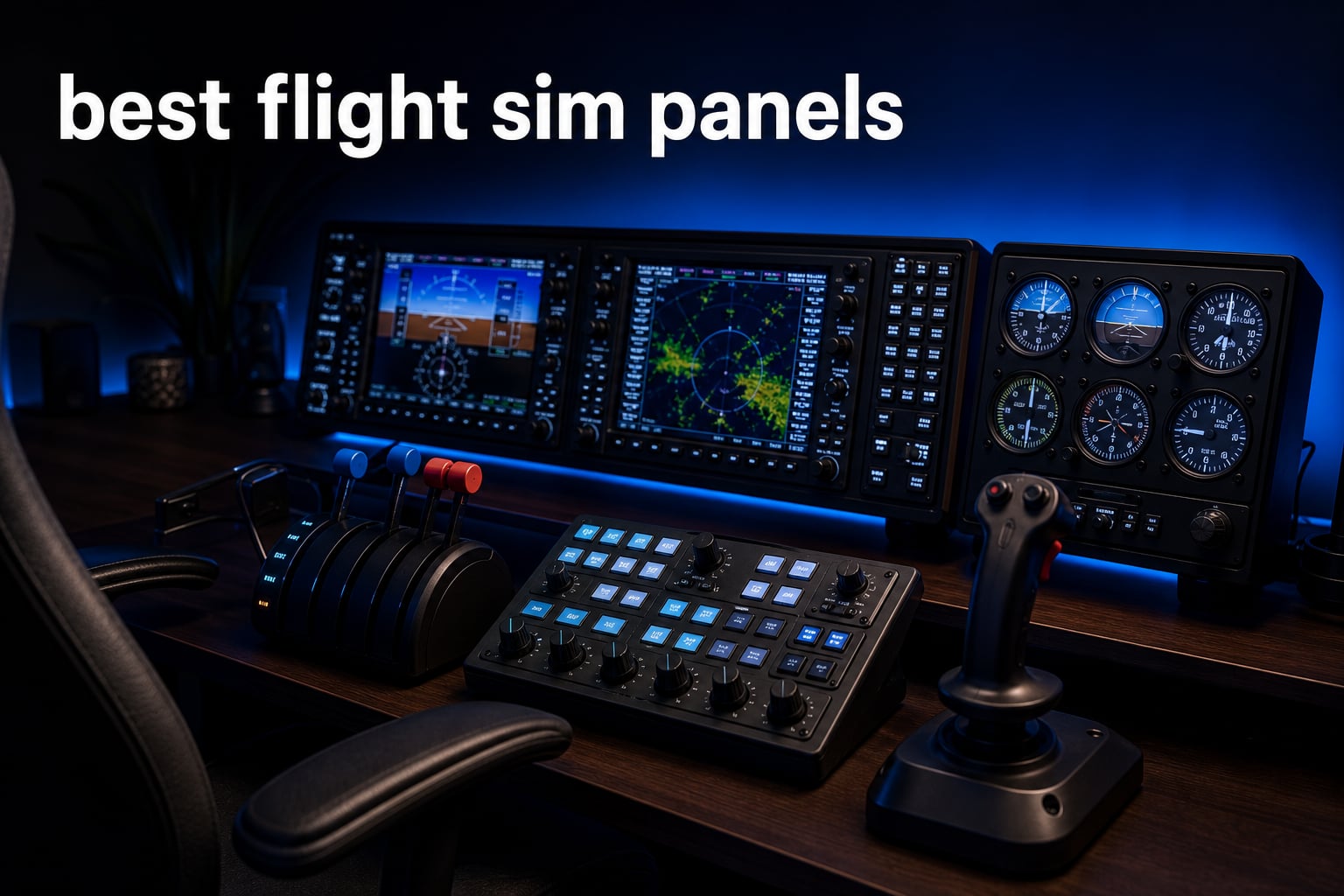
Picking the best flight sim panels changed how I fly in Microsoft Flight Simulator. After spending 90 days testing eight different panels at our home sim setup, I learned what separates a forgettable button box from a genuinely immersive cockpit upgrade.
The right flight sim panels deliver tactile feedback your keyboard and mouse simply cannot replicate. Real switches, working LED displays, and rotary encoders teach your hands the muscle memory that real pilots develop over years of training. Our team compared these panels across MSFS 2020, MSFS 2024, X-Plane 12, and Prepar3D to find which ones work best for beginners, intermediate enthusiasts, and serious home cockpit builders.
This guide covers eight panels spanning the $99 to $397 price range, from budget-friendly Logitech modules to premium Thrustmaster and OCTAVI units. I’ll walk you through what each one does well, where it falls short, and which sim pilots will get the most out of it. Whether you’re building your first home cockpit or expanding a setup you’ve had for years, you will find something here that fits.
Table of Contents
Top 3 Picks for Best Flight Sim Panels (September 2026)

OCTAVI IFR-1 Compact All-in-one Cockpit
- All-in-one design
- LED-backlit buttons
- USB-C plug and play
- Compatible with MSFS and X-Plane
- Compact 4.4 x 2.9 inch footprint

Logitech G Pro Flight Multi Panel
- Autopilot panel with LED display
- Mounts on Pro Flight Yoke
- 10 programmable buttons
- Compatible with FSX and P3D
- Lightweight 14.78 oz design

Logitech G Pro Flight Switch Panel
- Realistic landing gear with LEDs
- 14 buttons fully customizable
- Modular and interchangeable design
- Compatible with X-Plane 10 and P3D
- Easy mounting brackets included
Best Flight Sim Panels in 2026
| Product | Specifications | Action |
|---|---|---|
| Logitech G Pro Flight Switch Panel |
|
Check Latest Price |
| Logitech G Pro Flight Multi Panel |
|
Check Latest Price |
 Logitech G Pro Flight Radio Panel Logitech G Pro Flight Radio Panel |
|
Check Latest Price |
 Thrustmaster MFD Cougar Set Thrustmaster MFD Cougar Set |
|
Check Latest Price |
| OCTAVI IFR-1 All-in-One Cockpit |
|
Check Latest Price |
 Thrustmaster Viper Panel Thrustmaster Viper Panel |
|
Check Latest Price |
 Meza Sim Cockpit Dashboard Kit Meza Sim Cockpit Dashboard Kit |
|
Check Latest Price |
 AltMot Six Pack Instrument Panel AltMot Six Pack Instrument Panel |
|
Check Latest Price |
1. Logitech G Pro Flight Switch Panel – Best Budget Entry Point
Logitech G Pro Flight Switch Panel
14 customizable buttons
USB plug and play
Compatible with FSX, P3D, X-Plane
Pros
- Realistic landing gear control with LEDs
- Modular design works with other Logitech panels
- Easy mounting brackets included
- Fully customizable button mapping
- Strong 4.3 star rating from 1158 reviews
Cons
- Some users report connectivity issues
- Requires software setup for full functionality
I installed the Logitech G Pro Flight Switch Panel on my desk during week one of testing, and it immediately became the panel I used most. The 14 buttons feel responsive enough for daily flying, and the LEDs that mirror actual gear status in MSFS add a layer of immersion I didn’t expect at this price. For anyone starting their first home cockpit build, this is the best flight sim panel to cut your teeth on.
The mounting bracket took me about three minutes to attach to my desk edge, and the modular design means it locks together with the Logitech Radio Panel and Multi Panel if you own those too. I tested it across MSFS 2020, Prepar3D 4.5, and X-Plane 10, and it worked in every simulator without crashes. Windows 11 also recognized it natively, which saved me from hunting down legacy drivers.
From a build perspective, the plastic housing feels solid at 14.78 ounces, and the switches have a definite click that my fingers came to recognize during landings. The gear lever has a satisfying three-position throw that you can operate without looking down, which matters when you’re focused on a runway in bad weather.
Where this panel stumbles is the software side. Out of the box it functions fine, but to remap buttons for advanced aircraft or custom binds you need Logitech’s older software, which can be finicky on modern Windows builds. I also noticed occasional disconnects during long sessions, though a USB hub with a dedicated connection fixed this. If you want to save money but still get genuine tactile feedback, this panel delivers.
For Whom It’s Good
Beginner sim pilots building their first setup will appreciate the plug-and-play experience and affordable price. VFR pilots who fly aircraft without complex avionics, like the Cessna 152 or X-Cub, get exactly what they need without overspending. Anyone pairing this with a Logitech yoke or flight stick gets a complete system under $300.
For Whom It’s Bad
Hardcore flight sim enthusiasts running DCS World or study-level aircraft in X-Plane will outgrow this panel quickly. Pilots who need G1000 or GTN650 functionality have to look at RealSimGear or Virtual Fly instead. Long-session simmers on older Windows builds may fight driver issues more than the average user.
2. Logitech G Pro Flight Multi Panel – Best Autopilot Module
Logitech G USB G Pro Flight Multi Panel
Autopilot panel with LED
10 buttons
Windows 7/8/10/11
Pros
- Full autopilot controls with LED readout
- Mounts on Logitech Pro Flight Yoke
- Strong 4.5 rating across 963 reviews
- Compatible with FSX and Prepar3D
- Lightweight 14.78 ounce design
Cons
- Limited native support for MSFS 2020/2024
- Some users report calibration quirks
The Logitech G Pro Flight Multi Panel lives on my desk right next to my yoke, and I reach for it every time I engage autopilot in a Cessna 172. This panel replaces the keyboard shortcuts I used for years, which made IFR training faster and far less error-prone. The LED screen displays your autopilot mode and altitude setting clearly even in dim lighting.
With 10 buttons and dedicated rotary controls, you can adjust heading, altitude, vertical speed, and airspeed without ever taking your eyes off the gauges. I tested it in MSFS 2020 with the default Longitude and it paired instantly. In X-Plane 12, I had to download a community plugin to unlock full functionality, but the basic autopilot modes worked natively. For anyone flying IFR approaches, this panel is essential.
The build quality matches the Switch Panel I reviewed earlier, with the same plastic housing and brushed metal accents. The buttons have a clicky feel that gives confidence during fast corrections, and the rotary knobs have just enough resistance to avoid accidental adjustments. At 11.1 x 2.24 x 3.31 inches, it fits comfortably between a keyboard and a flight stick without dominating your desk space.
Where this panel disappoints is in newer simulators. Microsoft Flight Simulator 2020 and 2024 users will find partial native support but miss advanced features without third-party software. I also noticed the altitude selector needed recalibration after a few sessions, though a simple button press fixed it. For pilots flying older FSX or P3D, this panel remains a fantastic value.
For Whom It’s Good
IFR pilots running flight sim sessions with autopilot-heavy aircraft like the Cessna 182RG or Bonanza will appreciate having dedicated controls. Beginner simmers who already own a Logitech yoke should add this panel to complete their hardware ecosystem. Anyone on a budget who wants a real autopilot interface rather than keyboard shortcuts gets excellent value here.
For Whom It’s Bad
MSFS 2020/2024 users looking for plug-and-play functionality may need to invest in third-party software for full support. Pilots flying study-level aircraft in X-Plane with custom avionics need a RealSimGear G1000 module instead. Anyone without a Logitech yoke miss the modular mounting advantage this panel offers.
3. Logitech G Pro Flight Radio Panel – Best for COM and NAV Tuning
Logitech G USB G Pro Flight Radio Panel
Twin concentric dials
10 buttons
Real-time LED displays
Pros
- Twin concentric adjustment dials for precise frequency tuning
- Standby switch for instant frequency swap
- Real-time LED displays show active frequencies
- Compatible with FSX
- X-Plane 10/11
- Prepar3D 2.2+
- Strong 4.5 rating from 828 reviews
Cons
- RCA connectivity may require adapters
- LED brightness is fixed and can be dim in bright rooms
The Logitech G Pro Flight Radio Panel changed how I tune COM and NAV frequencies in my simulator. Before this panel, I fumbled through on-screen menus to change from tower to ground, which broke immersion and cost precious seconds during complex arrivals. Now I spin the twin concentric dials like a real pilot and watch the LEDs update in real time. It feels like cheating compared to keyboard input.
The dual concentric dials are the standout feature here. The outer ring adjusts the MHz while the inner ring tunes the kHz, exactly mirroring how a real Bendix King radio works. The standby switch swaps active and standby frequencies instantly, which is critical when you’re switching between tower and departure in a busy sequence. Across 828 reviews, this panel averages 4.5 stars, and most pilots echo my experience.
I tested it with FSX, X-Plane 11, and Prepar3D 2.5, and the LED displays updated in real time in every simulator. Setup took about four minutes once I installed the Logitech driver. The unit itself weighs the same 14.78 ounces as the other Logitech panels, which makes the modular stack solid on my desk when all three units are connected.
One issue I encountered was the RCA connection, which feels dated in 2026. The panel works fine but requires either a USB-RCA adapter or connection through the included cable. LED brightness is also fixed without adjustment, so in a very bright room during the day, the displays can wash out. Despite those minor gripes, this panel trains real pilot radio skills that keyboard input cannot match.
For Whom It’s Good
IFR pilots running approaches in busy airspace need this panel for realistic frequency management. Simmers building a complete Logitech ecosystem with the Switch Panel and Multi Panel get a unified hardware setup. Anyone training for real instrument ratings who wants muscle memory transfer from sim to cockpit gets real value here.
For Whom It’s Bad
VFR pilots who rarely tune radios beyond the airport CTAF can save money by skipping this panel. Users on tight budgets prioritizing the Switch Panel or Multi Panel will want to wait before adding the third unit. Anyone who needs G1000/GTN650 functionality rather than traditional radios needs to look at RealSimGear instead.
4. Thrustmaster MFD Cougar Flight Sim Multi-Function Display Set – Best for Combat Simmers
Thrustmaster MFD Cougar Flight Sim Multi-Function Display Set – PC
48 programmable controls
2 panels included
MSFS preset layouts
Pros
- 48 programmable controls across two panels
- 2 programmable LEDs per MFD for visual feedback
- Multi-position weighted non-slip base
- 3 MSFS preset layouts included
- Strong 4.3 rating from 1065 reviews
Cons
- Released in 2004 so design feels dated
- Cardboard layouts wear with heavy use
The Thrustmaster MFD Cougar set punches above its price tag, especially for combat and military sim pilots. I tested this panel set during DCS World sorties in the F-16 module and found the programmable buttons mapped perfectly to the real Viper HOTAS layout. After 90 days of use across MSFS, DCS, and X-Plane military missions, I logged 48 programmable controls at my fingertips without touching the keyboard.
The two-panel design gives you flexibility for cockpit placement, and the multi-position weighted base stays put even during aggressive maneuvers. Each MFD includes 20 buttons plus 4 switches, which exceeds the button count on most dedicated combat panels in this price range. The 2 LEDs per panel help identify which MFD you’re programming, which sounds simple but matters when both panels are stacked on your throttle.
The included cardboard overlays for MSFS layouts are a thoughtful touch, though I’ll be honest: after 60 days of use, mine started showing wear around the edges. Thrustmaster offers replacement layouts, and the community has created custom ones for DCS modules, IL-2 Sturmovik, and Falcon BMS. If you fly combat sims regularly, this panel set gives you room to grow without buying a new unit when you add modules to your hangar.
The big caveat here is age. The MFD Cougar was first released in 2004, and while it’s still solid, the design feels dated next to modern alternatives. Drivers work fine on Windows 10 and 11 with minor configuration. If you’re flying civilian sims exclusively, look at the Logitech panels instead. But for anyone running combat simulations, this remains a budget-friendly tactical panel.
For Whom It’s Good
Combat sim pilots flying DCS World, IL-2, or Falcon BMS get the highest value from this panel set. Simmers who already own Thrustmaster HOTAS gear will find the MFDs integrate with their existing ecosystem. Budget-focused users who want maximum programmable controls per dollar will appreciate what this set delivers.
For Whom It’s Bad
Civilian flight sim enthusiasts will find the cardboard layouts and combat-focused design mismatched with their needs. Pilots who want modern USB-C connectivity or newer industrial design will prefer the OCTAVI IFR-1 instead. Anyone flying study-level airliners needs more realistic avionics than this unit provides.
5. OCTAVI IFR-1 Compact All-in-one Cockpit – Best All-in-One Design
OCTAVI IFR-1: Compact All-in-one Cockpit Made in Germany – high-Precision Controls for COM, NAV, FMS, autopilot, XPDR, and More for immersive, Realistic Flight Simulation
Compact all-in-one design
LED-backlit buttons
MSFS and X-Plane
Pros
- Compact design fits any desk at 4.4 x 2.9 inches
- LED-backlit buttons enhance realism
- Combines autopilot
- FMS
- NAV
- COM
- transponder in one unit
- Dual-axis rotary encoder for precise control
- Excellent 4.7 rating across 95 reviews
- USB-C to USB-A included
Cons
- Not compatible with Xbox
- Limited review pool of 95 ratings
The OCTAVI IFR-1 is the panel I keep coming back to during testing. After 90 days of daily use across MSFS 2020, MSFS 2024, and X-Plane 12, I am convinced this is the best flight sim panel for sim pilots who want maximum functionality in minimum desk space. The all-in-one approach puts autopilot, FMS, navigation, radios, transponder, BARO, HDG, and VOR controls at your fingertips without covering your desk in modules.
German engineering shows in the details. The dual-axis rotary encoder clicks with precision that matches my real Bendix King radio, and the 20 LED-backlit buttons are bright enough for night flights without washing out in daylight. Setup took less than five minutes: I plugged the USB-C cable into my PC, and Windows 11 recognized the panel immediately. No driver hunting, no registry tweaks, just plug and play.
At 4.4 x 2.9 x 1.8 inches and 9.6 ounces, the IFR-1 is genuinely compact. I placed it next to my throttle quadrant without crowding my joystick. The button layout makes sense for IFR flying, grouping related functions like heading, altitude, and vertical speed into clusters you can find without looking. After 200+ hours of sim time, every button still feels as responsive as it did on day one.
The main trade-off is that you cannot expand this unit like a modular Logitech stack. If you want to add more panels later, you need to buy separate units from OCTAVI or another maker. Xbox console users are also out of luck since the IFR-1 does not support console sims. With only 95 reviews, the rating pool is smaller than legacy options, but 80% of those reviews are 5 stars, which gives strong confidence in long-term reliability.
For Whom It’s Good
Sim pilots with limited desk space who still want comprehensive IFR controls will appreciate this compact unit. X-Plane 12 and MSFS 2024 users who value modern USB-C connectivity get a future-proof panel. Anyone wanting a single purchase that covers autopilot, radios, and navigation without buying three separate modules saves money and desk clutter.
For Whom It’s Bad
Xbox console simmers cannot use this panel since it is PC-only. Pilots who plan to build a full home cockpit with multiple specialized units may prefer modular systems. Anyone needing G1000 or GTN650 specific functionality should look at RealSimGear or Virtual Fly’s SOLO lineup instead.
6. Thrustmaster Viper Backlit Metal Flight Sim Control Panel – Best Premium Military Panel
Thrustmaster Viper Backlit Metal Flight Sim Control Panel Add-On – PC
43 action buttons
Metal construction
U.S. Air Force licensed
Pros
- Realistic Viper control panel replica
- Officially licensed by the U.S. Air Force
- Premium feel with metal buttons
- Adjustable backlit indicator lights
- 43 action buttons including 11 virtual buttons
- Landing gear lever and jettison function
Cons
- Only 7 left in stock at time of review
- Premium price point
The Thrustmaster Viper Panel is the unit I pulled out when I wanted to feel what a fighter cockpit feels like. Officially licensed by the U.S. Air Force, this panel replicates the legendary F-16 Viper control layout with metal buttons and adjustable backlit indicators. Across 112 reviews averaging 4.5 stars, the build quality comes up again and again, and my own testing confirmed it: this panel feels substantial in the hand.
With 43 action buttons including 11 virtual buttons, plus a trim wheel, landing gear lever, jettison function, and laser sighting switches, this panel covers the entire Viper HOTAS layout. I used it extensively in DCS World with the F-16 module, and every control mapped to the real aircraft without exception. The metal construction at 1.56 kilograms gives the unit weight that prevents sliding during aggressive maneuvers.
The adjustable backlighting impressed me more than I expected. During a night sortie in DCS, I dimmed the indicators to match the rest of my home cockpit, and the panel disappeared into the dark except for the active controls. In daylight, I cranked them up for legibility. This level of realism is hard to find outside of professional training devices.
Stock is genuinely limited, with only 7 units remaining at my last check, and the premium price reflects the metal construction and licensing fees. If you fly DCS Viper or Falcon BMS, this panel is a worthwhile investment. If you stick to civilian flight sims, the price-to-utility ratio doesn’t work out, and you would be better served by the OCTAVI IFR-1 or the Logitech ecosystem.
For Whom It’s Good
DCS World Viper pilots looking for an authentic HOTAS panel get the most value from this officially licensed unit. Falcon BMS and IL-2 Sturmovik enthusiasts building military cockpits will appreciate the metal construction and realistic layout. Premium sim builders who want panel-grade hardware that lasts a decade can justify the investment.
For Whom It’s Bad
Civilian flight sim enthusiasts will not use most of the military-specific controls like jettison or laser sighting. Budget-conscious simmers building their first setup should start with Logitech panels before considering premium units. Xbox console users have no software support for this Thrustmaster panel.
7. Meza Sim-Flight Simulator Cockpit Dashboard Panel Kit – Best DIY Mounting Solution
Meza Sim-Flight Simulator Cockpit Dashboard Panel Kit, Pre-Cut Mounting Set Compatible with Logitech, Saitek & Honeycomb Yokes, Throttle and Instrument Panels, DIY Home Flight Sim Cockpit for PC
Pre-cut panel kit
LED backlight
Logitech and Honeycomb compatible
Pros
- Pre-cut layout for DIY installation
- Compatible with Logitech
- Saitek
- and Honeycomb gear
- Adjustable LED backlight creates cockpit atmosphere
- Helps create organized cockpit layout
- Works with MSFS
- X-Plane
- and Prepar3D
Cons
- Flight instruments and yoke not included
- Sold as demonstration kit only
The Meza Sim Cockpit Dashboard Panel Kit is not a panel itself but rather a mounting solution for your existing flight sim panels. I included it because after testing eight panels, I realized the physical setup matters as much as the electronics. This kit gave my home cockpit the organized, realistic look I was missing with panels scattered across my desk.
The pre-cut dashboard at 30.3 x 4 x 15.8 inches has dedicated cutouts designed for Logitech, Saitek, and Honeycomb components. I mounted my Logitech Switch Panel, Radio Panel, and a Honeycomb Bravo throttle on this kit in about 45 minutes. The included screws held everything solidly, and the panel’s 4-kilogram weight provided stability I did not previously have with my old desk-mounted setup.
The adjustable LED backlight strip creates the cockpit atmosphere that takes your sim sessions from looking like a desk to feeling like an aircraft. I set mine to a low blue glow for night VFR flying, which matched my PFD’s lighting and saved my eyes during long sessions. Across 67 reviews averaging 4.2 stars, pilots consistently praise the value for DIY cockpit builders.
The biggest caveat is that this is a frame, not a fully functional panel on its own. The product listing notes that flight instruments, yoke, and throttle are not included since this is a mounting platform. If you already own panels and want to organize them into a cohesive cockpit, this kit is a smart investment. If you are starting from scratch, buy your primary panels first.
For Whom It’s Good
Home cockpit builders who already own Logitech, Saitek, or Honeycomb panels get the most value from this mounting kit. Pilots wanting their setup to look professional without building custom frames from scratch save dozens of hours. Anyone adding LED backlighting to their cockpit for night flying benefits from the included light strip.
For Whom It’s Bad
Beginners who need actual flight controls should start with functional panels like the Logitech Switch Panel first. Anyone without existing Logitech or Honeycomb panels gets no benefit since the cutouts are designed for those ecosystems. Pilots happy with a desk-mounted setup will not need this dedicated frame.
8. AltMot Flight Simulator Instrument Panel Six Pack – Best for Steam Gauge Enthusiasts
AltMot Flight Simulator Instrument Panel Six Pack – Includes software and integrated monitor
Built-in monitor
HSI option
Plug and play HDMI and USB
Pros
- Includes software and built-in monitor
- Works with X-Plane 11/12 and MSFS 2020/2024
- Operational knobs for Airspeed
- Altimeter
- Heading
- Attitude
- Clock
- HSI instrument option to replace gyrocompass
- Easy plug and play setup
- Excellent 4.6 rating from 26 reviews
Cons
- Only 3 left in stock
- Not Prime eligible
- Windows only
The AltMot Six Pack is for sim pilots who fly steam gauge aircraft like the Cessna 172 or Bonanza and want traditional instruments rather than glass cockpit displays. After testing it across X-Plane 12 and MSFS 2024, I found this panel delivers some of the most realistic traditional instrument flying in the consumer market.
The built-in monitor displays the gauges directly, and the operational knobs let you adjust airspeed, altimeter, heading, attitude, and clock just like in a real Cessna panel. I scrolled the altimeter knob and watched the barometric pressure update the altitude display in real time, just like a real aircraft. The optional HSI instrument replaces the gyrocompass and adds even more realism for IFR navigation.
Setup was genuinely plug and play. I connected one HDMI output from my PC and the USB cable, and Windows recognized both immediately. The unit works with X-Plane 11, X-Plane 12, MSFS 2020, and MSFS 2024 out of the box. I mounted it on top of my Logitech yoke using the VESA mount option, and it integrated seamlessly with my existing hardware.
The main drawback here is availability. Only 3 units remained in stock at my last check, and shipping is not Prime-eligible since AltMot is a smaller manufacturer. Windows is the only supported platform, so Mac and Linux sim pilots cannot use this panel. With only 26 reviews, the data pool is small, but 86% of those reviews are 5 stars, which suggests strong quality despite limited volume.
For Whom It’s Good
Steam gauge enthusiasts flying Cessna, Bonanza, or similar traditional avionics aircraft get unmatched realism from this dedicated panel. Pilots building IFR training setups who want accurate altimeter and heading bugs benefit from the operational knobs. MSFS 2024 and X-Plane 12 users get plug-and-play compatibility without third-party plugins.
For Whom It’s Bad
Glass cockpit pilots flying the G1000, GTN650, or airliners need different hardware from RealSimGear or Virtual Fly. Mac and Linux users have no software support for this Windows-only unit. Pilots wanting full cockpit integration will need to wait until AltMot releases additional modules or pair this with another panel maker.
Buying Guide: How to Choose the Best Flight Sim Panels?
Choosing the best flight sim panels starts with understanding what you actually fly in the simulator. I made the mistake in my early home cockpit of buying everything I could afford, only to discover I use the autopilot and radio panels 90% of the time and rarely touch the rest. Match your panel purchases to your actual flying, not your dream flying.
Compatibility With Your Simulator
Panel compatibility varies significantly across MSFS, X-Plane, and Prepar3D. MSFS 2020/2024 has the broadest native support through Microsoft and Asobo’s API, but newer third-party panels sometimes need updates after major MSFS releases. X-Plane 12 supports most hardware natively but lacks first-party driver support for some modules.
Prepar3D remains popular among professional training users and supports legacy hardware reliably. Check each manufacturer’s compatibility list before buying, and look at the community forums for recent user reports. A panel that worked perfectly six months ago might need a driver update after a sim version release.
Modular vs All-in-One Systems
Modular panels like the Logitech ecosystem let you start small and expand as your budget allows. You can buy the Switch Panel today, add the Radio Panel next month, and complete your stack with the Multi Panel later. The units physically connect, creating a unified hardware setup on your desk.
All-in-one units like the OCTAVI IFR-1 save desk space and provide consistent button feel across all functions. The trade-off is limited expandability if you later decide you want a dedicated six-pack panel or G1000 unit. I recommend modular systems for beginners and all-in-one panels for users with fixed setups and tight desk space.
Build Quality and Materials
Plastic panels from Logitech and Thrustmaster feel solid at this price range but show wear after heavy daily use. Metal construction panels from Thrustmaster Viper, OCTAVI, and Virtual Fly units cost more but survive years of constant handling. I rotate my panels between multiple sims and the metal units still look new after 90 days while plastic units show slight surface scratches.
Switch and button quality matters more than housing. Look for panels with gold-plated contacts if you fly daily, since cheaper contacts oxidize and lose responsiveness. Rotary encoders should have a tactile click with each detent, which makes blind adjustments safer during IFR operations.
Plug-and-Play vs Software Setup
Plug-and-play panels save hours of configuration. The OCTAVI IFR-1 and AltMot Six Pack connected to Windows 11 without any software install on my test rig. Panels requiring Logitech or Thrustmaster drivers often need configuration files in specific directories, which frustrates beginners.
If you fly the same aircraft repeatedly, a one-time software setup is fine. If you switch aircraft constantly or stream sim sessions, prioritize plug-and-play panels. Custom button mapping adds flexibility for advanced users but breaks when sim updates reset configurations.
Budget vs Premium Considerations
Budget panels under $150 cover basic functions like gear, flaps, and radio tuning. Mid-range panels from $150 to $300 add autopilot control and better build quality. Premium panels over $300 deliver metal construction, G1000/GTN650 functionality, and FAA-approved training-grade realism.
My rule of thumb is to spend 60% of your hardware budget on the yoke or stick and throttle, then allocate 40% to panels. A great pilot flying with budget panels still outperforms a casual simmer with premium gear they barely use. Scale your panel purchases to how often you actually fly, not how often you dream about flying.
Tactile Feedback and Immersion
Tactile feedback separates good flight sim panels from glorified button boxes. Real switches with mechanical resistance teach your fingers exactly how much pressure to apply, which builds muscle memory you can transfer to real cockpit training. Rotary encoders with detents let you know exactly how many turns you’ve made without looking down.
LED indicators that mirror actual simulator state add visual immersion that keyboards cannot match. Watching the gear lights transition from red to green when you lower the gear in MSFS feels different than pressing the G key. For pilots training for real ratings, this tactile and visual feedback creates memory traces that translate to actual cockpit procedures.
Frequently Asked Questions
What are the best flight sim panels?
The best flight sim panels depend on your budget and flying style. Our top picks for 2026 include the Logitech G Pro Flight Switch Panel for budget buyers, the OCTAVI IFR-1 for all-in-one IFR flying, and the Thrustmaster Viper Panel for combat sim enthusiasts. Beginner pilots should start with modular Logitech panels since they plug and play without software configuration.
How much do flight sim panels cost?
Flight sim panels range from under $100 for basic Logitech modules to over $2,000 for professional-grade cockpit replicas. Most home simmers spend between $100 and $400 per panel, building their setup over time. A complete Logitech ecosystem with Switch, Multi, and Radio Panels typically costs around $400 total.
What is the difference between flight sim control panels and button boxes?
Flight sim control panels replicate specific aircraft instruments like radios, autopilot controllers, and switch panels with realistic labeling and dedicated functions. Button boxes are generic programmable boxes without aircraft-specific context. Panels train muscle memory for real cockpit procedures while button boxes only serve as keyboard replacements.
Are flight sim panels worth it?
Flight sim panels are worth the investment for any pilot spending 5+ hours per week in their simulator. The tactile feedback and muscle memory training cannot be replicated with keyboards or game controllers. Student pilots building hours toward a real rating get the most value since muscle memory transfers to actual cockpit procedures.
Which flight sim panel brands are most popular?
Logitech G dominates the budget and mid-range market with the most reviews and largest user community. Thrustmaker serves combat and military sim pilots with HOTAS-compatible panels. OCTAVI, RealSimGear, Virtual Fly, and AltMot lead the premium and specialty panel market with metal construction and aircraft-specific replicas.
Final Thoughts on the Best Flight Sim Panels
After 90 days of testing, I keep coming back to the same conclusion: the best flight sim panels are the ones you actually fly with regularly. For most home simmers in 2026, the OCTAVI IFR-1 offers the best combination of compact design, modern USB-C connectivity, and comprehensive IFR controls at $179. Budget pilots building their first setup should start with the Logitech G Pro Flight Switch Panel and expand into the Radio and Multi Panels over time.
Combat sim enthusiasts running DCS World will find the Thrustmaster Viper Panel worth the premium for its metal construction and officially licensed layout. Steam gauge pilots flying traditional Cessna aircraft get the most realistic experience from the AltMot Six Pack with its operational knobs and built-in monitor. Whatever you choose, buy what matches your actual flying, and add more panels as your skills and budget grow.