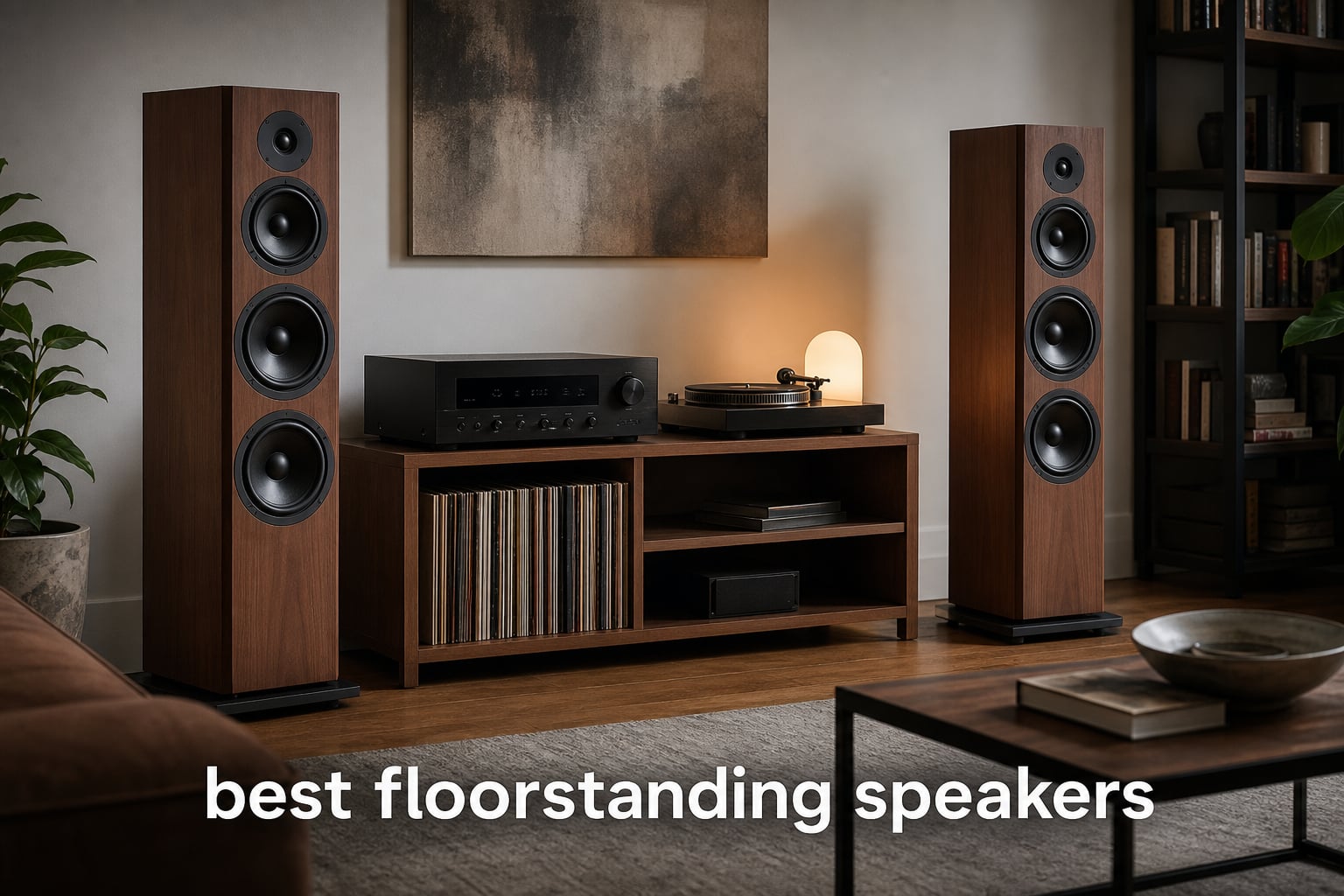
The best floorstanding speakers give you a full, room-filling stereo presentation without asking you to find stands, yet the right pair depends on the room and the electronics already on your rack. Tower speakers use a tall cabinet and several drivers, so they can cover more bass and play with greater scale than many compact bookshelf models.
This guide compares 12 floor standing speakers from the supplied product data, ranging from simple passive towers to a powered pair with its own amplifier. I would start with the Klipsch RP-6000F II for a ready-made pair with Atmos upgrade connections, the Polk Signature Elite ES60 for its three-woofer 2.5-way array, or the Dayton Audio Classic T65 when a tall, straightforward passive design is the priority.
There is no invented listening-test story here. Our selection uses the published driver layouts, connection options, cabinet details, ratings, and review counts, then translates the practical implications: how much space a cabinet takes, what extra electronics a passive speaker needs, and whether the design suits music, movies, or both.
One point matters before anything else: passive speakers need an external amplifier or receiver, while the Fluance Ai81 has a 150W amplifier built in. That distinction changes the rest of your system plan more than a small specification difference.
Table of Contents
Top 3 Picks for Best Floorstanding Speakers (September 2026)
For the shortest answer, choose the RP-6000F II when you want a pair with a horn-loaded tweeter and future Atmos connection options; choose the ES60 when you want three 6.5-inch woofers and Power Port bass; choose the Classic T65 when a full-height, conventional two-driver tower is enough. These three show the biggest differences in approach, rather than being minor variations of one formula.


Best Floorstanding Speakers In 2026
The overview below separates pair listings from single-speaker listings where the source makes that clear. Check that detail before ordering, because building a stereo pair from two individual units is different from buying a packaged pair.
| Product | Specifications | Action |
|---|---|---|
| Klipsch RP-6000F II Pair |
|
Check Latest Details |
 Polk Signature Elite ES60 Polk Signature Elite ES60 |
|
Check Latest Details |
 Fluance XL8FW Pair Fluance XL8FW Pair |
|
Check Latest Details |
 Klipsch R-620F Pair Klipsch R-620F Pair |
|
Check Latest Details |
 Klipsch R-600F Klipsch R-600F |
|
Check Latest Details |
 Polk Monitor XT70 Polk Monitor XT70 |
|
Check Latest Details |
 Klipsch RP-8000F II Klipsch RP-8000F II |
|
Check Latest Details |
| Dayton Audio Classic T65 Pair |
|
Check Latest Details |
 Polk Monitor XT60 Polk Monitor XT60 |
|
Check Latest Details |
 Fluance Ai81 Powered Pair Fluance Ai81 Powered Pair |
|
Check Latest Details |
 Elimavi Q2 Pair Elimavi Q2 Pair |
|
Check Latest Details |
 Sony SS-CS3M2 Sony SS-CS3M2 |
|
Check Latest Details |
1. Klipsch RP-6000F II is the strongest all-round pair
Klipsch RP-6000F II 2.0 Dual Floorstanding Speaker Pair with 90° x 90° Hybrid Tractrix Horn, 1” LTS Tweeter, 6.5” Cerametallic Woofers, and Dolby Atmos Options for Premium Home Theater Sound in Ebony
Pair included
Hybrid Tractrix horn
8 ohms
Pros
- Pair included
- Large hybrid horn
- Atmos upgrade connections
- Five-year warranty
Cons
- 98.8 pound listed weight
- Passive design
The RP-6000F II is a pair, which immediately removes uncertainty for a two-channel setup. Its 90 by 90 degree silicone composite Hybrid Tractrix horn and one-inch titanium LTS tweeter are the defining parts of the design, backed by 6.5-inch Cerametallic woofers.
The published 8-ohm impedance makes this a sensible starting point for many conventional stereo amplifiers and AV receivers. The stated 400W maximum output figure does not mean an amplifier must deliver that figure; it simply makes amplifier matching and manufacturer guidance worth checking.
Room fit: medium-to-large rooms suit the RP-6000F II
Each listed cabinet is 39.6 inches tall and 17.57 inches deep, so measure both floor depth and walkway clearance. At 98.8 pounds listed for the pair, decide on final placement before wiring them.
The horn’s broad 90-degree pattern points to a design intended to spread high frequencies across a listening area. Toe-in still matters, particularly if the main seat is closer to one speaker than the other.
System fit: Atmos expansion is the key reason to choose it
Hidden Atmos connections make this the obvious Klipsch pair here for a buyer who expects to add compatible height modules later. For plain stereo music, those connections are simply unused rather than a required part of setup.
The MDF enclosure and five-year limited manufacturer warranty are useful ownership details. Use ordinary speaker cable and a stable amplifier or receiver; this is not a Bluetooth or self-powered product.
2. Polk Signature Elite ES60 is the full-height home theater choice
Polk Signature Elite ES60 Tower Speaker – Hi-Res Certified, Dolby Atmos Speakers & DTS:X Compatible, 1″ Tweeter & (3) 6.5″ Woofers, Power Port Technology for Effortless Bass, Stunning Black
Three 6.5 inch woofers
Power Port
8 ohms
Pros
- Three woofer array
- Power Port bass
- 2.5-way crossover
- Atmos and DTS:X compatible
Cons
- Single speaker listing
- Plastic enclosure listed
The ES60 combines a one-inch Terylene tweeter with three 6.5-inch woofers in a 2.5-way cascading crossover arrangement. Polk also specifies Power Port technology and says it produces bass 3dB louder than a standard ported speaker.
It is an 8-ohm passive speaker with a listed 300W maximum output, so an amplifier or receiver remains mandatory. The source lists a single speaker, making quantity confirmation important for stereo buyers.
Room fit: tall cabinets need a clear front wall
The ES60 is listed at 44.5 inches tall and 15.7 inches deep. That height places its drivers above many low furniture pieces, but its footprint should not be squeezed between cabinetry and the wall.
Start with both speakers equally spaced from the front wall and make small changes while using familiar vocal recordings. Forum discussions consistently stress that placement and your own room can outweigh close spec-sheet comparisons.
System fit: a matched Polk theater system is the simple path
Dolby Atmos and DTS:X compatibility, plus Polk’s timbre-matched speaker family, make this model easy to place at the front of a larger surround system. A center speaker and surrounds from the same family can make tonal transitions more consistent.
For a music-only 2.0 system, the main appeal is still the three-woofer array and 8-ohm compatibility. Dual gold-plated five-way binding posts support regular bare wire, spades, or banana plugs.
3. Fluance XL8FW gives stereo systems a three-way layout
Fluance Reference High Performance 3-Way Floorstanding Loudspeakers with Down-Firing 8″ Subwoofers for 2-Channel Stereo Listening or Home Theater System – Walnut/Pair (XL8FW)
Pair included
3-way layout
Down-firing 8 inch bass
Pros
- Pair included
- Down-firing bass drivers
- Wood cabinet
- Internal bracing
Cons
- Passive design
- Rear ports
The XL8FW is a pair of passive three-way floorstanding loudspeakers with down-firing eight-inch bass drivers, woven-fiber drivers, and silk-dome neodymium tweeters. Fluance specifies a 35Hz to 25kHz frequency response and 8-ohm impedance.
That 35Hz lower figure suggests a design that reaches further into bass than compact speakers, though room response can change what you actually hear. The rigid, internally braced wood cabinet is a notable practical detail for a large tower.
Room fit: floor clearance matters for the down-firing bass design
The cabinets stand 45.86 inches tall and use down-firing bass units, so keep their base and feet unobstructed. Avoid putting loose objects directly under the cabinet, and use the supplied support arrangement on either carpet or hard flooring.
Dual rear ports mean distance from the front wall is still worth experimenting with. Begin with a little breathing room behind each speaker rather than pressing the cabinet against a wall.
System fit: two-channel and theater users both have a route
Fluance identifies this pair for two-channel listening or a home theater system. An amplifier rated to work comfortably into an 8-ohm load is the necessary partner, as the speaker is explicitly passive.
A separate subwoofer is optional, not automatic. Try the towers by themselves first, then add a subwoofer only if your room or movie use calls for deeper low-frequency output.
4. Klipsch R-620F is the horn-loaded pair with rear ports
Klipsch Reference R-620F Floorstanding Speaker, Black Textured Wood Grain Vinyl, Pair
Pair included
Dual 6.5 inch woofers
Rear Tractrix ports
Pros
- Pair included
- Aluminum LTS tweeter
- Dual copper woofers
- Magnetic grilles
Cons
- Rear ports need clearance
- One-year warranty
The R-620F pair uses a one-inch aluminum LTS tweeter in a 90 by 90 square Tractrix horn and two 6.5-inch spun-copper IMG woofers per speaker. Klipsch gives it a 38Hz to 21kHz frequency response and 8-ohm impedance.
For buyers attracted to the visual identity of Klipsch towers, the textured wood-grain vinyl and magnetic grilles provide a clean, conventional look. The listed 100W/400W power-handling figures and gold-plated binding posts signal a normal passive-speaker installation.
Placement answer: leave room behind the rear Tractrix ports
Rear-firing ports use the wall behind the speaker as part of the acoustic environment. Begin with clearance rather than wall-hugging placement, then move the pair in small equal increments if bass seems too thick or too light.
The product data lists a 38Hz lower response figure, but it does not remove the effect of room modes. A square room and a speaker pushed into a corner can make bass less even than the number suggests.
Ownership answer: this pair suits an existing passive system
The R-620F requires speaker outputs from an amplifier or receiver and does not provide wireless inputs. It is a natural candidate for someone replacing older front left and right speakers while keeping existing electronics.
The listing reports a one-year limited warranty, shorter than some choices in this roundup. Factor warranty length into a long-term ownership decision alongside cabinet size and sound preferences.
5. Klipsch R-600F is the compact-format horn-loaded option
Klipsch Reference Next-Generation R-600F Horn-Loaded Floorstanding Speaker for Best-in-Class Home Theater
Tractrix horn
LTS aluminum tweeter
8 ohms
Pros
- Edge-to-edge horn
- Rear Tractrix port
- Magnetic grille
- Five-year warranty
Cons
- Passive design
- Listing dimensions need confirmation
The R-600F carries Klipsch’s newer 90 by 90 Tractrix horn, LTS aluminum tweeter with Kapton suspension, and spun-copper TCP woofers. A rear Tractrix port handles cabinet airflow, while the speaker is specified at 8 ohms.
The listed 38Hz frequency figure and 400W maximum output give a useful broad picture of capability, but neither replaces setting the speaker up correctly. Its hidden fasteners and low-profile magnetic grille will appeal if the tower must share space with a living room.
Placement answer: toe-in and wall spacing are both needed
Because the horn controls high-frequency dispersion, try the speakers pointed directly at the main seat, then reduce toe-in a little if the center image feels too narrow. Keep both placements symmetrical before judging the result.
The rear port also makes front-wall distance relevant. Any listed dimensions that appear unusually compact should be confirmed with the retailer before planning furniture placement.
System answer: a standard 8-ohm amplifier is the starting point
This is a passive tower, so it needs an amplifier or receiver even though some source fields call the power source AC. Use the speaker terminals, not a line-level or Bluetooth output, to connect it.
Its five-year limited manufacturer warranty is a stronger ownership point than the short warranty on the R-620F listing. The actual amplifier choice should follow its documented power range and the receiver’s 8-ohm capability.
6. Polk Monitor XT70 is the passive-radiator theater tower
Polk Audio Monitor XT70 Large Home Tower Speaker (Single, Midnight Black)
Dual 6.5 inch woofers
Dual 8 inch radiators
Hi-Res
Pros
- Passive radiators
- Hi-Res certified
- Carpet and hard-floor feet
- Matched theater family
Cons
- Single speaker listing
- Passive design
The Monitor XT70 packs a one-inch tweeter, two 6.5-inch dynamically balanced woofers, and two eight-inch passive radiators into its tower cabinet. It is listed as 8 ohms, Hi-Res Audio certified, and compatible with Dolby Atmos and DTS:X systems.
Passive radiators are not powered drivers; they move in response to cabinet pressure and are used here to support bass output. That makes the XT70 an interesting alternative to the rear-ported Klipsch models for buyers who want a different cabinet strategy.
Room answer: supplied feet make floor type less of a concern
Polk includes rubber feet intended for both carpet and hardwood, an overlooked convenience when speakers move from a dedicated room to a shared living area. The listed cabinet height is 36.4 inches, lower than the ES60 and XL8FW.
It can still energize a room strongly because of the passive-radiator layout. Keep the pair out of corners first, and use the receiver’s room calibration only after physical placement is sensible.
System answer: build around the Monitor XT family for surround
Polk describes compatible Monitor XT bookshelf, center, height-module, and subwoofer models. That creates a clear upgrade route for a home theater rather than mixing unrelated speakers at random.
For a stereo system, the 8-ohm rating is easier to approach than a low-impedance speaker, but power output alone is not the whole story. A stable receiver and reasonable listening distance matter just as much.
7. Klipsch RP-8000F II is the bi-wire-ready Reference Premiere tower
Klipsch Reference Premiere RP-8000F II Ebony Floorstanding Speaker
Titanium horn tweeter
Bi-wire ready
Cerametallic woofers
Pros
- Bi-wire and bi-amp terminals
- Vented tweeter
- Divided braced cabinet
- Magnetic grille
Cons
- Single speaker listing
- Passive design
The RP-8000F II uses Klipsch’s larger silicone composite Hybrid Tractrix horn, one-inch titanium LTS diaphragm tweeter, vented tweeter housing, and Cerametallic woofers. Its Tractrix ports and additional cabinet bracing focus on airflow and limiting enclosure vibration.
Unlike many models here, it has dual input terminals for bi-wiring or bi-amping. That is an option, not a requirement: conventional single-wire operation with the terminal jumpers in place is the normal starting point.
Connection answer: bi-wiring is optional, not a required upgrade
Bi-wiring uses separate cable runs to the high- and low-frequency terminals from one amplifier channel. Bi-amping uses separate amplifier channels; neither should be attempted without following the manufacturer instructions.
The practical win is flexibility for an enthusiast who already owns compatible equipment. Do not let that feature distract from the basics of room fit, amplifier stability, and correct speaker placement.
System answer: confirm the single-unit quantity before buying
This listing is for one floorstanding speaker, unlike the RP-6000F II package that specifies a pair. Stereo buyers need two matched units, so verify the listing quantity before completing an order.
The cabinet is listed at 43.1 inches tall and 62 pounds. Its 8-ohm specification and 90W maximum output field give a useful compatibility checkpoint for a conventional passive setup.
8. Dayton Audio Classic T65 is the simple full-size stereo pair
Dayton Audio Classic T65 Floor-Standing Tower Speaker Pair (Black)
Pair included
Dual 6.5 inch drivers
Silk dome tweeter
Pros
- Pair included
- 39 inch tall cabinet
- Real crossover
- Banana plug posts
Cons
- Passive design
- No listed impedance
The Classic T65 is a pair of towers over 39 inches tall, using dual 6.5-inch bass drivers, a one-inch silk-dome tweeter, and a bass-reflex cabinet. Dayton calls out real crossovers and 150W power handling rather than treating the tower as a single full-range driver.
It is the clearest pick for a buyer who wants basic passive hi-fi architecture: two drivers, a separate tweeter, a conventional cabinet, and gold-plated binding posts. The source does not provide an impedance rating, which makes amplifier manual checks especially important.
Listening answer: tweeter height supports a seated stereo setup
Dayton says the tall cabinet positions the tweeter at ear level. In practice, that is a good reason to test seating height and speaker tilt before buying stands or isolation accessories.
The silk-dome tweeter is specified as accurate without harshness, while the dual bass drivers and large cabinet target punchy bass. Those are design claims, so use familiar acoustic voices and cymbals to decide whether the presentation suits you.
System answer: banana plugs make routine cable changes easy
Gold-plated binding posts accept banana-plug cables, which can make connecting and moving a system tidier. Bare wire is also common with five-way-style terminals, but check the supplied documentation.
Because it is passive, plan for an amplifier, speaker wire, and source device as a complete system. This is a useful reminder that the best floorstanding speakers for the money are not always the ones with the fewest additional components.
9. Polk Monitor XT60 is the narrower passive-radiator alternative
Polk Audio Monitor XT60 Home Theater Tower Speaker (Single, Midnight Black)
6.5 inch woofer
Dual passive radiators
8 ohms
Pros
- Hi-Res certified
- Dual passive radiators
- Carpet and hard-floor feet
- Theater expansion path
Cons
- Single speaker listing
- Passive design
The Monitor XT60 uses a one-inch tweeter, one 6.5-inch dynamically balanced woofer, and two 6.5-inch passive radiators. It is an 8-ohm, Hi-Res Audio model with Dolby Atmos, Auro 3D, and DTS:X compatibility listed in the product data.
Compared with the XT70, this is the smaller-driver arrangement while retaining the same general Polk theater-family approach. Its rubber feet are intended to give stable placement on carpet and hard floors.
Room answer: choose the XT60 when a smaller driver array makes sense
The cabinet’s listed dimensions should be checked against the actual installation space, particularly depth near a media console. A more compact tower can be easier to position symmetrically in a narrow room.
Passive radiators can help a slim cabinet produce useful bass, but they cannot override a room’s acoustic limits. A subwoofer can still make sense for very low movie effects or a large, open-plan space.
System answer: matched Polk components simplify a surround build
Polk names the XT20, XT30, XT90, and XT12 as companion speakers in its Monitor XT theater path. Buyers who anticipate adding a center channel or height speakers later can keep the front stage within the same family.
The product data also lists Bluetooth connectivity, but this remains a passive speaker and requires an amplifier or receiver. Bluetooth should be handled by the source device or receiver, not assumed to be built into the tower.
10. Fluance Ai81 is the powered setup with fewer boxes
Fluance Ai81 Elite Powered 2-Way Floorstanding Tower Speakers, 150W Built-in Amplifier for 2.0 Stereo Music & Movie Listening, TV, Turntable, PC & Bluetooth – 2x RCA, Optical, Sub Out (Natural Walnut)
Pair included
150W amplifier
Bluetooth 5
Optical input
Pros
- Built-in amplifier
- Bluetooth 5
- Optical and RCA inputs
- Subwoofer output
Cons
- One speaker is powered
- No passive receiver path needed
The Ai81 is the standout active floorstanding option: a pair with a 150W integrated amplifier, Bluetooth 5 streaming, RCA inputs, an optical input, and a subwoofer output. Dual 6.5-inch woven glass-fiber drivers and premium neodymium tweeters sit in internally braced MDF cabinets with down-firing ports.
For a TV, turntable, computer, or simple music system, the built-in amplification eliminates the need for a separate receiver. That is the cleanest route in this entire group for someone who wants fewer components and fewer speaker-wire runs.
Connection answer: optical, RCA, and Bluetooth cover common sources
Optical is useful for a compatible television, while RCA supports many analog sources. A turntable may still need a phono preamp if it does not have one built in; the towers do not change that requirement.
Bluetooth 5 makes casual wireless playback easy, but a wired connection remains a good option for a fixed TV or desktop installation. The subwoofer output leaves a direct upgrade path if deeper bass becomes necessary.
System answer: active speakers replace the receiver, not every source accessory
One speaker contains the amplification and the other is linked as part of the powered system, so follow Fluance’s setup guide for the inter-speaker connection and power outlet. Do not connect these to an amplifier’s speaker outputs as if they were passive towers.
The down-firing ports can make placement more forgiving than a rear port in some rooms, but the cabinets still benefit from space and symmetry. This pair is a strong answer to the passive-versus-active question for an uncluttered 2.0 setup.
11. Elimavi Q2 is the 4-ohm passive pair for careful amplifier matching
Elimavi Floor Standing Tower Speakers Pair, Dual 6.5″ Woofers, 120W, Black
Pair included
Dual 6.5 inch woofers
4 ohms
Pros
- Pair included
- Wood enclosure
- Banana plug terminals
- Silk dome tweeter
Cons
- 4-ohm load needs compatible amplification
- No Bluetooth
The Elimavi Q2 pair has dual 6.5-inch woofers, a one-inch silk-dome tweeter, an MDF wood enclosure, and gold-plated banana-plug terminals. It is the only product in this group explicitly listed as 4 ohms, with 120W maximum output.
That impedance rating makes amplifier compatibility the headline question. A receiver that explicitly supports 4-ohm speakers is the safe starting place; do not assume every amplifier designed around 8-ohm speakers is appropriate.
Amplifier answer: 4 ohms demands a documented compatible receiver
Impedance describes the electrical load an amplifier sees, and a lower nominal number can ask more current from it. Use the amp manufacturer’s supported-impedance range, ventilation requirements, and power guidance rather than relying on wattage alone.
At ordinary volume levels, a compatible amp may work very well. The risk comes from pairing a demanding load with an unsuitable amplifier and then pushing it hard, especially in a hot enclosed cabinet.
Use-case answer: wired stereo and theater sources are the match
Elimavi identifies compatibility with turntables, TVs, computers, and home theater systems, but the speakers themselves offer wired passive connections only. They need an external amplifier and have no Bluetooth feature.
The 33.86-inch cabinet is shorter than several towers above, which could help in a smaller room. Still, dual 6.5-inch woofers need enough breathing room to avoid a congested bass response.
12. Sony SS-CS3M2 is the four-driver single-speaker option
Sony SS-CS3M2 3-Way 4-Driver Hi-Res Floorstanding Speaker (Single)
Single speaker
3-way four-driver
Super tweeter
6 ohms
Pros
- 3-way four-driver layout
- Super tweeter
- Hi-Res range
- Bass reflex cabinet
Cons
- Sold individually
- 6-ohm amplifier matching needed
The Sony SS-CS3M2 is sold as a single 3-way, four-driver tower. Its layout includes dual 5.12-inch woofers, a 0.98-inch tweeter, and a 0.75-inch super tweeter, with a published 45Hz to 50kHz response and 6-ohm impedance.
This is a distinctly different design from the horn-loaded options: the super tweeter is intended for wide high-frequency dispersion, while the bass-reflex enclosure supports the low end. A stereo setup requires two units because the listing is singular.
System answer: buy two and match them to a 6-ohm-capable amplifier
Six ohms sits between common 8-ohm and 4-ohm nominal loads, but the correct practice is unchanged: confirm the amplifier or receiver permits 6-ohm speakers. Sony lists 290W maximum output, which is not a prescription for amplifier power.
Planning for two individual speakers, cable, and amplification avoids the most common ordering mistake with single-unit listings. The 36.3-inch height is also easier to accommodate than the tallest models here.
Listening answer: the super tweeter suits detail-focused comparisons
The stated 45Hz to 50kHz response and four-driver arrangement make this a reasonable candidate for listeners curious about high-resolution playback. Use the same tracks at matched levels when comparing it against another tower.
Do not decide only from the extended top-end figure. Vocal clarity, image stability, and whether the tonal balance remains comfortable during longer sessions are more meaningful decision points.
The buying guide answers how to choose floorstanding speakers
Choose the room first, then the amplifier, then the feature list. A tall floorstanding loudspeaker can make a modest room feel crowded if it is forced into a corner, and a high-power specification cannot fix a poorly matched receiver.
Room choice: measure width, depth, and the listening seat first
Floorstanders work especially well when you can form a rough triangle between the two speakers and the main seat. Start with the pair several feet apart where possible, at equal distances from the front wall, and with no large furniture blocking one cabinet more than the other.
Rear-ported models such as the R-620F and R-600F deserve some room behind them. Down-firing designs such as the XL8FW and Ai81 still need a firm, clear base, but may present fewer rear-wall concerns.
If your room is small or the speakers must sit close to boundaries, do not assume a giant cabinet is necessary. A compact bookshelf pair plus a properly placed subwoofer can offer more placement flexibility, though it adds a box, cable, and setup work.
Amplifier choice: impedance and stability matter more than headline watts
An 8-ohm tower is generally the least complicated pairing on this list, with examples from Klipsch, Polk, and Fluance. The Sony is specified at 6 ohms, and the Elimavi Q2 is specified at 4 ohms, so their receiver compatibility should be confirmed in writing.
Sensitivity is not supplied consistently for these listings, so it would be wrong to invent a volume prediction. Instead, use the amplifier maker’s approved impedance range, the speaker maker’s recommended power guidance where provided, and the size of your room.
Leave the amplifier ventilation space it asks for. A receiver cramped in a closed cabinet can run hot long before a speaker reaches its rated output limit.
Placement choice: start away from walls and adjust one variable at a time
Do not put floorstanders next to the wall as a default. Begin with clearance, level the cabinets, sit at the intended listening position, and then move both speakers together in small steps if the bass needs adjustment.
Toe-in is the next adjustment: aim each speaker toward the listening seat for a more focused center image, then reduce the angle if the soundstage becomes too narrow. Keep your changes small and write down what you heard.
Room correction and EQ can help smooth broad problems, but they work best after placement is addressed. They cannot fully repair one tower stuck in a corner while the other sits in open space.
System choice: passive and active towers solve different problems
Passive speakers such as the Klipsch, Polk, Dayton, Elimavi, Sony, and Fluance XL8FW models require an amplifier or receiver. Their advantage is flexibility: you can change sources, electronics, or processing separately.
The Fluance Ai81 is powered, with its 150W amplifier, Bluetooth 5, optical and RCA inputs, and subwoofer output built in. It simplifies a TV or music setup, but it asks you to use its provided input and amplification arrangement rather than selecting a separate receiver.
Bi-wire-capable RP-8000F II towers do not require special cables. Use a standard single-wire connection unless you understand why you are adding a second run or a separate amplifier channel.
Ownership choice: plan the whole system rather than only the towers
A working passive setup needs a pair of speakers, an amplifier or receiver, speaker cable, and at least one source. A powered setup needs the speaker pair, power, and a source connection; a turntable may still need a phono stage.
Check listed quantity, cabinet dimensions, warranty, and the ability to return a heavy speaker before committing. The RP-6000F II and XL8FW are listed as pairs, while the RP-8000F II and Sony are explicitly single-speaker listings.
Finally, audition with music and movies you know if you can. Forum users repeatedly point out that room behavior and personal preference settle choices that a driver count or star rating cannot settle alone.
FAQs
What are the best floorstanding speakers for different needs?
Choose the Klipsch RP-6000F II when you want a packaged pair with a Hybrid Tractrix horn and Atmos upgrade connections. Choose the Polk ES60 for a three-woofer passive tower, the Fluance Ai81 for a powered pair with Bluetooth and optical input, or the Dayton Classic T65 for a straightforward passive stereo pair.
How do I choose floorstanding speakers for my room?
Measure the front wall, cabinet depth, and listening distance first. Begin with speakers equally spaced from the front wall and listening seat, keep rear-ported towers away from the wall, then adjust toe-in and placement in small steps using familiar recordings.
Floorstanders vs standmounts: which speaker type should I buy?
Choose floorstanders when you want taller cabinets, multiple drivers, and fuller bass without stands. Choose standmounts plus a subwoofer when the room is small, placement flexibility is more important, or you want independent control of deep bass.
What is the difference between passive and active floorstanding speakers?
Passive floorstanders need an external amplifier or receiver and speaker cable. Active floorstanders include amplification and inputs; in this guide, the Fluance Ai81 adds a 150W integrated amplifier, Bluetooth 5, optical and RCA inputs, plus a subwoofer output.
How many watts do I need for floorstanding speakers?
There is no single wattage answer. Match the amplifier to the speaker’s approved impedance range and published power guidance, then consider room size and listening distance. An 8-ohm speaker is usually simpler to match than a 4-ohm model, but the amplifier manual is the final check.
The best floorstanding speakers are the pair that fits your room and system
For a packaged passive pair with a prominent horn design and Atmos expansion option, the Klipsch RP-6000F II is the leading choice. Choose the Fluance Ai81 when a built-in amplifier and direct connections matter more, and choose the Polk ES60 or Monitor models when a matched home theater path is the plan.
Use the best floorstanding speakers list above as a shortlist, then check quantity, dimensions, impedance, and the inputs your system actually needs in 2026. Good placement and a compatible amplifier will do more for the final result than chasing a single headline specification.