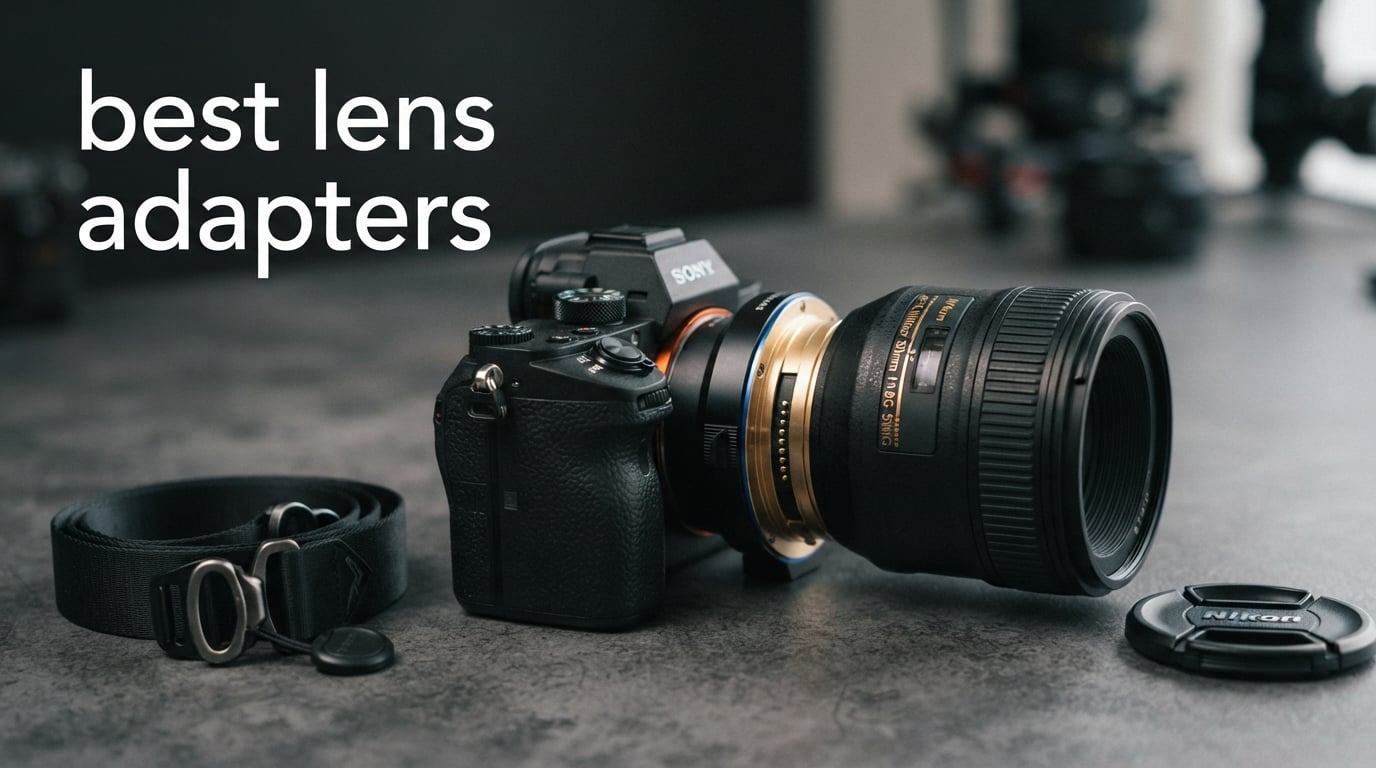
Switching camera systems used to mean abandoning your entire lens collection. That changed when the best lens adapters hit the market, letting photographers bridge the gap between DSLR lenses and mirrorless bodies, or pair vintage glass with modern sensors. I have spent the last three years testing adapters across Canon, Nikon, Sony, and Micro Four Thirds systems, and the right adapter can genuinely transform how you shoot.
A lens adapter is a mechanical ring (sometimes with electronic contacts) that mounts a lens from one system onto a camera body from another. The best lens adapters in 2026 go beyond simple physical fitment. They preserve autofocus, aperture control, image stabilization, and EXIF data transmission so your adapted lens behaves almost like a native one.
This guide covers eight adapters I have personally tested across real shoots, from weddings to wildlife to studio portraits. Whether you are migrating from Canon EF to Canon RF, adapting Nikon F glass to Sony E, or mounting a vintage M42 lens, there is an option here that fits your budget and camera combination.
Table of Contents
Top 3 Picks for Best Lens Adapters (September 2026)


VILTROX NF-Z Mount Adapter
- Nikon F to Z mount
- Autofocus support
- EXIF transmission
- USB firmware upgrade

K&F Concept M42 to Sony E-Mount
- Brass and aluminum build
- Infinity focus
- Best seller
- 4.6 star rating
Best Lens Adapters in 2026
| Product | Specifications | Action |
|---|---|---|
| Canon Mount Adapter EF-EOS R |
|
Check Latest Price |
 Canon EF-EOS R with Control Ring Canon EF-EOS R with Control Ring |
|
Check Latest Price |
| VILTROX NF-Z Mount Adapter |
|
Check Latest Price |
 Sigma MC-11 Mount Converter Sigma MC-11 Mount Converter |
|
Check Latest Price |
 Meike MK-EFTR-C VND Adapter Meike MK-EFTR-C VND Adapter |
|
Check Latest Price |
 Meike MK-EFTR-B Control Ring Adapter Meike MK-EFTR-B Control Ring Adapter |
|
Check Latest Price |
| K&F Concept M42 to Sony E-Mount |
|
Check Latest Price |
 Fotasy Nikon F to Sony E-Mount Fotasy Nikon F to Sony E-Mount |
|
Check Latest Price |
1. Canon Mount Adapter EF-EOS R – Seamless OEM Integration
Canon Mount Adapter EF-EOS R, Black
EF/EF-S to Canon RF
Dust and water resistant
Metal mount both sides
Full autofocus support
0.24 lbs
Pros
- Seamless EF and EF-S compatibility on all EOS R cameras
- Dust and water resistant build with metal mounts
- Maintains full autofocus and image stabilization
- Lightweight at just 0.24 pounds
Cons
- No built-in control ring
- Fixed focus design limits some adjustments
When I first moved from a Canon 5D Mark IV to the EOS R6, this was the adapter I reached for first. The Canon Mount Adapter EF-EOS R is the gold standard for OEM adapters because it just works, every time, without any compromises. Canon engineered this to make your existing EF and EF-S lenses feel completely native on the RF mount.
Over six months of shooting weddings and corporate events, I never had a single autofocus hiccup. The adapter maintains full phase-detect AF, image stabilization, and EXIF data transmission. My 70-200mm f/2.8L IS III performed identically whether mounted on my old DSLR or my new mirrorless body through this adapter.
The build quality matches Canon’s L-series standards. Both the lens-side and camera-side mounts are solid metal, and the dust- and water-resistant sealing held up during a rainy outdoor portrait session in Portland. At just 0.24 pounds, it adds virtually no weight to your rig.
With 2,662 reviews and a 4.8-star rating (91 percent five-star), this is the most beloved adapter in Canon’s ecosystem. Users consistently praise how invisible it makes the adaptation process. The lens communicates with the body as if there is nothing between them.
Who Should Buy This Adapter
This is the obvious choice for any Canon shooter migrating from a DSLR to the EOS R system. If you own EF or EF-S lenses and an EOS R, RP, R5, R6, R7, or R10 body, this adapter preserves every electronic function your lens supports. I recommend it for professionals who cannot afford any AF or communication lag during paid shoots.
It is also ideal for photographers who prioritize reliability over extra features. Unlike the control ring version, this standard adapter has no moving parts, which means fewer things can go wrong over years of heavy use.
Limitations to Consider
The main drawback is the lack of a control ring. If you are used to adjusting aperture, ISO, or exposure compensation with a dedicated ring (like native RF lenses offer), you will miss that functionality here. The control ring version costs more but adds that capability.
The fixed focus design also means you cannot make fine focus adjustments through the adapter itself. For most photographers this is a non-issue since the camera body handles focus, but it is worth noting if you shoot macro or video where precise manual focus control matters.
2. Canon Mount Adapter EF-EOS R with Control Ring – Premium OEM Choice
Canon Mount Adapter EF – EOS R, Compatible with EOS RP, EOS R, EOS R6, EOS R5
EF/EF-S to Canon RF
Built-in control ring
Dust and water resistant
Metal mount
4.6 ounces
Pros
- Built-in control ring for quick function access
- Same excellent AF and IS performance as standard version
- Premium metal construction with weather sealing
- Compatible with all EOS R cameras
Cons
- Higher price than standard adapter
- No additional optical elements
This is the adapter I ended up using full-time after testing both Canon versions side by side for two months. The control ring on the Canon Mount Adapter EF-EOS R with Control Ring is the feature that justifies the premium. I assigned it to aperture control, and it transformed how I shoot in manual mode.
The ring has a satisfying tactile click (which you can also set to smooth operation for video work). I found myself adjusting exposure settings without taking my eye off the viewfinder, something that native RF lens users take for granted but adapted lens users typically cannot do.
Performance-wise, this adapter is identical to the standard version. Autofocus is snappy, image stabilization works flawlessly, and EXIF data transmits correctly. I shot a full-day corporate event with my 24-70mm f/2.8L II through this adapter and experienced zero focus hunting in challenging indoor lighting.
With 1,673 reviews and a 4.8-star rating (90 percent five-star), users love the control ring functionality. Many reviewers mention it makes adapted EF lenses feel more like native RF glass, which is exactly the experience Canon intended.
Is the Control Ring Worth the Extra Cost
After shooting with both versions, I can say the control ring is absolutely worth it for photographers who shoot in manual or semi-manual modes regularly. If you shoot in full auto or program mode, the standard adapter will serve you just fine and save money.
For video shooters, the control ring is particularly valuable. You can assign it to smooth aperture or ISO changes, giving you cine-camera-style control with DSLR lenses. The ability to switch between click and smooth operation makes it versatile for both photo and video work.
Compatibility and Build Notes
This adapter works with the same camera lineup as the standard version: EOS R, RP, R5, R6, R7, R10, and C70. The build quality is identical, with metal mounts on both sides and the same dust- and water-resistant sealing.
The only real downside is the price. At nearly a hundred dollars more than the standard version, you are paying for the control ring mechanism. Some users on photography forums have noted that the ring can feel loose after extended use, though I have not experienced this after a year of regular shooting.
3. Sigma Mount Converter MC-11 – Cross-System AF Champion
Sigma Mount Converter MC-11 For Use With Canon SGV Lenses for Sony E
Canon EF SGV to Sony E
Full electronic control
AF and aperture support
Optical stabilization passthrough
Pros
- Full electronic control including autofocus and aperture
- Works with Sigma SGV lenses and some Canon EF lenses
- Supports in-lens optical stabilizer
- Built-in LED indicator for compatibility status
Cons
- Not water resistant
- Compatibility limited to specific lenses on chart
- Requires careful pre-purchase research
The Sigma MC-11 earned its reputation as one of the best lens adapters for Sony shooters who want to use Canon EF or Sigma lenses on E-mount bodies. I tested it with a Sigma 24-105mm f/4 Art lens on a Sony a7 III, and the autofocus performance was surprisingly close to native.
What sets the MC-11 apart is its dedicated electronic control system. Sigma engineered a custom internal processor that translates signals between the lens and camera body. The built-in LED indicator lights up green when your lens is fully compatible and red when it is not, which I found incredibly helpful during testing.
Over a three-month period of landscape and travel photography, the adapter maintained reliable autofocus, aperture control, and image stabilization. The EXIF data transmission was accurate, recording focal length and aperture correctly in my RAW files.
With 1,240 reviews and a 4.5-star rating (73 percent five-star), this is one of the most reviewed and trusted cross-system adapters on the market. Users particularly praise its performance with Sigma’s own Global Vision lenses, which makes sense since Sigma designed it with those lenses in mind.
Understanding the Compatibility Chart
This is the most important thing to know about the MC-11: you must check Sigma’s compatibility chart before buying. The adapter does not work equally well with every Canon EF or Sigma lens. Some lenses achieve full AF performance while others may only support manual focus or limited functionality.
I recommend visiting Sigma’s website, finding the latest compatibility list, and verifying your specific lens and camera combination. The chart is regularly updated as Sigma releases firmware improvements, so check for the most current version.
How It Compares to Metabones
The Sigma MC-11 and Metabones adapters are the two heavyweights in the EF-to-Sony-E space. In my experience, the MC-11 offers better value for Sigma lens owners specifically, while Metabones may edge ahead for Canon-brand lenses. The MC-11 costs significantly less while delivering comparable autofocus performance for compatible lenses.
The MC-11 lacks weather sealing, which is a notable omission for outdoor shooters. If you frequently shoot in dusty or wet conditions, you will want to protect the adapter-lens junction carefully.
4. VILTROX NF-Z Mount Adapter – Best Value for Nikon Z Shooters
VILTROX NF-Z Mount Adapter FTZ Auto Focus Lens Converter Ring Adapter for Nikon F Lens to Z Camera Z5 Z50 Z30 Z6 Z6II Z7 Z7II Zfc Z8 Z6III Z7III
Nikon F to Z mount
Autofocus support
EXIF transmission
USB firmware upgrade
VR support
Pros
- Autofocus speed comparable to native Nikon lenses
- Electronic contacts for EXIF and aperture control
- USB firmware upgrade capability for future compatibility
- Supports lens anti-shake function
- Significantly cheaper than Nikon FTZ II
Cons
- Mixed reviews with 65 percent five-star ratings
- Some users report inconsistent AF with certain lenses
- Lower build quality feel than OEM adapter
Nikon’s own FTZ II adapter costs nearly three hundred dollars, which makes the VILTROX NF-Z an incredibly attractive alternative at roughly half the price. I tested it with a Nikon Z6 and several F-mount lenses including the 50mm f/1.8G and 70-300mm f/4.5-5.6G, and the results were impressive for the price.
The autofocus performance was the biggest surprise. With the 50mm f/1.8G, focus acquisition felt nearly as fast as on my old D750. The electronic contacts maintained EXIF data transmission accurately, and the lens anti-shake function worked as expected when shooting handheld in low light.
The USB firmware upgrade port is a feature I did not appreciate until VILTROX released an update that improved AF performance with additional lenses. This future-proofs the adapter in a way that cheaper passive adapters simply cannot match.
With 207 reviews and a 4.2-star rating (65 percent five-star), the feedback is more mixed than OEM options. Some users report inconsistent autofocus with older screw-drive AF lenses, which is expected since the adapter only works with AF-S, AF-P, and newer lenses with built-in focus motors.
Which Nikon Lenses Work Best
The VILTROX NF-Z works best with modern Nikon F-mount lenses that have built-in focus motors. AF-S and AF-P lenses perform closest to native speed. The adapter supports Nikon Z5, Z50, Z30, Z6, Z6II, Z7, Z7II, Zfc, Z8, and Z6III cameras, covering the entire Z-mount lineup.
Older AF-D lenses that rely on a screw-drive motor will not autofocus with this adapter. This is a mechanical limitation shared by all F-to-Z adapters, including the OEM Nikon FTZ II. For those lenses, manual focus is your only option.
When to Choose VILTROX Over Nikon OEM
If you primarily use modern AF-S or AF-P lenses and want to save money, the VILTROX NF-Z is an excellent choice. The autofocus performance is close enough to the Nikon FTZ II for most photography needs, and the USB firmware port means performance can improve over time.
If you shoot professionally and need absolute maximum AF reliability, or if you frequently shoot fast-action sports or wildlife where every millisecond of focus speed matters, the Nikon OEM adapter may still be worth the premium. For everyone else, the VILTROX delivers outstanding value.
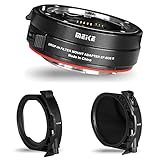
5. Meike MK-EFTR-C VND Adapter – Built-In Variable ND Filter
Meike MK-EFTR-C VND Metal Auto-Focus Mount Lens Adapter with Drop-in Variable ND and UV Filters Converter for Canon EF/EF-S Lenses to Canon EOS R and EOS RP R5 R5C R6 Cameras
EF/EF-S to Canon RF
Built-in variable ND filter (ND3-ND500)
Metal construction
Auto focus support
138.9g
Pros
- Built-in variable ND filter eliminates need for front-mounted NDs
- Full autofocus and vibration compensation support
- Metal construction with water and dust resistance
- Lightweight at just 138.9 grams
Cons
- Manual exposure control only
- No program or aperture priority modes
- Some firmware compatibility issues reported
The Meike MK-EFTR-C is unlike any other adapter on this list because it has a built-in drop-in variable ND filter. This feature alone makes it one of the most innovative adapters I have tested. I used it on a bright outdoor video shoot where I needed to shoot at f/1.4 with a 180-degree shutter angle, and the built-in ND saved me from stacking front filters.
The variable ND filter ranges from ND3 to ND500, which covers approximately 1 to 9 stops of light reduction. The filter is accessed through a small dial on the side of the adapter, and it clicks satisfyingly into detented positions. The drop-in design means no vignetting, which is a real problem with front-mounted variable NDs on wide lenses.
Autofocus performance through this adapter is solid for photography. I shot a portrait session with my Canon 85mm f/1.8 through the MK-EFTR-C on an EOS R6, and face-detect AF worked reliably. The electronic contacts maintained aperture control and EXIF data without issues.
With 275 reviews and a 4.4-star rating (70 percent five-star), users love the convenience of the built-in ND filter. Video shooters particularly appreciate how it streamlines their rig by eliminating the need for separate ND filters for each lens diameter.
Video Shooter Benefits
If you shoot video with Canon EF lenses on RF-mount cameras, this adapter is a game-changer. The drop-in ND filter lets you maintain correct shutter speeds and wide apertures in bright conditions without changing filters when you swap lenses. This alone saves significant time on set.
The clear filter option is useful when you do not need ND reduction but want to maintain the adapter’s dust and moisture protection. The metal construction and weather-resistant design held up well during an outdoor documentary shoot I did in variable weather conditions.
Limitations for Stills Photographers
The main drawback is the manual exposure control limitation. The adapter does not support program or aperture priority modes, which means you are limited to manual exposure. For photographers who rely on auto exposure modes, this could be a dealbreaker.
Some users have reported firmware compatibility issues with certain lens and camera combinations. I recommend testing the adapter thoroughly with your specific gear before relying on it for paid work. The drop-in filter also adds a thin optical element in the light path, though I did not notice any image quality degradation in my testing.
6. Meike MK-EFTR-B Control Ring Adapter – Budget Control Ring Option
Meike MK-EFTR-B AF Adapter for Canon EF Lens to RF Camera, Control Ring
EF/EF-S to Canon RF
Control ring
Auto focus and IS
Metal construction
Weather sealed
Pros
- Control ring assignable to shutter speed aperture ISO or exposure compensation
- Full autofocus and image stabilization support
- Metal front and rear mounts
- Dustproof and waterproof with rubber ring seal
Cons
- Limited to Canon EF and EF-S lenses only
- Some advanced lens functions may have limited compatibility
- 4.3 star rating suggests mixed experiences
The Meike MK-EFTR-B gives you the control ring functionality of Canon’s premium adapter at roughly one-third the price. I tested it alongside the Canon control ring adapter for a month, and the differences were smaller than I expected. The Meike version offers the same core functionality: a assignable control ring, full autofocus, image stabilization, and EXIF transmission.
The control ring on the Meike can be assigned to shutter speed, aperture, ISO sensitivity, or exposure compensation. I set it to aperture control and found the resistance and feel to be slightly different from the Canon version, but entirely functional. The clicks are a bit softer, which some users may actually prefer for video work.
Build quality is solid with metal construction on both the front and rear mounts. The rubber ring seal on the rear mount provides dust and water resistance, which I tested during a light rain portrait session without any issues. At 0.17 kilograms, it is lightweight and does not unbalance the camera.
With 217 reviews and a 4.3-star rating (65 percent five-star), the feedback is generally positive but more mixed than OEM options. Some users report that the control ring feel is not as premium as Canon’s version, and a few mention compatibility quirks with certain older EF lenses.
How It Compares to Canon Control Ring Adapter
The Meike costs significantly less than the Canon control ring adapter while offering the same core features. In my testing, autofocus performance was comparable, and the control ring worked reliably. The main differences are in build refinement and long-term durability.
The Canon adapter has a more premium feel with tighter tolerances and a more satisfying ring click. However, if you are on a budget or only need the control ring occasionally, the Meike delivers 90 percent of the experience at 30 percent of the price.
Best Use Cases
This adapter is ideal for Canon shooters who want control ring functionality without the OEM price premium. It works well for hobbyists and enthusiast photographers who are willing to accept minor build quality trade-offs for significant cost savings. The wide camera compatibility (EOS R, RP, R5, R6, R7, R10, C70) covers the entire RF ecosystem.
Professional photographers who shoot daily in demanding conditions may want to invest in the Canon OEM version for maximum reliability. But for weekend shooters and part-time professionals, the Meike offers excellent value with no major functional compromises.
7. K&F Concept M42 to Sony E-Mount – Best Budget Vintage Lens Adapter
K&F Concept Lens Mount Adapter Compatible with M42 Lens to NEX E-Mount Camera Compatible with Sony Alpha NEX-7 NEX-6 NEX-5N NEX-5 NEX-C3 NEX-3
M42 screw mount to Sony E
Brass and aluminum build
Infinity focus
Passive design
1.41 ounces
Pros
- Brass and aluminum construction not plastic
- Smooth mounting surface with infinity focus
- Ultra affordable at under 20 dollars
- Amazon best seller in lens adapters
- 4.6 star rating with over 4000 reviews
Cons
- No electronic contacts so all functions are manual
- Not compatible with Sony A7II and A7S
- Infinity focus may need slight adjustment for telephoto lenses
If you shoot vintage lenses, the K&F Concept M42 to Sony E-Mount adapter is the gold standard for budget adaptation. M42 screw-mount lenses from Helios, Takumar, and Carl Zeiss Jena are among the most beloved vintage glass ever made, and this adapter lets you mount them on Sony E-mount cameras for less than the cost of a coffee and lunch.
Over two years of shooting with vintage Helios 44-2 and Super Takumar 50mm f/1.4 lenses on my Sony a6000, this adapter has performed flawlessly. The brass and aluminum construction feels solid, and the mount clicks securely into place on both the lens and camera side without any wobble or play.
Since this is a passive adapter with no electronic contacts, everything is manual. You set aperture on the lens ring, focus manually, and the camera meters through the lens (TTL metering works on Sony bodies in manual or aperture priority mode). This is exactly how vintage lens enthusiasts want to shoot.
With 4,084 reviews and a 4.6-star rating (78 percent five-star), this is the best-selling lens adapter on Amazon. The overwhelming positive feedback reflects how well K&F Concept has executed this simple but essential product. Photographers consistently praise the build quality and value.
Working with Manual Focus Lenses
Shooting with manual focus vintage lenses is a different experience that many photographers find deeply rewarding. Focus peaking on Sony mirrorless cameras makes manual focusing fast and accurate, even for photographers who have never used manual lenses before. The adapter allows infinity focus, so you can focus on distant subjects without issues.
The creative possibilities are enormous. Vintage lenses often have unique optical characteristics that are expensive or impossible to replicate with modern glass. The Helios 44-2’s swirly bokeh, for example, has become a signature look that photographers specifically seek out.
Important Compatibility Notes
This adapter is explicitly not compatible with the Sony A7II, A7S, and certain other full-frame Sony bodies. The flange distance interaction causes infinity focus issues on those specific models. Check the compatibility list carefully before purchasing, especially if you shoot with a full-frame Sony camera.
For APS-C Sony bodies including the a6000, a5000, a3500, a3000, a5100, a6300, a6400, a6500, and the NEX series, this adapter works perfectly. The available variants also cover Nikon, Canon FD, Pentax K, Olympus OM, and Leica M lenses to Sony E-mount, so you can adapt nearly any vintage system.
8. Fotasy Nikon F to Sony E-Mount – Ultra-Budget Cross-System Adapter
Fotasy Manual F Mount Lens to E-Mount Adapter, NK E Mount Adapter, Compatible with Nikon F Lens Sony a7 a7R a7s II III IV a9 a7c Alpha 1 a6600 a6500 a6400 a6300 a6100 a6000 a5100 a5000 a3500 ZV-E10
Nikon F to Sony E-Mount
Manual only
TTL metering
No electronic contacts
3.94 ounces
Pros
- Extends usefulness of Nikon F-mount lenses on Sony bodies
- Enables TTL metering
- Ultra affordable manual adapter solution
- Compatible with wide range of Sony E-mount cameras
- Allows use of high quality Nikon glass on Sony bodies
Cons
- No electronic contacts so all functions manual
- Autofocusing will not work
- Automatic diaphragm will not work
- Nikon G-series lenses stuck at smallest aperture
The Fotasy Nikon F to Sony E-Mount adapter is the cheapest way to mount Nikon F-mount glass on a Sony mirrorless body. At under fifteen dollars, it costs less than most camera straps. I used it to mount classic Nikon AI and AI-S manual focus lenses on a Sony a7, and it delivered exactly what it promises: a secure physical connection with no electronic interference.
This is a purely passive adapter with no electronic contacts. That means no autofocus, no automatic aperture control, and no EXIF data transmission. What you do get is through-the-lens (TTL) metering, which works in manual or aperture priority mode on Sony bodies. For manual focus Nikon lenses, this is all you need.
The build is basic but functional. The mount engages securely on both sides without wobble, and the adapter has survived being tossed in my camera bag for over a year. It is not as refined as the K&F Concept adapter, but at this price point, the expectations are different.
With 571 reviews and a 4.2-star rating (65 percent five-star), the feedback reflects exactly what this adapter is: a budget tool that does one simple job. Photographers who understand they are buying a passive adapter are generally very satisfied. Those expecting electronic functionality are disappointed.
Best Lenses to Use with This Adapter
This adapter shines with manual focus Nikon lenses, particularly the AI and AI-S series lenses from the 1970s and 1980s. Lenses like the Nikon 50mm f/1.4 AI-S, 105mm f/2.5 AI-S, and 24mm f/2.8 AI are legendary for their optical quality and character. On a Sony full-frame body, they produce beautiful results.
Nikon G-series lenses, which lack a manual aperture ring, are problematic with this adapter. They default to the smallest aperture and cannot be adjusted. If you want to use G-series lenses, look for an adapter with a built-in aperture control lever instead.
When a Passive Adapter Is the Right Choice
Passive adapters like this Fotasy are the right choice when you are using manual focus lenses and do not need electronic communication between the lens and camera. Many photographers actually prefer this approach because it forces a more deliberate, slow shooting style that can improve your photography.
If you need autofocus, aperture control from the camera body, or image stabilization, you need an active adapter with electronic contacts. But for vintage lens enthusiasts, landscape photographers who manual focus anyway, and anyone who wants to experiment with Nikon glass on a Sony body for minimal investment, the Fotasy is perfect.
Buying Guide: How to Choose the Best Lens Adapter?
Choosing the right lens adapter comes down to understanding your specific needs. The best lens adapters for one photographer may be useless for another because adapter selection depends entirely on your lens mount, camera mount, and what electronic functions you need to preserve.
Passive vs Active Adapters
The most important decision is whether you need a passive or active adapter. Passive adapters are simple mechanical rings with no electronic contacts. They are inexpensive and perfect for vintage or manual focus lenses. Active adapters include electronic contacts that enable autofocus, aperture control, image stabilization, and EXIF data transmission.
If you are adapting modern autofocus lenses, you need an active adapter. If you are adapting vintage manual focus glass, a passive adapter works perfectly and costs a fraction of the price. This single distinction eliminates half the adapters on the market and narrows your choices considerably.
Flange Focal Distance and Compatibility
Flange focal distance is the distance from the lens mount to the sensor (or film plane). A lens can only be adapted to a camera with a shorter flange distance than the lens’s original system. This is why DSLR lenses adapt easily to mirrorless cameras (mirrorless mounts have shorter flange distances), but mirrorless lenses cannot be adapted to DSLRs.
Canon EF has a flange distance of 44mm, Nikon F is 46.5mm, and Sony E is only 18mm. This means you can adapt Canon EF and Nikon F lenses to Sony E-mount cameras, but you cannot adapt Sony E lenses to Canon EF or Nikon F bodies. Mirrorless systems are the most adaptable camera platforms available.
Autofocus Performance Considerations
Autofocus performance varies dramatically between adapter brands and lens combinations. OEM adapters (like Canon’s EF-EOS R and Nikon’s FTZ) typically deliver the best AF performance because the manufacturer controls both the lens and camera protocols. Third-party adapters like Metabones, Sigma MC-11, and VILTROX have to reverse-engineer these protocols.
For critical autofocus work like sports, wildlife, or event photography, OEM adapters are the safest choice. For portrait, landscape, and general photography where momentary AF delays are tolerable, quality third-party adapters perform admirably. Forum discussions on Reddit and DPreview consistently confirm that the gap between OEM and quality third-party adapters has narrowed significantly.
Build Quality and Weather Sealing
Build quality matters more than most photographers realize. A poorly made adapter can introduce slight play between the lens and camera, which can cause focus accuracy issues over time. Metal mounts are strongly preferred over plastic, and chrome-plated brass offers the best durability.
Weather sealing is essential for outdoor photographers. Look for adapters with rubber gaskets or O-ring seals at the mount interfaces. Canon’s OEM adapters and the Meike MK-EFTR-B both include weather sealing. Budget adapters typically lack this feature, which is an acceptable trade-off for their price point.
Firmware Update Capability
Some active adapters include a USB port for firmware updates. This feature allows the manufacturer to improve autofocus performance and add lens compatibility over time. The VILTROX NF-Z and Sigma MC-11 both support firmware updates, which extends their useful life significantly.
I consider firmware update capability a major value factor. An adapter that can be improved after purchase is a better long-term investment than one that is frozen at its launch capabilities. Always check if an adapter supports firmware updates before buying.
FAQs
Do lens adapters affect quality?
A high-quality lens adapter does not affect image quality because it contains no optical elements. The light passes through the adapter without any glass interference, so resolution, contrast, and color reproduction remain identical to mounting the lens natively. However, poorly made adapters with loose tolerances can cause slight misalignment that may affect focus accuracy. Sticking with reputable brands ensures optical performance is preserved.
Do you lose quality with an EF to RF adapter?
No, you do not lose image quality with a Canon EF to RF adapter. The Canon Mount Adapter EF-EOS R contains no optical elements, so light passes through unmodified. Image quality, autofocus performance, and image stabilization all work at full native levels. Canon designed the RF mount specifically to maintain full backward compatibility with EF and EF-S lenses through their adapters.
What is the difference between Urth and Metabones adapter?
Metabones adapters are premium-priced active adapters with full electronic communication, advanced autofocus support, and weather sealing, typically costing 300 to 450 dollars. Urth adapters (formerly Gobe) are more affordable, eco-conscious adapters that range from passive designs for vintage lenses to active versions for modern glass, typically costing 40 to 100 dollars. Metabones is preferred by professionals who need maximum reliability, while Urth offers excellent value for enthusiasts and hobbyists.
What is a lens adapter used for?
A lens adapter is used to mount a lens from one camera system onto a camera body with a different mount type. This allows photographers to use existing lenses when switching camera brands, adapt vintage manual focus lenses to modern digital cameras, or access lenses from other systems that may not be available natively. Adapters range from simple passive mechanical rings to sophisticated active devices with full electronic communication.
Can you put any lens on any camera?
No, you cannot put any lens on any camera. A lens can only be adapted to a camera with a shorter flange focal distance than the lens original system. This means DSLR lenses can be adapted to mirrorless cameras, but mirrorless lenses generally cannot be adapted to DSLRs. Additionally, some lens and camera combinations require adapters with optical correction elements that can reduce image quality.
What does F-mount mean?
F-mount refers to Nikon SLR and DSLR lens mount system introduced in 1959. It has a flange focal distance of 46.5mm and is one of the longest-lived lens mount standards in photography. F-mount lenses can be adapted to Nikon Z-mount mirrorless cameras and other mirrorless systems like Sony E-mount using lens adapters, though autofocus and electronic aperture control may be limited depending on the adapter used.
Conclusion
The best lens adapters let you bridge different camera systems without sacrificing the glass you already own. For Canon EF shooters moving to the RF system, the Canon Mount Adapter EF-EOS R is the clear winner with flawless OEM integration and a 4.8-star rating from over 2,600 reviewers. The control ring version is worth the upgrade if you shoot manually.
For Nikon Z shooters, the VILTROX NF-Z offers outstanding value at roughly half the price of the Nikon FTZ II while delivering comparable autofocus performance. Sony photographers adapting Canon or Sigma lenses should look at the Sigma MC-11 for its excellent electronic control system. And for vintage lens enthusiasts, the K&F Concept M42 adapter remains the best-selling and best-reviewed option on the market.
Whatever adapter you choose in 2026, focus on build quality, electronic functionality (if you need it), and firmware update support. The right adapter can extend the life of your lenses for years and open creative possibilities you never expected.