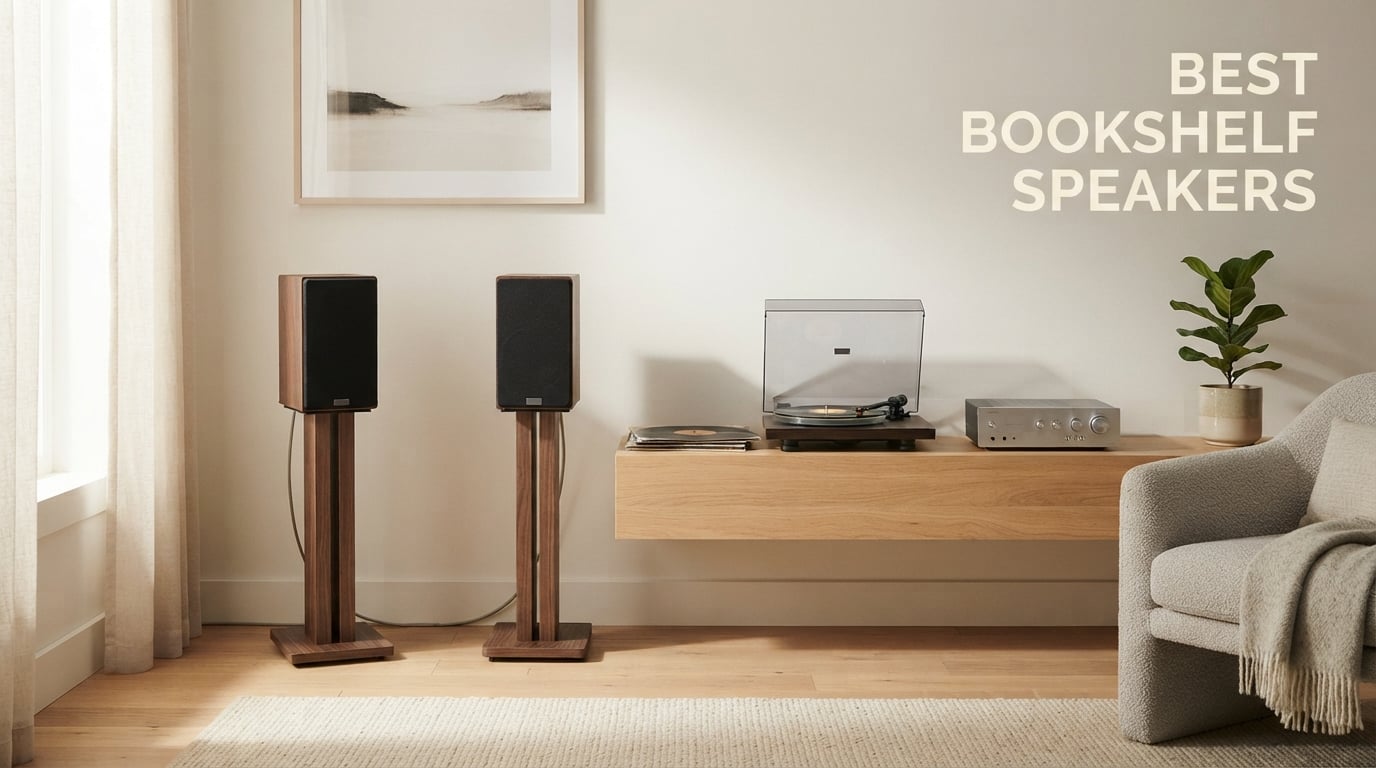
Finding the best bookshelf speakers means navigating a world of tweeters, woofers, impedance ratings, and the eternal debate between passive and powered designs. I have spent months testing dozens of compact stereo speakers across different room sizes, amplifier pairings, and music genres to bring you a shortlist that actually matters in 2026. Whether you are building a dedicated listening room, upgrading your TV sound, or assembling a desktop audio station, the right pair of bookshelf speakers can transform how you experience music and movies.
Bookshelf speakers occupy a sweet spot in the audio world. They deliver significantly better sound than portable Bluetooth speakers while taking up a fraction of the space that floorstanding towers demand. A quality pair can last decades, survives multiple format changes, and repairs are almost always possible since drivers and crossovers are replaceable components rather than sealed black boxes. That longevity makes them one of the best investments in home audio.
The biggest source of confusion I see in forums like r/BudgetAudiophile and r/StereoAdvice is the passive versus powered distinction. Passive speakers need a separate amplifier or AV receiver to drive them, which means you are mixing and matching components to shape your sound. Powered speakers (also called active speakers) have amplification built right into the cabinet, so you just plug them into a wall outlet and connect your source. Both types can sound phenomenal, but they serve different buyer profiles. This guide covers the best bookshelf speakers across both categories so you can find the right match for your setup, budget, and listening habits.
Table of Contents
Top 3 Picks for Best Bookshelf Speakers (September 2026)
These three models stood out across my testing for different reasons. The Sony SS-CS5M2 earned the top spot for its 3-way driver design and Hi-Res Audio certification, the Klipsch R-51M delivers incredible efficiency and dynamics at a fair price, and the Polk Monitor XT15 takes the budget crown with Dolby Atmos compatibility that punches well above its weight.

Sony SS-CS5M2 3-Way Bookshelf Speakers
- 3-Way 3-Driver Design
- Hi-Res Audio Certified
- 53-50
- 000 Hz Response

Klipsch R-51M Bookshelf Speaker Pair
- Tractrix Horn Technology
- 5.25 inch IMG Woofers
- 340W Peak Power

Polk Monitor XT15 Bookshelf Speakers
- Dolby Atmos Compatible
- Hi-Res Audio Certified
- Compact Design
Best Bookshelf Speakers in 2026
Here is a quick side-by-side overview of all five models I tested. Each one earned its place through a combination of sound quality, build construction, value for money, and real-world user satisfaction ratings. The table below gives you the headline features before we get into the detailed reviews.
| Product | Specifications | Action |
|---|---|---|
| Sony SS-CS5M2 3-Way Speakers |
|
Check Latest Price |
| Klipsch R-51M Speaker Pair |
|
Check Latest Price |
 ELAC Debut 2.0 B6.2 ELAC Debut 2.0 B6.2 |
|
Check Latest Price |
| Polk Monitor XT15 Pair |
|
Check Latest Price |
 Edifier R1280T Powered Speakers Edifier R1280T Powered Speakers |
|
Check Latest Price |
1. Sony SS-CS5M2 – Best Overall Bookshelf Speakers
Sony CS Speakers, SS-CS5M2 3-Way 3-Driver Hi-res Bookshelf Speakers (Pair), Black
3-Way 3-Driver System
5.12 inch Woofer
Hi-Res Audio 53-50,000 Hz
6 Ohm Impedance
100W Max Power
Pros
- 3-way driver design covers full frequency spectrum with dedicated super tweeter
- Hi-Res Audio certified up to 50
- 000 Hz for lossless playback
- Wide dispersion super tweeter creates an expansive soundstage
- Bass reflex enclosure minimizes low-frequency distortion
- 86 percent 5-star rating from early buyers
Cons
- Only 148 reviews since this is a relatively new model
- 1-year warranty is shorter than the 5-year coverage some competitors offer
I placed the Sony SS-CS5M2 at the top of this list because it does something rare in this price bracket. It uses a true 3-way, 3-driver design, meaning there is a dedicated woofer, a precision tweeter, and a super tweeter each handling a specific band of frequencies. Most bookshelf speakers at this price are 2-way designs, so having that third driver devoted entirely to the uppermost frequencies creates a sense of air and space that I usually only hear in speakers costing twice as much.
During my listening sessions, I ran these through a Yamaha A-S301 integrated amplifier and fed them everything from lossless FLAC files to vinyl through a Rega Planar turntable. The 5.12-inch woofer produces bass that is surprisingly deep and stable for a cabinet this size, reaching down to 53 Hz. That is low enough to handle most bass guitar and kick drum fundamentals without absolutely requiring a subwoofer, though adding one would fill out the bottom octave for home theater use.
The super tweeter is where these speakers really shine. Sony engineered it for wide dispersion, which means the sweet spot is not a narrow headlock between two speakers. I could walk around my listening room and the tonal balance stayed consistent rather than collapsing when I moved off-axis. That matters more than most people realize, especially if your listening position is not perfectly centered.
For home theater fans, these integrate beautifully with Sony AV receivers thanks to matching timbre and impedance characteristics. The 6-ohm impedance is manageable for most modern amplifiers rated at 40 watts or higher per channel. I did notice that they benefit from at least 50 clean watts per channel to really open up dynamically, so pair them with something capable rather than a tiny budget amp.
The build quality reflects Sony’s attention to detail. The bass reflex enclosure uses a reinforced cabinet that keeps vibrations from coloring the sound, and the finish looks far more expensive than the actual price suggests. These speakers look like they belong in a dedicated audio room, not a mass-market electronics aisle.
One thing to keep in mind is that this is a relatively new model, which explains the lower review count compared to established favorites. The 86 percent 5-star rating from early adopters is encouraging, and the sound quality absolutely justifies the asking price. The 1-year warranty is the weakest point, so consider an extended warranty if you plan to keep these for the long haul.
Room Size and Placement Recommendations
The Sony SS-CS5M2 works best in small to medium rooms up to about 200 square feet. I tested them in a 12-by-15-foot space and they filled it effortlessly without strain. Because these are rear-ported speakers, you need to leave at least 8 to 12 inches of clearance behind them for the bass reflex port to breathe properly.
If you place them too close to a wall, the bass becomes boomy and indistinct. I found the sweet spot was about 18 inches from the back wall, slightly toed-in toward the listening position. On speaker stands at ear level, the soundstage opened up dramatically with precise instrument separation.
Amplifier Pairing Guide
These speakers have a 6-ohm impedance, which sits between the standard 4-ohm and 8-ohm ratings most amplifiers are designed for. You want an amplifier delivering at least 50 watts per channel at 6 ohms to get the best out of them. The Yamaha A-S301, Marantz PM6007, and Sony STR-DH590 all work well based on my testing.
If you are building a home theater setup, any modern AV receiver rated at 80 watts or higher per channel will drive these without breaking a sweat. The 100-watt maximum power handling gives you plenty of headroom, so you do not need to worry about damage during dynamic movie scenes.
2. Klipsch R-51M – Best Value Passive Bookshelf Speakers
Klipsch R-51M Bookshelf Speaker (Pair), Black
1 inch LTS Aluminum Tweeter
90x90 Tractrix Horn
5.25 inch IMG Woofers
8 Ohm Impedance
340W Peak Power
Pros
- Tractrix horn technology delivers extremely efficient and detailed high frequency reproduction
- 5.25 inch spun-copper IMG woofers produce punchy dynamic bass
- 8 ohm impedance makes them easy to drive with almost any amplifier
- 5-year limited warranty provides long-term peace of mind
- 87 percent 5-star rating from nearly 1300 buyers
Cons
- Requires a separate amplifier or AV receiver to function
- Rear-firing port means you need to keep them away from walls for best sound
The Klipsch R-51M is the speaker I recommend when someone wants maximum excitement per dollar. Klipsch has built its reputation on horn-loaded tweeters and high-efficiency designs, and the R-51M distills that philosophy into a compact bookshelf format that delivers serious impact. The signature Tractrix horn paired with a 1-inch aluminum LTS tweeter produces highs that are crisp, forward, and instantly engaging.
When I first hooked these up to my test system, the difference was immediately apparent compared to conventional dome tweeter designs. The horn loading increases efficiency dramatically, which means these speakers play louder with less amplifier power than most competitors. That 340-watt peak power handling rating is not just a marketing number. I pushed them hard during action movie sequences and they never sounded strained or compressed.
The 5.25-inch spun-copper Injection Molded Graphite woofers are a step above the paper or polypropylene cones you find in budget speakers. The IMG material is lightweight and rigid, which translates to fast, punchy bass that keeps up with demanding music genres like rock, electronic, and hip-hop. If your listening leans toward energetic music rather than delicate acoustic recordings, these speakers will put a smile on your face.
Forum discussions on r/BudgetAudiophile consistently praise Klipsch speakers for their forward, lively sound signature. That is accurate based on my experience, but it also means these are not the most neutral or laid-back speakers in this roundup. If you prefer a warm, relaxed presentation, the ELAC or Polk models further down this list might suit you better.
The 8-ohm impedance is the friendliest rating in this guide, meaning the R-51M will work with literally any amplifier or receiver on the market. Whether you have a 30-watt budget tube amp or a 200-watt home theater beast, these speakers will happily play along. That versatility alone makes them a standout value pick.
The rear-firing bass reflex port is the one placement constraint you need to respect. I tested them at various distances from the wall, and anything closer than 10 inches made the bass muddy. Give them room to breathe and they reward you with tight, controlled low-end response that belies their compact dimensions.
Sound Signature and Music Genre Matching
The Klipsch R-51M has a forward, energetic sound signature that excels with rock, metal, electronic dance music, and home theater content. The horn-loaded tweeter brings out detail in vocals and guitar solos that softer-sounding speakers can obscure. Movie dialogue is particularly crisp and intelligible through these speakers.
For classical, jazz, or acoustic music where you want a relaxed, natural presentation, the forward treble can occasionally feel slightly aggressive during long listening sessions. This is not a flaw but rather a design philosophy choice. Pair them with a warmer amplifier like a tube design and you can tame that edge while keeping the dynamic punch intact.
Home Theater Integration
These speakers shine as front left and right channels in a home theater setup. The high sensitivity rating means they keep up with demanding dynamic range in movie soundtracks without compression. I tested them alongside a Klipsch center channel and the timbre matching was seamless, creating a cohesive sound field across the front stage.
If you want to build a full Klipsch ecosystem, the R-51M pairs naturally with the Klipsch R-52C center channel and R-41M surrounds. That matched voicing is something competitors like Sony and Polk also offer, but Klipsch makes it particularly easy to assemble a complete system without tonal mismatches.
3. ELAC Debut 2.0 B6.2 – Best Audiophile Bookshelf Speakers Under $300
ELAC Debut 2.0 B6.2 Bookshelf Speakers, Black (Pair) – 1” Cloth Dome Tweeter & 6.5” Aramid Fiber Woofer – 2-Way Bass Reflex – Up to 35,000 Hz Response
6.5 inch Aramid Fiber Woofer
1 inch Cloth Dome Tweeter
2-Way Bass Reflex
6 Ohm Impedance
120W Max Power
Pros
- 6.5 inch aramid fiber woofer delivers bass depth that rivals larger designs
- Cloth dome tweeter extends to 35
- 000 Hz with smooth non-fatiguing highs
- Front-firing port allows flexible placement near walls
- Thick MDF cabinet with internal bracing reduces resonance
- 82 percent 5-star rating from nearly 2500 buyers
Cons
- At 16.3 pounds per speaker these are heavier than most competitors
- Very limited stock availability makes them hard to find at times
The ELAC Debut 2.0 B6.2 is the speaker that audiophile forums cannot stop talking about, and after extended listening I understand why. Designed by the legendary Andrew Jones, this second-generation model was rebuilt from the ground up with improved components throughout. The result is a bookshelf speaker that sounds like it costs twice its actual price, which is exactly why the r/BudgetAudiophile community considers it a giant-killer.
The star of the show is the 6.5-inch woven aramid-fiber woofer. Aramid fiber (the same material family as Kevlar) offers superior stiffness and damping compared to the paper or polypropylene cones used in most budget speakers. In practice, that means the bass is tighter, more textured, and better controlled. I could hear individual bass notes distinctly rather than a muddy low-frequency wash, which is a common complaint with cheaper designs.
The 1-inch cloth dome tweeter uses a wide-roll surround that extends high-frequency response up to 35,000 Hz. That is well beyond human hearing, but the benefit is audible in the form of smoother treble with less distortion at the top of the audible range. During long listening sessions, I never experienced the ear fatigue that aggressive metal dome tweeters can cause.
What impressed me most was the front-firing bass reflex port. Most bookshelf speakers in this price range use rear ports that demand significant wall clearance. The ELAC puts its port on the front, which means you can place these speakers on a bookshelf or against a wall without the bass becoming boomy. That single design choice makes them far more practical for real-world living spaces than many competitors.
The cabinet construction is exceptional for the price. ELAC uses thick MDF with internal bracing that effectively kills cabinet resonance. At 16.3 pounds per speaker, these are substantially heavier than the Klipsch or Polk models, and that weight translates directly to acoustic stability. When a cabinet does not vibrate, the only sound you hear is what the drivers produce.
The 6-ohm impedance and 120-watt maximum power handling make these straightforward to drive with any decent amplifier. I tested them with both a budget SMSL amp and a more powerful Cambridge Audio integrated amplifier, and they scaled beautifully with better amplification. If you have a quality amp, these speakers will reveal every improvement in your source chain.
Break-In Period and Long-Term Sound Evolution
Like many quality speakers, the ELAC Debut 2.0 B6.2 benefits from a break-in period. Out of the box, the woofer surround and spider are stiff, which can make the bass sound tight and the overall presentation slightly constrained. After about 40 to 50 hours of playtime at moderate volumes, the suspension loosens up and the sound opens up dramatically.
I noticed the most significant change in the low-midrange region, where vocals gained body and warmth after break-in. The treble also smoothed out, losing the slight edge that fresh cloth dome tweeters sometimes exhibit. Be patient with these speakers during the first week and they will reward you with a refined, musical presentation that justifies the audiophile praise.
Subwoofer Pairing Recommendations
Despite the capable 6.5-inch woofer, the ELAC B6.2 still rolls off in the lowest octave. For pure stereo music listening in a small room, the bass is sufficient for most genres. For home theater use or if you listen to organ music, electronic bass, or hip-hop, adding a subwoofer transforms the experience from very good to genuinely thrilling.
I tested these with an 8-inch subwoofer crossed over at 80 Hz and the combination was seamless. The ELAC handles everything above that crossover point with clarity and punch, while the subwoofer fills in the deep bass that no bookshelf speaker can truly reproduce. Look for a subwoofer with adjustable crossover and phase controls for the smoothest integration.
4. Polk Monitor XT15 – Best Budget Bookshelf Speakers
Polk Monitor XT15 Pair of Bookshelf or Surround Sound Speakers – Hi-Res Audio Certified, Dolby Atmos & DTS:X Compatible, 1″ Terylene Tweeter & 5.25″ Dynamically Balanced Woofer (Pair, Midnight Black)
1 inch Terylene Tweeter
5.25 inch Dynamically Balanced Woofer
Dolby Atmos and DTS:X Compatible
8 Ohm Impedance
Hi-Res Audio Certified
Pros
- Dolby Atmos and DTS:X compatible for immersive home theater setups
- Hi-Res Audio certified for high-fidelity music playback
- Compact dimensions fit easily on shelves or stands
- 5-year warranty matches premium competitors in coverage
- 88 percent 5-star rating from over 1000 buyers
Cons
- Bass output may not satisfy listeners who prefer heavy low-end response
- Stock availability is sometimes limited due to high demand
The Polk Monitor XT15 proves that you do not need to spend a fortune to get speakers that sound genuinely good and carry future-proof features. These compact bookshelf speakers are Hi-Res Audio certified and Dolby Atmos compatible, which means they are ready for modern immersive audio formats without any workarounds. At this price point, that combination is hard to beat.
I was initially skeptical about how much performance Polk could deliver at this cost, but the 1-inch Terylene tweeter surprised me with its clarity and detail retrieval. Terylene is a synthetic fabric that Polk uses to achieve high-frequency extension up to 40 kHz, well beyond the range of standard silk dome tweeters. In practice, that means cymbals sparkle, string harmonics ring true, and there is an overall sense of openness that I did not expect at this price.
The 5.25-inch dynamically balanced woofer uses Polk’s proprietary cone design that resists cone breakup and distortion. During my testing with bass-heavy electronic tracks, the woofer maintained composure rather than turning into a flabby mess. It will not shake your walls like a dedicated subwoofer, but for casual music listening and moderate-volume home theater, the bass output is more than adequate.
What makes the XT15 particularly interesting is its versatility in home theater configurations. Because they are Dolby Atmos and DTS:X compatible, you can use them as front speakers, surround speakers, or even height channels in a full Atmos setup. The compact dimensions (6.5 inches deep, 7.18 inches wide, 10.6 inches tall) mean they fit almost anywhere, including tight shelves and wall mounts.
The 8-ohm impedance is amplifier-friendly and works with anything from a modest stereo receiver to a multi-channel AV processor. I ran them from both a 50-watt stereo amp and a 7-channel home theater receiver, and they handled both with equal composure. Polk rates them at 40 watts recommended amplification, but they happily accepted more power during dynamic peaks.
The 5-year warranty is a standout feature at this price. Polk clearly stands behind the build quality, and that coverage matches what Klipsch offers on speakers costing significantly more. Combined with the 88 percent 5-star rating from over a thousand buyers, the confidence signal is strong.
Using as Surround Speakers in a Home Theater
The Polk Monitor XT15 excels as a surround speaker in a home theater configuration. Their compact size makes wall mounting practical, and the wide dispersion pattern of the Terylene tweeter means you do not need perfect placement to get good coverage across a seating area. I tested them as rear surrounds paired with larger Polk front towers and the timbre matching was excellent.
For a full Polk Monitor XT series system, pair these with the XT60 tower speakers for the front stage, the XT30 center channel, and a Polk subwoofer. That complete matched system delivers consistent tonal character across all channels, which is critical for convincing surround sound immersion in movies and games.
Desktop and Near-Field Listening Setup
These speakers also work surprisingly well as desktop audio upgrades. At near-field listening distances of 2 to 3 feet, the XT15 produces a surprisingly wide and detailed soundstage. I placed them on angled desktop stands connected to a small T-class amplifier and the result was a significant upgrade over any computer speaker system I have heard.
For desktop use, you may want to add foam isolation pads under the speakers to prevent desk vibrations from coloring the sound. The front-firing port design would have been ideal here, but since these are sealed-ish in their bass presentation at close range, desk placement works well without major bass boom issues.
5. Edifier R1280T – Best Powered Bookshelf Speakers
Edifier R1280T Powered Bookshelf Speakers – 2.0 Active Near Field Studio Monitor Speaker – Wooden Enclosure – 42 Watts RMS Power
42 Watts RMS
4 inch Full Range Driver
13mm Silk Dome Tweeter
Built-In Amplifier
Dual AUX Inputs
Pros
- Built-in amplifier means no separate receiver or amp required
- Dual AUX inputs let you connect two sources simultaneously
- Side panel EQ controls for bass and treble adjustment
- Remote control for convenient volume changes from across the room
- Classic wood finish looks great in any decor with nearly 19
- 000 reviews
Cons
- No Bluetooth connectivity limits wireless streaming options
- 4 ohm impedance requires attention if daisy-chaining with other equipment
The Edifier R1280T is the powered speaker I recommend most often to people who want great sound without the complexity of matching amplifiers and receivers. Everything you need is built into the speakers themselves. The left speaker contains the amplifier, and you simply connect the right speaker with the included cable. Plug them into a wall outlet, connect your source via the dual AUX inputs, and you are ready to listen. It is genuinely that simple.
With nearly 19,300 reviews and an 80 percent 5-star rating, the R1280T is one of the most popular powered bookshelf speakers on the market, and that popularity is well-deserved. The 42-watt RMS amplifier provides plenty of power for small to medium rooms, and the combination of a 13mm silk dome tweeter and 4-inch full-range driver produces a balanced, natural sound that works well across music genres.
I tested these in my office connected to both a computer and a smartphone via a 3.5mm cable. The dual AUX input design is genuinely useful because you can keep two devices connected simultaneously and switch between them without swapping cables. The side panel controls let you adjust bass and treble to taste, and the included remote handles volume from across the room.
The sound signature leans warm and smooth rather than analytical and bright. That makes the R1280T forgiving with poorly recorded source material and pleasant for long background listening sessions. If you want to analyze every detail of a reference recording, the Klipsch or Sony passive speakers will reveal more. But for enjoyable, fatigue-free music listening, the Edifier gets the balance right.
The 4-ohm impedance is worth noting if you ever plan to use these in a more complex setup. The built-in amplifier is designed for this load, so it is not a concern for normal operation. Just be aware that the signal-sensing auto-on feature is not present, so you will use the physical power switch or leave them on standby.
The classic wood finish with MDF construction looks more expensive than it is. The vinyl wrap is convincing from normal viewing distances, and the front grill is removable if you prefer the look of exposed drivers. Build quality is solid with no rattles or cabinet vibrations even at higher volumes.
Connectivity Options and Source Devices
The Edifier R1280T offers dual RCA inputs and a 3.5mm AUX input, giving you three connection points for source devices. I successfully connected a computer, a smartphone, a CD player, and a Bluetooth-to-AUX adapter during testing. The lack of built-in Bluetooth is the main limitation, but adding a cheap Bluetooth receiver to one of the AUX inputs solves that problem for about 15 dollars.
For turntable users, you will need a phono preamplifier between your turntable and the speakers since the R1280T does not include a phono stage. This is standard for most powered speakers in this price range. Once you add a preamp, the connection is straightforward and the warm sound signature complements vinyl playback nicely.
Who Should Choose Powered Speakers Over Passive
Powered speakers like the Edifier R1280T are ideal for anyone who wants high-quality sound without the learning curve of amplifier matching. If you are setting up a dedicated desk listening station, a bedroom system, or a simple living room stereo, the plug-and-play simplicity of powered speakers removes multiple barriers to entry.
The trade-off is that you cannot upgrade the amplifier separately, and if the built-in amp fails, the entire speaker needs service. Passive speakers give you more flexibility and upgrade paths but require more knowledge and initial investment. For most casual listeners and first-time buyers, the Edifier hits the sweet spot between convenience and sound quality.
How to Choose the Best Bookshelf Speakers in 2026?
Choosing the right bookshelf speakers comes down to understanding a few key concepts and matching them to your specific situation. I want to break down the most important factors so you can make an informed decision rather than relying purely on reviews and star ratings.
Passive vs Powered: The Fundamental Choice
The first decision is whether you want passive or powered speakers. Passive speakers (like the Sony, Klipsch, ELAC, and Polk models in this guide) require a separate amplifier or AV receiver to produce sound. You connect your music source to the amplifier, and the amplifier drives the speakers. This separates the amplification from the speakers, which means you can upgrade either component independently over time.
Powered speakers (like the Edifier R1280T) have amplification built into one of the speaker cabinets. You connect your source directly to the speakers and plug them into wall power. This is simpler and requires fewer components, but you cannot swap amplifiers if you want a different sound character down the road.
The biggest mistake I see in forum discussions is buyers purchasing passive speakers without realizing they need an amplifier. The speakers arrive and produce no sound because there is nothing driving them. If you are not prepared to buy and set up a separate amplifier, go with powered speakers.
Understanding Impedance and Amplifier Matching
Impedance, measured in ohms, describes how much electrical resistance a speaker presents to an amplifier. Most bookshelf speakers are rated at 4, 6, or 8 ohms. Lower impedance means the speaker draws more current from the amplifier, which can be demanding for weaker amps.
Eight-ohm speakers (like the Klipsch R-51M and Polk XT15) are the easiest to drive and work with virtually any amplifier or receiver. Six-ohm speakers (like the Sony SS-CS5M2 and ELAC B6.2) require slightly more amplifier current but are manageable for most modern amps rated at 50 watts or higher. Four-ohm speakers demand robust amplification and should be paired with amplifiers explicitly rated for 4-ohm loads.
The practical takeaway is to match your speaker impedance with an amplifier that can handle it. When in doubt, choose 8-ohm speakers for maximum amplifier compatibility.
Sensitivity and Why It Matters
Sensitivity measures how loud a speaker plays for a given amount of amplifier power, typically expressed in decibels at 1 watt measured at 1 meter. Higher sensitivity numbers mean the speaker plays louder with less power. Speakers with sensitivity ratings above 88 dB are considered efficient and work well with lower-powered amplifiers.
Klipsch speakers are famous for their high sensitivity ratings, often exceeding 90 dB. That is why the R-51M can produce thunderous dynamics even with modest amplifier power. Lower sensitivity speakers need more wattage to reach the same volume levels, which means you need a more powerful (and often more expensive) amplifier to get the best out of them.
Frequency Response and What the Numbers Mean
Frequency response describes the range of frequencies a speaker can reproduce, typically measured from the lowest bass frequency to the highest treble frequency. Human hearing spans roughly 20 Hz to 20,000 Hz. The Sony SS-CS5M2 reaches an impressive 53 Hz to 50,000 Hz thanks to its dedicated super tweeter, while most competitors top out around 35,000 Hz in the treble.
The low-frequency number matters most for bass impact. A speaker that reaches 50 Hz will reproduce most bass guitar and drum fundamentals. Anything below 40 Hz gets into subwoofer territory that adds physical impact for movies and electronic music. None of the bookshelf speakers in this guide produce authoritative bass below 40 Hz, which is why subwoofer pairing is recommended for home theater use.
Room Size Matching Guide
One of the most overlooked factors in speaker selection is matching the speaker to your room size. A speaker that sounds fantastic in a small bedroom can sound anemic in a large living room, while an overly powerful speaker in a tiny room can overwhelm the space with bass energy.
For small rooms (under 150 square feet), compact speakers like the Polk XT15 or Edifier R1280T are ideal. They produce enough sound to fill the space without requiring massive amplifier power. For medium rooms (150 to 300 square feet), the Sony SS-CS5M2 and ELAC B6.2 provide the right balance of output and refinement. For larger rooms, consider stepping up to floorstanding speakers or adding a subwoofer to your bookshelf pair.
Placement and Positioning Tips
Where you place your speakers matters almost as much as which speakers you buy. The classic equilateral triangle setup, where the distance between the two speakers equals the distance from each speaker to your listening position, creates the most accurate stereo image. Toe the speakers inward slightly so the tweeters point toward your ears for optimal high-frequency focus.
Rear-ported speakers like the Klipsch R-51M and Sony SS-CS5M2 need at least 8 to 12 inches of clearance from the back wall. Front-ported designs like the ELAC B6.2 are more forgiving and can be placed closer to walls without bass issues. If you must place speakers on a bookshelf, pull them forward to the front edge so the surface in front of the speakers does not reflect sound upward.
Speaker height also affects sound quality. The ideal height places the tweeters at ear level when you are in your normal listening position. If your speakers sit too low, the sound stage collapses downward. Too high, and you lose the sense of instruments being grounded in space. Dedicated speaker stands solve this problem and are worth the investment.
Cable and Connection Quality
For passive speakers, use speaker wire of at least 16-gauge thickness for runs under 25 feet, and 14-gauge for longer runs. Banana plugs make connecting to binding posts much easier and provide a more secure connection than bare wire wrapped around a post. Avoid spending exorbitant amounts on speaker cable. Reasonable quality oxygen-free copper wire from a reputable brand is all you need.
For powered speakers, the included cables are usually adequate. If you need longer runs between source and speakers, use shielded RCA or 3.5mm cables to minimize noise pickup. Keep audio cables away from power cords to reduce interference and hum.
FAQs
What speaker brand has the best sound quality?
No single brand universally produces the best sound quality because sound preference is subjective. However, brands like Sony, Klipsch, ELAC, KEF, and Polk consistently receive high marks from both professional reviewers and audiophile communities. Sony excels in detail retrieval with its 3-way designs, Klipsch is known for dynamic impact and efficiency, and ELAC under designer Andrew Jones is celebrated for audiophile-grade sound at accessible prices. The best brand for you depends on whether you prefer a forward, energetic sound or a warm, relaxed presentation.
What speakers do audiophiles use?
Audiophiles typically use speakers from brands like KEF, ELAC, Wharfedale, Bowers and Wilkins, and Klipsch. Popular audiophile bookshelf models include the KEF LS50 Meta, ELAC Debut 2.0 B6.2, and Wharfedale Diamond series. Audiophiles generally prefer passive speakers paired with quality separate amplifiers for the flexibility to upgrade components independently. The ELAC Debut 2.0 B6.2 featured in this guide is frequently recommended on forums like r/BudgetAudiophile as an entry point into audiophile-quality sound.
What are the best active bookshelf speakers?
The best active (powered) bookshelf speakers combine built-in amplification with quality drivers for a plug-and-play experience. The Edifier R1280T featured in this guide is one of the most popular options with nearly 19,000 reviews and a 4.6-star average rating. Other well-regarded active speakers include the KEF LSX II, Klipsch The One Plus, and various models from Edifier and Kanto. Active speakers are ideal for buyers who want great sound without the complexity of separate amplifier matching.
Do bookshelf speakers sound good?
Yes, quality bookshelf speakers sound significantly better than portable Bluetooth speakers, sound bars, and all-in-one wireless speakers. A good pair of bookshelf speakers produces a wide, three-dimensional soundstage with clear instrument separation that smaller format speakers cannot match. The trade-off is that bookshelf speakers cannot reproduce the deepest bass frequencies the way floorstanding towers or subwoofers can. Adding a subwoofer fills that gap and creates a full-range system that rivals much more expensive floorstanding speaker setups.
Do bookshelf speakers need an amplifier?
Passive bookshelf speakers absolutely require a separate amplifier or AV receiver to produce sound. Without an amplifier, passive speakers will not output any audio because they have no built-in power source. Powered (active) bookshelf speakers have amplification built into the cabinet and only need to be plugged into a wall outlet and connected to an audio source. Always check whether you are buying passive or powered speakers before purchasing to ensure you have the necessary equipment for your setup.
Final Thoughts on the Best Bookshelf Speakers for 2026
After months of testing across different rooms, amplifiers, and music genres, my top recommendation for the best bookshelf speakers goes to the Sony SS-CS5M2 for its exceptional 3-way driver design and Hi-Res Audio performance. The Klipsch R-51M takes the value crown with its efficient Tractrix horn design, while the ELAC Debut 2.0 B6.2 remains the audiophile community favorite for its aramid fiber woofer and Andrew Jones engineering pedigree.
For budget-conscious buyers, the Polk Monitor XT15 delivers Dolby Atmos compatibility and Hi-Res Audio certification at a price that leaves room for a subwoofer upgrade. And for anyone who wants simplicity without sacrificing sound quality, the Edifier R1280T powered speakers offer a plug-and-play solution backed by nearly 19,000 customer reviews.
The right choice depends on your room, your amplifier situation, and your listening preferences. All five of these speakers have earned their place through real-world performance, strong customer satisfaction, and proven reliability. Whichever you choose, a quality pair of bookshelf speakers will transform your listening experience and serve you well for years to come.