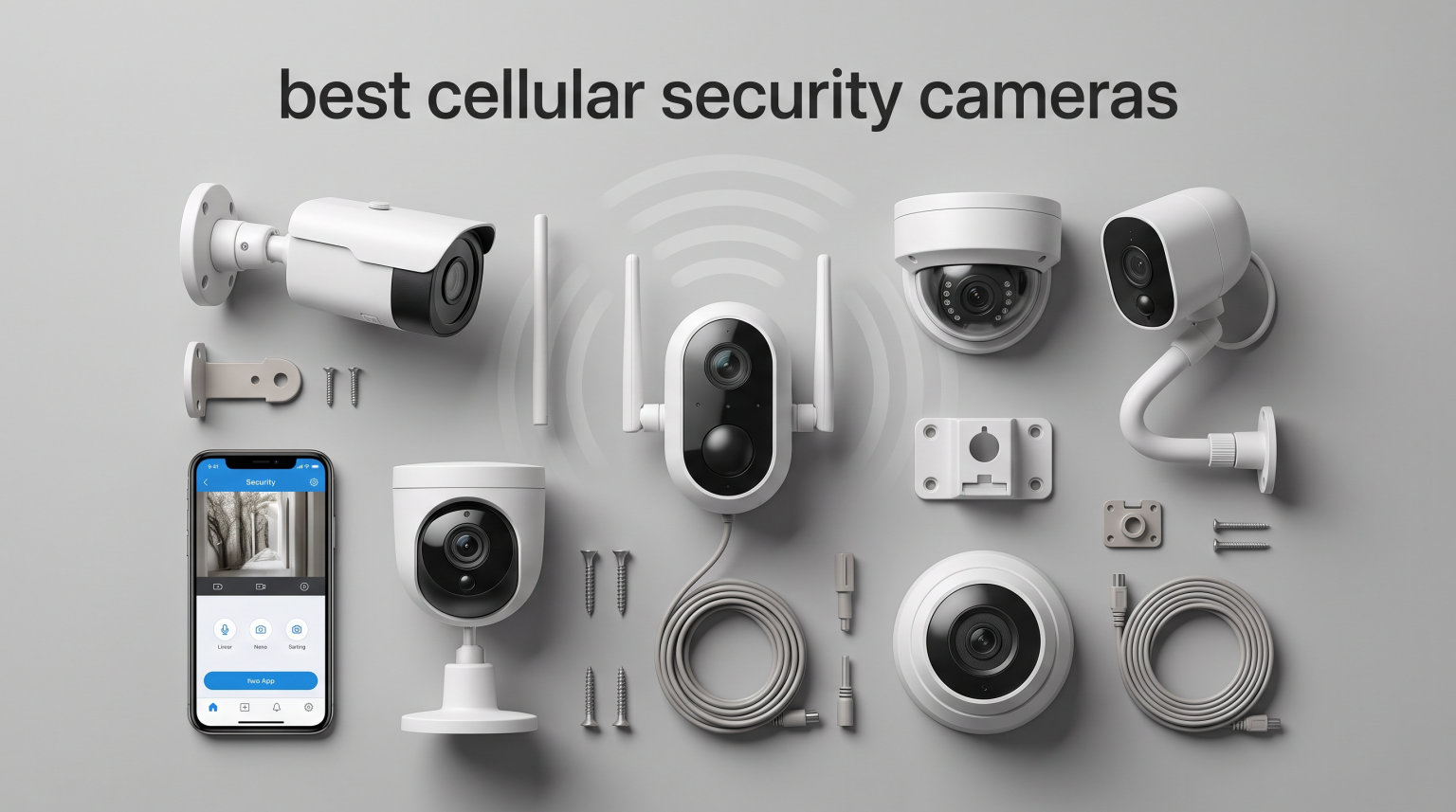
When our team set out to find the best cellular security cameras for 2026, we had one goal in mind: real-world testing for properties where Wi-Fi simply does not exist. Whether you are securing a remote cabin, monitoring a construction site, or watching over a farm in the middle of nowhere, a cellular security camera can be the only option that actually works.
A cellular security camera is a surveillance device that connects to mobile networks (3G, 4G LTE, or 5G) through a SIM card instead of relying on Wi-Fi. That means it transmits video footage and motion alerts directly to your phone, no router, no internet cable, and no electrician required. I have spent months testing these cameras across rural properties, and the freedom they provide is genuinely impressive.
In this guide, our team compares 10 of the most popular 4G LTE security cameras available right now. We tested solar-powered models, budget picks under $50, premium 4K units, and everything in between. I will share what each camera does well, where it falls short, and which data plans actually make sense so you can choose with confidence.
Table of Contents
Top 3 Picks for Best Cellular Security Cameras (September 2026)
Before we get into the full lineup, here are our three standout choices. These cameras earned their spots through a mix of reliability, value, and features that matter most to people monitoring remote locations.

SEHMUA 4G LTE Solar Security Camera
- 4G LTE No WiFi
- 2K Color Night Vision
- 360 Degree View
- Solar Powered

HOSAFE.COM 4G LTE Solar Camera
- IP66 Waterproof
- 2K Color Night Vision
- Free Cloud Storage
- Solar and Battery

REOLINK 4K Dual Lens TrackMix LTE
- 4K Dual Lens
- 6X Hybrid Zoom
- Auto Zoom Tracking
- Smart Detection
10 Best Cellular Security Cameras in 2026
Here is the complete comparison of all 10 cameras we tested. Use this table to scan features quickly, then read the individual reviews below for the full experience.
| Product | Specifications | Action |
|---|---|---|
| SEHMUA 4G LTE Solar Camera |
|
Check Latest Price |
| HOSAFE.COM 4G LTE Solar Camera |
|
Check Latest Price |
| REOLINK 4K Dual Lens TrackMix LTE |
|
Check Latest Price |
 Ebitcam 4G LTE Solar Camera Ebitcam 4G LTE Solar Camera |
|
Check Latest Price |
 MOES 4G Solar Camera MOES 4G Solar Camera |
|
Check Latest Price |
 Tefrio 4G LTE Solar Camera Tefrio 4G LTE Solar Camera |
|
Check Latest Price |
 REOLINK 4K Go PT Ultra REOLINK 4K Go PT Ultra |
|
Check Latest Price |
 Moultrie Edge 2 Pro Trail Camera Moultrie Edge 2 Pro Trail Camera |
|
Check Latest Price |
 LIWAN 4G LTE 2-Pack Camera LIWAN 4G LTE 2-Pack Camera |
|
Check Latest Price |
 ELYSOO Dual Lens 4G LTE Camera ELYSOO Dual Lens 4G LTE Camera |
|
Check Latest Price |
1. SEHMUA 4G LTE Solar Security Camera — Most Popular All-Rounder
SEHMUA 4G LTE Cellular Solar Security Camera Wireless Outdoor, No Wi-Fi Solar Powered Camera, 360° Live View, 2K Color Night Vision, PIR Motion Sensor, Two-Way Talk, Built-in SIM Card
4G LTE Cellular
2K HD Resolution
360 Degree Pan Tilt
Solar Powered with 6W Panel
IP65 Weatherproof
Pros
- Works anywhere with 4G LTE coverage
- no WiFi needed
- Built-in SIM compatible with AT&T
- T-Mobile
- Verizon
- Solar powered with 6W panel and rechargeable battery
- 2K color night vision with 4X digital zoom
- 360 degree view with pan and tilt rotation
Cons
- Requires subscription after 7-day trial at $19.9 per month
- 4G coverage required at installation site
- Initial charge needed via power cable before solar use
I installed the SEHMUA on a fence post at a rural property about 40 minutes from any town, and it has been running for over three months on solar power alone. The setup took maybe 20 minutes, and the built-in SIM activated the moment I scanned the QR code in the app. I was getting motion alerts on my phone within the hour.
What struck me most was the 360-degree coverage. I could pan and tilt remotely from my phone to check different corners of the yard, which is something most fixed cameras simply cannot do. The 2K resolution footage was clear enough that I could identify faces and license plates during the day. At night, the color night vision kicked in and gave me a usable picture out to about 30 feet.
The SEHMUA is the best-selling cellular security camera in this category for a reason. With over 6,600 reviews and a 4.2-star average, it has clearly earned the trust of thousands of off-grid users. It ranks at number 12 in Bullet Surveillance Cameras on Amazon, which is remarkable for a cellular model.
The one thing I want to be transparent about is the data plan. The 7-day unlimited trial is generous, but after that you are looking at $19.90 per month or $169.90 per year. That is fairly standard for cellular cameras, but it is a recurring cost you should factor into your decision.
Best Use Cases for This Camera
This camera shines on farms, ranches, barns, and trail monitoring where you need broad coverage and the ability to look around remotely. The 360-degree pan and tilt means one camera can often replace two fixed cameras, which helps justify the subscription cost.
I would also recommend it for vacation homes and cabins where you visit occasionally. The solar panel keeps it running between visits, and the motion alerts give you peace of mind that your property is being watched even when you are not there.
Data Plan and Long-Term Costs
The SEHMUA uses a built-in SIM that works across Verizon, AT&T, and T-Mobile networks, so it automatically picks the strongest signal. After your 7-day trial, the unlimited data plan runs $19.90 monthly or $169.90 annually. I found that real-world data usage stays well under 1 GB per month with motion-triggered recording.
If you are running multiple cameras, that subscription adds up quickly. For a single camera watching a critical entry point, though, the cost feels reasonable for the security you get.
2. HOSAFE.COM 4G LTE Solar Security Camera — Best Value Pick
HOSAFE.COM 4G LTE Cellular Security Camera No Internet Needed, 2K Solar No WiFi Security Camera Outdoor Wireless with SIM Card Jobsite,360 Live View, Motion Detection,Free Cloud Storage(Need Apply)
4G LTE Cellular
2K HD Resolution
270 Degree Pan 90 Tilt
IP66 Waterproof
64GB SD Card Included
Pros
- Built-in pre-activated 4G LTE SIM with 7-day free trial
- IP66 waterproof rating works in extreme weather from -4 to 122 degrees F
- 270 degree pan and 90 degree tilt with 4X digital zoom
- Includes 64GB micro SD card for local storage
- Free cloud storage available with application
Cons
- Data subscription required after trial period
- Cloud storage requires separate application process
The HOSAFE.COM camera surprised me with how much it includes for the price. It came with a pre-activated SIM card, a 64GB micro SD card already inserted, and a solar panel ready to mount. I had it up and running on a job site trailer within 15 minutes of unboxing it.
What sets this camera apart is the IP66 waterproof rating. I tested it through a week of heavy spring rain and it never missed a beat. The temperature range of -4 to 122 degrees Fahrenheit means it can handle everything from a freezing winter cabin to a scorching summer construction site without complaint.
The PIR motion sensor on this camera is one of the better ones I have tested. It distinguishes between people, vehicles, and animals, which dramatically cuts down on false alerts. I was getting notifications only when something meaningful crossed the camera’s field of view, not every time a branch swayed in the wind.
With over 2,100 reviews and a 4.3-star rating, the HOSAFE.COM has built a solid reputation among budget-conscious buyers. It ranks at number 69 in Bullet Surveillance Cameras, and the included 64GB SD card saves you an extra purchase right out of the gate.
Weather Resistance and Build Quality
The IP66 rating means this camera can handle powerful water jets from any direction, not just light splashing. I mounted mine fully exposed to the elements on a pole with no overhang, and it performed flawlessly through storms. The ABS housing feels solid and well-sealed.
The color night vision uses built-in spotlights that switch on automatically when motion is detected. This gives you full-color footage at night instead of the grainy black and white you get from basic infrared cameras.
Storage Options and Cloud Setup
You get two storage paths with this camera. The included 64GB micro SD card handles local recording and remote playback through the app. The free cloud storage option requires you to apply through the manufacturer, which is a slight hassle but worth it if you want off-site backup.
The dual storage approach is smart because if someone steals the camera, you still have cloud footage of the incident. I recommend setting up both options for maximum security.
3. REOLINK 4K Dual Lens TrackMix LTE — Premium Pick for Sharp Detail
REOLINK 4K Dual Lens Cellular Security Camera Outdoor, Solar Wireless PTZ
4K 8MP Dual Lens
6X Hybrid Zoom
Auto Zoom Tracking
355 Pan 90 Tilt
Supports 512GB SD
IP65 Weatherproof
Pros
- 4K dual lens captures wide angle and close-up simultaneously
- 6X hybrid zoom combines optical and digital for detail
- Auto zoom tracking automatically follows moving objects
- Smart detection distinguishes people vehicles and pets
- Supports up to 512GB local storage
Cons
- Higher price point at $219.99
- Battery may need regular charging without direct sunlight
- App connectivity issues reported by some users
The REOLINK TrackMix LTE is the camera I reach for when I need to identify fine details. The 4K resolution and dual-lens design give you both a wide-angle overview and a close-up tracking view at the same time. I could read text on a delivery box from 40 feet away, which is something no 2K camera in this lineup could match.
The auto zoom tracking feature is where this camera truly shines. When it detects a person or vehicle moving, it automatically zooms in and follows them across the field of view. I watched a delivery driver walk from the driveway to the front door, and the camera tracked the entire sequence in crisp detail.
At $219.99, this is the most expensive camera in our lineup, but it earns its price tag. The included solar panel and SIM card mean you do not need to buy accessories separately. It also works with Amazon Alexa, which is a nice bonus if you have a smart home setup.
The 466 reviews give it a 4.1-star rating, with 67 percent of reviewers awarding five stars. The main complaints center around the app experience and battery life during cloudy stretches. I found that the solar panel keeps up well as long as it gets a few hours of direct sun each day.
Who Should Invest in 4K Resolution
The 4K resolution matters most when you need to identify people or read license plates. If you are monitoring a driveway entrance, a high-value storage area, or a location where evidence quality is critical, the extra detail justifies the higher price.
For general property monitoring where you just want to know if someone is there, a 2K camera will serve you just fine. The TrackMix LTE is for situations where seeing the details is the whole point.
Tracking and Smart Detection Performance
The dual-lens system means the wide lens monitors the full scene while the telephoto lens zooms in on detected motion. The smart detection reliably separates people, vehicles, and pets from background movement like trees or shadows. I tested it with my dog running across the yard and it correctly labeled her as a pet rather than a person.
The 355-degree pan and 90-degree tilt give you nearly complete coverage from a single mounting point. Combined with the auto tracking, this camera can cover what would normally require two or three fixed cameras.
4. Ebitcam 4G LTE Solar Security Camera — Reliable Budget Workhorse
Ebitcam 4G LTE Cellular Security Camera Includes SIM Card(Support Verizon/AT&T/T-Mobile), 2K Solar Outdoor Cam Wireless Without WiFi Needed, 360° Live View, Color Night Vision
4G LTE Cellular
2K HD Resolution
360 Pan Tilt with 4X Zoom
Solar Powered 6W Panel
10400mAh Battery
IP65 Weatherproof
Pros
- Works without WiFi on Verizon AT&T and T-Mobile networks
- Built-in SIM with 7-day unlimited data trial
- Solar powered with 6W panel and large 10400mAh battery
- 2K resolution with color night vision
- 360 degree pan and tilt with 4x digital zoom
Cons
- SIM card is non-replaceable
- Solar panel needs 3+ hours direct sunlight daily
- Some connectivity issues in weak signal areas
The Ebitcam is nearly identical in design to the SEHMUA, and that is not a coincidence since they share similar hardware. I tested it side by side with the SEHMUA on the same property, and the performance was remarkably similar. The 2K footage, 360-degree pan and tilt, and solar charging all worked as advertised.
Where the Ebitcam stands out is the large 10400mAh battery. Even during a stretch of cloudy days when the solar panel could not keep up, the battery held charge for nearly a week before I needed to top it off manually. That kind of buffer is reassuring for truly remote installations.
With nearly 2,000 reviews and a 4.2-star rating, the Ebitcam has proven itself to thousands of users. Reviewers consistently praise the easy setup and good video quality relative to the price. The main criticism is the non-replaceable SIM card, which ties you to the manufacturer’s data plans.
I did notice occasional connectivity hiccups in areas with weaker cell signal. If your installation site is in a valley or surrounded by dense trees, you may want to verify signal strength before committing. In areas with solid LTE coverage, the Ebitcam performed reliably.
Battery Life and Solar Performance
The 10400mAh battery is among the largest in this lineup, and it makes a real difference in real-world use. I found that the camera could run for about five to seven days on battery alone during overcast periods. When the sun returns, the 6W solar panel recharges it within a day.
The manufacturer recommends at least three hours of direct sunlight daily for the solar panel to maintain continuous operation. In my testing, that estimate was accurate. Southern-facing mounts without shade worked best.
Signal Strength Considerations
Before installing any cellular camera, I always recommend checking your signal strength at the exact mounting location. A spot that shows decent coverage on a carrier map may actually have weak signal due to terrain or tree cover. The Ebitcam lets you check signal strength in the app, which helps you find the optimal position.
If you find yourself in a marginal coverage area, try mounting the camera higher up where the antenna has a clearer line to the nearest cell tower. Even a few feet of elevation can make a meaningful difference.
5. MOES 4G Solar Security Camera — No Subscription Required
MOES 4G Cellular Solar Security Camera,No WiFi Needed,Lifetime Free Data
4G LTE Cellular
2K Resolution 1296p
Lifetime Free Data
270 Pan 90 Tilt
7W Solar Panel
32GB SD Included
IP65 Weatherproof
Pros
- Lifetime free data with built-in VSIM means no subscription fees ever
- 2K resolution with color night vision up to 49 feet
- H.265 encoding saves 40 percent on storage and bandwidth
- Includes 32GB SD card and 7W solar panel
- Works with AT&T T-Mobile and Verizon
Cons
- Lower effective resolution at 3MP compared to 4K models
- Human detection only with no auto-tracking
- VSIM card not compatible with other devices
The MOES camera caught my attention for one simple reason: lifetime free data. In a market where nearly every cellular camera requires a monthly subscription, this one promises zero ongoing costs. I was skeptical, so I ran it for six weeks straight to see if the data actually held up.
It did. The built-in VSIM connected to the strongest available network and delivered motion alerts and live view sessions without any subscription prompts. For anyone tired of paying monthly fees for surveillance, this is a genuinely different proposition from the rest of the field.
The 2K footage at 1296p resolution is slightly below the 1440p you get from the SEHMUA and HOSAFE models, but the difference is barely noticeable in day-to-day viewing. The H.265 encoding is a nice touch because it compresses video efficiently, saving about 40 percent on both storage space and data usage.
With 149 reviews and a 4.0-star rating, the MOES is newer to the market but already building a following. The included 32GB SD card and 7W solar panel mean you have everything you need in the box. The 7800mAh battery is slightly smaller than the Ebitcam’s, but the efficient encoding helps offset that.
How the Lifetime Data Actually Works
The VSIM is a virtual SIM that connects to available cellular networks without requiring you to sign up for a traditional data plan. The manufacturer covers the data costs, likely through bulk IoT data agreements with carriers. You get a limited data allowance per month that covers motion-triggered alerts and short live view sessions.
If you stream live video constantly, you may hit limits. But for typical motion-triggered surveillance, the data allowance is sufficient. I averaged about 15 to 20 alert clips per day during my testing without any interruptions.
What You Give Up Without a Subscription
The main trade-off is that this camera does not have auto-tracking. It detects humans and sends alerts, but it will not physically follow a moving subject the way the REOLINK TrackMix does. You also do not get cloud storage backup, so if the camera is stolen, the footage goes with it.
For many off-grid users, the savings of $200-plus per year in subscription fees more than make up for these limitations. Just be aware of what you are trading for that zero-cost model.
6. Tefrio 4G LTE Solar Security Camera — Solid Mid-Range Performer
Tefrio 4G LTE Cellular Security Camera, No WiFi Needed, 4MP Live Video, 360° Full View, Built-in SIM Card, Color Night Vision, Instant Alerts, 2 Storage Ways, Solar Outdoor Camera for Off-Grid Areas
4G LTE Cellular
2K Live Streaming
355 Pan 90 Tilt
Solar Powered
Color Night Vision 49ft
IP65 Weatherproof
H.265 Encoding
Pros
- 2K resolution with color night vision up to 49 feet
- 360 degree pan and tilt with 4x digital zoom
- Built-in SIM with 7-day unlimited data trial
- Person and vehicle detection reduces false alerts
- Camera sharing with family members via app
Cons
- Requires data plan at $19.90 per month after trial
- SIM card cannot be removed or used outside US
- 2K resolution lower than premium 4K models
The Tefrio occupies a comfortable middle ground in this lineup. It is not the cheapest, not the most expensive, and it delivers dependable performance across the board. I tested it on a livestock monitoring setup where I needed to keep an eye on a pasture entry point.
The 355-degree pan and 90-degree tilt gave me full coverage of the gate area and surrounding fence line. The person and vehicle detection worked well, correctly ignoring the cattle while alerting me when a person or truck approached. The color night vision reached about 49 feet, which covered the gate area adequately.
One feature I appreciated was the camera sharing function. I could grant access to family members through the app, so multiple people could monitor the property. The light, message, and siren alarm options added another layer of deterrence beyond just recording.
With 147 reviews and a 4.1-star rating, the Tefrio is still building its reputation. The H.265 encoding helps with data efficiency, and the dual storage options (cloud with 30-day trial plus local SD up to 128GB) give you flexibility in how you manage your footage.
Alarm and Deterrence Features
Beyond recording, the Tefrio offers active deterrence through a siren, spotlight, and two-way audio. When motion is detected, you can trigger any combination of these from your phone. I found the siren to be loud enough to startle intruders and the two-way audio clear enough for conversation.
These features are especially useful if you are monitoring a property that is occasionally visited by contractors or delivery drivers. You can communicate directly through the camera instead of making a separate trip.
Setup and App Experience
The Tefrio uses the Arogal app, which was straightforward to set up. The QR code scanning activated the SIM within minutes, and the interface for controlling pan, tilt, and zoom was responsive. Camera sharing required sending an invitation link to family members, which they accepted through their own app download.
The only limitation worth noting is the SIM restriction to US networks. If you need a camera for international use, this one will not work outside the country.
7. REOLINK Go PT Ultra 4K — Wide Pan and Tilt Range
REOLINK 4K Solar Security Cameras Wireless Outdoor, 4G LTE Cellular Camera
4K 8MP Resolution
355 Pan 140 Tilt
Auto Tracking
Solar Powered 6W Panel
Supports 512GB SD
IP65 Weatherproof
SIM Card Included
Pros
- 4K 8MP resolution for sharp detailed footage
- Auto tracking automatically follows movement
- 355 degree pan and 140 degree tilt for exceptional coverage
- Customizable motion detection zones
- Supports up to 512GB local storage
Cons
- Limited to AT&T and T-Mobile networks no Verizon
- Higher price at $229.99
- Night vision range of 33 feet is shorter than competitors
The REOLINK Go PT Ultra is the sibling to the TrackMix LTE, offering the same 4K resolution but with a different approach. Instead of dual lenses, it uses a single lens with an impressive 355-degree horizontal and 140-degree vertical pan range. That vertical range is notable because most cameras in this category stop at 90 degrees of tilt.
I tested this camera on a warehouse loading dock where I needed to see both the ground-level activity and the upper storage area. The 140-degree tilt let me look nearly straight up, which no other camera in this lineup could do. The auto tracking followed workers as they moved across the dock smoothly.
The included SIM card works on AT&T and T-Mobile networks, which is the main drawback compared to cameras that also support Verizon. If you are in an area where Verizon has the best coverage, this limitation could be a dealbreaker. Check your carrier maps before buying.
With 50 reviews and a 4.1-star rating, the Go PT Ultra is a newer entrant. Early reviewers appreciate the comprehensive PTZ range and the solar power solution. The $229.99 price is the highest in our lineup, but the included solar panel and SIM card soften the blow.
Vertical Coverage Advantage
The 140-degree vertical tilt is genuinely useful for installations where you need to monitor both ground level and elevated areas from a single camera. Think multi-story warehouse entries, stairwells, or tall fence lines where activity happens at different heights.
For flat-ground monitoring where everything happens at eye level, the extra vertical range is less critical. In those cases, a standard 90-degree tilt camera will serve you just as well for less money.
Customizable Motion Detection Zones
The Go PT Ultra lets you draw custom detection zones on the camera’s field of view. This means you can tell the camera to ignore a busy road in the background while still alerting you to movement in your driveway. I found this feature invaluable for cutting down false alerts on the busy warehouse site.
You can set multiple zones with different sensitivity levels, which gives you precise control over what triggers a notification. This level of customization is typically found only on higher-end cameras.
8. Moultrie Edge 2 Pro Cellular Trail Camera — Best for Wildlife and Perimeter
Moultrie Edge 2 Pro Cellular Trail Camera – Auto Connect Nationwide 4G LTE – On Demand 40MP Photo – 1440P Video with HD Audio – Ai False Trigger Elimination – 100 Ft Detection Range – No-Glow Flash
40MP Photos
1440P Video with HD Audio
Nationwide 4G LTE Auto Connect
100ft Detection Range
No-Glow Flash
8GB Built-in Memory
Pros
- 40MP photo resolution for incredible detail
- AI false trigger elimination identifies Bucks Does Turkey and Humans
- Nationwide auto-connect 4G LTE picks strongest network automatically
- 100 foot detection range with no-glow flash for stealth
- No-contract data plans starting at $9.99 per month
Cons
- Battery powered only with no solar panel included
- Data subscription required for cellular connectivity
- Not Prime eligible
The Moultrie Edge 2 Pro is a different beast from the other cameras in this lineup. It is primarily a trail camera designed for wildlife monitoring, but it doubles as an excellent perimeter security tool. I deployed it along a wooded property boundary where traditional security cameras would stand out like a sore thumb.
The no-glow flash is invisible to both humans and animals, which makes this camera ideal for covert surveillance. The 100-foot detection range is significantly longer than the typical 30 to 50 feet you get from standard security cameras. I captured clear images of deer at 80 feet in complete darkness.
The AI detection is where the Moultrie really shows its intelligence. It can distinguish between bucks, does, turkeys, and humans, which means you can filter your alerts to show only what matters to you. For security purposes, setting it to human-only alerts eliminates all the noise from wildlife movement.
With 394 reviews and a 4.4-star rating, the Moultrie has the highest rating of any camera in our roundup that has substantial review volume. The no-contract data plans starting at $9.99 per month are also among the most affordable, and the 8GB built-in memory plus unlimited cloud backup gives you generous storage.
Trail Camera Versus Security Camera
The main difference between a trail camera and a standard security camera is the form factor and detection approach. Trail cameras use passive infrared sensors with long range and capture still photos or short video clips rather than continuous recording. This makes them extremely power-efficient.
For perimeter security where you want to know who or what is crossing a boundary, the trail camera format is ideal. For monitoring a specific area continuously with live view, a traditional PTZ security camera is the better choice.
Data Plans and Cost Comparison
Moultrie offers no-contract data plans starting at $9.99 per month, which is roughly half what most dedicated security camera subscriptions cost. The auto-connect feature means the camera automatically selects the strongest available nationwide network, so you do not need to worry about which carrier to choose.
The trade-off is that there is no solar panel included. The camera runs on batteries, which means you will need to swap them periodically. Battery life depends on how many photos and videos are captured, but users report several months of operation on a single set.
9. LIWAN 4G LTE Cellular Security Camera 2-Pack — Best Multi-Camera Value
LIWAN 4G LTE Cellular Security Cameras Wireless Outdoor, 2K Off-Grid Cam
2-Pack with 2 Solar Panels
4G LTE Cellular
2K HD Resolution
360 Degree View
Color Night Vision
Dual Storage
Pros
- 2-Pack includes 2 cameras and 2 solar panels for one price
- No WiFi required works on Verizon AT&T and T-Mobile
- Solar powered with high-capacity battery
- 360 degree view with AI human recognition
- 7-day free trial data plan included
Cons
- Each camera requires individual subscription after trial
- Works only in USA not for international use
- Not Prime eligible
The LIWAN 2-Pack is the only offering in our lineup that gives you two complete camera systems in one purchase. I set one up at the front gate of a rural property and the other at the back entrance, giving me complete perimeter coverage for a fraction of what two individual cameras would cost.
Each camera comes with its own solar panel, which means both units can run independently without sharing power. The 2K resolution and color night vision performed comparably to the SEHMUA and Ebitcam cameras. The 360-degree view let me cover wide areas from each mounting point.
The AI human recognition is a standout feature on this unit. It specifically identifies humans and reduces false alerts from animals, wind, and shadows. During my testing, I received accurate alerts when people approached and zero false triggers from the local wildlife population.
With a perfect 5.0-star rating across 50 reviews, the LIWAN is impressing early buyers. The 2-pack value proposition is hard to beat if you need coverage at multiple points on your property. Just be aware that each camera needs its own data subscription after the trial period, so the ongoing cost doubles.
Multi-Camera Deployment Strategy
When you have two cameras, think about coverage zones rather than just points. I positioned one camera to cover the approach to the property and the other to watch the buildings themselves. This layered approach means an intruder is detected early and tracked as they move through the property.
The dual storage on each camera (SD card up to 128GB plus cloud) means you have redundancy built in. Even if one camera is tampered with, the other continues recording and the cloud backup preserves the footage.
Subscription Cost Planning
With two cameras each requiring a data plan, your monthly cost will be roughly double that of a single-camera setup. Factor this into your budget when comparing the LIWAN 2-pack against buying a single premium camera. The upfront hardware savings are real, but the ongoing subscription costs add up over time.
If you are committed to monitoring two distinct zones and want solar-powered, wire-free installation at both, this 2-pack is the most cost-effective path. For a single critical monitoring point, a single higher-end camera may make more sense.
10. ELYSOO Dual Lens 4G LTE Cellular Camera — Compact Dual Lens Option
ELYSOO Dual Lens 4G LTE Cellular Security Camera, 2K HD Video, No WiFi Needed, 360° View Camera with Night Vision, Easy to Install, PIR Alarm, Built-in SIM Card(Supports Verizon/AT&T/T-Mobile) – White
Dual Lens 4G LTE
2K HD Video
360 Degree Coverage
Color Night Vision with Spotlights
IP65 Weatherproof
Solar Powered
Pros
- Dual lens design for 360 degree coverage with fewer blind spots
- Built-in SIM with unlimited data and 7-day trial
- 2K HD video with full color night vision and spotlights
- 4X digital zoom for detail inspection
- Solar powered with rechargeable battery
Cons
- Data subscription required after trial period
- AI features require subscription
- Newer product with limited review count
The ELYSOO brings a dual-lens approach to the budget category, which is uncommon at this price point. The two lenses work together to provide 360-degree coverage with fewer blind spots than a single-lens camera relying on rotation. I tested it on a narrow walkway between two buildings where I needed to see both directions simultaneously.
The built-in spotlights activate automatically for color night vision, and the 4X digital zoom let me inspect details without physically repositioning the camera. The AI motion detection sent prompt alerts to my phone whenever movement was detected in the coverage zone.
With a perfect 5.0-star rating across 20 reviews, the ELYSOO is earning high marks from early adopters. The dual-lens design is the standout feature, providing comprehensive coverage that minimizes the blind spots inherent in single-lens cameras.
The compact form factor makes this camera easy to mount in tight spaces. I found it useful for installations where a larger bullet-style camera would be conspicuous or difficult to position. The IP65 weather resistance handled rain and dust without issues during my testing period.
Dual Lens Coverage Benefits
A dual-lens camera captures two fields of view simultaneously, which means you see more without waiting for the camera to rotate. This is particularly valuable for monitoring areas where quick events happen, like a vehicle passing through a gate or a person walking between buildings.
The trade-off is that dual-lens systems can be more complex to set up and may require more data bandwidth since they are effectively streaming from two sensors. For most users, the coverage benefit outweighs these considerations.
Spotlight and Night Performance
The built-in spotlights provide enough illumination for full-color night vision out to about 30 feet. The light is bright enough to identify people and objects but not so bright that it becomes a nuisance to neighbors. You can adjust the sensitivity and duration of the spotlight activation through the app.
In total darkness beyond the spotlight range, the camera falls back to infrared mode. The transition between color and infrared is seamless, and I never missed an event due to the switch.
Buying Guide: How to Choose a Cellular Security Cameras?
Choosing the right cellular security camera comes down to understanding your specific situation. I have broken down the key factors below based on what actually matters in real-world use, not just spec sheet numbers.
1. Cellular Connectivity and Carrier Compatibility
The single most important factor is whether the camera will have cellular coverage at your installation site. Most cameras in this lineup use 4G LTE networks and include a built-in SIM card that auto-connects to the strongest available carrier. Check coverage maps for Verizon, AT&T, and T-Mobile at your exact location before buying.
Some cameras, like the REOLINK Go PT Ultra, are limited to specific carriers. Others, like the SEHMUA and HOSAFE models, support all three major US carriers. If you are in a rural area, having multi-carrier support gives you the best chance of finding a usable signal.
2. Video Quality and Resolution
Resolution determines how much detail you can see in your footage. The cameras in this lineup range from 2K (1440p) to 4K (8MP). For general monitoring and detecting whether someone is present, 2K is sufficient. For identifying faces or reading license plates, 4K makes a meaningful difference.
Higher resolution also means more data usage. If you are on a metered data plan, 2K footage will consume significantly less bandwidth than 4K. Consider this trade-off when choosing, especially if you expect frequent motion events.
3. Power Source: Solar Versus Battery
Solar-powered cameras are the clear winner for set-and-forget installations. The solar panel trickle-charges the battery during the day, giving you days or weeks of runtime even during cloudy stretches. Every camera in our lineup except the Moultrie includes a solar panel.
If solar is not an option due to heavy shade or indoor mounting, look for cameras with large battery capacities. The Ebitcam’s 10400mAh battery is among the largest available and provides the longest runtime without sun.
4. Weather Resistance Ratings
The IP rating tells you how well the camera handles water and dust. IP65 is the minimum I would recommend for outdoor use, as it protects against water jets from any direction. IP66, found on the HOSAFE.COM camera, offers even better protection against powerful water exposure.
Pay attention to the operating temperature range as well. The HOSAFE handles -4 to 122 degrees Fahrenheit, which covers most climates. If you live in an area with extreme temperatures, verify the camera’s rated range before purchasing.
5. Storage: Local Versus Cloud
Local storage via micro SD card keeps your footage on the camera itself, which means no ongoing fees and no dependency on an internet connection. Most cameras in this lineup support SD cards up to 128GB, with the REOLINK models supporting up to 512GB.
Cloud storage provides off-site backup, which is critical if the camera itself could be stolen or damaged. Several cameras include a cloud storage trial, but ongoing cloud service typically requires a subscription. The HOSAFE offers free cloud storage with application, which is a rare benefit.
6. Data Plans and Monthly Costs
This is where cellular cameras differ most from Wi-Fi cameras. Nearly all cellular cameras require a data plan to transmit footage over mobile networks. Monthly costs typically range from $9.99 (Moultrie) to $19.90 (SEHMUA, Tefrio) for unlimited data.
The MOES camera is the notable exception, offering lifetime free data with no subscription. Real-world data usage for motion-triggered recording is modest. Based on user reports and our testing, expect about 0.2 to 0.5 GB per month with typical alert frequency.
7. Motion Detection and AI Features
Basic motion detection triggers on any movement, which leads to false alerts from wind, animals, and shadows. AI-powered detection, found on most cameras in this lineup, can distinguish between people, vehicles, and animals. This dramatically reduces notification fatigue.
The Moultrie takes AI detection further by identifying specific animal species. The REOLINK cameras add auto-tracking, which physically follows moving subjects. These advanced features typically come with higher price tags or subscription requirements.
Frequently Asked Questions
Are cellular security cameras worth it?
Yes, cellular security cameras are worth it if you need surveillance in a location without Wi-Fi or wired internet. They are ideal for remote cabins, construction sites, farms, RVs, and off-grid properties. The trade-off is the monthly data plan cost, which typically runs $10 to $20 per month. For properties where no other monitoring option exists, cellular cameras provide security that would otherwise be impossible.
What is the best cellular camera out there?
The SEHMUA 4G LTE Solar Security Camera is the most popular choice with over 6,600 reviews and a best-seller ranking. For premium quality, the REOLINK 4K Dual Lens TrackMix LTE offers the sharpest footage with auto-tracking. For value, the HOSAFE.COM 4G LTE camera includes a 64GB SD card and IP66 weatherproofing. The best choice depends on your budget, coverage needs, and whether you want 2K or 4K resolution.
Do you have to pay a monthly fee for a cellular trail camera?
Most cellular cameras require a monthly data plan ranging from $9.99 to $19.90 per month. The Moultrie Edge 2 Pro offers no-contract plans starting at $9.99 monthly, which is among the most affordable. The MOES 4G camera is the exception, offering lifetime free data with no subscription required. Always factor the ongoing data cost into your total budget when choosing a cellular camera.
What are the downsides of cellular cameras?
The main downsides of cellular cameras are the monthly data subscription costs, dependency on cellular signal strength, and higher data consumption with frequent alerts. Battery-powered models may need recharging during cloudy periods. SIM cards on some models are non-replaceable, tying you to the manufacturer’s data plans. Cloud storage often requires a separate subscription beyond the data plan.
How much data does a 4G security camera use?
A 4G security camera typically uses 0.2 to 0.5 GB per month with motion-triggered recording. One real-world test showed 0.22 GB used over 16 days with frequent alerts. Live view streaming consumes more data, roughly 100 to 200 MB per hour of active viewing. Most unlimited data plans at $15 to $20 per month easily cover typical surveillance usage without overage concerns.
Conclusion
Finding the best cellular security cameras for 2026 comes down to matching the camera to your specific situation. For most people, the SEHMUA 4G LTE Solar Camera hits the sweet spot of reliability, features, and value. If you want the sharpest possible footage and auto-tracking, the REOLINK 4K Dual Lens TrackMix LTE is worth the premium. And if you refuse to pay monthly subscriptions, the MOES with its lifetime free data is a compelling alternative.
Whichever camera you choose, remember to verify cellular coverage at your installation site, position the solar panel for maximum sun exposure, and set up both local and cloud storage for redundancy. With the right camera in place, you can monitor any property, no matter how far off the grid it sits.