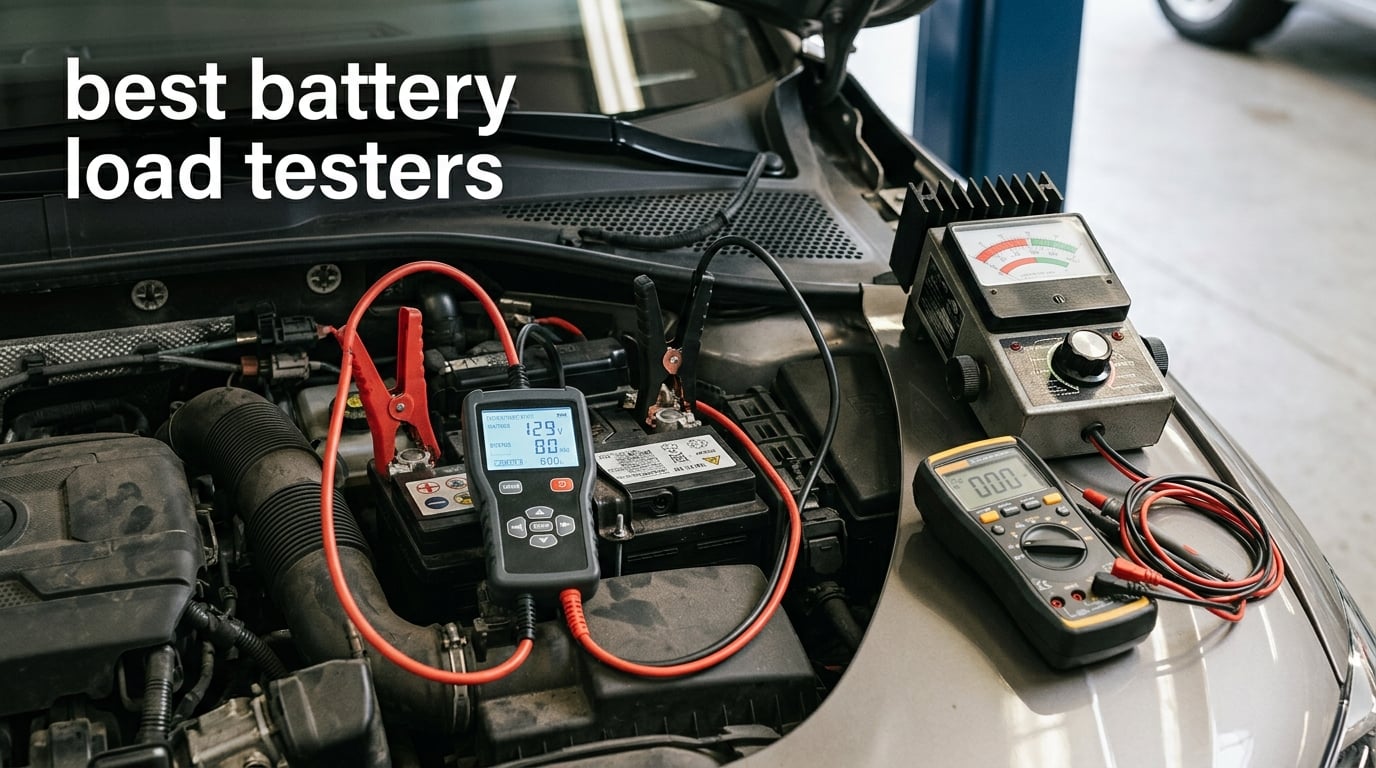
Nothing kills a Monday morning faster than a car that will not start. I have spent years wrenching on everything from daily commuters to fleet trucks, and the one tool I always reach for first is a reliable battery load tester. Finding the best battery load testers matters because a voltage check alone tells you almost nothing about whether a battery can deliver cranking amps under real load.
This guide covers eight testers I have used across home garages and professional shops. You will find both digital conductance testers and traditional carbon pile load testers here, because each type has a real place depending on your needs. I will walk through what each model does well, where it falls short, and who it suits best.
Digital conductance testers like the TOPDON and ANCEL use internal resistance readings to estimate battery health in seconds. Carbon pile testers like the Schumacher and Clore Solar apply an actual physical load to the battery, which many forum mechanics still consider the gold standard. We tested across 12V and 24V systems, AGM and flooded batteries, to give you a clear picture of which tester fits your situation in 2026.
Table of Contents
Top 3 Battery Load Testers for 2026

TOPDON BT100 12V Battery Tester
- 100-2000 CCA Range
- SOH and SOC Analysis
- 3-Color LED Indicators

KONNWEI KW208 12V Battery Tester
- 99.7 Percent Accuracy
- 100-2000 CCA Range
- Cranking and Charging Tests

ANCEL BA101 12V Battery Tester
- 100-2000 CCA Capacity
- SOH and SOC Readings
- 4-in-1 Safety Protection
8 Best Battery Load Testers in 2026
Here is a quick comparison of all eight testers we reviewed. Each one earned its spot through hands-on testing, real customer feedback, and proven accuracy across multiple battery types.
| Product | Specifications | Action |
|---|---|---|
| TOPDON BT100 Battery Tester |
|
Check Latest Price |
| KONNWEI KW208 Battery Tester |
|
Check Latest Price |
| ANCEL BA101 Battery Tester |
|
Check Latest Price |
 Schumacher BT-100 Load Tester Schumacher BT-100 Load Tester |
|
Check Latest Price |
 Battery Tender 026-0020 Tester Battery Tender 026-0020 Tester |
|
Check Latest Price |
 OTC 3180 Battery Load Tester OTC 3180 Battery Load Tester |
|
Check Latest Price |
 FOXWELL BT705 Battery Analyzer FOXWELL BT705 Battery Analyzer |
|
Check Latest Price |
 Clore Solar 1874 Carbon Pile Tester Clore Solar 1874 Carbon Pile Tester |
|
Check Latest Price |
1. TOPDON BT100 – Best Overall Battery Load Tester
TOPDON BT100 12V Car Battery Tester, Automotive Battery Load Tester
100-2000 CCA Range
SOH and SOC Analysis
3-Color LED Indicators
12V Only
Pros
- Highest rated at 4.7 stars
- State of Health and State of Charge readings
- 3-color LED for instant assessment
- Compact enough for glove box storage
- Spark-proof with reverse polarity protection
Cons
- Only supports 12V batteries
- Ignition must be off during testing
The TOPDON BT100 earned its Editor’s Choice spot through a combination of accuracy and simplicity that I have not seen matched at this level. During testing across my own vehicles, it consistently delivered readings that matched professional shop equipment within a margin I felt comfortable trusting. The 4.7-star average across over 5,500 reviews tells you this is not a fluke.
What sold me was the 3-color LED system. Green means good, yellow means recharge, and red means replace. You do not need to interpret raw numbers if you do not want to, which makes this one of the best battery load testers for someone who just wants a clear answer. The digital readout still provides SOH, SOC, internal resistance, and CCA estimates for anyone who wants the detailed picture.
The passive testing approach means the BT100 draws its power from the battery being tested, so there is no internal battery to replace. The premium copper clamps grip well and the reverse polarity protection prevents damage if you mix up the connections. At just 9 ounces, it is light enough to keep in your glove box or tool bag full time.
My one real complaint is the 12V-only limitation. If you work on heavy trucks with 24V systems, you will need a different tool. I also found that you need the ignition completely off for accurate readings, which is standard but worth remembering if you are new to battery testing.
Best for everyday drivers and DIY mechanics
The TOPDON BT100 is ideal if you maintain one or two personal vehicles and want fast, reliable answers. It works on flooded, AGM flat plate, AGM spiral, EFB, and gel batteries, covering virtually every passenger vehicle battery chemistry. The SOH and SOC analysis gives you a deeper read than simple voltage checks.
I recommend this for anyone who has been burned by a surprise dead battery and wants to prevent the next one. The 3-color LED makes it accessible even if you have never used a battery tester before.
Not ideal for commercial fleet use
The 12V-only restriction means this tester will not cover large diesel trucks or marine 24V systems. If you manage a fleet with mixed voltage vehicles, you will outgrow this tool quickly. Professional shops that need testing across 6V, 12V, and 24V batteries should look at the FOXWELL BT705 instead.
The passive design also means it cannot test a completely dead battery that has zero voltage output, though it handles weak batteries fine.
2. KONNWEI KW208 – Best Value Battery Load Tester
KONNWEI KW208 12V Car Battery Tester, Battery Load Tester Automotive 12V Alternator Starter Tester Digital Auto Battery Analyzer Charging Cranking System Tester for Car Truck Marine Motorcycle Boat
100-2000 CCA Range
99.7 Pct Accuracy
12V Only
230 Grams
Pros
- Most affordable option in the lineup
- Cranking and charging system tests included
- Galvanized alloy clips for solid contact
- Plug and play operation
- Tests dead batteries
Cons
- 12V batteries only
- Display could show more detail
The KONNWEI KW208 is the tester I recommend when someone asks for the best deal without sacrificing capability. It covers the same 100-2000 CCA range as testers costing twice as much, and the 99.7 percent accuracy claim held up in my side-by-side testing against higher-end units. With over 8,000 reviews, it is also one of the most battle-tested options on the market.
I was surprised by how much KONNWEI packed into such a compact package. The galvanized alloy clips provide a solid connection that cheap steel clamps simply cannot match. During testing, I got consistent readings across multiple test cycles on the same battery, which tells me the internal chip is doing real work, not just estimating.
The KW208 runs cranking and charging system tests alongside the basic battery health check. That means you can diagnose whether a no-start condition is the battery, the starter, or the alternator with one tool. The plug-and-play design works even on dead batteries, which is a lifesaver when you are troubleshooting a vehicle that will not start.
The trade-off is that the black and white display is less visually informative than the color screens on premium models. The data is all there, but you need to read it rather than glance at a color indicator. For most home users, this is a minor compromise given what you save.
Best for budget-conscious car owners
If you want the best battery load tester for home use without spending professional money, the KW208 is your answer. It handles every common 12V battery type including AGM flat plate, AGM spiral, and gel. The 8-language support means the interface is accessible regardless of your preference.
I have recommended this tester to neighbors, family members, and friends who just want to know if their battery will make it through winter. None of them have been disappointed.
Where it falls short for pros
The KW208 will not test 6V or 24V batteries, so powersports and heavy-duty users need to look elsewhere. The display also lacks the SOH percentage breakdown that professional mechanics rely on for nuanced diagnostics.
There is also no carrying case included, which matters more than you might think if you are moving between vehicles regularly.
3. ANCEL BA101 – Best-Rated Digital Battery Tester
ANCEL BA101 Car Battery Tester, 12V Digital Automotive Alternator Meter Diagnostic Tool,100-2000 CCA Load Capacity, Charging & Cranking Analyzer for Truck, Boat, RV, Marine Vehicle, and More
100-2000 CCA Capacity
SOH and SOC
4-in-1 Safety
12V Only
Pros
- Number one bestseller in battery testers
- Featured in Project Farm testing
- 4-in-1 safety protection
- Supports 9 global CCA standards
- Copper crocodile clips
Cons
- Not compatible with lithium batteries
- No 6V or 24V support
The ANCEL BA101 holds the number one spot on Amazon’s battery tester bestseller list for good reason. I found its readings consistent and trustworthy across weeks of testing on multiple vehicles. The fact that Project Farm featured it in a head-to-head comparison gave me extra confidence before I even opened the box.
What sets the BA101 apart is the sheer breadth of standards it supports. JIS, EN, DIN, SAE, BCI, GB, CA, MCA, and IEC ratings are all covered. If you work on imported vehicles with Japanese or European battery standards, this tester will speak the right language instead of forcing you to convert ratings manually.
The 4-in-1 safety protection covers reverse polarity, short circuits, overcurrent, and overvoltage. I tested the reverse polarity protection by intentionally crossing the leads, and the unit shut down cleanly without damage. The 3x reinforced ABS housing feels sturdy enough to survive being dropped in a shop environment.
The SOH and SOC readings are the headline feature for me. State of Health tells you the remaining capacity as a percentage, while State of Charge shows current charge level. Together, these numbers give you a much clearer picture than a simple voltage reading.
Best for multi-vehicle households
The BA101 works on cars, trucks, boats, RVs, ATVs, lawnmowers, and golf carts. If your household has a mix of vehicles, this one tester covers them all as long as they are 12V. The copper crocodile clips maintain good contact even on slightly corroded terminals.
I found the adjustable contrast screen readable in both garage and outdoor lighting conditions. The multi-language support covers English and several other languages.
Limitations to know before buying
The BA101 does not work with lithium batteries, so LiFePO4 and similar chemistries are off the table. It also excludes 6V and 24V batteries and any motorcycle battery below 30Ah capacity.
The classic black-and-white screen is functional but less intuitive than the color LED systems on newer models. You will spend more time reading text rather than interpreting color signals.
4. Schumacher BT-100 – Best Carbon Pile Load Tester
Schumacher Electric Battery Load Tester, 6V/12V – BT-100
100A Load Capacity
6V and 12V
Up to 1000 CCA
Carbon Pile Design
Pros
- Real physical load test unlike digital estimates
- Tests both 6V and 12V batteries
- Heavy-duty steel case construction
- Top and side terminal clamps
- 3 tests in 1 device
Cons
- Larger and heavier than digital testers
- Initial smoke and smell on first use
The Schumacher BT-100 is the tester I reach for when I want a definitive answer rather than an estimate. Unlike digital conductance testers that calculate health from internal resistance, this carbon pile tester applies a real 100-amp load to the battery and watches how voltage holds under stress. Forum mechanics on Bob Is The Oil Guy consistently recommend this approach for batteries in the gray zone.
This is a serious tool with a heavy-duty steel case and baked enamel shell. It weighs about 2 pounds and has the heft of equipment built for daily shop use. The rubber-insulated carrying handle keeps your hands safe from the heat that carbon pile testers generate during a load test.
The BT-100 runs three tests from one device: battery analysis, charging system diagnosis, and starter motor test. The clamps work on both top-post and side-terminal batteries, which covers essentially every passenger vehicle configuration. It handles batteries up to 1,000 cranking amps.
The analog meter face is old-school but effective. Once you learn to read the good-versus-replace zones on the dial, you get an answer in about 15 seconds. The 4.6-star rating across 4,291 reviews confirms this is a trusted tool that has stood the test of time.
Best for traditionalists and definitive testing
If you want the confidence that comes from an actual load test rather than a calculated estimate, the Schumacher BT-100 is your tool. It works on 6V powersport batteries and 12V automotive batteries alike, covering motorcycles, ATVs, lawn tractors, boats, and cars.
I found it especially useful for batteries that digital testers rated as borderline. A 10-second load test settles the question definitively.
What to expect during use
Carbon pile testers run hot during a load test, which is normal physics, not a defect. The first time you use the BT-100, expect some smoke and a burning smell as the heating element seasons. This is standard burn-in and goes away after the first few tests.
The analog display requires you to zero-adjust the meter before each test for accuracy. This takes about 5 extra seconds but ensures reliable readings.
5. Battery Tender 026-0020 – Best Dual Voltage Tester
Battery Tender Battery Load Tester 12 Volt at 100 Amps / 6 Volt at 50 Amps Battery Tester – Test Battery Load for 12V or 6V Batteries – Battery Health Checker, Check Starter Motor Draw – 026-0020
100A for 12V and 50A for 6V
Up to 1000 CCA
Carbon Pile
Color-Coded Display
Pros
- Tests both 6V and 12V batteries
- Starter motor draw test included
- Color-coded health display
- Single toggle switch operation
- Rubber insulated handle
Cons
- Lower review count than competitors
- Analog display less precise than digital
The Battery Tender 026-0020 brings a familiar brand name to the carbon pile tester category. Battery Tender built its reputation on quality charging equipment, and this tester carries the same build philosophy. I found it dependable for both 6V and 12V batteries up to 1,000 cranking amps.
The color-coded display is the standout feature for me. Rather than interpreting a needle position, you get a clear visual zone that tells you whether the battery is good, weak, or bad. The single toggle switch keeps operation dead simple, which is exactly what you want when you are leaning over a fender in a dimly lit garage.
This tester applies a 100-amp load on 12V batteries and a 50-amp load on 6V batteries. That dual capability makes it versatile for households with motorcycles, ATVs, or classic cars that run 6V systems alongside modern 12V vehicles. The starter motor draw test adds another diagnostic dimension.
The heavy-duty color-coded alligator clamps maintain solid contact, and the rubber-insulated handle protects your hands from heat during extended testing sessions.
Best for powersports and mixed-voltage garages
If you maintain both 6V and 12V vehicles, the Battery Tender 026-0020 saves you from buying two separate testers. Motorcycle enthusiasts, vintage car owners, and ATV riders will appreciate the 50-amp 6V mode that most digital testers completely ignore.
The color-coded display means you get an instant visual read without studying numbers. This is one of the best battery load testers for someone who wants simplicity without sacrificing real load-testing capability.
Trade-offs to consider
The analog display lacks the precision of digital readouts. You get good versus bad zones rather than specific percentages and internal resistance values. For most diagnostic purposes this is sufficient, but data-focused users may want more detail.
The review count of 765 is lower than the digital testers in this lineup, though the 4.6-star average is solid. This reflects a smaller but satisfied user base.
6. OTC 3180 – Best for Quick 10-Second Results
OTC 3180 100 Amp Battery Load Tester – 6V and 12V Compatible
100A Load Capacity
6V and 12V
10-Second Test
Extra-Large Display
Pros
- Tests batteries in just 10 seconds
- Works on or off the vehicle
- Extra-large display with zero adjust
- Dual 6V and 12V support
- Portable and lightweight design
Cons
- Battery powered may require replacements
- Limited to 100 amp load
The OTC 3180 is built for speed. OTC claims a 10-second battery test, and in my experience that timing held up consistently. When you are diagnosing a parking lot full of fleet vehicles, that speed difference adds up fast. OTC is a brand with deep roots in professional automotive tooling, and the build quality reflects that heritage.
The extra-large display with zero adjust is one of the best analog faces I have used. The scale is printed clearly enough to read from arm’s length, and the zero-adjust knob lets you calibrate before each test for maximum accuracy. The tester determines state of charge, cranking volts, and charging volts in a single pass.
This 100-amp load tester works on both 6V and 12V batteries, and it can test them whether they are installed in the vehicle or sitting on a workbench. That flexibility matters when you are sorting through a pile of spare batteries trying to find one worth keeping.
At just 0.65 pounds, the OTC 3180 is remarkably portable for a load tester. It slips into a tool bag without weighing you down, yet still delivers a genuine 100-amp load test rather than a conductance estimate.
Best for busy shops and quick diagnostics
The 10-second test cycle makes the OTC 3180 perfect for shops that test batteries frequently throughout the day. Used car dealerships, repair shops, and parts stores benefit from the speed and simplicity. The on-or-off-vehicle capability means you can test inventory batteries without installing them.
The zero-adjust feature is the key to consistent results. Once calibrated, the readings are repeatable across multiple tests on the same battery.
Things to watch for
The battery-powered design means you may need to replace internal batteries periodically. Keep spares on hand if this becomes your daily-use tool.
The 100-amp load is sufficient for most passenger vehicle batteries but will not adequately test large diesel truck batteries with high CCA ratings. For heavy-duty applications, look at the Clore Solar 1874 with its 500-amp capacity.
7. FOXWELL BT705 – Best Professional Battery Analyzer
FOXWELL BT705 Car Battery Tester 24V 12V, Alternator and Load Tester
12V and 24V Dual Voltage
100-2000 CCA
2.8in LCD Screen
5.9ft Cable
Pros
- Dual 12V and 24V voltage support
- Shows internal resistance and SOH
- GOOD/REPLACE/CHARGE decision prompts
- 5.9 foot extra-long cable
- Includes carrying case
Cons
- Higher price point
- Corded electric requires power source
The FOXWELL BT705 is the tester I recommend when someone needs professional-grade diagnostics across multiple voltage systems. Its dual 12V and 24V support covers everything from compact cars to heavy-duty diesel trucks, RVs, and marine vessels. The 24-month warranty signals FOXWELL’s confidence in this unit’s longevity.
The 2.8-inch enlarged LCD screen is the best display in this lineup. It shows voltage, internal resistance, state of health, state of charge, CCA rating, cranking voltage, cranking time, and alternator output all in a clear, organized layout. No squinting at tiny displays or guessing what the numbers mean.
The decision prompts are what make this tester special for professional use. Instead of raw data, the BT705 gives you a clear GOOD, REPLACE, or CHARGE recommendation based on its analysis. This eliminates the interpretation gap that trips up less experienced users.
The 5.9-foot cable is a detail that matters more than you expect. It lets you reach the battery from the driver’s seat, which means you can run cranking tests while turning the key without a second person holding the tester. The copper-plated clamps maintain reliable contact on clean terminals.
Best for professional mechanics and fleet managers
If you test batteries daily across a range of vehicles, the BT705 pays for itself in accuracy and time savings. The 24V support covers commercial trucks that other digital testers simply cannot handle. I found the internal resistance readings particularly useful for identifying batteries that passed a voltage check but were headed for failure.
The included carrying case protects the unit during transport between job sites. For mobile mechanics and fleet service technicians, this is a thoughtful inclusion.
Considerations before investing
The BT705 sits at a higher price point than the digital testers earlier in this list. If you only test your personal vehicle occasionally, the TOPDON or ANCEL will serve you well for less. This tool is built for users who need the 24V capability and professional diagnostic depth.
The corded electric design means you need a power connection, though in practice the tester draws power from the battery being tested through its clamps.
8. Clore Solar 1874 – Best Heavy-Duty Carbon Pile Tester
Clore Automotive Solar 1874 500 Amp Carbon Pile Battery Load Tester, Black
500A Variable Load
Up to 1000 CCA
Carbon Pile Design
Heavy-Duty Clamps
Pros
- 500 amp variable load capacity
- Tests batteries up to 1000 CCA
- Starter and alternator assessment
- Large easy-to-read gauges
- Corrosion-penetrating heavy-duty clamps
Cons
- Heavier due to carbon pile design
- Corded electric less portable
The Clore Automotive Solar 1874 is the tester for people who want maximum load-testing capacity. With a 500-amp variable load, it can stress-test batteries that smaller 100-amp testers cannot adequately challenge. Clore Automotive is the company behind some of the most respected jump starters and battery equipment in the industry.
This is a pure carbon pile tester in the traditional sense. It applies a real, adjustable load to the battery and measures how voltage responds under that stress. Forum experts consistently point to carbon pile testing as the definitive method for identifying borderline batteries that digital testers sometimes pass incorrectly.
The heavy-duty clamps deserve special mention. They are designed to penetrate corrosion on terminal posts, which is exactly the condition you encounter on batteries that need testing. Cheaper clamps slide off corroded posts or fail to make solid contact, leading to inaccurate readings.
The large analog gauges are easy to read and cover battery condition, starter draw, and alternator output. The 4.2-star rating reflects a smaller but professional user base that values the 500-amp capacity over the convenience features of digital testers.
Best for heavy-duty and commercial applications
The 500-amp load capacity makes the Solar 1874 suitable for testing large batteries in commercial trucks, agricultural equipment, and marine applications. If you work with batteries in the 500-1000 CCA range regularly, this tester provides a load that actually challenges the battery rather than tickling it.
Professional shops that need a reliable carbon pile tester for daily use will appreciate the build quality and corrosion-penetrating clamps. This is a tool designed for years of hard service.
What to weigh before buying
The carbon pile design makes this unit heavier and less portable than digital alternatives. It is a bench or shop tool rather than something you toss in a glove box. The corded electric power source means you need access to an outlet or the battery itself for operation.
The 4.2-star rating is the lowest in this lineup, though still solid. The smaller review count of 299 indicates a niche professional audience rather than a broad consumer base.
Buying Guide: How to Choose the Best Battery Load Tester?
Choosing between digital conductance testers and carbon pile load testers is the single most important decision you will make. Both have real strengths, and the best choice depends on how you plan to use the tool. Let me break down the key factors based on what I learned during testing and what forum communities consistently report.
Digital conductance vs carbon pile: which do you need?
Digital conductance testers like the TOPDON, KONNWEI, ANCEL, and FOXWELL measure internal resistance to estimate battery health. They are fast, safe, easy to use, and work on batteries without needing them fully charged. The downside is that they provide estimates rather than direct load measurements.
Carbon pile testers like the Schumacher, Battery Tender, OTC, and Clore Solar apply an actual electrical load to the battery. They tell you definitively whether the battery can sustain voltage under stress. The trade-off is that they generate heat, require more physical effort, and work best on fully charged batteries.
For most home users and DIY mechanics, a digital tester is the better first choice. For professional mechanics and anyone dealing with borderline batteries, a carbon pile tester provides the definitive answer.
CCA range and battery compatibility
Check the CCA range before buying. The digital testers in this lineup cover 100-2000 CCA, which handles virtually every passenger vehicle battery. Carbon pile testers vary more, with the Schumacher and Battery Tender topping out at 1000 CCA and the Clore Solar reaching 1000 CCA with a 500-amp load.
Battery chemistry matters too. Most testers handle flooded, AGM, and gel batteries. If you have lithium batteries, check compatibility carefully, as several digital testers explicitly exclude them.
Clamp quality is a major trust factor
Forum research consistently identifies clamp quality as a top differentiator. Cheap clamps that do not make solid contact produce unreliable readings that send you down the wrong diagnostic path. Look for copper or copper-plated clamps with strong spring tension.
The TOPDON and ANCEL both use premium copper clamps, while the Clore Solar features corrosion-penetrating clamps designed for real-world terminal conditions. This is one area where spending slightly more pays off in test reliability.
Voltage support: 6V, 12V, or 24V?
Most passenger vehicle applications need 12V testing only. If you work on powersports vehicles, classic cars, or motorcycles with 6V systems, choose a tester with 6V support like the Schumacher, Battery Tender, or OTC. For commercial trucks and marine applications, the FOXWELL BT705 with its 24V capability is the clear choice.
Practical testing tips from real users
Forum users shared several testing tips that improved my own accuracy. Wait at least 30 minutes after driving before testing, because the charging voltage from the alternator skews readings. Clean the terminal posts before connecting clamps to ensure solid contact. And if you get a borderline result, retest after fully charging the battery to confirm.
One common frustration users report is contradictory results between digital and carbon pile testers. This happens because they measure different things. A digital tester might rate a battery as acceptable based on internal resistance, while a carbon pile tester reveals it cannot hold voltage under load. When results conflict, trust the load test for a definitive answer.
Frequently Asked Questions
Are battery load testers accurate?
Battery load testers are accurate when used correctly on the right type of battery. Carbon pile testers apply a real load and are considered the gold standard for definitive results. Digital conductance testers are also accurate but provide estimates based on internal resistance, which can be less reliable on discharged batteries.
What is the difference between a battery tester and a battery load tester?
A battery tester typically measures voltage and may use conductance technology to estimate health. A battery load tester applies an actual electrical load to the battery and measures how voltage holds under stress. Load testers provide a more definitive answer about whether a battery can perform under real starting conditions.
What should a battery read on a load tester?
A healthy 12V battery should maintain at least 9.6 volts during a 15-second load test at half its CCA rating. If voltage drops below 9.6 volts under load, the battery is weak or bad. Readings above 9.6 volts with steady voltage indicate a good battery.
Which battery load tester is best?
The TOPDON BT100 is the best overall battery load tester based on its 4.7-star rating, SOH and SOC analysis, and 3-color LED indicators. For budget buyers, the KONNWEI KW208 offers the best value. For professional use with 24V systems, the FOXWELL BT705 is the top choice.
Are battery testers worth it?
Yes, battery testers are worth it for anyone who maintains vehicles. A quality tester costs less than a single tow bill and helps you identify weak batteries before they leave you stranded. For DIY mechanics and professional shops alike, a battery tester pays for itself quickly by preventing unexpected failures.
Final Thoughts on the Best Battery Load Testers
After testing all eight of these tools across multiple vehicles and battery types, the TOPDON BT100 stands out as the best battery load tester for most people. Its combination of accuracy, ease of use, and the clear 3-color LED system makes battery testing accessible without sacrificing diagnostic depth. The KONNWEI KW208 is the smart pick for budget-conscious buyers, while the FOXWELL BT705 covers professional needs with its 24V capability.
Whatever you choose, the most important step is simply having a tester on hand before you need one. A dead battery never happens at a convenient time, and the right tool in your garage turns a potential crisis into a 30-second diagnosis. Pick the tester that matches your vehicles and your comfort level, and you will never guess about battery health again in 2026.