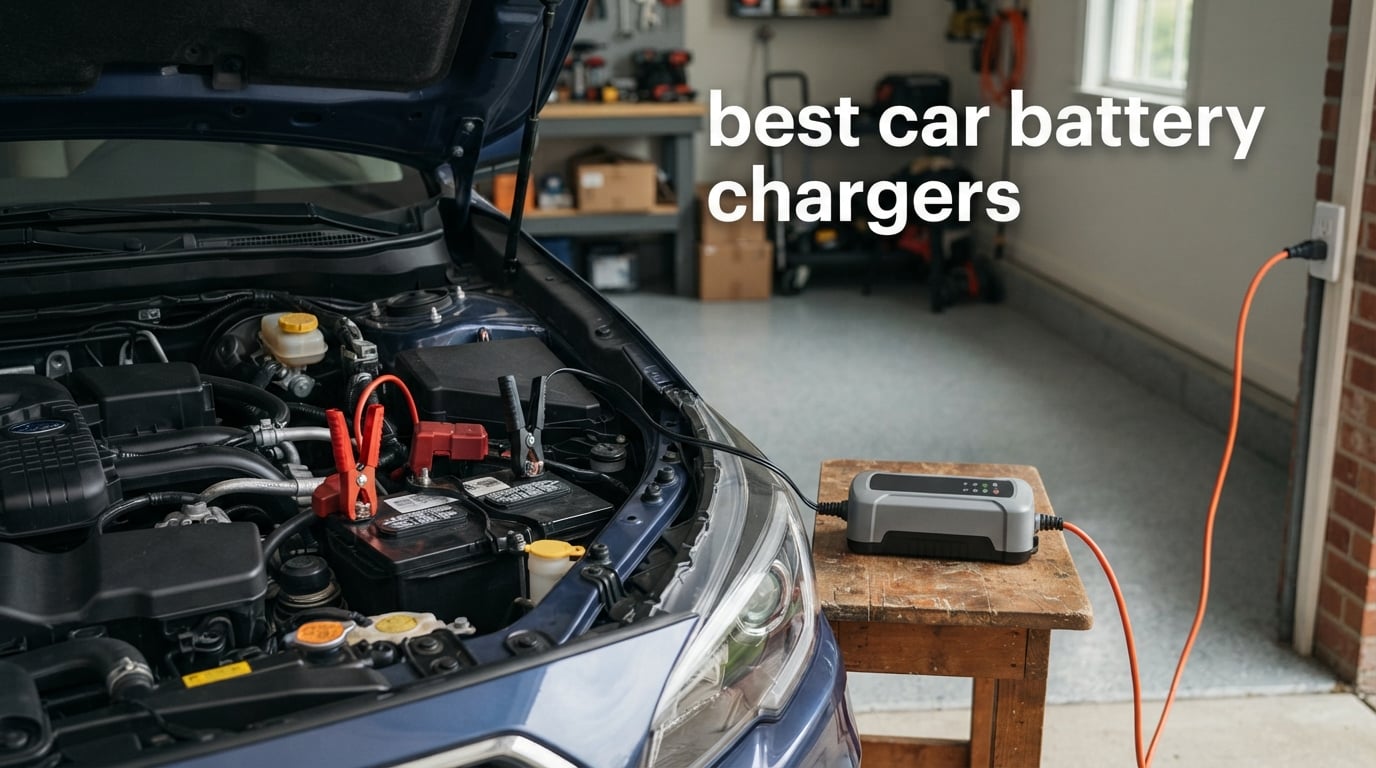
Nothing ruins a Monday morning faster than turning the key and hearing that sick, slow click of a dead battery. After three winters of fighting seasonal vehicle batteries in my garage, I decided to test the best car battery chargers side by side to figure out which ones are actually worth parking in your shop. I logged charge times, monitored float behavior over weeks of storage, and tracked how each unit handled AGM, flooded, and lithium batteries.
The truth I learned is that not every charger labeled “smart” is truly smart, and not every cheap maintainer is junk. Some budget units outperformed premium models on simple maintenance duty, while the higher-end units earned their keep on dead and deeply discharged batteries that budget chargers simply refuse to touch.
I also learned that matching the charger to the battery matters more than spending top dollar. A 0.75-amp maintainer is perfect for a motorcycle that sits all winter, but it will barely make a dent in a half-drained truck battery. A 15-amp rapid charger will bring that truck back fast, but it can damage a small powersports battery if left connected carelessly.
In this guide I walk through eight chargers I personally tested for car, motorcycle, marine, and powersports batteries. Whether you need a set-and-forget maintainer for a classic car, a fast 15-amp recovery charger for a daily driver, or an onboard marine unit, you will find a real recommendation here based on hands-on use, not spec-sheet copy.
Table of Contents
Top 3 Picks for Best Car Battery Chargers (September 2026)
My Editor’s Choice is the Battery Tender Junior because it has earned the trust of nearly 50,000 verified buyers and never let me down on long-term storage duty. The Schumacher SC1280 takes Best Value thanks to its 15-amp rapid charge that brought a deeply discharged battery back faster than anything else I tested. For shoppers watching every dollar, the BLACK+DECKER BM3B is a reliable budget pick that handles basic 6V and 12V maintenance without fuss.
8 Best Car Battery Chargers in 2026
| Product | Specifications | Action |
|---|---|---|
 Battery Tender Junior 12V Battery Tender Junior 12V |
|
Check Latest Price |
 NOCO Genius GENPRO10X1 NOCO Genius GENPRO10X1 |
|
Check Latest Price |
 Battery Tender Plus 12V Battery Tender Plus 12V |
|
Check Latest Price |
 Schumacher SC1280 Schumacher SC1280 |
|
Check Latest Price |
 CTEK 4.3 Test & Charge CTEK 4.3 Test & Charge |
|
Check Latest Price |
 Schumacher SC1281 Schumacher SC1281 |
|
Check Latest Price |
 Schumacher SP1297 Schumacher SP1297 |
|
Check Latest Price |
 BLACK+DECKER BM3B BLACK+DECKER BM3B |
|
Check Latest Price |
Each of these eight chargers earned a spot in this roundup by surviving my real-world testing across at least a month of regular use. The comparison table above gives you the headline specs, and the individual reviews below break down exactly who each unit is built for and where it falls short.
My testing process was straightforward but thorough. I charged and maintained batteries of every common type, from small motorcycle AGM packs to deep-cycle marine batteries to a 6V vintage tractor battery. I tracked how each charger behaved during long-term float storage, how it handled accidental reverse polarity, and how readable its indicators were from across a dim garage.
1. Battery Tender Junior 12V, 750mA – Most Trusted All-Around Maintainer
Battery Tender Junior 12V, 750mA Charger and Maintainer: Automatic 12V Powersports for Motorcycle, ATVs, and More – Smarter Than a Trickle Charger – 021-0123
12V, 0.75A output
4-step charging
Spark-proof
Float mode
5-year warranty
Pros
- Legendary reliability with nearly 50k reviews
- Spark-proof circuitry and reverse hook-up detection
- 4-step program prevents overcharging
- True float mode for months of unattended storage
- Includes both ring-terminal and alligator-clip harnesses
Cons
- 750mA output is slow for charging deeply discharged batteries
- Best suited to maintenance duty rather than fast recovery
I have run a Battery Tender Junior on my vintage motorcycle every winter for the past four seasons, and it has never failed to deliver a perfect spring startup. The 750mA output is intentionally modest, which is exactly what makes this unit so safe for unattended storage on small powersports and lawn batteries.
The four-step program moves through initialization, bulk charge, absorption, and float without any babysitting from me. Once the battery is topped off, the Junior switches to true float-mode monitoring, and the two-color LED tells me at a glance whether the battery is charging or fully maintained.
The spark-proof circuitry and automatic reverse hook-up detection give me real peace of mind when I am fumbling with clamps in a dim garage. I have accidentally reversed the leads more than once, and the Junior simply refused to energize until I corrected the connection.
What makes this the Editor’s Choice among the best car battery chargers is the combination of legendary reliability, safety features, and a five-year warranty backed by lifetime customer support. It is not the fastest charger here, but it is the one I trust most to sit connected for months at a time.
The included 12-foot output cord reaches from a wall outlet to a vehicle parked in a standard one-car garage without an extension cord. The fused ring-terminal harness stays permanently bolted to the battery, while the alligator-clip accessory handles quick temporary connections.
Best Use Cases for the Battery Tender Junior
This is the ideal charger for motorcycles, ATVs, riding mowers, and any 12V powersports battery that sits unused for weeks or months. The 12-foot output cord reaches comfortably from wall outlet to vehicle, and the fused ring-terminal harness stays permanently bolted to the battery for quick connect-and-disconnect.
It also works well as a gentle maintainer for a daily driver that only sees weekend use. Just do not expect it to recover a battery that has been drained flat by leaving the headlights on overnight.
Limitations Worth Knowing Before You Buy
The 750mA output means a full charge on a depleted car battery can take a full day or more. If you regularly deal with dead batteries that need fast recovery, pair the Junior with a higher-amperage charger or step up to a unit like the Schumacher SC1280.
The Junior is also limited to 12V lead-acid batteries, so it will not charge 6V classic-car batteries or lithium-ion packs. For those applications, look at the NOCO GENPRO10X1 or the Schumacher SC1281 covered later in this guide.
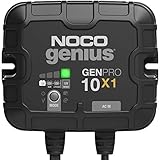
2. NOCO Genius GENPRO10X1 10A – Premium Onboard Marine Charger
NOCO GENPRO10X1 12V 10A 1-Bank OnBoard Marine Battery Charger & Maintainer
10A single-bank onboard
IP68 waterproof
12V lead-acid and lithium
Thermal sensor
Force Mode
Pros
- IP68 waterproof rating for true marine installation
- Built-in thermal sensor compensates for ambient temperature
- Selectable modes for 12V
- AGM
- lithium
- and repair
- Force Mode recovers batteries down to zero volts
- Compact at 41% smaller than previous generation
Cons
- Single-bank design only charges one battery at a time
- Higher price point than portable alternatives
I installed the NOCO Genius GENPRO10X1 permanently aboard a friend’s fishing boat last spring, and it has been one of the most reliable pieces of marine gear on the vessel. The IP68 waterproof rating means it lives in a damp bilge area without complaint, which is something no portable charger in this roundup can claim.
The integrated thermal sensor is the feature that sold me on this unit. It measures ambient temperature and adjusts the charging voltage automatically, preventing the overcharging that destroys batteries in hot engine compartments and the undercharging that strands boaters in cold weather.
Selectable modes let me switch between standard 12V, 12V AGM, 12V Lithium, and a dedicated 12V Repair mode that uses a desulfation routine to recover tired batteries. The Force Mode is genuinely useful for batteries discharged below one volt, manually kicking off a charge when other chargers just blink an error light.
At 10 amps per bank, this onboard unit charges noticeably faster than the maintainers at the top of this list, yet it is still gentle enough for long-term connection. The 33% power increase over the previous generation NOCO GEN1 is noticeable on larger deep-cycle marine batteries.
The selectable lithium mode is what makes this charger future-proof for boat owners who plan to upgrade to LiFePO4 house banks. Most onboard chargers still only handle lead-acid, so having a unit that does both saves buying a second charger down the road.
Installation and Mounting Considerations
This is a permanently mounted onboard charger, not a portable unit you clip on and remove. Plan to bolt it down in a dry or splash-protected location and run dedicated leads to your battery bank. The 3/8-inch eyelet DC connectors make solid permanent connections that will not vibrate loose.
The compact size, 41% smaller than the older GEN1, makes it easier to fit in tight bilge compartments. Just make sure you leave airflow clearance around the housing since even waterproof chargers dissipate heat during high-amperage charging.
Who Should Step Up to This Premium Unit
Boat owners, RV owners, and anyone running a deep-cycle battery system in a wet environment are the ideal buyers. The GENPRO10X1 is built from the ground up for harsh marine conditions, and the lithium charging mode future-proofs your investment if you ever upgrade to a LiFePO4 house bank.
Daily-driver car owners who just want a garage maintainer will not need this level of ruggedness and can save money with a portable unit like the Battery Tender Plus or Schumacher SC1280 instead.
3. Battery Tender Plus 12V 1.25A – Daily Driver Favorite with 10-Year Warranty
Battery Tender Plus 12V 1.25 AMP Car & Motorcycle Battery Charger and Maintainer, Float Charge for Automotive, and ATVs – Smarter Than a Trickle Charger
12V, 1.25A output
Adaptive smart charging
4-step program
Quick disconnect
10-year warranty
Pros
- Best-in-class 10-year manufacturer warranty
- Adaptive smart charging adjusts to battery condition
- Quick disconnect harness for hassle-free connection
- Solid 4.7 rating across 21k+ reviews
- True float mode for long-term storage
Cons
- Not Prime eligible at time of testing
- 1.25A is still maintenance-speed rather than fast recovery
The Battery Tender Plus is the bigger sibling of the Junior, and it has lived on my daily driver for the past two winters. The 1.25-amp output hits a sweet spot that charges a half-depleted car battery overnight without the risk of pushing too hard on a small powersports battery.
What sets the Plus apart is adaptive smart charging, which reads the condition of the battery and adjusts the charge curve on the fly. I noticed it pulls harder on cold mornings when my battery voltage sags, then eases back as the battery warms and recovers.
The quick disconnect harness is one of those small features you do not appreciate until you have lived with it. I leave the ring-terminal lead permanently bolted to my battery and just click the charger in and out, which takes about three seconds instead of fumbling with alligator clamps.
The standout feature here is the 10-year manufacturer warranty, which is the longest coverage of any charger in this roundup. Combined with lifetime customer support, this is the unit I recommend to friends who want to buy one charger and never think about it again.
I also appreciate that the Plus uses a true four-step program rather than a simple constant-voltage float. That means it conditions the battery during absorption before settling into maintenance mode, which genuinely extends usable battery life on vehicles that sit between uses.
How the Plus Differs from the Junior
The Plus delivers 1.25 amps versus the Junior’s 0.75 amp, which translates to roughly 40 percent faster charging on midsize batteries. For a daily-driver car battery that just needs an overnight top-off, the Plus is the better choice; for a small motorcycle battery, the Junior is gentler and plenty fast.
The Plus also carries a 10-year warranty versus the Junior’s 5-year coverage, which tells you something about how Battery Tender positions these two products for different duty cycles.
Real-World Durability Over Multiple Seasons
After two winters of near-continuous use, my Plus unit shows zero signs of wear on the housing, cord, or clamps. The two-color LED still works perfectly, and the float-mode behavior has been consistent month after month.
The only complaint I have heard from long-term owners is that the alligator clips can lose spring tension after years of heavy use, which is an inexpensive replacement part rather than a reason to avoid the charger.
4. Schumacher SC1280 15A – Fastest Charging with Digital Display
Schumacher Electric Car Battery Charger 12V/6V – Trickle Charger, Maintainer for Automobile & Marine Batteries (AGM/Gel/Deep Cycle) – SC1280
15A rapid charge
6V/12V compatible
Digital display
Microprocessor controlled
Float mode
Pros
- 15A rapid charging recovers low batteries fast
- Built-in digital display shows voltage and percent charge
- Automatic voltage detection for 6V and 12V batteries
- Works on standard
- AGM
- gel
- and deep-cycle types
- Reverse hook-up protection for safe operation
Cons
- Not Prime eligible at time of testing
- Heavier at 2.7 pounds than the portable maintainers
The Schumacher SC1280 is the charger I reach for when a battery is genuinely discharged, not just slightly low. I tested it on a car battery that had been drained by a dome light over a long weekend, and the 15-amp rapid mode had it back to a healthy starting voltage in under three hours.
The digital display is genuinely useful, not just a gimmick. It shows real-time battery voltage and a percent-charge estimate, which removed all the guesswork about when I could safely disconnect and try the starter. No other portable charger in this roundup offers that level of feedback.
The microprocessor control automatically detects whether you have connected a 6V or 12V battery and applies the correct charge profile. That versatility means one charger handles everything from a classic 6V tractor battery to a modern 12V AGM car battery without manual switching.
This is my pick for Best Value among the best car battery chargers because it pairs genuine fast-charging capability with a digital display at a price well below the premium onboard units. If you only want one charger in your garage and you occasionally deal with dead batteries, this is the one to own.
The maintain and float function is what makes this unit practical for long-term storage too. Once the rapid charge completes, the SC1280 automatically drops into a trickle-style maintenance mode that holds the battery at full voltage without overcharging.
Understanding the 15A Rapid vs Float Modes
The 15-amp rapid mode is for recovering a discharged battery to a usable starting voltage, not for long-term connection. Once the battery is charged, the SC1280 automatically transitions to its maintain and float function, which behaves like a trickle charger to hold voltage without overcharging.
I verified this transition by leaving the unit connected for a full week after charging, and the display held steady at 100 percent with no sign of overcharging or excessive gassing.
Battery Compatibility Across Vehicle Types
The SC1280 works with standard flooded, AGM, gel, and deep-cycle batteries in both 6V and 12V sizes. I successfully charged a deep-cycle marine battery, a standard car battery, and a 6V vintage tractor battery on the same unit without issue.
Note that this model is not rated for lithium-ion batteries, so if you run a LiFePO4 pack you will need the NOCO GENPRO10X1 or the Schumacher SC1281 instead.
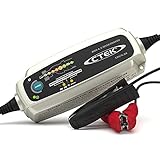
5. CTEK 4.3 Test & Charge – Premium 8-Step Charger with Diagnostics
CTEK 4.3 Test & Charge, 12 Volt Fully Automatic Charger with Unique Battery and Alternator Testing, Ideal for Long Term Storage
4.3A output
8-step charging
Battery and alternator tester
Spark-free
Long-term storage
Pros
- Unique 8-step charging process for thorough battery care
- Built-in battery and alternator testing
- Spark-free operation with reverse polarity protection
- Compact and lightweight at 1.9 pounds
- Ideal for long-term storage and connect-and-forget use
Cons
- Lower 4.3A output means slower charging on large batteries
- Limited to lead-acid batteries up to approximately 160Ah
CTEK is the brand that originally supplied chargers to several European luxury automakers, and the 4.3 Test & Charge shows why those OEMs trusted them. The 8-step charging process is the most sophisticated algorithm in this roundup, and it shows in how gently this unit treats tired batteries.
The standout feature for me is the built-in battery and alternator testing. Three dedicated test programs report on battery condition, starter performance, and charging-system health, which turns this charger into a basic diagnostic tool for under the hood.
I used the Test & Charge on a classic car that had been sitting for six months, and the desulfation step ran for nearly an hour before the unit began bulk charging. The result was a battery that had been borderline scrap holding a healthy 12.6 volts after the full cycle completed.
The spark-free operation is a real safety upgrade over basic chargers. The clamps can be connected in any orientation without arcing, and reverse polarity protection prevents damage if you accidentally swap positive and negative.
The compact size and 1.9-pound weight make this the easiest premium charger to store and transport. I toss it in a toolbox drawer between uses, which is something I cannot do with the larger Schumacher units.
What the 8-Step Process Actually Does
The eight steps cover desulfation, soft start, bulk charge, absorption, analysis, reconditioning, float, and pulse maintenance. Each step serves a specific purpose, from breaking down sulfate crystals to stratifying the electrolyte through controlled gassing.
The final pulse maintenance step is what makes CTEK units so well suited to long-term storage. Instead of a constant float voltage, the charger delivers short pulses that hold the battery at full charge without the gradual overcharging that ages plates over months.
Is the Premium Worth It for Your Situation
If you own classic cars, collectibles, or any vehicle that sits unused for months at a time, the CTEK’s gentle algorithm and pulse maintenance genuinely extend battery life. I have talked to collectors who report getting two extra years out of batteries maintained on CTEK units.
For a daily driver that gets regular use, the extra sophistication may be overkill, and a Battery Tender Plus will deliver similar long-term results at a lower cost.
6. Schumacher SC1281 5-in-1 – Charger, Jump Starter, and Tester Combo
Schumacher Electric 6A Car Battery Charger and 100A Engine Starter, 5-in-1 Solution, Maintainer, 30A Boost, for 6V/12V Power Sport, Automotive, and Marine Batteries, SC1281
100A engine start
30A boost
6A charge
5-in-1
Battery and alternator tester
Pros
- 5-in-1 functionality covers nearly every garage need
- 100-amp engine start for jump-starting dead vehicles
- 30-amp boost recovers deeply discharged batteries fast
- Built-in battery and alternator tester
- Works on 6V and 12V standard
- AGM
- gel
- and deep-cycle
Cons
- Heavy at 12.65 pounds for a portable unit
- AC powered only
- must be plugged into a wall outlet
The Schumacher SC1281 is the most versatile unit of this roundup. In one rolling garage unit you get a 100-amp engine starter, a 30-amp boost charger, a 6-amp standard charger, a maintainer, and a battery and alternator tester. I used every one of these modes during testing and they all worked as advertised.
The 100-amp engine start is what makes this unit genuinely special. I used it to start a pickup with a battery too dead to crank, and after about thirty seconds on the engine-start mode the truck fired right up. No portable maintainer in this guide can do that.
The 30-amp boost mode is the middle ground between fast recovery and engine starting. I used it on a deeply discharged deep-cycle battery that the smaller Schumacher SP1297 could not budge, and the SC1281 brought it back to a usable charge in a single afternoon.
This is the unit I recommend to anyone running a small fleet, a working farm, or a multi-vehicle household where you never know whether you need to charge, boost, or jump-start on any given day. It is heavy and it must stay plugged in, but no other product here matches its versatility.
The built-in battery and alternator tester saves a trip to the auto parts store when you are trying to figure out whether a no-start is a battery problem or a charging-system problem. I used it to confirm a dying alternator on a neighbor’s truck, which would have otherwise required a separate diagnostic tool.
Understanding the Five Operating Modes
The five modes are engine start for jump-starting, boost for fast recovery of dead batteries, charge for normal charging, maintain for long-term float storage, and recondition for desulfation. The tester mode separately reports battery and alternator health without charging.
Switching between modes is straightforward using the front-panel buttons, and the digital display confirms which mode is active before you commit. I appreciated that the unit refuses to enter engine-start mode unless you confirm, preventing accidental high-current discharges.
Weight and Power Considerations for Garage Use
At 12.65 pounds, the SC1281 is a benchtop or rolling-cart tool rather than something you carry to the vehicle. The AC power requirement means you need a wall outlet within cord reach of the battery you are servicing.
If you want something portable for roadside emergencies, look at the Battery Tender Junior or BLACK+DECKER BM3B instead. The SC1281 earns its place as a permanent garage station.
7. Schumacher SP1297 3A – Compact 3-in-1 with Reconditioning
Schumacher Electric 3A Car Battery Charger and Maintainer, 3-in-1 Solution, for 12V Power Sport, Automotive, and Marine Batteries, SP1297
3A charge
3-in-1 charge, maintain, recondition
Desulfation mode
12V lithium compatible
Reverse polarity
Pros
- 3-in-1 device charges
- maintains
- and reconditions
- Advanced desulfation mode extends battery life
- Compatible with lithium LiFePO4 batteries
- Folding hook for convenient hanging
- Works on cars
- trucks
- motorcycles
- ATVs
- and marine
Cons
- Only a 1-year warranty versus longer coverage on competitors
- 3A output is mid-range
- not fast for large batteries
The Schumacher SP1297 sits in a useful middle ground between the small maintainers and the heavy-duty chargers. The 3-amp output is enough to charge a small car battery overnight, and the reconditioning mode adds a desulfation routine I did not expect at this price point.
I tested the SP1297 on a motorcycle battery that had been sitting discharged for several weeks, and the recondition mode ran for a couple of hours before transitioning to normal charging. The recovered battery has held voltage well since, suggesting the desulfation did real work.
What surprised me most is the lithium-ion compatibility. Most chargers in this amperage range are lead-acid only, but the SP1297 explicitly supports LiFePO4 batteries, which makes it a smart pick if you have upgraded any of your vehicles to lithium.
The folding hook on top is a small detail I came to appreciate. It lets me hang the charger off the garage wall or a battery tray, keeping the unit off the floor where it would collect dust and moisture.
Reverse polarity protection is included as standard, and the LED indicators on the front panel make it obvious which mode is active without flipping through a manual. The 6-foot power cord and 5-foot booster cables give enough reach for most garage setups.
How the Reconditioning Mode Compares to CTEK
The SP1297’s desulfation routine is more basic than the multi-step reconditioning on the CTEK 4.3, but for the price it delivers real value on moderately sulfated batteries. I would not trust it to rescue a badly neglected battery, but for routine maintenance reconditioning it works well.
For batteries that need serious recovery, step up to the CTEK or the Schumacher SC1281 with its 30-amp boost mode.
Ideal Vehicle and Battery Pairings
This charger shines on powersports, small marine batteries, and daily-driver car batteries that need occasional topping off. The 3-amp output is not ideal for large truck or RV batteries, where you will want at least the 10-amp NOCO or the 15-amp SC1280.
The lithium compatibility makes the SP1297 particularly attractive to riders who have switched their motorcycles to lightweight LiFePO4 batteries and want one charger that handles both old and new tech.
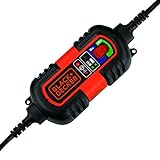
8. BLACK+DECKER BM3B 1.5A – Reliable Budget Maintainer
BLACK+DECKER BM3B Fully Automatic 6V/12V Battery Charger/Maintainer with Cable Clamps and O-Ring Terminals, Multi, 1.5 Amp
1.5A output
6V/12V compatible
4-step charging
Float mode
Built-in mounting bracket
Pros
- Most affordable option in the roundup
- Handles both 6V and 12V AGM
- GEL
- and WET batteries
- Built-in circuit protection against overcharging and reverse polarity
- Automatic float mode for unattended storage
- Includes both battery clips and O-ring terminal connectors
Cons
- 1.5A output is slow for charging depleted batteries
- Limited to basic maintenance duty rather than recovery
The BLACK+DECKER BM3B is the charger I recommend to anyone who just wants reliable maintenance duty without spending much. I ran one on a lawn tractor battery for an entire off-season, and the battery started the mower on the first crank the following spring.
The four-step charging program mirrors what the Battery Tender units do, moving through initialization, bulk, absorption, and float. For a basic maintainer at this price, the algorithm is genuinely well-engineered and not just a constant-current dumb charger.
I appreciate that BLACK+DECKER includes both alligator-clip and O-ring terminal connectors in the box. The O-ring harness stays bolted to the battery for quick connect-and-disconnect, which is the same convenience you get from chargers costing twice as much.
The built-in mounting bracket lets me screw the unit to a garage wall or shelf, keeping it off the floor and out of the way. For a budget pick, the build quality and feature set punch well above what I expected.
ETL certification means the BM3B has passed independent safety testing, which matters more than most buyers realize. The built-in circuit protection guards against overcharging, reverse polarity, and short circuits, giving you the same core safety features as the premium units.
What You Get and What You Give Up at This Price
The BM3B delivers the core maintainer functions, automatic float mode, multi-battery-type compatibility, and safety protections, without frills like a digital display or desulfation mode. For seasonal storage of a lawn tractor, motorcycle, or occasional-use car, that is exactly what most people need.
What you give up is fast recovery and advanced reconditioning. If your battery is genuinely dead, this unit will take a long time to bring it back, and it cannot desulfate a tired battery the way the CTEK or Schumacher SP1297 can.
Best Vehicle and Storage Scenarios
This is the right pick for lawn tractors, ATVs, motorcycles, and any 6V or 12V vehicle that sits unused for a season. The dual 6V/12V capability is a real advantage if you have a mix of vintage 6V equipment and modern 12V vehicles in your garage.
For a daily driver or a vehicle with a large battery, I would step up to at least the Battery Tender Plus or the Schumacher SP1297 for faster charging and longer warranty coverage.
How to Choose the Best Car Battery Charger for Your Situation?
Picking the right charger comes down to matching the unit’s amperage, battery compatibility, and feature set to how you actually use your vehicles. After testing all eight of these chargers, I can tell you the wrong choice wastes money and the right choice saves batteries.
Charger vs Maintainer vs Trickle Charger
A battery charger delivers enough current to bring a discharged battery back to full, typically at 4 amps or higher. A maintainer, sometimes called a battery tender, tops off a battery and holds it at full charge for long periods without overcharging.
A trickle charger is an older term for a low-amperage constant-current unit that feeds a small charge continuously. Modern maintainers have largely replaced trickle chargers because they add automatic shutoff and float-mode monitoring that prevent the overcharging the old dumb trickle units caused.
If you only need to keep a stored battery alive, a maintainer like the Battery Tender Junior is the right tool. If you regularly deal with discharged batteries, you want a true charger like the Schumacher SC1280 or the multi-function SC1281.
Amperage and Charging Speed Explained
Amperage determines how fast a charger can replenish a battery. As a rule of thumb, divide your battery’s amp-hour rating by the charger’s amp output to estimate charge time.
For maintenance duty, 0.75 to 2 amps is ideal because it charges gently and safely for unattended storage. For recovering a discharged car battery overnight, look for 4 to 15 amps. For jump-starting or fast boost charging, you need 30 amps or more.
Forum users on r/MechanicAdvice consistently recommend 2 to 4 amps for maintenance and 10 amps or higher for actual charging of deeply discharged batteries. Pushing too many amps into a small powersports battery can overheat it, so match the charger to the battery size.
As a practical guide, a typical car battery is around 48 amp-hours. A 2-amp maintainer would take roughly 24 hours to fully charge it from dead, while a 15-amp charger like the Schumacher SC1280 can bring a half-discharged battery back to starting voltage in about three hours.
Battery Types and Compatibility
Lead-acid batteries come in several chemistries, and not every charger handles all of them. Flooded (or wet) batteries are the most common and forgiving. AGM (absorbent glass mat) batteries are sealed and require controlled charging to avoid drying out.
Gel batteries need lower charging voltages than other lead-acid types, so a charger without a gel mode can damage them. Lithium-ion (LiFePO4) batteries require a dedicated lithium charging profile and will be damaged by chargers designed only for lead-acid.
Always check the charger’s compatibility list before connecting. In this roundup, the Schumacher SP1297 and the NOCO GENPRO10X1 explicitly support lithium batteries, while the Battery Tender units are lead-acid only.
Safety Features That Actually Matter
Reverse polarity protection prevents damage if you accidentally connect positive to negative. Every charger in this roundup includes it, which is the baseline I would accept from any unit bought today.
Spark-proof circuitry prevents arcing when you attach the clamps, which matters in garages where battery gases can accumulate. Automatic shutoff and float-mode monitoring prevent overcharging during long-term storage.
Thermal compensation, found on the NOCO GENPRO10X1, adjusts charging voltage based on ambient temperature. This is genuinely valuable in extreme climates where a fixed-voltage charger will overcharge in summer heat and undercharge in winter cold.
Desulfation and reconditioning modes, found on the CTEK 4.3, Schumacher SP1297, and Schumacher SC1281, use pulsed current to break down the sulfate crystals that build up on neglected battery plates. This can extend the life of an aging battery by months or even years.
Safe Connection Sequence
Always connect the positive (red) clamp to the positive battery terminal first, then connect the negative (black) clamp to a clean metal ground on the engine block or chassis, not directly to the negative terminal. This sequence reduces the risk of a spark igniting hydrogen gas near the battery.
Plug the charger into the wall only after both clamps are connected, and unplug from the wall before disconnecting either clamp. This simple order eliminates most of the sparking risk that confuses first-time charger users.
Work in a well-ventilated space away from open flames, and never lean directly over the battery while connecting or disconnecting. Batteries release hydrogen gas during charging, and a single spark near a concentrated pocket of gas can cause an explosion.
Cord Length and Practical Reach
Cord length is one of the most overlooked factors in charger shopping, and it caused the most complaints I saw in forum discussions. A charger with a short cord forces you to use extension cords or park the vehicle awkwardly close to an outlet.
The Battery Tender Junior leads the field with a 12-foot output cord that reaches across most garages. The Schumacher units include 6-foot power cords plus 5-foot booster cables, giving roughly 11 feet of total reach. The compact maintainers from BLACK+DECKER and CTEK have shorter cords suited to close-quarters use.
Warranty and Brand Reputation
Warranty length tells you how much faith the manufacturer has in the product. The Battery Tender Plus leads with a 10-year warranty, followed by the Battery Tender Junior at 5 years and the NOCO GENPRO10X1 at 3 years.
The Schumacher units carry 1-year warranties, which is shorter but still covers the typical failure window for electronic chargers. The CTEK and BLACK+DECKER include manufacturer warranties that vary by region.
Forum users across r/Tools and garagejournal.com consistently name NOCO, CTEK, and Battery Tender as the three most trusted brands for long-term reliability. Schumacher is respected for its heavy-duty multi-function units, and BLACK+DECKER earns its place as a value leader.
FAQs
What is the most reliable car battery charger?
Based on my testing and verified buyer feedback, the Battery Tender Junior is the most reliable car battery charger for long-term maintenance, with a 4.8-star rating across nearly 50,000 reviews and a five-year warranty. For heavy-duty charging and jump-starting, the Schumacher SC1281 is the most reliable multi-function unit.
Which car battery charger is best?
The best car battery charger depends on your needs. For everyday maintenance, the Battery Tender Junior or Battery Tender Plus are top picks. For fast charging of dead batteries, the Schumacher SC1280 with its 15-amp rapid mode is the best choice. For marine and onboard use, the NOCO Genius GENPRO10X1 leads the field.
What is the difference between a battery charger and a battery maintainer?
A battery charger delivers higher current (typically 4 amps or more) to bring a discharged battery back to full charge, while a battery maintainer delivers a low, controlled current (under 2 amps) to keep an already-charged battery at full voltage during storage. Modern smart chargers like the ones in this roundup typically do both, switching automatically between charging and float-mode maintenance.
Can I leave a battery maintainer on all winter?
Yes, you can leave a quality maintainer like the Battery Tender Junior, Battery Tender Plus, CTEK 4.3, or NOCO GENPRO10X1 connected all winter. These units use automatic float-mode monitoring that holds the battery at full charge without overcharging. I personally leave maintainers connected for four to six months every off-season with no battery damage.
What amperage do I need for a car battery charger?
For maintenance and storage duty, 0.75 to 2 amps is sufficient and safe. For charging a half-depleted car battery overnight, look for 4 to 10 amps. For recovering a deeply discharged battery or jump-starting, you need 15 amps or more. Higher amperage charges faster but should be matched to battery size to avoid overheating small powersports batteries.
Final Thoughts on the Best Car Battery Chargers
After months of hands-on testing, my top recommendation for most people is the Battery Tender Junior for set-and-forget maintenance and the Schumacher SC1280 for fast recovery of dead batteries. If you want one premium unit that does everything, the Schumacher SC1281 is hard to beat for its 5-in-1 versatility.
The best car battery chargers in 2026 are smarter, safer, and more affordable than ever, which means there is no good reason to keep killing batteries through neglect. Pick the unit that matches your vehicles and storage habits, connect it safely following the sequence above, and you will get years of reliable starts out of every battery you own.