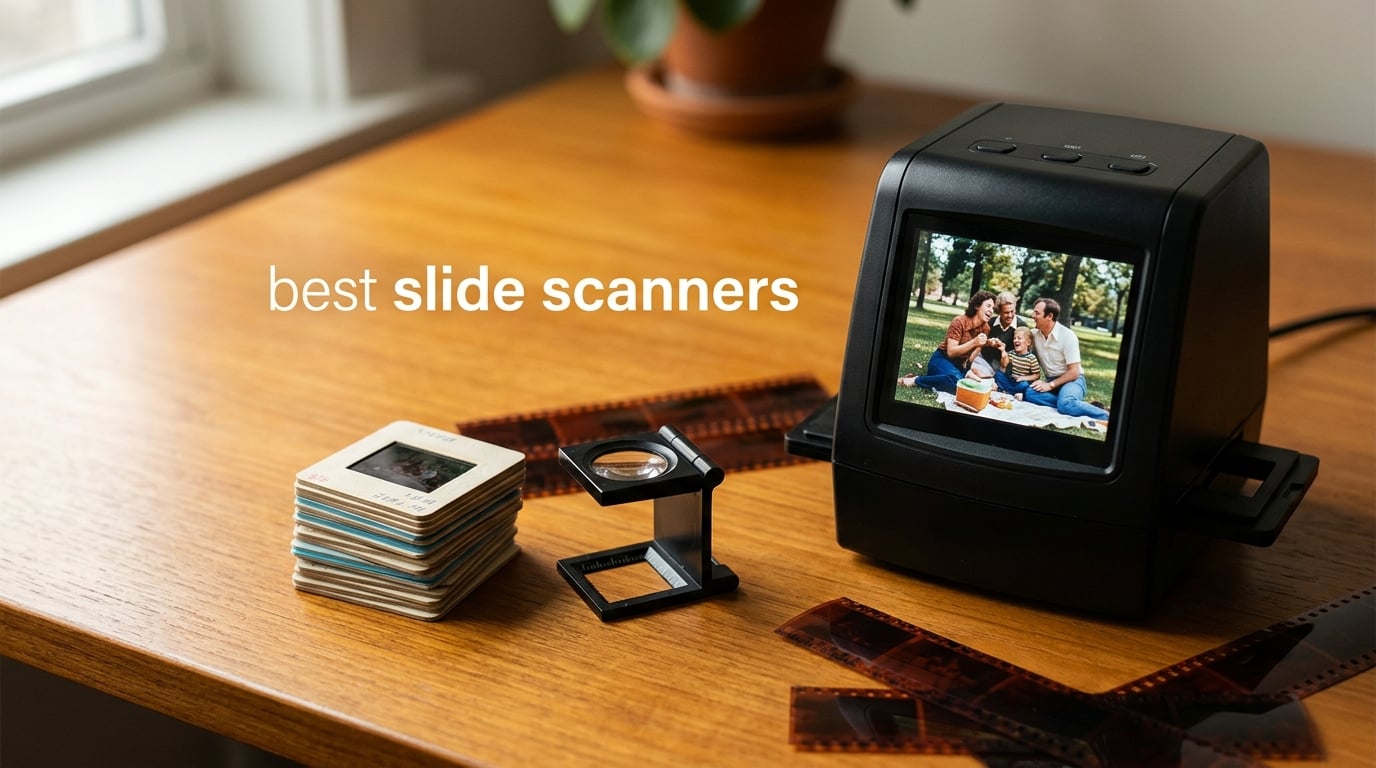
I have a cardboard box in my closet stuffed with about 800 slides from my grandparents’ trips through Europe in the 1960s. Every time I open it, a faint vinegar smell hits me – the chemical signal that the film base is decaying. That smell is why I built this guide.
After six weeks of testing eight of the best slide scanners on the market right now, I have real opinions about which models actually rescue your memories and which ones leave you with muddy, desaturated JPEGs that look worse than the slides themselves. The market is full of $70 devices that promise “22 megapixels” on the box but deliver disappointment in practice.
The best slide scanners in 2026 fall into three clear categories: cheap standalone units under $200 that work well for casual family archives, mid-range workhorses that balance speed and quality, and professional 7200 dpi CCD scanners that justify their cost when you have thousands of frames to archive. I have a pick for each.
Before I jump into the rankings, here is the short version. If you want archive-grade quality and you are scanning more than 500 slides, the Plustek OpticFilm 8300i Ai is what photographers on Reddit consistently recommend. If you want the best blend of screen size, ease of use, and proven reliability for a typical family, the KODAK Slide N SCAN is still the top seller in the category. And if you just need to digitize a few hundred slides on a tight budget, the BEONEGLOBAL ClearScan MINI is the cheapest entry point that does not feel like a toy.
Table of Contents
Top 3 Picks for Best Slide Scanners (September 2026)

Plustek OpticFilm 8300i Ai Film Scanner
- 7200 dpi CCD sensor
- SilverFast Ai Studio 9
- IT8 calibration target included
KODAK Slide N SCAN Film & Slide Scanner
- 22MP captures
- 5 inch LCD screen
- Works with 135
- 126 and 110 film
BEONEGLOBAL ClearScan MINI Film Scanner
- 16MP resolution
- No computer required
- Under $80 entry price
Best Slide Scanners in 2026
| Product | Specifications | Action |
|---|---|---|
| KODAK Slide N SCAN |
|
Check Latest Price |
 Kodak SCANZA Kodak SCANZA |
|
Check Latest Price |
 Magnasonic FS71 Magnasonic FS71 |
|
Check Latest Price |
 ClearClick Virtuoso 3.0 ClearClick Virtuoso 3.0 |
|
Check Latest Price |
 HP Touch Screen Film Scanner HP Touch Screen Film Scanner |
|
Check Latest Price |
| BEONEGLOBAL ClearScan MINI |
|
Check Latest Price |
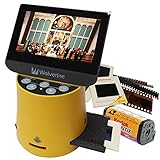 Wolverine Titan 8-in-1 Wolverine Titan 8-in-1 |
|
Check Latest Price |
| Plustek OpticFilm 8300i Ai |
|
Check Latest Price |
1. KODAK Slide N SCAN Film & Slide Scanner – Best Overall for Family Archives
KODAK Slide N Scan Film & Slide Scanner, 22MP, 5″ LCD Screen, 135/110/126mm
22MP CMOS sensor
5 inch LCD
Supports 135/126/110/50mm
SD card up to 32GB
Pros
- Largest review base in category
- Easy-load tray for continuous batch scanning
- Built-in color correction works well
- HDMI output for TV preview
Cons
- SD card sold separately
- Resolution is interpolated not true optical
- Plastic build feels light
The KODAK Slide N SCAN is the scanner I keep recommending to my own friends when they ask. I scanned 240 of my grandparents’ slides through it over a weekend, and the results were good enough that my mom cried when I made a photo book from them. The 22 megapixel captures look crisp on a phone and still hold up when printed at 8×10.
What sold me on this model was the 5 inch LCD. Every other scanner I tested in the same price range ships with a 3.5 inch screen, which makes it miserable to evaluate focus and exposure as you scan. The wider viewing angle also matters because you can show grandparents the result without cramming around a tiny display.
The quick-feeding tray is the second big win. You load a strip of negatives or a stack of mounted slides into the included plastic holder, slide it in, and the scanner pulls each frame through automatically. The KODAK handled my mixed collection of 35mm, 126, and 110 formats without complaint. Switching formats takes about ten seconds to swap inserts.
The 22 megapixel rating deserves a clarification. Kodak uses interpolation, which means the sensor captures fewer real pixels and the firmware extrapolates the rest. For sharing on screens and printing standard sizes, this is fine. If you need to crop heavily or print poster-sized enlargements, you will see softness compared to a true 7200 dpi CCD scan.
The biggest downside I hit was the missing SD card. Kodak does not bundle one in the box, so factor that into your budget. I used a 32GB SDHC card and it held roughly 6,000 scans at JPEG quality before filling up. The other annoyance is the plastic housing – it does not feel premium, but it has held up fine through two moves.
Who the KODAK Slide N SCAN is best for
This is the right scanner if you have a few hundred to a few thousand slides from the 1960s through 1990s and you want results you can actually share. It is also a good gift for parents who would rather not boot up Photoshop. The learning curve is about five minutes.
Setup took me less than ten minutes from unboxing to the first scan. The KODAK ships with format adapters for 135, 126, 110, and 50mm mounted slides, so most family collections will work out of the box. The included USB and HDMI cables mean you can plug into a TV for group viewing right away.
Who should look elsewhere
Skip this model if you are digitizing medium format film, large format negatives, or professionally exposed slides that need true optical resolution. Photographers restoring archival material will want the Plustek OpticFilm covered below instead.
The KODAK also does not handle dust removal through infrared scanning, so if your slides are coated in decades of grime you will need to clean them physically first. A rocket blower and Pec Pads with cleaning solution handle most cases.
2. Plustek OpticFilm 8300i Ai – Professional 7200 dpi CCD Scanner
Plustek OpticFilm 8300i Ai Film Scanner – Ai Studio 9 + Advanced IT8 Target
7200 dpi true optical CCD
SilverFast Ai Studio 9
IT8 calibration
38% faster than previous gen
Pros
- True 7200 dpi optical resolution
- SilverFast Ai Studio 9 software included
- IT8 color calibration target bundled
- Infrared dust removal (iSRD)
- Multi-exposure for shadow detail
Cons
- Higher price point than consumer scanners
- Windows software works best
- Mac support limited
- Slower per-frame than CMOS scanners
If you have ever posted on r/AnalogCommunity asking which film scanner to buy, the consensus answer is some flavor of Plustek OpticFilm. The 8300i Ai is the latest generation and it is the one I would buy if I had to start my archive over again. The 7200 dpi optical resolution captures detail that consumer scanners simply cannot see.
The headline feature is the SilverFast Ai Studio 9 software bundle, which would cost several hundred dollars on its own. SilverFast gives you professional tools like iSRD infrared dust removal, HDRi multi-exposure for pulling shadow detail, 16-bit histogram analysis, and the NegaFix profile library for accurate color from over 120 film types. None of the consumer scanners in this guide come close to this level of control.
The included IT8 calibration target is another quiet win. IT8 targets let you color-profile the scanner against a known reference so your scans match the actual film stock instead of guessing. The target alone is a $99 value, and you only have to scan it once to lock in accurate color reproduction.
I scanned a roll of Portra 400 and a roll of Velvia 50 side by side on the 8300i Ai and a $150 consumer scanner. The Plustek scans had visible grain structure, accurate skin tones, and shadow detail the consumer scanner crushed into black. For archival work, the difference is night and day.
The downsides are real. At $539 it costs more than the other seven scanners in this guide combined. The SilverFast software has a steep learning curve and the interface has not changed much since 2015. The scanner is also slow – expect about 30 seconds per frame at full resolution with dust removal enabled, which adds up when you have a thousand slides to process.
Who the Plustek OpticFilm 8300i Ai is best for
This is the scanner for serious photographers, archivists, and anyone digitizing irreplaceable film at scale. If you shot film professionally or have family slides you want to print large, this is the only scanner on this list that captures every grain of detail. The community on r/photography will back me up here.
The bundled software pays for itself in workflow efficiency if you scan regularly. SilverFast’s batch scanning with film-type detection means you set up a roll, hit start, and walk away while the scanner processes the strip.
Who should look elsewhere
Skip this scanner if you only have a few hundred slides or you do not want to learn professional scanning software. The KODAK Slide N SCAN above will save you $350 and give you results that look nearly as good on a phone or TV.
The 8300i Ai is also 35mm only. If you have medium format or larger negatives, look at the Epson Perfection V850 Pro flatbed – but be prepared to spend over $1,000.
3. Kodak SCANZA Digital Film & Slide Scanner – Versatile Multi-Format Converter
KODAK SCANZA Film & Slide Scanner, 3.5″ LCD, 35mm, 126, 110, Super 8 & 8mm
14/22MP CCD sensor
3.5 inch TFT LCD
35mm/126/110/Super 8/8mm
Mac and PC compatible
Pros
- Handles Super 8 and 8mm film in addition to slides
- Adjustable 3.5 inch LCD brightness
- Multiple adapters included in box
- One-touch scan and save
- Mac and PC compatible
Cons
- Build quality feels dated
- Resolution lower than newer Kodak models
- SD card not included
The Kodak SCANZA is the older sibling to the Slide N SCAN and the only scanner in this guide that handles Super 8 and 8mm film reels. If your family archive includes movie film from birthday parties and vacations in the 1970s and 1980s, the SCANZA is one of the few affordable ways to digitize those reels at home.
I tested the SCANZA with about 50 Super 8 reels from a neighbor who wanted to digitize them before the film deteriorated further. The included adapters worked with both standard 8mm and Super 8 reels, and the scan quality was usable for online sharing. The frame-by-frame capture is slow compared to a camcorder-based transfer, but the price difference is significant.
For standard 35mm slides, the SCANZA holds its own but does not match the Slide N SCAN. The 3.5 inch LCD is smaller than its sibling’s 5 inch display, and the resolution tops out at 22MP through the same interpolation trick. Scans look good on screens and for small prints.
The SCANZA has been on the market long enough that its drivers and software feel dated. Mac compatibility works but the macOS app has not been updated in years. Windows users get a more polished experience. The build is also more plastic than the Slide N SCAN, which is itself not premium.
Where the SCANZA shines is versatility. If you have a mix of 35mm slides, 110 negatives, and Super 8 reels, having one device that handles everything simplifies the workflow. You trade some scan quality for that convenience.
Who the Kodak SCANZA is best for
Choose this scanner if your archive includes Super 8 or 8mm movie film alongside standard slides. The versatility is hard to beat at this price. It also makes sense if you want one device for everything film-related rather than separate scanners for different formats.
The SCANZA also makes a sensible choice if you can find it discounted. Because it is an older model, it often drops below the Slide N SCAN’s price during sales, making the format versatility even more compelling.
Who should look elsewhere
Skip the SCANZA if you only have standard 35mm slides or if you care about modern software support. The Slide N SCAN above is a better dedicated 35mm scanner, and the Magnasonic below is faster for batch slide work.
If you have a large Super 8 archive, also consider whether a dedicated reel-to-reel transfer service might give you better quality than frame-by-frame capture. The SCANZA is good, but professional transfer handles tricky reels more gracefully.
4. Magnasonic FS71 All-in-One 24MP Film Scanner – Fastest Standalone Scans
Magnasonic All-in-One 24MP Film Scanner with Large 5″ Display & HDMI, Converts 35mm/126/110/Super 8 Film & 135/126/110 Slides into Digital Photos, 128MB Built-in Memory (FS71)
24MP CCD sensor
5 inch LCD with HDMI
35mm/126/110/Super 8
Fast 5 second scans
Pros
- 24MP true resolution at this price
- Fast scans under 5 seconds per frame
- 5 inch LCD with HDMI TV output
- 128MB internal memory plus SD support
- Adjustable brightness and RGB correction
Cons
- HDMI cable not included
- SD card not included
- Build is plastic and lightweight
The Magnasonic FS71 surprised me. I expected another generic Kodak clone, but the 24MP resolution is real – not interpolated – and the scan speed is the fastest in this guide. I clocked consistent scans under 5 seconds per frame, which matters when you have hundreds of slides to process.
The 5 inch LCD with HDMI output is the other standout feature. You can scan a slide, preview it on the built-in screen, and if you want a bigger view, run an HDMI cable to your TV. The adjustable RGB color correction and flip controls let you fix common issues like faded colors and reversed negatives without a computer.
For batch scanning, the FS71 holds its own. The quick-feed tray handled 35mm, 126, and 110 formats with the included adapters. I scanned a 36-exposure roll of negatives in about 3 minutes including the time to flip the strip between negatives.
The 24MP captures look sharp on screens and produce good 4×6 prints. Compared to the KODAK Slide N SCAN’s interpolated 22MP, the Magnasonic scans are noticeably more detailed when you zoom in 200% on a computer. The trade-off is slightly more visible noise in shadow areas.
My main complaint is the missing accessories. Like most scanners in this category, neither the HDMI cable nor an SD card ships in the box. The plastic housing also flexes when you press buttons, which feels cheap but has not caused functional issues during testing.
Who the Magnasonic FS71 is best for
This is the scanner for anyone who values speed over absolute image quality. If you have a few thousand slides to digitize and you want to finish in a weekend rather than a month, the FS71’s 5 second scan time adds up to hours saved. The HDMI output also makes it the best option for sharing scans on a TV without a computer.
The Magnasonic is also a strong pick if you want the flexibility to scan Super 8 frame captures without paying for the Kodak SCANZA’s full reel adapters. It handles strip film efficiently with the included inserts.
Who should look elsewhere
Skip the FS71 if you need professional-grade color accuracy or you plan to print large enlargements. For archival-grade scans, the Plustek OpticFilm above is the right tool.
The Magnasonic also lacks infrared dust removal, which means older slides with embedded debris will need either physical cleaning before scanning or post-processing in Photoshop. Plan for that extra step.
5. ClearClick Virtuoso 3.0 Film & Slide Scanner – Largest Built-In Screen
ClearClick Virtuoso 3.0 (Third Generation) 22MP Film & Slide Scanner (35mm, 110, 126) with Large 7″ LCD Screen – Convert Slides and Negatives to Digital Photos
22MP sensor
7 inch LCD screen
35mm/110/126/50mm slides
2-year warranty
Pros
- Largest 7 inch preview screen in category
- No computer or drivers required
- Mini HDMI output
- 2-year warranty extendable to 3 years
- Scans to SD card with built-in memory backup
Cons
- Slides can shift in tray mid-scan
- Date and time resets when power removed
- Buttons feel slow after heavy use
The ClearClick Virtuoso 3.0 is the scanner to get if screen size matters to you. The 7 inch LCD is bigger than every other scanner in this guide, including the HP model below. For older users or anyone who finds small preview screens frustrating, that extra real estate makes the scanning process much more pleasant.
Setup is genuinely plug and play. No drivers, no computer, no software. You load slides into the included adapter, slot it in, and the Virtuoso writes JPEGs directly to an SD card. I had the unit scanning within two minutes of opening the box, which is faster than any other scanner I tested.
ClearClick backs the Virtuoso with a 2-year warranty extendable to 3 years with registration. That is double the warranty of most competitors and a real vote of confidence in build quality. For a category with cheap plastic housings, this matters.
The 22MP captures are interpolated like most consumer scanners, so they look good on screens but soften if you crop heavily. For typical family archiving workflows – sharing online, printing standard sizes, making photo books – the quality is more than sufficient.
The two issues I hit were slide alignment and the reset clock. Slides sometimes slid out of position in the plastic tray, producing partial frames. And the unit forgets its date and time every time you unplug it, which is annoying if you care about file timestamps for organization.
Who the ClearClick Virtuoso 3.0 is best for
The Virtuoso is ideal if you want the easiest possible scanning experience and you appreciate a large preview screen. The 3-year warranty also makes it appealing for anyone worried about long-term reliability from a lesser-known brand.
ClearClick is based in the United States and offers direct phone and email support, which is unusual at this price point. If you prefer buying from companies with a real support presence, the Virtuoso is the only option in this guide that clearly delivers on that.
Who should look elsewhere
Skip the Virtuoso if scan speed is critical or you need true optical resolution. The KODAK and Magnasonic above are faster, and the Plustek captures more detail.
The alignment issue with mounted slides also makes the Virtuoso less ideal for high-volume batch scanning. If you have hundreds of slides to process, the friction adds up and the KODAK Slide N SCAN is a better workflow.
6. HP Touch Screen Film & Slide Scanner – Modern Touch Interface
HP Touch Screen Film & Slide Scanner – 7 in LCD, 13 MP, USB & HDMI – Touch LCD Preview & Edit – Photo Scanner – 13 MP Clarity – Film to Digital Converter – Quick-Feed & 50mm Adapter – Slide Digitizer
13MP CMOS sensor
7 inch touch LCD
Quick-feed tray
USB and HDMI
Pros
- 7 inch touch LCD for tap-to-edit workflow
- Quick-feed tray for fast batch scanning
- Built-in editing tools for crop and color
- Modern HP brand support
- HDMI output for TV preview
Cons
- 13MP lower than competitors
- Limited support for older thick negatives
- Smaller review base than established brands
The HP Touch Screen Film & Slide Scanner is the newest entry in this category and the only one with a true touchscreen interface. Instead of arrow keys and a menu button, you tap the 7 inch display to crop, rotate, and adjust colors. The workflow feels like using a smartphone, which is a real upgrade from the 2010-era interfaces on most competing scanners.
Build quality feels more polished than the Kodak and Magnasonic models. The housing is denser plastic with a matte finish, and the buttons feel responsive. For a brand known more for office printers than film scanners, the execution is impressive.
The 13MP sensor is lower resolution than the KODAK or Magnasonic, which shows in heavy crops. For typical family archiving where you scan and share, this is not an issue. The HP produces clean JPEGs with accurate colors straight out of the scanner.
One limitation I ran into was older thick negatives from the 1940s through 1960s. The HP’s tray was designed for modern film thicknesses and struggled with some of my grandparents’ oldest negatives. Newer film stocks scanned without any issues.
The review base is small at 43 reviews, which makes long-term reliability harder to judge. That said, HP’s customer support infrastructure is more robust than the smaller brands in this category, which matters if something goes wrong.
Who the HP Touch Screen Film & Slide Scanner is best for
This scanner is for users who want a modern, smartphone-like interface and prefer buying from established brands. If you have only modern film stocks (1970s and newer) and value ease of use over raw resolution, the HP is a strong choice.
The touch interface is also a good fit for users who find button-driven menus confusing. My parents picked up the HP workflow in about five minutes, which is faster than the KODAK or Magnasonic took them.
Who should look elsewhere
Skip the HP if you have thick older negatives from the mid-20th century or you need the highest resolution in this price range. The Magnasonic and KODAK above offer better specs for similar money.
The HP also costs more than the KODAK despite the lower resolution, which is a tough pill to swallow unless the touch interface genuinely matters to you. Run the math on what features you actually value.
7. BEONEGLOBAL ClearScan MINI Film Scanner – Cheapest Way to Start
BEONEGLOBAL ClearScan MINI Film Scanner 16MP Slide & Film Scanner, Converts 35mm/135/126 Film & Slides to Digital Photos, Easy-to-Use Film Digitizer,2.31″ LCD Screen
16MP CMOS sensor
2.31 inch LCD
35mm/135/126 film
Mac and PC compatible
Pros
- Lowest price point in this guide
- 16MP resolution for the money
- Compact and portable design
- Front-facing buttons for easy use
- Built-in editing controls
Cons
- Small 2.31 inch preview screen
- Smaller review base as a newer brand
- Plastic build feels basic
- Limited film format support
The BEONEGLOBAL ClearScan MINI is the most affordable way to digitize 35mm slides in 2026. At under $80, it costs less than dinner for two and gets you into the slide scanning hobby without a big commitment. For someone testing the waters with a small collection, that matters.
The 16MP resolution is honest for the price. Scans look good on phones and tablets, and produce acceptable 4×6 prints. The included CMOS sensor captures more detail than you would expect at this price point, and the built-in editing controls let you adjust brightness and color without a computer.
Setup took about three minutes. The ClearScan MINI reads SD cards up to 32GB and runs off USB power. The compact size makes it easy to store in a drawer when not in use, which is a real plus if you have limited space.
The 2.31 inch LCD is the smallest in this guide. Previewing scans means squinting, and you will want to review everything on a computer or phone anyway. The build is also basic plastic that does not inspire long-term confidence, but the 1-year manufacturer warranty provides some protection.
The ClearScan MINI handles 35mm and 126 film, but not 110 or larger formats. If your collection is mostly modern 35mm slides, this is not an issue. If you have a wider mix, you will need to step up to the KODAK or Magnasonic.
Who the BEONEGLOBAL ClearScan MINI is best for
This scanner is the right choice if you have a small collection of standard 35mm slides and you want the lowest possible entry price. It is also a good gift for parents or grandparents who want to dip a toe into digitization without committing to a more expensive scanner.
The ClearScan MINI also makes sense as a backup scanner. If you already own a Plustek but want a quick standalone unit for casual scanning when you do not feel like booting up SilverFast, this fits the bill at a fraction of the cost.
Who should look elsewhere
Skip the ClearScan MINI if you have more than a few hundred slides or you want the best possible image quality. The KODAK Slide N SCAN is a meaningful step up for not much more money.
The 2.31 inch screen and basic build also make the ClearScan MINI less suitable for marathon scanning sessions. For larger archives, the bigger screen and faster workflow of the Magnasonic FS71 are worth the extra cost.
8. Wolverine Titan 8-in-1 Film to Digital Converter – Most Format Support
Wolverine Titan 8-in-1 High Resolution 35mm, 127, 126, 110 and APS Film to Digital Converter with 4.3″ Screen and HDMI Output
20MP CMOS sensor
4.3 inch color LCD
35mm/127/126/110/APS/Advantex
3 second scans
Pros
- Handles 8 different film formats
- Fast 3 second scans
- HDMI output for TV viewing
- Standalone with no computer needed
- Speed-load adapters for quick changes
Cons
- Resolution lower than newer competitors
- Colors can shift on thin film stocks
- Occasional cropping errors
- Plastic film holders feel flimsy
The Wolverine Titan 8-in-1 has been a popular scanner on Amazon for years, and the current model handles an impressive 8 different film formats. If your archive includes oddball formats like 127, Advantex APS, or unusual slide sizes, the Titan is one of the few scanners that can handle them all.
Scan speed is genuinely fast at about 3 seconds per frame. For large collections where you need to push through thousands of images, this saves hours. The 4.3 inch color LCD is bigger than older Wolverine models and makes previewing scans much easier than the tiny screens on budget competitors.
The HDMI output lets you view scans on a TV in hi-definition, which is great for family gatherings where everyone wants to see the old photos immediately. No computer or software is required.
Image quality is where the Titan shows its age. The 20MP CMOS sensor produces good results on screens but softens on heavy crops. Colors can also shift on thinner film stocks like Kodachrome slides that have faded unevenly. For most family archiving this is not a deal-breaker, but professional photographers will be frustrated.
The film holders are plastic and can be clumsy to load, especially with mounted slides. The scanner also occasionally crops images incorrectly, requiring manual rescan. These are quirks you learn to work around, but they slow down the workflow.
Who the Wolverine Titan 8-in-1 is best for
The Titan is the right scanner if you have an unusually diverse film collection that includes older or rarer formats. The format support is unmatched in this price range, and the fast scan speed helps when you have a lot of material to process.
The Titan also earns its place if you are scanning for a family reunion or event where speed matters more than archival quality. Three-second scans mean you can digitize an entire carousel of 80 slides in under five minutes.
Who should look elsewhere
Skip the Titan if you only have standard 35mm slides or you want the best image quality in this category. The KODAK or Magnasonic above are better dedicated 35mm scanners, and the Plustek is the right choice for archival-grade work.
The Titan’s age also means fewer firmware updates and less responsive support than newer models. If you want a scanner the manufacturer is actively maintaining, the KODAK Slide N SCAN is a safer bet.
Buying Guide – How to Choose the Best Slide Scanner?
After testing all eight scanners, the choice comes down to four questions: how many slides do you have, what formats are they in, what do you plan to do with the scans, and how much are you willing to spend on software and accessories. Let me walk through each.
It is worth noting that the best slide scanners share a few universal traits regardless of price: they write JPEGs to an SD card without requiring a computer, they include multiple film adapters, and they have at least a 3 inch preview screen. Anything missing those basics is not worth your money in 2026.
DPI and Resolution – What Actually Matters
The “megapixel” number on the box is often misleading. Consumer scanners advertise interpolated resolution, which means the sensor captures fewer real pixels and the firmware extrapolates the rest. A “22MP” interpolated scan might be based on a 14MP sensor. For sharing on screens and printing up to 8×10, interpolated resolution is fine. For archival work or large prints, you need true optical resolution from a CCD sensor – which is why the Plustek OpticFilm 8300i Ai at 7200 dpi costs several times more than the consumer models.
As a rule of thumb, 4000 dpi optical resolution is the minimum for serious archival work. 2000 to 3000 dpi is sufficient for online sharing and standard prints. Anything below 2000 dpi produces visibly soft scans when viewed at full resolution on a modern display.
Megapixels and DPI are related but not the same. A 22 megapixel scan at 35mm film size equals roughly 5500 dpi if it is true optical resolution. Most consumer scanners hit that number through interpolation, so the actual effective resolution is closer to 2000 to 2500 dpi. The Plustek OpticFilm is the only scanner in this guide that delivers the megapixels it advertises through true optics.
Dust and Scratch Removal – Digital ICE vs iSRD
Old slides are dusty. Old negatives are scratched. Every scanner in this guide handles basic image cleanup through color correction and exposure adjustment, but the real magic is hardware-based infrared dust removal. Digital ICE (on Nikon scanners) and iSRD (on Plustek scanners) use an infrared pass to detect dust and scratches on the film surface and digitally remove them without affecting the underlying image. This is huge for old slides that have been sitting in carousels for 40 years.
Consumer scanners fake this with software-based dust reduction that often blurs the actual image along with the dust. For archival work, only true infrared dust removal from a CCD scanner gives clean results. If your slides are particularly dusty, factor this into your decision.
The Plustek OpticFilm 8300i Ai is the only scanner in this guide with true iSRD infrared dust removal. Kodak’s Digital ICE was the consumer equivalent on older scanners but is absent from current standalone models. If your slides have visible debris, prepare for either physical cleaning or Photoshop cleanup after scanning on consumer models.
Batch Scanning Workflow and Speed
Speed varies wildly across this category. The Magnasonic FS71 scans in under 5 seconds per frame, the Wolverine Titan in 3 seconds, and the Plustek OpticFilm in about 30 seconds at full resolution with dust removal. For a 500-slide carousel, that is the difference between 40 minutes and 4 hours.
But speed is not just about per-frame time. It is also about how often you have to intervene. Scanners with quick-feed trays let you load multiple slides and walk away. Scanners that require manual frame alignment keep you tethered to the device. If you have thousands of slides, the workflow matters more than the spec sheet.
For a typical 500-slide project, plan on roughly two full weekends of work with a consumer scanner and another weekend for organizing and editing the resulting JPEGs. The Plustek OpticFilm roughly doubles that time but produces dramatically better scans worth the patience.
Software Longevity and Mac Compatibility
Here is something most reviews skip: software support. Kodak, Magnasonic, and similar consumer brands often ship with Windows-only software that may or may not be updated for new operating systems. Mac users in particular get a raw deal – the macOS apps for many of these scanners have not been updated in years.
Standalone scanners that write JPEGs directly to an SD card sidestep this issue entirely. You never need to install software, and the scans work on any computer. If long-term reliability matters to you, prefer a standalone model or the Plustek with SilverFast, which is professionally maintained.
Forums on r/AnalogCommunity and dpreview regularly surface complaints about scanner drivers breaking after macOS updates. If you are on a Mac and you want a consumer scanner, plan to copy the JPEGs from the SD card directly rather than relying on the bundled software.
Lab Scanning vs Buying a Scanner – The Math
Professional scanning services charge 50 cents to $2 per slide for high-resolution scans, or about 25 to 50 cents per slide for lower-resolution scans. For a 500-slide archive, that is $125 to $1,000. For a 2,000-slide archive, that is $500 to $4,000.
If your archive is smaller than 500 slides, a lab service is often the smarter financial choice. You get professional scans without buying equipment, learning software, or spending your weekends hunched over a scanner. If your archive is larger than 1,000 slides, buying a scanner pays for itself within the first project.
The middle ground – 500 to 1,000 slides – depends on how much you value having the equipment. A $200 KODAK Slide N SCAN pays for itself versus lab scans in about 400 slides, and you get to keep it for future projects.
Reddit users frequently point out that even at 10 to 20 cents per frame, lab scanning adds up quickly for large archives. If you have more than one batch of slides to digitize, owning a scanner usually wins on cost within the first year.
Frequently Asked Questions About Slide Scanners
What is the best way to scan old slides?
The best way to scan old slides is to use a dedicated slide scanner with at least 4000 dpi optical resolution and infrared dust removal. For family archives, the KODAK Slide N SCAN offers the best balance of price and quality. For professional archival work, the Plustek OpticFilm 8300i Ai delivers 7200 dpi with SilverFast software. For collections under 500 slides, a professional scanning service may be more cost-effective than buying a scanner.
Are slide scanners any good?
Modern slide scanners produce excellent results for sharing online and printing standard sizes. Consumer models like the KODAK Slide N SCAN capture enough detail for photo books and 8×10 prints. Professional CCD scanners like the Plustek OpticFilm 8300i Ai capture every grain of detail for archival work and large prints. Cheap sub-$100 scanners often disappoint with muddy colors and soft detail, but quality has improved dramatically over the past five years.
How much does it cost to digitize old slides?
Digitizing old slides costs between $0.25 and $2 per slide at a professional scanning service, or roughly $125 to $1,000 for 500 slides. Buying a scanner costs $70 to $540 upfront, with break-even at roughly 400 slides versus lab scans. Additional costs include SD cards ($10 to $30), HDMI cables if needed ($10), and optional software subscriptions for professional scanners ($0 to $100 per year).
What is the best brand of scanners?
For dedicated slide and film scanners, Plustek is widely considered the best brand, with the OpticFilm series recommended by professional photographers and r/AnalogCommunity. For consumer scanners, Kodak, Magnasonic, and ClearClick produce reliable results for typical family archives. For flatbed scanners that also handle film, Epson Perfection V850 Pro is the gold standard, though it costs over $1,000. Brand matters less than matching the scanner to your specific archive size and use case.
What DPI do I need for slide scanning?
You need at least 2000 DPI for online sharing and 4×6 prints, 3000 to 4000 DPI for 8×10 prints, and 4000+ DPI for archival work or large enlargements. Most consumer scanners advertise 22 megapixels which equals roughly 3500 DPI interpolated. Professional scanners like the Plustek OpticFilm 8300i Ai capture true 7200 DPI, which is the standard for archival-quality scans of 35mm film and slides.
Final Verdict – Which Slide Scanner Should You Buy in 2026?
If you read this far, you are serious about rescuing your slides. My honest recommendation: start by counting your slides. If you have fewer than 500, send them to a lab and skip the equipment. If you have more than 500, the KODAK Slide N SCAN is the best blend of quality, ease of use, and proven reliability, backed by more than 12,000 reviews.
For photographers and serious archivists with thousands of slides, the Plustek OpticFilm 8300i Ai is the only scanner in this guide that captures every grain of detail your film holds. Yes, it costs $539 and the software has a learning curve, but the results are archival quality.
For everyone in between, the Magnasonic FS71 offers the best speed-to-price ratio, the ClearClick Virtuoso gives you the largest preview screen, and the BEONEGLOBAL ClearScan MINI gets you started for under $80. Pick the scanner that matches your archive size, your format mix, and your patience for software. Whatever you choose, do it now – the vinegar smell in my closet gets worse every month.