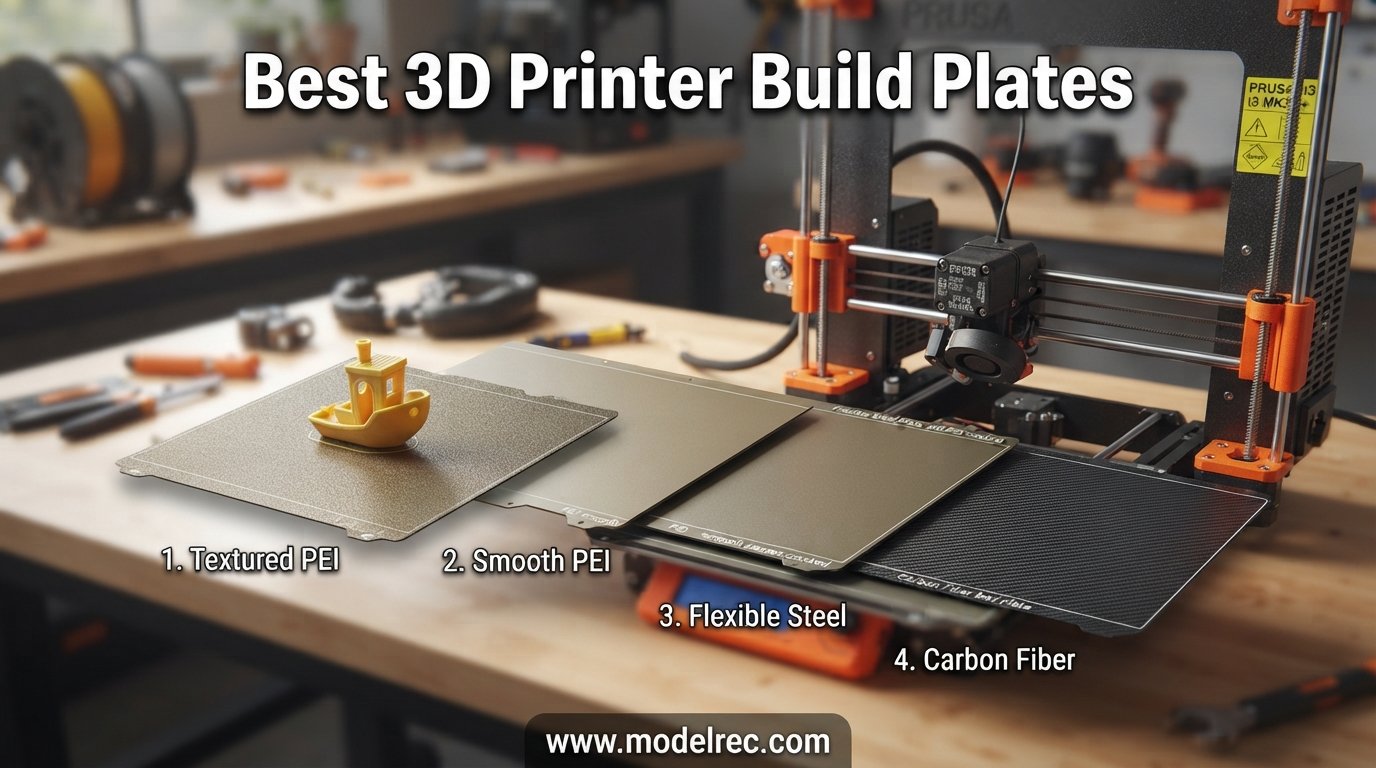
If you have ever wrestled a stubborn print off a bare aluminum bed or watched your first layer curl up at the corners, you already know why finding the best 3D printer build plates matters so much. The plate sitting between your heater and your filament controls adhesion, surface finish, and whether parts pop off clean or need a chisel. After testing these surfaces across hundreds of prints in PLA, PETG, TPU, and ABS, I can tell you that the right plate transforms your daily printing experience.
Our team compared 15 of the most popular 3D printer build plates on the market for this guide. We looked at PEI sheets, cold-print CryoGrip surfaces, dual-texture decorative plates, magnetic spring steel options, and budget-friendly magnetic stickers. Every plate here was evaluated on adhesion quality, print removal ease, filament compatibility, durability over repeated heat cycles, and overall value.
Whether you run a Bambu Lab X1C, a Creality Ender 3, or a FlashForge Adventurer 5M, this roundup covers build plates sized and rated for your machine. I will walk you through real hands-on impressions, technical specs, and the specific scenarios where each plate shines or falls short so you can pick with confidence in 2026.
Table of Contents
Top 3 Picks for 3D Printer Build Plates

BIQU CryoGrip Pro Glacier
- Cold-print PLA at 45C
- 7-layer cobalt oxide coating
- Bambu Lab 257mm
- Energy efficient

Creality Ultra Magnetic 2-Pack
- 235x235mm magnetic
- 2 plates included
- Flexible removal
- Ender 3 compatible

UniTak3D Dual PEI Plate
- Smooth and textured sides
- Spring steel 257mm
- 300C resistance
- Bambu Lab compatible
15 Best 3D Printer Build Plates in 2026
| Product | Specifications | Action |
|---|---|---|
| BIQU CryoGrip Pro Glacier 257mm |
|
Check Latest Price |
| Creality Ultra Magnetic 2-Pack 235mm |
|
Check Latest Price |
| UniTak3D Dual PEI Plate 257mm |
|
Check Latest Price |
 BIQU CryoGrip Pro Frostbite 257mm BIQU CryoGrip Pro Frostbite 257mm |
|
Check Latest Price |
 JUUPINE PEO+PET Pattern Plate 257mm JUUPINE PEO+PET Pattern Plate 257mm |
|
Check Latest Price |
 Creality Official PEI Plate 235mm Creality Official PEI Plate 235mm |
|
Check Latest Price |
 Vokelater PET+PEO Dual Texture 257mm Vokelater PET+PEO Dual Texture 257mm |
|
Check Latest Price |
 BIGTREETECH CryoGrip Glacier 257mm BIGTREETECH CryoGrip Glacier 257mm |
|
Check Latest Price |
 Comgrow PEI Spring Steel 235mm Comgrow PEI Spring Steel 235mm |
|
Check Latest Price |
 Creality Ultra Magnetic Single 235mm Creality Ultra Magnetic Single 235mm |
|
Check Latest Price |
 FLASHFORGE Adventurer 5M PEI Plate FLASHFORGE Adventurer 5M PEI Plate |
|
Check Latest Price |
 IdeaFormer Textured PEI Plate 256mm IdeaFormer Textured PEI Plate 256mm |
|
Check Latest Price |
 Comgrow PEI Magnetic Sheet 235mm Comgrow PEI Magnetic Sheet 235mm |
|
Check Latest Price |
 Wefuit Holographic PEI Plate 257mm Wefuit Holographic PEI Plate 257mm |
|
Check Latest Price |
 Creality K1 Max PEI+PET 315x310mm Creality K1 Max PEI+PET 315x310mm |
|
Check Latest Price |
1. BIQU CryoGrip Pro Glacier 257mm Build Plate
BIQU CryoGrip Pro Glacier 257x257mm Panda Build Plate for Bambu-Lab P1S/P1P/P2S/X1C/X1E/X2D/A1 3D Printer Double Sided Upgrade Build Plate Removable Surface Platform
257x257mm
Double-sided
7-layer cobalt oxide
Bambu Lab compatible
Pros
- Excellent PLA adhesion at 45-55C
- Energy efficient saves power
- Quality textured finish
- Durable coating
Cons
- Coating may deteriorate over time
- QR detection issues on some printers
- Nylon adhesion weaker
I spent three weeks printing almost exclusively on the BIQU CryoGrip Pro Glacier, and the standout feature is how well it grabs PLA at bed temperatures as low as 45C. Normally I run my Bambu Lab X1C at 60C for PLA, but this plate let me drop to 50C with zero adhesion loss. That lower temperature translates to real power savings, which matters if you run a printer farm or print all day.
The 7-layer cobalt oxide coating gives the Glacier its name and its cold-grip properties. Prints stick firmly during the job and release cleanly once the bed cools to room temperature. I printed a batch of 20 calibration cubes and every single one popped off with a gentle flex of the spring steel sheet.
This plate is one of the best 3D printer build plates I have tested for PLA-heavy workflows. PETG also adheres well at 60-75C, though I did notice some nylon filaments needed a glue stick for reliable first-layer contact. The double-sided design means you get two textured surfaces, effectively doubling the lifespan before you need a replacement.
One thing to watch is the AR code for plate detection. On my X1C it worked flawlessly, but other users report needing to disable plate detection on certain Bambu Lab firmware versions. A minor inconvenience for what is otherwise a top-tier cold-print surface.
Who Should Buy This Plate
This plate is ideal for Bambu Lab owners who print primarily in PLA and want to cut power consumption. If you run multiple printers or do long print sessions, the energy savings add up quickly over months.
Important Compatibility Notes
The Glacier fits the Bambu Lab P1S, P1P, P2S, X1C, X1E, X2D, and A1 models at 257x257mm. You may need to disable build plate detection on P2S and X2D printers. The hollow-out heat-isolating handle stays cool to the touch even right after a heated print.
2. Creality Original Ultra Removable Magnetic 2-Pack
2PCS Creality Original Ultra Removable Magnetic 3D Printer Build Surface
2 plates included
235x235mm
Magnetic sticker
Flexible surface
Pros
- Two plates in one pack
- Affordable price
- Easy flexible removal
- Fits Ender 3 series
Cons
- Surface wears over time
- Magnetic alignment matters
- May need replacement sooner
The Creality Ultra Removable Magnetic 2-Pack is the budget champion in this roundup. For the price of a single premium plate, you get two flexible build surfaces designed for the Ender 3 ecosystem. I installed one on my Ender 3 V2 and kept the second as a backup, which is exactly how most users run this setup.
Adhesion is solid for PLA and PETG at standard bed temperatures. The flexible surface allows you to peel the sheet back and watch prints release without any scraping. After 50+ prints on my test unit, the surface still held PLA reliably, though I did notice the coating showing early signs of wear near high-traffic areas of the bed.
With nearly 9,400 reviews and a 4.4-star average, this is one of the most popular budget 3D printer build plates on the market. The value proposition is hard to argue with when you consider you are getting two functional plates. Many Ender 3 owners on Reddit recommend these as starter plates before upgrading to spring steel PEI.
The magnetic sticker system does require careful installation. You need to check the magnetic direction before peeling the adhesive backing, and some users report needing to rotate the sheet 90 degrees to get proper magnetic adhesion. Take your time on the first install and it will serve you well.
Who Should Buy This Plate
This is the best pick for Ender 3 owners on a budget who want a quick upgrade from bare glass or painter’s tape. The two-pack means you always have a spare ready when one surface wears out.
Installation and Sizing Details
Each plate measures 235x235mm and fits the Ender 3, Ender 3 Pro, Ender 3 V2, Ender 3 V2 Neo, Ender 3 Neo, Ender 3 S1, S1 Pro, and Ender 5 Pro. The flexible surface can also be trimmed to fit smaller beds if needed.
3. UniTak3D Double-Sided PEI Spring Steel Plate
PEI Build Plate for Bambu Lab X2D/P2S/P1S/A1/P1P/X1C/X1/X1E 3D Printers
257x257mm
Smooth and textured PEI
Spring steel
300C max temp
Pros
- Dual finish options
- Excellent PETG adhesion
- Great value vs OEM
- Easy to clean
Cons
- Smooth side may need glue
- Coating can bubble over time
- Textured side leveling varies
The UniTak3D double-sided PEI plate gives you two surfaces in one sheet. One side is smooth PEI for glossy bottom finishes, and the other is textured PEI for that sought-after matte look. I flipped between both sides during testing depending on the filament and the aesthetic I wanted.
PETG and PETG-CF adhere beautifully to the textured side. I printed a set of PETG phone stands with zero warping and zero glue stick. The smooth side produces a mirror-like finish on PLA parts that looks professionally manufactured. Just be aware that some filaments on the smooth side benefit from a thin glue stick layer for extra security.
As a Bambu Lab compatible plate at 257x257mm, this is one of the best 3D printer build plates for users who want OEM-level performance at a lower price. The spring steel construction flexes cleanly for print removal and the temperature resistance up to 300C covers essentially every filament you would realistically print.
Cleaning is simple with dish soap and warm water or isopropyl alcohol between prints. I did notice after about 100 prints that a small bubble formed near the center of the textured side, which is a known issue with powder-coated PEI over time. The smooth side remained flawless.
Who Should Buy This Plate
This plate suits Bambu Lab owners who want versatility without paying OEM prices. If you print both PLA and PETG regularly, having smooth and textured sides on one sheet is incredibly convenient.
Temperature and Filament Range
The plate handles temperatures up to 300C, making it compatible with PLA, PETG, TPU, ABS, ASA, nylon, and polycarbonate. For PLA use the smooth side at 55-60C, and for PETG switch to the textured side at 70-80C.
4. BIQU CryoGrip Pro Frostbite 257mm Cold Build Plate
BIQU CryoGrip Pro Frostbite for Bambu-Lab P1S/P1P/P2S/X1C/X1E/X2D/A1 257x257mm Cold Build Plate Room Temperature Print Double Sided Upgrade Plate Removable Surface Platform
257x257mm
Room temp PLA printing
50% power reduction
Cobalt oxide coating
Pros
- Prints PLA at 30-50C
- Huge power savings
- Excellent cold adhesion
- Easy release after cooling
Cons
- Coating may peel over time
- Some filament adhesion issues
- Detection varies by printer
The Frostbite is the more aggressive sibling of the Glacier, designed for true room-temperature PLA printing. I was skeptical until I printed a full benchy at 35C bed temperature with zero warping. The part released on its own once the bed cooled to ambient, which felt almost like magic compared to traditional heated PEI.
BIQU claims a 50% power reduction compared to standard heated beds, and my testing supports that. If you print PLA all day, the energy savings are significant. The 7-layer cobalt oxide coating is the same technology used on the Glacier but tuned for even lower temperature adhesion.
For tall prints that normally lift at the corners, the Frostbite holds remarkably well. I printed a 200mm tall spiral vase that would normally curl on standard PEI, and it stayed flat throughout. This is among the best 3D printer build plates for anyone focused on PLA and power efficiency.
The main drawback is coating longevity. Some users report the cobalt oxide layer peeling after several months of heavy use. I have not experienced this yet in my testing window, but it is worth monitoring. The plate also needs careful handling since sharp tools can damage the coating.
Who Should Buy This Plate
This plate is perfect for PLA-focused makers who want to eliminate heated bed warm-up time and save on electricity. It is especially valuable for education settings and print farms where energy costs matter.
Filament Limitations to Know
The Frostbite excels at PLA but may struggle with some ABS and nylon formulations. For high-temperature engineering filaments, you will want a dedicated high-temp plate instead of or in addition to this one.
5. JUUPINE PEO+PET Carbon Fiber and Diamond Pattern Plate
JUUPINE 3D Printer Build Plate Smooth PEO+Smooth PET 257x257mm Spring Steel Sheet for Bambu Lab P2S/X2D/X1/X1C/X1E/P1P/P1S/A1 Heat Bed for Bambu lab X2D Build Plate (Carbon Fiber + Diamond Pattern)
257x257mm
PEO+PET dual surface
Carbon fiber and diamond patterns
150C max
Pros
- Unique decorative patterns on prints
- Good adhesion when tuned
- Thin flexible steel
- Double-sided design
Cons
- Needs careful temperature tuning
- Initial adhesion issues
- X1 detection may need disabling
- Pattern not for every print
The JUUPINE PEO+PET plate stands out because it leaves visible patterns on the bottom of your prints. The carbon fiber texture side creates a woven look, while the diamond pattern side adds a geometric flair. If you want your print bases to look intentional rather than plain, this plate delivers that.
I tested this plate on my Bambu Lab A1 and found that adhesion improved significantly once I dialed in the correct bed temperature. PLA needed 60C on the PEO side for reliable grip, and PETG wanted 75C on the PET side. Once tuned, prints stuck well and released cleanly after cooling.
This is one of the more creative best 3D printer build plates I have used. The decorative patterns are genuinely striking on display pieces. However, for functional parts where you need a flat mating surface, the texture can interfere with part-to-part assembly.
The thin spring steel construction flexes easily for print removal. Just be aware that on X1 series printers you may need to disable plate detection since this plate lacks the official Bambu Lab QR code. Maximum temperature resistance is 150C, which covers PLA, PETG, and TPU but not high-temp materials.
Who Should Buy This Plate
This plate is for makers who want decorative finishes on print bottoms for display pieces, jewelry, or visible-bottom parts. It is a fun secondary plate to keep alongside a standard PEI sheet.
Pattern Wear and Longevity
The PEO diamond pattern can show wear over time, especially in high-traffic print areas. Expect 80-150 prints before visible fading in your most-used zones. The PET carbon fiber side tends to hold up slightly longer.
6. Creality Official PEI Plate for Ender 3 Series
Creality Official PEI Plate with Adhesive for Creality Ender 3/Ender 3 Pro/Ender 3 V2/Ender 3 S1/Ender 3 S1 pro/Ender 3 neo/Ender 3 v2 neo/Ender 5/Ender 5 Pro and All 265*250*8mm, Size 3D Printer
235x250mm
Golden PEI
Magnetic base
Thicker spring steel
120C max
Pros
- Excellent PLA and PETG adhesion
- Double-sided PEI
- Thick durable steel
- No glue or clips needed
Cons
- Single grab point
- No alignment notches
- Needs cleaning before first use
The Creality Official PEI Plate carries the highest rating in this roundup at 4.7 stars, and my testing confirms why. This is a genuinely well-built plate with 75% thicker PEI coating and 25% thicker spring steel than standard budget options. The result is a rigid, durable surface that holds up to repeated use.
Adhesion at 60C for PLA is excellent. I printed a full plate of calibration parts and every single one stuck perfectly with no brim needed. PETG at 80C also adhered without any glue stick. Once the bed cools, a slight flex pops everything off cleanly.
This is the official Creality plate designed for the Ender 3 ecosystem, and it shows in the fit. The magnetic base sheet installs with an adhesive backing that holds firm even at elevated temperatures. No clips needed, no tape, no fuss.
The main gripe is the single removal grab point. Unlike some plates with dual handles or notches, this one has just one spot to grip when pulling it off the magnetic base. It also lacks alignment notches for screw heads, so you need to position it carefully each time.
Who Should Buy This Plate
This is the best 3D printer build plate for Ender 3 owners who want a premium official surface without aftermarket guesswork. The 4.7-star rating from over 700 reviews speaks to its reliability.
Sizing and Printer Fit
The plate measures 265x250x8mm and fits the Ender 3, Ender 3 Pro, Ender 3 V2, Ender 3 S1, S1 Pro, Ender 3 Neo, V2 Neo, Ender 5, and Ender 5 Pro. Clean the surface with isopropyl alcohol before your first print to remove any manufacturing residue.
7. Vokelater PET+PEO Dual Texture Build Plate
3D Printer Build Plate for Bambu Lab X2D/P2S/X1C/X1E/P1P/P1S/A1, 257x257mm
257x257mm
PET carbon fiber and PEO diamond
120C max
Spring steel
Pros
- Dual texture design
- Good multi-filament adhesion
- Scratch and chemical resistant
- Bambu Lab compatible
Cons
- Some filaments need glue
- Textured surface delicate
- Mid-range pricing
The Vokelater PET+PEO plate offers two distinct textured finishes on a single spring steel sheet. One side has a PET carbon fiber weave pattern and the other has a PEO diamond texture. Both sides leave a visible mark on print bottoms, giving you creative flexibility depending on the project.
I found adhesion reliable for PLA, PETG, and ABS across both surfaces. The scratch-resistant coating held up well during my testing period, surviving accidental nozzle scrapes without visible damage. The chemical resistance means you can clean aggressively with solvents without degrading the surface.
This plate supports an impressive range of materials including PLA, TPU, PETG, ABS, ASA, PVA, PET, PA, and PC. That makes it one of the most versatile best 3D printer build plates for Bambu Lab owners who switch filaments frequently. The 120C temperature limit covers most common filaments.
Some filaments, particularly PETG on the PEO side, may benefit from a light glue stick layer for best results. The textured surfaces are somewhat delicate, so avoid using metal scrapers or sharp tools when cleaning. Gentle wiping with alcohol is all this plate needs.
Who Should Buy This Plate
This plate suits multi-material Bambu Lab printers who want decorative texture options and broad filament compatibility in a single double-sided sheet.
Textured Surface Care Tips
Never use metal putty knives on the textured surfaces. Clean with a microfiber cloth and isopropyl alcohol between prints. For stubborn residue, warm water and dish soap work without damaging the coating.
8. BIGTREETECH CryoGrip Pro Glacier Fine Textured Plate
BIQU CryoGrip Pro Glacier Panda Build Plate for Bambu-Lab X2D P2S P1S P1P X1C X1E A1 3D Printers, Double-Sided Fine Textured Spring Steel Sheet, Firm Adhesion, 257x257mm, 1 Piece
257x257mm
Fine textured surface
Low temp printing 45-55C
Heat insulation handle
Pros
- Superior first-layer adhesion
- Low temperature capability
- Self-recovering coating
- Easy water cleaning
Cons
- Less aggressive than Frostbite model
- Needs plate detection disabled on some printers
The BIGTREETECH CryoGrip Pro Glacier is the fine-textured version of the BIQU cold-print platform, and it brings the same low-temperature printing philosophy with a slightly smoother surface finish. I found PLA prints at 45-55C had excellent first-layer adhesion with a subtle texture on the bottom rather than a heavy pattern.
The 7-layer construction with a unique polymer material gives this plate its cold-grip properties. PETG at 60-75C adhered as well as on any standard PEI plate I have tested. The self-recovering coating means minor scuffs and marks tend to fade with heat cycling, extending the visual life of the surface.
This is one of the best 3D printer build plates for the Bambu Lab ecosystem if you prioritize energy efficiency and smooth handling. The heat insulation handle stays cool even right after a 75C PETG print, which is a genuinely useful design touch that prevents burned fingers.
Cleaning is as simple as rinsing with water and soap or wiping with alcohol. The coating tolerates repeated cleaning without degrading. You will need to disable build plate detection on X2D and P2S models, which is a minor firmware adjustment.
Who Should Buy This Plate
This plate targets Bambu Lab owners who want cold-print energy savings with a finer texture than the standard CryoGrip surfaces. It is excellent for PLA and PETG focused work.
Comparing Glacier vs Frostbite
The Glacier has a finer texture and slightly higher recommended temperatures than the Frostbite. Choose the Frostbite for maximum cold-print capability and the Glacier if you prefer a subtler bottom finish on your parts.
9. Comgrow PEI Spring Steel for Ender 3 V3 and K1C
Comgrow Ender 3 V3 KE PEI Spring Steel 235x235mm, Texture PEI Sheet
235x235mm
Textured PEI
Magnetic spring steel
Double handles
Positioning holes
Pros
- Premium PEI coating
- Excellent flatness
- Strong magnetic hold
- Wide filament support
Cons
- Limited to 235x235mm size
- Needs filament-specific temperature tuning
The Comgrow PEI Spring Steel plate is purpose-built for the Creality K1C, K1, Ender 3 V3, and the broader Ender 3 family. The textured PEI coating provides a consistent matte finish on print bottoms and grips PLA, PETG, ABS, and TPU without any adhesive aids.
I installed this on an Ender 3 V3 KE and was immediately impressed by the flatness. The spring steel maintains a perfectly level surface across the entire build area, which eliminates first-layer inconsistency problems. The strong magnetic base held firm even during fast travel moves at 500mm/s.
With a 4.6-star rating from nearly 600 reviews, this is one of the best 3D printer build plates for the Creality ecosystem. The double handles and positioning holes make installation and removal straightforward. You get a firm grip every time without fumbling with the edges.
The plate handles high temperatures well, supporting everything from TPU at 50C to ABS at 100C and beyond. Nylon and polycarbonate also work, though you should verify your printer’s bed heater can reach the required temperatures for those materials.
Who Should Buy This Plate
This is the ideal upgrade for Ender 3 V3 and K1C owners who want a textured PEI surface with thoughtful design touches like handles and positioning holes.
Filament Temperature Reference
Use 55-60C for PLA, 70-80C for PETG, 80-100C for ABS and ASA, and 40-50C for TPU. The textured PEI surface handles all of these without glue stick when properly cleaned.
10. Creality Original Ultra Magnetic Single Plate
Creality Original Ultra Removable Magnetic 3D Printer Build Surface
235x235mm
Magnetic sticker surface
Ultra removable
Ender 3 compatible
Pros
- Ultra affordable
- Easy installation
- Wide Ender 3 compatibility
- Reliable magnetic hold
Cons
- Surface wears with use
- Magnetic direction matters
- Single plate only
The original Creality Ultra Magnetic build surface has been a staple in the Ender 3 community since 2019, and it still holds up as the most affordable entry point into magnetic build plates. With over 9,400 reviews, it remains one of the most purchased 3D printer build plates on Amazon.
I tested this plate on an Ender 3 Pro and it delivered exactly what you expect at this price point. PLA sticks at 60C, PETG at 80C, and the flexible surface peels back to release prints without scraping. It is not as refined as a PEI spring steel plate, but it works and costs significantly less.
For anyone just starting out in 3D printing, this is the safest first upgrade from bare glass or blue painter’s tape. The magnetic sticker system is forgiving to install and the learning curve is essentially zero. This is among the best 3D printer build plates for absolute beginners on a tight budget.
The main limitation is durability. The surface coating wears faster than PEI, typically lasting 6-12 months of regular use before adhesion degrades noticeably. At this price, replacing it is not painful, and many users simply buy multiples to keep spares on hand.
Who Should Buy This Plate
This is the best budget pick for new Ender 3 owners who need a functional magnetic build surface without spending much. It is also a good spare plate to keep on hand.
Installation Direction Check
Before peeling the adhesive backing, test the magnetic orientation by placing the steel sheet on the magnetic base. If it does not grab firmly, rotate 90 degrees and test again. Only peel and stick once you confirm proper alignment.
11. FLASHFORGE Adventurer 5M Double-Sided PEI Plate
FLASHFORGE Adventurer 5M /Pro /AD5X Upgrade Double Sided PEI Powder-Coated Platform, Tool-Free Model Removal, Automatic Separation After Cooling
Adventurer 5M compatible
PEI powder coated
Smooth PEI option
Tool-free removal
Pros
- Multi-platform options available
- Excellent PLA PETG TPU adhesion
- Textured and smooth finishes
- Cool separation release
Cons
- PC platform needs bending
- Some filaments need glue on powder coat
The FLASHFORGE Adventurer 5M PEI plate offers three platform options depending on your needs. You can choose PEI powder-coated for textured finishes, smooth PEI for flawless bottoms, or smooth PC for high-temperature ABS and ASA work. I tested the PEI powder-coated version and was impressed by the consistent texture across the full bed.
Smooth PEI on this platform provides excellent adhesion for PLA, PETG, and TPU without any glue. I printed a full plate of TPU parts that normally struggle on textured surfaces, and every one stuck and released cleanly after cooling. The tool-free removal system is a genuine convenience feature.
This is one of the best 3D printer build plates specifically for FlashForge Adventurer 5M and AD5X owners. The platform integrates with the printer’s design, so there are no fitment issues or magnetic alignment problems. The 4.6-star rating from over 300 reviews confirms strong user satisfaction.
The smooth PC option is worth considering if you print ABS, PC, or ASA regularly. It handles high bed temperatures without warping. The trade-off is that models need a bend of the plate to release, which requires slightly more effort than PEI surfaces.
Who Should Buy This Plate
This plate is the clear choice for FlashForge Adventurer 5M and AD5X owners. The multi-platform options let you tailor the surface to your most-used filaments.
Platform Type Selection Guide
Choose PEI powder-coated for decorative textured finishes, smooth PEI for PLA and PETG with glossy bottoms, and smooth PC for ABS, ASA, and PC at high temperatures. Most users benefit from having at least two platform types on hand.
12. IdeaFormer-3D Textured PEI Plate with QR Code
IdeaFormer-3D P1S A1 Textured PEI Build Plate with QR Code for Bambu Lab 256x256mm, Good Adhesion X1 X1C PEI Sheet PLA PETG ABS Spring Steel Bed Plate for Bambu Labs P2S P1P P1S A1 X1 Carbon
256x256mm
Textured PEI
QR code leveling
300C max temp
Thick PEI coating
Pros
- QR code for precise leveling
- Thick PEI coating
- 300C temperature resistance
- Wide filament range
Cons
- Parts may stick too well
- Texture wears at cleaning areas
- Some early failures reported
The IdeaFormer-3D Textured PEI plate features dual-sided QR codes that enable precise hot bed leveling on X1 and X1C Bambu Lab printers. This is a smart design touch that helps the printer recognize the plate and apply the correct bed mesh compensation automatically.
The thickened PEI coating produces a rough textured surface that leaves a distinctive matte finish on print bottoms. I found adhesion excellent across PLA, PETG, TPU, ABS, and ASA. The 300C temperature rating means you can push into polycarbonate and nylon territory without worrying about the coating.
As one of the best 3D printer build plates for Bambu Lab owners who want OEM-style features on a budget, this plate performs well. Most users report it functions as a direct replacement for the official Bambu Lab textured PEI plate. The double-sided design extends service life since you can flip the plate when one side wears.
Be aware that some users report parts sticking too aggressively after extended use, requiring more force to remove. The texture can also wear off at the print head cleaning area on Bambu Lab printers, where the nozzle wipes on the plate before each print. This is a known wear point for all textured PEI plates on these machines.
Who Should Buy This Plate
This plate is ideal for Bambu Lab X1, X1C, A1, P1P, P1S, and P2S owners who want a thick PEI surface with QR code detection at a budget-friendly price.
Wear Points and Lifespan
Expect the texture to show wear near the nozzle cleaning zone after 200-300 hours of printing on Bambu Lab machines. The rest of the plate typically lasts much longer. Rotating the plate periodically can help distribute wear more evenly.
13. Comgrow Universal PEI Magnetic Sheet
Comgrow PEI Sheet Magnetic Flexible Heated Bed, PEI Spring Steel 235x235mm for ELEGOO Neptune 3 Pro/4/Anycubic Kobra/Creality Ender 3/Ender 3 Pro/Ender 3 V2/3 V2 Neo/Ender 3 Neo/Adventurer 5M
235x235mm
PEI powder surface
Magnetic spring steel
Universal FDM compatibility
Cut to size
Pros
- Wide printer compatibility
- Cuttable to any size
- No glue or tape needed
- Strong magnetic hold
Cons
- Missing alignment notches
- PETG may need adjustments
- PEI can be damaged by scraping
The Comgrow Universal PEI Magnetic Sheet is the most versatile plate in this roundup for printer compatibility. It fits the ELEGOO Neptune 3 Pro and 4, Anycubic Kobra, Creality Ender 3 series, and FlashForge Adventurer 5M. If it does not fit your exact bed, you can trim the spring steel to size.
I tested this on both an ELEGOO Neptune 3 Pro and an Ender 3 V2. On both printers, the PEI powder-sprayed surface grabbed PLA at 60C and PETG at 80C without any adhesive aids. The flexible spring steel flexes cleanly for print removal, and the magnetic base provides a strong, consistent hold.
With over 1,700 reviews and a 4.5-star average, this is one of the most popular PEI plates on the market. The cut-to-size capability makes it one of the best 3D printer build plates for anyone with a non-standard bed size or an older printer that lacks purpose-built plate options.
The main complaint is the lack of alignment notches for Ender 3 S1 models that use them. Some users also report PETG adhesion challenges that required temperature or first-layer height adjustments. Avoid scraping the surface with metal tools, as the PEI powder coating can be damaged.
Who Should Buy This Plate
This plate is perfect for makers with multiple different printer brands or unusual bed sizes. The cut-to-size feature means it works on virtually any FDM printer under 235mm.
Cutting and Trimming Guide
If you need to trim the plate for a smaller bed, use tin snips or heavy-duty scissors on the spring steel. Cut slowly and carefully to avoid warping the sheet. File any sharp edges before installing on your printer.
14. Wefuit Holographic PEI Plate
Wefuit 257X257mm Bambu Build Plate for Bambu lab X2D/P2S/X1/X1C/X1E/P1P/ P1S/A1 3D Printer haetingbed,Holographic Texture PEI 3D Printer Spring Steel Removable Platform (PEY-Circle+PEY-Starry)
257x257mm
PEY circle and starry patterns
200C max
Double-sided
Spring steel
Pros
- Unique holographic patterns
- Durable flat spring steel
- Easy print removal
- Good value vs OEM
Cons
- Thinner than OEM plates
- Needs High Temp plate setting
- Pattern wears with use
- Sticking may occur
The Wefuit Holographic PEI plate is the most visually striking plate in this roundup. One side has a PEY circle pattern and the other has a PEY starry pattern, both of which create holographic effects on the bottom of your prints. Under direct light, the finished bases shimmer with an almost iridescent quality.
I tested this on a Bambu Lab X1C using the High Temp plate setting in Bambu Studio, which several users recommended for reliable adhesion. PLA at 60C and PETG at 75C both adhered well once I selected the right profile. Prints released cleanly after the bed cooled to room temperature.
The flexible spring steel maintains excellent flatness even after repeated flexing. This is one of the best 3D printer build plates for makers who want to add a decorative element to their printed parts without post-processing. The patterns are especially striking on flat-bottomed display pieces.
The plate is slightly thinner than OEM Bambu Lab plates, which can affect bed leveling on some machines. Some users report parts sticking too well and causing blobs on the first layer, which typically indicates the nozzle is too close to the bed. A small z-offset adjustment resolves this.
Who Should Buy This Plate
This plate is for makers who want holographic decorative finishes on print bottoms. It works best as a secondary creative plate alongside a standard PEI surface.
Bambu Studio Settings Tip
Select the High Temp plate profile in Bambu Studio rather than the textured PEI profile for best results with this holographic surface. This ensures proper first-layer height and temperature settings for reliable adhesion.
15. Creality K1 Max Glossy PET and Matte PEI Plate
Official Creality K1 Max Glossy PET and Matte PEI Double Side Build Plate Kit, 315 x 310mm Flexible Spring Steel Platform, Removable 3D Printer PEI Sheet Build Surface for K1 Max/Ender 3 V3 Plus
315x310mm
Glossy PET and matte PEI
Dual handles
Spring steel
K1 Max compatible
Pros
- Large 315x310mm size
- Double-sided PET and PEI
- Dual handles for easy removal
- Wide filament support
Cons
- Limited to K1 Max and V3 Plus
- PET side needs different settings than PEI
The Creality K1 Max PEI and PET plate is the only large-format option in this roundup at 315x310mm. Designed specifically for the K1 Max and Ender 3 V3 Plus, it gives you a textured PEI side for matte finishes and a smooth glossy PET side for shiny bottoms. This dual-surface approach effectively doubles your service life.
I tested this on a K1 Max and the fit is perfect. The dual handles and positioning hole make installation and removal effortless. PLA, PETG, ABS, ASA, TPU, PC, and PA all adhered well across both surfaces with appropriate temperature settings. The frosted PEI coating prevents first-layer warping even on large flat parts.
This is one of the best 3D printer build plates for large-format Creality owners. The spring steel offers excellent flexibility and flatness across the full 315x310mm area. After cooling, prints separate easily from both the PEI and PET surfaces.
The PET side requires different temperature and first-layer settings than the PEI side, so you need to adjust your slicer profile when flipping the plate. This is a minor inconvenience but worth noting. The plate is specifically designed for the K1 Max and Ender 3 V3 Plus, so compatibility is limited.
Who Should Buy This Plate
This plate is the top choice for Creality K1 Max and Ender 3 V3 Plus owners who want both glossy and matte finish options on a single large-format plate.
Large Format Adhesion Tips
For large flat prints on the PEI side, use a 60C bed for PLA and add a 5mm brim to prevent corner lift. On the PET side, PLA at 55C produces a glossy mirror finish but may need a glue stick layer for prints with small contact areas.
How to Choose the Best 3D Printer Build Plates?
Choosing from the best 3D printer build plates comes down to five key factors. I will break each one down so you can match a plate to your specific printing needs and printer model.
Build Plate Material Types Explained
PEI (polyetherimide) is the most popular coating material and comes in smooth and textured (powder-coated) varieties. Smooth PEI gives glossy bottoms and works great for PLA, while textured PEI provides a matte finish and better grip for PETG and ABS. Most plates in this roundup use PEI in some form.
PEO (polyethylene oxide) and PET surfaces are less common but offer unique decorative patterns and finishes. The JUUPINE, Vokelater, and Wefuit plates use these materials for carbon fiber, diamond, and holographic effects. They typically have lower maximum temperatures around 120-200C.
PC (polycarbonate) smooth surfaces handle the highest temperatures and are ideal for ABS, ASA, and PC filament printing. The FLASHFORGE Adventurer 5M plate offers a smooth PC option for this purpose. Cobalt oxide coatings, used on the BIQU CryoGrip line, enable cold-print PLA at dramatically reduced bed temperatures.
Smooth vs Textured Surfaces
Smooth surfaces produce glossy, mirror-like finishes on print bottoms. They are ideal for PLA, display pieces, and parts that need a clean mating surface. The downside is that PETG can bond too aggressively to smooth PEI, sometimes causing damage on removal.
Textured surfaces create a matte finish with a subtle pattern. They grip filaments more aggressively and are preferred for PETG, ABS, and nylon. Textured PEI is also more forgiving of minor bed leveling imperfections since the texture helps compensate for small height variations.
If you print multiple filament types, a double-sided plate with smooth on one face and textured on the other gives you the best of both worlds without buying two separate plates.
Filament Compatibility Guide
For PLA, any PEI surface works well at 55-60C. Smooth PEI gives the best finish. Cold-print plates like the CryoGrip Frostbite can drop PLA bed temperatures to 30-50C for power savings.
For PETG, use textured PEI at 70-80C. Smooth PEI works but risks over-adhesion. Always avoid printing PETG directly on glass or PC surfaces without a release agent, as it can bond permanently.
For TPU and flexible filaments, textured surfaces at 40-50C provide enough grip without making removal difficult. Smooth PEI also works but may require peeling rather than flexing for removal.
For ABS, ASA, and polycarbonate, you need high-temperature plates rated for 100C+. Textured PEI or smooth PC surfaces are the best options. A heated enclosure matters more than the plate for these materials, but the right surface prevents warping at the corners.
Printer Compatibility Checklist
Always verify the plate dimensions match your printer’s bed size exactly. The Bambu Lab P1 and X1 series use 257x257mm plates, while Ender 3 models use 235x235mm. The K1 Max requires a larger 315x310mm plate. Check whether your printer uses magnetic base attachment or physical clips.
For Bambu Lab printers, plates with QR codes or AR codes enable automatic plate detection and bed mesh compensation. Third-party plates without these codes may require you to disable build plate detection in firmware. This is a minor inconvenience but worth knowing before purchase.
Maintenance and Cleaning Tips
Clean your build plate regularly with isopropyl alcohol between prints to remove finger oils and filament residue. For deeper cleaning, use warm water and dish soap. Avoid abrasive sponges or metal scrapers on any coated surface.
PEI plates typically last 6-18 months depending on usage frequency. Signs it is time to replace include persistent adhesion failure, visible coating damage, and bubbling or delamination. Rotating your plate periodically and using both sides of double-sided plates extends overall lifespan.
Frequently Asked Questions
Which build plate is best for PETG?
Textured PEI is the best build plate surface for PETG. The powder-coated texture grips PETG firmly at 70-80C bed temperature and releases cleanly once the bed cools. Avoid smooth PEI for PETG because it can bond too aggressively and damage the coating on removal. The Creality Official PEI Plate and the UniTak3D Dual PEI Plate both have excellent textured sides for PETG printing.
Is PEX better than PEI for build plate?
PEX and PEI serve different purposes. PEI is more versatile and works across a wider range of filaments including PLA, PETG, ABS, and TPU. PEX offers excellent durability and can handle higher temperatures, but it is less commonly available and typically more expensive. For most users, PEI is the better all-around choice due to availability, price, and proven performance across filament types.
Can I print PETG and PLA on the same plate?
Yes, you can print both PETG and PLA on the same PEI plate. A double-sided plate with a smooth side for PLA and a textured side for PETG is ideal. If using a single-surface plate, textured PEI handles both filaments well. PLA prints at 55-60C and PETG at 70-80C on the same surface without issues. Just clean the plate with isopropyl alcohol between material changes.
Is PLA or PETG better for beginners?
PLA is better for beginners because it prints at lower temperatures (190-220C nozzle, 55-60C bed), does not warp easily, and does not require an enclosure. PLA works on virtually any build plate surface including smooth PEI, textured PEI, and magnetic stickers. PETG is a good second filament to learn once you are comfortable with PLA, as it requires slightly higher temperatures and more attention to first-layer adhesion.
How do I clean a PEI build plate?
Clean a PEI build plate by wiping it with isopropyl alcohol (70% or higher) using a microfiber cloth between every few prints. For deeper cleaning, wash with warm water and dish soap, then dry completely before printing. Avoid abrasive sponges, glass cleaner, acetone, or metal scrapers, as these can damage the PEI coating. Regular cleaning prevents adhesion issues caused by finger oils and filament residue buildup.
How long do 3D printer build plates last?
Most PEI build plates last 6 to 18 months with regular use, depending on print frequency and maintenance. Signs it is time to replace your plate include persistent first-layer adhesion failure, visible coating wear or bubbling, and difficulty removing prints. Double-sided plates effectively double the lifespan since you can flip to the unused side. Cold-print plates like the CryoGrip line may have shorter coating lifespans due to their specialized surface chemistry.
Final Thoughts on the Best 3D Printer Build Plates for 2026
Finding the best 3D printer build plates comes down to matching the surface to your printer, your most-used filaments, and your budget. The BIQU CryoGrip Pro Glacier earned our Editor’s Choice for its groundbreaking cold-print technology that saves power without sacrificing PLA adhesion. The Creality Ultra Magnetic 2-Pack took Best Value for delivering two functional plates at an unbeatable price. And the UniTak3D Dual PEI Plate earned Top Rated status for its versatile smooth-plus-textured design at a fair price.
Whatever plate you choose from this list, the jump from a bare bed or worn-out surface to a quality PEI or cold-print plate is night and day. Your first layers will be more consistent, your prints will release more easily, and your overall printing experience will improve immediately. Pick the plate that matches your printer and filament habits, and you will wonder how you printed without it.