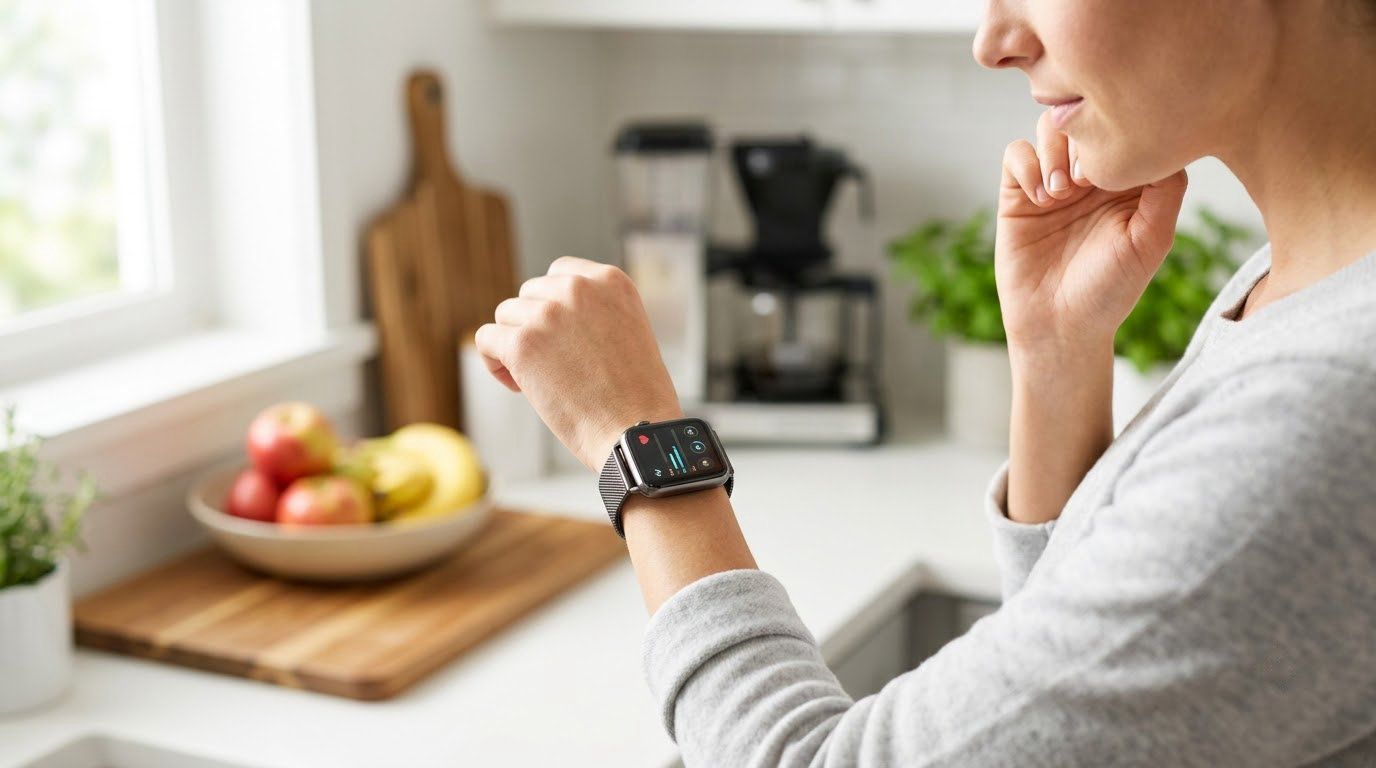
If you are buying a Garmin watch during Amazon’s Prime Big Deal Days sale, the vívoactive 5 is the one to watch: it carries more owner reviews than any other watch in this list, tracks sleep and training well, and runs up to 11 days between charges.
The Forerunner 165 suits anyone who wants a brighter AMOLED running watch, and the Forerunner 55 is the straightforward first Garmin. The sale itself runs October 6-7, 2026, and most offers need a Prime membership. Offers move through the event, so the buttons below are the place to see the current price.
Table of Contents
Our Top 3 Picks for Best Amazon Prime Big Deal Days Garmin Deals

Garmin vívoactive 5
- AMOLED display
- Up to 11 days battery
- Body Battery and sleep coaching

Garmin Forerunner 165
- AMOLED touchscreen
- Up to 11 days battery
- Training effect and Garmin Coach

Best Amazon Prime Big Deal Days Garmin Deals Compared (October 2026)
| Product | Specifications | Action |
|---|---|---|
| Garmin vívoactive 5 |
|
Check Deal Price |
| Garmin Forerunner 165 |
|
Check Deal Price |
| Garmin Forerunner 55 |
|
Check Deal Price |
 Garmin Forerunner 265 Garmin Forerunner 265 |
|
Check Deal Price |
 Garmin Instinct 2X Solar Garmin Instinct 2X Solar |
|
Check Deal Price |
 Garmin Forerunner 965 Garmin Forerunner 965 |
|
Check Deal Price |
 Garmin epix Pro Gen 2 Garmin epix Pro Gen 2 |
|
Check Deal Price |
 Garmin Instinct 3 AMOLED Garmin Instinct 3 AMOLED |
|
Check Deal Price |
 Garmin Venu 4 Garmin Venu 4 |
|
Check Deal Price |
 Garmin Instinct 2 Solar Garmin Instinct 2 Solar |
|
Check Deal Price |
How We Chose
Every watch here was compared on the specs that decide a Garmin purchase: display type, battery claims, positioning hardware, water rating and weight, plus what owners actually report after months of wear. Ratings and review counts were checked on Amazon in October 2026.
1. Garmin vívoactive 5: Best Overall Watch
Garmin vívoactive 5
Type: fitness smartwatch
Display: AMOLED
Battery: 11 days
Weight: 37 g
Pros
- Up to 11 days battery in smartwatch mode
- Strong sleep score and HRV tracking
- Body Battery gives useful daily context
- Light enough to wear overnight
- Over 30 sports apps plus offline Spotify and Deezer music
Cons
- No speaker or microphone so no voice assistant
- Third-party apps are thin next to Apple Watch
- No built-in maps or turn-by-turn navigation
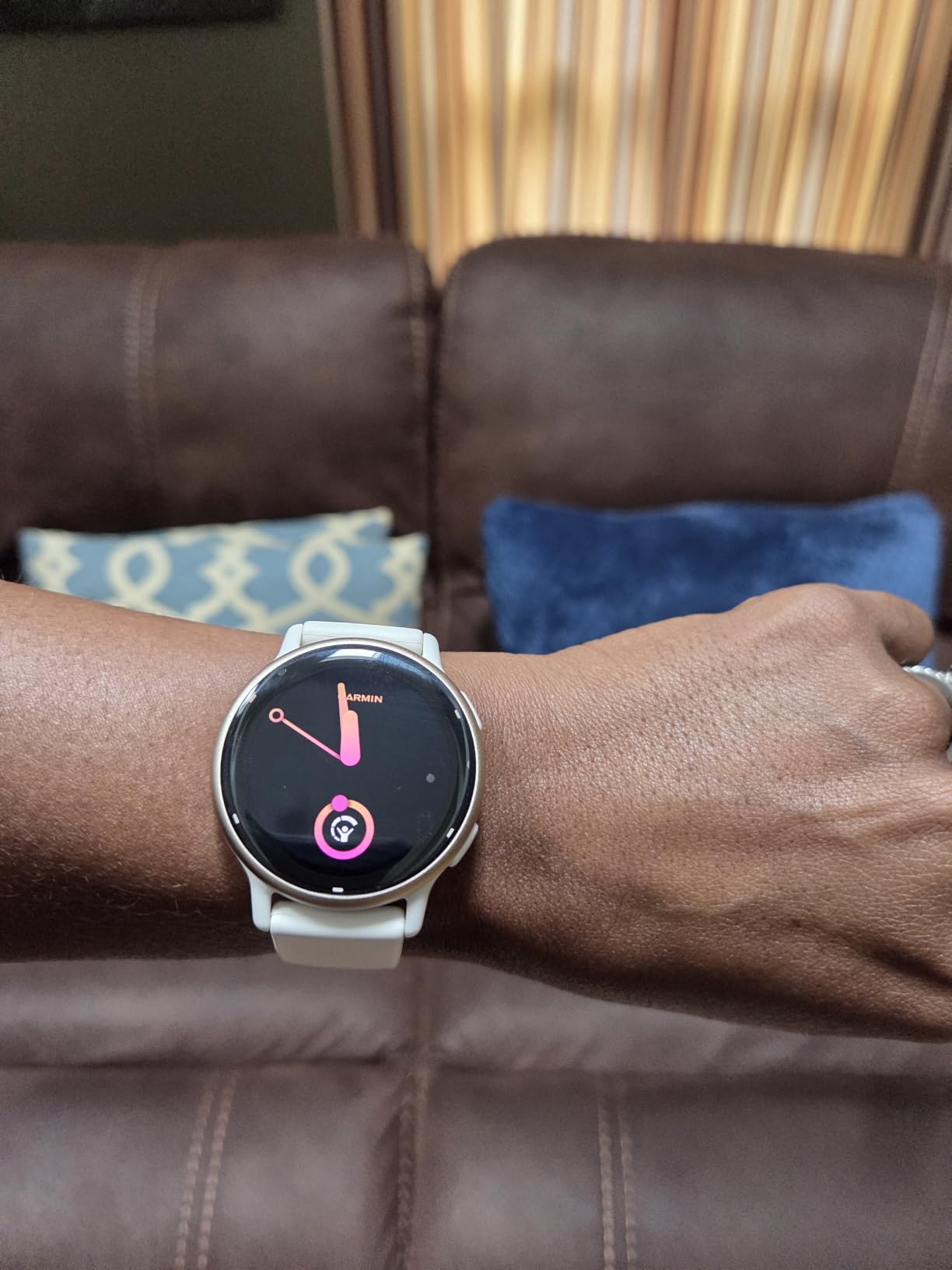
Buy the vívoactive 5 if you want one watch that handles training, sleep and ordinary wear without becoming a charging job. Owners report roughly a week between charges, sometimes longer, and that is the feature that converts people who were charging daily before.
The health side is the quiet strength. Body Battery, nap detection, a morning report and HRV status give the watch something useful to say at breakfast, and most of it works without a paid tier. Thirty-plus built-in sports apps cover everything from walking and cycling to HIIT and golf.
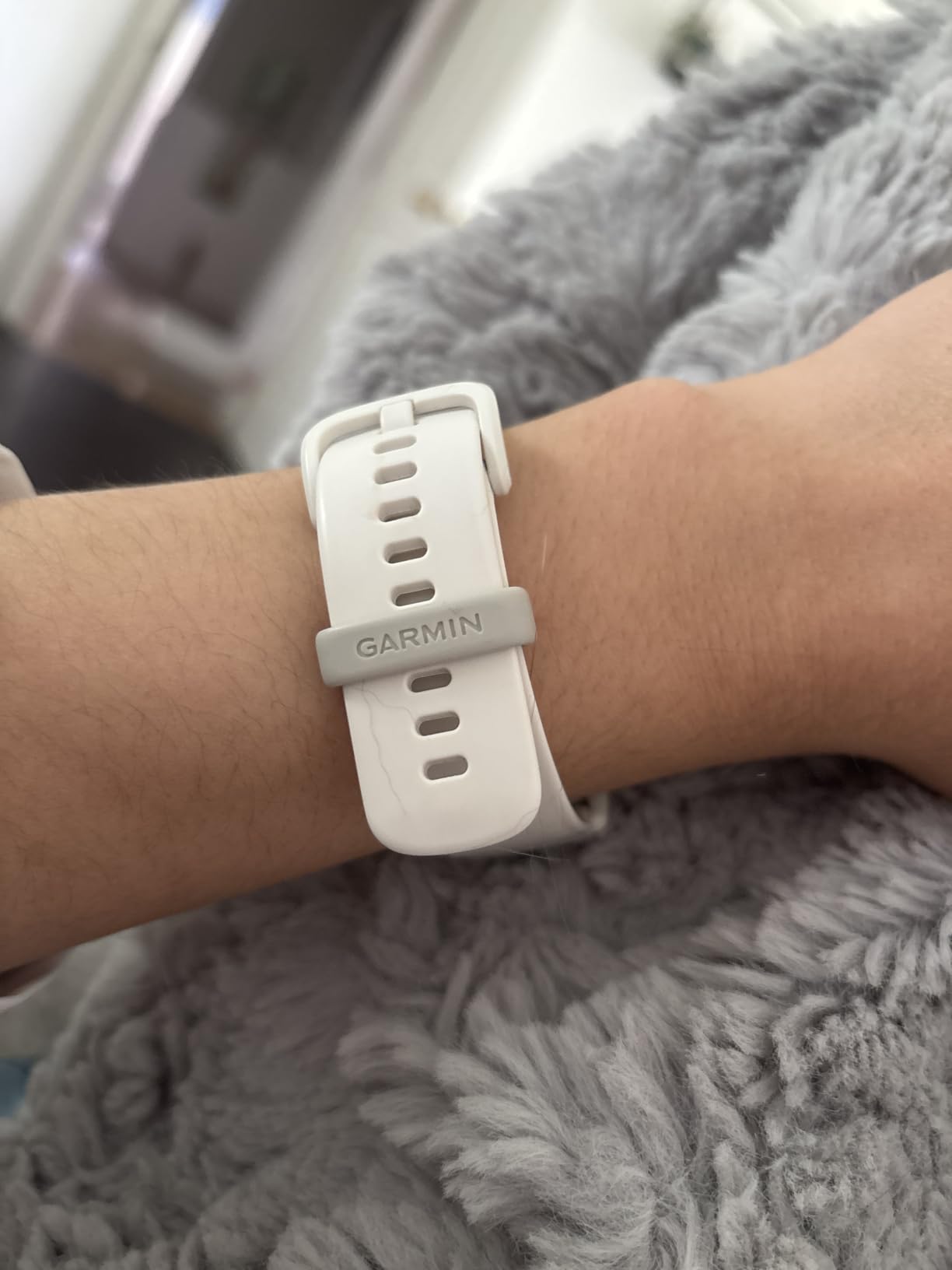
Compare it with the Forerunner 165 and the difference is purpose rather than quality. The Forerunner 165 is the better dedicated running computer; the vívoactive is the better watch for someone whose training is mixed and whose day includes a lot of sitting.
- 42 mm case at 1.31 ounces, comfortable enough to sleep in
- AMOLED screen that stays readable outdoors
- Offline music from Spotify, Amazon Music or Deezer
- Wheelchair mode alongside walk, run, cycle, HIIT and swim
Owners report one recurring annoyance: nap detection false-positives when you are just reclining, and those false naps are awkward to remove afterwards. If you need wrist-to-wrist calls or a real app ecosystem, look elsewhere.
2. Garmin Forerunner 165: Best Value Running Watch
Garmin Forerunner 165
Type: running smartwatch
Display: AMOLED
Battery: 11 days
Weight: 39 g
Pros
- Bright AMOLED touchscreen that reads well in sunlight
- About 10 to 13 days of real battery life
- Fast GPS lock with accurate pace and heart rate
- Training effect and recovery time at a mid-tier level
- Standard 20 mm quick-release bands
Cons
- No training readiness or training load
- No music storage or onboard maps on the standard model
- Wrist heart rate lags a chest strap in zone work
Owners moving over from a Fitbit or an Apple Watch tend to land here first. The screen is the reason: a bright 1.2-inch AMOLED at 1000 nits, with physical buttons underneath for when your hands are wet or you are mid-stride.
Battery life lands between 10 and 13 days for most people, which means charging roughly once a week. GPS locks quickly and pace, distance and wrist heart rate come out accurate in ordinary running conditions.
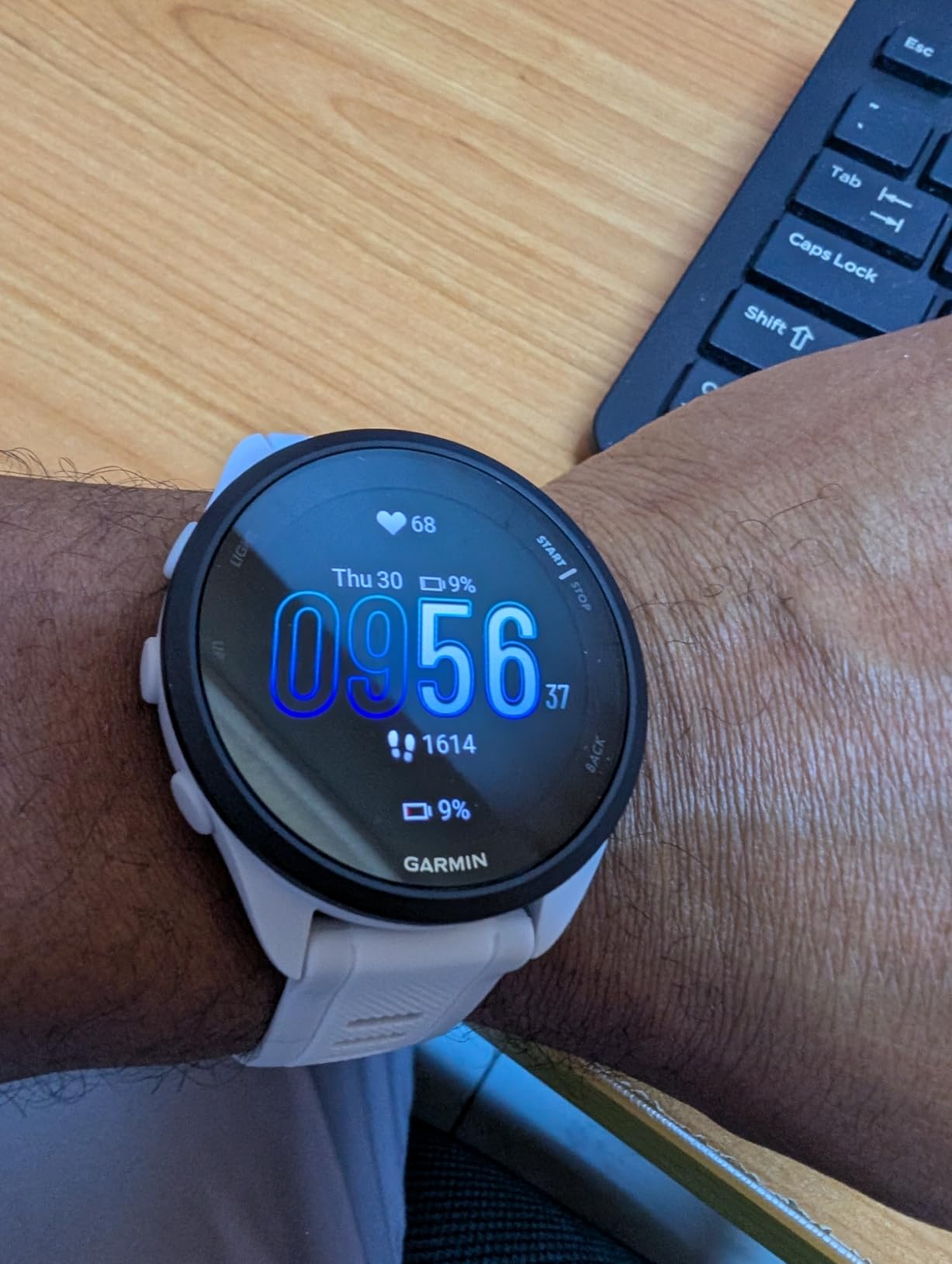
Where it stops is the software tier. Training effect, recovery time, the morning report and VO2 Max are all present, but training readiness, training status and multi-band positioning live higher up the range. Against the Forerunner 265 the gap shows in the training detail, not the hardware.
Good to know: several reviews mention Garmin Connect widget bugs that block adding fields to the at-a-glance view, plus the occasional Bluetooth dropout. They are software issues rather than build problems, and they come and go between app updates.
3. Garmin Forerunner 55: Best First Garmin on a Budget
Garmin Forerunner 55
Type: running watch
Display: monochrome MIP
Battery: 2 weeks
Weight: 37 g
Pros
- Lowest entry point in this Garmin list
- Two weeks of battery in smartwatch mode
- About 20 hours of GPS tracking
- Simple push-button interface
- PacePro and suggested workouts for newer runners
Cons
- Low-resolution dim MIP screen
- No touchscreen music payments or navigation
- No advanced training readiness or multi-band GPS
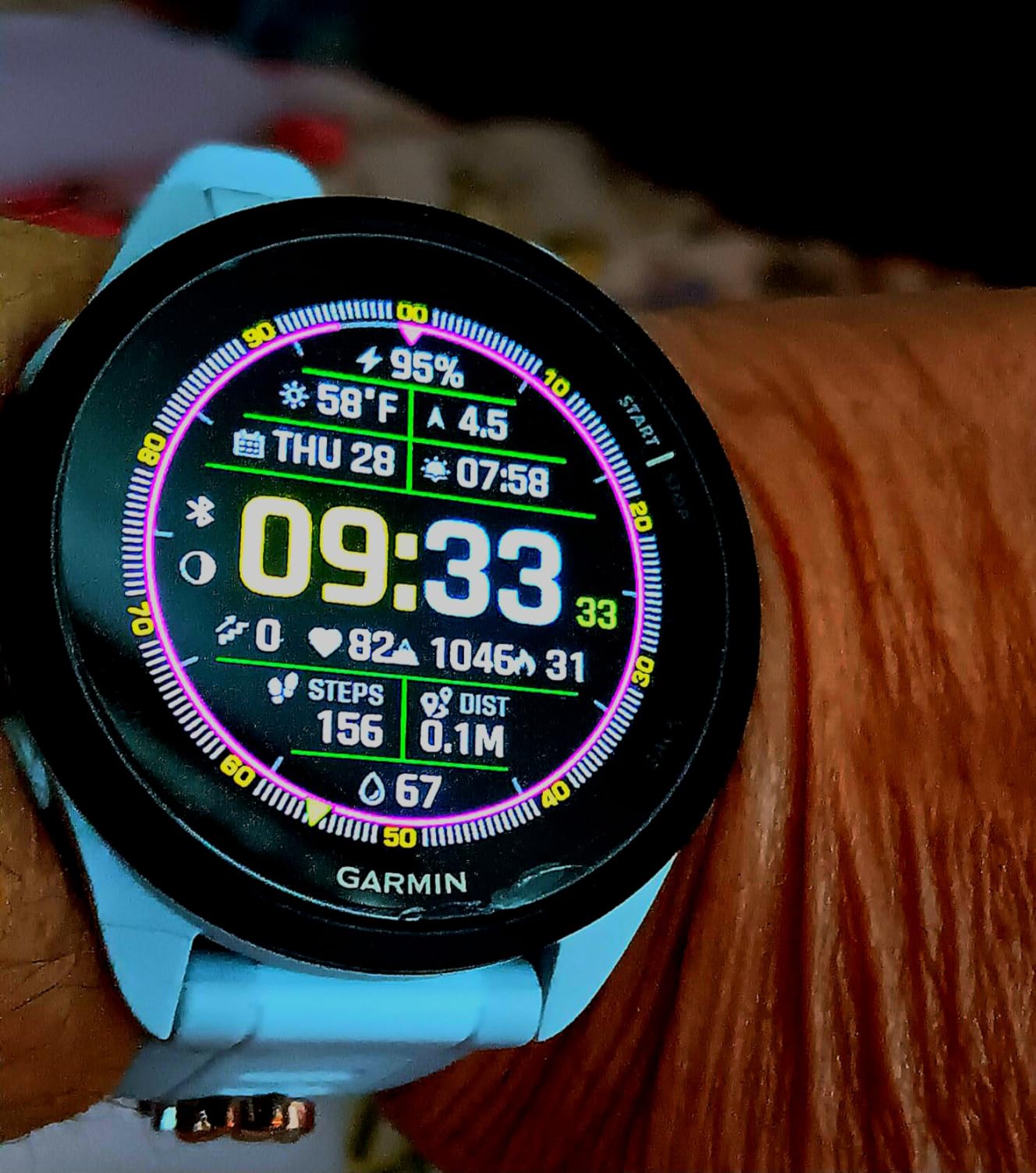
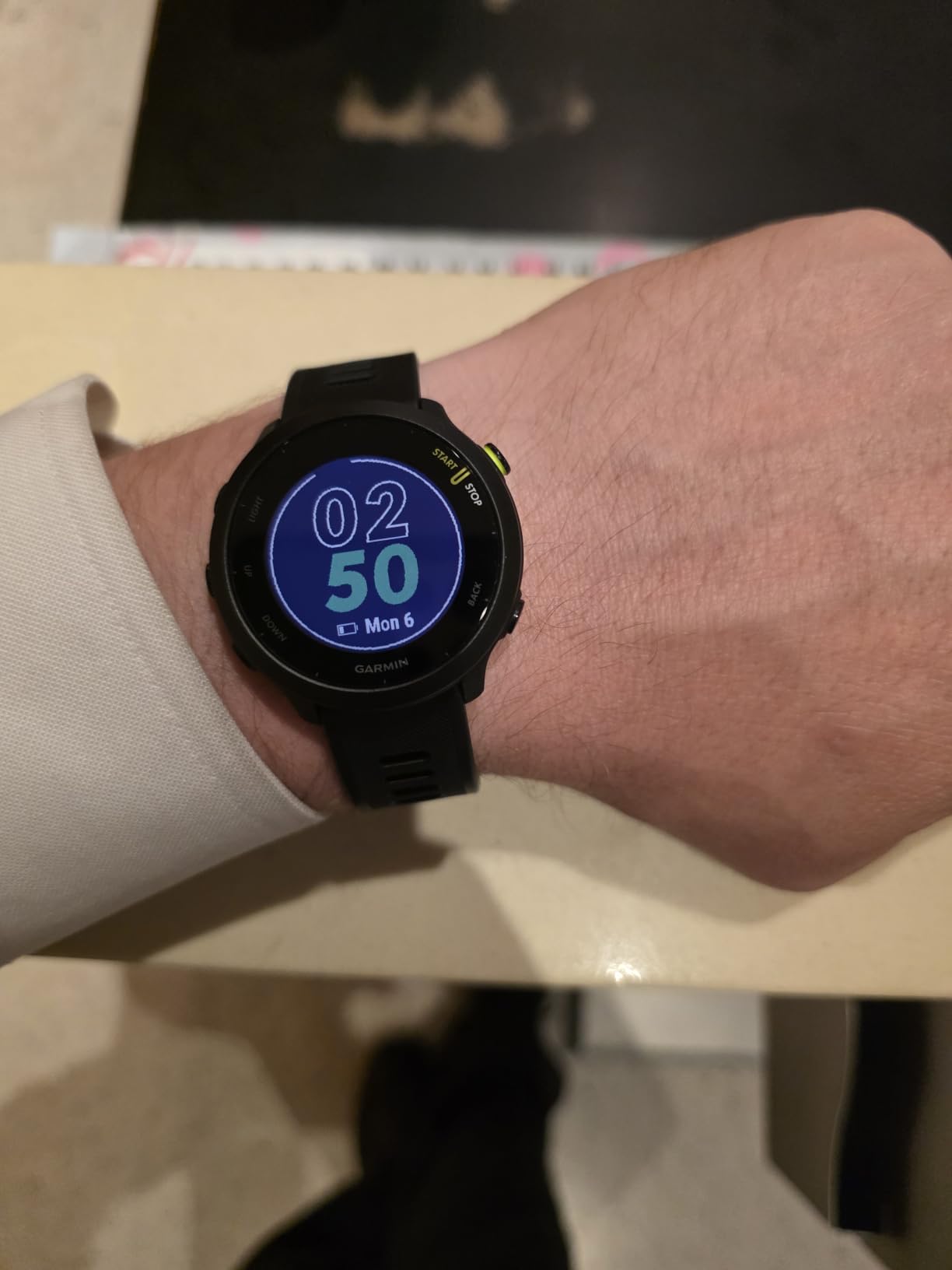
The Forerunner 55 is the watch people buy to find out whether they like wearing a Garmin at all. At 37 g with a two-week battery and simple buttons, it asks very little of the owner.
PacePro is the feature that quietly earns its place, guiding pace over a chosen course without a phone. Race time predictions and suggested workouts that adapt to your training history mean a beginner can follow a plan without planning it.
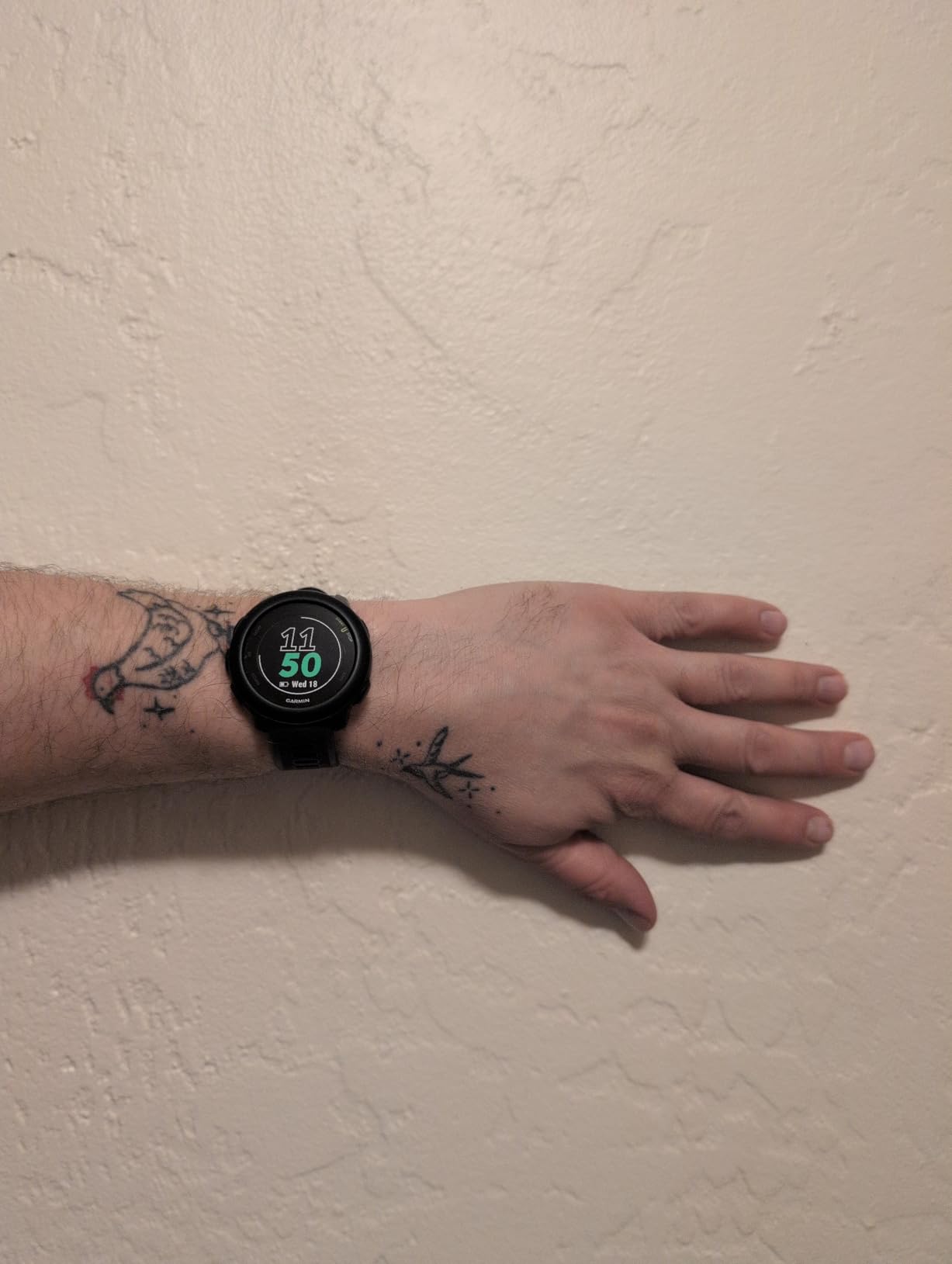
The trade-off owners name most often is the display. A transflective memory-in-pixel panel at 208 pixels is dim next to the AMOLED screens above it, and there is no touchscreen, so on-device course navigation is not something this watch offers. It is a wrist computer rather than a navigator.
If the plan is mostly pool swims, walking and casual miles, that is a fair swap. If you want music on the wrist or turn-by-turn, skip it and step up to the Forerunner 165.
4. Garmin Forerunner 265: Best for Serious Training Analysis
Garmin Forerunner 265
Type: running smartwatch
Display: AMOLED
Battery: 13 days
Weight: 47 g
Pros
- Highest average rating in this group
- Training readiness and training status are genuinely useful
- Multi-band GNSS with SatIQ holds signal in canyons
- Built-in running dynamics without a separate pod
- Music storage and about a week of real battery
Cons
- No built-in maps or turn-by-turn
- Sleep scoring can be inconsistent which skews readiness
- No speaker or microphone for calls
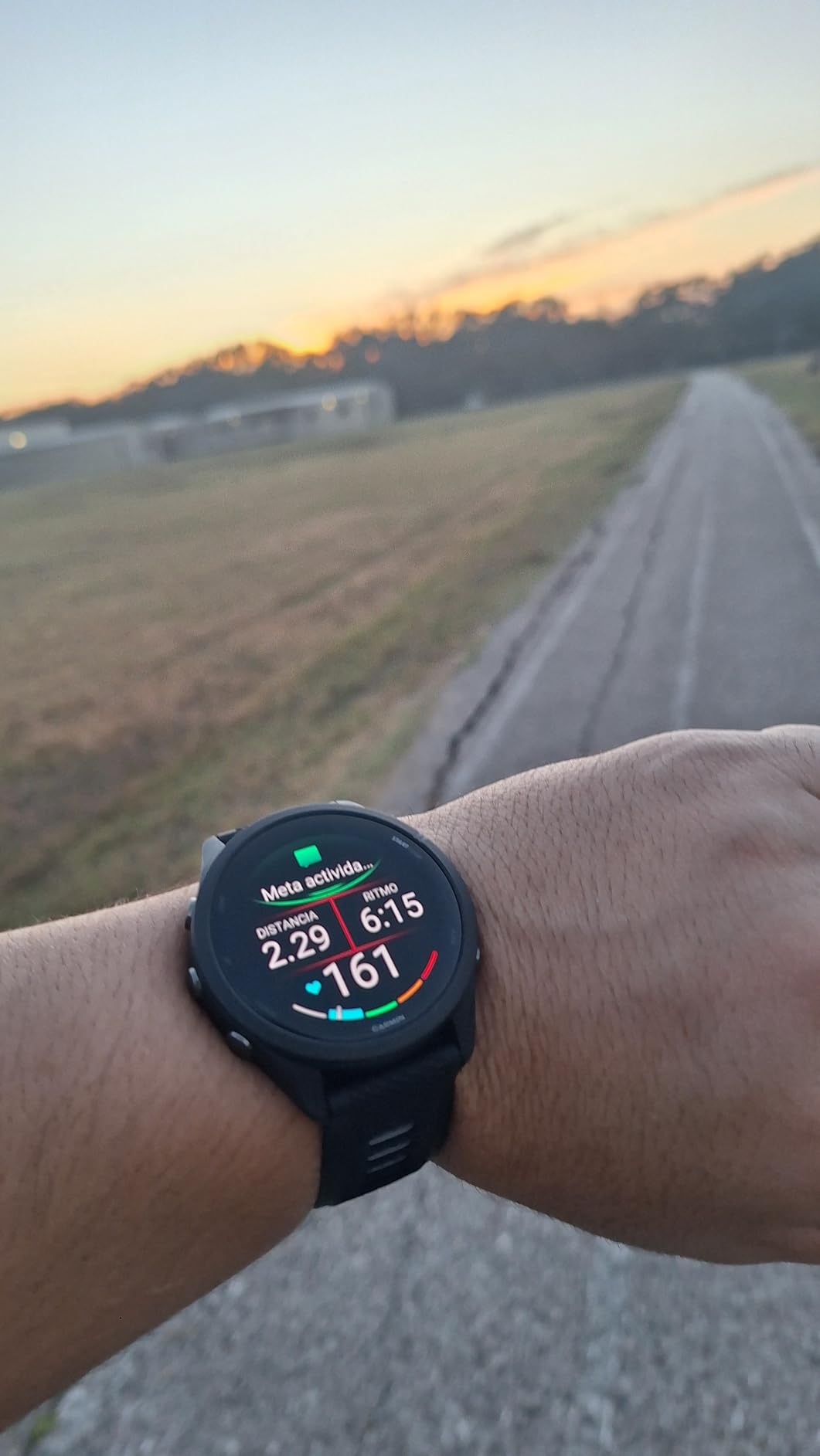
At 4.7 stars across more than 3,000 reviews, the Forerunner 265 is the highest-rated watch in this roundup. It is the one buyers describe as the day the training advice became worth paying attention to.
What separates it from the Forerunner 165 is the training layer. Readiness pulls together sleep, recovery, load and HRV into one number each morning, and training status tells you whether the last block was productive or simply heavy. Multi-band GNSS with SatIQ keeps position steady in woodland and between tall buildings.
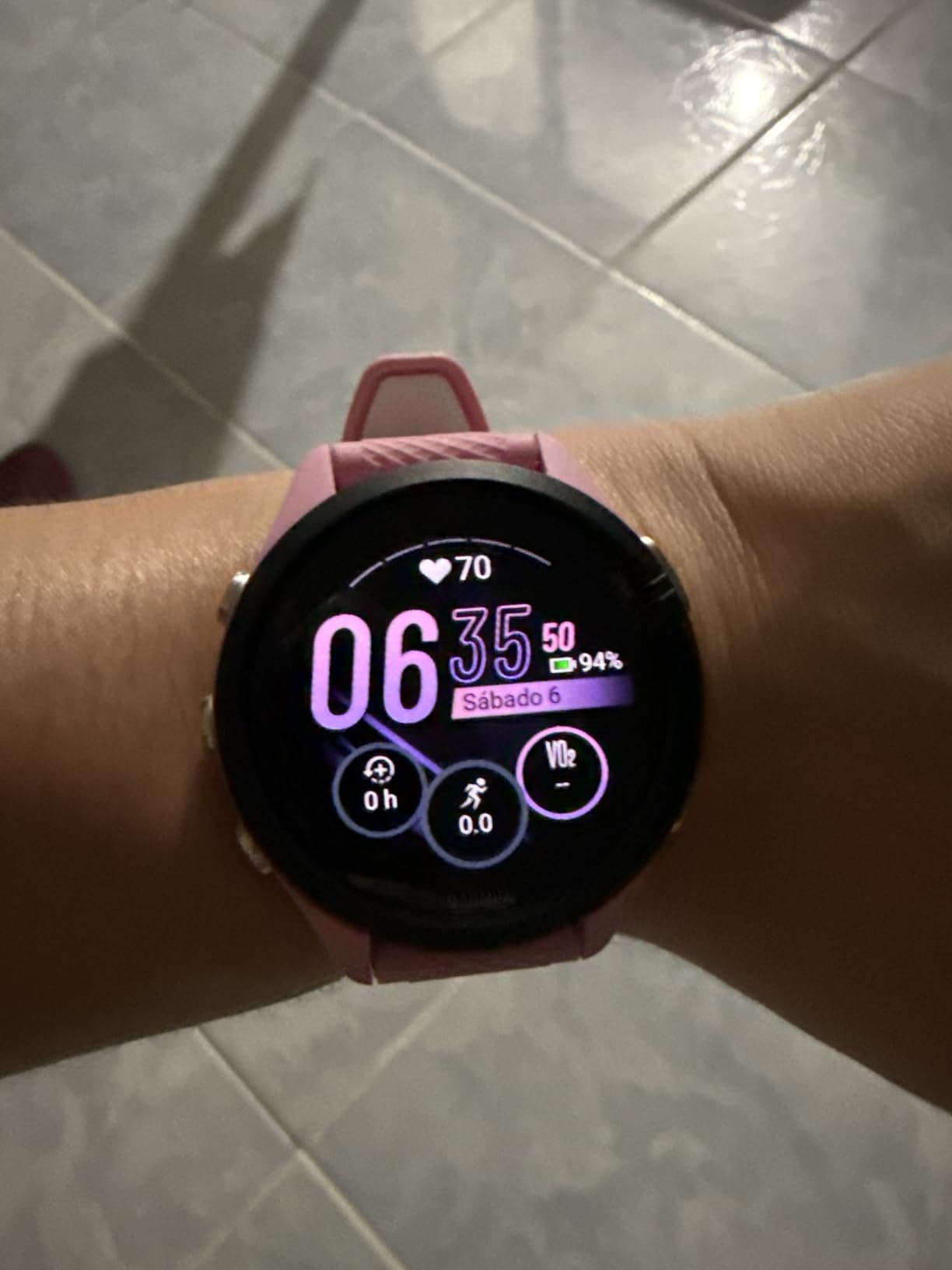
The honest weakness, raised often in reviews, is that sleep scoring is not always reliable, and because readiness leans on sleep, a bad night can throw the morning number off. Several owners also report skin irritation under the raised sensor bezel after long wear.
Compared with the Forerunner 965 you give up full-colour maps and roughly ten days of battery. Compared with the Forerunner 165 you gain readiness, multi-band positioning and music storage.
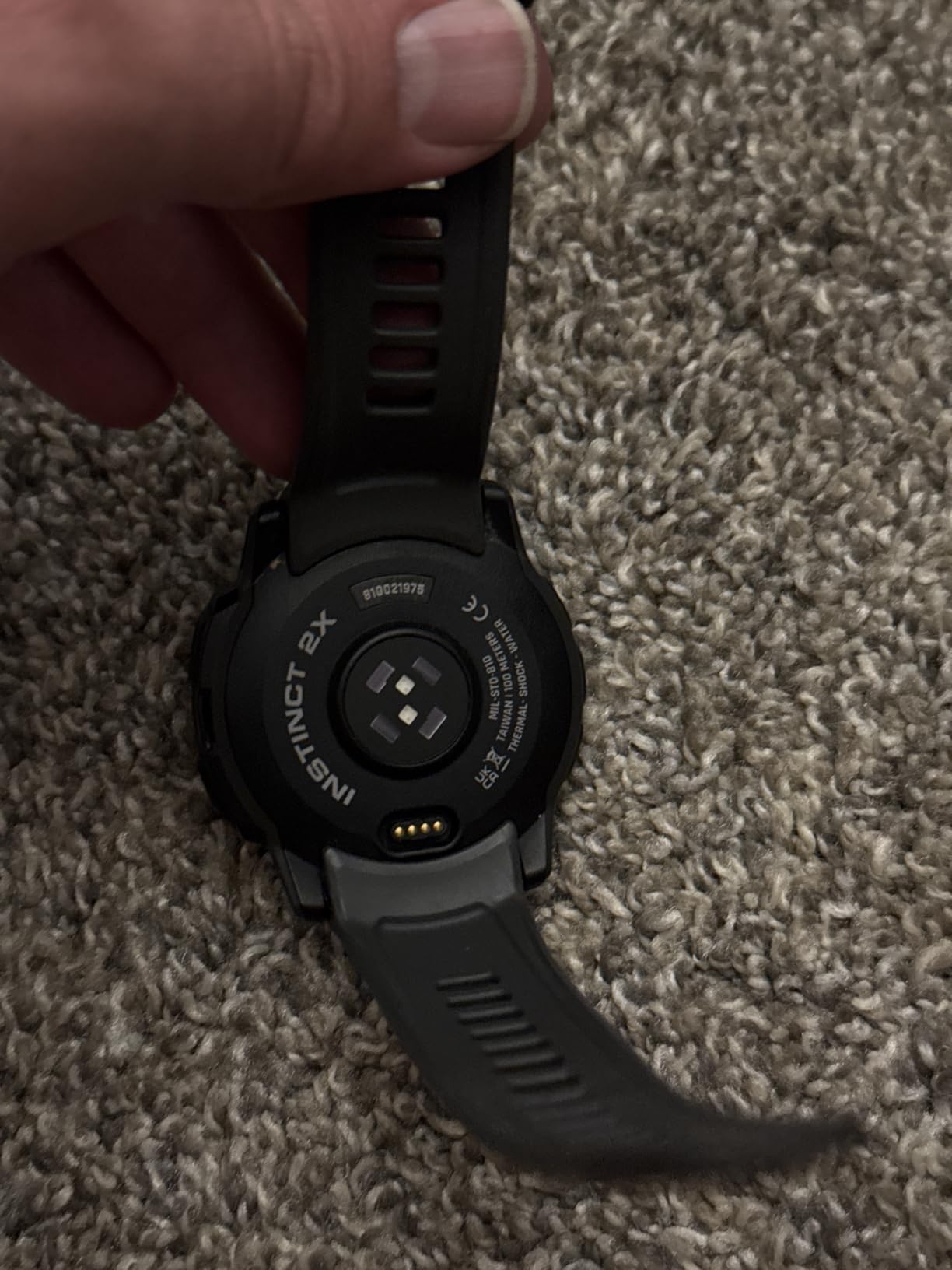
5. Garmin Instinct 2X Solar: Best for Trades and Tactical Use
Garmin Instinct 2X Solar
Type: rugged solar watch
Display: monochrome MIP
Battery: 40 days
Weight: 67 g
Pros
- Solar lens stretches charging to roughly a month
- Built-in LED flashlight with variable intensity and strobe
- MIL-STD-810 rated and water rated to 100 m
- Multi-band GNSS holds signal in valleys and canyons
- Tracback and line-of-sight tracking with no subscription
Cons
- Monochrome screen with no colour or touch
- Basic pointer navigation rather than detailed maps
- Bulky at 50 mm and awkward under long sleeves
Owners who moved here from a colour smartwatch usually write about the same three things: weeks between charges, the flashlight they did not know they needed, and a case that survives a building site.
The solar lens is rated to produce about 50% more energy than the standard Instinct 2 solar model, and Garmin’s claim is effectively unlimited battery in smartwatch mode with three hours of direct sun a day. Reviews put real-world life closer to a month. The built-in flashlight with variable brightness and strobe modes gets used nightly by plenty of owners, which is the feature most likely to surprise a sceptic.
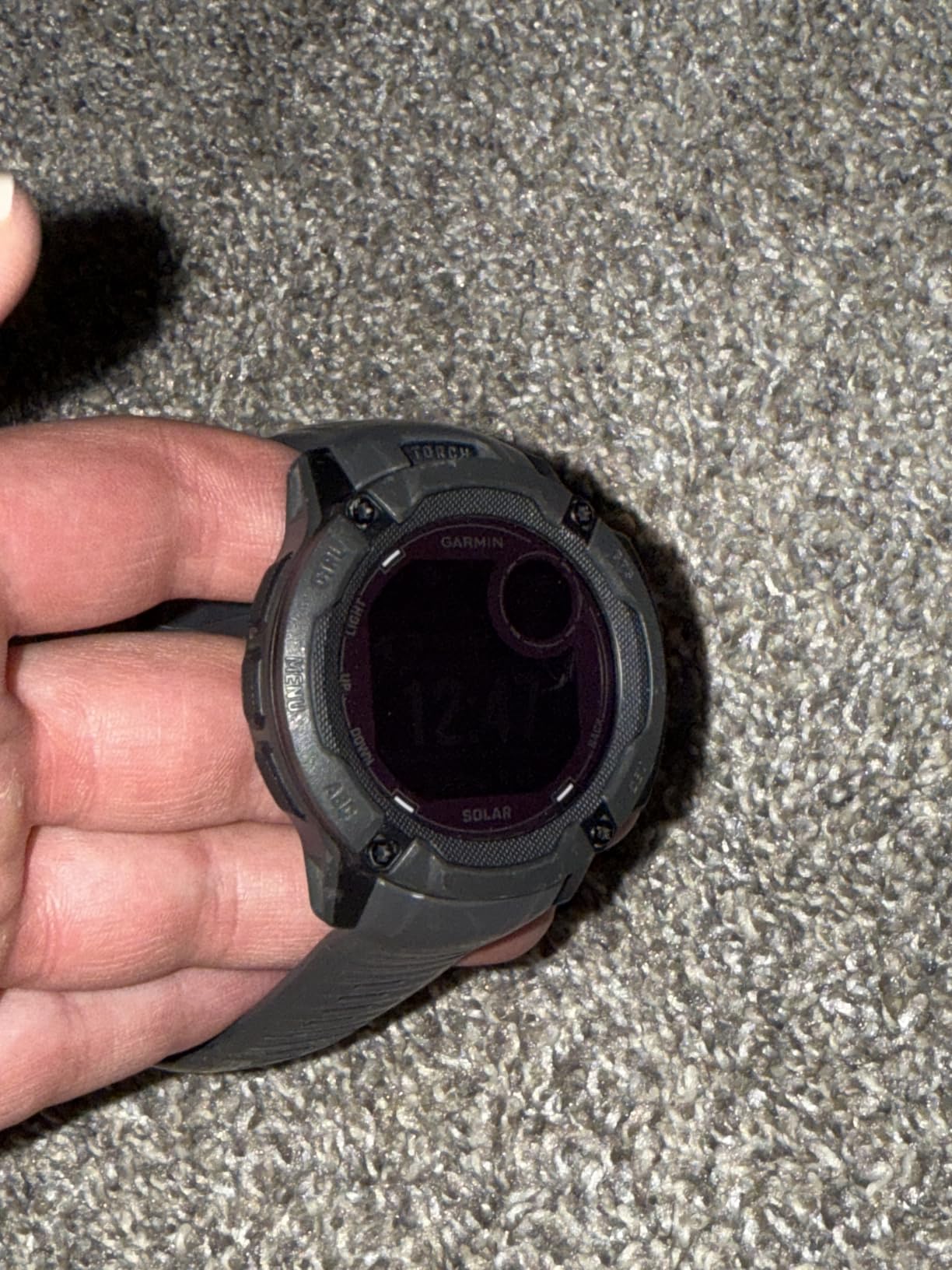
Buyers wanting colour should look at the Instinct 3 AMOLED instead. The 2X screen is monochrome and driven entirely by buttons, and navigation is a pointer and route line rather than proper cartography, so it suits navigation by trail sign and compass rather than by map.
One more caution: at 50 mm and 67 g it is the bulkiest watch here, and owners note it digs in when you sleep. If a watch you forget you are wearing matters, check the fit in a shop.
6. Garmin Forerunner 965: Best for Maps and Ultras
Garmin Forerunner 965
Type: multisport watch
Display: AMOLED
Battery: 23 days
Weight: 53 g
Pros
- Full-colour built-in maps with multi-band GPS
- Up to 23 days in smartwatch mode and 31 hours in GPS
- Lightweight titanium bezel at 53 g
- Triathlon and duathlon profiles plus race adaptive plans
- Wrist running power and running dynamics built in
Cons
- 47 mm case is large for small wrists
- Wrist heart rate can read sluggishly especially over tattoos
- No microphone or LTE so nothing from the wrist
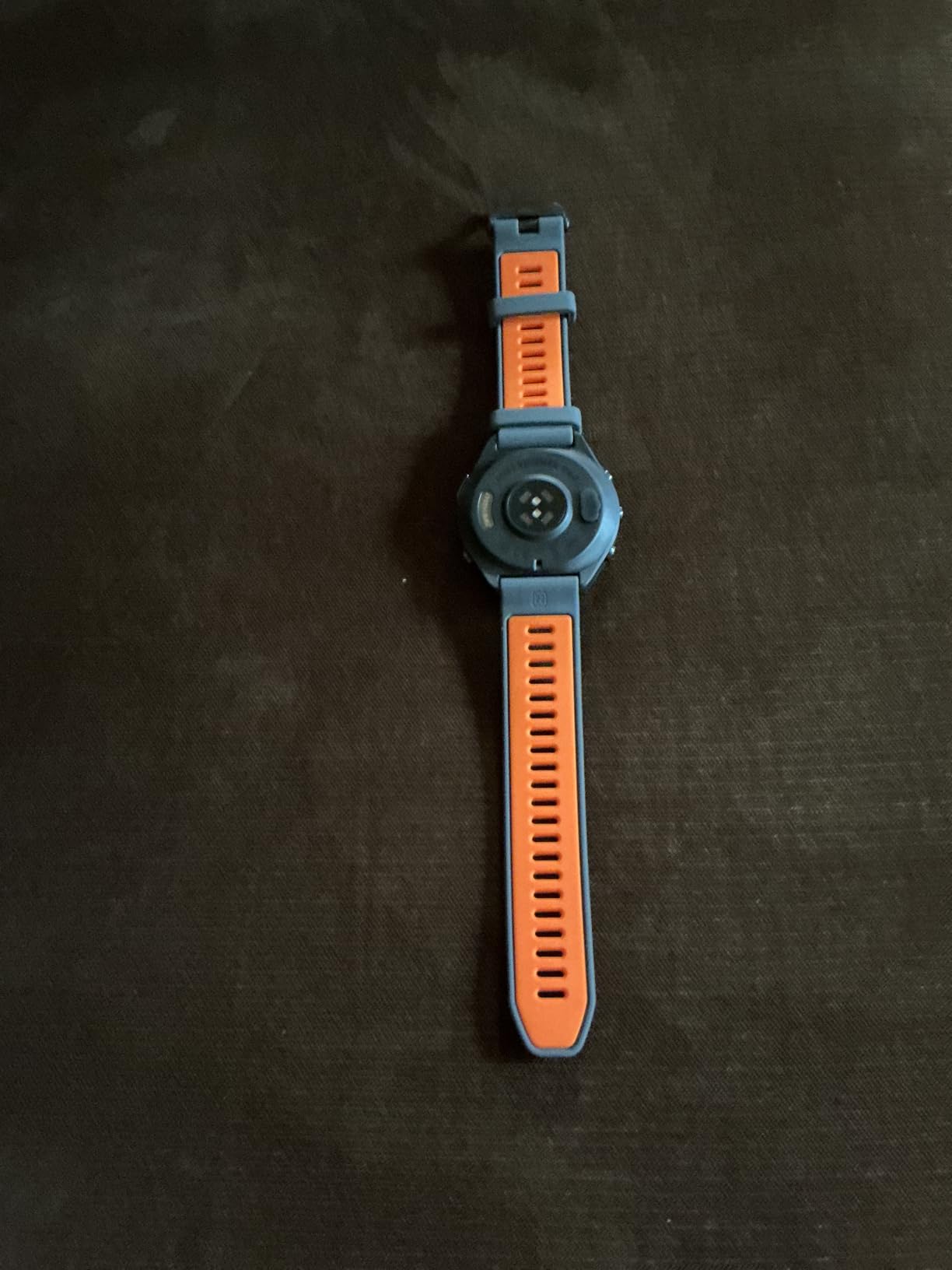
The Forerunner 965 is the watch in this list that solves the Apple Watch battery problem without giving up colour navigation. Built-in full-colour maps plus multi-band GPS make it the strongest route-follower here.
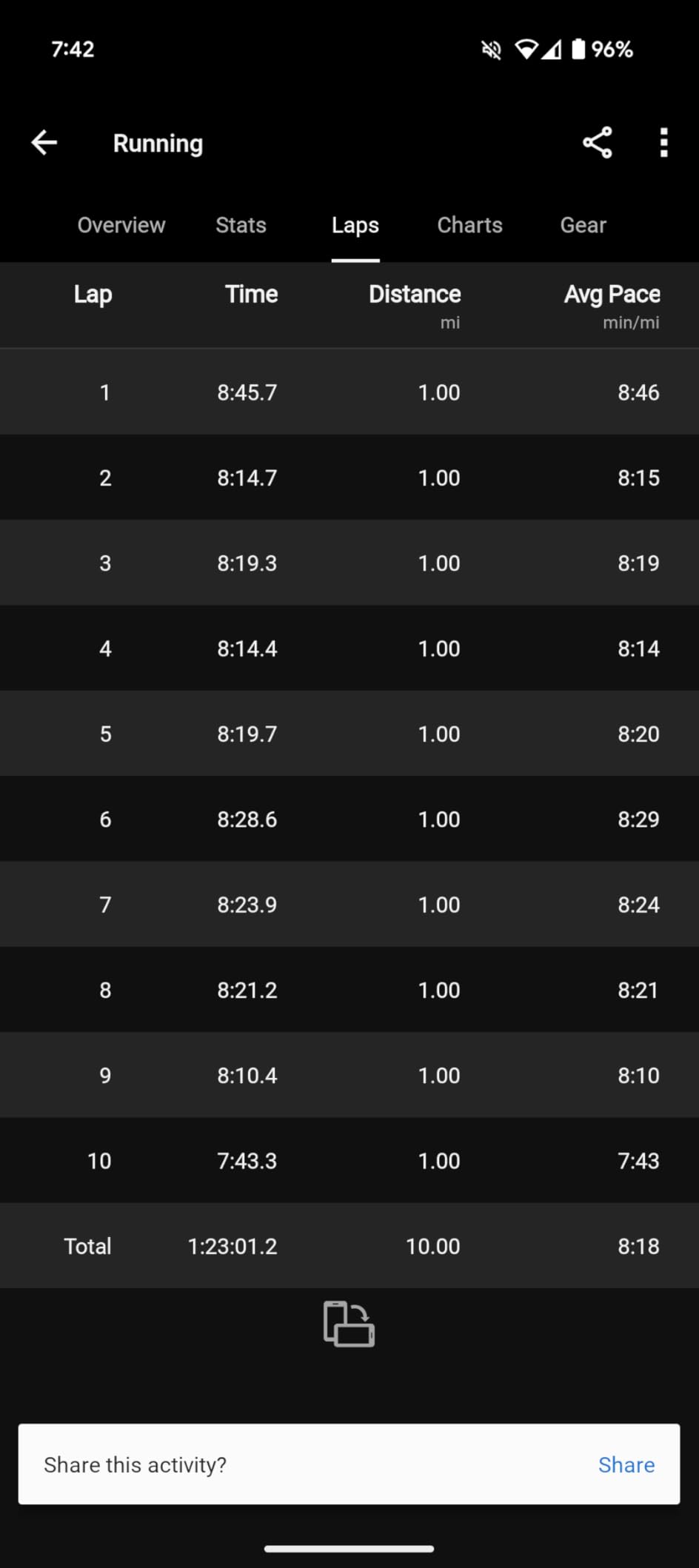
Battery claims run to 23 days in smartwatch mode and about 31 hours in GPS. Reviewers add the detail that matters more: a ten-mile run with music on costs only a few percent. A titanium bezel keeps the 47 mm case at 53 g, light enough to sleep in.
Ultra runners and triathletes get the most out of it, with brick workout, swimrun and duathlon profiles alongside race predictor and adaptive plans. Owners coming from smaller watches report needing a couple of days with the buttons, and the case takes wrist adjustment if you are under about 16 cm.
Compared with the Forerunner 265, this is the step up in navigation and endurance. Compared with the epix Pro Gen 2, it is lighter and lasts longer, but it has no sapphire lens and no preloaded resort maps.
7. Garmin epix Pro Gen 2: Best for Golf and Ski Weekends
Garmin epix Pro Gen 2
Type: adventure watch
Display: AMOLED
Battery: 7 to 16 days
Weight: 70 g
Pros
- Scratch-resistant sapphire lens with titanium bezel and case
- Always-on AMOLED that stays sharp outdoors
- Preloaded golf and ski resort maps plus TopoActive
- Built-in flashlight and Up Ahead turn prompts
- Multi-band GNSS with SatIQ and hill and endurance scores
Cons
- Heaviest watch here at 70 g
- No microphone or speaker for wrist calls
- Menus and buttons take days to master
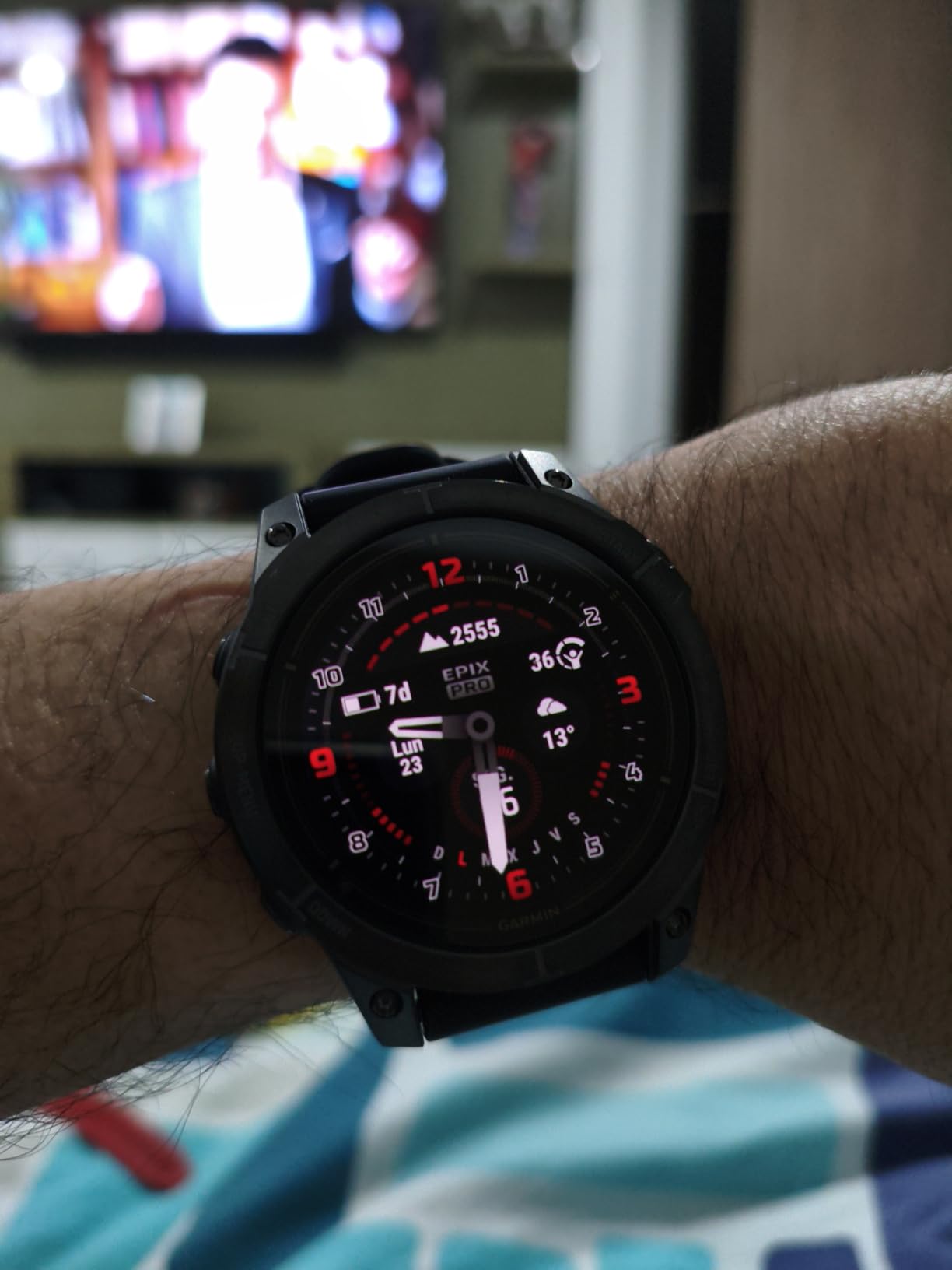
Buy the epix Pro Gen 2 when one watch has to cover a golf round in the morning and a ski trip later in the season. Preloaded golf and ski resort maps and TopoActive maps are the reason, and they work without a phone in the cold.
The hardware is the premium end of the range: a 1.3-inch always-on AMOLED under a sapphire lens, a titanium bezel, water rated to 100 m, plus a flashlight with variable intensity and strobe. Hill score and endurance score make sense of climbing days in a way most running watches ignore.
Battery life depends heavily on how much you leave the screen on. Reviews describe roughly 7 to 16 days in normal use, and fast charging makes an overnight top-up practical.
Good to know before you commit: this is the heaviest watch here at 70 g, and sleep comfort is a genuine issue for some owners even after swapping to a lighter third-party band. The included strap also draws complaints about length.
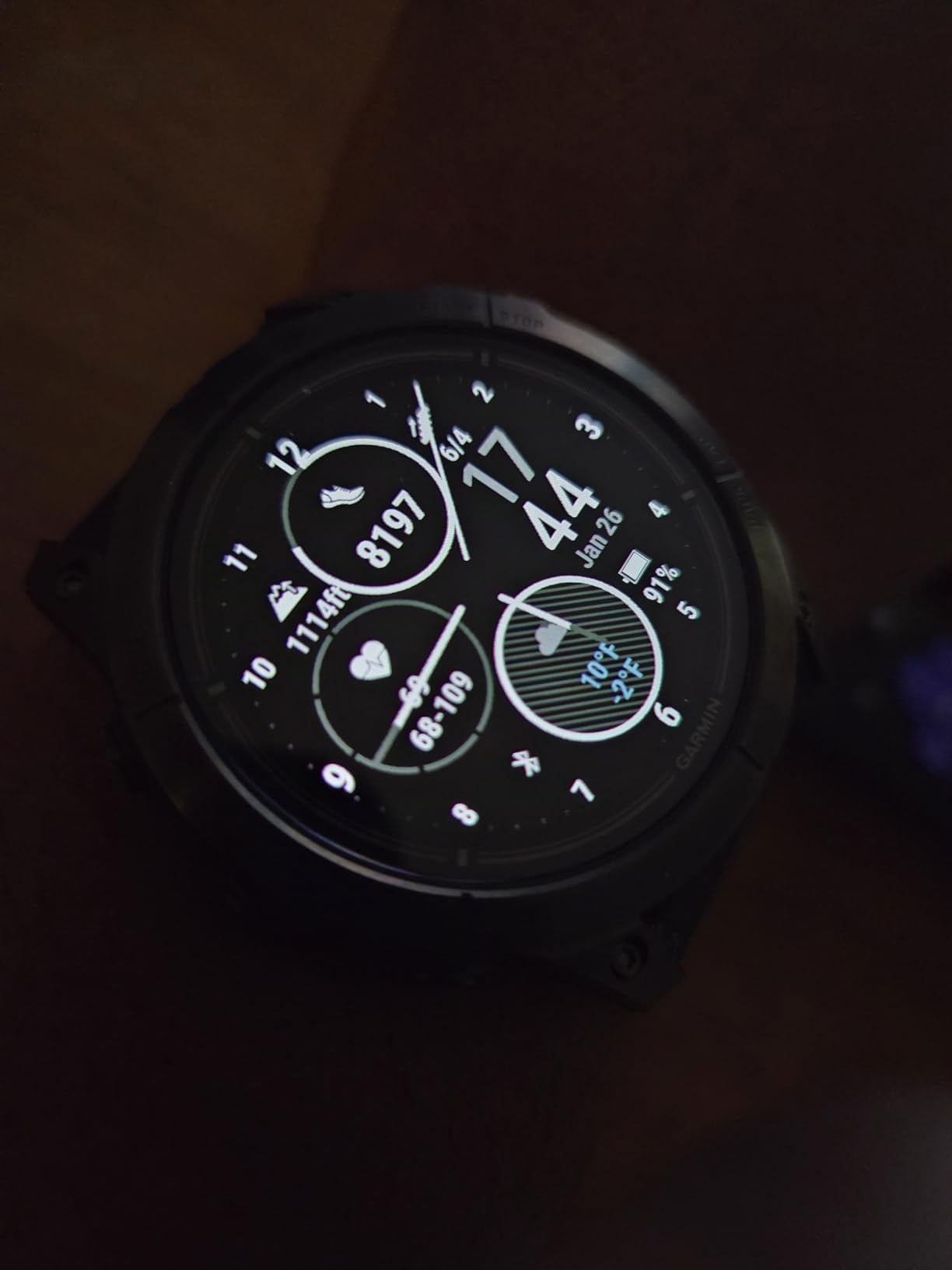
8. Garmin Instinct 3 AMOLED: Best Rugged Watch With a Colour Screen
Garmin Instinct 3 AMOLED
Type: rugged smartwatch
Display: AMOLED
Battery: 18 days
Weight: 53 g
Pros
- Colour AMOLED and about 18 days of battery in one case
- Built-in flashlight with red night-vision mode
- Supertough 45 mm polymer case rated to 100 m
- Multi-band GPS with SatIQ for canyons and tree cover
- Buttons stay reliable in rain mud and gloves
Cons
- No touchscreen at all
- Companion software and menus need a few days to learn
- Not a full mapping watch despite the colour screen
This is the compromise that works for most people. You get a bright colour screen and roughly 18 days of battery in a 45 mm case rated to 100 m, which no other watch in this list puts together.
Owners arriving from a Samsung or Apple Watch notice one thing first: there is no touchscreen. Most reviews say they stop missing it within a week, because buttons remain dependable in rain, mud and gloves. The flashlight includes a red mode for preserving night vision.
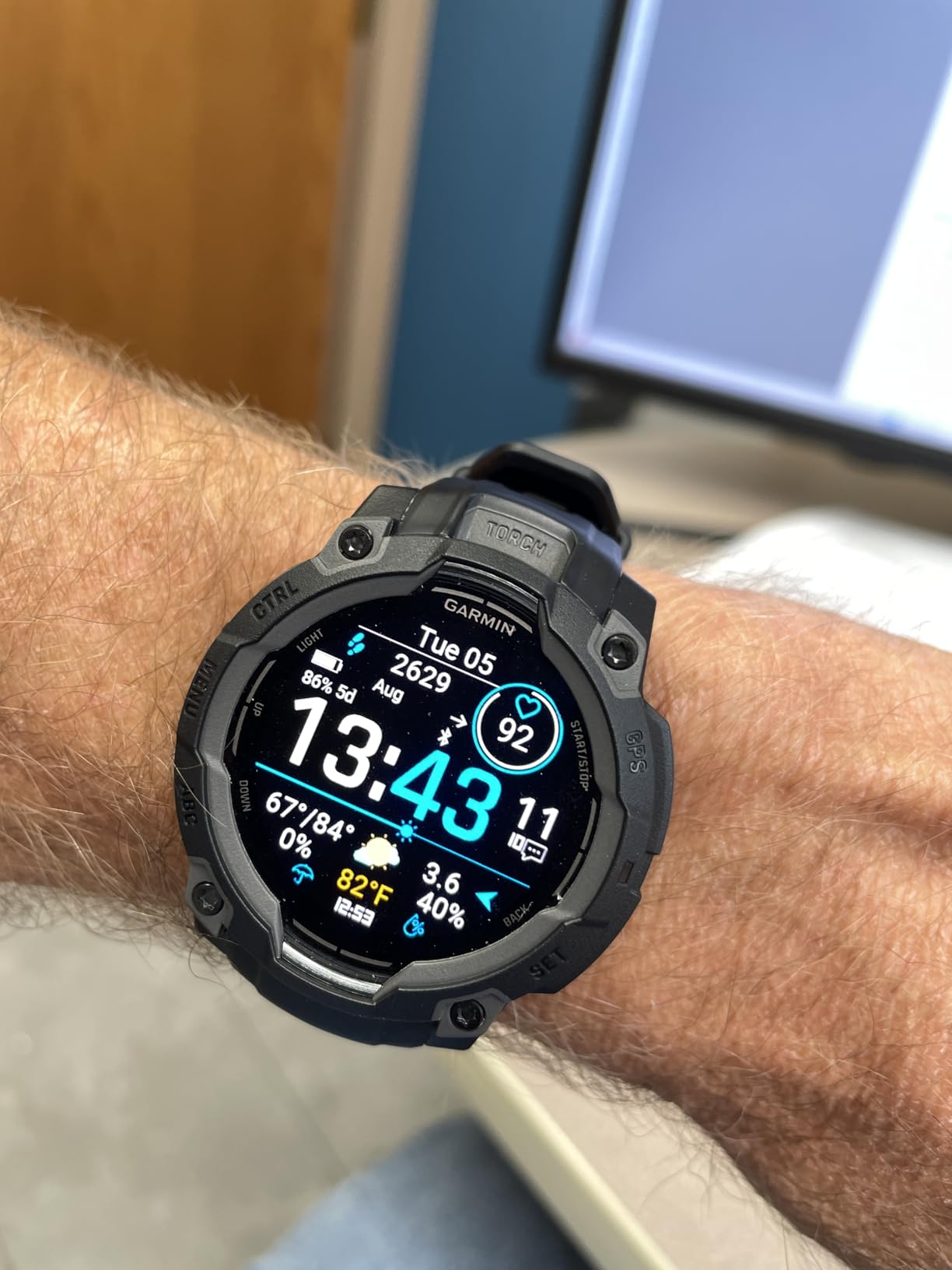
Positioning is handled by multi-band GPS with SatIQ, alongside a three-axis compass and barometric altimeter. It also pairs with inReach devices for messaging and tracking when you are out of phone coverage.
Smaller gripes: the weather and radar app can be slow to respond, the menus need a few days, and no printed manual is included. For navigation, this is a step up from the older Instinct but not a mapping watch like the Forerunner 965.
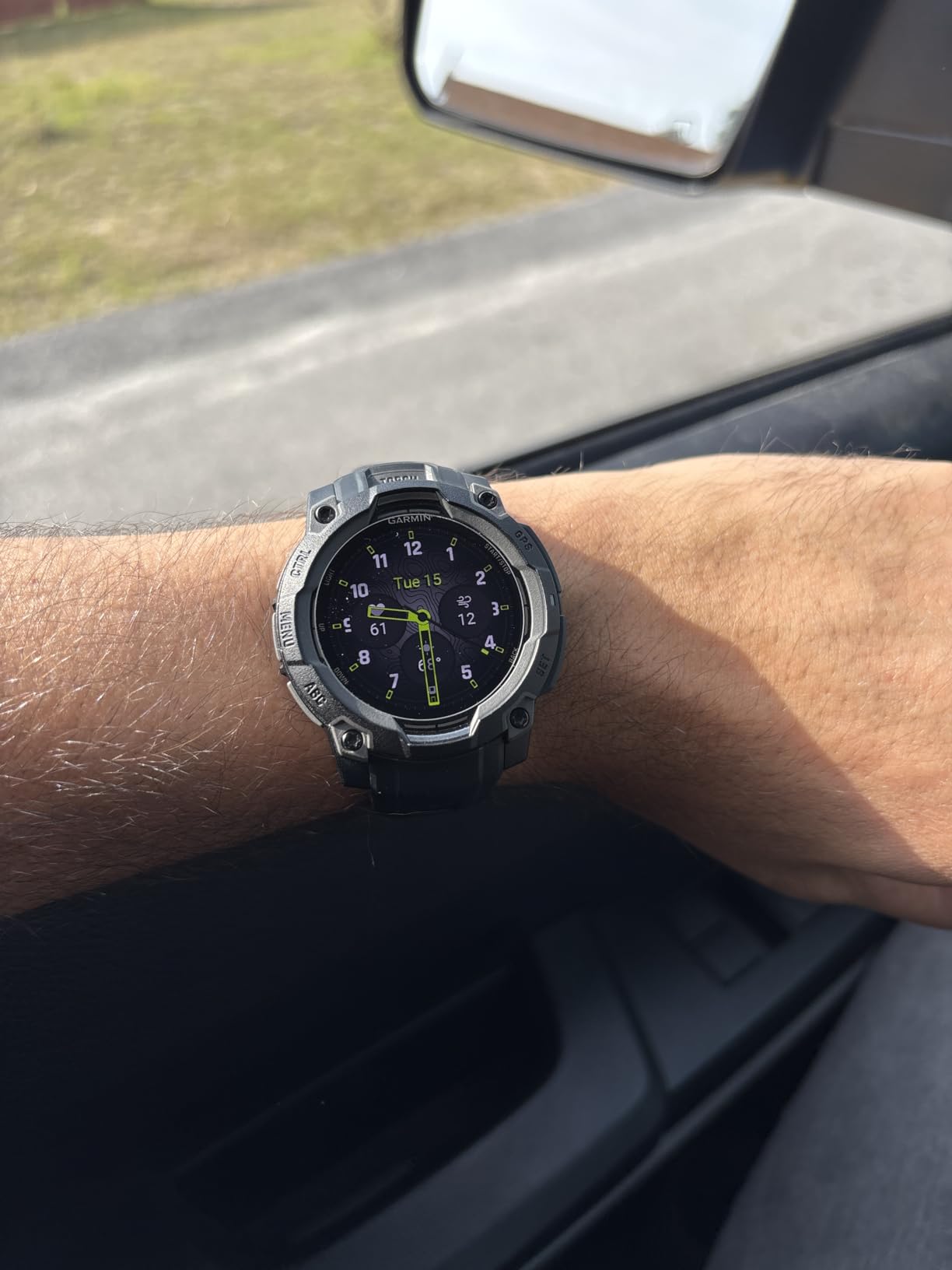
9. Garmin Venu 4: Best for Sleep and Recovery Detail
Garmin Venu 4
Type: lifestyle fitness watch
Display: AMOLED
Battery: 12 days
Weight: 37 g
Pros
- Most attractive design in the Garmin fitness range
- Bright responsive 1.4-inch AMOLED touchscreen
- About 10 to 12 days of real battery
- Sleep coaching and circadian rhythm alignment
- Built-in flashlight with four brightness levels
Cons
- Menu layout is confusing with duplicated options
- Vibration-only alarms get missed by heavy sleepers
- ECG support is region limited in practice
The Venu 4 is the one to look at if sleep is the metric you care about most. Sleep score, personalised coaching and circadian rhythm alignment sit at the centre, and several owners arriving from Fitbit say the numbers land close to what they had before.
Battery is real rather than aspirational: 10 to 12 days for most people, with a built-in flashlight that adds four brightness levels without meaningfully draining it. The stainless steel case and 1.4-inch AMOLED make it the nicest-looking watch here, and at 1.3 ounces it is one of the lightest.
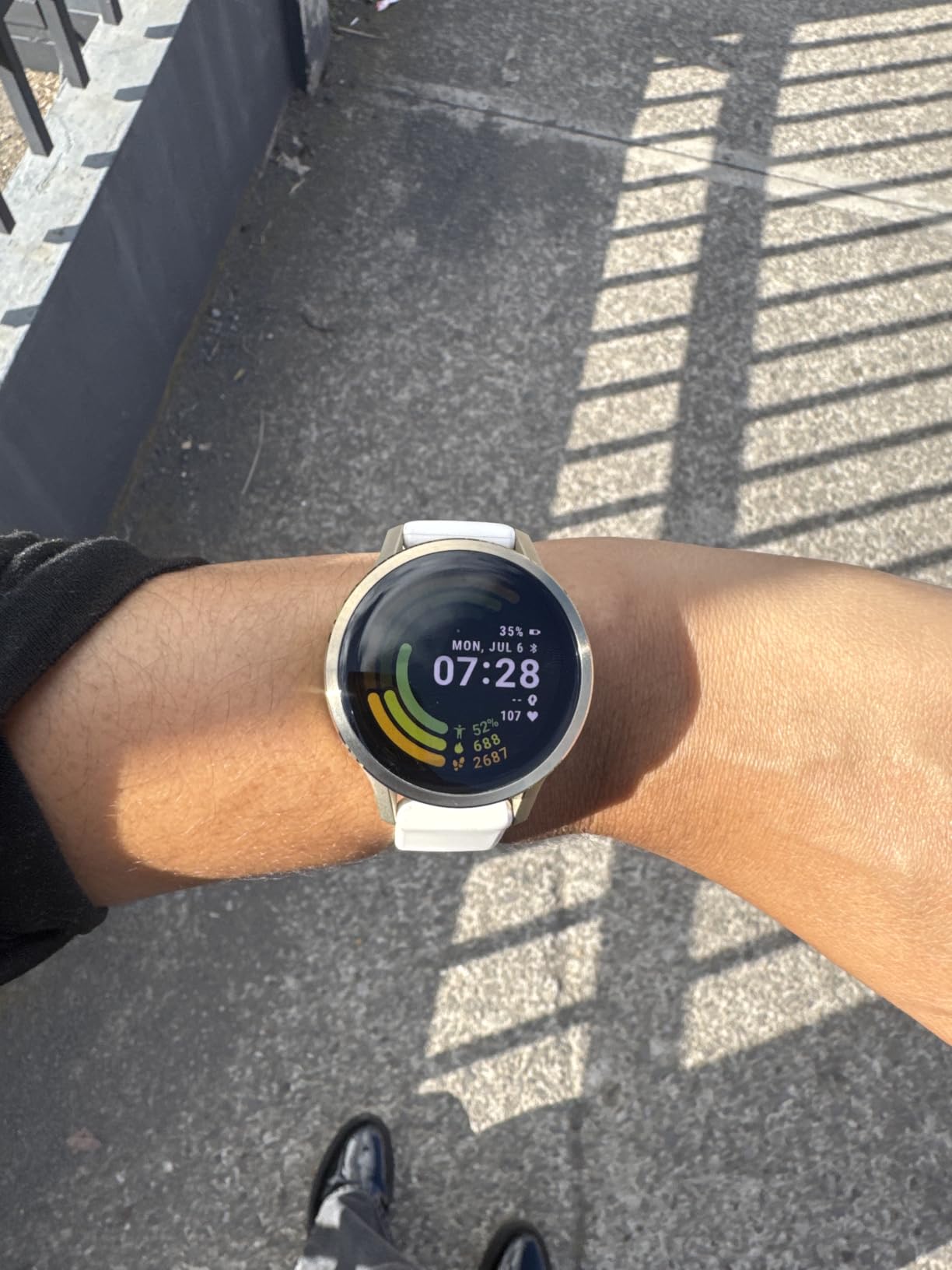
Health status watches for shifts in heart rate, HRV and skin temperature, and you can log daily behaviours such as caffeine or alcohol and see the reports in Garmin Connect. Useful habit data that most training watches skip.
The complaint that comes up most is software ergonomics: a menu structure with options duplicated across screens and settings that are hard to recall later. Vibration-only alarms also get missed by deep sleepers. Serious runners should read it as a lifestyle watch and look at the Forerunner 165 instead.
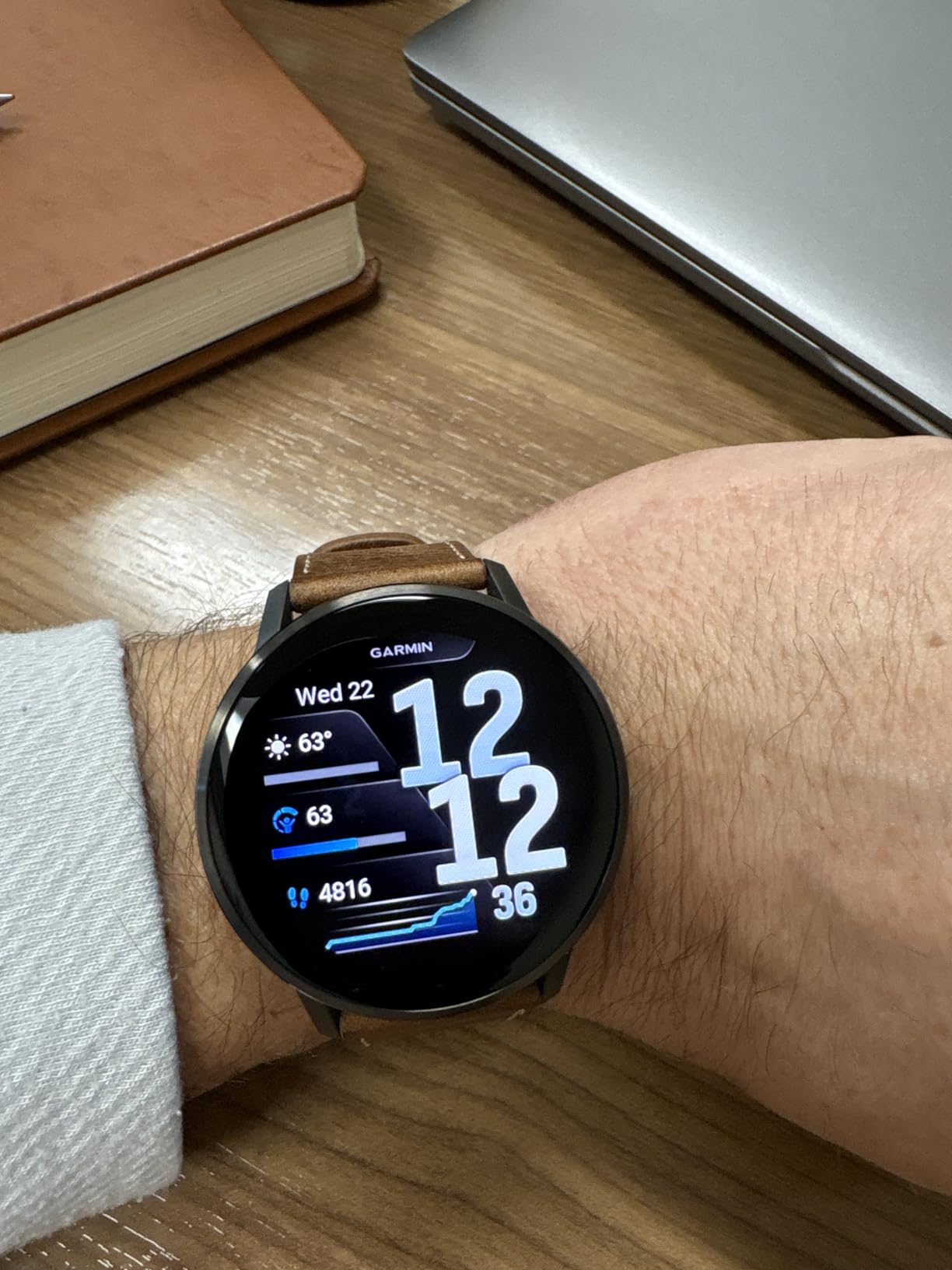
10. Garmin Instinct 2 Solar: Best Rugged Watch for Smaller Wrists
Garmin Instinct 2 Solar
Type: rugged solar watch
Display: monochrome MIP
Battery: 19 to 26 days
Weight: 52 g
Pros
- Real-world battery of roughly 19 to 26 days
- Multi-GNSS with compass and barometric altimeter
- 100 m water rating with a Gorilla glass lens
- Health sleep and training data need no subscription
- Transflective screen stays readable in strong sun
Cons
- Backlight is dim even at maximum brightness
- Solar gain from a couple of hours of sun is small
- Proprietary charge cable is easy to lose
Smaller and lighter than the Instinct 2X Solar at 52 g, this is the rugged pick for a wrist that cannot carry 50 mm. Long-term owners report 19 to 26 days between charges, with solar adding a day or two in summer.
Owners who replaced an old solar Casio or G-Shock tend to describe the same thing: they kept the battery habit and added notifications. Health, sleep and training data need no subscription, which still separates Garmin from plenty of newer rivals.
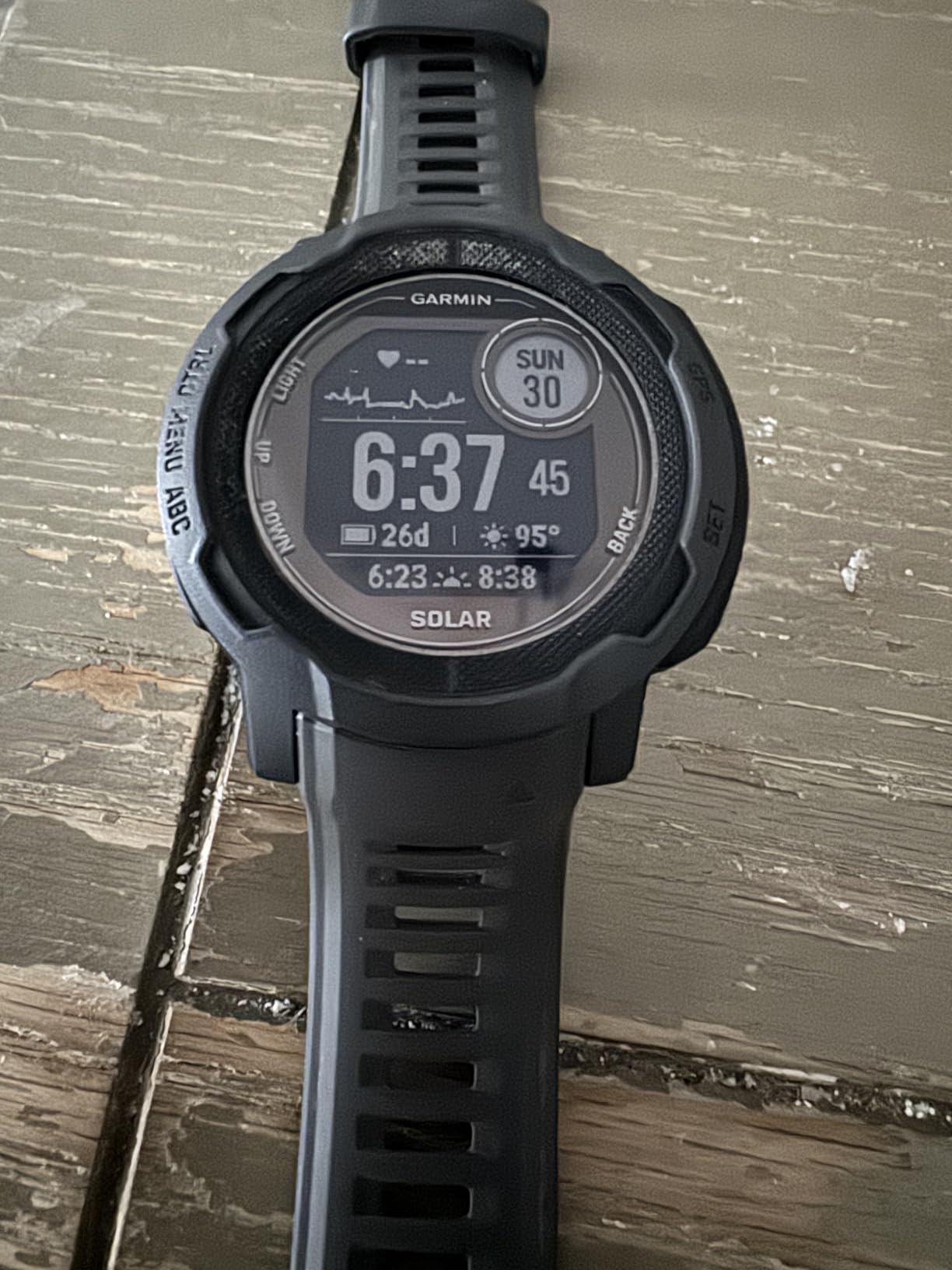
The monochrome transflective display stays readable in bright sunlight, which is exactly what it is for. Navigation is handled by a three-axis compass, barometric altimeter and multi-GNSS across GPS, GLONASS and Galileo, with up to 48 hours in GPS mode.
Recurring gripes: the backlight is dim even at its brightest, the solar panel adds only a few percent from a couple of hours of sun, and the proprietary charge cable is easy to lose and costs extra to replace. Owners also note barometric altitude drift on steep climbs.
How to Choose Garmin Devices During Prime Big Deal Days
Start With the Activity You Actually Do
Start with the activity, not the discount. A trail runner needs positioning you can trust in canyons, a swimmer needs pool profiles and a water rating, and someone who wants notifications on the wrist needs a screen they can actually read outdoors.
Second, decide how long a week you want between charges. Two weeks points to the Forerunner 55, roughly 11 to 13 days covers the vívoactive 5 and Forerunner 165, and anything above 18 days means the Instinct or epix end of the range.
GPS, Maps, and Navigation
Multi-band positioning, listed as multi-band GNSS or SatIQ, holds a lock in woodland and between tall buildings where a basic receiver wanders. In this list that appears on the Forerunner 265, Forerunner 965, Instinct 2X Solar, Instinct 3 AMOLED and epix Pro Gen 2.
Full-colour maps are a separate feature from positioning, and only the Forerunner 965 here carries them. The epix Pro Gen 2 adds preloaded golf and ski resort maps, while the older Instinct models navigate by pointer and route line. If you will be off-grid without a phone, maps matter more than the sensor list.
Activity and Sensor Features
Wrist heart rate is standard across all ten watches, and owners repeatedly note that a chest strap is still more accurate for zone-based work. What differs is the analysis layer: training effect appears from the Forerunner 165 up, training readiness and training status from the Forerunner 265 up, and hill and endurance scores on the epix Pro Gen 2.
For golf and winter sport, check the profile list rather than the specs. The epix Pro Gen 2 carries preloaded resort maps for both. For strength and court sports, several watches here add profiles such as HIIT, soccer and racquet sports.
Battery Life and Outdoor Durability
Two things matter more than the headline claim: what mode you will actually use it in, and how rough the day is. A watch rated in weeks in smartwatch mode can drop to hours of continuous GPS, so check both numbers against how you run, ride or hike.
Water rating separates the ranges too. Most watches here are rated to 50 m for swimming and rain; the Instinct 2X Solar, epix Pro Gen 2, Instinct 3 AMOLED and Instinct 2 Solar are rated to 100 m for open-water and surf work. Solar charging adds a day or two in summer rather than transforming the battery. If you want the gear that goes with long days outdoors, our picks for Big Green Egg grills follow the same logic: buy for the use, not the discount.
Connectivity and Smartwatch Compatibility
None of these watches makes calls or replies to messages. Every one pairs with an Android or Apple phone over Bluetooth for notifications, and all of them need the Garmin Connect app for configuration, so check that your phone is on the supported list before buying.
What varies is phone dependence after setup. The vívoactive 5, Forerunner 265, Forerunner 965, epix Pro Gen 2 and Instinct 3 AMOLED carry music storage, so playlists play without the phone nearby. None has a microphone or speaker.
How to Shop Garmin Deals During the Sale
Check the model number in the listing details before you commit. Numbers ending in a newer code indicate a later generation, and the case diameter tells you the size you are actually buying, which matters more for fit than the colour name does. Look at what the box contains, whether the unit is new or renewed, and who the seller is rather than the badge on the offer.
Most offers need a Prime membership, with a free trial counting, and offers change through the event. Confirm the exact variant and band width in your screenshot so you know what arrived if a price moves later.
- Match the case size to your wrist: 42 mm and under is small, 45-46 mm is the middle, 47 mm and above is large
- Confirm the model number to check you are getting the generation you researched
- Check whether music storage is on that specific model, not just the range
- Look at the water rating: 50 m for pool swimming, 100 m for open water
- Verify the seller and whether the unit is new or renewed
- Note that Garmin runs its own promotions all year, so an October offer is not the only one you will see
Frequently Asked Questions
When does Amazon Prime Big Deal Days run in 2026?
Amazon Prime Big Deal Days runs October 6-7, 2026, as a two-day event across the whole store. Garmin watches are among the product types that typically see reduced prices during it, though which individual models are included changes from year to year.
Do I need a Prime membership to buy a Garmin during Prime Big Deal Days?
Most offers during the event require a Prime membership, and a free trial counts for the length of the trial. A small number of offers run for everyone, so it is worth checking whether a listing shows the Prime price or a general price before deciding whether to start a trial.
Are Amazon Prime Big Deal Days Garmin deals the best Garmin offers of the year?
Not always. Garmin runs its own promotions through the year, and some models see deeper reductions outside Amazon events, so an October offer is worth taking when it matches what you wanted but it is not guaranteed to be the lowest price a model ever reaches.
How can I tell whether a Garmin sale listing is the latest model?
Look for the item model number in the product details and the release date, and compare the case diameter and display type with the generation you researched. Colour names repeat across years, so the model number is the reliable signal. The same habit pays off elsewhere: u003ca href=u0022https://modelrec.com/best-35mm-prime-lenses/u0022u003e35mm prime lensesu003c/au003e are easy to mix up between revisions for exactly the same reason.
Can Garmin devices be used without a smartphone?
Yes, for tracking and navigation. Every watch here records workouts, sleep, heart rate and GPS routes on the device itself. What needs a phone is setup, configuration and smart notifications, and the watches that store music can play playlists with the phone out of range.
Final Verdict: Best Amazon Prime Big Deal Days Garmin Deals
Buy the vívoactive 5 if you want the safest all-round choice: the most owner feedback in this group, an AMOLED screen and about 11 days between charges. Buy the Forerunner 165 if you run most days and want a bright screen at a mid-tier level, and pick the Forerunner 265 when training analysis is the reason you want a Garmin at all.
For battery measured in weeks and a case that survives rough work, the Instinct 3 AMOLED gives you a colour screen alongside the rugged build. The Instinct 2X Solar is the monochrome alternative with a flashlight and solar charging. Smaller wrists are better served by the Instinct 2 Solar, while the Forerunner 965 and epix Pro Gen 2 cover the map-heavy and premium ends, with the epix adding sapphire, titanium and preloaded resort maps.
Pick the model that fits the activity first, then check the current price on the listing during the sale, because offers move through the event.