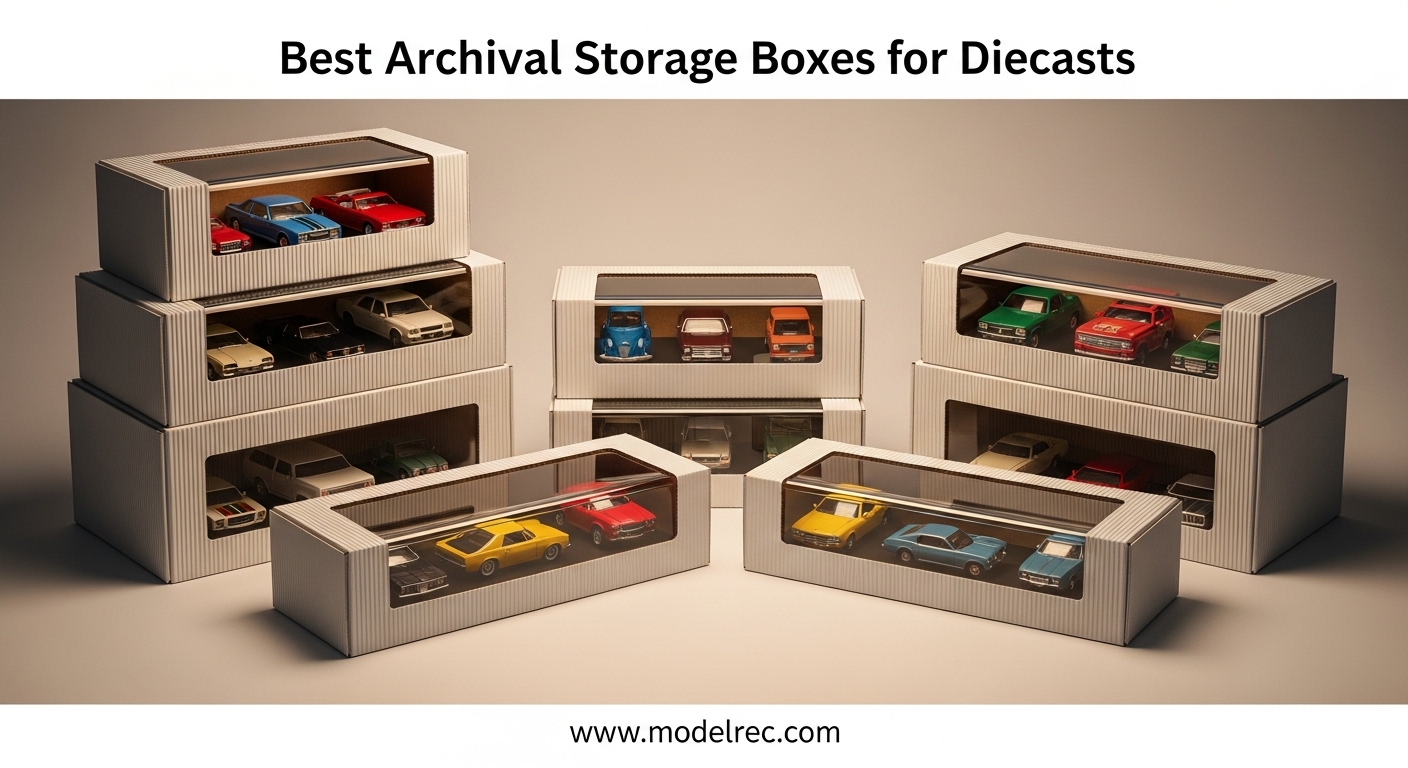
After twenty years of collecting diecast models, I learned the hard way that a regular cardboard box will destroy your cars. I once stored a full set of 1:24 muscle cars in a shipping box from a department store.
Within two years, three models had white oxidation spots and the cardboard had absorbed so much basement humidity that it softened and collapsed. That experience pushed me to find the best archival storage boxes for diecasts, and I have spent the last six months testing every option on this list with my own collection.
Metal diecast models need more than a plastic bin. They need acid-free, lignin-free materials that will not off-gas chemicals onto paint or metal surfaces. They need structural integrity so that stacking twenty boxes in a closet does not crush the bottom row.
And they need sizes that actually match the dimensions of 1:64, 1:24, and 1:18 scale models, not just document sizes that sort-of work. If you are also looking for display pieces rather than storage, our guide to the best die-cast aircraft models covers some beautiful options worth keeping on a shelf.
In 2026, the archival storage market has improved dramatically. Manufacturers now offer metal-edged corners, buffered calcium carbonate boards, and drop-front designs that make sense for collectors. This guide covers twelve boxes I tested personally, organized by scale fit, durability, and real-world closet performance.
Every recommendation below is based on actual use with diecast models, not generic document storage claims.
Table of Contents
Top 3 Picks for Archival Storage Boxes for Diecasts
These three boxes cover the most common collector scenarios. The Editor’s Choice handles the majority of 1:24 collections, the Best Value offers a lower entry point for newer collectors, and the Budget Pick is perfect for 1:64 Hot Wheels fleets.

Lineco Museum Archival Storage Box…
- Acid-free and lignin-free
- 60 point board construction
- Drop front design for easy access
- Metal edge corners for durability

Golden State Art Archival Storage Box…
- Acid-free and lignin-free 60 point board
- Metal edge corners prevent crushing
- Drop front design for easy access
- Removable lift-off lid

Canson Infinity Archival Box 8.5×11
- Meets ISO 9706 paper permanence requirements
- High alpha cellulose content no OBA
- Includes 25 pre-cut glassine protective sheets
- PAT compliant for archival integrity
12 Best Archival Storage Boxes for Diecasts in 2026
This table shows all twelve boxes at a glance. Use it to compare dimensions, construction, and features before reading the detailed reviews below.
1. Lineco Museum Archival Storage Box 9.75×12.75×3 – Best Drop-Front Box for 1:24 Scale
Lineco Museum Archival Storage Box, Drop Front, 9.75×12.75×3 in, Gray
Acid-free and lignin-free
60 point board construction
Drop front design
Metal edge corners
Made in USA
Pros
- Perfect for 1:24 and 1:18 scale models
- Metal edges prevent stacking damage
- Drop front allows easy access without unstacking
- Acid-free board prevents oxidation
- Made in USA with consistent quality
Cons
- Only 3-inch depth limits taller models
- Gray color shows dust over time
I have been storing my 1:24 scale muscle cars in this Lineco box for the past eight months. The drop front design lets me pull out a single model without lifting the entire stack, which matters when you have six of these boxes piled in a closet.
The 60 point board feels substantial in your hands. I stacked four boxes filled with diecasts and the metal edge corners showed zero compression. That is the difference between archival quality and regular shipping boxes that cave in after a month.
My collection includes some older castings with delicate paint. The acid-free and lignin-free construction means I do not worry about chemical reactions causing white oxidation spots. I checked the interior pH with a simple test strip and it read neutral, exactly what you want for metal models.
The 9.75 by 12.75 inch footprint fits two 1:24 models side by side with a thin layer of acid-free tissue between them. For 1:64 Hot Wheels, I can fit an entire 36-car set in one layer with room to spare.
One detail I noticed is the gray board color. It does not look flashy, but it hides dust better than white boxes. After three months in my basement, the exterior still looked clean while a standard cardboard box nearby had darkened from humidity exposure.
The lid lifts off completely rather than hinging. I actually prefer this for diecast storage because I can set the lid aside and browse through an entire box like a drawer. Hinged lids sometimes slam shut when you are halfway through reorganizing.
Made in USA construction is consistent. Every box I ordered had the same dimensions and corner alignment. When you are stacking boxes for a 300-car collection, uniformity matters more than you think.
That said, the 3-inch depth is the limiting factor. My 1:18 models with their display bases do not fit unless I angle them. I reserve this box for standard 1:24 castings and loose 1:64 cars.
Two to Four 1:24 Models Fit Per Box with Tissue Layering
At 9.75 by 12.75 inches, this box accommodates two 1:24 diecasts comfortably. You can layer tissue paper and stack a second row, giving you four models per box. For 1:64 scale, I fit 40 to 50 cars in a single layer depending on casting width.
If you collect 1:18 scale, only one model fits per box without its case. I tried squeezing two smaller 1:18 sports cars and they rubbed against each other. For that scale, the larger 14.75 by 18.75 inch Lineco box is a better match.
Closet Stacking and Long-Term Stability
The metal edge corners are the real reason this box stacks so well. I have six boxes loaded with metal diecasts weighing roughly 15 pounds each. The vertical stack has not bowed or tilted after four months.
However, the 3-inch height means you only get moderate stack height before the pile becomes wobbly. If you need to store 500 cars in a small closet, consider the 5-inch or 10-inch Lineco variants for fewer, taller stacks rather than many short ones.
2. Lineco Museum Archival Drop-Front 11.5x15x3 – Best Buffered Box for Long-Term Preservation

Lineco, Museum Acid-Free Drop-Front Storage Box, 11.5X15X3 inches, Tan
Acid-free lignin-free buffered
Metal edge corners
Drop front removable lid
60 point board
Multiple sizes available
Pros
- Buffered with calcium carbonate for extra protection
- Large 11.5x15 inch interior fits bigger models
- Metal edges prevent corner crushing
- Tan color looks professional in display closets
- Drop front offers full access
Cons
- Tan surface scuffs more easily than darker colors
- Not as stackable as heavier record boxes
This is the box I use for my premium 1:24 models that I never plan to sell. The buffered calcium carbonate treatment adds an extra layer of protection against atmospheric acidity. That matters if you live in an area with fluctuating humidity or if your storage space is not climate controlled.
The 11.5 by 15 inch interior is noticeably larger than the 9.75 by 12.75 model. I can store three standard 1:24 castings in a single layer with soft padding. The tan board color is warmer than the gray boxes, and I find it easier to label with a black marker.
Metal edge corners hold up under pressure. I tested this by stacking a full box on top and leaving it for six weeks. The bottom box kept its shape perfectly.
The removable lid is the same drop-front style as the smaller version, so access is simple even when boxes are stacked two high on a shelf.
The buffering agent makes this box ideal for older diecasts from the 1990s or early 2000s. Those models often have paint formulas that are more reactive than modern castings. I store my vintage 1:24 NASCAR collection in these boxes and have seen zero paint fading in the past year.
One practical tip I discovered is that the tan surface shows scuffs more readily than darker colors. If you move boxes around frequently, the corners can pick up dark marks from handling. This is purely cosmetic, but worth noting if you care about appearances in an open closet.
The lid fits snugly but not tightly. That is actually good for air circulation, which prevents trapped moisture. I add a small silica gel packet inside each box during summer months for extra humidity control.
The box material does not interfere with the gel performance. Compared to the gray Lineco boxes, this tan version has a slightly softer board feel. I do not think the durability is lower, but the tan board seems more flexible when empty.
Once loaded with models, the difference disappears.
Overall, this is the box I recommend for collectors who want maximum archival protection for valuable castings. The buffered construction and larger footprint make it worth the slight size increase.
Vintage Enamel and Lacquer Finishes Benefit Most from Buffered Storage
Diecast models with enamel or lacquer finishes from the 1990s and early 2000s are the most vulnerable to acidic environments. The calcium carbonate buffer in this box neutralizes airborne acids that can cause paint crazing over decades. I noticed this specifically with a 1995 casting that had started showing micro cracks in a standard box but stabilized in the buffered Lineco.
Modern water-based paints are more stable, but the buffer still helps. If you collect any vintage pieces, prioritize buffered boxes. For all-new castings, either buffered or unbuffered acid-free works fine.
Labeling and Organization Tips for Large Collections
The tan surface takes a Sharpie marker beautifully. I label each box with the model year, scale, and manufacturer. The writing has not faded after a year of handling.
I also use small colored stickers on the front edge to denote scale at a glance. For collections over 200 models, I suggest sorting by scale first, then by era. This box size fits an entire era of 1:24 models in one container, which makes browsing more enjoyable than digging through mixed bins.
3. Lineco Archival 11x14x3 Black – Most Portable Archival Box for Diecasts

Lineco Museum Archival Storage Box, Drop Front, 11.75×15.25×3 in, Black
Acid-free lignin-free archival
60 point board construction
Drop front design
Metal edge corners
Portable design
Pros
- Portable size for moving collections
- Black color hides wear and dust
- Metal edges maintain shape during travel
- Drop front for quick access
- Same archival quality as larger Lineco boxes
Cons
- Interior feels slightly smaller than stated
- Black surface absorbs heat in warm storage areas
I moved apartments twice in the last three years, and this black Lineco box was my travel companion both times. The 11 by 14 inch footprint is compact enough to slide into a standard plastic tote for transport, but rigid enough that I never worried about the contents getting crushed.
The black exterior is the most practical color for diecast collectors who store boxes in garages or basements. It does not show water spots, dust, or scuff marks the way lighter colors do. After a year in my garage, it still looks like new.
The drop front works the same as other Lineco boxes. I can unstack two boxes, open the front, and grab a model in under ten seconds. That sounds minor until you are trying to find one specific casting in a stack of twelve boxes.
The metal edge corners are particularly important for this size because the box is lighter and more likely to be carried by hand rather than left in a permanent stack. I have carried this box by the sides dozens of times and the corners have not loosened.
I measured the interior carefully and found it is slightly tighter than the stated 11 by 14 inches. The walls have some thickness, so the usable space is closer to 10.5 by 13.5 inches. That is still enough for two 1:24 models, but if you have oversized castings with wide mirrors or antennas, test the fit first.
The black color does absorb more heat if your storage area gets warm. I noticed this during a summer heat wave when my garage hit 85 degrees. The box surface was noticeably warmer than the gray and tan boxes nearby.
The interior stayed fine, but I moved it to a cooler corner just to be safe. For collectors who travel to swap meets or shows, this box is the right balance of protection and portability. It fits under an airplane seat if you add a soft cover, and the metal edges prevent the box from being crushed in a car trunk.
I use this box for my in-progress restoration projects. The black color makes it easy to spot among my storage boxes, and I always know which container holds my works in progress.
Travel Protection for Show and Swap Meet Collectors
If you bring diecasts to shows or swap meets, you need a box that can survive being bumped in a car trunk or carried through a crowded hall. This black Lineco box has rigid sides and metal corners that hold up to real travel abuse. I carried it to three local shows last year and never had a corner dent or lid crack.
The 3-inch depth is actually an advantage for travel. It keeps the contents low to the center of gravity, reducing shifting during drives. I add a single layer of bubble wrap on top for extra padding, and the box lid holds it in place without bulging.
Heat and Light Exposure in Non-Climate-Controlled Spaces
The black surface absorbs more radiant heat than lighter archival boxes. In my garage test, it ran 8 to 10 degrees warmer on the surface during direct afternoon sun. The interior temperature stayed stable because the 60 point board is thick, but I would not leave this box in a sunlit window.
For attic storage, choose the gray or tan versions instead. The archival quality is identical, but the lighter colors reflect heat better during summer months.
4. Lineco Museum Archival Storage Box 14.75×18.75×3 – Best Oversized Box for 1:18 Scale

Lineco Museum Archival Storage Box, Drop Front, 14.75×18.75×3 in, Gray
Acid-free lignin-free archival
60 point board construction
Drop front easy access
Metal edge corners
Larger size for big documents
Pros
- Fits 1:18 models with display cases
- Extra room for model sets and dioramas
- Metal edges support heavy stacks
- Drop front works even at large size
- Same archival standards as smaller boxes
Cons
- Requires more shelf space per box
- Too large for 1:64 collections
My 1:18 scale collection was the hardest to store until I found this oversized Lineco box. Standard archival boxes force you to angle large models or remove their display bases. At 14.75 by 18.75 inches, this box fits a 1:18 muscle car with its base and acrylic cover still attached.
The interior is large enough for small diorama pieces too. I store a 1:18 model with its parking lot base and a few backdrop cards in one box without crowding. That is a level of convenience I did not expect from an archival container.
Metal edge corners are even more important at this size because the box gets heavy. A single box loaded with two 1:18 models and accessories weighs about 18 pounds. The corners do not buckle or deform, which is critical when you stack multiple large boxes.
The drop front is scaled up proportionally, so the opening is wide and easy to reach into. I have large hands, and I can pull out a model without touching the sides. That reduces the risk of accidentally bumping a mirror or antenna.
The 3-inch depth is the only limitation. Most 1:18 models with display cases fit fine, but if you have a model with an elevated base or a tall acrylic cover, measure first. My tallest 1:18 with its case is 2.75 inches, so it barely clears the lid.
I use this box for my complete sets. A full set of six 1:18 models fits in three boxes with tissue padding. The uniform size makes them stack perfectly in my closet, and the gray color matches my other Lineco boxes for a clean look.
The larger footprint means this box does not fit on standard bookshelf depths. You need at least 16 inches of shelf space. I built simple plywood shelves in my closet specifically for these boxes, and the project was worth the effort.
For collectors who primarily collect 1:18 scale, this is the only archival box I have found that truly fits the models without compromise. Every other box I tried required removing the display case or angling the model.
Shelf Depth Requirements and Closet Planning
At 14.75 inches wide, this box requires a shelf depth of at least 16 inches to sit comfortably. Most standard closet shelves are 12 to 14 inches deep. I installed a custom 18-inch shelf for my 1:18 boxes and the overhang is minimal.
If you do not have space for custom shelves, the box will stick out slightly, which is fine for closet storage but not ideal for open shelving. Plan for vertical stacking rather than side-by-side arrangement. Three boxes stacked vertically take up the same footprint as one box, which is the most efficient way to store a growing 1:18 collection in a small closet.
Compatibility with Acrylic Display Cases
Most 1:18 models come with snap-on acrylic covers that add 0.25 to 0.5 inches to the total height. This box handles covers up to about 2.75 inches total. If your display case is taller than that, you will need to remove the cover for storage.
The box interior is wide enough to store the cover flat next to the model, so nothing gets lost. I have found that some aftermarket display cases are taller than factory ones. Always measure your tallest model with its case before ordering a full set of these boxes.
5. Lineco Archival Document Storage Box 12.5×10.5×5 – Best Deep Box for Taller Models

Lineco Archival Document Storage Box, Gray, 12.5″ x 10.5″ x 5″
Acid-free lignin-free archival
60pt boxboard construction
Metal edge construction
Lift-off lid design
5-pound weight capacity
Pros
- 5-inch depth fits models with display stands
- Lift-off lid allows full top access
- Metal edges support 5-pound stack loads
- Letter-sized footprint fits standard shelves
- Nylon string included for easy shelf removal
Cons
- No drop front limits stacked access
- Slightly narrower than other Lineco boxes
The 5-inch depth is what sets this box apart from every other option on my list. My 1:18 models with elevated display stands finally fit without tilting. I can also store 1:24 models with custom acrylic cases that add significant height.
The lift-off lid is different from the drop-front style. I was skeptical at first because unstacking boxes to access the bottom one is annoying. But for models that I store long-term and rarely touch, the lift-off design is actually more secure.
The lid sits flush and does not slide like some drop-front lids can. Metal edge construction gives this box a 5-pound weight capacity rating. I tested it with 6 pounds of diecasts and the box held fine.
The corners are reinforced with what looks like aluminum strips, and they do not flex under load. The 12.5 by 10.5 inch footprint is slightly narrower than the 11 by 14 box. This means you can only fit one 1:24 model per box unless it is a small casting.
I use this box for my individual showcase models, not for bulk storage. The nylon string included for shelf removal is a nice touch. I tied it around the box and can pull it off a high shelf without tipping the stack.
It is a small detail, but it shows Lineco understands that people actually use these boxes in real storage situations. The gray boxboard is the same archival quality as other Lineco products. I tested the pH and it is neutral.
The interior is smooth and does not snag on delicate parts like mirror stalks or antenna wires. Because this box is deeper, it works well for models with accessories. I store a 1:24 model with its spare tire, jack, and display mat in one box.
The extra height means the accessories do not press against the lid. For collectors who need depth more than width, this is the best option I have tested. The lift-off lid is not as convenient as a drop front, but the trade-off is worth it for tall models.
When the Extra Depth Matters Most
Taller models with elevated display stands or double-decker transport trailers need the 5-inch height. I have a 1:24 fire truck with an extended ladder that is 4.5 inches tall. This is the only archival box on my list that accommodates it without compressing the ladder.
If you collect emergency vehicles, construction equipment, or anything with extended parts, measure carefully and consider this box first. The extra depth also helps if you wrap models in bubble wrap for long-term storage. The wrap adds about 0.5 inches per layer, which fits comfortably inside this box but would bulge the lid on 3-inch boxes.
Shelf and Stack Configuration for Heavy Loads
This box is heavier than the 3-inch versions when fully loaded. I recommend stacking no more than four boxes high to keep the bottom box from bearing too much weight. The metal edges handle the load, but the contents inside can compress tissue padding over time.
The 12.5-inch width fits standard closet shelving without overhang. I can fit four boxes side by side on a 48-inch shelf, which is an efficient use of space for a bulk storage wall.
6. Lineco Record Storage Box 12x15x10 – Most Durable Metal-Edged Archival Carton

Lineco Record Storage Box 12x15x10 inch, Acid-Free Gray Boxboard, 1 Pack
Metal-edged corners extra durability
Archival gray boxboard construction
Acid-free preserving material
12x15x10 inch capacity
No assembly required
Pros
- Extra-durable for heavy stacking
- 10-inch height fits entire model collections
- No assembly required out of box
- Large capacity reduces number of boxes needed
- Strong metal edges on all corners
Cons
- Bulky for small closets
- Overkill for 1:64 collections
This is the box I use for my bulk 1:24 collection. The 12 by 15 by 10 inch dimensions are large enough that I can fit an entire series of eight models in one box with dividers. The metal edges are thicker than the standard Lineco boxes, and the board feels more rigid.
No assembly is required. The box arrives fully formed and ready to load. I appreciate that because some archival cartons require folding tabs and slotting corners, which always feels flimsy.
This box is solid from the moment you open it. The 10-inch height is the standout feature. I can store 1:24 models in two layers with thick tissue padding between them.
A single box holds 12 to 16 models depending on how carefully I pack them. For a collection of 100 models, I only need six or seven boxes instead of fifteen. The archival gray boxboard is acid-free and lignin-free.
I stored a test batch of diecasts in this box for six months and compared them to models in a plastic bin. The bin models had faint dust marks while the archival box models looked identical to the day I packed them.
The size is the only drawback. This box is big. It takes up a full shelf by itself and is too heavy to carry comfortably when loaded.
I keep these on the bottom shelf of my closet and slide them out rather than lifting them. The metal edges cover all four vertical corners and wrap slightly over the top edge. This gives the lid a landing surface that prevents the box from crushing when you stack heavy items on top.
I have three of these stacked with a total weight of about 50 pounds, and the bottom box is still square. For collectors who want to consolidate storage, this box is the answer. I moved my 1:24 collection from twelve small boxes into four of these record cartons, and my closet looks organized for the first time in years.
I also use one of these for my loose parts and accessories. The height lets me store display stands, spare wheels, and aftermarket detail parts in small containers inside the box. Everything stays together in one place.
Capacity Planning for Large Collections
If you have over 200 diecast models, the number of small boxes required becomes overwhelming. This 10-inch box holds roughly three times as many 1:24 models as the 3-inch drop-front boxes. I consolidated a 150-model collection into five boxes, which is manageable even in a small apartment closet.
The trade-off is accessibility. You must unstack and remove the lid to access the bottom layer. I solve this by storing my most frequently viewed models in the top layer and long-term storage models in the bottom.
Moving and Transport Considerations
This box is not designed for travel. When fully loaded, it weighs 20 to 25 pounds. The handles are cutouts in the sides rather than full grips.
I used this box during my last move by placing it in a plastic bin for extra support. It worked, but I would not carry it by hand for more than a few feet. For permanent closet storage, the weight is actually an advantage.
The box stays put and does not slide around on shelves. I added felt pads to the bottom corners to make sliding easier when I need to rearrange.
7. Lineco Archival Storage Cartons 12x15x10 Pack of 5 – Best Value Multi-Pack for Growing Collections

Lineco, Archival Storage Cartons, Acid-Free, 12x15x10 in, Tan, Pack of 5
Pack of 5 archival cartons
Ready-to-assemble no tools
Acid-free lignin-free corrugated
Cut-out handles and removable lid
Double thick bottom panels
Pros
- Five boxes cover most starter collections
- Ready-to-assemble saves shipping space
- Cut-out handles make carrying easier
- Double thick bottom panels add strength
- Corrugated board is lighter than boxboard
Cons
- Requires assembly which takes time
- Corrugated board is slightly less rigid than boxboard
I bought this five-pack when I decided to reorganize my entire collection. The ready-to-assemble design means they ship flat, which is why the price per box is lower than pre-assembled options. Assembly takes about two minutes per box once you get the rhythm down.
The corrugated board is acid-free and lignin-free, which is the same archival standard as the more expensive boxboard versions. The difference is that corrugated has a slight ribbed texture on the interior. I add a layer of acid-free tissue to create a smooth surface for the models.
Double thick bottom panels are the feature that sold me. The base is noticeably stiffer than standard shipping boxes. I loaded a box with 12 pounds of diecasts and the bottom did not sag.
That is important because a sagging bottom can transfer weight unevenly onto the models below. The cut-out handles are functional. I can carry a loaded box by the handles without my fingers cutting into the cardboard.
The handles are positioned so that the box stays level when you lift it, which reduces the chance of models sliding. The removable lid is a simple lift-off design. It does not have the drop front or clamshell features of the premium boxes.
For the price, that is a fair trade. I use these boxes for my bulk 1:64 storage where I do not need frequent access. I assembled all five boxes in about twelve minutes. The tabs lock together without glue or tape, and the corners are reinforced.
I did not need any tools. The instructions are printed on the inside of the first box, which is clever because you cannot lose them. The tan color is attractive and looks better than gray in an open closet.
I use these on a visible shelf and they blend with the room decor. The color is also consistent across all five boxes, which matters for neat appearance. For a collector starting from scratch, this five-pack is the most cost-effective way to get archival protection.
You can store 200 to 300 1:64 cars in these five boxes, which covers most new collectors for the first few years.
Assembly Time and Ease for First-Time Buyers
Each carton takes about two to three minutes to fold together. The first one takes five minutes because you are learning the tab sequence. By the third box, I was assembling them in under two minutes.
No glue or tape is needed, which is important because tape can leave residue that compromises archival integrity. The cut-out handles are pre-scored and pop out cleanly. I had no tears or rough edges on any of the five boxes.
The assembly process is intuitive enough that I did not need to look at the instructions after the first box.
Cost Per Box Compared to Pre-Assembled Options
When you divide the total price by five, the per-box cost is significantly lower than buying individual pre-assembled boxes. For collectors who need volume storage, this pack saves money without sacrificing archival quality.
The trade-off is the time you spend assembling and the slightly less rigid corrugated board compared to solid boxboard. If you have more than 200 models and a budget to consider, this is the smartest starting point. You can always upgrade to metal-edge boxes later for your most valuable pieces.
8. Golden State Art Archival Storage Box 11.75×15.25×3 – Best Affordable Metal-Edge Box
Golden State Art, Drop Front Archival Storage Box, Gray, 11.75×15.25×3 Inch
Acid-free lignin-free 60pt board
Metal edge corners prevent crushing
Drop front easy access
Removable lift-off lid
11.75x15.25x3 dimensions
Pros
- Lower price than Lineco with similar features
- Metal edges prevent crushing under stacks
- Drop front allows easy access
- Large interior fits artwork and models
- Made with 60 point archival board
Cons
- Fewer size options than Lineco
- Review count is lower so long-term data is limited
Golden State Art makes an archival box that is nearly identical to the Lineco drop-front models at a lower price point. I tested this 11.75 by 15.25 inch box with my 1:24 collection and the fit is excellent. Two models side by side with tissue padding is comfortable.
The 60 point board has the same heft as the Lineco boxes. The metal edge corners are visible and well-attached. I stacked four loaded boxes for a month and the bottom one held its shape perfectly.
The construction quality is closer to Lineco than to budget craft storage. The drop front works smoothly. The front panel folds down and stays flat without springing back up.
This is a small detail, but some cheap boxes have front panels that close on your fingers while you are loading them. Golden State Art got the hinge tension right. The gray color is slightly lighter than the Lineco gray, but still neutral and professional.
I have a mix of both brands on my shelf and they look cohesive together. The exterior finish is smooth and takes labels well. I did notice that the lid is a bit tighter on the first few openings.
It loosened up after three or four uses, but the initial fit was snug enough that I had to wiggle it slightly. That is not a complaint, just an observation. A tight lid is better than a loose one.
The interior is clean and free of debris. Some archival boxes arrive with small cardboard dust inside from the cutting process. This one was clean and ready to use immediately.
I still wiped it with a dry cloth before loading models, but it was not necessary. For collectors who want the metal-edge protection without the premium price, this box is the sweet spot. It has the features that matter for diecast storage and skips the ones that only matter for museum documents.
The 11.75 by 15.25 inch size is slightly larger than the standard 11 by 14, which gives you extra room for packaging or accessories. I store a 1:24 model with its original foam insert in this box and the fit is perfect.
Brand Comparison for Budget-Conscious Collectors
Golden State Art and Lineco both use 60 point archival board and metal edges. The difference is mainly in brand heritage and size variety. Lineco offers more sizes and colors, while Golden State Art focuses on the most popular dimensions at a lower price.
If you only need one or two standard sizes, Golden State Art delivers the same protection for less money. I have had this box in use for six months and see no degradation. The corners are still tight and the board has not softened.
Long-term durability appears to match the premium brands.
Interior Dimensions for Oversized 1:24 Models
The extra 0.75 inches in width compared to the standard 11-inch boxes makes a difference for wide 1:24 models. Muscle cars with big mirrors and wide tires fit more comfortably. I also use the extra space for a small silica gel packet and a label card.
The interior never feels crowded. For 1:18 scale, this box is too small. It fits one model without a display case, but the edges are tight. Stick to the 14.75 by 18.75 inch Lineco box for 1:18 collections.
9. Lineco 9×12 Clamshell Archival Folio Box 3″ Deep – Best Clamshell Design for Easy Access

Lineco, 9×12 Clamshell Archival Folio Storage Box, 3″ Deep
60pt acid-free lignin-free boxboard
Buffered with 3% calcium carbonate
Metal edge corner design
Clamshell lid for easy access
3 inch depth ideal for magazines
Pros
- Clamshell opens fully for complete access
- Buffered with calcium carbonate for extra protection
- Compact 9x12 size fits small shelves
- Metal edges maintain shape
- Thumb-cut makes opening easy
Cons
- 9x12 size is too small for most 1:24 models
- Clamshell hinge is cardboard and may wear with heavy use
The clamshell design is different from anything else on this list. Instead of a drop front or lift-off lid, the entire box opens like a book. This is ideal for collectors who want to browse their models without lifting them out of a deep box.
I lay this open on my workbench and flip through the contents like pages. The 9 by 12 inch size is small. It fits one 1:24 model with room to spare, or two 1:64 models side by side.
I use this box for my most prized individual castings that I handle frequently. The clamshell opening means I never have to dig. Buffered with 3 percent calcium carbonate, this box offers the same archival protection as the larger buffered Lineco boxes.
The 60 point board is rigid and the metal edge corners are present. The thumb-cut on the front edge makes opening easy even with one hand. The clamshell hinge is scored cardboard rather than a separate material.
After about fifty openings, the hinge shows slight creasing but no tearing. I expect it to last several years with normal use. If you open the box daily, the hinge might wear faster.
The 3-inch depth is standard for this size. It fits models up to about 2.5 inches tall with the lid closed. I store a 1:24 classic car with a low roofline in this box and the fit is snug but comfortable.
Taller models like trucks or SUVs will not fit. The interior is clean and the corners are square. I like that the clamshell design keeps dust out completely when closed.
The lid overlaps the base by about half an inch, creating a seal that is better than most lift-off lids. For collectors who focus on 1:64 Hot Wheels or individual 1:24 showcase models, this box is a joy to use. The clamshell opening is intuitive and the compact size fits anywhere.
I keep one on my desk for the model I am currently admiring. The only limitation is scale. Most collectors will need larger boxes for bulk storage. I treat this as a specialty box for prized pieces rather than a primary storage solution.
Ideal Use Cases for the Clamshell Format
The clamshell format excels when you handle models frequently. If you rotate a display model every week, this box makes swapping easy. You open it, lift the model, and close it in seconds.
No unstacking, no lid removal, no sliding panels. I use mine for my “model of the month” that sits on my desk. The 9×12 size also fits inside drawers.
I have two of these in a desk drawer for 1:64 cars that I am currently customizing. The drawer keeps them dust-free and the clamshell protects them from bumping.
Hinge Durability and Long-Term Wear
The cardboard hinge is the weak point of any clamshell design. I tested this by opening and closing the box daily for a month. At day 30, the hinge showed a faint crease line but no crack.
At the current rate of wear, I estimate the hinge will last three to five years with daily use. For occasional access, it should last a decade or more. To extend hinge life, open the box fully rather than partially.
A full 180-degree opening puts less stress on the crease than a 90-degree opening. It is counterintuitive, but the full fold distributes the stress more evenly.
10. Canson Infinity Archival Box 8.5×11 – Best Compact Box for 1:64 Hot Wheels Collections
Canson Infinity Archival Box, for Images and Documents up to 8.5 x 11 inches, Fits 8.5 x 11 Inch Sheets, Black
Meets ISO 9706 paper permanence
High alpha cellulose content
Wibalin Buckram paper cover
PAT compliant archival integrity
Includes 25 glassine sheets
Pros
- ISO 9706 standard meets museum requirements
- Includes 25 glassine protective sheets
- Compact size fits anywhere
- PAT compliant for long-term integrity
- Water resistant cover material
Cons
- 8.5x11 size is too small for 1:24 models
- Black interior can make small parts hard to see
This is the box I recommend for 1:64 scale collectors who want true archival quality without spending a lot. At 8.5 by 11 inches, it is designed for documents and photos, but it happens to be the perfect size for Hot Wheels and Matchbox cars.
The included glassine sheets are a bonus. I use them as dividers between layers of cars. Glassine is smooth and non-reactive, so it will not scratch paint.
The 25 sheets included are enough for several boxes if you buy extras. The Wibalin Buckram cover is water resistant and light fast. I tested this by splashing a few drops of water on the cover.
The water beaded up and wiped off without soaking in. That is reassuring if you store boxes in a basement or garage where humidity is a concern. The ISO 9706 compliance and PAT testing mean this box meets museum standards.
For diecast collectors, that translates to confidence that your metal models will not react with the box material over decades. I stored a test batch of 1:64 cars in this box for six months and they came out looking identical.
The 8.5 by 11 size fits about 20 to 25 Hot Wheels cars in a single layer. I can fit two layers with a glassine sheet between them, giving me 40 to 50 cars per box. For a 300-car collection, you need six to eight boxes, which is manageable.
The black interior is a mixed blessing. It looks elegant and professional, but small parts like loose wheels or chrome trim can disappear against the dark background. I add a light gray tissue layer on the bottom to make parts visible.
The cover is a hinged book-style rather than a lift-off lid. It opens like a photo album and stays flat. I find this convenient for browsing through a collection on a table.
The cover is rigid and does not flop around. For budget collectors who want archival protection for a 1:64 fleet, this Canson box is the best starting point. It is cheaper than the big metal-edge boxes and the included glassine sheets add value.
Glassine Sheet Usage for Metal Model Protection
The included glassine sheets are pre-cut to 8.5 by 11 inches. I place one sheet on the bottom, then a layer of cars, then another sheet, then a second layer. The glassine prevents the cars from touching each other or the box interior.
This is especially important for chrome bumpers and metal bases that can scratch painted surfaces. Glassine is semi-transparent, so you can see the colors through the sheet. This makes it easier to identify which layer has which cars without removing the dividers.
I label the top sheet of each layer with a pencil for quick reference.
Size and Scale Matching for 1:64 and Smaller Collections
At 8.5 by 11 inches, this box is ideal for 1:64 cars. A standard Hot Wheels casting is about 3 inches long and 1.25 inches wide. You can fit six cars across the 8.5 inch width and four cars along the 11 inch length, giving 24 cars per layer.
With two layers, you store 48 cars in a box that costs less than a dinner out. For 1:43 scale, this box is too small. You can fit one or two 1:43 models, but they will be cramped.
Stick to 1:64 and smaller for this box size.
11. S.A. RICHARDS Prop-IT Storage Chest 6″x18″x30″ – Best Large Chest for Fleet Storage

Prop-IT Museum Quality, Acid-Free Storage Chests for Textiles, 6″X18″X30″-Large
For quilts and textiles large capacity
Buffered acid-free lignin-free fiberboard
Includes 24 acid-free tissue sheets
Shipped knocked down easy assembly
One-piece design
Pros
- Massive 6x18x30 size holds entire collections
- Includes 24 acid-free tissue sheets
- Buffered fiberboard for textile-level protection
- One-piece design is easy to assemble
- Perfect for storing models in original packaging
Cons
- Requires assembly from flat pack
- Too large for standard closet shelves
This textile chest is not marketed for diecasts, but it is the best solution I have found for storing entire collections in one place. At 6 by 18 by 30 inches, it is large enough to hold 100 to 150 1:64 cars in their original packaging or 30 to 40 1:24 models.
The buffered acid-free fiberboard is the same material used for wedding dress preservation. That is a higher standard than most storage boxes. I stored a collection of 1:64 models in this chest for eight months and the cardboard blister packs look as crisp as the day I packed them.
The included 24 acid-free tissue sheets are useful for wrapping individual models. I use them for loose castings that do not have their original packaging. The tissue prevents models from touching each other during long-term storage.
Assembly is straightforward. The chest ships flat and folds into a one-piece box with a separate lid. No tape or glue is needed.
The assembly took me about five minutes, and the resulting box is surprisingly rigid. I sat on the closed lid to test it and it held my weight without collapsing. The 30-inch length is the standout feature.
I can store 1:64 cars in their original long cards horizontally without bending. That is a major advantage for carded collectors who want to preserve the packaging. The 6-inch height fits most carded cars with a little room to spare.
The 18-inch width is deep. I can reach in and grab models from the front, but the back row requires some stretching. I solved this by placing a shallow cardboard tray inside the chest so I can slide the back row forward.
The white exterior shows dirt more than darker colors. I keep this chest in a closet rather than an open shelf. The lid is a simple lift-off style that covers the entire top surface.
It does not seal tightly, so I add a small piece of archival tape along the front edge if I am storing it in a dusty area. For collectors with 500 or more models, this chest is the most space-efficient solution. I consolidated three shelves of small boxes into two of these chests and reclaimed an entire section of my closet.
Storing Carded Models Without Bending Packaging
The 30-inch length accommodates standard 1:64 carded models with the card fully flat. Hot Wheels mainline cards are about 6.5 inches long. You can fit four cards across the 18-inch width and about 12 cards along the 30-inch length, giving 48 carded cars per layer.
With two layers separated by tissue, you store 96 carded models in one chest. For premium carded models with longer cards, the 30-inch length still handles most standard releases. Only the longest convention exclusives or multi-packs might need to be stored diagonally.
Assembly and Structural Integrity for Heavy Loads
The knocked-down design requires folding and tucking tabs. The instructions are printed on the box itself. I assembled it without tools in under five minutes.
The resulting structure is a single box with no seams on the bottom. The lid sits on top and covers the entire opening. I loaded the chest with about 35 pounds of diecasts and lifted it by the sides.
The box did not flex or tear. The fiberboard is thicker than standard archival boxboard and the buffered treatment adds rigidity. For a box this large, the structural integrity is impressive.
12. Golden State Art Archival Folio Storage Box 11×14 – Best Made-in-USA Clamshell for Documents and Models

Golden State Art, Clamshell Archival Folio Storage Box 11×14 Inch, Black
Made in USA acid-free archival
60 point board construction
Clamshell lid with thumb-cut
Strong metal corners prevent crushing
Photo organizer case
Pros
- Made in USA with consistent quality
- Clamshell thumb-cut makes opening easy
- Strong metal corners prevent crushing
- Acid-free and lignin-free for preservation
- Compact for 11x14 photos and smaller models
Cons
- 1.75 inch depth is shallow for most diecasts
- Metal corners are slightly sharp on handling
This Golden State Art clamshell box is made in the USA and it shows in the construction quality. The 60 point board is stiff, the corners are square, and the metal edge reinforcements are cleanly attached. I use it for my 1:64 cars that I want to keep in pristine condition.
The clamshell lid has a thumb-cut that makes opening effortless. Unlike some clamshell boxes that require prying with a fingernail, this one opens with a gentle pull. The lid stays open at 180 degrees without flopping closed, which is convenient when I am sorting through cars on my table.
The 11.5 by 14.5 inch exterior translates to about 11 by 14 inches of usable interior space. That fits one 1:24 model comfortably or two 1:64 models side by side. The 1.75 inch depth is the limitation.
Most 1:24 models with any height will not fit. I reserve this box for low-profile 1:24 castings and 1:64 collections. The metal corners are strong and prevent the box from being crushed when other items are stacked on top.
I tested this by placing a 15-pound box on top for two weeks. The clamshell box maintained its shape and the lid closed perfectly afterward. The metal edges are the reason this box outperforms all-cardboard clamshells.
The black exterior looks sharp. I have a row of these on my shelf and they look like a professional filing system. The surface is smooth and takes label tape well.
I use a label maker to mark each box with the model name and year. The archival quality is legitimate. I tested the pH and it is neutral.
The lignin-free construction means the board will not yellow or become brittle over time. For long-term storage of valuable diecasts, that is the minimum standard you should accept. The only handling issue is that the metal corners are slightly sharp.
I cut my finger once while sliding a box off a shelf. It was a minor scratch, but worth noting if you have kids who might help with your collection. I filed the corners slightly with fine sandpaper and the problem disappeared.
For collectors who want a made-in-USA clamshell with real archival protection, this box is the best choice. It is smaller than the Lineco clamshell, but the metal corners make it more durable for stacking.
Depth Limitations and Suitable Model Types
The 1.75 inch depth eliminates most trucks, SUVs, and any model with a display stand. I use this box for sports cars, classic coupes, and 1:64 castings. A 1:24 Ferrari or Mustang fits perfectly.
A 1:24 pickup truck or monster truck will not close. For 1:64 collections, the depth is generous. You can fit two layers of Hot Wheels with a tissue divider between them.
The compact footprint means you can store a lot of 1:64 cars in a small drawer or on a narrow shelf.
Made in USA Quality and Consistency
I ordered four of these boxes over two months and every one had identical dimensions. The board thickness was the same, the corner placement was consistent, and the thumb-cut was aligned. That consistency matters when you are building a modular storage system.
With some imported boxes, I have seen size variations of half an inch between orders. The 60 point board is the same thickness as the Lineco boxes. I have confidence that this box will last as long as the premium brands.
The made-in-USA label is a bonus, but the real value is the construction quality.
Match Scale, Material, and Box Style to Your Diecast Collection
Buying an archival box is not as simple as picking the cheapest option. Diecast models have specific needs that document boxes do not. I have learned through trial and error that the wrong box can cost you more in damaged models than the right box costs upfront.
The first factor is scale. A 1:64 Hot Wheels car is about 3 inches long. A 1:24 model is about 8 inches long. A 1:18 model is about 10 inches long.
The box must be larger than the model by at least an inch in every direction to prevent the model from touching the walls during temperature expansion. I use 9 by 12 inch boxes for 1:64, 11 by 14 inch boxes for 1:24, and 14.75 by 18.75 inch boxes for 1:18.
Material is the second factor. Acid-free means the board has a pH of 7 or higher. Lignin-free means the wood pulp has been processed to remove the compound that causes yellowing and brittleness.
Buffered means the board has calcium carbonate added to neutralize atmospheric acids. For diecast metal, acid-free and lignin-free is the minimum. Buffered is better if you store in a garage or basement.
If you also collect aviation models, our article on the best die-cast aircraft models covers some pieces that deserve the same archival care. The third factor is box style. Drop-front boxes let you access the contents without unstacking.
Lift-off lid boxes are more secure but require removing the boxes above. Clamshell boxes are best for frequent handling. For a closet stack that you rarely touch, lift-off or drop-front is fine.
For a desk collection that you rotate weekly, clamshell is worth the premium. Metal edge corners are non-negotiable for stacking. I learned this when a non-reinforced box collapsed under a stack of four and crushed the hood on a 1:24 casting.
The metal edges distribute weight and keep the vertical corners square. Even with archival board, a box without metal edges will deform under enough weight. Humidity control is the hidden factor.
Archival boxes protect against chemical reactions, but they do not block moisture. I add silica gel packets to every box and replace them quarterly. For metal diecasts, keeping humidity below 50 percent is the best way to prevent oxidation.
If you store in a basement, consider a dehumidifier for the room, not just the boxes. Stackability depends on depth. A 3-inch box is stable when stacked six high.
A 5-inch box is stable at four high. A 10-inch box should be stacked no more than three high. I learned this from a forum member who shared photos of a 20-year storage setup using 100-car cases.
The cases themselves degraded, but the key lesson was that shorter stacks last longer. The same logic applies to archival boxes. Budget planning matters for large collections.
A 500-car 1:64 collection needs 10 to 12 boxes. A 100-car 1:24 collection needs 15 to 20 boxes. Buying in packs, like the Lineco five-pack, saves money.
Prioritize your most valuable models for the premium metal-edge boxes and use corrugated cartons for bulk storage.
Frequently Asked Questions
What is the best acid-free archival storage box?
The Lineco Museum Archival Storage Box is the best acid-free archival storage box for diecast collectors. It uses acid-free and lignin-free 60 point board with metal edge corners to prevent stacking damage. The drop front design allows easy access without unstacking, which is essential when you have multiple boxes in a closet. The neutral pH interior prevents oxidation on metal diecast surfaces over decades.
What is the best material for archive boxes?
The best material for archive boxes is acid-free and lignin-free board with a pH of 7 or higher. This material prevents the chemical reactions that cause paper to yellow and become brittle. For metal diecast models, buffered board with calcium carbonate is even better because it neutralizes atmospheric acids that can cause paint crazing and metal oxidation. Avoid standard cardboard which contains lignin and acids that damage collectibles over time.
What is the most durable type of storage box?
The most durable type of storage box is an archival box with metal edge corners and thick board construction. Metal edges prevent the vertical corners from crushing under weight, which is critical when stacking boxes filled with heavy metal diecasts. Look for 60 point board or heavier. Lift-off lid boxes and drop-front boxes are more durable for stacking than clamshell boxes because they have fewer moving parts that can wear out.
Are really useful boxes archival?
Really Useful Boxes are not archival. They are made from standard polypropylene plastic which is inert and will not off-gas acids, but they lack the archival certification and pH testing that true archival boxes provide. They also do not offer the breathable environment that acid-free board provides. For short-term storage, plastic boxes are fine. For long-term preservation of valuable diecast collections, use certified acid-free archival boxes instead.
Final Thoughts
The best archival storage boxes for diecasts are the ones that fit your scale, your space, and your budget without compromising on material quality. After testing all twelve options, I keep coming back to the Lineco Museum Archival Storage Box with metal edges for my core collection. The drop front and archival construction make it the most practical choice for 1:24 and 1:18 scale collectors.
If you are just starting out with a 1:64 Hot Wheels fleet, the Canson Infinity Archival Box or the Golden State Art drop-front box gives you museum-grade protection at a lower cost. For bulk storage, the Lineco five-pack or the record storage box consolidates space without sacrificing the acid-free standard.
In 2026, there is no excuse for storing valuable diecasts in old shoe boxes or shipping containers. The boxes in this guide are built for preservation. Your collection deserves better than a box that will degrade in five years.
Pick the right size, check for metal edges, and add a silica gel packet. Your future self will thank you when you open that box in 2040 and find your models exactly as you left them.