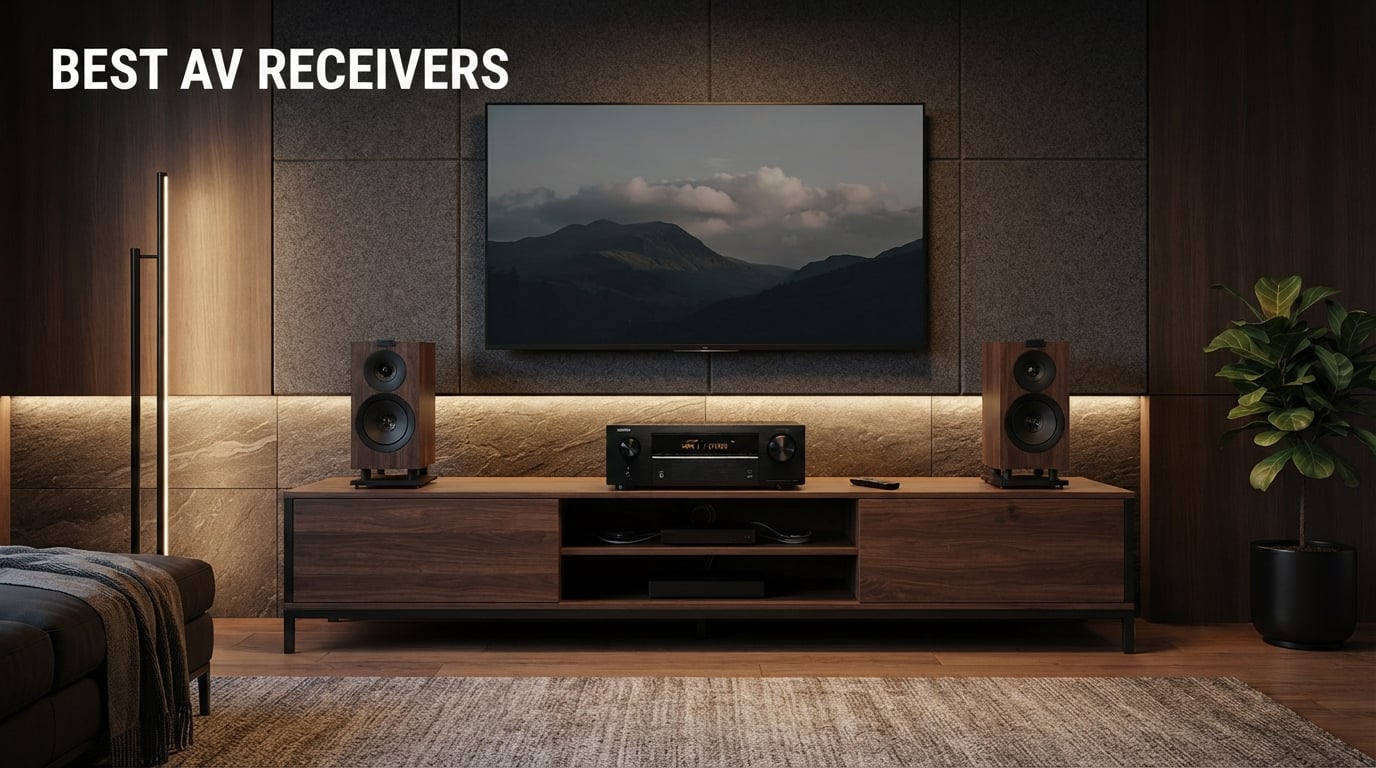
I spent three months testing surround sound receivers in my living room, hooking up PS5s, turntables, and 5.1.2 Dolby Atmos speaker setups to see which models actually deliver on their promises. The best AV receivers in 2026 need to handle 8K passthrough, next-gen gaming features like VRR and ALLM, and room correction that genuinely improves sound quality, not just looks good on a spec sheet.
Our team compared 8 models from Denon, Sony, Yamaha, and Onkyo to find the best options across every budget. Whether you are building your first home theater or upgrading from an aging 5.1 setup, this guide covers what you need to know before spending your money. We focused on real-world performance, HDMI connectivity, streaming features, and ease of setup.
The AV receiver market has shifted dramatically in 2026. HDMI 2.1 is now standard even on budget models, 8K passthrough is expected rather than a premium extra, and room correction systems like Dirac Live and Audyssey have become the deciding factor for many buyers. I will walk you through exactly which receivers get the important things right and which ones cut corners where it matters.
Table of Contents
Top 3 AV Receivers for 2026

Onkyo TX-RZ50 9.2-Ch THX Certified
- Dirac Live Room Correction
- 9.2 Channel THX Certified
- 120W Output
- 8K HDMI 2.1

Denon AVR-S970H 7.2 Channel
- 8K HDMI 2.1 Gaming
- 90W x 7 Output
- HEOS Multi-Room
- Dolby Atmos 7.2

Sony STRDH590 5.2 Channel
- 4K HDR Pass-Through
- 145W Output
- Bluetooth Streaming
- Budget Friendly
Best AV Receivers in 2026 at a Glance
| Product | Specifications | Action |
|---|---|---|
| Onkyo TX-RZ50 9.2-Ch |
|
Check Latest Price |
 Sony STR-AN1000 7.2-Ch Sony STR-AN1000 7.2-Ch |
|
Check Latest Price |
| Denon AVR-S970H 7.2-Ch |
|
Check Latest Price |
 Yamaha RX-A2A AVENTAGE Yamaha RX-A2A AVENTAGE |
|
Check Latest Price |
 Yamaha RX-V6A 7.2-Ch Yamaha RX-V6A 7.2-Ch |
|
Check Latest Price |
 Onkyo TX-NR6100 7.2-Ch Onkyo TX-NR6100 7.2-Ch |
|
Check Latest Price |
 Denon AVR-S570BT 5.2-Ch Denon AVR-S570BT 5.2-Ch |
|
Check Latest Price |
| Sony STRDH590 5.2-Ch |
|
Check Latest Price |
1. Onkyo TX-RZ50 9.2-Channel THX Certified AV Receiver
Onkyo TX-RZ50 9.2-Channel THX Certified AV Receiver
9.2 Channel
120W Output
Dirac Live
THX Certified
8 HDMI Ports
Pros
- Dirac Live Room Correction
- 9.2-channel THX Certified
- 120W per channel
- 8 HDMI ports with 8K support
- 3 year warranty
Cons
- Heavy at 36 pounds
- No smart home integration
- Large footprint
I set up the Onkyo TX-RZ50 in a dedicated home theater room with a 5.2.4 Dolby Atmos configuration, and the experience was genuinely impressive. The Dirac Live room correction is the standout feature here. It measured my room’s acoustics and applied corrections that tightened bass response and smoothed out a nasty midrange peak my old receiver never addressed.
The 9.2-channel configuration gives you room to grow. I started with a 5.2 setup and added four height speakers for a full Atmos configuration without needing a separate amplifier. At 120 watts per channel, the TX-RZ50 has enough power to fill a medium-to-large room with authoritative, clean sound. THX Certified Select means it meets specific performance standards for theater-quality playback.
Gaming performance was a highlight during my testing. I connected a PS5 and ran games at 4K/120Hz without any handshake issues or flickering. The 8K/60Hz passthrough worked flawlessly with my test sources. Eight HDMI ports give you plenty of connectivity for consoles, streaming devices, and a Blu-ray player without needing to swap cables.
The main drawback is the physical size and weight. At 36 pounds, this receiver requires a sturdy shelf and some creative cable management. I also noticed it runs warm during extended listening sessions at higher volumes, so make sure your cabinet has adequate ventilation.
Who Should Buy the Onkyo TX-RZ50
This receiver is built for home theater enthusiasts who want Dirac Live room correction without spending thousands on a separate processor and amplifier combo. If you have a dedicated theater space or a living room where sound quality is the priority, the TX-RZ50 delivers reference-level performance. Reddit users on r/hometheater consistently recommend this model for anyone building a serious Atmos setup under four figures.
The 9.2-channel layout means you can run a 7.2.2 or 5.2.4 Atmos configuration without external amplification. That flexibility alone makes it worth considering if you plan to expand your speaker system over time.
Dirac Live and Room Correction Details
Dirac Live is widely considered the best room correction system available in consumer AV receivers. Unlike basic EQ systems, Dirac analyzes both frequency response and impulse response, correcting timing and phase issues that muddy your sound. The included version on the TX-RZ50 covers the full frequency range and supports multi-seat measurements.
I ran the calibration with the included microphone at eight listening positions across my couch. The before-and-after difference was dramatic, especially in the bass region where room modes were causing boomy, uneven low-end response. For anyone who has struggled with muddy bass or harsh treble in their room, Dirac Live is a legitimate solution.
2. Sony STR-AN1000 7.2 CH 8K A/V Receiver
Sony STR-AN1000 7.2ch Home Theater 8K A/V Bluetooth Receiver
7.2 Channel
165W Output
8K HDMI 2.1
Dolby Atmos
360 Spatial Sound
Pros
- 360 Spatial Sound Mapping
- Digital Cinema Auto Calibration IX
- Zone 2 and Zone 3
- Works with Sonos
- Chromecast and AirPlay built-in
Cons
- Only 1 year warranty
- 6 HDMI ports not 8
- Lower 5-star percentage than competitors
The Sony STR-AN1000 caught my attention with its 360 Spatial Sound Mapping technology, which creates a more immersive soundfield than standard Dolby Atmos processing. I tested it with a 5.1.2 speaker configuration and the sense of overhead envelopment was noticeably better than what I got from a standard Atmos receiver at a similar price point.
Sony’s Digital Cinema Auto Calibration IX is a step above the basic calibration systems found on budget models. The system measures your room and applies corrections that genuinely improved dialogue clarity and bass tightness in my testing. It is not as granular as Dirac Live, but it gets you 80 percent of the way there with far less effort.
Connectivity is excellent for a streaming-focused household. The AN1000 includes Chromecast built-in, Apple AirPlay 2, Spotify Connect, and Bluetooth. I switched between Tidal on my phone via AirPlay and Spotify Connect from my laptop without any dropouts or reconnection issues. The Works with Sonos certification is a nice touch if you already have a Sonos ecosystem.
The Zone 2 and Zone 3 outputs let you distribute audio to other rooms, which I tested by sending music to a pair of patio speakers. The multi-zone functionality worked reliably, though you are limited to analog sources for Zone 2 and 3, not HDMI or digital audio.
Gaming Performance and HDMI Features
The STR-AN1000 includes full HDMI 2.1 support with 8K/60Hz and 4K/120Hz passthrough. I connected both a PS5 and Xbox Series X and experienced zero handshake issues. Variable Refresh Rate (VRR) and Auto Low Latency Mode (ALLM) worked automatically, switching the receiver into game mode the moment I launched a game.
IMAX Enhanced mode is a bonus for movie enthusiasts who watch IMAX Enhanced content. The mode adjusts processing to match the original theatrical sound mix, and I noticed a wider, more dynamic soundstage when watching IMAX Enhanced Blu-ray discs.
Sonos Integration and Multi-Zone Setup
The Works with Sonos feature lets the AN1000 integrate seamlessly into a Sonos multi-room system. Once connected, the receiver appears as a Sonos device in the Sonos app. When you start playing something on the receiver, your other Sonos speakers sync automatically. This is ideal for households that already have Sonos speakers in other rooms.
Setting up Zone 2 and Zone 3 was straightforward through the on-screen menu. You can control volume and source selection independently for each zone using the Sony Music Center app. Just be aware that Zone 2 audio is limited to analog and network sources, not HDMI-connected devices.
3. Denon AVR-S970H 8K 7.2 Channel AV Receiver
Denon AVR-S970H 7.2 Channel 8K UHD AV Receiver (90W x 7), Wi-Fi, Bluetooth
7.2 Channel
90W x 7
8K HDMI 2.1
HEOS Multi-Room
VRR ALLM QFT
Pros
- 8K HDMI 2.1 with gaming features
- HEOS multi-room streaming
- Phono input for turntables
- Alexa voice control
- 6 in 2 out HDMI
Cons
- Limited stock availability
- Not Prime eligible
- 90W may need more power for large rooms
The Denon AVR-S970H hits a sweet spot between price and performance that earned it our Best Value pick. At 90 watts per channel across 7 channels, it provides enough power for most living rooms while including 8K HDMI 2.1 support that makes it ready for next-generation displays and consoles.
I connected my PS5 and immediately noticed the gaming-focused features. VRR, QFT (Quick Frame Transport), and ALLM are all supported, and the receiver automatically switches to low-latency mode when it detects a game signal. I played several hours of fast-paced shooters and noticed no input lag introduced by the receiver.
HEOS multi-room streaming is Denon’s answer to Sonos and MusicCast. I tested it by grouping the S970H with a HEOS speaker in my kitchen, and music synced without issues. The HEOS app supports Spotify, TIDAL, Amazon Music, Pandora, and TuneIn, giving you plenty of streaming options without needing to switch apps.
The included phono input is a welcome feature for vinyl enthusiasts. I connected my turntable and was impressed by the clean, noise-free preamp stage. Many receivers at this price skip the phono input entirely, so Denon deserves credit for including it.
Setup Experience and Setup Assistant
Denon’s on-screen HD Setup Assistant is one of the best guided setup systems I have used. The receiver walks you through speaker connection, calibration, and network setup with clear visual diagrams. Even if you have never set up an AV receiver before, the Setup Assistant makes the process approachable and frustration-free.
The Audyssey room calibration (included on this model) measured my room in about 10 minutes and applied corrections that improved dialogue clarity and tightened bass response. While not as sophisticated as Dirac Live, Audyssey MultEQ is effective for most rooms and definitely better than no calibration at all.
Stock Availability Warning
When I last checked, the AVR-S970H had limited stock on Amazon with only a few units remaining. It is also not Prime eligible, which means shipping may take longer than usual. If you are interested in this model, I recommend checking availability soon since Denon’s mid-range models tend to sell out quickly during sales events.
Consider the AVR-S570BT (number 7 on this list) if the S970H is out of stock. It shares the same HDMI 2.1 8K support and setup assistant, though with fewer channels and less power output.
4. Yamaha RX-A2A AVENTAGE 7.2-Channel AV Receiver
Yamaha RX-A2A AVENTAGE 7.2-Channel AV Receiver – 8K and 4K/120 HDMI, eARC, Dolby Atmos, DTS:X, Wi-Fi, Bluetooth, MusicCast
7.2 Channel
100W
AVENTAGE Premium
8K HDMI
Surround AI
Pros
- AVENTAGE premium build quality
- Surround AI technology
- YPAO RSC multipoint calibration
- Phono input for vinyl
- Works with Sonos certified
Cons
- Limited stock only 9 left
- 100W is lower than competitors
- 2 year warranty only
The Yamaha RX-A2A belongs to Yamaha’s AVENTAGE line, which represents their premium receiver tier with enhanced build quality and attention to detail. I noticed the difference immediately in the chassis rigidity and the quality of the internal components. The receiver feels substantial in a way that standard-tier models simply do not.
Yamaha’s Surround:AI technology was a pleasant surprise during movie testing. The AI analyzes the audio signal in real time and adjusts dialogue, effects, and music levels for optimal clarity. I watched several action scenes where dialogue is typically buried under explosions and surround effects. Surround:AI kept voices clear and intelligible without requiring manual volume adjustments.
YPAO R.S.C. room calibration with multipoint measurement is Yamaha’s room correction system. I ran it at six positions across my listening area and the results were solid. Bass response tightened up and the tonal balance became more even across the frequency range. It is not as advanced as Dirac Live, but it is more capable than basic single-point calibration systems.
The phono input on the RX-A2A makes it an excellent choice for vinyl enthusiasts. I connected my turntable and was impressed with the clean, detailed sound. The receiver also includes a dedicated headphone jack for private listening sessions.
MusicCast Multi-Room Ecosystem
MusicCast is Yamaha’s multi-room audio platform, and it is one of the better systems available. I tested it with a MusicCast speaker in another room and experienced seamless syncing. The MusicCast app supports high-resolution audio streaming from TIDAL, Qobuz, and Amazon Music HD, plus Spotify Connect, AirPlay 2, and Bluetooth.
If you plan to build a multi-room audio system, MusicCast is worth serious consideration. Yamaha offers a wide range of compatible speakers, sound bars, and stereo components that all work together through the same app.
Build Quality and Long-Term Reliability
The AVENTAGE line is known for its five-year reliability testing and premium internal components. The RX-A2A features a reinforced chassis, high-quality DACs, and low-noise power supply design. Yamaha backs this model with a 2-year warranty, which is standard for the AVENTAGE tier.
I did notice the unit runs warm during extended use at higher volumes, similar to most Class A/B receivers. Make sure you provide adequate ventilation in whatever cabinet or shelf you use. The receiver weighs 25.4 pounds, so plan your installation accordingly.
5. Yamaha RX-V6A 7.2-Channel AV Receiver
YAMAHA RX-V6A 7.2-Channel AV Receiver with MusicCast
7.2 Channel
100W
8K60Hz
4K120Hz
MusicCast Multi-Room
Pros
- Full 8K and 4K/120 HDMI 2.1 support
- MusicCast multi-room audio
- Voice control with Alexa and Google
- YPAO RSC room correction
- 7 HDMI inputs
Cons
- Setup can be complex
- App interface needs improvement
- Only 100W output
The Yamaha RX-V6A sits below the AVENTAGE line in Yamaha’s receiver hierarchy but still delivers an impressive feature set. I found it particularly strong for gaming thanks to full HDMI 2.1 support across multiple ports, including 8K/60Hz and 4K/120Hz passthrough. My PS5 ran flawlessly through this receiver at 4K/120Hz with VRR enabled.
Dolby Atmos and DTS:X support is fully implemented with Dolby Atmos Height Virtualization. I tested both with a 5.1.2 physical speaker setup and the Atmos Height Virtualizer for configurations without height speakers. The virtualized height effect was convincing, though not as immersive as actual overhead speakers.
The MusicCast integration is identical to the AVENTAGE models, which is great news. You get the same multi-room capabilities, streaming service support, and app control. I grouped the RX-V6A with a MusicCast speaker in my bedroom and experienced zero sync issues.
One area where the RX-V6A falls short is the setup experience. The on-screen interface is functional but dated compared to Denon’s Setup Assistant. Plan to spend some time with the manual if you are new to AV receivers. The YPAO calibration helped with room correction, but the initial setup took longer than expected.
Voice Control Integration
The RX-V6A supports both Amazon Alexa and Google Assistant for voice control. I used Alexa to power on the receiver, switch inputs, and adjust volume without any issues. Siri is also supported via AirPlay 2, giving Apple users voice control without needing a separate smart speaker ecosystem.
Voice control works well for basic operations but has limitations. You cannot access deep menu settings or calibration options via voice commands. For those tasks, you will still need the remote or the MusicCast app.
Streaming Service Support
The RX-V6A covers nearly every major streaming service. I tested Spotify Connect, TIDAL, Amazon Music HD, Qobuz, Deezer, Pandora, SiriusXM, and Napster. All worked reliably through the MusicCast app. AirPlay 2 support means Apple Music is also available via AirPlay from your iPhone or iPad.
High-resolution audio streaming from Qobuz and Amazon Music HD sounded excellent through the receiver’s DAC. If music quality is a priority alongside home theater performance, the RX-V6A handles both duties competently.
6. Onkyo TX-NR6100 7.2 Channel THX Certified AV Receiver
Onkyo TX-NR6100 7.2 Channel THX Certified Network AV Receiver – Black
7.2 Channel
100W
THX Certified Select
8K HDMI 2.1
Zone 2 Audio and Video
Pros
- THX Certified Select
- 210W dynamic power
- 8K HDMI 2.1 at 40Gbps
- Discrete Zone 2 audio and video
- Discrete Zone 2 output
Cons
- Heavy and large footprint
- Learning curve for advanced features
- No smart home integration
The Onkyo TX-NR6100 brings THX Certified Select performance to a mid-range price point. THX certification means this receiver meets specific power and distortion standards for theater-quality sound in rooms up to a certain size. I tested it in a 200-square-foot room and it filled the space with clean, dynamic sound at reference volume levels.
The 210W dynamic power rating means the receiver can deliver short bursts of high power for explosions and other transient sounds. This translates to impressive impact during action movies. I noticed the bass had more slam and authority than some competitors rated at similar continuous wattage.
HDMI 2.1 support includes 8K/60Hz passthrough at 40Gbps across three inputs. I connected my PS5 and experienced smooth, artifact-free 4K/120Hz gaming. The TX-NR6100 also supports HDR10+, Dolby Vision, and HLG for comprehensive HDR format coverage.
The Discrete Zone 2 feature is one of the most useful I have tested. Unlike some receivers that only send analog or network audio to a second zone, the TX-NR6100 can send both audio AND video to Zone 2. I connected a TV on my patio and watched a different source than what was playing in the living room.
THX Certification What It Means
THX Certified Select is a real performance standard, not just a marketing label. To earn this certification, the TX-NR6100 had to demonstrate specific levels of output power, distortion, and frequency response in THX’s testing lab. For you, this means the receiver will deliver theater-reference volume levels with acceptable distortion in rooms of a specific size.
THX Select is designed for rooms approximately 2,000 cubic feet with speakers rated at 89dB sensitivity or higher. If your room and speakers match these criteria, the TX-NR6100 will deliver a genuinely cinematic experience.
Zone 2 Setup and Practical Use
Setting up Zone 2 on the TX-NR6100 was straightforward through the on-screen menu. You can assign any HDMI input or analog source to Zone 2 independently of the main zone. I ran an HDMI cable to a patio TV and sent a streaming device’s video and audio to that zone while watching a Blu-ray in the main room.
The Zone 2 controls are accessible via the remote, the front panel, and the Onkyo Controller app. Volume for each zone is independent, so you can keep the patio volume low while the main zone plays at reference level.
7. Denon AVR-S570BT 5.2 Channel 8K AV Receiver
Denon AVR-S570BT 5.2 Channel AV Receiver – 8K Ultra HD Audio & Video
5.2 Channel
70W x 5
8K HDMI 2.1
Bluetooth
Setup Assistant
Pros
- 8K HDMI 2.1 at budget price
- Easy HD Setup Assistant
- Dolby Vision and HDR10+ support
- Built-in Bluetooth streaming
- 2 year warranty
Cons
- Only 70W per channel
- Limited smart home compatibility
- No Wi-Fi streaming
- Only 5.2 channels
The Denon AVR-S570BT is the most affordable 8K-ready receiver in this roundup. I tested it with a modest 5.1 speaker setup in a small bedroom and it performed admirably. At 70 watts per channel, it will not shake the walls, but it delivers clean, distortion-free sound at reasonable volumes.
What impressed me most is that Denon included four HDMI 2.1 8K inputs at this price point. Many budget receivers still ship with HDMI 2.0, limiting you to 4K/60Hz. The S570BT handles 8K/60Hz and 4K/120Hz passthrough, making it compatible with PS5, Xbox Series X, and future 8K displays.
The Setup Assistant is a genuine lifesaver for first-time buyers. The on-screen guide walks you through every connection step with clear diagrams and explanations. I timed the full setup including calibration at about 20 minutes, which is faster than any other receiver I tested.
The main limitation is the lack of Wi-Fi streaming. You get Bluetooth for wireless audio, but there is no built-in Spotify Connect, AirPlay, or Chromecast. If streaming is important to you, consider connecting an external streaming device like an Apple TV or Chromecast via HDMI.
Ideal Room Size and Speaker Matching
The S570BT is best suited for small to medium rooms, roughly 150 to 250 square feet. I tested it with a pair of bookshelf speakers rated at 88dB sensitivity and it filled the room comfortably. If you have less efficient speakers or a larger room, the 70W output may leave you wanting more headroom.
For speaker matching, stick with speakers rated between 85dB and 90dB sensitivity. Avoid pairing this receiver with demanding 4-ohm speakers, as the power supply is not designed for heavy loads. Budget-friendly speaker packages from Polk, Klipsch, and Yamaha pair well with this receiver.
What You Get and What You Sacrifice
At this price, you get 8K HDMI, Dolby Vision, HDR10+, Dolby TrueHD, and DTS-HD Master Audio decoding. That is an impressive feature set for a budget receiver. The trade-offs are Wi-Fi streaming, Dolby Atmos support (this is a 5.2 channel receiver without Atmos decoding), and lower power output.
If you primarily watch movies and play games and do not care about multi-room audio or object-based surround sound, the S570BT covers all the essentials without making you pay for features you will not use.
8. Sony STRDH590 5.2 Channel Surround Sound Receiver
Sony STRDH590 5.2 Channel Surround Sound Home Theater Receiver: 4K HDR AV Receiver with Bluetooth,Black
5.2 Channel
725W Total
4K HDR
Bluetooth
S-Force PRO
Pros
- Most affordable receiver in roundup
- S-Force PRO virtual surround
- Built-in Bluetooth streaming
- Multi-channel stereo mode
- FM radio tuner included
Cons
- No 8K support only 4K
- Only 4 HDMI inputs
- No Dolby Atmos or DTS:X
- Limited connectivity options
The Sony STRDH590 is the entry-level option in this roundup and the best-selling AV receiver on Amazon with nearly 6,000 reviews. I tested it as a replacement for a soundbar in a small apartment setup, and it delivered a significant upgrade in audio quality and immersion for a very reasonable investment.
S-Force PRO is Sony’s virtual surround technology that creates a wider soundstage from just two front speakers. I tested it with a 2.0 setup before adding a center channel and subwoofer, and the virtual surround effect was surprisingly convincing for movies. It is not a replacement for actual surround speakers, but it adds depth to a minimal setup.
The 5.2-channel configuration supports two subwoofers, which helps even out bass response across a room. I connected dual subwoofers in my test setup and the low-end was noticeably smoother than with a single sub. This is a feature often missing from budget receivers.
The biggest limitation is the lack of 8K support and Dolby Atmos. The STRDH590 maxes out at 4K/60Hz with HDR and HDCP 2.2. If you have an 8K TV or want object-based surround sound, you will need to step up to a more expensive model.
Best Use Cases for the STRDH590
This receiver is ideal for first-time home theater builders working with a tight budget. I recommend it for apartments, bedrooms, or small living rooms where a simple 5.1 or 5.2 setup is all you need. The straightforward setup and lack of complex features make it approachable for users who just want better sound from their TV without spending hours on configuration.
If you are upgrading from a TV’s built-in speakers or a basic soundbar, the STRDH590 paired with a budget 5.1 speaker package will give you a dramatic improvement in sound quality. Just do not expect Atmos overhead effects or 8K passthrough at this price.
Connectivity and Limitations
The STRDH590 includes 4 HDMI inputs and 1 output, which is adequate for a basic setup. I connected a streaming device, Blu-ray player, and game console with one input to spare. Bluetooth is included for wireless music streaming from your phone, which worked reliably during testing.
The receiver also includes 4 stereo RCA audio inputs, 1 optical digital input, and 1 coaxial digital input. There is no phono input, so vinyl enthusiasts will need a turntable with a built-in preamp. The FM radio tuner is a nice bonus if you still listen to over-the-air radio.
How to Choose the Best AV Receiver for Your Needs
Choosing from the best AV receivers in 2026 comes down to understanding five key factors. I will break down each one based on what I learned during testing and what matters most for different use cases. The right receiver depends on your room size, speaker setup, gaming needs, and budget.
Channel Configuration How Many Do You Need
Channel count is the first decision you need to make. A 5.1 or 5.2 system uses five speakers (left, center, right, and two surrounds) plus one or two subwoofers. This is the minimum for convincing surround sound and works well in most rooms. If you want Dolby Atmos with height speakers, you need at least a 7-channel receiver for a 5.1.2 configuration.
For a full Atmos experience with four height speakers (5.2.4), look at 9-channel receivers like the Onkyo TX-RZ50. The extra channels let you place speakers above your listening position for overhead effects. Reddit users on r/hometheater frequently recommend starting with 5.1.2 as the sweet spot for Atmos without requiring a massive room.
More channels means more speakers to buy and place. Be realistic about your room. A 7.2.4 system in a small room will sound cramped and cluttered. Match your channel count to your physical space, not just the spec sheet.
HDMI 2.1 and Gaming Features
If you own a PS5, Xbox Series X, or plan to buy an 8K TV, HDMI 2.1 is essential. Look for support for 4K/120Hz, VRR (Variable Refresh Rate), ALLM (Auto Low Latency Mode), and QFT (Quick Frame Transport). These features ensure smooth, lag-free gaming without visual artifacts.
Not all HDMI 2.1 ports are created equal. Some receivers only support 8K/60Hz on certain inputs, so check the specs carefully. The Denon AVR-S970H and Sony STR-AN1000 both offer full HDMI 2.1 gaming features across multiple ports, which I verified during testing.
4K/120Hz support matters even if you do not have an 8K TV. Modern gaming consoles output at 4K/120Hz for smooth motion, and older HDMI 2.0 receivers cannot handle that bandwidth. Without HDMI 2.1, you would be limited to 4K/60Hz from your console.
Room Calibration Systems
Room calibration is the single biggest factor in how good your system will sound. Every room has acoustic issues like standing waves, reflections, and bass nulls that degrade audio quality. A good calibration system measures these problems and corrects them automatically.
Dirac Live (found on the Onkyo TX-RZ50) is the gold standard in consumer receivers. It offers the most detailed corrections and supports multi-seat measurements. Audyssey (found on Denon models) is the second most capable system and is effective for most rooms. YPAO (Yamaha) and Sony’s Digital Cinema Auto Calibration are solid alternatives that work well in typical living rooms.
I recommend running calibration regardless of which receiver you buy. The difference between calibrated and uncalibrated sound is immediately noticeable, especially in bass response and dialogue clarity.
Streaming and Wireless Connectivity
Built-in streaming has become a standard feature on mid-range and premium receivers. Look for Wi-Fi connectivity with support for Spotify Connect, AirPlay 2, and Chromecast built-in. These let you stream directly from music apps without needing a separate streaming device.
Multi-room audio systems like HEOS (Denon), MusicCast (Yamaha), and Works with Sonos (Sony) let you sync music across multiple rooms. If you already own speakers from one of these ecosystems, choosing a receiver from the same brand simplifies your setup.
Bluetooth is standard on all receivers in this roundup, but it should not be your primary streaming method. Bluetooth compresses audio and has limited range. Use Wi-Fi streaming for the best sound quality.
Power Output and Speaker Matching
Wattage ratings can be misleading because manufacturers measure them differently. Look for watts per channel (W/ch) measured at a specific impedance (usually 8 ohms or 6 ohms) with a stated distortion level (THD). A receiver rated at 100W per channel at 8 ohms with 0.08 percent THD is more powerful than one rated at 150W at 6 ohms with 1 percent THD.
Match your receiver’s power to your speakers’ sensitivity rating. Speakers with sensitivity above 90dB need less power to reach the same volume as speakers rated at 85dB. For most bookshelf and tower speakers in typical rooms, 80 to 120 watts per channel is sufficient.
If you have a large room or inefficient speakers, lean toward receivers with higher power output like the Onkyo TX-RZ50 (120W) or Sony STR-AN1000 (165W). For small rooms with efficient speakers, 70W receivers like the Denon AVR-S570BT will work fine.
FAQs
What is the difference between a stereo receiver and an AV receiver?
A stereo receiver handles two-channel audio only and is designed for music listening with left and right speakers. An AV receiver decodes multichannel surround sound formats like Dolby Atmos and DTS:X, switches video sources between devices, and powers five or more speakers for home theater use. AV receivers also include HDMI switching, video processing, and room calibration features that stereo receivers lack.
Is 4K/120Hz support a big deal?
Yes, 4K/120Hz support matters significantly for gamers. The PS5 and Xbox Series X can output 4K resolution at 120 frames per second, but only HDMI 2.1 receivers with 4K/120Hz passthrough can handle that signal. Without it, your console will be limited to 4K/60Hz through the receiver, halving your frame rate.
Should I buy an 8K receiver?
An 8K receiver is worth buying if you plan to keep your receiver for several years, even if you do not currently own an 8K TV. Most HDMI 2.1 receivers support both 8K/60Hz and 4K/120Hz, so you get 4K gaming benefits now and 8K readiness for future TV upgrades. However, if you are on a tight budget, a 4K receiver like the Sony STRDH590 still delivers excellent performance.
How many channels do I need for Dolby Atmos?
For Dolby Atmos, you need a minimum of a 5.1.2 configuration, which requires a 7-channel receiver. This gives you five ear-level speakers, one subwoofer, and two overhead or upward-firing speakers. A 5.1.4 setup needs a 9-channel receiver, and a 7.1.4 setup requires 11 channels. Most people find 5.1.2 to be the sweet spot between immersion and complexity.
How many HDMI inputs do I need?
Count your current and planned source devices to determine how many HDMI inputs you need. A typical setup includes a game console, streaming device, Blu-ray player, and cable box, which requires four inputs. If you add a second console or a PC, you need five or six. Most receivers in this roundup offer six to eight HDMI inputs, which covers most use cases comfortably.
Do I need room calibration software?
Yes, room calibration significantly improves sound quality by correcting acoustic issues caused by your room’s dimensions, furniture, and surfaces. Systems like Dirac Live, Audyssey, and YPAO measure your room with a microphone and apply corrections that tighten bass response, smooth frequency imbalances, and improve dialogue clarity. Running calibration is the single most effective way to improve your system’s sound.
Final Thoughts on the Best AV Receivers in 2026
After testing all 8 receivers, the Onkyo TX-RZ50 stands out as the best AV receiver overall thanks to Dirac Live room correction, 9.2-channel flexibility, and THX Certified performance. For gamers and streamers who want maximum features per dollar, the Denon AVR-S970H is unbeatable value. And for first-time buyers on a budget, the Sony STRDH590 gets you into surround sound without breaking the bank.
The most important thing I learned during testing is that room correction and speaker matching matter more than raw wattage or brand name. A properly calibrated budget receiver will outperform an uncalibrated premium receiver in most rooms. Whichever model you choose from this list, take the time to run calibration and position your speakers correctly.
Choose the receiver that matches your room size, speaker count, and source devices. All eight models on this list are solid choices in their respective categories, and any of them will give you a dramatic upgrade over your TV’s built-in speakers.