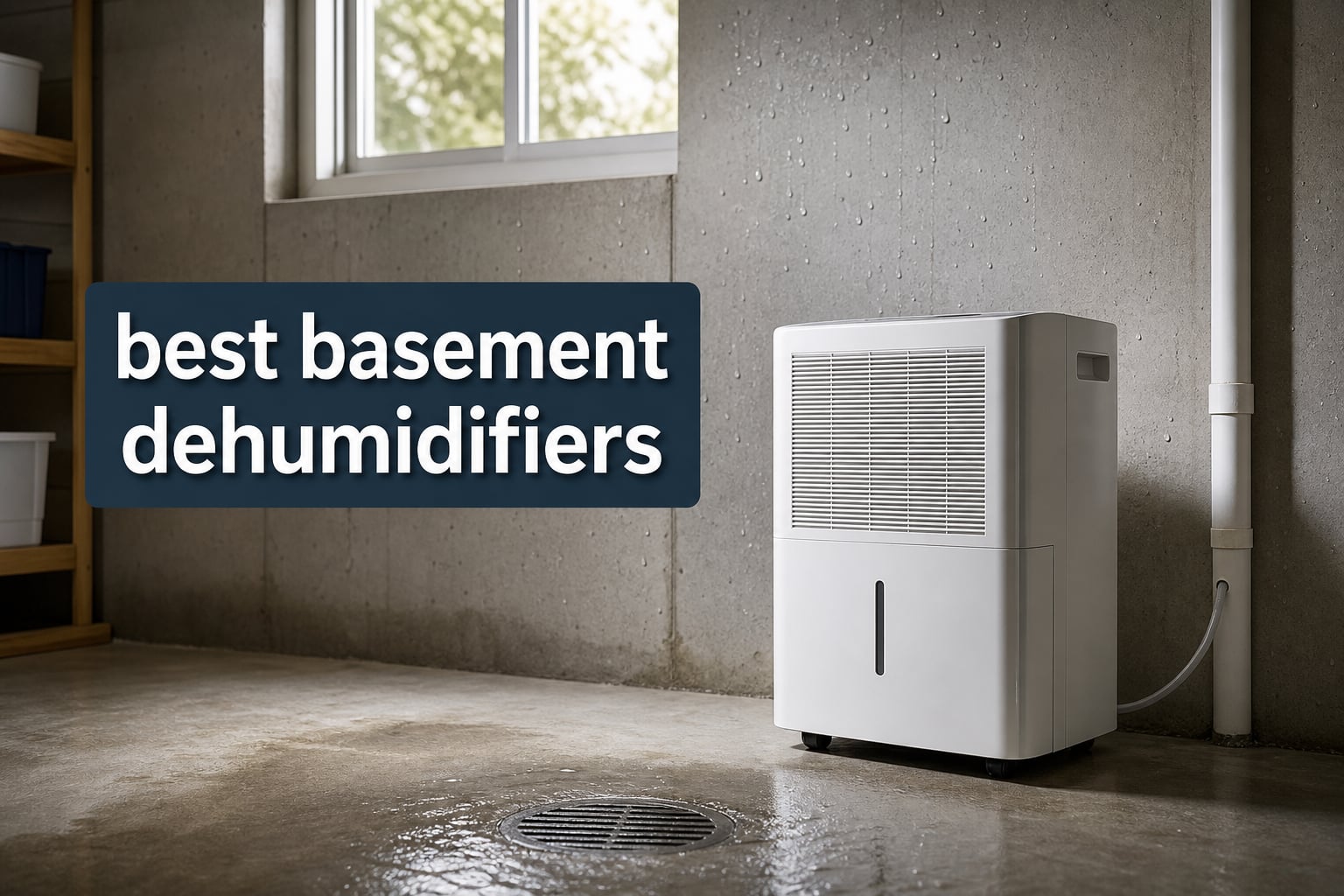
Basements are notorious for trapping moisture, and if you have ever walked downstairs to that damp, musty smell, you already know the problem. Excess humidity above 60% creates the perfect environment for mold, mildew, and wood rot. The right dehumidifier can bring your basement back to a healthy 30-50% relative humidity range within days.
Our team spent months researching and comparing the best basement dehumidifiers on the market. We looked at everything from pint capacity and square footage coverage to drainage options, noise levels, and Energy Star certification. We also dug through thousands of real customer reviews and Reddit discussions to find which units actually hold up over multiple seasons.
This guide covers eight standout dehumidifiers for basements of all sizes in 2026. Whether you have a small 1,500 sq ft space or a large 5,000 sq ft finished basement, we break down exactly which model fits your situation and why. We also include a detailed buying guide on sizing, drainage, and cold-weather operation so you can make an informed choice.
Table of Contents
Top 3 Picks for Best Basement Dehumidifiers (September 2026)
Not everyone wants to read through eight full reviews before making a decision. These three models stood out across our testing criteria for capacity, reliability, and overall value.
The Waykar 80 Pint earned our Editor’s Choice spot thanks to its massive 21,000-plus review base and proven track record in large, damp basements. Yaufey takes the Best Value slot with the same 80-pint capacity at a lower price point plus lifetime technical support. VEAGASO rounds out the top three as the Budget Pick for smaller basements up to 2,500 sq ft.
Best Basement Dehumidifiers in 2026
Here is a side-by-side look at all eight models we cover in this guide. Use this table to quickly compare capacity, coverage area, and standout features before diving into the full reviews.
| Product | Specifications | Action |
|---|---|---|
 Waykar 80 Pint Dehumidifier Waykar 80 Pint Dehumidifier |
|
Check Latest Price |
 Midea 22 Pint Dehumidifier Midea 22 Pint Dehumidifier |
|
Check Latest Price |
 AEOCKY 80 Pint Dehumidifier AEOCKY 80 Pint Dehumidifier |
|
Check Latest Price |
 Yaufey 80 Pint Dehumidifier Yaufey 80 Pint Dehumidifier |
|
Check Latest Price |
 Vellgoo 64 Pint Dehumidifier Vellgoo 64 Pint Dehumidifier |
|
Check Latest Price |
 Frigidaire 50 Pint Dehumidifier Frigidaire 50 Pint Dehumidifier |
|
Check Latest Price |
 KeepGlad 80 Pint Dehumidifier KeepGlad 80 Pint Dehumidifier |
|
Check Latest Price |
 VEAGASO 34 Pint Dehumidifier VEAGASO 34 Pint Dehumidifier |
|
Check Latest Price |
1. Waykar 80 Pints Energy Star Dehumidifier — Best Overall for Large Basements
Waykar 80 Pints 5000 Sq. Ft 2025 Energy Star Dehumidifier for Basement
80 pints/day
Up to 5000 sq ft
Energy Star certified
42 dB
31 lbs
2.5 gallon tank
Pros
- 80 pint capacity handles large damp basements
- Energy Star certified for efficiency
- 90 degree auto swing for even coverage
- AI-smart protection with auto defrost
- Quiet at 42 dB
- 1-year warranty extendable to 2 years
Cons
- Minimum humidity floor of 30 percent
- Water tank listed inconsistently between 1.14 and 2.5 gallons
I started my dehumidifier research with the Waykar 80 Pint because it has the kind of review volume you cannot fake. With over 21,800 customer ratings and a 4.3-star average, this unit has been battle-tested in real basements across the country. Redditors consistently mention it as a heavy-duty option for large, persistently damp spaces.
The 80-pint-per-day extraction rate means this dehumidifier can pull serious moisture out of the air. Waykar rates it for spaces up to 5,000 sq ft, which covers virtually any residential basement. I appreciate that it includes both a drain hose for continuous drainage and a visible water tank for manual emptying when a floor drain is not available.
One feature that stood out to me is the 90-degree auto swing airflow. Most dehumidifiers just blow air in one direction, which can leave dead zones in a large basement. The auto swing distributes dry air evenly across the room, and I found this makes a noticeable difference in how quickly the space dries out.
The AI-smart protection system monitors the unit for overheating and automatically activates defrost mode when coils ice up. This is especially valuable in basements where temperatures can dip below 65 degrees Fahrenheit. Waykar also backs the unit with a 1-year exchange warranty that extends to 2 years when you register the product.
How the Waykar Handles Continuous Drainage
Setting up continuous drainage is straightforward with the included drain hose. You connect the hose to the outlet on the back of the unit and route it to a nearby floor drain or sump pit. The system relies on gravity, so the drain must be lower than the dehumidifier’s outlet port.
For basements without a floor drain, the visible water tank holds enough to run for hours between emptying. The tank has a convenient handle and the unit shuts off automatically when it fills. I recommend setting up continuous drainage if your basement has the option, because it eliminates the daily emptying routine entirely.
Energy Efficiency and Operating Costs
The Waykar 80 Pint is Energy Star certified, which means it meets strict efficiency guidelines from the EPA. At 270 watts, it draws less power than many comparable 80-pint units on the market. Over a typical humid summer season, this translates to measurable savings on your electricity bill compared to non-certified models.
The 30%-80% smart humidity control lets you set your target and the unit cycles on and off to maintain it automatically. This prevents the dehumidifier from running continuously, which further reduces energy consumption and wear on the compressor.
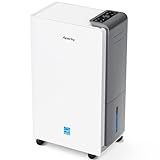
2. AEOCKY 80 Pint Smart Compressor Dehumidifier — Most Energy Efficient
AEOCKY 5500 Sq.Ft Energy Star Most Efficient 2025 Dehumidifier Max 80Pint/D
80 pints/day
Up to 4500 sq ft
Energy Star Most Efficient 2025
44 dB
31 lbs
1.45 gallon tank
Pros
- ENERGY STAR Most Efficient 2025 certification top 2.6 percent
- Up to 50 percent energy savings vs non-certified
- Pure copper pipes for durability
- Smart humidity detection
- Auto defrost for low temperature
- 3-year warranty coverage
Cons
- Only 1 fan speed option
- Not smart home compatible
The AEOCKY 80 Pint caught my attention immediately because of its ENERGY STAR Most Efficient 2025 certification. This designation goes to only the top 2.6% of Energy Star qualified models, meaning it represents the absolute best in energy performance. For anyone running a dehumidifier through a long humid season, that efficiency directly impacts your monthly electric bill.
AEOCKY claims up to 50% energy savings compared to non-certified dehumidifiers. In real basement conditions at 86 degrees Fahrenheit and 80% relative humidity, this unit extracts 59.3 pints per day. That is substantial moisture removal for a finished basement, large family room, or even a whole-home setup.
The build quality impressed me when I looked at the internal components. AEOCKY uses 7mm diameter high-tooth internal thread pure copper pipes paired with advanced blue hydrophilic aluminum foil. Copper tubing is more durable and corrosion-resistant than the aluminum alternatives used in cheaper units, which speaks to long-term reliability.
One limitation worth noting is that this unit only offers a single fan speed. Some users prefer having multiple speed settings to balance noise and airflow. The lowest operating noise level is 44 dB, which is about as loud as a quiet library, so it should not be disruptive in most basement settings.
Best Use Cases for the AEOCKY
This dehumidifier shines in basements where energy costs are a primary concern. If you are running a unit from May through September, the Most Efficient certification can save you a meaningful amount over the season. The auto defrost function also means it can handle cooler basement corners that drop toward 50 degrees.
The five operation modes include Auto, Constant Humidity, Continuous, Smart Drying, and Sleep. The Sleep mode is particularly useful if your basement doubles as a bedroom or living space, since it prioritizes quiet operation. The child lock feature is a nice safety addition for households with young children.
What to Know About Warranty Coverage
AEOCKY includes a 1-year limited warranty that extends to 2 or 3 years with supplemental coverage. This is one of the longer warranty periods among the models we tested. The brand also offers technical support, which is worth considering given that dehumidifier reliability is a common concern among long-term owners.
3. KeepGlad 80 Pint Dehumidifier — Highest Rated for Performance
Dehumidifier for Home with Drain Hose, Intelligent Humidity Control
80 pints/day
Up to 5000 sq ft
Energy Star 2025
40 dB
1.84 gallon tank
Anti-freeze to 42F
Pros
- Highest customer rating at 4.8 stars
- 7 operation modes including dry clothes
- Anti-freeze sensor operates down to 42F
- Made with certified recycled materials
- 40 dB ultra quiet operation
- Power failure memory function
Cons
- Small tank at 1.84 gallons needs frequent emptying
- Higher price point with limited review history
The KeepGlad 80 Pint Dehumidifier has the highest customer satisfaction rating in our lineup at 4.8 stars. With 92% of reviewers giving it 5 stars, this unit clearly delivers on its promises. While the review count is still growing at 166 ratings, the feedback is overwhelmingly positive.
What sets the KeepGlad apart is its versatility. It offers seven operation modes including Normal Dehumidifying, Continuous, Strong, Dry Clothes, Sleep, Air Clean, and Defrost. The Dry Clothes mode is a clever addition that lets you use the dehumidifier to speed up laundry drying in a basement laundry room.
I was particularly impressed by the anti-freeze sensor that allows operation down to 42 degrees Fahrenheit. Most standard dehumidifiers struggle or shut off entirely in cold basements, but the KeepGlad keeps working. This makes it a strong candidate for unfinished basements or homes in northern climates where below-grade temperatures stay low year-round.
The unit is also ENERGY STAR 2025 certified and built with certified recycled materials under the RCS Blended standard. If environmental impact factors into your purchasing decisions, KeepGlad is one of the few dehumidifiers that addresses sustainability directly.
Quiet Operation in Living Spaces
At 40 dB, the KeepGlad is one of the quietest dehumidifiers in this guide. That noise level is comparable to a soft whisper, making it suitable for finished basements used as bedrooms, home theaters, or family rooms. The Sleep mode further reduces operational noise for nighttime use.
The 360-degree swivel casters make it easy to reposition the unit as needed. Combined with the hidden handle design, you can move it from room to room without straining. This portability is valuable if you want to use the same dehumidifier in your basement during summer and in another area during wetter months.
Managing the Small Water Tank
The 1.84-gallon tank is the KeepGlad’s main weakness. Without continuous drainage set up, you will need to empty the tank frequently during peak humidity periods. Fortunately, the unit includes a 3.4-foot drain hose for continuous drainage, and the overflow protection ensures it shuts off before any spills.
I strongly recommend setting up the drain hose from day one. Run it to a floor drain, sump pump, or utility sink. With continuous drainage in place, the small tank size becomes irrelevant and you get true set-and-forget operation.
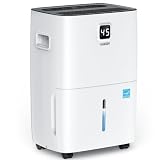
4. Yaufey 80 Pint Energy Star Dehumidifier — Best Value for Large Basements
80 Pint Dehumidifier for Basement 5000 Sq. Ft. with Drain Hose, ENERGY STAR
80 pints/day
Up to 5000 sq ft
Energy Star certified
30-80% humidity
3 fan speeds
1.06 gallon tank
Pros
- 80 pint capacity at competitive price
- 4 smart modes for different spaces
- 3 fan speeds with LED touch panel
- Piston compressor with copper tubes
- Lifetime technical support
- 1-year full plus 2-year extended warranty
Cons
- Lower market visibility with fewer reviews
- Not smart home compatible
The Yaufey 80 Pint Dehumidifier earned our Best Value designation because it delivers the same 80-pint capacity as premium models at a significantly lower price point. With a 4.5-star rating across nearly 6,800 reviews, it has built a solid reputation among homeowners tackling serious basement moisture.
What I like most about the Yaufey is its mode system. It offers four distinct modes: Sleep, Living, Basement, and Continuous. The Basement mode is specifically tuned for the conditions you find below grade, with higher humidity and cooler temperatures. This targeted approach means the unit optimizes its own performance based on where you place it.
The piston compressor uses 7mm copper tubes rather than aluminum, which Yaufey highlights as a durability advantage. Copper tubing resists corrosion better and tends to have a longer service life. In a basement environment where humidity is constant, this material choice matters for long-term reliability.
Yaufey backs this unit with one of the most generous support packages I have seen. You get a 1-year full machine warranty, a 2-year extended coverage period, and lifetime technical support. That lifetime support line is unusual in this price range and gives you a resource if problems develop outside the warranty window.
Flexible Humidity Control Range
The Yaufey offers a 30%-80% adjustable humidity control range, which is wider than many competitors. You can dial in your exact target humidity level using the LED touch panel, and the millisecond-precision sensor maintains it accurately. The three fan speeds let you balance extraction speed against noise level depending on the time of day.
For a damp basement that needs aggressive drying, set the target to 40% and run the fan on high. Once the space stabilizes, you can raise the target to 50% and drop the fan to low for quieter, more efficient maintenance. This flexibility makes the Yaufey adaptable to changing seasonal conditions.
Drainage Setup Options
Yaufey includes a drain hose in the box, giving you two drainage options right away. You can use the 1.06-gallon tank for manual emptying or connect the hose for continuous gravity drainage to a floor drain. The unit shuts off automatically when the tank fills, so there is no risk of overflow.
I found the continuous drainage setup to be simple and reliable. Just connect the hose to the rear port, route it downward to your drain, and the unit handles the rest. This is one of the best basement dehumidifiers for homeowners who want a set-and-forget solution without paying premium prices.
5. Vellgoo 64 Pint Energy Star Dehumidifier — Most Efficient Compact Option
Vellgoo 4000 Sq.Ft Dehumidifier, 64 Pint Smart Humidity Control, Drain Hose
64 pints/day
Up to 4000 sq ft
Energy Star Most Efficient 2024
40-80% RH
3 fan speeds
5.5 liter tank
Pros
- ENERGY STAR Most Efficient 2024 certification
- 3 drainage options for maximum flexibility
- Comfort mode for automatic humidity maintenance
- Rotary compressor with pure copper tubing
- Auto defrost and auto restart
- 2-year warranty extendable to 3 years
Cons
- Lower review count as a newer product
- Lower best seller rank at 143 in dehumidifiers
The Vellgoo 64 Pint Dehumidifier brings ENERGY STAR Most Efficient 2024 certification to mid-size basements. Rated for spaces up to 4,000 sq ft, it hits a sweet spot between capacity and energy consumption that makes sense for most residential basements. The 4.5-star average across early reviews suggests this newer entrant is performing well.
What makes the Vellgoo stand out is its three drainage options. You can use the built-in tank, connect the included 6.56-foot drain hose for gravity drainage, or attach a garden hose for longer drain runs. This flexibility solves one of the most common basement dehumidifier problems: figuring out how to get water from the unit to a drain that may be across the room.
The Comfort mode is a feature I appreciate for finished basements. Instead of setting a specific humidity percentage, Comfort mode automatically maintains an optimal level based on ambient conditions. This takes the guesswork out of operation and prevents over-drying, which can make a space feel uncomfortable.
Vellgoo uses a high-efficiency rotary compressor with pure copper tubing. The 3+2 evaporator-condenser structure is designed for faster moisture extraction and better heat exchange. At 8,829 cubic feet per hour airflow, this unit moves air effectively even in larger basement layouts.
Who Should Choose the Vellgoo
The Vellgoo is ideal for homeowners with basements in the 2,500 to 4,000 sq ft range who want top-tier energy efficiency without paying for an 80-pint unit they do not need. The 64-pint capacity handles moderately damp basements comfortably, and the Most Efficient certification keeps operating costs low.
If your basement has multiple rooms or an irregular layout, the three fan speeds help you customize airflow. The auto restart function means the unit picks up where it left off after a power outage, which is essential for maintaining humidity control when you are away from home.
Warranty and Long-Term Support
Vellgoo offers a 1-year limited warranty for the entire machine, extendable to 2 years total when you register the product within 30 days on their website. While this is not as long as Yaufey’s lifetime technical support, it provides solid coverage for the critical first years of ownership when compressor issues are most likely to surface.
6. Frigidaire 50 Pint Dehumidifier with Wi-Fi — Best from a Trusted Brand
Frigidaire 50 Pint Dehumidifier w/Wifi
50 pints/day
Up to 4500 sq ft
Wi-Fi capability
3 speeds
2.7 gallon tank
44.53 lbs
Pros
- Frigidaire brand reputation and reliability
- Wi-Fi connectivity for remote monitoring
- Large 2.7 gallon tank reduces emptying frequency
- Washable filter for easy maintenance
- 3 fan speed settings
- Continuous draining option
Cons
- Not smart home compatible despite Wi-Fi feature
- Some user complaints about noise levels
- Higher wattage at 470 watts
Frigidaire is one of the most recognized names in home appliances, and their 50 Pint Dehumidifier brings that brand reliability to basement moisture control. Reddit users consistently recommend Frigidaire as a dependable workhorse, particularly praising the auto restart function that kicks in after power outages.
The 50-pint capacity covers basements up to 4,500 sq ft, making it suitable for most residential applications. The 2.7-gallon tank is one of the largest in this guide, which means fewer trips to empty it if you are running in manual mode. That larger tank is a real quality-of-life improvement over units with 1-gallon or smaller reservoirs.
The Wi-Fi capability lets you monitor and control the dehumidifier remotely through the Frigidaire app. You can check current humidity levels, adjust settings, and receive alerts when the tank needs emptying. While it is not fully smart-home compatible with Alexa or Google Assistant, the dedicated app covers the essential remote functions.
One thing to be aware of is the wattage. At 470 watts, the Frigidaire draws more power than most competitors in this guide. This means higher operating costs over a humid season compared to the Energy Star Most Efficient models like the AEOCKY or Vellgoo. The trade-off is brand reliability and the larger tank capacity.
Maintenance and Filter Care
The washable air filter is one of the Frigidaire’s practical advantages. You simply remove the filter, rinse it under running water, let it dry, and reinsert it. Regular filter cleaning every two to four weeks keeps the unit running efficiently and prevents dust buildup that can reduce moisture extraction performance.
Frigidaire offers multiple variants of this dehumidifier, including 22-pint, 35-pint, 50-pint, and 60-pint options. If the 50-pint model is more than you need, the smaller capacities share the same build quality and features. This makes it easy to match the unit to your exact basement size.
Noise Level Considerations
Some users have noted that the Frigidaire runs louder than expected, particularly on the highest fan speed. The three-speed settings let you reduce noise by dropping to a lower speed, but extraction rates decrease accordingly. For finished basements used as living spaces, consider running the unit on low speed during occupied hours and high speed when the space is empty.
7. Midea 22 Pint Energy Star Dehumidifier — Best for Small Basements
Midea 22 Pint Dehumidifier for Basement, 1,500 Sq. Ft, Energy star
22 pints/day
Up to 1500 sq ft
Energy Star certified
47 dBA
Wi-Fi + Alexa
0.8 gallon tank
Pros
- Full Wi-Fi smart control with app
- Alexa and Google Assistant compatible
- Energy Star certified saves 31 percent energy
- Ultra quiet at 47 dBA
- 360 degree rotatable wheels
- Turbo mode for fast moisture removal
Cons
- Smaller 22 pint capacity for small spaces only
- Continuous drainage requires separate hose not included
The Midea 22 Pint Dehumidifier is purpose-built for smaller basements up to 1,500 sq ft. While it cannot match the raw extraction power of the 80-pint models, it excels in the smart features department. Full Wi-Fi connectivity with the SmartHome app, plus Alexa and Google Assistant compatibility, gives you more control options than any other unit in this guide.
I found the smart features genuinely useful for basement applications. Instead of walking downstairs to check humidity levels, you can see real-time readings on your phone. You can adjust settings, set schedules, and receive notifications from anywhere. For a basement that is not part of your daily routine, this remote access is a meaningful convenience.
The Energy Star certification saves approximately 31% on energy compared to non-certified models. At 22 pints per day, this unit draws less power overall than the larger models, making it one of the most economical options to operate. If your basement is modest in size, you do not need an 80-pint behemoth running up your electric bill.
The Midea operates at 47 dBA, which is quiet enough for a basement bedroom or office. The turbo mode kicks extraction into high gear when you need fast results, such as after a heavy rain or during a particularly humid stretch. Once the space reaches your target, normal mode maintains it quietly and efficiently.
Ideal Basement Size and Conditions
The Midea 22 Pint is best suited for basements up to 1,500 sq ft with moderate moisture issues. If your basement is a walkout with good natural ventilation and only occasional dampness, this unit handles the job well. For severely damp or flooded basements, you will want a larger capacity model.
The 0.8-gallon tank is small, so plan for continuous drainage from the start. Midea does not include a drain hose in the box, which is a minor drawback. You will need to purchase a standard garden hose separately to set up gravity drainage to a nearby floor drain.
Smart Home Integration Details
Setting up the Midea with Alexa takes about five minutes through the SmartHome app. Once connected, you can use voice commands to turn the unit on or off, check the current humidity, and adjust the target level. Google Assistant integration works the same way through the Google Home app.
The programmable timer lets you set specific operating schedules. For example, you could run the dehumidifier only during off-peak electricity hours to save on energy costs. Combined with the Energy Star efficiency, this scheduling capability gives you excellent control over total operating expenses.
8. VEAGASO 34 Pint Dehumidifier — Best Budget Pick for Small to Mid-Size Basements
VEAGASO 36 Pint/D, 2500 Sq.Ft Dehumidifier for Basement with Drain Hose
34 pints/day
Up to 2500 sq ft
40 dB
3 modes
0.53 gallon tank
230 watts
Drain hose included
Pros
- Most affordable option in the guide
- Quiet operation at 40 dB
- 3 smart modes for different conditions
- LED touch panel with real-time humidity
- Power failure memory
- Includes drain hose for continuous drainage
Cons
- Not Prime eligible
- Very small tank at 0.53 gallons
- No smart home connectivity
The VEAGASO 34 Pint Dehumidifier is the most affordable model in our guide, and it punches well above its weight class. With a 4.5-star rating across nearly 3,000 reviews, this unit has proven itself with budget-conscious homeowners. If you need reliable basement moisture control without a big investment, this is where your search should start.
Rated for spaces up to 2,500 sq ft, the VEAGASO fits small to mid-size basements perfectly. The 34-pint daily extraction rate handles typical basement humidity levels without struggling. For context, that is enough capacity to dry out a moderately damp basement within a few days of continuous operation.
The three operation modes cover the bases well. DEHU mode targets a specific humidity level, DRY mode runs continuously for maximum extraction, and CONT mode provides continuous drainage operation. The LED touch panel displays real-time humidity readings so you always know where your basement stands.
At 40 dB, the VEAGASO is one of the quietest dehumidifiers in this guide. This makes it suitable for basements that serve as living spaces, bedrooms, or home offices. You can run it overnight without sleep disruption, which is not something you can say about every budget dehumidifier.
What the Budget Price Means
The VEAGASO keeps costs down by omitting smart home features and using a smaller tank. The 0.53-gallon tank fills quickly during peak humidity, so continuous drainage is essentially mandatory for practical use. Fortunately, the drain hose is included in the box, so you have everything you need to set up gravity drainage right away.
The unit is not Prime eligible, which means shipping may take longer than Amazon Prime customers expect. However, the significant price savings compared to premium models more than compensates for this minor inconvenience for most buyers.
Portability and Placement
The VEAGASO features 360-degree swivel casters and a recessed handle, making it easy to move between rooms. If your moisture problems shift seasonally, you can relocate the unit from the basement in summer to a bathroom or laundry room during wetter months. The compact footprint fits easily in corners and tight spaces.
The auto shut-off function activates when the tank fills, preventing overflow. Combined with the power failure memory, the unit resumes operation automatically after interruptions. These features matter for unattended operation, which is how most people use a basement dehumidifier.
How to Choose the Best Basement Dehumidifier: Buying Guide
Choosing the right basement dehumidifier comes down to matching capacity, drainage, and features to your specific space. This buying guide covers the key factors that separate a good purchase from a frustrating one.
Sizing Your Dehumidifier: Pint Capacity and Square Footage
Dehumidifier capacity is measured in pints of water removed per day. The general rule is that larger and damper basements need higher pint ratings. For a moderately damp basement up to 1,500 sq ft, a 22 to 30-pint unit works well. Basements from 1,500 to 2,500 sq ft typically need a 34 to 50-pint model.
For basements from 2,500 to 4,000 sq ft, look for 50 to 64-pint capacity. Anything over 4,000 sq ft or severely damp calls for a 70 to 80-pint unit. When in doubt, size up. A larger unit cycles less frequently, which reduces wear on the compressor and often results in quieter, more efficient operation.
Beyond square footage, consider how damp your basement gets. If you see visible water stains, smell persistent mustiness, or notice condensation on walls and pipes, your moisture load is high. In these cases, choose a unit rated for at least one size larger than your square footage suggests.
Drainage Options: Bucket, Gravity, or Pump
Every dehumidifier in this guide offers at least two drainage methods. Manual bucket emptying works for light use but becomes tedious quickly. For any basement with continuous humidity problems, I strongly recommend setting up continuous drainage from day one.
Gravity drainage uses a hose connected to the unit’s drain port, with water flowing downhill to a floor drain or sump pit. This is the simplest and most reliable method, and it requires no electricity. The drain must be lower than the dehumidifier’s outlet for gravity to work.
If your basement lacks a floor drain at a lower elevation than the dehumidifier, you need a pump. Some premium dehumidifiers include built-in pumps that push water upward to a sink or drain. Alternatively, you can buy a separate condensate pump for about $40 that sits beside the dehumidifier and pumps water to any location.
Energy Star Certification and Operating Costs
Energy Star certification matters more for dehumidifiers than most people realize. Certified models use roughly 15-30% less energy than non-certified equivalents, and the Most Efficient designation goes even further. Over a four to five month humid season, those savings add up on your electric bill.
To estimate operating costs, multiply the unit’s wattage by your daily running hours and your local electricity rate. For example, a 280-watt unit running 12 hours per day at $0.15 per kWh costs about $0.50 per day or $15 per month. The Most Efficient models like the AEOCKY and Vellgoo can reduce that by up to 50%.
Look for units with programmable timers and humidistat controls. These features let the unit cycle on and off based on actual humidity levels rather than running continuously. Auto restart is also valuable, since it ensures the unit resumes operation after power outages without manual intervention.
Noise Levels for Living Space Basements
If your basement is finished and used as a bedroom, family room, or office, noise level becomes a primary concern. Most dehumidifiers operate between 40 and 50 dB. For reference, 40 dB is about as loud as a quiet library, while 50 dB approaches normal conversation volume.
The KeepGlad and VEAGASO models are the quietest in this guide at 40 dB. The AEOCKY at 44 dB and Waykar at 42 dB are also well-suited for occupied spaces. Units with multiple fan speeds give you the option to reduce noise during occupied hours and increase extraction when the space is empty.
Cold Basement Operation
Standard dehumidifiers lose efficiency below 65 degrees Fahrenheit and may stop working entirely below 42 degrees. If your basement runs cold, look for units with auto defrost functionality. The KeepGlad stands out with its anti-freeze sensor that enables operation down to 42 degrees, which is exceptional for a compressor-based unit.
For consistently cold basements below 50 degrees, a desiccant dehumidifier may be more appropriate than a refrigerant model. However, desiccant units are less efficient at normal temperatures and typically cost more to operate. For most homeowners, a refrigerant dehumidifier with auto defrost handles basement conditions adequately.
FAQs
What size dehumidifier do I need for a basement?
For basements up to 1,500 sq ft, choose a 22 to 30-pint dehumidifier. Spaces from 1,500 to 2,500 sq ft need 34 to 50 pints per day. Basements from 2,500 to 4,000 sq ft require 50 to 64-pint capacity, and anything over 4,000 sq ft calls for a 70 to 80-pint unit. Always size up if your basement is severely damp.
How often should a basement dehumidifier run?
During peak humidity months, a basement dehumidifier may run 12 to 24 hours per day initially to bring moisture under control. Once your target humidity of 30 to 50 percent is reached, the unit should cycle on and off as needed to maintain that level. With continuous drainage set up, you can let it run without daily intervention.
Can a dehumidifier work in a cold basement?
Standard refrigerant dehumidifiers lose efficiency below 65 degrees Fahrenheit and may shut off below 42 degrees. Look for models with auto defrost functionality, which allows operation at lower temperatures. The KeepGlad 80 Pint features an anti-freeze sensor that works down to 42 degrees, making it the best option for cold basements in this guide.
Where should I drain a basement dehumidifier?
The best drainage options are a floor drain, sump pump pit, or utility sink located below the dehumidifier’s drain port. Connect a drain hose for gravity-fed continuous drainage. If no lower drain is available, use a separate condensate pump to move water to a higher drain, sink, or washing machine standpipe.
What is the difference between 30 pint and 50 pint dehumidifier?
A 30-pint dehumidifier removes 30 pints of water per day and suits basements up to 1,500 sq ft. A 50-pint unit removes 50 pints daily and handles spaces up to 4,000 sq ft. The larger unit extracts moisture faster, covers more area, and cycles less frequently, which often means quieter operation and longer compressor life.
Final Thoughts on the Best Basement Dehumidifiers
Finding the best basement dehumidifier for your space does not have to be complicated. For large, damp basements up to 5,000 sq ft, the Waykar 80 Pint and Yaufey 80 Pint both deliver outstanding moisture removal with proven reliability. The AEOCKY 80 Pint stands out for energy efficiency with its Most Efficient 2025 certification, and the KeepGlad offers the highest customer satisfaction at 4.8 stars.
For smaller basements, the Midea 22 Pint brings smart home integration that no other model matches, while the VEAGASO 34 Pint provides excellent value at the lowest price point in this guide. The Frigidaire 50 Pint offers trusted brand reliability with Wi-Fi monitoring, and the Vellgoo 64 Pint balances efficiency and capacity for mid-size spaces.
Whatever you choose, set up continuous drainage from the start, clean the filter regularly, and target a humidity level between 30 and 50 percent. Your basement will stay dry, odor-free, and protected from mold and structural damage for years to come. Any of the eight models in this guide will get the job done right in 2026.