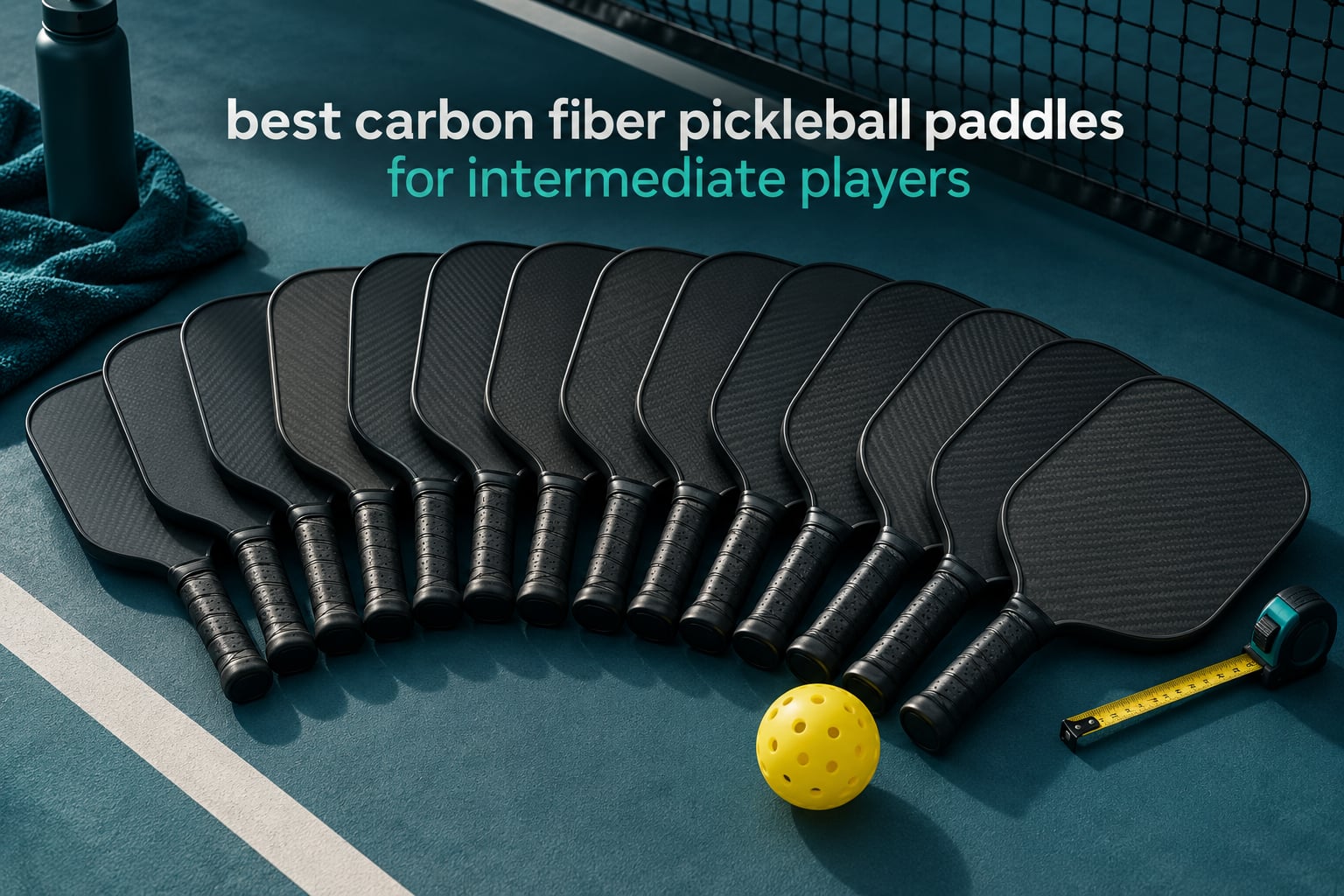
Most intermediate pickleball players hit the same wall. Your returns are fine, your consistency is decent, and then your third shot drops keep landing in the net while your drives sail long. That is rarely a technique problem. It is a paddle problem, and the paddle you are probably still using was built to get you into the game rather than to move your shot-making up a level.
This roundup covers the best carbon fiber pickleball paddles for intermediate players: 12 models whose published specs, ratings and owner feedback I compared side by side, including weight, core thickness, face construction, shape, handle length and warranty. Our top pick is the XSPAK Pro Series Thermoformed, and the reasoning sits in the first review.
If an upgrade is not even on the table yet, our broader pickleball paddle roundup covers the budget and composite options too. Carbon fiber is a large step up in grip and spin, and it is not right for every player, so read the buying guide near the end before you commit.
Table of Contents
Top 3 Best Carbon Fiber Pickleball Paddles for Intermediate Players in October

XSPAK Pro Series Thermoformed
- 8 oz thermoformed carbon fiber face
- XS28 polypropylene honeycomb core
- USAPA approved
- Low-profile edge guard

JOJOLEMON Shark Power Core
- 3K Toray T700SC raw carbon fiber
- 4-directional textured weave
- 16mm honeycomb core
- Extended handle

Vatic Pro Prism 16mm
- Raw T700 carbon fiber face
- 16mm core with foam-injected walls
- Cold-molded construction
- 8 oz weight
All 12 Carbon Fiber Paddles at a Glance in 2026
| Product | Specifications | Action |
|---|---|---|
| XSPAK Pro Series Thermoformed |
|
Check Latest Price |
| JOJOLEMON Shark Power Core |
|
Check Latest Price |
| Vatic Pro Prism 16mm |
|
Check Latest Price |
 JOOLA Ben Johns Hyperion JOOLA Ben Johns Hyperion |
|
Check Latest Price |
 CPX Pro Carbon Fiber CPX Pro Carbon Fiber |
|
Check Latest Price |
 HISK RAV PRO HISK RAV PRO |
|
Check Latest Price |
 YVMOVE 16mm Kevlar T700 YVMOVE 16mm Kevlar T700 |
|
Check Latest Price |
 DGYGQ T700 Raw Carbon DGYGQ T700 Raw Carbon |
|
Check Latest Price |
 Selkirk Sport Labs 007 Selkirk Sport Labs 007 |
|
Check Latest Price |
 LUZZ Cannon LUZZ Cannon |
|
Check Latest Price |
 Selkirk SLK Atlas Selkirk SLK Atlas |
|
Check Latest Price |
 Selkirk SLK Halo Selkirk SLK Halo |
|
Check Latest Price |
1. XSPAK Pro Series Thermoformed: The Best Overall Carbon Fiber Paddle for Intermediate Players
XSPAK PRO Series Thermoformed T700SC Tournament Carbon Fiber Pickleball Paddle, USAPA Certified Honeycomb Core with Comfort Cushion Grip, Dominant Power & Larger Sweet Spot
8 oz
16.5L x 7.4W
XS28 polypropylene honeycomb core
USAPA approved
Thermoformed carbon fiber
Pros
- Thermoformed carbon face generates strong spin
- Honeycomb core smooths feel and cuts vibration
- Low-profile edge guard reduces mishits
- USAPA approved for tournament play
Cons
- Less raw power than premium thermoformed paddles
- Power has to come from your own swing
Out of the twelve paddles here, this is the one I keep coming back to. It is an 8 oz thermoformed carbon fiber paddle built around a polypropylene XS28 honeycomb core, and 3447 owner reviews averaging 4.6 stars give it the deepest feedback base in the group.
Owners describe spin that arrives without a heavy swing and a face that stays predictable when contact is off-center. The high five-star share matches what the construction should deliver rather than generic marketing copy.
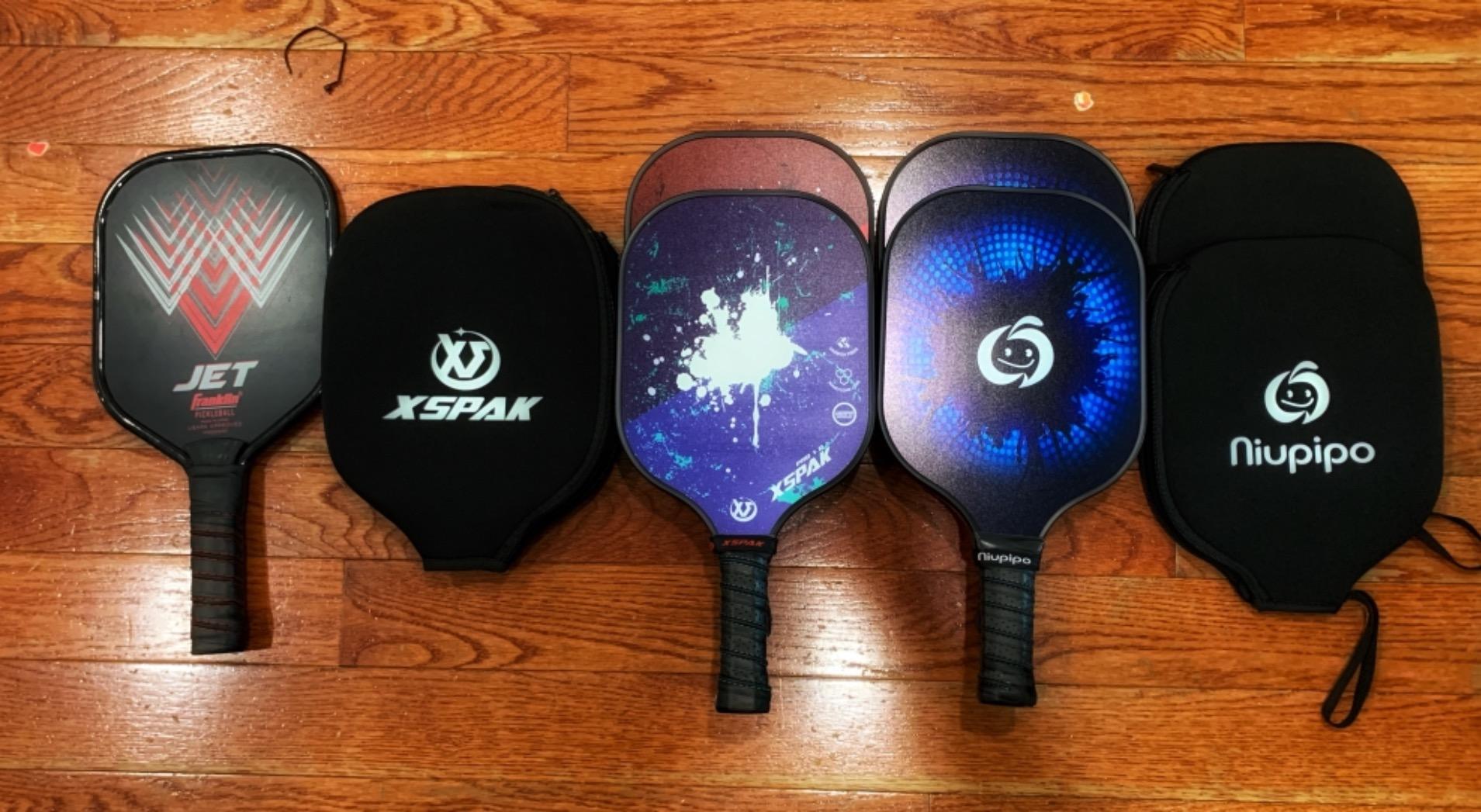
The spec sheet is short and complete: 8 ounces, 16.5 by 7.4 inches, a 5.5 by 4.35 inch grip, USAPA certification, and a one-year manufacturer warranty. The low-profile edge guard is the detail I appreciate most, because it cuts mishits without adding the rim weight that makes some paddles feel sluggish.
The limitation is power. You generate pace with paddle speed and placement rather than raw heft, which suits players who build points at the kitchen.
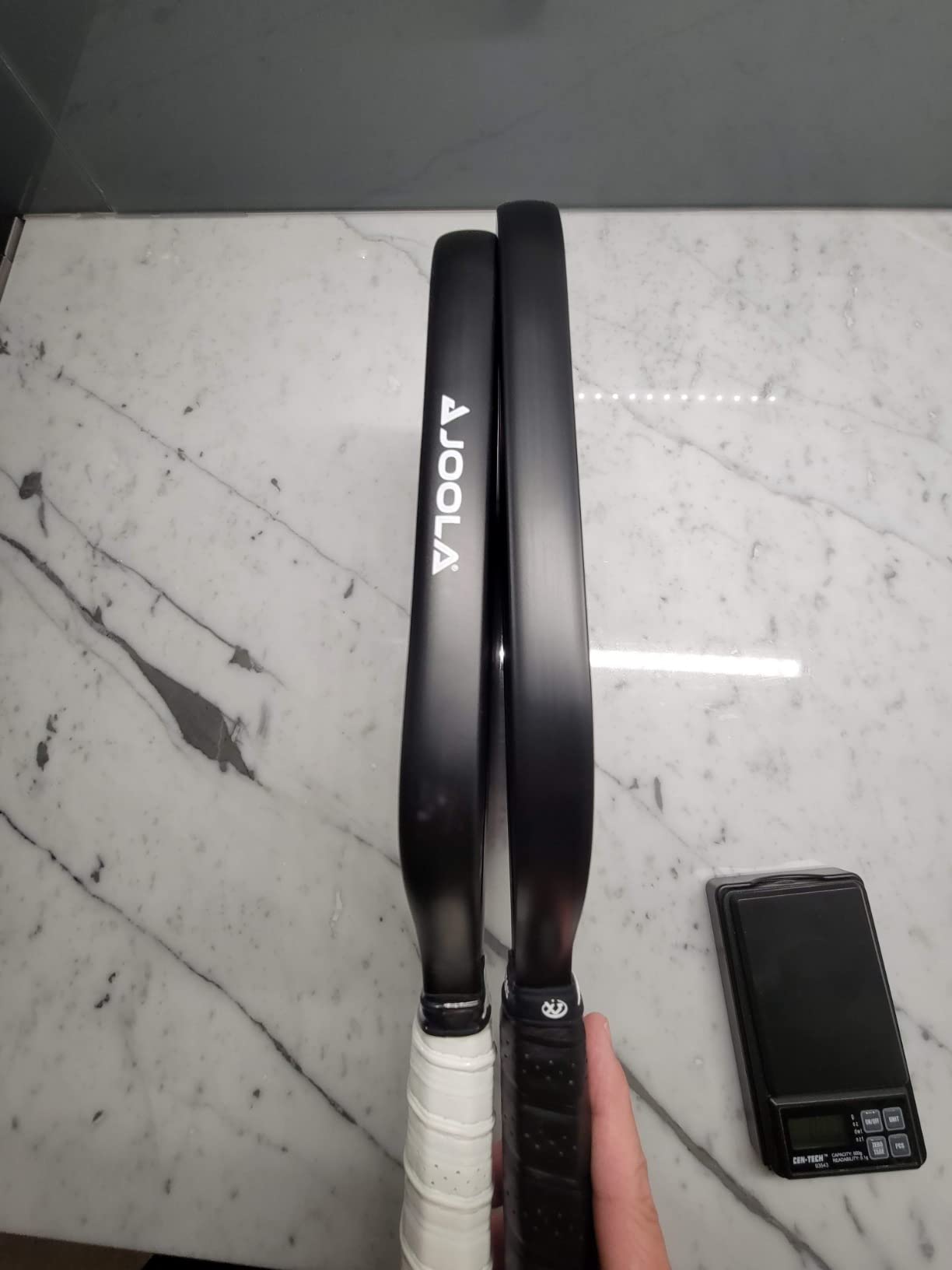
What 8 ounces and a honeycomb core do for your third shot drop
Eight ounces gives you enough mass to drive through a hard volley but not so much that your hands slow at the net. That middle ground is where intermediate games are won, and reviews report comfortable dwell time so a soft drop lands instead of skidding long.
Where it will frustrate you
If you rely on pace at the transition zone, the first few sessions will feel like you lost something. Power players chasing maximum velocity should look at the LUZZ Cannon further down. Everyone else will find the trade worth it.
2. JOJOLEMON Shark Power Core: Best Value Carbon Fiber Paddle With Genuine Toray T700 Fiber
JOJOLEMON Pickleball Paddles Featuring a Raw Carbon Fiber Paddle Face and 16mm Power Polymer Core Pickleball Rackets Designed for Spin and Consistency
8 oz
16.5L x 7.4W
3K Toray T700SC raw carbon
16mm core
Extended handle
Pros
- 3K Toray T700SC raw carbon face
- 4-directional weave enlarges the sweet spot
- 16mm honeycomb core with foam edges
- Extended handle suits two-handed backhands
- Cover eraser and grip tape included
Cons
- Built for control rather than maximum power
- 4.25 inch grip runs small for larger hands
This one rates 4.7 stars across 1539 reviews, and it is the paddle I would point an intermediate player toward if value is the question. Genuine 3K Toray T700SC raw carbon fiber and a four-directional textured weave sit on an 8 oz face with a 16mm polypropylene honeycomb core.
Few competitors at this tier name the fiber grade at all, and the weave does real work. Owners credit it with reducing dead spots near the edges, the most common complaint on cheaper carbon paddles.
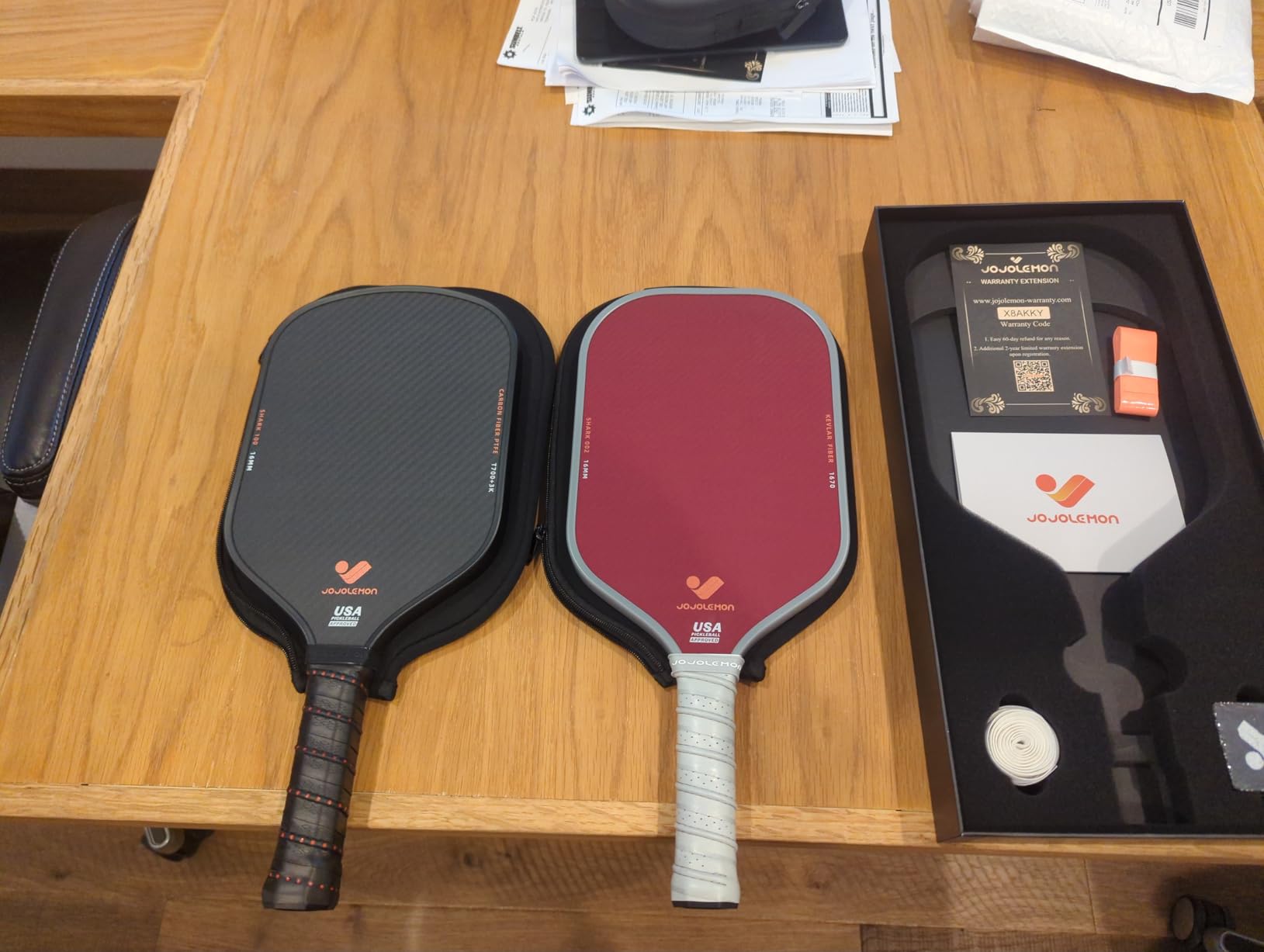
The box includes a cover, an eraser and grip tape, which sounds ordinary until you compare it with the bare-bones packages elsewhere in this list. The extended handle gives a two-handed backhander a real second grip point, and the strong five-star share suggests the fit works for most buyers.
The 4.25 inch grip circumference is on the compact side, and players with larger hands add an overgrip rather than replacing the paddle. That is a two-minute fix.
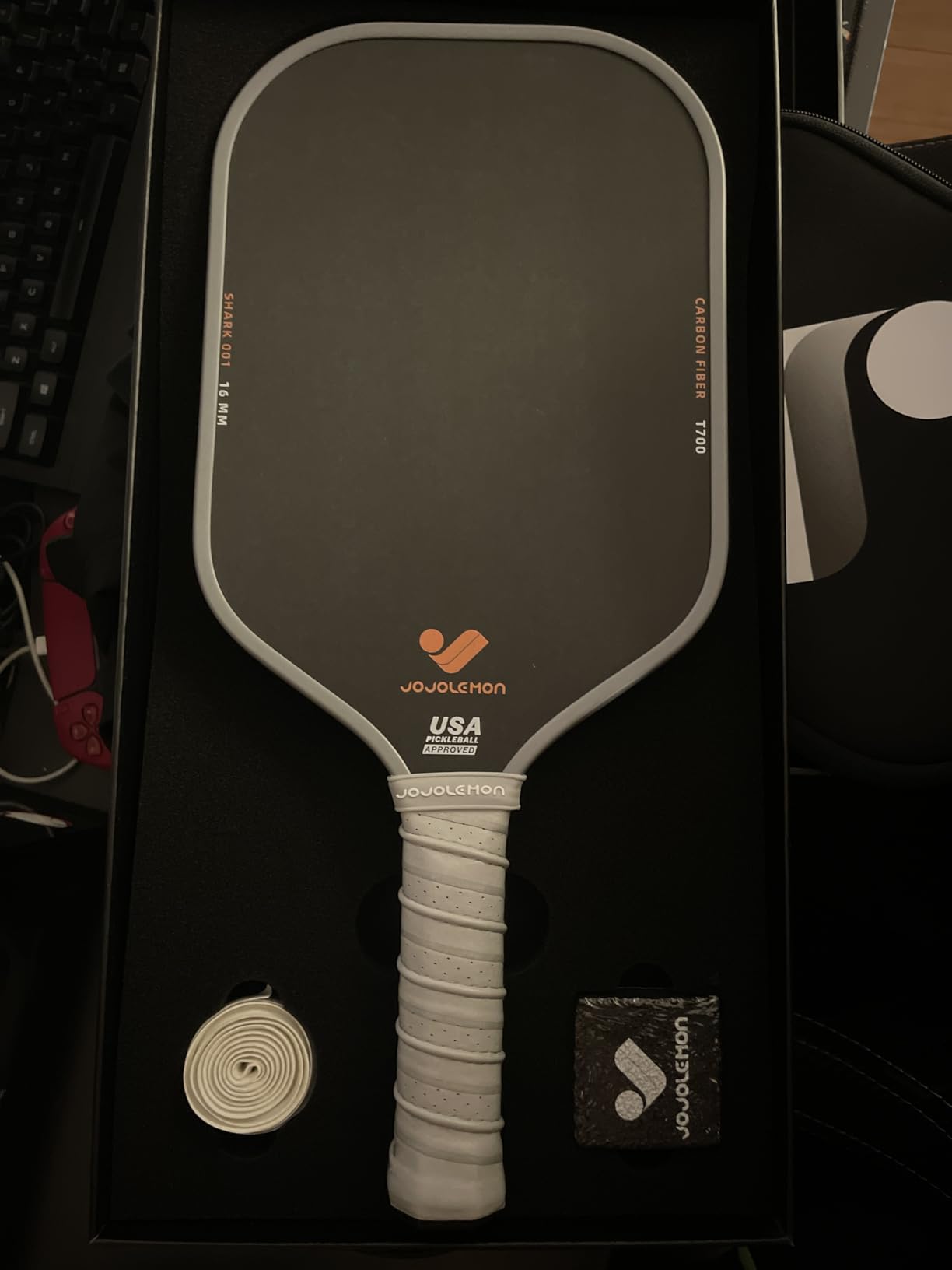
Why the fiber grade matters more than the badge
A named grade tells you the face is real woven carbon rather than a coating over fiberglass, which is the substitution players worry about most in forum threads. The practical test is an off-center hit: on genuine raw carbon the ball still leaves predictably near the shoulder, and that predictability is what makes the sweet spot feel large.
Where it will frustrate you
This is a control paddle aimed from the start at beginner and intermediate players. If your game depends on flattening hard drives with a short swing, a 16mm core gives back too little, and you should lean on placement instead of pace.
3. Vatic Pro Prism 16mm: The Most Compact for Kitchen Play and Placement
Vatic Pro Prism V7 Carbon Fiber 16mm – Foam Injected Walls – Includes Paddle Cover
8 oz
16.3L x 7.5W
Raw T700 carbon fiber
Foam-injected walls
USAPA approved
Pros
- Foam-injected walls improve control and touch
- Cold-molding avoids extreme heat processing
- Very few dead spots
- Low vibration and low fatigue
- Cover included
Cons
- Soft feel with limited pop
- Original grip can separate with heavy use
The Vatic Pro Prism is what I recommend to doubles players whose game is built at the kitchen. It is an 8 oz carbon fiber paddle with a raw T700 face and foam-injected walls, rated 4.6 across 1668 reviews. Owners call it the benchmark affordable carbon fiber paddle.
Its cold-molding process is the differentiator. Rather than cooking the whole paddle at extreme heat, foam is injected into the walls, increasing cross-sectional area and spreading impact across more of the face.
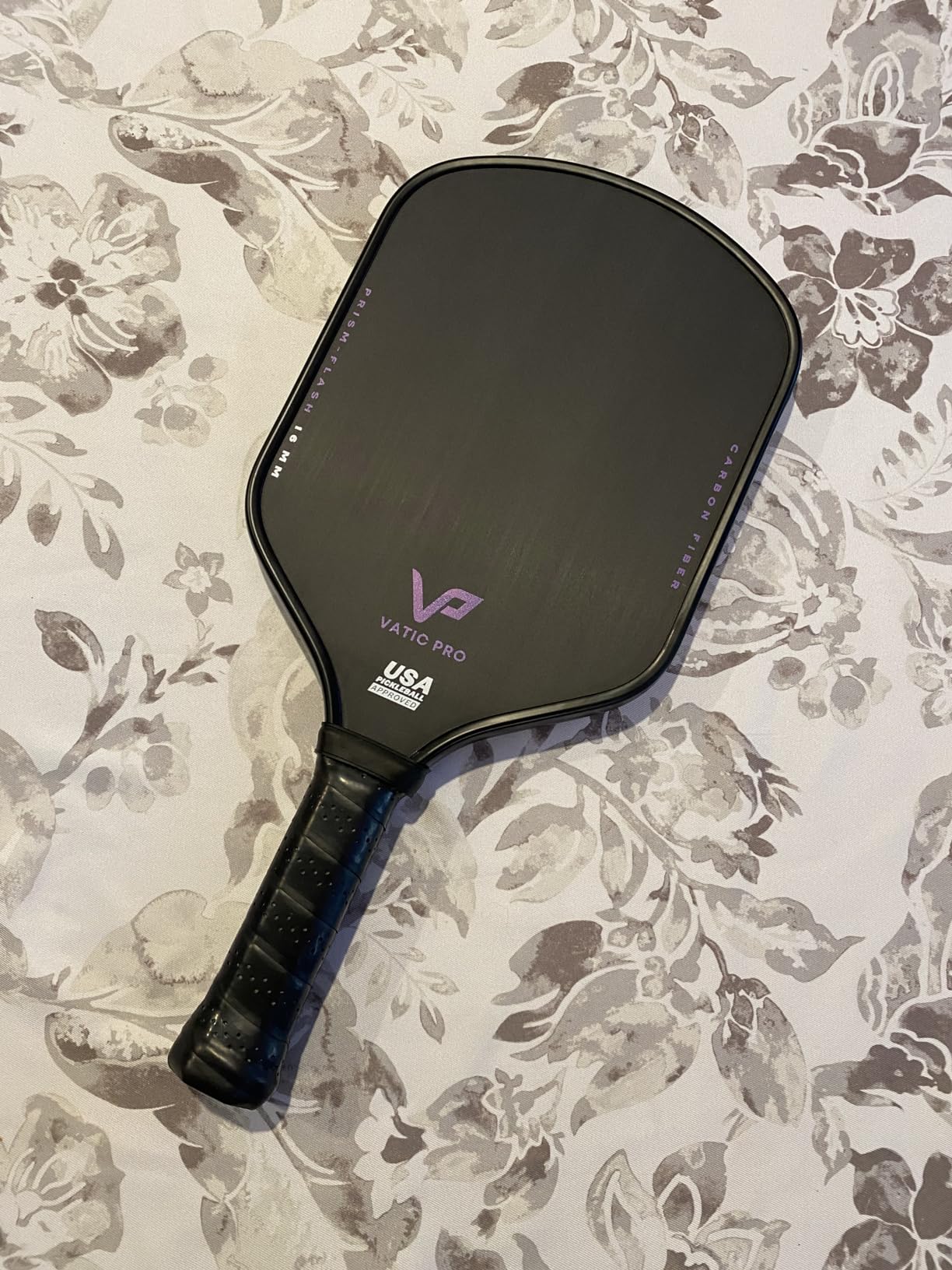
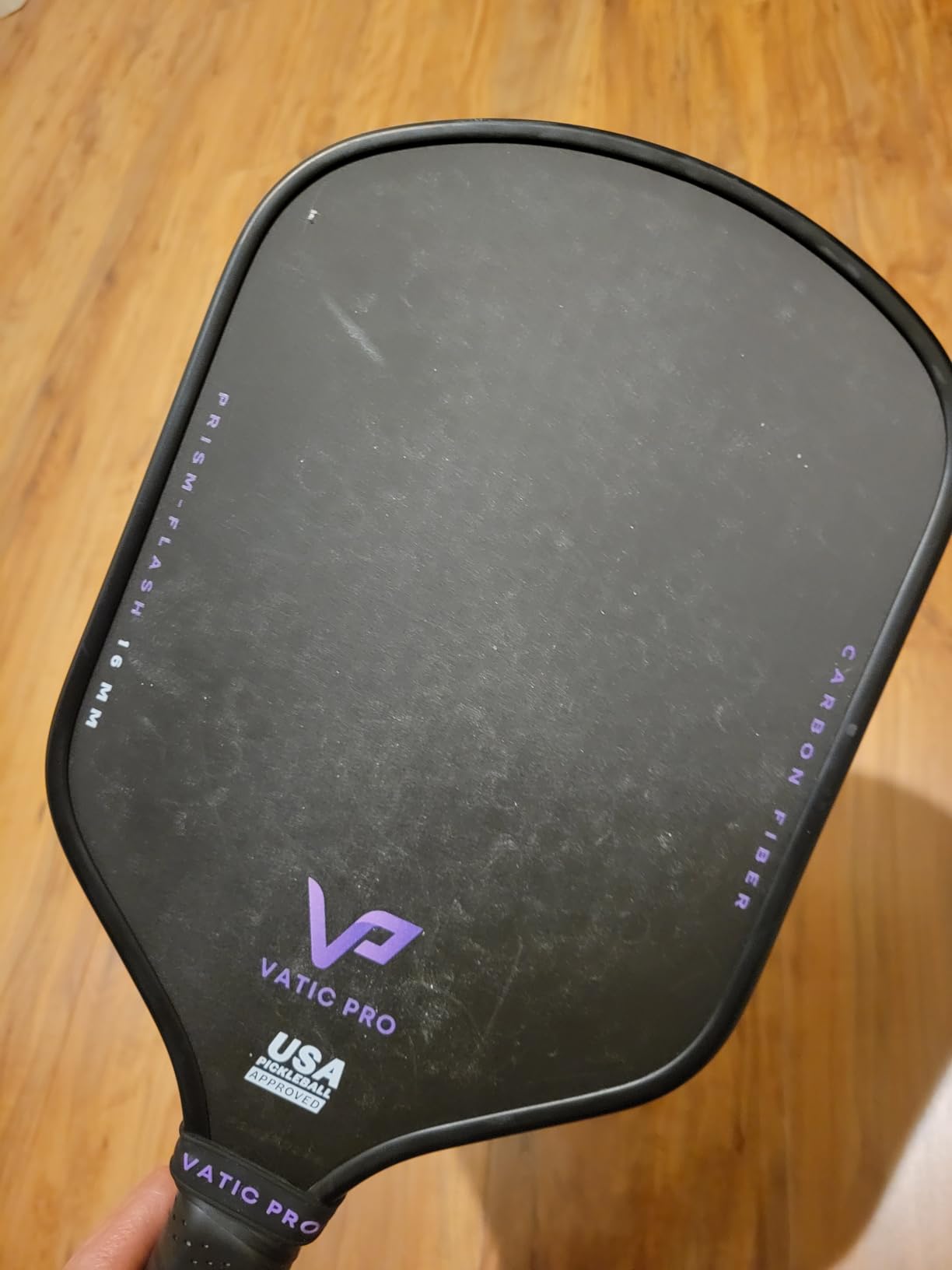
The paddle is 16.3 by 7.5 inches with a 5.3 inch grip, ships with a polypropylene sleeve, and is USAPA approved for sanctioned events. The 16mm core is the soft end of the intermediate-friendly range, so expect a quiet, damped impact rather than a crack.
Vibration is a genuine strength. Owners playing two or three sessions a week report less forearm fatigue than with stiffer paddles.
How the foam-injected walls change forgiveness
Forgiveness is the size of the area where an off-center hit still travels where you aimed. Foam walls and a wider cross-section both raise that area, so mishits near the edges degrade more gently, and a larger sweet spot beats extra pace for a player building consistency.
Where it will frustrate you
The soft impact means you must swing harder for real pace, which is the most common reason buyers return a soft-core paddle. The original grip can also separate after a few months, and the 30-day warranty is the shortest in this roundup.
4. JOOLA Ben Johns Hyperion: Best Hybrid Pick for Players Who Want Drives and Dinks
JOOLA Ben Johns Hyperion CAS 16 Pickleball Paddle – Carbon Abrasion Surface with High Grit & Spin, Sure-Grip Elongated Handle, 16mm, with Polypropylene Honeycomb Core, USAPA Approved
8.3 oz
22L x 7.5W
Carbon abrasion surface
16mm polymer honeycomb
120-day warranty
Pros
- Sand-blasted carbon abrasion surface for spin
- Hybrid-ply layering balances dinking and drives
- 16mm core reduces vibration
- Perforated anti-slip grip wicks moisture
- Familiar signature model
Cons
- Core can soften after extended play
- Handle runs small for larger hands
- 120-day warranty is short
The Ben Johns Hyperion is the most polarizing paddle here, with a 4.4 average across 1213 reviews and a much wider spread of one-star responses than its competitors. Owners arriving from a light composite paddle love the power; owners who wanted pure touch find it too firm.
The face uses a multi-step sand-blasted carbon abrasion process that roughens the surface for spin without the coarse grit of a raw T700 weave. Hybrid-ply layering puts a control layer on top and power layers beneath, so the paddle behaves differently depending on where the ball lands.
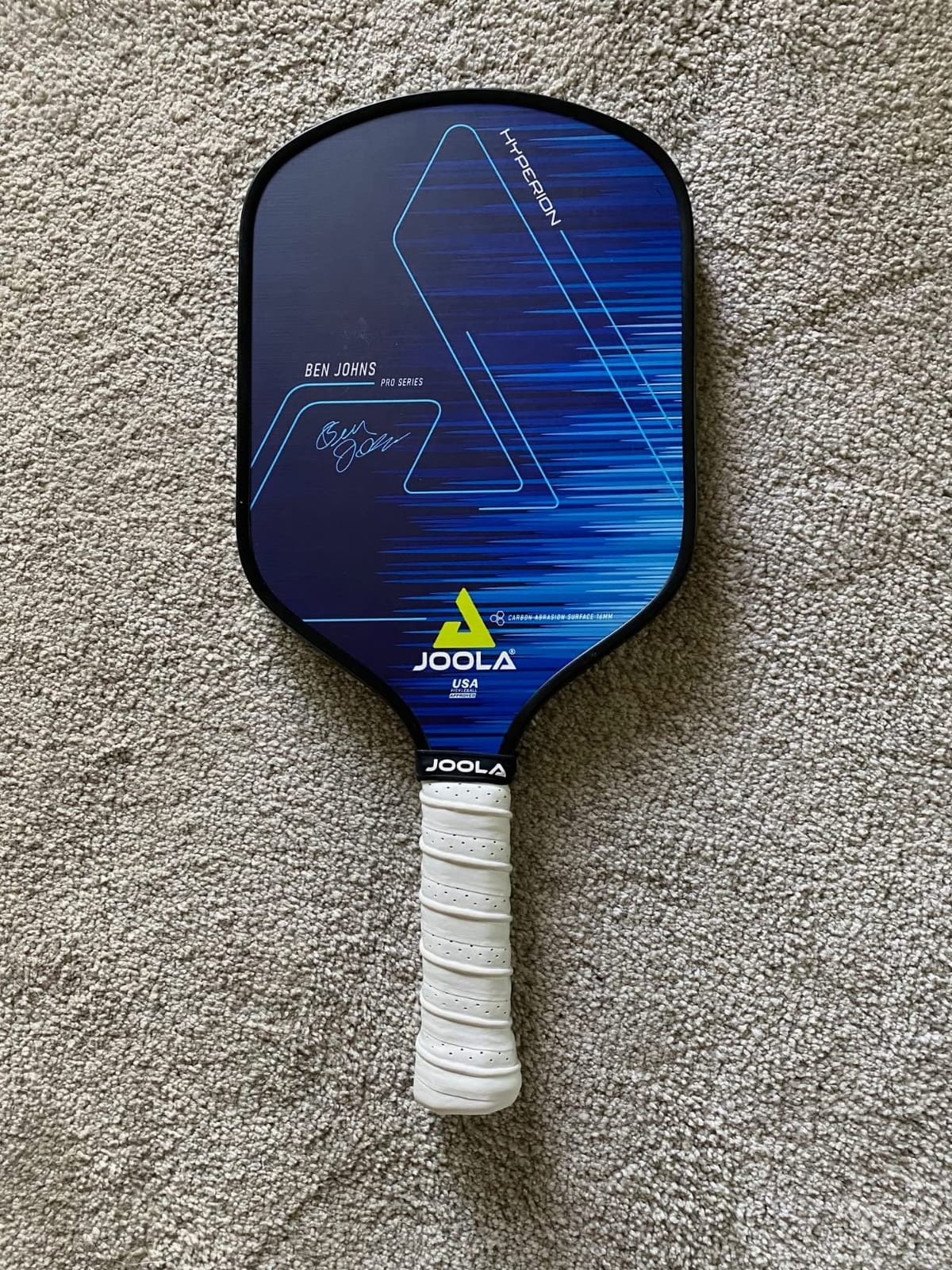
At 8.3 ounces and 22 inches long it is the longest paddle in the group, and that extra length buys reach at the net. The perforated ridge grip wicks moisture and absorbs shock, which matters in long doubles matches.
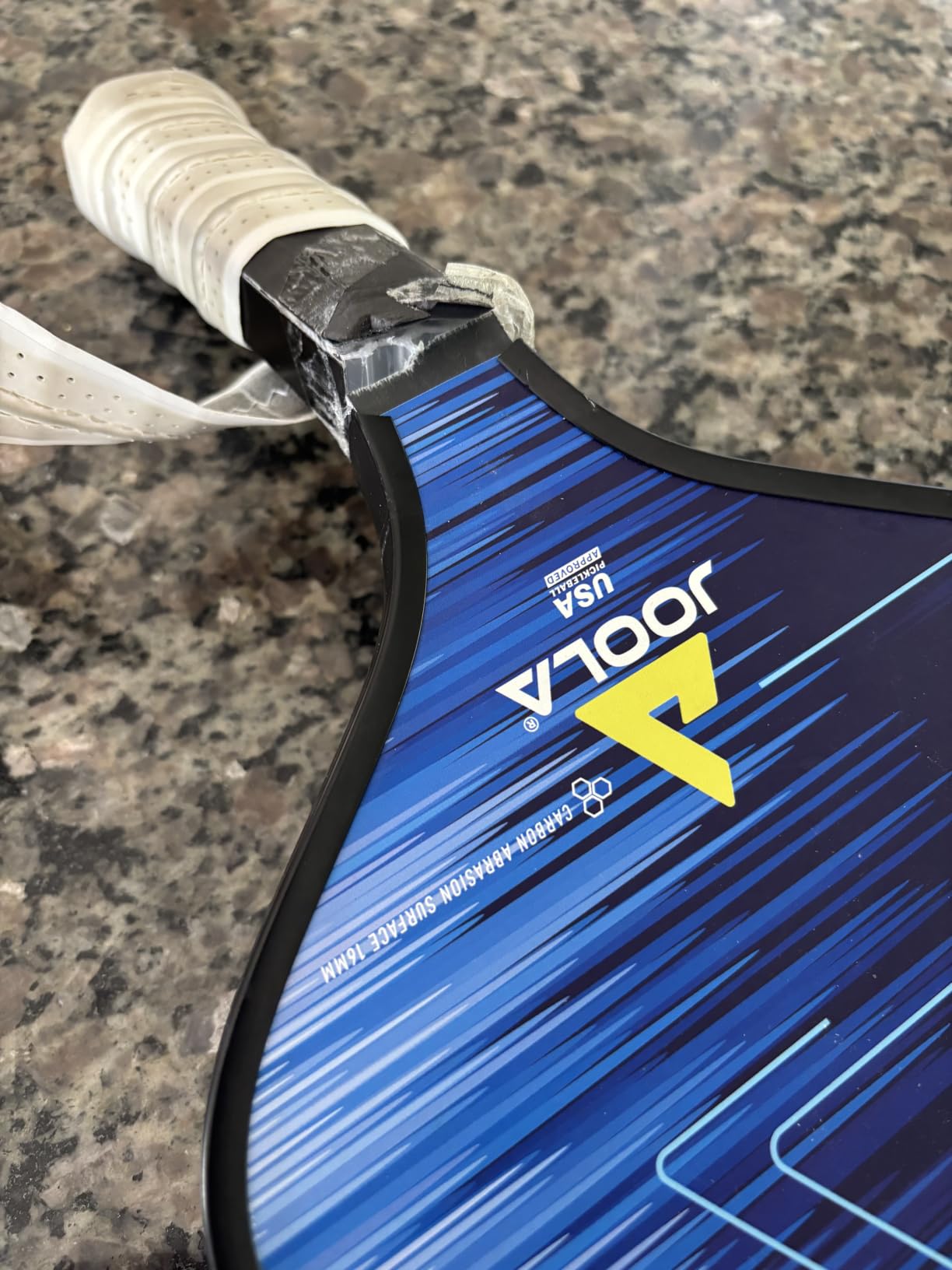
The 16mm honeycomb core reduces vibration, but it is an older generation core and a segment of owners report it softening after months of play.
When hybrid-ply layering actually helps your game
Hybrid-ply construction sits between a uniform face and a thin power core, and the benefit is shot tolerance: a ball landing slightly high still carries, and one landing low still controls. For players whose errors are placement rather than timing, that tolerance is worth a lot.
Where it will frustrate you
The handle is the most common complaint. Two-handed backhand players should check the short shaft against their grip style, and the 120-day limited warranty is the shortest here, so decide quickly.
5. CPX Pro Carbon Fiber: Best Pick for Players Coming From Tennis or Other Racket Sports
CPX Pro Carbon Fiber Pickleball Paddle – Professional Grade, Matte Finish, Honeycomb Core, Tennis Style Grip – Edgeless Paddle Designed in Chicago, USA (Black, Pro)
8.2 oz
Honeycomb core
Matte carbon fiber face
Tennis-style grip
Edgeless
Pros
- Matte carbon fiber face with honeycomb core
- Tennis-style handle shape
- Edgeless design avoids edge guard weight
- Consistent 4.6 rating across 685 reviews
Cons
- Published listing detail is sparse
- Sweet spot size not clearly documented
Most players buying a paddle for the first time properly arrive with a tennis or badminton grip in their hand, and this is the paddle that bridges that habit. The handle shape is deliberately tennis-like with a flat face and a 4.1 inch grip, which makes the move from a strung racket feel less strange.
At 235 grams, which is 8.2 ounces, it sits in the middle of the range where intermediate players work best. The edgeless design removes the guard entirely, so there is no heavy rim slowing your hands, and buyers report solid quality at this weight.
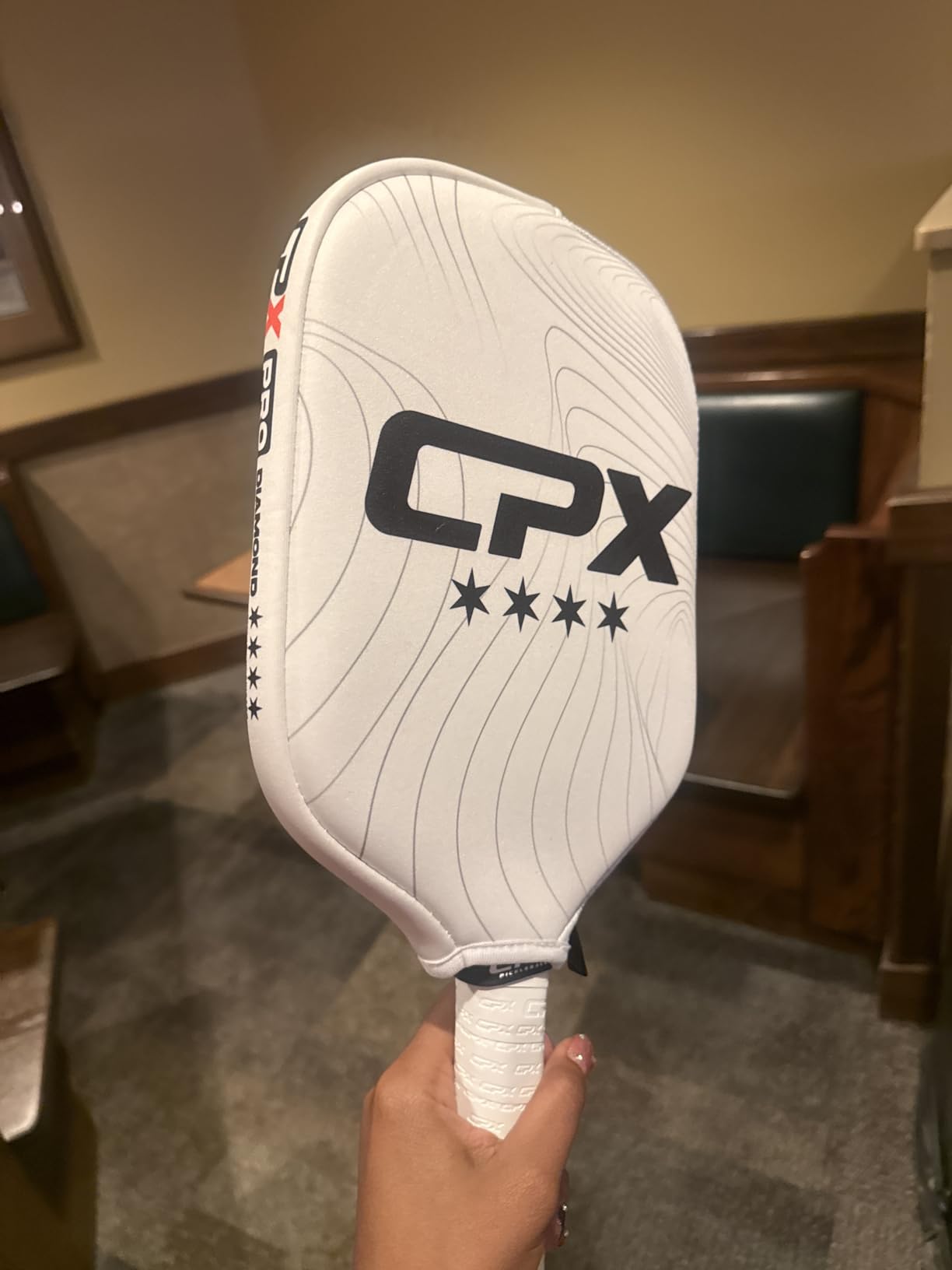
The paddle is designed in Chicago with a matte carbon fiber face and a honeycomb core. The matte finish is worth noting because it does not glare under bright indoor lighting.
The honest drawback is documentation. This listing publishes far less detail than the others, so core thickness is not stated and any claim beyond weight, face material and core type is inference rather than spec.
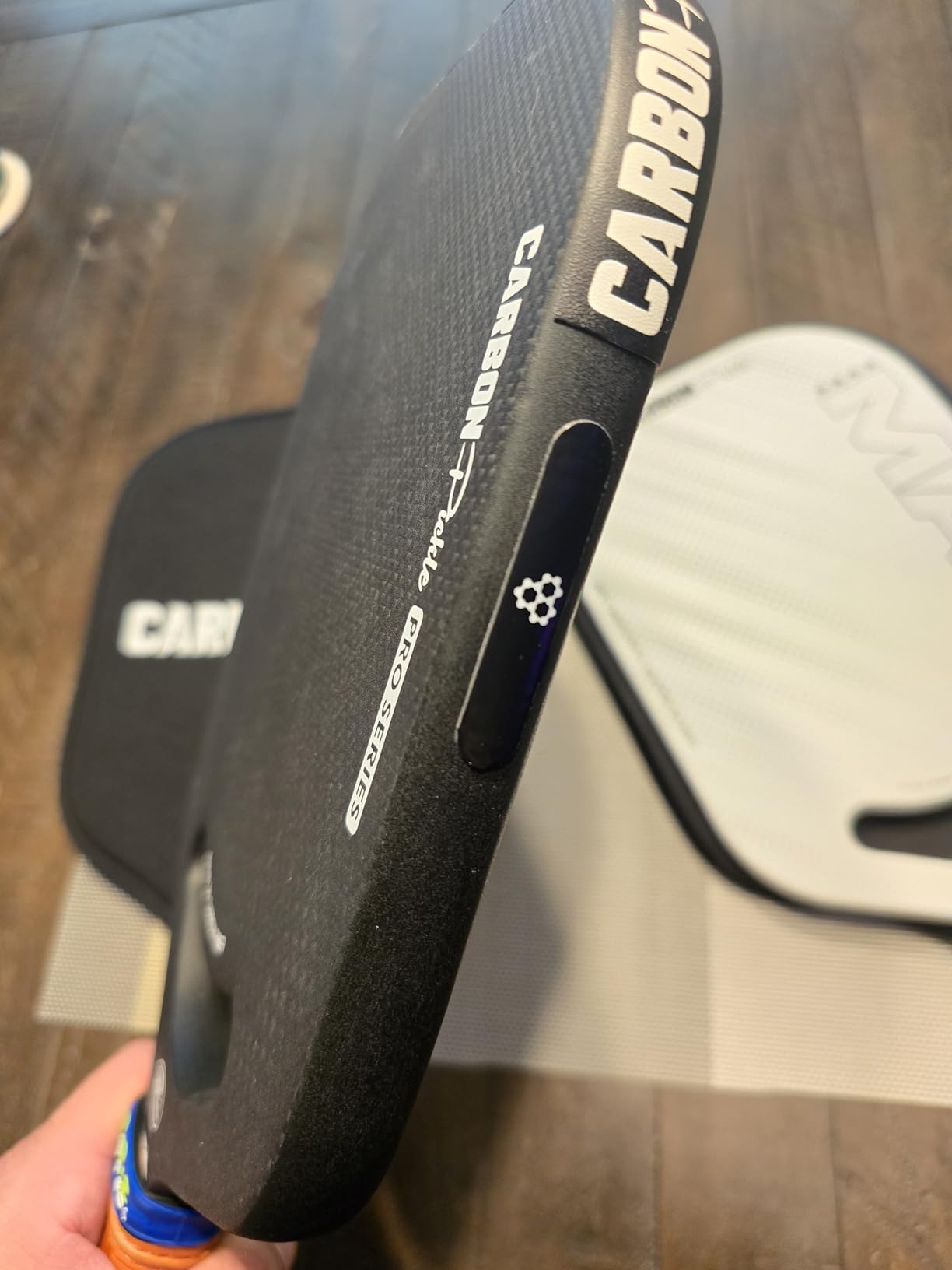
What an edgeless design changes
Removing the edge guard takes weight off the perimeter and eliminates the raised lip that catches low balls near the kitchen and deflects them upward. The trade is durability, since the carbon face is exposed to court surfaces and marks more readily than a nylon face.
Where it will frustrate you
You are buying feel rather than data here, so we would want to handle this one in person. Players who care most about documented core thickness and sweet spot size will find better-documented options elsewhere in this list.
6. HISK RAV PRO: Best Budget Route Into Raw Toray T700 Carbon Fiber
HISK RAV PRO T700 Toray Raw Carbon Fiber Pickleball Paddle USAPA Approved
7.9 oz
16.33L x 7.5W
Toray T700 raw carbon
16mm core
Extended handle
Pros
- Genuine Toray T700 raw carbon face
- Light 7.9 oz build reduces fatigue
- 16mm core absorbs pace for drops
- Bundled cover overgrip sweatbands and eraser
- Perimeter foam broadens the sweet spot
Cons
- No free power
- Smaller face than some rivals
- Rectangular handle takes practice
The RAV PRO answers the question we hear most in weekly paddle recommendation threads: can you get real raw Toray T700 carbon without tour-level money. Owners compare it favorably to paddles costing several times more, and the 4.6 rating across 540 reviews supports that.
What stands out is the package. You get a neoprene cover, an extra overgrip, wrist sweatbands and a carbon fiber eraser, and USA Pickleball approval means it is legal for sanctioned league and tournament play.
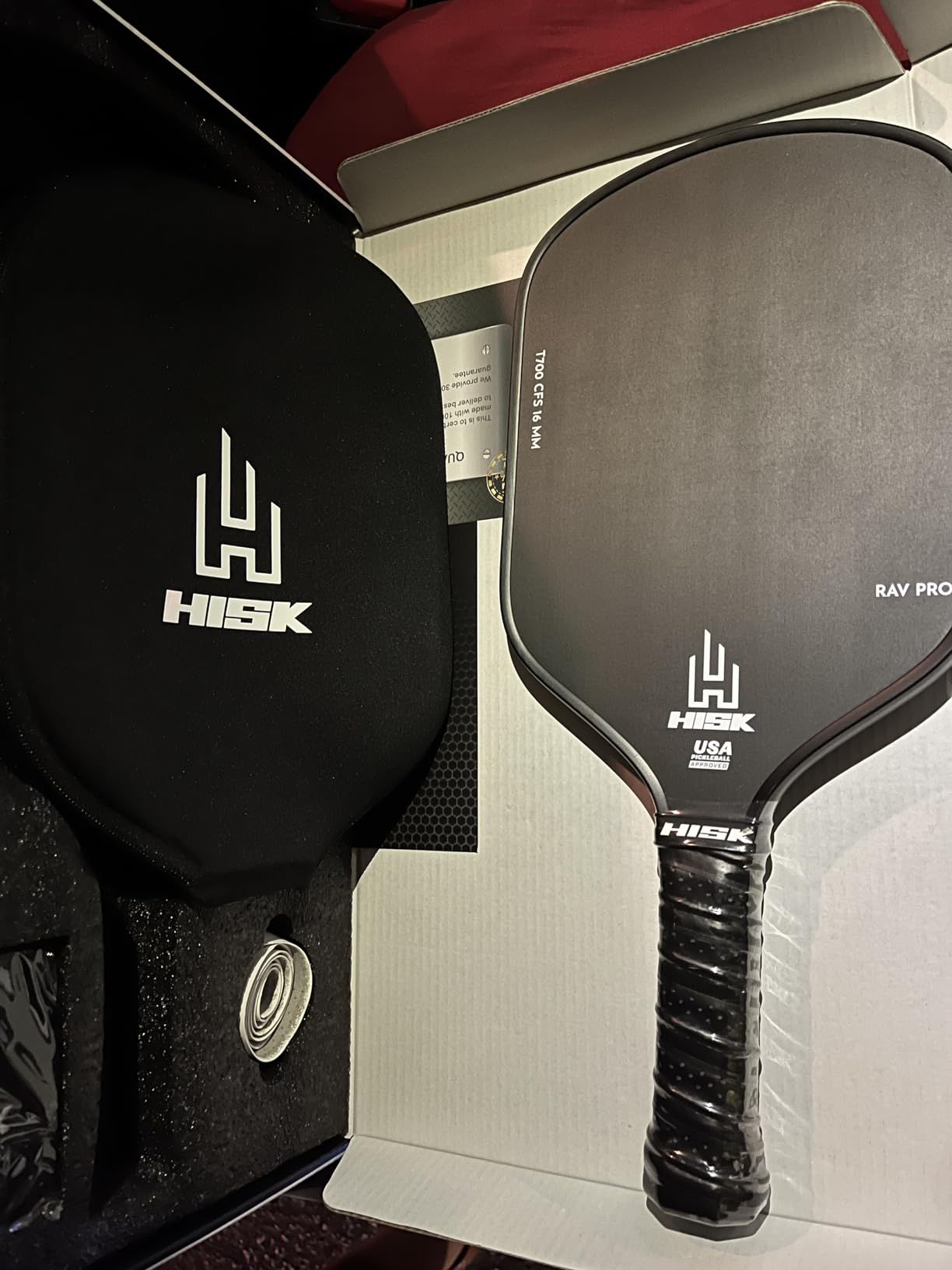
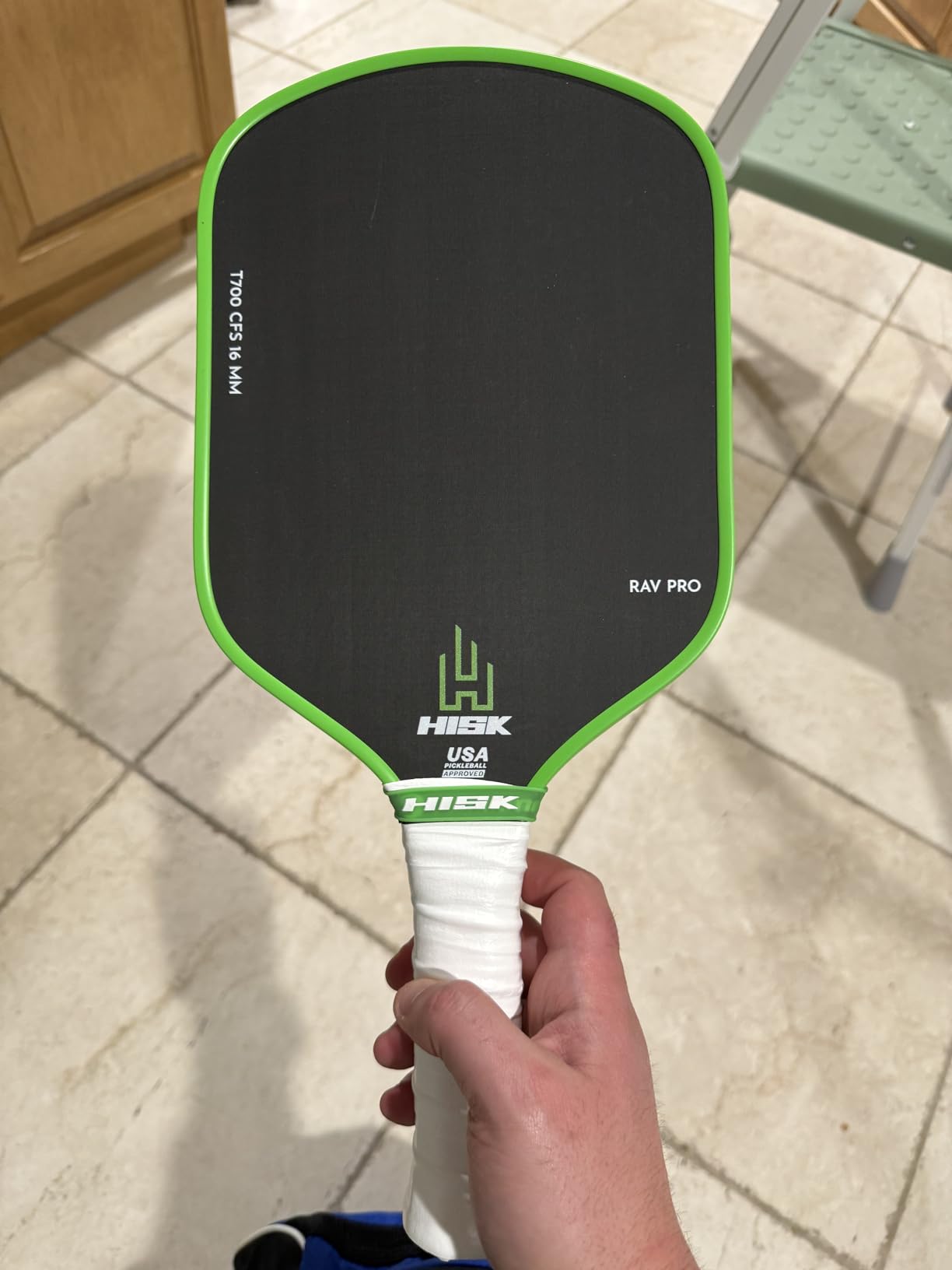
At 7.9 ounces it is one of the lightest paddles here, and fast hands at the net are noticeably easier. The 16.33 inch face with a 5.5 inch extended handle gives a two-handed backhander a second grip point, and perimeter foam edging broadens the sweet spot.
Owners describe a soft, dense feel rather than explosive power, and several add lead tape at the head to broaden the strike zone.
Is a light 7.9 oz paddle fast enough for kitchen play
Yes, and in fast-hands situations it is an advantage. A lighter paddle needs less effort to reverse direction, so blocks and reflex volleys arrive sooner, and against hard hitters that extra reaction time decides the block.
Where it will frustrate you
The face is slightly smaller than some rivals, so placement accuracy matters more. A few owners also find the sweet spot narrow out of the box and the rectangular handle unfamiliar.
7. YVMOVE 16mm Kevlar T700: Best for League Players Who Want the Highest Rating in the Group
YVmove 16mm T700 Carbon Fiber Pickleball Paddle USAPA Approved Black
8 oz
16.53L x 7.4W
6-layer T700 raw carbon
16mm Gen3 core
2-year warranty
Pros
- Highest average rating in the roundup at 4.8
- 6-layer T700 face with micro-grit texture
- Thermoformed unibody with perimeter foam
- Elongated handle for two-handed backhands
- Two-year warranty with tap-to-register chip
Cons
- Little head weight out of the box
- Supplied grip is thin
The YVMOVE has the highest average rating of any paddle we analyzed, 4.8 across 529 reviews with essentially no negative ratings. That distribution usually means a product that creates no strong reactions in either direction, which is exactly what a league player chasing consistency wants.
Construction is where the value sits: a thermoformed unibody with perimeter foam injection around a 16mm V-Sonic Gen3 core, under a six-layer T700 raw carbon face with a micro-grit surface.
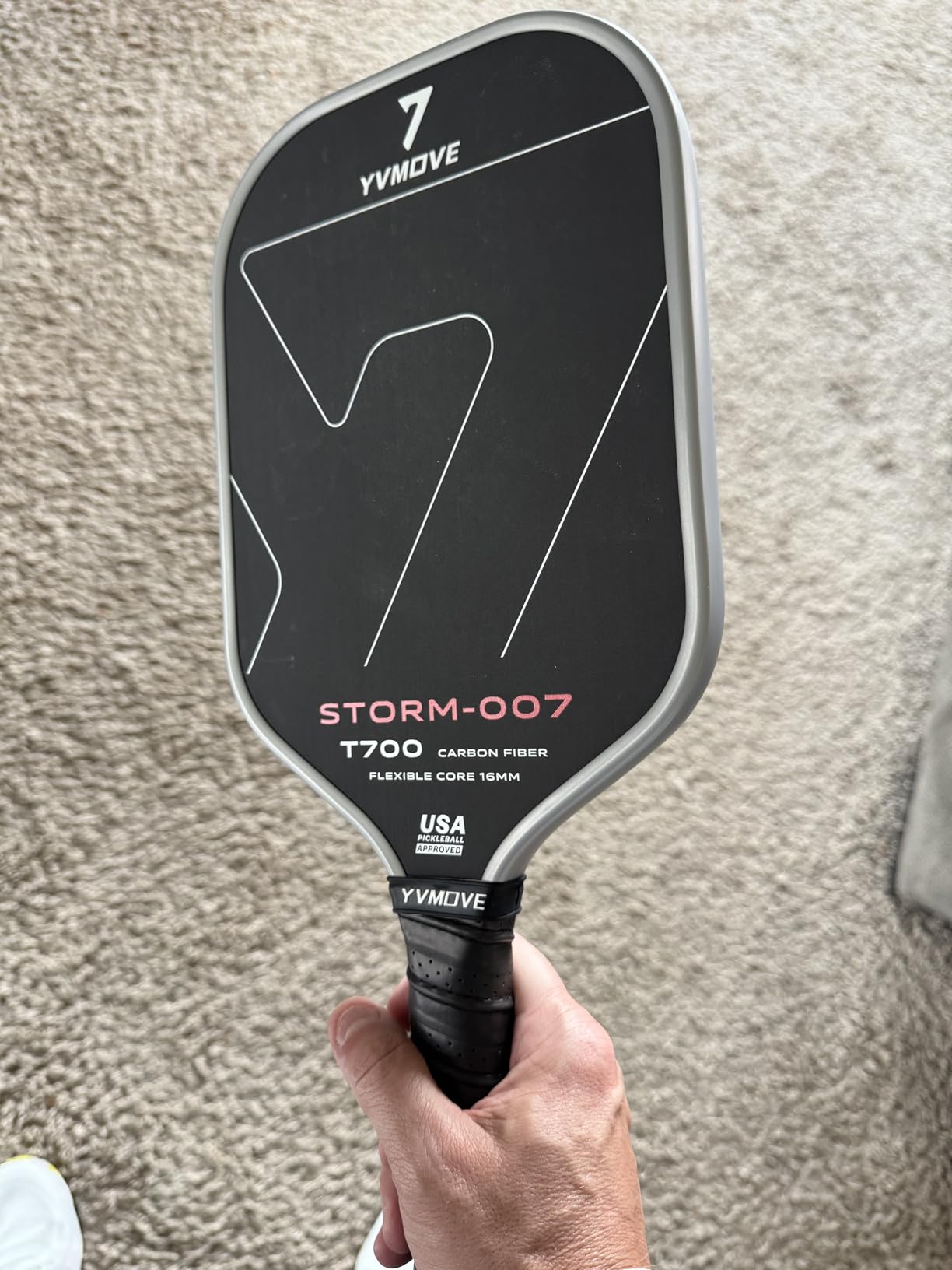
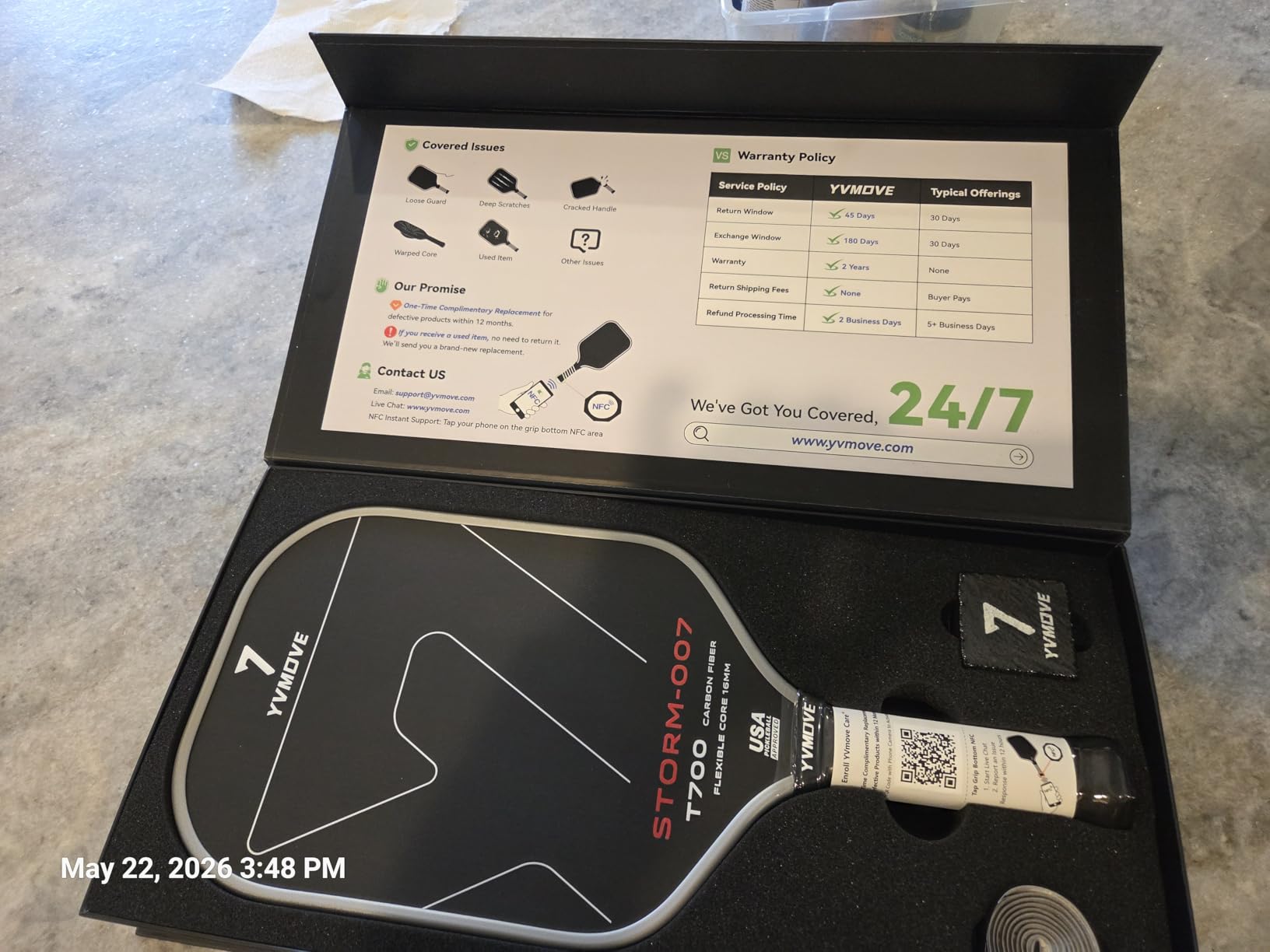
At 8 ounces and 16.53 by 7.4 inches with an elongated handle, it fits the standard intermediate profile, and USA Pickleball approval covers PPA Tour and APP Tour events. The two-year warranty is the longest here, and the cover, grip tapes and eraser are included.
An embedded NFC chip handles warranty registration by tap, so there is nothing to buy before your first session.
Why a thermoformed unibody reduces twisting
Thermoforming bonds the face, core and edge into one molded body instead of gluing separate layers. Because the layers cannot flex independently, an off-center hit transfers energy through the whole paddle rather than twisting the face sideways, which is why unibody paddles hold their sweet spot over time.
Where it will frustrate you
There is very little weight in the head, so players who want plow-through may find the ball dying mid-court, and lead tape is the common answer. The supplied grip is thinner than most players prefer.
8. DGYGQ T700 Raw Carbon: Most Versatile for a First Serious Carbon Fiber Upgrade
DGYGQ Pickleball Paddles, T700 Raw Carbon Fiber Surface, 16mm Polypropylene Honeycomb Core for All Skill Levels – Larger Sweet Spot for Max Spin, Control & Power
8 oz
16.92L x 7.36W
T700 raw carbon surface
16mm polypropylene core
ABS edge guards
Pros
- 4.8 average with essentially no negative ratings
- T700 raw carbon surface for spin and grip
- 16mm honeycomb core with ABS edges absorbs impact
- Carrying case and cleaning block included
- Edge guards protect the face
Cons
- Single color option
- Published spec detail is minimal
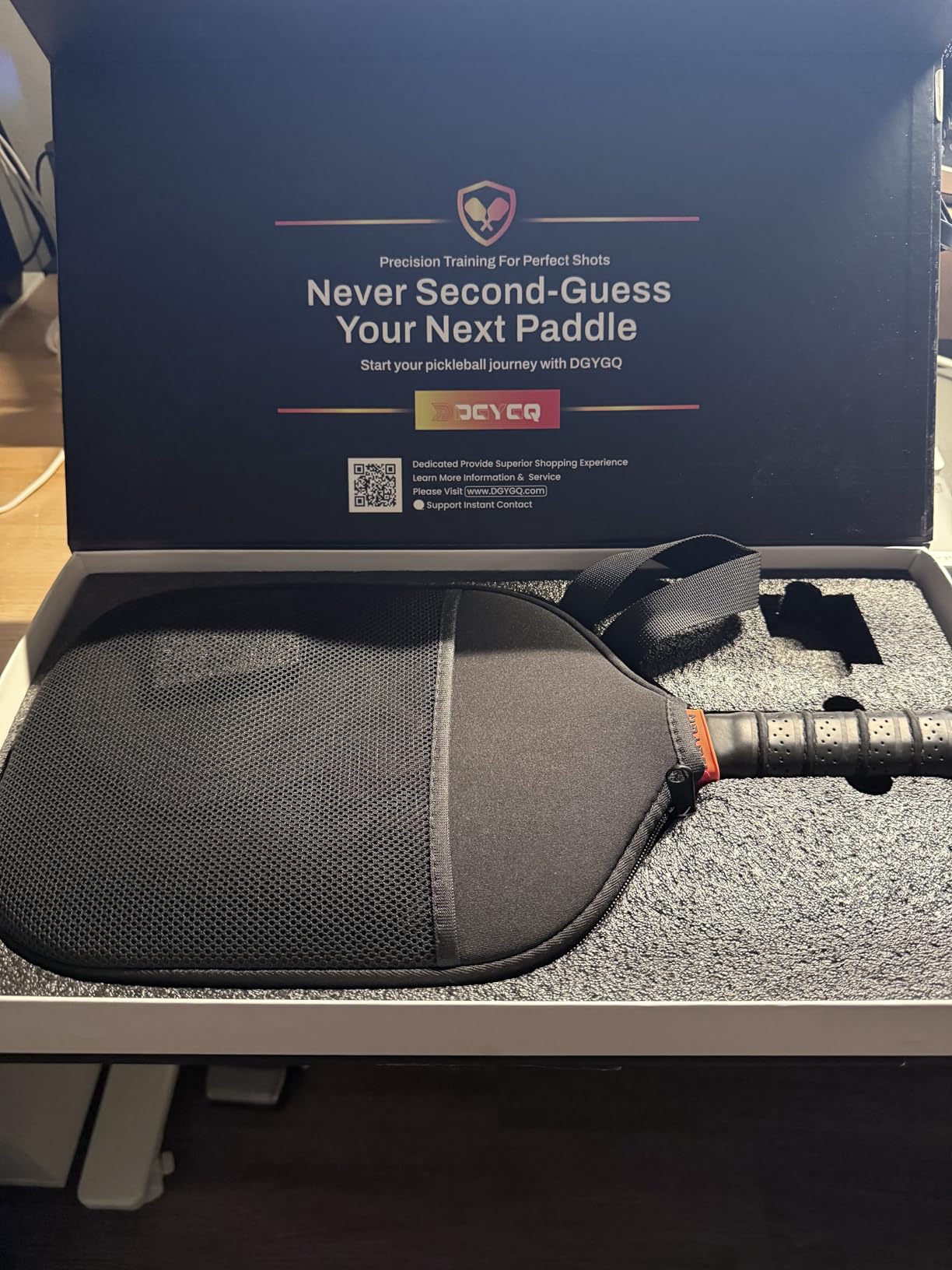
The DGYGQ is the simplest recommendation here, and simplicity is the point. It is an 8 oz paddle with a T700 raw carbon fiber surface and a 16mm polypropylene honeycomb core with ABS edges, carrying a 4.8 average across 232 reviews with no meaningful negative ratings.
Owners highlight control and grip rather than power, which is the right character for a player making the jump from a budget paddle.
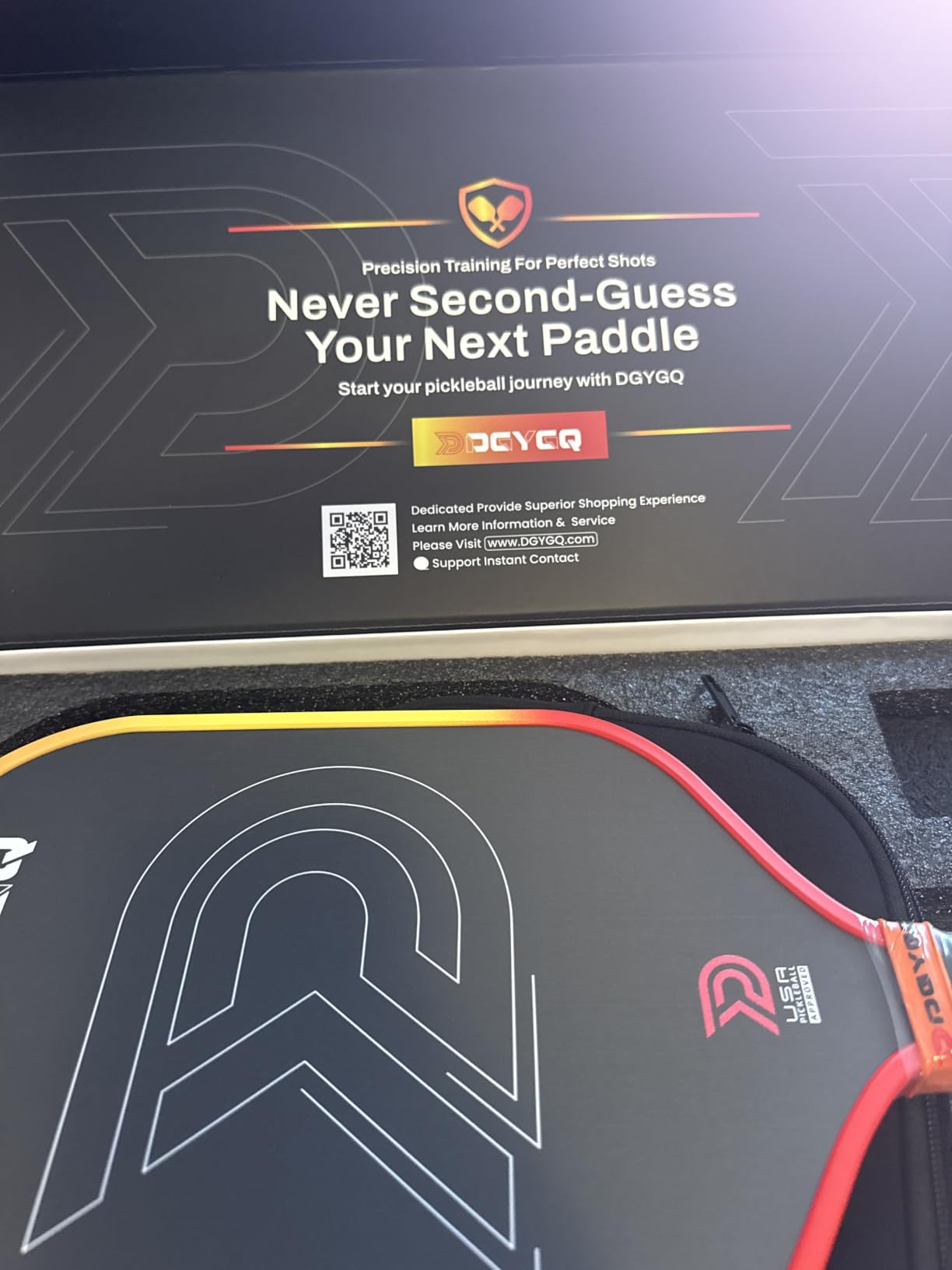
At 16.92 by 7.36 inches it is one of the larger faces in this roundup, and the ABS edge guards work with the honeycomb core to absorb impact and widen the effective sweet spot.
A carrying case and cleaning block are included, and the cleaning block matters more than it sounds, since a dedicated eraser keeps the raw carbon grit from clogging with resin and grime.
What you get stepping up from a nylon paddle
Moving from nylon to raw carbon changes three things at once: the ball grips on contact, the face flexes slightly before releasing, and the response stays consistent across the whole face. That is why third shot drops land instead of sailing and why placement becomes a skill you can actually control.
Where it will frustrate you
Published detail is minimal, with one color option and few specs beyond weight and face size. If you want documented core thickness, warranty length and handle measurements, the better-specified paddles in this list will serve you better.
9. Selkirk Sport Labs 007: Best for Vibration Damping and Long Sessions
Selkirk Sport LUXX Control Pickleball Paddle | Carbon Fiber X7 Core
0.31 kg
InfiGrit raw carbon surface
Florek carbon fiber
X7 Thikset core
EVA foam handle
Pros
- InfiGrit surface technology triples raw carbon durability
- Florek carbon fiber enlarges the sweet spot
- X7 Thikset core gives stable response
- EVA foam handle and throat absorb vibration
- Limited lifetime warranty
Cons
- Heavier than the midweight paddles in this roundup
- Premium tier for a player still developing technique
The Selkirk Labs 007 is the most engineered paddle here and the most polarizing, carrying a 4.4 average from 194 reviews. Both reactions trace back to a heavily dampened, generously sized build.
Three technologies set it apart: InfiGrit surface treatment on raw carbon, which the manufacturer says triples surface durability; a proprietary Florek carbon fiber that expands the sweet spot; and an X7 Thikset honeycomb core tuned for stable response.
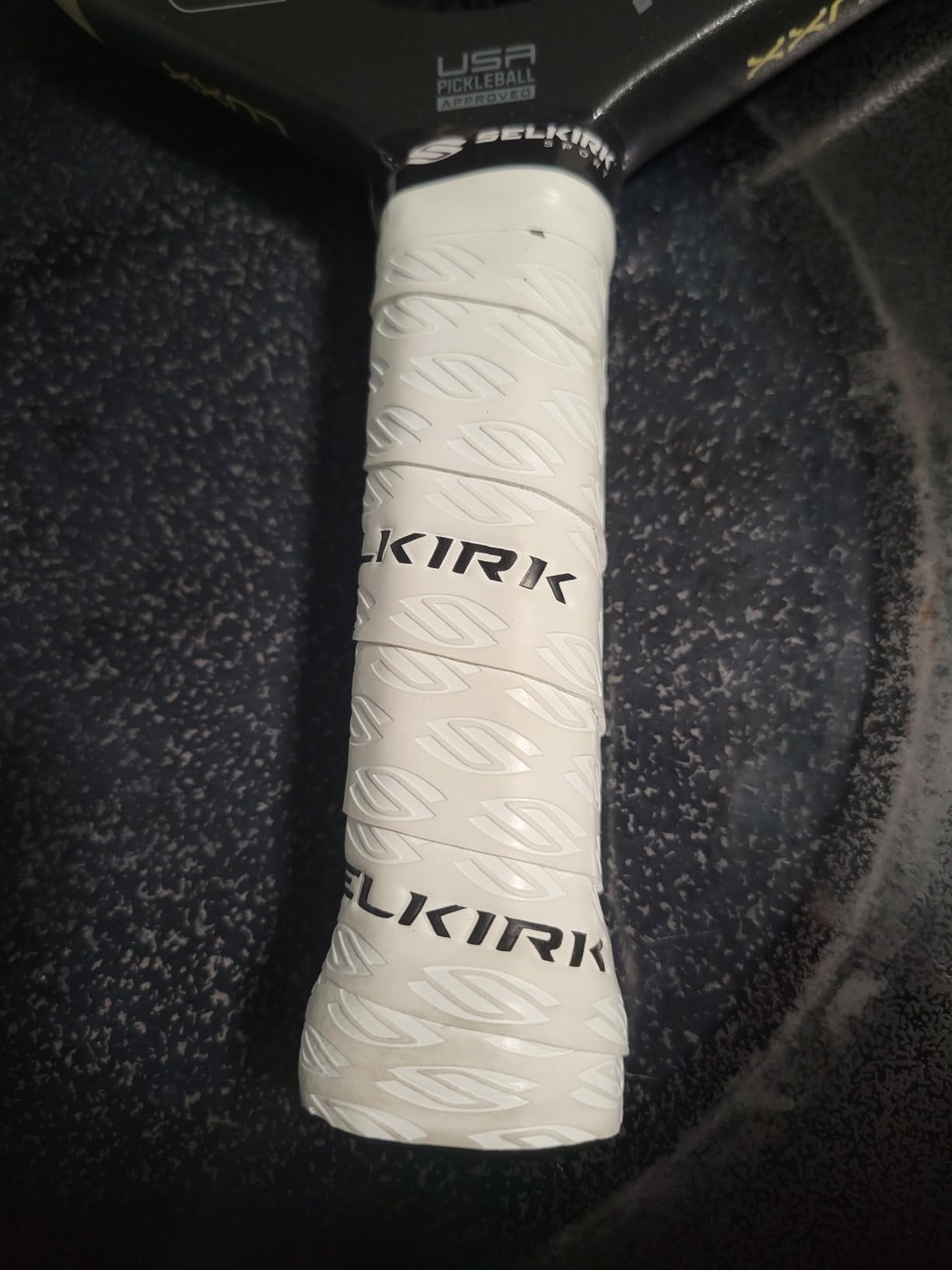
The EVA foam handle and throat absorb vibration before it reaches your forearm, which is why this paddle comes up in discussions about elbow and finger strain. Owners playing long sessions report less fatigue than with stiff, high-modulus paddles.
Weight is listed at 0.31 kg, noticeably above the 8 oz paddles most of this list uses, and the Invikta elongated shape adds reach at the cost of maneuverability. The limited lifetime warranty partially offsets the premium tier.
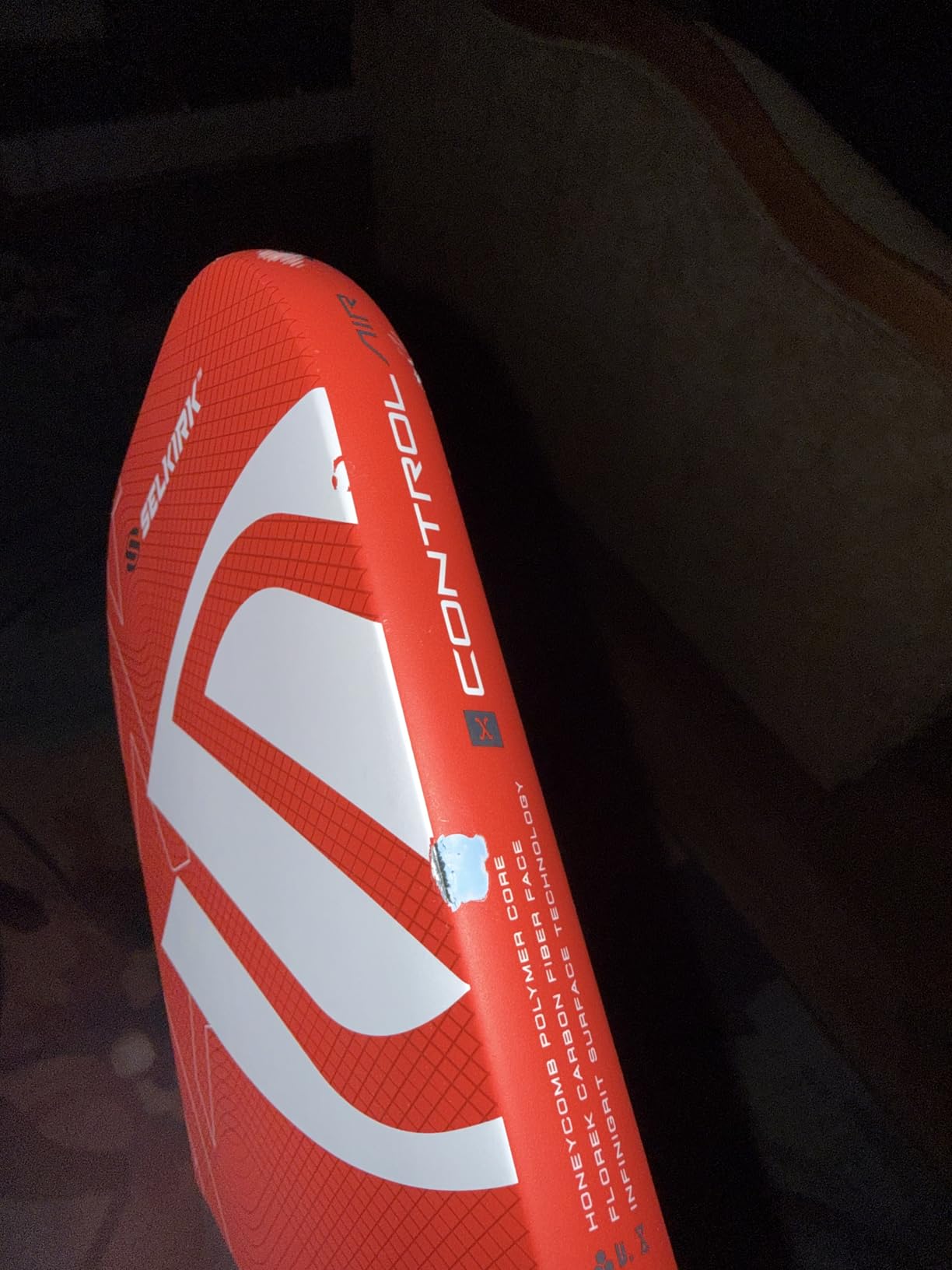
Who benefits from vibration damping
If you already feel tennis elbow or forearm tightness after a session, dampening matters more than power. Vibration travels from the face through the handle into the wrist and elbow, and foam in the handle and throat interrupts that path before the ball reaches your arm.
Where it will frustrate you
A heavier paddle slows hand transitions, and players with fast hands at the kitchen can struggle to block quickly enough. If your game is built on reactions rather than plow-through, pick a lighter midweight option such as the HISK RAV PRO or the XSPAK.
10. LUZZ Cannon: Best for Intermediate Players Who Want to Hit Harder
Luzz Pickleball Paddle Cannon Thermoformed T700 Carbon Fiber Honeycomb Core
16mm core
T700 raw carbon face
Waterfall texture
Sweet spot expanded 10 percent
Textured grip
Pros
- T700 raw carbon with fine waterfall texture
- U-shaped carbon fiber matrix core
- 16mm core gives power with low vibration
- Sweet spot area expanded by 10 percent
- Soft anti-perspiration grip
Cons
- Power takes practice to control
- Volleys can send the ball long
- Some players need a longer warm-up
The LUZZ Cannon sits at the power-leaning end of this roundup, which is exactly why it is worth an intermediate player’s attention. The 16mm core is thicker than a typical power paddle, yet the U-shaped carbon fiber matrix core is engineered for higher kinetic energy output with less vibration than a thin-core design.
Owners like the grip, the spin and the forgiving sweet spot, and the 10 percent expansion in sweet spot area is meaningful because a power paddle that still forgives off-center hits is rare.
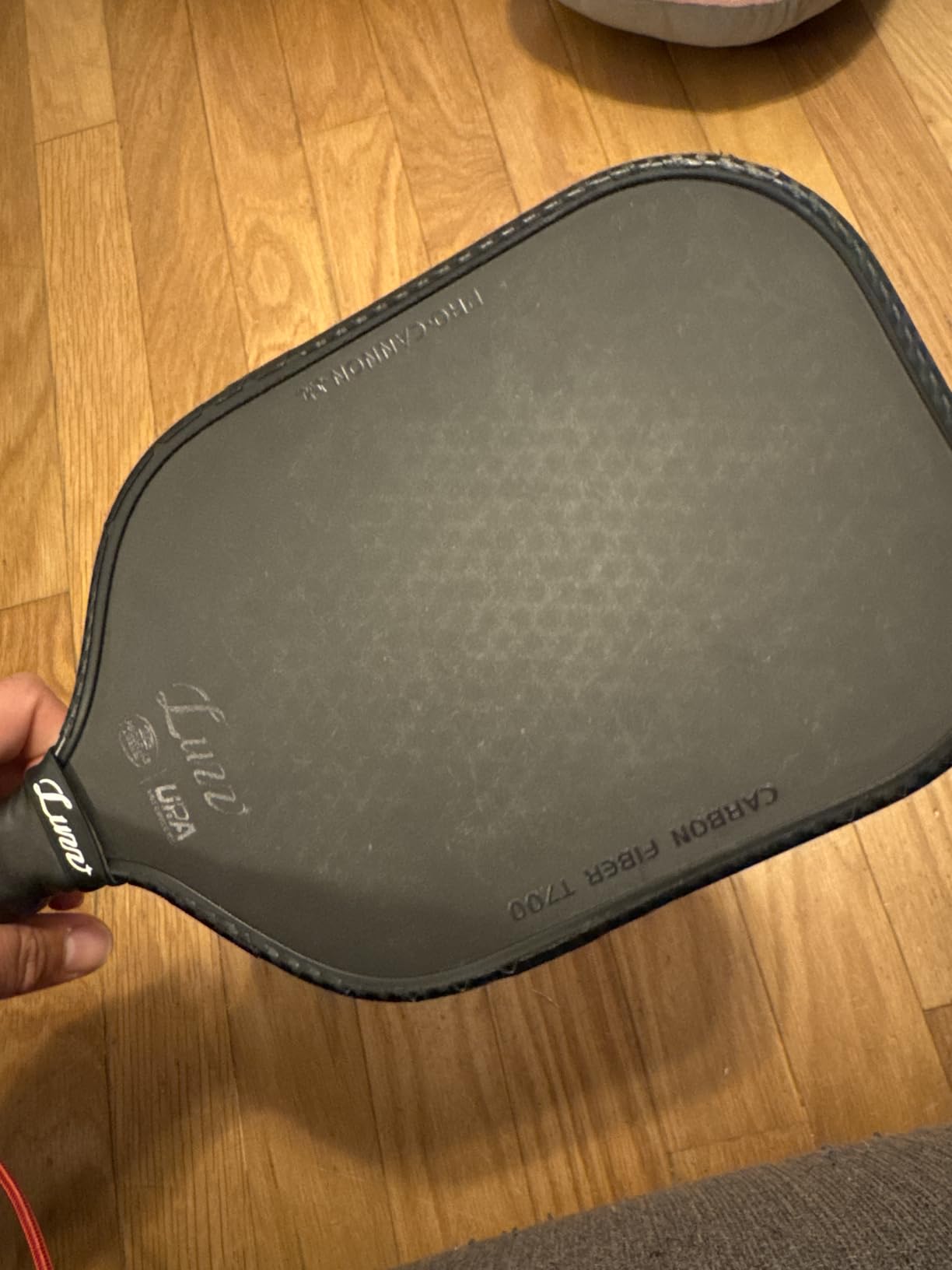
The face is T700 raw carbon with an ultra-fine waterfall texture that grips without the coarse grit of some raw carbon paddles. The handle measures 5.5 by 4.25 inches, larger than most here, and the anti-perspiration grip holds up through long matches.
Weight is not published on this listing, which is the main gap in the spec sheet. Grip size and face size are documented, so handle fit is not a gamble.
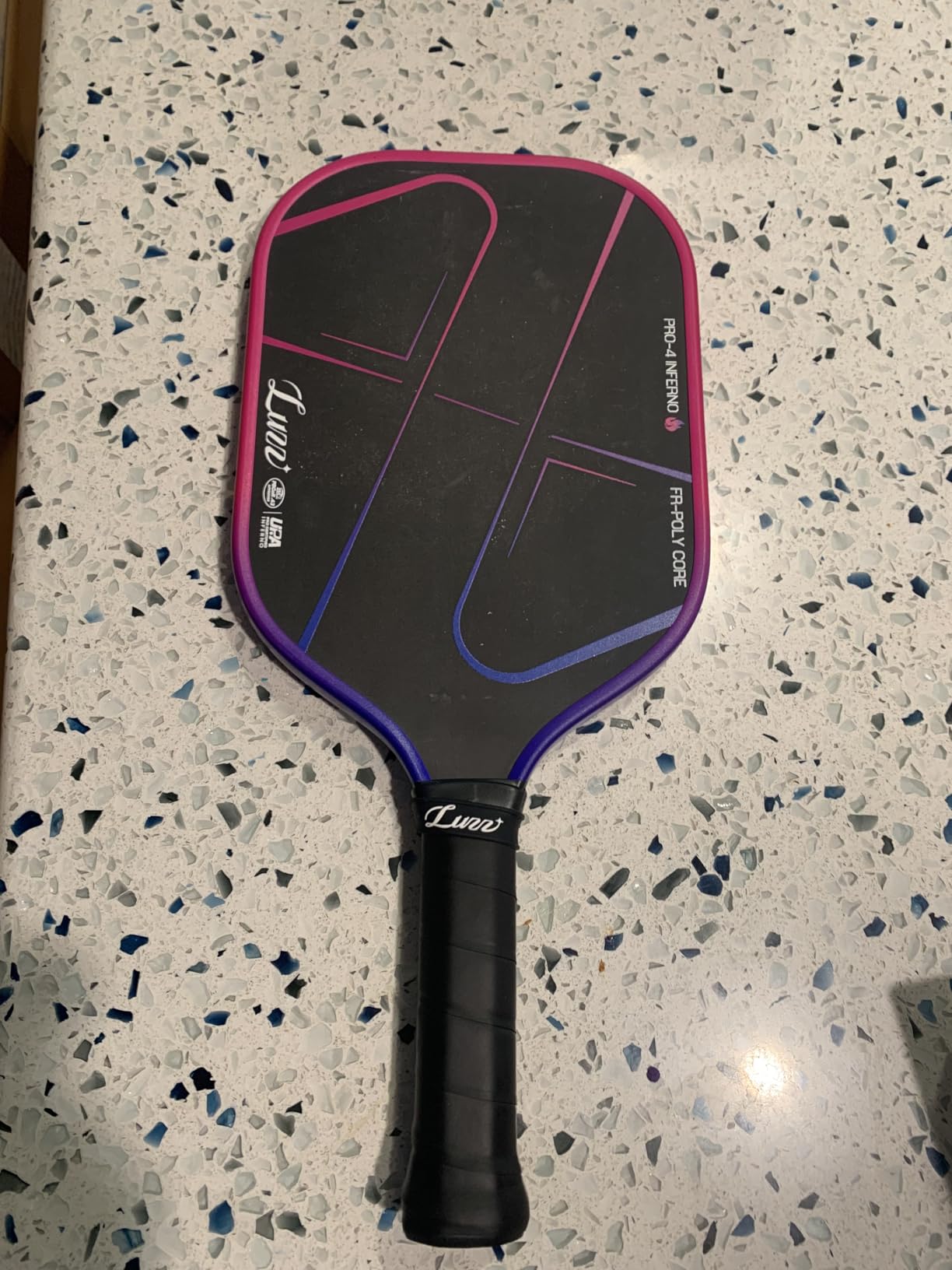
How to control a power paddle at the kitchen
Power paddles are not wrong at the kitchen, they are just less forgiving. The trick is angle rather than swing speed: open the face slightly on soft blocks, keep the paddle above the ball for roll shots, and let the pace come from the opponent.
Where it will frustrate you
A recurring note in the reviews is that the paddle needs a longer warm-up before control settles in. If you are impatient during the first few sessions, expect a rougher start here than with a control paddle.
11. Selkirk SLK Atlas: Best for Players Moving Up From a Budget Paddle
Selkirk Sport SLK Atlas Max Pickleball Paddles | Carbon Fiber | Oasis
0.23 kg
16L x 7.85W
Raw carbon fiber face
Rev-Control polymer core
Max and XL shapes
Pros
- Raw carbon fiber face for spin and precision
- Rev-Control polymer core with a very large sweet spot
- Midweight balance of power and maneuverability
- Tacky grip minimizes vibration
- Max and XL shape options
Cons
- No carry case included
- Not a thermoformed core
- Lacks punch for a power game
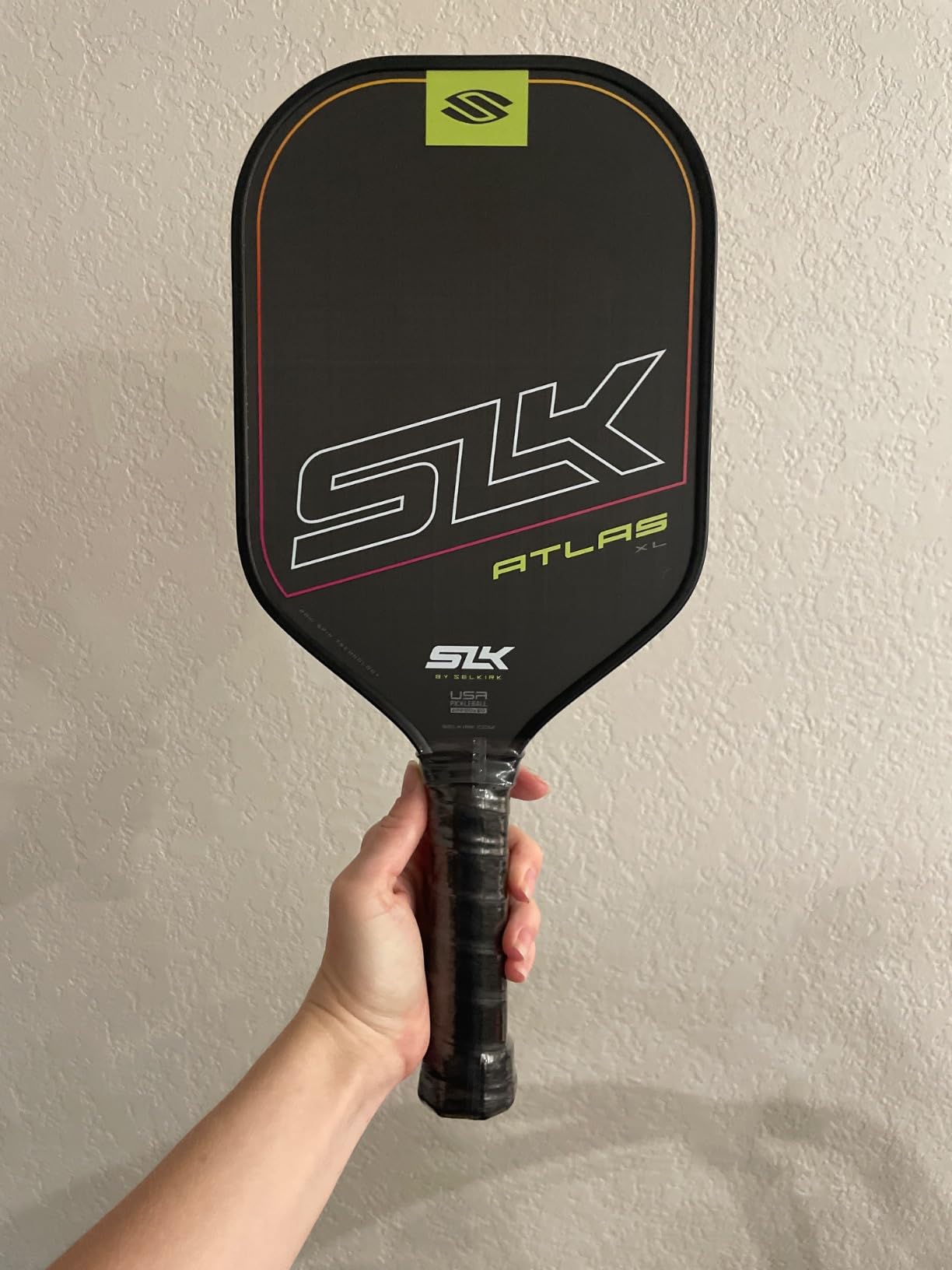
The SLK Atlas is the entry point we recommend for someone moving up from a demo paddle or a cheap composite. It pairs a raw carbon fiber face with a Rev-Control polymer honeycomb core, rated 4.6 across 136 reviews, and owners consistently report a very large sweet spot that reduces misses.
That forgiveness is the most valuable trait for a player still tightening fundamentals. At 0.23 kg it sits in a midweight class, and the 16 by 7.85 inch face comes in Max and XL shapes so you can choose width for reach or length for power.
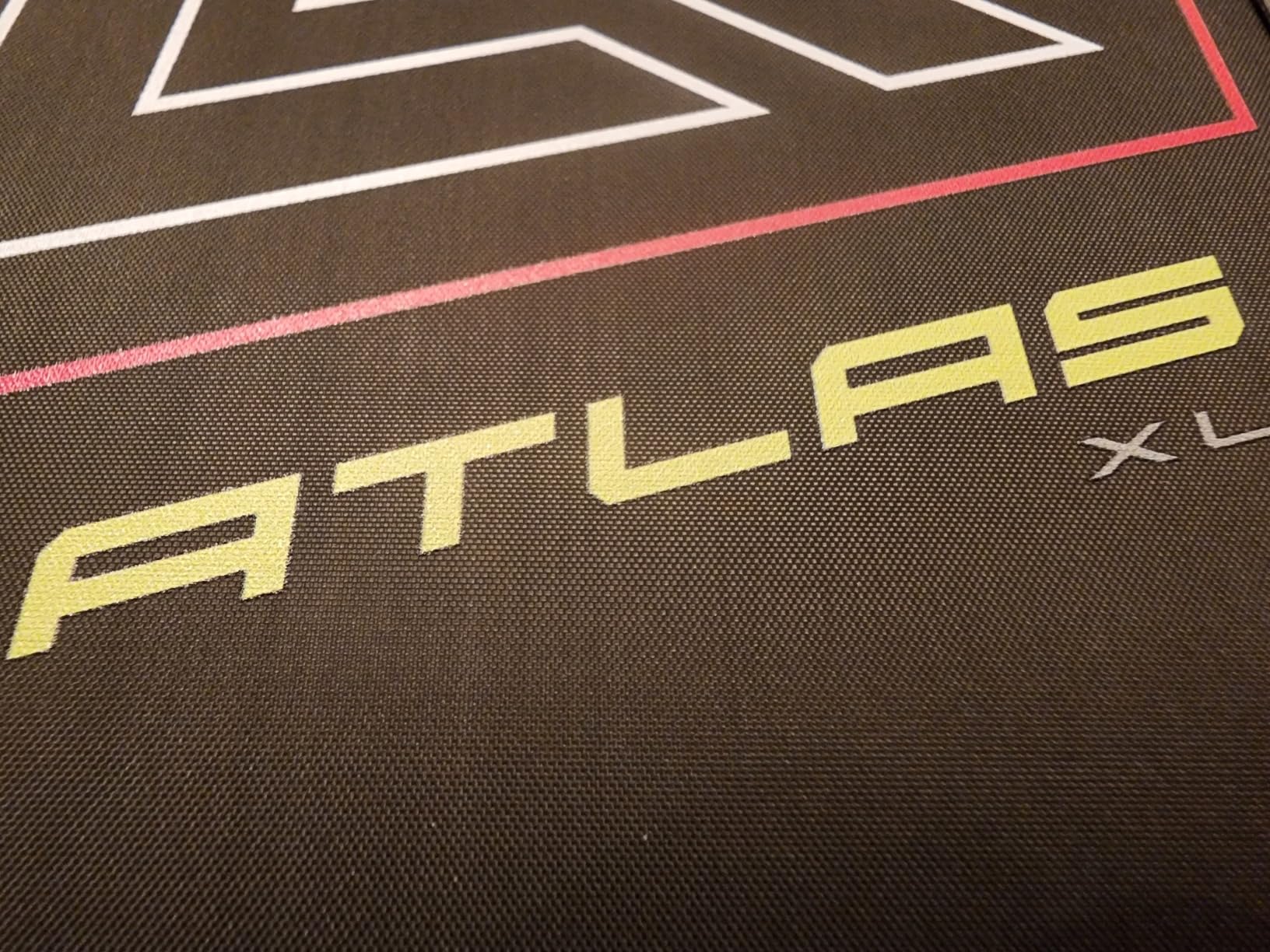
It is USAPA approved, so it is fine for tournament play, and the raw carbon face adds meaningful spin over nylon. Owners moving up from budget gear report more control, more spin and better reach.
The listing carries a beginner skill level, which reflects how most buyers use it rather than a limit on performance.
Why sweet spot size matters when you are still improving
A larger sweet spot converts near-misses into rally balls. When you hit slightly off-center the ball still lands in court, so you keep the point alive and can reset instead of conceding it, which is worth far more than extra pace on perfect contact.
Where it will frustrate you
It is not thermoformed, so it lacks the unibody twist resistance of the YVMOVE or the XSPAK, and a few players find it short on punch. No carry case is included.
12. Selkirk SLK Halo: Best for Players Who Want to Choose Their Own Shape
Selkirk Sport SLK Halo Control Max Pickleball Paddles | Carbon Fiber | Gray
7.7 to 8.0 oz
16L x 7.85W
18k UltraWeave raw carbon
16mm Rev-Control core
Max and XL
Pros
- 18k UltraWeave raw carbon face with Raw Spin Technology
- 16mm Rev-Control core with a large sweet spot
- MAX all-around shape adds face area
- Padded faux leather grip
- Control Power and Pro variants
Cons
- Control build gives up some raw power
- Handle length is fixed at 4.85 inches
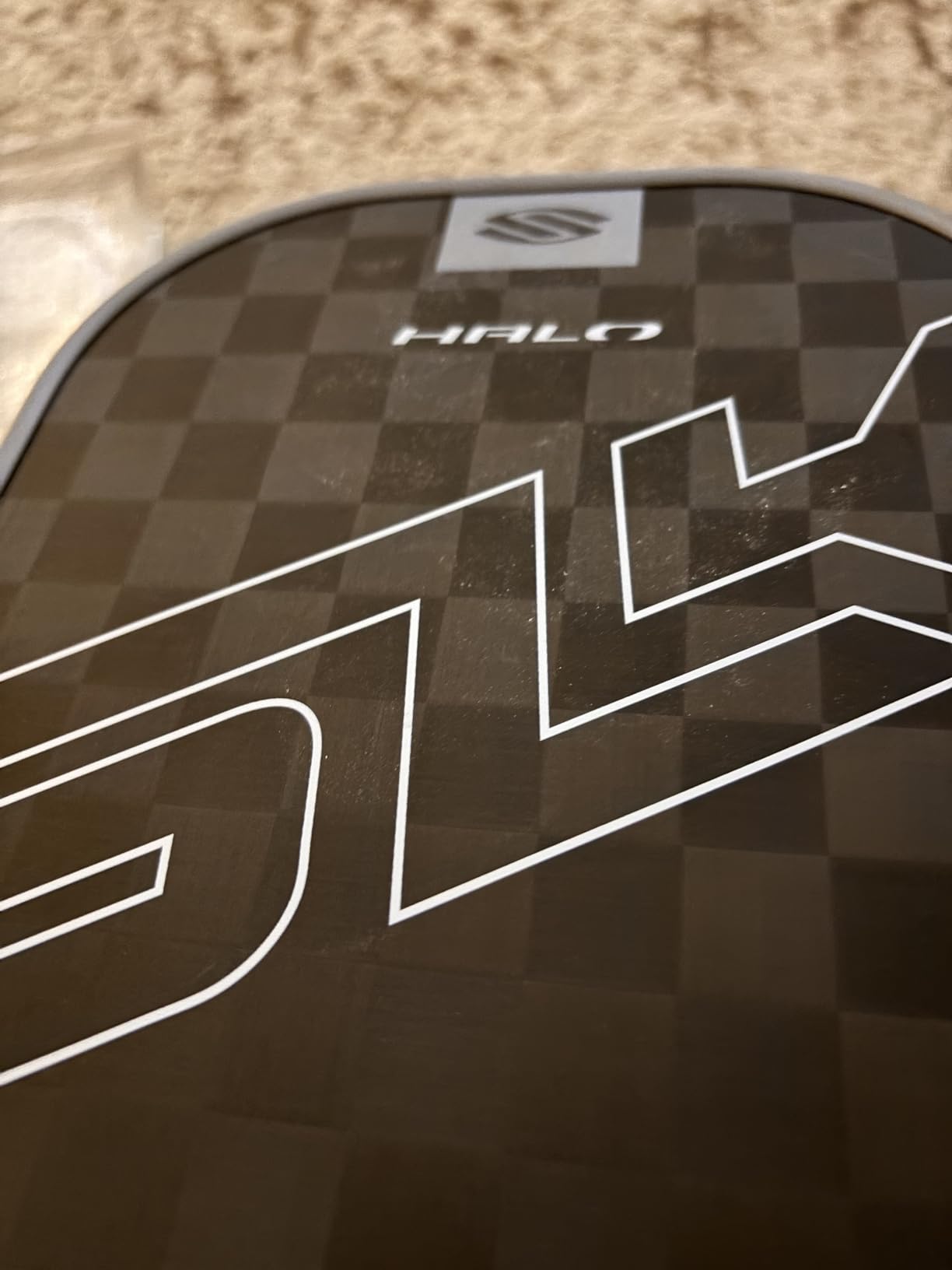
The SLK Halo is the pick for intermediates who want to tune shape to their game instead of accepting one compromise. An 18k UltraWeave raw carbon face with Raw Spin Technology sits on a 16mm Rev-Control polymer core, and the lineup runs in Control, Power and Pro variants across MAX and XL shapes.
Shape is the real decision. MAX is a wider all-around face that raises the sweet spot area, which suits kitchen players and doubles specialists, while XL is longer and narrower and favors reach and plow-through.
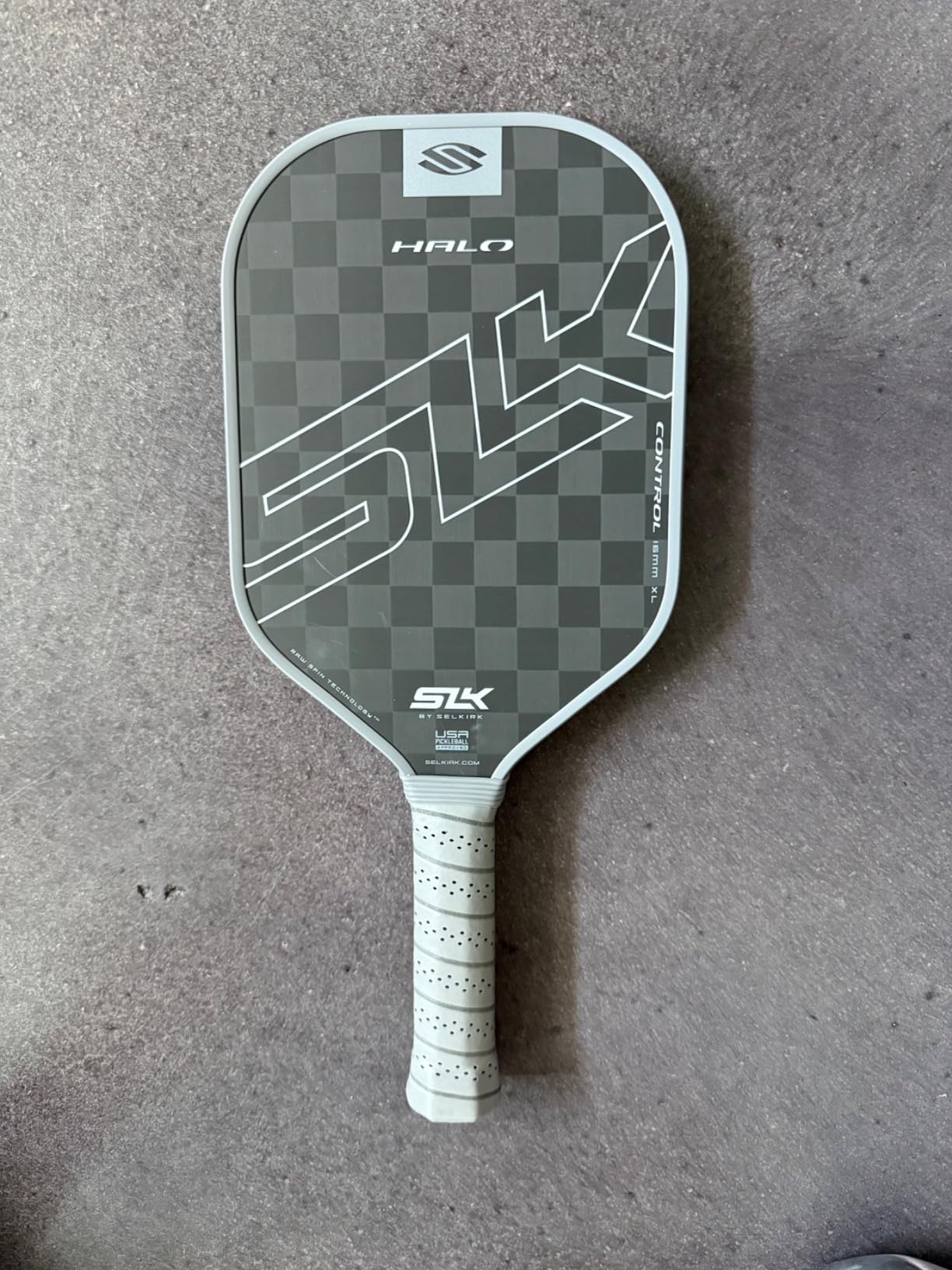
Published specs are among the best documented here: 7.7 to 8.0 ounces, 16 inches long, 7.85 inches wide, 4.25 inch grip circumference and a 4.85 inch handle. The padded faux leather grip stays comfortable when an outing runs three or four hours.
The one-year warranty is standard for the category.
How to pick between MAX and XL
Choose MAX if you play close to the kitchen, block volley a lot, or want the largest possible sweet spot, because a wider face absorbs off-center contact better. Choose XL if you play a transition game, defend deep balls or use a two-handed backhand and want reach.
Where it will frustrate you
The Control variant trades away raw power compared with the Power variant, so pick your strength honestly. The fixed 4.85 inch handle will not suit players who want a longer shaft.
How to Choose a Carbon Fiber Paddle at the Intermediate Level
Here is the framework we use to sort these picks. The first question is not which brand you like. It is whether you want control or power, how you hold the paddle on your backhand, and how much of your game happens within a few feet of the kitchen. Answer those three and the list narrows to two or three options.
14mm vs 16mm vs 15mm cores: the decision framework competitors skip
Core thickness is the most useful spec on the sheet, and most competitors treat it as a marketing line rather than a decision. The rule is simple: a thinner core is stiffer and returns more energy and speed, while a thicker core absorbs pace and gives more touch.
For intermediate players 16mm is the default, and the owner feedback here backs that up, since the Vatic Pro Prism, the YVMOVE, the Selkirk SLK Halo, the JOJOLEMON Shark Power Core and the Selkirk SLK Atlas are all control-leaning designs described in terms of drops, resets and placement. 14mm belongs to players who already have reliable control and want to hit harder.
Raw carbon fiber, carbon grip, and carbon-coated surfaces explained
The word carbon fiber is used loosely, and it confuses more intermediate buyers than anything else. Raw carbon fiber means the woven composite itself forms the playing surface, and it grips and resists abrasion best. Carbon grip is a surface treatment over a composite layer, such as the sand-blasted surface on the JOOLA Hyperion. Carbon-coated means a thin coating over fiberglass, the least durable of the three even when the listing says carbon fiber.
If you want the genuine article, look for a named fiber grade. Toray T700SC appears on the JOJOLEMON Shark Power Core, and plain T700 raw carbon appears on the HISK RAV PRO, the YVMOVE, the DGYGQ and the LUZZ Cannon.
Static weight vs swing weight, and why 7.8 to 8.2 oz fits intermediates
Static weight is what sits on the scale. Swing weight is how heavy the paddle feels when you move it, and a paddle can swing much heavier than its static number suggests when weight sits in the head. Swing weight is what you feel at the kitchen, so it is the more useful number past the beginner stage.
Most of the paddles here cluster between 7.7 and 8.3 ounces. Below about 7.5 ounces, stability on low balls suffers; above about 8.5 ounces, hand transitions slow and fast hands get harder. Aim for the middle of that band.
Shape, handle length, and the two-handed backhand question
A traditional or Max shape is wider with more surface area and suits players who dink and block volley close to the kitchen. An elongated shape is longer and narrower, adding reach and plow-through for players who defend deep balls or use a two-handed backhand.
Handle length is a pain point buyers underestimate, because a short handle leaves nowhere to put a second hand. Check handle length before buying rather than after, and if a listing does not publish it, ask or test in person. Our full paddle comparison guide breaks down shape and grip options in more depth.
Breaking in a new carbon paddle without quitting on it
The most common complaint in player forums about carbon fiber is not quality, it is the first three weeks. A fresh carbon paddle feels harder and quieter than nylon, and players often assume they bought the wrong thing. It is a change in dwell time and response that your hand has not calibrated to yet.
Give it four sessions. The first is for re-learning your drop shot depth, the second for trusting the grip, the third is where touch starts to feel natural, and by the fourth most players find the paddle feels softer than on day one even though nothing changed. Gripping slightly looser and letting the ball sit longer speeds this up.
Cheap tuning: lead tape, overgrips, and grip size
Two inexpensive modifications solve most carbon paddle complaints. Lead tape at the head adds weight there, improving plow-through and broadening the sweet spot for players who feel the ball dying, and it is the standard intermediate-level trick discussed in paddle communities. A thicker overgrip solves handle fit, changing the circumference without changing the paddle, and tackier grips help in humid conditions.
Frequently Asked Questions
What is the best pickleball paddle for an intermediate player?
The best paddle for most intermediate players is an 8 oz carbon fiber model with a 16mm core. That combination gives a large, predictable sweet spot and enough touch for third shot drops without giving up maneuverability at the kitchen. In this roundup, the XSPAK Pro Series Thermoformed is the pick we would start from, while players wanting a named Toray T700 fiber grade should look at the JOJOLEMON Shark Power Core.
Are carbon fiber pickleball paddles a good choice for intermediate players?
Yes, and the intermediate stage is arguably when a carbon fiber paddle pays off most. A carbon fiber face grips the ball and flexes slightly on contact, which extends dwell time and produces more spin and control with less effort. Nylon and graphite paddles can return the ball, but they do not give you the placement control needed once you start dropping third shots and dinking regularly.
Is a 14mm or 16mm paddle better for an intermediate player?
A 16mm core is better for most intermediate players. A 16mm core is softer, so it absorbs pace and gives you the touch needed for drops, resets, and kitchen play, which is where intermediate games are usually decided. A 14mm core is stiffer and returns more energy, so it suits players who already have reliable control and want to hit harder. If your game is built on placement rather than pace, choose 16mm.
Do pro pickleball players use 14mm or 16mm paddles?
Pro players use both, and the split follows role rather than rank. Control-oriented players favor thicker cores of 15mm and 16mm for touch and dwell time, while power players use 14mm and even thinner cores for pace. For an intermediate player, the pro preference is less relevant than the shot profile of your own game, and most players need 16mm before they need maximum power.
Which Selkirk paddle is best for an intermediate player?
Among the Selkirk paddles reviewed here, the SLK Halo is the most flexible option for an intermediate player because it runs in Control, Power, and Pro variants across MAX and XL shapes at 7.7 to 8.0 ounces with a 16mm core. The SLK Atlas is the better choice for a first upgrade from a budget paddle because of its very large sweet spot. The Sport Labs 007 is the premium option for players who want maximum vibration damping.
How heavy should a pickleball paddle be at the intermediate level?
Most intermediate players do best between about 7.8 and 8.2 ounces, and most of the paddles in this roundup fall in that band. Below that range, stability on low balls suffers, and above it, hand transitions at the kitchen get slower. Weight alone does not tell the whole story, because swing weight matters more than static weight once you are past the beginner stage.
Conclusion: The Best Carbon Fiber Pickleball Paddles for Intermediate Players
After working through twelve carbon fiber paddles, the XSPAK Pro Series Thermoformed remains our pick for most intermediate players. It pairs an 8 oz thermoformed carbon fiber face with a polypropylene XS28 honeycomb core, and its 3447 reviews at 4.6 stars give it more real-world feedback than anything else we analyzed. The JOJOLEMON Shark Power Core is the runner-up for anyone who wants a named Toray T700SC fiber grade, and the Vatic Pro Prism takes the kitchen game.
Whichever one you choose, give it four sessions before you judge it, and pick 16mm unless your game is already built on power. The best carbon fiber pickleball paddles for intermediate players in 2026 are not the ones with the longest spec sheet. They are the ones whose sweet spot stays predictable when the ball lands off-center, and that only shows up after real court time.