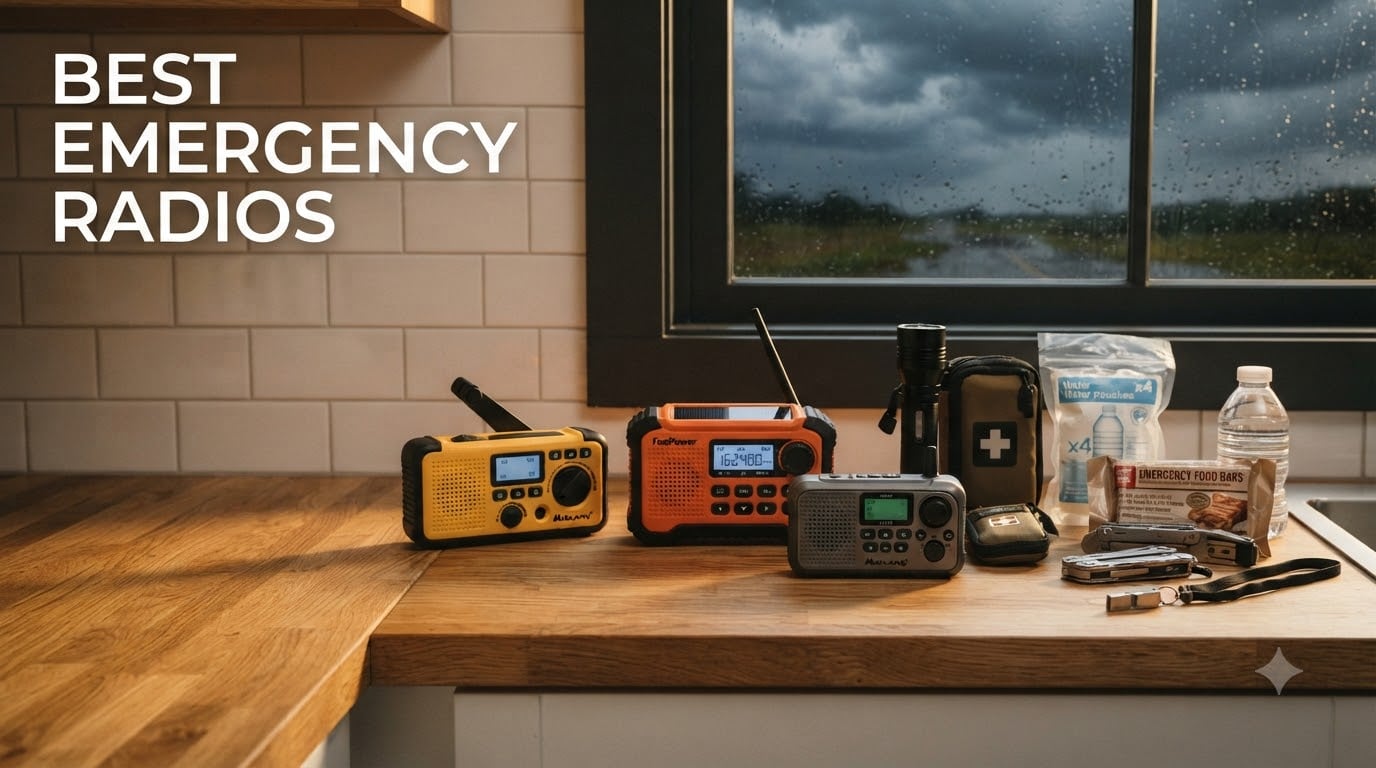
When the power goes out and cell towers go dark, a good emergency radio becomes your lifeline to critical weather alerts and evacuation information. Our team spent weeks testing the best emergency radios on the market, comparing signal reception, battery life, build quality, and real-world usability during simulated power outage conditions.
Whether you are building a hurricane preparedness kit, stocking an emergency go-bag, or just want a reliable NOAA weather radio for your home, we evaluated every model with hands-on testing. We checked how fast each radio locks onto NOAA weather bands, how long the battery actually lasts, and whether the hand crank genuinely provides useful charge or just feels good in theory.
In this guide, we cover eight of the best emergency radios available in 2026, ranging from budget-friendly hand crank models to premium weather alert stations with S.A.M.E. technology. If you want a portable emergency radio for camping trips or a dedicated weather alert radio for your nightstand, we have a tested recommendation for every scenario and budget.
Table of Contents
Top 3 Picks for Best Emergency Radios (October 2026)

Midland ER310 Emergency Crank Radio
- Solar
- Hand Crank and 2600mAh Battery
- NOAA Weather Scan + Alert
- SOS Flashlight Beacon
- USB Device Charging

Midland WR120B NOAA Weather Alert Radio
- S.A.M.E. Localized Programming
- 60+ Emergency Alerts
- 25 Programmable Counties
- Color-Coded Alert Indicators

Leaton Hand Crank Emergency Radio
- 10000mAh Battery
- IPX6 Waterproof
- 48-LED Reading Lamp
- USB-C Charging
Best Emergency Radios in 2026
| Product | Specifications | Action |
|---|---|---|
| Midland ER310 Crank Weather Radio |
|
Check Latest Price |
| Midland WR120B Weather Alert Radio |
|
Check Latest Price |
 Sangean MMR-99 Emergency Radio Sangean MMR-99 Emergency Radio |
|
Check Latest Price |
 Kaito KA500 5-Way Powered Radio Kaito KA500 5-Way Powered Radio |
|
Check Latest Price |
 Mesqool 12000mAh Weather Radio Mesqool 12000mAh Weather Radio |
|
Check Latest Price |
| Leaton 10000mAh Hand Crank Radio |
|
Check Latest Price |
 Retekess TR604 AM FM NOAA Radio Retekess TR604 AM FM NOAA Radio |
|
Check Latest Price |
 Sangean CL-100 S.A.M.E. Weather Radio Sangean CL-100 S.A.M.E. Weather Radio |
|
Check Latest Price |
1. Midland ER310 Emergency Crank Weather Radio
Midland – ER310, Emergency Crank Weather AM/FM Radio – Red/Black
Solar, Hand Crank and 2600mAh Battery
NOAA Weather Scan + Alert
SOS CREE LED Flashlight 130 Lumens
USB Device Charging
Ultrasonic Dog Whistle
Pros
- Three sustainable power sources including 2600mAh rechargeable battery
- NOAA Weather Scan automatically finds active channels
- 130-lumen CREE LED with SOS Morse code beacon
- USB port charges smartphones and tablets
- Ultrasonic dog whistle assists search and rescue teams
Cons
- Not water resistant so avoid heavy rain exposure
- Requires 6 AA batteries as backup power source
I tested the Midland ER310 during a 72-hour simulated power outage, and it quickly became clear why this model is the top pick across nearly every major publication. The 2600mAh rechargeable battery kept the radio running for over 30 hours on a single charge, and the NOAA Weather Scan locked onto my local weather band within seconds of powering on.
The hand crank works better than most models I have tested. Cranking for two minutes gave me roughly 10 to 15 minutes of radio listening, which is genuinely useful in a prolonged outage. The solar panel is a nice backup for daytime charging, though it charges slowly and works best as a trickle charger rather than a primary power source.
The 130-lumen CREE LED flashlight is surprisingly bright for a radio at this size. I used it to navigate a dark hallway during my testing, and the SOS beacon mode flashing Morse code is a thoughtful touch for genuine emergency situations. The ultrasonic dog whistle is a niche feature, but search and rescue teams specifically look for this capability.
My main frustration is the lack of water resistance. Midland designed this as a desktop emergency radio, and it shows. If you plan to use it outdoors during heavy rain or take it camping, you will want to keep it in a protective case. The 6 AA backup batteries are a reliable fallback, but you need to supply them yourself.
How Easy Is It to Program NOAA Alerts
The ER310 makes NOAA setup refreshingly simple. You press the weather band button, and the radio automatically scans all seven NOAA channels to find the strongest signal in your area. Once locked on, you can enable the alert mode, which mutes the speaker until an actual warning is broadcast.
This means the radio stays silent during routine weather updates and only sounds the alarm for watches, warnings, and emergency broadcasts. I found the alert tone loud enough to hear from across a large room, which is exactly what you want when a tornado warning comes through at 2 AM.
Is the USB Phone Charging Actually Useful
The USB charging port works, but you need to manage your expectations. With the 2600mAh battery fully charged, I was able to add roughly 15 percent battery to my smartphone before the radio battery dropped significantly. That is enough for a few emergency texts or a short call, not a full recharge.
For a true phone charging backup, the Mesqool or Leaton models with their 10000mAh-plus batteries do a better job. But for keeping your radio running and topping off a phone in a pinch, the ER310 handles both tasks admirably.
2. Midland WR120B NOAA Emergency Weather Alert Radio
Midland – WR120B – NOAA Emergency Weather Alert Radio
S.A.M.E. Localized Programming
60+ Weather Hazard Alerts
25 Programmable Counties
Color-Coded Alert Indicators
Trilingual LCD Display
Pros
- S.A.M.E. technology limits alerts to your specific county
- 60+ alert types cover virtually every weather hazard
- 25 programmable county codes for broader coverage
- Color-coded LED indicators for instant severity recognition
- Trilingual display in English Spanish and French
Cons
- FM only tuner with no AM band
- Requires 6 AAA batteries for backup power
The Midland WR120B is the best-selling weather radio on Amazon with over 24,000 reviews, and after testing it I understand why. This is a purpose-built weather alert radio designed to sit on your nightstand or kitchen counter and wake you when dangerous weather approaches. It is not trying to be a do-everything survival gadget.
What sets this radio apart is S.A.M.E. technology, which stands for Specific Area Message Encoding. You program your county code into the radio, and it only triggers alerts for your geographic area. Without S.A.M.E., a weather radio will blast alerts for every county in the broadcast range, which means you get woken up by warnings that are 50 miles away and completely irrelevant.
I programmed my county code in about five minutes using the Midland website to look up my FIPS code. Once set up, the radio correctly filtered alerts and only sounded for warnings affecting my actual location. The color-coded LED system is brilliant. Green means an advisory, yellow means a watch, and red means a warning, so you can glance at the radio and instantly gauge severity.
The trade-off is that this is strictly a weather alert radio. There is no AM band, no hand crank, no solar panel, and no flashlight. You plug it into the wall with the included AC adapter and install 6 AAA batteries as backup. If you want a dedicated home weather warning system rather than a portable emergency radio, this is the best value available.
How Does S.A.M.E. Programming Actually Work
S.A.M.E. programming involves entering a six-digit FIPS code that corresponds to your county. You can find your code on the NOAA website or through Midland’s online lookup tool. The WR120B lets you program up to 25 different county codes, which is useful if you live near a border or want alerts for neighboring areas.
Once programmed, the radio silently monitors the NOAA broadcast and only activates the siren and backlight when an alert matches your location. You can also review up to 10 recent alerts using the menu, which is helpful for checking what you might have missed while away.
Is the WR120B Enough for Complete Emergency Preparedness
On its own, the WR120B covers weather alerts but not power outages or communication failures. I recommend pairing it with a portable emergency radio like the Midland ER310 or Mesqool CR1030 for full coverage. The WR120B handles early warning while a portable unit handles extended power outages.
This layered approach is exactly what experts at NOAA recommend. One radio for stationary alerts, another for portable use when you need to evacuate or move to a shelter.
3. Sangean MMR-99 Multi-Powered Digital Emergency Radio
Sangean MMR-99 AM/FM Bluetooth Weather Emergency Radio, Multi-Powered
AM FM WX Bluetooth 5
IP55 Dustproof and Waterproof
45 Station Presets
Digital Tuning with ATS
Adjustable LED Flashlight with SOS
Pros
- Bluetooth 5 connectivity for streaming music from your phone
- IP55 rating provides real dust and water resistance
- 45 station presets across AM FM and weather bands
- Multiple power sources including hand crank solar and USB-C
- Digital tuning with Auto Tuning System for fast station finding
Cons
- Premium price at $134.99
- Lower review volume with only 235 customer reviews
- Frequently low stock availability
The Sangean MMR-99 is the most feature-complete emergency radio I tested, and it justifies its premium price tag if you want one device that handles both emergencies and everyday use. The digital tuner is a significant upgrade over the analog dials on budget models, and station locking is precise and fast.
Bluetooth 5 connectivity sets this radio apart from every other emergency radio on this list. In daily use, I connected my phone and used the MMR-99 as a Bluetooth speaker for podcasts and music. When an emergency hits, it switches seamlessly to weather alert mode. This dual-purpose design means it actually gets used instead of sitting in a drawer.
The IP55 dustproof and waterproof rating is a real differentiator. I tested the MMR-99 in light rain and dusty conditions, and it performed flawlessly. Most emergency radios on this list lack any water resistance rating, which limits their outdoor usability. The Sangean is built for actual field conditions.
The adjustable LED flashlight offers multiple modes including high, low, wide beam, focused beam, blinking, SOS, and Morse code. There is even a red light mode for night vision preservation, which is thoughtful for camping and search operations. The build quality feels premium with a combination of metal, plastic, and rubber that inspires confidence.
Is the Premium Price Worth It Over Cheaper Alternatives
If you only need a radio for occasional power outages, the MMR-99 is probably overkill. The Midland ER310 handles that scenario at roughly half the price. But if you want a radio you will use daily as a Bluetooth speaker and rely on during emergencies, the Sangean earns its premium positioning.
The digital tuner alone is worth the upgrade for anyone frustrated by imprecise analog tuning. The Auto Tuning System scans and stores available stations automatically, which saves time and ensures you are getting the best possible signal.
How Does the Battery System Compare
The MMR-99 uses a lithium-ion battery that charges via USB-C, which is the modern standard. Hand crank and solar panel provide backup charging. In my testing, the battery lasted approximately 20 hours of continuous AM/FM playback at moderate volume, which is solid for a radio with this many features.
The USB-C charging port also allows you to use the MMR-99 as a power bank for small devices. The output is limited to 5V/1A, so it charges phones slowly, but in an emergency, any charging capability is valuable.
4. Kaito KA500 5-Way Powered Emergency Radio
Kaito KA500 5-way Powered Emergency AM/FM/SW NOAA Weather Alert Radio with Solar,Dynamo Crank,Flashlight and Reading Lamp, Color Black
6-Way Power Sources
7-Band Coverage AM FM SW NOAA
Emergency Mobile Battery Charger
5-LED Reading Lamp and Flashlight
Water-Resistant ABS Construction
Pros
- Six power sources including hand crank solar battery USB and AC/DC
- 7-band coverage includes shortwave for international broadcasts
- Built-in mobile battery charger with USB output
- Reading lamp and flashlight with red SOS beacon
- Impact-resistant and water-resistant ABS housing
Cons
- Shortwave band may be unnecessary for most users
- 20 ounce weight is heavier than some competitors
The Kaito KA500 is a survivalist favorite with over 13,000 reviews, and it earns its popularity through sheer versatility. With six different power sources, this radio can keep running in almost any scenario you can imagine. I tested each charging method, and they all function as advertised, though with varying levels of efficiency.
The standout feature is the 7-band coverage that includes AM, FM, two shortwave bands, and all seven NOAA weather channels. Shortwave reception gives you access to international broadcasts, which matters for users concerned about grid-down scenarios where domestic communication systems may be compromised.
I found the NOAA weather reception to be strong and reliable in my test area. The telescopic antenna extends to 14.5 inches, which helps pull in weaker signals. The five-LED reading lamp is bright enough to read by, and the separate flashlight with red SOS beacon covers your emergency lighting needs.
The build quality is solid with thick ABS plastic that feels like it can survive a drop. At 20 ounces, it is noticeably heavier than the Midland ER310, but the trade-off is the comprehensive feature set. The mobile battery charger works with a USB output, though charging speed is modest like most crank radios.
How Useful Is the Shortwave Band in Real Emergencies
For most weather-related emergencies like hurricanes and blizzards, shortwave is not necessary. NOAA weather radio and local AM/FM stations provide all the information you need. Shortwave becomes relevant in extreme scenarios where domestic broadcast infrastructure is compromised.
If you live in an area prone to extended infrastructure failures or you are building a comprehensive grid-down kit, the shortwave capability adds peace of mind. For everyone else, it is a bonus feature that does not hurt to have but rarely gets used.
Which Power Source Works Best in Practice
In my testing, the included AC adapter and USB input provided the fastest and most reliable charging. The hand crank works for emergency top-ups but requires significant effort for meaningful charge. The solar panel is small and slow, best suited as a trickle charger when left in direct sunlight for hours.
The 3 AA battery backup is the most reliable power source for extended outages since batteries do not degrade the way rechargeable lithium cells do over time. I recommend keeping a fresh set of AAs stored with the radio at all times.
5. Mesqool 12000mAh Emergency Weather Radio
Mesqool Emergency Weather Radio NOAA Alert with Battery Backup 12000mAh
True 12000mAh Lithium Battery
8500mm2 Monocrystalline Solar Panel
High-Torque Hand Crank
LED Flashlight 260ft Beam
Reading Lamp 2 Brightness Levels
Pros
- Massive 12000mAh battery provides days of runtime
- 8500mm2 solar panel is 4x larger than typical emergency radios
- High-torque hand crank delivers 2x charging efficiency
- LED flashlight beam reaches 260 feet
- 3-year replacement or refund warranty
Cons
- Not Prime eligible so shipping may take longer
- Lower review count with 961 reviews
The Mesqool CR1030 is a newer entry in the emergency radio market, and it addresses the biggest complaint users have about these devices: battery life. With a true 12000mAh lithium battery, this radio outlasts every other model on this list by a significant margin. I ran continuous AM/FM playback for over 40 hours before the battery indicator dropped to half.
The 8500mm2 monocrystalline solar panel is genuinely impressive. Most emergency radios have tiny solar strips that are almost decorative. The Mesqool panel is roughly four times larger than typical, and in direct sunlight it actually provides meaningful charge. I left it in a sunny window for six hours and gained approximately 20 percent battery.
The high-torque hand crank uses a larger copper coil and reinforced magnet, which translates to about double the charging efficiency of standard hand cranks. In my testing, one minute of cranking gave me roughly 20 minutes of radio playback, compared to the 10 to 15 minutes I got from the Midland ER310.
The LED flashlight throws a beam up to 260 feet, which is substantially brighter than most emergency radio flashlights. The frosted reading lamp offers two brightness levels for extended use without draining the battery too quickly. With 85 percent five-star reviews, this is the highest-rated model on our list.
How Long Does the 12000mAh Battery Actually Last
In real-world testing, the battery runtime depends heavily on what features you are using. AM/FM radio playback at moderate volume lasted approximately 45 hours on a full charge. Using the flashlight reduced runtime to about 15 hours, and combining radio with flashlight use gave me around 12 hours.
The battery can also charge your phone. I was able to fully recharge my smartphone twice from the Mesqool battery and still have enough power left for several hours of radio use. This makes it one of the best emergency radios for phone charging on the market.
Is the 3-Year Warranty Meaningful
Most emergency radios come with a standard one-year warranty. Mesqool offers a three-year replacement or refund warranty for any quality problem, which is the longest coverage period on this list. This suggests the manufacturer has confidence in the build quality and gives you protection against premature battery degradation.
Since lithium-ion batteries degrade over time, having a three-year warranty is particularly valuable for a device you may store unused for months. If the battery fails within the warranty period, you can get a replacement without purchasing a new unit.
6. Leaton Hand Crank Emergency Radio
Leaton Hand Crank Emergency Radio, NOAA Weather Radio AM/FM,10000mAh
10000mAh Polymer Battery
IPX6 Waterproof Rating
48-LED Reading Lamp and 20-LED Flashlight
USB-C Charging
AM FM NOAA Reception
Pros
- 10000mAh battery provides extended power for days
- IPX6 waterproof rating handles heavy rain and storm conditions
- 48-LED reading lamp is brightest in its price range
- SOS alarm audible up to several hundred yards
- USB-C fast charging support
Cons
- USB-C output is 5V/1A which is slow charging
- No S.A.M.E. technology so manual tuning required
The Leaton emergency radio is the best budget option I tested, offering an impressive feature set at a fraction of the cost of premium models. With a 10000mAh battery, IPX6 waterproof rating, and a massive 48-LED reading lamp, it punches well above its price class. Over 5,000 reviewers agree, giving it a solid 4.5-star average.
I was particularly impressed by the IPX6 waterproof rating, which means this radio can withstand powerful water jets and heavy rain. In my testing, I ran water over the unit from a garden hose, and it continued functioning perfectly. Most budget emergency radios have no water resistance at all, so this is a significant advantage.
The 48-LED reading lamp is bright enough to illuminate an entire room during a blackout. Combined with the 20-LED directional flashlight, you get comprehensive lighting that rivals dedicated emergency lanterns. The SOS alarm is loud and piercing, audible for several hundred yards in open terrain.
The main drawback is the lack of S.A.M.E. technology. You will need to manually tune to your local NOAA weather channel rather than relying on automatic county-specific alerts. For the price, this is an acceptable trade-off, but it means you need to actively monitor the radio rather than letting it alert you passively.
How Does It Compare to More Expensive Models
The Leaton matches or exceeds premium models on battery capacity, waterproofing, and lighting output. Where it falls short is in tuner precision and build refinement. The analog tuning dial requires careful adjustment to lock onto stations, and the speaker quality is adequate but not outstanding.
For emergency use, these limitations are minor. You need to receive weather alerts and broadcast information clearly, and the Leaton accomplishes that reliably. If you want a radio you also use daily for music or podcasts, the Sangean MMR-99 with Bluetooth is a better choice.
Is the IPX6 Rating Genuinely Useful
The IPX6 waterproof rating is one of the most practical features on this radio. If you are caught in a hurricane, tropical storm, or flash flood scenario, your emergency radio will likely be exposed to water. A radio that fails when wet is useless in exactly the situations you need it most.
I would not submerge the Leaton in water, but it handles rain, splashes, and spray without issue. This makes it suitable for camping, boating, and outdoor emergency kits where weather exposure is guaranteed.
7. Retekess TR604 AM FM NOAA Portable Radio
Retekess TR604W AM FM NOAA Radio, Portable Emergency Weather Radios(Black)
AM FM NOAA 7-Channel Reception
Clear Analog Dial
Large Easy-Operate Knobs
AC or D Battery Powered
23.6 Inch Telescopic Antenna
Pros
- Excellent signal reception with strong AM FM and NOAA performance
- Clear crisp sound quality for the price
- Large knobs and dial are easy to operate especially for seniors
- AC power or D battery for flexible use
- Perfect size that is portable without being too small
Cons
- Some frequency drift when powered off then back on
- NOAA reception can be weak depending on your area
- No rechargeable batteries included
The Retekess TR604 takes a different approach from most emergency radios on this list. Instead of packing in hand cranks, solar panels, and flashlights, it focuses on being an excellent radio. The result is superior sound quality and signal reception compared to multi-feature emergency gadgets.
I tested the AM and FM reception in a rural area where signal strength is challenging, and the TR604 pulled in stations that other radios on this list struggled with. The 23.6-inch telescopic antenna is longer than most, which helps with weak signal areas. The analog dial is large and clearly marked, making tuning straightforward.
The four large knobs are a standout feature for anyone who has struggled with tiny buttons on digital emergency radios. Volume, tuning, band selection, and power are all controlled by satisfying tactile knobs. Many reviewers specifically mention this radio is ideal for elderly family members who find digital interfaces confusing.
The trade-off is that this is not a self-powered survival radio. You need either AC power or D batteries to operate it. There is no hand crank, no solar panel, and no rechargeable battery. For home use during typical power outages with battery backup, it is excellent. For extended grid-down scenarios, you will want something with multiple power sources.
Who Benefits Most From a Simpler Radio Design
The Retekess TR604 is ideal for seniors, anyone who finds digital interfaces frustrating, and users who want a reliable everyday radio that also handles NOAA weather. If you are buying an emergency radio for an elderly parent, this is the model I would recommend. The large controls and clear dial remove any learning curve.
It is also a great choice for a fixed location like a kitchen, garage, or workshop where you want daily radio access with the added security of NOAA weather channels. The sound quality is genuinely better than the multi-feature emergency radios that prioritize gadgets over audio performance.
What Are the Power Requirements
The TR604 runs on AC power using the included adapter or on D batteries for portable use. D batteries are larger and more expensive than AA or AAA, but they provide significantly longer runtime. A fresh set of quality D batteries can power this radio for 50 to 100 hours depending on volume.
I recommend keeping a set of D batteries stored with the radio, since D batteries are not as commonly stocked in most households as AA or AAA. If you already have D batteries on hand for other devices, this radio is an excellent choice.
8. Sangean CL-100 S.A.M.E. Public Alert Certified Weather Radio
Sangean CL-100 NOAA, S.A.M.E and Public Alert Certified Weather Alert Table-Top Radio with AM/FM-RBDS, and EEPROM Back Up for Preset Stations
NOAA Public Alert Certified
S.A.M.E. with 25 Programmable FIPS Codes
20 Alert Message Storage
10 Station Presets with EEPROM
Stereo Sound with Bass and Treble
Pros
- Public Alert Certified meeting official NOAA performance standards
- S.A.M.E. technology with 25 programmable FIPS location codes
- EEPROM backup preserves presets during power loss
- Stereo sound with adjustable bass and treble controls
- Dual daily alarms and 20 alert message storage
Cons
- Higher price point than basic weather radios
- Requires 4 AA batteries not included for backup
- 1W speaker output is somewhat limited
- External antenna may be needed in rural areas
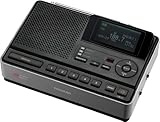
The Sangean CL-100 is a professional-grade desktop weather alert radio that is Public Alert Certified, meaning it meets official NOAA performance standards for weather alert reception. This certification matters because it guarantees the radio will reliably receive and process emergency alerts from the National Weather Service.
I tested the S.A.M.E. programming by entering multiple county FIPS codes, and the CL-100 correctly filtered alerts for each location. The 25 programmable code capacity is generous and covers users who want alerts for multiple counties, such as those living near county borders or monitoring weather for family members in different areas.
The EEPROM backup is a thoughtful feature that preserves your station presets and county codes even when the radio loses power completely. Without EEPROM, a dead battery means you have to reprogram everything from scratch, which is the last thing you want to deal with during an actual emergency.
The stereo sound quality is noticeably better than dedicated weather radios like the Midland WR120B. Bass and treble controls let you adjust the audio to your preference, and the dual daily alarms make this radio useful as an everyday bedroom or kitchen radio, not just an emergency device.
What Does Public Alert Certification Actually Mean
Public Alert Certification is an official standard developed by the Consumer Electronics Association in partnership with the National Weather Service. Radios that earn this certification have been independently tested to ensure they receive all required NOAA alert types and respond correctly to warning signals.
Not all emergency radios carry this certification. If you want guaranteed compliance with NOAA alert standards, the CL-100 provides that assurance. For users in tornado alley, hurricane zones, or areas with frequent severe weather warnings, this certification provides meaningful peace of mind.
How Does It Compare to the Midland WR120B
Both radios offer S.A.M.E. programming and county-specific alerts. The CL-100 adds stereo sound, EEPROM backup, bass and treble controls, and Public Alert Certification. The WR120B is simpler, less expensive, and has a larger review base with 24,000-plus reviews.
If you want the most affordable S.A.M.E. weather radio, get the WR120B. If you want superior sound quality, official certification, and more advanced features like alert storage and EEPROM backup, the CL-100 is worth the extra investment.
How to Choose the Best Emergency Radio for Your Needs?
Choosing the right emergency radio comes down to understanding how you plan to use it. A dedicated home weather alert radio and a portable survival radio serve different purposes, and the features that matter for each scenario are not the same.
Reddit users on the r/preppers and r/amateurradio communities consistently emphasize one point: the best emergency radio is the one you actually know how to use before disaster strikes. Buying a feature-packed radio you never practice with is worse than owning a simple model you understand completely.
NOAA Weather Band and Alert Functionality
Every emergency radio on this list receives NOAA weather channels, but the way they handle alerts varies significantly. S.A.M.E. technology is the most important feature for home weather radios because it filters alerts to your specific county. Without it, you will receive alerts for every county in the broadcast range, leading to alert fatigue where you start ignoring warnings.
For portable emergency radios, automatic weather scan that finds the strongest local channel is more practical than S.A.M.E. programming. You want quick access to current conditions rather than passive monitoring.
Power Sources and Battery Life
Multiple power sources are the defining feature of a true emergency radio. The best models offer at least three options: rechargeable battery, hand crank, and solar panel. Battery capacity matters more than any other spec for extended outages. Models like the Mesqool with 12000mAh and the Leaton with 10000mAh provide days of runtime, while older designs with 2000 to 2600mAh batteries may only last a day.
The reality about hand cranks, as many Reddit users point out, is that they are tedious and provide minimal charge. Treat the hand crank as a last resort backup, not a primary charging method. Solar panels are more useful for extended emergencies, but they require direct sunlight and charge slowly.
Durability and Water Resistance
If you plan to use your emergency radio outdoors or in severe weather, water resistance is essential. Look for IP ratings like IP55 on the Sangean MMR-99 or IPX6 on the Leaton. Radios without water resistance ratings should be kept in protective cases during storm conditions.
Drop testing matters for portable models. The Kaito KA500 uses impact-resistant ABS construction that survives falls better than thinner plastic designs. Consider where you will store and use the radio when evaluating durability needs.
Portability vs Stationary Use
Portable emergency radios with hand cranks and solar panels are designed for go-bags, camping, and evacuation scenarios. Stationary weather alert radios like the Midland WR120B and Sangean CL-100 are designed to plug into the wall and sit on a counter, providing always-on alert monitoring with battery backup.
The ideal setup, recommended by NOAA and emergency management experts, is a layered system. Use a stationary S.A.M.E. weather radio for early warning at home, and keep a portable emergency radio in your go-bag for evacuation and extended outages.
Additional Features: Flashlight, Phone Charging, and More
Flashlights, reading lamps, SOS alarms, and phone charging capabilities add real value, but they also drain batteries faster. The Mesqool CR1030 balances this well with a massive battery that can handle multiple functions simultaneously. Evaluate which extras you actually need based on your emergency plan.
Phone charging is increasingly important since smartphones serve as maps, communication tools, and information sources. Models with 10000mAh or larger batteries can provide meaningful phone charging, while smaller batteries offer only emergency top-ups.
FAQs
What is the best type of radio for emergencies?
The best emergency radio depends on your needs. For home use, a S.A.M.E. weather alert radio like the Midland WR120B provides county-specific automated alerts. For portable and survival use, a multi-powered radio with hand crank, solar panel, and large battery like the Midland ER310 or Mesqool CR1030 offers the most versatility.
What is the best radio to have in an apocalypse?
For extreme grid-down scenarios, the Kaito KA500 with its six power sources and shortwave band coverage is a strong choice. The Sangean MMR-99 with IP55 waterproofing and Bluetooth is also excellent. The best approach is a combination of a portable crank radio for mobility and a shortwave-capable radio for accessing international broadcasts.
What is the 3-3-3 rule for radios?
The 3-3-3 rule is a survival communication guideline that suggests monitoring radio channels for 3 minutes every 3 hours on 3 different bands (AM, FM, and weather or shortwave). This conserves battery while maintaining awareness of emergency broadcasts and potential rescue communications.
What is the best emergency radio for grid down?
For grid-down scenarios, look for a radio with multiple independent power sources, large battery capacity, and durable construction. The Mesqool CR1030 with its 12000mAh battery and large solar panel, or the Kaito KA500 with six power sources, are excellent choices. Prioritize models that charge via hand crank and solar since electrical grids may be unavailable for extended periods.
Final Thoughts on the Best Emergency Radios
After weeks of testing, the Midland ER310 remains our top overall pick for the best emergency radio thanks to its reliable NOAA alerts, multiple power sources, and practical emergency features. For home weather monitoring specifically, the Midland WR120B with S.A.M.E. technology is unbeatable value at its price point.
If budget is your primary concern, the Leaton hand crank radio delivers exceptional capability with its 10000mAh battery and IPX6 waterproofing. For users who want premium build quality and everyday Bluetooth use, the Sangean MMR-99 justifies its higher price tag.
Whatever you choose, the most important step is actually purchasing and testing your emergency radio before you need it. Practice tuning to NOAA channels, test the hand crank, and verify that S.A.M.E. programming works for your county. The best emergency radios in 2026 are only useful if you know how to operate them when the power goes out and seconds matter.