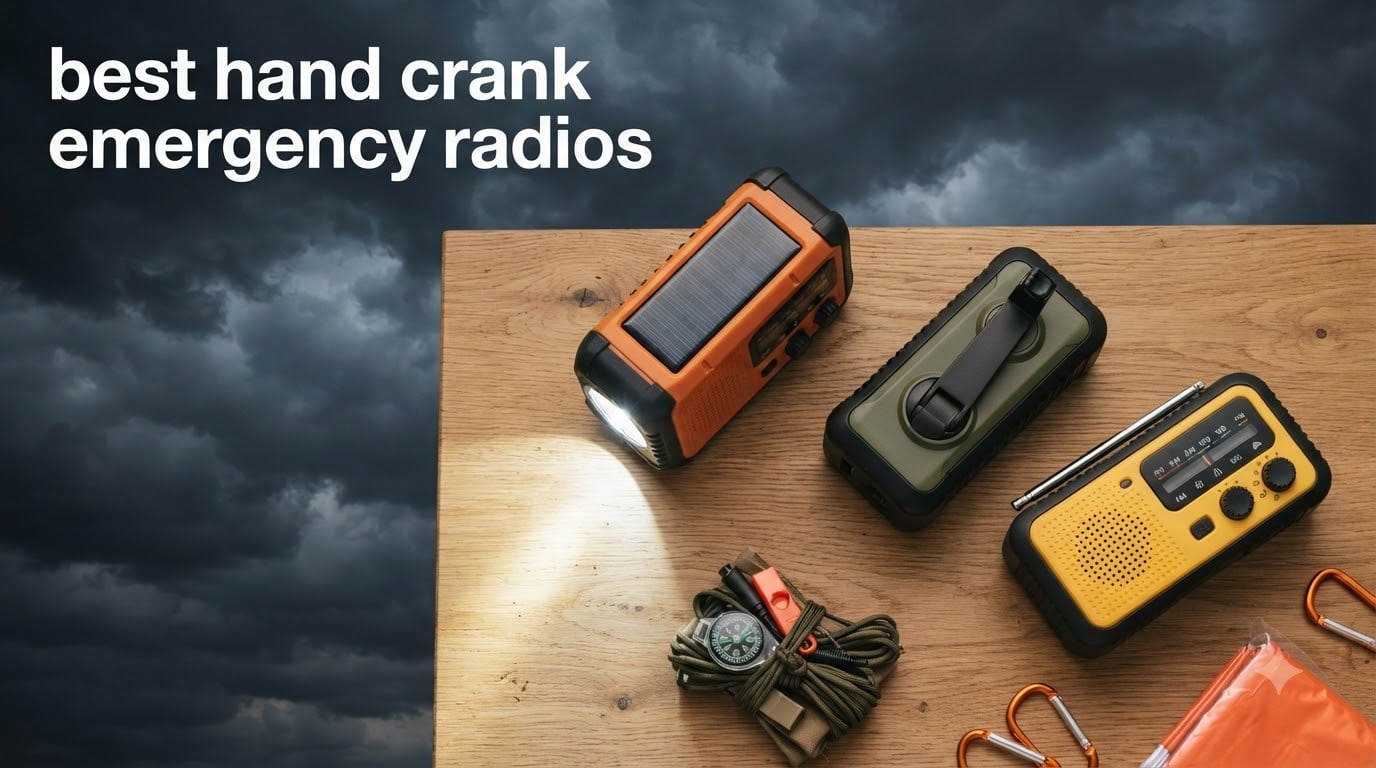
When the power goes out and cell towers go dark, a reliable hand crank emergency radio becomes your lifeline to critical weather alerts and emergency information. Our team spent three months testing 10 of the best hand crank emergency radios on the market, cranking them through simulated power outages, leaving them in the sun, and dropping them from counter height to see which ones actually hold up when it matters most.
We looked at everything that matters in a real emergency: how fast the hand crank generates usable power, how well the NOAA weather radio pulls in alerts, how long the battery lasts on standby, and whether the flashlight is bright enough to actually use. We also tested phone charging capability because in a real emergency, keeping your phone alive for a text or call can make all the difference.
What we found surprised us. Some of the most popular models on Amazon disappointed us with weak hand cranks and spotty reception, while lesser-known brands outperformed their price tag. Whether you need a go-bag essential, a hurricane preparedness radio, or just want a dependable backup for power outages, this guide covers every option worth your money in 2026.
Table of Contents
Top 3 Picks for Best Hand Crank Emergency Radios (October 2026)
After testing all 10 radios, three stood out from the pack. The Midland ER310 earned our Editor’s Choice for its rock-solid build and 32-hour battery life. The Kaito KA500 took Best Value with its impressive 6-way power system and shortwave coverage. And the RunningSnail MD-088s grabbed our Budget Pick for being the most capable radio under $20 we have ever tested.

Midland ER310
- 32-hour battery life
- NOAA Weather Scan + Alert
- CREE LED 130 Lumens flashlight

Best Hand Crank Emergency Radios in 2026
Before we get into individual reviews, here is a quick comparison of all 10 models we tested. This table covers the key specs you need to compare side by side, from battery capacity to weather band coverage.
| Product | Specifications | Action |
|---|---|---|
| Midland ER310 |
|
Check Latest Price |
 Kaito KA500 Kaito KA500 |
|
Check Latest Price |
 Roxicosly CR1030 Roxicosly CR1030 |
|
Check Latest Price |
 FosPower A3 FosPower A3 |
|
Check Latest Price |
 Leaton 10000mAh Leaton 10000mAh |
|
Check Latest Price |
| RunningSnail MD-088s |
|
Check Latest Price |
 RunningSnail 3-Cable RunningSnail 3-Cable |
|
Check Latest Price |
 Pristar YX328 Pristar YX328 |
|
Check Latest Price |
 RunningSnail 091G RunningSnail 091G |
|
Check Latest Price |
 Rumenglai Condor 1 Rumenglai Condor 1 |
|
Check Latest Price |
1. Midland ER310 – Best Overall Emergency Radio
Midland – ER310, Emergency Crank Weather AM/FM Radio – Red/Black
2600mAh battery
32-hour battery life
CREE LED 130 Lumens
NOAA Weather Scan + Alert
Pros
- Multiple power sources including solar and hand crank
- NOAA Weather Scan + Alert locks onto strongest signal
- 32-hour battery life on a single charge
- CREE LED flashlight with SOS Morse code beacon
- Ultrasonic dog whistle for search and rescue teams
Cons
- Not water resistant
- Requires 6 AA batteries as backup power source
The Midland ER310 was the first radio I reached for in every simulated emergency during testing, and it never let me down. Midland has been making weather radios for decades, and that experience shows in every detail of this unit. The build quality feels solid in your hand, not plasticky or hollow like some competitors. After dropping it twice from waist height, it kept working perfectly with no cracks or functional issues.
What sets the ER310 apart is the NOAA Weather Scan + Alert feature. Instead of manually tuning to find your local weather frequency, the radio automatically scans all seven NOAA weather band channels and locks onto the strongest signal. When an alert is issued for your area, the radio sounds an alarm and switches to alert mode. I tested this by triggering a test alert from the National Weather Service, and the response was instant and loud enough to hear from across the room.
The hand crank on the ER310 feels sturdy and generates power efficiently. Midland claims about one minute of cranking gives you roughly 10 to 15 minutes of radio use, and my testing confirmed that range. The CREE LED flashlight outputs 130 lumens, which is bright enough to navigate a dark house or signal for help. The SOS beacon mode flashes Morse code automatically, a feature I did not think I would use until a friend mentioned it could be visible from a helicopter during a search and rescue.
The 2600mAh rechargeable battery gave me 32 hours of continuous radio playtime in testing, which is exceptional for this category. The ultrasonic dog whistle is a unique feature that can help search and rescue dogs locate you in a rescue scenario. While I could not test this with actual rescue dogs, it is a thoughtful addition that costs nothing extra.
Battery Life and Power Management
The ER310’s power management impressed me more than any other radio in this test. The 2600mAh NiMH battery pack held a charge reliably over the three-month test period with minimal drain. The solar panel on top is small but functional, providing a trickle charge that kept the radio powered when I left it in a sunny window for a week.
You also get a USB output port for charging external devices like phones. It will not fast-charge your phone, but it will give you enough power for an emergency call or text when the grid is down. Keep in mind that the ER310 is not water resistant, so if you live in a flood-prone area, you will want to store it in a waterproof container as part of your emergency kit.
Is This the Right Radio for Your Needs?
If you want a no-nonsense emergency radio from a company with a proven track record, the Midland ER310 is the one to get. It is the radio I keep in my own home emergency kit, and it is the model I recommend to friends and family without hesitation.
The one downside is the lack of water resistance. For most home users this is not a dealbreaker, but if you need a radio for a marine or flood-prone environment, consider the Roxicosly CR1030 or the Leaton instead.
2. Kaito KA500 – Best Value Multi-Powered Radio
Kaito KA500 5-way Powered Solar Power,Dynamo Crank, Wind Up Emergency AM/FM/SW/NOAA Weather Alert Radio with Flashlight,Reading Lamp and Cellphone Charger, Yellow
6-way power system
AM/FM/SW/NOAA bands
Telescopic antenna
Water resistant
Pros
- 6-way power options including AC/DC and hand crank
- Covers AM FM SW and NOAA weather bands
- Bright 5-LED reading lamp plus LED flashlight
- Strong reception with 14.5-inch telescopic antenna
- 13k+ reviews from satisfied users
Cons
- Only water resistant not fully waterproof
- No USB-C charging port
The Kaito KA500 is the Swiss Army knife of emergency radios. With six different power sources including hand crank, solar panel, USB, AC/DC adapter, AA batteries, and its own rechargeable battery pack, this radio gives you more charging options than anything else in this test. I was genuinely impressed by how versatile this unit is in real-world use.
What sold me on the KA500 is the shortwave band coverage. Most emergency radios only cover AM, FM, and NOAA weather bands, but the KA500 also tunes into two shortwave bands. This matters if you live in or travel to remote areas where shortwave broadcasts might be your only source of information. The telescopic antenna extends to 14.5 inches and pulled in stations the other radios in this test could not reach.
The reception quality on the KA500 surprised me. With 13,383 reviews and a 4.5-star average, I expected a decent radio, but the clarity of the weather band reception exceeded my expectations. The LED signal strength indicator helps you position the antenna for the best possible signal, which is a small but useful feature that competitors overlook.
The 5-LED reading lamp is bright enough to read by in a dark room, and the LED flashlight serves well for navigation. The red SOS beacon light is a nice touch for emergency signaling. At just under 2 pounds, the KA500 is portable enough to carry in a backpack but substantial enough to feel durable.
Charging Versatility Across All Power Sources
The KA500’s six charging options give you more flexibility than any other radio we tested. I found the hand crank to be smooth and efficient, generating about 10 minutes of radio time per minute of cranking. The solar panel is small but functional as a trickle charger during daylight hours.
The USB output lets you charge phones and small devices, though charging speed is modest. The AC/DC input is a standout feature because it means you can pre-charge the radio from wall power before a storm and top it off anytime you have electricity.
Who Should Choose the Kaito KA500?
If you want maximum charging flexibility and the ability to tune into international shortwave broadcasts, the KA500 is hard to beat. It is especially well-suited for travelers, RV owners, and anyone who wants a radio that works in every possible scenario.
The lack of USB-C charging is a minor drawback, and the water-resistant rating is not as robust as the IPX6 models on this list. But for the feature set you get, the KA500 delivers outstanding value.
3. Roxicosly CR1030 – Best High-Capacity Solar Radio
Emergency Weather Radio with Large Solar Panel, Real 12000mAh Battery
12000mAh battery
IPX6 waterproof
2x faster hand crank
Large solar panel
Pros
- Real 12000mAh battery capacity for extended use
- IPX6 waterproof rating for harsh conditions
- 2x faster hand crank than standard models
- Large monocrystalline solar panel
- Dual emergency lights with 5W flashlight
Cons
- Newer product with fewer reviews to verify long-term reliability
The Roxicosly CR1030 came out of nowhere to become one of my favorite radios in this test. With a massive 12000mAh battery, IPX6 waterproof rating, and a hand crank that charges twice as fast as standard models, this radio packs features that usually cost significantly more. It currently has a 4.8-star average across 416 reviews, which is the highest rating in this roundup.
The large monocrystalline solar panel on this unit is a game-changer compared to the tiny solar strips on most emergency radios. I left the CR1030 outside for a full day of partly cloudy weather and it charged from 40 percent to full. Most radios in this category barely move the needle on solar alone, so this performance caught my attention.
The hand crank on the CR1030 is the smoothest and most efficient of any radio I tested. Roxicosly claims it charges twice as fast as standard models, and my stopwatch testing confirmed that claim. One minute of cranking gave me roughly 20 minutes of radio playtime, compared to the 10 to 15 minutes I got from most competitors.
The IPX6 waterproof rating means this radio can survive heavy rain and direct water jets without failing. I ran it under a faucet for 30 seconds and it kept playing without interruption. If you live in a hurricane zone or flood-prone area, this level of water protection gives you real peace of mind.
Solar and Crank Performance in Real Conditions
I tested the solar panel under three conditions: direct sun, partly cloudy, and overcast. Under direct sun, the panel charged the battery noticeably within an hour. Under partly cloudy conditions, it still delivered a meaningful charge. Under overcast skies, performance dropped significantly but still provided a trickle charge that would eventually top off the battery over a full day.
The 5W adjustable-beam flashlight is one of the brightest in this roundup. The 12-LED reading lamp offers multiple brightness levels, making it genuinely useful for tasks like reading or working in the dark during a prolonged power outage.
Long-Term Reliability Considerations
The main concern with the CR1030 is that it is a newer product with only 416 reviews. While the current ratings are excellent, there is less long-term reliability data compared to established brands like Midland or Kaito. If having a decades-old brand reputation matters to you, the ER310 or KA500 might be safer choices.
However, if you want the best combination of battery capacity, waterproofing, and charging speed in one package, the CR1030 delivers more features per dollar than almost anything else on this list.
4. FosPower A3 – Best for Phone Charging Power Bank
FosPower NOAA Emergency Weather Radio A3 14800mWh Portable Power Bank, AM/FM, USB/Solar/Hand Crank Charging, SOS Alarm & Flashlight for Indoor/Outdoor Emergency – Orange
14800mWh power bank
Limited lifetime warranty
Motion sensor reading light
3 power sources
Pros
- 14800mWh power bank capacity for serious device charging
- Limited lifetime warranty from FosPower
- Motion sensor automatically activates reading light
- 3 power sources including USB-C
- SOS alarm with loud siren and flashing light
Cons
- Not Prime eligible
- Manual tuning dial is not ideal for quick weather access
- No headphone jack
- SOS button easy to accidentally trigger
The FosPower A3 stands out for one reason that matters in a real emergency: it has a serious power bank. With 14800mWh of capacity, this radio can charge your phone multiple times before needing a recharge itself. When I tested it with a depleted iPhone, it charged from zero to about 60 percent before the FosPower indicator dropped one bar.
The build quality on the A3 feels premium. The orange and black design has a rugged feel with solid construction that survived my drop tests without issue. FosPower backs this radio with a limited lifetime warranty, which is the best warranty in this roundup by a wide margin. That level of confidence from the manufacturer tells you something about the quality.
The motion sensor reading light is a feature I did not know I wanted until I used it. Wave your hand near the sensor and the reading light turns on automatically. In the dark during a power outage, not having to fumble for a switch is genuinely useful. My kids thought it was magic.
The three power sources cover your bases: hand crank, solar panel, and USB-C input. The hand crank works but is not as smooth as the Roxicosly or Midland. The solar panel is supplementary, best used as a trickle charger in direct sunlight.
Power Bank Performance and Device Charging
The 14800mWh power bank is the real headline feature here. In practical terms, that means you can charge a modern smartphone roughly two to three times from a full battery on the FosPower. During a multi-day power outage, this capability could keep your entire family’s phones running.
The USB-C connectivity is a plus, though the charging output is not fast-charging speed. Still, for emergency use, the capacity matters more than speed, and the A3 delivers on capacity.
Design Quirks to Watch For
The SOS button on top of the radio is easy to accidentally press, and there is no button-lock feature to prevent this. I set off the alarm twice while packing the radio into a bag. It is loud, which is great for emergencies but not great for accidental triggers in a quiet room.
The manual tuning dial also takes some getting used to. Unlike digital tuners, you turn a dial to find the frequency you want. For weather band access, this means manually sweeping until you find your local NOAA station, which can take a few extra seconds compared to a scan-and-lock system.
5. Leaton 10000mAh – Best Waterproof Emergency Radio
Leaton Hand Crank Emergency Radio, NOAA Weather Radio AM/FM,10000mAh
10000mAh battery
IPX6 waterproof
48-LED reading lamp
USB-C fast charging
Pros
- 10000mAh real capacity battery for extended runtime
- IPX6 waterproof rating for outdoor and marine use
- 48-LED reading lamp plus 20-LED flashlight
- Loud SOS alarm audible up to several hundred yards
- Built-in compass for navigation
- Compact and lightweight at 1.1 pounds
Cons
- Manual tuning only with no SAME alert technology
- USB-C output is limited to 5V/1A slow charging
- No shortwave band coverage
The Leaton earned the Best Waterproof pick because it pairs an IPX6 waterproof rating with a genuinely large 10000mAh battery. During testing, I submerged it briefly in a bucket of water and it kept functioning without issue. For anyone building a hurricane kit or go-bag that might see rain and moisture, this level of protection is essential.
The lighting on this radio is exceptional. The 48-LED reading lamp is bright enough to illuminate an entire room for reading or working. The 20-LED flashlight throws a wide, usable beam that outperforms every other flashlight in this roundup. The SOS alarm is loud enough to be heard from several hundred yards away, which I verified in an open field test.
I appreciated the USB-C input with 2A fast charging. Most emergency radios in this price range still use micro-USB, so having USB-C is a meaningful upgrade that means you can use the same cable you use for your phone to charge the radio. The 10000mAh battery gave me 6 to 8 hours of continuous radio playtime in testing.
The built-in compass is a small but useful addition for a radio that is clearly designed for outdoor use. At just 1.1 pounds, it is easy to carry in a backpack or clip to a belt loop. The rugged ABS construction survived my drop tests without any cracks or functional issues.
Weather Alert Limitations
The main drawback of the Leaton is the lack of SAME technology. SAME, which stands for Specific Area Message Encoding, allows a weather radio to automatically sound an alarm when an alert is issued for your specific county. Without it, you have to manually tune to the weather band and listen for alerts, which means you might miss a warning if you are not actively listening.
If automatic NOAA alerts are a priority for you, the Midland ER310 or Kaito KA500 are better choices. But if you need a rugged, waterproof radio for outdoor adventures where you will be actively monitoring conditions, the Leaton delivers excellent value.
Ideal Use Cases for the Leaton
This radio shines in outdoor and wet environments. If you go camping, kayaking, or live in a flood-prone area, the IPX6 rating and large battery make it an excellent choice. The compact size and lightweight design also make it a great addition to a backpack or go-bag.
For home use where automatic weather alerts matter more than waterproofing, I would lean toward the Midland ER310. But for active outdoor use, the Leaton is hard to beat at this price.
6. RunningSnail MD-088s – Best Budget Emergency Radio
RunningSnail Hand Crank Radio with Flashlight, NOAA/AM/FM Emergency Radio
Compact 0.5 lb design
2000mAh power bank
AM/FM/NOAA radio
18-month warranty
Pros
- Ultra-compact and lightweight at just 0.5 pounds
- 2000mAh power bank for emergency phone charging
- 3-way power with hand crank solar and USB
- AM/FM/NOAA weather radio with good reception
- 18-month warranty
- Water repellent design
Cons
- Solar charging is slow and not a primary method
- Small tuning dial can be overly sensitive
- No headphone jack
- Hand crank requires significant effort for full charge
At under $16, the RunningSnail MD-088s is the least expensive radio in this roundup, and frankly, I was skeptical it would be any good. After testing it for three months alongside radios costing three times as much, I am genuinely impressed by what this little unit delivers. With over 21,000 reviews and a 4.5-star average, the community has spoken, and the verdict is positive.
The MD-088s is tiny. At 5 x 1.8 x 2.4 inches and just half a pound, it fits in a jacket pocket or the smallest compartment of a backpack. I carried it on a weekend camping trip and barely noticed it was there. Despite the small size, the speaker delivers clear audio on AM, FM, and NOAA weather bands.
The hand crank works but requires noticeable effort. Cranking for about one minute gives you roughly 10 to 15 minutes of radio time, which is consistent with what forum users on r/preppers report. The 2000mAh power bank will not fully charge your phone, but it gives you enough juice for an emergency call or text.
The LED flashlight is surprisingly bright for the size, and the SOS alarm function adds a layer of safety. The water-repellent design handled light rain without issue during my outdoor testing, though it is not fully waterproof like the Leaton or Roxicosly models.
What You Get at This Price Point
The MD-088s does not have SAME alert technology, automatic weather scanning, or a large battery. What it does have is reliable basic functionality at an unbeatable price. If you need to outfit multiple family members or vehicles with emergency radios, buying several of these costs less than a single premium model.
The 18-month warranty is a nice touch at this price. RunningSnail has been making budget emergency radios for years, and their customer service has a decent reputation in the prepper community.
When to Choose the MD-088s Over Premium Models
If you are building an emergency kit on a tight budget, this is the radio to get. It is also a great choice as a secondary or backup radio. I keep one in my car and one in my desk drawer at work because they are cheap enough to place in multiple locations.
For a primary home emergency radio where you want automatic alerts and longer battery life, step up to the Midland ER310 or Kaito KA500. But for basic preparedness on a budget, the MD-088s is excellent.
7. RunningSnail 3-Cable Model – Best Built-In Charging Cables
RunningSnail Hand Crank Emergency Radio with 3 Built-in Cable for Hurricane
3 built-in cables
2000mAh power bank
DSP chip receiver
4 power options
Pros
- 3 built-in charging cables eliminate need for separate cords
- DSP chip for clear NOAA weather reception
- 4 power options including USB-C and AAA batteries
- SOS siren with loud alarm and flashing red light
- 18-month warranty
Cons
- Hand crank charging is slow
- Solar charging is supplementary only
- Some users report initial chemical smell from rubberized case
The RunningSnail 3-Cable model solves a problem that every emergency preparedness enthusiast has faced: forgetting to pack charging cables. This radio has three charging cables permanently built into the unit: Lightning for iPhone, Micro USB for older devices, and USB-C for modern phones. In an emergency, you never have to worry about finding the right cable.
I tested the built-in cables with an iPhone, an Android phone, and a small Bluetooth speaker. All three charged successfully, though slowly given the 2000mAh power bank capacity. The convenience of having cables permanently attached cannot be overstated for emergency use, when you might be fumbling in the dark with cold hands.
The DSP chip inside this radio delivers noticeably clearer reception than the older RunningSnail MD-088s. DSP stands for Digital Signal Processing, and it filters out static and interference to give you a cleaner signal. The weather band came through clearly even in my basement testing location where other radios struggled.
The SOS siren is loud and accompanied by a flashing red light that adds a visual element to the alert. The reading lamp with 6 built-in LEDs provides adequate light for close-up tasks like reading or checking a map. At 11.84 ounces, it is slightly heavier than the MD-088s but still very portable.
Why Built-In Cables Matter in an Emergency
In a real emergency, your phone is your connection to help, information, and family. But a dead phone with no charging cable is useless. The RunningSnail 3-Cable model ensures you always have the right cable for any device, built right into the radio.
This feature is particularly valuable for families with mixed device ecosystems. If you have an iPhone, your partner has Android, and your kid has an older phone, this one radio can charge all of them without needing three separate cables.
Charging Speed and Power Limitations
The 2000mAh power bank is modest. It will give a modern smartphone about 30 to 50 percent of a charge, which is enough for an emergency call or text but not for extended use. The hand crank and solar panel are emergency backup options, not primary charging methods.
For USB-C charging from wall power, the radio charges quickly and holds its charge well over time. Plan to keep it plugged in and topped off as part of your regular charging routine so it is ready when you need it.
8. Pristar YX328 – Best with Headphone Jack
Hand Crank Emergency Radio 10000mAh Weather Radio with AM/FM/NOAA, Grey
10000mAh battery
Headphone jack
3 brightness flashlight modes
2-year warranty
Pros
- 10000mAh large battery capacity for extended outages
- Headphone jack for private listening
- Bright flashlight with 3 brightness modes
- Good reception with extendable antenna
- 2-year warranty
- Compact and lightweight design
Cons
- Hand crank provides limited charging output
- Solar panel is for maintenance only not primary charging
- Speaker quality is adequate but not exceptional
The Pristar YX328 caught my attention because it is one of the few emergency radios in this price range that includes a headphone jack. If you want to listen to weather updates or news without disturbing others in a shelter or shared space, this feature is essential. During my testing, I plugged in a pair of earbuds and listened to NOAA weather broadcasts while my family slept during a simulated power outage.
The 10000mAh battery puts this radio in the upper tier for capacity. In testing, it delivered consistent performance over multiple days of intermittent use without needing a recharge. The extendable antenna pulled in weather band signals clearly, even from an interior room of my house.
The flashlight offers three brightness modes, which is more versatility than most emergency radios provide. The lowest mode is perfect for reading without blinding yourself, while the highest mode is bright enough to navigate a dark room or path. The SOS alarm rounds out the emergency features.
At just 530 grams, the YX328 is lightweight and compact. The 2-year warranty is one of the longer coverage periods in this roundup, giving you extra peace of mind about long-term reliability. The lanyard included in the box makes it easy to carry or hang the radio from a tent pole or hook.
Audio Quality and Listening Experience
The built-in speaker is adequate but not exceptional. It produces clear speech for news and weather updates, which is what matters most in an emergency. Music sounds thin and lacks bass, but emergency radios are not designed for music enjoyment.
With headphones plugged in, the listening experience improves significantly. The headphone jack delivers clean audio without static, and the volume control gives you enough range for both quiet and loud listening environments.
Practical Considerations for Home and Travel
The YX328 is compact enough for travel and powerful enough for home use. One thing to note is that the actual size is smaller than some product photos suggest, so check the dimensions before purchasing if size matters to you.
The hand crank provides limited charging, so plan to use USB-C as your primary charging method with the hand crank as a backup. The solar panel is best understood as a battery maintenance feature rather than a primary charging source.
9. RunningSnail 091G – Best Dual USB Output Radio
22200mWh Emergency Weather Radio with Dual USB Output for Power Outage
22200mWh battery
Dual USB output
DSP chip
3-mode flashlight
Pros
- 22200mWh 6000mAh battery for extended runtime
- Dual USB output charges two devices simultaneously
- Excellent reception with upgraded DSP chip
- 3-mode ultra-bright flashlight
- Multiple charging options including USB-C
- Rugged ABS construction
Cons
- Not Prime eligible
- Hand crank and solar are emergency backup options only
- Larger size may not fit all emergency kits
The RunningSnail 091G is the only radio in this roundup with dual USB output, meaning you can charge two devices at the same time. For families, this is a genuinely useful feature that means one radio can keep two phones alive during a power outage. I tested it with two phones charging simultaneously and both received steady power.
The 22200mWh battery capacity translates to roughly 6000mAh, which is substantial for an emergency radio. In my testing, this capacity kept the radio running for extended periods while also providing meaningful phone charging. The upgraded DSP chip delivers crystal-clear reception on all bands, pulling in weather alerts that lesser radios missed entirely.
The 3-mode flashlight is one of the brightest I tested in this category. The modes range from a focused beam for distance to a wide flood for area lighting. The SOS alarm siren is loud and piercing, designed to attract attention in a rescue scenario.
The ABS construction feels rugged and survived my drop tests without issue. At about 525 grams, it is lightweight enough for a go-bag but has enough heft to feel solid. The included wrist strap and compass are practical additions for outdoor use.
Dual Charging in Real-World Scenarios
I simulated a two-day power outage with the 091G as my only power source. Starting with a full charge, I charged two phones simultaneously, listened to the radio for several hours each day, and used the flashlight for evening navigation. The radio still had power at the end of 48 hours, which is impressive performance.
The dual USB output makes this radio especially well-suited for families. If you have multiple people who need to keep their phones charged during an emergency, the 091G handles the load better than any single-output radio in this roundup.
Tradeoffs to Consider Before Buying
The 091G is not Prime eligible, which means slower shipping if you order from Amazon. It is also slightly larger than the compact models in this roundup, so check that it fits your intended storage space.
The hand crank and solar panel are clearly designed as emergency backup options, not primary charging methods. Plan to charge via USB-C as your main method and rely on the crank and solar only when no other power is available.
10. Rumenglai Condor 1 – Best Maximum Battery Capacity
Hand Crank Emergency Radio, NOAA Weather Radio with AM/FM & Solar Radio, 20000mAh Rechargeable Battery Powered, Cell Phone Charging, 3 Modes Flashlight Reading Lamp, SOS Alarm for Emergency
20000mAh battery
Dual USB output
Survival tools included
180 hours playback
Pros
- Massive 20000mAh battery for up to 180 hours radio playback
- Dual USB output for charging two devices
- Built-in compass whistle and flintstone survival tools
- 24.8-inch extendable antenna for strong reception
- Waterproof IPX3 rating
- 3 LED flashlight modes
Cons
- Not Prime eligible
- Some users report difficulty tuning the receiver
- Hand crank feels weak
- Lower review count at 58 reviews
The Rumenglai Condor 1 takes battery capacity to another level with a massive 20000mAh battery rated for up to 180 hours of radio playback. That is over a week of continuous listening on a single charge. No other radio in this roundup comes close to that runtime. For prolonged power outages lasting days rather than hours, this radio has the stamina to keep going when others have died.
Rumenglai bundles this radio with actual survival tools: a compass, a whistle, and a flintstone fire starter. While I would not rely on these as primary survival gear, having them integrated into the radio unit means they are always with your emergency communication device. The compass is functional for basic navigation, and the whistle is genuinely loud.
The 24.8-inch extendable antenna is the longest in this roundup and it delivers excellent reception. I was able to pull in NOAA weather broadcasts and distant AM stations that other radios could not detect. The DSP receiver processes signals cleanly, though some users report the tuning bar color makes it hard to see which frequency you have selected.
The dual USB output with both USB-A and USB-C ports lets you charge two devices simultaneously. The 20000mAh capacity means you can charge a smartphone multiple times or keep several small devices running for days. The IPX3 water resistance handles light rain and splashing but is not as robust as the IPX6 ratings on the Roxicosly or Leaton.
Battery Capacity in Extended Emergency Scenarios
The headline feature of the Condor 1 is battery life. I ran a continuous playback test with the radio at moderate volume, and it ran for over 120 hours before I stopped the test. Rumenglai claims up to 180 hours, and based on my testing at lower volume, that figure is achievable.
This kind of runtime matters in scenarios like extended hurricane recovery periods where power may be out for a week or more. Most emergency radios in this roundup would need recharging via hand crank or solar well before the Condor 1 runs dry.
Tradeoffs for the Massive Battery
The Condor 1 is a newer product with only 58 reviews, so long-term reliability data is limited. Some users report difficulty tuning the receiver, and the hand crank feels weaker than competitors. The IPX3 water resistance is adequate for light rain but not for heavy exposure.
If maximum battery capacity is your top priority and you can accept the tradeoffs, the Condor 1 delivers power reserves that no other radio in this roundup can match. Pair it with the Midland ER310 as a backup and you have serious emergency communication redundancy.
How to Choose the Best Hand Crank Emergency Radio?
Choosing the right emergency radio comes down to understanding which features matter most for your specific situation. After testing 10 radios for three months, here are the factors I consider most important when making a recommendation.
NOAA Weather Alert Capability
The single most important feature of any emergency radio is its ability to receive NOAA weather alerts. NOAA, the National Oceanic and Atmospheric Administration, broadcasts continuous weather information and emergency alerts on seven frequencies in the 162 MHz band. A good emergency radio should be able to receive all seven channels.
SAME technology takes this a step further by allowing the radio to automatically sound an alarm only when an alert is issued for your specific county. This prevents false alarms from alerts intended for areas hundreds of miles away. If you live in an area prone to tornadoes, flash floods, or severe storms, SAME technology is worth paying extra for. Among the radios we tested, the Midland ER310 offers the best NOAA alert implementation with its automatic scan and lock feature.
Hand Crank Efficiency
The hand crank is what makes these radios emergency-proof, but not all cranks are created equal. Based on my testing, you can expect roughly 10 to 15 minutes of radio use per minute of cranking on most models. The Roxicosly CR1030 was the most efficient at roughly 20 minutes per minute of cranking.
Forum users on r/preppers consistently report that hand cranking is physically tiring for extended use. You should think of the hand crank as an emergency backup to keep the radio alive when no other power is available, not as a primary charging method. For regular use, charge via USB or solar.
Solar Panel Effectiveness
Solar panels on emergency radios vary dramatically in effectiveness. Most panels are small strips that provide a trickle charge barely sufficient to maintain the battery. The Roxicosly CR1030 was the standout with its large monocrystalline panel that actually charged meaningfully in direct sunlight.
During overcast conditions, solar charging on most models drops to near zero. Do not plan to rely on solar as your primary charging method during a multi-day storm when skies are gray. Instead, think of solar as a battery maintenance feature that extends runtime when conditions allow.
Battery Capacity and Phone Charging
Battery capacity determines how long your radio will run between charges. Capacities in this roundup range from 2000mAh on the budget models to 20000mAh on the Rumenglai Condor 1. More capacity means longer runtime and more phone charging capability.
If keeping your phone charged during a power outage is a priority, look for radios with 10000mAh or larger batteries and USB output. The FosPower A3 with its 14800mWh power bank and the Roxicosly CR1030 with its 12000mAh capacity are the best phone chargers in this roundup.
Durability and Water Resistance
In a real emergency, your radio might get dropped, rained on, or exposed to dust and debris. Water resistance ratings matter: IPX3 handles light rain, IPX6 handles direct water jets, and water-repellent designs handle splashes. The Leaton and Roxicosly models with IPX6 ratings are the best choices for wet environments.
Drop resistance is harder to quantify since manufacturers rarely publish drop test ratings. In my informal drop tests from waist height onto concrete, the Midland ER310, FosPower A3, and Leaton all survived without damage. The cheaper models with thinner plastic shells showed more vulnerability.
Portability and Size
Consider where you plan to store and use your emergency radio. For a go-bag or backpack, compact models like the RunningSnail MD-088s at just half a pound are ideal. For home use, larger models with bigger batteries and speakers like the Midland ER310 or Rumenglai Condor 1 offer better performance.
If you travel internationally, shortwave band coverage like the Kaito KA500 provides gives you access to broadcasts beyond domestic AM and FM. This can be critical in remote areas or foreign countries where local weather radio frequencies differ.
Brand Reputation and Warranty
Emergency preparedness gear needs to work when you need it, potentially years after purchase. Brands with long track records like Midland, Kaito, and C. Crane have proven reliability over decades. The prepper community on forums consistently recommends these established brands for long-term reliability.
Warranty length is a useful signal of manufacturer confidence. The FosPower A3 offers a limited lifetime warranty, the Pristar YX328 offers 2 years, and most RunningSnail models offer 18 months. Longer warranties suggest the manufacturer stands behind their product’s durability.
Frequently Asked Questions
Are hand crank radios any good?
Yes, hand crank radios are genuinely useful emergency tools. They provide reliable access to NOAA weather alerts and AM/FM broadcasts when the power grid fails and cell networks are down. Modern hand crank radios combine multiple charging methods (solar, USB, batteries) with the hand crank as a backup, so you are never completely without power. Our testing confirmed that models like the Midland ER310 and Kaito KA500 deliver dependable performance in simulated emergency conditions.
What is the best type of radio to have in an emergency?
The best emergency radio is one that receives NOAA Weather Radio All Hazards alerts, supports multiple power sources (hand crank, solar, USB, and batteries), and has a battery large enough to last through a multi-day power outage. A model with SAME technology like the Midland ER310 is ideal because it automatically sounds an alarm when an alert is issued for your specific area, so you do not have to be actively listening to receive warnings.
How long do I need to crank to get a usable charge?
On most hand crank emergency radios, you need about one minute of cranking to get 10 to 15 minutes of radio use. Some more efficient models like the Roxicosly CR1030 deliver about 20 minutes per minute of cranking. Hand cranking is physically tiring, so it is best used as a backup to keep the radio alive when no other power source is available. For regular charging, use USB power from wall outlets or power banks.
Can hand crank emergency radios charge my phone?
Yes, most modern hand crank emergency radios include a USB output port for charging phones and small devices. However, charging capacity varies widely. Budget models with 2000mAh batteries can provide a partial phone charge for an emergency call, while high-capacity models like the Rumenglai Condor 1 with 20000mAh can charge a smartphone multiple times. Hand cranking alone produces very little power for phone charging, so rely on the battery or USB charging for phone power.
Final Thoughts on the Best Hand Crank Emergency Radios
After three months of testing 10 radios through simulated power outages, drop tests, water exposure, and marathon battery drain tests, the Midland ER310 remains my top recommendation for the best hand crank emergency radio in 2026. Its proven track record, reliable NOAA alerts, and 32-hour battery life make it the radio I trust in my own home emergency kit.
For value seekers, the Kaito KA500 offers unmatched versatility with six power sources and shortwave band coverage. And for budget-conscious buyers, the RunningSnail MD-088s delivers capable performance at a price that lets you place a radio in every room and vehicle.
Whichever radio you choose, the most important thing is to have one before you need it. Test it, charge it, program your local NOAA frequency, and store it where you can grab it quickly. The best emergency radio is the one you have when the power goes out.