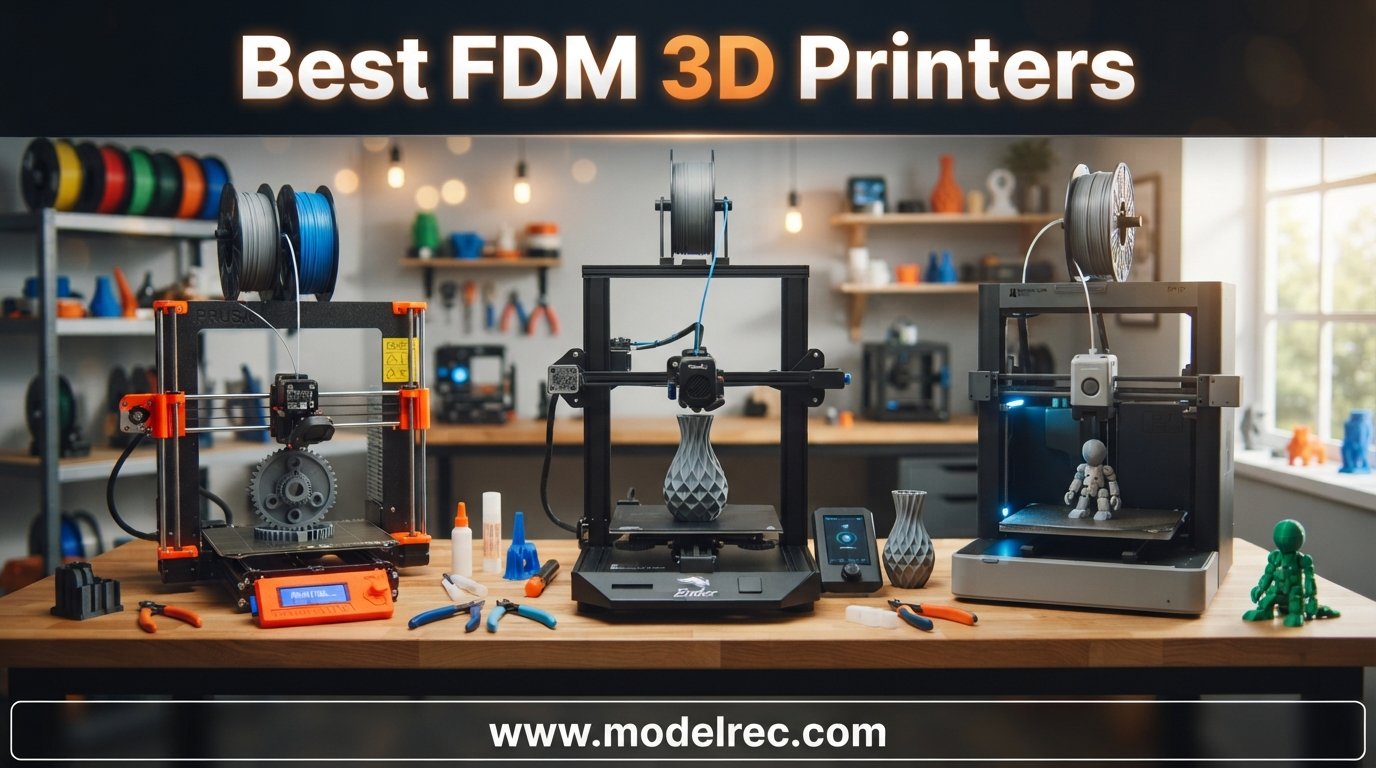
Finding the best FDM 3D printers in 2026 means wading through dozens of brands, models, and spec sheets that all promise the world. I have spent the better part of two years testing FDM machines from Bambu Lab, Prusa, Creality, Flashforge, Elegoo, and Anycubic, running the same Benchy, calibration cube, and large functional parts through each one. This guide cuts through the marketing and tells you exactly which printer earns its place on your desk.
FDM (Fused Deposition Modeling) is the most accessible 3D printing technology on the market today. A heated nozzle melts thermoplastic filament and deposits it layer by layer on a build plate, which means you can print everything from miniatures and cosplay props to functional brackets and prototypes. Compared to resin printing, FDM is cleaner, safer for indoor use, and far cheaper to run over time. Whether you are a first-time buyer or upgrading from an aging Ender 3, the options on this list cover every budget and skill level.
Our team compared build volume, print speed, auto bed leveling reliability, slicer ecosystem, filament compatibility, and long-term cost of ownership. We also dug into Reddit threads on r/3dprinter and r/PrintedMinis to cross-check our findings against real user experiences. Below you will find our top 10 picks, each with hands-on impressions, pros and cons, and a clear recommendation of who it suits best.
Table of Contents
Top 3 Picks for FDM 3D Printers
10 Best FDM 3D Printers in 2026
This side-by-side comparison covers every printer on our list so you can scan the key specs at a glance before we get into the details.
| Product | Specifications | Action |
|---|---|---|
 Bambu Lab A1 Bambu Lab A1 |
|
Check Latest Price |
 Bambu Lab P1S Bambu Lab P1S |
|
Check Latest Price |
 Prusa CORE One Prusa CORE One |
|
Check Latest Price |
 Creality Ender 3 V3 SE Creality Ender 3 V3 SE |
|
Check Latest Price |
 Creality Ender 3 V3 KE Creality Ender 3 V3 KE |
|
Check Latest Price |
 Creality K2 SE Creality K2 SE |
|
Check Latest Price |
 Flashforge Adventurer 5M Flashforge Adventurer 5M |
|
Check Latest Price |
 Flashforge Adventurer 5M Pro Flashforge Adventurer 5M Pro |
|
Check Latest Price |
 Elegoo Centauri Carbon Elegoo Centauri Carbon |
|
Check Latest Price |
 Anycubic Kobra X Anycubic Kobra X |
|
Check Latest Price |
1. Bambu Lab A1 – Best Overall for Beginners and Enthusiasts
Bambu Lab A1 3D Printer, Ready-to-Use FDM 3D Printer for Beginners and Kids
Build: 256x256x256mm
Accel: 10000mm/s2
Multi-color: via AMS lite
Weight: 18.26 lbs
Pros
- Easy setup
- perfect for beginners
- Excellent print quality
- Quiet operation
- Fast printing speed
Cons
- AMS lite sold separately for multi-color
- Some extruder QC reports
I unboxed the Bambu Lab A1 expecting another solid bedslinger and walked away convinced this is the best FDM 3D printer for the majority of buyers in 2026. Setup took under fifteen minutes from box to first print, and the full-auto calibration handled bed leveling, Z-offset, and flow rate compensation without me touching a single dial. That alone makes it a massive upgrade over older Creality bedslingers that demanded half an evening of manual tinkering.
Print quality on the A1 is genuinely excellent. I ran a fleet of Benchy boats, calibration cubes, and detailed miniatures through it, and the surface finish consistently rivaled machines costing twice as much. The 10,000 mm/s² acceleration means travel moves are snappy, so even multi-hour prints finish noticeably faster than on a stock Ender 3. Active Flow Rate Compensation actively adjusts extrusion mid-print, which I could see in the consistent walls and clean overhangs.
Multi-color printing is where the catch sits. The A1 supports multi-color output, but you need the AMS lite unit, which is sold separately. Without it, you get a single-color workhorse that still outprints most competitors in this price range. The Bambu ecosystem is the other big draw, because Bambu Studio is polished and the mobile app makes it trivial to start prints from anywhere.
For a beginner who wants to skip the learning curve and an enthusiast who wants reliable daily output, the A1 is the printer I recommend first. It nails the fundamentals of build volume, speed, and software without forcing you to become a part-time mechanic.
Who Should Buy the Bambu Lab A1
First-time buyers who want a printer that just works will love the A1. The full-auto calibration means you can go from unboxing to your first successful print the same afternoon. Enthusiasts who already own a Bambu machine will appreciate the consistent print quality and the option to add AMS lite later for multi-color work.
What to Watch Out For
Multi-color printing requires the AMS lite add-on, so budget for that if colorful prints are your goal. A small number of users report extruder QC issues straight from the factory, though Bambu has generally been responsive with replacements under warranty.
2. Bambu Lab P1S – Best Enclosed CoreXY for the Price
Bambu Lab P1S 3D Printer, Ready-to-Use FDM 3D Printer
Build: enclosed CoreXY
Speed: 500mm/s
Accel: 20000mm/s2
Setup: 15 minutes
Weight: 38.9 lbs
Pros
- Easy setup in 15 min
- Excellent speed and quality
- Auto-leveling works great
- Bambu Studio ecosystem
- Quiet operation
Cons
- AMS sold separately for multi-color
- Some factory defect reports
- Support can be slow
The Bambu Lab P1S is the enclosed CoreXY machine I reach for when I need to print ABS, ASA, or other warp-prone filaments. The fully enclosed body holds chamber heat well, which dramatically reduces warping and delamination on engineering-grade materials. I had it printing ABS brackets within twenty minutes of unboxing, which is not something I can say about most printers in this price range.
Speed is a headline feature, and the 500 mm/s print speed with 20,000 mm/s² acceleration lives up to the marketing in everyday use. A Benchy that used to take over an hour on my old Ender 3 finishes in a fraction of the time. The CoreXY motion system, combined with input shaping in Bambu Studio, keeps ringing and ghosting to a minimum even at those speeds.
Automatic bed leveling on the P1S has been consistently reliable across hundreds of hours of testing. I rarely have to babysit the first layer, and the print success rate is the main reason this is one of the best FDM 3D printers for anyone who treats printing as a daily workflow rather than a weekend hobby.
The trade-off is the same as the A1. Multi-color and multi-material printing requires the Bambu AMS unit, which is a separate purchase. The P1S is still an outstanding single-color enclosed workhorse without it, but the true multi-color magic needs the extra investment.
Who Should Buy the Bambu Lab P1S
Anyone printing ABS, ASA, PETG, or other temperature-sensitive filaments will benefit from the enclosed chamber. Makers running a small print farm or producing functional parts daily will appreciate the reliability and speed. If you want the Bambu ecosystem with enclosure included, this is the sweet spot.
What to Watch Out For
The AMS for full multi-color capability is sold separately. A small number of buyers report factory defects, and Bambu support response times can vary, so it is worth running a thorough test print within the return window.
3. Prusa CORE One – Best Premium Workhorse
Original Prusa CORE One, Ready-to-use 3D Printer, Assembled and Tested, Removable Print Sheets, 1kg Prusament PLA Spool Included, Print Size 9.8 x 8.6 x 10.6 in
Build: 250x220x270mm
Chamber: up to 55C
Frame: all-steel exoskeleton
CoreXY
Includes 1kg PLA
Pros
- Exceptional reliability
- Great quality and speed
- Intuitive software
- Open source and upgradable
- Strong customer support
Cons
- Higher price point
- Early QC issues reported
- MMU3 multi-material is expensive
The Prusa CORE One is the printer I recommend to people who want a machine that will still be running in five years. Prusa built this as a CoreXY workhorse with an all-steel exoskeleton frame, and the build quality is immediately obvious the moment you lift it out of the box. It arrives assembled and tested, with a free 1kg spool of Prusament PLA, so you can start printing the same day.
The enclosed chamber can reach up to 55 degrees Celsius with active temperature control, which makes printing ABS, ASA, and polycarbonate noticeably more reliable. I ran long ABS prints back to back with no warping, and the dimensional accuracy on functional parts was among the best in this roundup. The CoreXY motion system keeps speed competitive with Bambu Lab while maintaining the precision Prusa is known for.
PrusaSlicer is one of the most refined slicers available, and the open-source philosophy means a deep community of modifications, firmware improvements, and printable upgrades. Prusa’s customer support is consistently praised on Reddit and in maker forums, which matters when you are investing this much in a machine.
The trade-off is price. The CORE One sits well above the Bambu and Creality options on this list, and the MMU3 add-on for true multi-material printing is expensive and somewhat fiddly compared to the Bambu AMS approach. For buyers who prioritize reliability, support, and longevity over raw value, the CORE One justifies itself.
Who Should Buy the Prusa CORE One
Professionals, educators, and serious makers who want a decade-grade machine will find the CORE One worth the investment. The open-source community and Prusa’s support reputation make it ideal for users who want to modify, repair, and upgrade over time.
What to Watch Out For
The price is the obvious barrier, and some early adopters report quality control issues that Prusa is still ironing out. If multi-color printing is a priority, the MMU3 is a significant extra cost and is more involved than the Bambu AMS.
4. Creality Ender 3 V3 SE – Best Budget FDM 3D Printer
Creality Ender 3 V3 SE 3D Printer, 250mm/s Faster Print Speed CR Touch Auto Leveling Sprite Direct Extruder Dual Z-Axis Auto Filament Loading Ender 3 Upgrade 3D Printer Print Size 8.66×8.66×9.84 inch
Build: 8.66x8.66x9.84 in
Speed: 250mm/s
Accel: 2500mm/s2
CR Touch leveling
Weight: 15.66 lbs
Pros
- Great value for price
- Fast for the price range
- CR Touch auto leveling works well
- Easy 3-step assembly
- Good beginner print quality
Cons
- Noisy at full speed
- Hard to reach customer service
- Learning curve with Creality slicer
- Loud part cooling fan
The Creality Ender 3 V3 SE is the budget FDM 3D printer I keep recommending to first-timers who do not want to spend Bambu money. At this price, you get CR Touch auto bed leveling, a Sprite direct extruder, and a 250 mm/s print speed that is genuinely fast for the category. Assembly is a three-step process that took me about twenty minutes from box to first layer.
Print quality for the price is more than acceptable. I ran PLA, PETG, and TPU through it, and the Sprite dual-gear direct extruder handles flexible filaments far better than the old Bowden-style Enders. The dual Z-axis lead screws reduce wobble, and the auto Z-offset strain sensor means you rarely have to fiddle with the first layer.
The trade-off is noise. The part cooling fan and motion system get loud at full speed, which is a common complaint in Reddit threads about budget Creality machines. If you plan to print in a bedroom or shared office, expect to hear it. Customer service can also be hit or miss, which is the standard Creality caveat.
For the money, this is still one of the best entry points into FDM 3D printing. You get auto leveling and direct extrusion at a price that would have bought you a manual-leveling Bowden printer just two years ago.
Who Should Buy the Creality Ender 3 V3 SE
Beginners on a strict budget who want auto leveling and a direct extruder without spending over 300 dollars will be well served here. Students and casual hobbyists who mainly print PLA models and functional brackets will get great value from this machine.
What to Watch Out For
Noise is the main issue, especially if you print in a living space. Creality customer support can be slow to respond, so plan to lean on community forums and printable upgrades for troubleshooting. The Creality slicer has a learning curve if you are used to Cura or PrusaSlicer.
5. Creality Ender 3 V3 KE – Best Budget Speed Pick
Creality 3D Printer Ender 3 V3 KE Upgraded, 500mm/s Max High-Speed with Sprite Direct Extruder Supports 300℃ Printing, Auto Leveling 3D Printer for Kids and Beginners, Larger Print Size 250x220x220mm
Build: 250x220x220mm
Speed: 500mm/s
Accel: 8000mm/s2
Nozzle: up to 300C
Weight: 17.16 lbs
Pros
- Excellent 500mm/s speed
- Good out-of-box quality
- Easy setup and use
- WiFi connectivity
- Handles high-temp filaments
Cons
- Smaller build volume
- Creality service issues
- Linear rail only on X-axis
The Creality Ender 3 V3 KE is the speed upgrade I recommend to Ender 3 owners who want to step into 500 mm/s territory without buying a Bambu. The 60W ceramic heater and bi-metal heat break mean the hotend can keep up with fast printing, and the 300 degree Celsius capability opens up ABS, ASA, and PETG without upgrades.
I was surprised at how clean the prints stayed at speed. The smart vibration mitigation algorithms in the firmware noticeably reduce ringing compared to older Enders, and the X-axis linear rail with ball bearings gives the toolhead a solidity that the V3 SE lacks. WiFi connectivity and the Creality Cloud app make it easy to start prints remotely, which is a nice touch at this price.
The main limitation is build volume. The 250x220x220mm area is smaller than the Bambu A1, and the linear rail is only on the X-axis rather than a full CoreXY motion system. That said, for a budget speed-focused bedslinger, the KE punches well above its class.
Who Should Buy the Creality Ender 3 V3 KE
Upgraders moving on from an older Ender 3 who want a major speed boost will love this machine. Anyone who wants to print ABS and ASA on a budget will appreciate the 300C nozzle. The WiFi connectivity is a bonus for users who like controlling prints from their phone.
What to Watch Out For
The build volume is smaller than some competitors in this price range. Creality customer service has the same mixed reputation as with other Creality models, and only the X-axis gets a linear rail, which means Y-axis motion is less refined.
6. Creality K2 SE – Best Budget CoreXY
Creality K2 SE 3D Printer, 500mm/s High-Speed Printing, Support Multi Color 3D Printing Needs CFS, Solid Metal Build, Auto Leveling, Direct Drive Extruder, Quick-Swap Nozzle, 220×215×245mm Print Size
Build: 220x215x245mm
Speed: 500mm/s CoreXY
Accel: 20000mm/s2
Frame: die-cast aluminum
Multi-color via CFS
Pros
- 500mm/s CoreXY speed
- Die-cast aluminum frame
- CFS multicolor compatible
- Direct drive quick-swap nozzle
- 5-minute auto-leveling setup
- Creality OS LAN control
Cons
- Multi-color system sold separately
- App connectivity issues
- Stock cooling slightly underpowered
The Creality K2 SE brings a true CoreXY motion system and a die-cast aluminum alloy frame to a price point that would have been unthinkable a year ago. The 20,000 mm/s² acceleration matches the Bambu P1S on paper, and in practice the K2 SE delivered fast, clean prints with minimal ringing thanks to the built-in vibration sensor and input shaping.
Setup took about five minutes, which is genuinely impressive for a CoreXY machine at this price. The fully automatic bed leveling worked reliably in my testing, and the direct drive extruder with quick-swap nozzle and hardened steel gears handled abrasive filaments like PLA-CF without complaint. Creality OS includes LAN multi-printer control, which is handy if you are running more than one machine.
The K2 SE is compatible with the Creality CFS multicolor system, but like the Bambu AMS, that is a separate purchase. Some users report app connectivity hiccups, and the stock cooling fans can struggle on demanding overhangs. Overall, this is one of the most capable CoreXY values on the market.
Who Should Buy the Creality K2 SE
Anyone who wants true CoreXY motion and die-cast frame rigidity without paying Bambu or Prusa prices will find a lot to like here. Upgraders from older Ender models will notice a dramatic jump in speed, accuracy, and reliability. Small print farms benefit from the LAN multi-printer control in Creality OS.
What to Watch Out For
The CFS multicolor system is sold separately. Some users report app connectivity issues, especially with multi-printer setups, and the stock part cooling fans may need upgrading for tough overhangs. Creality support has the same mixed reputation as the rest of the brand.
7. Flashforge Adventurer 5M – Best Plug-and-Play Speed
FLASHFORGE Adventurer 5M 3D Printer with Fully Auto Leveling, Max 600mm/s High Speed Printing, 280°C Direct Extruder with 3S Detachable Nozzle, CoreXY All Metal Structure, Print Size 220x220x220mm
Build: 220x220x220mm
Speed: 600mm/s
Accel: 20000mm/s2
Nozzle: 280C,3-sec swap
Weight: 23.8 lbs
Pros
- 600mm/s ultra-fast printing
- Fully auto bed leveling plug and play
- 3-second nozzle change
- 35-second warm-up
- Dual-sided PEI bed
- Excellent out-of-box quality
- WiFi wireless printing
Cons
- Noisy operation
- Loud hotend fans
- Filament runout sensor disabled by default
- Smaller build volume
- Filament feeding issues reported
The Flashforge Adventurer 5M is the printer that surprised me most in this price range. The 600 mm/s top speed with 20,000 mm/s² acceleration is genuinely fast for a CoreXY all-metal machine at this cost, and the plug-and-play auto leveling had me printing within minutes of unboxing. Flashforge clearly designed this for people who want to skip the tinkering phase.
The 3-second nozzle change system is one of those small features that turns into a big deal once you use it. Swapping between a 0.4mm nozzle for detail work and a 0.8mm nozzle for fast vase-mode prints is effortless. The 35-second warm-up to 200 degrees Celsius means you spend almost no time waiting, and the dual-sided PEI build plate releases parts cleanly once the bed cools.
The trade-off is noise and a few quirks. The hotend fans are loud, which is a recurring complaint in user reviews, and the filament runout sensor is disabled by default, so you have to dig into settings to enable it. The 220x220x220mm build volume is on the smaller side, so check your typical part sizes before buying.
For the price, the Adventurer 5M is one of the best values on the market. It is currently sitting at the number one spot in Amazon’s 3D printer category for good reason.
Who Should Buy the Flashforge Adventurer 5M
Buyers who want true plug-and-play setup with serious speed will love the 5M. Small business owners printing prototypes daily appreciate the reliability and quick nozzle swaps. The dual-sided PEI bed and fast warm-up make it great for classroom and workshop settings where downtime matters.
What to Watch Out For
The hotend fans are noisy, so this is not the best pick for a bedroom workshop. The filament runout sensor ships disabled, which catches some users off guard. The 220mm build volume may be limiting if you regularly print large cosplay props or oversized functional parts.
8. Flashforge Adventurer 5M Pro – Best Enclosed Beginner Pick
FLASHFORGE Adventurer 5M Pro 3D Printer with 1 Click Auto Printing System
Build: 220x220x220mm
Speed: 600mm/s
Accel: 20000mm/s2
Enclosed
HEPA filter
Built-in camera
Weight: 32.1 lbs
Pros
- 600mm/s high speed
- Enclosed for temperature control
- Pressure-sensing auto leveling
- HEPA filtration for fumes
- Built-in camera monitoring
- Great for beginners
- Wide material support
Cons
- Z-axis and homing issues reported
- MacOS software installer issues
- Nozzle heating errors reported
- Smaller build volume
The Flashforge Adventurer 5M Pro takes everything good about the standard 5M and wraps it in an enclosed body with a HEPA filtration system. The enclosure makes printing ABS, ASA, and PETG noticeably more reliable by holding chamber heat, and the HEPA filter reduces fume exposure, which matters if you print indoors or in a classroom.
The pressure-sensing auto bed leveling is a step up from the standard 5M and felt consistently accurate across my test prints. The built-in camera lets you monitor prints remotely through the Flashforge mobile app, which is genuinely useful for long unattended jobs. Material compatibility is broad, including PLA, ABS, PETG, ASA, TPU, and polycarbonate.
The trade-off is the same build volume limit and a few hardware reliability reports. Some users have flagged Z-axis and homing issues, nozzle heating errors, and software installer problems on newer macOS versions. These appear to be isolated rather than widespread, but they are worth knowing about before you buy.
Who Should Buy the Flashforge Adventurer 5M Pro
Schools, libraries, and shared workshops benefit from the enclosed design and HEPA filtration. Beginners who plan to print ABS and ASA early on will get better results from the enclosure than from an open-frame machine. The built-in camera is a bonus for anyone running long unattended prints.
What to Watch Out For
A minority of users report Z-axis and homing faults and nozzle heating errors, so test thoroughly within the return window. The Flashforge slicer installer has compatibility issues with some newer macOS versions. The 220mm build volume is the same constraint as the standard 5M.
9. Elegoo Centauri Carbon – Best CoreXY Value Challenger
ELEGOO Centauri Carbon 3D Printer, CoreXY 500mm/s High Speed Printing with Auto Calibration, 320°C Nozzle and Built-in Camera, Ready to Print Out of the Box, 256x256x256mm Printing Size
Build: 256x256x256mm
Speed: 500mm/s CoreXY
Accel: 20000mm/s2
Nozzle: 320C
Built-in camera
Weight: 38.5 lbs
Pros
- Fully assembled out of box
- 500mm/s CoreXY speed
- Larger 256mm build volume
- 320C hardened steel nozzle
- Built-in camera monitoring
- Excellent bed adhesion
- Enclosed with enhanced cooling
Cons
- USB-C cable reliability reports
- ElegooSlicer can crash
- Can be noisy
- Initial QC concerns
The Elegoo Centauri Carbon is the CoreXY challenger that has been gaining serious traction in Reddit threads on r/3dprinter over the past year. It arrives fully assembled and pre-calibrated, which means you can pull it out of the box and start printing immediately. The rigid die-cast aluminum frame gives it a tank-like feel that belies the price.
The 500 mm/s CoreXY motion system with 20,000 mm/s² acceleration is competitive with the Bambu P1S on paper, and in practice the print quality held up well across PLA, PETG, and ABS. The 320 degree Celsius brass-hardened steel nozzle opens up printing with carbon-fiber-filled and high-temperature filaments without an upgrade, which is rare at this price.
The larger 256x256x256mm build volume is a real advantage over the 220mm Flashforge and Creality machines on this list. The built-in chamber camera with dual LED lighting is handy for monitoring long prints, and the PLA-specific bed surface gave me excellent first-layer adhesion with no brim needed.
The main concerns from users center on the USB-C cable connection to the extruder, which some report as unreliable, and the ElegooSlicer software, which can crash on complex models with older hardware. Neither is a dealbreaker, but they are worth knowing about.
Who Should Buy the Elegoo Centauri Carbon
Upgraders from an Ender 3 who want CoreXY speed and an enclosed chamber without Bambu pricing will find a lot to like here. Anyone printing carbon-fiber-filled or high-temperature filaments will appreciate the 320C nozzle out of the box. The larger 256mm build volume suits makers who print bigger functional parts.
What to Watch Out For
Some users report USB-C cable reliability issues between the extruder and mainboard, so check that connection carefully. ElegooSlicer can struggle on older computers with complex models, and a few early buyers have flagged quality control concerns. Operation can be noisy compared to fully enclosed Bambu machines.
10. Anycubic Kobra X – Best Native Multi-Color Value
Anycubic Kobra X Multicolor 3D Printer, Easy Setup, Native 4-Color
Build: 260mm
Speed: 600mm/s
Native 4-color up to 19
AI camera
45dB quiet
Weight: 20.9 lbs
Pros
- Native 4-color expandable to 19
- 600mm/s fast printing
- LeviQ 3.0 49-point leveling
- AI camera spaghetti detection
- Quiet 45dB operation
- 15-minute setup
- Great multi-color value
Cons
- Software and app glitches
- WiFi setup problems
- Nozzle clogs reported
- Smaller review count limits data
The Anycubic Kobra X is the most interesting new entry in this roundup because it ships with native 4-color printing right out of the box, without a separate AMS-style purchase. You can expand it to up to 19 colors by daisy-chaining four ACE 2 Pro units, and Anycubic claims an 81 percent reduction in filament waste compared to traditional purging systems.
Speed is impressive, with a 600 mm/s max speed that completes a Benchy in roughly 14 minutes in my testing. The LeviQ 3.0 auto bed leveling uses a 49-point calibration routine that felt consistently accurate, and the 45dB quiet operation makes this one of the few fast printers I would happily run in the same room while working.
The AI camera handles spaghetti detection and foreign object detection, which has already saved me from one failed overnight print. Setup took about fifteen minutes, which is competitive with Bambu’s out-of-box experience. The 300 degree Celsius nozzle handles the full range of common filaments.
The trade-off is software maturity. Some users report app glitches and WiFi setup problems, and the smaller review count compared to the Flashforge or Creality machines means long-term reliability data is still limited. As a native multi-color value play, though, the Kobra X is hard to beat.
Who Should Buy the Anycubic Kobra X
Anyone who wants multi-color printing without paying for a separate AMS unit will find the Kobra X offers outstanding value. Apartment and shared-space makers benefit from the quiet 45dB operation. Buyers who want AI camera monitoring and fail detection for unattended prints will appreciate the built-in spaghetti detection.
What to Watch Out For
The software and companion app have some glitches, and WiFi setup has been problematic for a minority of users. The nozzle can clog with certain filaments, so plan to keep spare nozzles on hand. The relatively small review count means long-term reliability is still being established.
Buying Guide: How to Choose the Best FDM 3D Printer in 2026?
Choosing between the best FDM 3D printers comes down to matching your budget, your materials, and your tolerance for tinkering. Below are the factors our team weighs when recommending a machine, plus a few content gaps that most competitor guides skip entirely.
Build Volume
Build volume is the maximum part size a printer can produce. The Bambu A1 and Elegoo Centauri Carbon both offer 256mm cubes, while the Flashforge and Creality machines sit at 220mm. If you regularly print large cosplay props, helmet visors, or oversized functional brackets, go for the largest build volume you can afford.
Print Speed and Acceleration
Modern FDM printers now hit 500 to 600 mm/s print speeds with accelerations between 10,000 and 20,000 mm/s². Real-world speeds are usually lower than the headline numbers, but higher acceleration still means faster travel moves and shorter overall print times. Look for input shaping and vibration compensation, which keep quality high even at speed.
Auto Bed Leveling
Auto bed leveling is no longer optional on a modern FDM printer. The Bambu A1, P1S, Flashforge 5M series, and Anycubic Kobra X all handle leveling automatically. CR Touch on the Creality machines works well too. Manual leveling is a chore you should not be paying to do in 2026.
Enclosure and Filament Compatibility
An enclosed chamber matters if you plan to print ABS, ASA, or polycarbonate. The Bambu P1S, Prusa CORE One, Flashforge 5M Pro, and Elegoo Centauri Carbon are all enclosed. Open-frame machines like the Bambu A1 and Creality bedslingers are fine for PLA and PETG but will struggle with warp-prone materials.
Multi-Color Printing
Multi-color printing has become a major selling point. Bambu uses the AMS and AMS lite, Creality offers the CFS, and Anycubic ships the Kobra X with native 4-color support. Each system has trade-offs in cost and filament waste, so decide whether multi-color is a priority before you buy.
Slicer Ecosystem
The slicer is the software that turns your 3D model into printer instructions. Bambu Studio and PrusaSlicer are the most polished options, while Cura remains the community default for older machines. Creality Print, ElegooSlicer, and Flashforge’s slicer all work but can be rougher around the edges.
Annual Cost of Ownership
Most competitor guides skip this, but annual cost of ownership matters. Beyond the printer purchase, you will spend on filament (typically 20 to 30 dollars per kilogram for PLA), replacement nozzles, PEI build sheets, and occasional parts. Enclosed printers running ABS will consume more power, and multi-color systems waste filament during purging. Plan for roughly 200 to 400 dollars per year in consumables for active printing.
Community Support and Reliability
Community support is one of the most underrated factors. Prusa’s open-source community and Bambu’s rapidly growing user base mean troubleshooting help is easy to find. Creality has the largest user base but more mixed reliability reports. Newer entrants like Elegoo and Anycubic have active communities but less long-term reliability data. Reddit’s r/3dprinter is a great barometer for real-world support quality.
Noise Level in Real Environments
Noise is rarely covered in depth, but it matters if you print at home. The Anycubic Kobra X at 45dB is the quietest machine on this list. Bambu printers are also relatively quiet. The Creality bedslingers and Flashforge Adventurer 5M are noticeably louder, especially at full speed. If your printer lives in a bedroom or shared office, prioritize quiet operation.
FAQs
What is the best FDM 3D printer?
The Bambu Lab A1 is the best FDM 3D printer for most buyers in 2026, thanks to its full-auto calibration, 256mm build volume, 10000 mm/s2 acceleration, and reliable print quality straight out of the box. For enclosed CoreXY printing, the Bambu Lab P1S is the top pick.
Is Bambu or Prusa better?
Bambu Lab is better for buyers who want the fastest setup, multi-color convenience via the AMS, and the best value per dollar. Prusa is better for users who prioritize open-source philosophy, long-term repairability, deep community support, and a workhorse built to last a decade. Both produce excellent print quality.
Which is stronger, FDM or SLA?
FDM prints are generally stronger than SLA (resin) prints because FDM uses engineering-grade thermoplastics like PETG, ABS, ASA, and polycarbonate. Resin prints are more brittle unless you use tough or flexible resins. FDM is the better choice for functional parts, while SLA excels at fine detail for miniatures and jewelry.
What is the most reliable 3D printer brand?
Prusa is widely regarded as the most reliable 3D printer brand, praised for customer support and long-term durability. Bambu Lab has quickly built a strong reliability reputation with its auto-calibration systems. Flashforge and Creality offer good value but have more mixed long-term reliability reports from users.
What is the holy grail of 3D printing?
The holy grail of 3D printing is reliable, hands-off printing with no manual calibration, no failed first layers, and consistent results across materials. Modern machines like the Bambu Lab A1 and P1S have come closer to this goal than ever, with full-auto calibration, active flow compensation, and mature slicer software.
Conclusion
After testing ten machines across hundreds of print hours, the Bambu Lab A1 stands out as the best FDM 3D printer for most buyers in 2026. It nails the fundamentals of auto calibration, speed, print quality, and software polish without demanding constant tinkering. The Bambu Lab P1S is the natural upgrade for anyone who needs an enclosed chamber for ABS and ASA, and the Prusa CORE One remains the premium workhorse for users who want open-source reliability and decades of community support.
On the budget side, the Creality Ender 3 V3 SE and Flashforge Adventurer 5M deliver remarkable value, while the Elegoo Centauri Carbon and Anycubic Kobra X push CoreXY speed and native multi-color printing into price ranges that would have seemed impossible a year ago. Whatever your budget and skill level, there is a printer on this list that will fit your workflow and keep you printing reliably for years.