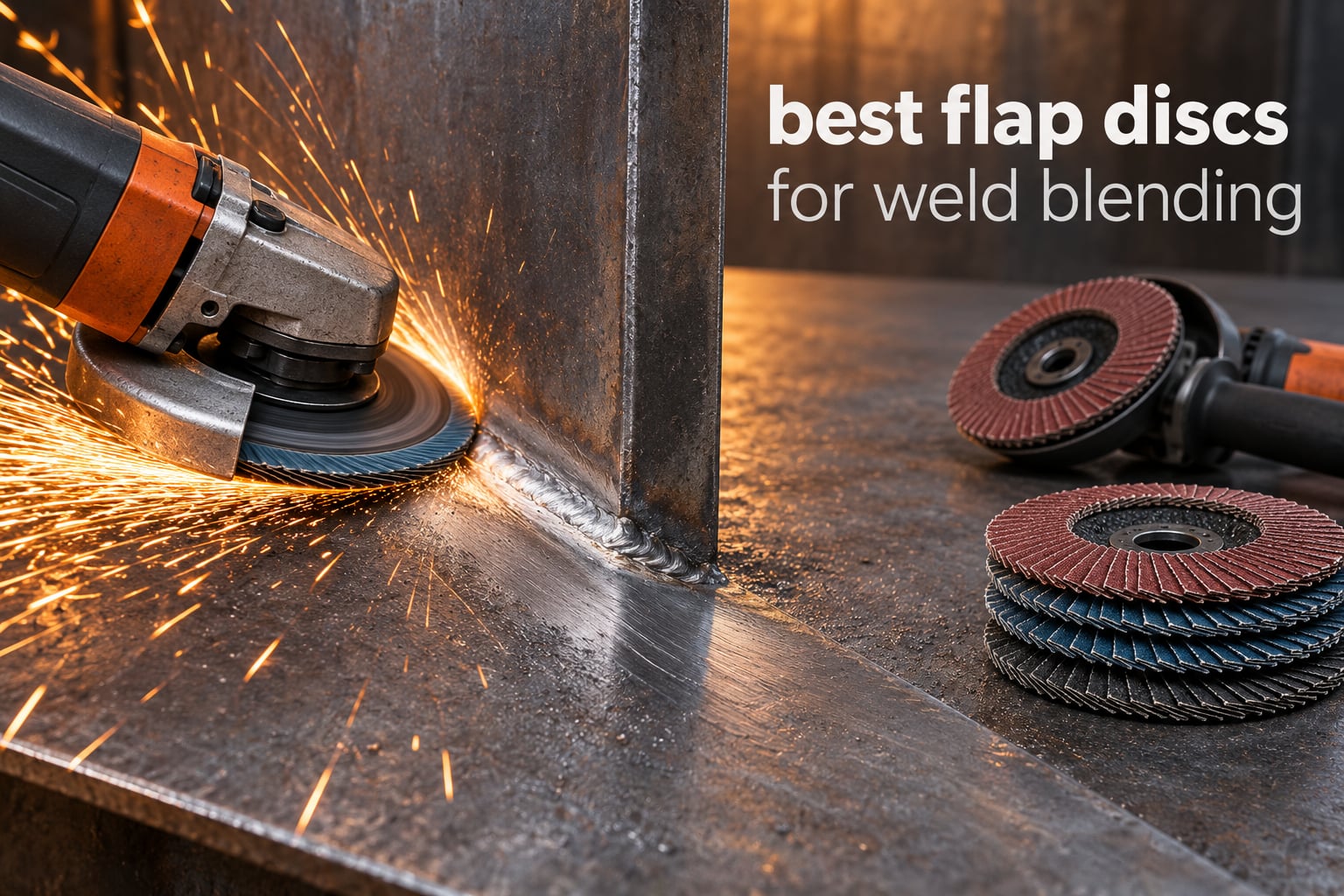
A proud fillet weld sits above the plate, throws a shadow across the joint, and refuses to disappear under paint until it is ground flush. That is the whole job this roundup is built around: putting a proud weld back level with the surrounding metal without burning the parent material or gouging a divot beside it.
A flap disc is a layered abrasive wheel, roughly the size of a hockey puck, with coated-abrasive flaps overlapped and bonded to a rigid backing plate. As you grind, the top layer of flaps wears away to expose sharper grain underneath, so the disc works from rough grinding through to a fine finish before it is finally spent. One tool, one step, no switching between grinding wheel and sander partway down a weld.
Every pick below was chosen on profile, grain, grit and backing rather than brand alone. Type 27 flat discs earn their place at low working angles on flat plate and sheet, while conical Type 29 discs put more abrasive in contact at the steeper angles you naturally hold on a curved fillet or a tube joint. Grain matters just as much: aluminum oxide is the entry point, zirconia alumina is the working middle, and ceramic blends are the option for hard stainless and carbon steel that burns through the others.
What follows is a 12-disc lineup split across sizes and grits, followed by the buying guide that explains how to pick between them without wasting a shift.
Table of Contents
Top 3 Best Flap Discs for Weld Blending in October

LotFancy 4.5 inch Mixed Grit Type 27
- 40/60/80/120 assorted grit in one pack
- Flat Type 27 for 5-15 degree blending
- Aluminum oxide on fiberglass backing
- 4.5 inch 7/8 arbor at 13300 RPM

EZARC 40 Grit Zirconia Type 29
- Zirconia grain that outlasts aluminum oxide
- Conical Type 29 for 15-20 degree working angle
- Coarse 40 grit for weld reinforcement
- 4.5 inch 7/8 arbor at 13300 RPM

Benchmark Abrasives High-Density Jumbo…
- High-density jumbo flap layout
- European zirconia cloth with uniform grit
- Built to exceed ANSI and EU standards
- 4.5 inch 7/8 arbor
The LotFancy multipack earns the top slot for a simple reason: it covers the entire grit ladder in a single purchase, so a shop can knock down a bead, blend it and finish it without a second order. The EZARC disc is a strong single-grit weld-dressing option here, and the Benchmark jumbo is the one to buy when you are grinding fillet after fillet and want fewer stops to change discs.
All 12 Picks Compared Side by Side in 2026
Every disc listed below is a genuine 4.5 inch class tool except two, and the table makes the differences obvious at a glance. Diameter, arbor, profile and grit decide where each one belongs.
| Product | Specifications | Action |
|---|---|---|
| LotFancy 4.5 inch 40/60/80/120 Type 27 |
|
Check Latest Price |
| EZARC 40 Grit Zirconia Type 29 |
|
Check Latest Price |
| Benchmark Abrasives High-Density Jumbo Type 29 |
|
Check Latest Price |
 NEIKO 120 Grit Zirconia Type 29 NEIKO 120 Grit Zirconia Type 29 |
|
Check Latest Price |
 NEIKO 80 Grit Aluminum Oxide Type 27 NEIKO 80 Grit Aluminum Oxide Type 27 |
|
Check Latest Price |
 Trivd Frol 40 Piece Zirconia Type 29 Trivd Frol 40 Piece Zirconia Type 29 |
|
Check Latest Price |
 PRETEC 60 Grit High-Density Type 27 PRETEC 60 Grit High-Density Type 27 |
|
Check Latest Price |
 PFERD Polifan Curve Radial Flap Disc PFERD Polifan Curve Radial Flap Disc |
|
Check Latest Price |
 PRVEW 5 Piece Mixed Grit Type 29 PRVEW 5 Piece Mixed Grit Type 29 |
|
Check Latest Price |
 SALI 60 Grit Ceramic Blend Type 29 SALI 60 Grit Ceramic Blend Type 29 |
|
Check Latest Price |
 DEWALT 7 Inch 36 Grit Zirconia Type 29 DEWALT 7 Inch 36 Grit Zirconia Type 29 |
|
Check Latest Price |
 Sbestily 2 Inch Curved R-Type Die Grinder Kit Sbestily 2 Inch Curved R-Type Die Grinder Kit |
|
Check Latest Price |
1. LotFancy 4.5 inch Mixed Grit Type 27 – The One-Pack Grit Ladder
LotFancy Angle Grinder Sanding Disc for Metal & Wood, 4 1/2”, 20 Flap Discs
4.5 inch 7/8 arbor
Type 27 flat profile
Aluminum oxide on fiberglass
13300 RPM max
Pros
- Covers the full 40 to 120 grit ladder in a single pack
- Flat Type 27 profile suits low-angle blending on plate and sheet
- Fiberglass backing adds reinforcement
- Works on stainless steel and mild steel cleanup
Cons
- Thinner than premium name-brand discs
- Sheds flap fragments faster on hard metals
- Shorter disc life per disc on hardened steel
I keep a box of these on the bench for any job where the weld condition is not known in advance. The pack holds 20 discs split across 40, 60, 80 and 120 grit, five of each, so the whole blending sequence is covered before the box is opened.
The flat Type 27 profile is the right shape when you are working the top side of a butt weld in plate and holding the grinder down near the surface. That low angle is also what makes a 120 grit disc in this pack useful as a final pass rather than a wasted abrasive.
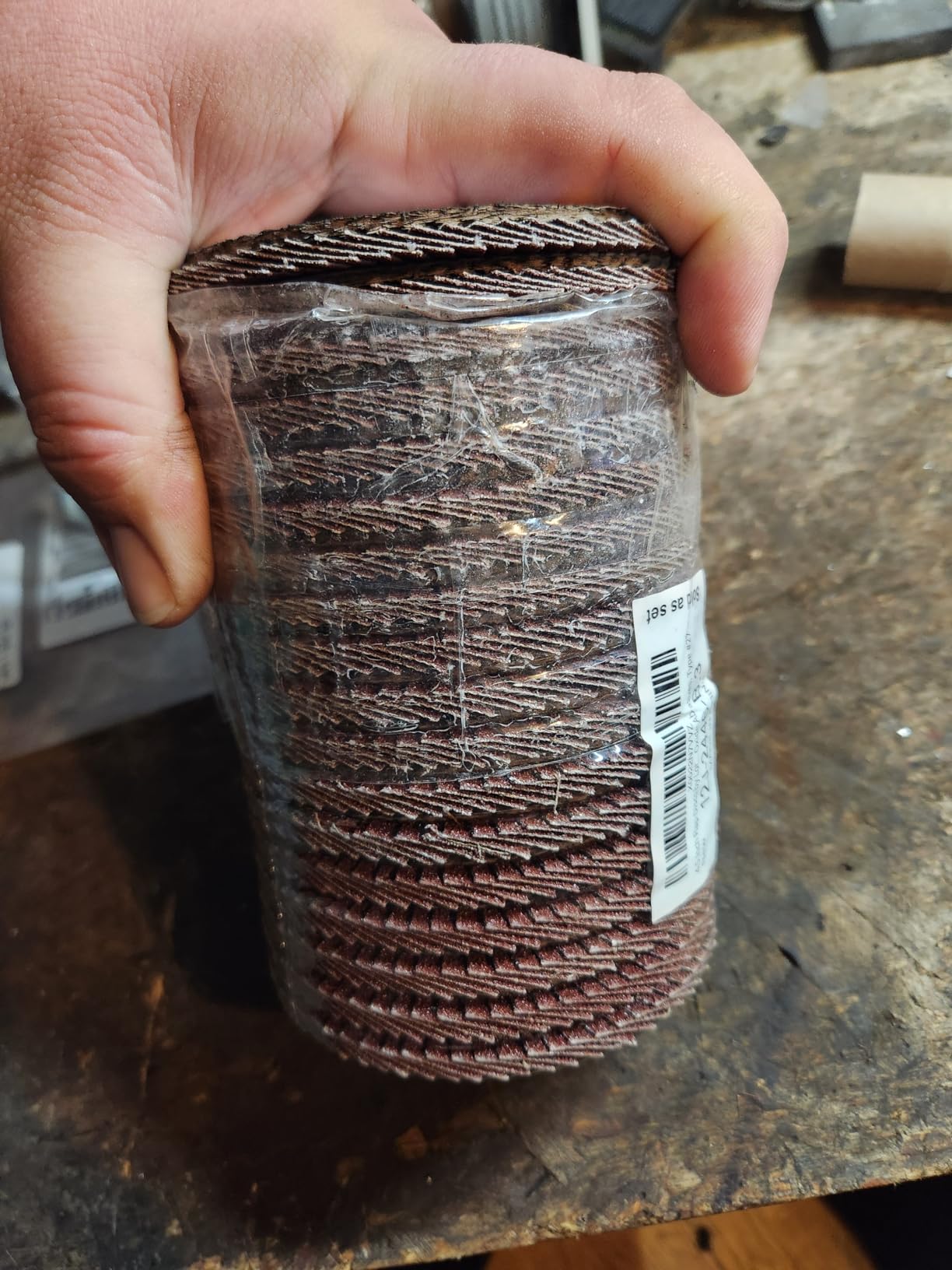
What you give up is disc life. These are noticeably thinner than what a shop that runs one grinder all day would buy, and reviewers comparing them against heavier name-brand discs consistently note faster wear and slightly more shedding on hard metals.
For mild steel work, home shop upgrades and any job where the per-disc cost is the deciding factor, that trade is a good one. A 4.6 average across more than 4000 ratings reflects exactly that value position: nobody expects these to last a shift, and most owners buy them because replacing one costs less than the time spent wishing you had bought a better one.
When this multipack is the right call
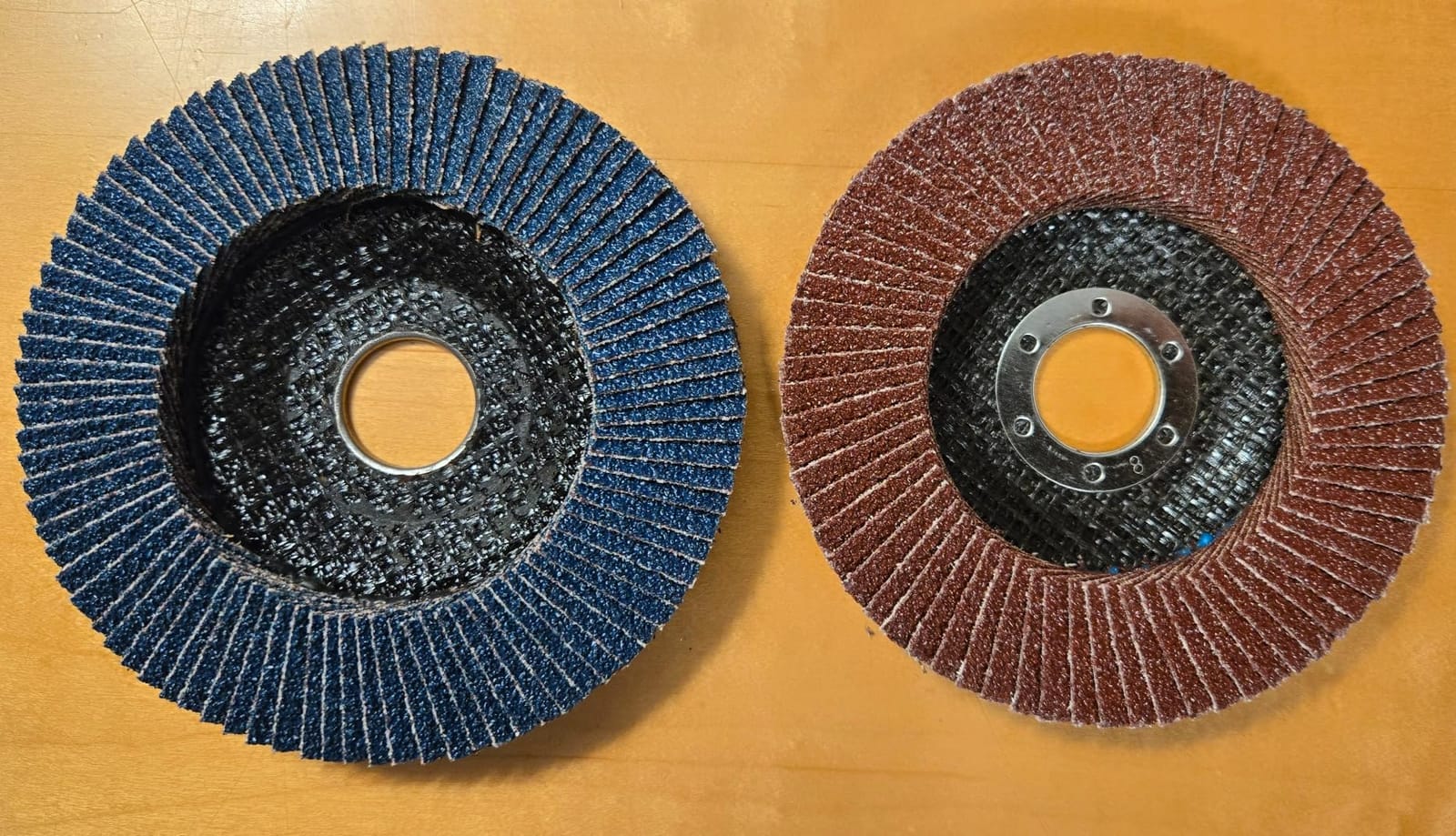
It wins when you are blending more than one type of weld. Tube rack, sheet metal and structural steel all show up in the same week in most shops, and having one box handle 40 grit knockout through 120 grit finish removes the excuse for grabbing the wrong disc.
When to buy something else
Production work on hardened or stainless steel is where the thinner construction shows. If a single disc has to survive repeated passes on hard metal without being changed out, spend up front on a high-density zirconia or ceramic disc instead of fighting the wear rate.
2. EZARC 40 Grit Zirconia Type 29 – Coarse Grit for Weld Knockdown
EZARC Zirconia Flap Discs 40 Grit, 4-1/2 x 7/8-Inch, Type 29, 10-Pack
4.5 inch 7/8 arbor
Type 29 conical profile
Zirconia alumina grain
13300 RPM max
Pros
- Zirconia grain that outlasts standard aluminum oxide abrasive
- Conical profile suits 15-20 degree working angle
- Coarse 40 grit strips weld reinforcement quickly
- Consistent on stainless aluminum and hardened chrome
Cons
- Disc life shorter than premium industrial discs
- Needs a finer grit disc to clean up after coarse work
This is the disc I reach for when the bead is proud and ugly and the goal is to get it down without wrecking the plate around it. At 40 grit with a zirconia grain, it is built to remove weld reinforcement quickly where an aluminum oxide disc at the same grit tends to slow down.
The Type 29 conical profile matters on this job. Holding a grinder on a vertical fillet naturally puts you near a 15 to 20 degree working angle, which is exactly where the conical layout puts more abrasive surface against the metal than a flat disc would.
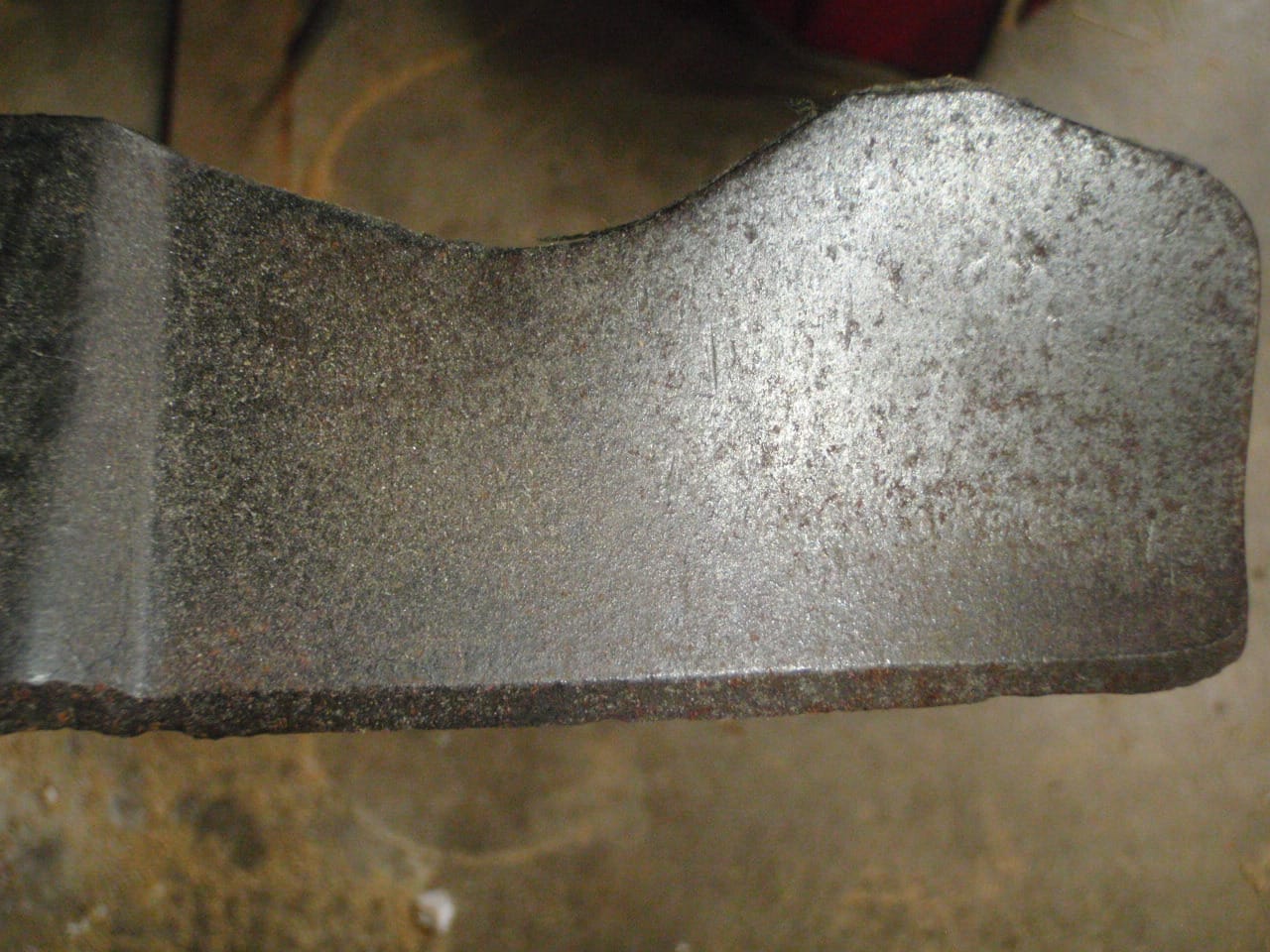
Reviewers running hydraulic and heavy equipment repair shops describe consistent behavior across stainless steel, aluminum and induction-hardened chrome, which is a broad material range for one disc at this price point. The fiberglass and adhesive backing is also credited with absorbing vibration enough to keep the cut stable.
The honest caveat is disc life, which reviewers report as shorter than premium industrial discs, and the fact that 40 grit always leaves work behind. You will finish this job with a second disc. Budget for the two-step.
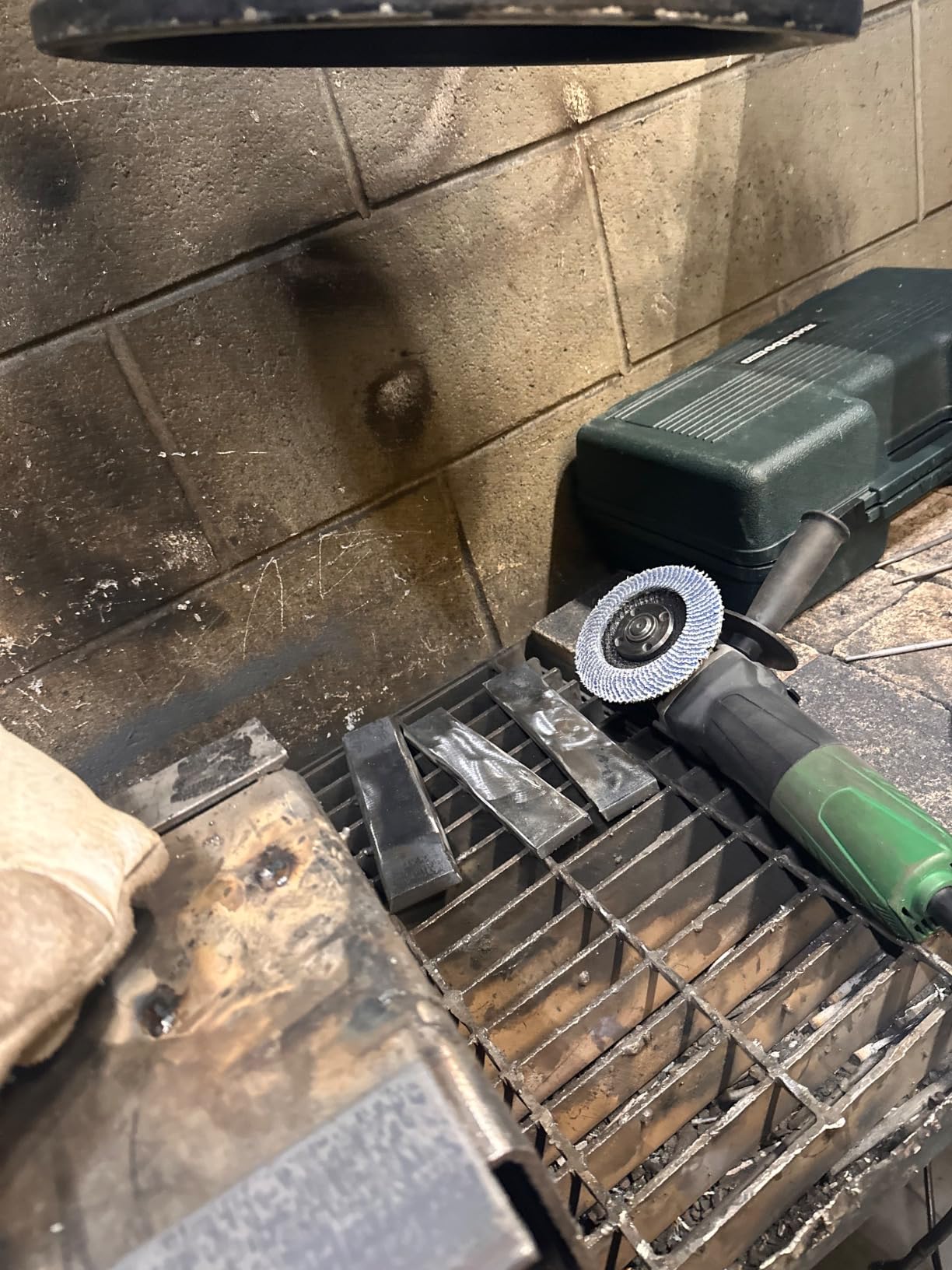
Why the profile matters for welds
A flat Type 27 disc loses contact as soon as you tilt past about 15 degrees, which on a curved or vertical joint happens almost immediately. The conical Type 29 layout keeps abrasive engaged across a wider angle range, so more of the disc works and less of it idles.
Where it falls short
On stainless work that needs a clean cosmetic finish, jumping straight to 40 grit leaves visible scratch patterns. Use it as the knockdown step, then step up a grit rather than trying to blend out the coarse scratches with the same disc.
3. Benchmark Abrasives High-Density Jumbo Type 29 – Built for Long Grinding Runs
Benchmark Abrasives 4.5″ x 7/8″ Zirconia Type 29 Flap Discs, 40 Grit
4.5 inch 7/8 arbor
High-density jumbo Type 29
European zirconia cloth
13300 RPM max
Pros
- High-density jumbo construction outlasts thin commodity discs
- European zirconia cloth with uniform particle size
- Curved profile handles contour and chamfer work
- Built to exceed ANSI and EU abrasive standards
Cons
- Less aggressive cut rate than some competing zirconia discs
- Higher per-disc cost than budget aluminum oxide options
When the job is a run of fillet welds rather than one repair, disc change time becomes the real cost. This high-density jumbo Type 29 disc is built for that: more abrasive packed into the same 4.5 inch footprint, which is the whole argument behind high-density construction.
The curved Type 29 profile works well for blending and chamfering, and owners of small welding businesses report ordering these on repeat. The European zirconia cloth is described as having a uniform particle size, which in practice shows up as an even scratch pattern instead of random deep gouges.
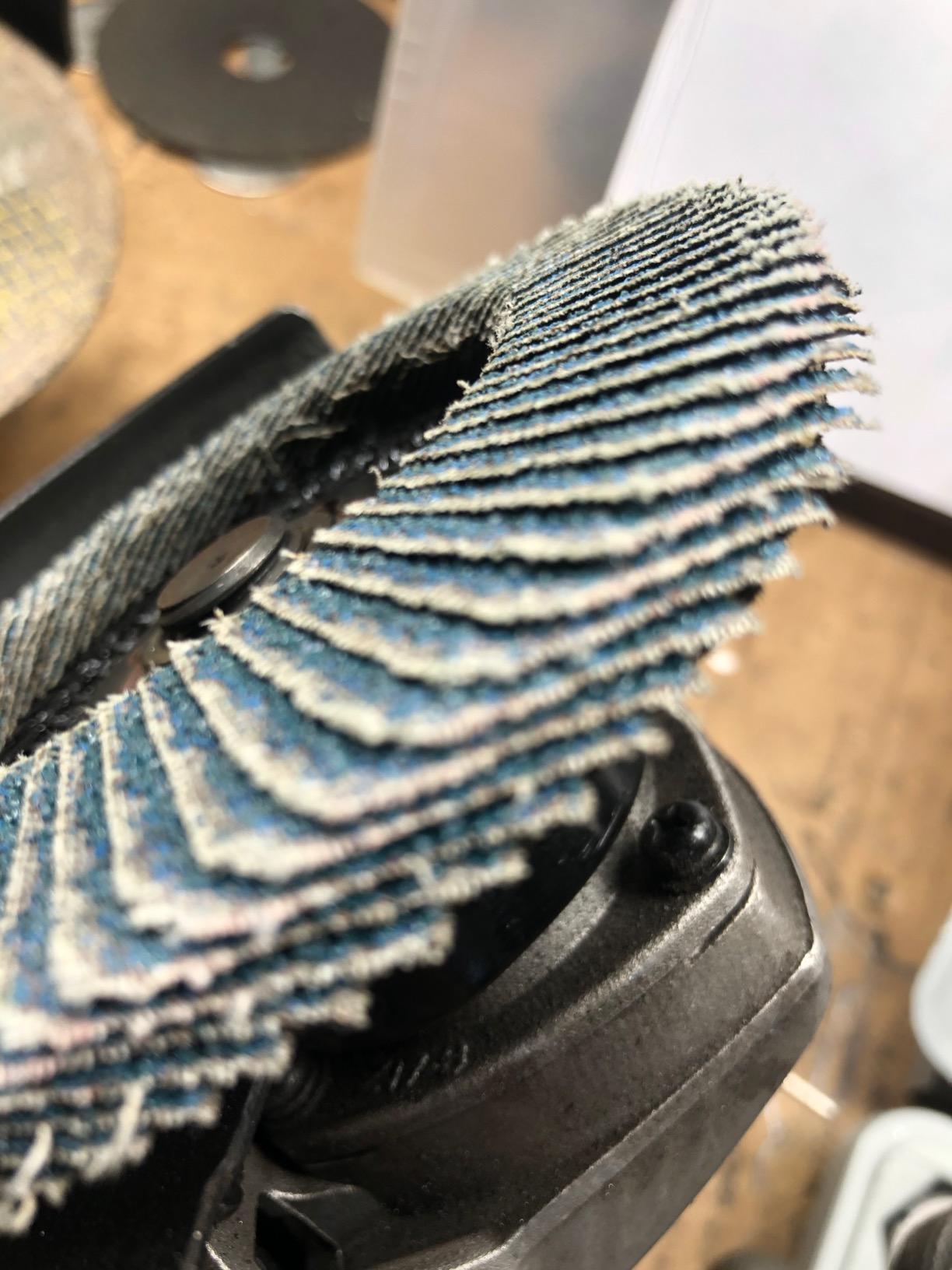
Direct head-to-head reports describe this disc as cutting a little slower than EZARC but wearing out three to four times slower, which turns into better value per hour on a long grinding run. If you are judging a disc purely on how fast it cuts in the first thirty seconds, it will not win that comparison.
It is built to exceed ANSI and EU European abrasive standards, and it fits any 7/8 inch arbor grinder from the major tool brands. The listed dimensions put it at about 0.5 inch thick, which is a physically substantial disc in the hand and a good sanity check on how the abrasive is packed.
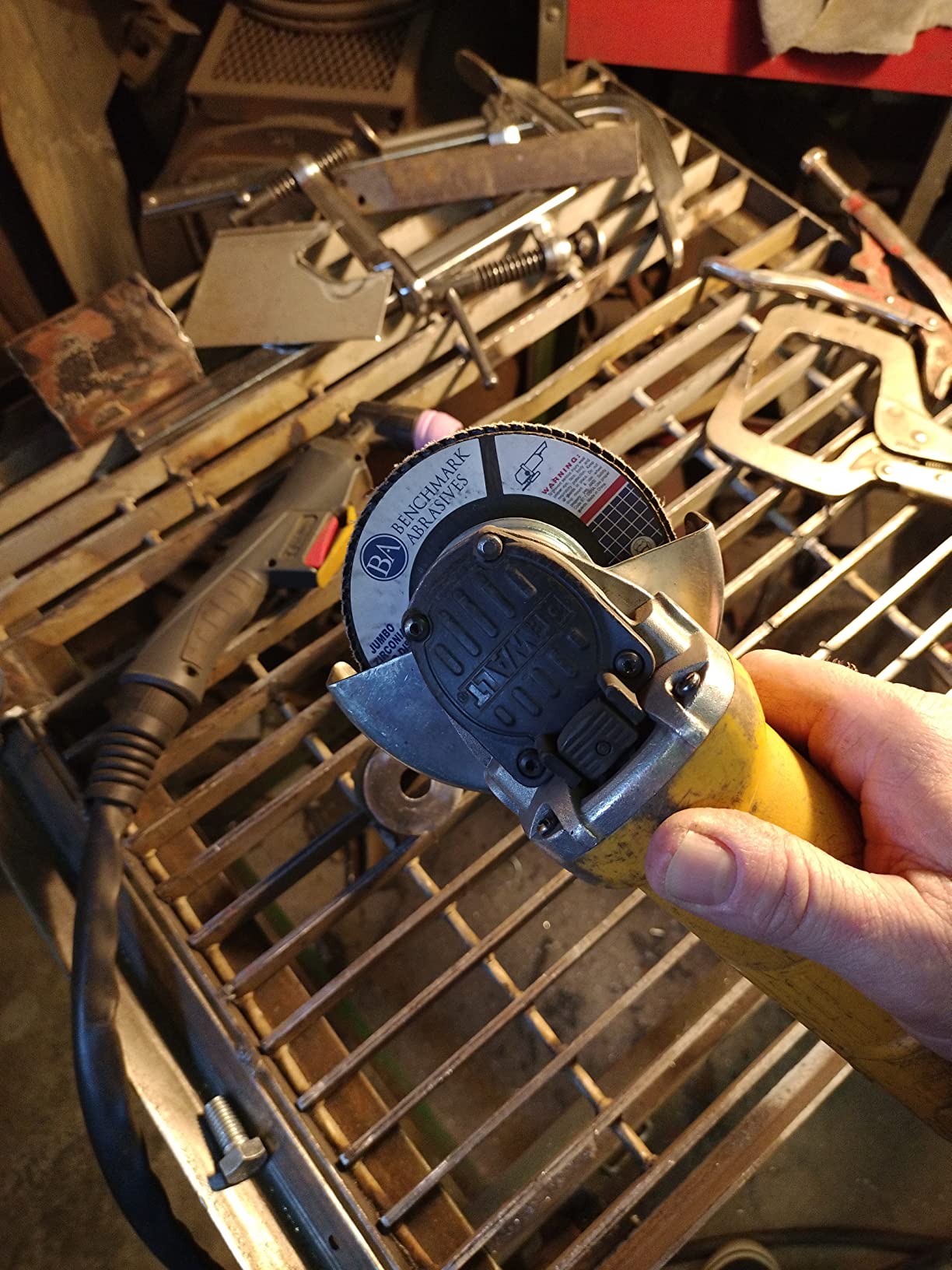
What high-density actually buys you
High-density construction means more abrasive per unit of surface area, so the disc wears down more slowly before the backing is exposed. On a long run that is fewer disc changes, less operator fatigue from repeated grinder restarts, and a more consistent finish across a batch of identical welds.
Who should pass on it
Occasional users and hobbyists grinding a gate hinge will not see the value, because a thin aluminum oxide disc will finish that job before the jumbo has proven anything. Density pays off in volume, not in one-offs.
4. NEIKO 120 Grit Zirconia Type 29 – Finishing Step for Stainless
NEIKO 11145A 10 Pack Zirconia Flap Discs 4-1/2 for Angle Grinder, 120 Grit Flapper Wheel, Angled T29 Grinding Wheel 4.5 Inch Flap Disc, 7/8″ Arbor Grinding Disc, Flap Wheel for Wood & Metal Sanding
4-1/2 inch 7/8 arbor
Type 29 bevel profile
Fine 120 grit zirconia
Fiberglass backing
Pros
- Fine grit removes surface defects without gouging soft metal
- Fiberglass backing keeps the workpiece free of smearing
- Industrial grade grain holds up at high temperature and pressure
- Works across metal fiberglass rubber and wood
Cons
- Too fine for any real material removal
- Flaps fill quickly on wet or dusty wood
The finishing step is where most weld blending goes wrong, because it is the step people rush. This 120 grit zirconia disc is the one I reach for to knock down the last of the 80 grit scratch pattern without cutting into the parent metal.
Owners report it lasting longer than expected and outperforming more expensive name-brand discs on sharpening and surfacing work. The fine grit is what does that: it polishes rather than cuts, so the risk of a divot next to the weld is far lower than at 40 grit.
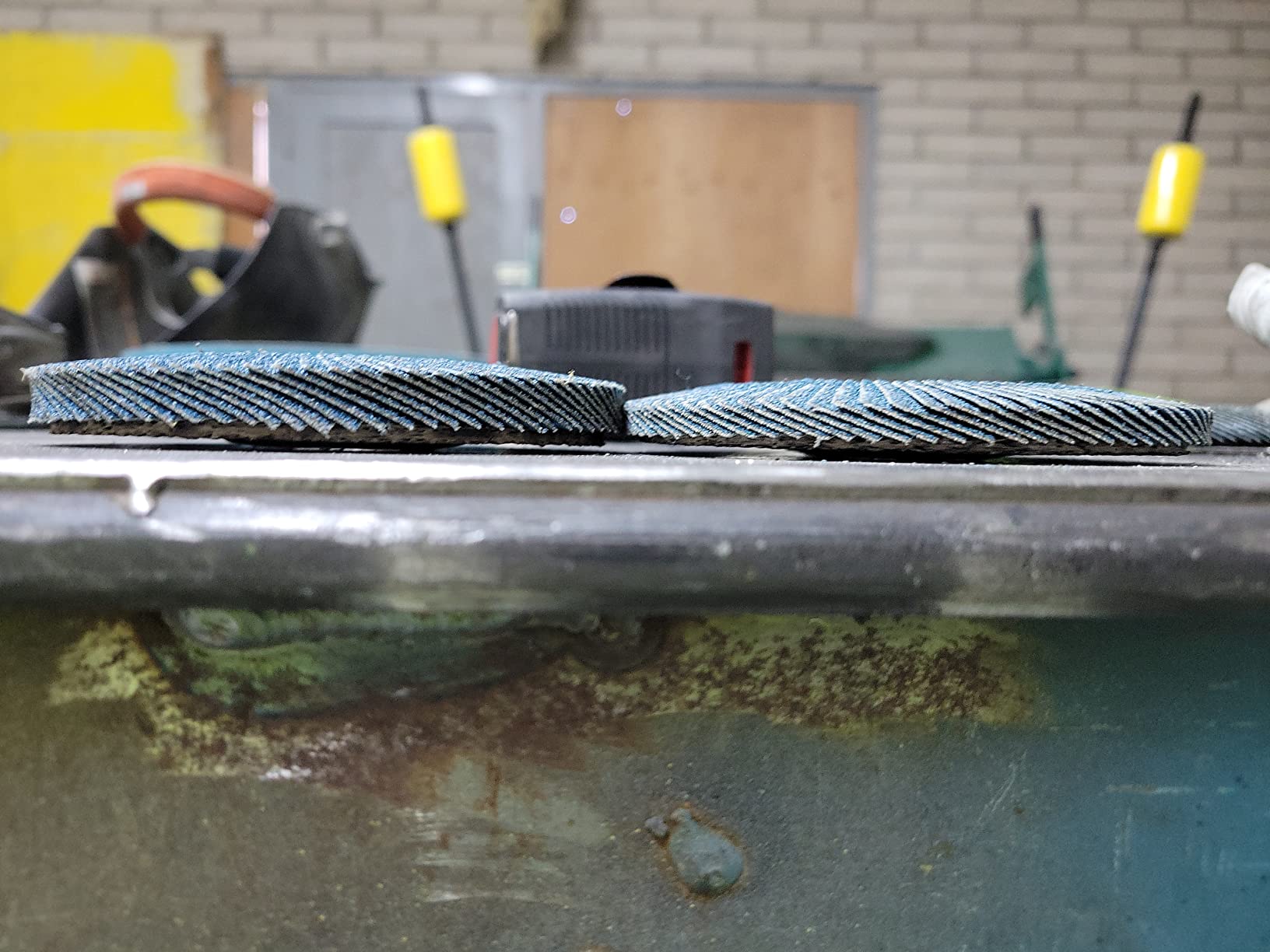
The fiberglass backing plate is credited with absorbing vibration without smearing the workpiece, which matters on stainless and aluminum where a contaminated surface is worse than an imperfect one. Owners of farm and shop setups also note that it holds up on chrome and soft aluminum without gouging.
Be clear about its limits. Reviewers consistently warn this is not a material removal tool, and that the flaps fill fast on wet or dusty wood, which stops the cut before the abrasive is exhausted.
Why the finishing step gets skipped
Once the weld looks flush, the temptation is to stop. But a 60 grit blend leaves a surface that catches light differently than the surrounding mill-finished plate, and that difference shows under paint, powder coat or clear coat. A 120 grit pass closes the gap.
Where a coarse job is a mistake
Never reach for this disc to knock down a proud bead. Fine grit at high pressure generates heat without removing material, which is exactly how you burn and discolor stainless. If the bead is still standing proud, you are on the wrong grit.
5. NEIKO 80 Grit Aluminum Oxide Type 27 – Flat Plate and Sheet Blending
NEIKO 11108A 10 Pack Aluminum Oxide Flap Discs 4-1/2 for Angle Grinder, 80 Grit Flapper Wheel, Flat T27 Grinding Wheel 4.5 Inch Flap Disc, 7/8″ Arbor Grinding Disc, Wood & Metal Sanding
4-1/2 inch 7/8 arbor
Flat Type 27 profile
Medium 80 grit aluminum oxide
Fiberglass backing
Pros
- Produces a flat smooth surface quickly on weld beads
- Flat Type 27 profile for low-angle work on plate
- Fiberglass backing absorbs vibration without smearing
- Strips paint and rust quickly
Cons
- Wear rate is fast so packs deplete quickly on hard metals
- Abrasive can shed under heavy grinding
- Some grinders need a spacer for a secure fit
This is the workhorse blending disc for anyone working flat plate, sheet metal or a straight butt weld. The flat Type 27 geometry at a 5 to 15 degree work angle is what keeps the disc flat against the surface and produces a level result instead of a weld that stays rounded over.
At 80 grit it is the natural middle step of the ladder: fine enough to blend out 60 grit scratches, coarse enough to still be doing real work. For cosmetic welds on sheet and for prep before paint, this is usually where most of the grinding actually happens.
Reviewers credit these with flattening weld cleanup faster than wire wheels and at a fraction of what they spend on premium branded flap discs. One owner notes that because the pad is thin, two inexpensive discs outperform a single thick premium one for the same job.
The complaints are consistent and predictable. Wear rate is fast on tough metals, some users see grit shed under intense grinding, and a few needed a grinder spacer for a tight fit on their particular spindle. With a 4.6 average across more than 1200 ratings, this is a long-established pick in the lineup.
Getting a true flat result
The flat result comes from keeping the disc at a low angle and moving in long strokes rather than spots. A rounded-over weld is almost always a technique problem, not a disc problem, and switching to a 60 grit disc will not fix it.
Honest limitation
On aluminum it will load and smear quickly, because aluminum oxide is the wrong grain for a soft non-ferrous metal. For aluminum weld finishing, use a zirconia or ceramic disc at a higher grit instead of pushing an 80 grit aluminum oxide disc harder.
6. Trivd Frol 40 Piece Zirconia Type 29 – Best Count for a Busy Shop
40 Pack Flap Discs 4 1/2 for Angle Grinder Sanding Disc – Trivd Frol 40/60/80/120 Grit T29 Flap Disc, 7/8 Inch Zirconia Abrasive Grinding Wheel Disc for Metal, Wood, Stainless Steel Finishing
4.5 inch 7/8 arbor
Type 29 profile
Assorted zirconia grits
13300 RPM max
Pros
- 40 discs across four grits suits high volume consumption
- Industrial grade zirconia resists heat and holds edge
- Fiberglass backing keeps vibration down for a smoother cut
- 13300 RPM rating reduces friction heat
Cons
- Pack is weighted toward the coarse 40 grit
- Fewer fine grit discs than the total count suggests
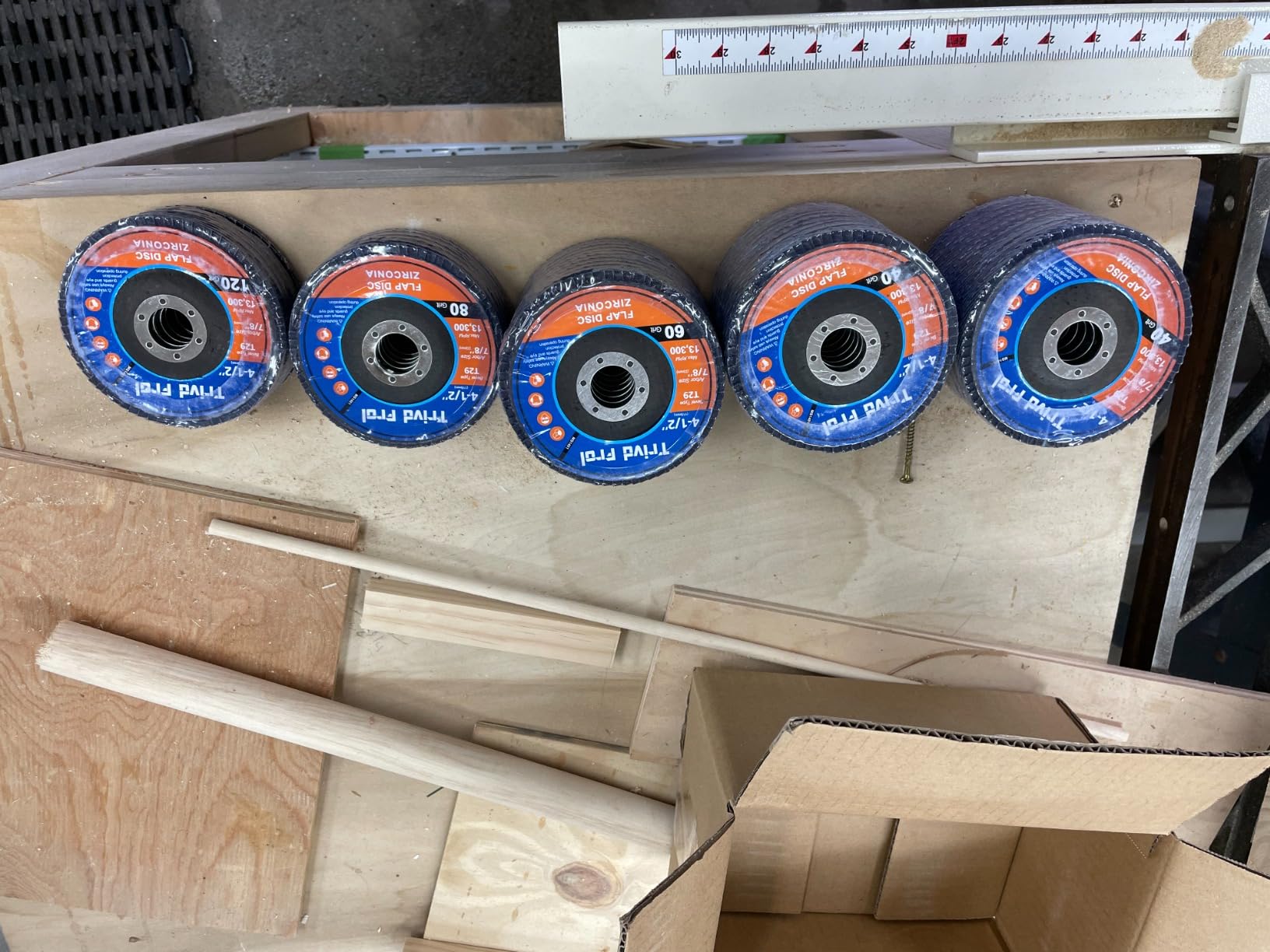
Pack sizing is the entire argument here. Forty discs in one purchase removes the reordering friction that quietly eats a week, and the breakdown is realistic for shop work: 20 pieces at 40 grit, 10 at 60 grit, 5 at 80 grit and 5 at 120 grit.
The zirconia grain across the range is what separates it from a plain aluminum oxide multipack. It holds an edge longer under heat, which on carbon steel weld work means less disc swapping in the middle of a run and a more consistent scratch pattern between passes.
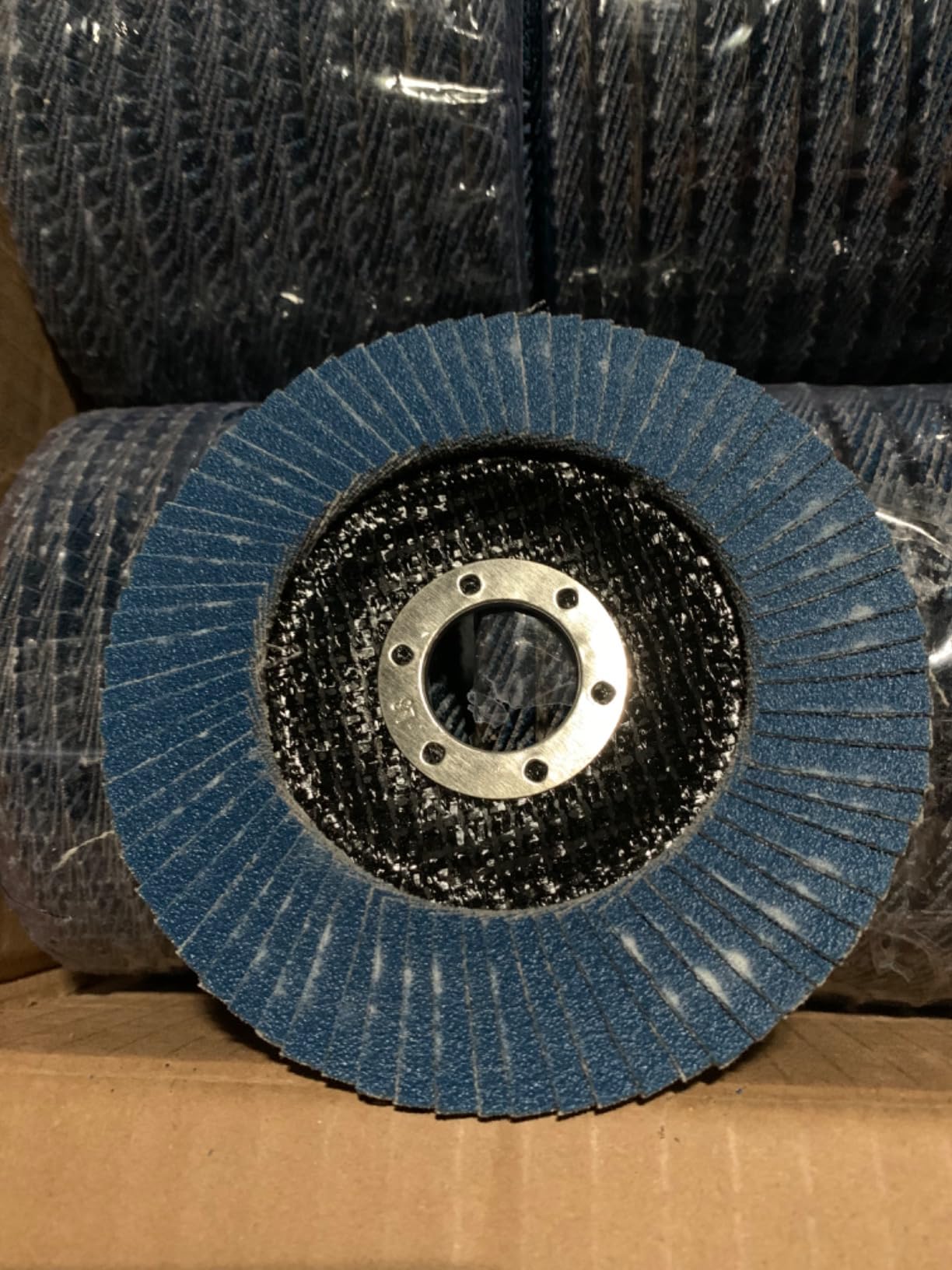
Review sentiment centers on pack size, zirconia durability and low vibration on steel weld work, with no recurring defect reports in the sampled feedback. The 13300 RPM rating is worth noting because it lets the disc run at full grinder speed without the disc itself being the limiting factor.
The fiberglass backing absorbs vibration rather than smearing the workpiece, which is what keeps the blend lines up on alloyed and unalloyed steels. Note that this pack is not recommended for concrete or stone grinding; it is a metal and wood finishing tool.
Reading the pack breakdown before you buy
Forty discs sounds generous until you see the distribution. If your work is mostly weld knockdown, the 20 coarse pieces are exactly right. If you are doing cosmetic finishing, you will be ordering again sooner than the total count suggests.
Best fit for the volume shop
A shop running a fabrication table or a production weld cell will get through this pack quickly and appreciate having all four grits on the shelf. For a weekend hobbyist, a smaller assortment pack is a better match to how fast consumables actually disappear.
7. PRETEC 60 Grit High-Density Type 27 – Zirconia with a Warranty
PRETEC Flap Discs 4 1/2 for Angle Grinder, 12 Pcs Flap Discs 60 Grit, 4.5″ x 7/8″ High Density Zirconia Type 27 Flap Sanding Disc for Grinding, Rust Removal, Sanding and Finishing – 12 Packs
4.5 inch 7/8 arbor
High-density zirconia
Flat Type 27 bevel
12 disc pack
Pros
- High-density zirconia holds up under heat and pressure
- Fiberglass backing stabilizes grinding without smearing
- Bevel Type 27 shape suits weld blending at 5-15 degrees
- Backed by a 1 year warranty
Cons
- Single grit means a separate purchase for finishing steps
- Flat profile will not follow a curved fillet as well as Type 29
Zirconia grain is the part of a disc that costs money, and this is a way to buy it without moving up to an industrial brand. The high-density construction is what separates it from a generic 60 grit disc, and it is why the disc holds up under the heat generated by a proper weld blend rather than glazing halfway through.
The beveled Type 27 shape is built for edge and corner work and for welded seams at a 5 to 15 degree working angle. That is the correct geometry for flat plate and for the flat side of a fillet, which is where a lot of cosmetic weld work actually sits.
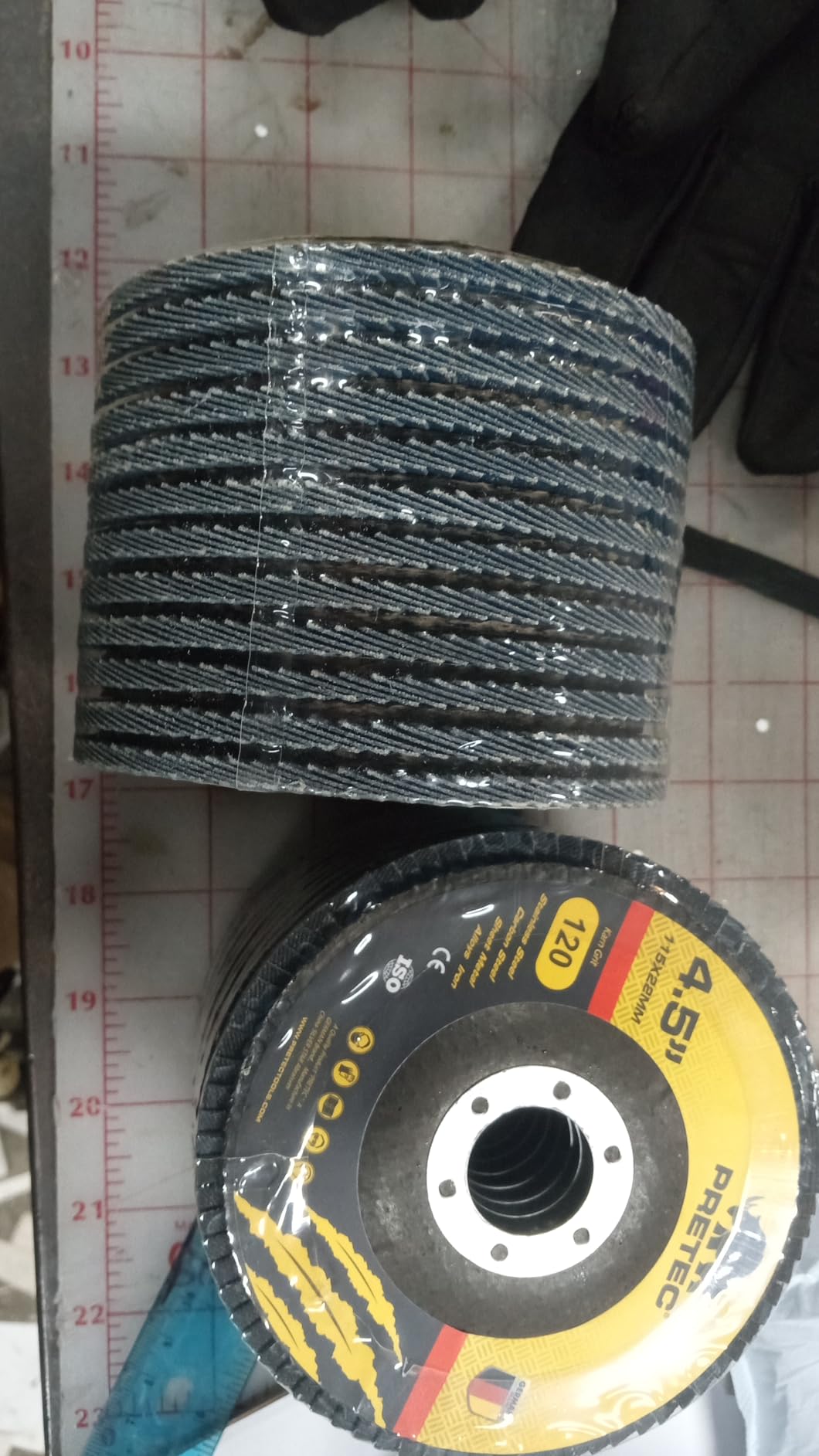
Owners report steady performance on metals and welds, with sentiment consistently positive around zirconia durability and vibration control. A 1 year warranty is a small but genuine differentiator in a category where most listings carry no warranty claim at all.
At 60 grit it sits in the useful middle of the ladder, doing genuine material removal while leaving a finish that 80 or 120 grit can clean up quickly. That makes it a practical second disc to keep on the shelf next to a coarse one.
What high-density changes in practice
Denser abrasive packing resists loading and holds its cut longer, so the disc still works at the end of a weld rather than glazing after the first foot. It also resists undercutting, the problem where the disc digs a trench just outside the weld toe.
Where the single-grit pack bites
Blending a weld properly means at least two grit steps. This pack gives you one, so plan a second purchase at a finer grit, or buy it alongside a finishing disc like the 120 grit option earlier in this list.
8. PFERD Polifan Curve Radial Disc – Built for Fillet Weld Repair
PFERD 67212 Polifan Zirkon Curve Radial Type Flap Disc, Zirconia Alumina, 4-1/2″ Diameter, 5/8-11 Thread, 13300 RPM, 40 Grit
4.5 inch diameter
5/8-11 threaded spindle
Radial flap layout
40 grit zirconia blend
Pros
- 280 degrees of grinding surface for topside side and bottom work
- Zirconia and aluminum oxide blend resists glazing
- Radial layout suits precise fillet weld geometry
- Works as a flap disc and an underhand grinding disc
Cons
- Sold as a single disc so a working quantity means repeat orders
- Needs a 5/8-11 threaded spindle and will not fit 7/8 arbor grinders
Almost every other disc in this list is a circular arrangement of flaps. This one uses a patented radial layout that spreads the abrasive across 280 degrees of surface, which is why it can approach a fillet from the top, the side and underneath without a disc change.
For repair work on a fillet where you need to blend the face and the toes at different angles, that geometry is the whole point. The radial arrangement also lets you work a concave corner that a flat circular disc simply cannot reach into.
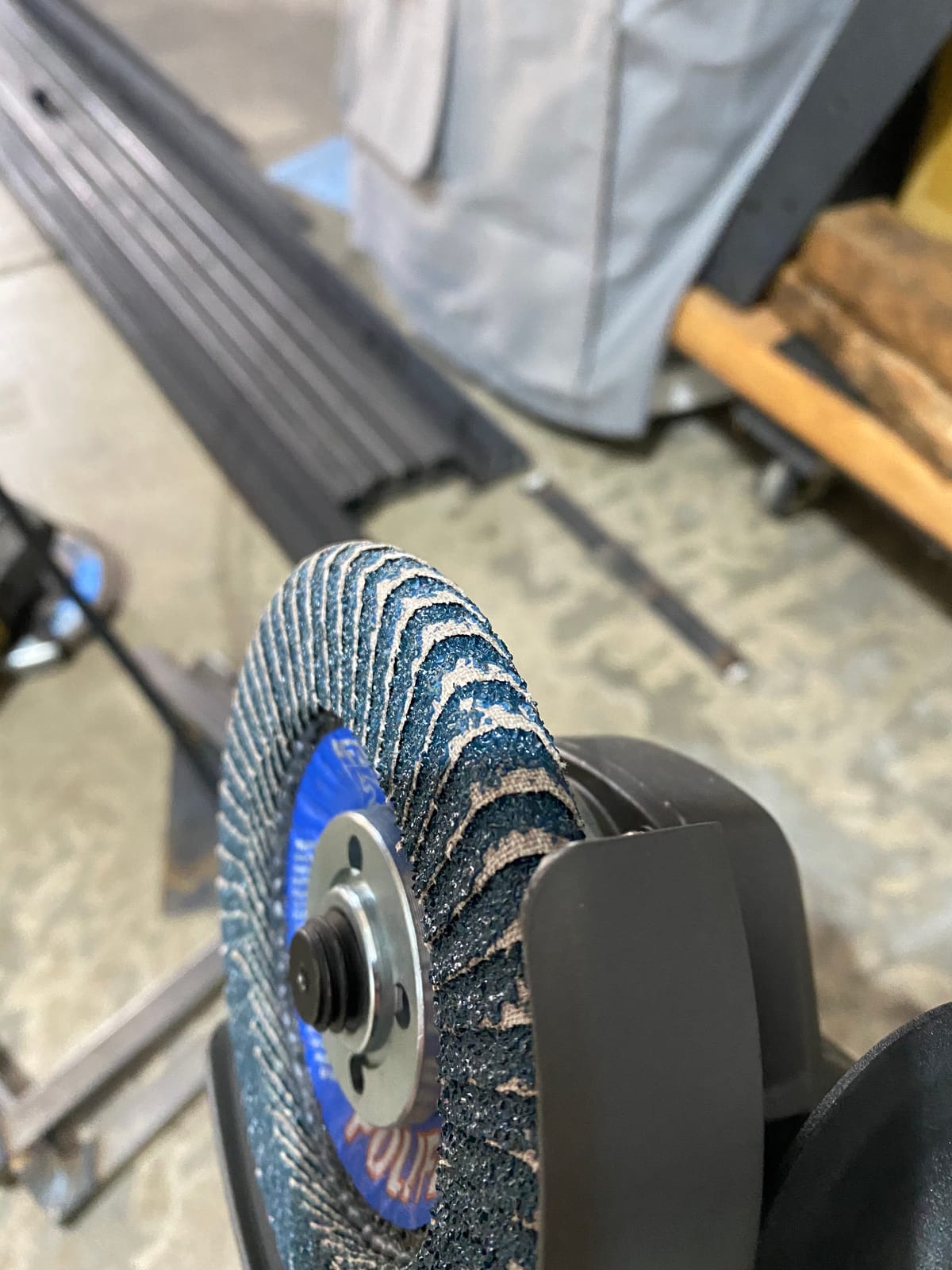
The grain is a zirconia and aluminum oxide blend, chosen for high throughput with a resistance to glazing that keeps the cut alive longer on a stubborn weld. At 40 grit it delivers strong material removal with a consistent surface finish.
Two practical constraints decide this one for you. It is a single disc, so building a working quantity takes several orders, and it requires a threaded 5/8-11 spindle, which will not fit the 7/8 arbor grinders used by most of the other picks here.
When a radial layout earns its place
Watch for the moment you find yourself rotating the disc constantly to chase a different face of the weld. On a T or Y joint, that rotation is what the radial layout is designed to eliminate, cutting the number of disc changes during a single repair.
Check your spindle before ordering
This is the most common reason a disc like this gets returned. The 5/8-11 thread is a real advantage on machines with a threaded spindle because it mounts securely, but on a standard 7/8 arbor grinder it simply will not fit.
9. PRVEW 5 Piece Mixed Grit Type 29 – Small Shop Sampler
PRVEW Flap Discs 4 1/2 Inch 5-Pack,4.5″ x 7/8″ Premium Zirconia Grinding Wheels Abrasive Flap Discs
4-1/2 inch 7/8 arbor
Type 29 bevel profile
Zirconia with mixed grits
5 disc pack
Pros
- Four grits in one small pack for a full blending sequence
- Zirconia grain holds up under heat and pressure
- Bevel Type 29 geometry suits contours edges and weld blending
- Low commitment way to test grit choices
Cons
- Smallest pack in the lineup at five discs
- Only two 40 grit pieces for heavy material removal
Five discs is not a production quantity, but it is exactly enough to learn how grit behaves on your own welds. The pack holds two 40 grit, one 60, one 80 and one 120, which maps neatly onto a knockdown, blend and finish sequence on a single joint.
The grain is zirconia, and the beveled Type 29 geometry suits contours, edges and weld blending. On a small job that only needs a few passes, the performance per disc is more than adequate.
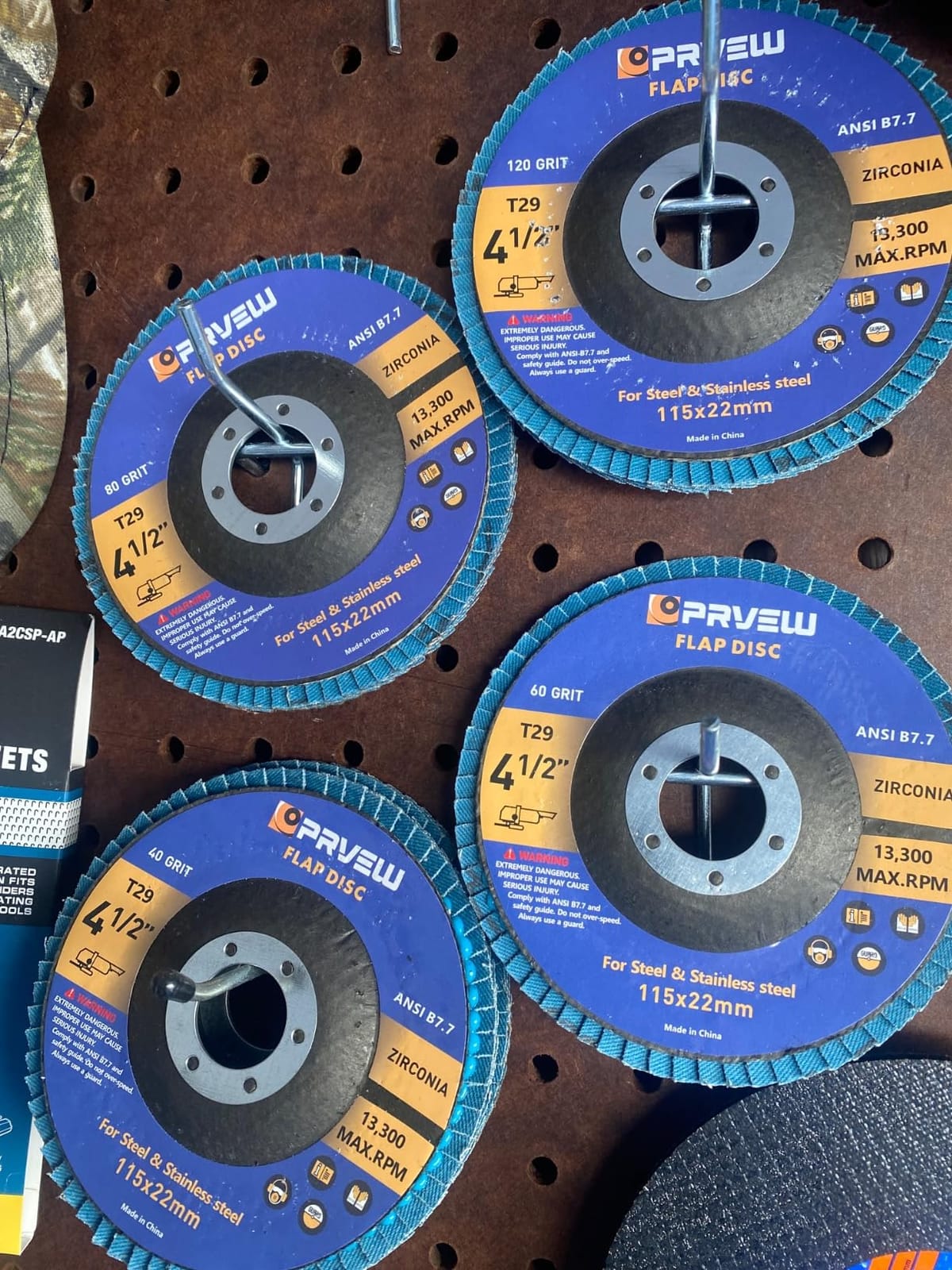
Buyers treat this as an inexpensive sampler or a portable kit, and feedback centers on the convenience of the mixed grits plus adequate zirconia performance for general metal grinding. For a hobbyist or a repair shop that does a handful of welds a month, it removes the guesswork.
The limitation is arithmetic. Two coarse pieces will not survive a heavy knockdown on thick carbon steel, and if the disc is being used daily the pack will be gone in a week with a repeat order needed immediately.
Best used as a learning pack
Grit behaves differently on every weld and every operator. Working one bead at each grit and watching how the finish changes teaches the ladder faster than any amount of reading, and this pack makes that experiment cheap.
When it is the wrong size
Any shop consuming more than a disc or two a day should be buying in tens, not fives. At that consumption rate the small pack stops being economical once reordering time is counted.
10. SALI 60 Grit Ceramic Blend Type 29 – Ceramic Grain in a 20 Pack
Sali 20 Pack Ceramic Flap Disc 60 Grit 4.5″ x 7/8 Inch Sanding Disc Bevel Type #29 Premium and Industrial Grade Angle Grinder Grinding Wheel High Performance Edge Grinding Purple
4.5 inch 7/8 arbor
Type 29 bevel
Ceramic and aluminum oxide blend
13300 RPM max
Pros
- Ceramic and aluminum oxide grain blend for hard materials
- Fiberglass backing absorbs vibration without smearing
- Bevel Type 29 shape suits weld blending and radius grinding
- 20 disc pack in a single 60 grit
Cons
- One of the smallest review bases in the lineup so long term data is thin
- Single grit pack requires a separate purchase for finishing
Ceramic grain has traditionally been the premium tier above zirconia, largely because the grain fractures into sharp fragments and stays sharp. This listing puts a ceramic and aluminum oxide blend in a 20 disc pack, which is an accessible way to test whether ceramic grain is worth it on your own work.
At 60 grit it is an aggressive material removal disc for hard materials, with the beveled Type 29 profile angled for contours, edges and weld blending. Owners report clean weld blending with no recurring defect reports in the sampled feedback.
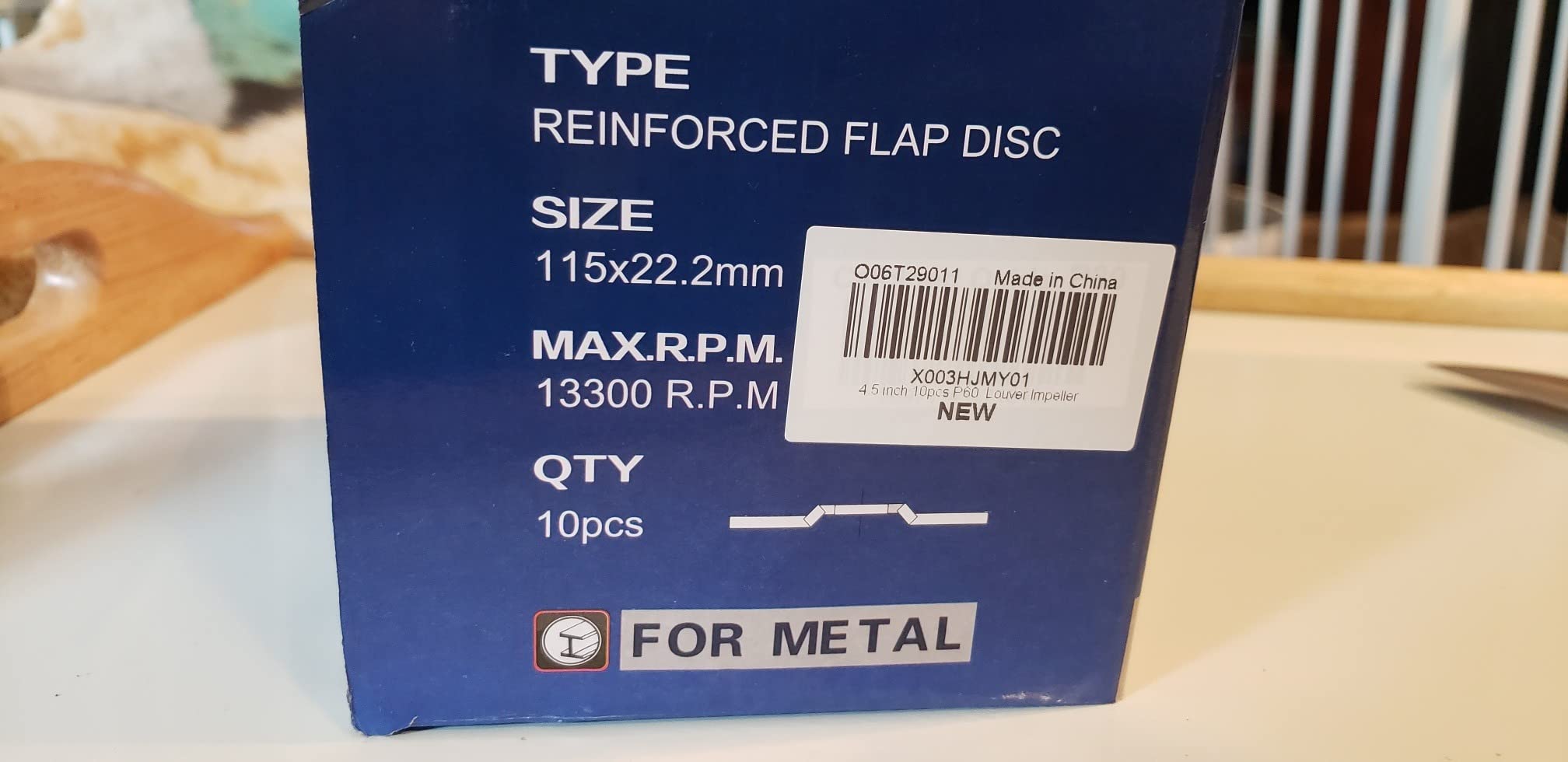
The fiberglass backing plate absorbs vibration without smearing or contaminating the workpiece, which keeps stainless and aluminum surfaces clean. It fits common 4.5 inch grinders from DEWALT, Makita and Bosch up to 13300 RPM.
The honest limitation is the evidence. With 89 ratings this is among the least reviewed products in the lineup, and the feedback is strongly positive but lightly sampled. Buying it means trusting the grain specification over a long-term durability record.
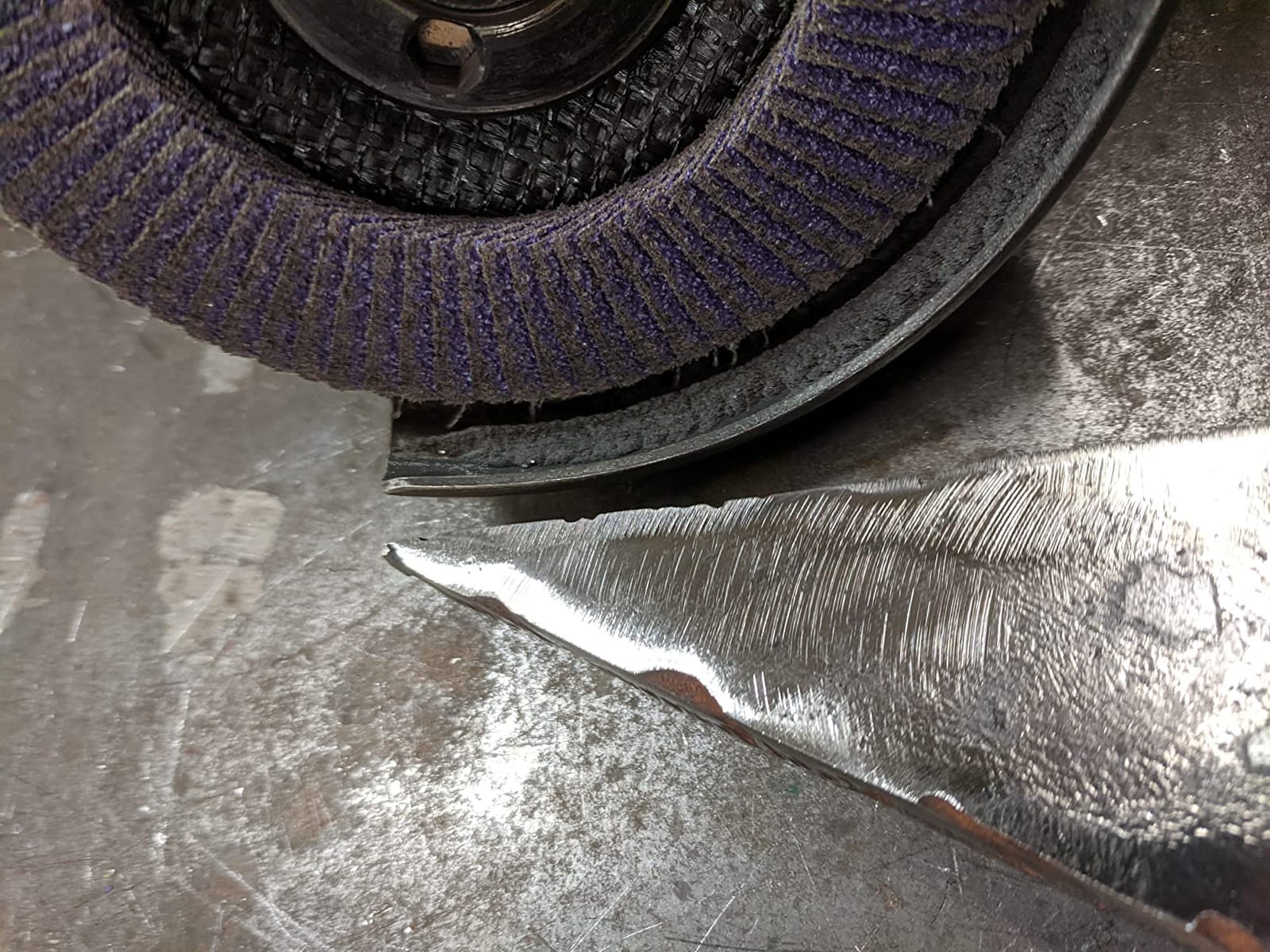
Ceramic grain versus zirconia
Ceramic grain micro-fractures during use, exposing fresh sharp edges continuously, which is why it holds a hard cut longer on stainless and hardened carbon steel. Zirconia is cheaper and does nearly as well on mild steel at typical workshop hardness.
Who should try it first
If you regularly grind stainless or hardened steel and keep replacing zirconia discs because they glaze, this is a reasonable next test. Keep the changeover modest so you can judge whether the blend improves or whether your burn and loading problems were technique all along.
11. DEWALT 7 Inch 36 Grit Type 29 – For Large Structural Grinders
DEWALT DW8327 7-Inch by 5/8-Inch-11 36 Grit Zirconia Angle Grinder Flap Disc
7 inch diameter
5/8-11 arbor
36 grit zirconia
Type 29 fiberglass backing
Pros
- Zirconia grit removes material faster than fiber resin sanding discs
- Premium abrasive cloth rated for long service life
- Type 29 fiberglass backing supports a 20-25 degree grinding angle
- Threaded hub makes fitting quick and secure
Cons
- Will not fit standard 4-1/2 inch grinders
- Single disc purchase means repeat orders for a working quantity
Seven inches is the largest size in this roundup, and that changes what a disc can physically reach. On a large structural fillet, a bigger disc means a longer contact patch and fewer passes across the bead.
At 36 grit this is weld dressing rather than blending. The manufacturer claims zirconia grit delivers up to three times faster material removal than fiber resin metal sanding discs and that the abrasive cloth lasts up to fifteen times longer, which is the gap the disc is designed to close.
The Type 29 fiberglass backing supports a 20 to 25 degree grinding angle, which puts it in the same family as the smaller Type 29 discs but with far more abrasive surface area in play. The threaded hub makes fitting it quick and secure on a compatible spindle.
Where a 7 inch disc earns its keep
Structural steel, shipbuilding and heavy plate work is where the diameter pays. Working a long seam with a 4.5 inch disc means overlapping passes across a narrower contact area; the bigger disc covers more ground per sweep and throws less dust.
The compatibility check that matters
This disc fits a 7 inch grinder with a 5/8-11 arbor and is rated to 8700 RPM. It will not go on a 4.5 inch tool, and the lower speed rating means it is a poor fit for a high-speed small-angle grinder despite the large diameter.
12. Sbestily 2 Inch Curved R-Type Kit – Tight Corners and Die Grinders
Sbestily 13PC Mixed Curved Flap Disc 2 Inch Die Grinder Sanding Discs Kit
2 inch curved R-Type discs
1/4 inch shank mandrel
Zirconia across four grits
13 piece kit
Pros
- Curved profile reaches weld corners and contours a flat disc cannot
- Mixed 40/60/80/120 grits cover removal through smoothing
- Quick change 1/4 inch shank works with die grinders
- One owner cleaned a poor joint back far enough to avoid a reweld
Cons
- Edge paper dulls before the abrasive is exhausted
- Lasts far longer at light pressure than under heavy load
- Not a replacement for a full size disc on flat surfaces
A 2 inch disc sounds like a toy until you have tried to blend the inside corner of a bracket with a 4.5 inch disc and watched the backing plate hit the wall on both sides. The curved R-Type profile on this kit is what makes those tight geometries workable.
It comes with a 1/4 inch shank mandrel, so it mounts on a die grinder rather than a full-size angle grinder. That is a genuine advantage inside a jig or a fixture where a large guard physically will not fit.
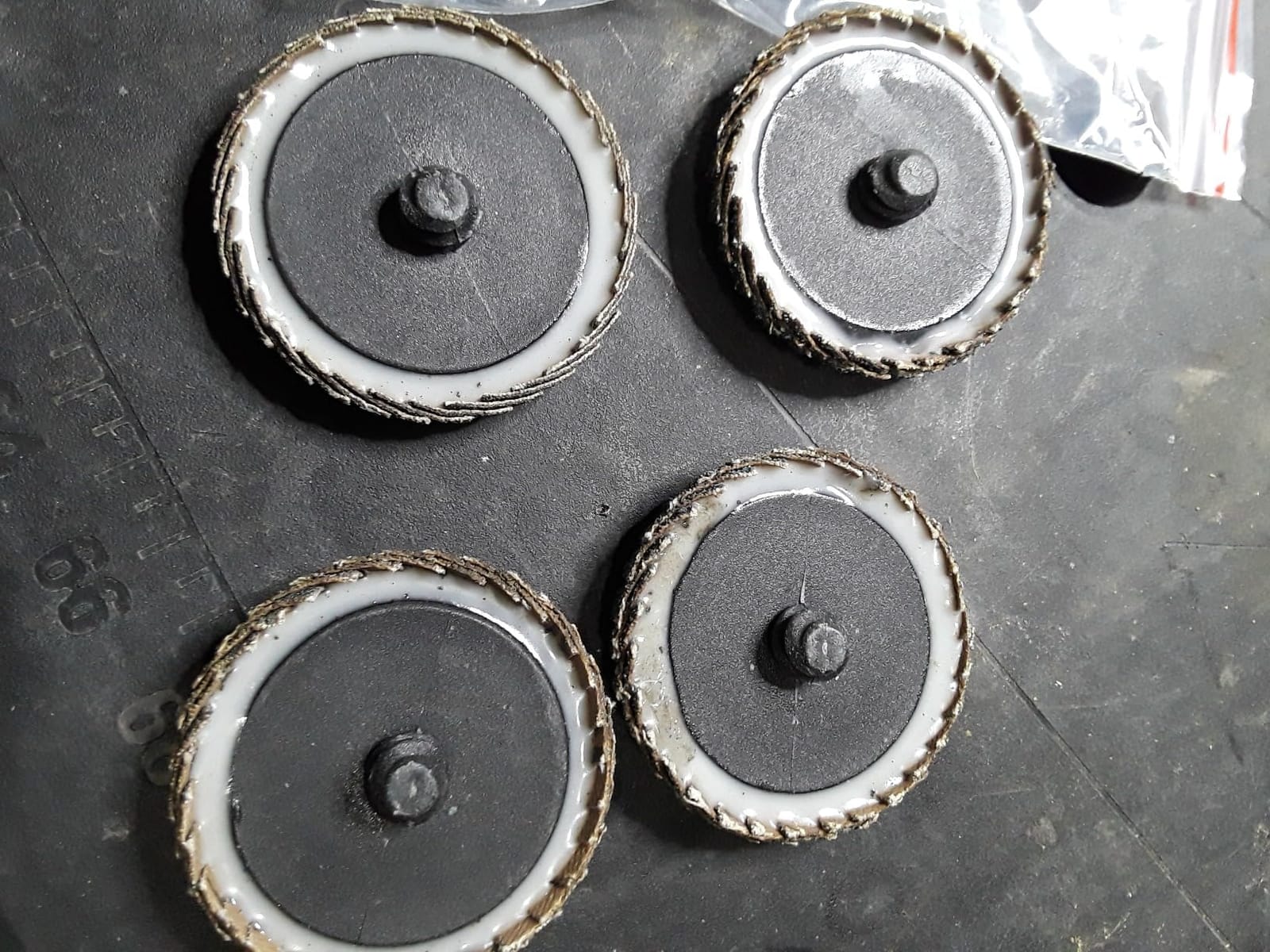
The kit holds twelve curved discs across 40, 60, 80 and 120 grit, which is enough to run the full blending sequence on a small part. Reviewers value the small curved format specifically for weld cleanup in tight spots and contoured welds a 4.5 inch disc cannot reach.
Two criticisms come up repeatedly. The edge paper dulls before the abrasive is used up, and the discs last far longer at light to moderate pressure than under heavy load, which is exactly when you want them most. One reviewer found the edge did not cut into rounded corners as hoped.
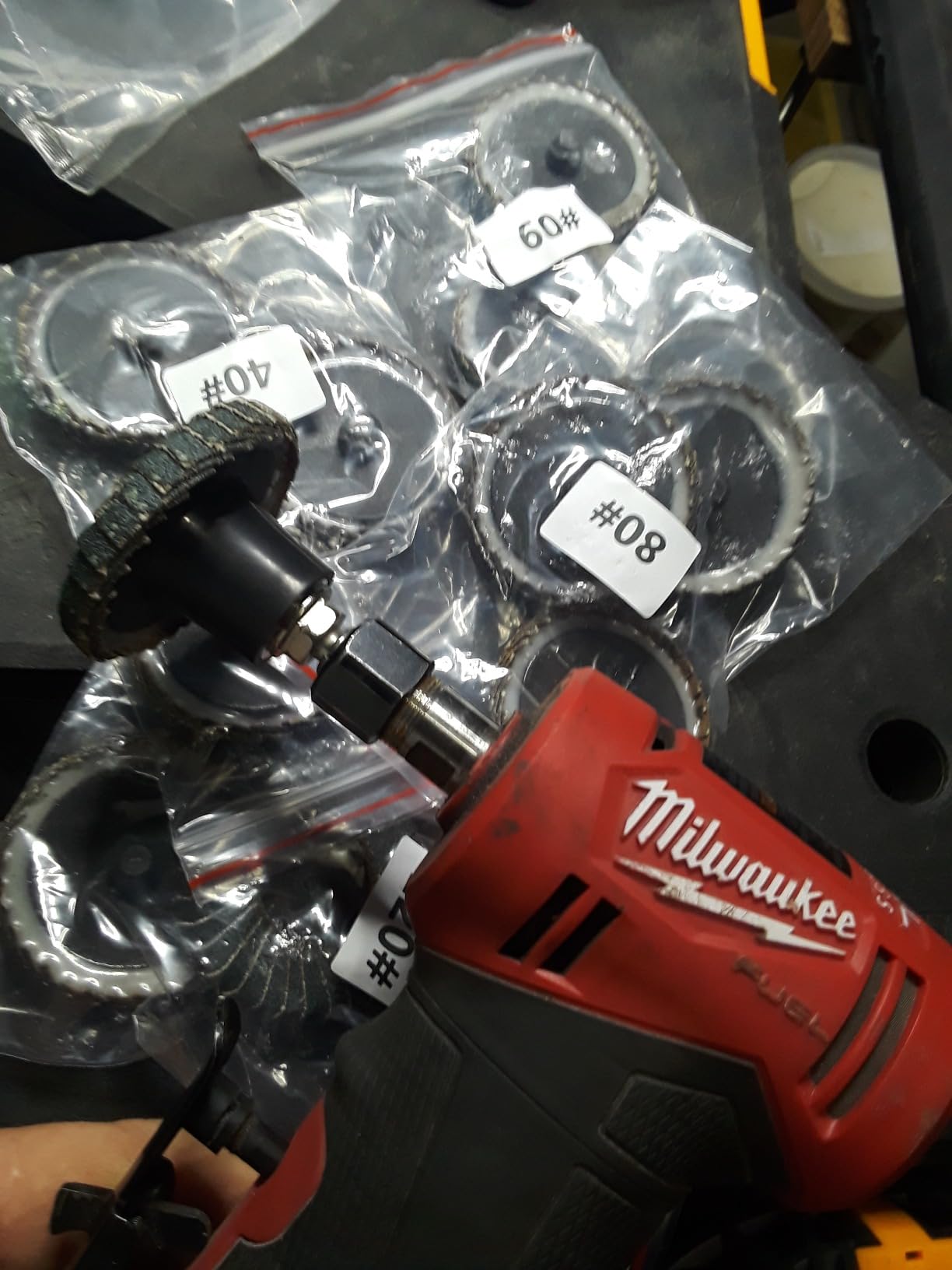
Where a 2 inch curved disc belongs
Inside corners, the toe of a fillet, the root of a joint, and any spot where the grinder guard itself is the limiting factor. On small welds and wood carving the reach advantage is obvious, and the mixed grits let you finish a joint without changing tools.
Where it is not a substitute
Never try to blend a large flat seam with it. The small diameter means constant repositioning, and the light pressure it prefers is not enough for material removal. Reserve it for the corners the big disc cannot get to.
How to Choose a Flap Disc for Weld Blending
Start with the angle you will naturally hold. Blending the top of a plate weld means holding the grinder nearly flat, which favors a Type 27. Blending a fillet or working into a curved tube joint means a steeper 15 to 35 degree working angle, which is what a Type 29 is built for.
Next decide how much material has to come off. If the bead is proud and needs real removal, start at 36 or 40 grit. If it is already close to flush and only needs blending, start at 60 and finish at 80 or 120.
Then check the hardware. Diameter and arbor have to match your grinder exactly: 4.5 inch with a 7/8 arbor covers most shop tools, 4.5 inch with a 5/8-11 thread mounts on spindled grinders, and 7 inch discs need a large grinder. Getting this wrong means the disc simply will not mount.
Grain is the last decision and the most expensive one. If your metal is mild or low-carbon steel, aluminum oxide will do the job and cost the least. Stainless, hardened steel and repeated production work justify zirconia, and ceramic is worth testing where discs keep glazing.
What Grit Flap Disc for Welding? The Grit Ladder Explained
For weld blending, the short answer is: use 40 grit to knock the bead down, 60 grit to blend the transition, 80 grit to smooth it, and 120 grit for the final finish before paint, powder coat or a visible surface.
A 36 or 40 grit disc is a material removal tool. It cuts fast and leaves deep scratches, so it belongs at the start of the job, never at the end.
60 grit is the workhorse of weld blending. It removes material quickly enough to be productive and leaves a pattern that one finer pass will erase, which is why most shops spend the most disc time at this step.
80 grit smooths the 60 grit pattern and pre-finishes the surface. It is the right choice for general fabrication work where the weld will be primed and painted rather than kept visible.
120 grit is the finishing step for visible welds, stainless handrails and anything that will be polished, clear-coated or left bare. Going finer than 120 buys very little on a welded joint and shortens disc life without improving the result.
Type 27 vs Type 29: Which Profile for Weld Blending?
A Type 27 disc has a flat face and is used at a 5 to 15 degree working angle, close to the surface of the workpiece. A Type 29 disc has a conical face and is used at roughly 15 to 35 degrees, so more of the abrasive sits against the metal when you tilt the grinder over.
This matters because of how the flaps wear. A flat disc tilted past 15 degrees loses contact with the work, so the remaining flaps do all the cutting and the disc wears unevenly. A conical disc keeps more of its surface engaged across a wider range of angles.
Rule of thumb: Type 27 for flat plate, sheet metal and the face of a butt weld. Type 29 for fillet welds, curved surfaces, tube joints, edge work and anywhere your hand naturally tilts the grinder down.
Mixing them up is not dangerous, it is just wasteful. Running a Type 27 on a steep angle gives a slower cut and shorter life than the same grain in a Type 29 would deliver.
Aluminum Oxide vs Zirconia vs Ceramic: Which Grain Is Worth It?
Aluminum oxide is the general-purpose grain, often called alumina. It is the cheapest, it works well on mild steel and cast iron, and it is the right default when a disc is doing occasional cleanup work.
Zirconia alumina is a harder grain that self-sharpens as it wears, producing a faster cut and roughly longer life than aluminum oxide on steel, stainless and aluminum. For most shop use it is the sensible middle tier.
Ceramic alumina micro-fractures during use to expose fresh sharp edges, which is why it holds a hard cut on stainless and hardened steel far longer. It costs the most and the case for it is heat resistance and cut consistency rather than raw removal rate.
Cost per weld is where the tiers get interesting. A cheap aluminum oxide disc that glazes mid-weld and burns the parent metal costs more once you count the rework than a ceramic disc that finished the job on the first pass.
Diameter, Backing, and Grinder Matching
The three common sizes are 4.5 inch with a 7/8 arbor, which fits the majority of angle grinders, and 5 inch with a 7/8 arbor for a little more reach. Larger 7 inch discs need a 5/8-11 threaded spindle and carry a lower speed rating.
Backing material changes how a disc behaves under load. Fiberglass backing adds flexibility and absorbs vibration, which keeps the cut stable and reduces smearing on soft metals. Phenolic is harder and better for heavy material removal. Trimmable backing plates let you rotate a partly worn disc to expose fresh flap before discarding it.
Almost all of the discs in this roundup carry a 13300 RPM rating, which matches a standard 4.5 inch grinder at full speed. The 7 inch DEWALT disc is rated to 8700 RPM instead, so the tool has to match the disc, not the other way around.
Flap Disc vs Fiber Disc vs Grinding Wheel
Use a grinding wheel for torch slag, hardened spatter and very rough scale. Flap discs are not built for that, and grinding slag with one tears the cloth and kills the disc quickly. Forums consistently report this as a common and avoidable mistake.
Use a fiber disc for heavy material removal on tough welds. WeldingWeb members specifically recommend 3M Cubitron and Norton Quantum and Blaze fiber discs as faster than hard grinding wheels when knocking down a bad weld.
Use a flap disc for everything from finish blending to moderate stock removal on welds. That is the job it was designed for, and it is the only one of the three that grinds and blends in a single step.
Use a wire wheel for cleaning slag and brushing, but never near a finish weld, because the wheel cuts into soft metal and leaves the surface worse than it started.
How to Use a Flap Disc Without Burning the Weld or Parent Metal
Use light pressure. Let the disc do the work and keep it moving, because leaning on a flap disc is what causes glazing, undercutting and heat discoloration faster than any other mistake.
Keep the work angle shallow on stainless, around 10 to 15 degrees, and rotate the disc regularly so worn sections move away from the joint. On a long fillet, working one spot until it finishes is the fastest way to burn a mark into clean metal.
Take cooling breaks on stainless and aluminum. Both materials load and smear quickly, and a loaded disc both stops cutting and generates more heat, which makes the loading worse.
Do not change grits by guessing. A 40 grit scratch pattern needs a 60 to move, a 60 grit pattern needs an 80, and an 80 grit pattern needs a 120. Skipping a step means going back with a coarser disc and redoing the work.
Once the surface is smooth and the weld is flush, the next step is usually a blending brush rather than another abrasive disc. Our guide to the best filbert brushes for blending techniques covers the soft brush work that comes after the metal is shaped.
Flap Disc Safety: Guards, RPM, and Inspection
Keep the grinder guard in place and positioned so it covers the operator side of the wheel. A guard is the only thing between a burst disc and your face, and it should never be removed for access.
Never exceed the rated speed. The disc speed rating and the grinder speed have to agree, and the rule is not flexible: a disc that over-speeds can fail catastrophically rather than simply wearing out.
Inspect before mounting. Look for cracks in the backing plate, torn or missing flaps, and any sign that the disc has been dropped. A disc that has been through an impact should be discarded even if it looks intact.
Wear eye and face protection. Grinding sparks, abrasive fragments and failed discs are all common, and safety glasses alone are not enough for this work.
Frequently Asked Questions
What grit flap disc for welds?
Use 40 grit to knock the bead down, 60 grit to blend the transition, 80 grit to smooth it, and 120 grit for the final finish. Starting coarser is worth it when material has to come off; starting finer than you need just wastes disc life.
Which brand of flap discs is considered the best?
Brand matters less than profile, grain and grit. The discs in this roundup cover aluminum oxide, zirconia and ceramic grains on Type 27 and Type 29 profiles. Match the grain to the metal and the profile to your working angle before you match the label.
What is the difference between a 40 grit and a 60 grit flap disc?
40 grit is a stock removal step that cuts fast and leaves deep scratches. 60 grit blends the transition after the bead is down and leaves a pattern one finer pass can erase. Going from 40 straight to 120 skips a step and shows.
What works best for grinding aluminum?
A finer grit zirconia or ceramic disc with light pressure. Aluminum oxide loads and smears on aluminum, and pushing a loaded disc harder generates more heat. On the MIG Welding forum, fabricators reach for 4.5 inch discs at low angles for aluminum weld finishing.
What is the best disc to use for grinding down welds?
A 36 or 40 grit zirconia Type 29 disc for the knockdown, then step to 60 and 80 grit for blending. Forum regulars follow that 40 to 60 to 80 to 120 discipline as their standard routine for fillet welds.
What is the difference between zirconia and ceramic flap discs?
Zirconia is a self-sharpening grain that is cheaper and performs close to ceramic on mild steel. Ceramic alumina micro-fractures to expose fresh sharp edges, holds a harder cut on stainless and hardened steel, and costs more per disc.
Bottom Line
The best flap discs for weld blending are the ones that match your working angle, your metal and your grit sequence. The LotFancy mixed grit Type 27 multipack is the safest single purchase for most people, because it covers the whole ladder in one box and works on flat plate at a low angle.
When you know your work is fillet grinding, step up to a zirconia Type 29 disc such as the EZARC at 40 grit for knockdown or the Benchmark high-density jumbo when you are running long jobs and want fewer disc changes. Add the NEIKO 120 grit for the finish, and you have a complete setup for 2026.
Whichever disc you choose, the finish comes from light pressure, a shallow work angle and stepping grits properly rather than pressing harder on a glaze. Every pick in this guide has a current price link so you can check today’s figure before you order.