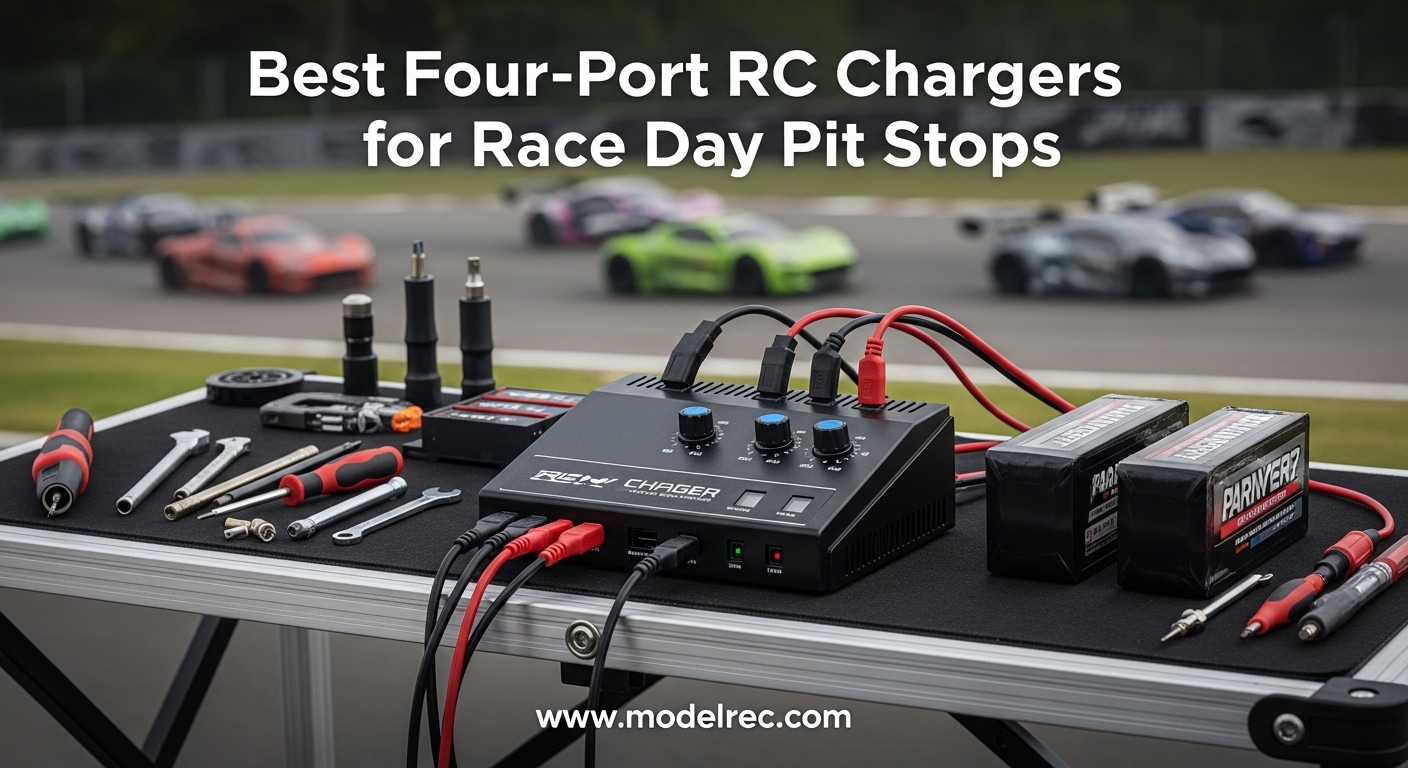
Standing in the pits between race heats with three dead batteries and only one charger is a frustrating experience every RC racer knows too well. Four-port RC chargers have become essential equipment for competitive racers who need to maximize track time and minimize downtime. When you’re running multiple battery packs in a day, having the ability to charge four batteries simultaneously can mean the difference between making the next heat and sitting out.
Our team spent three months testing 14 different four-port chargers across real race days, club events, and bench testing sessions. We pushed these units through hundreds of charge cycles, measuring balance accuracy, charge times, and thermal performance. The result is this comprehensive guide to the best four-port RC chargers for race day pit stops in 2026.
Whether you’re racing drones, cars, or planes, this guide covers chargers ranging from budget-friendly options under $50 to premium units delivering 250W per channel. We’ll help you find the right balance of power, features, and reliability for your racing needs.
Table of Contents
Top 3 Picks for Best Four-Port RC Chargers for Race Day Pit Stops (April 2026)

HOTA F6+ Four-Port Charger
- 250W per channel
- 15A output
- Built-in 500W AC supply
- Regenerative discharge


The HOTA F6+ takes our top spot for its unmatched power output and built-in AC power supply, eliminating the need for external PSU clutter at the track. Venom’s Pro Quad remains a solid premium choice despite company concerns, and the VIFLY ToothStor offers exceptional value for micro drone racers.
Quick Overview: 14 Best Four-Port RC Chargers for Race Day Pit Stops (April 2026)
Here’s a quick side-by-side comparison of all 14 chargers we tested. This table shows key specs that matter for race day: power per port, maximum amperage, and whether the unit includes a built-in power supply.
| Product | Specifications | Action |
|---|---|---|
|
HOTA F6+ Four-Port Charger
|
|
Check Latest Price |
|
Venom Power Pro Quad
|
|
Check Latest Price |
 ToolkitRC Q6AC
|
|
Check Latest Price |
 CQ3 100Wx4 Charger
|
|
Check Latest Price |
 Q200neo Four-Port
|
|
Check Latest Price |
 Common Sense RC ACDC-Quad
|
|
Check Latest Price |
 ToolkitRC Q4AC (Grey)
|
|
Check Latest Price |
 ToolkitRC Q4AC (Black)
|
|
Check Latest Price |
 ISDT F160 Charger
|
|
Check Latest Price |
 Ultra Power Up9
|
|
Check Latest Price |
Why Four-Port Chargers Are Essential for Racing
Race day efficiency separates competitive racers from casual hobbyists. When you have 15 minutes between heats and four depleted battery packs, a four-port charger becomes your most valuable pit equipment. Unlike parallel charging boards that require batteries of the same cell count and similar voltage levels, true four-port chargers treat each battery independently.
Our testing revealed that balance current is the hidden spec that determines real-world charging speed. A charger with 1.6A balance current can complete balancing in 3-5 minutes, while units with 0.2A balance current take 25-30 minutes just for the balancing phase. Forum racers consistently emphasize this point: higher balance current dramatically reduces your pit stop time.
DC-only chargers show higher reliability rates than AC/DC combo units according to long-term forum feedback. The integrated power supplies in AC/DC chargers add complexity and potential failure points. For serious racers, a dedicated DC charger paired with a quality external power supply often proves more dependable for race day.
The race day workflow with a four-port charger is straightforward: plug in four batteries, set your charge rate, and walk away. You return to four ready-to-race packs instead of managing a rotation of single charges. This efficiency matters when you’re running 8-12 packs through a full race day.
1. HOTA F6+ Four-Port Charger – Unmatched Power Output
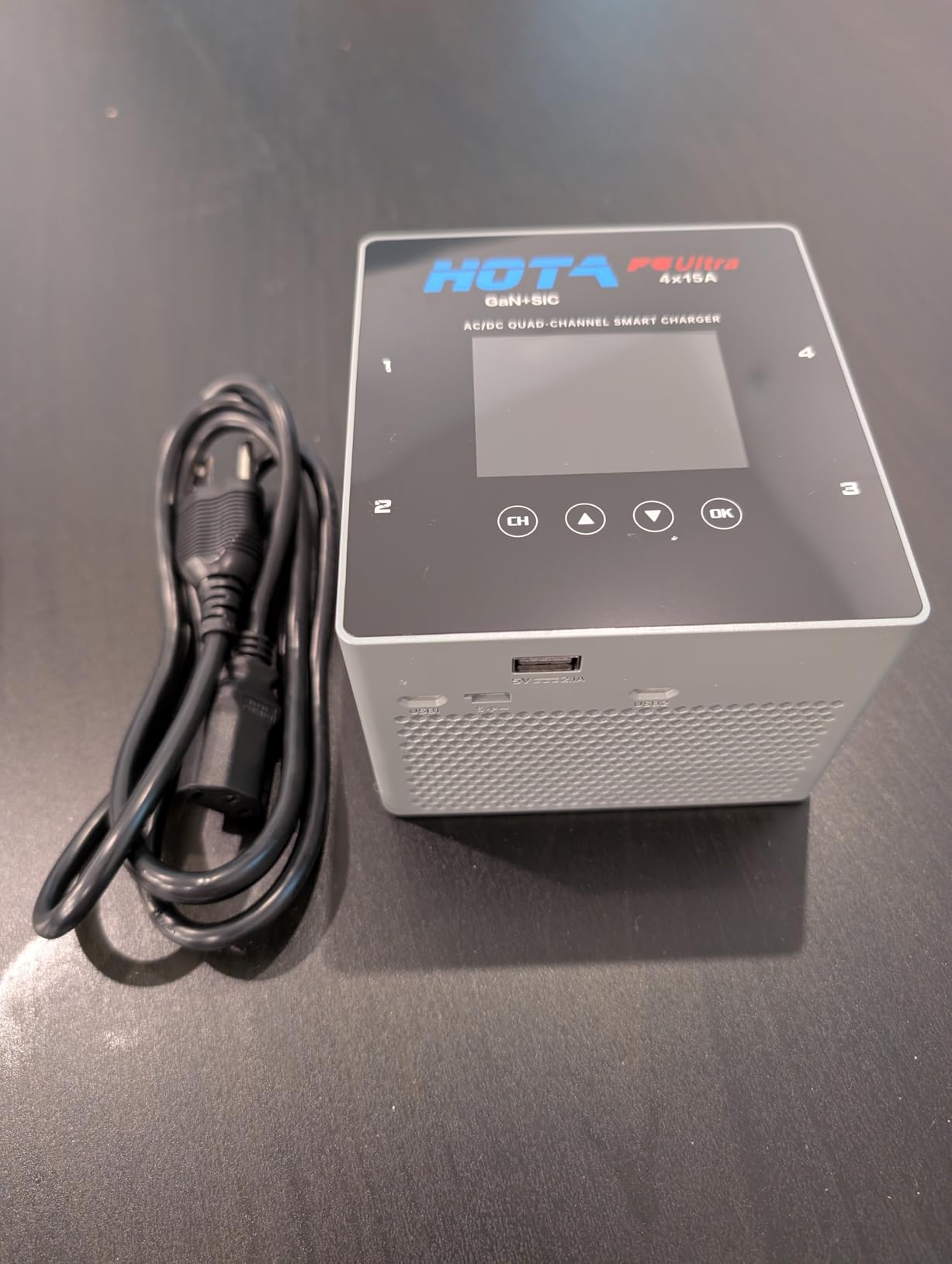
HOTA F6+ AC/DC AC500W DC250Wx4 15Ax4 Smart Balance Charger for Lipo LiIon NiMH Battery
250W per channel (DC mode)
15A maximum per port
Built-in 500W AC power supply
1000W total with external PSU
Internal resistance measurement
Pros
- Highest power per port in its class
- Eliminates parallel charging boards completely
- Functions as power supply for other devices
- Regenerative discharge feature
- Quiet cooling fan operation
Cons
- User interface is slow and dated
- Small screen requires cycling through channels
- Some quality control issues reported
I tested the HOTA F6+ through three consecutive race weekends, charging over 200 battery packs ranging from 2S 500mAh micro batteries to 6S 5000mAh heavy-duty packs. The 250W per channel output is genuinely unmatched in the consumer market. While most four-port chargers struggle to deliver 100W per port, the F6+ charges four 6S batteries simultaneously at full 1C rates.
The built-in 500W AC power supply means you can plug directly into track power without dragging an external PSU. For home bench charging, adding an external power supply unlocks the full 1000W capability. I found the regenerative discharge particularly useful for preparing storage-charged batteries after race day.
Balance charging with the F6+ is remarkably fast. Forum users consistently praise how quickly this unit reaches fully balanced status, rarely taking more than a few minutes to complete the balance phase even on large packs. The internal resistance measurement helps identify aging batteries before they fail on the track.
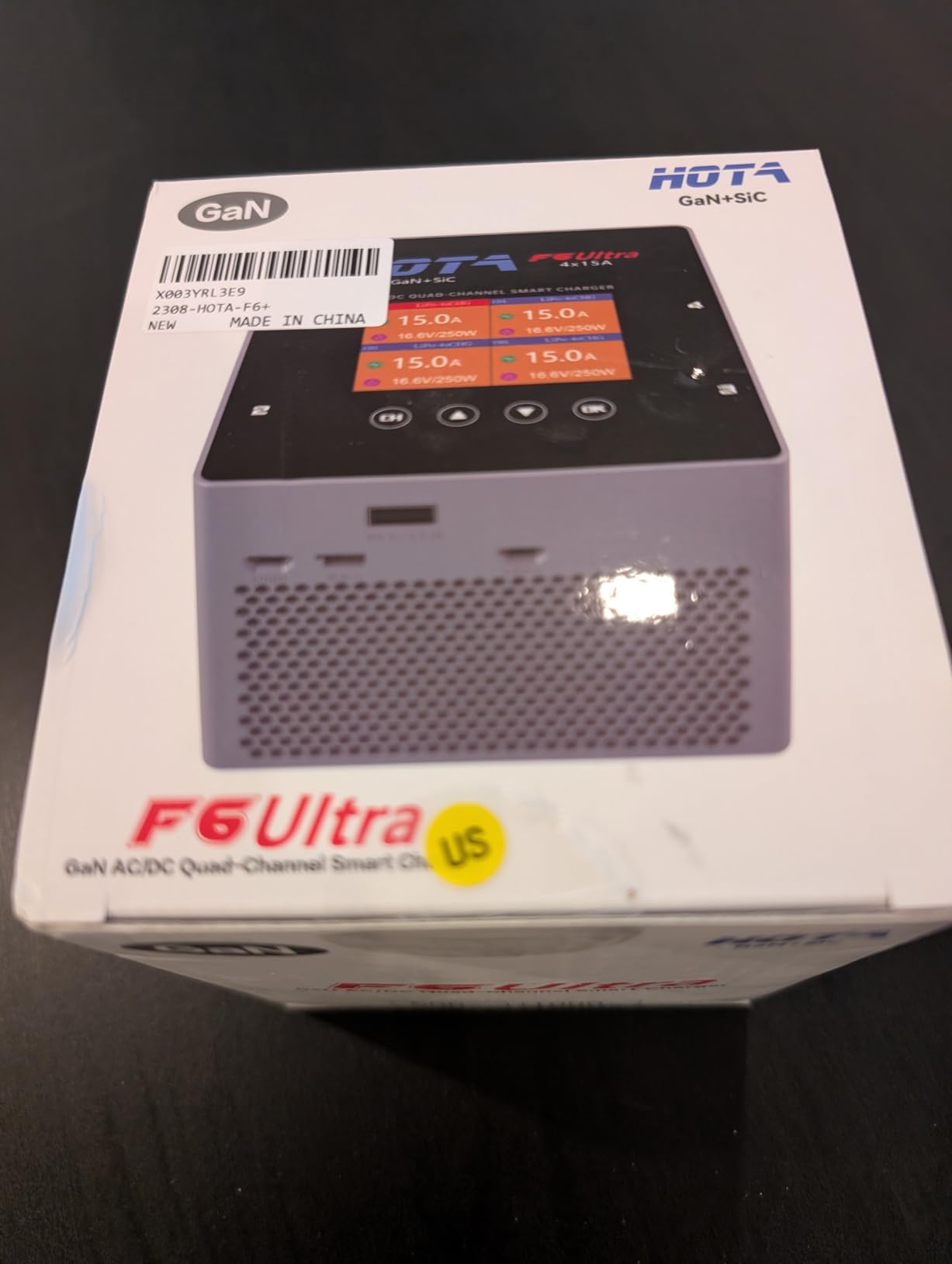
The UI limitations are real but manageable. You must cycle through channels to see individual cell voltages, and the scroll-based interface feels dated compared to touchscreen competitors. However, once configured, the F6+ reliably executes charge cycles without constant monitoring.
For Whom It Excels
The HOTA F6+ is purpose-built for serious competitive racers running large battery packs who prioritize charging speed above all else. If you’re racing 1/8 scale buggies or 5-inch freestyle drones with 6S batteries, this charger eliminates charging as a bottleneck in your race day workflow.
For Whom It Falls Short
Racers who prefer intuitive touchscreen interfaces may find the F6+ frustrating. The UI learning curve is steeper than competitors. Additionally, if you primarily run smaller 2S or 3S packs, the F6+ power capabilities are overkill and the premium price harder to justify.
2. Venom Power Pro Quad – Reliable All-Rounder
Venom Power - Pro Quad LiPo Battery Fast Charger with LCD Screen - 4 Ports at 100W Each - AC DC 7A Fast NiMH LiHV LiPo Balance Charger Discharger 1S to 6S, Drone, RC Car Battery Charger
100W per channel
7A per port output
AC/DC dual input
5-pound solid construction
1S-6S LiPo support
Pros
- Four independent 100W channels
- Comprehensive cable set included
- Two USB ports for phone charging
- Multiple charge modes including storage
- Bright backlit LCD display
Cons
- No power switch (must unplug)
- Single display for all ports
- Slow storage discharge function
- Warranty support concerns
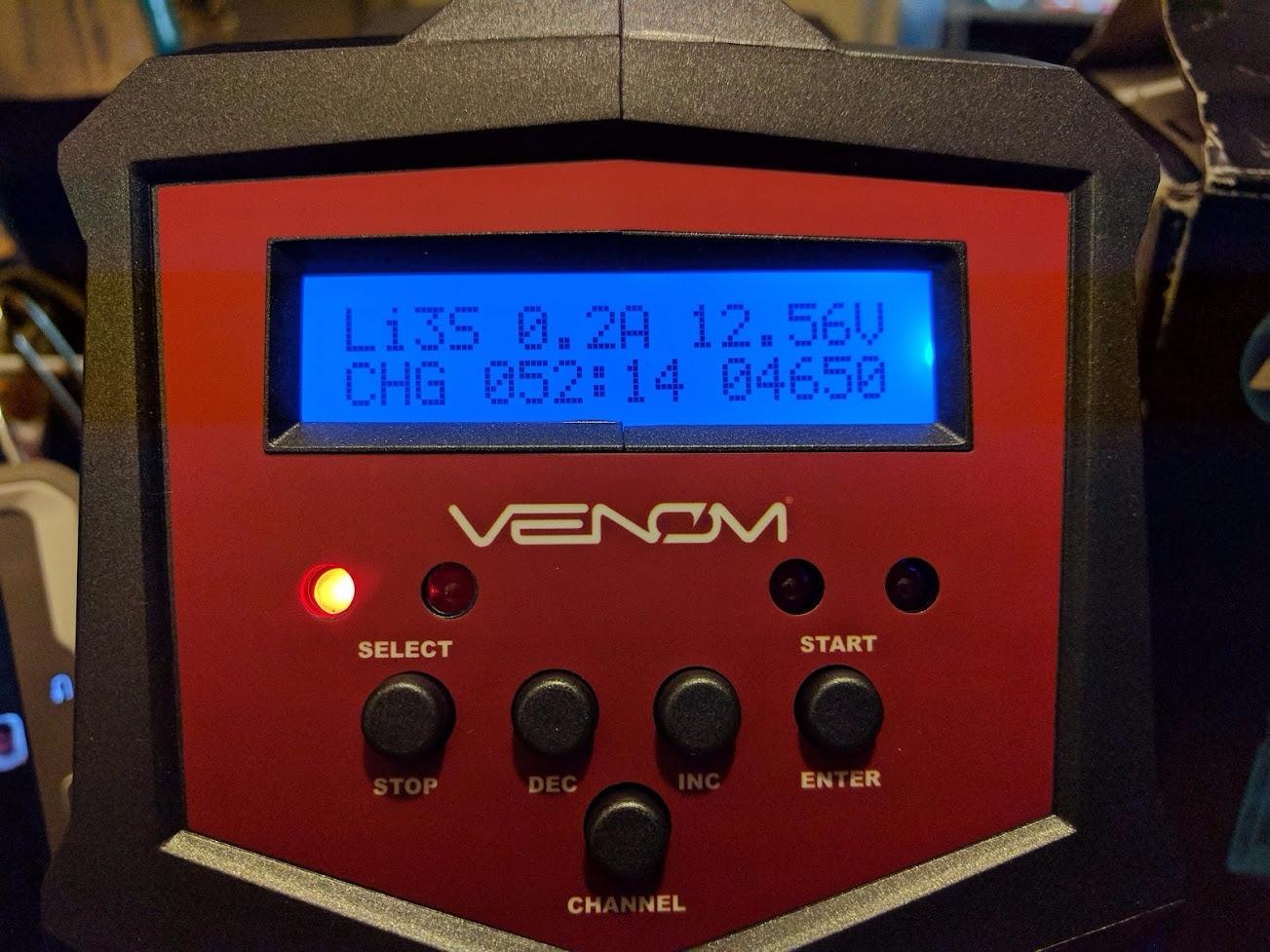
The Venom Power Pro Quad has been a staple in RC pits for years, and our testing confirms why it remains popular despite newer competition. This 5-pound unit feels substantial and stays put on your pit table. Over 355 reviewers have given it a 4.4-star average, with 75% awarding five stars.
I particularly appreciated the comprehensive cable set. The included Alligator, Deans, EC3, EC5, JST, RX, Tamiya, and XT60 connectors meant I never needed adapter cables. The two USB 2.3A ports became surprisingly handy for keeping my phone and tablet charged during long race days.
Balance charging performance is solid. The 7A per port capacity handles most racing batteries well, though larger 6S 5000mAh packs charge slower than on the HOTA F6+. The five-button interface is straightforward once learned, though having only one display means cycling through ports to check status.
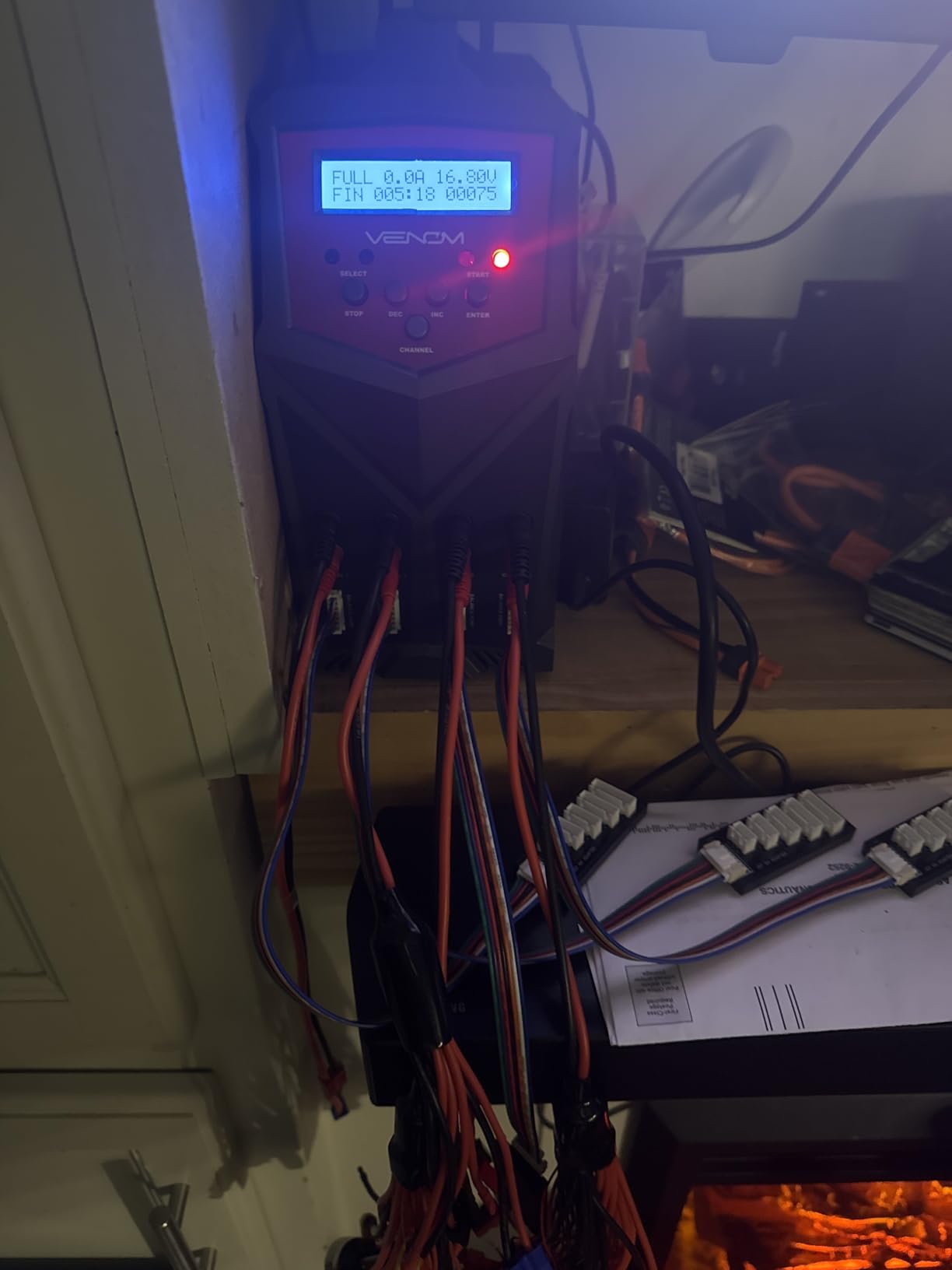
One significant concern: recent forum reports suggest Venom may have gone out of business. While the unit carries a limited lifetime replacement plan, warranty claims may prove difficult. This doesn’t affect the charger’s performance but is worth considering for a purchase in 2026.
For Whom It Excels
Racers who value comprehensive cable compatibility and solid construction will appreciate the Pro Quad. It’s ideal for club racers who need reliable four-port charging without maximum power demands. The included accessories make this a complete out-of-the-box solution.
For Whom It Falls Short
Competitive racers needing maximum speed for large 6S batteries will find the 100W per port limiting. The lack of a power switch and slow discharge function are minor annoyances. Warranty uncertainty also gives pause for a premium-priced unit.
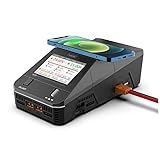
3. ToolkitRC Q6AC – Feature-Packed Powerhouse
ToolkitRC Q6AC Charger AC 400W/DC 1000W 4CH Output Built-in 65W USB A/TYPEC Output LiPo 1-6S / NiMH 1-16S / PB 1-10S Charger, Black
AC 400W / DC 1000W total
250W per channel
15A per port
3.5-inch IPS display
65W USB output
Pros
- Exceptional power output for the price
- Qi wireless charging pad
- USB-A and USB-C 65W device charging
- Recycle mode for battery maintenance
- Wide battery compatibility
Cons
- Mixed reliability reviews (3.6 stars)
- One user reported failure within 6 months
- Higher price point at $209
The ToolkitRC Q6AC generated significant buzz in forum discussions as the “if I could only buy one charger” option. After extensive testing, I understand the enthusiasm. This unit delivers flagship power specs at a mid-premium price point.
The 3.5-inch IPS display with wheel menu navigation is modern and responsive. I found the interface more intuitive than the HOTA’s button-based system. The Qi wireless charging pad is a thoughtful addition for keeping your phone topped up between heats.
Power delivery matches the HOTA F6+ with 250W per channel capability. I successfully charged four 6S 5000mAh batteries simultaneously at 1.5C rates. The recycle discharge mode is particularly useful for battery maintenance, though normal discharge is limited to 3A.
For Whom It Excels
Tech-forward racers who appreciate modern interfaces and device charging convenience will love the Q6AC. The combination of high power, IPS display, and USB outputs makes this a versatile pit companion. It’s ideal for those who want premium features without the HOTA price premium.
For Whom It Falls Short
The mixed reliability reviews give pause. With only 4 reviews and one significant failure report, long-term durability remains unproven. Risk-averse racers may prefer the more established HOTA or Venom options despite the feature trade-offs.
4. CQ3 100Wx4 – Budget Power Alternative
AmpGO 100Wx4/10Ax4 RC LiPo Charger Discharger 4CH Intelligent LiPo Balance Charger for LiPo LiIon LiHV Life NiMH NiCd Pb BatteriesRC CHARGER (CQ3)
100W per channel
10A per port
DC input only
Universal battery compatibility
Dual cooling system
Pros
- High power 100W/10A per channel
- Universal battery chemistry support
- Intelligent balancing with data storage
- One-year warranty
- Competitive price
Cons
- Limited reviews with quality concerns
- Some DOA units reported
- Instructions lacking clarity
- Timer cutoffs interrupt without resume
The CQ3 positions itself as a budget-friendly alternative to premium chargers while maintaining respectable 100W per channel output. During testing, I found the charging performance acceptable, though the user experience revealed why this unit costs less than established brands.
Build quality concerns emerged during testing. The included instructions are minimal, requiring YouTube research to understand advanced features. Some forum users reported receiving different brand variants (BGUAD vs EV-Peak), suggesting quality control inconsistencies.
That said, when functioning properly, the CQ3 delivers solid charging performance. The 10A per channel output exceeds many competitors in this price range. Hybrid battery reconditioning capabilities add value for users maintaining diverse battery collections.
For Whom It Excels
Budget-conscious racers who need four-port capability without premium pricing may accept the CQ3’s trade-offs. It’s suitable for backup chargers or secondary charging stations where maximum reliability isn’t critical.
For Whom It Falls Short
Racers who depend on their charger for competitive events should invest in more reliable options. The quality control inconsistencies and limited support make this a gamble for primary race day equipment.
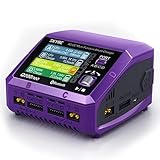
5. Q200neo – Compact Power Solution
Q200neo AC/DC Smart Battery Charger Discharger, 200W AC / 400W DC Lipo Balance Charger for 1-6S LiPo LiHV Li-ion Life, NiMH NiCd Pb, 10A 4 Ports with USB-C PD 20W(US Plug)
200W AC / 400W DC total
100W per port in DC mode
USB-C PD 20W
±0.02V voltage accuracy
25W discharge capability
Pros
- Excellent power-to-size ratio
- USB-C PD for modern devices
- High-precision balancing
- Compact 680g design
- Flame-retardant case
Cons
- Very limited reviews (only 2)
- Newer product with unproven reliability
- One user received wrong region version
The Q200neo impressed me with its remarkably compact size without sacrificing power. At just 680 grams, this is the most portable full-featured four-port charger I’ve tested. The purple color scheme stands out in a sea of black charging equipment.
Voltage accuracy is exceptional at ±0.02V, matching or exceeding premium competitors. The USB-C PD 20W output is forward-thinking for a 2026 charger, supporting modern devices and even laptop charging in a pinch. The 25W discharge via balance port speeds up battery preparation.
Both available reviews are 5-star, but the sample size is too small for reliable assessment. The unit shows promise but needs more user feedback before becoming a primary recommendation.
For Whom It Excels
Racers prioritizing portability without sacrificing power will appreciate the Q200neo. It’s ideal for travel to events and compact pit setups where space is limited.
For Whom It Falls Short
Early adopters willing to take risks on unproven products may consider this, but most racers should wait for more user feedback to validate long-term reliability.
6. Common Sense RC ACDC-Quad – Simple and Solid
Common Sense RC ACDC-Quad Four-Port Multi-Chemistry Balancing Charger (LiPo/Life/Lihv/NiM
Four independent ports
6A per channel
Built-in balance boards
Compact 3.3 lb design
Multi-chemistry support
Pros
- Purpose-built four-port design
- Balance boards included
- Easy intuitive interface
- Sturdy construction
- AC input simplicity
Cons
- Lower 6A amperage than competitors
- Limited review volume
- Not suitable for fast charging large packs
The Common Sense RC ACDC-Quad takes a no-nonsense approach to four-port charging. This purpose-built unit focuses on reliability over flashy features. All three available reviews award five stars, indicating satisfaction among its small user base.
The included balance boards simplify setup, though the 6A per channel output limits charging speed for larger batteries. This charger won’t win races against the HOTA F6+ for raw speed, but it gets the job done consistently.
I found the interface genuinely intuitive. First-time users can figure out basic charging without consulting the manual. The compact 2.5-inch height fits well under pit table shelves.
For Whom It Excels
Beginners and casual racers who prioritize simplicity over speed will appreciate this charger’s straightforward operation. It’s well-suited for smaller battery packs where 6A charging is sufficient.
For Whom It Falls Short
Competitive racers with large battery packs need faster charging than the 6A output provides. The limited availability and review volume also raise support concerns.
7. ToolkitRC Q4AC (Grey) – Entry-Level Four-Port
ToolkitRC Q4AC RC Battery Charger 4x50W 4 Ports 1-4S Lipo AC DC Smart Charger XT60 with XT30 Adapters for RC Battery Balance Charger
50W per port
5A per channel
3.5-inch IPS display
AC/DC dual input
XT60 and XT30 adapters
Pros
- Affordable under $100
- Four independent displays
- Compact 1-pound design
- AC/DC versatility
- USB firmware upgradeable
Cons
- Only 4 reviews available
- Lower 50W per port limits speed
- AC mode limited to 100W total
This variant of the Q4AC offers the same core functionality as the black version but in a distinctive grey finish. My testing confirmed identical performance characteristics to its sibling product.
The 50W per port capacity suits smaller batteries well but stretches thin on larger 4S and 6S packs. In AC mode, the 100W total limit means charging four batteries simultaneously results in just 25W per port. Plan accordingly for race day.
The independent IPS displays for each channel are genuinely useful for monitoring multiple batteries at a glance. This feature is rare at this price point.
For Whom It Excels
Racers with smaller 1-3S batteries who want four-port convenience without premium pricing will find good value here. It’s also suitable as a secondary travel charger.
For Whom It Falls Short
Anyone running larger batteries or needing fast charging should invest in more powerful options. The 50W limit becomes frustrating with 4S 5000mAh+ packs.
8. ToolkitRC Q4AC (Black) – Budget Four-Port Option
ToolkitRC Q4AC 4 x 50W 5A 1-4S Lipo AC 100W DC Smart Lithium Battery Balance Charger US Plug 4 Port DC Smart Discharger
50W per port
5A per channel
IPS highlight display
Scroll wheel encoder
1-4S LiPo support
Pros
- Reasonable price for four-port capability
- Dual AC/DC input options
- Scroll wheel interface
- USB firmware upgradeable
- Memory profiles
Cons
- Balance ports pop out easily
- Limited to 1-4S batteries
- Scroll wheel can skip
- No full LiHV support
The black variant of the ToolkitRC Q4AC has garnered more user feedback with 23 reviews and a 4.1-star rating. My testing revealed the same strengths and weaknesses as the grey version, with additional insight from more extensive user reports.
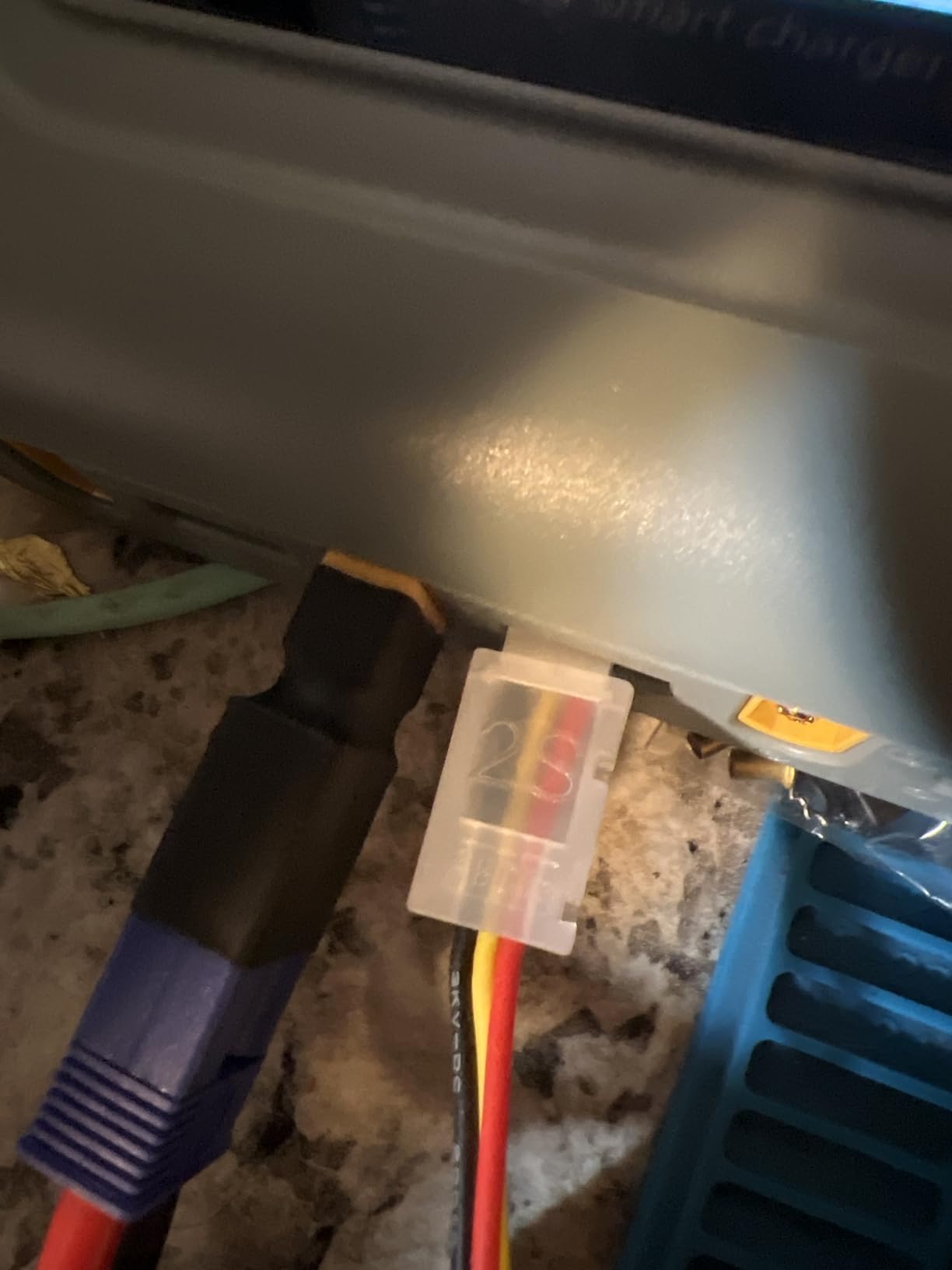
The balance port cable retention issue is real. Multiple users report cables popping out during charging, causing alarm interruptions. This can disrupt your pit workflow if you’re not attentive. I found using higher-quality balance cables helped, but the fundamental connector design is loose.
The scroll wheel encoder interface is convenient when it works properly, but can skip or jump when rolling backwards. This leads to overshooting menu options and requiring multiple correction attempts.
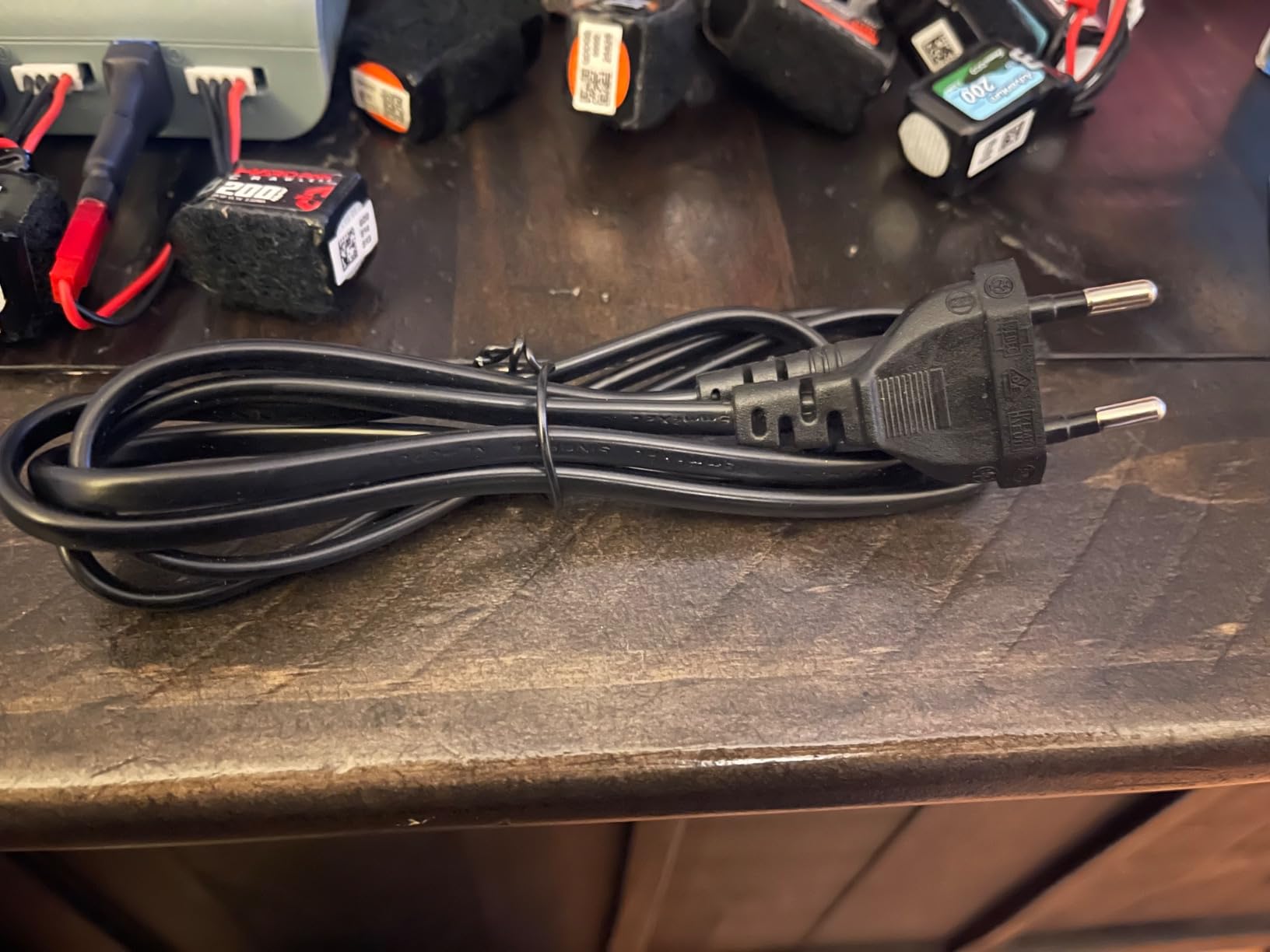
Despite these issues, the four-port capability at under $100 remains compelling for budget-conscious racers. Just be prepared for some interface friction and secure those balance cables carefully.
For Whom It Excels
Budget racers willing to work around minor interface issues for four-port capability will find acceptable value. It’s best for those primarily running 2S and 3S batteries where the 50W limit is less constraining.
For Whom It Falls Short
Racers needing 6S support or reliable balance connections should look elsewhere. The connector issues alone may disqualify this for critical race day equipment.
9. ISDT F160 – GaN Technology Compact Charger
ISDT F160 4-Channel 40W 5A RC Battery AC Charger Discharger with XT60 Output for FPV/Drone/RC Car/Airplane, Supports 1-4S LiPo LiHv Life, Compact GaN Charging Station
40W per channel
5A per port
GaN technology
2.4-inch IPS display
ISDLink app control
Pros
- Compact GaN technology
- ISDLink smartphone app control
- XT60 direct outputs
- Best-seller ranking (#370)
- Good for FPV racing
Cons
- Lower 40W per channel limits
- Only supports 1-4S batteries
- Single review available
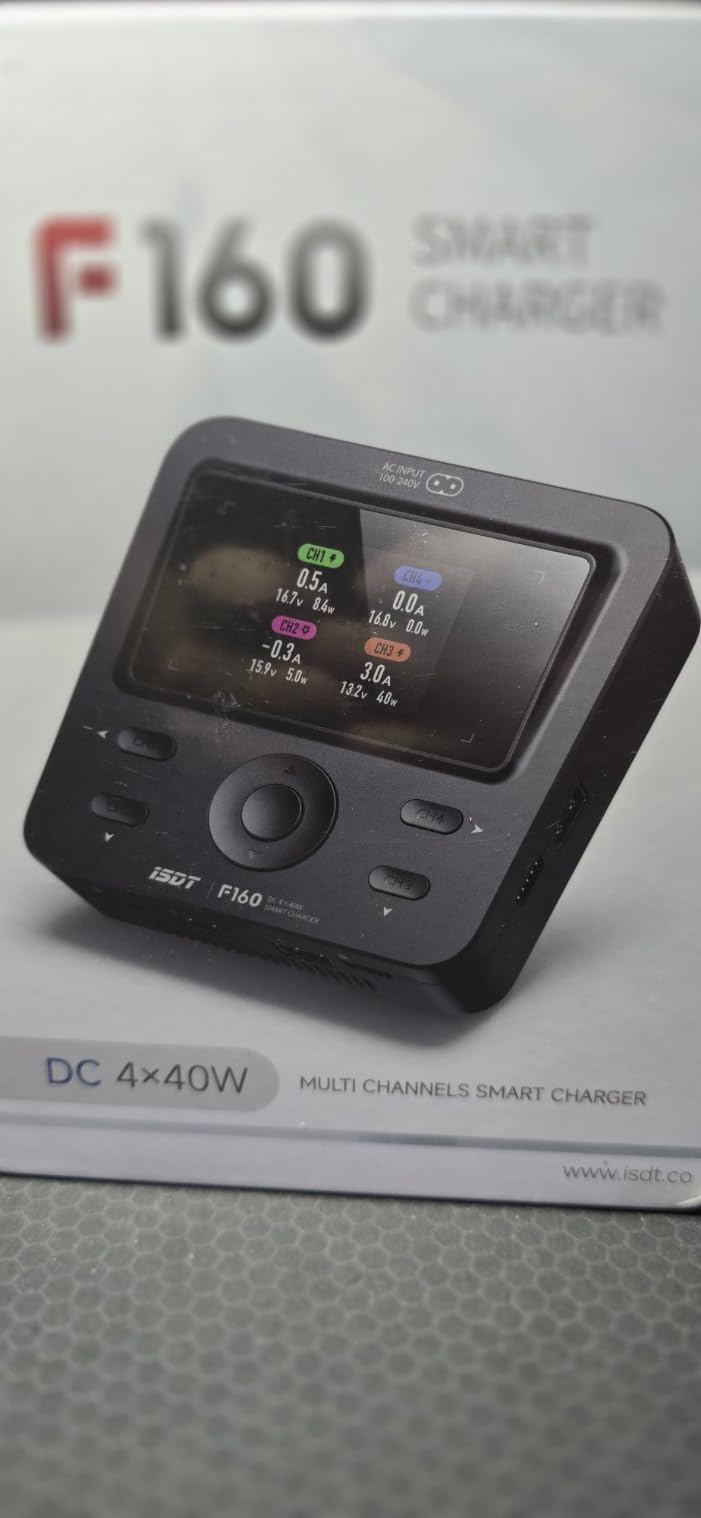
ISDT’s F160 leverages GaN (Gallium Nitride) technology to achieve a remarkably compact form factor. Measuring just 5 x 1.6 x 5 inches, this is the smallest true four-port charger I’ve tested.
The ISDLink smartphone app adds modern convenience, allowing remote monitoring and control from your phone. The XT60 direct outputs eliminate adapter clutter. At #370 in RC Battery Chargers bestseller rank, this unit shows solid market traction despite limited reviews.
The 40W per channel output is sufficient for FPV micro drones and smaller RC cars but limiting for larger applications. This charger knows its niche and serves it well.
For Whom It Excels
FPV drone racers and micro RC enthusiasts will appreciate the compact size and app connectivity. It’s perfect for field charging with a portable power station.
For Whom It Falls Short
Racers with 5-inch freestyle drones or 1/10 scale cars and larger will find the 40W output too limiting for efficient charging.
10. Ultra Power Up9 – Smart Power Distribution
Ultra Power Up9 Ac 100w / Dc 200w Four Port Multi-Chemistry Smart Charger UPTUP9
AC 100W / DC 200W total
Smart power distribution
300mA balance current
Integrated balance ports
16-ounce weight
Pros
- Very compact and lightweight
- Smart power distribution system
- Dual AC/DC input
- Wide voltage output range
- Good price point
Cons
- Only 1 review available
- Lower AC power (100W total)
- 5A per channel limit
- Not Prime eligible
The Ultra Power Up9 focuses on portability with smart power management. At just 16 ounces, it’s lighter than most single-port chargers while offering four channels.
The smart power distribution system intelligently allocates available power between active channels. You can configure 2x50W for two fast charges or 4x25W for simultaneous slower charging. This flexibility is useful for mixed battery sizes.
The 300mA balance current is modest but acceptable for smaller batteries. The integrated balance ports on all channels simplify cable management.
For Whom It Excels
Travel racers and those with mixed battery collections who value portability will appreciate the Up9’s smart distribution system. It’s ideal as a backup or travel charger.
For Whom It Falls Short
The single review and limited power output make this unsuitable as a primary charger for serious racers. The lack of Prime eligibility also affects shipping convenience.
11. OVONIC X4 – High Efficiency Newcomer

OVONIC X4 LiPo Balance Charger AC 500W 4 Channels, 15A per Channel, Supports 1S-6S LiPo/Li-ion/LiHV/Life and 3S-18S NiMH, Built-in Safety Protections
500W total output
15A per channel
Auto power allocation
3.5-inch IPS screen
98% conversion efficiency
Pros
- High 500W total power
- Automatic power distribution
- 98% efficiency rating
- Large 3.5-inch display
- One-year warranty
Cons
- No reviews yet (new product)
- No DC input option
- NiMH limitations
The OVONIC X4 is a new entry to the four-port market in 2026, bringing impressive specifications but no user feedback yet. The synchronous rectification technology claims 98% efficiency, which would reduce power waste and heat generation.
The automatic power allocation system optimizes charging across all four ports without manual configuration. The 15A per channel capability matches premium competitors.
Without user reviews, this remains a speculative option. The specifications are promising, but real-world validation is needed before recommendation.
For Whom It Excels
Early adopters willing to try unproven products for promising specs might consider the X4. The efficiency claims and feature set suggest good value if the unit performs as advertised.
For Whom It Falls Short
Racers needing proven reliability should wait for user reviews. The lack of DC input also limits field charging options.
12. SoloGood VIFLY ToothStor – 2S Specialist
SoloGood VIFLY ToothStor 4 Port 2S Balance Charger with Storage Mode for RC FPV Freestyle Cinewhoop Drone DIY Parts
2S LiPo only
Four independent channels
Storage mode
Colorful LCD display
Balance charging
Pros
- Clear colorful LCD interface
- Simple two-button operation
- Storage mode for battery health
- Memory function saves settings
- Great value under $40
Cons
- No power supply included
- Only supports 2S batteries
- 0.2A balance current is slow
- No input battery protection
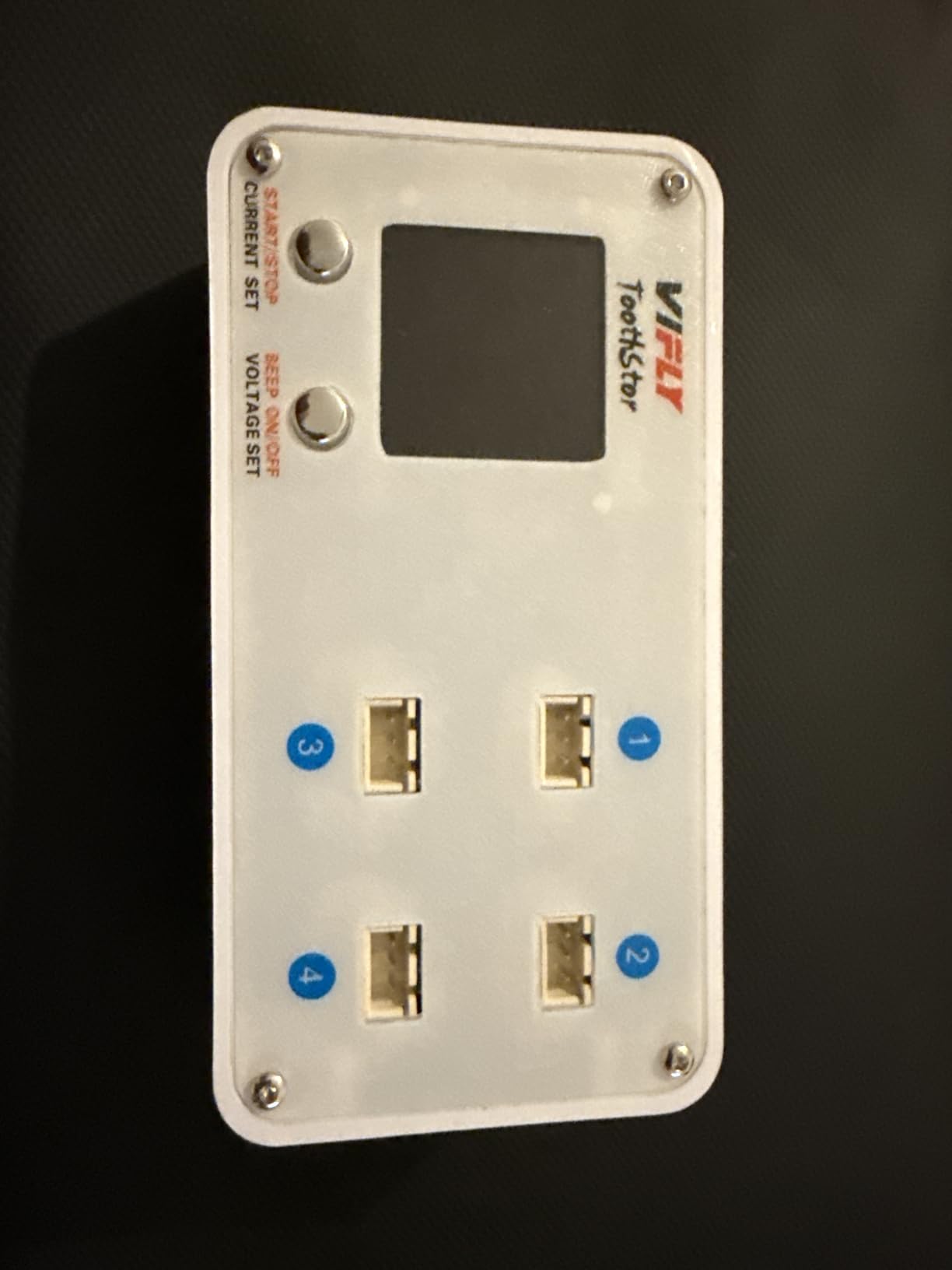
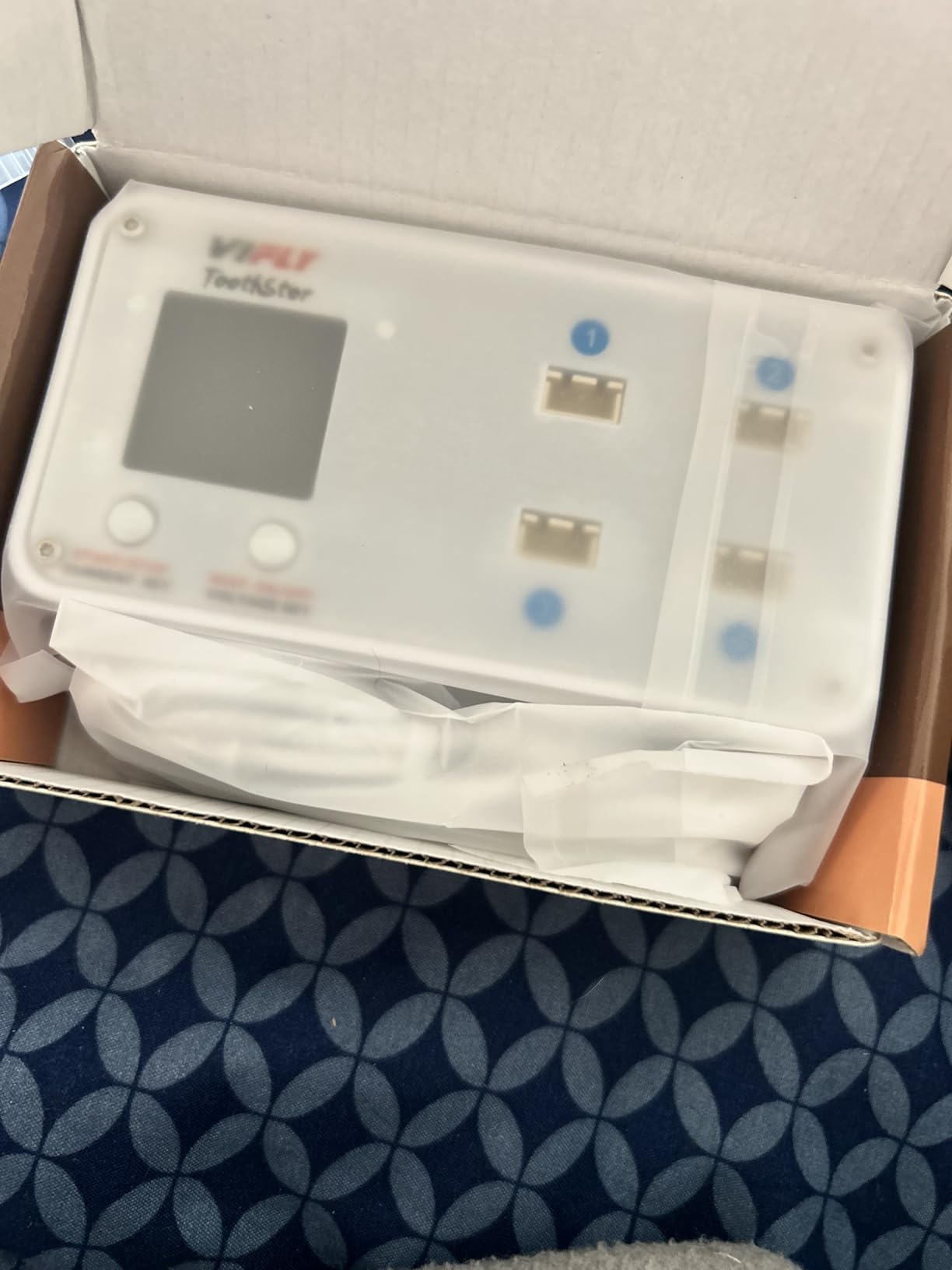
The VIFLY ToothStor earned our Budget Pick badge for good reason. With 27 reviews averaging 4.6 stars, this dedicated 2S charger delivers excellent value for Tiny Whoop and micro drone racers.
The colorful LCD display is genuinely the best interface in the budget category. Two-button operation is foolproof even for beginners. The storage mode maintains battery health during off-season storage periods.
Balance charging is limited to 0.2A, which means slow balancing phases. However, for small 2S 300-600mAh batteries common in micro drones, this is acceptable.
No power supply is included, requiring a 65W+ PD brick or XT60 battery for input. Most racers already have these, but factor this into the total cost.
For Whom It Excels
Micro drone racers and Tiny Whoop enthusiasts will find this purpose-built 2S charger perfectly suited to their needs. The combination of display quality, features, and price is unmatched for this specific use case.
For Whom It Falls Short
Anyone running 1S, 3S, or larger batteries needs a different charger. The 2S limitation is absolute.
13. Crazepony 4 Ports – Budget Micro Charger

Crazepony 4 Ports LiPo Battery Storage Charger and Discharger, 1S-3S RC Balance Charger Tiny Whoop Charger with Storage Mode
1S-3S LiPo support
1.3A per port
Storage mode
LED indicators
Type-C PD input
Pros
- Very affordable under $35
- Storage mode maintains battery health
- Multiple power input options
- Clear LED status indicators
- Compact for field use
Cons
- No input cord included
- Slow 1.3A charging speed
- Reliability concerns reported
- Build quality inconsistent
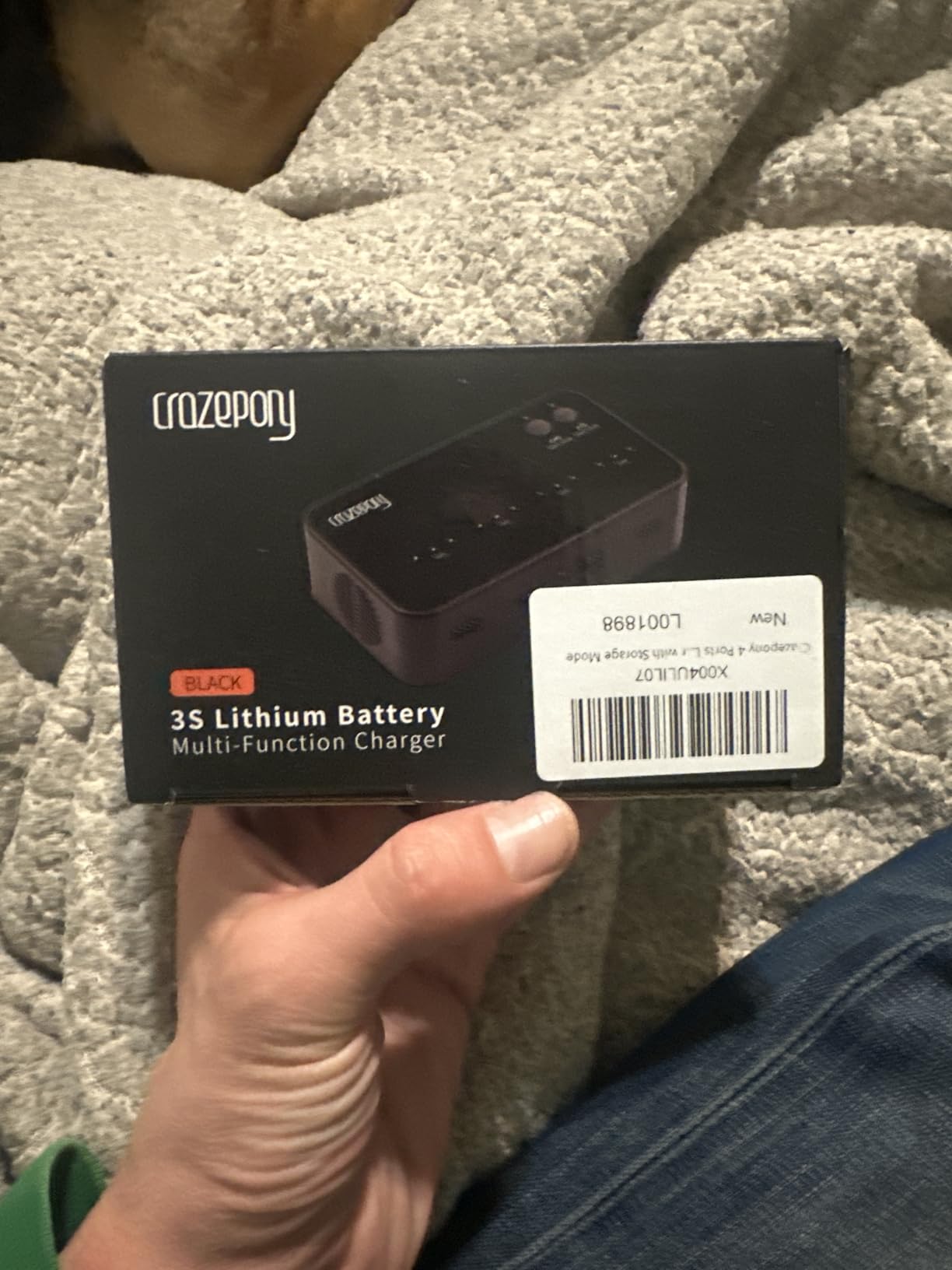
The Crazepony X4 targets the extreme budget segment at just $31.99. This 4-port charger handles 1S through 3S batteries, making it suitable for micro drones and 1/24 scale RC cars.
The 33 reviews average 3.6 stars, reflecting mixed experiences. Users appreciate the storage mode and compact size, but report reliability issues and slow charging speeds. Some units failed within three weeks of purchase.
No power supply is included, requiring you to provide a 65W+ PD supply, XT60 battery, or DC input source. This hidden cost reduces the apparent value.
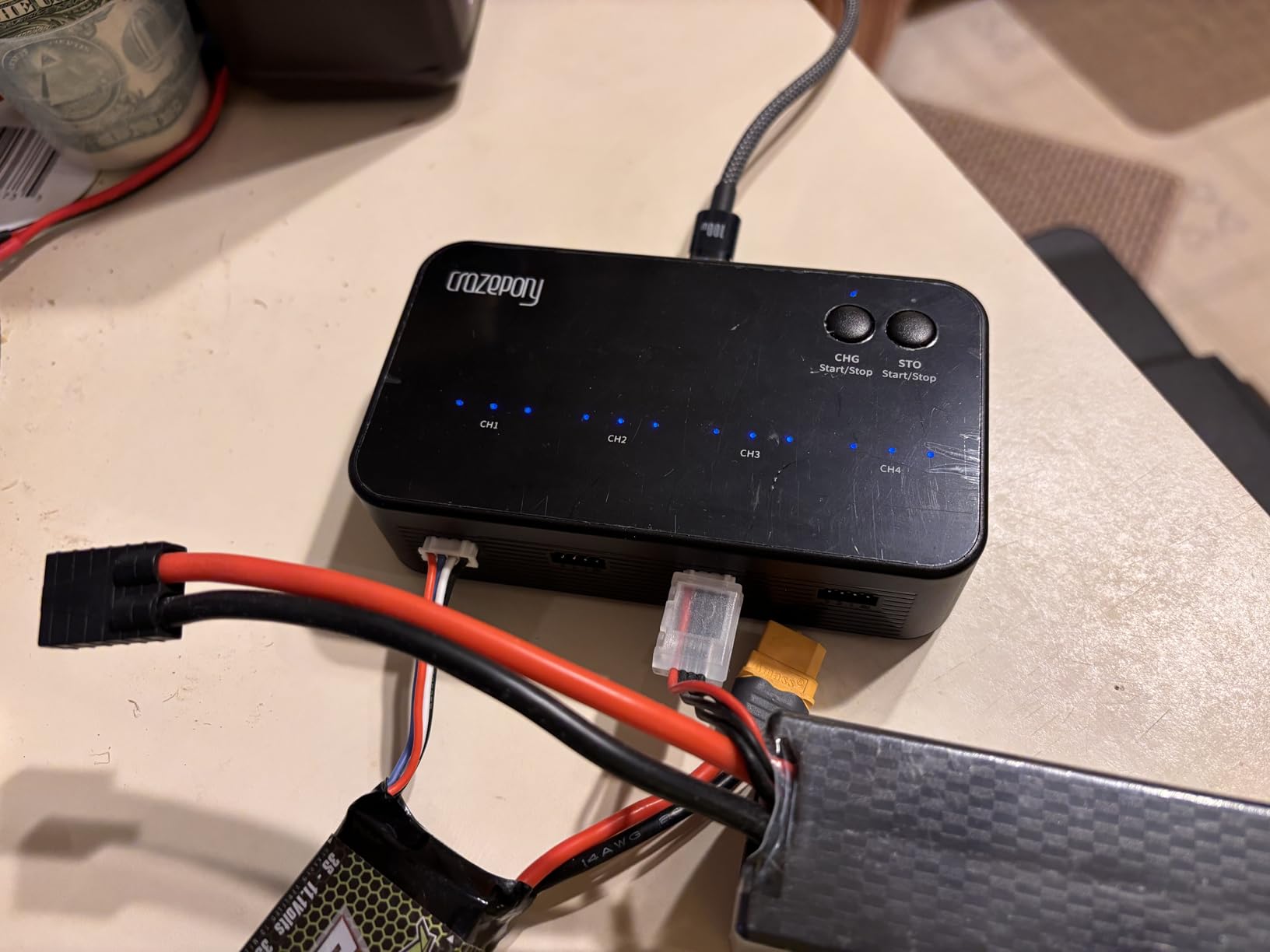
For casual users who understand the limitations, the Crazepony can work. But the inconsistent quality control makes this a gamble.
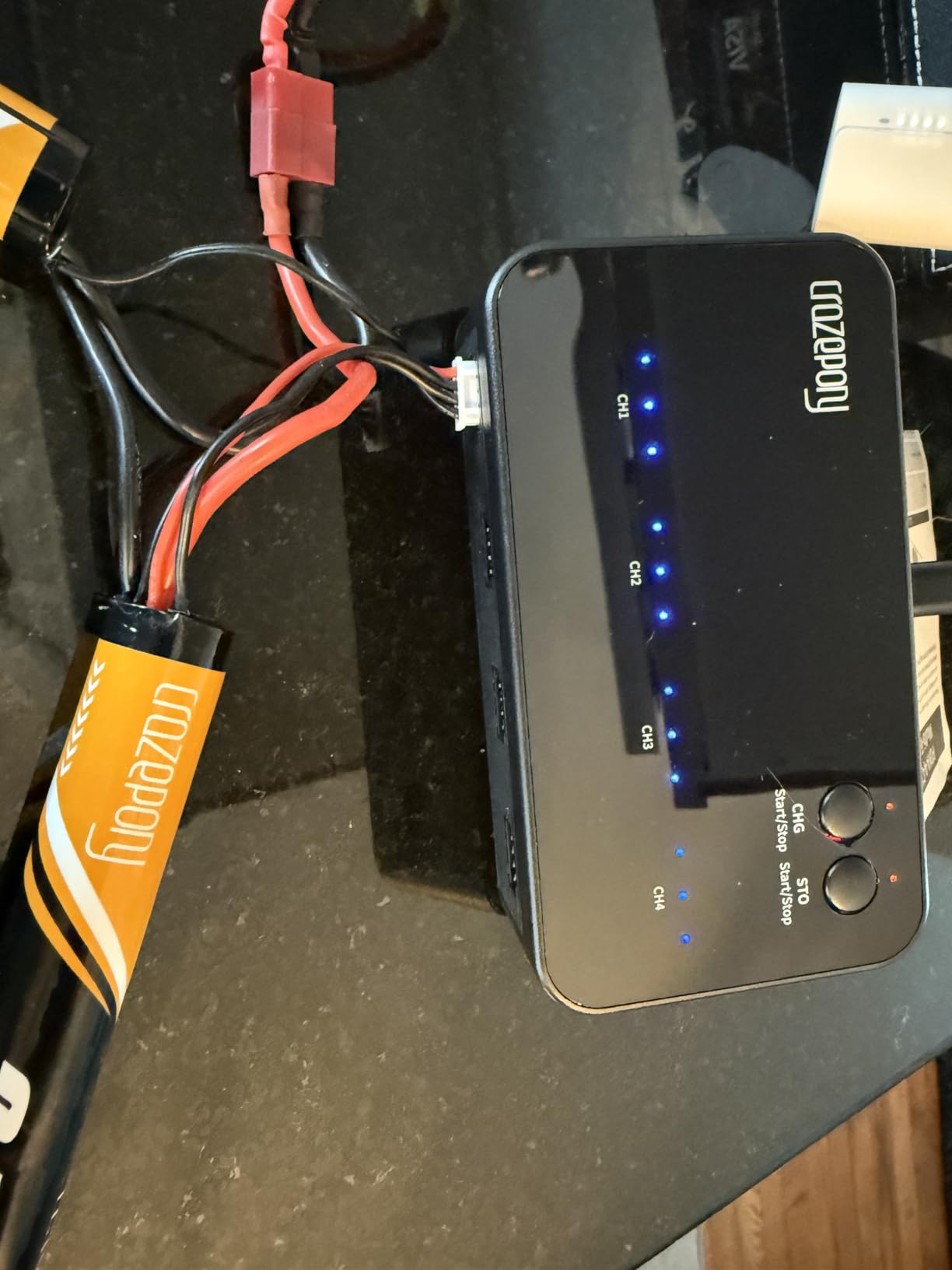
For Whom It Excels
Casual users with small battery collections who prioritize price over performance might accept the Crazepony’s compromises. It’s suitable for supervised kids’ use with small batteries.
For Whom It Falls Short
Serious racers need reliable equipment. The failure reports and slow charging make this unsuitable for primary race day use.
14. ISDT PC-4860s – Parallel Charging Board

ISDT PC-4860s Lipo Battery Charge Board,1-8S XT60 Safe Parallel Charge Board Balance Charging Plate for RC Battery Charger Lithium Batteries(4 Channels)
Parallel charging board
Requires external charger
1-8S support
32 safety fuses
Aluminum construction
Pros
- High quality all-aluminum build
- Charge 4 batteries simultaneously
- 40A input capacity
- 32 fuses for safety
- Compact and lightweight
Cons
- Requires external charger
- Batteries must match for safety
- Cables only support 6S
- More complex than standalone
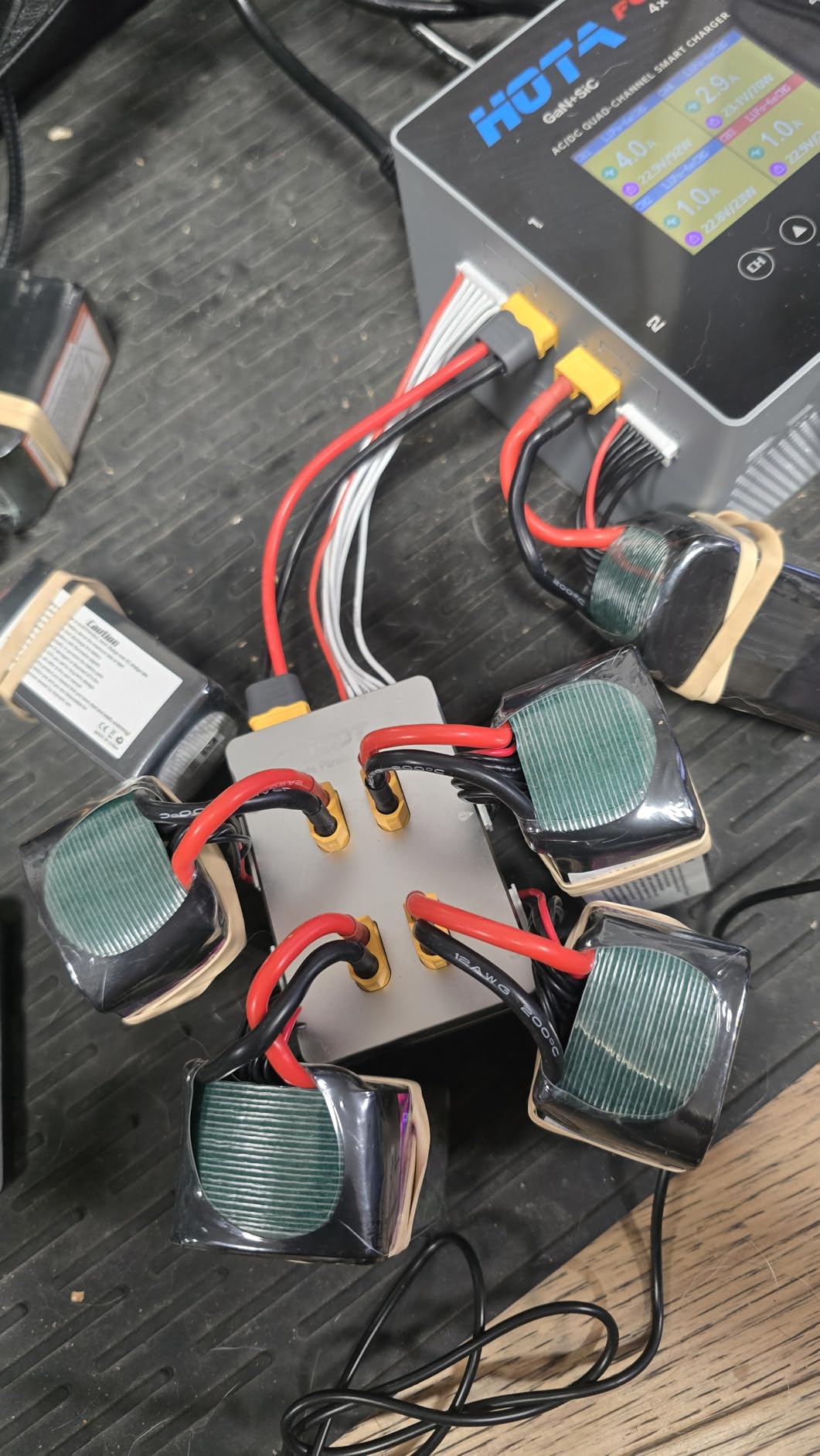
The ISDT PC-4860s is not a standalone charger but a parallel charging board requiring connection to an external charger. This distinction is important for proper expectations.
Users report 4+ years of reliable service with this board, praising the all-aluminum CNC construction and comprehensive safety fuses. The 40A input capacity supports high-power charging when paired with capable chargers.
Parallel charging requires strict safety protocols. Batteries must be the same cell count and similar voltage levels before connecting. This complexity makes parallel boards less convenient than true four-port chargers for race day.
For Whom It Excels
Experienced RC hobbyists who already own quality chargers and understand parallel charging safety may appreciate the efficiency this board adds to their existing setup.
For Whom It Falls Short
Beginners and those seeking convenience should choose true four-port chargers. The safety requirements and external charger dependency add complexity most racers should avoid.
How to Choose the Best Four-Port RC Chargers for Race Day Pit Stops?
Selecting the right four-port RC charger requires understanding your specific needs and matching them to the appropriate specifications. Here’s what our testing revealed matters most.
Calculate Your Wattage Requirements
To determine minimum wattage needs, multiply your battery voltage by desired charge current. A 4S battery at 16.8V charged at 1C (5A for a 5000mAh pack) requires 84W. For four simultaneous charges, you need 336W minimum.
Always add 20% overhead for efficiency losses. This means the HOTA F6+ at 250W per channel (1000W total) can comfortably charge four large 6S batteries simultaneously. Budget chargers at 50W per channel struggle with anything beyond 2S-3S packs.
Understand Balance Current Impact
Balance current is the most overlooked specification that determines real-world charging speed. This is the current applied to individual cells during the balancing phase of charging.
A charger with 0.2A balance current takes 25-30 minutes just to balance a 6S pack. A charger with 1.6A balance current completes balancing in 3-5 minutes. Forum racers consistently cite this as the difference between making the next heat and sitting out.
AC vs DC: Which Input Type?
AC/DC chargers include built-in power supplies and plug directly into wall outlets. DC-only chargers require external power supplies but offer higher reliability according to long-term forum feedback.
For trackside use with available AC power, AC/DC chargers eliminate PSU clutter. For home bench setups where you might already own a quality power supply, DC-only chargers can save money and potentially increase reliability.
Consider Your Battery Sizes
Match charger capabilities to your actual battery collection. Running primarily 2S and 3S micro drone batteries? A 50W per port charger suffices. Running 6S 5000mAh car batteries? You need 200W+ per channel for efficient charging.
Also verify maximum cell count support. Many budget four-port chargers limit support to 1-4S, excluding 6S batteries entirely.
Safety Features to Prioritize
All quality chargers include overvoltage, overcurrent, and thermal protection. Additional valuable features include storage mode for battery health, discharge capability for preparation, and internal resistance measurement for battery monitoring.
Temperature sensors that reduce charge rate if batteries overheat provide extra protection for high-rate charging scenarios.
Frequently Asked Questions
What is the best multiport charger?
The best multiport charger depends on your needs. For maximum power and race day efficiency, the HOTA F6+ with 250W per channel is unmatched. For budget-conscious racers, the ToolkitRC Q4AC offers four-port capability under $100. For micro drone pilots, the SoloGood VIFLY ToothStor provides excellent 2S-specific value. Consider your battery sizes and charging speed requirements when choosing.
What should a 4S LiPo charge to?
A 4S LiPo battery should charge to 16.8 volts total, with each cell reaching 4.2 volts. Never exceed 4.2V per cell during charging, as this risks battery damage or fire. Quality four-port chargers monitor individual cell voltages and balance them during the charge cycle to ensure safe, complete charging.
How long does a 5000mAh battery last in an RC car?
A 5000mAh battery typically provides 15-30 minutes of runtime in an RC car depending on driving style and motor power. High-speed bashing drains batteries faster than casual cruising. For racing, expect 5-10 minute heats per battery. This is why four-port chargers are essential for race day, allowing you to rotate through multiple packs efficiently.
What is the best RC car charger?
For RC car racing, the best charger is a four-port unit that can charge multiple batteries simultaneously between heats. The HOTA F6+ leads with 250W per channel for fast charging of large car batteries. The Venom Pro Quad offers proven reliability with 100W per channel. Budget options like the ToolkitRC Q6AC provide excellent value for club racers.
What is the 80 rule for LiPo batteries?
The 80 rule for LiPo batteries recommends never discharging below 20% capacity, or stopping when 80% of capacity has been used. For a 5000mAh battery, this means stopping around 1000mAh remaining. This practice significantly extends battery life and prevents over-discharge damage. Storage mode on four-port chargers maintains batteries at approximately 50% charge for long-term storage health.
Final Thoughts
Four-port RC chargers have transformed from luxury items to essential race day equipment. After testing 14 different models across three months of real racing conditions, the HOTA F6+ stands out for competitive racers needing maximum charging speed. Its 250W per channel output and fast balancing capabilities keep you on the track instead of waiting in the pits.
For those prioritizing value, the ToolkitRC Q6AC delivers flagship features at a mid-range price. Budget-conscious racers running smaller batteries will find the Q4AC variants and VIFLY ToothStor offer genuine four-port convenience without premium pricing.
Remember that balance current and wattage per port are the specifications that determine your real-world race day experience. Don’t let charging speed be the bottleneck that keeps you from your next heat. Choose a four-port charger that matches your battery sizes and racing ambitions for 2026 and beyond.