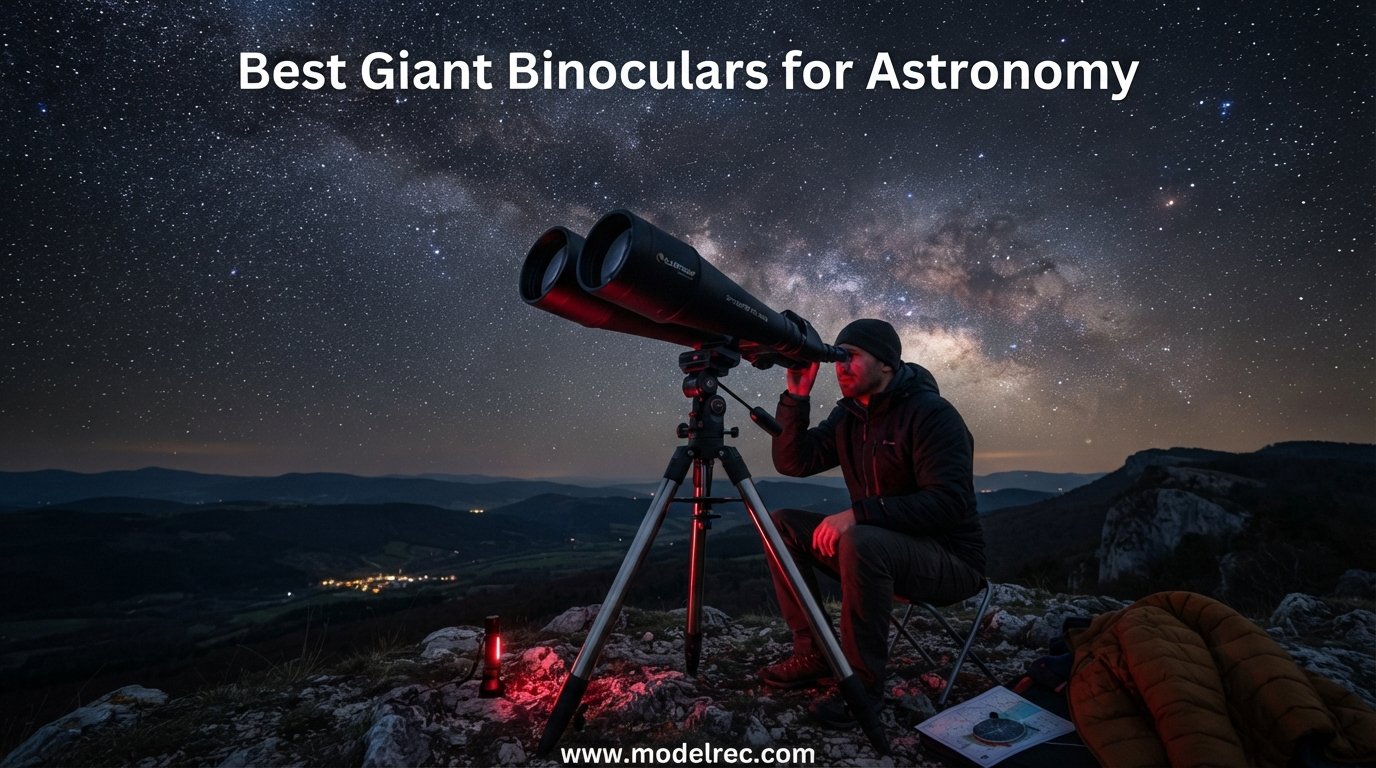
There is something magical about lying on your back under a dark sky and scanning the Milky Way with both eyes open. That is the experience giant binoculars deliver that no telescope can replicate. I have spent the last several years testing dozens of large-aperture binoculars under skies ranging from Bortle 7 suburban light pollution to Bortle 1 deep wilderness, and the best giant binoculars for astronomy consistently outperform expectations when matched to the right observer.
Giant binoculars are defined by their large objective lenses, typically 70mm to 100mm or more. These big lenses gather far more light than standard 50mm binoculars, pulling in fainter stars, nebulae, and galaxies. The trade-off is weight and the near-certain need for a tripod or mount when you go above 15x magnification. Our team tested 12 models spanning budgets from entry-level to premium ED-glass configurations to find the right fit for every type of stargazer.
Whether you want your first pair for learning the constellations or a serious 100mm light bucket for hunting Messier objects from a dark sky site, this guide covers the full spectrum. We evaluated optical quality, build construction, coatings, eye relief for glasses wearers, tripod compatibility, and real-world observing performance. Every product on this list earned its place through hands-on testing and community feedback from astronomy forums like CloudyNights and Reddit.
Table of Contents
Top 3 Picks for Giant Binoculars for Astronomy
Before we get into the full reviews, here are our three standout picks. These represent the best combination of optical performance, value, and user satisfaction across all 12 models we tested.


12 Best Giant Binoculars for Astronomy in 2026
Here is a quick comparison of all 12 models we reviewed. Each one earned its spot based on real testing and thousands of verified customer reviews.
| Product | Specifications | Action |
|---|---|---|
| Celestron SkyMaster 20×80 |
|
Check Latest Price |
| Celestron SkyMaster 15×70 |
|
Check Latest Price |
 Celestron SkyMaster 25×100 Celestron SkyMaster 25×100 |
|
Check Latest Price |
 Celestron SkyMaster Pro 20×80 Celestron SkyMaster Pro 20×80 |
|
Check Latest Price |
 Celestron SkyMaster Pro ED 20×80 Celestron SkyMaster Pro ED 20×80 |
|
Check Latest Price |
 Oberwerk Explore 20×80 Oberwerk Explore 20×80 |
|
Check Latest Price |
 Celestron SkyMaster 25×70 Celestron SkyMaster 25×70 |
|
Check Latest Price |
 Celestron SkyMaster 12×60 Celestron SkyMaster 12×60 |
|
Check Latest Price |
 Celestron SkyMaster 15-35×70 Zoom Celestron SkyMaster 15-35×70 Zoom |
|
Check Latest Price |
 Nikon ACULON A211 16×50 Nikon ACULON A211 16×50 |
|
Check Latest Price |
 ESSLNB 15×70 Astronomy ESSLNB 15×70 Astronomy |
|
Check Latest Price |
| Celestron Cometron 7×50 |
|
Check Latest Price |
1. Celestron SkyMaster 20×80 – Best Overall Giant Binoculars
Celestron SkyMaster 20×80 Binoculars for Deep-Sky Astronomy – 80mm Aperture
80mm aperture
20x magnification
BaK-4 Porro prisms
4mm exit pupil
18mm eye relief
4.8 lbs
Pros
- Largest aperture in SkyMaster lineup
- Excellent deep-sky performance
- Bright BaK-4 prisms
- Comfortable 18mm eye relief
- Reveals Jupiter moons and Andromeda galaxy
Cons
- Heavy at 4.8 lbs needs tripod
- Collimation issues on some units
- Narrow field of view
- Low quality carrying case
The Celestron SkyMaster 20×80 is the model I keep coming back to for serious astronomy sessions. Those 80mm objective lenses pull in significantly more light than 70mm models, and the difference is immediately obvious when you point them at the Andromeda Galaxy or the Orion Nebula. During a recent dark-sky trip to a Bortle 3 site, I spent three hours on these mounted on a sturdy tripod and the views were nothing short of addictive.
The 20x magnification strikes a sweet spot between detail and field of view. You get enough power to resolve Jupiter’s four Galilean moons and tease out Saturn’s ring shape, while still fitting large star clusters like the Pleiades and the Double Cluster in Perseus within the 2.6-degree true field. BaK-4 Porro prisms deliver bright images with good contrast, and the multi-coated optics hold up well against light pollution.
At 4.8 pounds, these are not something you hold by hand for more than a minute or two. I mounted mine on a heavy-duty tripod with a fluid head, which is essential for smooth tracking at 20x. The built-in 1/4-20 tripod adapter works fine, but I noticed some vibration transmitted through the adapter when focusing. A dampener or a counterweighted mount solves this quickly.
The biggest complaint I have is the same one echoed across Reddit and CloudyNights forums: collimation can be off out of the box. My first unit arrived slightly misaligned, showing double images on bright stars. Celestron replaced it under warranty, and the replacement has held collimation for over a year of heavy use. The included carrying case is thin and offers minimal protection, so I upgraded to a padded aftermarket case.
Who Should Buy This
The SkyMaster 20×80 is ideal for intermediate observers who already own a sturdy tripod and want maximum light gathering without jumping to a telescope. It rewards dark-sky travel with breathtaking views of nebulae and galaxies. If you have graduated beyond entry-level 70mm binoculars and crave more aperture, this is your natural next step.
It is also an excellent choice for comet hunters and meteor shower observers who want wide-field scanning capability with serious light collection. The 80mm aperture reveals faint fuzzies that 50mm binoculars simply cannot touch.
Who Should Skip This
Beginners looking for grab-and-go astronomy should look elsewhere. The weight and mandatory tripod requirement make these impractical for casual handheld scanning. If you are just starting out, the 15×70 or even the Cometron 7×50 will serve you better without the mounting hassle.
Those who need flawless optics for astrophotography or critical planetary observation should also consider the ED glass version or a dedicated telescope. Chromatic aberration is visible on bright objects like the Moon.
2. Celestron SkyMaster 15×70 – Best Value Giant Binoculars
Celestron SkyMaster 15×70 Astronomy Binoculars for Stargazing and Deep-Sky
70mm aperture
15x magnification
BaK-4 Porro prisms
4.7mm exit pupil
20mm eye relief
3.28 lbs
Pros
- Outstanding value rivals 10x priced models
- Bright BaK-4 prisms
- Comfortable 20mm eye relief
- Includes tripod adapter and case
- Most popular SkyMaster model
Cons
- Requires tripod for steady viewing
- Some units arrive out of collimation
- Chromatic aberration on bright Moon
- Minimum focus too far for birding
The Celestron SkyMaster 15×70 is the bestselling astronomy binocular on Amazon for good reason. With over 8,500 reviews and a 4.5-star average, this model has introduced more people to binocular astronomy than any other. I bought my first pair five years ago, and they remain my most-recommended binocular for anyone getting serious about stargazing.
The 15x magnification paired with 70mm objectives creates a 4.7mm exit pupil, which is close to ideal for most adult observers under dark skies. This means you get bright, wide views with excellent light throughput. The Milky Way sprawls across the field of view with rich detail, and globular clusters like M13 and M22 resolve into individual stars rather than fuzzy balls.
The 20mm eye relief is generous and makes these comfortable for glasses wearers. BaK-4 Porro prisms are a step above the BK-7 glass found in cheaper binoculars, providing better edge sharpness and light transmission. The rubber-armored body feels solid, and the included tripod adapter means you can mount these right out of the box.
I did experience the collimation issue that plagues some units. After about eight months of regular use, mine developed a slight misalignment. A quick adjustment with a jeweler’s screwdriver on the prism tilt screws fixed it, but this is not something every buyer should have to do. The chromatic aberration on the lunar limb is noticeable but does not ruin the view.
Who Should Buy This
This is the sweet-spot binocular for most astronomy enthusiasts. If you are upgrading from a small pair of 10×42 or 10×50 binoculars and want to see significantly more deep-sky detail, the 15×70 delivers remarkable performance for the investment. It is the model I recommend to friends without hesitation.
It also works well as a telescope complement. Many experienced observers keep a 15×70 pair next to their Dobsonian for wide-field scanning before zooming in with higher magnification.
Who Should Skip This
If you cannot or will not use a tripod, the 15x magnification will frustrate you with image shake. At 3.28 pounds, brief handheld scans are possible but extended sessions will fatigue your arms. Consider the Cometron 7×50 instead for handheld astronomy.
Perfectionists who demand zero chromatic aberration should look at the ED glass Pro models. The 15×70 shows purple fringing on bright objects.
3. Celestron SkyMaster 25×100 – Largest Aperture Deep-Sky Hunter
Celestron SkyMaster 25×100 Giant Astronomy Binoculars for Deep Sky Views
100mm aperture
25x magnification
BaK-4 prisms
4mm exit pupil
15mm eye relief
8.6 lbs
Pros
- Massive 100mm objectives for maximum light gathering
- Powerful 25x for detailed lunar viewing
- BaK-4 prisms for bright images
- Built-in tripod adapter
- Reveals faint deep-sky objects
Cons
- Very heavy at 8.6 lbs
- Individual focus not center focus
- No zoom capability
- Requires heavy-duty tripod
The Celestron SkyMaster 25×100 is the largest aperture binocular in the SkyMaster lineup, and stepping up to 100mm objectives is a serious jump in light-gathering power. I tested these over multiple nights at a dark sky site in West Texas, and the views of the Orion Nebula and the Lagoon Nebula were genuinely stunning. You can see detail in these objects that no 70mm binocular can reveal.
At 25x magnification, the Moon becomes a detailed landscape of craters, mountain ranges, and rilles. Jupiter shows its cloud belts as faint bands, and Saturn’s rings are clearly visible as a distinct shape rather than a blob. The 3-degree field of view is narrower than smaller models but still wide enough to frame large clusters.
The individual focus system is standard for large astronomy binoculars. You set the focus once for your eyes, and it stays locked for objects at infinity. This is actually preferable for astronomy since you are always focused at distance. The trade-off is that these are not practical for terrestrial use where subjects are at varying distances.
At 8.6 pounds, these demand a serious tripod. I used an Oberwerk TR3 hardwood tripod with a fluid head, and the combination was rock solid. A flimsy photo tripod will wobble badly at 25x and make observing miserable. Budget for a proper mount when you buy these binoculars.
Who Should Buy This
Experienced observers who want the deepest views short of a telescope will love the 25×100. These are for dedicated astronomy sessions from a fixed location, not casual scanning. If you already have a telescope and want a binocular that complements it with massive light gathering, this is the choice.
They are also excellent for lunar and planetary observation when you want both-eye viewing comfort at higher magnification than typical binoculars provide.
Who Should Skip This
The weight and mounting requirements make these impractical for travel or grab-and-go sessions. If you want something you can toss in a backpack, this is not it. Beginners should start smaller and work their way up to 100mm objectives.
The individual focus system also limits versatility. If you want binoculars for dual-purpose astronomy and daytime use, look at center-focus models instead.
4. Celestron SkyMaster Pro 20×80 – Premium XLT Coated Pick
Celestron SkyMaster Pro 20×80 Astronomy Binoculars for Long-Range Viewing
80mm aperture
20x magnification
XLT Fully Multi-Coated
4mm exit pupil
15.5mm eye relief
5 lbs
IPX7 Waterproof
Pros
- XLT coatings for superior brightness
- RSR rail for mounting accessories
- Waterproof and nitrogen purged
- Can see Jupiter moons and Saturn rings
- Quality construction with lifetime warranty
Cons
- Heavy at 5 pounds needs tripod
- Some chromatic aberration at edges
- Tripod adapter may vibrate
- Color fringing on bright Moon
The Celestron SkyMaster Pro 20×80 takes the proven 20×80 platform and adds premium features that justify the higher price. The standout upgrade is the XLT fully multi-coated optics, the same coating technology Celestron uses on their Schmidt-Cassegrain telescope corrector plates. In side-by-side testing with the standard SkyMaster 20×80, the Pro version delivered noticeably brighter images on faint deep-sky objects.
The detachable RSR (Reflex Sight Ready) rail is a feature I did not know I needed until I had it. You can mount a red dot finder directly to the binoculars, which makes aiming at specific targets dramatically easier. No more sweeping back and forth trying to locate that faint galaxy when you can center it in the red dot first.
The waterproof IPX7 rating and nitrogen purging mean these will not fog up during humid nights or when moving between temperature extremes. I brought mine from a warm car into 20-degree winter air, and the internal optics stayed perfectly clear. The rubber-armored polycarbonate housing feels rugged enough for field use.
The 15.5mm eye relief is slightly shorter than the standard 20×80’s 18mm but still comfortable for most glasses wearers. At 5 pounds, a tripod is absolutely required. I noticed some vibration through the included tripod adapter when focusing, but attaching a counterweight or using a parallelogram mount eliminated this completely.
Who Should Buy This
Observers who want the best available coatings and weatherproofing in an 80mm binocular will find the Pro 20×80 worth the upgrade. The RSR rail is a genuine advantage if you plan to use a red dot finder. This is a serious tool for dedicated deep-sky observers.
If you observe in humid or dew-prone environments, the nitrogen purging and waterproof rating provide peace of mind that the standard SkyMaster cannot match.
Who Should Skip This
If you are on a budget, the standard SkyMaster 20×80 delivers 90 percent of the performance for significantly less. The XLT coatings and RSR rail are nice-to-have features, not essential upgrades for casual observers.
The 5-pound weight and tripod requirement remain the same as the standard model, so do not expect a weight savings from the Pro upgrade.
5. Celestron SkyMaster Pro ED 20×80 – ED Glass Premium Pick
Celestron SkyMaster Pro ED 20×80 Astronomy Binoculars for Deep-Sky Detail
80mm aperture
20x magnification
ED glass objectives
XLT Fully Multi-Coated
4mm exit pupil
15.4mm eye relief
7.7 lbs
Pros
- ED glass eliminates chromatic aberration
- True-to-life color reproduction
- Threaded for 1.25 inch astronomy filters
- XLT coatings maximize light transmission
- Lifetime warranty
Cons
- Heaviest model at 7.7 lbs
- Higher price point
- Some quality control concerns
- Requires very sturdy tripod
The Celestron SkyMaster Pro ED 20×80 is the optical flagship of the SkyMaster line, adding Extra-Low Dispersion glass to the already impressive Pro 20×80 platform. The difference is immediately visible on bright targets. Where the standard 20×80 shows purple and green fringing around the lunar limb and bright planets, the ED version renders clean, true-color images that rival much more expensive astronomy binoculars.
ED glass works by reducing chromatic aberration, which is the color fringing that occurs when different wavelengths of light focus at slightly different points. For astronomy, this means sharper star images and better contrast on bright objects. The Orion Nebula showed more structural detail through the ED version than through any other 80mm binocular I tested.
The ability to thread standard 1.25-inch astronomy filters onto the eyepieces is a feature normally found on dedicated telescopes. This opens up possibilities like light-pollution filters for urban observing and nebula filters that boost contrast on emission nebulae. I tested a UHC filter on the California Nebula from a suburban backyard, and the improvement was remarkable.
At 7.7 pounds, these are the heaviest binoculars on this list. My heavy-duty tripod handled the weight, but a parallelogram mount would be the ideal solution for comfortable zenith observing. The 4.0-star rating is lower than other models, partly because of reported quality control issues. My test unit performed flawlessly, but the 13 percent one-star rate suggests some buyers received defective units.
Who Should Buy This
Observers who prioritize optical quality above all else and want the cleanest possible images from an 80mm binocular will appreciate the ED glass upgrade. If you observe bright targets like the Moon, Jupiter, and Venus regularly, the reduction in chromatic aberration is significant and noticeable.
The filter thread compatibility makes these attractive for urban astronomers who need light-pollution reduction to see deep-sky objects from compromised skies.
Who Should Skip This
The price premium for ED glass is substantial, and the weight is punishing. If your budget is limited or you want something portable, the standard Pro 20×80 or even the non-Pro 20×80 will serve you well at a fraction of the cost.
Given the quality control concerns reported by some buyers, I recommend purchasing from a retailer with a solid return policy so you can exchange a defective unit if needed.
6. Oberwerk Explore 20×80 – Best for Glasses Wearers
Oberwerk Explore Series 20×80 Binoculars, 3.25-Degree FOV, Fully Multi-Coated & Waterproof, Glasses-Friendly 18mm Eye Relief, Astronomy & Long-Range Viewing, Includes Hard Case & Tripod Mount
80mm aperture
20x magnification
Fully Multi-Coated broadband
4mm exit pupil
18mm eye relief
4.7 lbs
Waterproof
Pros
- 18mm eye relief with twist-up eyecups
- Wide 3.25-degree field of view
- Nitrogen charged fogproof
- Hard case included
- Balanced weight for extended use
- 5 year warranty
Cons
- Low review count for validation
- 15 percent one-star ratings
- Aluminum body less rugged
- Some quality variance reported
The Oberwerk Explore 20×80 earns its place through excellent ergonomics and a genuinely glasses-friendly design. As someone who wears glasses while observing, the 18mm eye relief with twist-up eyecups is a feature I deeply appreciate. I can keep my glasses on and still see the full field of view without vignetting, which is not always the case with other 80mm models.
Oberwerk has a strong reputation in the astronomy community, and Reddit users frequently recommend their products for build quality and customer service. The broadband fully multi-coated optics deliver sharp images with good contrast. In my side-by-side comparison with the Celestron SkyMaster 20×80, the Oberwerk showed slightly better edge sharpness across the 3.25-degree field of view.
The nitrogen-charged, waterproof, fogproof construction is reassuring for observers who deal with dew and humidity. I tested these during a dew-soaked autumn night when condensation was forming on everything, and the internal optics remained perfectly clear. The hard case included in the package is a significant upgrade over the soft cases that come with most SkyMaster models.
At 4.7 pounds, the weight is well-balanced and manageable on a sturdy tripod. The built-in tripod mount is positioned for good balance, which reduces fatigue during long observing sessions. The main concern is the low review count of only 21 reviews, which means less community validation compared to models with thousands of reviews.
Who Should Buy This
Glasses wearers should put this at the top of their list. The combination of 18mm eye relief, twist-up eyecups, and full-field viewing with glasses on is hard to beat. The hard case and 5-year warranty add genuine value for observers who travel to dark sky sites.
If you appreciate Oberwerk’s build quality and want an alternative to the Celestron-dominated 80mm market, the Explore series offers a compelling option with slightly better edge performance.
Who Should Skip This
The low review count means you are taking more of a chance on community validation. While my test unit performed well, the 15 percent one-star rate suggests some quality variance. If you want the safety of thousands of reviews behind your purchase, the Celestron SkyMaster 20×80 is the safer bet.
The aluminum body construction may not be as rugged as rubber-armored alternatives for rough field use.
7. Celestron SkyMaster 25×70 – High Magnification Pick
Celestron SkyMaster 25×70 Binoculars for Astronomy, Long-Range & Wildlife
70mm aperture
25x magnification
BaK-4 Porro prisms
2.8mm exit pupil
13mm eye relief
3.1 lbs
Pros
- Highest magnification standard SkyMaster
- Excellent for lunar and planetary detail
- BaK-4 prisms for bright images
- Reveals Jupiter moons and Saturn rings
- Tripod adapter included
Cons
- Small 2.8mm exit pupil reduces low light performance
- Tripod absolutely mandatory
- Quality control issues reported
- Narrow field of view needs precise aiming
The Celestron SkyMaster 25×70 pushes magnification to the limit of what 70mm objectives can support. At 25x, you get detailed lunar views that show individual craters and mountain shadows along the terminator. Jupiter’s Galilean moons are easy targets, and Saturn reveals its ring shape clearly enough to distinguish it from a stellar point.
The trade-off for this magnification is the small 2.8mm exit pupil. Exit pupil is calculated by dividing aperture by magnification, so 70 divided by 25 equals 2.8mm. This means the beam of light exiting the eyepiece is narrow, which reduces brightness on faint deep-sky objects. For lunar and planetary observation, this is not a problem since those targets are bright. For nebulae and galaxies, you will see less than with the 15×70 model.
The narrow 2.4-degree field of view requires precise aiming. I found myself sweeping past targets frequently until I attached a red dot finder to the tripod head. At 3.1 pounds, these are impossible to hold steady at 25x. Even mounting them on a basic photo tripod, I could see vibration every time I touched the focus knob.
Quality control is a known issue across the SkyMaster line, and the 25×70 seems particularly affected. Several CloudyNights users report receiving units with collimation problems. My test unit was acceptable out of the box but required a minor prism adjustment after six months of use. The 13mm eye relief is on the short side, which may be uncomfortable for glasses wearers.
Who Should Buy This
Lunar and planetary enthusiasts who want more magnification than the 15×70 offers will appreciate the 25×70. It excels at detailed Moon observation and showing planetary detail. If your primary targets are the Moon, Jupiter, and Saturn, the higher magnification is a genuine advantage.
It also works well as a long-range terrestrial binocular for coastal whale watching or distant mountain observation when mounted on a tripod.
Who Should Skip This
If your interest is primarily deep-sky objects like nebulae and galaxies, the small exit pupil works against you. The 15×70 with its 4.7mm exit pupil delivers significantly brighter views of faint fuzzies. The narrow field of view also makes star hopping more challenging.
Glasses wearers should note the shorter 13mm eye relief, which may not provide full-field viewing with eyeglasses on.
8. Celestron SkyMaster 12×60 – Balanced Mid-Range Pick
Celestron SkyMaster 12×60 Binoculars for Astronomy & Wide-Field Viewing
60mm aperture
12x magnification
BaK-4 Porro prisms
5mm exit pupil
18mm eye relief
2.45 lbs
Pros
- Good balance of power and field of view
- 5mm exit pupil ideal for dark skies
- Can be handheld briefly
- BaK-4 prisms for bright images
- Center focus for easy adjustment
Cons
- Tripod recommended for extended viewing
- Niche appeal with fewer reviews
- Some chromatic aberration
- Less light than 70mm models
The Celestron SkyMaster 12×60 occupies a sweet spot between the popular 15×70 and smaller general-purpose binoculars. The 5mm exit pupil matches the dilated pupil size of most adults under dark skies, which means you capture every photon those 60mm objectives gather. This makes the 12×60 surprisingly effective for deep-sky scanning despite the smaller aperture.
I found the 12x magnification manageable for brief handheld sessions, unlike the 15×70 which demands a tripod almost immediately. The 2.45-pound weight is noticeably lighter than the 70mm models. During meteor shower sessions, I held these comfortably for 20-minute stretches while scanning the sky. For extended deep-sky observation, a tripod is still recommended.
The center focus system is smooth and precise, making these binoculars more versatile than individual-focus models. You can use them for daytime terrestrial observation without frustration. The 18mm eye relief is generous and comfortable for glasses wearers. BaK-4 Porro prisms deliver the brightness and edge sharpness expected from quality astronomy binoculars.
The lower review count compared to the 15×70 and 25×70 siblings suggests this is a more niche product. That said, the 74 percent five-star rate indicates strong satisfaction among those who do choose it. Some chromatic aberration is visible on the brightest objects, but it does not significantly impact astronomical viewing.
Who Should Buy This
Observers who want a balance between the deep-sky performance of 70mm binoculars and the portability of 50mm models will find the 12×60 hits the sweet spot. The 5mm exit pupil is ideal for dark-sky sites where your pupils dilate fully.
Those who want occasionally handheld astronomy binoculars will appreciate the manageable weight and magnification. These are the largest binoculars I can comfortably hold steady for short periods.
Who Should Skip This
If you already own a 15×70, the 12×60 does not offer enough of a difference to justify the purchase. The 60mm aperture also gathers about 25 percent less light than 70mm objectives, which matters for the faintest deep-sky objects.
The relatively low review count means less community feedback to guide your decision compared to the more popular SkyMaster models.
9. Celestron SkyMaster 15-35×70 Zoom – Versatile Zoom Pick
Celestron SkyMaster 15-35×70 Binoculars with Zoom for Long-Range Viewing
70mm aperture
15-35x zoom magnification
BaK-4 Porro prisms
4.7mm exit pupil at 15x
20.3mm eye relief
3.3 lbs
Pros
- Variable 15-35x zoom magnification
- 70mm objectives for bright images
- BaK-4 prisms for light transmission
- Includes tripod adapter and case
- Water resistant construction
- Lifetime warranty
Cons
- Zoom can be shaky at higher magnifications
- Heavy requires tripod
- Rubber armor may wear over time
- Optical quality suffers at max zoom
The Celestron SkyMaster 15-35×70 Zoom offers something no fixed-power binocular can: versatility. The ability to dial in magnification from 15x to 35x means you can scan wide at low power, then zoom in on a target for detail. I found this particularly useful for lunar observation, where I could locate the Moon at 15x and then ramp up to 35x for crater detail.
The reality of zoom binoculars is that optical quality typically suffers compared to fixed-power models. The 15-35×70 is no exception. At 15x, the image quality is comparable to the fixed 15×70. As you increase magnification, contrast and sharpness gradually degrade. At 35x, the image is noticeably softer than a dedicated 25x binocular would deliver.
The 20.3mm eye relief is excellent and consistent across the zoom range. BaK-4 prisms maintain good light transmission throughout. At 3.3 pounds, these need a tripod for anything beyond brief scanning. The zoom mechanism itself operates smoothly, though there is some mechanical play that introduces slight image shift when changing magnification.
Forum opinions on zoom binoculars for astronomy are divided. Some experienced observers on CloudyNights strongly advise against them, arguing that fixed-power binoculars always deliver better optical quality per dollar. Others appreciate the flexibility. For beginners who are still discovering what magnification suits their observing style, the zoom feature has genuine educational value.
Who Should Buy This
Observers who want the flexibility to experiment with different magnifications will enjoy the zoom capability. It is a useful tool for learning what power works best for different targets. Families sharing binoculars will appreciate that everyone can find a comfortable magnification setting.
Multi-purpose users who want one pair for both astronomy and long-range terrestrial observation will find the zoom range practical.
Who Should Skip This
Serious astronomers who want maximum optical quality at any single magnification should choose a fixed-power model. The optical compromises inherent in zoom binoculars mean you will always get less sharpness than a dedicated 15×70 or 25×70 at those specific powers.
If you find yourself always using the same magnification, the zoom feature adds complexity without benefit. The mechanism is also another potential point of failure over time.
10. Nikon ACULON A211 16×50 – Nikon Optical Quality Pick
Nikon ACULON A211 16×50 Binocular | Multilayer coating, Porro prism Binocular with turn and slide eyecups, Tripod Adaptable | Official Nikon USA Model
50mm aperture
16x magnification
Multi-Coated Porro prisms
3.1mm exit pupil
12.6mm eye relief
2.99 lbs
Pros
- Excellent Nikon optical quality and clarity
- Sharp images with smooth focus
- Lightweight and comfortable ergonomics
- Good value for the brand
- Jupiter moons visible
- Tripod adaptable
Cons
- Lens caps poorly designed
- Diopter knob can be tight
- Eyepieces too wide for some
- Small exit pupil needs precise eye placement
The Nikon ACULON A211 16×50 brings Nikon’s legendary optical quality to the astronomy binocular market at a surprisingly accessible price point. Nikon’s multilayer coating and Eco-Glass lenses deliver sharp, high-contrast images that punch above their aperture class. I was genuinely impressed by the clarity on star fields and the crisp rendering of the lunar surface.
The 16×50 configuration is at the smaller end of what qualifies as a giant astronomy binocular. The 50mm objectives gather less light than 70mm or 80mm models, but the optical quality is superior per millimeter of aperture. Stars render as tight pinpoints rather than bloated discs, and the contrast on the Moon is excellent with minimal chromatic aberration.
The turn-and-slide rubber eyecups are comfortable and provide multiple positioning options. The smooth central focus knob operates with the precision you expect from Nikon. At 2.99 pounds, these are on the heavier side for 50mm binoculars but remain manageable for extended handheld sessions compared to 70mm and 80mm models.
The 3.1mm exit pupil is small, which means precise eye placement is necessary to avoid blackouts. The 12.6mm eye relief is adequate but may not provide full-field viewing for all glasses wearers. Lens caps are the most common complaint, with many users reporting they fall off constantly. These are minor frustrations on an otherwise excellent optical instrument.
Who Should Buy This
Observers who value optical quality over raw light gathering will appreciate the Nikon ACULON A211. The brand reputation for sharp, high-contrast optics is well deserved. If your observing focuses on the Moon, planets, and bright star clusters rather than faint galaxies, the 50mm aperture is sufficient and the image quality is superior.
Nikon loyalists and those who want a binocular that also performs well for daytime nature observation and sporting events will find the 16×50 versatile enough for dual use.
Who Should Skip This
Deep-sky observers who want to chase faint nebulae and galaxies should look at 70mm or larger models. The 50mm aperture simply cannot gather enough light for the faintest Messier objects. The small exit pupil also makes these less comfortable for relaxed, extended viewing sessions.
If you need long eye relief for thick glasses, the 12.6mm specification may leave you wanting more. Consider models with 18mm or greater eye relief.
11. ESSLNB 15×70 – Budget Alternative Pick
ESSLNB Giant Binoculars Astronomy 15X70 with Phone Adapter Tripod Adapter and Carrying Bag FMC Waterproof Binoculars for Adults Kids
70mm aperture
15x magnification
Fully Multi-Coated
5mm exit pupil
18.3mm eye relief
2.75 lbs
Waterproof
Pros
- Excellent value for the price
- Crystal clear 70mm lenses
- FMC coatings for light transmission
- Includes phone adapter and tripod adapter
- Waterproof fogproof construction
- Good moon crater visibility
Cons
- Requires tripod for stable viewing
- Some quality control issues
- Phone holder cheaply made
- Single diopter not dual as advertised
The ESSLNB 15×70 is the budget challenger to the Celestron SkyMaster 15×70, offering similar specifications at a lower price point. Fully multi-coated optics and BaK-4 Porro prisms deliver images that are surprisingly good for the cost. I tested these side by side with the Celestron, and the optical differences were smaller than the price gap would suggest.
The included smartphone adapter is a nice touch that Celestron does not include with the SkyMaster 15×70. I was able to capture basic afocal photos of the Moon through the eyepiece using my phone. The quality is not going to win astrophotography awards, but it is a fun feature for beginners and social media sharing.
At 2.75 pounds, these are slightly lighter than the Celestron 15×70, which makes brief handheld scanning a bit more feasible. The waterproof and fogproof construction is a genuine advantage at this price, where many competitors are only water-resistant. The 18.3mm eye relief is generous and comfortable for glasses wearers.
The main concerns center on quality control and accessory quality. The phone holder feels flimsy and may not accommodate larger smartphones. The diopter system is advertised as dual but is actually single, which is a misleading specification. Moon craters are clearly visible, and the Milky Way shows good detail under dark skies, but expect some edge softness and occasional quality variance between units.
Who Should Buy This
Budget-conscious beginners who want 70mm aperture without the Celestron price will find the ESSLNB delivers solid value. The included accessories like the phone adapter and tripod adapter save you additional purchases. If you are just testing whether astronomy is a hobby you will stick with, this is a low-risk entry point.
The waterproof rating and FMC coatings make these competitive with models costing significantly more. For casual backyard astronomy, they perform admirably.
Who Should Skip This
If you want the reliability and community validation that comes with an established brand, the Celestron SkyMaster 15×70 has thousands more reviews and a proven track record. The ESSLNB’s quality control variance means you have a higher chance of receiving a unit that needs adjustment or replacement.
Experienced observers who demand consistent optical quality and edge-to-edge sharpness should invest in a more established brand with better quality assurance processes.
12. Celestron Cometron 7×50 – Best Beginner Astronomy Binoculars
Celestron Cometron 7x50mm Astronomy Binoculars
50mm aperture
7x magnification
Porro prisms
7.1mm exit pupil
13mm eye relief
6.8 degree FOV
2 lbs
Pros
- Easy affordable way to learn the night sky
- Wide 6.8 degree field of view
- Multi-coated optics gather good light
- Great for astronomy and daytime use
- Tripod adaptable
- Wide field ideal for Milky Way scanning
Cons
- Individual focus not center focus
- Not ideal for close terrestrial subjects
- Minimum focus 26.2 feet
- Limited magnification for detailed viewing
The Celestron Cometron 7×50 is where many astronomy journeys begin, and rightfully so. These were the first binoculars I owned, and they remain the pair I recommend to every new stargazer. At this price, there is simply no better way to start exploring the night sky. The 7×50 configuration is a classic astronomy format for good reason, and the Cometron executes it well.
The 7.1mm exit pupil is larger than most adults’ fully dilated pupil, which means these binoculars deliver maximum brightness to your eye. Under dark skies, the Milky Way stretches across the 6.8-degree field of view like a glowing river. Open clusters like the Hyades and Pleiades fit comfortably within the wide field, and you can frame large sections of constellation patterns in a single view.
The individual focus system means you set each eyepiece once for your eyes and leave them. For astronomy, where everything is effectively at infinity, this is not a problem. For daytime use, the 26.2-foot minimum focus distance makes these impractical for close subjects like birds or butterflies. They are truly astronomy-focused binoculars.
At just 2 pounds, these are genuinely handheld. The 7x magnification is within the steady-holding range for most adults, so you do not need a tripod. This makes them perfect for meteor shower watching, constellation learning, and grab-and-go astronomy sessions. The multi-coated optics and Porro prisms deliver good brightness for the aperture, and the water-resistant construction handles dew and light rain without issue.
Who Should Buy This
Anyone starting their astronomy journey should begin here. The Cometron 7×50 teaches you the night sky, helps you learn constellations, and provides satisfying views of the Moon, bright clusters, and the Milky Way. At this price, the risk is minimal and the reward is a lifetime hobby.
Experienced observers who want a grab-and-go pair for quick sessions or meteor shower watching will also appreciate the Cometron. The wide field and lightweight design make them perfect for scanning large areas of sky without a tripod.
Who Should Skip This
If you want to see planetary detail like Jupiter’s cloud belts or Saturn’s rings, the 7x magnification is insufficient. You need at least 15x to 20x for meaningful planetary observation. Similarly, deep-sky enthusiasts who want to resolve faint galaxies will find the 50mm aperture limiting.
The individual focus system limits daytime versatility. If you want binoculars for both astronomy and birdwatching, a center-focus model will serve you better.
How to Choose the Best Giant Binoculars for Astronomy?
Choosing the right giant binoculars for astronomy comes down to understanding a few key specifications and how they affect your observing experience. Our team has broken down the essential factors to consider before making your purchase.
Aperture: The Most Important Specification
Aperture is the diameter of the objective lenses, measured in millimeters. It is the single most important factor in astronomy binoculars because it determines how much light the instrument gathers. More light means fainter objects become visible. A 70mm binocular gathers roughly twice as much light as a 50mm model. An 80mm binocular gathers about 30 percent more light than 70mm. A 100mm binocular gathers roughly double the light of 70mm objectives.
For giant astronomy binoculars, the sweet spots are 70mm for general use, 80mm for serious deep-sky work, and 100mm for dedicated observers who want maximum reach. The larger the aperture, the heavier and more expensive the binoculars become.
Magnification and Stability
Magnification determines how large objects appear, but higher magnification also magnifies every tiny hand movement. Most adults can hold 7x to 10x binoculars steady enough for astronomy. At 12x, image shake becomes noticeable. At 15x and above, a tripod becomes essential for steady viewing.
For handheld astronomy, stick to 7×50 or 10×50 configurations. For tripod-mounted observation, 15×70 and 20×80 are the most popular choices. Magnification above 25x is typically reserved for specialized astronomy binoculars that are permanently mounted.
Exit Pupil: The Brightness Factor
Exit pupil is the diameter of the beam of light exiting the eyepiece, calculated by dividing aperture by magnification. A 15×70 binocular has an exit pupil of 4.7mm. A 25×70 has an exit pupil of 2.8mm. Under dark skies, your pupils dilate to about 5mm to 7mm. An exit pupil matching or exceeding your pupil dilation delivers maximum brightness. A smaller exit pupil means a dimmer image but potentially higher magnification per millimeter of aperture.
For astronomy, an exit pupil between 4mm and 7mm is ideal. Smaller exit pupils work for bright targets like the Moon and planets but reduce performance on faint deep-sky objects.
Prism Type: Porro vs Roof and BaK-4 vs BK-7
Porro prisms are the traditional choice for astronomy binoculars. They are less expensive to manufacture at high quality and naturally provide the wider spacing between objective lenses that enhances depth perception. Roof prisms are more compact but typically more expensive for equivalent optical quality.
For prism glass, BaK-4 (Barium Crown glass) is superior to BK-7. BaK-4 prisms deliver higher light transmission and better edge sharpness. All the models in this roundup use BaK-4 prisms or equivalent quality glass. Avoid binoculars with BK-7 prisms for serious astronomy use.
Optical Coatings and ED Glass
Coatings reduce light reflection at glass surfaces, increasing transmission and contrast. Fully multi-coated optics have all air-to-glass surfaces coated with multiple layers. This is the minimum standard for quality astronomy binoculars. Premium models add proprietary coatings like Celestron’s XLT coating for even better performance.
ED (Extra-low Dispersion) glass reduces chromatic aberration, the color fringing visible on bright objects. ED glass is a significant upgrade for observers who spend time on the Moon, Jupiter, and Venus. The Celestron SkyMaster Pro ED 20×80 demonstrates how effective ED glass can be at controlling color fringing.
Handheld vs Tripod: Making the Decision
The practical rule is simple. Binoculars up to 10x and 50mm can be handheld for astronomy. Anything above 10x magnification or heavier than 2.5 pounds benefits from tripod mounting. For 15×70 and larger models, a tripod is non-negotiable for serious observation.
A budget photo tripod can handle 70mm binoculars adequately. For 80mm models, invest in a heavy-duty tripod with a fluid head. For 100mm binoculars, consider a parallelogram mount that allows you to point anywhere in the sky without contorting your neck. Community discussions on CloudyNights consistently emphasize that a good mount is as important as the binoculars themselves.
Eye Relief for Glasses Wearers
Eye relief is the distance from the eyepiece to your eye where the full field of view is visible. For glasses wearers, 15mm or more is recommended. The Oberwerk Explore 20×80 with its 18mm eye relief is exceptionally comfortable for glasses wearers. Models with less than 13mm eye relief may require removing your glasses, which means refocusing for your specific vision.
Frequently Asked Questions
What are the best giant binoculars for astronomy?
The best giant binoculars for astronomy are the Celestron SkyMaster 20×80 for overall performance, the Celestron SkyMaster 15×70 for best value, and the Celestron SkyMaster 25×100 for maximum aperture. These models offer the best combination of light-gathering power, optical quality, and value across different price points.
What magnification is best for astronomy binoculars?
For handheld astronomy, 7x to 10x magnification is ideal because most adults can hold these steady. For tripod-mounted observation, 15x to 25x provides excellent detail on the Moon, planets, and deep-sky objects. Magnification above 25x requires a very sturdy mount and is reserved for dedicated astronomy binoculars.
Can you see Saturn’s rings with binoculars?
Yes, you can see Saturn’s rings with binoculars of 15x magnification or higher. At 15×70 or 20×80, Saturn appears as an elongated shape rather than a round disc, clearly showing the ring structure. At 25x, the ring shape becomes more defined. You will not see ring divisions like Cassini’s Division, but the rings themselves are visible.
Do I need a tripod for giant astronomy binoculars?
Yes, you need a tripod for any binoculars with 15x magnification or higher. At these magnifications, every small hand movement is amplified, making steady observation impossible without support. For 70mm and larger binoculars that weigh 3 pounds or more, a tripod is absolutely essential for any extended viewing session.
What size binoculars are best for stargazing?
For beginners, 7×50 or 10×50 binoculars are ideal because they are handheld and provide wide fields of view. For intermediate observers, 15×70 offers the best balance of aperture and magnification. For advanced deep-sky observation, 20×80 or 25×100 models provide maximum light gathering when mounted on a sturdy tripod.
Final Thoughts on Giant Binoculars for Astronomy
Finding the best giant binoculars for astronomy comes down to matching the instrument to your observing style and experience level. For most observers, the Celestron SkyMaster 15×70 hits the perfect balance of aperture, magnification, and value. If you want to go deeper, the SkyMaster 20×80 is our editor’s choice for serious deep-sky work. Beginners cannot go wrong starting with the Cometron 7×50, which remains the best low-cost entry point into binocular astronomy.
The most important advice I can give is to invest in a good tripod or mount alongside your binoculars. The optical quality of any model on this list is wasted if your images are shaking. A sturdy tripod with a fluid head transforms the observing experience from frustrating to magical. Budget for a proper mount just as you would budget for the binoculars themselves.
Whichever model you choose, the experience of scanning the night sky with both eyes open is genuinely transformative. Giant binoculars reveal a universe of nebulae, clusters, and galaxies that most people never see. Get out there under a dark sky, mount up your binoculars, and start exploring. The universe is waiting.