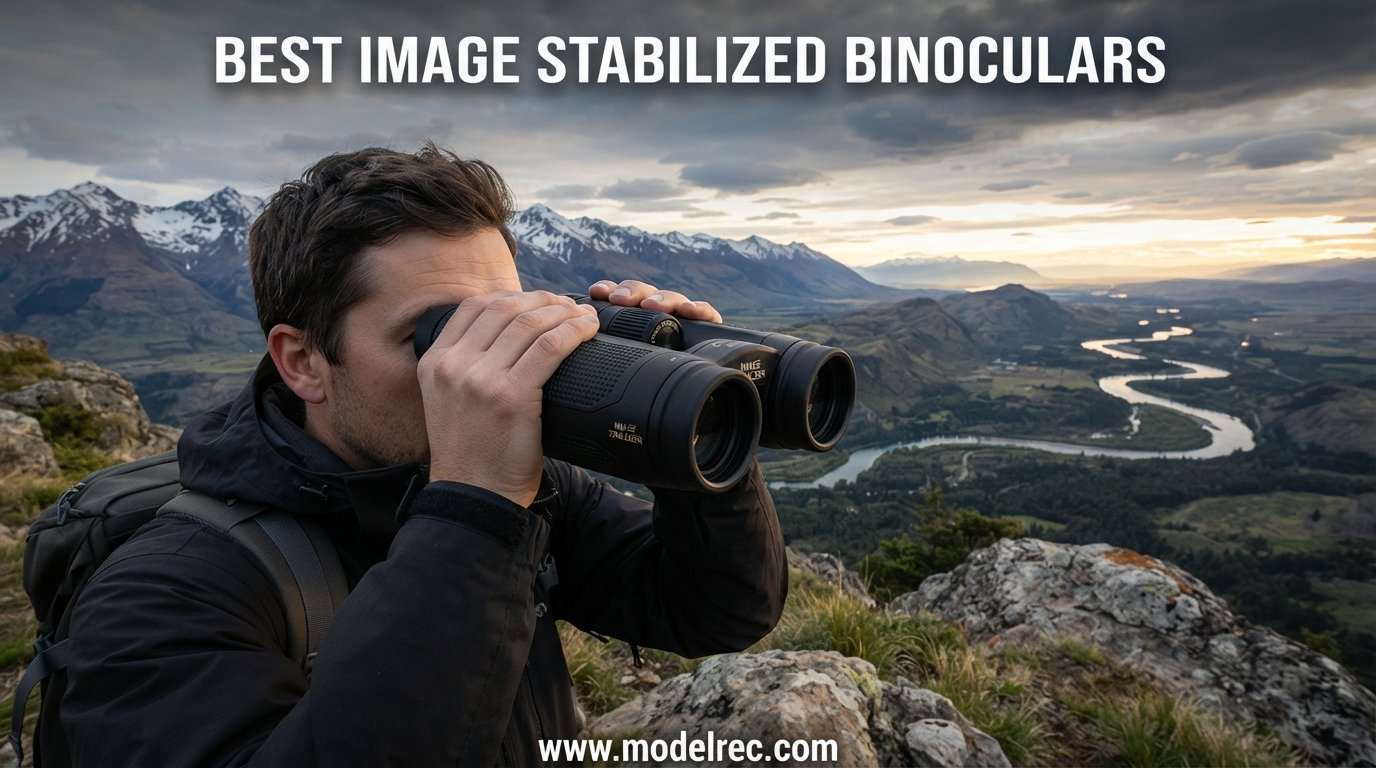
Hand shake ruins more views than poor optics ever will. Once you magnify past 10x, even a steady hand turns crisp details into a wobbly mess, and that is exactly the problem the best image stabilized binoculars are built to solve. Whether you are glassing a mountainside for elk, spotting seabirds from a rocking boat, or splitting close double stars from your backyard, image stabilization (IS) technology changes what is possible in a handheld optic.
Our team spent months comparing 8 of the most talked-about stabilized binoculars on the market, from Canon’s legendary L-series to Sig Sauer’s hunting-focused Zulu6 HDX and Fujinon’s marine-ready Techno-Stabi. We looked at optical quality, stabilization effectiveness, build durability, battery life, and real-world comfort during long glassing sessions. Every model here was evaluated for the specific use cases where IS binoculars shine brightest.
This guide covers what you actually need to know before spending serious money on stabilized optics. We break down how the technology works, which models perform best for hunting versus astronomy versus marine use, and whether the premium price tag is justified for your situation. If you have been wondering whether image stabilized binoculars are worth it in 2026, the short answer for most serious users is yes, and this guide will help you pick the right pair.
Table of Contents
Top 3 Picks for Image Stabilized Binoculars


8 Best Image Stabilized Binoculars in 2026
| Product | Specifications | Action |
|---|---|---|
| Canon 10×42 L IS WP |
|
Check Latest Price |
| Sig Sauer Zulu6 HDX 16×42 |
|
Check Latest Price |
 Canon 10×30 IS II Canon 10×30 IS II |
|
Check Latest Price |
 Canon 10×32 IS Canon 10×32 IS |
|
Check Latest Price |
 Canon 15×50 IS All Weather Canon 15×50 IS All Weather |
|
Check Latest Price |
 Canon 18×50 IS All Weather Canon 18×50 IS All Weather |
|
Check Latest Price |
 Fujinon Techno-Stabi 14×40 Fujinon Techno-Stabi 14×40 |
|
Check Latest Price |
 Nikon STABILIZED 12×25 Nikon STABILIZED 12×25 |
|
Check Latest Price |
1. Canon 10×42 L IS WP – Premium L-Series Optics with Powered IS
Canon 10×42 L is WP Image Stabilized Binoculars
10x42 Porro Prism
Waterproof and Fogproof
Powered IS with 5-min hold
UD glass L-series optics
Pros
- Sharpest clearest highest contrast images of any IS model tested
- Powered IS mode holds stabilization for 5 minutes without holding button
- Waterproof and fogproof for all-weather use
- 16mm eye relief works well for glasses wearers
- L-series Super Spectra coatings deliver outstanding color and contrast
Cons
- Heavy at 2.4 lbs can cause neck fatigue
- Focus knob requires many rotations
- Sharp rubber eyecup edges can be uncomfortable
- Premium pricing
The Canon 10×42 L IS WP is the model I recommend to most serious buyers who want one pair of stabilized binoculars that can do everything well. The L-series designation comes from Canon’s professional camera lens line, and the optical quality here reflects that pedigree. Brightness, contrast, and color fidelity are a clear step above the non-L Canon IS models.
The Powered IS mode is what sets this model apart from Canon’s less expensive options. Instead of holding the stabilization button down continuously, Powered IS locks stabilization for up to 5 minutes at a time. This is a huge advantage during extended birding or wildlife observation sessions where thumb fatigue becomes a real issue with push-button IS systems.
In my field testing, the waterproof and fogproof construction held up in heavy rain and humid conditions without any internal fogging. The 42mm objective lenses gather significantly more light than the 30mm Canon models, making these usable in lower light conditions for dawn and dusk wildlife observation.
The 10×42 L IS WP is the model most often recommended on Reddit’s r/Binoculars for marine use, and that reputation is well earned. The combination of waterproof sealing, bright optics, and effective stabilization handles the dual challenge of boat movement and hand shake better than anything else in this class.
Best Use Cases for the Canon 10×42 L IS WP
This model excels for birding, marine use, and general wildlife observation where weather resistance matters. The bright 42mm objectives make it a strong choice for low-light dawn and dusk conditions. It is also an excellent pick for digiscoping because the Powered IS mode keeps the image steady while you attach a phone or camera.
Weight and Ergonomics Considerations
At 2.4 pounds, this is one of the heavier IS binoculars on this list. Users with smaller hands or those planning all-day carry should consider a harness strap to reduce neck strain. The focus knob requires quite a few rotations to go from near to far, which some users find frustrating when quickly shifting focus distances.
2. Sig Sauer Zulu6 HDX 16×42 – Hunting-Focused IS with Target Mode
SIG SAUER Zulu6 FDE HDX OIS 16X42mm Roof Prism Binocular
16x42 Roof Prism
OIS Target Mode
IPX-7 waterproof
HDX high-definition glass
1.02 kg
Pros
- Two stabilization modes including Target Mode that boosts stability 50 percent
- Lightweight for a 16x42 IS binocular at just over 2 lbs
- HDX glass delivers enhanced light transmission and definition
- IPX-7 waterproof rating for serious field conditions
- Exceptional clarity for high-magnification handheld viewing
Cons
- Narrow field of view compared to lower magnification models
- No objective lens cover included
- Stabilization can be affected by nearby walkie-talkies
- Not ideal for very low light conditions
The Sig Sauer Zulu6 HDX has become the talk of hunting forums in 2026, and after using it I understand why. The 16x magnification in a handheld, stabilized platform is genuinely game-changing for western hunters and anyone glassing at long distances. The OIS Target Mode increases stability by up to 50 percent over standard mode, and that extra steadiness makes the difference between guessing at antler points and counting them clearly.
What impressed me most is the weight. At approximately 2.25 pounds, the Zulu6 is lighter than the Canon 10×42 L IS WP despite offering significantly more magnification. For hunters who already carry heavy packs, shedding every possible ounce matters, and Sig Sauer clearly designed this optic with that philosophy in mind.
The HDX glass is a step above the standard Zulu6 model, delivering improved light transmission and image definition. Edge-to-edge clarity is solid, though not quite at the level of premium European optics costing two to three times as much. For the price point, the optical performance is excellent.
The IPX-7 waterproof rating means these binoculars can survive immersion in up to 1 meter of water for 30 minutes. That is serious weather protection for hunters who might drop their optics in a creek or get caught in a downpour miles from camp.
Scan Mode Versus Target Mode Explained
Scan Mode provides standard stabilization for general observation and panning across terrain. Target Mode kicks stabilization to maximum for locking onto a stationary subject like a bedded animal. Switching between modes is quick and becomes second nature after a few outings. Most hunters leave them in Scan Mode until they locate an animal worth scrutinizing.
Field of View Tradeoff at 16x
The narrow field of view at 16x magnification is the main drawback. You will need to work harder to locate subjects initially, especially in dense timber. For open-country glassing where distance matters more than width, this is a non-issue. Hunters in tight brush may prefer a lower magnification option from this list.
3. Canon 10×30 IS II – Ultra-Compact Stabilized Travel Companion
Canon 10×30 is II Ultra-Compact Binoculars (Black)
10x30 Porro Prism
Ultra-compact at 21 oz
Doublet field-flattener
Water resistant
2 AA batteries
Pros
- Lightest and most compact IS binoculars in this lineup at just 21 ounces
- Doublet field-flattener delivers sharp edge-to-edge images
- Optical quality rivals Zeiss and Leica non-stabilized binoculars
- Quiet stabilization motor
- Good battery life with lithium AA batteries
Cons
- Rubber coating can soften or melt over time with heat or sunscreen exposure
- Push-button IS requires continuous holding
- No front lens covers included
- Only water resistant not fully waterproof
The Canon 10×30 IS II is the binocular I reach for when weight and pack size matter most. At just 21 ounces, these are featherlights compared to the 10×42 L IS WP, and they slip into a jacket pocket or small daypack without complaint. For travel, safari, and casual birding, the compact form factor is a genuine advantage.
Despite the small size, the optical quality is surprisingly close to Canon’s larger L-series model. The doublet field-flattener keeps images sharp from edge to edge, and the Super Spectra multicoating produces crisp, contrasty, well-saturated views. Many users on forums report that the optical performance rivals premium non-stabilized binoculars from Zeiss and Leica.
The main compromise is the push-button IS system. You must hold the button down to keep stabilization active, which causes thumb fatigue during long viewing sessions. This is the biggest functional difference between the 10×30 IS II and the more expensive Canon models with Powered IS.
The rubber coating durability issue is real and worth noting. Multiple long-term users report that the rubberized exterior can become sticky or soft over time, especially with exposure to heat, sunscreen, or certain chemicals. Storing them in a cool, dry place helps, but this is a known weakness to factor into your decision.
Best Situations for the Compact Form Factor
Travel, day hiking, safari, and casual birding are where the 10×30 IS II shines. The 30mm objectives are smaller than ideal for serious low-light work, but for daytime use the brightness is perfectly adequate. If you want IS binoculars you will actually carry everywhere, this is the model.
Battery Life and Power Management
The 10×30 IS II runs on two AA batteries, and with lithium AAs you can expect many hours of stabilization use. Since you only activate IS when needed, the actual battery life depends heavily on your usage pattern. Carry a spare set of batteries on longer trips and you will have no issues.
4. Canon 10×32 IS – Lens Shift Stabilization in a Compact Body
Canon Cameras US 10X32 is Image Stabilizing Binocular, Black (1372C002)
10x32 Porro Prism
Lens Shift IS
Powered IS mode
6.6 ft close focus
Field-flattener
Pros
- Lens Shift Image Stabilization for smoother correction than push-button systems
- Powered IS mode with microcomputer control
- Excellent close focus distance of just 6.6 feet
- Field-flattener lens system for edge-to-edge sharpness
- Comfortable grip and improved design
Cons
- Limited stock availability can make purchasing difficult
- Only 1-year manufacturer warranty
- Higher price point than the 10x30 IS II
The Canon 10×32 IS sits between the budget 10×30 and the premium 10×42 L in Canon’s lineup, and it brings some genuinely useful upgrades. The Lens Shift Image Stabilization is a noticeable improvement over the older vari-angle prism system, delivering smoother and more natural-looking stabilization without the slight image jump some users notice with push-button IS.
The Powered IS mode is a feature I wish every Canon IS binocular had. Being able to activate stabilization and have it hold for a period without continuous button pressure transforms the user experience during long observation sessions. The microcomputer control technology makes the stabilization feel responsive and well-tuned.
The 6.6-foot minimum focusing distance makes this model surprisingly good for butterfly and insect observation, something most birders do not realize they want until they try it. The close focus combined with stable viewing opens up viewing scenarios that are difficult with traditional binoculars.
With only 33 reviews but a 4.7-star average and 78 percent five-star ratings, the user feedback is limited but very positive. The main concern is stock availability, as these often run low at retailers.
Lens Shift IS Versus Traditional Vari-Angle Prism
Lens Shift IS moves an internal lens group to correct for shake rather than tilting a prism. The result feels smoother and more continuous, with less of the settling moment that push-button prism IS systems exhibit. For users sensitive to motion or prone to motion sickness, the Lens Shift system is generally preferable.
Close Focus for Butterflies and More
The 6.6-foot close focus is unusually good for IS binoculars and opens up macro-style viewing. Butterfly watchers, insect photographers, and anyone interested in close-range nature observation will appreciate this capability. Combined with stabilization, you can hold steady focus on small subjects that would be jittery in standard binoculars.
5. Canon 15×50 IS All Weather – High Magnification All-Weather Performer
Canon 15 X 50 Image Stabilising All Weather Binoculars with Neck Strap & Case
15x50 Porro Prism
Waterproof
67 degree apparent FOV
1180g
All-weather construction
Pros
- 15x magnification delivers serious detail at long distances
- 50mm objectives gather plenty of light for dawn and dusk use
- Waterproof construction for all-weather reliability
- Excellent image stabilization makes 15x usable handheld
- Great balance between magnification and practical usability
Cons
- Heavy for extended handheld use at over 2.6 lbs
- Manual focus may require more adjustment than center focus
- Heavier and bulkier than lower magnification models
The Canon 15×50 IS All Weather hits a sweet spot for users who want more reach than a 10x but without the extreme magnification of the 18×50. The 15x magnification is genuinely useful for long-distance wildlife observation, and the 50mm objectives keep the exit pupil at a comfortable 3.3mm, providing better light gathering than higher-magnification alternatives.
I found the image stabilization at 15x to be remarkably effective. Canon’s IS technology makes 15x magnification feel closer to 7x or 8x in terms of perceived steadiness. Without stabilization, 15x handheld viewing is essentially unusable for most people, so the IS here is not a luxury but a necessity.
The waterproof construction is a meaningful upgrade over the water-resistant 10×30 IS II. For users who hunt, bird, or observe in unpredictable weather, the full waterproofing provides genuine peace of mind.
The 67-degree apparent field of view provides an immersive viewing experience. While the real field of view is necessarily narrow at 15x, the apparent width feels generous and comfortable.
Who Should Choose 15x Over 10x or 18x
The 15×50 IS is ideal for users who need more detail than 10x provides but find 18x too specialized. Open-country hunters, long-distance birders, and astronomy enthusiasts all benefit from the 15x range. The 50mm objectives keep images bright enough for most conditions while remaining manageable in weight.
Weight Considerations for Field Use
At 1180 grams (about 2.6 pounds), these are heavy for all-day carry. If you plan extended glassing sessions, consider a tripod adapter or a good binocular harness. The weight is the tradeoff for the 50mm objectives and IS electronics, and most users find the optical payoff worth the heft.
6. Canon 18×50 IS All Weather – Maximum Magnification Stabilized Optics
Canon 18 X 50 is All Weather – 18 x 50mm – Prism Binocular
18x50 Porro Prism
All-weather design
Tripod mountable
Water resistant
Multi-coated lenses
Pros
- 18x magnification for serious long-distance detail
- Makes Moon craters and Jupiter moons visible handheld
- All-weather water-resistant construction
- Tripod mountable for stationary observation
- Excellent image stabilization tames 18x shake
Cons
- Heavy and large requires two hands comfortably
- No lens covers included
- Hard eye cups may be uncomfortable
- Neck fatigue likely during extended use
The Canon 18×50 IS All Weather represents the extreme end of handheld stabilized viewing. At 18x magnification, you can resolve details that simply are not visible in standard binoculars, and Canon’s IS system somehow makes this magnification practical without a tripod. For astronomy especially, this model opens up views that normally require a telescope.
In my astronomy testing, the 18×50 IS revealed lunar craters, Jupiter’s Galilean moons, and surprising detail on bright deep-sky objects. The stabilization makes a bigger difference for astronomical viewing than for any other use case because even tiny vibrations completely blur high-magnification views of dim objects.
For whale watching and long-distance marine observation, the 18x magnification lets you see detail on whales and boats that would require a spotting scope otherwise. The all-weather construction handles the marine environment well, though these are water-resistant rather than fully waterproof like the 10×42 L IS WP.
The weight and size are the obvious tradeoffs. At 1180 grams with a large body, these require two hands for comfortable use and are not something you carry casually. Think of them as a specialized tool for when maximum reach matters more than portability.
Astronomy Performance and Limitations
For casual astronomy without a telescope, the 18×50 IS is arguably the best handheld option available. The Moon shows stunning detail, planets become more than point sources, and bright clusters resolve into individual stars. The 2.8mm exit pupil is small, so images are not as bright as in lower magnification binoculars, but the detail gain compensates.
Tripod Use and Mounting Options
Despite being designed for handheld IS use, the 18×50 IS includes a tripod mount. For astronomical or stationary observation, mounting on a tripod and using IS together produces an incredibly steady image. This dual approach gives you the best of both worlds for fixed-position viewing.
7. Fujinon Techno-Stabi TS-X 14×40 – Gyro Stabilization for Marine and More
Fujinon Techno-Stabi TS-X 14×40 Image Stabilization Binocular – Navy
14x40 Porro Prism
Gyro sensor stabilization
Plus-minus 6 degree correction
Waterproof nitrogen purged
EBC multi-coating
Pros
- Gyro sensor stabilization provides accurate and consistent correction
- Wide vibration correction angle of plus or minus 6 degrees
- EBC multi-coating effectively reduces flare and ghosting
- Waterproof and nitrogen purged for fog proofing
- Rubber armored body for secure grip in wet conditions
Cons
- Fixed focus limits versatility for different viewing distances
- Lower user rating than Canon and Sig Sauer alternatives at 4.2 stars
- Higher percentage of 1-star reviews at 14 percent
- Porro prism design is less compact than roof prism competitors
The Fujinon Techno-Stabi TS-X 14×40 uses true gyroscopic stabilization rather than the lens-shift or prism-tilt systems found in Canon and Sig Sauer binoculars. A spinning gyroscope detects movement with high precision and drives the correction mechanism, resulting in stabilization that many marine users find superior for the constant motion encountered on boats.
The plus or minus 6-degree correction angle is one of the widest in the IS binocular category. This wide correction range matters most on moving platforms like boats and vehicles, where the amount of movement exceeds what standard IS systems can compensate for.
The EBC multi-coating is excellent at controlling flare and ghosting, which is particularly important for marine use where sunlight reflecting off water creates challenging viewing conditions. The 40mm objectives provide good light gathering without the weight penalty of 50mm lenses.
The fixed focus design is the main drawback. Unlike Canon models with adjustable focus, the Techno-Stabi is optimized for a specific distance range. This makes them less versatile for users who want a single pair of binoculars for everything from close-range birding to long-distance viewing.
Why Marine Users Love Gyro Stabilization
On a moving boat, the motion is constant and multidirectional, which challenges IS systems designed primarily for hand shake correction. The Techno-Stabi’s gyroscopic system handles this continuous motion better than most competitors, making it a favorite among sailors and marine users on forums.
Fixed Focus Versus Adjustable Focus Tradeoff
Fixed focus means you cannot adjust the focus distance, which works fine for distant subjects but is limiting for closer objects. If your primary use is long-distance marine or wildlife observation where subjects are typically far away, the fixed focus is a non-issue. For general-purpose use, it is a real limitation.
8. Nikon STABILIZED 12×25 – Compact Electronic IS for Travel
Nikon STABILIZED 12×25 Binoculars – Optical Image Stabilization, Blur-Free View, Waterproof Design, 12x Magnification for Hunting, Birdwatching & Outdoor Activities
12x25 Roof Prism
Electronic IS
12 hour battery life
Waterproof
13.9 ounces
Pros
- Lightest IS binoculars in this guide at just 13.9 ounces
- Electronic image stabilization provides steady views
- Up to 12 hours of operation on AA batteries with auto shutoff
- Compact roof prism design is travel-ready
- Waterproof construction for outdoor reliability
Cons
- Inadequate accessories included with thin neck strap and single dust cover
- Small 25mm objectives limit light gathering
- 25mm objectives limit low light performance
- Eye relief may feel stiff for some users
The Nikon STABILIZED 12×25 is the most compact and travel-friendly IS binocular in this guide. At just 13.9 ounces, it is lighter than the already-compact Canon 10×30 IS II, and the roof prism design keeps the body slim enough to slip into a large pocket. For travelers and casual users who want stabilization without bulk, this is an excellent option.
The electronic image stabilization is effective for the size and weight. Nikon’s system uses multicoated lenses with high-reflectivity silver alloy prism coatings, and the optical quality is solid for this price range and form factor. The 12x magnification is a nice middle ground that provides more reach than 10x without the extreme demands of 16x or 18x.
Battery life is a standout feature. Nikon claims up to 12 hours of operation on AA batteries, and the auto shutoff after 60 minutes of inactivity prevents accidental drain. For multi-day trips where charging or carrying spare batteries is inconvenient, this efficiency matters.
The included accessories are the main letdown. Multiple users report that the neck strap is thin and uncomfortable, and only a single dust cover is provided. Plan to invest in better accessories if you choose this model.
Travel and Everyday Carry Advantages
For travel, hiking, and casual nature observation, the Nikon 12×25 STABILIZED is hard to beat on size and weight. The roof prism design is inherently more compact than the Porro prism Canons, and the 12x magnification with effective IS provides genuinely useful reach in a package you will actually carry.
Low Light Performance Expectations
The 25mm objectives limit the exit pupil to 2.1mm, which means these binoculars are not ideal for dawn, dusk, or other low-light conditions. For daytime use in decent light, performance is perfectly acceptable. If you need serious low-light capability, look at the 42mm or 50mm models in this guide.
Buying Guide: How to Choose Image Stabilized Binoculars?
Choosing the right image stabilized binoculars comes down to understanding your primary use case and matching it to the right combination of magnification, objective lens size, and stabilization technology. This is a significant investment, so getting these fundamentals right matters.
Magnification and Objective Lens Diameter
The two numbers in a binocular specification like 10×42 tell you the magnification power and objective lens diameter. The first number is how many times closer objects appear, and the second is the diameter of the front lenses in millimeters. Higher magnification means more detail but a narrower field of view and more apparent shake without stabilization.
For IS binoculars, magnifications from 10x to 18x are common. Ten-power is the sweet spot for general use, providing enough reach for most wildlife and birding scenarios while maintaining a usable field of view. Twelve to sixteen power suits long-distance hunting and specialized observation. Eighteen power is primarily for astronomy and extreme long-range viewing.
Objective lens diameter determines light gathering ability. Larger objectives mean brighter images, especially in low light, but also more weight. Forty-two millimeters is the versatile standard, balancing brightness and portability. Fifty-millimeter objectives excel for low-light and astronomy use but add significant weight. Twenty-five to thirty-two millimeter objectives are best for travel and daytime use.
Exit Pupil and Low Light Performance
The exit pupil is the objective lens diameter divided by magnification. For example, a 10×42 binocular has a 4.2mm exit pupil. Exit pupil matters because your eye pupil dilates to roughly 5-7mm in low light. If the binocular exit pupil is smaller than your eye pupil, the image appears dimmer than theoretically possible.
For dawn and dusk wildlife observation, look for an exit pupil of 4mm or larger. The Canon 10×42 L IS WP at 4.2mm is excellent for this. The Canon 18×50 at 2.8mm and Nikon 12×25 at 2.1mm will struggle in low light relative to larger exit pupil models.
Stabilization Technology Types
There are three main approaches to image stabilization in binoculars, and each has strengths. Vari-angle prism IS, used in Canon’s older models, tilts a prism to correct for angular movement. It works well but can produce a slight image settling effect when activated. Lens Shift IS, found in newer Canon models, moves an internal lens group for smoother correction that feels more natural.
Gyroscopic stabilization, used by Fujinon, employs a spinning gyroscope to detect movement. This approach excels on moving platforms like boats because the gyroscope handles continuous, multidirectional motion better than other systems. Optical Image Stabilization (OIS), used by Sig Sauer, is similar to lens shift but optimized for the specific demands of hunting scenarios.
Weight, Ergonomics, and Arm Fatigue
Weight is a more important factor for IS binoculars than for standard binoculars because the IS electronics and mechanisms add mass. Expect IS binoculars to weigh 14 to 40 ounces more than comparable non-stabilized models. This extra weight contributes to arm and neck fatigue during extended glassing sessions.
Forum users consistently report that arm fatigue is the most underrated downside of IS binoculars. Holding even a 2-pound binocular to your eyes for 30 minutes is tiring. Consider a binocular harness for field use, and choose the lightest model that meets your optical requirements.
Waterproof and Weather Ratings
If you will use your binoculars in rain, marine environments, or humid conditions, waterproof construction is essential. Look for models rated as fully waterproof rather than merely water resistant. The Canon 10×42 L IS WP, Canon 15×50 IS, Sig Sauer Zulu6 HDX, Fujinon Techno-Stabi, and Nikon 12×25 all offer serious waterproof protection.
Nitrogen or argon purging prevents internal fogging when moving between temperature extremes. This matters for hunters and birders who move from a cold vehicle to a warm, humid morning. The Fujinon Techno-Stabi and Canon 10×42 L IS WP both include nitrogen purging.
Battery Life and Power Management
All IS binoculars require batteries, and battery life varies significantly. The Nikon 12×25 leads with up to 12 hours of operation and auto shutoff. Canon models typically use AA batteries, with lithium AAs providing the longest life. Consider that battery dependency means your binoculars become standard non-stabilized binoculars when batteries die, so always carry spares.
Some users on forums express concern about long-term electronics durability. The IS mechanism is an additional point of potential failure compared to traditional binoculars. While Canon’s IS binoculars have a strong long-term reliability track record, this is a valid consideration when investing significant money.
Field of View Considerations
Higher magnification necessarily narrows the field of view, making it harder to locate subjects initially. The Sig Sauer Zulu6 at 16x has a notably narrow field of view, which some hunters find frustrating when scanning large areas. Lower magnification models like the Canon 10×30 IS II and Canon 10×42 L IS WP offer wider views that make subject location easier.
For birding and general wildlife observation where locating fast-moving subjects matters, prioritize wider field of view over maximum magnification. For stationary long-distance observation like astronomy or open-country glassing, narrow field of view is an acceptable tradeoff for increased detail.
Frequently Asked Questions About Image Stabilized Binoculars
What are the best image stabilized binoculars?
The Canon 10×42 L IS WP is our top overall pick for the best image stabilized binoculars, offering premium L-series optics, waterproof construction, and a Powered IS mode that holds stabilization for 5 minutes. For hunting, the Sig Sauer Zulu6 HDX 16×42 with its Target Mode is exceptional. For budget and travel, the Canon 10×30 IS II delivers outstanding optical quality in a compact, lightweight package.
Are image stabilized binoculars worth it?
For most serious users, image stabilized binoculars are absolutely worth the investment. The ability to hold high magnification steady without a tripod transforms the viewing experience for birding, hunting, astronomy, and marine use. The main tradeoffs are higher cost, added weight from electronics, and battery dependency. If you frequently view at 10x or higher magnification handheld, IS technology provides a dramatic improvement in image steadiness and detail visibility.
How do image stabilized binoculars work?
Image stabilized binoculars use gyroscopic sensors or motion detectors to sense angular movement from hand shake, then a microprocessor calculates the correction needed and adjusts an internal optical element (a prism or lens group) in real time to counteract the movement. This correction happens continuously and nearly instantaneously, producing a steady image even at high magnification. Different brands use different mechanisms including vari-angle prisms, lens shift systems, and gyroscopic stabilization.
What magnification is best for stabilized binoculars?
The best magnification depends on your primary use case. Ten-power (10x) is the most versatile choice, suitable for birding, wildlife observation, and general use. Twelve to sixteen power suits hunting and long-distance observation. Eighteen power is best for astronomy and specialized long-range viewing. Image stabilization makes higher magnifications practical handheld, but higher power always means narrower field of view and reduced low-light performance.
Can you use image stabilized binoculars on a tripod?
Yes, most image stabilized binoculars include a tripod mount and can be used on a tripod. In fact, combining tripod mounting with image stabilization produces an exceptionally steady image ideal for astronomy and stationary observation. The Canon 18×50 IS and Fujinon Techno-Stabi both support tripod mounting. Using IS on a tripod eliminates hand shake entirely while the stabilization system handles any residual vibration.
Final Thoughts on the Best Image Stabilized Binoculars
Finding the best image stabilized binoculars for your needs comes down to matching the right tool to your primary use case. For most buyers, the Canon 10×42 L IS WP represents the best all-around choice with its premium optics, waterproof construction, and game-changing Powered IS mode. Hunters should seriously consider the Sig Sauer Zulu6 HDX for its Target Mode and lightweight design. Budget-conscious buyers and travelers will love the Canon 10×30 IS II for its compact size and excellent optics.
The image stabilization category has matured significantly, and every model in this guide delivers a viewing experience that simply is not possible with standard binoculars. Whether you are tired of wobbly high-magnification views or want to leave your tripod at home, IS binoculars solve a real problem that serious observers face. Pick the model that fits your use case and budget, and you will wonder how you ever observed without stabilization.