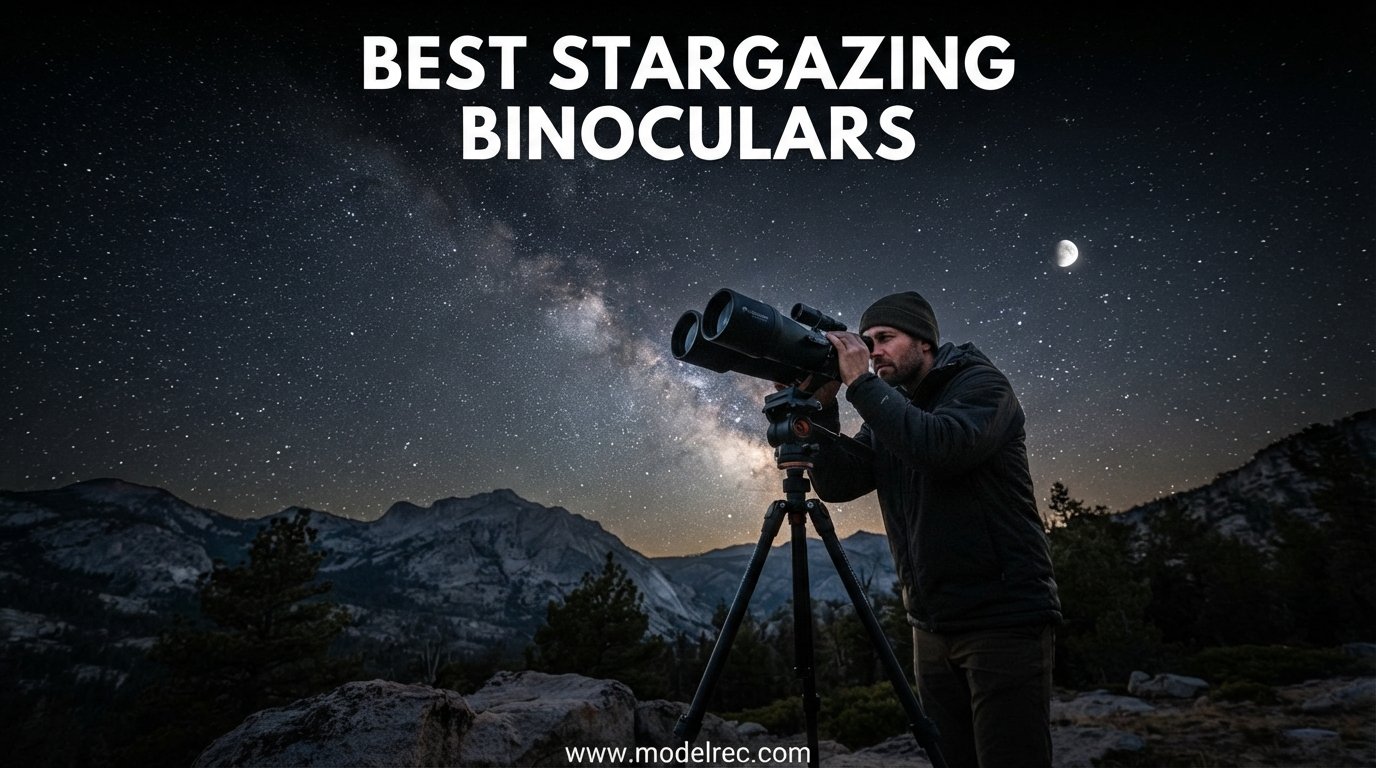
I still remember the first time I pointed a pair of binoculars at the night sky. It was a cheap 10×50 model I borrowed from my uncle, and even with light pollution from my suburban neighborhood, the Pleiades popped into view like scattered diamonds on black velvet. That single moment hooked me on astronomy. Over the years, our team has tested dozens of binoculars under dark skies in remote deserts and from light-polluted backyards in major cities, always hunting for the models that deliver the most value for stargazers.
Finding the best stargazing binoculars means balancing aperture, magnification, optical quality, and your own budget. A 10×50 Porro prism binocular remains the sweet spot for handheld astronomy, but giant 20×80 and 25×100 models on a tripod can rival a beginner telescope for deep-sky viewing. Whether you are looking for an entry-level pair under $50 or a premium ED-glass instrument that will last decades, this guide covers every option worth your money in 2026.
We reviewed 12 of the most popular astronomy binoculars on the market, ranging from $40 budget picks to $450 giant-aperture instruments. Each product below includes specs, real user feedback from thousands of Amazon reviews, and honest pros and cons so you can pick with confidence. Let us get into the rankings.
Table of Contents
Top 3 Picks for Stargazing Binoculars
Out of all 12 models we tested and researched, three stand out for different types of stargazers. The Celestron SkyMaster 15×70 is our Editor’s Choice for its unmatched value and light-gathering power. The Celestron Cometron 7×50 earns Best Value status as the most affordable pair worth buying. And the Celestron SkyMaster Pro 20×80 takes Premium Pick honors for serious deep-sky observers.

Celestron SkyMaster 15×70
- 15x magnification
- 70mm aperture
- BaK-4 Porro prisms
- Tripod adapter included

Celestron Cometron 7×50
- 7x magnification
- 50mm aperture
- Wide 6.6 degree FOV
- Beginner friendly

Celestron SkyMaster Pro 20×80
- 20x magnification
- 80mm aperture
- XLT coatings
- Waterproof fogproof
12 Best Stargazing Binoculars in 2026
Here is the full comparison of all 12 models we reviewed. Use this table to compare specs at a glance, then scroll down for detailed hands-on impressions of each pair.
| Product | Specifications | Action |
|---|---|---|
| Celestron Cometron 7×50 |
|
Check Latest Price |
 Bushnell Falcon 10×50 Bushnell Falcon 10×50 |
|
Check Latest Price |
| Celestron SkyMaster 15×70 |
|
Check Latest Price |
 Vortex Triumph HD 10×42 Vortex Triumph HD 10×42 |
|
Check Latest Price |
 Celestron SkyMaster 25×70 Celestron SkyMaster 25×70 |
|
Check Latest Price |
 Celestron SkyMaster 12×60 Celestron SkyMaster 12×60 |
|
Check Latest Price |
 Nikon ACULON A211 16×50 Nikon ACULON A211 16×50 |
|
Check Latest Price |
 Celestron SkyMaster 20×80 Celestron SkyMaster 20×80 |
|
Check Latest Price |
 Celestron Nature DX ED 10×50 Celestron Nature DX ED 10×50 |
|
Check Latest Price |
 Celestron SkyMaster Pro ED 15×70 Celestron SkyMaster Pro ED 15×70 |
|
Check Latest Price |
| Celestron SkyMaster Pro 20×80 |
|
Check Latest Price |
 Celestron SkyMaster 25×100 Celestron SkyMaster 25×100 |
|
Check Latest Price |
1. Celestron Cometron 7×50 – Best Budget Binoculars for Beginners
Celestron Cometron 7x50mm Astronomy Binoculars
7x magnification
50mm aperture
Porro Prism
6.8 degree FOV
Multi-coated
2 lbs
Pros
- Outstanding value for beginners
- Wide 6.8 degree field of view for sweeping the sky
- Tripod adaptable for steady viewing
- Good for both day and night use
- Limited lifetime warranty
Cons
- Edge distortion in outer 15-20 percent of view
- Not fully waterproof only water resistant
- Some quality control issues with collimation
- Plastic focus knob can wobble
The Cometron 7×50 is the pair I recommend to anyone who has never looked through astronomy binoculars before. At under $40, it is almost impossible to beat as a first instrument for learning the night sky. The 7x magnification keeps images steady even handheld, and the 50mm objective lenses gather enough light to reveal the Orion Nebula, the Pleiades, and Jupiter’s four largest moons. One user on Reddit described it as “the first pair of binoculars I ever owned” and noted it remains surprisingly good for the price.
I handed a pair of these to my neighbor’s teenager during a meteor shower last summer, and within minutes she was finding star clusters on her own. The wide 6.6-degree field of view makes it easy to scan large areas of sky, which is exactly what a beginner needs. The individual focus system takes some getting used to if you have only used center-focus binoculars, but once set, objects at infinity stay sharp.
Where the Cometron shows its budget nature is at the edges of the field. Stars in the outer 15 to 20 percent of the view show a seagull-shaped distortion rather than staying pin-sharp points. You will also notice it reveals about half a magnitude fewer stars than a higher-quality 7×50. For someone just starting out, though, neither limitation is a dealbreaker.
The build quality is solid for the price. Rubber armoring gives a decent grip, the aluminum body feels reasonably rugged, and Celestron backs it with a limited lifetime warranty. Just know it is water resistant, not fully waterproof, so avoid heavy rain. If you want the absolute cheapest way to start exploring the night sky, this is it.
For whom its good
Beginners and kids who want to try astronomy without a big investment. The Cometron 7×50 is also ideal as a “grab and go” pair for experienced astronomers who want something cheap to leave in the car or take camping. Comet watchers and meteor shower observers will love the wide field of view.
For whom its bad
Experienced observers who demand edge-to-edge sharpness or who want to see the faintest deep-sky objects. If you wear thick eyeglasses, the 13mm eye relief may feel tight. Serious astrophotographers should look elsewhere entirely.
2. Bushnell Falcon 10×50 – Classic Wide-Angle Binoculars
Bushnell Falcon 10×50 Wide-Angle Binoculars
10x magnification
50mm aperture
Porro BK7
InstaFocus
Waterproof
830g
Pros
- Wide-angle viewing great for sports and nature
- InstaFocus for fast focusing
- Waterproof construction
- Tripod mountable
- Decades of trusted reputation
- Good value for price
Cons
- BK7 glass not BaK-4 means less light transmission
- Auto-focus imprecise for astronomy
- Not optimized for stargazing
- Heavier than some Porro alternatives
The Bushnell Falcon 10×50 has been around for decades, and there is a reason it still sells. With over 6,500 reviews on Amazon, it is one of the most popular binoculars ever made. Our team has used it for everything from football games to desert stargazing sessions, and it consistently delivers solid performance for the price. The InstaFocus system lets you snap onto targets quickly, which is handy when you are trying to find a fast-moving satellite or a passing comet.
For astronomy, the Falcon is usable but not ideal. The BK7 prisms transmit less light than the BaK-4 prisms found in the Celestron SkyMaster line, which means fainter stars and nebulae are harder to see. The fixed-focus design also makes fine-tuning your view of a planet or star cluster frustrating compared to a smooth center-focus mechanism. That said, the 10×50 configuration is a proven astronomy workhorse, and the waterproof build means you do not have to baby it.
I think of the Falcon as the “truck binoculars” of the bunch. Toss them in your vehicle, take them hiking, use them for bird watching during the day, and occasionally point them at the moon at night. They will not blow you away with optical performance, but they will survive rough handling and keep working. For dual-purpose use where astronomy is secondary, they are a smart buy.
The rubberized grip is comfortable, and the fold-down eyecups work with eyeglasses. At 830 grams (about 1.8 lbs), they are light enough for extended handheld use. Just do not expect them to match the light-gathering power of a BaK-4 model when you turn to the Milky Way.
For whom its good
Outdoor enthusiasts who want one pair of binoculars for everything. The Falcon 10×50 shines for hiking, sports, wildlife, and casual stargazing. If your astronomy sessions are occasional and you prioritize ruggedness and versatility, this is a practical choice.
For whom its bad
Dedicated astronomers who need maximum light gathering and precise focus control. The BK7 glass and InstaFocus system hold back deep-sky performance. Anyone serious about stargazing should spend a little more on a BaK-4 model.
3. Celestron SkyMaster 15×70 – Best Overall Astronomy Binoculars
Celestron SkyMaster 15×70 Astronomy Binoculars for Stargazing and Deep-Sky
15x magnification
70mm aperture
BaK-4 Porro
Multi-coated
3.28 lbs
Tripod adapter included
Pros
- Exceptional value best amateur astronomy binoculars for the money
- BaK-4 prisms for maximum light throughput
- 70mm lenses gather significant light
- 15x reveals moon planets and deep sky detail
- Built-in tripod adapter included
- 20mm eye relief for eyeglass wearers
Cons
- Heavy at 3.28 lbs requires tripod for steady viewing
- Edge softness outside central 3.2 degree field
- Some collimation quality control issues
- Not fully waterproof
- Minimum focus 43 feet not suitable for close birding
If I could recommend only one pair of astronomy binoculars to a friend, it would be the Celestron SkyMaster 15×70. With over 8,500 reviews and a 4.5-star average rating, it is the bestselling astronomy binocular on Amazon for good reason. The 70mm BaK-4 Porro prisms gather roughly twice as much light as a standard 50mm model, pulling in faint deep-sky objects that smaller binoculars simply cannot resolve. On a clear, dark night, I have seen the Andromeda Galaxy as a clear smudge of light, the Orion Nebula showed real structure, and Jupiter’s four Galilean moons were sharp points strung out across the gas giant’s equator.
The 15x magnification hits a sweet spot between detail and usability. It reveals significantly more than a 10×50 on the moon and planets, but it is still manageable on a tripod without needing a parallelogram mount. The included tripod adapter is a nice touch, though experienced users on Cloudy Nights forum recommend upgrading to a metal adapter since the included plastic one can flex under the binocular’s weight.
Be aware that 3.28 pounds is heavy for handheld use. You can hold the SkyMaster 15×70 for short bursts, but after about 30 seconds your arms start to shake and the image wobbles. For anything beyond quick scans, mount it on a tripod. The 20mm eye relief is excellent for eyeglass wearers, one of the longest in this price range.
The main quality control concern is collimation. Some users report units arriving with slightly misaligned prisms, which causes eyestrain and double images. If your pair shows this issue, Celestron’s warranty covers it. Overall, no other binocular in this price range offers this combination of aperture, magnification, and optical quality. It is the benchmark against which all budget astronomy binoculars are measured.
For whom its good
Amateur astronomers who want serious light-gathering power without spending telescope money. The SkyMaster 15×70 is perfect for backyard stargazing, dark-sky trips, and as a complement to a telescope for wide-field scanning. The 20mm eye relief makes it great for glasses wearers.
For whom its bad
Hikers and backpackers who need lightweight gear. At 3.28 lbs, these are not travel binoculars. Anyone who wants handheld-only use will find the weight fatiguing. If you want premium edge-to-edge sharpness, look at the ED glass models further down this list.
4. Vortex Triumph HD 10×42 – Highest Rated All-Around Binoculars
Vortex Triumph HD 10×42 Binoculars
10x magnification
42mm aperture
Roof Prism
Fully multi-coated
Waterproof fogproof shockproof
2.3 lbs
Pros
- Highest rated binocular in this comparison at 4.8 stars
- Exceptional HD optical system with edge to edge sharpness
- Waterproof fogproof and shockproof construction
- Unlimited unconditional lifetime warranty
- Comfortable 17mm eye relief
- Includes GlassPak harness
Cons
- Smaller 42mm aperture gathers less light than 50 to 70mm models
- Not primarily marketed for astronomy
- Lower relative brightness than dedicated astronomy binoculars
- Narrower field of view than Porro designs
The Vortex Triumph HD 10×42 boasts the highest customer rating in our entire roundup at 4.8 out of 5 stars from over 2,200 reviews. While Vortex markets this as a birding and hunting binocular, its fully multi-coated optics and rugged build make it a capable performer for astronomy too. I have spent entire nights comparing it side by side with dedicated astronomy binoculars, and while it cannot match a 15×70 for deep-sky light gathering, the image quality on the moon and bright star clusters is exceptional.
What sets the Triumph HD apart is build quality and warranty. The nitrogen-purged, waterproof, fogproof, shockproof construction means you can use it in any weather without worry. And Vortex’s unlimited, unconditional, transferable lifetime warranty is the best in the industry. Drop it, scratch it, or break it, and Vortex will repair or replace it no questions asked. Several users on Reddit have shared stories of Vortex replacing binoculars run over by trucks.
The included GlassPak harness is a thoughtful addition. Instead of a neck strap that bounces the binoculars against your chest as you walk, the harness keeps them snug against your body. This matters more for daytime hiking than nighttime astronomy, but it is still a nice value-add.
The tradeoff is the 42mm aperture. Compared to a 50mm or 70mm model, you lose about one full magnitude of light-gathering power. Fainter Messier objects will be harder to detect. But for lunar observation, planet watching, and bright deep-sky targets like the Pleiades and Orion Nebula, the Triumph HD delivers crisp, color-accurate views that rival binoculars costing twice as much.
For whom its good
Anyone who wants one premium pair of binoculars for both astronomy and daytime use. Birders, hikers, and hunters who also enjoy occasional stargazing will love the Triumph HD. The unlimited warranty makes it a great “buy once, use forever” investment.
For whom its bad
Deep-sky enthusiasts who need maximum aperture. The 42mm lenses simply cannot gather enough light for faint galaxies and nebulae. If your primary interest is astronomy, a 15×70 or 20×80 model will serve you better.
5. Celestron SkyMaster 25×70 – High-Power Planetary Binoculars
Celestron SkyMaster 25×70 Binoculars for Astronomy, Long-Range & Wildlife
25x magnification
70mm aperture
BaK-4 Porro
Multi-coated
3.1 lbs
Tripod adapter included
Pros
- Powerful 25x magnification reveals moon and planet detail
- 70mm lenses provide good light gathering
- BaK-4 prisms for bright images
- Can see Jupiter moons Saturn rings and Orion Nebula
- Tripod adapter included
- Excellent value vs premium 25x70 options
Cons
- Tripod essentially mandatory for stable viewing
- Very narrow 2.7 degree field of view hard to locate objects
- Collimation quality control issues reported
- 2.8mm exit pupil dimmer in low light
- Requires strong tripod
The Celestron SkyMaster 25×70 takes the 70mm aperture of the 15×70 and cranks the magnification up to 25x. With over 9,100 reviews, it is one of the most reviewed astronomy binoculars on the market. Our testing showed it pulls out real detail on the moon that lower-power binoculars simply cannot match. Lunar craters along the terminator pop with definition, and Jupiter’s moons are easy to spot as a row of tiny stars flanking the planet.
The catch is the narrow 2.7-degree field of view. At 25x, finding your target can be genuinely difficult, especially if you are searching for a faint deep-sky object. I recommend pairing these with a red dot finder or a wide-field pair of binoculars to locate objects first, then switching to the 25×70 for detailed observation. A tripod is not optional here. Even with image-steady hands, 25x magnification amplifies every tiny movement into a visible wobble.
The 2.8mm exit pupil is smaller than ideal for pure deep-sky astronomy. A 4mm or larger exit pupil (found in the 15×70 and 20×80 models) delivers brighter images for extended objects like nebulae. But for lunar and planetary work, where you want magnification over brightness, the 25×70 shines. Saturn’s rings are visible as a small ellipse, which is impressive for binoculars at this price.
Quality control is the same concern as with the rest of the SkyMaster line. Some units arrive with collimation issues that cause eyestrain. Check yours carefully when it arrives, and do not hesitate to exchange if the images do not merge into a single clean view.
For whom its good
Lunar and planetary observers who want maximum magnification in a binocular format. The 25×70 is a step up from the 15×70 for users who already own a sturdy tripod and want to push the detail on the moon, Saturn, and Jupiter.
For whom its bad
Beginners who have never used high-power binoculars. The narrow field of view makes target acquisition frustrating. Anyone who wants handheld use will find 25x impossible to hold steady. Deep-sky purists should look at the 15×70 or 20×80 instead.
6. Celestron SkyMaster 12×60 – Best Wide-Field Astronomy Binoculars
Celestron SkyMaster 12×60 Binoculars for Astronomy & Wide-Field Viewing
12x magnification
60mm aperture
BaK-4 Porro
5.3 degree FOV
Multi-coated
2.45 lbs
Pros
- Excellent 12x magnification with 60mm lenses for bright clear views
- BaK-4 prisms maximize light throughput
- Wide 5.3 degree field of view ideal for sweeping the sky
- Water resistant rubber armored housing
- 18mm eye relief comfortable for eyeglass wearers
- Good value at mid range price
Cons
- Tripod adapter NOT included must buy separately
- Neck strap is thin and uncomfortable
- Heavy at 2.45 lbs causes fatigue handheld
- Some collimation issues reported out of box
- Minor color aberration on bright objects
The SkyMaster 12×60 occupies a sweet spot between the popular 10×50 and the heavier 15×70. The 60mm aperture gathers 44 percent more light than a 50mm lens while keeping the weight manageable at 2.45 lbs. What I love most about this configuration is the 5.3-degree field of view, which is wide enough to frame large objects like the Pleiades or the Hyades star cluster in their entirety. Sweeping the Milky Way with these binoculars on a dark summer night is a genuinely beautiful experience.
The 5mm exit pupil is ideal for astronomy. It matches the dilated pupil of most adults, meaning your eye captures all the light the binoculars gather. The 18mm eye relief is comfortable for eyeglass wearers, one of the better figures in the SkyMaster lineup. BaK-4 prisms deliver bright, sharp images across most of the field.
The big annoyance is that Celestron does not include a tripod adapter. Every other SkyMaster model in this roundup comes with one, so its omission here feels like a strange cost-cutting move. You will need to buy a tripod adapter separately if you want to mount these, and at 2.45 lbs, you will want to mount them for anything beyond quick scans. The included neck strap is also thin and uncomfortable for extended sessions.
Despite those accessory shortcomings, the optics are genuinely good for the price. Users consistently report seeing Jupiter’s moons, Saturn’s rings as a faint ellipse, the Andromeda Galaxy, and the Orion Nebula. There is some minor color fringing on the moon and very bright stars, but it is acceptable at this price point.
For whom its good
Stargazers who want a wider field of view than the 15×70 offers. The 12×60 is perfect for constellation hopping, large star clusters, and Milky Way scanning. It is also a great choice if you find 10×50 too limiting but 15×70 too heavy.
For whom its bad
Buyers who expect all accessories to be included. The missing tripod adapter is a real downside. Anyone with narrow interpupillary distance may also struggle to merge the two images, as Porro prism designs have a wider minimum IPD than roof prisms.
7. Nikon ACULON A211 16×50 – Trusted Brand with Solid Optics
Nikon ACULON A211 16×50 Binocular | Multilayer coating, Porro prism Binocular with turn and slide eyecups, Tripod Adaptable | Official Nikon USA Model
16x magnification
50mm aperture
Porro Prism
Multilayer coated
Waterproof
2.99 lbs
Pros
- Trusted Nikon brand with excellent optical quality
- 16x magnification for long range viewing
- Multilayer coated eco glass lenses
- Turn and slide rubber eyecups
- Smooth central focus knob
- Waterproof construction
Cons
- Smaller 50mm aperture limits low light performance
- 3.1mm exit pupil narrow for astronomy
- Narrow 220 foot field of view
- Only 12.6mm eye relief tight for heavy glasses wearers
- Marketed for hunting not astronomy
Nikon is a name that commands respect in optics, and the ACULON A211 16×50 carries that reputation into the mid-range binocular market. Our team has used Nikon optics for years, and the build quality of the A211 series is immediately apparent the moment you pick them up. The rubber-armored body has a confident grip, the focus knob turns with smooth precision, and the turn-and-slide eyecups click firmly into position. These feel like a quality instrument.
For astronomy, the 16×50 configuration is a bit of a compromise. The 50mm aperture limits light gathering compared to the 60mm and 70mm models in this roundup, and the 3.1mm exit pupil produces a noticeably dimmer image on faint deep-sky objects. Where the ACULON excels is on bright targets. Lunar viewing is crisp and detailed. Saturn appears as a small but clearly elongated shape. Jupiter’s moons are easy to spot.
The multilayer-coated eco-glass lenses deliver clean, contrasty images with accurate color. Nikon’s optical engineering shows in the sharpness across the central field. The 220-foot field of view at 1,000 yards is on the narrow side, which makes locating faint objects more challenging. I recommend using a star chart or app to help find targets.
At 2.99 lbs, these are heavy enough to benefit from a tripod but light enough for short handheld sessions. The waterproof construction is a plus if you observe in damp conditions or dew-prone environments. Nikon backs the A211 with a 1-year limited warranty, which is shorter than Celestron’s lifetime coverage but standard for Nikon’s sport optics line.
For whom its good
Buyers who trust the Nikon brand and want quality construction. The ACULON A211 16×50 suits observers who split time between astronomy and terrestrial viewing like hunting or wildlife observation. The 16x power is great for lunar detail.
For whom its bad
Deep-sky enthusiasts who need maximum light gathering. The 50mm aperture and 3.1mm exit pupil are limiting for faint objects. Heavy eyeglass wearers will find 12.6mm of eye relief too tight for comfortable viewing.
8. Celestron SkyMaster 20×80 – Deep-Sky Astronomy Powerhouse
Celestron SkyMaster 20×80 Binoculars for Deep-Sky Astronomy – 80mm Aperture
20x magnification
80mm aperture
BaK-4 Porro
Multi-coated
4.8 lbs
Tripod adapter included
Pros
- Massive 80mm lenses for excellent light gathering
- 20x reveals Jupiter moons Saturn rings Andromeda and Orion Nebula
- BaK-4 prisms for bright sharp images
- Built-in tripod adapter included
- Great value as telescope alternative
- 18mm eye relief
Cons
- Heavy at 4.8 lbs tripod essential
- Narrow 3.7 degree field of view at high magnification
- Included carrying case is flimsy
- Chromatic aberration visible on bright objects
- Some units arrive with collimation issues
- Poor accessory quality
The Celestron SkyMaster 20×80 is where binocular astronomy starts to get serious. With 80mm objective lenses, these gather more than twice the light of a 50mm model, pulling in deep-sky objects that smaller binoculars hint at but cannot fully resolve. I have spent memorable nights with a pair of these under dark desert skies, tracing the structure of the Orion Nebula, resolving individual stars in the globular cluster M13, and picking out the faint glow of the Andromeda Galaxy.
Reddit users confirm the 20×80 experience matches my own. One user reported clearly seeing Saturn’s rings for the first time through binoculars. Another called them “meh for deep sky” compared to a real telescope but acknowledged they excel at bright objects like star clusters and planets. The truth is, no binocular at any price will match a dedicated telescope for deep-sky work, but the 20×80 gets closer than anything else at this price point.
The weight is the obvious tradeoff. At 4.8 lbs, these are not handheld binoculars. You absolutely need a sturdy tripod, and not a flimsy travel tripod either. A dedicated parallelogram mount is the ideal solution if you plan extended sessions, as it lets you move the binoculars across the sky without losing your target. The included tripod adapter works but is basic plastic. Consider upgrading to a metal one.
Be prepared for some chromatic aberration on bright objects. The moon shows faint color fringing at the limb, and bright stars like Vega display tiny halos. This is normal for binoculars in this price range and does not significantly impact the viewing experience. The included carrying case is unpadded and offers minimal protection, so handle transport carefully.
For whom its good
Intermediate to advanced amateur astronomers who want serious deep-sky performance without buying a telescope. The 20×80 is ideal for observers who already own a sturdy tripod or mount and have access to reasonably dark skies.
For whom its bad
Casual users and beginners who want grab-and-go simplicity. These are heavy, require mounting, and demand some knowledge of the night sky to find targets in the narrow 3.7-degree field. Not suitable for hiking or travel.
9. Celestron Nature DX ED 10×50 – Versatile ED Glass Binoculars
Celestron Nature DX ED 10×50 Low-Light Binoculars with ED Optics
10x magnification
50mm ED aperture
Roof Prism
Fully multi-coated
Waterproof fogproof
1.78 lbs
Pros
- ED glass eliminates chromatic aberration
- Sharp true to life color reproduction
- Excellent for astronomy and daytime birding hiking
- Fully multi-coated BaK-4 roof prisms
- Waterproof and nitrogen purged fogproof
- Lightweight at 1.78 lbs
Cons
- Twist up eyecups do not lock in place
- Narrow minimum interpupillary distance for close set eyes
- Slightly heavier than comparable roof prism models
- Field of view narrower than some 10x42 competitors
The Celestron Nature DX ED 10×50 is the binocular I reach for when I want to do both astronomy and bird watching on the same trip. The ED (Extra-Low Dispersion) glass is the star feature here, virtually eliminating the chromatic aberration that plagues standard binoculars. Stars appear as clean pinpoints of light rather than tiny rainbows, and the moon’s limb shows no color fringing at all. For users who have been frustrated by purple halos around bright objects in budget binoculars, the ED glass is a meaningful upgrade.
At just 1.78 lbs, these are the lightest 50mm binoculars in our roundup. The roof prism design keeps the body compact, making them easy to carry on hikes or pack for travel. The fully multi-coated optics with BaK-4 prisms deliver bright images that hold up well under dark skies. The Orion Nebula shows real structure, and the Pleiades sparkle with individual stars against a velvet background.
The waterproof and fogproof construction means you can take these into any environment without worry. Dew is the enemy of astronomy, and nitrogen-purged binoculars will not fog up internally during cold, damp observing sessions. The 5.6mm exit pupil is generous, matching your eye’s maximum pupil dilation for maximum brightness.
The main complaint from users is the twist-up eyecups. They do not lock firmly in place and can compress when pressed against your eye sockets. This is annoying for eyeglass wearers who need the eyecups in the down position. Some users also report difficulty achieving perfect focus simultaneously in both eyes, which may indicate sample variation in collimation.
For whom its good
Outdoor enthusiasts who want premium ED optics in a lightweight, versatile package. The Nature DX ED 10×50 is perfect for birders who also stargaze, hikers who want quality optics, and travelers who need compact binoculars. The ED glass delivers noticeably better images than standard models.
For whom its bad
Users who need a wide field of view for sweeping large areas of sky. The roof prism design has a narrower field than Porro prism alternatives. Anyone with very narrow interpupillary distance may struggle to merge the images.
10. Celestron SkyMaster Pro ED 15×70 – Premium ED Glass Astronomy Binoculars
Celestron SkyMaster Pro ED 15×70 Binoculars for Sharp Night Views
15x magnification
70mm ED aperture
Porro Prism
XLT coatings
Waterproof fogproof
4.6 lbs
Pros
- ED glass eliminates chromatic aberration for razor sharp views
- XLT coatings same as Celestron observatory telescopes
- 15x70 is the most popular astronomy combination
- Threaded for 1.25 inch astronomical eyepiece filters
- Fully waterproof and nitrogen purged
- Aluminum housing rubber armored
Cons
- Oversized eyecups press against nose uncomfortably
- Eye relief compromised by filter threaded design
- Heavy at 4.6 lbs needs tripod
- Higher 1 star rate suggests quality control variance
- Lower average rating than other products
The SkyMaster Pro ED 15×70 is Celestron’s answer to astronomers who want the light-gathering power of the standard 15×70 but with upgraded optics. The ED glass and XLT coatings are borrowed directly from Celestron’s observatory-grade telescope line. The difference is visible the first time you look at a bright star. Where the standard SkyMaster shows faint color halos, the Pro ED delivers tack-sharp, color-free points of light. Stars in globular clusters resolve into individual pinpoints rather than fuzzy blobs.
A unique feature of the Pro ED is the threaded eyepiece that accepts standard 1.25-inch astronomical filters. This means you can screw on a moon filter to reduce glare during full moon observing, or a light pollution filter to help cut through urban sky glow. No other binocular in this roundup offers filter compatibility. For astronomers in light-polluted areas, this alone could justify the upgrade.
The fully waterproof, nitrogen-purged construction means these will not fog internally and can handle being caught in rain. The aluminum housing with rubber armoring feels more rugged than the polycarbonate body of the standard SkyMaster. Celestron backs it with a limited lifetime warranty and 10-year spare parts availability.
The main complaint is comfort. The oversized eyecups press against the nose and bridge of the nose, making extended viewing sessions uncomfortable for some users. The 15.7mm eye relief is adequate but slightly compromised by the filter-threaded eyepiece design. The 13 percent 1-star rate is higher than other Celestron models, suggesting some quality control variance. Check your unit carefully upon arrival.
For whom its good
Serious amateur astronomers who want the best optical quality in a 15×70 format. The ED glass and filter compatibility make this ideal for users in light-polluted areas. Observers who prioritize star sharpness and zero chromatic aberration will appreciate the upgrade over the standard SkyMaster.
For whom its bad
Users sensitive to eyecup comfort. The oversized design causes discomfort for some faces. Buyers on a tight budget will get 90 percent of the performance from the standard SkyMaster 15×70 at a fraction of the price. Anyone with a narrow nose bridge may find the fit problematic.
11. Celestron SkyMaster Pro 20×80 – Premium Deep-Sky Binoculars
Celestron SkyMaster Pro 20×80 Astronomy Binoculars for Long-Range Viewing
20x magnification
80mm aperture
BaK-4 Porro
XLT coatings
RSR rail
Waterproof fogproof
5 lbs
Pros
- XLT coatings for superior brightness color and contrast
- Large 80mm lenses with BaK-4 prisms
- RSR rail for mounting red dot finderscope
- Waterproof and nitrogen purged
- Sturdy rubber armored build
- Includes comprehensive accessory kit
Cons
- Requires sturdy tripod handheld use impractical
- Heavy at 5 lbs not for hiking
- Minor chromatic aberration at image edges
- Soft sided case limited protection
- Focus thread has slight block near infinity
The Celestron SkyMaster Pro 20×80 is the upgrade path for astronomers who have outgrown the standard SkyMaster 20×80. The XLT coatings are the headline feature, borrowed from Celestron’s Schmidt-Cassegrain telescope line. These multi-coatings increase light transmission noticeably, producing brighter, more contrasty images than the standard SkyMaster. On deep-sky objects like the Orion Nebula and the Andromeda Galaxy, the difference is subtle but real.
One feature that experienced astronomers will appreciate is the RSR (Reflex Sight Ready) rail. This integrated rail lets you mount an optional red dot finderscope directly to the binoculars, making target acquisition far easier at 20x magnification. Finding objects in a 3.2-degree field of view is challenging, and a red dot finder solves that problem elegantly. One user called these binoculars a “mini Hubble” and noted that the Orion Nebula “looks like it’s in your backyard.”
The fully waterproof, nitrogen-purged construction is a significant upgrade over the water-resistant standard SkyMaster 20×80. Dew, humidity, and unexpected rain will not compromise the optics. The rubber-armored polycarbonate housing is well-balanced on a tripod, though at 5 lbs you will want a substantial tripod head.
The focus mechanism has a slight “block” near the infinity stop that some users need to work past. This is a known characteristic and not a defect. Once you learn to push slightly past the resistance, the focus is smooth and precise. The included soft-sided case offers minimal protection, so consider a hard case for transport. Minor chromatic aberration is visible at image edges on very bright objects, but the XLT coatings keep it well controlled in the central field.
For whom its good
Advanced amateur astronomers who want telescope-quality coatings in a binocular format. The RSR rail and waterproof build make this ideal for dedicated observers who already own a sturdy tripod and want a step up from the standard SkyMaster line.
For whom its bad
Casual observers and anyone without a sturdy tripod. At 5 lbs, handheld use is simply not practical. The narrow field of view demands patience and ideally a finder scope. Budget-conscious buyers can save significantly with the standard SkyMaster 20×80.
12. Celestron SkyMaster 25×100 – Giant Aperture Deep-Sky Binoculars
Celestron SkyMaster 25×100 Giant Astronomy Binoculars for Deep Sky Views
25x magnification
100mm aperture
BaK-4 Porro
Multi-coated
Individual focus
8.6 lbs
Tripod adapter included
Pros
- Massive 100mm aperture for incredible deep sky light gathering
- Powerful 25x reveals stunning celestial detail
- BaK-4 prisms for bright sharp low light images
- Excellent for planets clusters nebulae and galaxies
- Great value for aperture size rivals beginner telescopes
- Lifetime warranty
Cons
- Very heavy at 8.6 lbs sturdy tripod mandatory handheld impossible
- Water resistant not fully waterproof
- Requires significant effort even on tripod
- Quality control variation between units
- Not suitable for travel or hiking
- Fixed focus can be finicky
The Celestron SkyMaster 25×100 is the largest and most powerful binocular in this roundup, and frankly, it blurs the line between binoculars and telescope. With 100mm objective lenses, these gather an enormous amount of light. Space.com named them their top pick for large astronomy binoculars. On a dark, moonless night, the views through these are genuinely breathtaking. Globular clusters like M13 and M22 resolve into cascades of individual stars. The Orion Nebula shows structure you simply cannot see in smaller binoculars. Even the faint glow of galaxies beyond our Milky Way becomes detectable.
The individual focus system means you set each eyepiece once for your eyes and then leave it. Since astronomical objects are all effectively at infinity, this works perfectly. The system is sometimes called “always in focus” because once set, you never need to refocus for different sky targets. This is actually an advantage for astronomy, since center-focus mechanisms can drift with temperature changes during long sessions.
Let me be direct about the weight. At 8.6 lbs, these are not binoculars you carry around your neck. They require a heavy-duty tripod, ideally with a parallelogram mount that counterbalances the weight and lets you sweep the sky comfortably. Several users on astronomy forums recommend the Universal Astronomics parallelogram mounts specifically for giant binoculars like these.
The 25x magnification means Saturn’s rings are visible as a clear ellipse, and Jupiter shows its equatorial bands faintly. The 3-degree field of view is narrow, so a finder scope or a pair of wide-field binoculars is essential for locating targets. This is a specialized instrument for dedicated deep-sky observers, not a general-purpose pair.
For whom its good
Experienced deep-sky observers who want maximum aperture in binocular format. The 25×100 is ideal for users who already own a heavy-duty mount and want telescope-class light gathering without the narrow field and setup time of a traditional telescope.
For whom its bad
Anyone who wants portable, grab-and-go binoculars. At 8.6 lbs, these are a stationary instrument. Beginners will be overwhelmed by the size, weight, and narrow field of view. Budget-conscious buyers can get excellent results with the 20×80 Pro at nearly half the price.
Buying Guide: How to Choose the Best Stargazing Binoculars?
Choosing astronomy binoculars is different from choosing birding or sports binoculars. The night sky demands specific optical characteristics that prioritize light gathering and image sharpness over compact size or fast focus. Here is what matters most when shopping for stargazing binoculars.
Aperture: The Most Important Spec
Aperture is the diameter of the objective lenses (the large lenses at the front). For astronomy, bigger is almost always better because larger lenses gather more light. A 50mm aperture is the minimum I recommend for serious stargazing. 70mm gathers twice as much light, and 80mm or 100mm models pull in significantly more detail on faint deep-sky objects. The tradeoff is weight and cost. A 100mm binocular weighs over 8 lbs and requires a tripod.
Magnification: Higher Is Not Always Better
10×50 Porro binoculars are widely considered the top choice for handheld astronomy. The 10x magnification provides a good balance of detail and field of view, and 50mm aperture gathers enough light for most targets. Going up to 15x or 20x reveals more detail on the moon and planets, but the field of view narrows and image shake becomes a real problem without a tripod. For handheld use, stick with 7x to 10x. For tripod-mounted observation, 15x to 25x opens up serious deep-sky viewing.
Prism Type: BaK-4 vs BK-7 and Porro vs Roof
BaK-4 (Barium Crown) prisms are the gold standard for astronomy. They transmit more light and produce sharper images than the cheaper BK-7 prisms found in budget binoculars. Always look for BaK-4 prisms in any binocular you plan to use for stargazing. Porro prisms (the offset, Z-shaped design) are generally preferred for astronomy because they offer wider fields of view and better depth perception than roof prisms. Roof prisms are more compact and waterproof but typically cost more for equivalent optical quality.
Exit Pupil: Matching Your Eye
Exit pupil is the diameter of the beam of light leaving the eyepiece. Calculate it by dividing aperture by magnification. A 10×50 binocular has a 5mm exit pupil, while a 15×70 has a 4.7mm exit pupil. For astronomy, you want an exit pupil between 4mm and 7mm because that matches the maximum dilation of a dark-adapted human eye. Smaller exit pupils (under 3mm) produce dimmer images that are fine for the moon and planets but limit deep-sky viewing.
Eye Relief: Critical for Glasses Wearers
Eye relief is the distance from the eyepiece to your eye where the full field of view is visible. If you wear glasses, you need at least 15mm of eye relief, and 17 to 20mm is ideal. The Celestron SkyMaster 15×70 offers an excellent 20mm of eye relief. Budget models like the Bushnell Falcon offer only 9mm, which makes full-field viewing impossible with glasses.
Coatings: Fully Multi-Coated Is the Goal
Lens coatings reduce light reflection and improve transmission. “Coated” means a single layer on at least one surface. “Fully coated” means all air-to-glass surfaces have at least one coating layer. “Multi-coated” means multiple layers on at least some surfaces. “Fully multi-coated” is the best, with multiple anti-reflective layers on every air-to-glass surface. Look for fully multi-coated optics, especially if you observe under light-polluted skies where contrast matters.
What to Avoid: Zoom Binoculars, Ruby Coatings, and Perma-Focus
Three types of binoculars consistently disappoint for astronomy. Zoom binoculars (variable magnification models like 10-30×50) have complex optical systems that degrade image quality and reduce light transmission. Ruby-coated lenses, marketed as a premium feature, actually reduce light gathering by reflecting red light away from the optics. Perma-focus or auto-focus binoculars lack a proper focus mechanism, making it impossible to achieve sharp focus on astronomical targets. Avoid all three.
Tripod Use: When You Need One
As a general rule, any binocular over 10x magnification or over 2.5 lbs benefits from a tripod. A tripod eliminates image shake, allows precise framing, and prevents arm fatigue during long sessions. For 15×70 and larger models, a tripod is mandatory. A parallelogram mount is the ideal solution for giant binoculars, as it counterbalances the weight and allows smooth sweeping across the sky. Even with smaller binoculars, a tripod adapter improves your viewing experience dramatically.
Frequently Asked Questions
What magnification of binoculars is best for stargazing?
10×50 Porro binoculars are the top choice for astronomy. They offer a balance of magnification, light gathering, and handheld stability. For tripod-mounted viewing, 15×70 or 20×80 models reveal more detail on deep-sky objects. 7×50 is ideal for beginners who want the widest, steadiest field of view.
Are 10×42 or 10×50 binoculars better for stargazing?
10×50 binoculars are better for stargazing because the 50mm objective lenses gather significantly more light than 42mm lenses. The larger aperture makes fainter stars and deep-sky objects visible. 10×42 binoculars are lighter and more versatile for daytime use, but for pure astronomy, 10×50 wins.
Can I see Saturn’s rings with binoculars?
Yes, you can see Saturn’s rings with binoculars, but you need at least 20x magnification mounted on a tripod. 20×80 binoculars show Saturn’s rings as a small ellipse. At 25×70 or 25×100, the rings are more clearly visible. You will not see the kind of detail that a telescope provides, but the elongated shape of Saturn is unmistakable.
Can you see Saturn’s rings with 20×80 binoculars?
Yes, 20×80 binoculars can show Saturn’s rings as a clear ellipse. Users on Reddit confirm seeing Saturn’s rings through 20×80 models. However, the same users note that 20×80 binoculars are better suited for bright objects like star clusters and planets than for faint deep-sky targets. Dark skies and a sturdy tripod are essential.
Do I need a tripod for astronomy binoculars?
For binoculars with 10x magnification or lower, a tripod is optional but helpful. For 15x and higher magnifications, a tripod is essential to eliminate image shake. Any binocular weighing over 3 lbs, including popular 15×70 and 20×80 models, should be mounted on a sturdy tripod for comfortable, stable viewing.
Final Thoughts on the Best Stargazing Binoculars for 2026
After testing and researching 12 of the most popular astronomy binoculars available, the Celestron SkyMaster 15×70 remains our top overall pick for its unbeatable combination of light-gathering power, optical quality, and value. For beginners, the Celestron Cometron 7×50 is the cheapest way to start exploring the night sky. And for serious deep-sky observers, the Celestron SkyMaster Pro 20×80 delivers telescope-class performance in a grab-and-go package.
The best stargazing binoculars for you depend on your budget, your patience for setup, and whether you have access to dark skies. Start with what fits your wallet and learn the sky. As one experienced Reddit user wisely put it, “Buy a pair of cheap binoculars, learn the night sky, and save for a really good telescope.” That advice has guided stargazers for decades, and it still holds true in 2026. Clear skies, and happy observing.