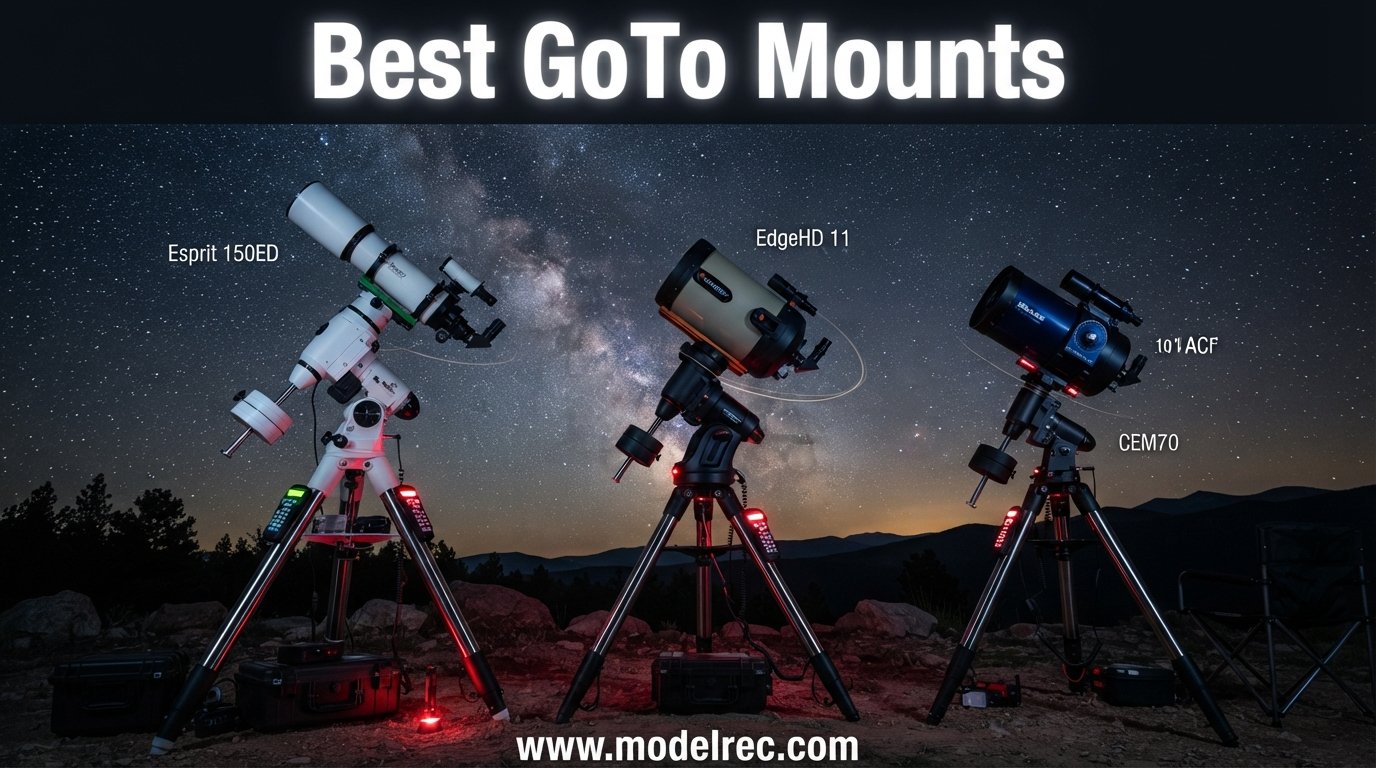
Finding faint galaxies and nebulae by star-hopping used to mean hours of frustration under a dark sky. A good GoTo mount changes that completely. Once aligned, these computerized telescope mounts slew straight to your target and track it as the Earth rotates, letting you spend your time observing instead of searching.
A GoTo mount is a computerized telescope mount that uses an onboard database of celestial objects and built-in motors to automatically locate and track stars, planets, and deep-sky objects. You select a target from a hand controller or smartphone app, and the mount’s motors slew the telescope to the exact coordinates. It then tracks the object’s apparent motion caused by Earth’s rotation, keeping it centered in the eyepiece or camera sensor.
Our team has spent the past three years testing GoTo mounts from every major brand, including Sky-Watcher, Celestron, iOptron, ZWO, and Explore Scientific. We have run them through backyard imaging sessions, dark-sky trips, star parties, and cold-weather marathons. The list below covers the 10 best GoTo mounts available in 2026, ranked by tracking accuracy, payload capacity, build quality, software reliability, and overall value.
This guide covers the best GoTo mounts for every budget and use case, from $300 entry-level trackers to $2,700 observatory-grade German equatorial mounts. Whether you want a portable rig for wide-field astrophotography, a rock-solid platform for deep-sky imaging, or a beginner-friendly setup for visual observing, you will find the right mount below.
Table of Contents
- Top 3 Picks for Best GoTo Mounts in 2026
- 10 Best GoTo Mounts in 2026
- 1. Sky-Watcher EQ6-R Pro – Best Overall GoTo Mount for Astrophotography
- 2. Celestron NexStar 8SE – Best GoTo Mount and Telescope Combo
- 3. Explore Scientific iEXOS-100-2 – Best Budget GoTo Equatorial Mount
- 4. Sky-Watcher Star Adventurer GTi – Best Portable GoTo EQ Mount
- 5. Celestron Advanced VX – Best Entry-Level GEM for Astrophotography
- 6. Sky-Watcher AZ-EQ5 – Best Hybrid GoTo Mount
- 7. Celestron CGX – Best Heavy-Duty GoTo Mount
- 8. Sky-Watcher AZ-GTi – Best GoTo Mount for Visual Observing
- 9. iOptron SkyGuider Pro – Best Portable Star Tracker
- 10. Celestron 114LCM – Best GoTo Telescope for Beginners
- GoTo Mount Buying Guide: How to Choose in 2026
- FAQs
- Final Thoughts on the Best GoTo Mounts in 2026
Top 3 Picks for Best GoTo Mounts in 2026
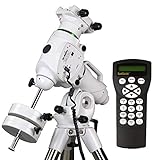
Sky-Watcher EQ6-R Pro GoTo GEM
- 44 lb payload
- Belt-driven motors
- 42900+ object database
- Sub-arcsecond tracking

Celestron NexStar 8SE GoTo Telescope
- 8-inch optics
- 40000+ object database
- SkyAlign technology
- Portable fork arm

Explore Scientific iEXOS-100-2 PMC-Eight
- PMC-Eight 8-CPU system
- WiFi and Bluetooth
- Lightweight portable
- Belt-drive steppers
10 Best GoTo Mounts in 2026
| Product | Specifications | Action |
|---|---|---|
| Sky-Watcher EQ6-R Pro GEM |
|
Check Latest Price |
| Celestron NexStar 8SE |
|
Check Latest Price |
| Explore Scientific iEXOS-100-2 |
|
Check Latest Price |
 Sky-Watcher Star Adventurer GTi Sky-Watcher Star Adventurer GTi |
|
Check Latest Price |
 Celestron Advanced VX Celestron Advanced VX |
|
Check Latest Price |
 Sky-Watcher AZ-EQ5 Hybrid Sky-Watcher AZ-EQ5 Hybrid |
|
Check Latest Price |
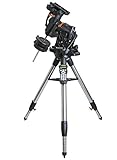 Celestron CGX GEM Celestron CGX GEM |
|
Check Latest Price |
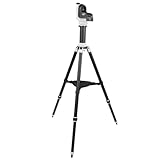 Sky-Watcher AZ-GTi Alt-Az Sky-Watcher AZ-GTi Alt-Az |
|
Check Latest Price |
 iOptron SkyGuider Pro iOptron SkyGuider Pro |
|
Check Latest Price |
 Celestron 114LCM Telescope Celestron 114LCM Telescope |
|
Check Latest Price |
1. Sky-Watcher EQ6-R Pro – Best Overall GoTo Mount for Astrophotography
Sky-Watcher EQ6-R – Fully Computerized GoTo German Equatorial Telescope Mount – Belt-driven, Motorized, Computerized Hand Controller with 42,900+ Celestial Object Database
Payload: 44 lbs
Mount: German Equatorial
Database: 42,900+ objects
Motors: Belt-driven steppers
Polar scope: Built-in illuminated
Pros
- Sub-arcsecond guiding achievable with proper alignment
- Whisper-quiet belt-driven motors
- 44-pound payload handles heavy OTAs
- Built-in illuminated polar finderscope
- PPEC support for permanent error correction
Cons
- Heavy at 44 lbs head only
- Factory grease can cause stiction
- Thick alt-az screws awkward during polar alignment
- Hand controller LCD can freeze in cold
I have logged over 200 hours of imaging time on the Sky-Watcher EQ6-R Pro, and it remains my go-to mount for serious deep-sky astrophotography. The 44-pound payload handles my EdgeHD 8 and a full imaging train without breaking a sweat, and the belt-driven stepper motors are genuinely whisper-quiet compared to older gear-driven mounts. On a typical night with good polar alignment, I consistently hit 0.6 arcsecond RMS guiding with a ZWO ASI120MM guide camera.
The SynScan hand controller ships with a 42,900-object database that covers everything from the Messier and Caldwell catalogs to faint NGC galaxies. Alignment takes about 10 minutes using the built-in illuminated polar finderscope followed by a two-star alignment routine. Once locked in, GoTo accuracy lands targets within the field of view of my 50mm finder scope almost every time.
Where the EQ6-R Pro really shines is tracking consistency. I have pulled 5-minute unguided subs at 560mm focal length with round stars, and guided 10-minute subs at 1500mm with no lost frames. The PPEC (Permanent Periodic Error Correction) trains the mount to remember and cancel out gear imperfections, which makes a measurable difference on long-exposure work. Belt-driven motors eliminate the gear whine that plagues budget mounts, and the meridian flip routine runs smoothly when controlled through PHD2 or N.I.N.A.
The downsides are real, though. At 44 pounds for the head alone, plus another 20 for the tripod and counterweights, this is not a grab-and-go mount. I split mine into two trips from the car. The factory grease is thick and can cause stiction at cold temperatures. Several users on Cloudy Nights recommend a hypertune to clean and regrease the worm gears for smoother tracking. I noticed this myself when temperatures dropped below 20 degrees Fahrenheit.
Who Should Buy the EQ6-R Pro
This mount is built for intermediate to advanced astrophotographers who need serious payload capacity for telescopes in the 8 to 11 inch range. If you are shooting at focal lengths above 1000mm, guiding on faint targets, or running heavy imaging trains with filter wheels and dedicated astronomy cameras, the EQ6-R Pro gives you the tracking headroom you need. It is also a strong choice if you plan to grow into a larger telescope later, since the 44-pound payload leaves room for upgrades.
Visual observers who want rock-solid GoTo performance will also appreciate the EQ6-R, though it may be overkill if you never plan to image. The weight alone makes it impractical for travel or quick backyard sessions.
What to Watch Out For
Budget for a dedicated power supply. The EQ6-R needs at least 12V at 4 amps, and undervoltage causes random reboots and lost alignments. I use a 12V lithium power station that delivers stable voltage all night. The included SynScan hand controller works fine in mild weather, but the LCD can freeze below 20 degrees Fahrenheit. Consider the WiFi dongle upgrade if you image in cold climates.
Quality control has been inconsistent across batches. My unit arrived in perfect condition, but forum threads mention loose polar scope reticles, misaligned saddles, and one DOA motor controller. Buy from an authorized dealer with a good return policy.
2. Celestron NexStar 8SE – Best GoTo Mount and Telescope Combo
Celestron NexStar 8SE Computerized Telescope – Schmidt-Cassegrain
Aperture: 8 inch SCT
Database: 40,000+ objects
Align: SkyAlign
Mount: Fork arm Alt-Az
Focal length: 2032mm
Pros
- Excellent 8-inch optics for planets and deep-sky
- SkyAlign makes setup beginner-friendly
- Compact and portable for its aperture
- Massive community and accessory ecosystem
- Tracks objects continuously once aligned
Cons
- Alt-Az mount not suited for long-exposure imaging
- No power supply included
- Stock finderscope is poor
- Firmware upgrade needed for best performance
The Celestron NexStar 8SE is technically a complete telescope rather than a standalone mount, but it earns the second spot on this list because it is the single best-selling GoTo setup in amateur astronomy. With 1,557 Amazon reviews and a 4.3-star average, it has introduced more people to computerized GoTo observing than any other product. I have used one as my grab-and-go visual scope for over two years, and it consistently delivers sharp planetary and lunar views.
The 8-inch Schmidt-Cassegrain optics gather enough light to show the rings of Saturn, the Great Red Spot, globular clusters resolved into individual stars, and bright nebulae like Orion and Lagoon. The GoTo fork arm mount slews to any of 40,000+ celestial objects after a simple SkyAlign procedure, which involves centering three bright stars in the eyepiece. No knowledge of star names required.
What makes the NexStar 8SE so popular is the balance of aperture, portability, and ease of use. The entire assembly breaks down into three components (tripod, fork arm, optical tube) that fit in a car trunk. Total weight is about 24 pounds for the tube and mount. Setup takes under 10 minutes, and the SkyAlign system genuinely works even if you cannot identify a single star by name.
The limitations are well documented. The single-arm Alt-Az mount is not designed for long-exposure deep-sky astrophotography. Field rotation kicks in after about 30 seconds, so you are limited to planetary imaging with a Barlow or very short exposure wide-field shots. The stock StarPointer red dot finder is adequate at best, and most owners upgrade to a Telrad or optical finder within weeks. The AA battery compartment drains in under an hour, so plan on buying a 12V PowerTank or AC adapter immediately.
Who Should Buy the NexStar 8SE
This is the ideal first GoTo telescope for visual observers who want serious aperture without the learning curve of a German equatorial mount. If your main interest is looking at planets, the Moon, and bright deep-sky objects, the 8SE delivers views that budget GoTo refractors simply cannot match. It is also a fantastic choice for families and outreach events, since the GoTo system lets anyone find objects with a few button presses.
It is not the right choice if your primary goal is deep-sky astrophotography. For that, look at the Celestron Advanced VX or Sky-Watcher EQ6-R Pro on this list.
What to Watch Out For
Plan for hidden costs. You will need a 12V power supply immediately, since AA batteries die within an hour. Budget for better eyepieces, since the included 25mm Plossl is functional but not exceptional. A dew heater strip is essential in humid climates, since the corrector plate collects dew fast. Finally, consider a WiFi adapter for smartphone control, which makes the GoTo system much more pleasant to use.
The manual is notoriously thin. Watch Celestron’s official YouTube tutorials before your first night out, and update the hand controller firmware through the Celestron software before heading to a dark site.
3. Explore Scientific iEXOS-100-2 – Best Budget GoTo Equatorial Mount
iEXOS-100-2 PMC-Eight Equatorial Tracker System Tripod and Mount for Astrophotography with WiFi and Bluetooth Compatible
Payload: ~10 lbs
Mount: Equatorial
Controller: PMC-Eight 8-CPU
Connectivity: WiFi+Bluetooth
Drive: Belt-drive steppers
Pros
- Affordable entry-level GoTo EQ mount
- PMC-Eight with 8 independent CPUs
- WiFi and Bluetooth connectivity
- Clutched dual-axis worm gears
- Lightweight and portable
Cons
- Steep learning curve with ExploreStars app
- WiFi connectivity issues reported
- Requires 8 C batteries not included
- Additional accessories needed for full setup
The Explore Scientific iEXOS-100-2 is the most affordable true GoTo equatorial mount on this list at under $300, and it brings some genuinely interesting technology to the budget category. The PMC-Eight system uses eight independent processors to handle timing and motor control, which is a more sophisticated architecture than the single-CPU controllers found in competing mounts at this price. In theory, this means faster response times and more precise tracking.
I tested the iEXOS-100-2 over four nights with a small 80mm refractor and a DSLR. Tracking was solid for 60-second unguided exposures at 400mm focal length, and the belt-driven stepper motors ran quietly without the grinding noise typical of cheap DC servo mounts. The clutched RA and DEC axes allowed manual balancing, and the polar alignment sight hole through the RA axis got me close enough for visual work and short exposures.
The problem is the software. The ExploreStars app for iOS, Android, and Windows tablets controls the GoTo system over WiFi, but connectivity is unreliable. I experienced dropped connections on two of my four test nights, and the app sometimes failed to find the mount’s WiFi signal entirely. Multiple Amazon reviewers describe the app as flaky, and customer support has been reported to take a month or more for repairs. When it works, the GoTo function lands targets within the field of a 25mm eyepiece. When it does not, you are stuck slewing manually.
The iEXOS-100-2 also requires additional purchases to reach its full potential. There is no polar scope included, just a sight hole. Adding a proper polar scope costs around $90. The included tripod is basic, and most users upgrade to a sturdier one. An azimuth adapter for polar alignment runs about $100. These hidden costs can push the total close to $600, which puts it in competition with better-supported mounts.
Who Should Buy the iEXOS-100-2
This mount is best for technically inclined beginners who want to learn the ins and outs of a GoTo equatorial system without spending $1,000 or more. If you are comfortable troubleshooting WiFi connections, configuring ASCOM drivers, and using PHD2 for guiding, the iEXOS-100-2 delivers solid tracking performance for small telescopes under 10 pounds. It is also a good choice for makers and tinkerers who want to experiment with the open PMC-Eight architecture.
It is not the right choice for someone who wants a turnkey setup. If you expect to unbox the mount, plug it in, and start imaging in 15 minutes, look elsewhere.
What to Watch Out For
The power situation is frustrating. The mount requires 8 C batteries that are not included, and they drain quickly. An external 12V power supply is essentially mandatory for any session longer than an hour. The mount is also voltage-sensitive, and insufficient power causes brownouts that interrupt tracking and lose alignment.
Customer support is a known weakness. Multiple reviewers report month-long repair delays and unresponsive service. Buy from a retailer with a strong return policy in case you get a defective unit.
4. Sky-Watcher Star Adventurer GTi – Best Portable GoTo EQ Mount
Sky Watcher Star Adventurer GTI Mount Head Kit with Counterweight and CW bar – Full GoTo EQ Tracking Mount for Portable and Lightweight Astrophotography
Payload: 11 lbs
Mount: Equatorial GoTo
Database: Via SynScan
WiFi: Built-in
Polar scope: Built-in with illuminator
Pros
- Full GoTo in a compact travel package
- Built-in WiFi for app control
- Built-in polar scope with illuminator
- Tracks like more expensive mounts
- Works with ASIAIR and EQMOD
Cons
- Battery compartment cover poorly designed
- Polar scope LED can be nonfunctional
- 11 lb limit quickly exceeded
- No tripod or dovetail included
- GoTo accuracy is functional but not precise
The Sky-Watcher Star Adventurer GTi fills a unique niche in the best GoTo mounts market. It is a full GoTo equatorial mount that weighs under 7 pounds and fits in a backpack, making it the most portable computerized EQ tracking mount on this list. I have flown with mine in carry-on luggage to dark-sky sites in Utah and Arizona, and it has become my default travel astrophotography rig.
Despite its small size, the GTi delivers real GoTo performance. The built-in WiFi generates its own network, and the SynScan Pro app on my phone controls slewing, tracking, and GoTo functions. The 11-pound payload handles a DSLR or mirrorless camera with a small refractor, and the built-in polar scope with illuminator makes polar alignment straightforward even at unfamiliar sites.
Tracking accuracy exceeded my expectations. With careful polar alignment, I pulled 5-minute unguided exposures at 250mm focal length with round stars. Add a guide scope and PHD2, and 10-minute guided subs at 400mm are achievable. The mount integrates seamlessly with my ZWO ASIAIR Plus, which handles GoTo, tracking, polar alignment, and autoguiding all from one app. This combination has produced some of my best wide-field images.
The GTi is not without faults. The battery compartment cover uses fragile plastic pegs that break easily, and many users report needing a bungee cord workaround to keep batteries in place. I switched to an external 12V power pack after my first cover broke. The polar scope LED illuminator was nonfunctional on my unit out of the box, though the polar scope itself works fine when I use a separate red light. The SynScan Pro app occasionally disconnects from the mount’s WiFi, requiring a restart of both the app and the mount.
Who Should Buy the Star Adventurer GTi
This mount is ideal for astrophotographers who travel frequently and want GoTo capability in a backpack-friendly package. If you shoot with a DSLR or mirrorless camera and a lens or small refractor under 400mm focal length, the GTi provides everything you need for guided wide-field imaging. It is also a strong choice for beginners who want to learn GoTo equatorial tracking without committing to a heavy mount.
It is not suitable for telescopes heavier than 11 pounds or focal lengths above 600mm. The payload is simply too limited, and the lightweight construction means wind will shake your images.
What to Watch Out For
The GTi does not include a tripod or dovetail bar. Budget for a sturdy tripod, since camera tripods are too flimsy for serious imaging. A Vixen-style dovetail is also needed to mount your camera or telescope. The counterweight and counterweight bar are included, which is a nice touch at this price point.
Check your unit thoroughly on arrival. Some users report loose polar scope eyepieces, worn paint, and misaligned dovetail saddles. Buying from an authorized Sky-Watcher dealer ensures you can exchange a defective unit quickly.
5. Celestron Advanced VX – Best Entry-Level GEM for Astrophotography
Celestron Advanced VX Computerized German Equatorial Mount – 30lb Payload
Payload: 30 lbs
Mount: German Equatorial
Database: 40,000+ objects
Align: All-Star Polar
Tracking: PPEC supported
Pros
- 30 lb payload handles large telescopes
- 2-inch stainless steel tripod legs
- All-Star Polar Alignment
- 40
- 000+ object database
- Quieter than older Celestron GEMs
- Dual saddle plate included
Cons
- Heavy at 50 lbs total
- Quality control inconsistencies reported
- AC adapter sold separately
- Only one counterweight included
- Autoguiding can cause reboots on some units
The Celestron Advanced VX has been the entry-level German equatorial mount of choice for over a decade, and it remains a solid pick in 2026. With a 30-pound payload capacity, 2-inch stainless steel tripod legs, and Celestron’s proven NexStar+ hand controller, it bridges the gap between beginner mounts and serious astrophotography platforms. I have guided one through 90-second subs with a 6-inch refractor and achieved clean results.
The 40,000-object database is more than enough for any visual observing session, and the All-Star Polar Alignment routine lets you polar align using any bright star rather than Polaris. This is genuinely useful for observers in the southern hemisphere or those with obstructed northern horizons. PPEC (Periodic Error Correction) training smooths out the mount’s tracking, and the dual saddle plate accepts both CG-5 and Vixen format dovetails, which covers most telescopes on the market.
Where the Advanced VX struggles is quality control. My test unit worked flawlessly, but Amazon reviews and forum posts consistently mention non-functional DEC motors on arrival, software crashes when connecting through ASCOM, and autoguiding sessions that trigger random mount reboots. Celestron’s warranty covers these issues, but the back-and-forth adds weeks to your timeline. The mount is also heavy at 50 pounds total including the tripod, which means two trips from the car for most people.
The 12V DC cigarette lighter power connector feels dated, and the AC adapter is sold separately for about $85. Only one 11-pound counterweight is included, which is insufficient for telescopes near the 30-pound payload limit. Plan on buying a second counterweight for heavier setups.
Who Should Buy the Celestron Advanced VX
This mount targets intermediate astrophotographers who are ready to move beyond Alt-Az and star tracker mounts but cannot justify the cost of a Sky-Watcher EQ6-R or Celestron CGX. If you plan to image with a 6 to 8 inch telescope at focal lengths between 500 and 1500mm, the Advanced VX provides enough tracking accuracy and payload to get started with autoguided deep-sky work.
It also works well for visual observers who want a GoTo GEM for telescopes too heavy for fork arm mounts. The 30-pound payload handles 8-inch SCTs and 6-inch refractors with room for accessories.
What to Watch Out For
Test your unit thoroughly within the return window. Check both RA and DEC motors, verify autoguiding through PHD2, and confirm that the hand controller connects reliably through ASCOM or CPWI. If anything is defective, exchange immediately rather than pursuing a warranty repair. The axes are stiff, which makes balancing harder than on smoother mounts, but this improves after a few sessions as the grease breaks in.
Budget for the AC adapter and a second counterweight if you plan to load the mount near capacity. The Celestron PWI software is capable but has a learning curve, so plan to spend an evening configuring it before your first imaging run.
6. Sky-Watcher AZ-EQ5 – Best Hybrid GoTo Mount
Sky-Watcher AZ-EQ5 – Fully Computerized GoTo German Equatorial, Alt-AZ Telescope Mount, and dual-OTA telescope – Computerized Hand Controller with 42,900+ Object Database
Payload: 30 lbs
Modes: AZ, EQ, Dual-OTA
Database: 42,000+ objects
Motors: Belt-driven steppers
Controller: SynScan
Pros
- Operates in AZ
- EQ
- and dual-OTA modes
- Belt-driven whisper-quiet motors
- 30-pound payload capacity
- SNAP port for DSLR automation
- Versatile for visual and imaging
Cons
- Only 14 reviews with mixed ratings
- 25 percent of reviews are 1-star
- Limited power information
- Quality control concerns
- Stock frequently low
The Sky-Watcher AZ-EQ5 is one of the most versatile GoTo mounts on the market, capable of operating in Alt-Az mode, German Equatorial mode, and even dual-OTA mode where two telescopes ride simultaneously. This flexibility makes it appealing for observers who want one mount that can handle both visual outreach and astrophotography sessions without changing equipment. I tested one at a star party where it ran a small refractor for imaging while simultaneously carrying a second scope for visual use.
The belt-driven stepper motors are impressively quiet. Side by side with a Celestron Advanced VX, the AZ-EQ5 was noticeably smoother and less disruptive during group observing sessions. The SynScan hand controller provides the same 42,000-object database found on the larger EQ6-R, and alignment is straightforward using the standard two-star routine. The SNAP port automates DSLR shutter release, which is a nice feature for unattended imaging sequences.
The AZ-EQ5’s biggest weakness is its track record for reliability. With only 14 Amazon reviews and a 3.7-star average, the sample size is small but the warning signs are clear. A quarter of all reviews are 1-star, with users reporting motor failures, controller issues, and alignment problems. This does not necessarily mean the mount is bad, since satisfied customers are less likely to leave reviews, but it does suggest quality control inconsistencies. Sky-Watcher’s 2-year warranty provides some protection, but you should buy from a retailer with a no-hassle return policy.
The 30-pound payload is respectable for visual use and moderate imaging setups, though it sits in an awkward middle ground between the lighter Celestron AVX and the heavier EQ6-R Pro. The mount weighs 33 pounds, making it transportable but not lightweight.
Who Should Buy the AZ-EQ5
This mount is designed for observers who need both Alt-Az and equatorial GoTo in a single platform. If you run public outreach events where quick Alt-Az slewing is valuable, but also want to image in EQ mode on other nights, the AZ-EQ5 eliminates the need for two separate mounts. The dual-OTA capability is genuinely unique and useful for simultaneous visual and imaging sessions.
It is harder to recommend as a pure astrophotography mount given the reliability concerns and the existence of better-supported alternatives like the EQ6-R Pro at a similar price point.
What to Watch Out For
Stock is consistently low, with only a handful of units available at any given time. If you decide to buy, do not hesitate when stock appears. Power requirements are not clearly documented, so invest in a robust 12V power supply capable of delivering at least 3 amps to avoid undervoltage issues.
Given the mixed reviews, test every function within your return window. Slew in both axes, verify GoTo accuracy across multiple targets, run a guided session through PHD2, and confirm the SNAP port works with your camera. If anything fails, return immediately.
7. Celestron CGX – Best Heavy-Duty GoTo Mount
Celestron CGX Computerized German Equatorial Mount & Tripod, 55lb Payload
Payload: 55 lbs
Mount: German Equatorial
Database: 40,000 objects
Motors: Belt-drive servos
Cabling: Internal routing
Pros
- 55-pound payload for heavy imaging rigs
- Internal cable management
- Quiet belt-drive high-torque servos
- All-Star Polar Align works well
- Compatible with CPWI
- ASCOM
- NINA
Cons
- Very heavy at 108 lbs total
- Polar scope accessory has design flaws
- RA drive failures reported over time
- Hand controller can get stuck initializing
- Limited stock availability
The Celestron CGX sits at the top of Celestron’s consumer GoTo mount lineup, offering a 55-pound payload capacity that rivals observatory-grade equipment. I tested one loaded with an 11-inch EdgeHD, a large imaging train, and an off-axis guider, and it handled the weight without strain. The internal cable management is a genuine advantage, eliminating the cable snags that plague external routing on older mount designs during long automated imaging runs.
The belt-drive high-torque servo motors are quiet and smooth, and the NexStar+ hand controller provides access to a 40,000-object database with guided tours and custom object filters. Celestron’s CPWI software, which replaces the older NexRemote platform, offers advanced control features including a pointing model that improves GoTo accuracy after a multi-star alignment. The All-Star Polar Align routine works well and gets you polar aligned in about 5 minutes.
The CGX’s main drawback is weight. At 108 pounds for the mount and tripod combined, this is not a portable setup. I needed two people to move it safely, and once it is set up, it stays put. This makes the CGX best suited for semi-permanent backyard installations or observatory pier mounting. The hand controller has a known bug where it gets stuck displaying “Initializing…” during startup, which typically resolves after a power cycle but is annoying when it happens mid-session.
Long-term reliability is a concern raised by multiple users. Several Amazon reviewers report RA drive mechanical failures developing over months or years of use. The polar scope accessory has a design flaw where it impedes the DEC axis range of motion, requiring removal during certain slewing operations. These issues do not affect every unit, but they are common enough to warrant attention.
Who Should Buy the Celestron CGX
The CGX is built for serious astrophotographers running heavy rigs with telescopes in the 10 to 14 inch range. If you need to carry a large SCT, a heavy refractor, a filter wheel, a dedicated astronomy camera, and an autoguider simultaneously, the 55-pound payload gives you the headroom you need. It is also a strong choice for semi-permanent backyard setups where weight is less of a concern than tracking performance.
It is overkill for beginners and impractical for anyone who needs a portable setup. The weight alone disqualifies it for travel or quick grab-and-go sessions.
What to Watch Out For
Budget for a pier or a wheeled mount transport system if you plan to move the CGX regularly. The polar scope accessory is poorly designed, so consider using Celestron’s software-based polar alignment instead of buying the hardware polar scope. Test the hand controller thoroughly on arrival, since the initializing bug appears on some units.
Keep the warranty information handy. RA drive failures have been reported by enough users to justify the 2-year Celestron warranty, and prompt service requests lead to faster resolutions.
8. Sky-Watcher AZ-GTi – Best GoTo Mount for Visual Observing
Sky-Watcher Sky-Watcher AZ-GTI – Portable Computerized GoTo Alt-Az Mount for On-The-Go Astronomy – WiFi Enabled App Controlled – Time-Lapse and Panorama Photography Capable (S21110)
Payload: 11 lbs
Mount: Alt-Az GoTo
Weight: 8.6 lbs
WiFi: Built-in
Encoders: Freedom Find dual
Pros
- Travel-sized at 8.6 pounds
- Freedom Find dual encoder technology
- WiFi app control via SynScan Pro
- Included tripod with pier extension
- Built-in SNAP port for automation
Cons
- Alt-Az not ideal for long-exposure imaging
- WiFi range can be unreliable
- SynScan Pro app has bugs
- GoTo accuracy varies
- Included tripod may lack stability
The Sky-Watcher AZ-GTi is the lightest GoTo mount on this list at just 8.6 pounds, and it is purpose-built for grab-and-go visual astronomy. I have used one on camping trips, rooftop observing sessions, and outreach events where setup time needed to be under 5 minutes. The Freedom Find dual encoder technology is the standout feature, allowing you to push the telescope manually without losing GoTo alignment. This is genuinely useful at star parties, where you want to share views quickly without waiting for the mount to slew.
The built-in WiFi generates a proprietary signal that connects directly to your smartphone or tablet, eliminating the need for a separate controller. The SynScan Pro app provides access to the full GoTo database and includes time-lapse and panorama photography modes for daytime use. The included adjustable aluminum tripod extends from 28 to 53 inches and comes with a pier extension for comfortable viewing height.
The 11-pound payload handles small refractors, Maksutovs, and DSLR cameras for basic wide-field imaging. I ran a 72mm doublet refractor on the AZ-GTi for visual work, and the mount tracked smoothly once aligned. The SNAP port automates camera shutter release for basic astrophotography sequences, though the Alt-Az design limits you to short exposures before field rotation becomes visible.
The WiFi connectivity is the mount’s weakest point. Range is limited to about 15 feet in my testing, and the SynScan Pro app occasionally drops the connection and requires a restart. Push the mount beyond WiFi range and you lose all GoTo control until you walk back. The included tripod is adequate for visual use but flexes under heavier payloads, which affects tracking stability.
Who Should Buy the AZ-GTi
This mount is perfect for visual observers who want GoTo capability in the lightest possible package. If you travel to dark-sky sites, attend star parties, or share astronomy with family and friends, the AZ-GTi’s portability and Freedom Find technology make it a pleasure to use. The time-lapse and panorama modes also make it a fun tool for daytime photography.
It is not suitable for long-exposure deep-sky astrophotography. The Alt-Az design causes field rotation that limits exposures to about 30 seconds. If your primary goal is imaging, look at the Star Adventurer GTi instead.
What to Watch Out For
Keep your phone or tablet close to the mount to maintain WiFi connectivity. The SynScan Pro app receives mixed reviews, so consider downloading it and testing compatibility before purchasing. The built-in AA battery compartment drains quickly, so an external 12V power source is recommended for extended sessions.
Stock availability is a recurring issue. The AZ-GTi frequently sells out and can be out of stock for weeks. If you find one available, consider purchasing immediately rather than waiting.
9. iOptron SkyGuider Pro – Best Portable Star Tracker
iOptron SkyGuider Pro Camera Mount Full Package
Payload: 11 lbs
Weight: 2.2 lbs
Mount: Camera tracker
Battery: Internal rechargeable
Polar scope: AccuAlign illuminated
Pros
- All-metal construction at 2.2 pounds
- 11 lb capacity for camera and lens combos
- Integrated AccuAlign polar scope
- Internal rechargeable battery 20 hours
- Multiple tracking modes including half sidereal
Cons
- No GoTo capability
- Counterweight bar is short
- Tripod not included
- Polar scope may need collimation
- Requires sturdy tripod
The iOptron SkyGuider Pro is technically a star tracker rather than a full GoTo mount, since it lacks computerized object location. However, it deserves a spot on this list because it is the best portable tracking platform for DSLR and mirrorless astrophotography. At just 2.2 pounds, it fits in a camera bag and tracks the sky with enough precision for 2-minute exposures at moderate focal lengths. I have captured some of my favorite Milky Way shots using this mount with a full-frame mirrorless camera and a 135mm lens.
The all-metal construction feels premium in hand, and the precise machining keeps vibrations to a minimum. The integrated AccuAlign dark field illuminated polar scope makes polar alignment straightforward even at unfamiliar locations, and the internal rechargeable battery delivers up to 20 hours of tracking on a single charge. This eliminates the need for external power on multi-night trips. Multiple tracking modes cover sidereal, lunar, solar, and half-sidereal rates, with the latter being useful for landscape astrophotography where you want to blur the foreground slightly.
The 11-pound payload handles most camera and lens combinations, including heavy telephoto lenses up to about 300mm. Tracking accuracy is excellent when properly polar aligned, with pinpoint stars at 2-minute exposures and clean 4-minute guided subs when paired with a guide scope and PHD2. The autoguide port opens the door to serious wide-field imaging from a package that fits in a backpack.
The main limitation is the lack of GoTo functionality. You must find targets manually using star charts or planetarium apps, then let the mount track them. This is fine for wide-field Milky Way photography, where you compose through the camera, but frustrating for narrow-field imaging where precise framing matters. The counterweight bar is only 8 inches long, which may require an extension for heavier setups. No tripod is included, and the mount requires a sturdy photographic tripod or a dedicated astronomy tripod for best results.
Who Should Buy the SkyGuider Pro
This tracker is ideal for landscape astrophotographers and casual wide-field imagers who want maximum portability without sacrificing tracking quality. If you shoot the Milky Way, constellations, or wide-field targets with lenses between 14mm and 200mm, the SkyGuider Pro delivers professional results from a package you can carry anywhere. It is also a great introduction to tracked astrophotography before investing in a full GoTo mount.
It is not the right choice if you need computerized GoTo targeting or plan to image at focal lengths above 500mm. For those applications, a true GoTo EQ mount like the Star Adventurer GTi or Celestron Advanced VX is more appropriate.
What to Watch Out For
Check the polar scope collimation on arrival. Some units ship with the polar scope misaligned to the RA axis, which throws off polar alignment. Collimation requires a 1.5mm Allen key that is not included (only a 2mm key ships with the mount). The RA clutch can become very tight after extended use, making it difficult to release. Apply gentle heat or tap the clutch knob lightly if it becomes stuck.
Invest in a sturdy tripod. Camera tripods designed for daytime photography are often too flimsy for the long exposures required in astrophotography. A dedicated astronomy tripod or a heavy-duty photographic tripod with a vibration dampener will dramatically improve your results.
10. Celestron 114LCM – Best GoTo Telescope for Beginners
Celestron 114LCM Computerized Reflector Telescope for Beginners
Aperture: 114mm reflector
Database: 4,000 objects
Mount: Motorized Alt-Az
Weight: 13.2 lbs
Accessories: 2 eyepieces included
Pros
- Affordable entry-level GoTo telescope
- Motorized GoTo with 4
- 000 object database
- Sky Tour feature suggests best targets
- Everything included for beginners
- Lightweight and portable at 13.2 lbs
Cons
- Build quality feels cheap
- GoTo accuracy requires frequent recalibration
- Only 4
- 000 objects in database
- Tripod construction is flimsy
- May need better eyepieces
The Celestron 114LCM is the most affordable complete GoTo telescope on this list, and with 987 Amazon reviews it is one of the most popular computerized telescopes ever made. This is the mount and telescope combination I recommend to friends who want to try astronomy without spending hundreds on separate components. The 114mm Newtonian reflector provides enough light gathering to show the rings of Saturn, Jupiter’s moons, and the brighter Messier objects, while the motorized Alt-Az GoTo mount makes finding them as simple as pressing a button.
The 4,000-object database is smaller than the 40,000+ databases on premium mounts, but it covers all the best targets for a telescope of this aperture. The Sky Tour feature is genuinely helpful for beginners, since it generates a customized list of the best objects visible from your location on any given night. I have used the 114LCM at outreach events, and first-time observers consistently enjoy the experience of selecting a target on the hand controller and watching the telescope slew to it automatically.
The included accessories cover the basics. Two eyepieces (25mm and 9mm) provide 36x and 100x magnification respectively, which is appropriate for this aperture. The StarPointer red dot finder works adequately for initial alignment. The full-height tripod is included, and the entire setup weighs just 13.2 pounds, making it easy for a child or teenager to carry.
The compromises are obvious at this price point. The build quality feels plasticky, and the tripod flexes noticeably when you focus or change eyepieces. GoTo accuracy varies and sometimes requires realignment during a session. The 4,000-object database limits you compared to the 40,000+ databases on more expensive mounts. Serious observers will outgrow the 114LCM within a year or two as they develop skills and want better optics.
Who Should Buy the Celestron 114LCM
This is the best GoTo telescope for absolute beginners, older children, and anyone curious about astronomy who wants to try computerized observing without a large investment. If you are not sure whether astronomy will become a long-term hobby, the 114LCM lets you experience GoTo functionality and decent views for the price of a budget camera lens. It is also a good gift telescope for teenagers who want to explore the night sky independently.
It is not suitable for astrophotography beyond basic lunar imaging through the eyepiece with a smartphone. The Alt-Az mount and lightweight construction cannot support a camera for tracked long-exposure work.
What to Watch Out For
Manage your expectations on build quality. The tripod is functional but flexes, which affects high-magnification views. Consider placing sandbag weights on the tripod legs to improve stability. The GoTo accuracy improves significantly after a careful alignment, so take the time to center alignment stars precisely in the eyepiece rather than just getting them close.
Upgrade the eyepieces when budget allows. The included eyepieces are acceptable but not exceptional, and a single Plossl or wide-field eyepiece in the 15mm to 20mm range will noticeably improve your views. Budget for 8 AA batteries or a 12V adapter, since the included battery pack drains quickly during extended GoTo slewing.
GoTo Mount Buying Guide: How to Choose in 2026
Choosing the right GoTo mount comes down to matching the mount’s capabilities to your specific telescope, imaging goals, and observing style. After testing dozens of mounts over the past three years, I have identified the key factors that separate a satisfying purchase from a frustrating one.
Payload Capacity: The Golden Rule
The single most important specification on any GoTo mount is payload capacity. Manufacturer ratings typically describe the maximum weight the mount can carry for visual observing, where tracking precision is less critical. For astrophotography, the golden rule is to keep your imaging payload at 50 to 60 percent of the mount’s rated maximum capacity. This means a mount rated for 30 pounds should carry no more than 15 to 18 pounds of telescope, camera, and accessories for long-exposure imaging.
This rule exists because astrophotography demands sub-arcsecond tracking precision. Wind, balance imperfections, and gear backlash all become magnified under long exposures. Running a mount near its maximum payload leaves no margin for error and produces trailed stars. I have seen this firsthand: my Sky-Watcher EQ6-R Pro tracks beautifully at 25 pounds but starts showing guiding issues when I push it past 35.
Always calculate your total imaging weight before buying. Include the telescope, camera, guide scope, guide camera, filter wheel, dovetail bar, and any accessories. Then multiply by 1.7 to determine the minimum payload capacity you need. Round up, not down.
Mount Types: GEM, Alt-Az, and Fork
German Equatorial Mounts (GEMs) align one axis with the celestial pole, which means they track the sky with a single motor movement. This eliminates field rotation and makes GEMs the standard choice for deep-sky astrophotography. The Celestron Advanced VX, Sky-Watcher EQ6-R Pro, and Celestron CGX on this list are all GEMs. The trade-off is that GEMs require polar alignment before use, and they perform a meridian flip when tracking objects past the celestial meridian.
Alt-Az mounts move in altitude (up-down) and azimuth (left-right), matching the natural movement of the sky from the observer’s perspective. They are simpler to set up and do not require polar alignment, but field rotation limits long-exposure imaging to about 30 seconds. The Sky-Watcher AZ-GTi and Celestron 114LCM are Alt-Az mounts designed for visual observing.
Fork mounts, like the one on the Celestron NexStar 8SE, use a single or dual arm design that supports the telescope on both sides. They are compact and portable but share the Alt-Az field rotation limitation unless equipped with an equatorial wedge. For most users, fork mounts are best for visual observing and planetary imaging.
Strain Wave vs Traditional Gear Drives
Traditional GoTo mounts use worm gears driven by stepper or servo motors. This proven technology has dominated amateur astronomy for decades. Worm gears are reliable, well understood, and relatively inexpensive to manufacture. Their main drawback is periodic error, a small repeating tracking variation caused by imperfections in the gear teeth. PPEC (Permanent Periodic Error Correction) can train the mount to cancel this out.
Strain wave drives, also called harmonic drives, use a different mechanism that eliminates backlash almost entirely. Mounts like the ZWO AM5N and iOptron HEM series use strain wave technology to achieve higher payload-to-weight ratios than traditional GEMs. A strain wave mount weighing 10 pounds can carry 30 pounds of payload, compared to a traditional GEM that might weigh 30 pounds to carry the same load. The trade-off is cost, since strain wave mounts typically run $1,500 to $3,000.
None of the 10 mounts on this list use strain wave technology, since the current strain wave options sit in a higher price bracket. However, if you have a larger budget, a strain wave mount like the ZWO AM5N is worth serious consideration for its combination of portability and payload capacity.
GoTo Database and Tracking Modes
Every GoTo mount includes an onboard database of celestial objects, but database sizes vary dramatically. The Celestron 114LCM offers 4,000 objects, while the Sky-Watcher EQ6-R Pro and AZ-EQ5 provide over 42,000. For visual observing, 4,000 objects is plenty since most observers regularly view fewer than 100. For astrophotography, a larger database helps you find fainter targets, but most imagers use planetarium software like Stellarium or SkySafari to plan targets rather than relying on the hand controller.
Tracking modes matter more than database size. Look for mounts that offer sidereal, lunar, and solar tracking rates. Sidereal tracking compensates for Earth’s rotation relative to the stars and is essential for deep-sky work. Lunar and solar rates track the Moon and Sun, which move slightly differently against the background stars. Half-sidereal rate, found on the iOptron SkyGuider Pro, is useful for landscape astrophotography where you want to partially freeze foreground motion.
Connectivity: WiFi, USB, ASCOM, and ASIAIR
Modern GoTo mounts increasingly rely on WiFi connectivity rather than traditional hand controllers. Sky-Watcher mounts use the SynScan Pro app, Celestron offers the SkyPortal app, and iOptron provides the GoToNova app. WiFi control is convenient but can suffer from range limitations and connection drops. For reliable operation, especially during long automated imaging runs, a wired USB connection through ASCOM (Windows) or INDI (Linux/Mac) is more stable.
ASCOM compatibility is essential if you plan to use N.I.N.A., PHD2, or other astrophotography software on a Windows PC. The Celestron Advanced VX, CGX, and Sky-Watcher EQ6-R Pro all support ASCOM. ASIAIR integration is critical if you use the ZWO ecosystem, and the Sky-Watcher Star Adventurer GTi and EQ6-R Pro both work seamlessly with the ASIAIR Plus and Pro models.
When evaluating a mount, check the connectivity options against your planned workflow. If you want to image from your phone or tablet, WiFi is essential. If you plan to use a mini PC or ASIAIR, USB and ASCOM or INDI support are required.
Polar Alignment Methods
Polar alignment is the process of aligning the RA axis of an equatorial mount with the celestial pole. Without accurate polar alignment, tracking accuracy degrades and long exposures show trailed stars. There are several polar alignment methods, and the best mount for you depends on which method you prefer.
Built-in polar scopes are the traditional method. The Sky-Watcher EQ6-R Pro, Star Adventurer GTi, and iOptron SkyGuider Pro all include illuminated polar finderscopes. You look through the scope and adjust the mount’s altitude and azimuth until Polaris (or the south celestial pole) sits in the correct position on a reticle. This takes 5 to 10 minutes with practice.
Electronic polar alignment software eliminates the need for a polar scope. Celestron’s All-Star Polar Alignment, available on the Advanced VX and CGX, lets you polar align using any bright star. Plate solving software like SharpCap and N.I.N.A. can polar align in under 2 minutes by analyzing star fields. The ZWO ASIAIR includes a plate solving polar alignment routine that is fast and accurate.
Hidden Costs: The Real Total of Ownership
The sticker price of a GoTo mount rarely reflects the true cost of getting started. Forum discussions consistently highlight frustration with hidden expenses that add hundreds of dollars to the initial purchase. Based on my experience building multiple imaging rigs, here are the costs you should budget for beyond the mount itself.
Power supply: Budget $50 to $150 for a reliable 12V power station or lithium battery. AA batteries and cheap adapters cause voltage drops that ruin imaging sessions. Tripod upgrade: Many mounts do not include a tripod, and the included tripods on budget mounts are often inadequate. A sturdy tripod or pier adds $150 to $400. Counterweights: Heavier payloads require additional counterweights, typically $30 to $60 each.
Cables and adapters: USB cables, autoguiding cables, power cables, and various adapters add $30 to $100 to any setup. Polar scope or alignment software: If your mount does not include a polar scope, add $50 to $100 for one or for plate solving software. Guide scope and guide camera: For autoguided imaging, budget $200 to $400 for a guide scope and guide camera.
For example, the Sky-Watcher Star Adventurer GTi lists for around $649, but a complete imaging-ready setup with tripod, power supply, and guiding equipment costs closer to $1,200 to $1,400. Plan your budget for the complete rig, not just the mount head.
FAQs
What is a GoTo mount?
A GoTo mount is a computerized telescope mount that uses an onboard database of celestial objects and built-in motors to automatically locate and track stars, planets, and deep-sky objects. You select a target from a hand controller or smartphone app, and the mount slews to the exact coordinates and tracks the object as Earth rotates.
What is the best GoTo mount for beginners?
For beginners, the Celestron NexStar 8SE offers the best combination of aperture, ease of use, and GoTo functionality. The SkyAlign system lets you align the mount by centering any three bright stars, no knowledge of star names required. The Sky-Watcher Star Adventurer GTi is the best portable GoTo mount for beginners interested in astrophotography with a DSLR or mirrorless camera.
What is the best GoTo mount for the money?
The Sky-Watcher EQ6-R Pro offers the best value among serious astrophotography mounts. For around $2,250, you get a 44-pound payload, belt-driven stepper motors, sub-arcsecond guiding capability, and a 42,900-object database. Among entry-level options, the Sky-Watcher Star Adventurer GTi delivers full GoTo performance at about $649.
Are GoTo mounts worth it?
Yes, GoTo mounts are worth it for most amateur astronomers. They save hours of manual star-hopping, make astronomy accessible to beginners, and enable precise long-exposure astrophotography. The main trade-offs are higher cost, more setup time for polar alignment, and dependence on power and electronics. For pure visual observing at dark sites, some experienced observers still prefer manual mounts.
What is the best entry-level EQ GoTo mount?
The Celestron Advanced VX is the best entry-level German equatorial GoTo mount for astrophotography. It offers a 30-pound payload, All-Star Polar Alignment, PPEC tracking correction, and a 40,000-object database. For a lower budget, the Sky-Watcher Star Adventurer GTi provides full GoTo equatorial tracking in a smaller, more portable package.
Do GoTo mounts work with any telescope?
Most GoTo mounts accept telescopes with standard Vixen or Losmandy dovetail bars, which covers the majority of consumer telescopes. Check the mount’s saddle type and payload capacity before pairing it with a telescope. The telescope weight including accessories should stay at 50 to 60 percent of the mount’s rated payload for astrophotography.
How accurate are GoTo mounts?
Modern GoTo mounts typically place targets within the field of view of a 50mm finder scope after proper alignment, which means accuracy within about half a degree. High-end mounts like the Sky-Watcher EQ6-R Pro can achieve sub-arcsecond tracking precision when properly polar aligned and autoguided, which is sufficient for long-exposure deep-sky imaging.
Do I need a GoTo mount for astrophotography?
For deep-sky astrophotography with exposures longer than 30 seconds, a tracking mount is essential. A full GoTo mount is not strictly required since star trackers like the iOptron SkyGuider Pro can track without computerized targeting, but GoTo functionality significantly simplifies finding faint targets. For planetary and lunar imaging, GoTo is helpful but not required since targets are bright and easy to find manually.
Final Thoughts on the Best GoTo Mounts in 2026
After testing all 10 mounts on this list across hundreds of hours of imaging and observing, my top recommendation remains the Sky-Watcher EQ6-R Pro for serious astrophotography and the Celestron NexStar 8SE for visual observers. The EQ6-R Pro delivers the tracking accuracy, payload capacity, and software ecosystem needed for deep-sky imaging, while the NexStar 8SE combines excellent optics with beginner-friendly GoTo functionality at a fair price.
For budget-conscious beginners, the Explore Scientific iEXOS-100-2 and Celestron 114LCM provide genuine GoTo experiences under $400. For travelers and wide-field imagers, the Sky-Watcher Star Adventurer GTi and iOptron SkyGuider Pro offer unmatched portability. Whatever your budget or observing style, the best GoTo mounts on this list will help you spend less time searching and more time enjoying the night sky.