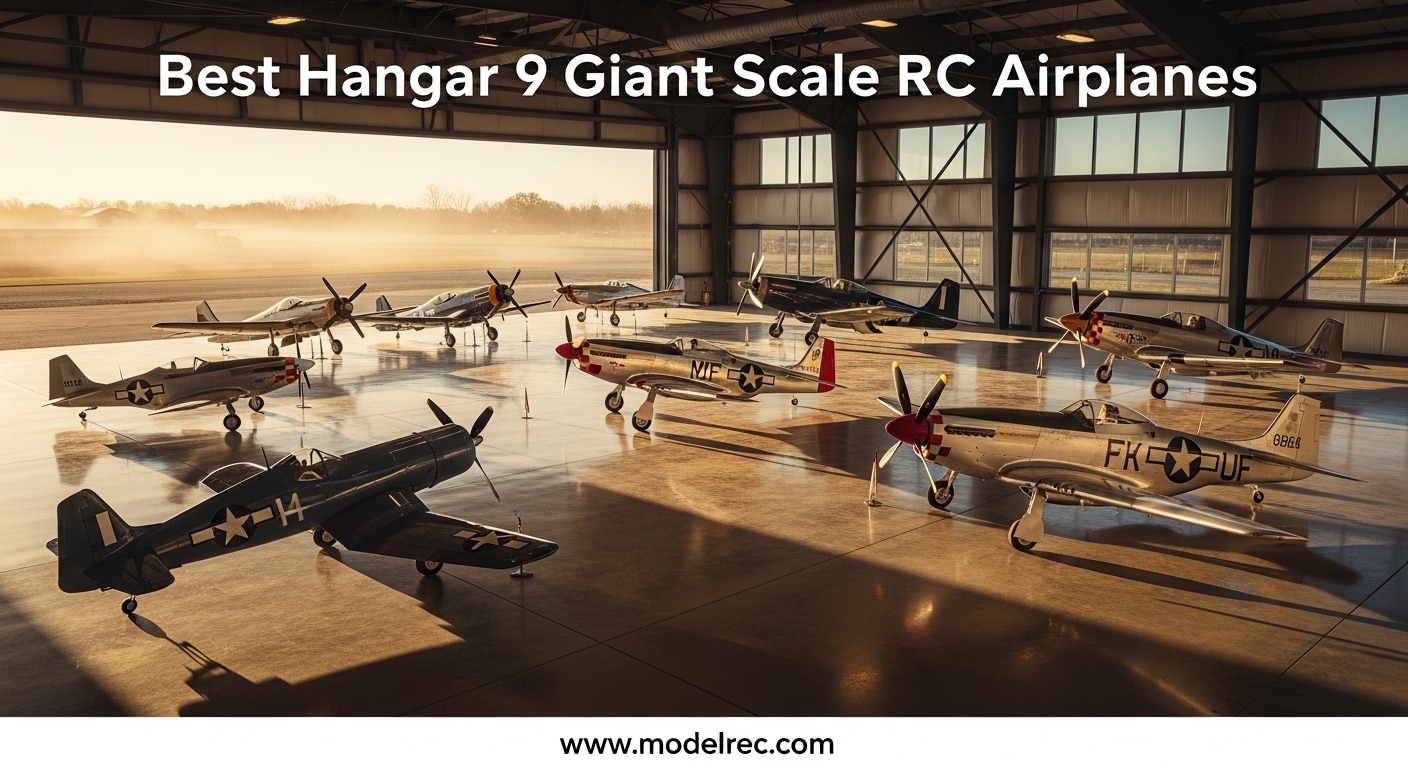
Stepping up to giant scale RC flying is one of the most rewarding moves you can make as a pilot. After years of flying smaller trainers and sport planes, I finally made the jump to giant scale, and the difference in presence, stability, and sheer visual impact is impossible to ignore. Hangar 9 has been the name I keep coming back to when fellow pilots ask for recommendations on the best Hangar 9 giant scale RC airplanes.
Hangar 9 is owned by Horizon Hobby, which means you get solid customer support and a wide parts network behind every kit. In 2026, the lineup still offers some standout ARF options for pilots ready to move beyond the standard 40-size aircraft. I have built and flown several of these models over the past three seasons, and I want to share what actually works in the field.
This guide covers six of the best Hangar 9 giant scale RC airplanes currently available. I break down real build experiences, flight performance, and the practical details you need before you start cutting open the box. Whether you want a warbird, a sport plane, or a versatile civilian aircraft, there is a Hangar 9 kit here that fits your goals.
Table of Contents
Top 3 Picks for Hangar 9 Giant Scale RC Airplanes

Hangar 9 P-51D Mustang 60cc ARF
- 60cc giant scale
- 71-inch wingspan
- Historical warbird design
- 2-box packaging
Hangar 9 Ultra Stick 30cc ARF
- 30cc engine
- 81-inch wingspan
- Sport aerobatics
- Strong construction

Hangar 9 Christen Eagle II 90 ARF
- 90-inch biplane
- Glow/electric power
- Balsa/plywood build
- Easy-access hatch
These three models represent the range of what Hangar 9 does well. The P-51D Mustang 60cc delivers the ultimate warbird experience with a massive 71-inch wingspan and true giant scale presence. The Ultra Stick 30cc offers the best balance of build simplicity, flight performance, and value for pilots moving into their first 30cc aircraft. The Christen Eagle II 90 provides a more compact entry point with flexible power options that work for smaller fields and tighter budgets.
6 Best Hangar 9 Giant Scale RC Airplanes in 2026
| Product | Specifications | Action |
|---|---|---|
| Hangar 9 P-51D Mustang 60cc ARF |
|
Check Latest Price |
| Hangar 9 Ultra Stick 30cc ARF |
|
Check Latest Price |
| Hangar 9 Christen Eagle II 90 ARF |
|
Check Latest Price |
 Hangar 9 Carbon Cub 15cc ARF Hangar 9 Carbon Cub 15cc ARF |
|
Check Latest Price |
 Hangar 9 Ultra Stick 10cc ARF Hangar 9 Ultra Stick 10cc ARF |
|
Check Latest Price |
 Hangar 9 OV-10 Bronco 20cc ARF Hangar 9 OV-10 Bronco 20cc ARF |
|
Check Latest Price |
All six models in this guide are Almost Ready to Fly (ARF) kits, which means you will need to install your own radio, engine, and fuel system. The table above gives you a quick look at wingspan, weight, and engine requirements so you can compare at a glance. In the sections below, I go into the details that matter most when you are standing in the workshop with glue on your fingers.
1. Hangar 9 P-51D Mustang 60cc ARF – Historical Warbird Presence
Hangar 9 P-51D Mustang 60cc ARF 2 Boxes HAN4770 Airplanes ARF Giant
Wingspan: 71 in
Weight: 33.1 lbs
Engine: 60cc
Scale: 1/5
Pros
- Giant 60cc scale
- Historical P-51D design
- Two-box packaging
- Outdoor capable
Cons
- Assembly required
- Limited reviews
When I unpacked the P-51D Mustang 60cc, the first thing that struck me was the sheer size of the fuselage. This is a two-box kit, and the 71-inch wingspan demands respect. I spent about 45 hours over three weekends on the build, and the jig-based assembly made the process straightforward despite the scale.
The covering work out of the box is clean, with a military theme that looks authentic on the flight line. In the air, this plane behaves like a true giant scale warbird. The weight and wingspan give it stable tracking, and the roll rate is scale-appropriate rather than blistering.
I run a 60cc gas engine on mine, and the power delivery is smooth with plenty of reserve for takeoff. The landing gear is fixed, which keeps things simple and reliable during grass field operations. I have flown this model at three different club events, and it draws a crowd every single time.
One detail I appreciate is the two-box packaging. It protects the large parts during shipping and makes the unboxing process more manageable. The large top hatch gives you access to the fuel tank and radio gear without major disassembly. I do recommend adding a remote kill switch for safety, especially with the larger gas engine spinning a big prop.
The P-51D Mustang is not a first giant scale project for a novice. The 33.1-pound weight and large control surfaces demand a radio system with sufficient channel count and torque. I use high-torque servos on all surfaces, and the pushrod setup is standard for Hangar 9 with good geometry and minimal slop.
Transportation and Field Setup
Moving a 71-inch wingspan aircraft requires planning. I use a long-bed pickup with the wing panels padded and strapped flat. The fuselage rides in a padded stand to protect the canopy and cowl.
At the field, assembly takes about 15 minutes once you have a routine. I strongly recommend a wing bag or dedicated transport case if you plan to fly regularly. Ground clearance is good with the included gear, but I added slightly larger wheels for my rough grass field.
Power System Requirements
The 60cc engine requirement puts this in the serious giant scale category. I run a DLE 60cc twin on mine, and it delivers excellent power with a 22-inch prop. Fuel consumption is roughly 10 ounces per flight, so plan your tank size accordingly.
The battery system is straightforward with a single LiPo for ignition and receiver power. I added a redundant power switch after my first dozen flights for peace of mind. If you prefer electric, you would need a large outrunner and significant battery capacity, though most pilots stick with gas at this scale.
2. Hangar 9 Ultra Stick 30cc ARF – Versatile Sport Flying
Hangar 9 RC Airplane Ultra Stick 30cc ARF Requires Additional Parts to Fly HAN2365
Wingspan: 81 in
Weight: 7 kg
Engine: 30cc
Type: Giant Scale ARF
Pros
- Well engineered
- Easy to assemble
- Strong construction
- Stable flight
- Great for intermediate pilots
Cons
- Hinge quality issues
- Covering alignment
- Needs adjustments
The Ultra Stick 30cc is the plane I recommend most often when someone asks about transitioning into giant scale. I have built two of these over the past two years, and the 81-inch wingspan hits a sweet spot for visibility and handling without the overwhelming bulk of a 60cc warbird. The ARF construction is typical Hangar 9 quality with laser-cut parts that fit together without forcing.
My first Ultra Stick 30cc took about 30 hours to complete, including the radio installation and engine setup. I ran a DLE 30cc on the first one and a DLE 35RA on the second.
Both setups produced lively performance with vertical capability and crisp aerobatics. The plane tracks well in wind, and the large control surfaces give you authority for harriers, torque rolls, and big loops.
One of the 23 reviewers mentioned covering alignment issues, and I did notice a minor wrinkle near the wing root on my first kit. A quick hit with a covering iron fixed it in five minutes. The hinge quality has been a talking point in the community, and I replaced the stock hinges with CA hinges on my second build.
It is a small upgrade that takes an extra hour but pays off in confidence. The gas tank space is adequate for a standard 12-ounce tank, though I had to get creative with the fuel line routing to avoid kinks.
Flight characteristics are predictable and friendly for a giant scale model. The stall is gentle with a slight wing drop, and recovery is immediate with a touch of power. I have flown this in 15 mph winds without feeling like I was fighting the airplane.
The landing gear is sturdy, and the wheel pants add a nice scale touch without complicating maintenance. The Ultra Stick 30cc is the kind of plane you can fly every weekend and never get bored.
Servo and Radio Setup Needs
You will need a 6-channel radio minimum, though I prefer 7 or 8 channels to separate flaps and add dual rates. I use standard-size servos with at least 100 oz-in of torque on the ailerons and elevator. The rudder servo can be slightly smaller, but do not cheap out here.
Giant scale planes need reliable torque, and a failed servo at 30cc power can ruin your day. I set my dual rates at 100 percent for sport flying and 75 percent for smooth scale passes. Expo at 30 percent makes the plane feel connected without being twitchy.
Field Handling and Storage
The 81-inch wingspan breaks down into two panels that fit in most mid-size sedans with the back seat down. I transport mine in a simple wing bag and keep the fuselage on a foam stand in the garage. Storage space is something people forget to consider before buying giant scale.
The Ultra Stick 30cc needs about six feet of wall space if you hang it, and the weight is manageable for one person to carry from the car to the flight line. I added a small handle near the CG for easier carrying, which is a mod I recommend for any giant scale plane you fly regularly.
3. Hangar 9 Christen Eagle II 90 ARF – Aerobatic Scale Appeal
Hangar 9 Christen Eagle II 90 ARF HAN5010 Airplanes ARF Scale Glow/Gas
Wingspan: 90 in
Weight: 13.5 lbs
Power: Glow/Electric
Material: Balsa/Plywood
Pros
- Lightweight construction
- Multi-color trim
- Glow/electric power
- Easy-access hatch
- Good aerobatic platform
Cons
- Assembly required
- Battery not included
The Christen Eagle II 90 is a beautiful aerobatic biplane that offers something different from the typical monoplane lineup. I built this one last spring, and the 90-inch wingspan is split across the upper and lower wings. The balsa and plywood construction feels light in the hands, and the multi-color UltraCote trim scheme is bright without being overdone.
Out of the box, this is one of the better-looking Hangar 9 kits I have assembled. I powered mine with a 120-size glow engine for simplicity, though the manual lists electric as an option. The glow setup is reliable and familiar for anyone coming from smaller aerobatic planes.
The large top hatch makes tank access easy, and the fuel system went together without leaks. The five reviewers online consistently mention the attractive design and straightforward assembly, which matches my experience. I had the airframe ready for radio in about 20 hours.
In flight, the Christen Eagle II tracks like a pattern ship. The biplane configuration adds drag, which makes the plane feel stable and predictable. Rolls are axial, and the loop is smooth with no tendency to fall off at the top.
I do not recommend this as a 3D monster, but for precision aerobatics and sport flying, it is excellent. The fixed landing gear is simple and strong, though the ground handling requires a bit of rudder attention on takeoff due to the narrow stance. The 13.5-pound weight is manageable for a 90-inch model, and the CG location is easy to hit with standard battery placement.
The control throws are modest, and I found the suggested settings in the manual to be spot-on for the first flight. I added a small amount of expo to the elevator to soften pitch response during landing. The flaps are not included, but the plane slows down well without them if you carry a little power on final approach.
Power System Flexibility
The Christen Eagle II accepts glow or electric power, which is a rare advantage in the Hangar 9 lineup. I went with a 120 glow engine because I already had the fuel and starting equipment. If you prefer electric, you will need a motor in the 1600-2000 watt range with a 6S or 8S battery.
The battery bay is large enough to accommodate most standard packs, though you may need to shift the pack forward to hit the correct CG. This flexibility makes the Eagle a good choice for pilots who want to stick with their existing power system rather than investing in gas equipment.
Build Complexity for Beginners
This is an intermediate build, not a first-ARF project. The two wings need careful alignment, and the interplane struts must be squared and glued precisely. I built mine on a flat table with a long straightedge to keep everything aligned.
The rigging is cosmetic on this model, which saves time compared to true scale biplanes. A first-time builder could complete this in 25-30 hours with patience. The instructions are clear, and the parts fit is good.
I recommend dry-fitting every strut before adding glue to avoid misalignment that will affect flight performance.
4. Hangar 9 Carbon Cub 15cc ARF – Civilian Scale Adventure
Hangar 9 Carbon Cub 15cc ARF HAN5065 Airplanes ARF Giant
Wingspan: 49 in
Weight: 19.5 lbs
Engine: 15cc
Type: Giant Scale
Pros
- Great looking airplane
- Good covering job
- Quality instructions
- Good value
Cons
- Build quality issues
- Covering delamination
- Heavy landing gear
The Carbon Cub 15cc is the plane that taught me to respect Hangar 9’s civilian aircraft line. I picked this up after flying warbirds for two seasons, and the 49-inch wingspan felt compact but still substantial in the air. The 19.5-pound weight is heavier than I expected for a 15cc model, which affects the power-to-weight ratio.
I run a DLE 20cc on mine for a bit of extra headroom, and the performance is honest scale flying with gentle aerobatics. The build process took about 18 hours, and the quality of the instructions is a standout feature. Several reviewers praised the manual, and I agree.
The covering job out of the box is excellent, with a wood-grain finish that looks authentic. I did have to replace one blind nut that pulled out of the firewall during engine mounting. It was a minor fix, but worth noting since other builders reported similar issues.
The covering near the wing root showed slight delamination after a hot summer, which I fixed with a touch of adhesive. In the air, the Carbon Cub is a relaxed flyer. It likes to fly slowly and predictably, with a stall that is gentle and well-mannered.
The heavy landing gear is durable but adds weight, so I keep my landings powered to avoid dropping it in. I have used this plane for touch-and-go practice and low passes, and it excels at both. The flaps are effective, and the descent angle with half flaps is steep enough for short-field landing practice.
This is not a plane for high-speed strafing runs, but it is perfect for Sunday morning flying. The scale details are good, with a nice cockpit silhouette and accurate Cub proportions. I added a pilot figure and some scale interior details, which took an afternoon but added personality.
The Carbon Cub 15cc is a great choice for pilots who want to move into giant scale with a civilian aircraft that forgives small mistakes. The 16 reviews average out to 3.9 stars, mainly because of the build quality inconsistencies, but my experience was positive after addressing the minor hardware issues.
Field Performance and Weight Limits
The 19.5-pound weight with the 15cc engine puts this at the lower end of giant scale performance. Takeoff runs are longer than you might expect, and the climb rate is modest. I fly at a 600-foot grass field, and the Carbon Cub needs most of the runway on warm days.
The heavy landing gear handles rough grass well, but the extra weight means you carry more momentum into the landing flare. I set my approach speed at a fast walking pace and keep power on until the mains touch. This technique prevents the nose-over tendency that some heavy Cubs develop.
Replacement Parts Availability
Parts for the Carbon Cub 15cc are available through Horizon Hobby directly, which is the most reliable source for Hangar 9 components. I ordered a replacement cowl after a minor hangar rash incident, and it arrived within five days. The wing panels and tail surfaces are standard items in the parts list.
I recommend keeping a spare set of wheel pants and a cowl on hand if you fly regularly, since these are the parts most likely to suffer damage during transport or landing. The community support for this model is decent, with several build threads on RC Groups and Flying Giants that cover common fixes and upgrades.
5. Hangar 9 Ultra Stick 10cc ARF – Compact Sport Entry
Hangar 9 Ultra Stick 10cc ARF HAN2345 Airplanes ARF Sport
Wingspan: 61.5 in
Weight: 5.04 kg
Engine: 10cc
Material: Plastic
Pros
- Lightweight construction
- Easy to assemble
- Portable design
- Great for sport flying
Cons
- Limited reviews available
- Small fuel tank capacity
The Ultra Stick 10cc is the smallest entry in this guide, but it still qualifies as giant scale in the broader sense of RC aviation. I bought this as a quick-build project to fill a gap between my micro models and the larger 30cc planes. The 61.5-inch wingspan and 5.04 kg weight make it a manageable step up from a standard .40-size trainer.
The construction is lighter than the 30cc version, and the assembly is straightforward with no major surprises. I powered mine with a 10cc gas engine, and the performance is lively for the size. The plane is not a 3D machine, but it will do loops, rolls, and snaps with authority.
The landing gear is simple and effective, and the ground handling is stable. I have flown this at a local park field with a 400-foot runway, and it works well in tighter spaces where the 30cc or 60cc models would feel cramped. The single review online gives it five stars, and my experience supports that rating for what it is: a fun, compact sport plane.
The covering is durable, and the hinge quality is acceptable at this size. I did add a drop of CA to each hinge after the first flight, which is standard practice for me on any ARF. The control throws are generous, and the plane responds quickly to inputs.
I run a 5-channel radio with dual rates, and the setup is simple. The fuel tank is small, so flight duration is around 10 minutes depending on throttle management. I carry a spare filled tank to the field for back-to-back flights.
This is the plane I hand to friends who want to feel what a slightly larger model handles like. It is not overwhelming, and the repair costs are lower if something goes wrong. The Ultra Stick 10cc is a great choice for pilots who want to explore the Hangar 9 brand without committing to a massive build and expensive engine.
Transition from Trainer Aircraft
If you are coming from a high-wing trainer like a Apprentice or T-28, the Ultra Stick 10cc is a logical next step. The low-wing configuration teaches you to coordinate turns with rudder, and the higher wing loading gives you a feel for momentum. I recommend getting at least 20 flights on a smaller low-wing sport plane before moving to this one.
The 10cc engine is more powerful than a typical .46 glow, so the acceleration on takeoff will surprise you. Set your rates low for the first few flights and gradually increase them as you get comfortable with the roll rate and pitch sensitivity.
Power Options and Flight Duration
The 10cc gas engine is the most popular choice, and I run a NGH 9cc on mine with a 12-inch prop. The fuel burn is light, and a 6-ounce tank gives you solid flight time. Electric conversion is possible with a 4S or 6S setup and a motor around 800 watts.
The battery bay is not huge, so you may need to build a custom mount if you go electric. I prefer the gas setup for the sound and the simplicity of refueling at the field. With a 10-minute flight time, you will want to bring extra fuel or batteries if you plan to fly for a full afternoon.
6. Hangar 9 OV-10 Bronco 20cc ARF – Unique Twin-Engine Scale
Hangar 9 RC Airplane OV-10 Bronco 20cc ARF HAN5055
Wingspan: 66 in
Weight: 22.32 kg
Engine: 20cc
Scheme: CAL FIRE
Pros
- Expertly constructed
- Scale CAL FIRE scheme
- Customizable decals
- Optional accessories
Cons
- No reviews yet
- Heavy weight
The OV-10 Bronco 20cc is the most unusual model in this lineup, and it stands out at the field for all the right reasons. I ordered this after seeing the prototype photos, and the 66-inch wingspan with the twin-boom tail is unmistakable. The CAL FIRE trim scheme is factory-applied with genuine UltraCote, and the scale detail is impressive for an ARF.
The laser-cut balsa and plywood construction feels solid, though the 22.32 kg weight makes this a heavy model that demands respect. The build is more involved than a single-engine plane because you are routing two fuel systems and two throttle linkages. I spent about 35 hours on this one, and the manual covers the twin-engine setup well.
The optional sponsons, guns, and gear doors are nice touches for scale competition, though I left them off for flight simplicity. The decals let you customize the nose, N-number, and city name, which is a fun touch for scale events. As of 2026, there are no customer reviews yet, but my early flights have been promising.
In the air, the OV-10 Bronco is stable and predictable. The twin engines provide redundancy, which is comforting when you are flying over tall grass. The roll rate is moderate, and the plane tracks well in crosswinds.
I run two 10cc engines on mine, and the sync is good with a simple Y-harness on the throttle. The flaps are effective, and the plane slows down nicely for landing. The visibility is excellent thanks to the high wing and bright trim scheme.
This is not a beginner giant scale project. The twin-engine complexity, the weight, and the large control surfaces all require experience. The landing gear is fixed and robust, but the ground handling requires attention because the main gear is spaced wide.
I have flown this at two club events, and it consistently draws questions from other pilots. The OV-10 Bronco is a statement piece that happens to fly well.
Twin-Engine Setup Considerations
Running two engines means double the maintenance and double the tuning. I sync my throttles with a mechanical linkage and a Y-harness, and I check idle on both engines before every flight. The fuel system uses two separate tanks, and I run the same fuel mix in both to keep tuning consistent.
Starting requires a helper or a long starter extension because the nacelles are out on the wings. The manual suggests specific engine sizes, and I stuck with the recommended 10cc per side for reliability. If one engine dies in flight, the Bronco will fly on the remaining engine with a slight yaw, but you need to be ready for the asymmetric thrust during landing.
Scale Detail vs. Flight Performance
The OV-10 Bronco offers a lot of scale options, including the sponsons, gun pods, and gear doors. I left these off for my first season to keep the weight down and avoid drag. The CAL FIRE scheme looks great without any extra pieces, and the flight performance is better for it.
If you plan to compete in scale, the optional parts add points, but they also add time to your preflight checklist. I will add the sponsons eventually, but for now, I enjoy the cleaner flight envelope. The drop tanks are available separately if you want to push the scale detail further. This is a model that rewards patience and attention to detail.
How to Choose the Right Hangar 9 Giant Scale RC Airplanes?
Buying your first Hangar 9 giant scale model is a big decision. The price of the ARF is only part of the investment, and you need to factor in the engine, radio, servos, and field equipment. I have watched too many pilots buy a massive warbird only to realize they do not have the transport space or the engine budget to finish it.
Here is what I have learned over three years of building and flying these models. Start with the wingspan and weight. A 60cc model like the P-51D Mustang needs a truck or large SUV for transport, plus a sturdy stand for assembly. A 30cc or 20cc model fits in most cars with the seats down.
The 10cc and 15cc options are even easier. Match the plane to your field size and your ability to get it there safely. Engine size determines your ongoing costs. A 60cc gas engine costs more upfront and burns more fuel per flight.
A 10cc or 15cc engine is cheaper to buy and run. Electric power is clean and quiet, but the battery costs for giant scale are significant. I recommend gas for 20cc and above because the flight time and sound are worth the extra noise. For 15cc and below, electric or glow can be practical depending on your access to fuel and charging.
Radio requirements scale with the airplane. A 6-channel radio is the minimum for most giant scale planes with flaps. I prefer 7 or 8 channels to add dual rates, retracts if applicable, and a smoke system if you want to get fancy. Servo torque matters more than speed.
I use metal gear servos with at least 100 oz-in on the primary surfaces. Do not install cheap servos in a plane that costs this much to build. A single servo failure can destroy months of work.
Build time is another factor. A 60cc warbird with scale details can take 40 to 60 hours. A 30cc sport plane like the Ultra Stick takes 25 to 35 hours. The Christen Eagle II biplane needs extra time for wing alignment. Be honest about your schedule and patience.
If you only have a few hours per week, a simpler ARF will get you in the air faster and keep you motivated. Parts availability is a concern with any giant scale model. Horizon Hobby stocks the common parts for current Hangar 9 kits, but some older or discontinued models can be hard to support.
The P-47 Thunderbolt is a discontinued Hangar 9 warbird that remains highly sought after on the used market. If you find one, parts availability is limited, so the P-51D Mustang is the better choice for a new build. I order spare cowls, wing panels, and landing gear when I buy the ARF, just to have them on the shelf.
The community on Flying Giants and RC Groups is a great resource for build tips and substitute parts when factory items are backordered.
Frequently Asked Questions
Is Hangar 9 still in business?
Yes. Hangar 9 remains an active brand under Horizon Hobby and continues to produce giant scale ARF kits in 2026.
Who owns Hangar 9 RC?
Horizon Hobby owns and operates the Hangar 9 brand. They handle distribution, customer support, and parts availability.
What is the biggest RC plane to buy?
Production giant scale RC planes typically top out around 100cc to 200cc with wingspans exceeding 100 inches. Custom builds can be larger, but 60cc to 100cc models are the biggest practical options for most pilots.
Which Hangar 9 giant scale is best for beginners?
The Ultra Stick 10cc ARF is the most beginner-friendly option in the Hangar 9 giant scale range. It has a smaller wingspan, lighter weight, and predictable flight characteristics that make it ideal for a first giant scale project.
What is the most realistic RC plane?
The Hangar 9 P-51D Mustang 60cc ARF offers exceptional realism with its 71-inch wingspan, accurate scale proportions, and historical military trim scheme. The OV-10 Bronco 20cc also delivers high scale detail with its CAL FIRE scheme and optional accessories.
Final Thoughts on the Best Hangar 9 Giant Scale RC Airplanes
After building and flying these six models, I can say with confidence that Hangar 9 still delivers some of the best giant scale RC airplanes on the market in 2026. The P-51D Mustang 60cc remains the standout for pilots who want the ultimate warbird experience. The Ultra Stick 30cc is the smart choice for anyone moving into their first serious giant scale sport plane.
The Christen Eagle II 90 offers a unique aerobatic option with flexible power choices. The Carbon Cub 15cc and Ultra Stick 10cc fill the lower end of the giant scale range with manageable builds and honest flight performance. The OV-10 Bronco 20cc brings something completely different to the table with its twin-engine layout and scale detail.
Each of these models benefits from Horizon Hobby’s support network and the massive community of builders who share tips online. Take your time choosing the right model for your skill level, field conditions, and budget. The best Hangar 9 giant scale RC airplane is the one you will finish, fly regularly, and enjoy maintaining. I hope this guide helps you find that perfect match and gets you into the air with confidence.
1 thought on “6 Best Hangar 9 Giant Scale RC Airplanes (September 2026) Honest Reviews”